×
Hero Background
English
Chinese
French
Japanese
Korean
German
Spanish

Synthetic Rubber Market Trends

ID: MRFR/CnM/3520-CR
110 Pages
Anshula Mandaokar
October 2022

Synthetic Rubber Market Research Report Information By Type (Styrene-Butadiene Rubber (SBR), Ethylene Propylene Diene Monomer (EPDM), Butyl Rubber, Polyisoprene, Others) Application (Construction, Automotive & Transportation, Medical, Others) Forecast 2030

Share:
Download PDF ×

We do not share your information with anyone. However, we may send you emails based on your report interest from time to time. You may contact us at any time to opt-out.

Synthetic Rubber Market Infographic
Purchase Options

Market Trends

Key Emerging Trends in the Synthetic Rubber Market

The synthetic rubber market has witnessed significant trends in recent years, driven by various factors such as technological advancements, changing consumer preferences, and evolving regulatory landscapes. One of the key trends in the synthetic rubber market is the growing demand for environmentally friendly and sustainable products. As awareness about climate change and environmental degradation increases, consumers and businesses alike are seeking alternatives to traditional rubber products derived from fossil fuels. This has led to a surge in the development and adoption of bio-based synthetic rubbers, which are derived from renewable sources such as plants and biomass. Bio-based synthetic rubbers not only offer similar performance characteristics to their petroleum-based counterparts but also help reduce carbon emissions and dependence on non-renewable resources.

Another notable trend in the synthetic rubber market is the increasing use of advanced manufacturing technologies such as 3D printing and additive manufacturing. These technologies allow for the precise and efficient production of custom-designed rubber components, offering manufacturers greater flexibility and agility in product development and customization. Additionally, 3D printing enables the production of complex geometries and structures that are difficult or impossible to achieve using traditional manufacturing methods, opening up new opportunities for innovation and product differentiation in the synthetic rubber market.

Moreover, increasing sports events such as racing car tournaments as well as increasing research & development on the production of high quality tires and rubber is predicted to drive the market growth over the forecast period. Furthermore, increasing construction activities in the developed and developing nation is expected to drive the growth of the market.

Furthermore, the automotive industry remains a key driver of demand in the synthetic rubber market. With the growing popularity of electric vehicles (EVs) and stringent fuel efficiency regulations, automakers are increasingly turning to lightweight and high-performance materials such as synthetic rubber to reduce vehicle weight and improve fuel economy. Synthetic rubber compounds are used in a wide range of automotive components, including tires, seals, hoses, and gaskets, contributing to improved durability, safety, and overall performance of vehicles.

Additionally, the construction industry represents another important market for synthetic rubber products. Synthetic rubbers are widely used in building materials such as roofing membranes, sealants, and adhesives due to their excellent weather resistance, durability, and waterproofing properties. With increasing urbanization and infrastructure development worldwide, the demand for synthetic rubber in the construction sector is expected to remain strong in the coming years.

Moreover, the Asia-Pacific region is witnessing rapid growth in the synthetic rubber market, driven by factors such as rapid industrialization, urbanization, and infrastructure development. Countries like China and India are experiencing robust demand for synthetic rubber across various end-use industries, including automotive, construction, and consumer goods. Additionally, favorable government policies, investments in infrastructure, and growing disposable incomes are further fueling the demand for synthetic rubber products in the region.

Author
Anshula Mandaokar
Team Lead - Research

Anshula Mandaokar holds an academic degree in Chemical Engineering and has been contributing to the field for more than 5 years. She has expertise in Market Research and Business Consulting and serves as a Team Lead for a reputed Market Research firm under the Chemicals and Materials domain spectrum. She has worked on multiple projects, generating explicit results in a quick turnaround time. Her understanding of data interpretation justifies her role as a leader.

Leave a Comment

FAQs

What growth rate global synthetic rubber market would register in the future?

The global synthetic rubber market would register a growth of 4.77%.

Which industry will play a crucial role in taking the synthetic rubber market ahead??

The automotive & transportation industry will play a prominent role in taking the market forward.

What is the key restraining factor for the global synthetic rubber market?

Increasing environmental concerns and stringent regulations imposed by the government surrounding usage of synthetic rubber.

Which region would enjoy the upper hand in the synthetic rubber market?

Asia-Pacific would enjoy the upper hand in the synthetic rubber market, and it is poised to grow at a rapid rate.

Which Asia-Pacific country would set the trend in the synthetic rubber market?

China is poised to set the trend for demand growth in the synthetic rubber market.

What is the major regional market for synthetic rubber?

Asia Pacific is the leading regional market for synthetic rubber due to the growing automotive industry in the region.

What are the leading players in the global synthetic rubber market?

Leading players in the synthetic rubber market include ZEON Corporation, Lanxess, LG Chem, Dow, Asahi Kasei Corporation, and JSR Corporation.

Market Summary

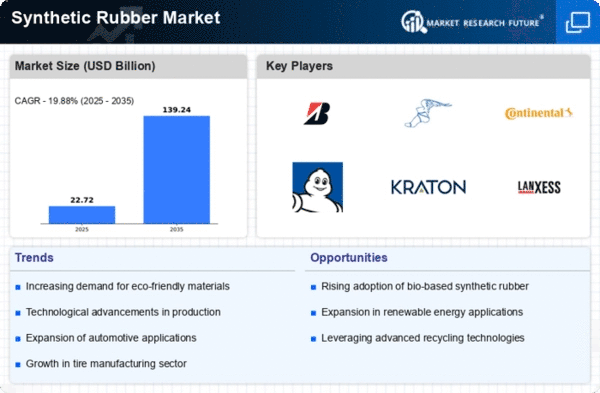
As per MRFR analysis, the Synthetic Rubber Market Size was estimated at 18.95 USD Billion in 2024. The Synthetic Rubber industry is projected to grow from 22.72 USD Billion in 2025 to 139.24 USD Billion by 2035, exhibiting a compound annual growth rate (CAGR) of 19.88 during the forecast period 2025 - 2035.

Key Market Trends & Highlights

The Synthetic Rubber Market is poised for robust growth driven by sustainability and technological advancements.

  • North America remains the largest market for synthetic rubber, primarily due to its established automotive sector.
  • Asia-Pacific is the fastest-growing region, reflecting increasing demand for synthetic rubber in various applications.
  • The tire segment continues to dominate the market, while the adhesives segment is experiencing rapid growth.
  • Rising demand for tires and expansion of the construction sector are key drivers propelling market growth.

Market Size & Forecast

2024 Market Size 18.95 (USD Billion)
2035 Market Size 139.24 (USD Billion)
CAGR (2025 - 2035) 19.88%
Largest Regional Market Share in 2024 Asia-Pacific

Major Players

<p>Bridgestone (JP), Goodyear (US), Continental (DE), Michelin (FR), Kraton Corporation (US), Lanxess (DE), SABIC (SA), TSRC Corporation (TW), Asahi Kasei (JP), Kumho Petrochemical (KR)</p>

Market Trends

The Synthetic Rubber Market is currently experiencing a dynamic evolution, driven by various factors that influence demand and supply. The increasing application of synthetic rubber in diverse industries, such as automotive, construction, and consumer goods, appears to be a primary catalyst for growth. Additionally, the rising emphasis on sustainability and eco-friendly materials is prompting manufacturers to innovate and develop greener alternatives. This shift towards sustainable practices may reshape the competitive landscape, as companies strive to meet consumer expectations and regulatory requirements. Moreover, advancements in technology and production processes are likely enhancing the efficiency and quality of synthetic rubber. The integration of digital technologies in manufacturing could streamline operations, reduce costs, and improve product performance. As the market continues to evolve, it seems that collaboration among stakeholders, including suppliers, manufacturers, and end-users, will be crucial in navigating challenges and seizing opportunities. Overall, the Synthetic Rubber Market is poised for a transformative phase, characterized by innovation, sustainability, and strategic partnerships.

Sustainability Initiatives

The focus on sustainability within the Synthetic Rubber Market is intensifying, as companies seek to reduce their environmental footprint. This trend encompasses the development of bio-based synthetic rubbers and recycling initiatives, which aim to minimize waste and promote circular economy principles. As consumers become more environmentally conscious, manufacturers are likely to prioritize sustainable practices to enhance brand loyalty and meet regulatory standards.

Technological Advancements

Technological innovations are playing a pivotal role in shaping the Synthetic Rubber Market. Enhanced production techniques, such as automation and advanced materials science, are improving efficiency and product quality. These advancements may lead to the creation of high-performance synthetic rubbers that cater to specific industry needs, thereby expanding application areas and driving market growth.

Growing Automotive Sector

The automotive industry is a significant driver of demand within the Synthetic Rubber Market. As vehicle production increases globally, the need for durable and high-performance materials is becoming more pronounced. This trend suggests that synthetic rubber will continue to play a crucial role in the manufacturing of tires, seals, and other automotive components, further solidifying its importance in this sector.

Synthetic Rubber Market Market Drivers

Growth in Construction Activities

The Global Synthetic Rubber Market Industry is significantly influenced by the expansion of construction activities worldwide. Synthetic rubber is utilized in various applications, including roofing membranes, flooring, and sealants, which are essential for modern construction projects. As urbanization continues to rise, particularly in developing regions, the demand for synthetic rubber is expected to increase. This growth is anticipated to contribute to the market's expansion, with projections indicating a rise to 36.4 USD Billion by 2035. The construction sector's increasing reliance on synthetic rubber for its versatility and performance characteristics suggests a promising outlook for the industry.

Rising Demand from Automotive Sector

The automotive sector plays a pivotal role in driving the Global Synthetic Rubber Market Industry. With the increasing production of vehicles, the demand for synthetic rubber, particularly in tires and seals, is expected to surge. In 2024, the market is projected to reach 21.1 USD Billion, reflecting the industry's reliance on synthetic rubber for enhanced performance and durability. As electric vehicles gain traction, the need for high-performance materials is likely to escalate, further propelling market growth. This trend indicates a robust future for synthetic rubber, especially as the automotive industry aims for sustainability and efficiency.

Increasing Application in Consumer Goods

The Global Synthetic Rubber Market Industry is witnessing a surge in demand due to its increasing application in consumer goods. Products such as footwear, adhesives, and sporting goods utilize synthetic rubber for its durability and flexibility. As consumer preferences shift towards high-quality and long-lasting products, manufacturers are likely to increase their use of synthetic rubber in production. This trend is expected to bolster the market, contributing to its growth trajectory. The versatility of synthetic rubber in various consumer applications indicates a sustained demand, further solidifying its position in the global market.

Technological Advancements in Production

Technological advancements in the production of synthetic rubber are likely to enhance the efficiency and sustainability of the Global Synthetic Rubber Market Industry. Innovations such as the development of bio-based synthetic rubber and improved polymerization processes are expected to reduce environmental impact while increasing production capacity. These advancements may lead to cost reductions and improved product quality, making synthetic rubber more appealing to manufacturers across various sectors. As the industry evolves, the integration of advanced technologies could potentially drive market growth, aligning with the projected CAGR of 5.1% from 2025 to 2035.

Environmental Regulations and Sustainability Initiatives

The Global Synthetic Rubber Market Industry is increasingly shaped by environmental regulations and sustainability initiatives. Governments worldwide are implementing stricter regulations on materials used in manufacturing, prompting companies to seek eco-friendly alternatives. Synthetic rubber, particularly bio-based variants, is gaining traction as a sustainable option. The industry's shift towards greener practices is likely to attract investment and innovation, fostering growth. As sustainability becomes a priority for consumers and manufacturers alike, the demand for environmentally friendly synthetic rubber solutions is expected to rise, positively impacting the market.

Market Segment Insights

By Application: Tires (Largest) vs. Adhesives (Fastest-Growing)

<p>In the Synthetic Rubber Market, the application segment showcases a diverse distribution, where Tires hold the largest share due to their essential role in automotive manufacturing. Following Tires, Adhesives are gaining traction, attributed to increased demand across various industries including construction and consumer goods. Sealants, Footwear, and Automotive Parts are also notable contributors, with each catering to specific end-user applications and markets.</p>

<p>Tires (Dominant) vs. Adhesives (Emerging)</p>

<p>Tires represent the dominant sector within the Synthetic Rubber Market due to their critical demand in the automotive industry, where performance and durability are paramount. The continuous evolution of automotive technologies fuels the tire sector's growth, pushing for advanced rubber compositions that enhance safety and efficiency. In contrast, Adhesives are classified as an emerging segment, driven by trends in manufacturing and product assembly where high-performance synthetic adhesives are required. This segment benefits from innovative developments in polymer chemistry, leading to superior adhesion properties, while addressing environmental concerns, positioning it for rapid expansion in the coming years.</p>

By End Use: Automotive (Largest) vs. Consumer Goods (Fastest-Growing)

<p>The synthetic rubber market exhibits a diverse distribution of market share among its various end use segments. The automotive sector remains the largest, driven by rising vehicle production and growing demand for fuel-efficient tires. Following closely is the construction segment, which utilizes synthetic rubber in various applications such as flooring and waterproofing materials. Meanwhile, the consumer goods segment is emerging rapidly, spurred by innovative product designs and increasing consumer preferences for durable goods that utilize synthetic rubber components.</p>

<p>Automotive (Dominant) vs. Consumer Goods (Emerging)</p>

<p>In the synthetic rubber market, the automotive sector dominates due to the substantial demand for high-performance tires and automotive components that require durability and reliability. Innovative materials and production technologies continue to bolster its market position. On the other hand, the consumer goods segment is gaining traction as manufacturers increasingly incorporate synthetic rubber into products such as footwear, exercise equipment, and household items. This emerging segment benefits from consumer trends favoring lightweight and resilient materials. As sustainability becomes a key concern, both segments are likely to adapt their offerings to enhance environmental profiles, driving further growth.</p>

By Type: Styrene-Butadiene Rubber (Largest) vs. Butyl Rubber (Fastest-Growing)

<p>The Synthetic Rubber Market is diversified into several types, with Styrene-Butadiene Rubber (SBR) being the largest segment, commanding a significant portion of market share due to its extensive application in tire manufacturing and other automotive components. Following SBR, Butyl Rubber holds a notable share due to its excellent air retention properties, making it a suitable choice for inner tubes and tire components. Overall, Nitrile, Ethylene Propylene Diene Monomer (EPDM), and Polybutadiene Rubber have smaller but essential market shares, primarily utilized for their specific characteristics in various industrial applications. The growth trends in the Synthetic Rubber Market indicate a strong demand for environmentally friendly alternatives, driving innovations within the Butyl Rubber and EPDM segments. Styrene-Butadiene Rubber is projected to remain the cornerstone of the market; however, Butyl Rubber is rapidly gaining traction due to rising demand in the automotive and construction sectors. The increasing focus on sustainability is likely to propel Nitrile and Polybutadiene Rubber towards accelerated growth, highlighting the shifting preferences among manufacturers and consumers alike.</p>

<p>Styrene-Butadiene Rubber (Dominant) vs. Nitrile Rubber (Emerging)</p>

<p>Styrene-Butadiene Rubber remains the dominant player in the Synthetic Rubber Market, primarily due to its versatility and cost-effectiveness, being extensively used in tire manufacturing and as a general-purpose rubber. Its exceptional elasticity, resilience, and weather resistance make it ideal for various applications. On the other hand, Nitrile Rubber is emerging as a key segment, especially in applications that require resistance to oil, fuel, and chemicals. This segment is witnessing a rise in demand from industries such as automotive and healthcare, where high-performance materials are critical. Nitrile's ability to withstand harsh conditions positions it favorably as market players seek durable and efficient solutions, making it a strong contender in the emerging category of synthetic rubbers.</p>

By Form: Solid (Largest) vs. Liquid (Fastest-Growing)

<p>In the Synthetic Rubber Market, the form segment is characterized by a diverse range of offerings, including solid, liquid, powder, granular, and sheet forms. Among these, solid synthetic rubber holds the largest market share due to its widespread application in tire manufacturing and industrial products. Liquid synthetic rubber is gaining traction, primarily due to its increasing use in adhesives, sealants, and coatings, making it a key player in the market's growth dynamics. Looking at growth trends, the liquid form is the fastest-growing segment, fueled by innovation in polymer technologies and the rising demand for environmentally friendly products. Solid synthetic rubber, while dominant, faces competition from the versatility of liquid and granular forms, particularly in applications requiring flexibility and ease of processing. The overall trend indicates a shift towards more specialized forms of synthetic rubber, catering to specific industry needs and sustainability criteria.</p>

<p>Solid (Dominant) vs. Liquid (Emerging)</p>

<p>Solid synthetic rubber is recognized for its strength and durability, making it the dominant form in applications such as tires, gaskets, and industrial products. It offers excellent resistance to wear and tear, which is critical in high-demand environments. In contrast, liquid synthetic rubber, as an emerging segment, provides unique advantages such as superior flow properties and ease of integration into various formulations. Liquid rubber can be utilized in coatings and sealants, reflecting a growing trend towards more flexible and environmentally friendly materials. The ability to adapt to different processing techniques and a heightened focus on sustainability further enhance the growth prospects of liquid synthetic rubber, setting the stage for a dynamic interplay between these two forms in the market.</p>

Get more detailed insights about Synthetic Rubber Market Research Report—Global Forecast till 2035

Regional Insights

North America : Mature Market with Steady Growth

The North American synthetic rubber market is projected to reach $3.79 billion by 2025, driven by robust automotive and construction sectors. Regulatory support for sustainable materials and innovations in production processes are key growth catalysts. The region's focus on reducing carbon emissions is also influencing demand trends, as manufacturers seek eco-friendly alternatives to traditional rubber products. Leading countries like the US and Canada dominate the market, with major players such as Goodyear and Bridgestone establishing a strong presence. The competitive landscape is characterized by ongoing investments in R&D to enhance product performance and sustainability. As the market matures, companies are increasingly focusing on strategic partnerships and acquisitions to strengthen their market position.

Europe : Innovation and Sustainability Focus

Europe's synthetic rubber market is expected to reach $4.25 billion by 2025, fueled by stringent environmental regulations and a shift towards sustainable materials. The region's commitment to reducing greenhouse gas emissions is driving demand for eco-friendly synthetic rubber products. Additionally, the automotive industry's transition to electric vehicles is creating new opportunities for innovative rubber solutions. Germany, France, and the UK are leading the market, with key players like Continental and Michelin investing heavily in sustainable technologies. The competitive landscape is marked by collaborations between manufacturers and research institutions to develop advanced materials. As Europe prioritizes sustainability, the synthetic rubber market is poised for significant growth, aligning with the EU's Green Deal objectives.

Asia-Pacific : Dominant Market Leader

The Asia-Pacific region is the largest market for synthetic rubber, projected to reach $10.0 billion by 2025. Rapid industrialization, urbanization, and a growing automotive sector are key drivers of this growth. Countries like China and India are experiencing increased demand for synthetic rubber in various applications, including tires and consumer goods. Government initiatives promoting infrastructure development further bolster market expansion. China is the dominant player in the region, with significant contributions from Japan and South Korea. Major companies such as Kumho Petrochemical and TSRC Corporation are expanding their production capacities to meet rising demand. The competitive landscape is characterized by aggressive pricing strategies and technological advancements, positioning Asia-Pacific as a powerhouse in The Synthetic Rubber.

Middle East and Africa : Emerging Market Potential

The Middle East and Africa (MEA) synthetic rubber market is projected to reach $0.91 billion by 2025, driven by increasing demand in the automotive and construction sectors. The region's rich natural resources and strategic location are enhancing its appeal for synthetic rubber production. Additionally, government initiatives aimed at diversifying economies are fostering growth in this sector. Countries like South Africa and Saudi Arabia are leading the market, with key players such as SABIC making significant investments in production facilities. The competitive landscape is evolving, with new entrants seeking to capitalize on the region's growth potential. As infrastructure projects expand, the demand for synthetic rubber is expected to rise, creating new opportunities for manufacturers.

Key Players and Competitive Insights

The Synthetic Rubber Market is currently characterized by a dynamic competitive landscape, driven by innovation, sustainability, and strategic partnerships. Key players such as Bridgestone (JP), Goodyear (US), and Michelin (FR) are actively shaping the market through their focus on advanced materials and eco-friendly production processes. Bridgestone (JP) emphasizes its commitment to sustainability, aiming to reduce CO2 emissions by 50% by 2030, which positions it favorably among environmentally conscious consumers. Goodyear (US) is leveraging digital transformation to enhance its manufacturing efficiency and product offerings, while Michelin (FR) is investing in R&D to develop high-performance synthetic rubber solutions that cater to the evolving demands of the automotive industry.

The market structure appears moderately fragmented, with a mix of established players and emerging companies. Key tactics such as localizing manufacturing and optimizing supply chains are prevalent among major firms, allowing them to respond swiftly to regional demands and fluctuations in raw material prices. This collective influence of major players fosters a competitive environment where innovation and operational efficiency are paramount.

In November 2025, Goodyear (US) announced a strategic partnership with a leading tech firm to integrate AI into its production processes. This collaboration aims to enhance predictive maintenance and optimize resource allocation, potentially reducing operational costs by up to 20%. Such advancements not only improve Goodyear's competitive edge but also reflect a broader trend of digitalization within the industry.

In October 2025, Michelin (FR) unveiled a new line of sustainable synthetic rubber products derived from bio-based materials. This initiative aligns with the company's sustainability goals and caters to the growing demand for eco-friendly alternatives in the automotive sector. By diversifying its product portfolio, Michelin (FR) strengthens its market position and appeals to environmentally conscious consumers.

In September 2025, Lanxess (DE) expanded its production capacity for synthetic rubber in Asia, responding to the increasing demand from the automotive and tire industries. This expansion not only enhances Lanxess's operational capabilities but also signifies a strategic move to solidify its presence in a rapidly growing market. Such investments are crucial for maintaining competitiveness in a landscape where supply chain reliability is becoming increasingly important.

As of December 2025, the Synthetic Rubber Market is witnessing trends that emphasize digitalization, sustainability, and strategic alliances. Companies are increasingly focusing on innovation and technology to differentiate themselves, moving away from traditional price-based competition. The integration of AI and sustainable practices is likely to redefine competitive dynamics, with firms that prioritize these elements poised for success in the evolving market landscape.

Key Companies in the Synthetic Rubber Market market include

Industry Developments

Future Outlook

Synthetic Rubber Market Future Outlook

<p>The Synthetic Rubber Market is projected to grow at a 19.88% CAGR from 2024 to 2035, driven by increasing automotive production, demand for high-performance materials, and advancements in manufacturing technologies.</p>

New opportunities lie in:

  • <p>Expansion into bio-based synthetic rubber production</p>
  • <p>Development of advanced tire technologies for electric vehicles</p>
  • <p>Investment in recycling technologies for synthetic rubber waste</p>

<p>By 2035, the Synthetic Rubber Market is expected to achieve substantial growth and innovation.</p>

Market Segmentation

Synthetic Rubber Market Form Outlook

  • Solid
  • Liquid
  • Powder
  • Granular
  • Sheet

Synthetic Rubber Market Type Outlook

  • Styrene-Butadiene Rubber
  • Butyl Rubber
  • Nitrile Rubber
  • Ethylene Propylene Diene Monomer
  • Polybutadiene Rubber

Synthetic Rubber Market End Use Outlook

  • Automotive
  • Construction
  • Consumer Goods
  • Industrial
  • Electronics

Synthetic Rubber Market Application Outlook

  • Tires
  • Adhesives
  • Sealants
  • Footwear
  • Automotive Parts

Report Scope

MARKET SIZE 202418.95(USD Billion)
MARKET SIZE 202522.72(USD Billion)
MARKET SIZE 2035139.24(USD Billion)
COMPOUND ANNUAL GROWTH RATE (CAGR)19.88% (2024 - 2035)
REPORT COVERAGERevenue Forecast, Competitive Landscape, Growth Factors, and Trends
BASE YEAR2024
Market Forecast Period2025 - 2035
Historical Data2019 - 2024
Market Forecast UnitsUSD Billion
Key Companies ProfiledBridgestone (JP), Goodyear (US), Continental (DE), Michelin (FR), Kraton Corporation (US), Lanxess (DE), SABIC (SA), TSRC Corporation (TW), Asahi Kasei (JP), Kumho Petrochemical (KR)
Segments CoveredApplication, End Use, Type, Form
Key Market OpportunitiesGrowing demand for eco-friendly synthetic rubber alternatives presents significant opportunities in the Synthetic Rubber Market.
Key Market DynamicsRising demand for eco-friendly materials drives innovation and competition in the synthetic rubber market.
Countries CoveredNorth America, Europe, APAC, South America, MEA

FAQs

What growth rate global synthetic rubber market would register in the future?

The global synthetic rubber market would register a growth of 4.77%.

Which industry will play a crucial role in taking the synthetic rubber market ahead??

The automotive &amp; transportation industry will play a prominent role in taking the market forward.

What is the key restraining factor for the global synthetic rubber market?

Increasing environmental concerns and stringent regulations imposed by the government surrounding usage of synthetic rubber.

Which region would enjoy the upper hand in the synthetic rubber market?

Asia-Pacific would enjoy the upper hand in the synthetic rubber market, and it is poised to grow at a rapid rate.

Which Asia-Pacific country would set the trend in the synthetic rubber market?

China is poised to set the trend for demand growth in the synthetic rubber market.

What is the major regional market for synthetic rubber?

Asia Pacific is the leading regional market for synthetic rubber due to the growing automotive industry in the region.

What are the leading players in the global synthetic rubber market?

Leading players in the synthetic rubber market include ZEON Corporation, Lanxess, LG Chem, Dow, Asahi Kasei Corporation, and JSR Corporation.

  1. EXECUTIVE SUMMARY 17
    1. MARKET ATTRACTIVENESS
    2. ANALYSIS 19
  2. GLOBAL SYNTHETIC RUBBER MARKET, BY TYPE 20
  3. GLOBAL SYNTHETIC RUBBER MARKET, BY APPLICATION
  4. GLOBAL
  5. SYNTHETIC RUBBER MARKET, BY REGION 22
  6. MARKET INTRODUCTION 23
    1. DEFINITION 23
    2. SCOPE OF THE STUDY 23
    3. MARKET STRUCTURE 24
  7. RESEARCH METHODOLOGY 25
    1. RESEARCH PROCESS 25
    2. PRIMARY RESEARCH 26
    3. SECONDARY RESEARCH 27
    4. MARKET SIZE ESTIMATION 27
    5. TOP-DOWN AND BOTTOM-UP APPROACHES 28
    6. FORECAST MODEL 29
    7. LIST OF ASSUMPTIONS
      1. USE OF SYNTHETIC RUBBER FOR CONSTRUCTION PURPOSES
    8. & LIMITATIONS 30
    9. MARKET DYNAMICS 31
    10. INTRODUCTION 31
    11. DRIVERS 33
    12. INCREASING USE OF SYNTHETIC RUBBER IN TIRE MANUFACTURING 33
    13. RESTRAINTS
      1. STRINGENT
    14. REGULATIONS AND ADVERSE EFFECTS ASSOCIATED WITH RUBBER PROCESSING 35
    15. OPPORTUNITIES 36
      1. DEVULCANIZATION
    16. OF SYNTHETIC RUBBER 36
    17. USE OF END-OF-LIFE TIRES FOR STORABLE ENERGY CARRIERS AND TIRE-DERIVED FUEL 37
    18. CHALLENGES 37
      1. VOLATILE RAW MATERIAL
    19. PRICES 37
    20. MARKET FACTOR ANALYSIS 39
    21. SUPPLY CHAIN ANALYSIS 39
      1. RAW MATERIAL SUPPLIERS 40
      2. SYNTHETIC RUBBER PRODUCERS
      3. DISTRIBUTION
      4. APPLICATIONS 41
    22. & SALES CHANNELS 41
    23. PORTER’S FIVE FORCES ANALYSIS 42
      1. THREAT OF NEW ENTRANTS
      2. BARGAINING
      3. BARGAINING POWER OF BUYERS 43
      4. INTENSITY OF RIVALRY 43
    24. POWER OF SUPPLIERS 43
    25. THREAT OF SUBSTITUTES 43
    26. PRICING OVERVIEW 44
    27. IMPACT OF COVID 19 OUTBREAK ON GLOBAL SYNTHETIC
      1. IMPACT ON SUUPLY CHAIN OF SYNTHETIC RUBBER MARKET 45
      2. QUALITATIVE ANALYSIS
    28. RUBBER MARKET 45
    29. IMPACT ON GLOBAL ECONOMY 45
    30. ON CHANGES IN DEMAND FROM END USERS 45
  8. GLOBAL SYNTHETIC RUBBER MARKET, BY TYPE 46
    1. OVERVIEW 46
      1. GLOBAL SYNTHETIC RUBBER
      2. GLOBAL SYNTHETIC RUBBER MARKET ESTIMATES &
    2. MARKET ESTIMATES & FORECAST BY TYPE, 2019 TO 2030 46
    3. FORECAST BY TYPE, 2019 TO 2030 47
    4. STYRENE-BUTADIENE RUBBER (SBR) 48
      1. STYRENE-BUTADIENE RUBBER (SBR) MARKET ESTIMATES
    5. & FORECAST BY REGION,2019 TO 2030 48
    6. ETHYLENE PROPYLENE DIENE MONOMER (EPDM) 49
      1. ETHYLENE PROPYLENE
    7. DIENE MONOMER (EPDM) MARKET ESTIMATES & FORECAST BY REGION,2019 TO 2030 49
    8. BUTYL RUBBER 50
      1. BUTYL RUBBER MARKET
    9. ESTIMATES & FORECAST BY REGION,2019 TO 2030 50
    10. POLYISOPRENE 51
      1. POLYISOPRENE MARKET ESTIMATES & FORECAST
    11. BY REGION,2019 TO 2030 51
    12. OTHERS 52
      1. OTHERS MARKET ESTIMATES & FORECAST BY REGION,2019 TO 2030
  9. GLOBAL
  10. SYNTHETIC RUBBER MARKET, BY APPLICATION 53
    1. OVERVIEW 53
      1. GLOBAL SYNTHETIC RUBBER MARKET ESTIMATES &
      2. GLOBAL SYNTHETIC RUBBER MARKET ESTIMATES & FORECAST
    2. FORECAST BY APPLICATION, 2019 TO 2030 53
    3. BY APPLICATION, 2019 TO 2030 54
    4. CONSTRUCTION 55
      1. CONSTRUCTION: MARKET ESTIMATES & FORECAST BY REGION,2019
      2. AUTOMOTIVE & TRANSPORTATION MARKET ESTIMATES &
    5. TO 2030 55
    6. AUTOMOTIVE & TRANSPORTATION 56
    7. FORECAST BY REGION, 2019 TO 2030 56
    8. MEDICAL 57
      1. MEDICAL: MARKET ESTIMATES & FORECAST BY REGION,2019
    9. TO 2030 57
    10. OTHERS 58
    11. OTHERS: MARKET ESTIMATES & FORECAST BY REGION,2019 TO 2030 58
  11. GLOBAL SYNTHETIC RUBBER MARKET,
    1. BY REGION 59
    2. OVERVIEW 59
    3. NORTH AMERICA 62
    4. US 65
    5. CANADA 67
    6. EUROPE 69
    7. GERMANY 72
    8. UK 74
    9. FRANCE 76
    10. SPAIN 78
    11. ITALY 80
    12. RUSSIA 82
    13. REST OF EUROPE 84
    14. ASIA-PACIFIC 86
    15. CHINA 89
    16. JAPAN 91
    17. INDIA 93
    18. SOUTH KOREA 95
    19. AUSTRALIA & NEW ZEALAND 97
    20. COUNTRIES 115
    21. TURKEY 117
    22. SOUTH AFRICA 119
    23. REST OF THE MIDDLE EAST & AFRICA 121
  12. REST OF ASIA-PACIFIC 99
    1. LATIN AMERICA 101
      1. BRAZIL 104
      2. MEXICO 106
      3. ARGENTINA 108
      4. REST OF LATIN AMERICA 110
    2. MIDDLE EAST & AFRICA
      1. GCC
  13. COMPETITIVE LANDSCAPE 123
    1. MARKET INTRODUCTION 123
    2. GLOBAL MARKET STRATEGY ANALYSIS 123
    3. RECENT DEVELOPMENTS
    4. COMPETITIVE
      1. COMPANY OVERVIEW 130
      2. FINANCIAL OVERVIEW 130
      3. PRODUCTS OFFERED 131
      4. KEY DEVELOPMENTS 131
      5. SWOT ANALYSIS 132
      6. KEY STRATEGIES 132
    5. BENCHMARKING 125
    6. COMPANY PROFILES 127
    7. LANXESS 127
    8. COMPANY OVERVIEW 127
    9. FINANCIAL OVERVIEW 128
    10. PRODUCTS OFFERED 128
    11. KEY DEVELOPMENTS 129
    12. SWOT ANALYSIS 129
    13. KEY STRATEGIES 129
    14. KUMHO PETROCHEMICAL CO., LTD 130
    15. LG CHEM LTD 133
      1. COMPANY OVERVIEW 133
      2. FINANCIAL OVERVIEW 133
      3. PRODUCTS OFFERED 134
      4. KEY DEVELOPMENTS 134
      5. SWOT ANALYSIS 134
      6. KEY STRATEGIES 134
    16. SINOPEC 135
      1. COMPANY OVERVIEW 135
      2. FINANCIAL OVERVIEW 136
      3. PRODUCTS OFFERED 137
      4. KEY DEVELOPMENTS 137
      5. SWOT ANALYSIS 138
      6. KEY STRATEGIES 138
    17. VERSALIS SPA. 139
      1. COMPANY OVERVIEW 139
      2. FINANCIAL OVERVIEW 140
      3. PRODUCTS OFFERED 141
      4. KEY DEVELOPMENTS 141
      5. SWOT ANALYSIS 142
      6. KEY STRATEGIES 142
    18. TSRC CORPORATION 143
      1. COMPANY OVERVIEW 143
      2. FINANCIAL OVERVIEW 144
      3. PRODUCTS OFFERED 145
      4. KEY DEVELOPMENTS 145
      5. SWOT ANALYSIS 146
      6. KEY STRATEGIES 146
    19. ZEON CORPORATION 147
      1. COMPANY OVERVIEW 147
      2. FINANCIAL OVERVIEW 147
      3. PRODUCTS OFFERED 147
      4. KEY DEVELOPMENTS 148
      5. SWOT ANALYSIS 148
      6. KEY STRATEGIES 148
    20. GROUP DYNASOL 149
      1. COMPANY OVERVIEW 149
      2. FINANCIAL OVERVIEW 149
      3. PRODUCTS OFFERED 149
      4. KEY DEVELOPMENTS 150
      5. SWOT ANALYSIS 151
      6. KEY STRATEGIES 151
    21. KRATON CORPORATION 152
      1. COMPANY OVERVIEW 152
      2. FINANCIAL OVERVIEW 153
      3. PRODUCTS OFFERED 154
      4. KEY DEVELOPMENTS 154
      5. SWOT ANALYSIS 155
      6. KEY STRATEGIES 155
    22. JSR CORPORATION 156
      1. COMPANY OVERVIEW 156
      2. FINANCIAL OVERVIEW 157
      3. PRODUCTS OFFERED 158
      4. KEY DEVELOPMENTS
      5. COMPANY OVERVIEW 160
      6. FINANCIAL OVERVIEW 161
      7. PRODUCTS OFFERED 162
      8. KEY DEVELOPMENTS
      9. COMPANY OVERVIEW 168
      10. FINANCIAL OVERVIEW 169
      11. PRODUCTS OFFERED 170
      12. KEY DEVELOPMENTS
    23. SWOT ANALYSIS 159
    24. KEY STRATEGIES 159
    25. PJSC NIZHNEKAMSKNEFTEKHIM 160
    26. SWOT ANALYSIS 163
    27. KEY STRATEGIES 163
    28. SIBUR 164
    29. COMPANY OVERVIEW 164
    30. FINANCIAL OVERVIEW 165
    31. PRODUCTS OFFERED 166
    32. KEY DEVELOPMENTS 166
    33. SWOT ANALYSIS 167
    34. KEY STRATEGIES 167
    35. THE GOODYEAR TIRE & RUBBER COMPANY 168
    36. SWOT ANALYSIS 171
    37. KEY STRATEGIES 171
    38. TRINSEO 172
    39. COMPANY OVERVIEW 172
    40. FINANCIAL OVERVIEW 173
    41. PRODUCTS OFFERED 173
    42. KEY DEVELOPMENTS 174
    43. SWOT ANALYSIS 174
    44. KEY STRATEGIES 174
    45. PETROCHINA 175
    46. COMPANY OVERVIEW 175
    47. FINANCIAL OVERVIEW 176
    48. PRODUCTS OFFERED 176
    49. KEY DEVELOPMENTS 177
    50. SWOT ANALYSIS 177
    51. KEY STRATEGIES 177
    52. APPENDIX 178
    53. REFERENCES 178
    54. RELATED REPORTS 179
  14. LIST OF TABLES
  15. LIST OF ASSUMPTIONS
    1. & LIMITATIONS 30
    2. TABLE
  16. PRICING OVERVIEW, BY REGION (USD/TONS) 44
  17. GLOBAL SYNTHETIC RUBBER MARKET ESTIMATES
    1. & FORECAST, BY TYPE, 2019 TO 2030 (USD MILLION) 46
  18. GLOBAL SYNTHETIC RUBBER MARKET ESTIMATES
    1. & FORECAST, BY TYPE, 2019 TO 2030 (KILO TONS) 47
  19. STYRENE-BUTADIENE RUBBER (SBR) MARKET ESTIMATES
    1. & FORECAST, BY REGION, 2019 TO 2030 (USD MILLION) 48
  20. STYRENE-BUTADIENE RUBBER (SBR) MARKET ESTIMATES
    1. & FORECAST, BY REGION, 2019 TO 2030 (KILO TONS) 48
  21. ETHYLENE PROPYLENE DIENE MONOMER (EPDM) MARKET
    1. ESTIMATES & FORECAST, BY REGION, 2019 TO 2030 (USD MILLION) 49
  22. ETHYLENE PROPYLENE DIENE
  23. MONOMER (EPDM) MARKET ESTIMATES & FORECAST, BY REGION, 2019 TO 2030 (KILO TONS)
    1. TABLE 9
  24. BUTYL RUBBER MARKET ESTIMATES & FORECAST, BY REGION, 2019 TO 2030 (USD MILLION)
    1. TABLE 10
  25. BUTYL RUBBER MARKET ESTIMATES & FORECAST, BY REGION, 2019 TO 2030 (KILO TONS)
    1. TABLE 11
  26. POLYISOPRENE MARKET ESTIMATES & FORECAST, BY REGION, 2019 TO 2030 (USD MILLION)
    1. TABLE 12
  27. POLYISOPRENE MARKET ESTIMATES & FORECAST, BY REGION, 2019 TO 2030 (KILO TONS)
    1. TABLE 13
  28. OTHERS MARKET ESTIMATES & FORECAST, BY REGION, 2019 TO 2030 (USD MILLION) 52
  29. OTHERS MARKET
    1. ESTIMATES & FORECAST, BY REGION, 2019 TO 2030 (KILO TONS) 52
  30. GLOBAL SYNTHETIC RUBBER
  31. MARKET ESTIMATES & FORECAST, BY APPLICATION, 2019 TO 2030 (USD MILLION) 53
  32. GLOBAL SYNTHETIC
  33. RUBBER MARKET ESTIMATES & FORECAST, BY APPLICATION, 2019 TO 2030 (KILO TONS)
    1. TABLE 17
  34. CONSTRUCTION MARKET ESTIMATES & FORECAST, BY REGION, 2019 TO 2030 (USD MILLION)
    1. TABLE 18
  35. CONSTRUCTION MARKET ESTIMATES & FORECAST, BY REGION, 2019 TO 2030 (KILO TONS)
    1. TABLE 19
  36. AUTOMOTIVE & TRANSPORTATION MARKET ESTIMATES & FORECAST, BY REGION, 2019
    1. TO 2030 (USD MILLION) 56
  37. AUTOMOTIVE & TRANSPORTATION MARKET ESTIMATES & FORECAST,
    1. BY REGION, 2019 TO 2030 (KILO TONS) 56
  38. MEDICAL MARKET ESTIMATES & FORECAST, BY REGION,
  39. MEDICAL MARKET ESTIMATES & FORECAST, BY REGION, 2019 TO
    1. TABLE
  40. OTHERS MARKET ESTIMATES & FORECAST, BY REGION, 2019 TO 2030 (USD MILLION)
    1. TABLE 24
  41. OTHERS MARKET ESTIMATES & FORECAST, BY REGION, 2019 TO 2030 (KILO TONS) 58
  42. GLOBAL SYNTHETIC
  43. RUBBER MARKET, BY REGION, 2019 TO 2030 (USD MILLION) 60
  44. GLOBAL SYNTHETIC RUBBER MARKET, BY REGION,
  45. NORTH AMERICA: GLOBAL SYNTHETIC RUBBER MARKET, BY COUNTRY,
  46. NORTH AMERICA: GLOBAL SYNTHETIC RUBBER MARKET, BY COUNTRY,
  47. NORTH AMERICA: GLOBAL SYNTHETIC RUBBER MARKET, BY TYPE, 2019
    1. TO 2030 (USD MILLION) 62
  48. NORTH AMERICA: GLOBAL SYNTHETIC RUBBER MARKET, BY TYPE, 2019
    1. TO 2030 (KILO TONS) 63
    2. TABLE
  49. NORTH AMERICA: GLOBAL SYNTHETIC RUBBER MARKET, BY APPLICATION, 2019 TO 2030 (USD
    1. MILLION) 63
    2. TABLE
  50. NORTH AMERICA: GLOBAL SYNTHETIC RUBBER MARKET, BY APPLICATION, 2019 TO 2030 (KILO
    1. TONS) 64
    2. TABLE
  51. US: GLOBAL SYNTHETIC RUBBER MARKET, BY TYPE, 2019 TO 2030 (USD MILLION) 65
  52. US: GLOBAL SYNTHETIC
  53. RUBBER MARKET, BY TYPE, 2019 TO 2030 (KILO TONS) 65
  54. US: GLOBAL SYNTHETIC RUBBER MARKET, BY APPLICATION,
  55. US: GLOBAL SYNTHETIC RUBBER MARKET, BY APPLICATION, 2019 TO
    1. TABLE
  56. CANADA: GLOBAL SYNTHETIC RUBBER MARKET, BY TYPE, 2019 TO 2030 (USD MILLION) 67
  57. CANADA: GLOBAL
  58. SYNTHETIC RUBBER MARKET, BY TYPE, 2019 TO 2030 (KILO TONS) 67
  59. CANADA: GLOBAL SYNTHETIC
  60. RUBBER MARKET, BY APPLICATION, 2019 TO 2030 (USD MILLION) 68
  61. CANADA: GLOBAL SYNTHETIC RUBBER MARKET,
    1. BY APPLICATION, 2019 TO 2030 (KILO TONS) 68
  62. EUROPE: GLOBAL SYNTHETIC RUBBER MARKET,
    1. BY COUNTRY, 2019 TO 2030 (USD MILLION) 69
  63. EUROPE: GLOBAL SYNTHETIC RUBBER MARKET,
    1. BY COUNTRY, 2019 TO 2030 (KILO TONS) 69
  64. EUROPE: GLOBAL SYNTHETIC RUBBER MARKET, BY TYPE,
  65. EUROPE: GLOBAL SYNTHETIC RUBBER MARKET, BY TYPE, 2019 TO 2030
    1. (KILO TONS) 70
    2. TABLE
  66. EUROPE: GLOBAL SYNTHETIC RUBBER MARKET, BY APPLICATION, 2019 TO 2030 (USD MILLION)
    1. TABLE 46
  67. EUROPE: GLOBAL SYNTHETIC RUBBER MARKET, BY APPLICATION, 2019 TO 2030 (KILO TONS)
    1. TABLE 47
  68. GERMANY: GLOBAL SYNTHETIC RUBBER MARKET, BY TYPE, 2019 TO 2030 (USD MILLION) 72
  69. GERMANY: GLOBAL
  70. SYNTHETIC RUBBER MARKET, BY TYPE, 2019 TO 2030 (KILO TONS) 72
  71. GERMANY: GLOBAL SYNTHETIC
  72. RUBBER MARKET, BY APPLICATION, 2019 TO 2030 (USD MILLION) 73
  73. GERMANY: GLOBAL SYNTHETIC RUBBER MARKET,
    1. BY APPLICATION, 2019 TO 2030 (KILO TONS) 73
  74. UK: GLOBAL SYNTHETIC RUBBER MARKET, BY TYPE,
  75. UK: GLOBAL SYNTHETIC RUBBER MARKET, BY TYPE, 2019 TO 2030
    1. (KILO TONS) 74
    2. TABLE
  76. UK: GLOBAL SYNTHETIC RUBBER MARKET, BY APPLICATION, 2019 TO 2030 (USD MILLION)
    1. TABLE 54
  77. UK: GLOBAL SYNTHETIC RUBBER MARKET, BY APPLICATION, 2019 TO 2030 (KILO TONS) 75
  78. FRANCE: GLOBAL
  79. SYNTHETIC RUBBER MARKET, BY TYPE, 2019 TO 2030 (USD MILLION) 76
  80. FRANCE: GLOBAL SYNTHETIC
  81. RUBBER MARKET, BY TYPE, 2019 TO 2030 (KILO TONS) 76
  82. FRANCE: GLOBAL SYNTHETIC RUBBER MARKET,
    1. BY APPLICATION, 2019 TO 2030 (USD MILLION) 77
  83. FRANCE: GLOBAL SYNTHETIC RUBBER MARKET,
    1. BY APPLICATION, 2019 TO 2030 (KILO TONS) 77
  84. SPAIN: GLOBAL SYNTHETIC RUBBER MARKET, BY
    1. TYPE, 2019 TO 2030 (USD MILLION) 78
  85. SPAIN: GLOBAL SYNTHETIC RUBBER MARKET, BY TYPE,
  86. SPAIN: GLOBAL SYNTHETIC RUBBER MARKET, BY APPLICATION, 2019
    1. TO 2030 (USD MILLION) 79
  87. SPAIN: GLOBAL SYNTHETIC RUBBER MARKET, BY APPLICATION, 2019
    1. TO 2030 (KILO TONS) 79
    2. TABLE
  88. ITALY: GLOBAL SYNTHETIC RUBBER MARKET, BY TYPE, 2019 TO 2030 (USD MILLION) 80
  89. ITALY: GLOBAL
  90. SYNTHETIC RUBBER MARKET, BY TYPE, 2019 TO 2030 (KILO TONS) 80
  91. ITALY: GLOBAL SYNTHETIC
  92. RUBBER MARKET, BY APPLICATION, 2019 TO 2030 (USD MILLION) 81
  93. ITALY: GLOBAL SYNTHETIC RUBBER MARKET, BY
    1. APPLICATION, 2019 TO 2030 (KILO TONS) 81

Synthetic Rubber Market Segmentation

Market Segmentation Overview

  • Detailed segmentation data will be available in the full report
  • Comprehensive analysis by multiple parameters
  • Regional and country-level breakdowns
  • Market size forecasts by segment
Infographic

Free Sample Request

Kindly complete the form below to receive a free sample of this Report

Get Free Sample

Customer Strories

Compare Licence

×
Features License Type
Single User Multiuser License Enterprise User
Price $4,950 $5,950 $7,250
Maximum User Access Limit 1 User Upto 10 Users Unrestricted Access Throughout the Organization
Free Customization
Direct Access to Analyst
Deliverable Format
Platform Access
Discount on Next Purchase 10% 15% 15%
Printable Versions