Request Free Sample ×

Kindly complete the form below to receive a free sample of this Report

* Please use a valid business email

Leading companies partner with us for data-driven Insights

clients tt-cursor
Hero Background
English
Chinese
French
Japanese
Korean
German
Spanish

Surgical Sutures Market Trends

ID: MRFR/HC/10219-HCR
200 Pages
Rahul Gotadki
April 2026

Surgical Sutures Market Research Report: Size, Share, Trend Analysis By Product Type (Absorbable Sutures, Non-Absorbable Sutures, Barbed Sutures, Surgical Zip Ties), By Material (Silk, Polypropylene, Polyglycolic Acid, Polyester, Catgut), By Applications (Cardiothoracic Surgery, Orthopedic Surgery, Plastic Surgery, General Surgery), By End-use (Hospitals, Ambulatory Surgical Centers, Clinics), and By Regional (North America, Europe, South America, Asia Pacific, Middle East and Africa) - Growth Outlook & Industry Forecast 2025 To 2035

Share:
Download PDF ×

We do not share your information with anyone. However, we may send you emails based on your report interest from time to time. You may contact us at any time to opt-out.

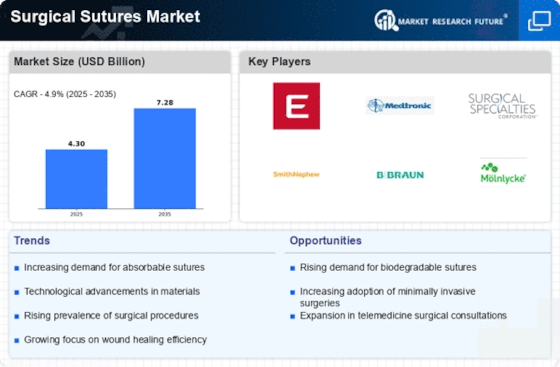
Surgical Sutures Market Infographic
Purchase Options

Market Trends

Key Emerging Trends in the Surgical Sutures Market

The surgical sutures market is characterized by vigorous trends, which signify the devotion to innovation and patient results concerning efficiency in terms of surgery. One interesting trend is increased use of absorbable sutures, instead of non-absorbable ones. Surgeons have also been attracted by the fact that absorbable sutures dissolve as time passes without being removed. This tendency corresponds with the concept of minimization and simplification in postoperative care. Technological developments in suture materials have reshaped the market. Surgical stitches, such as synthetic absorbable polymers and antimicrobial-coated sutures are gaining increased tensile strength resistance to infection, and compliance. Such innovations result to improved wound healing responses, and they respond adequately with the ever-changing needs of modern surgery. The growing popularity of minimally invasive surgery (MIS) is driving suture preference. With an increased demand for minimally invasive procedures, there is a surging need of sutures compatible with these techniques. In response, manufacturers are creating MIS sutures with thinner needles and lesser tissue damage to improve manipulation. This development emphasizes the market’s responsiveness to changes in surgical practices. The market is seeing a shift from natural sutures to synthetic ones as substitutes for normal natural sutured. Synthetic sutures, which are prepared from materials such as PGA and poliglecaprone provide standard operation with tissues reactivity minimization. When considering surgeon preference, it is possible to notice that more and more surgeons prefer synthetic sutures due to their characteristics of manageability and patient comfort. Customization and variety in suture offerings are now crucial factors for manufacturers. Surgeons are looking to find suture materials that meet the demands of varied surgery practices. This trend has enabled to use different sizes, length, and material of sutures based on key features in every separate case. The demand for barbed sutures is growing in the market. In some cases, procedures such as cosmetic and bariatric surgeries often use barbed sutures that are equipped with tiny projections whose function is to replace the need for traditional knot-tying. Benefits of barbed sutures include shorter operating time; improved tissue apposition and possible lesser scar potential, the reasons for their increasing popularity in certain surgical situations.


Author
Author Profile
Rahul Gotadki
Research Manager

He holds an experience of about 9+ years in Market Research and Business Consulting, working under the spectrum of Life Sciences and Healthcare domains. Rahul conceptualizes and implements a scalable business strategy and provides strategic leadership to the clients. His expertise lies in market estimation, competitive intelligence, pipeline analysis, customer assessment, etc.

Leave a Comment

FAQs

What is the projected market valuation of the Surgical Sutures Market by 2035?

The Smarket is projected to reach a valuation of 7.281 USD Billion by 2035.

What was the market valuation of the Surgical Sutures Market in 2024?

In 2024, the overall market valuation of the market was 4.301 USD Billion.

What is the expected CAGR for the Surgical Sutures Market during the forecast period 2025 - 2035?

The expected CAGR for the market during the forecast period 2025 - 2035 is 4.9%.

Which companies are considered key players in the Surgical Sutures Market?

Key players in the market include Ethicon, Medtronic, Surgical Specialties Corporation, and Smith & Nephew.

What are the projected values for absorbable sutures by 2035?

<p>By 2035, the projected value for absorbable sutures is expected to range from 2.5 USD Billion.</p>

How do non-absorbable sutures perform in terms of market valuation?

<p>Non-absorbable sutures are projected to reach a valuation of 2.0 USD Billion by 2035.</p>

What is the expected market size for surgical zip ties by 2035?

<p>The market size for surgical zip ties is anticipated to grow to 1.581 USD Billion by 2035.</p>

Which material segment is projected to have the highest valuation by 2035?

<p>The polypropylene material segment is projected to reach a valuation of 2.2205 USD Billion by 2035.</p>

What is the anticipated market size for orthopedic surgery applications by 2035?

<p>The anticipated market size for orthopedic surgery applications is expected to be 2.2275 USD Billion by 2035.</p>

What end-use segment is expected to dominate the Surgical Sutures Market by 2035?

<p>The hospitals end-use segment is expected to dominate the market, reaching 2.5 USD Billion by 2035.</p>

Market Summary

As per MRFR analysis, the Surgical Sutures Market size was valued at USD 4.301 Billion in 2024. The market is projected to grow from USD 4.512 Billion in 2025 to USD 7.281 Billion by 2035, exhibiting a CAGR of 4% during the forecast period 2025–2035. North America led the market with over 44.18% share, generating around USD 1.9 Billion in revenue.
 
The Surgical Sutures Market is primarily driven by increasing global surgical procedures and rising prevalence of chronic diseases, boosting demand for advanced suturing solutions, including biodegradable and antimicrobial sutures, to enhance healing outcomes and reduce postoperative complications effectively.
 
According to the World Health Organization (WHO), over 313 million surgical procedures are performed globally each year, highlighting substantial demand for surgical consumables. This rising surgical volume is significantly accelerating the adoption of advanced sutures, improving patient safety, wound healing outcomes, and healthcare efficiency worldwide.

Key Market Trends & Highlights

The Surgical Sutures Market is experiencing a transformative shift towards innovative materials and technologies.

  • Antimicrobial sutures reduce infection risks, addressing 20% of healthcare-associated infections in surgical settings. North America holds 44.18% share, while Europe accounts for 30% share valued at USD 1.2903 billion in 2024. Absorbable sutures dominate with 58% share, supported by improved patient comfort and elimination of removal procedures. Hospitals lead end-use with 62% share, driven by high surgical volumes and advanced infrastructure globally.

Market Size & Forecast

2024 Market Size 4.301 (USD Billion)
2035 Market Size 7.281 (USD Billion)
CAGR (2025 - 2035) 4.9%
Largest Regional Market Share in 2024 North America

Major Players

Companies such as Ethicon (US), <a href="https://www.medtronic.com/en-us/healthcare-professionals/products/wound-closure/sutures.html">Medtronic</a> (US), Surgical Specialties Corporation (US), Smith &amp; Nephew (GB), B. Braun Melsungen AG (DE), Mölnlycke Health Care (SE), Conmed Corporation (US), DemeTECH Corporation (US), Tissuemed Limited (GB), representing leading surgical sutures manufacturer groups and global sutures manufacturers are some of the major participants in the global market.

Market Trends

The Surgical Sutures Market is currently experiencing a dynamic evolution, driven by advancements in medical technology and an increasing emphasis on patient safety. The demand for innovative suture materials, such as biodegradable and antimicrobial options, appears to be on the rise, reflecting a broader trend within the global surgical suture market. Furthermore, the growing prevalence of surgical procedures across various medical specialties suggests a robust market potential. As healthcare providers seek to improve recovery times and reduce complications, the focus on high-quality sutures and optimized surgical suture sizes becomes paramount.

In addition, the Surgical Sutures Market is likely influenced by the ongoing development of minimally invasive surgical techniques. These methods often require specialized suturing solutions offered by advanced surgical suture manufacturers and supported by global suture suppliers. The integration of smart technologies into surgical sutures, such as those that can monitor healing or deliver medication, indicates a potential shift towards more sophisticated products. Overall, the market landscape appears to be shifting towards innovation, quality, and adaptability, which may redefine surgical practices in the near future.

Rise of Biodegradable Sutures

The Surgical Sutures Market is witnessing a notable shift towards biodegradable sutures, which offer the advantage of eliminating the need for removal after healing. This trend aligns with sustainability initiatives increasingly adopted by sutures manufacturers worldwide. 

The United Nations Population Fund (UNFPA) reports that the global population aged 65+ is expected to double by 2050, increasing surgical interventions among elderly patients. Biodegradable sutures reduce the need for removal procedures, enhancing recovery efficiency and supporting adoption across age-sensitive surgical applications.

Integration of Smart Technologies

The incorporation of smart technologies into surgical sutures is emerging as a significant trend. These advanced sutures may include features such as drug delivery systems or sensors that monitor healing, enhancing outcomes within the broader suture market.

The Institute for Health Metrics and Evaluation (IHME) highlights the growing global burden of diseases requiring surgical intervention. Integration of smart technologies in sutures, such as drug delivery and healing monitoring, supports improved outcomes and aligns with increasing demand for precision-driven surgical innovations.

Focus on Antimicrobial Properties

There is an increasing emphasis on antimicrobial sutures within the Surgical Sutures Market. These products aim to reduce the risk of surgical site infections and are increasingly developed by leading surgical sutures manufacturer organizations. The demand for such sutures suggests a proactive approach to patient safety and infection control.

According to the Centers for Disease Control and Prevention (CDC), surgical site infections account for nearly 20% of all healthcare-associated infections. Antimicrobial sutures significantly reduce infection risks, improving patient outcomes and driving adoption across hospitals aiming to enhance surgical safety and reduce complications.


Surgical Sutures Market Market Drivers

Increasing Surgical Procedures

The Surgical Sutures Market is experiencing growth due to the rising number of surgical procedures performed worldwide. Factors such as an aging population, increasing prevalence of chronic diseases, and advancements in surgical techniques contribute to this trend. According to recent data, the number of surgical procedures is projected to increase by approximately 10% annually over the next five years.
 
This surge in surgical interventions necessitates a corresponding demand for surgical sutures, as they are essential for wound closure and healing. As healthcare providers strive to improve patient outcomes, the reliance on high-quality sutures becomes paramount, thereby driving the Surgical Sutures Market forward.

Technological Advancements in Sutures

Technological innovations are significantly influencing the Surgical Sutures Market. The introduction of advanced materials, such as synthetic absorbable sutures and antimicrobial-coated sutures, enhances the performance and safety of surgical sutures. These innovations not only improve healing times but also reduce the risk of infections, which is a critical concern in surgical settings.
 
Market data indicates that the segment of advanced sutures is expected to grow at a compound annual growth rate of 8% over the next few years. As healthcare providers increasingly adopt these advanced sutures, the Surgical Sutures Market is likely to witness substantial growth.

Expansion of Healthcare Infrastructure

The expansion of healthcare infrastructure in various regions is positively impacting the Surgical Sutures Market. As new hospitals and surgical centers are established, the demand for surgical sutures is expected to rise correspondingly. Investments in healthcare facilities, particularly in emerging markets, are facilitating access to surgical procedures and, consequently, increasing the need for sutures.
 
Recent reports indicate that healthcare spending in these regions is anticipated to grow by 20% over the next decade. This expansion not only enhances surgical capabilities but also drives the growth of the Surgical Sutures Market, as more facilities require reliable and effective suturing solutions.

Growing Awareness of Surgical Site Infections

The increasing awareness of surgical site infections (SSIs) is a significant driver for the Surgical Sutures Market. Healthcare professionals are becoming more vigilant about infection control, leading to a heightened demand for sutures with antimicrobial properties.
 
Studies indicate that SSIs can lead to extended hospital stays and increased healthcare costs, prompting hospitals to invest in high-quality sutures that mitigate these risks. The market for antimicrobial sutures is projected to grow by 15% over the next five years, reflecting the urgent need for effective solutions in the Surgical Sutures Market.

Rising Demand for Minimally Invasive Surgeries

The trend towards minimally invasive surgeries is reshaping the Surgical Sutures Market. These procedures, which offer reduced recovery times and lower risk of complications, often require specialized sutures that cater to their unique needs. As more surgeons adopt minimally invasive techniques, the demand for sutures that can effectively support these procedures is expected to rise.
 
Market analysis suggests that the minimally invasive surgery segment is growing at a rate of 12% annually, which directly impacts the Surgical Sutures Market. This shift not only enhances patient satisfaction but also drives innovation in suture technology.

Market Segment Insights

By Type: Absorbable Sutures (Largest) vs. Barbed Sutures (Fastest-Growing)

In the Surgical Sutures Market, absorbable sutures lead the segment with a significant market share of 58% due to their versatility and effectiveness in various surgical procedures. These sutures are designed to degrade naturally in the body, eliminating the need for removal and ensuring patient comfort post-surgery. Non-absorbable sutures, while still prominent, serve specific needs in long-term wound support, accounting for a substantial portion of the market but lacking the growth momentum of absorbable options. Barbed sutures are emerging rapidly, while innovations in surgical suture sizes continue to enhance procedural efficiency and outcomes. Surgical zip ties, although niche, have gained interest for their quick and secure applicability, catering to specific surgical disciplines. As surgical techniques evolve, the demand for innovative suturing solutions continues to drive growth within these segments, reflecting a shift towards efficiency and patient outcomes.

Absorbable Sutures (Dominant) vs. Non-Absorbable Sutures (Emerging)

Absorbable sutures are recognized as the dominant segment in the Surgical Sutures Market, known for their substantial benefits such as reducing the need for additional procedures and minimizing patient recovery time. These sutures find extensive applications in a variety of surgical scenarios, especially in internal tissues where removal would be impractical. They are undergoing continual innovation with developments in materials and coatings to enhance performance further. In contrast, non-absorbable sutures are emerging as a significant alternative for applications requiring long-term tensile strength. They are ideally suited for areas needing sustained support, such as in orthopedic and cardiac surgeries. Both segments exhibit unique advantages, with absorbable sutures leading in growth while non-absorbable options continue to adapt to meet changing surgical demands.

By Material: Polypropylene (Largest) vs. Polyglycolic Acid (Fastest-Growing)

In the Surgical Sutures Market, the material segment is witnessing diverse dynamics driven by the varying applications and performance characteristics of different suture materials. Polypropylene currently dominates this segment owing to its excellent tensile strength and flexibility, making it a preferred choice for numerous surgical procedures. The share distribution reveals that while polypropylene leads with share of 55%, materials such as silk and polyester also maintain a significant presence due to their specific advantages in different clinical scenarios. The growth trends indicate a notable increase in the use of polyglycolic acid sutures, which are rapidly being recognized for their bio-absorbable properties, transitioning them into a fast-growing category within the market. Factors propelling this growth include an increase in minimally invasive surgeries and advancements in material science that enhance suture functionality. As healthcare professionals seek more effective options, the demand for innovative and specialized materials continues to rise, reshaping market dynamics in favor of emerging materials like polyglycolic acid.

Polypropylene (Dominant) vs. Catgut (Emerging)

<a href="https://www.marketresearchfuture.com/reports/polypropylene-market-1063">Polypropylene</a> sutures are characterized by their non-absorbable nature and exceptional elasticity, making them the dominant force in the surgical sutures market. Their utility spans various surgical applications including orthopedic and cardiovascular surgeries, largely due to their resistance to fatigue and low tissue reactivity. Conversely, catgut sutures, made from natural materials, represent an emerging alternative characterized by their absorbable nature, which allows for gradual absorption by the body. Though they have seen a decline in usage due to the advent of synthetic materials, catgut sutures have regained attention for their biocompatibility in certain applications. This comparison illustrates the ongoing dialogue between established materials and emerging alternatives, highlighting the need for versatility in surgical procedures.

By Application: General Surgery (Largest) vs. Cardiothoracic Surgery (Fastest-Growing)

The Surgical Sutures Market exhibits significant diversification across various application segments. Among these, General Surgery holds the largest market share of 60% due to its extensive utilization in a wide array of surgical procedures, making it a cornerstone of surgical practices. Orthopedic procedures are also driving demand for specialized orthopedic sutures, contributing significantly to the growth of the surgical sutures market.<br>On the other hand, Cardiothoracic Surgery is rapidly gaining traction, driven by increasing prevalence of cardiovascular diseases and advancements in surgical techniques, therefore positioning itself as a vital component of this market.

General Surgery: (Dominant) vs. Cardiothoracic Surgery: (Emerging)

General Surgery is regarded as the dominant segment within the Surgical Sutures Market, primarily due to its foundational role in a myriad of surgical interventions, from minor procedures to complex operations. It utilizes a diverse range of suture materials tailored for various applications, ensuring effective wound closure and healing. Conversely, Cardiothoracic Surgery is emerging as a significant segment, propelled by technological advancements in minimally invasive surgical techniques and the growing number of procedures conducted on patients with heart and lung conditions. This segment is characterized by increased innovation in suture technologies that cater specifically to the complexities of cardiothoracic operations, fostering growth and enhancing surgical outcomes.

By End-use: Hospitals (Largest) vs. Ambulatory Surgical Centers (Fastest-Growing)

In the Surgical Sutures Market, Hospitals dominate the market with share of 62% due to high surgical volumes, while ambulatory surgical centers increasingly rely on efficient solutions supplied by global suture suppliers and established surgical suture manufacturer networks. Ambulatory surgical centers, while comparatively smaller, are rapidly increasing their share due to advancements in outpatient surgical procedures that cater to a growing demand for minimally invasive surgeries. Clinics also contribute to the market but to a lesser extent, focusing mainly on minor procedures that require suturing. The growth of this segment is influenced by various factors, including the rising number of surgical procedures across settings and the increasing prevalence of chronic conditions requiring surgical intervention. Specifically, the shift towards outpatient surgeries in ambulatory surgical centers is expected to propel demand for innovative suturing solutions, which cater to patient safety and rapid recovery needs. As technologies evolve, the suturing techniques adopted in these facilities become more sophisticated, enhancing overall patient outcomes.

Hospitals (Dominant) vs. Ambulatory Surgical Centers (Emerging)

In the Surgical Sutures Market, hospitals are the dominant end-use segment, primarily due to their multidisciplinary capabilities and the vast number of surgical cases they handle. They typically employ a range of suturing materials, accommodating variable requirements for different surgical procedures. On the other hand, ambulatory surgical centers are an emerging segment, growing rapidly as they adapt to the rising trend of outpatient surgeries. These centers emphasize efficiency and patient convenience, driving a need for specialized sutures that optimize recovery and minimize complications. Compared to hospitals, ambulatory surgical centers focus on specific types of surgeries, often incorporating advanced techniques and materials to streamline their operations and enhance patient care.

Get more detailed insights about Surgical Sutures Market Research Report—Global Forecast till 2035

Regional Insights

North America : Market Leader in Innovation

North America leads the global surgical suture market, driven by innovation, regulatory support, and strong presence of companies such as Ethicon and Medtronic, including divisions like ethicon endo-surgery. The region's growth is driven by advanced healthcare infrastructure, increasing surgical procedures, and a rising geriatric population. Regulatory support from agencies like the FDA further catalyzes market expansion, ensuring high safety and efficacy standards for surgical products.

The United States is the primary contributor, with key players such as Ethicon and Medtronic leading the market. The competitive landscape is characterized by continuous innovation and product development, with companies focusing on biodegradable and antimicrobial sutures. The presence of established firms and a robust distribution network enhances market accessibility and growth potential.

Growth is driven by high surgical volumes, advanced healthcare infrastructure, and strong adoption of innovative suturing technologies. The Centers for Disease Control and Prevention (CDC) reports millions of surgeries are performed annually in the U.S., with increasing demand for infection prevention and improved surgical outcomes. This is accelerating adoption of advanced sutures, including antimicrobial and biodegradable variants.


Europe : Emerging Market with Growth Potential

Europe is the second-largest market for surgical sutures, accounting for around 30% of the global share. Europe remains a key contributor to the sutures market, supported by advanced healthcare systems and established sutures manufacturers. Regulatory frameworks, such as the Medical Device Regulation (MDR), ensure high-quality standards, promoting market confidence and growth.

Leading countries include Germany, the UK, and France, where significant investments in healthcare infrastructure are observed. The competitive landscape features key players like B. Braun and Smith & Nephew, who are innovating to meet the evolving needs of healthcare providers. The presence of a well-established healthcare system and a growing demand for minimally invasive surgeries further drive market expansion.

Growth is driven by strong healthcare systems, regulatory support, and increasing adoption of minimally invasive surgical techniques. According to the World Health Organization (WHO), chronic diseases account for a significant healthcare burden in Europe, increasing surgical interventions. Rising healthcare investments and focus on patient safety are driving demand for advanced sutures, supporting improved clinical outcomes and market growth.


Asia-Pacific : Rapidly Growing Market Segment

Asia-Pacific is an emerging powerhouse in the surgical sutures market, holding approximately 20% of the global share. Asia-Pacific is emerging rapidly, with strong growth potential in countries such as China and India. The expanding china surgical sutures market is supported by local manufacturing and increasing healthcare investments. Countries like China and India are witnessing rapid advancements in healthcare infrastructure, supported by government initiatives aimed at improving medical services.

China is the largest market in the region, with significant contributions from local manufacturers and international players. The competitive landscape is evolving, with companies focusing on cost-effective solutions and innovative products. The presence of key players like Mölnlycke Health Care and Conmed Corporation enhances market dynamics, catering to the growing demand for surgical sutures in various medical applications.

Middle East and Africa : Untapped Market with Opportunities

The Middle East and Africa represent a developing market for surgical sutures, accounting for about 5% of the global share. The region's growth is driven by increasing healthcare investments, a rising prevalence of chronic diseases, and a growing number of surgical procedures. Government initiatives aimed at enhancing healthcare access and quality are also contributing to market expansion.

Leading countries include South Africa and the UAE, where healthcare reforms are underway to improve medical services. The competitive landscape is characterized by a mix of local and international players, with companies focusing on expanding their product offerings. The presence of key players like DemeTECH and Tissuemed Limited is crucial for meeting the region's evolving healthcare needs.

Key Players and Competitive Insights

The Surgical Sutures Market is characterized by a dynamic competitive landscape, driven by innovation, technological advancements, and strategic partnerships. Key players such as Ethicon (US), Medtronic (US), and B. Braun Melsungen AG (DE) are at the forefront, each adopting distinct strategies to enhance their market presence. Ethicon (US) focuses on product innovation, particularly in the development of advanced wound closure technologies, while Medtronic (US) emphasizes a comprehensive portfolio that integrates surgical sutures with other medical devices. B. Braun Melsungen AG (DE) appears to prioritize sustainability in its operations, aligning with global trends towards environmentally friendly practices.
 
Collectively, these strategies contribute to a competitive environment that is increasingly shaped by technological advancements and a focus on patient outcomes. In terms of business tactics, companies are localizing manufacturing to reduce lead times and optimize supply chains. The market structure is moderately fragmented, with several players vying for market share, yet dominated by a few key companies that exert considerable influence. This fragmentation allows for niche players to emerge, particularly those focusing on specialized sutures or innovative materials, thereby enhancing competition.
 
 In August 2025, Ethicon (US) launched a new line of biodegradable sutures designed to minimize environmental impact while maintaining high performance in surgical settings. This strategic move not only addresses growing concerns regarding waste in healthcare but also positions Ethicon as a leader in sustainable surgical solutions. The introduction of these sutures could potentially reshape market expectations regarding product lifecycle and environmental responsibility. In September 2025, Medtronic (US) announced a partnership with a leading AI technology firm to develop smart sutures that can monitor wound healing in real-time.
 
This initiative reflects a significant shift towards integrating digital health solutions within traditional surgical products, potentially enhancing patient outcomes and reducing complications. The collaboration underscores Medtronic's commitment to innovation and its strategic focus on leveraging technology to improve surgical procedures. In July 2025, B. Braun Melsungen AG (DE) expanded its manufacturing capabilities in Asia, aiming to meet the increasing demand for surgical sutures in emerging markets. This expansion not only enhances B. Braun's supply chain efficiency but also positions the company to capitalize on the growing healthcare needs in the region. Such strategic moves indicate a proactive approach to market dynamics and a commitment to maintaining competitive advantage.
 
As of October 2025, the Surgical Sutures Market is witnessing trends that emphasize digitalization, sustainability, and the integration of artificial intelligence. Strategic alliances are becoming increasingly vital, as companies seek to enhance their technological capabilities and expand their market reach. The competitive differentiation is likely to evolve from traditional price-based competition towards a focus on innovation, technological integration, and supply chain reliability, suggesting a transformative phase for the industry.

Key Companies in the Surgical Sutures Market include

Industry Developments

Researchers from Donghua University in China announced a surgical suture that is completely biodegradable and self-electrifying on October 8, 2024. This suture uses the strain created by movement to provide electrical stimulation.This novel suture, which has a magnesium core encased in biodegradable polymers, produces an electric field at the wound site, which speeds up cell migration, inhibits bacterial development, and considerably increases the rate of healing in rat models.

Clinical studies on humans are now under progress.Johnson & Johnson's Ethicon company announced on May 4, 2023, the ongoing worldwide rollout of its STRATAFIXTM barbed, knotless sutures, which are a component of a larger portfolio that includes more than 300 codes for absorbable and antibacterial solutions.

Because of their simplicity of application and strengthened tissue approximation qualities, these sutures have become indispensable in orthopedic, plastic, general, and robotic-assisted operations. A new framework for real-time simulation of suture thread dynamics that integrates control barrier functions was presented in academic study on February 13, 2025.This advancement advances robotic suturing performance by boosting simulation accuracy and control without requiring significant processing burdens in autonomous surgical systems, such the MagnetoSuture platform.

Future Outlook

Surgical Sutures Market Future Outlook

The Surgical Sutures Market size is projected to reach USD 7.28 Billion by 2035, growing at a CAGR of 4.9%, driven by technological advancements, increasing surgical procedures, and rising healthcare expenditures.

New opportunities lie in:

  • <p>Development of biodegradable sutures for eco-friendly surgical practices. Expansion into emerging markets with tailored product offerings. Integration of smart sutures with monitoring capabilities for enhanced patient outcomes.</p>

By 2035, the Surgical Sutures Market is expected to achieve robust growth, reflecting evolving healthcare demands.

Market Segmentation

Surgical Sutures Market Type Outlook

  • Absorbable Sutures
  • Non-Absorbable Sutures
  • Barbed Sutures
  • Surgical Zip Ties

Surgical Sutures Market End-use Outlook

  • Hospitals
  • Ambulatory Surgical Centers
  • Clinics

Surgical Sutures Market Material Outlook

  • Silk
  • Polypropylene
  • Polyglycolic Acid
  • Polyester
  • Catgut

Surgical Sutures Market Application Outlook

  • Cardiothoracic Surgery
  • Orthopedic Surgery
  • Plastic Surgery
  • General Surgery

Report Scope

MARKET SIZE 2024 4.301(USD Billion)
MARKET SIZE 2025 4.512(USD Billion)
MARKET SIZE 2035 7.281(USD Billion)
COMPOUND ANNUAL GROWTH RATE (CAGR) 4.9% (2025 - 2035)
REPORT COVERAGE Revenue Forecast, Competitive Landscape, Growth Factors, and Trends
BASE YEAR 2024
Market Forecast Period 2025 - 2035
Historical Data 2019 - 2024
Market Forecast Units USD Billion
Key Companies Profiled Ethicon (US), Medtronic (US), Surgical Specialties Corporation (US), Smith & Nephew (GB), B. Braun Melsungen AG (DE), Mölnlycke Health Care (SE), Conmed Corporation (US), DemeTECH Corporation (US), Tissuemed Limited (GB)
Segments Covered Product Type, Material, Applications, End-use, Regional
Key Market Opportunities Integration of advanced biomaterials and smart technologies in the Surgical Sutures Market presents substantial growth opportunities.
Key Market Dynamics Rising demand for advanced surgical sutures driven by technological innovations and evolving healthcare regulations.
Countries Covered North America, Europe, APAC, South America, MEA

FAQs

What is the projected market valuation of the Surgical Sutures Market by 2035?

The Smarket is projected to reach a valuation of 7.281 USD Billion by 2035.

What was the market valuation of the Surgical Sutures Market in 2024?

In 2024, the overall market valuation of the market was 4.301 USD Billion.

What is the expected CAGR for the Surgical Sutures Market during the forecast period 2025 - 2035?

The expected CAGR for the market during the forecast period 2025 - 2035 is 4.9%.

Which companies are considered key players in the Surgical Sutures Market?

Key players in the market include Ethicon, Medtronic, Surgical Specialties Corporation, and Smith &amp; Nephew.

What are the projected values for absorbable sutures by 2035?

<p>By 2035, the projected value for absorbable sutures is expected to range from 2.5 USD Billion.</p>

How do non-absorbable sutures perform in terms of market valuation?

<p>Non-absorbable sutures are projected to reach a valuation of 2.0 USD Billion by 2035.</p>

What is the expected market size for surgical zip ties by 2035?

<p>The market size for surgical zip ties is anticipated to grow to 1.581 USD Billion by 2035.</p>

Which material segment is projected to have the highest valuation by 2035?

<p>The polypropylene material segment is projected to reach a valuation of 2.2205 USD Billion by 2035.</p>

What is the anticipated market size for orthopedic surgery applications by 2035?

<p>The anticipated market size for orthopedic surgery applications is expected to be 2.2275 USD Billion by 2035.</p>

What end-use segment is expected to dominate the Surgical Sutures Market by 2035?

<p>The hospitals end-use segment is expected to dominate the market, reaching 2.5 USD Billion by 2035.</p>

  1. SECTION I: EXECUTIVE SUMMARY AND KEY HIGHLIGHTS |
    1. EXECUTIVE SUMMARY | |
      1. Market Overview | |
      2. Key Findings | |
      3. Market Segmentation | |
      4. Competitive Landscape | |
      5. Challenges and Opportunities | |
      6. Future Outlook 2
  2. SECTION II: SCOPING, METHODOLOGY AND MARKET STRUCTURE |
    1. MARKET INTRODUCTION | |
      1. Definition | |
      2. Scope of the study | | |
    2. RESEARCH METHODOLOGY | |
      1. Overview | |
      2. Data Mining | |
      3. Secondary Research | |
      4. Primary Research | | |
      5. Forecasting Model | |
      6. Market Size Estimation | | |
      7. Data Triangulation | |
      8. Validation 3
  3. SECTION III: QUALITATIVE ANALYSIS |
    1. MARKET DYNAMICS | |
      1. Overview | |
      2. Drivers | |
      3. Restraints | |
      4. Opportunities |
    2. MARKET FACTOR ANALYSIS | |
      1. Value chain Analysis | |
      2. Porter's Five Forces Analysis | | |
      3. COVID-19 Impact Analysis | | |
  4. SECTION IV: QUANTITATIVE ANALYSIS |
    1. Healthcare, BY Type (USD Billion) | |
      1. Absorbable Sutures | |
      2. Non-Absorbable Sutures | |
      3. Barbed Sutures | |
      4. Surgical Zip Ties |
    2. Healthcare, BY Material (USD Billion) | |
      1. Silk | |
      2. Polypropylene | |
      3. Polyglycolic Acid | |
      4. Polyester | |
      5. Catgut |
    3. Healthcare, BY Application (USD Billion) | |
      1. Cardiothoracic Surgery | |
      2. Orthopedic Surgery | |
      3. Plastic Surgery | |
      4. General Surgery |
    4. Healthcare, BY End-use (USD Billion) | |
      1. Hospitals | |
      2. Ambulatory Surgical Centers | |
      3. Clinics |
    5. Healthcare, BY Region (USD Billion) | |
      1. North America | | |
      2. Europe | | |
      3. APAC | | |
      4. South America | | |
      5. MEA | | |
  5. SECTION V: COMPETITIVE ANALYSIS |
    1. Competitive Landscape | |
      1. Overview | |
      2. Competitive Analysis | |
      3. Market share Analysis | |
      4. Major Growth Strategy in the Healthcare | |
      5. Competitive Benchmarking | |
      6. Leading Players in Terms of Number of Developments in the Healthcare | |
      7. Key developments and growth strategies | | |
      8. Major Players Financial Matrix | | |
    2. Company Profiles | |
      1. Ethicon (US) | | |
      2. Medtronic (US) | | |
      3. Surgical Specialties Corporation (US) | | |
      4. Smith & Nephew (GB) | | |
      5. B. Braun Melsungen AG (DE) | | |
      6. Mölnlycke Health Care (SE) | | |
      7. Conmed Corporation (US) | | |
      8. DemeTECH Corporation (US) | | |
      9. Tissuemed Limited (GB) | | |
    3. Appendix | |
      1. References | |
      2. Related Reports 6 LIST OF FIGURES |
    4. MARKET SYNOPSIS |
    5. NORTH AMERICA MARKET ANALYSIS |
    6. US MARKET ANALYSIS BY TYPE |
    7. US MARKET ANALYSIS BY MATERIAL |
    8. US MARKET ANALYSIS BY APPLICATION |
    9. US MARKET ANALYSIS BY END-USE |
    10. CANADA MARKET ANALYSIS BY TYPE |
    11. CANADA MARKET ANALYSIS BY MATERIAL |
    12. CANADA MARKET ANALYSIS BY APPLICATION |
    13. CANADA MARKET ANALYSIS BY END-USE |
    14. EUROPE MARKET ANALYSIS |
    15. GERMANY MARKET ANALYSIS BY TYPE |
    16. GERMANY MARKET ANALYSIS BY MATERIAL |
    17. GERMANY MARKET ANALYSIS BY APPLICATION |
    18. GERMANY MARKET ANALYSIS BY END-USE |
    19. UK MARKET ANALYSIS BY TYPE |
    20. UK MARKET ANALYSIS BY MATERIAL |
    21. UK MARKET ANALYSIS BY APPLICATION |
    22. UK MARKET ANALYSIS BY END-USE |
    23. FRANCE MARKET ANALYSIS BY TYPE |
    24. FRANCE MARKET ANALYSIS BY MATERIAL |
    25. FRANCE MARKET ANALYSIS BY APPLICATION |
    26. FRANCE MARKET ANALYSIS BY END-USE |
    27. RUSSIA MARKET ANALYSIS BY TYPE |
    28. RUSSIA MARKET ANALYSIS BY MATERIAL |
    29. RUSSIA MARKET ANALYSIS BY APPLICATION |
    30. RUSSIA MARKET ANALYSIS BY END-USE |
    31. ITALY MARKET ANALYSIS BY TYPE |
    32. ITALY MARKET ANALYSIS BY MATERIAL |
    33. ITALY MARKET ANALYSIS BY APPLICATION |
    34. ITALY MARKET ANALYSIS BY END-USE |
    35. SPAIN MARKET ANALYSIS BY TYPE |
    36. SPAIN MARKET ANALYSIS BY MATERIAL |
    37. SPAIN MARKET ANALYSIS BY APPLICATION |
    38. SPAIN MARKET ANALYSIS BY END-USE |
    39. REST OF EUROPE MARKET ANALYSIS BY TYPE |
    40. REST OF EUROPE MARKET ANALYSIS BY MATERIAL |
    41. REST OF EUROPE MARKET ANALYSIS BY APPLICATION |
    42. REST OF EUROPE MARKET ANALYSIS BY END-USE |
    43. APAC MARKET ANALYSIS |
    44. CHINA MARKET ANALYSIS BY TYPE |
    45. CHINA MARKET ANALYSIS BY MATERIAL |
    46. CHINA MARKET ANALYSIS BY APPLICATION |
    47. CHINA MARKET ANALYSIS BY END-USE |
    48. INDIA MARKET ANALYSIS BY TYPE |
    49. INDIA MARKET ANALYSIS BY MATERIAL |
    50. INDIA MARKET ANALYSIS BY APPLICATION |
    51. INDIA MARKET ANALYSIS BY END-USE |
    52. JAPAN MARKET ANALYSIS BY TYPE |
    53. JAPAN MARKET ANALYSIS BY MATERIAL |
    54. JAPAN MARKET ANALYSIS BY APPLICATION |
    55. JAPAN MARKET ANALYSIS BY END-USE |
    56. SOUTH KOREA MARKET ANALYSIS BY TYPE |
    57. SOUTH KOREA MARKET ANALYSIS BY MATERIAL |
    58. SOUTH KOREA MARKET ANALYSIS BY APPLICATION |
    59. SOUTH KOREA MARKET ANALYSIS BY END-USE |
    60. MALAYSIA MARKET ANALYSIS BY TYPE |
    61. MALAYSIA MARKET ANALYSIS BY MATERIAL |
    62. MALAYSIA MARKET ANALYSIS BY APPLICATION |
    63. MALAYSIA MARKET ANALYSIS BY END-USE |
    64. THAILAND MARKET ANALYSIS BY TYPE |
    65. THAILAND MARKET ANALYSIS BY MATERIAL |
    66. THAILAND MARKET ANALYSIS BY APPLICATION |
    67. THAILAND MARKET ANALYSIS BY END-USE |
    68. INDONESIA MARKET ANALYSIS BY TYPE |
    69. INDONESIA MARKET ANALYSIS BY MATERIAL |
    70. INDONESIA MARKET ANALYSIS BY APPLICATION |
    71. INDONESIA MARKET ANALYSIS BY END-USE |
    72. REST OF APAC MARKET ANALYSIS BY TYPE |
    73. REST OF APAC MARKET ANALYSIS BY MATERIAL |
    74. REST OF APAC MARKET ANALYSIS BY APPLICATION |
    75. REST OF APAC MARKET ANALYSIS BY END-USE |
    76. SOUTH AMERICA MARKET ANALYSIS |
    77. BRAZIL MARKET ANALYSIS BY TYPE |
    78. BRAZIL MARKET ANALYSIS BY MATERIAL |
    79. BRAZIL MARKET ANALYSIS BY APPLICATION |
    80. BRAZIL MARKET ANALYSIS BY END-USE |
    81. MEXICO MARKET ANALYSIS BY TYPE |
    82. MEXICO MARKET ANALYSIS BY MATERIAL |
    83. MEXICO MARKET ANALYSIS BY APPLICATION |
    84. MEXICO MARKET ANALYSIS BY END-USE |
    85. ARGENTINA MARKET ANALYSIS BY TYPE |
    86. ARGENTINA MARKET ANALYSIS BY MATERIAL |
    87. ARGENTINA MARKET ANALYSIS BY APPLICATION |
    88. ARGENTINA MARKET ANALYSIS BY END-USE |
    89. REST OF SOUTH AMERICA MARKET ANALYSIS BY TYPE |
    90. REST OF SOUTH AMERICA MARKET ANALYSIS BY MATERIAL |
    91. REST OF SOUTH AMERICA MARKET ANALYSIS BY APPLICATION |
    92. REST OF SOUTH AMERICA MARKET ANALYSIS BY END-USE |
    93. MEA MARKET ANALYSIS |
    94. GCC COUNTRIES MARKET ANALYSIS BY TYPE |
    95. GCC COUNTRIES MARKET ANALYSIS BY MATERIAL |
    96. GCC COUNTRIES MARKET ANALYSIS BY APPLICATION |
    97. GCC COUNTRIES MARKET ANALYSIS BY END-USE |
    98. SOUTH AFRICA MARKET ANALYSIS BY TYPE |
    99. SOUTH AFRICA MARKET ANALYSIS BY MATERIAL |
    100. SOUTH AFRICA MARKET ANALYSIS BY APPLICATION |
    101. SOUTH AFRICA MARKET ANALYSIS BY END-USE |
    102. REST OF MEA MARKET ANALYSIS BY TYPE |
    103. REST OF MEA MARKET ANALYSIS BY MATERIAL |
    104. REST OF MEA MARKET ANALYSIS BY APPLICATION |
    105. REST OF MEA MARKET ANALYSIS BY END-USE |
    106. KEY BUYING CRITERIA OF HEALTHCARE |
    107. RESEARCH PROCESS OF MRFR |
    108. DRO ANALYSIS OF HEALTHCARE |
    109. DRIVERS IMPACT ANALYSIS: HEALTHCARE |
    110. RESTRAINTS IMPACT ANALYSIS: HEALTHCARE |
    111. SUPPLY / VALUE CHAIN: HEALTHCARE |
    112. HEALTHCARE, BY TYPE, 2024 (% SHARE) |
    113. HEALTHCARE, BY TYPE, 2024 TO 2035 (USD Billion) |
    114. HEALTHCARE, BY MATERIAL, 2024 (% SHARE) |
    115. HEALTHCARE, BY MATERIAL, 2024 TO 2035 (USD Billion) |
    116. HEALTHCARE, BY APPLICATION, 2024 (% SHARE) |
    117. HEALTHCARE, BY APPLICATION, 2024 TO 2035 (USD Billion) |
    118. HEALTHCARE, BY END-USE, 2024 (% SHARE) |
    119. HEALTHCARE, BY END-USE, 2024 TO 2035 (USD Billion) |
    120. BENCHMARKING OF MAJOR COMPETITORS 7 LIST OF TABLES |
    121. LIST OF ASSUMPTIONS | |
      1. |
    122. North America MARKET SIZE ESTIMATES; FORECAST | |
      1. BY TYPE, 2025-2035 (USD Billion) | |
      2. BY MATERIAL, 2025-2035 (USD Billion) | |
      3. BY APPLICATION, 2025-2035 (USD Billion) | |
      4. BY END-USE, 2025-2035 (USD Billion) |
    123. US MARKET SIZE ESTIMATES; FORECAST | |
      1. BY TYPE, 2025-2035 (USD Billion) | |
      2. BY MATERIAL, 2025-2035 (USD Billion) | |
      3. BY APPLICATION, 2025-2035 (USD Billion) | |
      4. BY END-USE, 2025-2035 (USD Billion) |
    124. Canada MARKET SIZE ESTIMATES; FORECAST | |
      1. BY TYPE, 2025-2035 (USD Billion) | |
      2. BY MATERIAL, 2025-2035 (USD Billion) | |
      3. BY APPLICATION, 2025-2035 (USD Billion) | |
      4. BY END-USE, 2025-2035 (USD Billion) |
    125. Europe MARKET SIZE ESTIMATES; FORECAST | |
      1. BY TYPE, 2025-2035 (USD Billion) | |
      2. BY MATERIAL, 2025-2035 (USD Billion) | |
      3. BY APPLICATION, 2025-2035 (USD Billion) | |
      4. BY END-USE, 2025-2035 (USD Billion) |
    126. Germany MARKET SIZE ESTIMATES; FORECAST | |
      1. BY TYPE, 2025-2035 (USD Billion) | |
      2. BY MATERIAL, 2025-2035 (USD Billion) | |
      3. BY APPLICATION, 2025-2035 (USD Billion) | |
      4. BY END-USE, 2025-2035 (USD Billion) |
    127. UK MARKET SIZE ESTIMATES; FORECAST | |
      1. BY TYPE, 2025-2035 (USD Billion) | |
      2. BY MATERIAL, 2025-2035 (USD Billion) | |
      3. BY APPLICATION, 2025-2035 (USD Billion) | |
      4. BY END-USE, 2025-2035 (USD Billion) |
    128. France MARKET SIZE ESTIMATES; FORECAST | |
      1. BY TYPE, 2025-2035 (USD Billion) | |
      2. BY MATERIAL, 2025-2035 (USD Billion) | |
      3. BY APPLICATION, 2025-2035 (USD Billion) | |
      4. BY END-USE, 2025-2035 (USD Billion) |
    129. Russia MARKET SIZE ESTIMATES; FORECAST | |
      1. BY TYPE, 2025-2035 (USD Billion) | |
      2. BY MATERIAL, 2025-2035 (USD Billion) | |
      3. BY APPLICATION, 2025-2035 (USD Billion) | |
      4. BY END-USE, 2025-2035 (USD Billion) |
    130. Italy MARKET SIZE ESTIMATES; FORECAST | |
      1. BY TYPE, 2025-2035 (USD Billion) | |
      2. BY MATERIAL, 2025-2035 (USD Billion) | |
      3. BY APPLICATION, 2025-2035 (USD Billion) | |
      4. BY END-USE, 2025-2035 (USD Billion) |
    131. Spain MARKET SIZE ESTIMATES; FORECAST | |
      1. BY TYPE, 2025-2035 (USD Billion) | |
      2. BY MATERIAL, 2025-2035 (USD Billion) | |
      3. BY APPLICATION, 2025-2035 (USD Billion) | |
      4. BY END-USE, 2025-2035 (USD Billion) |
    132. Rest of Europe MARKET SIZE ESTIMATES; FORECAST | |
      1. BY TYPE, 2025-2035 (USD Billion) | |
      2. BY MATERIAL, 2025-2035 (USD Billion) | |
      3. BY APPLICATION, 2025-2035 (USD Billion) | |
      4. BY END-USE, 2025-2035 (USD Billion) |
    133. APAC MARKET SIZE ESTIMATES; FORECAST | |
      1. BY TYPE, 2025-2035 (USD Billion) | |
      2. BY MATERIAL, 2025-2035 (USD Billion) | |
      3. BY APPLICATION, 2025-2035 (USD Billion) | |
      4. BY END-USE, 2025-2035 (USD Billion) |
    134. China MARKET SIZE ESTIMATES; FORECAST | |
      1. BY TYPE, 2025-2035 (USD Billion) | |
      2. BY MATERIAL, 2025-2035 (USD Billion) | |
      3. BY APPLICATION, 2025-2035 (USD Billion) | |
      4. BY END-USE, 2025-2035 (USD Billion) |
    135. India MARKET SIZE ESTIMATES; FORECAST | |
      1. BY TYPE, 2025-2035 (USD Billion) | |
      2. BY MATERIAL, 2025-2035 (USD Billion) | |
      3. BY APPLICATION, 2025-2035 (USD Billion) | |
      4. BY END-USE, 2025-2035 (USD Billion) |
    136. Japan MARKET SIZE ESTIMATES; FORECAST | |
      1. BY TYPE, 2025-2035 (USD Billion) | |
      2. BY MATERIAL, 2025-2035 (USD Billion) | |
      3. BY APPLICATION, 2025-2035 (USD Billion) | |
      4. BY END-USE, 2025-2035 (USD Billion) |
    137. South Korea MARKET SIZE ESTIMATES; FORECAST | |
      1. BY TYPE, 2025-2035 (USD Billion) | |
      2. BY MATERIAL, 2025-2035 (USD Billion) | |
      3. BY APPLICATION, 2025-2035 (USD Billion) | |
      4. BY END-USE, 2025-2035 (USD Billion) |
    138. Malaysia MARKET SIZE ESTIMATES; FORECAST | |
      1. BY TYPE, 2025-2035 (USD Billion) | |
      2. BY MATERIAL, 2025-2035 (USD Billion) | |
      3. BY APPLICATION, 2025-2035 (USD Billion) | |
      4. BY END-USE, 2025-2035 (USD Billion) |
    139. Thailand MARKET SIZE ESTIMATES; FORECAST | |
      1. BY TYPE, 2025-2035 (USD Billion) | |
      2. BY MATERIAL, 2025-2035 (USD Billion) | |
      3. BY APPLICATION, 2025-2035 (USD Billion) | |
      4. BY END-USE, 2025-2035 (USD Billion) |
    140. Indonesia MARKET SIZE ESTIMATES; FORECAST | |
      1. BY TYPE, 2025-2035 (USD Billion) | |
      2. BY MATERIAL, 2025-2035 (USD Billion) | |
      3. BY APPLICATION, 2025-2035 (USD Billion) | |
      4. BY END-USE, 2025-2035 (USD Billion) |
    141. Rest of APAC MARKET SIZE ESTIMATES; FORECAST | |
      1. BY TYPE, 2025-2035 (USD Billion) | |
      2. BY MATERIAL, 2025-2035 (USD Billion) | |
      3. BY APPLICATION, 2025-2035 (USD Billion) | |
      4. BY END-USE, 2025-2035 (USD Billion) |
    142. South America MARKET SIZE ESTIMATES; FORECAST | |
      1. BY TYPE, 2025-2035 (USD Billion) | |
      2. BY MATERIAL, 2025-2035 (USD Billion) | |
      3. BY APPLICATION, 2025-2035 (USD Billion) | |
      4. BY END-USE, 2025-2035 (USD Billion) |
    143. Brazil MARKET SIZE ESTIMATES; FORECAST | |
      1. BY TYPE, 2025-2035 (USD Billion) | |
      2. BY MATERIAL, 2025-2035 (USD Billion) | |
      3. BY APPLICATION, 2025-2035 (USD Billion) | |
      4. BY END-USE, 2025-2035 (USD Billion) |
    144. Mexico MARKET SIZE ESTIMATES; FORECAST | |
      1. BY TYPE, 2025-2035 (USD Billion) | |
      2. BY MATERIAL, 2025-2035 (USD Billion) | |
      3. BY APPLICATION, 2025-2035 (USD Billion) | |
      4. BY END-USE, 2025-2035 (USD Billion) |
    145. Argentina MARKET SIZE ESTIMATES; FORECAST | |
      1. BY TYPE, 2025-2035 (USD Billion) | |
      2. BY MATERIAL, 2025-2035 (USD Billion) | |
      3. BY APPLICATION, 2025-2035 (USD Billion) | |
      4. BY END-USE, 2025-2035 (USD Billion) |
    146. Rest of South America MARKET SIZE ESTIMATES; FORECAST | |
      1. BY TYPE, 2025-2035 (USD Billion) | |
      2. BY MATERIAL, 2025-2035 (USD Billion) | |
      3. BY APPLICATION, 2025-2035 (USD Billion) | |
      4. BY END-USE, 2025-2035 (USD Billion) |
    147. MEA MARKET SIZE ESTIMATES; FORECAST | |
      1. BY TYPE, 2025-2035 (USD Billion) | |
      2. BY MATERIAL, 2025-2035 (USD Billion) | |
      3. BY APPLICATION, 2025-2035 (USD Billion) | |
      4. BY END-USE, 2025-2035 (USD Billion) |
    148. GCC Countries MARKET SIZE ESTIMATES; FORECAST | |
      1. BY TYPE, 2025-2035 (USD Billion) | |
      2. BY MATERIAL, 2025-2035 (USD Billion) | |
      3. BY APPLICATION, 2025-2035 (USD Billion) | |
      4. BY END-USE, 2025-2035 (USD Billion) |
    149. South Africa MARKET SIZE ESTIMATES; FORECAST | |
      1. BY TYPE, 2025-2035 (USD Billion) | |
      2. BY MATERIAL, 2025-2035 (USD Billion) | |
      3. BY APPLICATION, 2025-2035 (USD Billion) | |
      4. BY END-USE, 2025-2035 (USD Billion) |
    150. Rest of MEA MARKET SIZE ESTIMATES; FORECAST | |
      1. BY TYPE, 2025-2035 (USD Billion) | |
      2. BY MATERIAL, 2025-2035 (USD Billion) | |
      3. BY APPLICATION, 2025-2035 (USD Billion) | |
      4. BY END-USE, 2025-2035 (USD Billion) |
    151. PRODUCT LAUNCH/PRODUCT DEVELOPMENT/APPROVAL | |
      1. |
    152. ACQUISITION/PARTNERSHIP | |

Healthcare Market Segmentation

Healthcare By Type (USD Billion, 2025-2035)

  • Absorbable Sutures
  • Non-Absorbable Sutures
  • Barbed Sutures
  • Surgical Zip Ties

Healthcare By Material (USD Billion, 2025-2035)

  • Silk
  • Polypropylene
  • Polyglycolic Acid
  • Polyester
  • Catgut

Healthcare By Application (USD Billion, 2025-2035)

  • Cardiothoracic Surgery
  • Orthopedic Surgery
  • Plastic Surgery
  • General Surgery

Healthcare By End-use (USD Billion, 2025-2035)

  • Hospitals
  • Ambulatory Surgical Centers
  • Clinics
Infographic

Free Sample Request

Kindly complete the form below to receive a free sample of this Report

Get Free Sample

Customer Strories

Compare Licence

×
Features License Type
Single User Multiuser License Enterprise User
Price $4,950 $5,950 $7,250
Maximum User Access Limit 1 User Upto 10 Users Unrestricted Access Throughout the Organization
Free Customization
Direct Access to Analyst
Deliverable Format
Platform Access
Discount on Next Purchase 10% 15% 15%
Printable Versions
%>