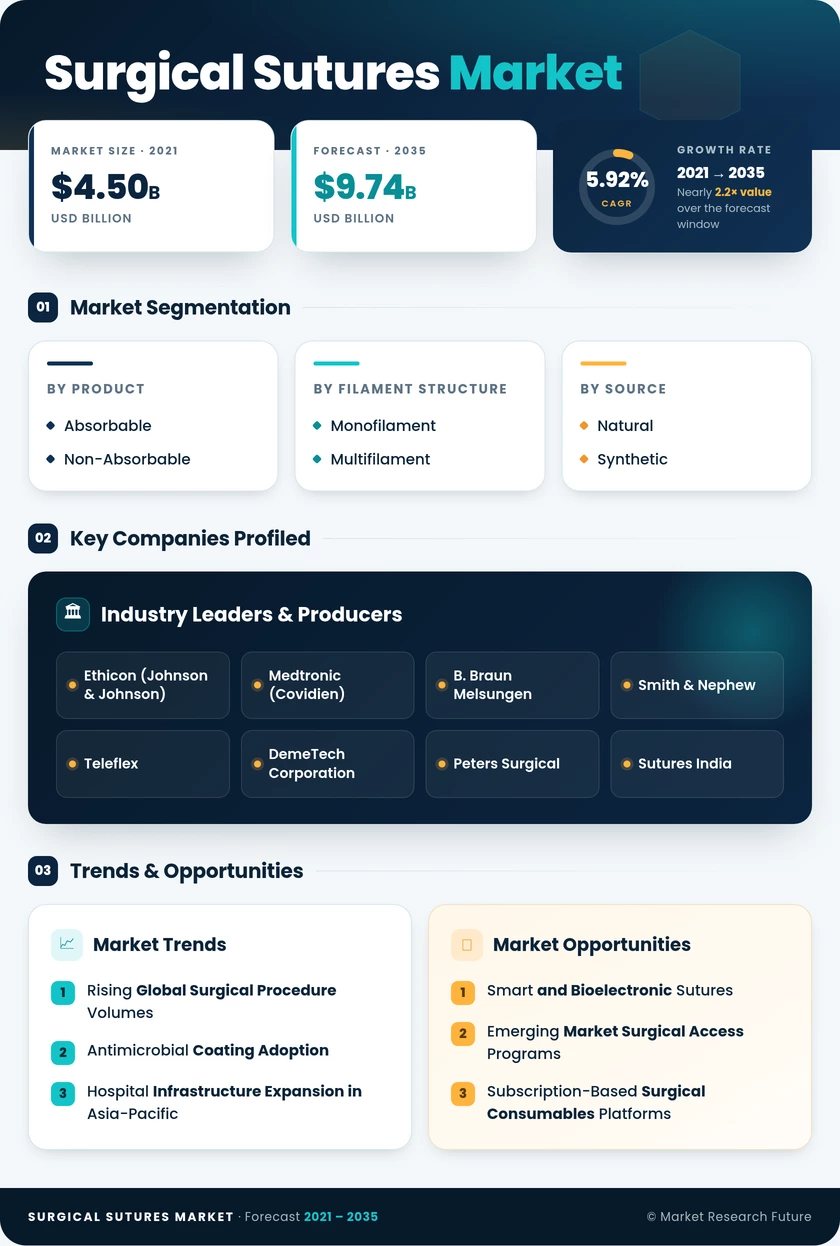
Segmentation Quick Reference
| Dimension | Sub-Segments | Dominant Segment | Fastest Growing Segment |
| Product | Absorbable, Non-Absorbable | Absorbable | Absorbable |
| Filament Structure | Monofilament, Multifilament | Monofilament | Monofilament |
| Source | Natural, Synthetic | Synthetic | Synthetic |
| Coating | Coated (Antimicrobial), Uncoated | Coated (Antimicrobial) | Coated (Antimicrobial) |
| Application | Cardiovascular, General, Orthopedic, Gynecology & Obstetrics, Ophthalmic, Plastic & Reconstructive | Cardiovascular Surgery | Plastic & Reconstructive Surgery |
| End User | Hospitals, Ambulatory Surgical Centers, Clinics & Others | Hospitals | Ambulatory Surgical Centers |
Market Segmentation Overview
By Product
| Sub-Segment | Key Trend |
| Absorbable | Shift toward engineered synthetic polymers with predictable absorption timelines replacing legacy catgut |
| Non-Absorbable | Sustained demand in cardiovascular, orthopedic, and dermatologic applications requiring permanent tensile strength |
Absorbable sutures represent the majority of demand across the Surgical Sutures Market, driven by clinical preference for products that eliminate the need for removal procedures and align with outpatient care delivery models. Non-absorbable sutures maintain critical relevance in specialties where long-term mechanical support is clinically required.
By Filament Structure
| Sub-Segment | Key Trend |
| Monofilament | Preferred for infection-prone surgical sites due to smooth surface resisting bacterial adherence |
| Multifilament | Valued for superior knot security and pliability in general and gynecological procedures |
Monofilament designs command the largest share due to infection-prevention advantages, while multifilament braided sutures retain clinical loyalty where handling characteristics and knot performance are prioritized.
By Source
| Sub-Segment | Key Trend |
| Natural | Cost-effective option in price-sensitive procurement environments; declining share globally |
| Synthetic | Consistent absorption profiles and batch uniformity driving rapid adoption across all geographies |
Synthetic polymer sutures dominate modern surgical practice because they offer reproducible tensile strength, predictable degradation rates, and reduced tissue reactivity compared to natural-origin alternatives.
By Coating
| Sub-Segment | Key Trend |
| Coated (Antimicrobial) | Clinical evidence base supporting 25–30% SSI reduction accelerating procurement mandates |
| Uncoated | Budget-tier option persisting in developing markets and low-risk surgical applications |
Antimicrobial-coated sutures have become the standard specification in hospital infection-control protocols across North America and Europe, with adoption expanding into Asia-Pacific and Latin American markets as clinical evidence gains institutional acceptance.
By Application
| Sub-Segment | Key Trend |
| Cardiovascular Surgery | High-value procedures requiring premium non-absorbable sutures with exceptional tensile strength |
| General Surgery | Largest procedure volume globally, broad suture type utilization |
| Orthopedic Surgery | Growth driven by joint replacement and sports medicine procedures |
| Gynecology & Obstetrics | Rising C-section rates and pelvic floor repair driving absorbable suture demand |
| Ophthalmic Surgery | Ultra-fine suture requirements for cataract and vitreoretinal procedures |
| Plastic & Reconstructive Surgery | Fastest-growing application segment fueled by aesthetic demand and trauma reconstruction |
Cardiovascular surgery leads by revenue share due to high procedure complexity and premium product pricing, while plastic and reconstructive surgery records the strongest growth rate driven by rising cosmetic procedure demand and advances in microsurgical techniques.
By End User
| Sub-Segment | Key Trend |
| Hospitals | Centralized procurement and complex inpatient procedures sustain dominant share |
| Ambulatory Surgical Centers | Rapid growth as outpatient procedure migration accelerates globally |
| Clinics & Others | Minor procedure volume and wound care applications |
Hospitals remain the primary procurement channel across the Surgical Sutures Market, but ambulatory surgical centers are growing fastest as health systems shift lower-acuity procedures to cost-efficient outpatient settings with streamlined consumable kits.