Request Free Sample ×

Kindly complete the form below to receive a free sample of this Report

* Please use a valid business email

Leading companies partner with us for data-driven Insights

clients tt-cursor
Hero Background
English
Chinese
French
Japanese
Korean
German
Spanish

Surface Mining Market Trends

ID: MRFR/PCM/4048-HCR
111 Pages
Varsha More
Last Updated: April 06, 2026

Surface Mining Market Research Report Information: By Type (Strip Mining, Terrace Mining, and Open-Pit Mining), Application (Coal Mining, Metal Mining, Mineral Mining) and Region- Forecast To 2035

Share:
Download PDF ×

We do not share your information with anyone. However, we may send you emails based on your report interest from time to time. You may contact us at any time to opt-out.

Surface Mining Market Infographic
Purchase Options

Market Trends

Key Emerging Trends in the Surface Mining Market

Surface mining market during the last years experienced a variety of trends, which followed the fast transformation taking place in the industry. It is worth noting that the deployment of new technologies with the objective of promoting efficiency and safety in operations is among the major tendencies. An automation powered with remote-controlled equipment is currently one of key technologies for surface mining. It helps companies to simplify processes and make working conditions safe therefore minimizing observed affect of harsh environments on people. This transformation towards technology-driven solutions has not only taught higher performance but is as well the reason for more sustainability in surface mining activities.

Among all the impacts surrounding environment, climate change is by now a key market trend shaping surface mining industry. The technology industry has been growing around the world with an extreme focus on responsible mining methods and sustainable practices by company owners who are now incorporating eco-friendly practices and technologies into their operations. Such measures include the installation of dust suppression systems, reconnection with ecosystems, and the use of renewable energy sources for powering mining processes. With such environmental regulations getting much stricter, the surface mining businesses are not only taking proactive measures to follow the sustainability goals proposed across the globe but also to enforce them.

Moreover, the mining market has thoroughly accommodated the digital revolution which has now led to the overwhelming increase in digitization and data analytics. Data management systems are able to collect, analyze, convert, and utilize based on information and empirical evidence for better decisions by the mining firms. Ranging from the more comprehensive recording of the extraction procedures as well as predictive maintenance of equipment, data for insights is the leading way from efficiency gains to cost reduction. Introduction of digital technologies has turned Surface mining into a data driven industry and paradoxically made it more technology-prone.

Moreover, world wide-economic terms have their effect on market of surface mining, because of the fact, that the condition of commodity is volatile and by that influence the rate of development in this industry. The stakeholders in the industry are now well adapted to the changes in the prices of commodities and are adjusting their strategies to cope with the changing prices. Furthermore, geopolitics has an effect on trade, as well as infrastructure development while also having a substantial effect on the source of the otherwise necessary surface mined minerals and resources. The surface mine markets dynamics is related to the economic position of the country; therefore a mining firm should be responsive and trade within the dynamic market trends.

Safety has been a long-lasting target for surface mining sector which, based on the new trends, will not be changed and no new plans for improving workers safety and safety. Use of these cutting edge technologies including real-time monitoring mechanisms, wearable equipment, and predictive modeling plays a key role in improving the safety procedures and reducing the likelihood of accidents. Firms are investing in the training and the protection programs so as to build a system of consciousness and responsibility, putting their workers welfare first.


Author
Author Profile
Varsha More
Senior Research Analyst

Experienced business professional with a demonstrated history of working in the CFnB industry. Skilled in market research, and market estimation. Strong professional with a Masters focused in marketing management.

Leave a Comment

FAQs

What is the current valuation of the Surface Mining Market in 2025?

<p>The Surface Mining Market is valued at approximately 9.24 USD Billion in 2024.</p>

What is the projected market size for the Surface Mining Market by 2035?

<p>The market is expected to reach a valuation of 12.89 USD Billion by 2035.</p>

What is the expected CAGR for the Surface Mining Market during the forecast period 2025 - 2035?

<p>The anticipated CAGR for the Surface Mining Market during the forecast period is 3.07%.</p>

Which companies are considered key players in the Surface Mining Market?

Key players in the market include BHP, Rio Tinto, Vale, Anglo American, Freeport-McMoRan, Southern Copper Corporation, Teck Resources, Newmont Corporation, and Barrick Gold Corporation.

What are the main types of surface mining and their market valuations?

The main types include Strip Mining valued at 5.1 USD Billion, Open Pit Mining at 5.5 USD Billion, and Terrace Mining at 2.29 USD Billion.

How does the Surface Mining Market segment by application?

The market segments by application include Coal Mining at 4.0 USD Billion, Metal Mining at 4.5 USD Billion, and Mineral Mining at 4.39 USD Billion.

What are the key categories of equipment used in surface mining?

Key categories include Excavators valued at 2.0 USD Billion, Automated Equipment at 1.1 USD Billion, and Software at 1.5 USD Billion.

What is the significance of automated equipment in the Surface Mining Market?

Automated Equipment is projected to grow from 0.8 USD Billion to 1.1 USD Billion, indicating a rising trend towards automation.

How does the Surface Mining Market's growth compare across different segments?

The market shows varied growth, with Metal Mining and Software segments likely experiencing robust increases compared to others.

What trends are expected to shape the Surface Mining Market in the coming years?

Trends may include increased automation, enhanced safety systems, and a focus on sustainability, influencing market dynamics through 2035.

Market Summary

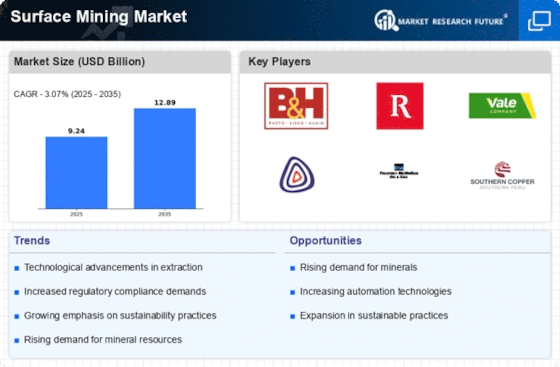
As per Market Research Future analysis, the Surface Mining Market Size was estimated at 9.24 USD Billion in 2024. The Surface Mining industry is projected to grow from 9.524 USD Billion in 2025 to 12.89 USD Billion by 2035, exhibiting a compound annual growth rate (CAGR) of 3.07% during the forecast period 2025 - 2035

Key Market Trends & Highlights

The Surface Mining Market is poised for growth driven by technological advancements and increasing demand for minerals.

  • Technological advancements are reshaping operational efficiencies in the North American surface mining sector. Sustainability initiatives are gaining traction, particularly in the Asia-Pacific region, as companies seek to minimize environmental impact. Digital transformation is becoming essential for enhancing productivity in both strip mining and open pit mining segments. Rising demand for minerals and infrastructure development projects are key drivers propelling market expansion.

Market Size & Forecast

2024 Market Size 9.24 (USD Billion)
2035 Market Size 12.89 (USD Billion)
CAGR (2025 - 2035) 3.07%
Largest Regional Market Share in 2024 Asia Pacific

Major Players

BHP (AU), Rio Tinto (GB), Vale (BR), Anglo American (GB), Freeport-McMoRan (US), Southern Copper Corporation (US), Teck Resources (CA), Newmont Corporation (US), Barrick Gold Corporation (CA)

Market Trends

The Surface Mining Market is currently experiencing a dynamic evolution, driven by various factors that shape its landscape. The increasing demand for minerals and resources, coupled with advancements in technology, appears to be propelling growth in this sector. Companies are increasingly adopting innovative techniques and equipment to enhance efficiency and reduce environmental impact. Furthermore, regulatory frameworks are evolving, which may influence operational practices and investment strategies within the market. As sustainability becomes a focal point, stakeholders are likely to prioritize eco-friendly practices, potentially reshaping the competitive dynamics of the industry. In addition, the Surface Mining Market is witnessing a shift towards automation and digitalization. This trend suggests that companies are investing in smart technologies to optimize operations and improve safety standards. The integration of data analytics and artificial intelligence could lead to more informed decision-making processes, enhancing productivity. Overall, the Surface Mining Market appears poised for continued transformation, with emerging technologies and sustainability initiatives likely to play pivotal roles in its future development.

Technological Advancements

The Surface Mining Market is increasingly influenced by technological innovations. Companies are adopting advanced machinery and automated systems to enhance operational efficiency. These developments not only streamline processes but also contribute to improved safety and reduced environmental impact.

Sustainability Initiatives

There is a growing emphasis on sustainability within the Surface Mining Market. Stakeholders are prioritizing eco-friendly practices, which may lead to the adoption of greener technologies and methods. This shift reflects a broader commitment to minimizing the ecological footprint of mining activities.

Digital Transformation

The integration of digital technologies is reshaping the Surface Mining Market. Companies are leveraging data analytics and artificial intelligence to optimize operations. This trend indicates a move towards more informed decision-making, potentially enhancing productivity and operational effectiveness.

Surface Mining Market Market Drivers

Rising Demand for Minerals

The Surface Mining Market is experiencing a notable increase in demand for minerals, driven by the expansion of various sectors such as construction, automotive, and electronics. As urbanization accelerates, the need for raw materials like copper, gold, and coal intensifies. According to recent data, the demand for copper alone is projected to rise by approximately 25% by 2030, primarily due to its essential role in renewable energy technologies. This surge in demand compels mining companies to enhance their extraction capabilities, thereby propelling growth within the Surface Mining Market. Furthermore, the increasing reliance on advanced materials in manufacturing processes further underscores the necessity for efficient surface mining operations.

Infrastructure Development Projects

Infrastructure development projects are a critical driver for the Surface Mining Market, as governments and private entities invest heavily in building roads, bridges, and other essential facilities. The construction sector's growth is closely linked to the availability of mined materials, which are fundamental for concrete, asphalt, and other construction components. Recent reports indicate that infrastructure spending is expected to reach trillions of dollars over the next decade, particularly in emerging economies. This investment not only stimulates demand for minerals but also encourages the adoption of innovative mining techniques to meet the increasing material requirements. Consequently, the Surface Mining Market stands to benefit significantly from this trend.

Regulatory Framework and Compliance

The regulatory framework surrounding the Surface Mining Market is evolving, with governments implementing stricter environmental and safety regulations. These regulations aim to mitigate the ecological impact of mining activities and ensure the safety of workers. Compliance with these regulations often necessitates investment in cleaner technologies and sustainable practices, which can initially increase operational costs. However, companies that adapt to these regulations may gain a competitive advantage by appealing to environmentally conscious consumers and investors. Furthermore, adherence to regulatory standards can lead to long-term operational sustainability, positioning firms favorably within the Surface Mining Market.

Technological Innovations in Mining

Technological innovations are reshaping the Surface Mining Market, enhancing efficiency and safety in operations. The integration of automation, artificial intelligence, and advanced data analytics is revolutionizing traditional mining practices. For instance, the use of autonomous trucks and drones for surveying and monitoring has shown to increase productivity by up to 30%. Moreover, the implementation of real-time data analytics allows for better decision-making and resource management, reducing operational costs. As mining companies seek to optimize their processes and minimize environmental impact, these technological advancements are likely to play a pivotal role in the future of the Surface Mining Market.

Increased Investment in Mining Projects

Increased investment in mining projects is a significant driver for the Surface Mining Market, as both public and private sectors recognize the potential for high returns. Investment in exploration and development of new mining sites is crucial for meeting the rising demand for minerals. Recent trends indicate that investment in mining projects has surged, with funding reaching unprecedented levels in various regions. This influx of capital not only facilitates the expansion of existing operations but also encourages the development of new technologies and practices. As a result, the Surface Mining Market is poised for growth, driven by this renewed interest and investment in mining activities.

Market Segment Insights

By Type: Strip Mining (Largest) vs. Open Pit Mining (Fastest-Growing)

In the Surface Mining Market, the segment values showcase a diverse landscape where Strip Mining currently holds the largest share. This method dominates the market due to its operational efficiency and lower production costs, making it a preferred choice for extracting minerals in extensive deposits. Meanwhile, Open Pit Mining, while slightly smaller in market share, has been gaining traction and is identified as the fastest-growing method in recent years, driving interest and investment from major mining companies. Growth in the Surface Mining Market is influenced by various factors, including technological advancements and the rising demand for minerals in other industries. Open Pit Mining is benefiting from improved excavation techniques and the accessibility of deeper reserves, thereby increasing productivity rates. Additionally, environmental regulations and industry trends towards sustainability are prompting a shift towards these mining methods, with companies seeking to adapt and innovate to meet market demands.

Mining Techniques: Strip Mining (Dominant) vs. Terrace Mining (Emerging)

Strip Mining stands out as the dominant technique in the Surface Mining Market, characterized by its large-scale operations, which involve removing overburden material to access mineral deposits near the surface. This method is particularly efficient for minerals with horizontal and extensive deposits, allowing for increased productivity and cost-effectiveness. However, Terrace Mining is emerging as a viable alternative, particularly in regions where traditional methods face environmental limitations. This technique employs a step-like approach, adapting to challenging terrains, and offers environmental benefits by minimizing land disturbance. As the mining industry evolves, both techniques will need to align with sustainability efforts while maintaining operational efficiency.

By Application: Coal Mining (Largest) vs. Metal Mining (Fastest-Growing)

The Surface Mining Market exhibits a diverse application segment whereby coal mining stands out as the largest contributor to market share. This sector, driven by ongoing demand for energy generation and industrial applications, has maintained a significant lead over its counterparts. Metal mining also holds a noteworthy position, capturing a growing share due to the increasing need for metals in various industries such as automotive and <a href="https://www.marketresearchfuture.com/reports/construction-market-16065">construction</a>. Mineral mining, while important, remains comparatively smaller within the overall landscape of surface mining applications.

Coal Mining: Dominant vs. Metal Mining: Emerging

Coal mining has long been the dominant application in the Surface Mining Market, propelled by its critical role in energy production and its established infrastructure. With vast reserves globally, coal mining operations benefit from mature technologies and extensive experience, contributing to efficient extraction processes. Conversely, metal mining is categorized as an emerging application, capturing heightened interest due to the resurgence in global industrial activity and the green energy transition. The demand for essential metals like copper, lithium, and gold is expected to grow significantly, paving the way for innovative extraction and processing techniques that will elevate this sector's market presence.

By Category: Automated Equipment (Largest) vs. Software (Fastest-Growing)

In the Surface Mining Market, the 'Category' segment displays a varied distribution among its values. Automated Equipment emerges as the largest value, attributing its leading position to increased operational efficiency and enhanced safety protocols in mining operations. Other significant players include Excavators and Drillers and Breakers, while Software solutions illustrate an expanding niche, showcasing the importance of data analytics and operational management in optimizing performance.

Technology: Automated Equipment (Dominant) vs. Software (Emerging)

Automated Equipment plays a pivotal role in the Surface Mining Market, characterized by its ability to enhance productivity and safety while minimizing labor costs. This segment encompasses advanced machinery and robotics designed for various mining tasks, like drilling, hauling, and excavation. On the other hand, Software solutions are emerging as a critical component, focusing on data management, analytics, and operational support. These technological advancements are catering to the industry's shift toward digitalization and real-time decision-making, driving their rapid adoption. As environmental concerns rise, both segments are under pressure to innovate, with Software solutions potentially reshaping operational paradigms through the integration of intelligent systems and connectivity solutions.

Get more detailed insights about Surface Mining Market Research Report - Forecast To 2035

Regional Insights

North America : Resource-Rich Powerhouse

North America is witnessing robust growth in the surface mining market, driven by increasing demand for minerals and metals, particularly copper and gold. The region holds approximately 35% of the global market share, with the United States being the largest contributor, followed by Canada. Regulatory support for sustainable mining practices and technological advancements are further propelling market growth. The competitive landscape is dominated by key players such as Freeport-McMoRan, Southern Copper Corporation, and Newmont Corporation. These companies are leveraging advanced technologies to enhance operational efficiency and reduce environmental impact. The presence of rich mineral deposits, coupled with a strong regulatory framework, positions North America as a leader in the surface mining sector.

Europe : Innovative Mining Landscape

Europe is emerging as a significant player in the surface mining market, with a focus on sustainable mining practices and regulatory compliance. The region accounts for approximately 25% of the global market share, with countries like Germany and Sweden leading the charge. The European Union's stringent regulations on environmental protection and resource management are acting as catalysts for innovation and investment in the sector. Leading companies such as Anglo American and Rio Tinto are actively investing in sustainable technologies to minimize their environmental footprint. The competitive landscape is characterized by a mix of established players and emerging firms, all striving to meet the growing demand for responsibly sourced minerals. This focus on sustainability is expected to drive further growth in the coming years.

Asia-Pacific : Emerging Market Dynamics

Asia-Pacific is rapidly becoming a powerhouse in the surface mining market, driven by increasing industrialization and urbanization. The region holds around 30% of the global market share, with China and Australia being the largest contributors. Government initiatives aimed at boosting mineral exploration and extraction are fueling demand, while regulatory frameworks are evolving to support sustainable practices in mining operations. The competitive landscape features major players like BHP and Vale, who are investing heavily in technology and innovation to enhance productivity. The presence of vast mineral resources, coupled with a growing demand for metals, positions Asia-Pacific as a critical region for future growth in the surface mining market. Companies are also focusing on partnerships and collaborations to strengthen their market presence.

Middle East and Africa : Resource-Rich Frontier

The Middle East and Africa region is poised for significant growth in the surface mining market, driven by abundant natural resources and increasing foreign investments. This region accounts for approximately 10% of the global market share, with South Africa and Botswana leading in mineral production. Government initiatives aimed at attracting investment and improving infrastructure are key drivers of market expansion. The competitive landscape is characterized by a mix of local and international players, with companies like Barrick Gold Corporation and Teck Resources actively exploring opportunities. The region's rich mineral deposits, particularly in gold and diamonds, present substantial growth potential. As regulatory frameworks continue to evolve, the market is expected to attract more investments and technological advancements.

Key Players and Competitive Insights

The Surface Mining Market is currently characterized by a dynamic competitive landscape, driven by a confluence of technological advancements, sustainability initiatives, and strategic partnerships. Major players such as BHP (AU), Rio Tinto (GB), and Vale (BR) are actively reshaping their operational focus to enhance efficiency and reduce environmental impact. BHP (AU) has been particularly proactive in integrating digital technologies into its operations, which not only streamlines processes but also optimizes resource extraction. Meanwhile, Rio Tinto (GB) emphasizes sustainability, aiming to achieve net-zero emissions by 2050, which influences its investment strategies and operational methodologies. Collectively, these strategies foster a competitive environment that prioritizes innovation and environmental stewardship, setting a precedent for industry practices.

In terms of business tactics, companies are increasingly localizing manufacturing and optimizing supply chains to enhance resilience and responsiveness to market demands. The Surface Mining Market appears moderately fragmented, with a mix of large multinational corporations and smaller regional players. The collective influence of key players, such as Freeport-McMoRan (US) and Anglo American (GB), contributes to a competitive structure that encourages collaboration and innovation, particularly in the realms of technology and sustainability.

In August 2025, Freeport-McMoRan (US) announced a strategic partnership with a leading technology firm to develop AI-driven solutions for predictive maintenance in mining operations. This initiative is poised to enhance operational efficiency and reduce downtime, reflecting a broader trend towards digital transformation in the industry. The integration of AI technologies not only streamlines operations but also aligns with the company's commitment to sustainability by minimizing resource waste.

In September 2025, Vale (BR) unveiled its ambitious plan to invest in renewable energy sources for its mining operations, aiming to reduce its carbon footprint significantly. This strategic move underscores the growing importance of sustainability in the mining sector and positions Vale as a leader in environmentally responsible mining practices. By investing in renewable energy, Vale not only addresses regulatory pressures but also appeals to a market increasingly concerned with environmental impact.

In October 2025, Anglo American (GB) launched a new initiative focused on enhancing community engagement and local workforce development in its mining regions. This initiative is strategically significant as it fosters goodwill and strengthens relationships with local stakeholders, which is essential for long-term operational success. By prioritizing community involvement, Anglo American (GB) not only enhances its corporate social responsibility profile but also secures its social license to operate in various regions.

As of October 2025, the Surface Mining Market is witnessing a pronounced shift towards digitalization, sustainability, and AI integration. These trends are reshaping competitive dynamics, with strategic alliances becoming increasingly vital for innovation and operational efficiency. The focus appears to be shifting from traditional price-based competition to a more nuanced approach that emphasizes technological advancement, sustainability, and supply chain reliability. This evolution suggests that companies that can effectively differentiate themselves through innovation and responsible practices are likely to thrive in the future.

Key Companies in the Surface Mining Market include

Industry Developments

  • Cisco unveiled a new networking solution that is designed to endure the rigors of the most demanding environments while also giving IT and OT teams with intent-based networking capabilities to scale and expedite IoT
  • AppDynamics, a Cisco subsidiary that specializes in application intelligence, has launched the AppDynamics Integration Partner Program, a new partnership program that aims to simplify the fast-increasing technological ecosystem for businesses by partnering with premier technology companies.
  • The ABB Ability Operations Management System was launched for real-time integration in underground and open-pit mines by the business ABB. It boosts productivity, improves efficiency, and maximizes productivity by maximizing coordination between dynamic situations and weekly production schedules in mining.

Future Outlook

Surface Mining Market Future Outlook

The Surface Mining Market is projected to grow at a 3.07% CAGR from 2025 to 2035, driven by technological advancements, increasing demand for minerals, and sustainable practices.

New opportunities lie in:

  • <p>Integration of AI-driven predictive maintenance solutions Development of eco-friendly mining equipment Expansion into emerging markets with untapped mineral resources</p>

By 2035, the Surface Mining Market is expected to achieve robust growth, reflecting evolving industry dynamics.

Market Segmentation

Surface Mining Market Type Outlook

  • Strip Mining
  • Open Pit Mining
  • Terrace Mining

Surface Mining Market Category Outlook

  • Automated Equipment
  • Excavator
  • Robotic Truck
  • Driller and Breaker
  • Load Haul Pump
  • Component
  • Hardware
  • Sensors
  • RFID Tags
  • Intelligent Systems
  • Software
  • Data and operation management software
  • Safety and Security Systems
  • Connectivity Solutions
  • Analytics Solutions
  • Services
  • Support and Maintenance (Engineering Service)
  • System integration (Deployment Service)
  • Consulting Services

Surface Mining Market Application Outlook

  • Coal Mining
  • Metal Mining
  • Mineral Mining

Report Scope

MARKET SIZE 2024 9.24(USD Billion)
MARKET SIZE 2025 9.524(USD Billion)
MARKET SIZE 2035 12.89(USD Billion)
COMPOUND ANNUAL GROWTH RATE (CAGR) 3.07% (2025 - 2035)
REPORT COVERAGE Revenue Forecast, Competitive Landscape, Growth Factors, and Trends
BASE YEAR 2024
Market Forecast Period 2025 - 2035
Historical Data 2019 - 2024
Market Forecast Units USD Billion
Key Companies Profiled BHP (AU), Rio Tinto (GB), Vale (BR), Anglo American (GB), Freeport-McMoRan (US), Southern Copper Corporation (US), Teck Resources (CA), Newmont Corporation (US), Barrick Gold Corporation (CA)
Segments Covered Type
Key Market Opportunities Adoption of automation and digital technologies enhances efficiency in the Surface Mining Market.
Key Market Dynamics Technological advancements and regulatory changes are reshaping operational efficiencies in the surface mining sector.
Countries Covered North America, Europe, APAC, South America, MEA

FAQs

What is the current valuation of the Surface Mining Market in 2025?

<p>The Surface Mining Market is valued at approximately 9.24 USD Billion in 2024.</p>

What is the projected market size for the Surface Mining Market by 2035?

<p>The market is expected to reach a valuation of 12.89 USD Billion by 2035.</p>

What is the expected CAGR for the Surface Mining Market during the forecast period 2025 - 2035?

<p>The anticipated CAGR for the Surface Mining Market during the forecast period is 3.07%.</p>

Which companies are considered key players in the Surface Mining Market?

Key players in the market include BHP, Rio Tinto, Vale, Anglo American, Freeport-McMoRan, Southern Copper Corporation, Teck Resources, Newmont Corporation, and Barrick Gold Corporation.

What are the main types of surface mining and their market valuations?

The main types include Strip Mining valued at 5.1 USD Billion, Open Pit Mining at 5.5 USD Billion, and Terrace Mining at 2.29 USD Billion.

How does the Surface Mining Market segment by application?

The market segments by application include Coal Mining at 4.0 USD Billion, Metal Mining at 4.5 USD Billion, and Mineral Mining at 4.39 USD Billion.

What are the key categories of equipment used in surface mining?

Key categories include Excavators valued at 2.0 USD Billion, Automated Equipment at 1.1 USD Billion, and Software at 1.5 USD Billion.

What is the significance of automated equipment in the Surface Mining Market?

Automated Equipment is projected to grow from 0.8 USD Billion to 1.1 USD Billion, indicating a rising trend towards automation.

How does the Surface Mining Market's growth compare across different segments?

The market shows varied growth, with Metal Mining and Software segments likely experiencing robust increases compared to others.

What trends are expected to shape the Surface Mining Market in the coming years?

Trends may include increased automation, enhanced safety systems, and a focus on sustainability, influencing market dynamics through 2035.

  1. SECTION I: EXECUTIVE SUMMARY AND KEY HIGHLIGHTS
    1. | 1.1 EXECUTIVE SUMMARY
    2. | | 1.1.1 Market Overview
    3. | | 1.1.2 Key Findings
    4. | | 1.1.3 Market Segmentation
    5. | | 1.1.4 Competitive Landscape
    6. | | 1.1.5 Challenges and Opportunities
    7. | | 1.1.6 Future Outlook
  2. SECTION II: SCOPING, METHODOLOGY AND MARKET STRUCTURE
    1. | 2.1 MARKET INTRODUCTION
    2. | | 2.1.1 Definition
    3. | | 2.1.2 Scope of the study
    4. | | | 2.1.2.1 Research Objective
    5. | | | 2.1.2.2 Assumption
    6. | | | 2.1.2.3 Limitations
    7. | 2.2 RESEARCH METHODOLOGY
    8. | | 2.2.1 Overview
    9. | | 2.2.2 Data Mining
    10. | | 2.2.3 Secondary Research
    11. | | 2.2.4 Primary Research
    12. | | | 2.2.4.1 Primary Interviews and Information Gathering Process
    13. | | | 2.2.4.2 Breakdown of Primary Respondents
    14. | | 2.2.5 Forecasting Model
    15. | | 2.2.6 Market Size Estimation
    16. | | | 2.2.6.1 Bottom-Up Approach
    17. | | | 2.2.6.2 Top-Down Approach
    18. | | 2.2.7 Data Triangulation
    19. | | 2.2.8 Validation
  3. SECTION III: QUALITATIVE ANALYSIS
    1. | 3.1 MARKET DYNAMICS
    2. | | 3.1.1 Overview
    3. | | 3.1.2 Drivers
    4. | | 3.1.3 Restraints
    5. | | 3.1.4 Opportunities
    6. | 3.2 MARKET FACTOR ANALYSIS
    7. | | 3.2.1 Value chain Analysis
    8. | | 3.2.2 Porter's Five Forces Analysis
    9. | | | 3.2.2.1 Bargaining Power of Suppliers
    10. | | | 3.2.2.2 Bargaining Power of Buyers
    11. | | | 3.2.2.3 Threat of New Entrants
    12. | | | 3.2.2.4 Threat of Substitutes
    13. | | | 3.2.2.5 Intensity of Rivalry
    14. | | 3.2.3 COVID-19 Impact Analysis
    15. | | | 3.2.3.1 Market Impact Analysis
    16. | | | 3.2.3.2 Regional Impact
    17. | | | 3.2.3.3 Opportunity and Threat Analysis
  4. SECTION IV: QUANTITATIVE ANALYSIS
    1. | 4.1 Packaging & Transport, BY Type (USD Billion)
    2. | | 4.1.1 Strip Mining
    3. | | 4.1.2 Open Pit Mining
    4. | | 4.1.3 Terrace Mining
    5. | 4.2 Packaging & Transport, BY Application (USD Billion)
    6. | | 4.2.1 Coal Mining
    7. | | 4.2.2 Metal Mining
    8. | | 4.2.3 Mineral Mining
    9. | 4.3 Packaging & Transport, BY Category (USD Billion)
    10. | | 4.3.1 Automated Equipment
    11. | | 4.3.2 Excavator
    12. | | 4.3.3 Robotic Truck
    13. | | 4.3.4 Driller and Breaker
    14. | | 4.3.5 Load Haul Pump
    15. | | 4.3.6 Component
    16. | | 4.3.7 Hardware
    17. | | 4.3.8 Sensors
    18. | | 4.3.9 RFID Tags
    19. | | 4.3.10 Intelligent Systems
    20. | | 4.3.11 Software
    21. | | 4.3.12 Data and operation management software
    22. | | 4.3.13 Safety and Security Systems
    23. | | 4.3.14 Connectivity Solutions
    24. | | 4.3.15 Analytics Solutions
    25. | | 4.3.16 Services
    26. | | 4.3.17 Support and Maintenance (Engineering Service)
    27. | | 4.3.18 System integration (Deployment Service)
    28. | | 4.3.19 Consulting Services
    29. | 4.4 Packaging & Transport, BY Region (USD Billion)
    30. | | 4.4.1 North America
    31. | | | 4.4.1.1 US
    32. | | | 4.4.1.2 Canada
    33. | | 4.4.2 Europe
    34. | | | 4.4.2.1 Germany
    35. | | | 4.4.2.2 UK
    36. | | | 4.4.2.3 France
    37. | | | 4.4.2.4 Russia
    38. | | | 4.4.2.5 Italy
    39. | | | 4.4.2.6 Spain
    40. | | | 4.4.2.7 Rest of Europe
    41. | | 4.4.3 APAC
    42. | | | 4.4.3.1 China
    43. | | | 4.4.3.2 India
    44. | | | 4.4.3.3 Japan
    45. | | | 4.4.3.4 South Korea
    46. | | | 4.4.3.5 Malaysia
    47. | | | 4.4.3.6 Thailand
    48. | | | 4.4.3.7 Indonesia
    49. | | | 4.4.3.8 Rest of APAC
    50. | | 4.4.4 South America
    51. | | | 4.4.4.1 Brazil
    52. | | | 4.4.4.2 Mexico
    53. | | | 4.4.4.3 Argentina
    54. | | | 4.4.4.4 Rest of South America
    55. | | 4.4.5 MEA
    56. | | | 4.4.5.1 GCC Countries
    57. | | | 4.4.5.2 South Africa
    58. | | | 4.4.5.3 Rest of MEA
  5. SECTION V: COMPETITIVE ANALYSIS
    1. | 5.1 Competitive Landscape
    2. | | 5.1.1 Overview
    3. | | 5.1.2 Competitive Analysis
    4. | | 5.1.3 Market share Analysis
    5. | | 5.1.4 Major Growth Strategy in the Packaging & Transport
    6. | | 5.1.5 Competitive Benchmarking
    7. | | 5.1.6 Leading Players in Terms of Number of Developments in the Packaging & Transport
    8. | | 5.1.7 Key developments and growth strategies
    9. | | | 5.1.7.1 New Product Launch/Service Deployment
    10. | | | 5.1.7.2 Merger & Acquisitions
    11. | | | 5.1.7.3 Joint Ventures
    12. | | 5.1.8 Major Players Financial Matrix
    13. | | | 5.1.8.1 Sales and Operating Income
    14. | | | 5.1.8.2 Major Players R&D Expenditure. 2023
    15. | 5.2 Company Profiles
    16. | | 5.2.1 BHP (AU)
    17. | | | 5.2.1.1 Financial Overview
    18. | | | 5.2.1.2 Products Offered
    19. | | | 5.2.1.3 Key Developments
    20. | | | 5.2.1.4 SWOT Analysis
    21. | | | 5.2.1.5 Key Strategies
    22. | | 5.2.2 Rio Tinto (GB)
    23. | | | 5.2.2.1 Financial Overview
    24. | | | 5.2.2.2 Products Offered
    25. | | | 5.2.2.3 Key Developments
    26. | | | 5.2.2.4 SWOT Analysis
    27. | | | 5.2.2.5 Key Strategies
    28. | | 5.2.3 Vale (BR)
    29. | | | 5.2.3.1 Financial Overview
    30. | | | 5.2.3.2 Products Offered
    31. | | | 5.2.3.3 Key Developments
    32. | | | 5.2.3.4 SWOT Analysis
    33. | | | 5.2.3.5 Key Strategies
    34. | | 5.2.4 Anglo American (GB)
    35. | | | 5.2.4.1 Financial Overview
    36. | | | 5.2.4.2 Products Offered
    37. | | | 5.2.4.3 Key Developments
    38. | | | 5.2.4.4 SWOT Analysis
    39. | | | 5.2.4.5 Key Strategies
    40. | | 5.2.5 Freeport-McMoRan (US)
    41. | | | 5.2.5.1 Financial Overview
    42. | | | 5.2.5.2 Products Offered
    43. | | | 5.2.5.3 Key Developments
    44. | | | 5.2.5.4 SWOT Analysis
    45. | | | 5.2.5.5 Key Strategies
    46. | | 5.2.6 Southern Copper Corporation (US)
    47. | | | 5.2.6.1 Financial Overview
    48. | | | 5.2.6.2 Products Offered
    49. | | | 5.2.6.3 Key Developments
    50. | | | 5.2.6.4 SWOT Analysis
    51. | | | 5.2.6.5 Key Strategies
    52. | | 5.2.7 Teck Resources (CA)
    53. | | | 5.2.7.1 Financial Overview
    54. | | | 5.2.7.2 Products Offered
    55. | | | 5.2.7.3 Key Developments
    56. | | | 5.2.7.4 SWOT Analysis
    57. | | | 5.2.7.5 Key Strategies
    58. | | 5.2.8 Newmont Corporation (US)
    59. | | | 5.2.8.1 Financial Overview
    60. | | | 5.2.8.2 Products Offered
    61. | | | 5.2.8.3 Key Developments
    62. | | | 5.2.8.4 SWOT Analysis
    63. | | | 5.2.8.5 Key Strategies
    64. | | 5.2.9 Barrick Gold Corporation (CA)
    65. | | | 5.2.9.1 Financial Overview
    66. | | | 5.2.9.2 Products Offered
    67. | | | 5.2.9.3 Key Developments
    68. | | | 5.2.9.4 SWOT Analysis
    69. | | | 5.2.9.5 Key Strategies
    70. | 5.3 Appendix
    71. | | 5.3.1 References
    72. | | 5.3.2 Related Reports
  6. LIST OF FIGURES
    1. | 6.1 MARKET SYNOPSIS
    2. | 6.2 NORTH AMERICA MARKET ANALYSIS
    3. | 6.3 US MARKET ANALYSIS BY TYPE
    4. | 6.4 US MARKET ANALYSIS BY APPLICATION
    5. | 6.5 US MARKET ANALYSIS BY CATEGORY
    6. | 6.6 CANADA MARKET ANALYSIS BY TYPE
    7. | 6.7 CANADA MARKET ANALYSIS BY APPLICATION
    8. | 6.8 CANADA MARKET ANALYSIS BY CATEGORY
    9. | 6.9 EUROPE MARKET ANALYSIS
    10. | 6.10 GERMANY MARKET ANALYSIS BY TYPE
    11. | 6.11 GERMANY MARKET ANALYSIS BY APPLICATION
    12. | 6.12 GERMANY MARKET ANALYSIS BY CATEGORY
    13. | 6.13 UK MARKET ANALYSIS BY TYPE
    14. | 6.14 UK MARKET ANALYSIS BY APPLICATION
    15. | 6.15 UK MARKET ANALYSIS BY CATEGORY
    16. | 6.16 FRANCE MARKET ANALYSIS BY TYPE
    17. | 6.17 FRANCE MARKET ANALYSIS BY APPLICATION
    18. | 6.18 FRANCE MARKET ANALYSIS BY CATEGORY
    19. | 6.19 RUSSIA MARKET ANALYSIS BY TYPE
    20. | 6.20 RUSSIA MARKET ANALYSIS BY APPLICATION
    21. | 6.21 RUSSIA MARKET ANALYSIS BY CATEGORY
    22. | 6.22 ITALY MARKET ANALYSIS BY TYPE
    23. | 6.23 ITALY MARKET ANALYSIS BY APPLICATION
    24. | 6.24 ITALY MARKET ANALYSIS BY CATEGORY
    25. | 6.25 SPAIN MARKET ANALYSIS BY TYPE
    26. | 6.26 SPAIN MARKET ANALYSIS BY APPLICATION
    27. | 6.27 SPAIN MARKET ANALYSIS BY CATEGORY
    28. | 6.28 REST OF EUROPE MARKET ANALYSIS BY TYPE
    29. | 6.29 REST OF EUROPE MARKET ANALYSIS BY APPLICATION
    30. | 6.30 REST OF EUROPE MARKET ANALYSIS BY CATEGORY
    31. | 6.31 APAC MARKET ANALYSIS
    32. | 6.32 CHINA MARKET ANALYSIS BY TYPE
    33. | 6.33 CHINA MARKET ANALYSIS BY APPLICATION
    34. | 6.34 CHINA MARKET ANALYSIS BY CATEGORY
    35. | 6.35 INDIA MARKET ANALYSIS BY TYPE
    36. | 6.36 INDIA MARKET ANALYSIS BY APPLICATION
    37. | 6.37 INDIA MARKET ANALYSIS BY CATEGORY
    38. | 6.38 JAPAN MARKET ANALYSIS BY TYPE
    39. | 6.39 JAPAN MARKET ANALYSIS BY APPLICATION
    40. | 6.40 JAPAN MARKET ANALYSIS BY CATEGORY
    41. | 6.41 SOUTH KOREA MARKET ANALYSIS BY TYPE
    42. | 6.42 SOUTH KOREA MARKET ANALYSIS BY APPLICATION
    43. | 6.43 SOUTH KOREA MARKET ANALYSIS BY CATEGORY
    44. | 6.44 MALAYSIA MARKET ANALYSIS BY TYPE
    45. | 6.45 MALAYSIA MARKET ANALYSIS BY APPLICATION
    46. | 6.46 MALAYSIA MARKET ANALYSIS BY CATEGORY
    47. | 6.47 THAILAND MARKET ANALYSIS BY TYPE
    48. | 6.48 THAILAND MARKET ANALYSIS BY APPLICATION
    49. | 6.49 THAILAND MARKET ANALYSIS BY CATEGORY
    50. | 6.50 INDONESIA MARKET ANALYSIS BY TYPE
    51. | 6.51 INDONESIA MARKET ANALYSIS BY APPLICATION
    52. | 6.52 INDONESIA MARKET ANALYSIS BY CATEGORY
    53. | 6.53 REST OF APAC MARKET ANALYSIS BY TYPE
    54. | 6.54 REST OF APAC MARKET ANALYSIS BY APPLICATION
    55. | 6.55 REST OF APAC MARKET ANALYSIS BY CATEGORY
    56. | 6.56 SOUTH AMERICA MARKET ANALYSIS
    57. | 6.57 BRAZIL MARKET ANALYSIS BY TYPE
    58. | 6.58 BRAZIL MARKET ANALYSIS BY APPLICATION
    59. | 6.59 BRAZIL MARKET ANALYSIS BY CATEGORY
    60. | 6.60 MEXICO MARKET ANALYSIS BY TYPE
    61. | 6.61 MEXICO MARKET ANALYSIS BY APPLICATION
    62. | 6.62 MEXICO MARKET ANALYSIS BY CATEGORY
    63. | 6.63 ARGENTINA MARKET ANALYSIS BY TYPE
    64. | 6.64 ARGENTINA MARKET ANALYSIS BY APPLICATION
    65. | 6.65 ARGENTINA MARKET ANALYSIS BY CATEGORY
    66. | 6.66 REST OF SOUTH AMERICA MARKET ANALYSIS BY TYPE
    67. | 6.67 REST OF SOUTH AMERICA MARKET ANALYSIS BY APPLICATION
    68. | 6.68 REST OF SOUTH AMERICA MARKET ANALYSIS BY CATEGORY
    69. | 6.69 MEA MARKET ANALYSIS
    70. | 6.70 GCC COUNTRIES MARKET ANALYSIS BY TYPE
    71. | 6.71 GCC COUNTRIES MARKET ANALYSIS BY APPLICATION
    72. | 6.72 GCC COUNTRIES MARKET ANALYSIS BY CATEGORY
    73. | 6.73 SOUTH AFRICA MARKET ANALYSIS BY TYPE
    74. | 6.74 SOUTH AFRICA MARKET ANALYSIS BY APPLICATION
    75. | 6.75 SOUTH AFRICA MARKET ANALYSIS BY CATEGORY
    76. | 6.76 REST OF MEA MARKET ANALYSIS BY TYPE
    77. | 6.77 REST OF MEA MARKET ANALYSIS BY APPLICATION
    78. | 6.78 REST OF MEA MARKET ANALYSIS BY CATEGORY
    79. | 6.79 KEY BUYING CRITERIA OF PACKAGING & TRANSPORT
    80. | 6.80 RESEARCH PROCESS OF MRFR
    81. | 6.81 DRO ANALYSIS OF PACKAGING & TRANSPORT
    82. | 6.82 DRIVERS IMPACT ANALYSIS: PACKAGING & TRANSPORT
    83. | 6.83 RESTRAINTS IMPACT ANALYSIS: PACKAGING & TRANSPORT
    84. | 6.84 SUPPLY / VALUE CHAIN: PACKAGING & TRANSPORT
    85. | 6.85 PACKAGING & TRANSPORT, BY TYPE, 2024 (% SHARE)
    86. | 6.86 PACKAGING & TRANSPORT, BY TYPE, 2024 TO 2035 (USD Billion)
    87. | 6.87 PACKAGING & TRANSPORT, BY APPLICATION, 2024 (% SHARE)
    88. | 6.88 PACKAGING & TRANSPORT, BY APPLICATION, 2024 TO 2035 (USD Billion)
    89. | 6.89 PACKAGING & TRANSPORT, BY CATEGORY, 2024 (% SHARE)
    90. | 6.90 PACKAGING & TRANSPORT, BY CATEGORY, 2024 TO 2035 (USD Billion)
    91. | 6.91 BENCHMARKING OF MAJOR COMPETITORS
  7. LIST OF TABLES
    1. | 7.1 LIST OF ASSUMPTIONS
    2. | | 7.1.1
    3. | 7.2 North America MARKET SIZE ESTIMATES; FORECAST
    4. | | 7.2.1 BY TYPE, 2025-2035 (USD Billion)
    5. | | 7.2.2 BY APPLICATION, 2025-2035 (USD Billion)
    6. | | 7.2.3 BY CATEGORY, 2025-2035 (USD Billion)
    7. | 7.3 US MARKET SIZE ESTIMATES; FORECAST
    8. | | 7.3.1 BY TYPE, 2025-2035 (USD Billion)
    9. | | 7.3.2 BY APPLICATION, 2025-2035 (USD Billion)
    10. | | 7.3.3 BY CATEGORY, 2025-2035 (USD Billion)
    11. | 7.4 Canada MARKET SIZE ESTIMATES; FORECAST
    12. | | 7.4.1 BY TYPE, 2025-2035 (USD Billion)
    13. | | 7.4.2 BY APPLICATION, 2025-2035 (USD Billion)
    14. | | 7.4.3 BY CATEGORY, 2025-2035 (USD Billion)
    15. | 7.5 Europe MARKET SIZE ESTIMATES; FORECAST
    16. | | 7.5.1 BY TYPE, 2025-2035 (USD Billion)
    17. | | 7.5.2 BY APPLICATION, 2025-2035 (USD Billion)
    18. | | 7.5.3 BY CATEGORY, 2025-2035 (USD Billion)
    19. | 7.6 Germany MARKET SIZE ESTIMATES; FORECAST
    20. | | 7.6.1 BY TYPE, 2025-2035 (USD Billion)
    21. | | 7.6.2 BY APPLICATION, 2025-2035 (USD Billion)
    22. | | 7.6.3 BY CATEGORY, 2025-2035 (USD Billion)
    23. | 7.7 UK MARKET SIZE ESTIMATES; FORECAST
    24. | | 7.7.1 BY TYPE, 2025-2035 (USD Billion)
    25. | | 7.7.2 BY APPLICATION, 2025-2035 (USD Billion)
    26. | | 7.7.3 BY CATEGORY, 2025-2035 (USD Billion)
    27. | 7.8 France MARKET SIZE ESTIMATES; FORECAST
    28. | | 7.8.1 BY TYPE, 2025-2035 (USD Billion)
    29. | | 7.8.2 BY APPLICATION, 2025-2035 (USD Billion)
    30. | | 7.8.3 BY CATEGORY, 2025-2035 (USD Billion)
    31. | 7.9 Russia MARKET SIZE ESTIMATES; FORECAST
    32. | | 7.9.1 BY TYPE, 2025-2035 (USD Billion)
    33. | | 7.9.2 BY APPLICATION, 2025-2035 (USD Billion)
    34. | | 7.9.3 BY CATEGORY, 2025-2035 (USD Billion)
    35. | 7.10 Italy MARKET SIZE ESTIMATES; FORECAST
    36. | | 7.10.1 BY TYPE, 2025-2035 (USD Billion)
    37. | | 7.10.2 BY APPLICATION, 2025-2035 (USD Billion)
    38. | | 7.10.3 BY CATEGORY, 2025-2035 (USD Billion)
    39. | 7.11 Spain MARKET SIZE ESTIMATES; FORECAST
    40. | | 7.11.1 BY TYPE, 2025-2035 (USD Billion)
    41. | | 7.11.2 BY APPLICATION, 2025-2035 (USD Billion)
    42. | | 7.11.3 BY CATEGORY, 2025-2035 (USD Billion)
    43. | 7.12 Rest of Europe MARKET SIZE ESTIMATES; FORECAST
    44. | | 7.12.1 BY TYPE, 2025-2035 (USD Billion)
    45. | | 7.12.2 BY APPLICATION, 2025-2035 (USD Billion)
    46. | | 7.12.3 BY CATEGORY, 2025-2035 (USD Billion)
    47. | 7.13 APAC MARKET SIZE ESTIMATES; FORECAST
    48. | | 7.13.1 BY TYPE, 2025-2035 (USD Billion)
    49. | | 7.13.2 BY APPLICATION, 2025-2035 (USD Billion)
    50. | | 7.13.3 BY CATEGORY, 2025-2035 (USD Billion)
    51. | 7.14 China MARKET SIZE ESTIMATES; FORECAST
    52. | | 7.14.1 BY TYPE, 2025-2035 (USD Billion)
    53. | | 7.14.2 BY APPLICATION, 2025-2035 (USD Billion)
    54. | | 7.14.3 BY CATEGORY, 2025-2035 (USD Billion)
    55. | 7.15 India MARKET SIZE ESTIMATES; FORECAST
    56. | | 7.15.1 BY TYPE, 2025-2035 (USD Billion)
    57. | | 7.15.2 BY APPLICATION, 2025-2035 (USD Billion)
    58. | | 7.15.3 BY CATEGORY, 2025-2035 (USD Billion)
    59. | 7.16 Japan MARKET SIZE ESTIMATES; FORECAST
    60. | | 7.16.1 BY TYPE, 2025-2035 (USD Billion)
    61. | | 7.16.2 BY APPLICATION, 2025-2035 (USD Billion)
    62. | | 7.16.3 BY CATEGORY, 2025-2035 (USD Billion)
    63. | 7.17 South Korea MARKET SIZE ESTIMATES; FORECAST
    64. | | 7.17.1 BY TYPE, 2025-2035 (USD Billion)
    65. | | 7.17.2 BY APPLICATION, 2025-2035 (USD Billion)
    66. | | 7.17.3 BY CATEGORY, 2025-2035 (USD Billion)
    67. | 7.18 Malaysia MARKET SIZE ESTIMATES; FORECAST
    68. | | 7.18.1 BY TYPE, 2025-2035 (USD Billion)
    69. | | 7.18.2 BY APPLICATION, 2025-2035 (USD Billion)
    70. | | 7.18.3 BY CATEGORY, 2025-2035 (USD Billion)
    71. | 7.19 Thailand MARKET SIZE ESTIMATES; FORECAST
    72. | | 7.19.1 BY TYPE, 2025-2035 (USD Billion)
    73. | | 7.19.2 BY APPLICATION, 2025-2035 (USD Billion)
    74. | | 7.19.3 BY CATEGORY, 2025-2035 (USD Billion)
    75. | 7.20 Indonesia MARKET SIZE ESTIMATES; FORECAST
    76. | | 7.20.1 BY TYPE, 2025-2035 (USD Billion)
    77. | | 7.20.2 BY APPLICATION, 2025-2035 (USD Billion)
    78. | | 7.20.3 BY CATEGORY, 2025-2035 (USD Billion)
    79. | 7.21 Rest of APAC MARKET SIZE ESTIMATES; FORECAST
    80. | | 7.21.1 BY TYPE, 2025-2035 (USD Billion)
    81. | | 7.21.2 BY APPLICATION, 2025-2035 (USD Billion)
    82. | | 7.21.3 BY CATEGORY, 2025-2035 (USD Billion)
    83. | 7.22 South America MARKET SIZE ESTIMATES; FORECAST
    84. | | 7.22.1 BY TYPE, 2025-2035 (USD Billion)
    85. | | 7.22.2 BY APPLICATION, 2025-2035 (USD Billion)
    86. | | 7.22.3 BY CATEGORY, 2025-2035 (USD Billion)
    87. | 7.23 Brazil MARKET SIZE ESTIMATES; FORECAST
    88. | | 7.23.1 BY TYPE, 2025-2035 (USD Billion)
    89. | | 7.23.2 BY APPLICATION, 2025-2035 (USD Billion)
    90. | | 7.23.3 BY CATEGORY, 2025-2035 (USD Billion)
    91. | 7.24 Mexico MARKET SIZE ESTIMATES; FORECAST
    92. | | 7.24.1 BY TYPE, 2025-2035 (USD Billion)
    93. | | 7.24.2 BY APPLICATION, 2025-2035 (USD Billion)
    94. | | 7.24.3 BY CATEGORY, 2025-2035 (USD Billion)
    95. | 7.25 Argentina MARKET SIZE ESTIMATES; FORECAST
    96. | | 7.25.1 BY TYPE, 2025-2035 (USD Billion)
    97. | | 7.25.2 BY APPLICATION, 2025-2035 (USD Billion)
    98. | | 7.25.3 BY CATEGORY, 2025-2035 (USD Billion)
    99. | 7.26 Rest of South America MARKET SIZE ESTIMATES; FORECAST
    100. | | 7.26.1 BY TYPE, 2025-2035 (USD Billion)
    101. | | 7.26.2 BY APPLICATION, 2025-2035 (USD Billion)
    102. | | 7.26.3 BY CATEGORY, 2025-2035 (USD Billion)
    103. | 7.27 MEA MARKET SIZE ESTIMATES; FORECAST
    104. | | 7.27.1 BY TYPE, 2025-2035 (USD Billion)
    105. | | 7.27.2 BY APPLICATION, 2025-2035 (USD Billion)
    106. | | 7.27.3 BY CATEGORY, 2025-2035 (USD Billion)
    107. | 7.28 GCC Countries MARKET SIZE ESTIMATES; FORECAST
    108. | | 7.28.1 BY TYPE, 2025-2035 (USD Billion)
    109. | | 7.28.2 BY APPLICATION, 2025-2035 (USD Billion)
    110. | | 7.28.3 BY CATEGORY, 2025-2035 (USD Billion)
    111. | 7.29 South Africa MARKET SIZE ESTIMATES; FORECAST
    112. | | 7.29.1 BY TYPE, 2025-2035 (USD Billion)
    113. | | 7.29.2 BY APPLICATION, 2025-2035 (USD Billion)
    114. | | 7.29.3 BY CATEGORY, 2025-2035 (USD Billion)
    115. | 7.30 Rest of MEA MARKET SIZE ESTIMATES; FORECAST
    116. | | 7.30.1 BY TYPE, 2025-2035 (USD Billion)
    117. | | 7.30.2 BY APPLICATION, 2025-2035 (USD Billion)
    118. | | 7.30.3 BY CATEGORY, 2025-2035 (USD Billion)
    119. | 7.31 PRODUCT LAUNCH/PRODUCT DEVELOPMENT/APPROVAL
    120. | | 7.31.1
    121. | 7.32 ACQUISITION/PARTNERSHIP
    122. | | 7.32.1

Packaging & Transport Market Segmentation

Packaging & Transport By Type (USD Billion, 2025-2035)

  • Strip Mining
  • Open Pit Mining
  • Terrace Mining

Packaging & Transport By Application (USD Billion, 2025-2035)

  • Coal Mining
  • Metal Mining
  • Mineral Mining

Packaging & Transport By Category (USD Billion, 2025-2035)

  • Automated Equipment
  • Excavator
  • Robotic Truck
  • Driller and Breaker
  • Load Haul Pump
  • Component
  • Hardware
  • Sensors
  • RFID Tags
  • Intelligent Systems
  • Software
  • Data and operation management software
  • Safety and Security Systems
  • Connectivity Solutions
  • Analytics Solutions
  • Services
  • Support and Maintenance (Engineering Service)
  • System integration (Deployment Service)
  • Consulting Services
Infographic

Free Sample Request

Kindly complete the form below to receive a free sample of this Report

Get Free Sample

Customer Strories

Compare Licence

×
Features License Type
Single User Multiuser License Enterprise User
Price $4,950 $5,950 $7,250
Maximum User Access Limit 1 User Upto 10 Users Unrestricted Access Throughout the Organization
Free Customization
Direct Access to Analyst
Deliverable Format
Platform Access
Discount on Next Purchase 10% 15% 15%
Printable Versions