×
Request Free Sample ×

Kindly complete the form below to receive a free sample of this Report

* Please use a valid business email

Leading companies partner with us for data-driven Insights

clients tt-cursor
Hero Background
English
Chinese
French
Japanese
Korean
German
Spanish

Superwetting Surfactants Market Trends

ID: MRFR/CnM/6164-HCR
140 Pages
Priya Nagrale
October 2025

Superwetting Surfactants Market Research Report Information by Type (Organic Surfactants, Silicone-Based Surfactants, Fluoro-Surfactants), Application (Agricultural Adjuvants, Paints & Coatings, Printing Inks, Varnishes & Primers,), Region— Forecast till 2035

Share:
Download PDF ×

We do not share your information with anyone. However, we may send you emails based on your report interest from time to time. You may contact us at any time to opt-out.

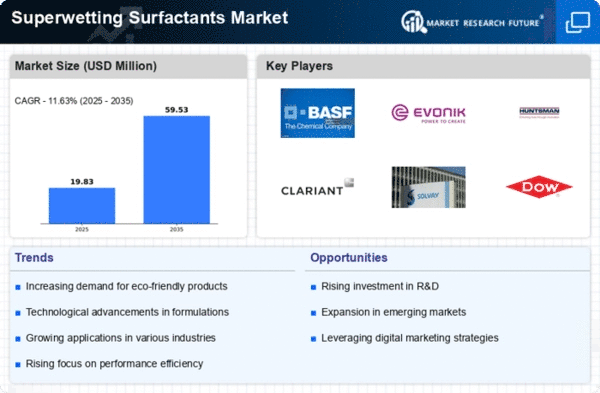
Superwetting Surfactants Market Infographic
Purchase Options

Market Trends

Key Emerging Trends in the Superwetting Surfactants Market

Superwetting surfactant market trends are changing due to the demand for innovative products in many industries. Automotive and electronics sectors' growing demand for high performance coatings drives the market. These surfactants promote coating wetting, adhesion, and durability. Superwetting surfactants are increasingly used in car exterior coatings to repel water and oil, improving vehicle durability and appearance.

In oil recovery, superwetting surfactants are becoming more popular. Superwetting surfactants are helping the oil and gas industry boost oil extraction efficiency. These surfactants reduce oil water interfacial tension, improving oil recovery and extraction yields. As global energy demand rises, the oil and gas sector's focus on production process optimization will drive superwetting surfactant demand.

The textile industry uses superwetting surfactants to improve fabric functionality. These surfactants boost water and stain resistance, making them perfect for sportswear, outdoor clothes, and medical textiles. Superwetting surfactants address consumers' growing demand for performance-enhanced textiles in a sustainable and effective way. As the textile industry prioritizes functional and eco-friendly materials, this trend may continue.

The market is also moving toward eco-friendly formulas. Superwetting surfactants from renewable sources are becoming more popular as industry prioritize sustainability. Manufacturers are investing in R&D to generate bio-based alternatives with great wetting properties and environmental responsibilities. Companies are developing and selling greener products due to governmental demands and customer awareness. Collaborations and partnerships are also affecting superwetting surfactants market competition. Surfactant, materials, and application experts are strategically partnering.

Author
Priya Nagrale
Senior Research Analyst

With an experience of over five years in market research industry (Chemicals & Materials domain), I gather and analyze market data from diverse sources to produce results, which are then presented back to a client. Also, provide recommendations based on the findings. As a Senior Research Analyst, I perform quality checks (QC) for market estimations, QC for reports, and handle queries and work extensively on client customizations. Also, handle the responsibilities of client proposals, report planning, report finalization, and execution

Leave a Comment

FAQs

At what CAGR is the Superwetting Surfactants Market predicted to grow during the forecast period?

Superwetting Surfactants Market is predicted to grow at Substantial CAGR through forecast period of 2025-2035.

What is the forecast period of Superwetting Surfactants Market research report?

The forecast period for Superwetting Surfactants Market research report is 2025-2035.

Which region will lead the global Superwetting Surfactants Market?

Global Superwetting Surfactants Market is dominated by APAC region.

What are the key factors driving the Superwetting Surfactants Market?

The product has excellent spreading and wetting property which makes it applicable in the agricultural adjuvants.

Who are the key players in the Superwetting Surfactants Market?

Evonik (Germany), AGC SEIMI CHEMICAL CO. (US), Ashland (US), BYK (Germany), BASF SE (Germany), Ethox Chemicals LLC (US), Siltech Corporation (Canada), The Dow Chemical Company (US), Jiangxi Tiansheng New Materials Co., Ltd. (China), and BRANDT (US)

Market Summary

As per MRFR analysis, the Superwetting Surfactants Market Size was estimated at 17.76 USD Million in 2024. The Superwetting Surfactants industry is projected to grow from 19.82 USD Million in 2025 to 59.53 USD Million by 2035, exhibiting a compound annual growth rate (CAGR) of 11.63 during the forecast period 2025 - 2035.

Key Market Trends & Highlights

The Superwetting Surfactants Market is poised for robust growth driven by sustainability and technological advancements.

  • North America remains the largest market for superwetting surfactants, reflecting a strong demand across various industries.
  • Asia-Pacific is emerging as the fastest-growing region, fueled by increasing industrialization and innovation.
  • The coatings segment dominates the market, while the textiles segment is experiencing rapid growth due to evolving consumer preferences.
  • Key market drivers include rising demand in coatings and inks, alongside advancements in agricultural applications.

Market Size & Forecast

2024 Market Size 17.76 (USD Million)
2035 Market Size 59.53 (USD Million)
CAGR (2025 - 2035) 11.63%
Largest Regional Market Share in 2024 Asia-Pacific

Major Players

BASF SE (DE), Evonik Industries AG (DE), Huntsman Corporation (US), Clariant AG (CH), Solvay SA (BE), Dow Inc. (US), Stepan Company (US), Kraton Corporation (US), Croda International Plc (GB)

Market Trends

The Superwetting Surfactants Market is currently experiencing a notable transformation, driven by the increasing demand for advanced materials across various industries. These surfactants, known for their ability to reduce surface tension, are finding applications in sectors such as coatings, textiles, and personal care products. The growing emphasis on sustainability and eco-friendly formulations is influencing manufacturers to innovate and develop products that align with environmental standards. As a result, the market is witnessing a shift towards bio-based and biodegradable surfactants, which are perceived as more favorable by consumers and regulatory bodies alike. Moreover, the Superwetting Surfactants Market is characterized by a heightened focus on research and development activities. Companies are investing in new technologies to enhance the performance and efficiency of surfactants, thereby expanding their application scope. This trend is further supported by collaborations between industry players and research institutions, aimed at fostering innovation. The competitive landscape is evolving, with both established firms and new entrants striving to capture market share by offering differentiated products that meet the diverse needs of end-users. Overall, the Superwetting Surfactants Market appears poised for growth, driven by technological advancements and changing consumer preferences.

Sustainability Initiatives

The Superwetting Surfactants Market is increasingly influenced by sustainability initiatives. Manufacturers are prioritizing the development of eco-friendly surfactants that minimize environmental impact. This trend reflects a broader shift towards greener formulations, as consumers demand products that align with their values.

Technological Advancements

Technological advancements play a crucial role in shaping the Superwetting Surfactants Market. Innovations in formulation and production processes are enhancing the performance of surfactants. Companies are leveraging new technologies to create more effective and efficient products, thereby expanding their market reach.

Diverse Applications

The versatility of superwetting surfactants is leading to their adoption across diverse applications. Industries such as coatings, textiles, and personal care are increasingly utilizing these surfactants to improve product performance. This trend indicates a growing recognition of the benefits offered by superwetting surfactants in various sectors.

Superwetting Surfactants Market Market Drivers

Technological Advancements

Technological innovations play a crucial role in shaping the Global Superwetting Surfactants Market Industry. Recent advancements in formulation technologies have led to the development of more efficient and environmentally friendly surfactants. For example, the introduction of bio-based superwetting surfactants has garnered attention due to their reduced ecological footprint. These innovations not only meet regulatory requirements but also align with the growing consumer preference for sustainable products. As a result, the market is expected to maintain its valuation of 515 USD Million in 2035, reflecting the ongoing evolution driven by technological progress.

Diverse Applications Across Sectors

The versatility of superwetting surfactants contributes to their widespread adoption across various sectors, thereby driving the Global Superwetting Surfactants Market Industry. These surfactants find applications in cleaning products, oil recovery, and even pharmaceuticals, showcasing their adaptability. For instance, in the oil industry, superwetting surfactants enhance oil recovery rates, making them invaluable in extraction processes. This broad applicability not only supports market growth but also indicates a stable demand trajectory, with projections suggesting a consistent market valuation of 515 USD Million through 2035.

Rising Demand in Various Industries

The Global Superwetting Surfactants Market Industry experiences heightened demand across multiple sectors, including agriculture, coatings, and personal care. These surfactants enhance wetting properties, thereby improving product performance and efficiency. For instance, in agricultural applications, superwetting surfactants facilitate better pesticide dispersion, leading to increased crop yields. The market is projected to maintain a steady valuation of 515 USD Million in 2024, indicating a stable interest in these products. This demand is likely to persist, as industries increasingly recognize the benefits of superwetting surfactants in enhancing product effectiveness.

Growing Awareness of Product Performance

Consumer awareness regarding product performance is a significant driver for the Global Superwetting Surfactants Market Industry. As end-users become more knowledgeable about the benefits of superwetting surfactants, their demand is likely to increase. Industries such as textiles and paints are recognizing that these surfactants can improve the application and durability of their products. This growing awareness is expected to sustain the market's valuation at 515 USD Million in 2024, as manufacturers respond to consumer preferences by incorporating superwetting surfactants into their formulations.

Regulatory Support for Sustainable Practices

The Global Superwetting Surfactants Market Industry benefits from increasing regulatory support aimed at promoting sustainable practices. Governments worldwide are implementing stricter regulations on chemical usage, encouraging the adoption of eco-friendly surfactants. This regulatory landscape fosters innovation and drives manufacturers to develop products that comply with environmental standards. Consequently, the market is likely to see a gradual shift towards sustainable superwetting surfactants, which could enhance their market share. The anticipated CAGR of 0.0% for the period from 2025 to 2035 suggests a stable market environment, influenced by these regulatory frameworks.

Market Segment Insights

By Application: Coatings (Largest) vs. Textiles (Fastest-Growing)

The Superwetting Surfactants Market shows a robust distribution among various applications, with coatings holding the largest share due to their widespread use in industries such as automotive, construction, and manufacturing. Textiles, on the other hand, are rapidly gaining traction and represent the fastest-growing segment, driven by increasing demand for innovative textile finishing processes that improve performance and sustainability. Agriculture, personal care, and household products also contribute significantly, but they trail behind these two key segments.

Coatings (Dominant) vs. Textiles (Emerging)

Coatings are the dominant application in the Superwetting Surfactants Market, characterized by their essential role in enhancing the performance of paints and finishes. This segment focuses on providing superior wetting, spreading, and leveling properties that ensure high-quality results and durability. Conversely, textiles are emerging as a vital segment, with innovations aimed at improving water repellency and staining resistance, driven by consumer preferences for high-performance and eco-friendly fabrics. The drive towards sustainable practices in textile production has created a surge in demand for superwetting surfactants that meet both performance and environmental standards.

By End Use: Automotive (Largest) vs. Electronics (Fastest-Growing)

The Superwetting Surfactants Market displays a diverse distribution among its end-use segments, with Automotive leading in market share. This dominance stems from the extensive application of superwetting surfactants in automotive coatings and cleaning agents, reflecting the sector's robust demand. Following closely, Construction also holds a significant share due to the necessity for advanced surfactants in paint and coatings that enhance performance in construction applications. Other notable segments include Consumer Goods and Industrial, which also leverage these surfactants, albeit with comparatively smaller market shares. Growth trends are primarily driven by increasing technological advancements and the rising demand for high-performance coatings in Automotive and Construction sectors. The Electronics segment is emerging rapidly, spurred by the growing use of superwetting surfactants in electronic applications such as lubrication and cleaning, indicating a shift in focus towards innovative technologies. Additionally, the push for more sustainable and eco-friendly products is leading to increased adoption across all segments, bolstering growth. The convergence of these factors creates a dynamic marketplace for superwetting surfactants across various end uses.

Automotive (Dominant) vs. Electronics (Emerging)

The Automotive segment stands as the dominant player in the Superwetting Surfactants Market due to its extensive utilization in coatings, adhesion promotion, and surface treatment processes. The reliability and performance enhancements provided by superwetting surfactants play a crucial role in automotive manufacturing, offering improved durability and aesthetics. On the other hand, the Electronics segment is rapidly emerging as a vital area of growth. This segment benefits from the increasing integration of advanced materials and technologies in electronic devices, where superwetting surfactants assist in the critical processes of cleaning, lubrication, and surface modification. As electronics manufacturers strive to meet stringent performance standards, the demand for high-quality surfactants is expected to surge, bridging the gap between traditional applications and innovative electronic solutions.

By Type: Anionic Surfactants (Largest) vs. Cationic Surfactants (Fastest-Growing)

The Superwetting Surfactants Market is characterized by a diverse range of surfactant types, with anionic surfactants holding the largest market share. This dominance is attributed to their widespread use in various applications, including detergents and personal care products. Cationic surfactants, while having a smaller share, are recognized as the fastest-growing segment due to increasing demand in cosmetics and hair care products. Together, these segments reflect the dynamic landscape of surfactant utilization in modern formulations.

Anionic Surfactants (Dominant) vs. Cationic Surfactants (Emerging)

Anionic surfactants are dominant in the Superwetting Surfactants Market, primarily due to their effectiveness in reducing surface tension and enhancing wetting properties, making them ideal for household cleaning products and industrial applications. Their performance in alkaline environments further increases their market relevance. Conversely, cationic surfactants are emerging rapidly due to their beneficial properties in various applications, particularly in hair conditioning and personal care products. They are known for their antimicrobial properties and ability to enhance product stability, thus capturing the attention of manufacturers looking for innovative solutions in formulation chemistry. The development of new cationic products is expected to drive further growth in this segment.

By Formulation: Liquid (Largest) vs. Powder (Fastest-Growing)

In the Superwetting Surfactants Market, the formulation segment is primarily characterized by liquid, powder, emulsion, and granule forms. Currently, liquid formulations hold the largest market share, appealing due to their ease of use in various applications and effective performance in modifying surface tension. Powder formulations, while smaller in size, are rapidly gaining traction, driven by their versatility and suitability for different industrial applications such as coatings and detergents. The growth of the formulation segment is influenced by increasing demand for eco-friendly and efficient surfactants in a variety of sectors, including agriculture, textiles, and personal care products. Powdered surfactants are recognized for their longer shelf life and reduced transportation costs, making them an appealing choice for manufacturers. As environmental regulations become stricter, the shift towards more biodegradable and sustainable product formulations will support the continuing expansion of both liquid and powdered surfactants in the market.

Liquid (Dominant) vs. Powder (Emerging)

Liquid formulations of superwetting surfactants are renowned for their superior performance and immediate effectiveness in applications such as cleaning agents, agrochemicals, and personal care products. Their ability to quickly modify surface tension makes them the preferred choice for consumers and industries requiring efficiency. Conversely, powdered formulations are emerging as a competitive alternative, particularly for applications that demand longer-lasting performance and reduced stabilization requirements. The rising trend of water conservation is bolstering the demand for powdered surfactants as they offer convenience in transportation and storage. As manufacturers innovate to create more sustainable and functional powdered options, this segment is rapidly evolving, reflecting the changing preferences of the market.

By Functionality: Wetting Agent (Largest) vs. Dispersant (Fastest-Growing)

The Superwetting Surfactants Market showcases a varied distribution across its functionality segments, with Wetting Agents claiming the largest market share. This segment is crucial in enhancing surfactant properties by improving wetting characteristics across numerous applications. Dispersants, while smaller in overall size, are experiencing rapid growth due to heightened demand in industries such as coatings and personal care products, as they provide essential functionality in stabilizing mixtures and enhancing product performance. Growth trends in the Superwetting Surfactants Market show that Dispersants are quickly carving out a significant niche, driven by technological advancements and innovative applications, particularly in specialty chemicals. Manufacturers are focusing on enhancing the efficacy of Dispersants, which are pivotal in various formulations from paints to detergents. The shift towards environmentally friendly and sustainable formulations further fuels the growth of both segments, highlighting the dynamic evolution within the industry.

Wetting Agent: Dominant vs. Dispersant: Emerging

Wetting Agents are established as the dominant force within the Superwetting Surfactants Market, providing essential functionalities that enhance the spreading and penetration of liquids on various substrates. Their broad applicability across industries, including coatings, textiles, and agriculture, solidifies their market position. Wetting Agents improve surface interactions, making them integral to product formulation and performance. In contrast, Dispersants represent an emerging segment characterized by rapid innovation and adaptation to contemporary challenges in product formulation. With increasing requirements for stability in mixtures, especially in coatings and personal care products, Dispersants are evolving to meet these needs, greatly influencing product performance. The competitive landscape is witnessing the development of new Dispersants that augment attributes such as efficiency, environmental safety, and compatibility with various formulations.

Get more detailed insights about Superwetting Surfactants Market Report - Global Forecast till 2035

Regional Insights

North America : Established Market with Growth Potential

The North American superwetting surfactants market is projected to reach $3.55 billion by 2025, driven by increasing demand in various applications such as coatings, textiles, and personal care products. Regulatory support for sustainable and eco-friendly products is also a significant catalyst for growth. The region's focus on innovation and technology further enhances market dynamics, with companies investing in R&D to develop advanced surfactant solutions. Leading countries in this region include the US and Canada, where major players like Dow Inc. and Huntsman Corporation are actively expanding their product portfolios. The competitive landscape is characterized by a mix of established companies and emerging players, all striving to capture market share. The presence of key players ensures a robust supply chain and innovation pipeline, positioning North America as a vital market for superwetting surfactants.

Europe : Innovation and Sustainability Focus

Europe's superwetting surfactants market is anticipated to reach €4.25 billion by 2025, fueled by stringent environmental regulations and a strong emphasis on sustainability. The demand for eco-friendly surfactants is rising, driven by consumer preferences and regulatory frameworks that promote green chemistry. This region is also witnessing innovations in product formulations, enhancing performance while reducing environmental impact. Germany, France, and the UK are leading countries in this market, with key players like BASF SE and Evonik Industries AG driving advancements. The competitive landscape is marked by collaborations and partnerships aimed at developing sustainable solutions. The presence of a well-established chemical industry supports the growth of superwetting surfactants, making Europe a pivotal region in this market.

Asia-Pacific : Emerging Powerhouse in Surfactants

The Asia-Pacific superwetting surfactants market is projected to dominate with a market size of $9.0 billion by 2025, driven by rapid industrialization and urbanization. The region's growing population and increasing disposable income are leading to higher demand for personal care and household products. Additionally, supportive government policies and investments in manufacturing capabilities are propelling market growth. China, Japan, and India are the leading countries in this region, with a strong presence of key players like Clariant AG and Solvay SA. The competitive landscape is characterized by a mix of local and international companies, all vying for market share. The region's focus on innovation and product development is crucial for maintaining its leadership position in The Superwetting Surfactants.

Middle East and Africa : Emerging Market with Growth Potential

The Middle East and Africa superwetting surfactants market is expected to reach $0.96 billion by 2025, driven by increasing industrial activities and a growing consumer base. The demand for surfactants in sectors such as oil and gas, personal care, and agriculture is on the rise, supported by regional economic diversification efforts. Government initiatives aimed at enhancing manufacturing capabilities are also contributing to market growth. Countries like South Africa and the UAE are leading the market, with a growing number of local and international players entering the scene. The competitive landscape is evolving, with companies focusing on innovation and sustainability to meet the unique demands of the region. The presence of key players is essential for driving growth and establishing a robust supply chain in the Middle East and Africa.

Key Players and Competitive Insights

The Superwetting Surfactants Market is currently characterized by a dynamic competitive landscape, driven by increasing demand across various applications such as coatings, textiles, and personal care products. Key players are actively pursuing strategies that emphasize innovation, sustainability, and regional expansion to enhance their market positions. For instance, BASF SE (DE) has focused on developing eco-friendly surfactants, which aligns with the growing consumer preference for sustainable products. Similarly, Evonik Industries AG (DE) is investing in digital transformation initiatives to optimize its production processes and improve customer engagement, thereby reinforcing its competitive edge.In terms of business tactics, companies are increasingly localizing manufacturing to reduce lead times and enhance supply chain efficiency. The market structure appears moderately fragmented, with several players vying for market share. However, the collective influence of major companies like Huntsman Corporation (US) and Clariant AG (CH) is notable, as they leverage their extensive distribution networks and technological capabilities to maintain a competitive advantage.

In November Huntsman Corporation (US) announced the launch of a new line of superwetting surfactants designed specifically for the agricultural sector. This strategic move is significant as it not only diversifies their product portfolio but also addresses the growing need for effective agricultural solutions amid increasing environmental regulations. The introduction of these products could potentially enhance their market share in a sector that is becoming increasingly important for sustainable practices.

In October Clariant AG (CH) entered into a strategic partnership with a leading biotechnology firm to develop bio-based surfactants. This collaboration is indicative of the industry's shift towards sustainable alternatives, as it allows Clariant to leverage innovative technologies while enhancing its product offerings. Such partnerships are likely to play a crucial role in shaping the future of the market, as they enable companies to stay ahead of regulatory changes and consumer preferences.

In September Solvay SA (BE) expanded its production capacity for superwetting surfactants in Asia, reflecting a strategic focus on regional growth. This expansion is particularly relevant given the increasing demand for surfactants in emerging markets. By enhancing its manufacturing capabilities, Solvay positions itself to better serve local customers and respond to market fluctuations more effectively.

As of December the competitive trends in the Superwetting Surfactants Market are increasingly defined by digitalization, sustainability, and the integration of advanced technologies such as AI. Strategic alliances are becoming more prevalent, as companies recognize the need to collaborate to innovate and meet evolving consumer demands. Looking ahead, it appears that competitive differentiation will increasingly hinge on innovation and technology, rather than solely on price. Companies that can reliably optimize their supply chains while delivering innovative solutions are likely to emerge as leaders in this evolving landscape.

Key Companies in the Superwetting Surfactants Market include

Industry Developments

    • In December 2021, German's prominent super wetting surfactants manufacturer Evonik launched a new cationic ultraviolet (UV) cure release system called the TEGO RC 1442. It is developed on the basis of its existing RC 1400 series technology. Moreover, it has been developed with the silicone release coating that offers ease of release and excellent coating that fulfills the customers' needs. Further, this development has aimed to strengthen the position of Evonik in the pressure-sensitive adhesive (PSA) industry.

Report Overview 

The global Superwetting Surfactants Market report consists of both qualitative and quantitative research method that shows a significant growth in the performance of the global market.

Future Outlook

Superwetting Surfactants Market Future Outlook

The Superwetting Surfactants Market is projected to grow at 11.63% CAGR from 2025 to 2035, driven by increasing demand in various industrial applications and advancements in formulation technologies.

New opportunities lie in:

  • Development of eco-friendly superwetting surfactants for sustainable applications.
  • Expansion into emerging markets with tailored product offerings.
  • Investment in R&D for innovative formulations targeting niche industries.

By 2035, the Superwetting Surfactants Market is expected to achieve substantial growth and diversification.

Market Segmentation

Superwetting Surfactants Market Type Outlook

  • Anionic Surfactants
  • Cationic Surfactants
  • Nonionic Surfactants
  • Amphoteric Surfactants

Superwetting Surfactants Market End Use Outlook

  • Automotive
  • Construction
  • Consumer Goods
  • Industrial
  • Electronics

Superwetting Surfactants Market Application Outlook

  • Coatings
  • Textiles
  • Agriculture
  • Personal Care
  • Household Products

Superwetting Surfactants Market Formulation Outlook

  • Liquid
  • Powder
  • Emulsion
  • Granule

Superwetting Surfactants Market Functionality Outlook

  • Wetting Agent
  • Dispersant
  • Emulsifier
  • Foaming Agent

Report Scope

MARKET SIZE 202417.76(USD Million)
MARKET SIZE 202519.82(USD Million)
MARKET SIZE 203559.53(USD Million)
COMPOUND ANNUAL GROWTH RATE (CAGR)11.63% (2025 - 2035)
REPORT COVERAGERevenue Forecast, Competitive Landscape, Growth Factors, and Trends
BASE YEAR2024
Market Forecast Period2025 - 2035
Historical Data2019 - 2024
Market Forecast UnitsUSD Million
Key Companies ProfiledBASF SE (DE), Evonik Industries AG (DE), Huntsman Corporation (US), Clariant AG (CH), Solvay SA (BE), Dow Inc. (US), Stepan Company (US), Kraton Corporation (US), Croda International Plc (GB)
Segments CoveredApplication, End Use, Type, Formulation, Functionality
Key Market OpportunitiesGrowing demand for eco-friendly formulations drives innovation in the Superwetting Surfactants Market.
Key Market DynamicsRising demand for eco-friendly formulations drives innovation in superwetting surfactants across various industries.
Countries CoveredNorth America, Europe, APAC, South America, MEA

FAQs

At what CAGR is the Superwetting Surfactants Market predicted to grow during the forecast period?

Superwetting Surfactants Market is predicted to grow at Substantial CAGR through forecast period of 2025-2035.

What is the forecast period of Superwetting Surfactants Market research report?

The forecast period for Superwetting Surfactants Market research report is 2025-2035.

Which region will lead the global Superwetting Surfactants Market?

Global Superwetting Surfactants Market is dominated by APAC region.

What are the key factors driving the Superwetting Surfactants Market?

The product has excellent spreading and wetting property which makes it applicable in the agricultural adjuvants.

Who are the key players in the Superwetting Surfactants Market?

Evonik (Germany), AGC SEIMI CHEMICAL CO. (US), Ashland (US), BYK (Germany), BASF SE (Germany), Ethox Chemicals LLC (US), Siltech Corporation (Canada), The Dow Chemical Company (US), Jiangxi Tiansheng New Materials Co., Ltd. (China), and BRANDT (US)

  1. SECTION I: EXECUTIVE SUMMARY AND KEY HIGHLIGHTS
    1. | 1.1 EXECUTIVE SUMMARY
    2. | 1.1.1 Market Overview
    3. | 1.1.2 Key Findings
    4. | 1.1.3 Market Segmentation
    5. | 1.1.4 Competitive Landscape
    6. | 1.1.5 Challenges and Opportunities
    7. | 1.1.6 Future Outlook
  2. SECTION II: SCOPING, METHODOLOGY AND MARKET STRUCTURE
    1. | 2.1 MARKET INTRODUCTION
    2. | 2.1.1 Definition
    3. | 2.1.2 Scope of the study
    4. |-- 2.1.2.1 Research Objective
    5. |-- 2.1.2.2 Assumption
    6. |-- 2.1.2.3 Limitations
    7. | 2.2 RESEARCH METHODOLOGY
    8. | 2.2.1 Overview
    9. | 2.2.2 Data Mining
    10. | 2.2.3 Secondary Research
    11. | 2.2.4 Primary Research
    12. |-- 2.2.4.1 Primary Interviews and Information Gathering Process
    13. |-- 2.2.4.2 Breakdown of Primary Respondents
    14. | 2.2.5 Forecasting Model
    15. | 2.2.6 Market Size Estimation
    16. |-- 2.2.6.1 Bottom-Up Approach
    17. |-- 2.2.6.2 Top-Down Approach
    18. | 2.2.7 Data Triangulation
    19. | 2.2.8 Validation
  3. SECTION III: QUALITATIVE ANALYSIS
    1. | 3.1 MARKET DYNAMICS
    2. | 3.1.1 Overview
    3. | 3.1.2 Drivers
    4. | 3.1.3 Restraints
    5. | 3.1.4 Opportunities
    6. | 3.2 MARKET FACTOR ANALYSIS
    7. | 3.2.1 Value chain Analysis
    8. | 3.2.2 Porter's Five Forces Analysis
    9. |-- 3.2.2.1 Bargaining Power of Suppliers
    10. |-- 3.2.2.2 Bargaining Power of Buyers
    11. |-- 3.2.2.3 Threat of New Entrants
    12. |-- 3.2.2.4 Threat of Substitutes
    13. |-- 3.2.2.5 Intensity of Rivalry
    14. | 3.2.3 COVID-19 Impact Analysis
    15. |-- 3.2.3.1 Market Impact Analysis
    16. |-- 3.2.3.2 Regional Impact
    17. |-- 3.2.3.3 Opportunity and Threat Analysis
  4. SECTION IV: QUANTITATIVE ANALYSIS
    1. | 4.1 Chemicals and Materials, BY Application (USD Million)
    2. | 4.1.1 Coatings
    3. | 4.1.2 Textiles
    4. | 4.1.3 Agriculture
    5. | 4.1.4 Personal Care
    6. | 4.1.5 Household Products
    7. | 4.2 Chemicals and Materials, BY End Use (USD Million)
    8. | 4.2.1 Automotive
    9. | 4.2.2 Construction
    10. | 4.2.3 Consumer Goods
    11. | 4.2.4 Industrial
    12. | 4.2.5 Electronics
    13. | 4.3 Chemicals and Materials, BY Type (USD Million)
    14. | 4.3.1 Anionic Surfactants
    15. | 4.3.2 Cationic Surfactants
    16. | 4.3.3 Nonionic Surfactants
    17. | 4.3.4 Amphoteric Surfactants
    18. | 4.4 Chemicals and Materials, BY Formulation (USD Million)
    19. | 4.4.1 Liquid
    20. | 4.4.2 Powder
    21. | 4.4.3 Emulsion
    22. | 4.4.4 Granule
    23. | 4.5 Chemicals and Materials, BY Functionality (USD Million)
    24. | 4.5.1 Wetting Agent
    25. | 4.5.2 Dispersant
    26. | 4.5.3 Emulsifier
    27. | 4.5.4 Foaming Agent
    28. | 4.6 Chemicals and Materials, BY Region (USD Million)
    29. | 4.6.1 North America
    30. |-- 4.6.1.1 US
    31. |-- 4.6.1.2 Canada
    32. | 4.6.2 Europe
    33. |-- 4.6.2.1 Germany
    34. |-- 4.6.2.2 UK
    35. |-- 4.6.2.3 France
    36. |-- 4.6.2.4 Russia
    37. |-- 4.6.2.5 Italy
    38. |-- 4.6.2.6 Spain
    39. |-- 4.6.2.7 Rest of Europe
    40. | 4.6.3 APAC
    41. |-- 4.6.3.1 China
    42. |-- 4.6.3.2 India
    43. |-- 4.6.3.3 Japan
    44. |-- 4.6.3.4 South Korea
    45. |-- 4.6.3.5 Malaysia
    46. |-- 4.6.3.6 Thailand
    47. |-- 4.6.3.7 Indonesia
    48. |-- 4.6.3.8 Rest of APAC
    49. | 4.6.4 South America
    50. |-- 4.6.4.1 Brazil
    51. |-- 4.6.4.2 Mexico
    52. |-- 4.6.4.3 Argentina
    53. |-- 4.6.4.4 Rest of South America
    54. | 4.6.5 MEA
    55. |-- 4.6.5.1 GCC Countries
    56. |-- 4.6.5.2 South Africa
    57. |-- 4.6.5.3 Rest of MEA
  5. SECTION V: COMPETITIVE ANALYSIS
    1. | 5.1 Competitive Landscape
    2. | 5.1.1 Overview
    3. | 5.1.2 Competitive Analysis
    4. | 5.1.3 Market share Analysis
    5. | 5.1.4 Major Growth Strategy in the Chemicals and Materials
    6. | 5.1.5 Competitive Benchmarking
    7. | 5.1.6 Leading Players in Terms of Number of Developments in the Chemicals and Materials
    8. | 5.1.7 Key developments and growth strategies
    9. |-- 5.1.7.1 New Product Launch/Service Deployment
    10. |-- 5.1.7.2 Merger & Acquisitions
    11. |-- 5.1.7.3 Joint Ventures
    12. | 5.1.8 Major Players Financial Matrix
    13. |-- 5.1.8.1 Sales and Operating Income
    14. |-- 5.1.8.2 Major Players R&D Expenditure. 2023
    15. | 5.2 Company Profiles
    16. | 5.2.1 BASF SE (DE)
    17. |-- 5.2.1.1 Financial Overview
    18. |-- 5.2.1.2 Products Offered
    19. |-- 5.2.1.3 Key Developments
    20. |-- 5.2.1.4 SWOT Analysis
    21. |-- 5.2.1.5 Key Strategies
    22. | 5.2.2 Evonik Industries AG (DE)
    23. |-- 5.2.2.1 Financial Overview
    24. |-- 5.2.2.2 Products Offered
    25. |-- 5.2.2.3 Key Developments
    26. |-- 5.2.2.4 SWOT Analysis
    27. |-- 5.2.2.5 Key Strategies
    28. | 5.2.3 Huntsman Corporation (US)
    29. |-- 5.2.3.1 Financial Overview
    30. |-- 5.2.3.2 Products Offered
    31. |-- 5.2.3.3 Key Developments
    32. |-- 5.2.3.4 SWOT Analysis
    33. |-- 5.2.3.5 Key Strategies
    34. | 5.2.4 Clariant AG (CH)
    35. |-- 5.2.4.1 Financial Overview
    36. |-- 5.2.4.2 Products Offered
    37. |-- 5.2.4.3 Key Developments
    38. |-- 5.2.4.4 SWOT Analysis
    39. |-- 5.2.4.5 Key Strategies
    40. | 5.2.5 Solvay SA (BE)
    41. |-- 5.2.5.1 Financial Overview
    42. |-- 5.2.5.2 Products Offered
    43. |-- 5.2.5.3 Key Developments
    44. |-- 5.2.5.4 SWOT Analysis
    45. |-- 5.2.5.5 Key Strategies
    46. | 5.2.6 Dow Inc. (US)
    47. |-- 5.2.6.1 Financial Overview
    48. |-- 5.2.6.2 Products Offered
    49. |-- 5.2.6.3 Key Developments
    50. |-- 5.2.6.4 SWOT Analysis
    51. |-- 5.2.6.5 Key Strategies
    52. | 5.2.7 Stepan Company (US)
    53. |-- 5.2.7.1 Financial Overview
    54. |-- 5.2.7.2 Products Offered
    55. |-- 5.2.7.3 Key Developments
    56. |-- 5.2.7.4 SWOT Analysis
    57. |-- 5.2.7.5 Key Strategies
    58. | 5.2.8 Kraton Corporation (US)
    59. |-- 5.2.8.1 Financial Overview
    60. |-- 5.2.8.2 Products Offered
    61. |-- 5.2.8.3 Key Developments
    62. |-- 5.2.8.4 SWOT Analysis
    63. |-- 5.2.8.5 Key Strategies
    64. | 5.2.9 Croda International Plc (GB)
    65. |-- 5.2.9.1 Financial Overview
    66. |-- 5.2.9.2 Products Offered
    67. |-- 5.2.9.3 Key Developments
    68. |-- 5.2.9.4 SWOT Analysis
    69. |-- 5.2.9.5 Key Strategies
    70. | 5.3 Appendix
    71. | 5.3.1 References
    72. | 5.3.2 Related Reports

Chemicals and Materials Market Segmentation

Chemicals and Materials By Application (USD Million, 2025-2035)

  • Coatings
  • Textiles
  • Agriculture
  • Personal Care
  • Household Products

Chemicals and Materials By End Use (USD Million, 2025-2035)

  • Automotive
  • Construction
  • Consumer Goods
  • Industrial
  • Electronics

Chemicals and Materials By Type (USD Million, 2025-2035)

  • Anionic Surfactants
  • Cationic Surfactants
  • Nonionic Surfactants
  • Amphoteric Surfactants

Chemicals and Materials By Formulation (USD Million, 2025-2035)

  • Liquid
  • Powder
  • Emulsion
  • Granule

Chemicals and Materials By Functionality (USD Million, 2025-2035)

  • Wetting Agent
  • Dispersant
  • Emulsifier
  • Foaming Agent
Infographic

Free Sample Request

Kindly complete the form below to receive a free sample of this Report

Get Free Sample

Customer Strories

Compare Licence

×
Features License Type
Single User Multiuser License Enterprise User
Price $4,950 $5,950 $7,250
Maximum User Access Limit 1 User Upto 10 Users Unrestricted Access Throughout the Organization
Free Customization
Direct Access to Analyst
Deliverable Format
Platform Access
Discount on Next Purchase 10% 15% 15%
Printable Versions