×
Hero Background
English
Chinese
French
Japanese
Korean
German
Spanish

Superhydrophobic Coating Market Analysis

ID: MRFR/CnM/4847-HCR
100 Pages
Priya Nagrale
October 2025

Superhydrophobic Coating Market Research Report Information by Raw Material (Carbon Nanotubes, Silica Nanoparticles), Property (Anti-Microbial, Anti-Corrosion), End-Use Industry (Electricals & Electronics, Textiles & Leather), Region—Forecast till 2035

Share:
Download PDF ×

We do not share your information with anyone. However, we may send you emails based on your report interest from time to time. You may contact us at any time to opt-out.

Superhydrophobic Coating Market Infographic
Purchase Options

Market Analysis

In-depth Analysis of Superhydrophobic Coating Market Industry Landscape

The superhydrophobic coating market has witnessed significant growth in recent years, driven by a surge in demand across various industries. These coatings, known for their ability to repel water and resist adhesion of other substances, have found widespread applications in sectors like automotive, aerospace, electronics, and healthcare. One of the primary market dynamics contributing to this growth is the increasing emphasis on durability and protection. Industries seek coatings that offer corrosion resistance, reduce maintenance costs, and prolong the lifespan of their products. The automotive sector, in particular, has shown substantial interest in these coatings to enhance the longevity of vehicle surfaces and improve their performance under varying weather conditions.

Moreover, advancements in nanotechnology have played a pivotal role in the evolution of superhydrophobic coatings. Manufacturers are leveraging nanomaterials to develop coatings with superior water-repelling properties while ensuring environmental sustainability. The market has seen a shift toward eco-friendly formulations, driven by regulations promoting green technologies and the rising awareness among consumers about the environmental impact of chemical coatings. As a result, companies are investing in research and development to create environmentally benign superhydrophobic coatings without compromising on performance.

Another crucial aspect influencing the market dynamics is the continuous innovation in application techniques. Companies are exploring novel methods to apply these coatings efficiently on diverse substrates, ranging from metals and plastics to textiles and glass. Advancements in spray coating, dip coating, and chemical vapor deposition techniques have expanded the scope of these coatings, enabling their use in intricate surfaces and complex geometries. This versatility has widened the potential market for superhydrophobic coatings across various industries and applications.

Furthermore, the competitive landscape within the superhydrophobic coating market is dynamic. Established players and new entrants are engaged in intense competition, leading to extensive research to develop coatings with enhanced properties such as self-cleaning abilities, anti-icing properties, and resistance to oil and dirt. Market players are also focusing on strategic collaborations, partnerships, and mergers to strengthen their market presence, expand their product portfolios, and capitalize on untapped market segments.

The market dynamics of superhydrophobic coatings are also influenced by geographical factors. Regions with a strong industrial base, such as North America, Europe, and Asia-Pacific, are witnessing robust demand due to the high adoption of advanced technologies across industries. Moreover, emerging economies in Asia-Pacific, particularly China and India, are experiencing rapid growth in the automotive and electronics sectors, driving the demand for superhydrophobic coatings.

However, challenges persist in the market, including the high cost associated with these advanced coatings, which may hinder their widespread adoption, especially among small and medium-sized enterprises. Additionally, ensuring consistent performance and durability under varying environmental conditions remains a focal point for manufacturers, prompting continuous improvements and quality assurance measures.
Author
Priya Nagrale
Senior Research Analyst

With an experience of over five years in market research industry (Chemicals & Materials domain), I gather and analyze market data from diverse sources to produce results, which are then presented back to a client. Also, provide recommendations based on the findings. As a Senior Research Analyst, I perform quality checks (QC) for market estimations, QC for reports, and handle queries and work extensively on client customizations. Also, handle the responsibilities of client proposals, report planning, report finalization, and execution

Leave a Comment

FAQs

At what CAGR is the global superhydrophobic coating market is estimated to during 2025-2035?

The global superhydrophobic coating market is estimated grow at 30.7% CAGR during the forecast period (2025-2035).

What is a superhydrophobic coating and where its used?

Superhydrophobic coating is made of nanoscopic surface layers that act as excellent water repellent. These coatings are used on plastic, glass, wood, concrete, and fabric materials to provide them resistance to moisture, dirt, abrasions, and corrosion.

What are the major end-use industries of superhydrophobic coating?

Superhydrophobic coating is widely used in all major industries such as consumer goods, electrical & electronics, and textiles & leather items.

Which is the largest segment in the global superhydrophobic coating market?

The electrical and electronics segment is the largest segment in the global superhydrophobic coating market.

Which region holds the largest share in the global superhydrophobic coating market?

Asia Pacific holds the largest share in the global superhydrophobic coating market followed by North America and Europe, respectively.

Who are the top players in the global superhydrophobic coating market?

P2i International Ltd (US), UltraTech International Inc. (US), Lotus Leaf Inc. (Mexico), Rust-Oleum (US), NEI Corporation (US), United Protective Technologies (US), Hydrobead (US), Aculon (US), NeverWet (US), Advanced NanoTech Lab (India), and Excel Coatings (India), are some of the leading players in the global superhydrophobic coating market.

Market Summary

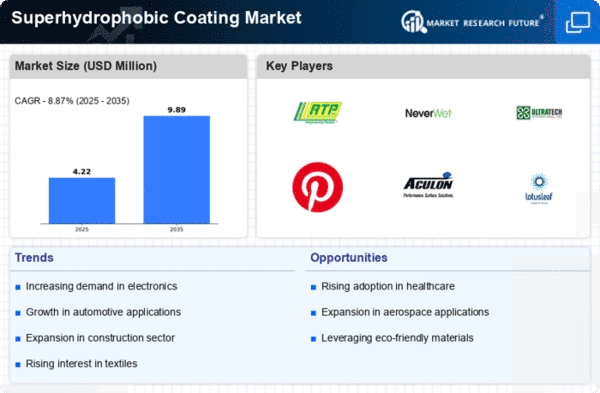
As per MRFR analysis, the Superhydrophobic Coating Market Size was estimated at 3.88 USD Million in 2024. The Superhydrophobic Coating industry is projected to grow from 4.23 in 2025 to 9.89 by 2035, exhibiting a compound annual growth rate (CAGR) of 8.87 during the forecast period 2025 - 2035.

Key Market Trends & Highlights

The Superhydrophobic Coating Market is poised for substantial growth driven by technological advancements and increasing demand for eco-friendly solutions.

  • Technological advancements are enhancing the performance and applicability of superhydrophobic coatings across various sectors.
  • North America remains the largest market, while the Asia-Pacific region is recognized as the fastest-growing area for superhydrophobic coatings.
  • The textiles segment leads in market size, whereas the electronics segment is experiencing rapid growth due to innovative applications.
  • Rising demand for eco-friendly solutions and expanding applications across industries are key drivers propelling market growth.

Market Size & Forecast

2024 Market Size 3.88 (USD Million)
2035 Market Size 9.89 (USD Million)
CAGR (2025 - 2035) 8.87%
Largest Regional Market Share in 2024 North America

Major Players

<p>RTP Company (US), NeverWet (US), UltraTech International (US), P2i (GB), Aculon (US), Lotus Leaf Coatings (US), Hydrophobic Coatings (US), Nanex (US)</p>

Market Trends

The Superhydrophobic Coating Market is currently experiencing a notable transformation, driven by advancements in material science and increasing demand across various industries. These coatings, characterized by their ability to repel water and other liquids, are finding applications in sectors such as automotive, electronics, and textiles. The growing awareness of the benefits of superhydrophobic surfaces, including enhanced durability and reduced maintenance, appears to be propelling market growth. Furthermore, innovations in nanotechnology are likely to enhance the performance and applicability of these coatings, making them more accessible to a broader range of consumers and industries. In addition to technological advancements, environmental considerations are influencing the Superhydrophobic Coating Market. As industries seek sustainable solutions, the development of eco-friendly coatings is becoming increasingly relevant. This shift towards sustainability may lead to the emergence of new formulations that minimize environmental impact while maintaining high performance. Overall, the Superhydrophobic Coating Market seems poised for continued expansion, with a focus on innovation and sustainability shaping its future trajectory.

Technological Advancements

Recent innovations in nanotechnology and material science are enhancing the performance of superhydrophobic coatings. These advancements are likely to improve the durability and effectiveness of coatings, making them suitable for a wider array of applications.

Sustainability Trends

There is a growing emphasis on eco-friendly solutions within the Superhydrophobic Coating Market. Manufacturers are increasingly developing sustainable formulations that reduce environmental impact while delivering high performance.

Diverse Applications

The versatility of superhydrophobic coatings is leading to their adoption across various sectors, including automotive, electronics, and textiles. This trend indicates a broadening market scope as industries recognize the benefits of these advanced coatings.

Superhydrophobic Coating Market Market Drivers

Market Growth Projections

The Global Superhydrophobic Coating Market Industry is characterized by robust growth projections. The market is expected to expand from 10.6 USD Million in 2024 to an impressive 120.3 USD Million by 2035. This growth trajectory suggests a compound annual growth rate (CAGR) of 24.76% from 2025 to 2035, indicating strong demand across various sectors. The increasing adoption of superhydrophobic coatings in industries such as automotive, electronics, and healthcare is likely to drive this growth. As companies recognize the benefits of these coatings, including enhanced durability and water resistance, the market is poised for a transformative period.

Rising Demand in Electronics

The Global Superhydrophobic Coating Market Industry experiences a surge in demand driven by the electronics sector. With the increasing miniaturization of devices, manufacturers seek coatings that enhance durability and water resistance. For instance, superhydrophobic coatings are utilized in smartphones and wearable devices to protect against moisture damage. This trend is reflected in the projected market growth, with revenues expected to reach 10.6 USD Million in 2024 and potentially escalating to 120.3 USD Million by 2035. The anticipated compound annual growth rate (CAGR) of 24.76% from 2025 to 2035 indicates a robust expansion in this segment, highlighting the coatings' critical role in electronics innovation.

Advancements in Material Science

Advancements in material science significantly contribute to the Global Superhydrophobic Coating Market Industry. Innovations in nanotechnology and polymer chemistry enable the development of more effective and durable coatings. These advancements allow for the creation of coatings that not only repel water but also resist dirt and grime, enhancing the longevity of various surfaces. Industries such as automotive and construction are increasingly adopting these advanced coatings to improve product performance and aesthetics. As a result, the market is poised for growth, with a projected CAGR of 24.76% from 2025 to 2035, reflecting the ongoing evolution of material capabilities and their applications.

Increased Applications in Healthcare

The Global Superhydrophobic Coating Market Industry is witnessing increased applications in the healthcare sector. Superhydrophobic coatings are being utilized in medical devices and equipment to enhance hygiene and reduce the risk of contamination. For instance, coatings applied to surgical instruments and surfaces can repel water and bodily fluids, making them easier to clean and sterilize. This trend is particularly relevant in the context of rising healthcare standards and the need for improved infection control measures. As the healthcare industry continues to adopt these coatings, the market is likely to experience substantial growth, driven by the demand for safer and more effective medical solutions.

Environmental Sustainability Initiatives

The Global Superhydrophobic Coating Market Industry is positively influenced by the growing emphasis on environmental sustainability. Industries are increasingly adopting eco-friendly coatings that minimize environmental impact while providing superior performance. For example, superhydrophobic coatings can reduce the need for chemical cleaning agents, thereby lowering harmful emissions. This shift towards sustainable practices aligns with global regulatory trends aimed at reducing environmental footprints. As companies prioritize sustainability, the demand for superhydrophobic coatings is expected to rise, contributing to the market's growth trajectory. The anticipated increase in market size from 10.6 USD Million in 2024 to 120.3 USD Million by 2035 underscores this trend.

Growing Investment in Research and Development

Investment in research and development plays a crucial role in the Global Superhydrophobic Coating Market Industry. Companies are increasingly allocating resources to innovate and improve coating technologies, which enhances performance and broadens application scopes. This focus on R&D leads to the discovery of new materials and methods that can produce more effective superhydrophobic coatings. As a result, industries ranging from textiles to aerospace are benefiting from these advancements. The commitment to innovation is expected to drive market growth, with projections indicating a significant increase in market size from 10.6 USD Million in 2024 to 120.3 USD Million by 2035.

Market Segment Insights

By Application: Textiles (Largest) vs. Electronics (Fastest-Growing)

<p>The Superhydrophobic Coating Market is diverse, with significant application across multiple sectors. Textiles currently represent the largest share, owing to their vital role in waterproofing and stain resistance, greatly appealing to both consumers and manufacturers. This dominance stems from the increased demand for functional fabrics in fashion, sportswear, and outdoor gear. Meanwhile, the electronics sector is emerging as a fast-growing segment, driven by the rising need for water-repellent surfaces in gadgets that enhance durability and reliability.</p>

<p>Textiles (Dominant) vs. Electronics (Emerging)</p>

<p>Textiles have established themselves as the dominant sector within the Superhydrophobic Coating Market, given their essential function in producing high-performance clothing and upholstery. The ability to render fabrics resistant to water and stains enhances their appeal across diverse applications, such as fashion and industrial uses. On the other hand, the electronics segment, while still developing, is increasingly recognized as an emerging player, as manufacturers are leveraging superhydrophobic coatings to create devices that are more water-resistant and less prone to damage. The growth in consumer electronics and the trend towards rugged devices is expected to propel this segment, highlighting its potential in the market.</p>

By End Use: Consumer Goods (Largest) vs. Aerospace (Fastest-Growing)

<p>The Superhydrophobic Coating Market is primarily driven by the Consumer Goods segment, which holds a significant market share due to its increasing application in consumer electronics, textiles, and personal care products. This segment continues to thrive as manufacturers seek innovative solutions to enhance product performance and durability, making superhydrophobic coatings increasingly desirable for everyday items. In contrast, the Aerospace segment emerges as the fastest-growing area within the superhydrophobic coatings market. The growing demand for lightweight and innovative materials in the aerospace industry is pushing manufacturers to incorporate superhydrophobic coatings into aircraft components and surfaces, enhancing performance by providing water and dirt repellency, as well as reducing maintenance costs.</p>

<p>Consumer Goods: Dominant vs. Aerospace: Emerging</p>

<p>The Consumer Goods segment is recognized as the dominant force in the Superhydrophobic Coating Market, showcasing a vast array of applications ranging from electronics to household items. The need for increased durability and protection against contaminants drives the demand for coatings that repel water and dirt effectively. Meanwhile, the Aerospace segment is considered an emerging area poised for significant growth. The integration of innovative materials within aircraft systems is essential for improving fuel efficiency and operational performance, promoting the adoption of superhydrophobic coatings in components like wings and fuselages. This focus on advanced material solutions within aerospace is gradually transforming it into a critical area of development for superhydrophobic technologies.</p>

By Technology: Chemical Vapor Deposition (Largest) vs. Sol-Gel Process (Fastest-Growing)

<p>In the Superhydrophobic Coating Market, the technology segment is primarily dominated by Chemical Vapor Deposition (CVD), which holds the largest market share due to its ability to produce high-quality, uniform coatings on various substrates. While CVD leads in stability and performance, the Sol-Gel Process is gaining traction, appealing to industries focusing on cost-effective and versatile applications. The different technologies cater to specific needs and are witnessing distinct growth trajectories in adoption. The growth trends for these segments are influenced by advancements in nanotechnology and increasing demand for high-performance coatings across various end-use industries including automotive, electronics, and textiles. The Sol-Gel Process, identified as the fastest-growing technology, benefits from burgeoning innovations and eco-friendliness, while CVD remains crucial for applications requiring durability and superior properties. The overall technological advancement plays a key role in shaping the market dynamics by enhancing coating effectiveness and broadening applications.</p>

<p>Technology: CVD (Dominant) vs. Sol-Gel Process (Emerging)</p>

<p>Chemical Vapor Deposition (CVD) currently dominates the Superhydrophobic Coating Market due to its superior ability to create robust and durable coatings that are suitable for various demanding applications. CVD is widely used in industries where high levels of water repellency and environmental resistance are critical. In contrast, the Sol-Gel Process is emerging rapidly, praised for its ease of use, lower production costs, and ability to coat complex geometries. The appeal of Sol-Gel technology lies in its versatility and application in a wide range of industries, driving growing interest among manufacturers seeking cost-effective solutions without compromising performance. Together, these technologies reflect the dual focus of the market on high-quality performance and innovation-driven affordability.</p>

By Substrate Type: Metal (Largest) vs. Plastic (Fastest-Growing)

<p>In the Superhydrophobic Coating Market, the distribution of market share among various substrate types reveals significant insights. Metal emerges as the largest segment due to its extensive applications in automotive and industrial sectors, owing to its robustness and versatility. Following metal, plastic is gaining traction as an appealing substrate choice, particularly in consumer electronics and medical devices, due to its lightweight properties and cost-effectiveness. The growth trends reflect an increasing demand for superhydrophobic coatings across industries, driven by advancements in surface technologies and a rising need for protective solutions. The automotive and electronics sectors are experiencing the fastest growth, where the performance enhancements offered by superhydrophobic coatings, such as self-cleaning surfaces and enhanced durability, are becoming critical. Manufacturers are investing in R&D to cater to these demands, propelling the growth of the plastic substrate segment even further.</p>

<p>Metal (Dominant) vs. Plastic (Emerging)</p>

<p>The metal substrate segment holds a dominant position in the Superhydrophobic Coating Market, attributed to its high durability and extensive use in various high-performance applications, such as automotive and aerospace. This substrate type is known for its excellent adhesion properties with superhydrophobic coatings, enabling enhanced performance in environmental durability and corrosion resistance. On the other hand, plastic substrates represent an emerging segment, with their lightweight and versatile nature appealing to various industries, including electronics and consumer goods. The adaptability of superhydrophobic coatings on plastic allows for innovative applications, such as electronic devices and packaging solutions. As technological advancements continue, the demand for durable and functional plastic coatings is expected to rise, positioning this segment as a significant player in the evolving market.</p>

By Functionality: Water Repellency (Largest) vs. Self-Cleaning (Fastest-Growing)

<p>In the Superhydrophobic Coating Market, water repellency is the largest segment, capturing significant market share due to its wide applicability across various industries, including automotive, textiles, and electronics. This property is crucial for enhancing the durability and lifespan of products, which in turn drives its demand. Meanwhile, self-cleaning emerges as the fastest-growing segment, attracting attention for its innovative applications in construction materials and consumer products that simplify maintenance and improve hygiene standards.</p>

<p>Water Repellency (Dominant) vs. Self-Cleaning (Emerging)</p>

<p>Water repellency dominates the Superhydrophobic Coating Market, valued for its effectiveness in preventing water accumulation on surfaces, thus extending the life of products. This attribute is essential in sectors like construction where water damage can lead to significant losses. In contrast, self-cleaning coatings are emerging rapidly due to increasing demand for low-maintenance surfaces in both residential and commercial settings. These coatings utilize advanced technology to break down organic materials, facilitating easy removal by rain, making them increasingly sought after in environments prone to dirt and grime. Both segments are vital, reflecting the industry's innovation and response to consumer needs.</p>

Get more detailed insights about Superhydrophobic Coating Market Research Report – Forecast to 2035

Regional Insights

North America : Market Leader in Innovation

North America is poised to maintain its leadership in the superhydrophobic coating market, holding a market size of $1.54B in 2025. The region's growth is driven by increasing demand across various sectors, including automotive, electronics, and textiles. Regulatory support for advanced materials and sustainability initiatives further catalyze market expansion. The presence of key players like RTP Company and Aculon enhances innovation and product development, ensuring a competitive edge in the market. The United States stands as the primary contributor to this market, with significant investments in R&D and a robust manufacturing base. Companies such as NeverWet and UltraTech International are at the forefront, developing cutting-edge technologies that cater to diverse applications. The competitive landscape is characterized by strategic partnerships and collaborations, aimed at enhancing product offerings and market reach. This dynamic environment positions North America as a hub for superhydrophobic coating advancements.

Europe : Emerging Market with Potential

Europe is witnessing a growing interest in superhydrophobic coatings, with a market size of €1.2B projected for 2025. The region's growth is fueled by increasing demand in sectors such as construction, automotive, and healthcare. Regulatory frameworks promoting eco-friendly materials and innovations in nanotechnology are significant catalysts for market expansion. The European market is characterized by a shift towards sustainable solutions, aligning with global environmental goals. Leading countries like Germany, France, and the UK are driving this growth, supported by a strong presence of key players such as P2i and Aculon. The competitive landscape is marked by innovation and collaboration among companies, focusing on developing advanced coatings that meet stringent regulatory standards. This collaborative approach enhances the region's ability to adapt to market demands and technological advancements, positioning Europe as a significant player in the superhydrophobic coating market.

Asia-Pacific : Rapid Growth and Adoption

Asia-Pacific is rapidly emerging as a significant player in the superhydrophobic coating market, with a projected market size of $0.9B by 2025. The region's growth is driven by increasing industrialization, urbanization, and rising consumer awareness regarding advanced materials. Countries like China and India are leading this trend, supported by government initiatives promoting technological advancements and sustainable practices. The demand for superhydrophobic coatings in electronics and automotive sectors is particularly strong, contributing to market expansion. China is the dominant force in this region, with numerous local manufacturers and a growing number of international players entering the market. The competitive landscape is characterized by a mix of established companies and startups, focusing on innovation and cost-effective solutions. Key players such as Nanex and Hydrophobic Coatings are actively developing products tailored to meet the unique needs of the region, ensuring a robust growth trajectory for the superhydrophobic coating market.

Middle East and Africa : Untapped Market Potential

The Middle East and Africa region is still in the nascent stages of the superhydrophobic coating market, with a market size of $0.24B projected for 2025. The growth in this region is primarily driven by increasing industrial activities and a rising demand for advanced materials in sectors such as oil and gas, construction, and textiles. Government initiatives aimed at diversifying economies and promoting technological advancements are expected to catalyze market growth in the coming years. Countries like the UAE and South Africa are leading the charge, with investments in infrastructure and technology. The competitive landscape is characterized by a limited number of key players, but there is significant potential for growth as more companies recognize the benefits of superhydrophobic coatings. As the market matures, opportunities for innovation and collaboration will likely emerge, positioning the Middle East and Africa as a future hub for superhydrophobic technologies.

Key Players and Competitive Insights

The Superhydrophobic Coating Market is currently characterized by a dynamic competitive landscape, driven by advancements in material science and increasing demand across various sectors, including automotive, electronics, and textiles. Key players such as RTP Company (US), NeverWet (US), and P2i (GB) are strategically positioning themselves through innovation and partnerships. RTP Company (US) has focused on enhancing its product portfolio with advanced formulations that cater to specific industry needs, while NeverWet (US) has been actively expanding its distribution channels to increase market penetration. P2i (GB) appears to be leveraging its expertise in nano-coating technologies to differentiate its offerings, thereby shaping a competitive environment that emphasizes technological superiority and customer-centric solutions.

In terms of business tactics, companies are increasingly localizing manufacturing to reduce lead times and optimize supply chains. The market structure is moderately fragmented, with several players vying for market share, yet the collective influence of major companies is significant. This fragmentation allows for niche players to emerge, but it also intensifies competition among established firms, compelling them to innovate continuously and enhance operational efficiencies.

In November 2025, RTP Company (US) announced a strategic partnership with a leading automotive manufacturer to develop superhydrophobic coatings specifically designed for vehicle exteriors. This collaboration is expected to enhance the durability and aesthetic appeal of vehicles, indicating RTP's commitment to innovation and responsiveness to market demands. Such partnerships not only bolster RTP's market position but also reflect a broader trend of collaboration within the industry to drive technological advancements.

In October 2025, NeverWet (US) launched a new line of eco-friendly superhydrophobic coatings aimed at the textile industry. This initiative aligns with the growing consumer preference for sustainable products and positions NeverWet as a forward-thinking player in the market. The introduction of environmentally friendly solutions may attract a new customer base, thereby enhancing brand loyalty and market share.

In September 2025, P2i (GB) expanded its operations into Asia by establishing a manufacturing facility in China. This move is likely to reduce production costs and improve supply chain efficiency, allowing P2i to cater to the rapidly growing demand in the Asian market. The establishment of local manufacturing capabilities may also facilitate quicker response times to customer needs, further solidifying P2i's competitive edge.

As of December 2025, the competitive trends in the Superhydrophobic Coating Market are increasingly influenced by digitalization, sustainability, and the integration of AI technologies. Strategic alliances are becoming more prevalent, as companies recognize the value of collaboration in enhancing innovation and market reach. Looking ahead, competitive differentiation is expected to evolve, with a notable shift from price-based competition to a focus on innovation, technological advancements, and supply chain reliability. This transition underscores the importance of developing unique value propositions that resonate with consumers and meet the demands of an ever-evolving market.

Key Companies in the Superhydrophobic Coating Market market include

Industry Developments

APV Coatings made a statement in February 2020 stating that their coatings market had had record growth in 2019. The revenues from the superhydrophobic market were included as well. The product is quickly gaining traction in the apparel business. P2i announced a partnership with Samsung in March 2020 for their Barrier nano-coating technology, which will be used in a variety of smartphone designs starting in 2019 and will extend water and liquid protection to the internal components of selected Samsung Galaxy devices. In the future, P2i's Barrier will be rolled out to more smartphone models.

The new deal expands on Samsung and P2i's previous partnership, which began in 2014.

Intended Audience

    • Superhydrophobic coating manufacturers
    • Traders and distributors of superhydrophobic coatings
    • Research and development institutes
    • Potential investors
    • Raw material suppliers
    • Nationalized laboratories

Future Outlook

Superhydrophobic Coating Market Future Outlook

<p>The Superhydrophobic Coating Market is projected to grow at an 8.87% CAGR from 2024 to 2035, driven by advancements in nanotechnology, increasing demand in automotive, and protective applications.</p>

New opportunities lie in:

  • <p>Development of eco-friendly superhydrophobic coatings for consumer electronics.</p>
  • <p>Integration of superhydrophobic coatings in construction materials for enhanced durability.</p>
  • <p>Establishment of specialized application services for industrial equipment maintenance.</p>

<p>By 2035, the Superhydrophobic Coating Market is expected to achieve substantial growth and innovation.</p>

Market Segmentation

Superhydrophobic Coating Market End Use Outlook

  • Consumer Goods
  • Industrial
  • Aerospace
  • Marine
  • Defense

Superhydrophobic Coating Market Technology Outlook

  • Chemical Vapor Deposition
  • Sol-Gel Process
  • Spray Coating
  • Electrospinning
  • Self-Assembly

Superhydrophobic Coating Market Application Outlook

  • Textiles
  • Electronics
  • Automotive
  • Construction
  • Medical

Superhydrophobic Coating Market Functionality Outlook

  • Water Repellency
  • Self-Cleaning
  • Anti-Fogging
  • Corrosion Resistance
  • Stain Resistance

Superhydrophobic Coating Market Substrate Type Outlook

  • Metal
  • Glass
  • Plastic
  • Ceramic
  • Wood

Report Scope

MARKET SIZE 20243.88(USD Million)
MARKET SIZE 20254.23(USD Million)
MARKET SIZE 20359.89(USD Million)
COMPOUND ANNUAL GROWTH RATE (CAGR)8.87% (2024 - 2035)
REPORT COVERAGERevenue Forecast, Competitive Landscape, Growth Factors, and Trends
BASE YEAR2024
Market Forecast Period2025 - 2035
Historical Data2019 - 2024
Market Forecast UnitsUSD Million
Key Companies ProfiledRTP Company (US), NeverWet (US), UltraTech International (US), P2i (GB), Aculon (US), Lotus Leaf Coatings (US), Hydrophobic Coatings (US), Nanex (US)
Segments CoveredApplication, End Use, Technology, Substrate Type, Functionality
Key Market OpportunitiesGrowing demand for advanced protective coatings in electronics and automotive sectors drives Superhydrophobic Coating Market expansion.
Key Market DynamicsRising demand for advanced protective coatings drives innovation and competition in the superhydrophobic coating market.
Countries CoveredNorth America, Europe, APAC, South America, MEA

FAQs

At what CAGR is the global superhydrophobic coating market is estimated to during 2025-2035?

The global superhydrophobic coating market is estimated grow at 30.7% CAGR during the forecast period (2025-2035).

What is a superhydrophobic coating and where its used?

Superhydrophobic coating is made of nanoscopic surface layers that act as excellent water repellent. These coatings are used on plastic, glass, wood, concrete, and fabric materials to provide them resistance to moisture, dirt, abrasions, and corrosion.

What are the major end-use industries of superhydrophobic coating?

Superhydrophobic coating is widely used in all major industries such as consumer goods, electrical &amp; electronics, and textiles &amp; leather items.

Which is the largest segment in the global superhydrophobic coating market?

The electrical and electronics segment is the largest segment in the global superhydrophobic coating market.

Which region holds the largest share in the global superhydrophobic coating market?

Asia Pacific holds the largest share in the global superhydrophobic coating market followed by North America and Europe, respectively.

Who are the top players in the global superhydrophobic coating market?

P2i International Ltd (US), UltraTech International Inc. (US), Lotus Leaf Inc. (Mexico), Rust-Oleum (US), NEI Corporation (US), United Protective Technologies (US), Hydrobead (US), Aculon (US), NeverWet (US), Advanced NanoTech Lab (India), and Excel Coatings (India), are some of the leading players in the global superhydrophobic coating market.

  1. Executive Summary
  2. Scope of the Report
    1. Market Definition
    2. Scope of the Study
      1. Research Objectives
      2. Assumptions & Limitations
    3. Markets Structure
  3. Market
    1. Research Methodology
    2. Research Process
    3. Secondary Research
    4. Primary Research
    5. Forecast Model
  4. Market Landscape
    1. Supply Chain Analysis
    2. Market Dynamics of Global Superhydrophobic Coating Market
  5. Raw Material Suppliers
  6. Manufacturers/Producers
  7. Distributors/Retailers/Wholesalers/E-Commerce
  8. End Users
    1. Porter’s Five Forces Analysis
      1. Threat of New Entrants
      2. Bargaining Power of Buyers
      3. Bargaining Power of Suppliers
      4. Threat of Substitutes
      5. Intensity of Competitive Rivalry
    2. Introduction
    3. Drivers
    4. Restraints
    5. Opportunities
    6. Challenges
    7. Trends/Raw Material
  9. Global Superhydrophobic Coating Market, by
    1. Raw Material
    2. Introduction
    3. Carbon Nanotubes
      1. Market Estimates
      2. Market Estimates & Forecast, by Region,
    4. & Forecast, 2020−2027
    5. Silica Nanoparticles
      1. Market Estimates &
      2. Market Estimates & Forecast, by Region,
    6. Forecast, 2020−2027
    7. Graphene
      1. Market Estimates & Forecast, 2020−2027
      2. Market Estimates & Forecast, by Region, 2020−2027
    8. Others
      1. Market Estimates & Forecast, 2020−2027
      2. Market Estimates
    9. & Forecast, by Region, 2020−2027
  10. Global Superhydrophobic Coating
  11. Market, by Property
    1. Introduction
    2. Anti-Microbial
      1. Market
      2. Market Estimates & Forecast,
    3. Estimates & Forecast, 2020−2027
    4. by Region, 2020−2027
    5. Non-Wetting
      1. Market Estimates &
      2. Market Estimates & Forecast, by Region,
    6. Forecast, 2020−2027
    7. Anti-Corrosion
      1. Market Estimates & Forecast,
      2. Market Estimates & Forecast, by Region, 2020−2027
    8. Others
      1. Market Estimates & Forecast, 2020−2027
  12. Market Estimates & Forecast, by Region, 2020−2027
  13. Global Superhydrophobic
  14. Coating Market, by End-Use Industry
    1. Introduction
    2. Electricals &
      1. Market Estimates & Forecast, 2020−2027
    3. Electronics
  15. Market Estimates & Forecast, by Region, 2020−2027
    1. Transportation
      1. Market Estimates & Forecast, 2020−2027
      2. Market Estimates & Forecast, by Region, 2020−2027
    2. & Allied Logistics
    3. Medical
      1. Market Estimates & Forecast, 2020−2027
    4. and Healthcare
  16. Market Estimates & Forecast, by Region, 2020−2027
    1. Optical
      1. Market Estimates & Forecast, 2020−2027
      2. Market Estimates
    2. & Forecast, by Region, 2020−2027
    3. Construction & Building
      1. Market Estimates & Forecast, 2020−2027
      2. Market Estimates
    4. & Forecast, by Region, 2020−2027
    5. Textiles & Leather
      1. Market Estimates &
    6. Market Estimates & Forecast, 2020−2027
    7. Forecast, by Region, 2020−2027
    8. Others
      1. Market Estimates
      2. Market Estimates & Forecast, by Region,
    9. & Forecast, 2020−2027
  17. Global Superhydrophobic Coating Market, by Region
    1. Introduction
    2. North America
      1. Market Estimates & Forecast,
      2. Market Estimates & Forecast, by Raw Material, 2020−2027
      3. Market Estimates & Forecast, by Applications, 2020−2027
  18. Market Estimates & Forecast, by End-Use Industry, 2020−2027
    1. US
    2. Estimates & Forecast, by Raw Material, 2020−2027
    3. & Forecast, by Applications, 2020−2027
    4. Forecast, by End-Use Industry, 2020−2027
    5. Estimates & Forecast, 2020−2027
    6. by Raw Material, 2020−2027
    7. Applications, 2020−2027
    8. Industry, 2020−2027
  19. Market Estimates & Forecast, 2020−2027
  20. Market
  21. Market Estimates
  22. Market Estimates &
  23. Canada
  24. Market
  25. Market Estimates & Forecast,
  26. Market Estimates & Forecast, by
  27. Market Estimates & Forecast, by End-Use
    1. Europe
      1. Market Estimates & Forecast,
      2. Market Estimates & Forecast, by Raw Material, 2020−2027
      3. Market Estimates & Forecast, by Applications, 2020−2027
  28. Market Estimates & Forecast, by End-Use Industry, 2020−2027
    1. Germany
  29. Market Estimates & Forecast, 2020−2027
  30. Market Estimates & Forecast, by Raw Material, 2020−2027
    1. Estimates & Forecast, by Applications, 2020−2027
    2. & Forecast, by End-Use Industry, 2020−2027
    3. Market Estimates & Forecast, 2020−2027
    4. Forecast, by Raw Material, 2020−2027
    5. by Applications, 2020−2027
    6. End-Use Industry, 2020−2027
    7. & Forecast, 2020−2027
    8. Raw Material, 2020−2027
  31. Market
  32. Market Estimates
  33. France
  34. Market Estimates &
  35. Market Estimates & Forecast,
  36. Market Estimates & Forecast, by
  37. Italy
  38. Market Estimates
  39. Market Estimates & Forecast, by
  40. Market Estimates & Forecast, by Applications,
  41. Market Estimates & Forecast, by End-Use Industry,
  42. Spain
  43. Market Estimates & Forecast, 2020−2027
  44. Market Estimates & Forecast, by Raw Material, 2020−2027
  45. Market Estimates & Forecast, by Applications, 2020−2027
    1. Estimates & Forecast, by End-Use Industry, 2020−2027
    2. & Forecast, by Raw Material, 2020−2027
    3. Forecast, by Applications, 2020−2027
    4. by End-Use Industry, 2020−2027
    5. & Forecast, 2020−2027
    6. Raw Material, 2020−2027
    7. Applications, 2020−2027
    8. End-Use Industry, 2020−2027
    9. & Forecast, 2020−2027
    10. Raw Material, 2020−2027
    11. Applications, 2020−2027
    12. End-Use Industry, 2020−2027
    13. Estimates & Forecast, 2020−2027
    14. by Raw Material, 2020−2027
    15. by Applications, 2020−2027
    16. by End-Use Industry, 2020−2027
    17. & Forecast, 2020−2027
    18. Material, 2020−2027
  46. Market
  47. UK
  48. Market Estimates & Forecast, 2020−2027
  49. Market Estimates
  50. Market Estimates &
  51. Market Estimates & Forecast,
  52. Russia
  53. Market Estimates
  54. Market Estimates & Forecast, by
  55. Market Estimates & Forecast, by
  56. Market Estimates & Forecast, by
  57. Poland
  58. Market Estimates
  59. Market Estimates & Forecast, by
  60. Market Estimates & Forecast, by
  61. Market Estimates & Forecast, by
  62. Rest of Europe
  63. Market
  64. Market Estimates & Forecast,
  65. Market Estimates & Forecast,
  66. Market Estimates & Forecast,
    1. Asia-Pacific
      1. Market Estimates
      2. Market Estimates & Forecast, by Raw
      3. Market Estimates & Forecast, by Applications,
      4. Market Estimates & Forecast, by End-Use Industry,
      5. China
  67. Market Estimates & Forecast, by Applications, 2020−2027
    1. Estimates & Forecast, by End-Use Industry, 2020−2027
    2. & Forecast, by Raw Material, 2020−2027
    3. Forecast, by Applications, 2020−2027
    4. by End-Use Industry, 2020−2027
    5. & Forecast, 2020−2027
    6. Raw Material, 2020−2027
    7. & Forecast, 2020−2027
    8. Raw Material, 2020−2027
    9. Forecast, 2020−2027
  68. Market
  69. India
  70. Market Estimates & Forecast, 2020−2027
  71. Market Estimates
  72. Market Estimates &
  73. Market Estimates & Forecast,
  74. Japan
  75. Market Estimates
  76. Market Estimates & Forecast, by
  77. Market Estimates & Forecast, by Applications,
  78. Market Estimates & Forecast, by End-Use Industry,
  79. Australia & New Zealand
  80. Market Estimates
  81. Market Estimates & Forecast, by
  82. Market Estimates & Forecast, by Applications,
  83. Market Estimates & Forecast, by End-Use Industry,
  84. Rest of Asia-Pacific
  85. Market Estimates &
  86. Market Estimates & Forecast, by Raw Material,
  87. Market Estimates & Forecast, by Applications, 2020−2027
  88. Market Estimates & Forecast, by End-Use Industry, 2020−2027
    1. Middle East & Africa
      1. Market Estimates & Forecast, 2020−2027
      2. Market Estimates & Forecast, by Raw Material, 2020−2027
  89. Market Estimates & Forecast, by Applications, 2020−2027
    1. Estimates & Forecast, by End-Use Industry, 2020−2027
    2. & Forecast, by Raw Material, 2020−2027
    3. Forecast, by Applications, 2020−2027
    4. by End-Use Industry, 2020−2027
    5. & Forecast, 2020−2027
    6. Raw Material, 2020−2027
  90. Market
  91. GCC
  92. Market Estimates & Forecast, 2020−2027
  93. Market Estimates
  94. Market Estimates &
  95. Market Estimates & Forecast,
  96. Israel
  97. Market Estimates
  98. Market Estimates & Forecast, by
  99. Market Estimates & Forecast, by Applications,
  100. Market Estimates & Forecast, by End-Use Industry,
  101. North Africa
  102. Market Estimates & Forecast,
  103. Market Estimates & Forecast, by Raw Material, 2020−2027
  104. Market Estimates & Forecast, by Applications, 2020−2027
  105. Market Estimates & Forecast, by End-Use Industry, 2020−2027
    1. Turkey
  106. Market Estimates & Forecast, 2020−2027
  107. Market Estimates & Forecast, by Raw Material, 2020−2027
    1. Estimates & Forecast, by Applications, 2020−2027
    2. & Forecast, by End-Use Industry, 2020−2027
    3. East & Africa
  108. Market
  109. Market Estimates
  110. Rest of the Middle
  111. Market Estimates & Forecast, 2020−2027
  112. Market Estimates & Forecast, by Raw Material, 2020−2027
  113. Market Estimates & Forecast, by Applications, 2020−2027
    1. Estimates & Forecast, by End-Use Industry, 2020−2027
    2. & Forecast, by Raw Material, 2020−2027
    3. Forecast, by Applications, 2020−2027
    4. by End-Use Industry, 2020−2027
    5. & Forecast, 2020−2027
    6. Raw Material, 2020−2027
  114. Market
    1. Latin America
      1. Market Estimates & Forecast, 2020−2027
      2. Market Estimates
      3. Market Estimates &
      4. Market Estimates & Forecast,
      5. Brazil
      6. Mexico
  115. Market Estimates & Forecast, by End-Use Industry, 2020−2027
    1. Argentina
  116. Market Estimates & Forecast, 2020−2027
  117. Market Estimates & Forecast, by Raw Material, 2020−2027
    1. Estimates & Forecast, by Applications, 2020−2027
    2. & Forecast, by End-Use Industry, 2020−2027
    3. Estimates & Forecast, by Raw Material, 2020−2027
    4. & Forecast, by Applications, 2020−2027
    5. Forecast, by End-Use Industry, 2020−2027
  118. Market
  119. Market Estimates
  120. Rest of Latin America
  121. Market Estimates & Forecast, 2020−2027
  122. Market
  123. Market Estimates
  124. Market Estimates &
  125. Company Landscape
    1. Introduction
    2. Market Strategy
    3. Key Development Analysis
    4. (Expansions/Mergers
    5. & Acquisitions/Joint Ventures/New Product Developments/Agreements/Investments)
  126. Company Profiles
    1. P2i International Ltd
      1. Company
      2. Financial Updates
      3. Product/Business Segment Overview
      4. Strategy
      5. Key Developments
      6. SWOT Analysis
    2. Overview
    3. UltraTech International Inc.
      1. Company Overview
      2. Financial
      3. Product/Business Segment Overview
      4. Strategy
      5. Key Developments
      6. SWOT Analysis
    4. Updates
    5. Lotus Leaf Inc.
      1. Company Overview
      2. Financial Updates
      3. Product/Business
      4. Strategy
      5. Key Developments
    6. Segment Overview
    7. SWOT Analysis
    8. NEI Corporation
      1. Company Overview
      2. Product/Business Segment Overview
      3. Strategy
      4. Key Developments
      5. SWOT Analysis
    9. Financial Updates
    10. Rust-Oleum
      1. Company Overview
      2. Financial Updates
      3. Product/Business
      4. Strategy
      5. Key Developments
    11. Segment Overview
    12. SWOT Analysis
    13. NEI Corporation
      1. Company Overview
      2. Product/Business Segment Overview
      3. Strategy
      4. Key Developments
      5. SWOT Analysis
    14. Financial Updates
    15. United Protective
      1. Company Overview
      2. Financial Updates
      3. Strategy
      4. Key Developments
      5. SWOT Analysis
    16. Technologies
    17. Product/Business Segment Overview
    18. Hydrobead
      1. Company Overview
      2. Product/Business Segment Overview
      3. Strategy
      4. Key Developments
      5. SWOT Analysis
    19. Financial Updates
    20. Aculon
      1. Financial Updates
      2. Product/Business Segment
      3. Strategy
      4. Key Developments
      5. SWOT Analysis
    21. Company Overview
    22. Overview
    23. NeverWet
      1. Company Overview
      2. Financial Updates
      3. Product/Business Segment Overview
      4. Strategy
      5. SWOT Analysis
    24. Key Developments
    25. Advanced NanoTech Lab
      1. Company Overview
      2. Financial Updates
      3. Product/Business
      4. Strategy
      5. Key Developments
    26. Segment Overview
    27. SWOT Analysis
    28. Excel Coatings
      1. Company Overview
      2. Product/Business Segment Overview
      3. Key Developments
      4. SWOT Analysis
    29. Financial Updates
    30. Strategy
  127. Conclusion
  128. LIST OF TABLES
  129. Global Superhydrophobic Coating Market, by Region,
  130. North America: Superhydrophobic Coating Market, by
    1. Country, 2020−2027
  131. Europe: Superhydrophobic Coating Market,
    1. by Country, 2020−2027
  132. Asia-Pacific: Superhydrophobic Coating
  133. Market, by Country, 2020−2027
  134. Middle East & Africa: Superhydrophobic
  135. Coating Market, by Country, 2020−2027
  136. Latin America: Superhydrophobic
  137. Coating Market, by Country, 2020−2027
  138. Global Superhydrophobic
  139. Coating Raw Material Market, by Region, 2020−2027
  140. North America:
  141. Superhydrophobic Coating Raw Material Market, by Country, 2020−2027
    1. Table
  142. Europe: Superhydrophobic Coating Raw Material Market, by Country, 2020−2027
  143. Table10 Asia-Pacific: Superhydrophobic Coating Raw Material Market, by Country,
    1. Table11 Middle East & Africa: Superhydrophobic Coating
  144. Raw Material Market, by Country, 2020−2027
    1. Table12 Latin America: Superhydrophobic
  145. Coating Raw Material Market, by Country, 2020−2027
    1. Table13 Global Superhydrophobic
  146. Coating Applications Market, by Region, 2020−2027
    1. Table14 North America:
  147. Superhydrophobic Coating by Applications Market, by Country, 2020−2027
  148. Table15 Europe: Superhydrophobic Coating Applications Market, by Country, 2020−2027
  149. Table16 Asia-Pacific: Superhydrophobic Coating Applications Market, by Country,
    1. Table17 Middle East & Africa: Superhydrophobic Coating
  150. Applications Market, by Country, 2020−2027
    1. Table18 Latin America: Superhydrophobic
  151. Coating Applications Market, by Country, 2020−2027
    1. Table19 Global Superhydrophobic
  152. Coating End-Use Industry Market, by Region, 2020−2027
    1. Table20 North America:
  153. Superhydrophobic Coating End-Use Industry Market, by Country, 2020−2027
  154. Table21 Europe: Superhydrophobic Coating End-Use Industry Market, by Country,
    1. Table22 Asia-Pacific: Superhydrophobic Coating End-Use Industry
  155. Market, by Country, 2020−2027
    1. Table23 Middle East & Africa: Superhydrophobic
  156. Coating End-Use Industry Market, by Country, 2020−2027
    1. Table24 Latin
  157. America: Superhydrophobic Coating End-Use Industry Market, by Country, 2020−2027
  158. Table25 Global Raw Material Market, by Region, 2020−2027
    1. Table26
  159. Global Applications Market, by Region, 2020−2027
    1. Table27 Global End-Use
  160. Industry Market, by Region, 2020−2027
    1. Table28 North America: Superhydrophobic
  161. Coating Market, by Country, 2020−2027
    1. Table29 North America: Superhydrophobic
  162. Coating Market, by Raw Material, 2020−2027
    1. Table30 North America: Superhydrophobic
  163. Coating Market, by Application, 2020−2027
    1. Table31 North America: Superhydrophobic
  164. Coating Market, by End-Use Industry, 2020−2027
    1. Table32 Europe: Superhydrophobic
  165. Coating Market, by Country, 2020−2027
    1. Table33 Europe: Superhydrophobic
  166. Coating Market, by Raw Material, 2020−2027
    1. Table34 Europe: Superhydrophobic
  167. Coating Market, by Applications, 2020−2027
    1. Table35 Europe: Superhydrophobic
  168. Coating Market, by End-Use Industry, 2020−2027
    1. Table36 Asia-Pacific:
  169. Superhydrophobic Coating Market, by Country, 2020−2027
    1. Table37 Asia-Pacific:
  170. Superhydrophobic Coating Market, by Raw Material, 2020−2027
    1. Table38 Asia-Pacific:
  171. Superhydrophobic Coating Market, by Applications, 2020−2027
    1. Table39
  172. Asia-Pacific: Superhydrophobic Coating Market, by End-Use Industry, 2020−2027
  173. Table40 Middle East & Africa: Superhydrophobic Coating Market, by Country,
    1. Table41 Middle East & Africa: Superhydrophobic Coating
  174. Market, by Raw Material, 2020−2027
    1. Table42 Middle East & Africa:
  175. Superhydrophobic Coating Market, by Applications, 2020−2027
    1. Table43 Middle
  176. East & Africa: Superhydrophobic Coating Market, by End-Use Industry, 2020−2027
  177. Table44 Latin America: Superhydrophobic Coating Market, by Country, 2020−2027
  178. Table45 Latin America: Superhydrophobic Coating Market, by Raw Material, 2020−2027
  179. Table46 Latin America: Superhydrophobic Coating Market, by Applications, 2020−2027
  180. Table47 Latin America: Superhydrophobic Coating Market, by End-Use Industry,
  181. LIST OF FIGURES
  182. Global Superhydrophobic
    1. Coating Market Segmentation
  183. Forecast Research Methodology
    1. FIGURE
  184. Five Forces Analysis of Global Superhydrophobic Coating Market
  185. Value
    1. Chain of Global Superhydrophobic Coating Market
  186. Share of Global Superhydrophobic
  187. Coating Market in 2020, by Country (%)
  188. Global Superhydrophobic Coating
    1. Market, 2020−2027
  189. Global Superhydrophobic Coating Market Size,
    1. by Raw Material, 2020
  190. Share of Global Superhydrophobic Coating Market,
    1. by Raw Material, 2020−2027
  191. Global Superhydrophobic Coating Market
    1. Size, by Application, 2020
  192. Share of Global Superhydrophobic Coating
  193. Market, by Application, 2020−2027
  194. Global Superhydrophobic Coating
  195. Market Size, by End-Use Industry, 2020
  196. Share of Global Superhydrophobic
  197. Coating Market, by End-Use Industry, 2020−2027

Superhydrophobic Coating Market Segmentation

Market Segmentation Overview

  • Detailed segmentation data will be available in the full report
  • Comprehensive analysis by multiple parameters
  • Regional and country-level breakdowns
  • Market size forecasts by segment
Infographic

Free Sample Request

Kindly complete the form below to receive a free sample of this Report

Get Free Sample

Customer Strories

Compare Licence

×
Features License Type
Single User Multiuser License Enterprise User
Price $4,950 $5,950 $7,250
Maximum User Access Limit 1 User Upto 10 Users Unrestricted Access Throughout the Organization
Free Customization
Direct Access to Analyst
Deliverable Format
Platform Access
Discount on Next Purchase 10% 15% 15%
Printable Versions