Request Free Sample ×

Kindly complete the form below to receive a free sample of this Report

* Please use a valid business email

Leading companies partner with us for data-driven Insights

clients tt-cursor
Hero Background
English
Chinese
French
Japanese
Korean
German
Spanish

Superdisintegrants Market Size

ID: MRFR/Pharma/5200-HCR
100 Pages
Rahul Gotadki
Last Updated: April 06, 2026

Superdisintegrants Market Research Report By Type (Natural Superdisintegrants, Synthetic Superdisintegrants, Modified Starch Superdisintegrants), By Application (Tablets, Capsules, Granules), By Functionality (Immediate Release, Controlled Release, Sustained Release), By End Use Industry (Pharmaceuticals, Nutraceuticals, Cosmetics) and By Regional (North America, Europe, South America, Asia Pacific, Middle East and Africa) - Growth & Industry Forecast 2025 To 2035

Share:
Download PDF ×

We do not share your information with anyone. However, we may send you emails based on your report interest from time to time. You may contact us at any time to opt-out.

Superdisintegrants Market Infographic
Purchase Options

Superdisintegrants Size

Superdisintegrants Market Growth Projections and Opportunities

The Pharmaceutical Superdisintegrants Market is a crucial part of the pharmaceutical industry, and it plays a central role in the production of oral dosage forms. They are substances added to pharma products with a view to enhancing their disintegration and dissolution so as to improve tablets decaying rates as well as drug availability. This market is growing fast because more people need medicines that dissolve easily and act quickly.

In pharmaceuticals, super-disintegrants primary roles are to speed up the breakdown of tablets or capsules into smaller particles on contact with water or saliva in order to facilitate quick drug release. This is particularly relevant when dealing with drugs that have low solubility or slow dissolution rates. The Pharmaceutical Superdisintegrants Market offers choices such as crospovidone and croscarmellose sodium (synthetic superdisintegrants), among others, for formulators looking for natural alternatives of disintegrating agents derived from plants.

The rising focus on patient compliance and convenience represents one of the key drivers in the Pharmaceutical Superdisintegrants Market. With fast-dissolving tablets like ODTs becoming more common, they offer user-friendly substitutes for traditional solid dosage forms. These formulations are mostly useful when patients cannot swallow tablets properly or water administration would be impractical during emergency treatment.

In response to efforts made by the pharmaceutical industry towards optimizing drug delivery and guaranteeing therapeutic efficacy of drugs, the market exists. Immediate-release formulations that enhance onset of action can be developed using superdisintegrants thus making them suitable for drugs requiring rapid absorption. For instance, this is vital during pain management or acute allergic reactions where there is necessity for immediate therapeutic responses.

Challenges within the Pharmaceutical Superdisintegrants Market include formulation compatibility issues with other components besides effects on drug stability. Other factors influencing choice range from physicochemical properties unique to each active substance, its release kinetics desired profile among others. The superdisintegrant options available allow drug developers to custom make their choices based on formulation considerations.

Ongoing research and development in the Pharmaceutical Superdisintegrants Market also target new superdisintegrants as well as enhanced existing formulations. Such studies have included natural superdisintegrants such as algae or starches, which are in line with the current trend in pharmaceutical industry of using environmentally friendly and sustainable materials.

Additionally, a growing number of paediatric and elderly patients often experience swallowing difficulties when taking conventional tablets hence market for these individuals is expanding. Superdisintegrants contribute to the development of age-appropriate formulations that enhance medication adherence and effectiveness in these patient groups.
Superdisintegrants Market Size Graph
Author
Author Profile
Rahul Gotadki
Research Manager

He holds an experience of about 9+ years in Market Research and Business Consulting, working under the spectrum of Life Sciences and Healthcare domains. Rahul conceptualizes and implements a scalable business strategy and provides strategic leadership to the clients. His expertise lies in market estimation, competitive intelligence, pipeline analysis, customer assessment, etc.

Leave a Comment

FAQs

What is the projected market valuation for the Superdisintegrants Market in 2035?

<p>The projected market valuation for the Superdisintegrants Market in 2035 is 6281.97 USD Million.</p>

What was the overall market valuation of the Superdisintegrants Market in 2024?

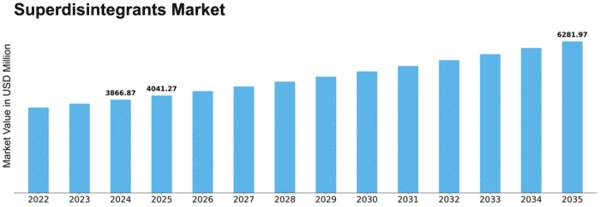
<p>The overall market valuation of the Superdisintegrants Market in 2024 was 3866.87 USD Million.</p>

What is the expected CAGR for the Superdisintegrants Market during the forecast period 2025 - 2035?

<p>The expected CAGR for the Superdisintegrants Market during the forecast period 2025 - 2035 is 4.51%.</p>

Which companies are considered key players in the Superdisintegrants Market?

<p>Key players in the Superdisintegrants Market include BASF SE, Ashland Global Holdings Inc., JRS Pharma, and others.</p>

What are the main applications of superdisintegrants in the market?

<p>The main applications of superdisintegrants in the market include Pharmaceuticals, Nutraceuticals, Food Industry, and Cosmetics.</p>

How much is the Pharmaceuticals segment projected to grow by 2035?

<p>The Pharmaceuticals segment is projected to grow from 1550.0 USD Million to 2500.0 USD Million by 2035.</p>

What types of superdisintegrants are available in the market?

<p>The types of superdisintegrants available in the market include Natural Superdisintegrants, Synthetic Superdisintegrants, Modified Starch, and Microcrystalline Cellulose.</p>

What is the projected valuation for the Food Industry segment by 2035?

<p>The Food Industry segment is projected to grow from 900.0 USD Million to 1500.0 USD Million by 2035.</p>

What formulation types are commonly used in the Superdisintegrants Market?

<p>Common formulation types in the Superdisintegrants Market include Tablet Formulations, Capsule Formulations, Powder Formulations, and Granule Formulations.</p>

What is the expected growth for the Oral Drug Delivery segment by 2035?

<p>The Oral Drug Delivery segment is expected to grow from 1550.0 USD Million to 2500.0 USD Million by 2035.</p>

Market Summary

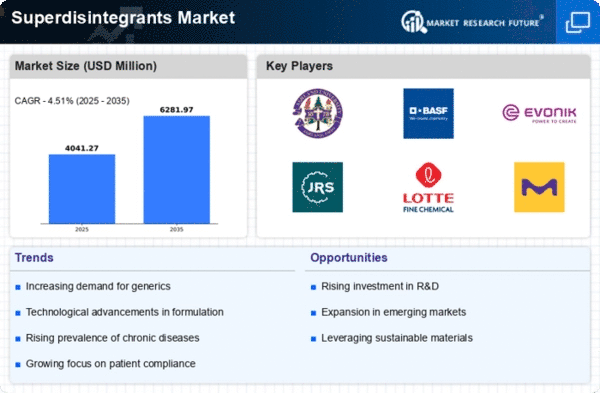
As per MRFR analysis, the Superdisintegrants Market Size was estimated at 3866.87 USD Million in 2024. The Superdisintegrants industry is projected to grow from 4041.27 in 2025 to 6281.97 by 2035, exhibiting a compound annual growth rate (CAGR) of 4.51% during the forecast period 2025 - 2035.

Key Market Trends & Highlights

The Superdisintegrants Market is experiencing a dynamic shift towards natural and innovative solutions, driven by evolving consumer preferences and technological advancements.

  • The market is witnessing a notable rise in the adoption of natural superdisintegrants, particularly in North America, which remains the largest market. Technological advancements in formulation are enhancing the efficiency and effectiveness of superdisintegrants, especially in the pharmaceutical sector. Asia-Pacific is emerging as the fastest-growing region, fueled by increasing investments in the nutraceuticals segment. The growing demand for fast-dissolving formulations and the expansion of the pharmaceutical sector are key drivers propelling market growth.

Market Size & Forecast

2024 Market Size 3866.87 (USD Million)
2035 Market Size 6281.97 (USD Million)
CAGR (2025 - 2035) 4.51%
Largest Regional Market Share in 2024 North America

Major Players

Ashland (US), BASF (DE), Evonik Industries (DE), JRS Pharma (DE), Lotte Fine Chemical (KR), Merck KGaA (DE), Roquette Freres (FR), Shin-Etsu Chemical (JP), Sodium Starch Glycolate (IN)

Market Trends

The Superdisintegrants Market is currently experiencing a notable evolution, driven by the increasing demand for efficient drug delivery systems. This market encompasses a variety of excipients that facilitate the rapid disintegration of tablets and capsules, thereby enhancing bioavailability. The growing focus on patient-centric formulations appears to be a significant factor influencing the development of innovative superdisintegrants. Furthermore, the rise in chronic diseases necessitates the creation of more effective pharmaceutical products, which may further propel market growth. As pharmaceutical companies strive to improve the efficacy of their formulations, the role of superdisintegrants becomes increasingly critical.

In addition, the superdisintegrants market is witnessing advancements in technology and formulation strategies. The emergence of novel materials and the exploration of natural superdisintegrants highlight a shift toward sustainable practices. Insights from superdisintegrants market analysis indicate that regulatory bodies are increasingly emphasizing quality and safety, which may lead to stricter guidelines for excipient usage. Overall, the superdisintegrants market appears poised for steady growth, supported by ongoing research and innovation aimed at enhancing excipient performance.

Rise of Natural Superdisintegrants

There is a growing inclination towards natural superdisintegrants, as consumers increasingly prefer products derived from plant sources. This trend reflects a broader movement towards sustainability and health consciousness, prompting manufacturers to explore alternatives that align with these values.

Technological Advancements in Formulation

Innovations in formulation technologies are significantly impacting the Superdisintegrants Market. Enhanced techniques for incorporating superdisintegrants into various dosage forms are emerging, which may improve the efficiency and effectiveness of drug delivery systems.

Regulatory Compliance and Quality Assurance

The emphasis on regulatory compliance and stringent quality assurance measures is shaping the Superdisintegrants Market. Companies are likely to invest more in research and development to meet these standards, ensuring that their products are safe and effective.

Superdisintegrants Market Market Drivers

Rising Investment in Pharmaceutical R&D

The Global Superdisintegrants Market Industry is also benefiting from rising investments in pharmaceutical research and development. As companies allocate more resources to R&D, there is a greater emphasis on developing novel drug formulations that utilize superdisintegrants to improve patient outcomes. This trend is particularly evident in the development of oral dosage forms that require rapid disintegration for effective drug delivery. Increased funding for innovative projects is likely to drive market growth, as pharmaceutical firms seek to enhance their product portfolios and meet the evolving needs of healthcare providers and patients.

Increasing Prevalence of Chronic Diseases

The rising prevalence of chronic diseases globally is a critical driver for the Global Superdisintegrants Market Industry. As the demand for effective medication increases, pharmaceutical companies are focusing on developing formulations that ensure rapid onset of action. Superdisintegrants Market play a vital role in achieving this goal by enhancing the disintegration and dissolution of tablets. The market is anticipated to grow significantly, with projections indicating a value of 6.28 USD Billion by 2035. This growth is likely to be fueled by the need for efficient drug delivery systems that cater to the growing patient population suffering from chronic conditions.

Technological Advancements in Drug Formulation

Technological advancements in drug formulation are significantly influencing the Global Superdisintegrants Market Industry. Innovations in polymer chemistry and processing techniques are enabling the development of more effective superdisintegrants that enhance the performance of solid dosage forms. For example, the introduction of novel excipients with tailored properties can improve disintegration times and overall product stability. This evolution in formulation technology is expected to contribute to a compound annual growth rate of 4.55% from 2025 to 2035, indicating a robust growth trajectory for the market as pharmaceutical companies seek to optimize their formulations.

Growing Demand for Fast-Dissolving Formulations

The Global Superdisintegrants Market Industry is experiencing a notable increase in demand for fast-dissolving formulations, particularly in the pharmaceutical sector. This trend is driven by the rising preference for patient-friendly dosage forms that enhance bioavailability and improve therapeutic outcomes. For instance, superdisintegrants facilitate rapid disintegration of tablets, leading to quicker absorption of active ingredients. As a result, the market is projected to reach 3.85 USD Billion in 2024, reflecting a growing recognition of the benefits associated with these excipients. The shift towards innovative drug delivery systems is likely to further propel the market forward.

Regulatory Support for Advanced Drug Delivery Systems

Regulatory bodies are increasingly supporting the development of advanced drug delivery systems, which is positively impacting the Global Superdisintegrants Market Industry. Guidelines that encourage the use of innovative excipients and formulations are paving the way for the introduction of new superdisintegrants. This regulatory environment fosters research and development efforts among pharmaceutical manufacturers, leading to the creation of more effective and safer products. As a result, the market is expected to benefit from enhanced product offerings, which could further stimulate growth and adoption of superdisintegrants in various therapeutic applications.

Market Segment Insights

By Application: Pharmaceuticals (Largest) vs. Nutraceuticals (Fastest-Growing)

In the superdisintegrants market , the application segment reveals a diverse distribution of market share among Pharmaceuticals, Nutraceuticals, Food Industry, and Cosmetics. Pharmaceuticals hold the largest share, driven by the rising demand for effective drug formulations and increasing development of novel medicines. Nutraceuticals, on the other hand, are swiftly gaining traction, fueled by the growing consumer awareness about health and wellness products.

Pharmaceuticals (Dominant) vs. Nutraceuticals (Emerging)

The Pharmaceuticals application stands out as the dominant force in the Superdisintegrants Market, characterized by a broad range of applications including tablets and capsules that require rapid disintegration. This segment benefits from stringent regulatory requirements that emphasize higher product quality and efficacy, leading to increased use of advanced superdisintegrants. On the other hand, the Nutraceuticals segment is emerging rapidly, fueled by consumer demand for dietary supplements and functional food products aimed at improving health and well-being. Nutraceutical applications are unique as they cater to the growing trends towards natural and organic ingredients, driving innovation in superdisintegrants that align with these preferences. Both segments display distinct characteristics that highlight their importance in the overall market landscape.

By Type: Natural Superdisintegrants (Largest) vs. Synthetic Superdisintegrants (Fastest-Growing)

The Superdisintegrants Market is characterized by a diverse range of products, with Natural Superdisintegrants commanding the largest share. These naturally derived agents, primarily sourced from plant-based materials, have gained significant traction due to their favorable consumer acceptance and regulatory approvals. In contrast, Synthetic Superdisintegrants, while currently smaller in market share, are rapidly gaining ground thanks to advancements in formulation technologies and increasing demand for high-performance pharmaceuticals. Growth trends in the Superdisintegrants Market are largely influenced by the rising demand for effective and efficient drug formulations. The pharmaceutical industry's ongoing shift towards personalized medicine and the increasing prevalence of chronic diseases are driving the need for superior disintegration properties. Natural Superdisintegrants are favored for their biocompatibility, while Synthetic counterparts are emerging as key players due to their ability to provide customizable disintegration rates, making them attractive for product innovation.

Natural Superdisintegrants (Dominant) vs. Synthetic Superdisintegrants (Emerging)

Natural Superdisintegrants are predominantly derived from plant sources such as starch, alginates, and gums, making them highly suitable for various pharmaceutical applications due to their safety profiles and environmental sustainability. Their dominance in the market can be attributed to growing preferences for clean-label products and the increasing trend of natural ingredient utilization. On the other hand, Synthetic Superdisintegrants, which include materials engineered to enhance specific disintegration properties, are emerging due to their versatility and efficiency in high-stakes applications. These synthetic variants offer tailored disintegration rates and enhanced performance in complex formulations, positions them as a crucial component in meeting the evolving needs of the pharmaceutical sector.

By Formulation Type: Tablet Formulations (Largest) vs. Capsule Formulations (Fastest-Growing)

In the superdisintegrants market , Tablet Formulations hold the largest market share, making them a critical component in pharmaceutical applications. Their established presence is due impart to their widespread utilization in various therapeutic categories. In contrast, Capsule Formulations, although currently smaller in market share, are rapidly gaining traction among consumers and manufacturers alike, showcasing their increasing importance in the field of drug delivery.

Formulations: Tablet Formulations (Dominant) vs. Capsule Formulations (Emerging)

Tablet Formulations represent the dominant force within the Superdisintegrants Market, favored for their efficient disintegration properties which enhance bioavailability. They cater primarily to the traditional pill market where reliability and dosage accuracy are paramount, making them a preferred choice among manufacturers. Conversely, Capsule Formulations are emerging as a robust alternative, providing ease of swallowing and versatility in encapsulating a range of substances. Their growth is fueled by consumer preference for capsules that allow for easier intake and the ability to mask unpleasant tastes, positioning them as a progressive choice in modern formulations.

By End Use: Oral Drug Delivery (Largest) vs. Topical Drug Delivery (Fastest-Growing)

In the Superdisintegrants Market, the oral drug delivery segment holds the largest market share, significantly outpacing its counterparts in topical and parenteral drug delivery. This dominance is largely driven by the increasing demand for orally administered medications, which are favored for their convenience and patient compliance. As a result, manufacturers are increasingly focusing on enhancing superdisintegrant formulations tailored to optimize the dissolution rate of oral drugs, making them more effective and faster-acting. Conversely, topical drug delivery is recognized as the fastest-growing segment within this market. The rise in chronic skin conditions and the need for localized treatment drive this growth. Furthermore, advancements in superdisintegrant technologies facilitate better drug absorption through the skin barrier, enhancing therapeutic efficacy and patient satisfaction. As more companies innovate in this area, the potential for further expansion of the topical segment remains significant.

Drug Delivery Method: Oral Drug Delivery (Dominant) vs. Topical Drug Delivery (Emerging)

Oral drug delivery remains the dominant method in the Superdisintegrants Market due to its high efficacy and patient acceptance. This approach minimizes the complexity involved in medication administration, allowing for predictable pharmacokinetics and dosage forms. Superdisintegrants used in this segment are engineered to allow rapid disintegration upon contact with saliva, making them ideal for formulations such as fast-dissolving tablets. On the other hand, topical drug delivery is emerging as a crucial segment, characterized by the growing demand for non-invasive therapeutic options. The ability to deliver medications directly to affected areas makes this approach increasingly attractive, particularly in dermatological treatments. Innovations in superdisintegrants that enhance skin permeation are propelling its growth, marking it as a vital area for research and development.

By Functionality: Rapid Disintegration (Largest) vs. Controlled Release (Fastest-Growing)

In the Superdisintegrants Market, the functionality segments showcase varied market shares, with Rapid Disintegration holding the largest portion due to its widespread application across fast-dissolving and immediate-release drug formulations. Controlled Release follows as a significant contender, capturing the interest of manufacturers focusing on prolonged drug delivery systems, ensuring a balance between efficacy and patient compliance. Taste Masking, while essential, remains a niche area primarily driven by pediatric and geriatric formulations, representing a smaller yet important segment within the overall market. The growth trends in the Superdisintegrants Market reflect an increasing demand for Rapid Disintegration technologies, fueled by the rising popularity of orally disintegrating tablets (ODTs) among consumers who prefer convenience. Additionally, the Controlled Release segment is rapidly evolving, propelled by innovative drug delivery mechanisms that enhance therapeutic effectiveness while minimizing side effects. The rise of personalized medicine and advanced formulation technologies is further expected to drive the growth of these functionalities, catering to specific patient needs and preferences.

Functionality: Rapid Disintegration (Dominant) vs. Taste Masking (Emerging)

Rapid Disintegration is the dominant functionality in the Superdisintegrants Market, renowned for its role in enhancing the dissolution rates of solid dosage forms, particularly in ODTs. This segment benefits from significant consumer preference for quick-dissolving medications, making it a key area for pharmaceutical development. In contrast, Taste Masking represents an emerging trend, gaining traction primarily in formulations aimed at pediatric and geriatric patients. As taste perception can significantly impact patient adherence, manufacturers are increasingly investing in taste-masking technologies. Despite being smaller in market share, this segment is innovating rapidly, offering specialized solutions that provide dual benefits of enhanced compliance and improved product acceptance among sensitive patient populations.

Get more detailed insights about Superdisintegrants Market Research Report-Global Forecast till 2035

Regional Insights

North America : Market Leader in Superdisintegrants

North America is poised to maintain its leadership in the Superdisintegrants Market, holding a significant market share of 1930.0. The region's growth is driven by increasing demand for advanced pharmaceutical formulations and stringent regulatory standards that favor high-quality excipients. The presence of major pharmaceutical companies and a robust R&D infrastructure further catalyze market expansion, ensuring compliance with evolving regulations and enhancing product efficacy. The United States stands out as the leading country in this region, with key players like Ashland, Merck KGaA, and BASF driving innovation and competition. The competitive landscape is characterized by strategic partnerships and acquisitions aimed at enhancing product portfolios. As the market evolves, companies are focusing on sustainable practices and the development of novel superdisintegrants to meet the growing needs of the pharmaceutical industry.

Europe : Emerging Hub for Innovation

Europe is witnessing a robust growth trajectory in the Superdisintegrants Market, with a market size of 1200.0. The region benefits from a strong regulatory framework that encourages innovation and ensures product safety. Increasing investments in pharmaceutical R&D and a growing trend towards personalized medicine are key drivers of demand. Regulatory bodies are actively promoting the use of superdisintegrants to enhance drug delivery systems, thereby supporting market growth. Germany, France, and the UK are leading countries in this market, hosting major players like BASF and Evonik Industries. The competitive landscape is marked by a focus on technological advancements and collaborations among industry stakeholders. Companies are increasingly investing in sustainable practices and exploring new formulations to cater to the evolving needs of the pharmaceutical sector.

Asia-Pacific : Rapidly Growing Market Potential

The Asia-Pacific region is emerging as a significant player in the Superdisintegrants Market, with a market size of 600.0. The growth is fueled by rising healthcare expenditures, increasing pharmaceutical manufacturing, and a growing population demanding better healthcare solutions. Regulatory support for generic drug production and the expansion of the pharmaceutical sector are also contributing to the market's upward trajectory. Countries like China, India, and Japan are at the forefront of this growth, with a mix of local and international players such as Lotte Fine Chemical and Shin-Etsu Chemical. The competitive landscape is evolving, with companies focusing on innovation and cost-effective solutions to meet the diverse needs of the market. As the region continues to develop, the demand for high-quality superdisintegrants is expected to rise significantly.

Middle East and Africa : Emerging Market with Challenges

The Middle East and Africa region is gradually developing its Superdisintegrants Market, currently valued at 136.87. The growth is driven by increasing healthcare investments and a rising demand for pharmaceuticals. However, challenges such as regulatory hurdles and varying market dynamics across countries can impact growth. Efforts to improve healthcare infrastructure and regulatory frameworks are essential for market expansion. Countries like South Africa and the UAE are leading the way in this region, with a growing number of pharmaceutical companies entering the market. The competitive landscape is characterized by a mix of local and international players, focusing on enhancing product offerings and meeting regulatory standards. As the market matures, the demand for effective superdisintegrants is expected to increase, driven by the need for improved drug delivery systems.

Key Players and Competitive Insights

The Superdisintegrants Market is currently characterized by a dynamic competitive landscape, driven by increasing demand for efficient drug delivery systems and the growing prevalence of chronic diseases. Key players such as Ashland (US), BASF (DE), and Evonik Industries (DE) are strategically positioned to leverage innovation and technological advancements. Ashland (US) focuses on enhancing its product portfolio through research and development, while BASF (DE) emphasizes sustainability in its operations, aiming to reduce environmental impact. Evonik Industries (DE) is actively pursuing partnerships to expand its market reach, indicating a collective strategy among these companies to foster a competitive environment that prioritizes innovation and sustainability.In terms of business tactics, companies are increasingly localizing manufacturing to reduce lead times and optimize supply chains. The market structure appears moderately fragmented, with several players vying for market share. This fragmentation allows for a diverse range of products and innovations, yet the influence of major players remains significant, shaping market trends and consumer preferences.
In November Ashland (US) announced the launch of a new line of superdisintegrants designed specifically for fast-dissolving formulations. This strategic move is likely to enhance their competitive edge by addressing the growing demand for rapid drug release, thereby positioning Ashland as a leader in innovation within the market. The introduction of this product line may also attract new partnerships with pharmaceutical companies seeking to improve their formulations.
In October BASF (DE) unveiled its commitment to sustainability by introducing a new biodegradable superdisintegrant. This initiative not only aligns with global trends towards eco-friendly products but also reflects BASF's strategic focus on meeting regulatory requirements and consumer preferences for sustainable solutions. The potential market impact of this biodegradable option could be substantial, as it may appeal to environmentally conscious manufacturers and consumers alike.
In September Evonik Industries (DE) entered into a strategic partnership with a leading pharmaceutical company to co-develop advanced superdisintegrants. This collaboration is indicative of a broader trend towards strategic alliances in the industry, which may enhance innovation capabilities and accelerate product development cycles. Such partnerships could also facilitate access to new markets and customer segments, further solidifying Evonik's position in the competitive landscape.
As of December the Superdisintegrants Market is witnessing trends such as digitalization, sustainability, and the integration of AI technologies. These trends are reshaping competitive dynamics, with companies increasingly focusing on strategic alliances to enhance their innovation capabilities. The shift from price-based competition to a focus on technological advancements and supply chain reliability is evident. Moving forward, differentiation in the market will likely hinge on the ability to innovate and adapt to evolving consumer demands, underscoring the importance of agility and responsiveness in a rapidly changing environment.

Key Companies in the Superdisintegrants Market include

Industry Developments

Recent developments in the Superdisintegrants Market showcase an increasing demand for efficient excipients, including pharmaceutical excipients, in the pharmaceutical industry. Companies like Merck Group and BASF are focusing on expanding their product portfolios to meet the rising need for improved drug delivery systems. Ashland Holdings recently launched new superdisintegrant formulations aimed at enhancing dissolution rates in tablets, reflecting innovation trends within the market. 

FMC Corporation is also investing in research to develop more sustainable and biodegradable superdisintegrants, aligning with the growing environmental concerns among manufacturers. Furthermore, Aldrich Chemical Company and ShinEtsu Chemical have strengthened their market presence through strategic partnerships, enhancing their distribution channels globally. Notably, there have been discussions regarding acquisitions, with rumors about potential mergers among key players like Evonik Industries and JRS Pharma, which could reshape competitive dynamics. 

Future Outlook

Superdisintegrants Market Future Outlook

The Superdisintegrants Market is projected to grow at a 4.51% CAGR from 2025 to 2035, driven by increasing demand for efficient drug formulations and advancements in pharmaceutical technologies.

New opportunities lie in:

  • <p>Development of novel superdisintegrants with enhanced performance characteristics. Expansion into emerging markets with tailored product offerings. Strategic partnerships with pharmaceutical companies for co-development initiatives.</p>

By 2035, the Superdisintegrants Market is expected to achieve robust growth and increased market penetration.

Market Segmentation

Superdisintegrants Market Type Outlook

  • Natural Superdisintegrants
  • Synthetic Superdisintegrants
  • Modified Starch
  • Microcrystalline Cellulose

Superdisintegrants Market End Use Outlook

  • Oral Drug Delivery
  • Topical Drug Delivery
  • Parenteral Drug Delivery

Superdisintegrants Market Application Outlook

  • Pharmaceuticals
  • Nutraceuticals
  • Food Industry
  • Cosmetics

Superdisintegrants Market Functionality Outlook

  • Rapid Disintegration
  • Controlled Release
  • Taste Masking

Superdisintegrants Market Formulation Type Outlook

  • Tablet Formulations
  • Capsule Formulations
  • Powder Formulations
  • Granule Formulations

Report Scope

MARKET SIZE 2024 3866.87(USD Million)
MARKET SIZE 2025 4041.27(USD Million)
MARKET SIZE 2035 6281.97(USD Million)
COMPOUND ANNUAL GROWTH RATE (CAGR) 4.51% (2025 - 2035)
REPORT COVERAGE Revenue Forecast, Competitive Landscape, Growth Factors, and Trends
BASE YEAR 2024
Market Forecast Period 2025 - 2035
Historical Data 2019 - 2024
Market Forecast Units USD Million
Key Companies Profiled Ashland (US), BASF (DE), Evonik Industries (DE), JRS Pharma (DE), Lotte Fine Chemical (KR), Merck KGaA (DE), Roquette Freres (FR), Shin-Etsu Chemical (JP), Sodium Starch Glycolate (IN)
Segments Covered Application, Type, Formulation Type, End Use, Functionality
Key Market Opportunities Growing demand for innovative drug delivery systems enhances opportunities in the Superdisintegrants Market.
Key Market Dynamics Rising demand for efficient drug delivery systems drives innovation in superdisintegrants and enhances market competition.
Countries Covered North America, Europe, APAC, South America, MEA

FAQs

What is the projected market valuation for the Superdisintegrants Market in 2035?

<p>The projected market valuation for the Superdisintegrants Market in 2035 is 6281.97 USD Million.</p>

What was the overall market valuation of the Superdisintegrants Market in 2024?

<p>The overall market valuation of the Superdisintegrants Market in 2024 was 3866.87 USD Million.</p>

What is the expected CAGR for the Superdisintegrants Market during the forecast period 2025 - 2035?

<p>The expected CAGR for the Superdisintegrants Market during the forecast period 2025 - 2035 is 4.51%.</p>

Which companies are considered key players in the Superdisintegrants Market?

<p>Key players in the Superdisintegrants Market include BASF SE, Ashland Global Holdings Inc., JRS Pharma, and others.</p>

What are the main applications of superdisintegrants in the market?

<p>The main applications of superdisintegrants in the market include Pharmaceuticals, Nutraceuticals, Food Industry, and Cosmetics.</p>

How much is the Pharmaceuticals segment projected to grow by 2035?

<p>The Pharmaceuticals segment is projected to grow from 1550.0 USD Million to 2500.0 USD Million by 2035.</p>

What types of superdisintegrants are available in the market?

<p>The types of superdisintegrants available in the market include Natural Superdisintegrants, Synthetic Superdisintegrants, Modified Starch, and Microcrystalline Cellulose.</p>

What is the projected valuation for the Food Industry segment by 2035?

<p>The Food Industry segment is projected to grow from 900.0 USD Million to 1500.0 USD Million by 2035.</p>

What formulation types are commonly used in the Superdisintegrants Market?

<p>Common formulation types in the Superdisintegrants Market include Tablet Formulations, Capsule Formulations, Powder Formulations, and Granule Formulations.</p>

What is the expected growth for the Oral Drug Delivery segment by 2035?

<p>The Oral Drug Delivery segment is expected to grow from 1550.0 USD Million to 2500.0 USD Million by 2035.</p>

  1. SECTION I: EXECUTIVE SUMMARY AND KEY HIGHLIGHTS |
    1. EXECUTIVE SUMMARY | |
      1. Market Overview | |
      2. Key Findings | |
      3. Market Segmentation | |
      4. Competitive Landscape | |
      5. Challenges and Opportunities | |
      6. Future Outlook 2
  2. SECTION II: SCOPING, METHODOLOGY AND MARKET STRUCTURE |
    1. MARKET INTRODUCTION | |
      1. Definition | |
      2. Scope of the study | | |
    2. RESEARCH METHODOLOGY | |
      1. Overview | |
      2. Data Mining | |
      3. Secondary Research | |
      4. Primary Research | | |
      5. Forecasting Model | |
      6. Market Size Estimation | | |
      7. Data Triangulation | |
      8. Validation 3
  3. SECTION III: QUALITATIVE ANALYSIS |
    1. MARKET DYNAMICS | |
      1. Overview | |
      2. Drivers | |
      3. Restraints | |
      4. Opportunities |
    2. MARKET FACTOR ANALYSIS | |
      1. Value chain Analysis | |
      2. Porter's Five Forces Analysis | | |
      3. COVID-19 Impact Analysis | | |
  4. SECTION IV: QUANTITATIVE ANALYSIS |
    1. Healthcare, BY Application (USD Million) | |
      1. Pharmaceuticals | |
      2. Nutraceuticals | |
      3. Food Industry | |
      4. Cosmetics |
    2. Healthcare, BY Type (USD Million) | |
      1. Natural Superdisintegrants | |
      2. Synthetic Superdisintegrants | |
      3. Modified Starch | |
      4. Microcrystalline Cellulose |
    3. Healthcare, BY Formulation Type (USD Million) | |
      1. Tablet Formulations | |
      2. Capsule Formulations | |
      3. Powder Formulations | |
      4. Granule Formulations |
    4. Healthcare, BY End Use (USD Million) | |
      1. Oral Drug Delivery | |
      2. Topical Drug Delivery | |
      3. Parenteral Drug Delivery |
    5. Healthcare, BY Region (USD Million) | |
      1. North America | | |
      2. Europe | | |
      3. APAC | | |
      4. South America | | |
      5. MEA | | |
  5. SECTION V: COMPETITIVE ANALYSIS |
    1. Competitive Landscape | |
      1. Overview | |
      2. Competitive Analysis | |
      3. Market share Analysis | |
      4. Major Growth Strategy in the Healthcare | |
      5. Competitive Benchmarking | |
      6. Leading Players in Terms of Number of Developments in the Healthcare | |
      7. Key developments and growth strategies | | |
      8. Major Players Financial Matrix | | |
    2. Company Profiles | |
      1. BASF SE (DE) | | |
      2. Ashland Global Holdings Inc. (US) | | |
      3. JRS Pharma (DE) | | |
      4. Lotte Fine Chemical (KR) | | |
      5. Roquette Freres (FR) | | |
      6. DOW Chemical Company (US) | | |
      7. Evonik Industries AG (DE) | | |
      8. Signet Chemical Corporation (IN) | | |
      9. Mingtai Chemical (CN) | | |
    3. Appendix | |
      1. References | |
      2. Related Reports 6 LIST OF FIGURES |
    4. MARKET SYNOPSIS |
    5. NORTH AMERICA MARKET ANALYSIS |
    6. US MARKET ANALYSIS BY APPLICATION |
    7. US MARKET ANALYSIS BY TYPE |
    8. US MARKET ANALYSIS BY FORMULATION TYPE |
    9. US MARKET ANALYSIS BY END USE |
    10. CANADA MARKET ANALYSIS BY APPLICATION |
    11. CANADA MARKET ANALYSIS BY TYPE |
    12. CANADA MARKET ANALYSIS BY FORMULATION TYPE |
    13. CANADA MARKET ANALYSIS BY END USE |
    14. EUROPE MARKET ANALYSIS |
    15. GERMANY MARKET ANALYSIS BY APPLICATION |
    16. GERMANY MARKET ANALYSIS BY TYPE |
    17. GERMANY MARKET ANALYSIS BY FORMULATION TYPE |
    18. GERMANY MARKET ANALYSIS BY END USE |
    19. UK MARKET ANALYSIS BY APPLICATION |
    20. UK MARKET ANALYSIS BY TYPE |
    21. UK MARKET ANALYSIS BY FORMULATION TYPE |
    22. UK MARKET ANALYSIS BY END USE |
    23. FRANCE MARKET ANALYSIS BY APPLICATION |
    24. FRANCE MARKET ANALYSIS BY TYPE |
    25. FRANCE MARKET ANALYSIS BY FORMULATION TYPE |
    26. FRANCE MARKET ANALYSIS BY END USE |
    27. RUSSIA MARKET ANALYSIS BY APPLICATION |
    28. RUSSIA MARKET ANALYSIS BY TYPE |
    29. RUSSIA MARKET ANALYSIS BY FORMULATION TYPE |
    30. RUSSIA MARKET ANALYSIS BY END USE |
    31. ITALY MARKET ANALYSIS BY APPLICATION |
    32. ITALY MARKET ANALYSIS BY TYPE |
    33. ITALY MARKET ANALYSIS BY FORMULATION TYPE |
    34. ITALY MARKET ANALYSIS BY END USE |
    35. SPAIN MARKET ANALYSIS BY APPLICATION |
    36. SPAIN MARKET ANALYSIS BY TYPE |
    37. SPAIN MARKET ANALYSIS BY FORMULATION TYPE |
    38. SPAIN MARKET ANALYSIS BY END USE |
    39. REST OF EUROPE MARKET ANALYSIS BY APPLICATION |
    40. REST OF EUROPE MARKET ANALYSIS BY TYPE |
    41. REST OF EUROPE MARKET ANALYSIS BY FORMULATION TYPE |
    42. REST OF EUROPE MARKET ANALYSIS BY END USE |
    43. APAC MARKET ANALYSIS |
    44. CHINA MARKET ANALYSIS BY APPLICATION |
    45. CHINA MARKET ANALYSIS BY TYPE |
    46. CHINA MARKET ANALYSIS BY FORMULATION TYPE |
    47. CHINA MARKET ANALYSIS BY END USE |
    48. INDIA MARKET ANALYSIS BY APPLICATION |
    49. INDIA MARKET ANALYSIS BY TYPE |
    50. INDIA MARKET ANALYSIS BY FORMULATION TYPE |
    51. INDIA MARKET ANALYSIS BY END USE |
    52. JAPAN MARKET ANALYSIS BY APPLICATION |
    53. JAPAN MARKET ANALYSIS BY TYPE |
    54. JAPAN MARKET ANALYSIS BY FORMULATION TYPE |
    55. JAPAN MARKET ANALYSIS BY END USE |
    56. SOUTH KOREA MARKET ANALYSIS BY APPLICATION |
    57. SOUTH KOREA MARKET ANALYSIS BY TYPE |
    58. SOUTH KOREA MARKET ANALYSIS BY FORMULATION TYPE |
    59. SOUTH KOREA MARKET ANALYSIS BY END USE |
    60. MALAYSIA MARKET ANALYSIS BY APPLICATION |
    61. MALAYSIA MARKET ANALYSIS BY TYPE |
    62. MALAYSIA MARKET ANALYSIS BY FORMULATION TYPE |
    63. MALAYSIA MARKET ANALYSIS BY END USE |
    64. THAILAND MARKET ANALYSIS BY APPLICATION |
    65. THAILAND MARKET ANALYSIS BY TYPE |
    66. THAILAND MARKET ANALYSIS BY FORMULATION TYPE |
    67. THAILAND MARKET ANALYSIS BY END USE |
    68. INDONESIA MARKET ANALYSIS BY APPLICATION |
    69. INDONESIA MARKET ANALYSIS BY TYPE |
    70. INDONESIA MARKET ANALYSIS BY FORMULATION TYPE |
    71. INDONESIA MARKET ANALYSIS BY END USE |
    72. REST OF APAC MARKET ANALYSIS BY APPLICATION |
    73. REST OF APAC MARKET ANALYSIS BY TYPE |
    74. REST OF APAC MARKET ANALYSIS BY FORMULATION TYPE |
    75. REST OF APAC MARKET ANALYSIS BY END USE |
    76. SOUTH AMERICA MARKET ANALYSIS |
    77. BRAZIL MARKET ANALYSIS BY APPLICATION |
    78. BRAZIL MARKET ANALYSIS BY TYPE |
    79. BRAZIL MARKET ANALYSIS BY FORMULATION TYPE |
    80. BRAZIL MARKET ANALYSIS BY END USE |
    81. MEXICO MARKET ANALYSIS BY APPLICATION |
    82. MEXICO MARKET ANALYSIS BY TYPE |
    83. MEXICO MARKET ANALYSIS BY FORMULATION TYPE |
    84. MEXICO MARKET ANALYSIS BY END USE |
    85. ARGENTINA MARKET ANALYSIS BY APPLICATION |
    86. ARGENTINA MARKET ANALYSIS BY TYPE |
    87. ARGENTINA MARKET ANALYSIS BY FORMULATION TYPE |
    88. ARGENTINA MARKET ANALYSIS BY END USE |
    89. REST OF SOUTH AMERICA MARKET ANALYSIS BY APPLICATION |
    90. REST OF SOUTH AMERICA MARKET ANALYSIS BY TYPE |
    91. REST OF SOUTH AMERICA MARKET ANALYSIS BY FORMULATION TYPE |
    92. REST OF SOUTH AMERICA MARKET ANALYSIS BY END USE |
    93. MEA MARKET ANALYSIS |
    94. GCC COUNTRIES MARKET ANALYSIS BY APPLICATION |
    95. GCC COUNTRIES MARKET ANALYSIS BY TYPE |
    96. GCC COUNTRIES MARKET ANALYSIS BY FORMULATION TYPE |
    97. GCC COUNTRIES MARKET ANALYSIS BY END USE |
    98. SOUTH AFRICA MARKET ANALYSIS BY APPLICATION |
    99. SOUTH AFRICA MARKET ANALYSIS BY TYPE |
    100. SOUTH AFRICA MARKET ANALYSIS BY FORMULATION TYPE |
    101. SOUTH AFRICA MARKET ANALYSIS BY END USE |
    102. REST OF MEA MARKET ANALYSIS BY APPLICATION |
    103. REST OF MEA MARKET ANALYSIS BY TYPE |
    104. REST OF MEA MARKET ANALYSIS BY FORMULATION TYPE |
    105. REST OF MEA MARKET ANALYSIS BY END USE |
    106. KEY BUYING CRITERIA OF HEALTHCARE |
    107. RESEARCH PROCESS OF MRFR |
    108. DRO ANALYSIS OF HEALTHCARE |
    109. DRIVERS IMPACT ANALYSIS: HEALTHCARE |
    110. RESTRAINTS IMPACT ANALYSIS: HEALTHCARE |
    111. SUPPLY / VALUE CHAIN: HEALTHCARE |
    112. HEALTHCARE, BY APPLICATION, 2024 (% SHARE) |
    113. HEALTHCARE, BY APPLICATION, 2024 TO 2035 (USD Million) |
    114. HEALTHCARE, BY TYPE, 2024 (% SHARE) |
    115. HEALTHCARE, BY TYPE, 2024 TO 2035 (USD Million) |
    116. HEALTHCARE, BY FORMULATION TYPE, 2024 (% SHARE) |
    117. HEALTHCARE, BY FORMULATION TYPE, 2024 TO 2035 (USD Million) |
    118. HEALTHCARE, BY END USE, 2024 (% SHARE) |
    119. HEALTHCARE, BY END USE, 2024 TO 2035 (USD Million) |
    120. BENCHMARKING OF MAJOR COMPETITORS 7 LIST OF TABLES |
    121. LIST OF ASSUMPTIONS | |
      1. |
    122. North America MARKET SIZE ESTIMATES; FORECAST | |
      1. BY APPLICATION, 2025-2035 (USD Million) | |
      2. BY TYPE, 2025-2035 (USD Million) | |
      3. BY FORMULATION TYPE, 2025-2035 (USD Million) | |
      4. BY END USE, 2025-2035 (USD Million) |
    123. US MARKET SIZE ESTIMATES; FORECAST | |
      1. BY APPLICATION, 2025-2035 (USD Million) | |
      2. BY TYPE, 2025-2035 (USD Million) | |
      3. BY FORMULATION TYPE, 2025-2035 (USD Million) | |
      4. BY END USE, 2025-2035 (USD Million) |
    124. Canada MARKET SIZE ESTIMATES; FORECAST | |
      1. BY APPLICATION, 2025-2035 (USD Million) | |
      2. BY TYPE, 2025-2035 (USD Million) | |
      3. BY FORMULATION TYPE, 2025-2035 (USD Million) | |
      4. BY END USE, 2025-2035 (USD Million) |
    125. Europe MARKET SIZE ESTIMATES; FORECAST | |
      1. BY APPLICATION, 2025-2035 (USD Million) | |
      2. BY TYPE, 2025-2035 (USD Million) | |
      3. BY FORMULATION TYPE, 2025-2035 (USD Million) | |
      4. BY END USE, 2025-2035 (USD Million) |
    126. Germany MARKET SIZE ESTIMATES; FORECAST | |
      1. BY APPLICATION, 2025-2035 (USD Million) | |
      2. BY TYPE, 2025-2035 (USD Million) | |
      3. BY FORMULATION TYPE, 2025-2035 (USD Million) | |
      4. BY END USE, 2025-2035 (USD Million) |
    127. UK MARKET SIZE ESTIMATES; FORECAST | |
      1. BY APPLICATION, 2025-2035 (USD Million) | |
      2. BY TYPE, 2025-2035 (USD Million) | |
      3. BY FORMULATION TYPE, 2025-2035 (USD Million) | |
      4. BY END USE, 2025-2035 (USD Million) |
    128. France MARKET SIZE ESTIMATES; FORECAST | |
      1. BY APPLICATION, 2025-2035 (USD Million) | |
      2. BY TYPE, 2025-2035 (USD Million) | |
      3. BY FORMULATION TYPE, 2025-2035 (USD Million) | |
      4. BY END USE, 2025-2035 (USD Million) |
    129. Russia MARKET SIZE ESTIMATES; FORECAST | |
      1. BY APPLICATION, 2025-2035 (USD Million) | |
      2. BY TYPE, 2025-2035 (USD Million) | |
      3. BY FORMULATION TYPE, 2025-2035 (USD Million) | |
      4. BY END USE, 2025-2035 (USD Million) |
    130. Italy MARKET SIZE ESTIMATES; FORECAST | |
      1. BY APPLICATION, 2025-2035 (USD Million) | |
      2. BY TYPE, 2025-2035 (USD Million) | |
      3. BY FORMULATION TYPE, 2025-2035 (USD Million) | |
      4. BY END USE, 2025-2035 (USD Million) |
    131. Spain MARKET SIZE ESTIMATES; FORECAST | |
      1. BY APPLICATION, 2025-2035 (USD Million) | |
      2. BY TYPE, 2025-2035 (USD Million) | |
      3. BY FORMULATION TYPE, 2025-2035 (USD Million) | |
      4. BY END USE, 2025-2035 (USD Million) |
    132. Rest of Europe MARKET SIZE ESTIMATES; FORECAST | |
      1. BY APPLICATION, 2025-2035 (USD Million) | |
      2. BY TYPE, 2025-2035 (USD Million) | |
      3. BY FORMULATION TYPE, 2025-2035 (USD Million) | |
      4. BY END USE, 2025-2035 (USD Million) |
    133. APAC MARKET SIZE ESTIMATES; FORECAST | |
      1. BY APPLICATION, 2025-2035 (USD Million) | |
      2. BY TYPE, 2025-2035 (USD Million) | |
      3. BY FORMULATION TYPE, 2025-2035 (USD Million) | |
      4. BY END USE, 2025-2035 (USD Million) |
    134. China MARKET SIZE ESTIMATES; FORECAST | |
      1. BY APPLICATION, 2025-2035 (USD Million) | |
      2. BY TYPE, 2025-2035 (USD Million) | |
      3. BY FORMULATION TYPE, 2025-2035 (USD Million) | |
      4. BY END USE, 2025-2035 (USD Million) |
    135. India MARKET SIZE ESTIMATES; FORECAST | |
      1. BY APPLICATION, 2025-2035 (USD Million) | |
      2. BY TYPE, 2025-2035 (USD Million) | |
      3. BY FORMULATION TYPE, 2025-2035 (USD Million) | |
      4. BY END USE, 2025-2035 (USD Million) |
    136. Japan MARKET SIZE ESTIMATES; FORECAST | |
      1. BY APPLICATION, 2025-2035 (USD Million) | |
      2. BY TYPE, 2025-2035 (USD Million) | |
      3. BY FORMULATION TYPE, 2025-2035 (USD Million) | |
      4. BY END USE, 2025-2035 (USD Million) |
    137. South Korea MARKET SIZE ESTIMATES; FORECAST | |
      1. BY APPLICATION, 2025-2035 (USD Million) | |
      2. BY TYPE, 2025-2035 (USD Million) | |
      3. BY FORMULATION TYPE, 2025-2035 (USD Million) | |
      4. BY END USE, 2025-2035 (USD Million) |
    138. Malaysia MARKET SIZE ESTIMATES; FORECAST | |
      1. BY APPLICATION, 2025-2035 (USD Million) | |
      2. BY TYPE, 2025-2035 (USD Million) | |
      3. BY FORMULATION TYPE, 2025-2035 (USD Million) | |
      4. BY END USE, 2025-2035 (USD Million) |
    139. Thailand MARKET SIZE ESTIMATES; FORECAST | |
      1. BY APPLICATION, 2025-2035 (USD Million) | |
      2. BY TYPE, 2025-2035 (USD Million) | |
      3. BY FORMULATION TYPE, 2025-2035 (USD Million) | |
      4. BY END USE, 2025-2035 (USD Million) |
    140. Indonesia MARKET SIZE ESTIMATES; FORECAST | |
      1. BY APPLICATION, 2025-2035 (USD Million) | |
      2. BY TYPE, 2025-2035 (USD Million) | |
      3. BY FORMULATION TYPE, 2025-2035 (USD Million) | |
      4. BY END USE, 2025-2035 (USD Million) |
    141. Rest of APAC MARKET SIZE ESTIMATES; FORECAST | |
      1. BY APPLICATION, 2025-2035 (USD Million) | |
      2. BY TYPE, 2025-2035 (USD Million) | |
      3. BY FORMULATION TYPE, 2025-2035 (USD Million) | |
      4. BY END USE, 2025-2035 (USD Million) |
    142. South America MARKET SIZE ESTIMATES; FORECAST | |
      1. BY APPLICATION, 2025-2035 (USD Million) | |
      2. BY TYPE, 2025-2035 (USD Million) | |
      3. BY FORMULATION TYPE, 2025-2035 (USD Million) | |
      4. BY END USE, 2025-2035 (USD Million) |
    143. Brazil MARKET SIZE ESTIMATES; FORECAST | |
      1. BY APPLICATION, 2025-2035 (USD Million) | |
      2. BY TYPE, 2025-2035 (USD Million) | |
      3. BY FORMULATION TYPE, 2025-2035 (USD Million) | |
      4. BY END USE, 2025-2035 (USD Million) |
    144. Mexico MARKET SIZE ESTIMATES; FORECAST | |
      1. BY APPLICATION, 2025-2035 (USD Million) | |
      2. BY TYPE, 2025-2035 (USD Million) | |
      3. BY FORMULATION TYPE, 2025-2035 (USD Million) | |
      4. BY END USE, 2025-2035 (USD Million) |
    145. Argentina MARKET SIZE ESTIMATES; FORECAST | |
      1. BY APPLICATION, 2025-2035 (USD Million) | |
      2. BY TYPE, 2025-2035 (USD Million) | |
      3. BY FORMULATION TYPE, 2025-2035 (USD Million) | |
      4. BY END USE, 2025-2035 (USD Million) |
    146. Rest of South America MARKET SIZE ESTIMATES; FORECAST | |
      1. BY APPLICATION, 2025-2035 (USD Million) | |
      2. BY TYPE, 2025-2035 (USD Million) | |
      3. BY FORMULATION TYPE, 2025-2035 (USD Million) | |
      4. BY END USE, 2025-2035 (USD Million) |
    147. MEA MARKET SIZE ESTIMATES; FORECAST | |
      1. BY APPLICATION, 2025-2035 (USD Million) | |
      2. BY TYPE, 2025-2035 (USD Million) | |
      3. BY FORMULATION TYPE, 2025-2035 (USD Million) | |
      4. BY END USE, 2025-2035 (USD Million) |
    148. GCC Countries MARKET SIZE ESTIMATES; FORECAST | |
      1. BY APPLICATION, 2025-2035 (USD Million) | |
      2. BY TYPE, 2025-2035 (USD Million) | |
      3. BY FORMULATION TYPE, 2025-2035 (USD Million) | |
      4. BY END USE, 2025-2035 (USD Million) |
    149. South Africa MARKET SIZE ESTIMATES; FORECAST | |
      1. BY APPLICATION, 2025-2035 (USD Million) | |
      2. BY TYPE, 2025-2035 (USD Million) | |
      3. BY FORMULATION TYPE, 2025-2035 (USD Million) | |
      4. BY END USE, 2025-2035 (USD Million) |
    150. Rest of MEA MARKET SIZE ESTIMATES; FORECAST | |
      1. BY APPLICATION, 2025-2035 (USD Million) | |
      2. BY TYPE, 2025-2035 (USD Million) | |
      3. BY FORMULATION TYPE, 2025-2035 (USD Million) | |
      4. BY END USE, 2025-2035 (USD Million) |
    151. PRODUCT LAUNCH/PRODUCT DEVELOPMENT/APPROVAL | |
      1. |
    152. ACQUISITION/PARTNERSHIP | |

Healthcare Market Segmentation

Healthcare By Application (USD Million, 2025-2035)

  • Pharmaceuticals
  • Nutraceuticals
  • Food Industry
  • Cosmetics

Healthcare By Type (USD Million, 2025-2035)

  • Natural Superdisintegrants
  • Synthetic Superdisintegrants
  • Modified Starch
  • Microcrystalline Cellulose

Healthcare By Formulation Type (USD Million, 2025-2035)

  • Tablet Formulations
  • Capsule Formulations
  • Powder Formulations
  • Granule Formulations

Healthcare By End Use (USD Million, 2025-2035)

  • Oral Drug Delivery
  • Topical Drug Delivery
  • Parenteral Drug Delivery
Infographic

Free Sample Request

Kindly complete the form below to receive a free sample of this Report

Get Free Sample

Customer Strories

Compare Licence

×
Features License Type
Single User Multiuser License Enterprise User
Price $4,950 $5,950 $7,250
Maximum User Access Limit 1 User Upto 10 Users Unrestricted Access Throughout the Organization
Free Customization
Direct Access to Analyst
Deliverable Format
Platform Access
Discount on Next Purchase 10% 15% 15%
Printable Versions