×
Hero Background
English
Chinese
French
Japanese
Korean
German
Spanish

Supercomputer Market Trends

ID: MRFR/SEM/10034-HCR
128 Pages
Aarti Dhapte
October 2025

Supercomputer Market Research Report Information By Type (Vector Processing Machines, Tightly Connected Cluster Computer, and Commodity Cluster), By End User (Commercial Industries, Government Entities, and Research Institutions), By Application (Cloud Infrastructure, Commercial, Space & Research Centers, Hospitals & Laboratories, Government Entities, Defense, and BFSI), And By Region (North America, Europe, Asia-Pacific, And Rest Of The World) –Industry Size, Share and Forecast Till 2035

Share:
Download PDF ×

We do not share your information with anyone. However, we may send you emails based on your report interest from time to time. You may contact us at any time to opt-out.

Supercomputer Market Infographic
Purchase Options

Market Trends

Key Emerging Trends in the Supercomputer Market

The Supercomputer market is witnessing several noteworthy trends that are shaping its trajectory and influencing the industry's future. Firstly, there is a clear trend towards increased computational power and performance. As applications become more complex, there is a growing demand for supercomputers with higher processing speeds, advanced parallel processing capabilities, and improved energy efficiency. Manufacturers are focusing on developing innovative solutions to meet these escalating performance expectations.

Another prominent trend is the integration of artificial intelligence (AI) and machine learning (ML) capabilities into supercomputing systems. The convergence of high-performance computing and AI is transforming various industries, including healthcare, finance, and research. Supercomputers are being designed to handle the massive data sets required for AI and ML applications, opening up new possibilities for advanced simulations, data analytics, and scientific research.

Energy efficiency is emerging as a critical trend in the Supercomputer market. With a growing awareness of environmental sustainability, manufacturers are investing in research and development to create supercomputing solutions that are not only powerful but also energy-efficient. This trend aligns with global efforts to reduce the carbon footprint of high-performance computing, making it more environmentally friendly.

Quantum computing is gaining momentum as a transformative trend in the Supercomputer market. While still in the early stages of development, quantum computers have the potential to revolutionize computing by leveraging the principles of quantum mechanics. Companies are exploring quantum computing as the next frontier in high-performance computing, aiming to overcome the limitations of classical computing and solve problems currently deemed unsolvable.

Edge computing is another trend influencing the Supercomputer market. As the Internet of Things (IoT) continues to proliferate, there is a growing need for supercomputing capabilities at the edge of networks. Edge computing enables real-time processing of data generated by IoT devices, reducing latency and enhancing the overall efficiency of applications such as autonomous vehicles, smart cities, and industrial automation.

Hybrid and heterogeneous computing architectures are gaining traction as a trend in the Supercomputer market. Instead of relying solely on traditional central processing units (CPUs), supercomputers are incorporating graphics processing units (GPUs), field-programmable gate arrays (FPGAs), and other specialized accelerators. This trend enhances overall system performance by leveraging the strengths of different processing elements for specific tasks.

The democratization of supercomputing is a notable trend, driven by cloud computing services and advancements in accessibility. Cloud-based supercomputing allows organizations and researchers to access high-performance computing resources without the need for substantial upfront investments in infrastructure. This trend is making supercomputing capabilities more accessible to a broader range of users, fostering innovation across various industries.

Security and data privacy are becoming increasingly important trends in the Supercomputer market. As supercomputers handle vast amounts of sensitive data, there is a growing emphasis on implementing robust cybersecurity measures. Manufacturers are incorporating advanced security features to protect against cyber threats and ensure the integrity of data processed by supercomputing systems.

Interconnectivity is a key trend influencing supercomputing architectures. High-speed and low-latency interconnects are essential for facilitating communication between different components within a supercomputer. Advancements in interconnect technologies contribute to improved overall system performance, scalability, and efficiency.


Author
Aarti Dhapte
Team Lead - Research

She holds an experience of about 6+ years in Market Research and Business Consulting, working under the spectrum of Information Communication Technology, Telecommunications and Semiconductor domains. Aarti conceptualizes and implements a scalable business strategy and provides strategic leadership to the clients. Her expertise lies in market estimation, competitive intelligence, pipeline analysis, customer assessment, etc.

Leave a Comment

FAQs

How much is the Supercomputer market?

The Supercomputer Market End User was valued at USD 8.9 Billion in 2022.

What is the growth rate of the Supercomputer market?

The global market is projected to grow at a CAGR of 11.50% during the forecast period, 2024-2032.

Which region held the largest market share in the Supercomputer market?

Asia Pacific had the largest share in the global market

Who are the key players in the Supercomputer market?

The key players in the market are Nvidia, NEC Corporation, Lenovo, Intel, IBM, HPE, Fujitsu, Dwave, Honeywell, SpaceX, Dell, CISCO, Atos., and Advanced Micro Devices.

Which Type led the Supercomputer market?

The Vector Processing Machines Type dominated the market in 2022.

Which End User had the largest market share in the Supercomputer market?

The Commercial End User had the largest share in the global market.

Market Summary

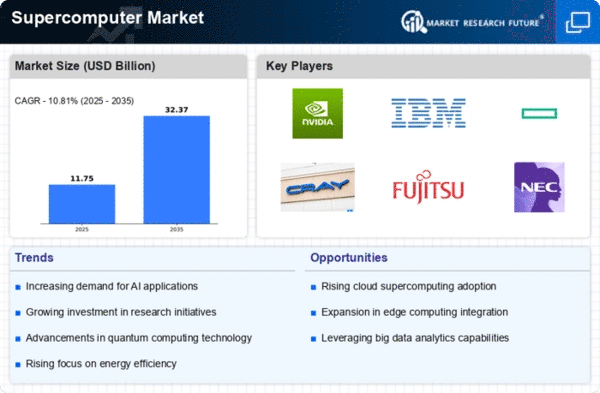
As per MRFR analysis, the Supercomputer Market Size was estimated at 10.6 USD Billion in 2024. The Supercomputer industry is projected to grow from 11.59 USD Billion in 2025 to 32.37 USD Billion by 2035, exhibiting a compound annual growth rate (CAGR) of 10.81 during the forecast period 2025 - 2035.

Key Market Trends & Highlights

The supercomputer market is experiencing robust growth driven by technological advancements and increasing demand across various sectors.

  • The adoption of AI and machine learning technologies is significantly enhancing the capabilities of supercomputers in North America.
  • Energy efficiency is becoming a critical focus, with manufacturers striving to reduce power consumption while maintaining performance.
  • Cloud-based supercomputing solutions are expanding rapidly, particularly in the Asia-Pacific region, facilitating access to high-performance computing resources.
  • Rising demand for high-performance computing and government initiatives are key drivers propelling growth in the supercomputer market.

Market Size & Forecast

2024 Market Size 10.6 (USD Billion)
2035 Market Size 32.37 (USD Billion)
CAGR (2025 - 2035) 10.81%
Largest Regional Market Share in 2024 North America

Major Players

<p>NVIDIA (US), IBM (US), Hewlett Packard Enterprise (US), Cray Inc. (US), Fujitsu (JP), NEC Corporation (JP), Atos (FR), Lenovo (CN), Tianhe Computing (CN)</p>

Market Trends

The Supercomputer Market is currently experiencing a transformative phase characterized by rapid advancements in technology and increasing demand across various sectors. Organizations are increasingly recognizing the value of high-performance computing for complex simulations, data analysis, and artificial intelligence applications. This growing reliance on supercomputers is driven by the need for enhanced computational power to solve intricate problems that traditional computing cannot efficiently address. As a result, investments in supercomputing infrastructure are on the rise, with both public and private sectors seeking to leverage these powerful systems for competitive advantage. Moreover, the landscape of the Supercomputer Market is evolving with the integration of cloud computing and hybrid models. This shift allows organizations to access supercomputing capabilities without the need for substantial upfront investments in hardware. The flexibility and scalability offered by cloud-based solutions are appealing to a diverse range of industries, from healthcare to finance. As the market continues to mature, it appears that collaboration between technology providers and end-users will be crucial in driving innovation and meeting the growing demands for computational resources. The future of the Supercomputer Market seems poised for further expansion, with emerging technologies likely to play a pivotal role in shaping its trajectory.

Increased Adoption of AI and Machine Learning

The Supercomputer Market is witnessing a notable rise in the adoption of artificial intelligence and machine learning technologies. Organizations are leveraging supercomputers to process vast datasets, enabling them to derive insights and make informed decisions. This trend is likely to enhance the capabilities of various sectors, including healthcare, finance, and scientific research.

Shift Towards Energy Efficiency

There is a growing emphasis on energy efficiency within the Supercomputer Market. As environmental concerns become more pressing, manufacturers are focusing on developing systems that consume less power while delivering high performance. This shift not only addresses sustainability issues but also reduces operational costs for organizations.

Expansion of Cloud-Based Supercomputing Solutions

The emergence of cloud-based supercomputing solutions is reshaping the market landscape. Organizations are increasingly opting for cloud services to access supercomputing resources without the burden of maintaining physical infrastructure. This trend is expected to democratize access to high-performance computing, allowing smaller enterprises to benefit from advanced computational capabilities.

Supercomputer Market Market Drivers

Rising Demand for High-Performance Computing

The Global Supercomputer Market Industry experiences a notable increase in demand for high-performance computing solutions across various sectors. Industries such as pharmaceuticals, aerospace, and climate research require advanced computational capabilities to process vast datasets and conduct complex simulations. In 2024, the market is projected to reach 10.6 USD Billion, driven by the need for faster and more efficient computing solutions. This trend indicates a growing reliance on supercomputers for critical applications, which could further propel market growth as organizations seek to enhance their research and development capabilities.

Market Segment Insights

By Application: Artificial Intelligence (Largest) vs. Weather Forecasting (Fastest-Growing)

<p>The application segment of the Supercomputer Market showcases a diverse landscape, with Artificial Intelligence standing out as the largest component, driven by its extensive use across various industries. Meanwhile, Weather Forecasting is emerging as the fastest-growing segment due to increased demand for accurate predictions fueled by climate change concerns and the need for real-time data analysis.</p>

<p>Application: Artificial Intelligence (Dominant) vs. Weather Forecasting (Emerging)</p>

<p>Artificial Intelligence dominates the supercomputer application sector as it underpins numerous advanced technologies including machine learning and deep learning. Its ability to handle vast datasets and perform complex computations makes it indispensable for industries such as healthcare, finance, and automotive. In contrast, Weather Forecasting is rapidly gaining momentum as an emerging application, leveraging supercomputing resources for enhanced climate modeling and predictive analytics. This growth is spurred by global climate changes that demand advanced forecasting techniques, resulting in increased investments in supercomputing capabilities dedicated to environmental monitoring and prediction.</p>

By End Use: Government Research (Largest) vs. Healthcare (Fastest-Growing)

<p>In the Supercomputer Market, the distribution of end-use applications reveals that Government Research remains the largest segment, primarily driven by extensive computational needs for simulations and data analyzes in areas such as climate research, national security, and other scientific pursuits. Academic Institutions also hold a substantial share, benefiting from supercomputers for research and innovation. These segments reflect significant investments in high-performance computing to address complex research challenges. On the other hand, the Healthcare sector is emerging as the fastest-growing segment, propelled by the increasing adoption of supercomputers for data analysis in genomics, personalized medicine, and drug discovery. The demand for real-time data processing and advanced simulations in patient care continues to escalate, fostering the rapid growth of supercomputing capabilities within this sector.</p>

<p>Government Research: Dominant vs. Healthcare: Emerging</p>

<p>Government Research in the Supercomputer Market is characterized by substantial investment in high-performance computing infrastructures, enabling complex simulations and data processing for diverse applications such as climate modeling, cryptography, and national defense strategies. This segment's dominant position is attributed to ongoing federal and state funding, which supports cutting-edge research initiatives. In contrast, Healthcare is rapidly emerging as a significant player, utilizing supercomputers for advanced medical research, particularly in genomics, where the need for large-scale data analysis is critical for personalized medicine. The convergence of healthcare data with supercomputing power is expected to innovate diagnostics and treatment plans, thereby enhancing patient outcomes.</p>

By Deployment Type: On-Premises (Largest) vs. Cloud-Based (Fastest-Growing)

<p>In the Supercomputer Market, the On-Premises deployment type holds the largest share, primarily due to its reliability and control over data security. Organizations that require substantial processing power, such as research institutions and government entities, prefer this traditional setup to meet their specific performance and compliance needs. Meanwhile, Cloud-Based solutions are gaining traction, appealing to businesses looking for scalability and reduced upfront investment, but they currently constitute a smaller segment of the market. The ongoing digital transformation across industries is fueling the growth of the Hybrid deployment model, which combines elements of both On-Premises and Cloud-Based solutions. This flexibility allows organizations to optimize their supercomputing resources based on workload demands. As more enterprises embrace multi-cloud environments, Cloud-Based models are set to experience rapid growth, driven by the increasing demand for high-performance computing capabilities without the associated capital expenditures of on-premises systems.</p>

<p>On-Premises (Dominant) vs. Cloud-Based (Emerging)</p>

<p>On-Premises supercomputers remain the dominant choice for organizations that value control, security, and a customized systems architecture. These systems are typically deployed in environments where massive data processing, secure management, and high-throughput operations are critical, such as in scientific research, defense, and large-scale simulations. These systems require considerable capital investment and ongoing maintenance. In contrast, Cloud-Based supercomputing is emerging as a viable alternative that offers significant advantages in flexibility and cost efficiency. As organizations shift toward digital and cloud-first strategies, Cloud-Based solutions allow users to leverage high computation power without substantial capital expenditure. This model is particularly advantageous for businesses seeking to scale their computing resources dynamically while reducing operational overhead.</p>

By Architecture Type: Vector Processing (Largest) vs. Parallel Processing (Fastest-Growing)

<p>In the Supercomputer Market, the architecture type segment showcases a clear distribution of market power, where Vector Processing stands out as the largest contributor. This segment has cemented its relevance due to its efficiency in handling complex calculations, making it a preferred choice for industries demanding high-level computations. In contrast, Parallel Processing, while not the largest, is rapidly gaining traction, marking itself as the fastest-growing architecture type due to advancements in multi-core technologies that facilitate simultaneous processing of data, appealing to sectors looking to leverage real-time analytical capabilities.</p>

<p>Vector Processing (Dominant) vs. Distributed Computing (Emerging)</p>

<p>Vector Processing dominates the supercomputer architecture scene by providing unparalleled efficiency and speed, particularly for tasks requiring mathematical operations on large datasets. This architecture excels in applications such as scientific simulations and complex modeling, where performance is paramount. On the other hand, Distributed Computing represents an emerging player that offers flexibility and scalability, enabling multiple interconnected computers to collaborate on tasks. Although currently less dominant than Vector Processing, it is becoming increasingly attractive for organizations looking to leverage cloud computing and big data analytics, driving its growth in the supercomputer market.</p>

By System Type: Supercomputers (Largest) vs. Clusters (Fastest-Growing)

<p>The Supercomputer market is predominantly driven by Supercomputers, which hold the largest share in the segment. These high-performance computing systems are utilized across various industries, including government, research, and finance, making them essential for data-intensive tasks. Clusters, while smaller in market share, are quickly gaining traction due to their cost-effectiveness and scalability, appealing particularly to academic and research institutions.</p>

<p>Supercomputers (Dominant) vs. Workstations (Emerging)</p>

<p>Supercomputers remain the dominant force in the market, known for their unparalleled speed and processing capabilities. They are critical for complex simulations and scientific modeling, handling vast amounts of data efficiently. In contrast, Workstations are emerging as a popular choice for specialized tasks that require substantial computational power, but on a smaller scale. They are increasingly seen as viable alternatives for sectors that do not require the extensive capabilities of Supercomputers, thereby appealing to organizations looking for high performance without the associated costs of supercomputing systems.</p>

Get more detailed insights about Supercomputer Market Research Report—Global Forecast till 2035

Regional Insights

North America : Innovation and Leadership Hub

North America continues to lead the supercomputer market, holding a significant share of 5.8 in 2025. The region's growth is driven by advancements in AI, big data analytics, and cloud computing. Government initiatives and funding for research and development further catalyze demand, ensuring that North America remains at the forefront of technological innovation. The increasing need for high-performance computing in various sectors, including healthcare and finance, also contributes to this growth. The competitive landscape in North America is robust, featuring key players like NVIDIA, IBM, and Hewlett Packard Enterprise. These companies are investing heavily in R&D to enhance their offerings and maintain market leadership. The presence of leading universities and research institutions fosters collaboration, driving innovation in supercomputing technologies. As a result, North America is not only a market leader but also a hub for cutting-edge research and development in the supercomputer sector.

Europe : Emerging Technological Powerhouse

Europe's supercomputer market is poised for growth, with a market size of 2.8 in 2025. The region is focusing on enhancing its computational capabilities to support scientific research and industrial applications. Initiatives like the European High-Performance Computing Joint Undertaking aim to bolster investments in supercomputing infrastructure, driving demand across various sectors. Regulatory support for green computing and energy-efficient technologies is also a significant catalyst for market growth. Leading countries in Europe include Germany, France, and the UK, which are home to several prominent supercomputer manufacturers like Atos and Fujitsu. The competitive landscape is characterized by collaborations between public and private sectors, fostering innovation. As Europe aims to reduce its reliance on non-European technologies, the presence of key players and strategic investments will be crucial for the region's supercomputing ambitions.

Asia-Pacific : Rapidly Growing Market

The Asia-Pacific region is witnessing a surge in supercomputer adoption, with a market size of 1.8 in 2025. This growth is driven by increasing investments in research and development, particularly in countries like China and Japan. The demand for high-performance computing in sectors such as weather forecasting, healthcare, and artificial intelligence is propelling the market forward. Government initiatives aimed at enhancing technological capabilities are also significant growth drivers in this region. China stands out as a leader in the supercomputer market, with companies like Lenovo and Tianhe Computing making substantial contributions. Japan is also a key player, with Fujitsu and NEC Corporation leading the charge. The competitive landscape is marked by rapid technological advancements and collaborations between academia and industry, positioning Asia-Pacific as a formidable player in the global supercomputing arena.

Middle East and Africa : Emerging Market Potential

The Middle East and Africa region is currently at a nascent stage in the supercomputer market, with a market size of only 0.2 in 2025. Despite this, there is a growing recognition of the importance of high-performance computing for various applications, including oil and gas exploration, climate modeling, and academic research. Government initiatives aimed at enhancing technological infrastructure are beginning to emerge, which could catalyze future growth in this sector. Countries like South Africa and the UAE are leading the way in adopting supercomputing technologies, albeit at a slower pace compared to other regions. The competitive landscape is still developing, with few key players present. However, as investments in technology and education increase, the potential for growth in the supercomputer market in the Middle East and Africa is significant, paving the way for future advancements.

Key Players and Competitive Insights

The Supercomputer Market is characterized by intense competition and rapid technological advancements, driven by the increasing demand for high-performance computing across various sectors, including scientific research, artificial intelligence, and big data analytics. Major players such as NVIDIA (US), IBM (US), and Fujitsu (Japan) are at the forefront, each adopting distinct strategies to enhance their market positioning. NVIDIA (US) focuses on innovation in GPU technology, which is pivotal for supercomputing applications, while IBM (US) emphasizes hybrid cloud solutions and quantum computing integration. Fujitsu (Japan) leverages its expertise in high-performance computing to cater to specific industry needs, thereby shaping a competitive landscape that is both dynamic and multifaceted.

Key business tactics within the Supercomputer Market include localizing manufacturing and optimizing supply chains to enhance efficiency and reduce costs. The market structure appears moderately fragmented, with several key players exerting substantial influence. This fragmentation allows for a diverse range of offerings, yet the collective strength of these companies fosters a competitive environment where innovation and technological advancements are paramount.

In November 2025, NVIDIA (US) announced the launch of its latest supercomputer architecture, which integrates advanced AI capabilities aimed at accelerating research in climate modeling. This strategic move underscores NVIDIA's commitment to addressing global challenges through technology, potentially positioning the company as a leader in environmentally focused supercomputing solutions. The integration of AI into supercomputing not only enhances performance but also aligns with growing sustainability trends in the industry.

In October 2025, IBM (US) unveiled a new partnership with a consortium of universities to develop a supercomputing platform that supports collaborative research in healthcare. This initiative highlights IBM's strategy to foster innovation through academic partnerships, thereby expanding its influence in the supercomputing domain. By aligning its technology with pressing societal needs, IBM is likely to enhance its competitive edge and drive further adoption of its solutions.

In September 2025, Fujitsu (Japan) launched a new supercomputer tailored for the automotive industry, focusing on simulations for autonomous vehicle development. This strategic action reflects Fujitsu's intent to penetrate niche markets, thereby diversifying its customer base and reinforcing its position in the supercomputer sector. The targeted approach may yield significant returns as the automotive industry increasingly relies on advanced computing for innovation.

As of December 2025, current trends in the Supercomputer Market indicate a strong emphasis on digitalization, sustainability, and AI integration. Strategic alliances are becoming increasingly vital, as companies seek to combine their strengths to address complex challenges. The competitive differentiation is likely to evolve from traditional price-based competition to a focus on innovation, technological advancements, and supply chain reliability. This shift suggests that companies that prioritize these elements will be better positioned to thrive in an ever-evolving market landscape.

Key Companies in the Supercomputer Market market include

Industry Developments

  • Q2 2024: Japan’s Fugaku supercomputer upgraded to boost AI research Japan’s RIKEN and Fujitsu announced an upgrade to the Fugaku supercomputer, enhancing its capabilities for artificial intelligence research and scientific simulations.
  • Q2 2024: HPE to build new supercomputer for the European High Performance Computing Joint Undertaking HPE announced it was selected to build a new supercomputer for the European HPC JU, aiming to advance research and innovation across Europe.
  • Q2 2024: UK government unveils £900m investment in national exascale supercomputer The UK government announced a £900 million investment to develop a national exascale supercomputer, targeting breakthroughs in climate modeling and AI.
  • Q2 2024: NVIDIA and SoftBank partner to launch AI-powered supercomputer in Japan NVIDIA and SoftBank revealed a partnership to deploy a new AI-focused supercomputer in Japan, designed to support advanced research and commercial applications.
  • Q3 2024: Meta launches new supercomputer to accelerate AI model training Meta announced the launch of a new supercomputer dedicated to training large-scale AI models, aiming to improve its generative AI capabilities.
  • Q3 2024: China unveils exascale supercomputer at National Supercomputing Center China’s National Supercomputing Center announced the commissioning of a new exascale supercomputer, marking a significant milestone in computational power.
  • Q3 2024: Dell Technologies wins contract to supply supercomputing systems to US Department of Energy Dell Technologies announced it secured a contract to deliver advanced supercomputing systems to the US Department of Energy for scientific research.
  • Q4 2024: IBM launches next-generation quantum-enabled supercomputer IBM introduced a new supercomputer integrating quantum computing capabilities, targeting breakthroughs in materials science and cryptography.
  • Q4 2024: Cerebras Systems raises $150M Series D to expand AI supercomputing Cerebras Systems announced a $150 million Series D funding round to accelerate the development and deployment of its AI-focused supercomputers.
  • Q1 2025: France opens new supercomputing facility for climate research The French government inaugurated a new supercomputing center dedicated to climate modeling and environmental research.
  • Q1 2025: Intel appoints new head of supercomputing division Intel announced the appointment of a new executive to lead its supercomputing division, aiming to strengthen its position in high-performance computing.
  • Q2 2025: Microsoft and OpenAI partner to build world’s largest AI supercomputer Microsoft and OpenAI revealed plans to jointly develop the world’s largest AI supercomputer, targeting advancements in generative AI and large language models.

Future Outlook

Supercomputer Market Future Outlook

<p>The Supercomputer Market is projected to grow at a 10.81% CAGR from 2024 to 2035, driven by advancements in AI, big data analytics, and cloud computing.</p>

New opportunities lie in:

  • <p>Development of energy-efficient supercomputing solutions</p>
  • <p>Expansion of supercomputing as a service (SCaaS) models</p>
  • <p>Integration of quantum computing capabilities into existing supercomputers</p>

<p>By 2035, the Supercomputer Market is expected to achieve substantial growth and technological advancements.</p>

Market Segmentation

Supercomputer Market End Use Outlook

  • Academic Institutions
  • Government Research
  • Healthcare
  • Defense
  • Energy Sector

Supercomputer Market Application Outlook

  • Weather Forecasting
  • Molecular Modeling
  • Artificial Intelligence
  • Data Analytics
  • Computational Fluid Dynamics

Supercomputer Market System Type Outlook

  • Supercomputers
  • Workstations
  • Clusters

Supercomputer Market Deployment Type Outlook

  • On-Premises
  • Cloud-Based
  • Hybrid

Supercomputer Market Architecture Type Outlook

  • Vector Processing
  • Parallel Processing
  • Distributed Computing

Report Scope

MARKET SIZE 202410.6(USD Billion)
MARKET SIZE 202511.59(USD Billion)
MARKET SIZE 203532.37(USD Billion)
COMPOUND ANNUAL GROWTH RATE (CAGR)10.81% (2024 - 2035)
REPORT COVERAGERevenue Forecast, Competitive Landscape, Growth Factors, and Trends
BASE YEAR2024
Market Forecast Period2025 - 2035
Historical Data2019 - 2024
Market Forecast UnitsUSD Billion
Key Companies ProfiledNVIDIA (US), IBM (US), Hewlett Packard Enterprise (US), Cray Inc. (US), Fujitsu (JP), NEC Corporation (JP), Atos (FR), Lenovo (CN), Tianhe Computing (CN)
Segments CoveredApplication, End Use, Deployment Type, Architecture Type, System Type
Key Market OpportunitiesIntegration of artificial intelligence in Supercomputer Market enhances computational efficiency and drives innovation.
Key Market DynamicsRising demand for advanced computing capabilities drives innovation and competition in the supercomputer market.
Countries CoveredNorth America, Europe, APAC, South America, MEA

FAQs

How much is the Supercomputer market?

The Supercomputer Market End User was valued at USD 8.9 Billion in 2022.

What is the growth rate of the Supercomputer market?

The global market is projected to grow at a CAGR of 11.50% during the forecast period, 2024-2032.

Which region held the largest market share in the Supercomputer market?

Asia Pacific had the largest share in the global market

Who are the key players in the Supercomputer market?

The key players in the market are Nvidia, NEC Corporation, Lenovo, Intel, IBM, HPE, Fujitsu, Dwave, Honeywell, SpaceX, Dell, CISCO, Atos., and Advanced Micro Devices.

Which Type led the Supercomputer market?

The Vector Processing Machines Type dominated the market in 2022.

Which End User had the largest market share in the Supercomputer market?

The Commercial End User had the largest share in the global market.

  1. EXECUTIVE SUMMARY
  2. MARKET INTRODUCTION
    1. Definition
    2. Scope of the Study
      1. Research Objective
      2. Limitations
    3. Assumptions
  3. RESEARCH METHODOLOGY
    1. Overview
    2. Data Mining
    3. Secondary Research
    4. Primary Research
      1. Breakdown of Primary
    5. Primary Interviews and Information Gathering Process
    6. Respondents
    7. Forecasting Model
    8. Market Size Estimation
      1. Top-Down Approach
    9. Bottom-Up Approach
    10. Data Triangulation
    11. Validation
  4. MARKET DYNAMICS
    1. Overview
    2. Drivers
    3. Restraints
    4. Opportunities
  5. MARKET FACTOR ANALYSIS
    1. Value Chain Analysis
    2. Porter’s Five Forces Analysis
      1. Bargaining
      2. Bargaining Power of Buyers
      3. Threat of
      4. Threat of Substitutes
      5. Intensity of Rivalry
    3. Power of Suppliers
    4. New Entrants
    5. COVID-19 Impact Analysis
      1. Market Impact Analysis
      2. Opportunity and Threat Analysis
    6. Regional Impact
  6. GLOBAL SUPERCOMPUTER
  7. MARKET, BY TYPE
    1. Overview
    2. Vector Processing Machines
    3. Tightly Connected Cluster Computer
    4. Commodity Cluster
  8. GLOBAL SUPERCOMPUTER
  9. MARKET, BY END USER
    1. Overview
    2. Commercial Industries
    3. Government Entities
    4. Research Institutions
  10. GLOBAL SUPERCOMPUTER
  11. MARKET, BY APPLICATION
    1. Overview
    2. Cloud Infrastructure
    3. Commercial
    4. Space & Research Centers
    5. Hospitals & Laboratories
    6. Government Entities
    7. Defense
    8. BFSI
  12. GLOBAL SUPERCOMPUTER
  13. MARKET, BY REGION
    1. Overview
    2. North America
      1. US
    3. Canada
    4. Europe
      1. Germany
      2. France
      3. UK
      4. Italy
      5. Spain
      6. Rest of Europe
    5. Asia-Pacific
      1. China
      2. India
      3. Japan
      4. South Korea
      5. Rest of Asia-Pacific
    6. Australia
    7. Rest of the World
      1. Africa
      2. Latin America
    8. Middle East
  14. COMPETITIVE LANDSCAPE
    1. Overview
    2. Competitive Analysis
    3. Market Share Analysis
    4. Major Growth Strategy in the Global Supercomputer Market,
    5. Competitive
    6. Benchmarking
    7. Leading Players in Terms of Number of Developments in the
    8. Global Supercomputer Market,
    9. Key developments and Growth Strategies
      1. New Product Launch/Service Deployment
      2. Merger & Acquisitions
      3. Joint Ventures
    10. Major Players Financial Matrix
      1. Major Players R&D Expenditure.
    11. Sales & Operating Income, 2022
  15. COMPANY PROFILES
    1. NVIDIA
      1. Company Overview
      2. Financial Overview
      3. Products Offered
      4. Key Developments
      5. SWOT Analysis
      6. Key Strategies
    2. NEC Corporation
      1. Company Overview
      2. Financial Overview
      3. Products
      4. Key Developments
      5. SWOT Analysis
      6. Key
    3. Offered
    4. Strategies
    5. Lenovo
      1. Company Overview
      2. Financial
      3. Products Offered
      4. Key Developments
      5. Key Strategies
    6. Overview
    7. SWOT Analysis
    8. Intel
      1. Company
      2. Financial Overview
      3. Products Offered
      4. SWOT Analysis
      5. Key Strategies
      6. Company Overview
      7. Financial Overview
      8. Products
      9. Key Developments
      10. SWOT Analysis
      11. Key
    9. Overview
    10. Key Developments
    11. IBM
    12. Offered
    13. Strategies
    14. FUJITSU
      1. Company Overview
      2. Financial
      3. Products Offered
      4. Key Developments
      5. Key Strategies
    15. Overview
    16. SWOT Analysis
    17. Dwave
      1. Company
      2. Financial Overview
      3. Products Offered
      4. SWOT Analysis
      5. Key Strategies
      6. Company Overview
      7. Financial Overview
      8. Key Developments
      9. SWOT Analysis
    18. Overview
    19. Key Developments
    20. Honeywell
    21. Products Offered
    22. Key Strategies
    23. SpaceX
      1. Company Overview
      2. Financial
      3. Products Offered
      4. Key Developments
      5. Key Strategies
    24. Overview
    25. SWOT Analysis
    26. Dell
      1. Company
      2. Financial Overview
      3. Products Offered
      4. SWOT Analysis
      5. Key Strategies
    27. Overview
    28. Key Developments
    29. APPENDIX
    30. References
    31. Related Reports
    32. LIST
  16. OF TABLES
  17. GLOBAL SUPERCOMPUTER MARKET, SYNOPSIS, 2018-2032
    1. TABLE
  18. GLOBAL SUPERCOMPUTER MARKET, ESTIMATES & FORECAST, 2018-2032 (USD BILLION)
  19. GLOBAL SUPERCOMPUTER MARKET, BY TYPE, 2018-2032 (USD BILLION)
    1. TABLE
  20. GLOBAL SUPERCOMPUTER MARKET, BY END USER, 2018-2032 (USD BILLION)
    1. TABLE 5
  21. GLOBAL SUPERCOMPUTER MARKET, BY APPLICATION, 2018-2032 (USD BILLION)
    1. TABLE
  22. NORTH AMERICA: SUPERCOMPUTER MARKET, BY TYPE, 2018-2032 (USD BILLION)
    1. TABLE
  23. NORTH AMERICA: SUPERCOMPUTER MARKET, BY END USER, 2018-2032 (USD BILLION)
  24. NORTH AMERICA: SUPERCOMPUTER MARKET, BY APPLICATION, 2018-2032 (USD BILLION)
  25. US: SUPERCOMPUTER MARKET, BY TYPE, 2018-2032 (USD BILLION)
    1. TABLE
  26. US: SUPERCOMPUTER MARKET, BY END USER, 2018-2032 (USD BILLION)
    1. TABLE 11
  27. US: SUPERCOMPUTER MARKET, BY APPLICATION, 2018-2032 (USD BILLION)
    1. TABLE 12
  28. CANADA: SUPERCOMPUTER MARKET, BY TYPE, 2018-2032 (USD BILLION)
  29. CANADA:
  30. SUPERCOMPUTER MARKET, BY END USER, 2018-2032 (USD BILLION)
  31. CANADA:
  32. SUPERCOMPUTER MARKET, BY APPLICATION, 2018-2032 (USD BILLION)
  33. EUROPE:
  34. SUPERCOMPUTER MARKET, BY TYPE, 2018-2032 (USD BILLION)
  35. EUROPE: SUPERCOMPUTER
  36. MARKET, BY END USER, 2018-2032 (USD BILLION)
  37. EUROPE: SUPERCOMPUTER
  38. MARKET, BY APPLICATION, 2018-2032 (USD BILLION)
  39. GERMANY: SUPERCOMPUTER
  40. MARKET, BY TYPE, 2018-2032 (USD BILLION)
  41. GERMANY: SUPERCOMPUTER MARKET,
    1. BY END USER, 2018-2032 (USD BILLION)
  42. GERMANY: SUPERCOMPUTER MARKET,
    1. BY APPLICATION, 2018-2032 (USD BILLION)
  43. FRANCE: SUPERCOMPUTER MARKET,
    1. BY TYPE, 2018-2032 (USD BILLION)
  44. FRANCE: SUPERCOMPUTER MARKET, BY END
    1. USER, 2018-2032 (USD BILLION)
  45. FRANCE: SUPERCOMPUTER MARKET, BY APPLICATION,
  46. ITALY: SUPERCOMPUTER MARKET, BY TYPE, 2018-2032
    1. (USD BILLION)
  47. ITALY: SUPERCOMPUTER MARKET, BY END USER, 2018-2032
    1. (USD BILLION)
  48. ITALY: SUPERCOMPUTER MARKET, BY APPLICATION, 2018-2032
    1. (USD BILLION)
  49. SPAIN: SUPERCOMPUTER MARKET, BY TYPE, 2018-2032 (USD
    1. BILLION)
  50. SPAIN: SUPERCOMPUTER MARKET, BY END USER, 2018-2032 (USD
    1. BILLION)
  51. SPAIN: SUPERCOMPUTER MARKET, BY APPLICATION, 2018-2032 (USD
    1. BILLION)
  52. UK: SUPERCOMPUTER MARKET, BY TYPE, 2018-2032 (USD BILLION)
  53. UK: SUPERCOMPUTER MARKET, BY END USER, 2018-2032 (USD BILLION)
    1. TABLE
  54. UK: SUPERCOMPUTER MARKET, BY APPLICATION, 2018-2032 (USD BILLION)
    1. TABLE
  55. REST OF EUROPE: SUPERCOMPUTER MARKET, BY TYPE, 2018-2032 (USD BILLION)
    1. TABLE
  56. REST OF EUROPE: SUPERCOMPUTER MARKET, BY END USER, 2018-2032 (USD BILLION)
  57. REST OF EUROPE: SUPERCOMPUTER MARKET, BY APPLICATION, 2018-2032 (USD
    1. BILLION)
  58. ASIA-PACIFIC: SUPERCOMPUTER MARKET, BY TYPE, 2018-2032 (USD
    1. BILLION)
  59. ASIA-PACIFIC: SUPERCOMPUTER MARKET, BY END USER, 2018-2032
    1. (USD BILLION)
  60. ASIA-PACIFIC: SUPERCOMPUTER MARKET, BY APPLICATION,
  61. JAPAN: SUPERCOMPUTER MARKET, BY TYPE, 2018-2032
    1. (USD BILLION)
  62. JAPAN: SUPERCOMPUTER MARKET, BY END USER, 2018-2032
    1. (USD BILLION)
  63. JAPAN: SUPERCOMPUTER MARKET, BY APPLICATION, 2018-2032
    1. (USD BILLION)
  64. CHINA: SUPERCOMPUTER MARKET, BY TYPE, 2018-2032 (USD
    1. BILLION)
  65. CHINA: SUPERCOMPUTER MARKET, BY END USER, 2018-2032 (USD
    1. BILLION)
  66. CHINA: SUPERCOMPUTER MARKET, BY APPLICATION, 2018-2032 (USD
    1. BILLION)
  67. INDIA: SUPERCOMPUTER MARKET, BY TYPE, 2018-2032 (USD BILLION)
  68. INDIA: SUPERCOMPUTER MARKET, BY END USER, 2018-2032 (USD BILLION)
  69. INDIA: SUPERCOMPUTER MARKET, BY APPLICATION, 2018-2032 (USD BILLION)
  70. AUSTRALIA: SUPERCOMPUTER MARKET, BY TYPE, 2018-2032 (USD BILLION)
  71. AUSTRALIA: SUPERCOMPUTER MARKET, BY END USER, 2018-2032 (USD BILLION)
  72. AUSTRALIA: SUPERCOMPUTER MARKET, BY APPLICATION, 2018-2032 (USD BILLION)
  73. SOUTH KOREA: SUPERCOMPUTER MARKET, BY TYPE, 2018-2032 (USD BILLION)
  74. SOUTH KOREA: SUPERCOMPUTER MARKET, BY END USER, 2018-2032 (USD BILLION)
  75. SOUTH KOREA: SUPERCOMPUTER MARKET, BY APPLICATION, 2018-2032 (USD BILLION)
  76. REST OF ASIA-PACIFIC: SUPERCOMPUTER MARKET, BY TYPE, 2018-2032 (USD BILLION)
  77. REST OF ASIA-PACIFIC: SUPERCOMPUTER MARKET, BY END USER, 2018-2032
    1. (USD BILLION)
  78. REST OF ASIA-PACIFIC: SUPERCOMPUTER MARKET, BY APPLICATION,
  79. REST OF THE WORLD: SUPERCOMPUTER MARKET,
    1. BY TYPE, 2018-2032 (USD BILLION)
  80. REST OF THE WORLD: SUPERCOMPUTER
  81. MARKET, BY END USER, 2018-2032 (USD BILLION)
  82. REST OF THE WORLD: SUPERCOMPUTER
  83. MARKET, BY APPLICATION, 2018-2032 (USD BILLION)
  84. MIDDLE EAST: SUPERCOMPUTER
  85. MARKET, BY TYPE, 2018-2032 (USD BILLION)
  86. MIDDLE EAST: SUPERCOMPUTER
  87. MARKET, BY END USER, 2018-2032 (USD BILLION)
  88. MIDDLE EAST: SUPERCOMPUTER
  89. MARKET, BY APPLICATION, 2018-2032 (USD BILLION)
  90. AFRICA: SUPERCOMPUTER
  91. MARKET, BY TYPE, 2018-2032 (USD BILLION)
  92. AFRICA: SUPERCOMPUTER MARKET,
    1. BY END USER, 2018-2032 (USD BILLION)
  93. AFRICA: SUPERCOMPUTER MARKET,
    1. BY APPLICATION, 2018-2032 (USD BILLION)
  94. LATIN AMERICA: SUPERCOMPUTER
  95. MARKET, BY TYPE, 2018-2032 (USD BILLION)
  96. LATIN AMERICA: SUPERCOMPUTER
  97. MARKET, BY END USER, 2018-2032 (USD BILLION)
  98. LATIN AMERICA: SUPERCOMPUTER
  99. MARKET, BY APPLICATION, 2018-2032 (USD BILLION)
  100. LIST OF FIGURES
  101. RESEARCH PROCESS
  102. MARKET STRUCTURE FOR THE GLOBAL SUPERCOMPUTER
    1. MARKET
  103. MARKET DYNAMICS FOR THE GLOBAL SUPERCOMPUTER MARKET
    1. FIGURE
  104. GLOBAL SUPERCOMPUTER MARKET, SHARE (%), BY TYPE, 2022
  105. GLOBAL SUPERCOMPUTER
  106. MARKET, SHARE (%), BY END USER, 2022
  107. GLOBAL SUPERCOMPUTER MARKET,
    1. SHARE (%), BY APPLICATION, 2022
  108. GLOBAL SUPERCOMPUTER MARKET, SHARE
    1. (%), BY REGION, 2022
  109. NORTH AMERICA: SUPERCOMPUTER MARKET, SHARE (%),
    1. BY REGION, 2022
  110. EUROPE: SUPERCOMPUTER MARKET, SHARE (%), BY REGION,
  111. ASIA-PACIFIC: SUPERCOMPUTER MARKET, SHARE (%), BY REGION, 2022
  112. REST OF THE WORLD: SUPERCOMPUTER MARKET, SHARE (%), BY REGION, 2022
  113. GLOBAL SUPERCOMPUTER MARKET: COMPANY SHARE ANALYSIS, 2022 (%)
  114. NVIDIA: FINANCIAL OVERVIEW SNAPSHOT
  115. NVIDIA: SWOT ANALYSIS
  116. NEC CORPORATION: FINANCIAL OVERVIEW SNAPSHOT
  117. NEC
    1. CORPORATION: SWOT ANALYSIS
  118. LENOVO: FINANCIAL OVERVIEW SNAPSHOT
  119. LENOVO: SWOT ANALYSIS
  120. INTEL: FINANCIAL OVERVIEW SNAPSHOT
  121. INTEL: SWOT ANALYSIS
  122. IBM.: FINANCIAL OVERVIEW SNAPSHOT
  123. IBM.: SWOT ANALYSIS
  124. FUJITSU: FINANCIAL OVERVIEW SNAPSHOT
  125. FUJITSU: SWOT ANALYSIS
  126. DWAVE: FINANCIAL OVERVIEW SNAPSHOT
  127. DWAVE: SWOT ANALYSIS
  128. HONEYWELL: FINANCIAL OVERVIEW
    1. SNAPSHOT
  129. HONEYWELL: SWOT ANALYSIS
  130. SPACEX: FINANCIAL
    1. OVERVIEW SNAPSHOT
  131. SPACEX: SWOT ANALYSIS
  132. DELL: FINANCIAL
    1. OVERVIEW SNAPSHOT
  133. DELL: SWOT ANALYSIS

Supercomputer Market Segmentation

Supercomputer Type Outlook (USD Billion, 2018-2032)

  • Vector Processing Machines
  • Tightly Connected Cluster Computer
  • Commodity Cluster

Supercomputer End User Outlook (USD Billion, 2018-2032)

  • Commercial Industries
  • Government Entities
  • Research Institutions

Supercomputer Application Outlook (USD Billion, 2018-2032)

  • Cloud Infrastructure
  • Commercial
  • Space & Research Centers
  • Hospitals & Laboratories
  • Government Entities
  • Defense
  • BFSI

Supercomputer Products Regional Outlook (USD Billion, 2018-2032)

  • North America Outlook (USD Billion, 2018-2032)

    • North America Supercomputer Products by Type
      • Vector Processing Machines
      • Tightly Connected Cluster Computer
      • Commodity Cluster
    • North America Supercomputer Products by End User
      • Commercial Industries
      • Government Entities
      • Research Institutions
    • North America Supercomputer Products by Application
      • Cloud Infrastructure
      • Commercial
      • Space & Research Centers
      • Hospitals & Laboratories
      • Government Entities
      • Defense
      • BFSI
    • US Outlook (USD Billion, 2018-2032)

    • US Supercomputer Products by Type
      • Vector Processing Machines
      • Tightly Connected Cluster Computer
      • Commodity Cluster
    • US Supercomputer Products by End User
      • Commercial Industries
      • Government Entities
      • Research Institutions
    • US Supercomputer Products by Application
      • Cloud Infrastructure
      • Commercial
      • Space & Research Centers
      • Hospitals & Laboratories
      • Government Entities
      • Defense
      • BFSI
    • Canada Outlook (USD Billion, 2018-2032)

    • Canada Supercomputer Products by Type
      • Vector Processing Machines
      • Tightly Connected Cluster Computer
      • Commodity Cluster
    • Canada Supercomputer Products by End User
      • Commercial Industries
      • Government Entities
      • Research Institutions
    • Canada Supercomputer Products by Application
      • Cloud Infrastructure
      • Commercial
      • Space & Research Centers
      • Hospitals & Laboratories
      • Government Entities
      • Defense
      • BFSI
  • Europe Outlook (USD Billion, 2018-2032)

    • Europe Supercomputer Products by Type
      • Vector Processing Machines
      • Tightly Connected Cluster Computer
      • Commodity Cluster
    • Europe Supercomputer Products by End User
      • Commercial Industries
      • Government Entities
      • Research Institutions
    • Europe Supercomputer Products by Application
      • Cloud Infrastructure
      • Commercial
      • Space & Research Centers
      • Hospitals & Laboratories
      • Government Entities
      • Defense
      • BFSI
    • Germany Outlook (USD Billion, 2018-2032)

    • Germany Supercomputer Products by Type
      • Vector Processing Machines
      • Tightly Connected Cluster Computer
      • Commodity Cluster
    • Germany Supercomputer Products by End User
      • Commercial Industries
      • Government Entities
      • Research Institutions
    • Germany Supercomputer Products by Application
      • Cloud Infrastructure
      • Commercial
      • Space & Research Centers
      • Hospitals & Laboratories
      • Government Entities
      • Defense
      • BFSI
    • France Outlook (USD Billion, 2018-2032)

    • France Supercomputer Products by Type
      • Vector Processing Machines
      • Tightly Connected Cluster Computer
      • Commodity Cluster
    • France Supercomputer Products by End User
      • Commercial Industries
      • Government Entities
      • Research Institutions
    • France Supercomputer Products by Application
      • Cloud Infrastructure
      • Commercial
      • Space & Research Centers
      • Hospitals & Laboratories
      • Government Entities
      • Defense
      • BFSI
    • UK Outlook (USD Billion, 2018-2032)

    • UK Supercomputer Products by Type
      • Vector Processing Machines
      • Tightly Connected Cluster Computer
      • Commodity Cluster
    • UK Supercomputer Products by End User
      • Commercial Industries
      • Government Entities
      • Research Institutions
    • UK Supercomputer Products by Application
      • Cloud Infrastructure
      • Commercial
      • Space & Research Centers
      • Hospitals & Laboratories
      • Government Entities
      • Defense
      • BFSI
    • Italy Outlook (USD Billion, 2018-2032)

    • Italy Supercomputer Products by Type
      • Vector Processing Machines
      • Tightly Connected Cluster Computer
      • Commodity Cluster
    • Italy Supercomputer Products by End User
      • Commercial Industries
      • Government Entities
      • Research Institutions
    • Italy Supercomputer Products by Application
      • Cloud Infrastructure
      • Commercial
      • Space & Research Centers
      • Hospitals & Laboratories
      • Government Entities
      • Defense
      • BFSI
    • Spain Outlook (USD Billion, 2018-2032)

    • Spain Supercomputer Products by Type
      • Vector Processing Machines
      • Tightly Connected Cluster Computer
      • Commodity Cluster
    • Spain Supercomputer Products by End User
      • Commercial Industries
      • Government Entities
      • Research Institutions
    • Spain Supercomputer Products by Application
      • Cloud Infrastructure
      • Commercial
      • Space & Research Centers
      • Hospitals & Laboratories
      • Government Entities
      • Defense
      • BFSI
    • Rest Of Europe Outlook (USD Billion, 2018-2032)

    • Rest Of Europe Supercomputer Products by Type
      • Vector Processing Machines
      • Tightly Connected Cluster Computer
      • Commodity Cluster
    • Rest Of Europe Supercomputer Products by End User
      • Commercial Industries
      • Government Entities
      • Research Institutions
    • Rest Of Europe Supercomputer Products by Application
      • Cloud Infrastructure
      • Commercial
      • Space & Research Centers
      • Hospitals & Laboratories
      • Government Entities
      • Defense
      • BFSI
  • Asia-Pacific Outlook (USD Billion, 2018-2032)

    • Asia-Pacific Supercomputer Products by Type
      • Vector Processing Machines
      • Tightly Connected Cluster Computer
      • Commodity Cluster
    • Asia-Pacific Supercomputer Products by End User
      • Commercial Industries
      • Government Entities
      • Research Institutions
    • Asia-Pacific Supercomputer Products by Application
      • Cloud Infrastructure
      • Commercial
      • Space & Research Centers
      • Hospitals & Laboratories
      • Government Entities
      • Defense
      • BFSI
    • China Outlook (USD Billion, 2018-2032)

    • China Supercomputer Products by Type
      • Vector Processing Machines
      • Tightly Connected Cluster Computer
      • Commodity Cluster
    • China Supercomputer Products by End User
      • Commercial Industries
      • Government Entities
      • Research Institutions
    • China Supercomputer Products by Application
      • Cloud Infrastructure
      • Commercial
      • Space & Research Centers
      • Hospitals & Laboratories
      • Government Entities
      • Defense
      • BFSI
    • Japan Outlook (USD Billion, 2018-2032)

    • Japan Supercomputer Products by Type
      • Vector Processing Machines
      • Tightly Connected Cluster Computer
      • Commodity Cluster
    • Japan Supercomputer Products by End User
      • Commercial Industries
      • Government Entities
      • Research Institutions
    • Japan Supercomputer Products by Application
      • Cloud Infrastructure
      • Commercial
      • Space & Research Centers
      • Hospitals & Laboratories
      • Government Entities
      • Defense
      • BFSI
    • India Outlook (USD Billion, 2018-2032)

    • India Supercomputer Products by Type
      • Vector Processing Machines
      • Tightly Connected Cluster Computer
      • Commodity Cluster
    • India Supercomputer Products by End User
      • Commercial Industries
      • Government Entities
      • Research Institutions
    • India Supercomputer Products by Application
      • Cloud Infrastructure
      • Commercial
      • Space & Research Centers
      • Hospitals & Laboratories
      • Government Entities
      • Defense
      • BFSI
    • Australia Outlook (USD Billion, 2018-2032)

    • Australia Supercomputer Products by Type
      • Vector Processing Machines
      • Tightly Connected Cluster Computer
      • Commodity Cluster
    • Australia Supercomputer Products by End User
      • Commercial Industries
      • Government Entities
      • Research Institutions
    • Australia Supercomputer Products by Application
      • Cloud Infrastructure
      • Commercial
      • Space & Research Centers
      • Hospitals & Laboratories
      • Government Entities
      • Defense
      • BFSI
    • Rest of Asia-Pacific Outlook (USD Billion, 2018-2032)

    • Rest of Asia-Pacific Supercomputer Products by Type
      • Vector Processing Machines
      • Tightly Connected Cluster Computer
      • Commodity Cluster
    • Rest of Asia-Pacific Supercomputer Products by End User
      • Commercial Industries
      • Government Entities
      • Research Institutions
    • Rest of Asia-Pacific Supercomputer Products by Application
      • Cloud Infrastructure
      • Commercial
      • Space & Research Centers
      • Hospitals & Laboratories
      • Government Entities
      • Defense
      • BFSI
  • Rest of the World Outlook (USD Billion, 2018-2032)

    • Rest of the World Supercomputer Products by Type
      • Vector Processing Machines
      • Tightly Connected Cluster Computer
      • Commodity Cluster
    • Rest of the World Supercomputer Products by End User
      • Commercial Industries
      • Government Entities
      • Research Institutions
    • Rest of the World Supercomputer Products by Application
      • Cloud Infrastructure
      • Commercial
      • Space & Research Centers
      • Hospitals & Laboratories
      • Government Entities
      • Defense
      • BFSI
    • Middle East Outlook (USD Billion, 2018-2032)

    • Middle East Supercomputer Products by Type
      • Vector Processing Machines
      • Tightly Connected Cluster Computer
      • Commodity Cluster
    • Middle East Supercomputer Products by End User
      • Commercial Industries
      • Government Entities
      • Research Institutions
    • Middle East Supercomputer Products by Application
      • Cloud Infrastructure
      • Commercial
      • Space & Research Centers
      • Hospitals & Laboratories
      • Government Entities
      • Defense
      • BFSI
    • Africa Outlook (USD Billion, 2018-2032)

    • Africa Supercomputer Products by Type
      • Vector Processing Machines
      • Tightly Connected Cluster Computer
      • Commodity Cluster
    • Africa Supercomputer Products by End User
      • Commercial Industries
      • Government Entities
      • Research Institutions
    • Africa Supercomputer Products by Application
      • Cloud Infrastructure
      • Commercial
      • Space & Research Centers
      • Hospitals & Laboratories
      • Government Entities
      • Defense
      • BFSI
    • Latin America Outlook (USD Billion, 2018-2032)

    • Latin America Supercomputer Products by Type
      • Vector Processing Machines
      • Tightly Connected Cluster Computer
      • Commodity Cluster
    • Latin America Supercomputer Products by End User
      • Commercial Industries
      • Government Entities
      • Research Institutions
    • Latin America Supercomputer Products by Application
      • Cloud Infrastructure
      • Commercial
      • Space & Research Centers
      • Hospitals & Laboratories
      • Government Entities
      • Defense
      • BFSI


Infographic

Free Sample Request

Kindly complete the form below to receive a free sample of this Report

Get Free Sample

Customer Strories

Compare Licence

×
Features License Type
Single User Multiuser License Enterprise User
Price $4,950 $5,950 $7,250
Maximum User Access Limit 1 User Upto 10 Users Unrestricted Access Throughout the Organization
Free Customization
Direct Access to Analyst
Deliverable Format
Platform Access
Discount on Next Purchase 10% 15% 15%
Printable Versions