×
Request Free Sample ×

Kindly complete the form below to receive a free sample of this Report

* Please use a valid business email

Leading companies partner with us for data-driven Insights

clients tt-cursor
Hero Background
English
Chinese
French
Japanese
Korean
German
Spanish

Sugarcane Wax Market Trends

ID: MRFR/CnM/8626-CR
85 Pages
Anshula Mandaokar
July 2020

Sugarcane Wax Market Research Report Information by Application (Pharmaceuticals, Food, Cosmetics, Textile & Leather and Others) and Region (North America, Europe, Asia-Pacific, Latin America and the Middle East & Africa) - Forecast till 2035

Share:
Download PDF ×

We do not share your information with anyone. However, we may send you emails based on your report interest from time to time. You may contact us at any time to opt-out.

Sugarcane Wax Market Infographic
×
Sugarcane Wax Market Infographic Full View
Purchase Options

Market Trends

Key Emerging Trends in the Sugarcane Wax Market

Sugarcane Wax market trends reflect industrial changes. Buyer information on environmental issues is boosting demand in affordable and typical products. Unlike ordinary waxes, sugarcane wax is sustainable and inexhaustible. Sugarcane Wax is also driven by beauty and personal care.

Sugarcane Wax is used in beautification and wrapping. Manufacturers are studying bio-based bundling materials as manageability becomes a demand. Natural sugarcane wax is becoming a popular eco-friendly wrapping material. This pattern may increase as more companies pursue stockpiling chains.

Sugarcane Wax market geology is intriguing. Sugarcane Wax demand is rising in growing Asian and Latin American countries. Due to growing familiarity with affordable goods and natural resources. Some of these nations' laws support bio-based products, boosting the market.

Sugarcane Wax market changes due to mechanical developments. Innovative research is improving sugarcane wax extraction and properties. These modifications boost Sugarcane Wax's quality and affordability, making it more competitive.

The Sugarcane Wax industry faces unrefined substance value variations. Market actors are vulnerable to sugarcane yield and cost variations due to their dependence. Climate, agriculture, and the organic market affect sugarcane availability and price.

Author
Anshula Mandaokar
Team Lead - Research

Anshula Mandaokar holds an academic degree in Chemical Engineering and has been contributing to the field for more than 5 years. She has expertise in Market Research and Business Consulting and serves as a Team Lead for a reputed Market Research firm under the Chemicals and Materials domain spectrum. She has worked on multiple projects, generating explicit results in a quick turnaround time. Her understanding of data interpretation justifies her role as a leader.

Leave a Comment

FAQs

What is the projected market value of the global sugarcane wax market?

Global SUGARCANE WAX market is touted to record a substantial market valuation of USD 55.7 million by 2025.

What is the estimated growth rate of the global sugarcane wax market?

Global sugarcane wax market is projected to register a moderate 3.87% CAGR in the forecast period.

Which factors are poised to drive the market growth?

The massive demand for sugarcane wax for its use as a preservative in the processing of fruits and vegetables are the primary growth inducer of the market.

Which region is expected to observe the highest growth?

The APAC is poised to secure the highest CAGR.

What are the major by-products obtained in the sugarcane processing industries?

• Bagasse • Molasses • Press mud

What are the techniques involved in sugarcane wax processing?

• Crushing • Juice clarification • Crystallization • Centrifuge • Depolarization and conditioning • Packing and bagging

Who are the major end-user industries of the Sugarcane wax industry?

• Pharmaceuticals • Food • Cosmetics • Textile and leather • Others

Who are the major market players in the sugarcane wax industry?

• DUREX AG (Germany) • CERAX (South Africa) • Origen chemicals (South Africa) • Huzhou Shengtao Biotech LLC (China) • Godavari Biorefineries (India).

Market Summary

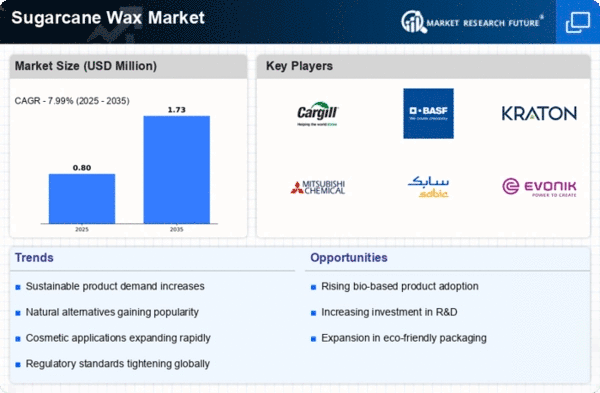
As per MRFR analysis, the Sugarcane Wax Market Size was estimated at 0.742 USD Million in 2024. The Sugarcane Wax industry is projected to grow from 0.801 in 2025 to 1.73 by 2035, exhibiting a compound annual growth rate (CAGR) of 7.99 during the forecast period 2025 - 2035.

Key Market Trends & Highlights

The Sugarcane Wax Market is poised for growth driven by sustainability and diverse applications.

  • The market is experiencing a notable shift towards sustainability, influencing production and consumption patterns.
  • North America remains the largest market for sugarcane wax, while Asia-Pacific is emerging as the fastest-growing region.
  • In the cosmetics segment, sugarcane wax is the largest application, whereas the candle segment is witnessing rapid growth.
  • Market drivers include increasing sustainability initiatives and consumer awareness regarding eco-friendly products.

Market Size & Forecast

2024 Market Size 0.742 (USD Million)
2035 Market Size 1.73 (USD Million)
CAGR (2025 - 2035) 7.99%
Largest Regional Market Share in 2024 North America

Major Players

Cargill (US), BASF (DE), Kraton Corporation (US), Mitsubishi Chemical Corporation (JP), SABIC (SA), Evonik Industries (DE), NatureWax (US), Givaudan (CH), Kraton Polymers (US)

Market Trends

The Sugarcane Wax Market is currently experiencing a notable transformation, driven by increasing consumer awareness regarding sustainable and eco-friendly products. This natural wax, derived from sugarcane, is gaining traction in various applications, including cosmetics, food packaging, and candles. As industries seek alternatives to petroleum-based waxes, the demand for sugarcane wax appears to be on the rise. Furthermore, the growing trend towards plant-based materials aligns with broader environmental goals, suggesting a promising future for this market segment. In addition to sustainability, the Sugarcane Wax Market is influenced by innovations in product formulations and processing techniques. Manufacturers are exploring new methods to enhance the properties of sugarcane wax, making it more versatile for diverse applications. This innovation could lead to improved performance characteristics, such as melting point and texture, which may attract a wider range of consumers. As the market evolves, it seems likely that the synergy between sustainability and technological advancement will play a crucial role in shaping its trajectory.

Sustainability Focus

The emphasis on sustainable products is reshaping the Sugarcane Wax Market. Consumers increasingly prefer eco-friendly options, prompting manufacturers to prioritize natural ingredients. This trend aligns with global efforts to reduce environmental impact.

Technological Advancements

Innovations in processing techniques are enhancing the quality and versatility of sugarcane wax. Manufacturers are developing improved formulations that cater to various applications, potentially expanding market reach.

Diverse Applications

The Sugarcane Wax Market is witnessing growth across multiple sectors, including cosmetics and food packaging. As industries recognize the benefits of natural wax, demand is likely to increase, fostering market expansion.

Sugarcane Wax Market Market Drivers

Market Growth Projections

The Global Sugarcane Wax Market Industry is projected to experience substantial growth over the coming years. With a market value of 54.4 USD Million in 2024, it is anticipated to reach 81.4 USD Million by 2035, reflecting a robust upward trajectory. The compound annual growth rate of 3.74% from 2025 to 2035 indicates a steady increase in demand, driven by various factors such as sustainability trends and expanding applications. This growth presents opportunities for stakeholders to invest in research and development, enhancing product offerings and exploring new markets. The industry's future appears promising, with potential for significant advancements and innovations.

Expansion in Cosmetic Applications

The Global Sugarcane Wax Market Industry is witnessing significant growth due to its expanding applications in the cosmetic sector. Sugarcane wax is increasingly utilized in formulations for lip balms, creams, and lotions, owing to its emollient properties and ability to enhance texture. The industry's focus on natural ingredients is likely to bolster the demand for sugarcane wax, as brands seek to cater to health-conscious consumers. This trend suggests a promising future, with the market anticipated to reach 81.4 USD Million by 2035. The integration of sugarcane wax in cosmetic products may also encourage further research into its benefits, potentially leading to new product developments.

Rising Awareness of Health Benefits

The Global Sugarcane Wax Market Industry is positively influenced by the rising awareness of health benefits associated with natural waxes. Sugarcane wax is perceived as a safer alternative to synthetic waxes, particularly in food and cosmetic applications. This perception is likely to drive consumer preferences towards products containing sugarcane wax, as individuals increasingly seek out healthier options. The industry's growth trajectory appears promising, with a projected compound annual growth rate of 3.74% from 2025 to 2035. This trend indicates a potential for sustained market expansion as consumers prioritize health-conscious choices in their purchasing decisions.

Growing Demand for Eco-Friendly Products

The Global Sugarcane Wax Market Industry experiences a notable increase in demand for eco-friendly and sustainable products. As consumers become more environmentally conscious, there is a shift towards natural alternatives in various applications, including cosmetics and food packaging. Sugarcane wax, derived from renewable resources, aligns with this trend, appealing to manufacturers aiming to reduce their carbon footprint. This growing preference is reflected in the market's projected value of 54.4 USD Million in 2024, indicating a robust consumer inclination towards sustainable materials. The industry's response to this demand could potentially drive innovation and expansion in product offerings.

Technological Advancements in Production

The Global Sugarcane Wax Market Industry is experiencing advancements in production technologies that enhance efficiency and reduce costs. Innovations in extraction and processing methods are enabling manufacturers to produce sugarcane wax more sustainably and at a larger scale. These technological improvements not only streamline production but also contribute to the overall quality of the wax, making it more appealing for various applications. As production capabilities expand, the market is likely to benefit from increased supply and competitive pricing, further driving adoption across industries. This trend may also encourage new entrants to explore opportunities within the sugarcane wax sector.

Regulatory Support for Sustainable Practices

The Global Sugarcane Wax Market Industry benefits from increasing regulatory support for sustainable practices. Governments worldwide are implementing policies that promote the use of renewable resources and biodegradable materials. Such regulations encourage manufacturers to adopt sugarcane wax as a viable alternative to petroleum-based waxes, which are less environmentally friendly. This regulatory landscape not only enhances market growth but also positions sugarcane wax as a key player in the transition towards sustainable manufacturing. As these policies evolve, the industry may see an uptick in investments aimed at expanding production capabilities and improving supply chain efficiencies.


Market Segment Insights

By Application: Cosmetics (Largest) vs. Candles (Fastest-Growing)

The application segment of the Sugarcane Wax Market showcases a diverse distribution, with cosmetics dominating the landscape. This segment utilizes sugarcane wax for its natural and emollient properties, catering to a growing demand for eco-friendly beauty products. Following cosmetics, the food industry also holds a significant share, employing sugarcane wax as a natural coating for various food items to enhance preservation and visual appeal. Pharmaceuticals and coatings play a smaller yet essential role, driven by their versatile applications and benefits over synthetic alternatives.

Cosmetics: Dominant vs. Candles: Emerging

The cosmetics sector currently holds a dominant position in the Sugarcane Wax Market due to its extensive use in formulations for creams, lipsticks, and lotions, where sugarcane wax acts as a natural thickener and stabilizer. By contrast, the candles segment is emerging as a rapidly growing application, driven by a heightened consumer interest in sustainable and eco-friendly products. As candle manufacturers increasingly seek natural waxes that offer a cleaner burn and are biodegradable, sugarcane wax is gaining traction for its desirable properties. This unique profile offers an advantage over traditional paraffin and other synthetic waxes, positioning both segments favorably in the market.

By End Use: Personal Care Products (Largest) vs. Food Packaging (Fastest-Growing)

The Sugarcane Wax Market is predominantly driven by the personal care products segment, which holds the largest market share. This is attributed to the rising consumer preference for natural and sustainable ingredients in cosmetics and skincare formulations. Alongside personal care, food packaging also represents a significant portion of the market, reflecting the growing demand for eco-friendly and biodegradable packaging solutions. The industrial applications and household products segments, while notable, contribute less to the overall market share but are essential for a comprehensive view of the end-use landscape. Growth trends within the Sugarcane Wax Market are greatly influenced by increasing awareness regarding environmental sustainability and the health benefits of plant-based products. As consumers gravitate toward natural options, personal care brands are incorporating sugarcane wax to enhance product formulations. The food packaging segment is experiencing rapid growth as companies seek alternatives to traditional plastics, driven by stringent regulations. Industrial applications are expanding as industries look to renewable resources, while household products benefit from similar consumer trends towards sustainability and safety.

Personal Care Products (Dominant) vs. Food Packaging (Emerging)

In the Sugarcane Wax Market, personal care products stand out as the dominant segment, leveraging its natural properties that appeal to eco-conscious consumers. Sugarcane wax is favored in formulations for creams, lotions, and other cosmetic products due to its emollient qualities and skin compatibility. This segment continues to flourish with rising awareness of organic and clean beauty trends. On the other hand, food packaging is recognized as an emerging segment, driven by the need for sustainable alternatives in the packaging industry. With increasing regulatory pressures and consumer demands for biodegradable and recyclable materials, sugarcane wax is gaining traction in food packaging applications, offering a competitive advantage to brands committed to environmental responsibility. The future looks promising as innovations in sugarcane wax formulations align with global sustainability initiatives.

By Form: Solid (Largest) vs. Liquid (Fastest-Growing)

In the Sugarcane Wax Market, the distribution among segment values reveals that the solid form of sugarcane wax dominates the market, holding a significant share due to its widespread applications in cosmetics and candles. The solid segment benefits from stability and ease of use, making it a preferred choice for both manufacturers and consumers. Conversely, the liquid form is gaining attention for its versatility and adaptability in various formulations, leading to rapid growth and adoption in industries such as food and pharmaceuticals. Growth trends in the Sugarcane Wax Market indicate a bright future for the liquid segment, which is projected to become the fastest-growing category. Factors driving this growth include the increasing demand for natural and environmentally friendly products, along with the liquid form's ability to enhance product performance in applications such as coatings and emulsions. Additionally, consumer preferences are shifting towards sustainable options, further bolstering the appeal of liquid sugarcane wax products.

Solid (Dominant) vs. Liquid (Emerging)

The solid form of sugarcane wax is recognized as the dominant choice in the market, primarily due to its robustness and high melting point, which make it suitable for a range of applications including personal care and cosmetics. It provides excellent firmness and texture, which is essential for products like lip balms and solid perfumes. On the other hand, the liquid form is emerging as an appealing alternative, especially in formulations that require easy application and incorporation. Its ability to blend seamlessly with other ingredients enables manufacturers to create innovative products that cater to the evolving consumer preferences towards convenience and sustainability. As the market evolves, both forms of sugarcane wax will likely coexist, catering to diverse needs.

By Source: Organic Sugarcane (Largest) vs. Conventional Sugarcane (Fastest-Growing)

In the Sugarcane Wax Market, the distribution of market share is characterized by a significant dominance of Organic Sugarcane. This segment appeals to consumers seeking natural and eco-friendly alternatives, reflecting a growing trend towards sustainability in product sourcing. On the other hand, Conventional Sugarcane holds a notable presence, supported by established agricultural practices and wider availability, though it is perceived as less premium compared to organic counterparts.

Sugarcane Source: Organic (Dominant) vs. Conventional (Emerging)

Organic Sugarcane enjoys a commanding presence in the Sugarcane Wax Market due to its association with health-conscious and environmentally aware consumers. As a dominant force, it underscores a holistic approach to product sourcing that prioritizes sustainability and ethical practices. In contrast, Conventional Sugarcane represents an emerging trend, leveraging established farming methods to meet increased demand. While it may not carry the same premium appeal as its organic counterpart, it is gaining traction for its cost-effectiveness and reliability, particularly in industries that prioritize functionality over brand ethics.

Get more detailed insights about Sugarcane Wax Market Research Report - Forecast till 2035

Regional Insights

North America : Market Leader in Sugarcane Wax

North America is poised to maintain its leadership in the Sugarcane Wax market, holding a significant market share of 30% in 2024. The region's growth is driven by increasing demand for sustainable and eco-friendly products, alongside stringent regulations promoting renewable resources. The rise in consumer awareness regarding the environmental impact of synthetic waxes further fuels this trend. The United States stands out as the leading country in this market, with major players like Cargill and Kraton Corporation driving innovation and production. The competitive landscape is characterized by a mix of established companies and emerging players, all vying for market share. The presence of key players ensures a robust supply chain and continuous advancements in product offerings, solidifying North America's position in the global market.

Europe : Sustainable Innovations Drive Growth

Europe is witnessing a notable increase in the Sugarcane Wax market, with a market share of 20% in 2024. The region's growth is propelled by a strong regulatory framework that encourages the use of bio-based materials. Initiatives aimed at reducing carbon footprints and promoting sustainability are key drivers of demand. The European market is also characterized by a shift towards natural and organic products, aligning with consumer preferences. Leading countries such as Germany and France are at the forefront of this transition, with companies like BASF and Evonik Industries investing heavily in R&D. The competitive landscape is vibrant, with numerous players focusing on innovation and sustainability. The presence of regulatory bodies ensures compliance and fosters a conducive environment for market growth. "The European Union aims to increase the share of renewable materials in various industries, including cosmetics and food packaging," European Commission.

Asia-Pacific : Emerging Market Potential

Asia-Pacific is emerging as a significant player in the Sugarcane Wax market, holding a market share of 15% in 2024. The region's growth is driven by rising disposable incomes and increasing consumer awareness regarding sustainable products. Countries like Japan and Australia are leading the charge, with a growing demand for eco-friendly alternatives in various applications, including cosmetics and food packaging. Regulatory support for bio-based products further enhances market prospects. The competitive landscape is evolving, with key players like Mitsubishi Chemical Corporation and NatureWax making substantial investments in production capabilities. The presence of these companies fosters innovation and ensures a steady supply of high-quality products. As the market matures, the focus on sustainability and compliance with environmental regulations will be crucial for success in this region.

Middle East and Africa : Developing Market Landscape

The Middle East and Africa region is gradually developing its Sugarcane Wax market, currently holding a market share of 7% in 2024. The growth is hindered by limited awareness and infrastructure for sustainable products. However, increasing interest in eco-friendly alternatives presents opportunities for market expansion. Regulatory frameworks are beginning to evolve, promoting the use of renewable resources, which could catalyze growth in the coming years. Countries like South Africa and the UAE are showing potential, with local players exploring the benefits of sugarcane wax in various applications. The competitive landscape is still nascent, but the presence of international companies could drive innovation and market penetration. As awareness grows, the region may see a shift towards more sustainable practices in the wax industry.

Key Players and Competitive Insights

The Sugarcane Wax Market is currently characterized by a dynamic competitive landscape, driven by increasing demand for sustainable and biodegradable products. Key players are actively engaging in strategic initiatives to enhance their market positioning. For instance, Cargill (US) has been focusing on innovation in product development, particularly in creating high-performance waxes that cater to the growing eco-conscious consumer base. Similarly, BASF (DE) has been investing in research and development to improve the efficiency of sugarcane wax production, thereby reinforcing its commitment to sustainability and operational excellence. These strategies collectively contribute to a competitive environment that emphasizes innovation and sustainability as primary growth drivers.In terms of business tactics, companies are increasingly localizing manufacturing to reduce transportation costs and enhance supply chain efficiency. This approach not only minimizes carbon footprints but also allows for quicker response times to market demands. The competitive structure of the Sugarcane Wax Market appears moderately fragmented, with several key players exerting influence over their respective segments. The collective actions of these companies suggest a trend towards consolidation, as they seek to leverage synergies and enhance their competitive edge.

In November Kraton Corporation (US) announced a strategic partnership with a leading agricultural firm to enhance the sourcing of sustainable raw materials for its wax production. This collaboration is expected to bolster Kraton's supply chain resilience while aligning with the increasing consumer preference for environmentally friendly products. The strategic importance of this partnership lies in its potential to secure a stable supply of high-quality sugarcane, thereby ensuring product consistency and reliability.

In October Mitsubishi Chemical Corporation (JP) launched a new line of sugarcane wax products aimed at the cosmetics industry, highlighting its commitment to innovation and market diversification. This move is particularly significant as it allows Mitsubishi to tap into the lucrative beauty sector, which is increasingly leaning towards natural and sustainable ingredients. The introduction of these products not only enhances Mitsubishi's portfolio but also positions the company as a leader in sustainable cosmetic solutions.

In September Givaudan (CH) expanded its production capabilities for sugarcane wax in response to rising global demand. This expansion is indicative of Givaudan's strategic focus on scaling operations to meet market needs while maintaining a commitment to sustainability. The increased production capacity is likely to enhance Givaudan's competitive positioning, allowing it to better serve its clients in various industries, including food and personal care.

As of December the Sugarcane Wax Market is witnessing trends that emphasize digitalization, sustainability, and the integration of advanced technologies. Strategic alliances among key players are shaping the competitive landscape, fostering innovation and enhancing supply chain efficiencies. The shift from price-based competition to a focus on technological advancements and reliable supply chains is becoming increasingly evident. Moving forward, companies that prioritize innovation and sustainability are likely to differentiate themselves in this evolving market.
Key Companies in the Sugarcane Wax Market include

Industry Developments

Future Outlook

Sugarcane Wax Market Future Outlook

The Sugarcane Wax Market is projected to grow at a 7.99% CAGR from 2025 to 2035, driven by increasing demand in cosmetics, food, and packaging industries.

New opportunities lie in:

  • Expansion into biodegradable packaging solutions
  • Development of high-performance sugarcane wax blends
  • Strategic partnerships with cosmetic manufacturers for exclusive formulations

By 2035, the Sugarcane Wax Market is expected to achieve substantial growth and diversification.

Market Segmentation

Sugarcane Wax Market Form Outlook

  • Solid
  • Liquid
  • Emulsified

Sugarcane Wax Market Source Outlook

  • Organic Sugarcane
  • Conventional Sugarcane

Sugarcane Wax Market End Use Outlook

  • Personal Care Products
  • Food Packaging
  • Industrial Applications
  • Household Products

Sugarcane Wax Market Application Outlook

  • Cosmetics
  • Food Industry
  • Pharmaceuticals
  • Candles
  • Coatings

Report Scope

MARKET SIZE 20240.742(USD Million)
MARKET SIZE 20250.801(USD Million)
MARKET SIZE 20351.73(USD Million)
COMPOUND ANNUAL GROWTH RATE (CAGR)7.99% (2025 - 2035)
REPORT COVERAGERevenue Forecast, Competitive Landscape, Growth Factors, and Trends
BASE YEAR2024
Market Forecast Period2025 - 2035
Historical Data2019 - 2024
Market Forecast UnitsUSD Million
Key Companies ProfiledCargill (US), BASF (DE), Kraton Corporation (US), Mitsubishi Chemical Corporation (JP), SABIC (SA), Evonik Industries (DE), NatureWax (US), Givaudan (CH), Kraton Polymers (US)
Segments CoveredApplication, End Use, Form, Source
Key Market OpportunitiesGrowing demand for sustainable packaging solutions drives innovation in the Sugarcane Wax Market.
Key Market DynamicsRising demand for sustainable products drives innovation and competition in the Sugarcane Wax Market.
Countries CoveredNorth America, Europe, APAC, South America, MEA

FAQs

What is the projected market value of the global sugarcane wax market?

Global SUGARCANE WAX market is touted to record a substantial market valuation of USD 55.7 million by 2025.

What is the estimated growth rate of the global sugarcane wax market?

Global sugarcane wax market is projected to register a moderate 3.87% CAGR in the forecast period.

Which factors are poised to drive the market growth?

The massive demand for sugarcane wax for its use as a preservative in the processing of fruits and vegetables are the primary growth inducer of the market.

Which region is expected to observe the highest growth?

The APAC is poised to secure the highest CAGR.

What are the major by-products obtained in the sugarcane processing industries?

• Bagasse • Molasses • Press mud

What are the techniques involved in sugarcane wax processing?

• Crushing • Juice clarification • Crystallization • Centrifuge • Depolarization and conditioning • Packing and bagging

Who are the major end-user industries of the Sugarcane wax industry?

• Pharmaceuticals • Food • Cosmetics • Textile and leather • Others

Who are the major market players in the sugarcane wax industry?

• DUREX AG (Germany) • CERAX (South Africa) • Origen chemicals (South Africa) • Huzhou Shengtao Biotech LLC (China) • Godavari Biorefineries (India).

  1. SECTION I: EXECUTIVE SUMMARY AND KEY HIGHLIGHTS
    1. | 1.1 EXECUTIVE SUMMARY
    2. | 1.1.1 Market Overview
    3. | 1.1.2 Key Findings
    4. | 1.1.3 Market Segmentation
    5. | 1.1.4 Competitive Landscape
    6. | 1.1.5 Challenges and Opportunities
    7. | 1.1.6 Future Outlook
  2. SECTION II: SCOPING, METHODOLOGY AND MARKET STRUCTURE
    1. | 2.1 MARKET INTRODUCTION
    2. | 2.1.1 Definition
    3. | 2.1.2 Scope of the study
    4. |-- 2.1.2.1 Research Objective
    5. |-- 2.1.2.2 Assumption
    6. |-- 2.1.2.3 Limitations
    7. | 2.2 RESEARCH METHODOLOGY
    8. | 2.2.1 Overview
    9. | 2.2.2 Data Mining
    10. | 2.2.3 Secondary Research
    11. | 2.2.4 Primary Research
    12. |-- 2.2.4.1 Primary Interviews and Information Gathering Process
    13. |-- 2.2.4.2 Breakdown of Primary Respondents
    14. | 2.2.5 Forecasting Model
    15. | 2.2.6 Market Size Estimation
    16. |-- 2.2.6.1 Bottom-Up Approach
    17. |-- 2.2.6.2 Top-Down Approach
    18. | 2.2.7 Data Triangulation
    19. | 2.2.8 Validation
  3. SECTION III: QUALITATIVE ANALYSIS
    1. | 3.1 MARKET DYNAMICS
    2. | 3.1.1 Overview
    3. | 3.1.2 Drivers
    4. | 3.1.3 Restraints
    5. | 3.1.4 Opportunities
    6. | 3.2 MARKET FACTOR ANALYSIS
    7. | 3.2.1 Value chain Analysis
    8. | 3.2.2 Porter's Five Forces Analysis
    9. |-- 3.2.2.1 Bargaining Power of Suppliers
    10. |-- 3.2.2.2 Bargaining Power of Buyers
    11. |-- 3.2.2.3 Threat of New Entrants
    12. |-- 3.2.2.4 Threat of Substitutes
    13. |-- 3.2.2.5 Intensity of Rivalry
    14. | 3.2.3 COVID-19 Impact Analysis
    15. |-- 3.2.3.1 Market Impact Analysis
    16. |-- 3.2.3.2 Regional Impact
    17. |-- 3.2.3.3 Opportunity and Threat Analysis
  4. SECTION IV: QUANTITATIVE ANALYSIS
    1. | 4.1 Chemicals and Materials, BY Application (USD Million)
    2. | 4.1.1 Cosmetics
    3. | 4.1.2 Food Industry
    4. | 4.1.3 Pharmaceuticals
    5. | 4.1.4 Candles
    6. | 4.1.5 Coatings
    7. | 4.2 Chemicals and Materials, BY End Use (USD Million)
    8. | 4.2.1 Personal Care Products
    9. | 4.2.2 Food Packaging
    10. | 4.2.3 Industrial Applications
    11. | 4.2.4 Household Products
    12. | 4.3 Chemicals and Materials, BY Form (USD Million)
    13. | 4.3.1 Solid
    14. | 4.3.2 Liquid
    15. | 4.3.3 Emulsified
    16. | 4.4 Chemicals and Materials, BY Source (USD Million)
    17. | 4.4.1 Organic Sugarcane
    18. | 4.4.2 Conventional Sugarcane
    19. | 4.5 Chemicals and Materials, BY Region (USD Million)
    20. | 4.5.1 North America
    21. |-- 4.5.1.1 US
    22. |-- 4.5.1.2 Canada
    23. | 4.5.2 Europe
    24. |-- 4.5.2.1 Germany
    25. |-- 4.5.2.2 UK
    26. |-- 4.5.2.3 France
    27. |-- 4.5.2.4 Russia
    28. |-- 4.5.2.5 Italy
    29. |-- 4.5.2.6 Spain
    30. |-- 4.5.2.7 Rest of Europe
    31. | 4.5.3 APAC
    32. |-- 4.5.3.1 China
    33. |-- 4.5.3.2 India
    34. |-- 4.5.3.3 Japan
    35. |-- 4.5.3.4 South Korea
    36. |-- 4.5.3.5 Malaysia
    37. |-- 4.5.3.6 Thailand
    38. |-- 4.5.3.7 Indonesia
    39. |-- 4.5.3.8 Rest of APAC
    40. | 4.5.4 South America
    41. |-- 4.5.4.1 Brazil
    42. |-- 4.5.4.2 Mexico
    43. |-- 4.5.4.3 Argentina
    44. |-- 4.5.4.4 Rest of South America
    45. | 4.5.5 MEA
    46. |-- 4.5.5.1 GCC Countries
    47. |-- 4.5.5.2 South Africa
    48. |-- 4.5.5.3 Rest of MEA
  5. SECTION V: COMPETITIVE ANALYSIS
    1. | 5.1 Competitive Landscape
    2. | 5.1.1 Overview
    3. | 5.1.2 Competitive Analysis
    4. | 5.1.3 Market share Analysis
    5. | 5.1.4 Major Growth Strategy in the Chemicals and Materials
    6. | 5.1.5 Competitive Benchmarking
    7. | 5.1.6 Leading Players in Terms of Number of Developments in the Chemicals and Materials
    8. | 5.1.7 Key developments and growth strategies
    9. |-- 5.1.7.1 New Product Launch/Service Deployment
    10. |-- 5.1.7.2 Merger & Acquisitions
    11. |-- 5.1.7.3 Joint Ventures
    12. | 5.1.8 Major Players Financial Matrix
    13. |-- 5.1.8.1 Sales and Operating Income
    14. |-- 5.1.8.2 Major Players R&D Expenditure. 2023
    15. | 5.2 Company Profiles
    16. | 5.2.1 Cargill (US)
    17. |-- 5.2.1.1 Financial Overview
    18. |-- 5.2.1.2 Products Offered
    19. |-- 5.2.1.3 Key Developments
    20. |-- 5.2.1.4 SWOT Analysis
    21. |-- 5.2.1.5 Key Strategies
    22. | 5.2.2 BASF (DE)
    23. |-- 5.2.2.1 Financial Overview
    24. |-- 5.2.2.2 Products Offered
    25. |-- 5.2.2.3 Key Developments
    26. |-- 5.2.2.4 SWOT Analysis
    27. |-- 5.2.2.5 Key Strategies
    28. | 5.2.3 Kraton Corporation (US)
    29. |-- 5.2.3.1 Financial Overview
    30. |-- 5.2.3.2 Products Offered
    31. |-- 5.2.3.3 Key Developments
    32. |-- 5.2.3.4 SWOT Analysis
    33. |-- 5.2.3.5 Key Strategies
    34. | 5.2.4 Mitsubishi Chemical Corporation (JP)
    35. |-- 5.2.4.1 Financial Overview
    36. |-- 5.2.4.2 Products Offered
    37. |-- 5.2.4.3 Key Developments
    38. |-- 5.2.4.4 SWOT Analysis
    39. |-- 5.2.4.5 Key Strategies
    40. | 5.2.5 SABIC (SA)
    41. |-- 5.2.5.1 Financial Overview
    42. |-- 5.2.5.2 Products Offered
    43. |-- 5.2.5.3 Key Developments
    44. |-- 5.2.5.4 SWOT Analysis
    45. |-- 5.2.5.5 Key Strategies
    46. | 5.2.6 Evonik Industries (DE)
    47. |-- 5.2.6.1 Financial Overview
    48. |-- 5.2.6.2 Products Offered
    49. |-- 5.2.6.3 Key Developments
    50. |-- 5.2.6.4 SWOT Analysis
    51. |-- 5.2.6.5 Key Strategies
    52. | 5.2.7 NatureWax (US)
    53. |-- 5.2.7.1 Financial Overview
    54. |-- 5.2.7.2 Products Offered
    55. |-- 5.2.7.3 Key Developments
    56. |-- 5.2.7.4 SWOT Analysis
    57. |-- 5.2.7.5 Key Strategies
    58. | 5.2.8 Givaudan (CH)
    59. |-- 5.2.8.1 Financial Overview
    60. |-- 5.2.8.2 Products Offered
    61. |-- 5.2.8.3 Key Developments
    62. |-- 5.2.8.4 SWOT Analysis
    63. |-- 5.2.8.5 Key Strategies
    64. | 5.2.9 Kraton Polymers (US)
    65. |-- 5.2.9.1 Financial Overview
    66. |-- 5.2.9.2 Products Offered
    67. |-- 5.2.9.3 Key Developments
    68. |-- 5.2.9.4 SWOT Analysis
    69. |-- 5.2.9.5 Key Strategies
    70. | 5.3 Appendix
    71. | 5.3.1 References
    72. | 5.3.2 Related Reports

Chemicals and Materials Market Segmentation

Chemicals and Materials By Application (USD Million, 2025-2035)

  • Cosmetics
  • Food Industry
  • Pharmaceuticals
  • Candles
  • Coatings

Chemicals and Materials By End Use (USD Million, 2025-2035)

  • Personal Care Products
  • Food Packaging
  • Industrial Applications
  • Household Products

Chemicals and Materials By Form (USD Million, 2025-2035)

  • Solid
  • Liquid
  • Emulsified

Chemicals and Materials By Source (USD Million, 2025-2035)

  • Organic Sugarcane
  • Conventional Sugarcane
Infographic

Free Sample Request

Kindly complete the form below to receive a free sample of this Report

Get Free Sample

Customer Strories

Compare Licence

×
Features License Type
Single User Multiuser License Enterprise User
Price $4,950 $5,950 $7,250
Maximum User Access Limit 1 User Upto 10 Users Unrestricted Access Throughout the Organization
Free Customization
Direct Access to Analyst
Deliverable Format
Platform Access
Discount on Next Purchase 10% 15% 15%
Printable Versions