
Request Free Sample ×

Kindly complete the form below to receive a free sample of this Report

* Please use a valid business email

Leading companies partner with us for data-driven Insights

clients tt-cursor
Hero Background
English
Chinese
French
Japanese
Korean
German
Spanish

Substation Monitoring Market Trends

ID: MRFR/EnP/5872-HCR
185 Pages
Priya Nagrale
Last Updated: April 06, 2026

Substation Monitoring Market Research Report Information By Component (Hardware, Software), By Communication Technology (Wired, Wireless), By Sector (Transmission, Distribution), Industry (Utility, Mining, Steel, Oil & Gas And Transportation) And By Region (North America, Europe, Asia-Pacific, And Rest Of The World) - Growth & Industry Forecast to 2035

Share:
Download PDF ×

We do not share your information with anyone. However, we may send you emails based on your report interest from time to time. You may contact us at any time to opt-out.

Substation Monitoring Market Infographic
Purchase Options

Market Trends

Key Emerging Trends in the Substation Monitoring Market

The Substation Monitoring Market, a vital energy infrastructure industry, uses many methods to gain market share. Innovation in technology is key. This market's companies spend in R&D to create enhanced monitoring systems. Smart sensors, IoT connection, and sophisticated data analytics may improve substation monitoring. Companies attract clients seeking cutting-edge solutions and dominate the Substation Monitoring Market by delivering cutting-edge technology. Substation Monitoring Market positioning relies on strategic alliances. Collaborations with utility companies, equipment manufacturers, and technology suppliers enable knowledge and resource sharing. Joint ventures or large-scale project collaborations frequently come from these agreements, extending market reach and company reputation. Businesses present themselves as well-connected and competent substation monitoring providers by associating with industry leaders. Cost-effective solutions are key to Substation Monitoring Market competitiveness. Manufacturing process optimization, cost reduction, and economies of scale are company priorities. Offering quality monitoring solutions at cheap costs attracts cost-conscious clients and helps organizations grow. Cost efficiency allows organizations to provide inexpensive, high-quality solutions, making them marketable. Geographic growth is crucial for Substation Monitoring Market share positioning. Companies customize their goods to local requirements and laws to develop a strong presence in important locations. This technique requires understanding market needs and modifying offerings. Strategically expanding into new locations diversifies customers and reduces sensitivity to regional economic volatility and geopolitical issues. Customer-centricity is key to Substation Monitoring Market share. Excellent customer service, personalized solutions, and timely assistance improve client satisfaction. Brand loyalty and favorable word-of-mouth boost market share for customer-focused companies. User-friendly interfaces and extensive end-user training improve customer experience and substation monitoring businesses' market standing. In conclusion, the Substation Monitoring Market uses many methods to gain market share. Companies use technical innovation, strategic collaborations, cost-effective solutions, global growth, and customer-centric methods to distinguish, acquire new markets, and generate loyalty. Substation Monitoring Market companies must adapt and innovate to be competitive as demand for dependable and sophisticated substation monitoring systems rises.


Author
Author Profile
Priya Nagrale
Senior Research Analyst

With an experience of over five years in market research industry (Chemicals & Materials domain), I gather and analyze market data from diverse sources to produce results, which are then presented back to a client. Also, provide recommendations based on the findings. As a Senior Research Analyst, I perform quality checks (QC) for market estimations, QC for reports, and handle queries and work extensively on client customizations. Also, handle the responsibilities of client proposals, report planning, report finalization, and execution

Leave a Comment

FAQs

What is the projected market valuation of the Substation Monitoring Market by 2035?

<p>The Substation Monitoring Market is projected to reach a valuation of 15.73 USD Billion by 2035.</p>

What was the market valuation of the Substation Monitoring Market in 2024?

<p>In 2024, the overall market valuation was 6.96 USD Billion.</p>

What is the expected CAGR for the Substation Monitoring Market during the forecast period 2025 - 2035?

<p>The expected CAGR for the Substation Monitoring Market during the forecast period 2025 - 2035 is 7.69%.</p>

Which companies are considered key players in the Substation Monitoring Market?

<p>Key players in the Substation Monitoring Market include Siemens, Schneider Electric, General Electric, ABB, Eaton, Honeywell, Emerson Electric, Mitsubishi Electric, and Rockwell Automation.</p>

How is the Substation Monitoring Market segmented by component?

<p>The Substation Monitoring Market is segmented by component into Hardware and Software, with valuations of 3.48 and 7.86 USD Billion for Hardware, and 3.48 and 7.87 USD Billion for Software.</p>

What are the communication technology segments in the Substation Monitoring Market?

<p>The market is segmented by communication technology into Wired and Wireless, with valuations of 2.08 and 4.73 USD Billion for Wired, and 4.88 and 10.99 USD Billion for Wireless.</p>

How is the Substation Monitoring Market divided by sector?

The market is divided by sector into Transmission and Distribution, with valuations of 3.48 and 7.86 USD Billion for Transmission, and 3.48 and 7.87 USD Billion for Distribution.

What industries are included in the Substation Monitoring Market segmentation?

The Substation Monitoring Market includes industries such as Utility, Mining, Steel, Oil &amp; Gas, and Transportation, with respective valuations of 2.08, 1.05, 0.92, 1.39, and 1.52 USD Billion.

What does the growth trend of the Substation Monitoring Market indicate for future investments?

The growth trend suggests that the Substation Monitoring Market may attract significant investments, particularly given its projected increase to 15.73 USD Billion by 2035.

How does the Substation Monitoring Market's performance compare across different segments?

The performance across segments indicates that both Hardware and Software components are poised for growth, alongside advancements in Wired and Wireless communication technologies.

Market Summary

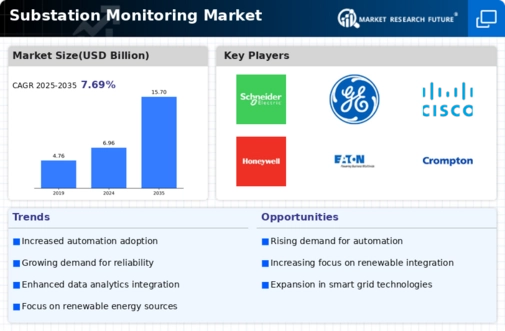
As per Market Research Future analysis, the Substation Monitoring Market Size was estimated at 6.96 USD Billion in 2024. The Substation Monitoring industry is projected to grow from 7.495 USD Billion in 2025 to 15.73 USD Billion by 2035, exhibiting a compound annual growth rate (CAGR) of 7.6% during the forecast period 2025 - 2035

Key Market Trends & Highlights

The Substation Monitoring Market is poised for substantial growth driven by technological advancements and a shift towards renewable energy.

  • The integration of IoT technologies is transforming substation monitoring, enhancing data collection and analysis capabilities. North America remains the largest market, while Asia-Pacific is emerging as the fastest-growing region in substation monitoring solutions. The hardware segment dominates the market, whereas the software segment is experiencing rapid growth due to increasing automation needs. Key drivers include the rising demand for reliable power supply and growing investments in smart grid infrastructure.

Market Size & Forecast

2024 Market Size 6.96 (USD Billion)
2035 Market Size 15.73 (USD Billion)
CAGR (2025 - 2035) 7.69%
Largest Regional Market Share in 2024 North America

Major Players

<a href="https://www.siemens.com/global/en/company/about/businesses/smart-infrastructure/downloads-events/accelerating-the-electrification.html?acz=1&amp;gad_source=1&amp;gad_campaignid=21054104045&amp;gbraid=0AAAAADEuPPMW3gb9DArcS6ISGROmENv9d&amp;gclid=CjwKCAiAxc_JBhA2EiwAFVs7XI1N9JbB6sCLBR2fkSqVfztcekXcrUEOA3Zs5-ITL8WsGEJ6c8h_ShoCnkIQAvD_BwE">Siemens</a> (DE), Schneider Electric (FR), General Electric (US), ABB (CH), Eaton (US), Honeywell (US), Emerson Electric (US), Mitsubishi Electric (JP), <a href="https://www.rockwellautomation.com/en-in/products/hardware/energy-monitoring.html">Rockwell Automation</a> (US)

Market Trends

The Substation Monitoring Market is currently experiencing a transformative phase, driven by advancements in technology and the increasing demand for efficient energy management. The integration of Internet of Things (IoT) devices and artificial intelligence is reshaping how substations operate, allowing for real-time data collection and analysis. This shift not only enhances operational efficiency but also improves reliability and safety in power distribution. As utilities seek to modernize their infrastructure, the adoption of smart monitoring solutions is becoming more prevalent, indicating a significant trend towards automation and remote management. Moreover, the growing emphasis on renewable energy sources is influencing the Substation Monitoring Market. As more renewable energy projects come online, the need for effective monitoring systems to manage the variability and integration of these resources becomes critical. This trend suggests that companies are increasingly investing in advanced monitoring technologies to ensure seamless operation and grid stability. The focus on sustainability and regulatory compliance further propels the demand for sophisticated monitoring solutions, which are essential for optimizing performance and minimizing environmental impact. Overall, the Substation Monitoring Market appears poised for substantial growth as it adapts to the evolving energy landscape.

Integration of IoT Technologies

The incorporation of Internet of Things technologies is revolutionizing the Substation Monitoring Market. By enabling real-time data transmission and analysis, IoT devices facilitate enhanced monitoring capabilities, leading to improved operational efficiency and predictive maintenance.

Shift Towards Renewable Energy

The increasing reliance on renewable energy sources is reshaping the Substation Monitoring Market. As utilities integrate more solar and wind power, the demand for advanced monitoring systems to manage these variable resources is rising, ensuring grid stability and reliability.

Focus on Automation and Remote Management

There is a notable trend towards automation and remote management within the Substation Monitoring Market. This shift allows for more efficient operations, reducing the need for on-site personnel and enabling utilities to respond swiftly to potential issues.

Substation Monitoring Market Market Drivers

Regulatory Compliance and Safety Standards

Regulatory compliance and safety standards are becoming increasingly stringent, driving the Substation Monitoring Market. Governments and regulatory bodies are imposing stricter guidelines to ensure the safety and reliability of electrical infrastructure. For instance, the implementation of the NERC CIP standards in North America mandates utilities to adopt advanced monitoring systems to protect critical infrastructure. This regulatory landscape compels utilities to invest in substation monitoring technologies that not only meet compliance requirements but also enhance operational safety. The market for substation monitoring solutions is expected to grow as utilities seek to align with these regulations, ensuring that they can operate within legal frameworks while minimizing risks associated with electrical failures.

Increasing Demand for Reliable Power Supply

The rising demand for a reliable power supply is a primary driver for the Substation Monitoring Market. As urbanization and industrialization continue to expand, the need for uninterrupted electricity becomes paramount. This demand is reflected in the increasing investments in power infrastructure, with the global power sector projected to reach a value of over 2 trillion USD by 2025. Enhanced monitoring systems in substations are essential to ensure that power distribution remains stable and efficient. By implementing advanced monitoring technologies, utilities can preemptively identify potential failures, thereby reducing downtime and improving service reliability. This trend indicates a growing recognition of the importance of robust substation monitoring solutions in maintaining the integrity of power supply networks.

Growing Investment in Smart Grid Infrastructure

The growing investment in smart grid infrastructure is a crucial driver for the Substation Monitoring Market. Governments and private entities are increasingly recognizing the need for modernizing electrical grids to enhance efficiency and reliability. This investment trend is evident in various initiatives aimed at upgrading aging infrastructure and integrating smart technologies. For example, the U.S. Department of Energy has allocated billions of dollars towards smart grid projects, which include advanced substation monitoring systems. As these investments materialize, the demand for innovative monitoring solutions is likely to surge, as utilities seek to optimize their operations and improve service delivery through enhanced grid management.

Technological Advancements in Monitoring Solutions

Technological advancements in monitoring solutions are significantly influencing the Substation Monitoring Market. Innovations such as artificial intelligence, machine learning, and big data analytics are being integrated into monitoring systems, enhancing their capabilities. These technologies enable real-time data analysis, predictive maintenance, and improved decision-making processes. The market for smart grid technologies, which includes advanced substation monitoring systems, is projected to grow substantially, with estimates suggesting a compound annual growth rate of over 20% in the coming years. As utilities adopt these cutting-edge technologies, the efficiency and reliability of power distribution networks are expected to improve, further driving the demand for sophisticated monitoring solutions.

Rising Focus on Energy Efficiency and Sustainability

The rising focus on energy efficiency and sustainability is shaping the Substation Monitoring Market. As environmental concerns gain prominence, utilities are increasingly adopting practices that promote energy conservation and reduce carbon footprints. Substation monitoring systems play a vital role in this transition by enabling utilities to optimize energy distribution and minimize losses. The market for energy-efficient technologies is expected to witness substantial growth, with projections indicating a significant increase in investments in sustainable energy solutions. By implementing advanced monitoring systems, utilities can not only enhance operational efficiency but also contribute to broader sustainability goals, thereby driving the demand for substation monitoring technologies.

Market Segment Insights

By Component: Hardware (Largest) vs. Software (Fastest-Growing)

<p>In the Substation Monitoring Market, the component segment is comprised of two primary categories: hardware and software. The hardware portion dominates the market, benefiting from robust demand for physical equipment such as sensors, relays, and communication devices essential for efficient monitoring and control of substations. As the backbone of substation infrastructure, hardware solutions are integral in maintaining systematic operations and ensuring reliability in power distribution. On the other hand, the software component is witnessing a rapid growth trajectory, driven by the increasing need for advanced data analytics, machine learning, and real-time monitoring capabilities. The evolution of IoT (Internet of Things) has significantly bolstered software applications within this segment, enabling enhanced decision-making and predictive maintenance functionalities that hardware alone cannot provide. As utilities seek to optimize performance and integrate smart technologies, the software segment is set to enhance its market share further.</p>

<p>Component: Hardware (Dominant) vs. Software (Emerging)</p>

<p>In the Substation Monitoring Market, hardware represents the dominant segment due to its critical role in the operational efficiency of substations. This includes components such as sensors, relays, and communication devices that facilitate monitoring and control functions. These hardware elements ensure reliability and safety in power distribution, leveraging both established technology and innovations. Meanwhile, the software segment is emerging as a key driver of transformation within the market. It enables utilities to harness big data for informed decision-making and predictive maintenance, making it an invaluable asset. Software solutions, which include advanced analytics and cloud-based applications, are becoming increasingly popular as more organizations emphasize flexibility, scalability, and integration of smart technologies in their facilities.</p>

By Communication Technology: Wired (Largest) vs. Wireless (Fastest-Growing)

<p>In the Substation Monitoring Market, the market share distribution between Wired and Wireless communication technologies is significant. Wired communication holds the largest share due to its reliability and established infrastructure, making it the preferred choice for many utility companies. Conversely, Wireless communication is rapidly gaining traction, driven by advancements in technology and a growing demand for flexibility and cost-effectiveness. This shift reflects the changing preferences of end-users who are increasingly adopting digital solutions for monitoring and control.</p>

<p>Communication Technology: Wired (Dominant) vs. Wireless (Emerging)</p>

<p>Wired communication technology remains the dominant force in the Substation Monitoring Market, favored for its robustness and reliability. Its established frameworks ensure minimal disruptions, making it ideal for critical infrastructure. However, the emerging Wireless segment is becoming increasingly popular due to its scalability and ease of implementation. Wireless technologies facilitate real-time data transmission and remote monitoring capabilities, which are essential for modern utility operations. The combination of these two segments highlights the industry's shift towards integrating advanced communication solutions, with each offering unique benefits tailored to specific operational needs.</p>

By Sector: Transmission (Largest) vs. Distribution (Fastest-Growing)

<p>In the Substation Monitoring Market, the transmission sector maintains a substantial market share, driven by the need for efficient energy management across long distances. This sector is characterized by advanced monitoring technologies that enhance the reliability and performance of high-voltage transmission lines. Meanwhile, the distribution sector, while currently smaller in share, is rapidly expanding due to increasing urbanization and the growing demand for distributed energy resources. Innovations in monitoring solutions are helping to connect end users and improve operational efficiencies in this segment.</p>

<p>Sector: Transmission (Dominant) vs. Distribution (Emerging)</p>

<p>The transmission sector is recognized for its dominant market position, characterized by robust infrastructure and the integration of sophisticated monitoring tools that ensure system reliability and power quality. This segment focuses on high-voltage transmission networks which are critical for moving electricity over long distances. On the other hand, the distribution sector is emerging as a key player, reflecting the trend towards decentralized power systems and smart grid technologies. With heightened competition and innovations in monitoring technologies, this sector is adapting rapidly to include real-time data analytics and advanced communication systems, marking it as a significant area for growth in the Substation Monitoring Market.</p>

By Industry: Utility (Largest) vs. Oil & Gas (Fastest-Growing)

<p>In the Substation Monitoring Market, the distribution of market share among various industries showcases Utilities as the dominant sector, leading significantly in adoption due to their critical role in maintaining grid stability and reliability. Following Utilities, the Oil & Gas industry holds substantial interest, driven by the need for efficient monitoring and control of substations to minimize downtime and enhance safety measures. Other industries such as Mining, Steel, and Transportation are gradually increasing their share, but they still remain in the trailing positions compared to the leading Utilities and the rapidly growing Oil & Gas sector. The growth trends in the Substation Monitoring Market indicate that while Utilities continue to expand their market presence through technological advancements in smart grid solutions, Oil & Gas is emerging as a major growth driver due to the rising demand for enhanced monitoring capabilities in response to fluctuating market conditions and regulatory requirements. Additionally, industries like Mining and Steel are showing gradual growth by increasing their reliance on advanced substation monitoring technologies to optimize operations and ensure compliance with safety standards. As the push for automation and efficiency intensifies across industries, the Substation Monitoring Market is positioned for continued growth, particularly among the sectors that are adapting quickly to the evolving technological landscape.</p>

<p>Utility: Dominant vs. Oil & Gas: Emerging</p>

<p>The Utility sector stands out as the dominant force within the Substation Monitoring Market, characterized by its extensive infrastructure and historical reliance on substations for efficient power distribution and management. With a strong emphasis on reliability and operational efficiency, Utilities are increasingly adopting advanced monitoring systems to support smart grid initiatives and improve response to outages. In comparison, the Oil & Gas sector is emerging rapidly, showcasing a robust demand for comprehensive monitoring solutions to ensure operational safety and regulatory compliance. As this industry navigates through the complexities of energy transition and environmental scrutiny, its investment in substation monitoring technology positions it as a promising area of growth, driven by the need for enhanced performance and risk management in its operations.</p>

Get more detailed insights about Substation Monitoring Market Research Report – Global Forecast till 2035

Regional Insights

North America : Technological Innovation Leader

North America is the largest market for substation monitoring, holding approximately 40% of the global share. The region's growth is driven by increasing investments in smart grid technologies and stringent regulatory frameworks aimed at enhancing energy efficiency. The demand for real-time monitoring solutions is also rising due to the need for improved reliability and reduced operational costs in power distribution. The United States leads the market, followed by Canada, with significant contributions from key players like General Electric, Siemens, and Schneider Electric. The competitive landscape is characterized by continuous innovation and partnerships among these companies to enhance their product offerings. The presence of advanced infrastructure and a focus on renewable energy integration further bolster market growth.

Europe : Sustainable Energy Transition Hub

Europe is the second-largest market for substation monitoring, accounting for around 30% of the global market share. The region's growth is propelled by ambitious sustainability goals and regulatory support for smart grid initiatives. The European Union's commitment to reducing carbon emissions and enhancing energy efficiency drives demand for advanced monitoring solutions in substations. Leading countries include Germany, France, and the UK, where major players like ABB and Schneider Electric are actively involved. The competitive landscape is marked by a strong emphasis on innovation and collaboration among companies to meet regulatory requirements. The presence of robust infrastructure and a growing focus on renewable energy sources further enhance market dynamics.

Asia-Pacific : Emerging Market Potential

Asia-Pacific is witnessing rapid growth in the substation monitoring market, holding approximately 25% of the global share. The region's expansion is driven by increasing urbanization, industrialization, and government initiatives aimed at modernizing power infrastructure. Countries like China and India are investing heavily in smart grid technologies, which significantly boosts demand for monitoring solutions. China is the largest market in the region, followed by India and Japan. The competitive landscape features key players such as Mitsubishi Electric and Rockwell Automation, who are focusing on technological advancements and strategic partnerships. The growing emphasis on renewable energy integration and grid reliability further supports market growth in this dynamic region.

Middle East and Africa : Resource-Rich Energy Sector

The Middle East and Africa region is emerging as a significant player in the substation monitoring market, accounting for about 5% of the global share. The growth is driven by increasing investments in energy infrastructure and the need for efficient power management solutions. Governments are focusing on enhancing grid reliability and integrating renewable energy sources, which catalyzes demand for advanced monitoring technologies. Leading countries include South Africa and the UAE, where key players like Siemens and Honeywell are establishing a strong presence. The competitive landscape is evolving, with local companies also entering the market to meet the growing demand. The region's focus on energy diversification and sustainability initiatives further supports market expansion.

Key Players and Competitive Insights

Leading market players are investing heavily in research and development in order to expand their product lines, which will help the Substation Monitoring Market, grow even more. Market participants are also undertaking a variety of strategic activities to expand their global footprint, with important market developments including new product launches, contractual agreements, mergers and acquisitions, higher investments, and collaboration with other organizations. To expand and survive in a more competitive and rising market climate, Substation Monitoring industry must offer cost-effective items.
Manufacturing locally to minimize operational costs is one of the key business tactics used by manufacturers in the global Substation Monitoring industry to benefit clients and increase the market sector. In recent years, the Substation Monitoring industry has offered some of the most significant advantages to medicine. Major players in the Substation Monitoring Market, including Emerson Electric, Honeywell, Eaton, Emerson Electric, Crompton Greaves, Schweitzer Engineering Laboratories, Novatech, Igrid T&D, Sentient Energy and others, are attempting to increase market demand by investing in research and development operations.
ABB Ltd. is a global Swedish-Swiss enterprise headquartered in Zürich, Switzerland. ASEA Brown Boveri was created in 1988 when Sweden's Allmänna Svenska Elektriska Aktiebolaget (ASEA) and Switzerland's Brown, Boveri & Cie amalgamated to form ASEA Brown Boveri, afterwards abbreviated to ABB. Both firms were founded in the late 1800s and were major makers of electrical equipment, a business in which ABB is still involved today. Since then, the company has grown into robotics and automation technology.
In August 2021, Hitachi ABB Power Grids Ltd. (India) has announced the creation of a TXpert remote services portfolio for remote monitoring of transformer fleets, consulting, troubleshooting, and guidance through augmented reality. Hitachi ABB Power Grids assists in the analysis of vast amounts of data as well as the creation of detailed reports required for effective maintenance.
Schneider Electric SE is a multinational French corporation specializing in digital automation and energy management. By merging energy technology, real-time automation, software, and services, it addresses homes, buildings, data centres, infrastructure, and industries.
In September Schneider Electric extended their business by establishing a smart distribution centre in Brazil, which has aided in cutting customer delivery times and optimizing supply chain operations by minimizing equipment downtime and overall power usage. Customers, partners, and educational institutions can visit the distribution centre to see and learn about the company's most innovative technologies supplied through its loT-enabled, open, interoperable architecture, and EcoStruxure.

Key Companies in the Substation Monitoring Market include

Industry Developments

In August 2019, Energy Efficiency Services Limited, a joint venture of four public sector enterprises under the union ministry of power, announced that India planned to invest USD 379.35 million for the smart meter project in Uttar Pradesh, allowing major players to pump huge investments into smart grid projects in the global market.

In June 2018, In conjunction with Tata Power Delhi Distribution (Tata Power - DDL), GE Power's Grid Solutions company announced a new sophisticated Distribution Management Solution (ADMS) with sophisticated capabilities such as monitoring, planning, security, and analysis.

Future Outlook

Substation Monitoring Market Future Outlook

The Substation Monitoring Market is projected to grow at a 7.69% CAGR from 2025 to 2035, driven by technological advancements, regulatory mandates, and increasing demand for grid reliability.

New opportunities lie in:

  • <p>Integration of AI-driven predictive maintenance solutions Development of advanced cybersecurity protocols for monitoring systems Expansion of IoT-enabled real-time data analytics platforms</p>

By 2035, the market is expected to be robust, driven by innovation and increased investment.

Market Segmentation

Substation Monitoring Market Sector Outlook

  • Transmission
  • Distribution

Substation Monitoring Market Industry Outlook

  • Utility
  • Mining
  • Steel
  • Oil & Gas
  • Transportation

Substation Monitoring Market Component Outlook

  • Hardware
  • Software

Substation Monitoring Market Communication Technology Outlook

  • Wired
  • Wireless

Report Scope

MARKET SIZE 2024 6.96(USD Billion)
MARKET SIZE 2025 7.495(USD Billion)
MARKET SIZE 2035 15.73(USD Billion)
COMPOUND ANNUAL GROWTH RATE (CAGR) 7.69% (2025 - 2035)
REPORT COVERAGE Revenue Forecast, Competitive Landscape, Growth Factors, and Trends
BASE YEAR 2024
Market Forecast Period 2025 - 2035
Historical Data 2019 - 2024
Market Forecast Units USD Billion
Key Companies Profiled Siemens (DE), Schneider Electric (FR), General Electric (US), ABB (CH), Eaton (US), Honeywell (US), Emerson Electric (US), Mitsubishi Electric (JP), Rockwell Automation (US)
Segments Covered Component, Communication Technology, Sector, Region
Key Market Opportunities Integration of advanced analytics and IoT technologies enhances efficiency in the Substation Monitoring Market.
Key Market Dynamics Rising demand for real-time data analytics drives innovation in substation monitoring technologies and competitive market dynamics.
Countries Covered North America, Europe, APAC, South America, MEA

FAQs

What is the projected market valuation of the Substation Monitoring Market by 2035?

<p>The Substation Monitoring Market is projected to reach a valuation of 15.73 USD Billion by 2035.</p>

What was the market valuation of the Substation Monitoring Market in 2024?

<p>In 2024, the overall market valuation was 6.96 USD Billion.</p>

What is the expected CAGR for the Substation Monitoring Market during the forecast period 2025 - 2035?

<p>The expected CAGR for the Substation Monitoring Market during the forecast period 2025 - 2035 is 7.69%.</p>

Which companies are considered key players in the Substation Monitoring Market?

<p>Key players in the Substation Monitoring Market include Siemens, Schneider Electric, General Electric, ABB, Eaton, Honeywell, Emerson Electric, Mitsubishi Electric, and Rockwell Automation.</p>

How is the Substation Monitoring Market segmented by component?

<p>The Substation Monitoring Market is segmented by component into Hardware and Software, with valuations of 3.48 and 7.86 USD Billion for Hardware, and 3.48 and 7.87 USD Billion for Software.</p>

What are the communication technology segments in the Substation Monitoring Market?

<p>The market is segmented by communication technology into Wired and Wireless, with valuations of 2.08 and 4.73 USD Billion for Wired, and 4.88 and 10.99 USD Billion for Wireless.</p>

How is the Substation Monitoring Market divided by sector?

The market is divided by sector into Transmission and Distribution, with valuations of 3.48 and 7.86 USD Billion for Transmission, and 3.48 and 7.87 USD Billion for Distribution.

What industries are included in the Substation Monitoring Market segmentation?

The Substation Monitoring Market includes industries such as Utility, Mining, Steel, Oil &amp; Gas, and Transportation, with respective valuations of 2.08, 1.05, 0.92, 1.39, and 1.52 USD Billion.

What does the growth trend of the Substation Monitoring Market indicate for future investments?

The growth trend suggests that the Substation Monitoring Market may attract significant investments, particularly given its projected increase to 15.73 USD Billion by 2035.

How does the Substation Monitoring Market's performance compare across different segments?

The performance across segments indicates that both Hardware and Software components are poised for growth, alongside advancements in Wired and Wireless communication technologies.

  1. SECTION I: EXECUTIVE SUMMARY AND KEY HIGHLIGHTS
    1. | 1.1 EXECUTIVE SUMMARY
    2. | | 1.1.1 Market Overview
    3. | | 1.1.2 Key Findings
    4. | | 1.1.3 Market Segmentation
    5. | | 1.1.4 Competitive Landscape
    6. | | 1.1.5 Challenges and Opportunities
    7. | | 1.1.6 Future Outlook
  2. SECTION II: SCOPING, METHODOLOGY AND MARKET STRUCTURE
    1. | 2.1 MARKET INTRODUCTION
    2. | | 2.1.1 Definition
    3. | | 2.1.2 Scope of the study
    4. | | | 2.1.2.1 Research Objective
    5. | | | 2.1.2.2 Assumption
    6. | | | 2.1.2.3 Limitations
    7. | 2.2 RESEARCH METHODOLOGY
    8. | | 2.2.1 Overview
    9. | | 2.2.2 Data Mining
    10. | | 2.2.3 Secondary Research
    11. | | 2.2.4 Primary Research
    12. | | | 2.2.4.1 Primary Interviews and Information Gathering Process
    13. | | | 2.2.4.2 Breakdown of Primary Respondents
    14. | | 2.2.5 Forecasting Model
    15. | | 2.2.6 Market Size Estimation
    16. | | | 2.2.6.1 Bottom-Up Approach
    17. | | | 2.2.6.2 Top-Down Approach
    18. | | 2.2.7 Data Triangulation
    19. | | 2.2.8 Validation
  3. SECTION III: QUALITATIVE ANALYSIS
    1. | 3.1 MARKET DYNAMICS
    2. | | 3.1.1 Overview
    3. | | 3.1.2 Drivers
    4. | | 3.1.3 Restraints
    5. | | 3.1.4 Opportunities
    6. | 3.2 MARKET FACTOR ANALYSIS
    7. | | 3.2.1 Value chain Analysis
    8. | | 3.2.2 Porter's Five Forces Analysis
    9. | | | 3.2.2.1 Bargaining Power of Suppliers
    10. | | | 3.2.2.2 Bargaining Power of Buyers
    11. | | | 3.2.2.3 Threat of New Entrants
    12. | | | 3.2.2.4 Threat of Substitutes
    13. | | | 3.2.2.5 Intensity of Rivalry
    14. | | 3.2.3 COVID-19 Impact Analysis
    15. | | | 3.2.3.1 Market Impact Analysis
    16. | | | 3.2.3.2 Regional Impact
    17. | | | 3.2.3.3 Opportunity and Threat Analysis
  4. SECTION IV: QUANTITATIVE ANALYSIS
    1. | 4.1 Energy & Power, BY Component (USD Billion)
    2. | | 4.1.1 Hardware
    3. | | 4.1.2 Software
    4. | 4.2 Energy & Power, BY Communication Technology (USD Billion)
    5. | | 4.2.1 Wired
    6. | | 4.2.2 Wireless
    7. | 4.3 Energy & Power, BY Sector (USD Billion)
    8. | | 4.3.1 Transmission
    9. | | 4.3.2 Distribution
    10. | 4.4 Energy & Power, BY Industry (USD Billion)
    11. | | 4.4.1 Utility
    12. | | 4.4.2 Mining
    13. | | 4.4.3 Steel
    14. | | 4.4.4 Oil & Gas
    15. | | 4.4.5 Transportation
    16. | 4.5 Energy & Power, BY Region (USD Billion)
    17. | | 4.5.1 North America
    18. | | | 4.5.1.1 US
    19. | | | 4.5.1.2 Canada
    20. | | 4.5.2 Europe
    21. | | | 4.5.2.1 Germany
    22. | | | 4.5.2.2 UK
    23. | | | 4.5.2.3 France
    24. | | | 4.5.2.4 Russia
    25. | | | 4.5.2.5 Italy
    26. | | | 4.5.2.6 Spain
    27. | | | 4.5.2.7 Rest of Europe
    28. | | 4.5.3 APAC
    29. | | | 4.5.3.1 China
    30. | | | 4.5.3.2 India
    31. | | | 4.5.3.3 Japan
    32. | | | 4.5.3.4 South Korea
    33. | | | 4.5.3.5 Malaysia
    34. | | | 4.5.3.6 Thailand
    35. | | | 4.5.3.7 Indonesia
    36. | | | 4.5.3.8 Rest of APAC
    37. | | 4.5.4 South America
    38. | | | 4.5.4.1 Brazil
    39. | | | 4.5.4.2 Mexico
    40. | | | 4.5.4.3 Argentina
    41. | | | 4.5.4.4 Rest of South America
    42. | | 4.5.5 MEA
    43. | | | 4.5.5.1 GCC Countries
    44. | | | 4.5.5.2 South Africa
    45. | | | 4.5.5.3 Rest of MEA
  5. SECTION V: COMPETITIVE ANALYSIS
    1. | 5.1 Competitive Landscape
    2. | | 5.1.1 Overview
    3. | | 5.1.2 Competitive Analysis
    4. | | 5.1.3 Market share Analysis
    5. | | 5.1.4 Major Growth Strategy in the Energy & Power
    6. | | 5.1.5 Competitive Benchmarking
    7. | | 5.1.6 Leading Players in Terms of Number of Developments in the Energy & Power
    8. | | 5.1.7 Key developments and growth strategies
    9. | | | 5.1.7.1 New Product Launch/Service Deployment
    10. | | | 5.1.7.2 Merger & Acquisitions
    11. | | | 5.1.7.3 Joint Ventures
    12. | | 5.1.8 Major Players Financial Matrix
    13. | | | 5.1.8.1 Sales and Operating Income
    14. | | | 5.1.8.2 Major Players R&D Expenditure. 2023
    15. | 5.2 Company Profiles
    16. | | 5.2.1 Siemens (DE)
    17. | | | 5.2.1.1 Financial Overview
    18. | | | 5.2.1.2 Products Offered
    19. | | | 5.2.1.3 Key Developments
    20. | | | 5.2.1.4 SWOT Analysis
    21. | | | 5.2.1.5 Key Strategies
    22. | | 5.2.2 Schneider Electric (FR)
    23. | | | 5.2.2.1 Financial Overview
    24. | | | 5.2.2.2 Products Offered
    25. | | | 5.2.2.3 Key Developments
    26. | | | 5.2.2.4 SWOT Analysis
    27. | | | 5.2.2.5 Key Strategies
    28. | | 5.2.3 General Electric (US)
    29. | | | 5.2.3.1 Financial Overview
    30. | | | 5.2.3.2 Products Offered
    31. | | | 5.2.3.3 Key Developments
    32. | | | 5.2.3.4 SWOT Analysis
    33. | | | 5.2.3.5 Key Strategies
    34. | | 5.2.4 ABB (CH)
    35. | | | 5.2.4.1 Financial Overview
    36. | | | 5.2.4.2 Products Offered
    37. | | | 5.2.4.3 Key Developments
    38. | | | 5.2.4.4 SWOT Analysis
    39. | | | 5.2.4.5 Key Strategies
    40. | | 5.2.5 Eaton (US)
    41. | | | 5.2.5.1 Financial Overview
    42. | | | 5.2.5.2 Products Offered
    43. | | | 5.2.5.3 Key Developments
    44. | | | 5.2.5.4 SWOT Analysis
    45. | | | 5.2.5.5 Key Strategies
    46. | | 5.2.6 Honeywell (US)
    47. | | | 5.2.6.1 Financial Overview
    48. | | | 5.2.6.2 Products Offered
    49. | | | 5.2.6.3 Key Developments
    50. | | | 5.2.6.4 SWOT Analysis
    51. | | | 5.2.6.5 Key Strategies
    52. | | 5.2.7 Emerson Electric (US)
    53. | | | 5.2.7.1 Financial Overview
    54. | | | 5.2.7.2 Products Offered
    55. | | | 5.2.7.3 Key Developments
    56. | | | 5.2.7.4 SWOT Analysis
    57. | | | 5.2.7.5 Key Strategies
    58. | | 5.2.8 Mitsubishi Electric (JP)
    59. | | | 5.2.8.1 Financial Overview
    60. | | | 5.2.8.2 Products Offered
    61. | | | 5.2.8.3 Key Developments
    62. | | | 5.2.8.4 SWOT Analysis
    63. | | | 5.2.8.5 Key Strategies
    64. | | 5.2.9 Rockwell Automation (US)
    65. | | | 5.2.9.1 Financial Overview
    66. | | | 5.2.9.2 Products Offered
    67. | | | 5.2.9.3 Key Developments
    68. | | | 5.2.9.4 SWOT Analysis
    69. | | | 5.2.9.5 Key Strategies
    70. | 5.3 Appendix
    71. | | 5.3.1 References
    72. | | 5.3.2 Related Reports
  6. LIST OF FIGURES
    1. | 6.1 MARKET SYNOPSIS
    2. | 6.2 NORTH AMERICA MARKET ANALYSIS
    3. | 6.3 US MARKET ANALYSIS BY COMPONENT
    4. | 6.4 US MARKET ANALYSIS BY COMMUNICATION TECHNOLOGY
    5. | 6.5 US MARKET ANALYSIS BY SECTOR
    6. | 6.6 US MARKET ANALYSIS BY INDUSTRY
    7. | 6.7 CANADA MARKET ANALYSIS BY COMPONENT
    8. | 6.8 CANADA MARKET ANALYSIS BY COMMUNICATION TECHNOLOGY
    9. | 6.9 CANADA MARKET ANALYSIS BY SECTOR
    10. | 6.10 CANADA MARKET ANALYSIS BY INDUSTRY
    11. | 6.11 EUROPE MARKET ANALYSIS
    12. | 6.12 GERMANY MARKET ANALYSIS BY COMPONENT
    13. | 6.13 GERMANY MARKET ANALYSIS BY COMMUNICATION TECHNOLOGY
    14. | 6.14 GERMANY MARKET ANALYSIS BY SECTOR
    15. | 6.15 GERMANY MARKET ANALYSIS BY INDUSTRY
    16. | 6.16 UK MARKET ANALYSIS BY COMPONENT
    17. | 6.17 UK MARKET ANALYSIS BY COMMUNICATION TECHNOLOGY
    18. | 6.18 UK MARKET ANALYSIS BY SECTOR
    19. | 6.19 UK MARKET ANALYSIS BY INDUSTRY
    20. | 6.20 FRANCE MARKET ANALYSIS BY COMPONENT
    21. | 6.21 FRANCE MARKET ANALYSIS BY COMMUNICATION TECHNOLOGY
    22. | 6.22 FRANCE MARKET ANALYSIS BY SECTOR
    23. | 6.23 FRANCE MARKET ANALYSIS BY INDUSTRY
    24. | 6.24 RUSSIA MARKET ANALYSIS BY COMPONENT
    25. | 6.25 RUSSIA MARKET ANALYSIS BY COMMUNICATION TECHNOLOGY
    26. | 6.26 RUSSIA MARKET ANALYSIS BY SECTOR
    27. | 6.27 RUSSIA MARKET ANALYSIS BY INDUSTRY
    28. | 6.28 ITALY MARKET ANALYSIS BY COMPONENT
    29. | 6.29 ITALY MARKET ANALYSIS BY COMMUNICATION TECHNOLOGY
    30. | 6.30 ITALY MARKET ANALYSIS BY SECTOR
    31. | 6.31 ITALY MARKET ANALYSIS BY INDUSTRY
    32. | 6.32 SPAIN MARKET ANALYSIS BY COMPONENT
    33. | 6.33 SPAIN MARKET ANALYSIS BY COMMUNICATION TECHNOLOGY
    34. | 6.34 SPAIN MARKET ANALYSIS BY SECTOR
    35. | 6.35 SPAIN MARKET ANALYSIS BY INDUSTRY
    36. | 6.36 REST OF EUROPE MARKET ANALYSIS BY COMPONENT
    37. | 6.37 REST OF EUROPE MARKET ANALYSIS BY COMMUNICATION TECHNOLOGY
    38. | 6.38 REST OF EUROPE MARKET ANALYSIS BY SECTOR
    39. | 6.39 REST OF EUROPE MARKET ANALYSIS BY INDUSTRY
    40. | 6.40 APAC MARKET ANALYSIS
    41. | 6.41 CHINA MARKET ANALYSIS BY COMPONENT
    42. | 6.42 CHINA MARKET ANALYSIS BY COMMUNICATION TECHNOLOGY
    43. | 6.43 CHINA MARKET ANALYSIS BY SECTOR
    44. | 6.44 CHINA MARKET ANALYSIS BY INDUSTRY
    45. | 6.45 INDIA MARKET ANALYSIS BY COMPONENT
    46. | 6.46 INDIA MARKET ANALYSIS BY COMMUNICATION TECHNOLOGY
    47. | 6.47 INDIA MARKET ANALYSIS BY SECTOR
    48. | 6.48 INDIA MARKET ANALYSIS BY INDUSTRY
    49. | 6.49 JAPAN MARKET ANALYSIS BY COMPONENT
    50. | 6.50 JAPAN MARKET ANALYSIS BY COMMUNICATION TECHNOLOGY
    51. | 6.51 JAPAN MARKET ANALYSIS BY SECTOR
    52. | 6.52 JAPAN MARKET ANALYSIS BY INDUSTRY
    53. | 6.53 SOUTH KOREA MARKET ANALYSIS BY COMPONENT
    54. | 6.54 SOUTH KOREA MARKET ANALYSIS BY COMMUNICATION TECHNOLOGY
    55. | 6.55 SOUTH KOREA MARKET ANALYSIS BY SECTOR
    56. | 6.56 SOUTH KOREA MARKET ANALYSIS BY INDUSTRY
    57. | 6.57 MALAYSIA MARKET ANALYSIS BY COMPONENT
    58. | 6.58 MALAYSIA MARKET ANALYSIS BY COMMUNICATION TECHNOLOGY
    59. | 6.59 MALAYSIA MARKET ANALYSIS BY SECTOR
    60. | 6.60 MALAYSIA MARKET ANALYSIS BY INDUSTRY
    61. | 6.61 THAILAND MARKET ANALYSIS BY COMPONENT
    62. | 6.62 THAILAND MARKET ANALYSIS BY COMMUNICATION TECHNOLOGY
    63. | 6.63 THAILAND MARKET ANALYSIS BY SECTOR
    64. | 6.64 THAILAND MARKET ANALYSIS BY INDUSTRY
    65. | 6.65 INDONESIA MARKET ANALYSIS BY COMPONENT
    66. | 6.66 INDONESIA MARKET ANALYSIS BY COMMUNICATION TECHNOLOGY
    67. | 6.67 INDONESIA MARKET ANALYSIS BY SECTOR
    68. | 6.68 INDONESIA MARKET ANALYSIS BY INDUSTRY
    69. | 6.69 REST OF APAC MARKET ANALYSIS BY COMPONENT
    70. | 6.70 REST OF APAC MARKET ANALYSIS BY COMMUNICATION TECHNOLOGY
    71. | 6.71 REST OF APAC MARKET ANALYSIS BY SECTOR
    72. | 6.72 REST OF APAC MARKET ANALYSIS BY INDUSTRY
    73. | 6.73 SOUTH AMERICA MARKET ANALYSIS
    74. | 6.74 BRAZIL MARKET ANALYSIS BY COMPONENT
    75. | 6.75 BRAZIL MARKET ANALYSIS BY COMMUNICATION TECHNOLOGY
    76. | 6.76 BRAZIL MARKET ANALYSIS BY SECTOR
    77. | 6.77 BRAZIL MARKET ANALYSIS BY INDUSTRY
    78. | 6.78 MEXICO MARKET ANALYSIS BY COMPONENT
    79. | 6.79 MEXICO MARKET ANALYSIS BY COMMUNICATION TECHNOLOGY
    80. | 6.80 MEXICO MARKET ANALYSIS BY SECTOR
    81. | 6.81 MEXICO MARKET ANALYSIS BY INDUSTRY
    82. | 6.82 ARGENTINA MARKET ANALYSIS BY COMPONENT
    83. | 6.83 ARGENTINA MARKET ANALYSIS BY COMMUNICATION TECHNOLOGY
    84. | 6.84 ARGENTINA MARKET ANALYSIS BY SECTOR
    85. | 6.85 ARGENTINA MARKET ANALYSIS BY INDUSTRY
    86. | 6.86 REST OF SOUTH AMERICA MARKET ANALYSIS BY COMPONENT
    87. | 6.87 REST OF SOUTH AMERICA MARKET ANALYSIS BY COMMUNICATION TECHNOLOGY
    88. | 6.88 REST OF SOUTH AMERICA MARKET ANALYSIS BY SECTOR
    89. | 6.89 REST OF SOUTH AMERICA MARKET ANALYSIS BY INDUSTRY
    90. | 6.90 MEA MARKET ANALYSIS
    91. | 6.91 GCC COUNTRIES MARKET ANALYSIS BY COMPONENT
    92. | 6.92 GCC COUNTRIES MARKET ANALYSIS BY COMMUNICATION TECHNOLOGY
    93. | 6.93 GCC COUNTRIES MARKET ANALYSIS BY SECTOR
    94. | 6.94 GCC COUNTRIES MARKET ANALYSIS BY INDUSTRY
    95. | 6.95 SOUTH AFRICA MARKET ANALYSIS BY COMPONENT
    96. | 6.96 SOUTH AFRICA MARKET ANALYSIS BY COMMUNICATION TECHNOLOGY
    97. | 6.97 SOUTH AFRICA MARKET ANALYSIS BY SECTOR
    98. | 6.98 SOUTH AFRICA MARKET ANALYSIS BY INDUSTRY
    99. | 6.99 REST OF MEA MARKET ANALYSIS BY COMPONENT
    100. | 6.100 REST OF MEA MARKET ANALYSIS BY COMMUNICATION TECHNOLOGY
    101. | 6.101 REST OF MEA MARKET ANALYSIS BY SECTOR
    102. | 6.102 REST OF MEA MARKET ANALYSIS BY INDUSTRY
    103. | 6.103 KEY BUYING CRITERIA OF ENERGY & POWER
    104. | 6.104 RESEARCH PROCESS OF MRFR
    105. | 6.105 DRO ANALYSIS OF ENERGY & POWER
    106. | 6.106 DRIVERS IMPACT ANALYSIS: ENERGY & POWER
    107. | 6.107 RESTRAINTS IMPACT ANALYSIS: ENERGY & POWER
    108. | 6.108 SUPPLY / VALUE CHAIN: ENERGY & POWER
    109. | 6.109 ENERGY & POWER, BY COMPONENT, 2024 (% SHARE)
    110. | 6.110 ENERGY & POWER, BY COMPONENT, 2024 TO 2035 (USD Billion)
    111. | 6.111 ENERGY & POWER, BY COMMUNICATION TECHNOLOGY, 2024 (% SHARE)
    112. | 6.112 ENERGY & POWER, BY COMMUNICATION TECHNOLOGY, 2024 TO 2035 (USD Billion)
    113. | 6.113 ENERGY & POWER, BY SECTOR, 2024 (% SHARE)
    114. | 6.114 ENERGY & POWER, BY SECTOR, 2024 TO 2035 (USD Billion)
    115. | 6.115 ENERGY & POWER, BY INDUSTRY, 2024 (% SHARE)
    116. | 6.116 ENERGY & POWER, BY INDUSTRY, 2024 TO 2035 (USD Billion)
    117. | 6.117 BENCHMARKING OF MAJOR COMPETITORS
  7. LIST OF TABLES
    1. | 7.1 LIST OF ASSUMPTIONS
    2. | | 7.1.1
    3. | 7.2 North America MARKET SIZE ESTIMATES; FORECAST
    4. | | 7.2.1 BY COMPONENT, 2025-2035 (USD Billion)
    5. | | 7.2.2 BY COMMUNICATION TECHNOLOGY, 2025-2035 (USD Billion)
    6. | | 7.2.3 BY SECTOR, 2025-2035 (USD Billion)
    7. | | 7.2.4 BY INDUSTRY, 2025-2035 (USD Billion)
    8. | 7.3 US MARKET SIZE ESTIMATES; FORECAST
    9. | | 7.3.1 BY COMPONENT, 2025-2035 (USD Billion)
    10. | | 7.3.2 BY COMMUNICATION TECHNOLOGY, 2025-2035 (USD Billion)
    11. | | 7.3.3 BY SECTOR, 2025-2035 (USD Billion)
    12. | | 7.3.4 BY INDUSTRY, 2025-2035 (USD Billion)
    13. | 7.4 Canada MARKET SIZE ESTIMATES; FORECAST
    14. | | 7.4.1 BY COMPONENT, 2025-2035 (USD Billion)
    15. | | 7.4.2 BY COMMUNICATION TECHNOLOGY, 2025-2035 (USD Billion)
    16. | | 7.4.3 BY SECTOR, 2025-2035 (USD Billion)
    17. | | 7.4.4 BY INDUSTRY, 2025-2035 (USD Billion)
    18. | 7.5 Europe MARKET SIZE ESTIMATES; FORECAST
    19. | | 7.5.1 BY COMPONENT, 2025-2035 (USD Billion)
    20. | | 7.5.2 BY COMMUNICATION TECHNOLOGY, 2025-2035 (USD Billion)
    21. | | 7.5.3 BY SECTOR, 2025-2035 (USD Billion)
    22. | | 7.5.4 BY INDUSTRY, 2025-2035 (USD Billion)
    23. | 7.6 Germany MARKET SIZE ESTIMATES; FORECAST
    24. | | 7.6.1 BY COMPONENT, 2025-2035 (USD Billion)
    25. | | 7.6.2 BY COMMUNICATION TECHNOLOGY, 2025-2035 (USD Billion)
    26. | | 7.6.3 BY SECTOR, 2025-2035 (USD Billion)
    27. | | 7.6.4 BY INDUSTRY, 2025-2035 (USD Billion)
    28. | 7.7 UK MARKET SIZE ESTIMATES; FORECAST
    29. | | 7.7.1 BY COMPONENT, 2025-2035 (USD Billion)
    30. | | 7.7.2 BY COMMUNICATION TECHNOLOGY, 2025-2035 (USD Billion)
    31. | | 7.7.3 BY SECTOR, 2025-2035 (USD Billion)
    32. | | 7.7.4 BY INDUSTRY, 2025-2035 (USD Billion)
    33. | 7.8 France MARKET SIZE ESTIMATES; FORECAST
    34. | | 7.8.1 BY COMPONENT, 2025-2035 (USD Billion)
    35. | | 7.8.2 BY COMMUNICATION TECHNOLOGY, 2025-2035 (USD Billion)
    36. | | 7.8.3 BY SECTOR, 2025-2035 (USD Billion)
    37. | | 7.8.4 BY INDUSTRY, 2025-2035 (USD Billion)
    38. | 7.9 Russia MARKET SIZE ESTIMATES; FORECAST
    39. | | 7.9.1 BY COMPONENT, 2025-2035 (USD Billion)
    40. | | 7.9.2 BY COMMUNICATION TECHNOLOGY, 2025-2035 (USD Billion)
    41. | | 7.9.3 BY SECTOR, 2025-2035 (USD Billion)
    42. | | 7.9.4 BY INDUSTRY, 2025-2035 (USD Billion)
    43. | 7.10 Italy MARKET SIZE ESTIMATES; FORECAST
    44. | | 7.10.1 BY COMPONENT, 2025-2035 (USD Billion)
    45. | | 7.10.2 BY COMMUNICATION TECHNOLOGY, 2025-2035 (USD Billion)
    46. | | 7.10.3 BY SECTOR, 2025-2035 (USD Billion)
    47. | | 7.10.4 BY INDUSTRY, 2025-2035 (USD Billion)
    48. | 7.11 Spain MARKET SIZE ESTIMATES; FORECAST
    49. | | 7.11.1 BY COMPONENT, 2025-2035 (USD Billion)
    50. | | 7.11.2 BY COMMUNICATION TECHNOLOGY, 2025-2035 (USD Billion)
    51. | | 7.11.3 BY SECTOR, 2025-2035 (USD Billion)
    52. | | 7.11.4 BY INDUSTRY, 2025-2035 (USD Billion)
    53. | 7.12 Rest of Europe MARKET SIZE ESTIMATES; FORECAST
    54. | | 7.12.1 BY COMPONENT, 2025-2035 (USD Billion)
    55. | | 7.12.2 BY COMMUNICATION TECHNOLOGY, 2025-2035 (USD Billion)
    56. | | 7.12.3 BY SECTOR, 2025-2035 (USD Billion)
    57. | | 7.12.4 BY INDUSTRY, 2025-2035 (USD Billion)
    58. | 7.13 APAC MARKET SIZE ESTIMATES; FORECAST
    59. | | 7.13.1 BY COMPONENT, 2025-2035 (USD Billion)
    60. | | 7.13.2 BY COMMUNICATION TECHNOLOGY, 2025-2035 (USD Billion)
    61. | | 7.13.3 BY SECTOR, 2025-2035 (USD Billion)
    62. | | 7.13.4 BY INDUSTRY, 2025-2035 (USD Billion)
    63. | 7.14 China MARKET SIZE ESTIMATES; FORECAST
    64. | | 7.14.1 BY COMPONENT, 2025-2035 (USD Billion)
    65. | | 7.14.2 BY COMMUNICATION TECHNOLOGY, 2025-2035 (USD Billion)
    66. | | 7.14.3 BY SECTOR, 2025-2035 (USD Billion)
    67. | | 7.14.4 BY INDUSTRY, 2025-2035 (USD Billion)
    68. | 7.15 India MARKET SIZE ESTIMATES; FORECAST
    69. | | 7.15.1 BY COMPONENT, 2025-2035 (USD Billion)
    70. | | 7.15.2 BY COMMUNICATION TECHNOLOGY, 2025-2035 (USD Billion)
    71. | | 7.15.3 BY SECTOR, 2025-2035 (USD Billion)
    72. | | 7.15.4 BY INDUSTRY, 2025-2035 (USD Billion)
    73. | 7.16 Japan MARKET SIZE ESTIMATES; FORECAST
    74. | | 7.16.1 BY COMPONENT, 2025-2035 (USD Billion)
    75. | | 7.16.2 BY COMMUNICATION TECHNOLOGY, 2025-2035 (USD Billion)
    76. | | 7.16.3 BY SECTOR, 2025-2035 (USD Billion)
    77. | | 7.16.4 BY INDUSTRY, 2025-2035 (USD Billion)
    78. | 7.17 South Korea MARKET SIZE ESTIMATES; FORECAST
    79. | | 7.17.1 BY COMPONENT, 2025-2035 (USD Billion)
    80. | | 7.17.2 BY COMMUNICATION TECHNOLOGY, 2025-2035 (USD Billion)
    81. | | 7.17.3 BY SECTOR, 2025-2035 (USD Billion)
    82. | | 7.17.4 BY INDUSTRY, 2025-2035 (USD Billion)
    83. | 7.18 Malaysia MARKET SIZE ESTIMATES; FORECAST
    84. | | 7.18.1 BY COMPONENT, 2025-2035 (USD Billion)
    85. | | 7.18.2 BY COMMUNICATION TECHNOLOGY, 2025-2035 (USD Billion)
    86. | | 7.18.3 BY SECTOR, 2025-2035 (USD Billion)
    87. | | 7.18.4 BY INDUSTRY, 2025-2035 (USD Billion)
    88. | 7.19 Thailand MARKET SIZE ESTIMATES; FORECAST
    89. | | 7.19.1 BY COMPONENT, 2025-2035 (USD Billion)
    90. | | 7.19.2 BY COMMUNICATION TECHNOLOGY, 2025-2035 (USD Billion)
    91. | | 7.19.3 BY SECTOR, 2025-2035 (USD Billion)
    92. | | 7.19.4 BY INDUSTRY, 2025-2035 (USD Billion)
    93. | 7.20 Indonesia MARKET SIZE ESTIMATES; FORECAST
    94. | | 7.20.1 BY COMPONENT, 2025-2035 (USD Billion)
    95. | | 7.20.2 BY COMMUNICATION TECHNOLOGY, 2025-2035 (USD Billion)
    96. | | 7.20.3 BY SECTOR, 2025-2035 (USD Billion)
    97. | | 7.20.4 BY INDUSTRY, 2025-2035 (USD Billion)
    98. | 7.21 Rest of APAC MARKET SIZE ESTIMATES; FORECAST
    99. | | 7.21.1 BY COMPONENT, 2025-2035 (USD Billion)
    100. | | 7.21.2 BY COMMUNICATION TECHNOLOGY, 2025-2035 (USD Billion)
    101. | | 7.21.3 BY SECTOR, 2025-2035 (USD Billion)
    102. | | 7.21.4 BY INDUSTRY, 2025-2035 (USD Billion)
    103. | 7.22 South America MARKET SIZE ESTIMATES; FORECAST
    104. | | 7.22.1 BY COMPONENT, 2025-2035 (USD Billion)
    105. | | 7.22.2 BY COMMUNICATION TECHNOLOGY, 2025-2035 (USD Billion)
    106. | | 7.22.3 BY SECTOR, 2025-2035 (USD Billion)
    107. | | 7.22.4 BY INDUSTRY, 2025-2035 (USD Billion)
    108. | 7.23 Brazil MARKET SIZE ESTIMATES; FORECAST
    109. | | 7.23.1 BY COMPONENT, 2025-2035 (USD Billion)
    110. | | 7.23.2 BY COMMUNICATION TECHNOLOGY, 2025-2035 (USD Billion)
    111. | | 7.23.3 BY SECTOR, 2025-2035 (USD Billion)
    112. | | 7.23.4 BY INDUSTRY, 2025-2035 (USD Billion)
    113. | 7.24 Mexico MARKET SIZE ESTIMATES; FORECAST
    114. | | 7.24.1 BY COMPONENT, 2025-2035 (USD Billion)
    115. | | 7.24.2 BY COMMUNICATION TECHNOLOGY, 2025-2035 (USD Billion)
    116. | | 7.24.3 BY SECTOR, 2025-2035 (USD Billion)
    117. | | 7.24.4 BY INDUSTRY, 2025-2035 (USD Billion)
    118. | 7.25 Argentina MARKET SIZE ESTIMATES; FORECAST
    119. | | 7.25.1 BY COMPONENT, 2025-2035 (USD Billion)
    120. | | 7.25.2 BY COMMUNICATION TECHNOLOGY, 2025-2035 (USD Billion)
    121. | | 7.25.3 BY SECTOR, 2025-2035 (USD Billion)
    122. | | 7.25.4 BY INDUSTRY, 2025-2035 (USD Billion)
    123. | 7.26 Rest of South America MARKET SIZE ESTIMATES; FORECAST
    124. | | 7.26.1 BY COMPONENT, 2025-2035 (USD Billion)
    125. | | 7.26.2 BY COMMUNICATION TECHNOLOGY, 2025-2035 (USD Billion)
    126. | | 7.26.3 BY SECTOR, 2025-2035 (USD Billion)
    127. | | 7.26.4 BY INDUSTRY, 2025-2035 (USD Billion)
    128. | 7.27 MEA MARKET SIZE ESTIMATES; FORECAST
    129. | | 7.27.1 BY COMPONENT, 2025-2035 (USD Billion)
    130. | | 7.27.2 BY COMMUNICATION TECHNOLOGY, 2025-2035 (USD Billion)
    131. | | 7.27.3 BY SECTOR, 2025-2035 (USD Billion)
    132. | | 7.27.4 BY INDUSTRY, 2025-2035 (USD Billion)
    133. | 7.28 GCC Countries MARKET SIZE ESTIMATES; FORECAST
    134. | | 7.28.1 BY COMPONENT, 2025-2035 (USD Billion)
    135. | | 7.28.2 BY COMMUNICATION TECHNOLOGY, 2025-2035 (USD Billion)
    136. | | 7.28.3 BY SECTOR, 2025-2035 (USD Billion)
    137. | | 7.28.4 BY INDUSTRY, 2025-2035 (USD Billion)
    138. | 7.29 South Africa MARKET SIZE ESTIMATES; FORECAST
    139. | | 7.29.1 BY COMPONENT, 2025-2035 (USD Billion)
    140. | | 7.29.2 BY COMMUNICATION TECHNOLOGY, 2025-2035 (USD Billion)
    141. | | 7.29.3 BY SECTOR, 2025-2035 (USD Billion)
    142. | | 7.29.4 BY INDUSTRY, 2025-2035 (USD Billion)
    143. | 7.30 Rest of MEA MARKET SIZE ESTIMATES; FORECAST
    144. | | 7.30.1 BY COMPONENT, 2025-2035 (USD Billion)
    145. | | 7.30.2 BY COMMUNICATION TECHNOLOGY, 2025-2035 (USD Billion)
    146. | | 7.30.3 BY SECTOR, 2025-2035 (USD Billion)
    147. | | 7.30.4 BY INDUSTRY, 2025-2035 (USD Billion)
    148. | 7.31 PRODUCT LAUNCH/PRODUCT DEVELOPMENT/APPROVAL
    149. | | 7.31.1
    150. | 7.32 ACQUISITION/PARTNERSHIP
    151. | | 7.32.1

Energy & Power Market Segmentation

Energy & Power By Component (USD Billion, 2025-2035)

  • Hardware
  • Software

Energy & Power By Communication Technology (USD Billion, 2025-2035)

  • Wired
  • Wireless

Energy & Power By Sector (USD Billion, 2025-2035)

  • Transmission
  • Distribution

Energy & Power By Industry (USD Billion, 2025-2035)

  • Utility
  • Mining
  • Steel
  • Oil & Gas
  • Transportation
Infographic

Free Sample Request

Kindly complete the form below to receive a free sample of this Report

Get Free Sample

Customer Strories

Compare Licence

×
Features License Type
Single User Multiuser License Enterprise User
Price $4,950 $5,950 $7,250
Maximum User Access Limit 1 User Upto 10 Users Unrestricted Access Throughout the Organization
Free Customization
Direct Access to Analyst
Deliverable Format
Platform Access
Discount on Next Purchase 10% 15% 15%
Printable Versions