Request Free Sample ×

Kindly complete the form below to receive a free sample of this Report

* Please use a valid business email

Leading companies partner with us for data-driven Insights

clients tt-cursor
Hero Background
English
Chinese
French
Japanese
Korean
German
Spanish

Submucosal Injections Market Analysis

ID: MRFR/Pharma/10612-HCR
128 Pages
Rahul Gotadki
Last Updated: April 06, 2026

Submucosal Injections Market Research Report: Information Type of Agent (Eleview and ORISE Gel, Normal Saline, Sextrose Water, Hydroxyethyl Starch, Hydroxypropyl Methylcellulose, Succinylated Gelatin, Hyaluronic Acid and Fibrinogen Mixture), By Application (Colorectal Cancer, Gastic Cancer and Esophageal Cancer), By End User (Hospitals, Surgical Centers and Others) And By Region (North America, Europe, Asia-Pacific, And Rest Of The World) –Market Forecast Till 2035

Share:
Download PDF ×

We do not share your information with anyone. However, we may send you emails based on your report interest from time to time. You may contact us at any time to opt-out.

Submucosal Injections Market Infographic
Purchase Options

Market Analysis

In-depth Analysis of Submucosal Injections Market Industry Landscape

The Pinnacle of Research and Development in Hyaluronic Acid: A Multifaceted Exploration In the dynamic realm of scientific inquiry, hyaluronic acid has become a focal point across various research domains, propelling extensive studies and development initiatives. An article authored by Arianna Fallacara, Erika Baldini, Stefano Manfredini, and Silvia Vertuani in the MDPI journal in June 2018 sheds light on the multifaceted applications of hyaluronic acid and its derivatives, unveiling a spectrum of possibilities in drug delivery systems, cancer therapy, and 3D scaffold structures for cell culture. Diverse Applications in Drug Delivery: The versatility of hyaluronic acid in drug delivery systems is showcased through its utilization alone or in conjunction with other substances to create an array of innovative carriers. Pro-drugs, surface-modified liposomes, nanoparticles, microparticles, and hydrogels represent a selection of these carriers. Notably, hydrogels derived from hyaluronic acid and its chemical derivatives manifest as 3D polymeric networks, proving invaluable in the topical delivery of cells and various active ingredients. This includes anti-inflammatories, antibacterial agents, antibodies, and proteins, thereby broadening the spectrum of therapeutic applications. In the realm of cancer therapy, studies have elucidated the overexpression of the CD44 receptor in diverse tumor cells, correlating with an increased affinity for hyaluronic acid binding and internalization. This revelation has positioned the CD44 receptor as a potential target for cancer therapy, with hyaluronan emerging as a potent ligand for the development of targeted therapies. Hyaluronic acid's dual role as a drug carrier and targeting agent is exemplified through polymer-antitumoral conjugates and delivery systems encapsulating anti-cancer drugs. This dual functionality holds promise for more effective and targeted cancer treatments. According to a report published in the Journal of Pharmaceutical Investigation in May 2019, the chemical modification of hyaluronic acid and the fabrication of hyaluronic acid-based nano systems open avenues for diverse clinical applications. These advancements underscore the significance of ongoing research and development efforts in harnessing hyaluronic acid's potential for groundbreaking medical interventions. 3D Scaffold Structures for Cell Culture: Beyond its role in drug delivery, hyaluronic acid and its synthetic derivatives emerge as pivotal components in the creation of 3D scaffold structures, providing physical support for in-vitro cell culture. Specific derivatives, characterized by aldehyde and hydrazide groups, have been instrumental in developing biomimetic 3D culture systems. For instance, these systems have been employed in creating a supportive environment for poorly adherent metastatic prostate cancer cells, serving as an in-vitro platform to assess the efficacy of anticancer drugs. This innovative approach not only provides a more accurate representation of the in-vivo environment but also offers a testing ground for potential therapeutic interventions. Conclusion: In conclusion, the extensive research and development associated with hyaluronic acid underscore its significance as a versatile and promising component in the field of medical science. From revolutionary drug delivery systems with targeted applications to the creation of 3D scaffold structures for advanced cell culture, hyaluronic acid continues to unveil its potential across diverse domains. The interplay between scientific exploration and technological innovation is shaping a future where hyaluronic acid stands at the forefront of transformative medical applications, promising improved therapeutic outcomes and novel solutions to complex healthcare challenges. As research endeavors persist, the full spectrum of hyaluronic acid's capabilities is yet to be fully realized, offering a glimpse into the boundless possibilities that lie ahead in the realm of medical advancements.


Author
Author Profile
Rahul Gotadki
Research Manager

He holds an experience of about 9+ years in Market Research and Business Consulting, working under the spectrum of Life Sciences and Healthcare domains. Rahul conceptualizes and implements a scalable business strategy and provides strategic leadership to the clients. His expertise lies in market estimation, competitive intelligence, pipeline analysis, customer assessment, etc.

Leave a Comment

FAQs

What is the projected market valuation of the Submucosal Injections Market by 2035?

<p>The Submucosal Injections Market is projected to reach a valuation of 2.391 USD Billion by 2035.</p>

What was the market valuation of the Submucosal Injections Market in 2024?

<p>In 2024, the market valuation of Submucosal Injections was 1.232 USD Billion.</p>

What is the expected CAGR for the Submucosal Injections Market during the forecast period 2025 - 2035?

<p>The expected CAGR for the Submucosal Injections Market during the forecast period 2025 - 2035 is 6.21%.</p>

Which companies are considered key players in the Submucosal Injections Market?

<p>Key players in the Submucosal Injections Market include Allergan, Medytox, Revance Therapeutics, Ipsen, Hugel, Galderma, and Sientra.</p>

What are the main applications of submucosal injections in the market?

<p>The main applications of submucosal injections include treating colorectal cancer, gastric cancer, and esophageal cancer.</p>

What was the market size for colorectal cancer applications in 2024?

<p>In 2024, the market size for colorectal cancer applications was 0.4936 USD Billion.</p>

How much is the market for hospitals expected to grow by 2035?

The market for hospitals is expected to grow from 0.615 USD Billion in 2024 to 1.215 USD Billion by 2035.

What types of agents are used in submucosal injections?

Types of agents used in submucosal injections include Eleview, ORISE gel, normal saline, and hyaluronic acid, among others.

What was the market size for surgical centers in 2024?

The market size for surgical centers in 2024 was 0.415 USD Billion.

What is the projected market size for gastric cancer applications by 2035?

The projected market size for gastric cancer applications is expected to reach 0.7386 USD Billion by 2035.

Market Summary

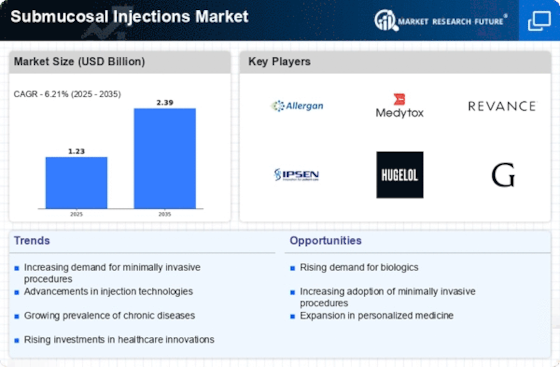
As per Market Research Future analysis, the Submucosal Injections Market Size was estimated at 1.232 USD Billion in 2024. The Submucosal Injections industry is projected to grow from 1.309 USD Billion in 2025 to 2.391 USD Billion by 2035, exhibiting a compound annual growth rate (CAGR) of 6.21% during the forecast period 2025 - 2035

Key Market Trends & Highlights

The Submucosal Injections Market is poised for substantial growth driven by technological advancements and increasing demand for aesthetic procedures.

  • North America remains the largest market for submucosal injections, reflecting a robust demand for both therapeutic and aesthetic applications. The Asia-Pacific region is emerging as the fastest-growing market, fueled by rising healthcare investments and a growing population seeking minimally invasive procedures. Hydroxypropyl methylcellulose dominates the market, while hyaluronic acid is rapidly gaining traction due to its applications in aesthetic treatments. Technological innovations in delivery systems and the increasing prevalence of chronic diseases are key drivers propelling market expansion.

Market Size & Forecast

2024 Market Size 1.232 (USD Billion)
2035 Market Size 2.391 (USD Billion)
CAGR (2025 - 2035) 6.21%
Largest Regional Market Share in 2024 North America

Major Players

Allergan (US), Medytox (KR), Revance Therapeutics (US), Ipsen (FR), Hugel (KR), Galderma (CH), Medytox (KR), Sientra (US)

Market Trends

The Submucosal Injections Market is currently experiencing a notable evolution, driven by advancements in medical technology and an increasing demand for minimally invasive procedures. This market encompasses a variety of applications, including cosmetic enhancements, pain management, and treatment of various medical conditions. The growing awareness of the benefits associated with submucosal injections, such as reduced recovery times and lower complication rates, appears to be influencing both healthcare providers and patients alike. Furthermore, the rise in aesthetic procedures has contributed to the expansion of this market, as individuals seek non-surgical options for enhancing their appearance. In addition to aesthetic applications, the Submucosal Injections Market is also witnessing a surge in therapeutic uses. Healthcare professionals are increasingly utilizing these injections for conditions such as allergies, chronic pain, and localized infections. The versatility of submucosal injections, combined with ongoing research into new formulations and techniques, suggests a promising future for this market. As the healthcare landscape continues to evolve, the Submucosal Injections Market is likely to adapt, potentially leading to innovative solutions that cater to the diverse needs of patients and practitioners alike.

Technological Advancements

Recent innovations in injection techniques and delivery systems are enhancing the efficacy and safety of submucosal injections. These advancements may lead to improved patient outcomes and increased adoption among healthcare providers.

Rising Demand for Aesthetic Procedures

The growing popularity of non-invasive cosmetic treatments is driving the Submucosal Injections Market. Patients are increasingly seeking alternatives to surgical procedures, which could result in a broader acceptance of submucosal injections.

Expansion in Therapeutic Applications

There is a noticeable trend towards utilizing submucosal injections for various medical conditions beyond aesthetics. This expansion may open new avenues for treatment, potentially increasing the market's scope and reach.

Submucosal Injections Market Market Drivers

Regulatory Support and Standardization

The Submucosal Injections Market is benefiting from increased regulatory support and standardization efforts aimed at ensuring the safety and efficacy of injection products. Regulatory bodies are actively working to establish guidelines that facilitate the approval process for new injection technologies. This support is crucial for fostering innovation and encouraging manufacturers to invest in research and development. As a result, the market is expected to see a rise in the introduction of novel submucosal injection products, potentially leading to a market growth rate of 7% in the coming years. Enhanced regulatory frameworks are likely to instill greater confidence among healthcare providers and patients alike.

Increasing Prevalence of Chronic Diseases

The rising incidence of chronic diseases, such as diabetes and hypertension, is a key driver for the Submucosal Injections Market. As these conditions often require long-term management, the demand for effective drug delivery methods is escalating. Submucosal injections offer a viable alternative to traditional routes, providing rapid absorption and improved bioavailability of medications. According to recent estimates, the prevalence of diabetes alone is expected to reach 700 million by 2045, thereby significantly increasing the need for innovative treatment options. This trend is likely to bolster the market as healthcare providers seek efficient solutions for chronic disease management.

Rising Aesthetic and Cosmetic Applications

The Submucosal Injections Market is witnessing a notable increase in demand for aesthetic and cosmetic applications. Procedures such as dermal fillers and facial rejuvenation treatments are gaining popularity, leading to a surge in the use of submucosal injections. This trend is fueled by a growing societal emphasis on appearance and self-image, particularly among younger demographics. Market analysis suggests that the aesthetic segment could account for a substantial portion of the overall market, with an anticipated growth rate of 9% over the next few years. This shift towards aesthetic applications is likely to further diversify the market landscape.

Technological Innovations in Delivery Systems

The Submucosal Injections Market is experiencing a surge in technological innovations that enhance the efficacy and safety of injection delivery systems. Advanced needle designs, such as microneedles, are being developed to minimize pain and improve patient compliance. Furthermore, the integration of smart technologies, including automated injection devices, is likely to streamline the administration process. These innovations not only improve the precision of drug delivery but also expand the range of therapeutic applications. As a result, the market is projected to grow at a compound annual growth rate of approximately 8% over the next five years, driven by these advancements.

Growing Interest in Minimally Invasive Procedures

The Submucosal Injections Market is benefiting from a growing preference for minimally invasive procedures among both patients and healthcare providers. These procedures are associated with reduced recovery times, lower risk of complications, and enhanced patient satisfaction. As more practitioners adopt submucosal injections for various applications, including aesthetic enhancements and therapeutic interventions, the market is poised for growth. The increasing awareness of the benefits of such techniques is likely to drive demand, with projections indicating a potential market expansion of 10% annually as more patients opt for less invasive treatment options.

Market Segment Insights

By Type of Agent: Hydroxypropyl methylcellulose (Largest) vs. Hyaluronic acid (Fastest-Growing)

<p>In the Submucosal Injections Market, the distribution of market share among various agents showcases Hydroxypropyl methylcellulose as the dominant player due to its widespread application in various medical procedures. It holds a significant share owing to its versatile properties that enable effective delivery and enhanced patient outcomes. Other agents, such as Hyaluronic acid, are gaining traction as they are becoming recognized for their biocompatibility and efficacy in promoting healing, showing promising growth in recent years. Emerging drivers in this segment include advancements in formulation technologies and rising demand for less invasive procedures. The increasing awareness of the benefits provided by agents like Succinylated gelatin and Fibrinogen mixture in specific surgical practices also contribute to this growth. As professionals become more familiar with newer agents, the competitive landscape evolves, positioning emerging agents for substantial market share in the coming years.</p>

<p>Hydroxypropyl methylcellulose (Dominant) vs. Hyaluronic acid (Emerging)</p>

<p>Hydroxypropyl methylcellulose (HPMC) is widely recognized for its use in submucosal injections due to its excellent gel-forming abilities, providing stability and effective drug delivery. Its established presence in the market makes it a dominant agent preferred by healthcare practitioners for a variety of applications. In contrast, Hyaluronic acid is quickly emerging, thanks to its favorable properties, including its natural occurrence in the body, which minimizes adverse reactions. This growth is propelled by its applications in regenerative medicine and aesthetic procedures, where it enhances healing and tissue regeneration. As both agents continue to resonate with practitioners, Hydroxypropyl methylcellulose remains a trusted choice while Hyaluronic acid captures the attention of innovators and researchers in the field.</p>

By Application: Colorectal Cancer (Largest) vs. Gastric Cancer (Fastest-Growing)

<p>In the Submucosal Injections Market, colorectal cancer applications hold the largest market share, driven by increasing prevalence rates and heightened awareness of early detection and treatment options. This dominance is supported by advanced treatment methodologies that utilize submucosal injections to deliver targeted therapies effectively. Meanwhile, gastric cancer is emerging as the fastest-growing application segment, largely attributed to rising incidence rates and a growing understanding of the disease's complexity, prompting further investigation and innovation in submucosal injection applications.</p>

<p>Colorectal Cancer: (Dominant) vs. Gastric Cancer (Emerging)</p>

<p>Colorectal cancer has established itself as the dominant application in the Submucosal Injections Market due to significant advancements in treatment protocols, enhancing both efficacy and patient outcomes. The application of submucosal injections has shown promising results in administering chemotherapeutic agents directly into the tumor vicinity, minimizing systemic exposure and maximizing localized treatment benefits. On the other hand, gastric cancer is categorized as an emerging segment. Recent studies and trials focusing on its management have stimulated interest in submucosal injection techniques, positioning it as a key area for research and development. Both segments reflect the evolving landscape of cancer treatment, emphasizing the need for innovative therapeutic solutions.</p>

By End User: Hospitals (Largest) vs. Surgical Centers (Fastest-Growing)

<p>In the Submucosal Injections Market, the distribution of end-user segments reveals that hospitals hold the largest share, attributing to their extensive resources and established protocols for administering submucosal injections. Surgical centers, though smaller in share compared to hospitals, are rapidly gaining traction, particularly in outpatient procedures, contributing significantly to their growth in recent years.</p>

<p>End User: Hospitals (Dominant) vs. Surgical Centers (Emerging)</p>

<p>Hospitals dominate the submucosal injections market, benefiting from advanced medical technologies, specialized staff, and comprehensive patient care systems. They house various departments that utilize submucosal injections for diagnostics and therapeutic purposes, leading to their prevailing market share. Conversely, surgical centers have emerged as a notable alternative, offering efficient, cost-effective outpatient services. Their rapid growth is driven by an increase in minimally invasive procedures and patient preference for localized treatment options, positioning them as a competitive force in the market.</p>

Get more detailed insights about Submucosal Injections Market Research Report 2035

Regional Insights

North America : Market Leader in Innovation

North America is the largest market for submucosal injections, holding approximately 45% of the global market share. The region's growth is driven by increasing demand for minimally invasive procedures, advancements in injection technologies, and a robust healthcare infrastructure. Regulatory support from agencies like the FDA further catalyzes market expansion, ensuring safety and efficacy in new products. The United States leads the market, with significant contributions from Canada. Key players such as Allergan and Revance Therapeutics are at the forefront, driving innovation and competition. The presence of established healthcare systems and a high prevalence of aesthetic procedures bolster the market, making it a focal point for investment and development in submucosal injection technologies.

Europe : Emerging Market Dynamics

Europe is the second-largest market for submucosal injections, accounting for around 30% of the global share. The region is witnessing a surge in demand for aesthetic treatments, driven by changing consumer preferences and increasing disposable incomes. Regulatory frameworks, such as the European Medicines Agency guidelines, are evolving to support innovative therapies, enhancing market growth prospects. Leading countries include Germany, France, and the UK, where the presence of key players like Ipsen and Galderma is notable. The competitive landscape is characterized by a mix of established firms and emerging startups, fostering innovation. The region's focus on research and development, coupled with a growing awareness of aesthetic procedures, positions Europe as a dynamic market for submucosal injections.

Asia-Pacific : Rapid Growth Potential

Asia-Pacific is rapidly emerging as a significant market for submucosal injections, holding approximately 20% of the global market share. The region's growth is fueled by rising disposable incomes, increasing awareness of aesthetic treatments, and a growing elderly population. Countries like South Korea and Japan are leading the charge, supported by favorable regulatory environments that encourage innovation in cosmetic procedures. South Korea is particularly notable for its advanced aesthetic market, with key players like Medytox and Hugel driving competition. The presence of a tech-savvy consumer base and a cultural inclination towards beauty treatments further enhance market dynamics. As the region continues to develop, it is poised for substantial growth in the submucosal injections sector, attracting investments and new entrants.

Middle East and Africa : Untapped Market Opportunities

The Middle East and Africa region is gradually emerging in the submucosal injections market, currently holding about 5% of the global share. The growth is driven by increasing urbanization, rising disposable incomes, and a growing interest in aesthetic procedures. Regulatory bodies are beginning to establish frameworks that support the introduction of new products, which is crucial for market expansion in this region. Countries like the UAE and South Africa are leading the market, with a growing number of clinics offering aesthetic treatments. The competitive landscape is evolving, with both local and international players entering the market. As awareness of aesthetic procedures increases, the region is expected to see significant growth in demand for submucosal injections, making it an attractive area for investment.

Key Players and Competitive Insights

Leading market players are investing heavily in research and development in order to expand their product lines, which will help the submucosal injections market, grow even more. Market participants are also undertaking a variety of strategic activities to expand their footprint, with important market developments including new product launches, contractual agreements, mergers and acquisitions, higher investments, and collaboration with other organizations. To expand and survive in a more competitive and rising market climate, submucosal injections industry must offer cost-effective items.
Manufacturing locally to minimize operational costs is one of the key business tactics used by manufacturers in the submucosal injections industry to benefit clients and increase the market sector. In recent years, the submucosal injections industry has offered some of the most significant advantages to medicine. Major players in the Submucosal injections market, including Seikagaku Corp., Ovesco Endoscopy AG, GI Supply, Cosmo Pharmaceuticals, Boston Scientific, The Standard, Micro-Tech Endoscopy, ENDOCLOT PLUS, INC. and others, are attempting to increase market demand by investing in research and development operations.
Devices are developed, manufactured, and sold by Boston Scientific Corp. (Boston Scientific) for a range of interventional medical specialties. The company sells products in a variety of medical specialties, including electrophysiology, gastroenterology, gastrointestinal surgery, female pelvic medicine, gynecology, interventional cardiology, interventional radiology, neurological surgery, orthopedic surgery, pain management, pulmonology, urology, and vascular surgery. Boston Scientific offers services to hospitals, clinics, outpatient facilities, and medical offices all around the world. The company has manufacturing sites in the US, Ireland, Costa Rica, Brazil, Malaysia, and Puerto Rico.
Both directly and through a network of distributors and dealers, it sells goods across Europe, the Middle East, Africa, Asia Pacific, and the Americas. Boston Scientific's corporate offices are in the US city of Marlborough, Massachusetts.
COSMOS Pharmaceutical Corp. (COSMOS) is a company that sells pharmaceutical products. In the general food, incidental items, pharmaceutical, and cosmetics areas, the company sells a range of commodities. It offers products and services under private brands such ON365, Standard Day, delicious sides, and Antellige EX. Amazon and shop.cosmospc.co.jp are two third-party online marketplaces where the company sells its products. It conducts business through its subsidiaries Green Flash Co., Ltd. and Cosmos Corporation Co., Ltd. Several prefectures, including Nagasaki, Saga, Fukuoka, Yamaguchi, Shimane, Okayama, Hiroshima, Tottori, and Hyogo, are among the prefectures where the company sells its products.
Fukuoka City, in the Japanese prefecture of Fukuoka, is home to COSMOS's headquarters.

Key Companies in the Submucosal Injections Market include

Industry Developments

Future Outlook

Submucosal Injections Market Future Outlook

The Submucosal Injections Market is projected to grow at a 6.21% CAGR from 2025 to 2035, driven by technological advancements, increasing healthcare demands, and rising prevalence of chronic diseases.

New opportunities lie in:

  • Development of biodegradable injection materials for enhanced patient safety.
  • Integration of AI-driven dosage systems for precision medicine.
  • Expansion into emerging markets with tailored submucosal therapies.

By 2035, the Submucosal Injections Market is expected to achieve substantial growth and innovation.

Market Segmentation

Submucosal Injections Market End User Outlook

  • Hospitals
  • Surgical Centers
  • Others

Submucosal Injections Market Application Outlook

  • Colorectal Cancer
  • Gastric Cancer
  • Esophageal Cancer

Submucosal Injections Market Type of Agent Outlook

  • Eleview and ORISE gel
  • Normal saline
  • Sextrose water
  • Hydroxyethyl starch
  • Hydroxypropyl methylcellulose
  • Succinylated gelatin
  • Hyaluronic acid
  • Fibrinogen mixture

Report Scope

MARKET SIZE 2024 1.232(USD Billion)
MARKET SIZE 2025 1.309(USD Billion)
MARKET SIZE 2035 2.391(USD Billion)
COMPOUND ANNUAL GROWTH RATE (CAGR) 6.21% (2025 - 2035)
REPORT COVERAGE Revenue Forecast, Competitive Landscape, Growth Factors, and Trends
BASE YEAR 2024
Market Forecast Period 2025 - 2035
Historical Data 2019 - 2024
Market Forecast Units USD Billion
Key Companies Profiled Allergan (US), Medytox (KR), Revance Therapeutics (US), Ipsen (FR), Hugel (KR), Galderma (CH), Medytox (KR), Sientra (US)
Segments Covered Application, End User, Region
Key Market Opportunities Advancements in needle-free delivery systems enhance patient compliance in the Submucosal Injections Market.
Key Market Dynamics Rising demand for minimally invasive procedures drives innovation and competition in the submucosal injections market.
Countries Covered North America, Europe, APAC, South America, MEA

FAQs

What is the projected market valuation of the Submucosal Injections Market by 2035?

<p>The Submucosal Injections Market is projected to reach a valuation of 2.391 USD Billion by 2035.</p>

What was the market valuation of the Submucosal Injections Market in 2024?

<p>In 2024, the market valuation of Submucosal Injections was 1.232 USD Billion.</p>

What is the expected CAGR for the Submucosal Injections Market during the forecast period 2025 - 2035?

<p>The expected CAGR for the Submucosal Injections Market during the forecast period 2025 - 2035 is 6.21%.</p>

Which companies are considered key players in the Submucosal Injections Market?

<p>Key players in the Submucosal Injections Market include Allergan, Medytox, Revance Therapeutics, Ipsen, Hugel, Galderma, and Sientra.</p>

What are the main applications of submucosal injections in the market?

<p>The main applications of submucosal injections include treating colorectal cancer, gastric cancer, and esophageal cancer.</p>

What was the market size for colorectal cancer applications in 2024?

<p>In 2024, the market size for colorectal cancer applications was 0.4936 USD Billion.</p>

How much is the market for hospitals expected to grow by 2035?

The market for hospitals is expected to grow from 0.615 USD Billion in 2024 to 1.215 USD Billion by 2035.

What types of agents are used in submucosal injections?

Types of agents used in submucosal injections include Eleview, ORISE gel, normal saline, and hyaluronic acid, among others.

What was the market size for surgical centers in 2024?

The market size for surgical centers in 2024 was 0.415 USD Billion.

What is the projected market size for gastric cancer applications by 2035?

The projected market size for gastric cancer applications is expected to reach 0.7386 USD Billion by 2035.

  1. SECTION I: EXECUTIVE SUMMARY AND KEY HIGHLIGHTS
    1. | 1.1 EXECUTIVE SUMMARY
    2. | | 1.1.1 Market Overview
    3. | | 1.1.2 Key Findings
    4. | | 1.1.3 Market Segmentation
    5. | | 1.1.4 Competitive Landscape
    6. | | 1.1.5 Challenges and Opportunities
    7. | | 1.1.6 Future Outlook
  2. SECTION II: SCOPING, METHODOLOGY AND MARKET STRUCTURE
    1. | 2.1 MARKET INTRODUCTION
    2. | | 2.1.1 Definition
    3. | | 2.1.2 Scope of the study
    4. | | | 2.1.2.1 Research Objective
    5. | | | 2.1.2.2 Assumption
    6. | | | 2.1.2.3 Limitations
    7. | 2.2 RESEARCH METHODOLOGY
    8. | | 2.2.1 Overview
    9. | | 2.2.2 Data Mining
    10. | | 2.2.3 Secondary Research
    11. | | 2.2.4 Primary Research
    12. | | | 2.2.4.1 Primary Interviews and Information Gathering Process
    13. | | | 2.2.4.2 Breakdown of Primary Respondents
    14. | | 2.2.5 Forecasting Model
    15. | | 2.2.6 Market Size Estimation
    16. | | | 2.2.6.1 Bottom-Up Approach
    17. | | | 2.2.6.2 Top-Down Approach
    18. | | 2.2.7 Data Triangulation
    19. | | 2.2.8 Validation
  3. SECTION III: QUALITATIVE ANALYSIS
    1. | 3.1 MARKET DYNAMICS
    2. | | 3.1.1 Overview
    3. | | 3.1.2 Drivers
    4. | | 3.1.3 Restraints
    5. | | 3.1.4 Opportunities
    6. | 3.2 MARKET FACTOR ANALYSIS
    7. | | 3.2.1 Value chain Analysis
    8. | | 3.2.2 Porter's Five Forces Analysis
    9. | | | 3.2.2.1 Bargaining Power of Suppliers
    10. | | | 3.2.2.2 Bargaining Power of Buyers
    11. | | | 3.2.2.3 Threat of New Entrants
    12. | | | 3.2.2.4 Threat of Substitutes
    13. | | | 3.2.2.5 Intensity of Rivalry
    14. | | 3.2.3 COVID-19 Impact Analysis
    15. | | | 3.2.3.1 Market Impact Analysis
    16. | | | 3.2.3.2 Regional Impact
    17. | | | 3.2.3.3 Opportunity and Threat Analysis
  4. SECTION IV: QUANTITATIVE ANALYSIS
    1. | 4.1 Healthcare, BY Type of Agent (USD Billion)
    2. | | 4.1.1 Eleview and ORISE gel
    3. | | 4.1.2 Normal saline
    4. | | 4.1.3 Sextrose water
    5. | | 4.1.4 Hydroxyethyl starch
    6. | | 4.1.5 Hydroxypropyl methylcellulose
    7. | | 4.1.6 Succinylated gelatin
    8. | | 4.1.7 Hyaluronic acid
    9. | | 4.1.8 Fibrinogen mixture
    10. | 4.2 Healthcare, BY Application (USD Billion)
    11. | | 4.2.1 Colorectal Cancer
    12. | | 4.2.2 Gastric Cancer
    13. | | 4.2.3 Esophageal Cancer
    14. | 4.3 Healthcare, BY End User (USD Billion)
    15. | | 4.3.1 Hospitals
    16. | | 4.3.2 Surgical Centers
    17. | | 4.3.3 Others
    18. | 4.4 Healthcare, BY Region (USD Billion)
    19. | | 4.4.1 North America
    20. | | | 4.4.1.1 US
    21. | | | 4.4.1.2 Canada
    22. | | 4.4.2 Europe
    23. | | | 4.4.2.1 Germany
    24. | | | 4.4.2.2 UK
    25. | | | 4.4.2.3 France
    26. | | | 4.4.2.4 Russia
    27. | | | 4.4.2.5 Italy
    28. | | | 4.4.2.6 Spain
    29. | | | 4.4.2.7 Rest of Europe
    30. | | 4.4.3 APAC
    31. | | | 4.4.3.1 China
    32. | | | 4.4.3.2 India
    33. | | | 4.4.3.3 Japan
    34. | | | 4.4.3.4 South Korea
    35. | | | 4.4.3.5 Malaysia
    36. | | | 4.4.3.6 Thailand
    37. | | | 4.4.3.7 Indonesia
    38. | | | 4.4.3.8 Rest of APAC
    39. | | 4.4.4 South America
    40. | | | 4.4.4.1 Brazil
    41. | | | 4.4.4.2 Mexico
    42. | | | 4.4.4.3 Argentina
    43. | | | 4.4.4.4 Rest of South America
    44. | | 4.4.5 MEA
    45. | | | 4.4.5.1 GCC Countries
    46. | | | 4.4.5.2 South Africa
    47. | | | 4.4.5.3 Rest of MEA
  5. SECTION V: COMPETITIVE ANALYSIS
    1. | 5.1 Competitive Landscape
    2. | | 5.1.1 Overview
    3. | | 5.1.2 Competitive Analysis
    4. | | 5.1.3 Market share Analysis
    5. | | 5.1.4 Major Growth Strategy in the Healthcare
    6. | | 5.1.5 Competitive Benchmarking
    7. | | 5.1.6 Leading Players in Terms of Number of Developments in the Healthcare
    8. | | 5.1.7 Key developments and growth strategies
    9. | | | 5.1.7.1 New Product Launch/Service Deployment
    10. | | | 5.1.7.2 Merger & Acquisitions
    11. | | | 5.1.7.3 Joint Ventures
    12. | | 5.1.8 Major Players Financial Matrix
    13. | | | 5.1.8.1 Sales and Operating Income
    14. | | | 5.1.8.2 Major Players R&D Expenditure. 2023
    15. | 5.2 Company Profiles
    16. | | 5.2.1 Allergan (US)
    17. | | | 5.2.1.1 Financial Overview
    18. | | | 5.2.1.2 Products Offered
    19. | | | 5.2.1.3 Key Developments
    20. | | | 5.2.1.4 SWOT Analysis
    21. | | | 5.2.1.5 Key Strategies
    22. | | 5.2.2 Medytox (KR)
    23. | | | 5.2.2.1 Financial Overview
    24. | | | 5.2.2.2 Products Offered
    25. | | | 5.2.2.3 Key Developments
    26. | | | 5.2.2.4 SWOT Analysis
    27. | | | 5.2.2.5 Key Strategies
    28. | | 5.2.3 Revance Therapeutics (US)
    29. | | | 5.2.3.1 Financial Overview
    30. | | | 5.2.3.2 Products Offered
    31. | | | 5.2.3.3 Key Developments
    32. | | | 5.2.3.4 SWOT Analysis
    33. | | | 5.2.3.5 Key Strategies
    34. | | 5.2.4 Ipsen (FR)
    35. | | | 5.2.4.1 Financial Overview
    36. | | | 5.2.4.2 Products Offered
    37. | | | 5.2.4.3 Key Developments
    38. | | | 5.2.4.4 SWOT Analysis
    39. | | | 5.2.4.5 Key Strategies
    40. | | 5.2.5 Hugel (KR)
    41. | | | 5.2.5.1 Financial Overview
    42. | | | 5.2.5.2 Products Offered
    43. | | | 5.2.5.3 Key Developments
    44. | | | 5.2.5.4 SWOT Analysis
    45. | | | 5.2.5.5 Key Strategies
    46. | | 5.2.6 Galderma (CH)
    47. | | | 5.2.6.1 Financial Overview
    48. | | | 5.2.6.2 Products Offered
    49. | | | 5.2.6.3 Key Developments
    50. | | | 5.2.6.4 SWOT Analysis
    51. | | | 5.2.6.5 Key Strategies
    52. | | 5.2.7 Medytox (KR)
    53. | | | 5.2.7.1 Financial Overview
    54. | | | 5.2.7.2 Products Offered
    55. | | | 5.2.7.3 Key Developments
    56. | | | 5.2.7.4 SWOT Analysis
    57. | | | 5.2.7.5 Key Strategies
    58. | | 5.2.8 Sientra (US)
    59. | | | 5.2.8.1 Financial Overview
    60. | | | 5.2.8.2 Products Offered
    61. | | | 5.2.8.3 Key Developments
    62. | | | 5.2.8.4 SWOT Analysis
    63. | | | 5.2.8.5 Key Strategies
    64. | 5.3 Appendix
    65. | | 5.3.1 References
    66. | | 5.3.2 Related Reports
  6. LIST OF FIGURES
    1. | 6.1 MARKET SYNOPSIS
    2. | 6.2 NORTH AMERICA MARKET ANALYSIS
    3. | 6.3 US MARKET ANALYSIS BY TYPE OF AGENT
    4. | 6.4 US MARKET ANALYSIS BY APPLICATION
    5. | 6.5 US MARKET ANALYSIS BY END USER
    6. | 6.6 CANADA MARKET ANALYSIS BY TYPE OF AGENT
    7. | 6.7 CANADA MARKET ANALYSIS BY APPLICATION
    8. | 6.8 CANADA MARKET ANALYSIS BY END USER
    9. | 6.9 EUROPE MARKET ANALYSIS
    10. | 6.10 GERMANY MARKET ANALYSIS BY TYPE OF AGENT
    11. | 6.11 GERMANY MARKET ANALYSIS BY APPLICATION
    12. | 6.12 GERMANY MARKET ANALYSIS BY END USER
    13. | 6.13 UK MARKET ANALYSIS BY TYPE OF AGENT
    14. | 6.14 UK MARKET ANALYSIS BY APPLICATION
    15. | 6.15 UK MARKET ANALYSIS BY END USER
    16. | 6.16 FRANCE MARKET ANALYSIS BY TYPE OF AGENT
    17. | 6.17 FRANCE MARKET ANALYSIS BY APPLICATION
    18. | 6.18 FRANCE MARKET ANALYSIS BY END USER
    19. | 6.19 RUSSIA MARKET ANALYSIS BY TYPE OF AGENT
    20. | 6.20 RUSSIA MARKET ANALYSIS BY APPLICATION
    21. | 6.21 RUSSIA MARKET ANALYSIS BY END USER
    22. | 6.22 ITALY MARKET ANALYSIS BY TYPE OF AGENT
    23. | 6.23 ITALY MARKET ANALYSIS BY APPLICATION
    24. | 6.24 ITALY MARKET ANALYSIS BY END USER
    25. | 6.25 SPAIN MARKET ANALYSIS BY TYPE OF AGENT
    26. | 6.26 SPAIN MARKET ANALYSIS BY APPLICATION
    27. | 6.27 SPAIN MARKET ANALYSIS BY END USER
    28. | 6.28 REST OF EUROPE MARKET ANALYSIS BY TYPE OF AGENT
    29. | 6.29 REST OF EUROPE MARKET ANALYSIS BY APPLICATION
    30. | 6.30 REST OF EUROPE MARKET ANALYSIS BY END USER
    31. | 6.31 APAC MARKET ANALYSIS
    32. | 6.32 CHINA MARKET ANALYSIS BY TYPE OF AGENT
    33. | 6.33 CHINA MARKET ANALYSIS BY APPLICATION
    34. | 6.34 CHINA MARKET ANALYSIS BY END USER
    35. | 6.35 INDIA MARKET ANALYSIS BY TYPE OF AGENT
    36. | 6.36 INDIA MARKET ANALYSIS BY APPLICATION
    37. | 6.37 INDIA MARKET ANALYSIS BY END USER
    38. | 6.38 JAPAN MARKET ANALYSIS BY TYPE OF AGENT
    39. | 6.39 JAPAN MARKET ANALYSIS BY APPLICATION
    40. | 6.40 JAPAN MARKET ANALYSIS BY END USER
    41. | 6.41 SOUTH KOREA MARKET ANALYSIS BY TYPE OF AGENT
    42. | 6.42 SOUTH KOREA MARKET ANALYSIS BY APPLICATION
    43. | 6.43 SOUTH KOREA MARKET ANALYSIS BY END USER
    44. | 6.44 MALAYSIA MARKET ANALYSIS BY TYPE OF AGENT
    45. | 6.45 MALAYSIA MARKET ANALYSIS BY APPLICATION
    46. | 6.46 MALAYSIA MARKET ANALYSIS BY END USER
    47. | 6.47 THAILAND MARKET ANALYSIS BY TYPE OF AGENT
    48. | 6.48 THAILAND MARKET ANALYSIS BY APPLICATION
    49. | 6.49 THAILAND MARKET ANALYSIS BY END USER
    50. | 6.50 INDONESIA MARKET ANALYSIS BY TYPE OF AGENT
    51. | 6.51 INDONESIA MARKET ANALYSIS BY APPLICATION
    52. | 6.52 INDONESIA MARKET ANALYSIS BY END USER
    53. | 6.53 REST OF APAC MARKET ANALYSIS BY TYPE OF AGENT
    54. | 6.54 REST OF APAC MARKET ANALYSIS BY APPLICATION
    55. | 6.55 REST OF APAC MARKET ANALYSIS BY END USER
    56. | 6.56 SOUTH AMERICA MARKET ANALYSIS
    57. | 6.57 BRAZIL MARKET ANALYSIS BY TYPE OF AGENT
    58. | 6.58 BRAZIL MARKET ANALYSIS BY APPLICATION
    59. | 6.59 BRAZIL MARKET ANALYSIS BY END USER
    60. | 6.60 MEXICO MARKET ANALYSIS BY TYPE OF AGENT
    61. | 6.61 MEXICO MARKET ANALYSIS BY APPLICATION
    62. | 6.62 MEXICO MARKET ANALYSIS BY END USER
    63. | 6.63 ARGENTINA MARKET ANALYSIS BY TYPE OF AGENT
    64. | 6.64 ARGENTINA MARKET ANALYSIS BY APPLICATION
    65. | 6.65 ARGENTINA MARKET ANALYSIS BY END USER
    66. | 6.66 REST OF SOUTH AMERICA MARKET ANALYSIS BY TYPE OF AGENT
    67. | 6.67 REST OF SOUTH AMERICA MARKET ANALYSIS BY APPLICATION
    68. | 6.68 REST OF SOUTH AMERICA MARKET ANALYSIS BY END USER
    69. | 6.69 MEA MARKET ANALYSIS
    70. | 6.70 GCC COUNTRIES MARKET ANALYSIS BY TYPE OF AGENT
    71. | 6.71 GCC COUNTRIES MARKET ANALYSIS BY APPLICATION
    72. | 6.72 GCC COUNTRIES MARKET ANALYSIS BY END USER
    73. | 6.73 SOUTH AFRICA MARKET ANALYSIS BY TYPE OF AGENT
    74. | 6.74 SOUTH AFRICA MARKET ANALYSIS BY APPLICATION
    75. | 6.75 SOUTH AFRICA MARKET ANALYSIS BY END USER
    76. | 6.76 REST OF MEA MARKET ANALYSIS BY TYPE OF AGENT
    77. | 6.77 REST OF MEA MARKET ANALYSIS BY APPLICATION
    78. | 6.78 REST OF MEA MARKET ANALYSIS BY END USER
    79. | 6.79 KEY BUYING CRITERIA OF HEALTHCARE
    80. | 6.80 RESEARCH PROCESS OF MRFR
    81. | 6.81 DRO ANALYSIS OF HEALTHCARE
    82. | 6.82 DRIVERS IMPACT ANALYSIS: HEALTHCARE
    83. | 6.83 RESTRAINTS IMPACT ANALYSIS: HEALTHCARE
    84. | 6.84 SUPPLY / VALUE CHAIN: HEALTHCARE
    85. | 6.85 HEALTHCARE, BY TYPE OF AGENT, 2024 (% SHARE)
    86. | 6.86 HEALTHCARE, BY TYPE OF AGENT, 2024 TO 2035 (USD Billion)
    87. | 6.87 HEALTHCARE, BY APPLICATION, 2024 (% SHARE)
    88. | 6.88 HEALTHCARE, BY APPLICATION, 2024 TO 2035 (USD Billion)
    89. | 6.89 HEALTHCARE, BY END USER, 2024 (% SHARE)
    90. | 6.90 HEALTHCARE, BY END USER, 2024 TO 2035 (USD Billion)
    91. | 6.91 BENCHMARKING OF MAJOR COMPETITORS
  7. LIST OF TABLES
    1. | 7.1 LIST OF ASSUMPTIONS
    2. | | 7.1.1
    3. | 7.2 North America MARKET SIZE ESTIMATES; FORECAST
    4. | | 7.2.1 BY TYPE OF AGENT, 2025-2035 (USD Billion)
    5. | | 7.2.2 BY APPLICATION, 2025-2035 (USD Billion)
    6. | | 7.2.3 BY END USER, 2025-2035 (USD Billion)
    7. | 7.3 US MARKET SIZE ESTIMATES; FORECAST
    8. | | 7.3.1 BY TYPE OF AGENT, 2025-2035 (USD Billion)
    9. | | 7.3.2 BY APPLICATION, 2025-2035 (USD Billion)
    10. | | 7.3.3 BY END USER, 2025-2035 (USD Billion)
    11. | 7.4 Canada MARKET SIZE ESTIMATES; FORECAST
    12. | | 7.4.1 BY TYPE OF AGENT, 2025-2035 (USD Billion)
    13. | | 7.4.2 BY APPLICATION, 2025-2035 (USD Billion)
    14. | | 7.4.3 BY END USER, 2025-2035 (USD Billion)
    15. | 7.5 Europe MARKET SIZE ESTIMATES; FORECAST
    16. | | 7.5.1 BY TYPE OF AGENT, 2025-2035 (USD Billion)
    17. | | 7.5.2 BY APPLICATION, 2025-2035 (USD Billion)
    18. | | 7.5.3 BY END USER, 2025-2035 (USD Billion)
    19. | 7.6 Germany MARKET SIZE ESTIMATES; FORECAST
    20. | | 7.6.1 BY TYPE OF AGENT, 2025-2035 (USD Billion)
    21. | | 7.6.2 BY APPLICATION, 2025-2035 (USD Billion)
    22. | | 7.6.3 BY END USER, 2025-2035 (USD Billion)
    23. | 7.7 UK MARKET SIZE ESTIMATES; FORECAST
    24. | | 7.7.1 BY TYPE OF AGENT, 2025-2035 (USD Billion)
    25. | | 7.7.2 BY APPLICATION, 2025-2035 (USD Billion)
    26. | | 7.7.3 BY END USER, 2025-2035 (USD Billion)
    27. | 7.8 France MARKET SIZE ESTIMATES; FORECAST
    28. | | 7.8.1 BY TYPE OF AGENT, 2025-2035 (USD Billion)
    29. | | 7.8.2 BY APPLICATION, 2025-2035 (USD Billion)
    30. | | 7.8.3 BY END USER, 2025-2035 (USD Billion)
    31. | 7.9 Russia MARKET SIZE ESTIMATES; FORECAST
    32. | | 7.9.1 BY TYPE OF AGENT, 2025-2035 (USD Billion)
    33. | | 7.9.2 BY APPLICATION, 2025-2035 (USD Billion)
    34. | | 7.9.3 BY END USER, 2025-2035 (USD Billion)
    35. | 7.10 Italy MARKET SIZE ESTIMATES; FORECAST
    36. | | 7.10.1 BY TYPE OF AGENT, 2025-2035 (USD Billion)
    37. | | 7.10.2 BY APPLICATION, 2025-2035 (USD Billion)
    38. | | 7.10.3 BY END USER, 2025-2035 (USD Billion)
    39. | 7.11 Spain MARKET SIZE ESTIMATES; FORECAST
    40. | | 7.11.1 BY TYPE OF AGENT, 2025-2035 (USD Billion)
    41. | | 7.11.2 BY APPLICATION, 2025-2035 (USD Billion)
    42. | | 7.11.3 BY END USER, 2025-2035 (USD Billion)
    43. | 7.12 Rest of Europe MARKET SIZE ESTIMATES; FORECAST
    44. | | 7.12.1 BY TYPE OF AGENT, 2025-2035 (USD Billion)
    45. | | 7.12.2 BY APPLICATION, 2025-2035 (USD Billion)
    46. | | 7.12.3 BY END USER, 2025-2035 (USD Billion)
    47. | 7.13 APAC MARKET SIZE ESTIMATES; FORECAST
    48. | | 7.13.1 BY TYPE OF AGENT, 2025-2035 (USD Billion)
    49. | | 7.13.2 BY APPLICATION, 2025-2035 (USD Billion)
    50. | | 7.13.3 BY END USER, 2025-2035 (USD Billion)
    51. | 7.14 China MARKET SIZE ESTIMATES; FORECAST
    52. | | 7.14.1 BY TYPE OF AGENT, 2025-2035 (USD Billion)
    53. | | 7.14.2 BY APPLICATION, 2025-2035 (USD Billion)
    54. | | 7.14.3 BY END USER, 2025-2035 (USD Billion)
    55. | 7.15 India MARKET SIZE ESTIMATES; FORECAST
    56. | | 7.15.1 BY TYPE OF AGENT, 2025-2035 (USD Billion)
    57. | | 7.15.2 BY APPLICATION, 2025-2035 (USD Billion)
    58. | | 7.15.3 BY END USER, 2025-2035 (USD Billion)
    59. | 7.16 Japan MARKET SIZE ESTIMATES; FORECAST
    60. | | 7.16.1 BY TYPE OF AGENT, 2025-2035 (USD Billion)
    61. | | 7.16.2 BY APPLICATION, 2025-2035 (USD Billion)
    62. | | 7.16.3 BY END USER, 2025-2035 (USD Billion)
    63. | 7.17 South Korea MARKET SIZE ESTIMATES; FORECAST
    64. | | 7.17.1 BY TYPE OF AGENT, 2025-2035 (USD Billion)
    65. | | 7.17.2 BY APPLICATION, 2025-2035 (USD Billion)
    66. | | 7.17.3 BY END USER, 2025-2035 (USD Billion)
    67. | 7.18 Malaysia MARKET SIZE ESTIMATES; FORECAST
    68. | | 7.18.1 BY TYPE OF AGENT, 2025-2035 (USD Billion)
    69. | | 7.18.2 BY APPLICATION, 2025-2035 (USD Billion)
    70. | | 7.18.3 BY END USER, 2025-2035 (USD Billion)
    71. | 7.19 Thailand MARKET SIZE ESTIMATES; FORECAST
    72. | | 7.19.1 BY TYPE OF AGENT, 2025-2035 (USD Billion)
    73. | | 7.19.2 BY APPLICATION, 2025-2035 (USD Billion)
    74. | | 7.19.3 BY END USER, 2025-2035 (USD Billion)
    75. | 7.20 Indonesia MARKET SIZE ESTIMATES; FORECAST
    76. | | 7.20.1 BY TYPE OF AGENT, 2025-2035 (USD Billion)
    77. | | 7.20.2 BY APPLICATION, 2025-2035 (USD Billion)
    78. | | 7.20.3 BY END USER, 2025-2035 (USD Billion)
    79. | 7.21 Rest of APAC MARKET SIZE ESTIMATES; FORECAST
    80. | | 7.21.1 BY TYPE OF AGENT, 2025-2035 (USD Billion)
    81. | | 7.21.2 BY APPLICATION, 2025-2035 (USD Billion)
    82. | | 7.21.3 BY END USER, 2025-2035 (USD Billion)
    83. | 7.22 South America MARKET SIZE ESTIMATES; FORECAST
    84. | | 7.22.1 BY TYPE OF AGENT, 2025-2035 (USD Billion)
    85. | | 7.22.2 BY APPLICATION, 2025-2035 (USD Billion)
    86. | | 7.22.3 BY END USER, 2025-2035 (USD Billion)
    87. | 7.23 Brazil MARKET SIZE ESTIMATES; FORECAST
    88. | | 7.23.1 BY TYPE OF AGENT, 2025-2035 (USD Billion)
    89. | | 7.23.2 BY APPLICATION, 2025-2035 (USD Billion)
    90. | | 7.23.3 BY END USER, 2025-2035 (USD Billion)
    91. | 7.24 Mexico MARKET SIZE ESTIMATES; FORECAST
    92. | | 7.24.1 BY TYPE OF AGENT, 2025-2035 (USD Billion)
    93. | | 7.24.2 BY APPLICATION, 2025-2035 (USD Billion)
    94. | | 7.24.3 BY END USER, 2025-2035 (USD Billion)
    95. | 7.25 Argentina MARKET SIZE ESTIMATES; FORECAST
    96. | | 7.25.1 BY TYPE OF AGENT, 2025-2035 (USD Billion)
    97. | | 7.25.2 BY APPLICATION, 2025-2035 (USD Billion)
    98. | | 7.25.3 BY END USER, 2025-2035 (USD Billion)
    99. | 7.26 Rest of South America MARKET SIZE ESTIMATES; FORECAST
    100. | | 7.26.1 BY TYPE OF AGENT, 2025-2035 (USD Billion)
    101. | | 7.26.2 BY APPLICATION, 2025-2035 (USD Billion)
    102. | | 7.26.3 BY END USER, 2025-2035 (USD Billion)
    103. | 7.27 MEA MARKET SIZE ESTIMATES; FORECAST
    104. | | 7.27.1 BY TYPE OF AGENT, 2025-2035 (USD Billion)
    105. | | 7.27.2 BY APPLICATION, 2025-2035 (USD Billion)
    106. | | 7.27.3 BY END USER, 2025-2035 (USD Billion)
    107. | 7.28 GCC Countries MARKET SIZE ESTIMATES; FORECAST
    108. | | 7.28.1 BY TYPE OF AGENT, 2025-2035 (USD Billion)
    109. | | 7.28.2 BY APPLICATION, 2025-2035 (USD Billion)
    110. | | 7.28.3 BY END USER, 2025-2035 (USD Billion)
    111. | 7.29 South Africa MARKET SIZE ESTIMATES; FORECAST
    112. | | 7.29.1 BY TYPE OF AGENT, 2025-2035 (USD Billion)
    113. | | 7.29.2 BY APPLICATION, 2025-2035 (USD Billion)
    114. | | 7.29.3 BY END USER, 2025-2035 (USD Billion)
    115. | 7.30 Rest of MEA MARKET SIZE ESTIMATES; FORECAST
    116. | | 7.30.1 BY TYPE OF AGENT, 2025-2035 (USD Billion)
    117. | | 7.30.2 BY APPLICATION, 2025-2035 (USD Billion)
    118. | | 7.30.3 BY END USER, 2025-2035 (USD Billion)
    119. | 7.31 PRODUCT LAUNCH/PRODUCT DEVELOPMENT/APPROVAL
    120. | | 7.31.1
    121. | 7.32 ACQUISITION/PARTNERSHIP
    122. | | 7.32.1

Healthcare Market Segmentation

Healthcare By Type of Agent (USD Billion, 2025-2035)

  • Eleview and ORISE gel
  • Normal saline
  • Sextrose water
  • Hydroxyethyl starch
  • Hydroxypropyl methylcellulose
  • Succinylated gelatin
  • Hyaluronic acid
  • Fibrinogen mixture

Healthcare By Application (USD Billion, 2025-2035)

  • Colorectal Cancer
  • Gastric Cancer
  • Esophageal Cancer

Healthcare By End User (USD Billion, 2025-2035)

  • Hospitals
  • Surgical Centers
  • Others
Infographic

Free Sample Request

Kindly complete the form below to receive a free sample of this Report

Get Free Sample

Customer Strories

Compare Licence

×
Features License Type
Single User Multiuser License Enterprise User
Price $4,950 $5,950 $7,250
Maximum User Access Limit 1 User Upto 10 Users Unrestricted Access Throughout the Organization
Free Customization
Direct Access to Analyst
Deliverable Format
Platform Access
Discount on Next Purchase 10% 15% 15%
Printable Versions