
×
Request Free Sample ×

Kindly complete the form below to receive a free sample of this Report

* Please use a valid business email

Leading companies partner with us for data-driven Insights

clients tt-cursor
Hero Background
English
Chinese
French
Japanese
Korean
German
Spanish

Sub 6GHZ PTP And PTMP Proprietary Solutions Market Share

ID: MRFR/SEM/10428-CR
128 Pages
Aarti Dhapte
July 2023

Sub 6GHZ PTP And PTMP Proprietary Solutions Market Size, Share and Research Report By Solution Type (Wireless Broadband Systems, Microwave Systems, Fixed Wireless Access (FWA) Systems, Small Cell Solutions, Mesh Networking Systems, Outdoor Access Points (AP) Systems, Others ), By Antenna Technology (Single Antenna Solutions, Multiple Input Multiple Output (MIMO) Solutions, Massive MIMO Solutions), By Capacity And Throughput (Low Capacity Solutions, Medium Capacity Solutions, High-Capacity Solutions) –Industry Forecast Till 2035

Share:
Download PDF ×

We do not share your information with anyone. However, we may send you emails based on your report interest from time to time. You may contact us at any time to opt-out.

Sub 6GHZ PTP And PTMP Proprietary Solutions Market Infographic
Purchase Options

Market Share

Sub 6GHZ PTP And PTMP Proprietary Solutions Market Share Analysis

In today's fast-paced and interconnected world, the imperative to deploy connectivity solutions rapidly and cost-effectively is paramount. This necessity has become a pivotal driver for the widespread adoption of Sub 6GHz Point-to-Point (PTP) and Point-to-Multipoint (PTMP) proprietary solutions, especially when compared to traditional wired alternatives.

A key advantage of Sub 6GHz PTP and PTMP proprietary solutions lies in their swift deployment capabilities. Establishing wired infrastructure, such as fiber-optic cables, entails a time-consuming process involving meticulous planning, excavation, and installation. In contrast, wireless solutions can be deployed much more expeditiously, significantly reducing the time required to bring connectivity services to market. For instance, in disaster-stricken areas where wired infrastructure may be damaged or nonexistent, Sub 6GHz wireless solutions offer a prompt means to establish temporary communication networks. These solutions facilitate emergency responders in coordinating efforts, delivering essential services, and enabling communication among affected individuals. The rapid deployment facilitated by wireless solutions proves invaluable in critical situations where time sensitivity is paramount.

Furthermore, the cost-effectiveness of Sub 6GHz PTP and PTMP proprietary solutions stands out compared to wired counterparts. Constructing wired network infrastructure, especially in remote or underserved regions, can incur prohibitively high expenses. Costs associated with cable laying, trenching, and ongoing maintenance can quickly accumulate, rendering wired solutions financially impractical. In contrast, wireless solutions obviate the need for extensive physical infrastructure, resulting in significant reductions in deployment costs. By harnessing Sub 6GHz PTP and PTMP solutions, service providers can present cost-effective connectivity options in areas where wired solutions may lack economic viability.

Moreover, the scalability of Sub 6GHz PTP and PTMP proprietary solutions further enhances their cost-effectiveness. Wireless networks can effortlessly scale based on demand, allowing service providers to optimize their investments and allocate resources efficiently. Additionally, the cost-effectiveness of wireless solutions extends beyond initial deployment and infrastructure costs. Sub 6GHz PTP and PTMP solutions offer operational cost savings compared to wired alternatives. Wireless networks require less maintenance since there are no physical cables to repair or replace. This results in reduced ongoing operational expenses, making wireless solutions an enticing choice for service providers looking to optimize their cost structures.

The swift deployment and cost-effectiveness of Sub 6GHz PTP and PTMP proprietary solutions position them as appealing alternatives to traditional wired solutions. The ability to rapidly establish wireless connectivity without substantial infrastructure investments proves particularly valuable in emergency situations or underserved areas. Furthermore, the overall cost-effectiveness of wireless solutions, encompassing both deployment costs and ongoing operational expenses, makes them an attractive option for service providers aiming to offer affordable and scalable connectivity. As technology advances and the demand for fast, cost-effective connectivity continues to grow, Sub 6GHz wireless solutions are poised to play a crucial role in meeting these evolving demands.


Author
Aarti Dhapte
AVP - Research

A consulting professional focused on helping businesses navigate complex markets through structured research and strategic insights. I partner with clients to solve high-impact business problems across market entry strategy, competitive intelligence, and opportunity assessment. Over the course of my experience, I have led and contributed to 100+ market research and consulting engagements, delivering insights across multiple industries and geographies, and supporting strategic decisions linked to $500M+ market opportunities. My core expertise lies in building robust market sizing, forecasting, and commercial models (top-down and bottom-up), alongside deep-dive competitive and industry analysis. I have played a key role in shaping go-to-market strategies, investment cases, and growth roadmaps, enabling clients to make confident, data-backed decisions in dynamic markets.

Leave a Comment

FAQs

What is the projected market valuation for the Sub 6GHZ PTP and PTMP proprietary solutions market by 2035?

<p>The projected market valuation for the Sub 6GHZ PTP and PTMP proprietary solutions market is expected to reach 244394.62 USD Million by 2035.</p>

What was the overall market valuation for the Sub 6GHZ PTP and PTMP proprietary solutions market in 2024?

<p>The overall market valuation for the Sub 6GHZ PTP and PTMP proprietary solutions market was 17447.38 USD Million in 2024.</p>

What is the expected CAGR for the Sub 6GHZ PTP and PTMP proprietary solutions market during the forecast period 2025 - 2035?

<p>The expected CAGR for the Sub 6GHZ PTP and PTMP proprietary solutions market during the forecast period 2025 - 2035 is 27.12%.</p>

Which companies are considered key players in the Sub 6GHZ PTP and PTMP proprietary solutions market?

<p>Key players in the market include Cambium Networks, Ubiquiti Inc., MikroTik, Siklu Communication, Radwin, Telrad Networks, Proxim Wireless, BridgeWave Communications, and Aviat Networks.</p>

What segment had the highest valuation in the Sub 6GHZ PTP and PTMP proprietary solutions market in 2024?

The Fixed Wireless Access (FWA) Systems segment had the highest valuation at 4000.0 USD Million in 2024.

How does the valuation of Multiple Input Multiple Output (MIMO) Solutions compare to other antenna technologies?

The valuation for Multiple Input Multiple Output (MIMO) Solutions was 8000.0 USD Million in 2024, indicating a strong position compared to other antenna technologies.

What is the valuation range for High-Capacity Solutions in the Sub 6GHZ PTP and PTMP proprietary solutions market?

The valuation range for High-Capacity Solutions is from 8847.38 USD Million to 120394.62 USD Million.

Which industry vertical is projected to have the highest market valuation in the Sub 6GHZ PTP and PTMP proprietary solutions market?

The Telecommunications and Service Providers vertical is projected to have the highest market valuation, ranging from 4000.0 USD Million to 60000.0 USD Million.

What is the valuation of Microwave Systems in the Sub 6GHZ PTP and PTMP proprietary solutions market?

The valuation of Microwave Systems was 2500.0 USD Million in 2024.

What is the expected growth trend for Outdoor Access Points (AP) Systems in the coming years?

The Outdoor Access Points (AP) Systems segment is expected to grow significantly, with a valuation range from 3000.0 USD Million to 40000.0 USD Million.

Market Summary

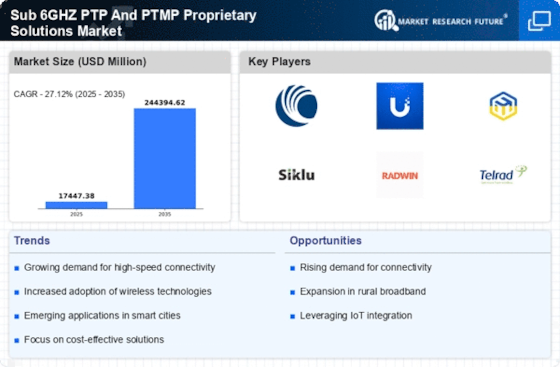
As per Market Research Future analysis, the Sub 6GHZ PTP And PTMP Proprietary Solutions Market Size was estimated at 17447.38 USD Million in 2024. The Sub 6GHZ PTP And PTMP Proprietary Solutions industry is projected to grow from 22179.15 USD Million in 2025 to 244394.62 USD Million by 2035, exhibiting a compound annual growth rate (CAGR) of 27.12% during the forecast period 2025 - 2035

Key Market Trends & Highlights

The Sub 6GHz PTP and PTMP proprietary solutions market is experiencing robust growth driven by technological advancements and increasing connectivity demands.

  • The market is witnessing a rising demand for high-speed connectivity, particularly in North America, which remains the largest market.
  • Integration of advanced technologies is becoming prevalent, especially in the Asia-Pacific region, recognized as the fastest-growing area.
  • Customization and flexibility are increasingly prioritized, with wireless broadband systems leading the market while massive MIMO solutions are emerging rapidly.
  • Key market drivers include the increasing need for reliable communication and the expansion of wireless infrastructure, which are essential for meeting growing connectivity demands.

Market Size & Forecast

2024 Market Size 17447.38 (USD Million)
2035 Market Size 244394.62 (USD Million)
CAGR (2025 - 2035) 27.12%
Largest Regional Market Share in 2024 Europe

Major Players

Cambium Networks (US), Ubiquiti Inc. (US), MikroTik (LV), Siklu Communication (IL), Radwin (IL), Telrad Networks (IL), Proxim Wireless (US), BridgeWave Communications (US), Aviat Networks (US)

Market Trends

The Sub 6GHZ PTP And PTMP Proprietary Solutions Market is currently experiencing a dynamic evolution, driven by the increasing demand for high-speed connectivity and reliable communication solutions. As industries continue to embrace digital transformation, the need for robust point-to-point (PTP) and point-to-multipoint (PTMP) systems has become more pronounced. This market appears to be characterized by a diverse range of applications, including telecommunications, public safety, and enterprise networking. The ongoing advancements in technology suggest that proprietary solutions are likely to play a pivotal role in enhancing network performance and efficiency. Moreover, the competitive landscape of the Sub 6GHZ PTP And PTMP Proprietary Solutions Market is marked by the presence of numerous players striving to innovate and differentiate their offerings. Companies are increasingly focusing on developing solutions that not only meet current demands but also anticipate future requirements. This proactive approach indicates a trend towards more integrated and versatile systems that can adapt to varying operational environments. As the market continues to mature, it may witness further consolidation, with strategic partnerships and collaborations becoming more common as firms seek to leverage complementary strengths and capabilities.

Rising Demand for High-Speed Connectivity

The need for faster and more reliable communication solutions is driving growth in the Sub 6GHZ PTP And PTMP Proprietary Solutions Market. As businesses and consumers increasingly rely on digital services, the demand for high-speed connectivity is expected to rise, prompting innovation in proprietary technologies.

Integration of Advanced Technologies

The integration of advanced technologies such as artificial intelligence and machine learning into proprietary solutions is becoming more prevalent. This trend suggests that companies are looking to enhance network management and optimize performance, potentially leading to more efficient operations.

Focus on Customization and Flexibility

There is a growing emphasis on customization and flexibility within the Sub 6GHZ PTP And PTMP Proprietary Solutions Market. Providers are likely to offer tailored solutions that cater to specific industry needs, allowing for greater adaptability in various operational contexts.

Sub 6GHZ PTP And PTMP Proprietary Solutions Market Market Drivers

Adoption of Smart Technologies

The Sub 6GHZ PTP And PTMP Proprietary Solutions Market is witnessing a notable increase in the adoption of smart technologies. As industries integrate advanced technologies such as artificial intelligence and machine learning, the need for efficient data transmission becomes critical. PTP and PTMP solutions are essential for connecting smart devices and ensuring real-time data exchange. Market analysis suggests that the integration of smart technologies could lead to a 15% increase in demand for proprietary solutions over the next few years. This trend highlights the importance of reliable communication systems in supporting the growing ecosystem of interconnected devices.

Expansion of Wireless Infrastructure

The Sub 6GHZ PTP And PTMP Proprietary Solutions Market is significantly influenced by the ongoing expansion of wireless infrastructure. As urban areas continue to grow, the demand for efficient wireless communication solutions is escalating. The deployment of PTP and PTMP systems is becoming essential for providing high-speed internet access in underserved regions. Recent statistics indicate that investments in wireless infrastructure are expected to reach billions of dollars in the coming years, reflecting a commitment to enhancing connectivity. This expansion not only supports residential users but also facilitates business operations, thereby driving the adoption of proprietary solutions in the market.

Increasing Need for Reliable Communication

The Sub 6GHZ PTP And PTMP Proprietary Solutions Market is experiencing a surge in demand for reliable communication systems. As businesses and organizations increasingly rely on uninterrupted connectivity for operations, the need for robust point-to-point (PTP) and point-to-multipoint (PTMP) solutions becomes paramount. This trend is particularly evident in sectors such as telecommunications, where the requirement for dependable data transmission is critical. According to recent data, the market for PTP and PTMP solutions is projected to grow at a compound annual growth rate of approximately 12% over the next five years. This growth is driven by the necessity for seamless communication in various applications, including remote work, cloud services, and IoT deployments.

Growing Demand for Cost-Effective Solutions

The Sub 6GHZ PTP And PTMP Proprietary Solutions Market is driven by the growing demand for cost-effective communication solutions. Organizations are seeking ways to optimize their operational costs while maintaining high-quality connectivity. PTP and PTMP solutions offer a viable alternative to traditional wired systems, providing flexibility and scalability at a lower cost. Market trends indicate that the shift towards more economical solutions is likely to result in a 20% increase in the adoption of proprietary technologies in the next few years. This demand for affordability is reshaping the competitive landscape of the market.

Regulatory Support for Wireless Communication

The Sub 6GHZ PTP And PTMP Proprietary Solutions Market benefits from favorable regulatory frameworks that promote wireless communication. Governments are increasingly recognizing the importance of enhancing connectivity and are implementing policies that support the deployment of PTP and PTMP solutions. These regulations often include spectrum allocation and funding for infrastructure development, which can significantly impact market growth. Recent initiatives have shown that regulatory support can lead to a 10% increase in market penetration for proprietary solutions, as companies are encouraged to invest in advanced communication technologies.

Market Segment Insights

By Solution Type: Wireless Broadband Systems (Largest) vs. Microwave Systems (Fastest-Growing)

<p>In the Sub 6GHz PTP and PTMP Proprietary Solutions Market, the distribution of market share reveals a competitive landscape among various solution types. Wireless Broadband Systems currently dominate this segment, capturing a significant portion of the market due to their proven efficiency and widespread adoption. Following closely, Microwave Systems are witnessing a rapid rise in share as businesses increasingly turn to them for high-capacity data transmission over long distances. Furthermore, segments such as Fixed Wireless Access Systems and Small Cell Solutions also contribute meaningfully to the overall dynamics, offering specialized capabilities that cater to diverse customer needs. The growth trends in this market segment are primarily driven by the escalating demand for reliable, high-speed internet access in urban and rural areas alike. The push for digital transformation across various industries, coupled with advancements in technology, is fueling the adoption of Microwave Systems and Small Cell Solutions. Furthermore, as competition intensifies, service providers are exploring innovative solutions like Mesh Networking Systems and Outdoor Access Points to enhance coverage and capacity, appealing to the growing number of users requiring uninterrupted connectivity.</p>

<p>Wireless Broadband Systems (Dominant) vs. Microwave Systems (Emerging)</p>

<p>Wireless Broadband Systems continue to be the dominant player in the Sub 6GHz PTP and PTMP Proprietary Solutions Market. Their robustness, ease of installation, and ability to deliver high-speed connectivity make them the preferred choice among many enterprises and service providers. These systems are essential in linking various endpoints, allowing for efficient data transfer and communication. On the other hand, Microwave Systems are viewed as an emerging solution, gaining traction for their ability to offer long-range connectivity with minimal latency. As technology enhances their performance and reduces costs, they are becoming increasingly attractive for operators looking to upgrade their infrastructure and meet growing bandwidth demands. The competition between these segments highlights a dynamic market landscape with evolving consumer expectations.</p>

By Antenna Technology: Single Antenna Solutions (Largest) vs. Massive MIMO Solutions (Fastest-Growing)

<p>In the Sub 6GHZ PTP and PTMP proprietary solutions market, the distribution of market share among antenna technologies reveals that single antenna solutions occupy the largest segment. This dominance is primarily attributed to their simplicity, ease of deployment, and cost-effectiveness, making them a preferred choice for various applications. In contrast, massive MIMO solutions, while starting from a smaller base, are gaining traction due to their ability to enhance spectral efficiency and network capacity, appealing to service providers looking to upgrade existing infrastructures. Growth trends in this segment indicate a significant shift towards more advanced technologies, especially in urban and densely populated areas. The need for higher data rates and improved connectivity is driving the adoption of massive MIMO solutions, marked by advancements in signal processing and hardware. Additionally, the push for 5G deployments is accelerating the transition from traditional single antenna systems to more sophisticated configurations, which promise higher throughput and reliability in wireless communications.</p>

<p>Single Antenna Solutions (Dominant) vs. MIMO Solutions (Emerging)</p>

<p>Single antenna solutions are characterized by their straightforward implementation and low costs, making them a longstanding choice for numerous end-users in the Sub 6GHZ PTP and PTMP markets. These solutions provide reliable performance for many standard applications, securing their position as a dominant segment. However, tremendous growth potential exists in MIMO solutions, which employ multiple antennas to transmit and receive signals concurrently. This technology significantly boosts system capacity and user throughput, catering to the growing demand for high-speed connectivity. The transition towards MIMO systems is driven by the increasing data traffic and the need for enhanced network efficiency, placing them firmly in the emerging category as their adoption rapidly gains pace.</p>

By Capacity and Throughput: High-Capacity Solutions (Largest) vs. Low-Capacity Solutions (Fastest-Growing)

<p>The Sub 6GHz PTP and PTMP proprietary solutions market exhibits a diverse landscape characterized by varying capacities. High-capacity solutions dominate this sector, accounting for the majority of market share due to their ability to support extensive data transfers and high user demand. In contrast, low-capacity solutions, while holding a smaller share, have garnered increasing interest because of their cost-effectiveness and suitability for smaller applications and networks. These trends indicate a balanced yet competitive environment among various capacity tiers.</p>

<p>Medium Capacity Solutions (Dominant) vs. Low-Capacity Solutions (Emerging)</p>

<p>Medium capacity solutions play a critical role in the Sub 6GHz PTP and PTMP proprietary solutions market, offering a balanced performance suitable for a wide range of applications, from small to medium enterprises. These solutions are characterized by their efficient throughput capabilities and scalability, making them attractive for users seeking a good compromise between capacity and cost. In contrast, low-capacity solutions are emerging as a viable alternative for budget-conscious consumers and smaller networks. They provide adequate performance for simple tasks and foster market penetration among non-enterprise users, highlighting a growing demand for flexible options that can cater to diverse network needs.</p>

By Modulation Schemes: 64QAM (Largest) vs. 256QAM (Fastest-Growing)

<p>In the Sub 6GHZ PTP and PTMP Proprietary Solutions Market, modulation schemes are key components influencing performance and efficiency. The share of QPSK remains significant due to its widespread use in applications requiring less bandwidth and lower complexity. However, 64QAM has established itself as the largest segment, thanks to its balance between spectral efficiency and robustness. The shift towards higher-order modulation, such as 256QAM, is indicative of the increasing demand for high-capacity transmission systems, providing an alternative to established methods while propelling market dynamics.</p>

<p>64QAM (Dominant) vs. 256QAM (Emerging)</p>

<p>64QAM is regarded as the dominant modulation scheme within the Sub 6GHz PTP and PTMP proprietary solutions market, owing to its ability to efficiently transmit large volumes of data over limited bandwidth. Its characteristics include robust performance in challenging environments and higher data rates compared to lower-order schemes such as QPSK. On the other hand, 256QAM is recognized as the emerging modulation scheme, demonstrating rapid growth due to its superior efficiency and capacity for delivering high data throughput. This increasing adoption can be attributed to advancements in technology and the demand for more bandwidth-intensive applications, thus positioning 256QAM as an attractive alternative for future deployments.</p>

By Industry Verticals: Telecommunications and Service Providers (Largest) vs. Transportation and Logistics (Fastest-Growing)

<p>The Sub 6GHz PTP and PTMP proprietary solutions market exhibits a diverse distribution of market share across various industry verticals. Telecommunications and Service Providers hold a significant portion of the market, attributed to their need for high-capacity data transmission solutions. Other notable segments include Enterprise and Business and Industrial and Utilities, which contribute to the overall market presence, while segments like Smart Cities and Municipalities and Public Safety are gaining traction.</p>

<p>Telecommunications and Service Providers (Dominant) vs. Transportation and Logistics (Emerging)</p>

<p>Telecommunications and Service Providers dominate the Sub 6GHz PTP and PTMP proprietary solutions market due to their extensive infrastructure and demand for reliable, high-speed connectivity. Their established position enables them to leverage these solutions for enhancing communication networks. Conversely, the Transportation and Logistics sector is emerging rapidly, driven by the need for efficient data transfer and real-time tracking. Companies in this sector are increasingly adopting proprietary solutions to optimize logistics, enhance safety, and improve operational efficiency. This shift signifies a growing trend towards digitalization and the integration of advanced communication technologies in logistics.</p>

Get more detailed insights about Sub 6GHZ PTP And PTMP Proprietary Solutions Market Research Report—Global Forecast till 2035

Regional Insights

North America : Innovation and Market Leadership

North America is the largest market for Sub 6GHz PTP and PTMP proprietary solutions, holding approximately 45% of the global market share. The region's growth is driven by increasing demand for high-speed internet and the expansion of wireless infrastructure. Regulatory support for broadband initiatives further catalyzes market growth, with significant investments in technology and infrastructure development. The United States leads the market, with key players like Cambium Networks, Ubiquiti Inc., and Proxim Wireless driving innovation. The competitive landscape is characterized by rapid technological advancements and a focus on enhancing connectivity solutions. Canada also plays a significant role, contributing to the region's overall market strength, with a growing emphasis on rural broadband expansion.

Europe : Emerging Market with Regulations

Europe is the second-largest market for Sub 6GHz PTP and PTMP proprietary solutions, accounting for approximately 30% of the global market share. The region's growth is propelled by stringent regulations aimed at enhancing broadband access and digital inclusion. Initiatives from the European Union to promote 5G and wireless technologies are significant drivers of demand, fostering a competitive environment for innovation. Leading countries include Germany, the UK, and France, where companies like MikroTik and Siklu Communication are making substantial contributions. The competitive landscape is marked by a mix of established players and emerging startups, all vying for market share in a rapidly evolving sector. The focus on sustainability and green technologies is also shaping product development and market strategies.

Asia-Pacific : Rapid Growth and Adoption

Asia-Pacific is witnessing rapid growth in the Sub 6GHz PTP and PTMP proprietary solutions market, holding about 20% of the global market share. The region's demand is driven by increasing internet penetration, urbanization, and the need for reliable communication infrastructure. Government initiatives to enhance digital connectivity and investments in telecommunications are key factors propelling market expansion. Countries like China, India, and Australia are at the forefront of this growth, with significant contributions from local and international players. Companies such as Radwin and Telrad Networks are actively participating in the market, focusing on innovative solutions tailored to regional needs. The competitive landscape is dynamic, with a strong emphasis on cost-effective and scalable solutions to meet the diverse demands of the region.

Middle East and Africa : Untapped Potential and Growth

The Middle East and Africa region is emerging as a significant market for Sub 6GHz PTP and PTMP proprietary solutions, holding around 5% of the global market share. The growth is driven by increasing investments in telecommunications infrastructure and a rising demand for high-speed internet services. Government initiatives aimed at improving connectivity in rural and underserved areas are also contributing to market expansion. Leading countries include South Africa, Nigeria, and the UAE, where local and international players are actively competing. Companies like BridgeWave Communications and Aviat Networks are focusing on innovative solutions to address the unique challenges of the region. The competitive landscape is characterized by a mix of established firms and new entrants, all striving to capture the growing demand for reliable connectivity solutions.

Key Players and Competitive Insights

The 6GHz PTP and PTMP Proprietary solutions market has witnessed significant growth over the forecast period due to increasing demand for reliable and high-capacity wireless connectivity, growing need for bridging the digital divide in underserved areas, rapid deployment and cost-effectiveness compared to wired solutions. There are several domestic, regional, and global players operating in the 6GHz PTP and PTMP Proprietary solutions market who continuously strive to gain a significant share of the overall market.During the study, MRFR has analyzed some of the major players in the 6GHz PTP and PTMP Proprietary solutions market who have contributed to the market growth. These include Cambium Networks, RADWIN, Siklu, Mimosa Networks, Ceragon Networks Ltd, Infinite Wireless, Ligowave AG, Telrad Networks (Liquid Intelligent Technologies), Proxim wireless, Ubiquiti Networks, RAD Data Communications, Intracom Telecom, CableFree, IGNITENET (ACCTON GROUP), Aviat Networks, Inc, Redline Communication, Star Microwave, SIAE microelettronica S.p.a., Rad Communications, and Saf Tehnika.Among these, SAf Tehnika, Aviat networks inc, Ubiquiti Networks, IgniteNet, and Liquid Intelligent Technologies are among the top 5 prominent players in the 6GHz PTP and PTMP Proprietary solutions market. These players focus on expanding and enhancing their product portfolio and services to remain competitive and increase their customer base. Additionally, these players are focusing on partnerships & collaborations to expand their business and customer base to enhance their market position.

Key Companies in the Sub 6GHZ PTP And PTMP Proprietary Solutions Market include

Industry Developments

February 2023: The deployment of RADWIN's solutions in East Texas will now be expanded thanks to a collaboration between RADWIN and Peoples Telephone Cooperative. The success of RADWIN's legacy 5000 PtMP solutions, implemented in 2014 to service People's residential and commercial customers, led to this choice.

November 2022: A relationship between Cogent Distribution and RADWIN was announced. By entering into this new relationship, Cogent will fulfill its commitment to continuously offer value while expanding the market reach of RADWIN's products in the UK. RADWIN's wireless broadband solutions for Point-to-MultiPoint and Point-to-Point connectivity will be widely available from Cogent Distribution.

June 2022: A collaborative relationship between Siklu, Gigabit Wireless Access (GWA), Mobile x-Haul, and Signify was launched to include Siklu's MultiHaul TG multi-gigabit wireless connectivity technology into Signify's BrightSites line-up. The upshot of this combination will be a new product called Broadband luminaires that will be added to the BrightSites inventory.

Future Outlook

Sub 6GHZ PTP And PTMP Proprietary Solutions Market Future Outlook

The Sub 6GHz PTP and PTMP Proprietary Solutions Market is projected to grow at a 27.12% CAGR from 2025 to 2035, driven by increasing demand for high-speed connectivity and advancements in wireless technology.

New opportunities lie in:

  • Expansion into rural broadband infrastructure projects
  • Development of integrated IoT connectivity solutions
  • Partnerships with telecom operators for enhanced service offerings

By 2035, the market is expected to achieve substantial growth, solidifying its position as a leader in wireless communication solutions.

Market Segmentation

Sub 6GHZ PTP And PTMP Proprietary Solutions Market Solution Type Outlook

  • Wireless Broadband Systems
  • Microwave Systems
  • Fixed Wireless Access (FWA) Systems
  • Small Cell Solutions
  • Mesh Networking Systems
  • Outdoor Access Points (AP) Systems
  • Others

Sub 6GHZ PTP And PTMP Proprietary Solutions Market Antenna Technology Outlook

  • Single Antenna Solutions
  • Multiple Input Multiple Output (MIMO) Solutions
  • Massive MIMO Solutions

Sub 6GHZ PTP And PTMP Proprietary Solutions Market Industry Verticals Outlook

  • Telecommunications And Service Providers
  • Enterprise And Business
  • Industrial And Utilities
  • Public Safety and Emergency Services
  • Transportation And Logistics
  • Smart Cities and Municipalities
  • Others

Sub 6GHZ PTP And PTMP Proprietary Solutions Market Modulation Schemes Outlook

  • QPSK (Quadrature Phase-Shift Keying)
  • 16QAM (16 Quadrature Amplitude Modulation)
  • 64QAM (64 Quadrature Amplitude Modulation)
  • 256QAM (256 Quadrature Amplitude Modulation)

Sub 6GHZ PTP And PTMP Proprietary Solutions Market Capacity and Throughput Outlook

  • Low-Capacity Solutions
  • Medium Capacity Solutions
  • High-Capacity Solutions

Report Scope

MARKET SIZE 2024 17447.38(USD Million)
MARKET SIZE 2025 22179.15(USD Million)
MARKET SIZE 2035 244394.62(USD Million)
COMPOUND ANNUAL GROWTH RATE (CAGR) 27.12% (2025 - 2035)
REPORT COVERAGE Revenue Forecast, Competitive Landscape, Growth Factors, and Trends
BASE YEAR 2024
Market Forecast Period 2025 - 2035
Historical Data 2019 - 2024
Market Forecast Units USD Million
Key Companies Profiled Cambium Networks (US), Ubiquiti Inc. (US), MikroTik (LV), Siklu Communication (IL), Radwin (IL), Telrad Networks (IL), Proxim Wireless (US), BridgeWave Communications (US), Aviat Networks (US)
Segments Covered Solution Type, Antenna Technology, Capacity And Throughput
Key Market Opportunities Growing demand for high-speed connectivity drives innovation in Sub 6GHZ PTP And PTMP Proprietary Solutions Market.
Key Market Dynamics Rising demand for high-capacity data transmission drives innovation in Sub 6GHz Point-to-Point and Point-to-Multipoint solutions.
Countries Covered North America, Europe, APAC, South America, MEA

FAQs

What is the projected market valuation for the Sub 6GHZ PTP and PTMP proprietary solutions market by 2035?

<p>The projected market valuation for the Sub 6GHZ PTP and PTMP proprietary solutions market is expected to reach 244394.62 USD Million by 2035.</p>

What was the overall market valuation for the Sub 6GHZ PTP and PTMP proprietary solutions market in 2024?

<p>The overall market valuation for the Sub 6GHZ PTP and PTMP proprietary solutions market was 17447.38 USD Million in 2024.</p>

What is the expected CAGR for the Sub 6GHZ PTP and PTMP proprietary solutions market during the forecast period 2025 - 2035?

<p>The expected CAGR for the Sub 6GHZ PTP and PTMP proprietary solutions market during the forecast period 2025 - 2035 is 27.12%.</p>

Which companies are considered key players in the Sub 6GHZ PTP and PTMP proprietary solutions market?

<p>Key players in the market include Cambium Networks, Ubiquiti Inc., MikroTik, Siklu Communication, Radwin, Telrad Networks, Proxim Wireless, BridgeWave Communications, and Aviat Networks.</p>

What segment had the highest valuation in the Sub 6GHZ PTP and PTMP proprietary solutions market in 2024?

The Fixed Wireless Access (FWA) Systems segment had the highest valuation at 4000.0 USD Million in 2024.

How does the valuation of Multiple Input Multiple Output (MIMO) Solutions compare to other antenna technologies?

The valuation for Multiple Input Multiple Output (MIMO) Solutions was 8000.0 USD Million in 2024, indicating a strong position compared to other antenna technologies.

What is the valuation range for High-Capacity Solutions in the Sub 6GHZ PTP and PTMP proprietary solutions market?

The valuation range for High-Capacity Solutions is from 8847.38 USD Million to 120394.62 USD Million.

Which industry vertical is projected to have the highest market valuation in the Sub 6GHZ PTP and PTMP proprietary solutions market?

The Telecommunications and Service Providers vertical is projected to have the highest market valuation, ranging from 4000.0 USD Million to 60000.0 USD Million.

What is the valuation of Microwave Systems in the Sub 6GHZ PTP and PTMP proprietary solutions market?

The valuation of Microwave Systems was 2500.0 USD Million in 2024.

What is the expected growth trend for Outdoor Access Points (AP) Systems in the coming years?

The Outdoor Access Points (AP) Systems segment is expected to grow significantly, with a valuation range from 3000.0 USD Million to 40000.0 USD Million.

  1. SECTION I: EXECUTIVE SUMMARY AND KEY HIGHLIGHTS
    1. | 1.1 EXECUTIVE SUMMARY
    2. | | 1.1.1 Market Overview
    3. | | 1.1.2 Key Findings
    4. | | 1.1.3 Market Segmentation
    5. | | 1.1.4 Competitive Landscape
    6. | | 1.1.5 Challenges and Opportunities
    7. | | 1.1.6 Future Outlook
  2. SECTION II: SCOPING, METHODOLOGY AND MARKET STRUCTURE
    1. | 2.1 MARKET INTRODUCTION
    2. | | 2.1.1 Definition
    3. | | 2.1.2 Scope of the study
    4. | | | 2.1.2.1 Research Objective
    5. | | | 2.1.2.2 Assumption
    6. | | | 2.1.2.3 Limitations
    7. | 2.2 RESEARCH METHODOLOGY
    8. | | 2.2.1 Overview
    9. | | 2.2.2 Data Mining
    10. | | 2.2.3 Secondary Research
    11. | | 2.2.4 Primary Research
    12. | | | 2.2.4.1 Primary Interviews and Information Gathering Process
    13. | | | 2.2.4.2 Breakdown of Primary Respondents
    14. | | 2.2.5 Forecasting Model
    15. | | 2.2.6 Market Size Estimation
    16. | | | 2.2.6.1 Bottom-Up Approach
    17. | | | 2.2.6.2 Top-Down Approach
    18. | | 2.2.7 Data Triangulation
    19. | | 2.2.8 Validation
  3. SECTION III: QUALITATIVE ANALYSIS
    1. | 3.1 MARKET DYNAMICS
    2. | | 3.1.1 Overview
    3. | | 3.1.2 Drivers
    4. | | 3.1.3 Restraints
    5. | | 3.1.4 Opportunities
    6. | 3.2 MARKET FACTOR ANALYSIS
    7. | | 3.2.1 Value chain Analysis
    8. | | 3.2.2 Porter's Five Forces Analysis
    9. | | | 3.2.2.1 Bargaining Power of Suppliers
    10. | | | 3.2.2.2 Bargaining Power of Buyers
    11. | | | 3.2.2.3 Threat of New Entrants
    12. | | | 3.2.2.4 Threat of Substitutes
    13. | | | 3.2.2.5 Intensity of Rivalry
    14. | | 3.2.3 COVID-19 Impact Analysis
    15. | | | 3.2.3.1 Market Impact Analysis
    16. | | | 3.2.3.2 Regional Impact
    17. | | | 3.2.3.3 Opportunity and Threat Analysis
  4. SECTION IV: QUANTITATIVE ANALYSIS
    1. | 4.1 Semiconductor & Electronics, BY Solution Type (USD Million)
    2. | | 4.1.1 Wireless Broadband Systems
    3. | | 4.1.2 Microwave Systems
    4. | | 4.1.3 Fixed Wireless Access (FWA) Systems
    5. | | 4.1.4 Small Cell Solutions
    6. | | 4.1.5 Mesh Networking Systems
    7. | | 4.1.6 Outdoor Access Points (AP) Systems
    8. | | 4.1.7 Others
    9. | 4.2 Semiconductor & Electronics, BY Antenna Technology (USD Million)
    10. | | 4.2.1 Single Antenna Solutions
    11. | | 4.2.2 Multiple Input Multiple Output (MIMO) Solutions
    12. | | 4.2.3 Massive MIMO Solutions
    13. | 4.3 Semiconductor & Electronics, BY Capacity and Throughput (USD Million)
    14. | | 4.3.1 Low-Capacity Solutions
    15. | | 4.3.2 Medium Capacity Solutions
    16. | | 4.3.3 High-Capacity Solutions
    17. | 4.4 Semiconductor & Electronics, BY Modulation Schemes (USD Million)
    18. | | 4.4.1 QPSK (Quadrature Phase-Shift Keying)
    19. | | 4.4.2 16QAM (16 Quadrature Amplitude Modulation)
    20. | | 4.4.3 64QAM (64 Quadrature Amplitude Modulation)
    21. | | 4.4.4 256QAM (256 Quadrature Amplitude Modulation)
    22. | 4.5 Semiconductor & Electronics, BY Industry Verticals (USD Million)
    23. | | 4.5.1 Telecommunications And Service Providers
    24. | | 4.5.2 Enterprise And Business
    25. | | 4.5.3 Industrial And Utilities
    26. | | 4.5.4 Public Safety and Emergency Services
    27. | | 4.5.5 Transportation And Logistics
    28. | | 4.5.6 Smart Cities and Municipalities
    29. | | 4.5.7 Others
    30. | 4.6 Semiconductor & Electronics, BY Region (USD Million)
    31. | | 4.6.1 North America
    32. | | | 4.6.1.1 US
    33. | | | 4.6.1.2 Canada
    34. | | 4.6.2 Europe
    35. | | | 4.6.2.1 Germany
    36. | | | 4.6.2.2 UK
    37. | | | 4.6.2.3 France
    38. | | | 4.6.2.4 Russia
    39. | | | 4.6.2.5 Italy
    40. | | | 4.6.2.6 Spain
    41. | | | 4.6.2.7 Rest of Europe
    42. | | 4.6.3 APAC
    43. | | | 4.6.3.1 China
    44. | | | 4.6.3.2 India
    45. | | | 4.6.3.3 Japan
    46. | | | 4.6.3.4 South Korea
    47. | | | 4.6.3.5 Malaysia
    48. | | | 4.6.3.6 Thailand
    49. | | | 4.6.3.7 Indonesia
    50. | | | 4.6.3.8 Rest of APAC
    51. | | 4.6.4 South America
    52. | | | 4.6.4.1 Brazil
    53. | | | 4.6.4.2 Mexico
    54. | | | 4.6.4.3 Argentina
    55. | | | 4.6.4.4 Rest of South America
    56. | | 4.6.5 MEA
    57. | | | 4.6.5.1 GCC Countries
    58. | | | 4.6.5.2 South Africa
    59. | | | 4.6.5.3 Rest of MEA
  5. SECTION V: COMPETITIVE ANALYSIS
    1. | 5.1 Competitive Landscape
    2. | | 5.1.1 Overview
    3. | | 5.1.2 Competitive Analysis
    4. | | 5.1.3 Market share Analysis
    5. | | 5.1.4 Major Growth Strategy in the Semiconductor & Electronics
    6. | | 5.1.5 Competitive Benchmarking
    7. | | 5.1.6 Leading Players in Terms of Number of Developments in the Semiconductor & Electronics
    8. | | 5.1.7 Key developments and growth strategies
    9. | | | 5.1.7.1 New Product Launch/Service Deployment
    10. | | | 5.1.7.2 Merger & Acquisitions
    11. | | | 5.1.7.3 Joint Ventures
    12. | | 5.1.8 Major Players Financial Matrix
    13. | | | 5.1.8.1 Sales and Operating Income
    14. | | | 5.1.8.2 Major Players R&D Expenditure. 2023
    15. | 5.2 Company Profiles
    16. | | 5.2.1 Cambium Networks (US)
    17. | | | 5.2.1.1 Financial Overview
    18. | | | 5.2.1.2 Products Offered
    19. | | | 5.2.1.3 Key Developments
    20. | | | 5.2.1.4 SWOT Analysis
    21. | | | 5.2.1.5 Key Strategies
    22. | | 5.2.2 Ubiquiti Inc. (US)
    23. | | | 5.2.2.1 Financial Overview
    24. | | | 5.2.2.2 Products Offered
    25. | | | 5.2.2.3 Key Developments
    26. | | | 5.2.2.4 SWOT Analysis
    27. | | | 5.2.2.5 Key Strategies
    28. | | 5.2.3 MikroTik (LV)
    29. | | | 5.2.3.1 Financial Overview
    30. | | | 5.2.3.2 Products Offered
    31. | | | 5.2.3.3 Key Developments
    32. | | | 5.2.3.4 SWOT Analysis
    33. | | | 5.2.3.5 Key Strategies
    34. | | 5.2.4 Siklu Communication (IL)
    35. | | | 5.2.4.1 Financial Overview
    36. | | | 5.2.4.2 Products Offered
    37. | | | 5.2.4.3 Key Developments
    38. | | | 5.2.4.4 SWOT Analysis
    39. | | | 5.2.4.5 Key Strategies
    40. | | 5.2.5 Radwin (IL)
    41. | | | 5.2.5.1 Financial Overview
    42. | | | 5.2.5.2 Products Offered
    43. | | | 5.2.5.3 Key Developments
    44. | | | 5.2.5.4 SWOT Analysis
    45. | | | 5.2.5.5 Key Strategies
    46. | | 5.2.6 Telrad Networks (IL)
    47. | | | 5.2.6.1 Financial Overview
    48. | | | 5.2.6.2 Products Offered
    49. | | | 5.2.6.3 Key Developments
    50. | | | 5.2.6.4 SWOT Analysis
    51. | | | 5.2.6.5 Key Strategies
    52. | | 5.2.7 Proxim Wireless (US)
    53. | | | 5.2.7.1 Financial Overview
    54. | | | 5.2.7.2 Products Offered
    55. | | | 5.2.7.3 Key Developments
    56. | | | 5.2.7.4 SWOT Analysis
    57. | | | 5.2.7.5 Key Strategies
    58. | | 5.2.8 BridgeWave Communications (US)
    59. | | | 5.2.8.1 Financial Overview
    60. | | | 5.2.8.2 Products Offered
    61. | | | 5.2.8.3 Key Developments
    62. | | | 5.2.8.4 SWOT Analysis
    63. | | | 5.2.8.5 Key Strategies
    64. | | 5.2.9 Aviat Networks (US)
    65. | | | 5.2.9.1 Financial Overview
    66. | | | 5.2.9.2 Products Offered
    67. | | | 5.2.9.3 Key Developments
    68. | | | 5.2.9.4 SWOT Analysis
    69. | | | 5.2.9.5 Key Strategies
    70. | 5.3 Appendix
    71. | | 5.3.1 References
    72. | | 5.3.2 Related Reports
  6. LIST OF FIGURES
    1. | 6.1 MARKET SYNOPSIS
    2. | 6.2 NORTH AMERICA MARKET ANALYSIS
    3. | 6.3 US MARKET ANALYSIS BY SOLUTION TYPE
    4. | 6.4 US MARKET ANALYSIS BY ANTENNA TECHNOLOGY
    5. | 6.5 US MARKET ANALYSIS BY CAPACITY AND THROUGHPUT
    6. | 6.6 US MARKET ANALYSIS BY MODULATION SCHEMES
    7. | 6.7 US MARKET ANALYSIS BY INDUSTRY VERTICALS
    8. | 6.8 CANADA MARKET ANALYSIS BY SOLUTION TYPE
    9. | 6.9 CANADA MARKET ANALYSIS BY ANTENNA TECHNOLOGY
    10. | 6.10 CANADA MARKET ANALYSIS BY CAPACITY AND THROUGHPUT
    11. | 6.11 CANADA MARKET ANALYSIS BY MODULATION SCHEMES
    12. | 6.12 CANADA MARKET ANALYSIS BY INDUSTRY VERTICALS
    13. | 6.13 EUROPE MARKET ANALYSIS
    14. | 6.14 GERMANY MARKET ANALYSIS BY SOLUTION TYPE
    15. | 6.15 GERMANY MARKET ANALYSIS BY ANTENNA TECHNOLOGY
    16. | 6.16 GERMANY MARKET ANALYSIS BY CAPACITY AND THROUGHPUT
    17. | 6.17 GERMANY MARKET ANALYSIS BY MODULATION SCHEMES
    18. | 6.18 GERMANY MARKET ANALYSIS BY INDUSTRY VERTICALS
    19. | 6.19 UK MARKET ANALYSIS BY SOLUTION TYPE
    20. | 6.20 UK MARKET ANALYSIS BY ANTENNA TECHNOLOGY
    21. | 6.21 UK MARKET ANALYSIS BY CAPACITY AND THROUGHPUT
    22. | 6.22 UK MARKET ANALYSIS BY MODULATION SCHEMES
    23. | 6.23 UK MARKET ANALYSIS BY INDUSTRY VERTICALS
    24. | 6.24 FRANCE MARKET ANALYSIS BY SOLUTION TYPE
    25. | 6.25 FRANCE MARKET ANALYSIS BY ANTENNA TECHNOLOGY
    26. | 6.26 FRANCE MARKET ANALYSIS BY CAPACITY AND THROUGHPUT
    27. | 6.27 FRANCE MARKET ANALYSIS BY MODULATION SCHEMES
    28. | 6.28 FRANCE MARKET ANALYSIS BY INDUSTRY VERTICALS
    29. | 6.29 RUSSIA MARKET ANALYSIS BY SOLUTION TYPE
    30. | 6.30 RUSSIA MARKET ANALYSIS BY ANTENNA TECHNOLOGY
    31. | 6.31 RUSSIA MARKET ANALYSIS BY CAPACITY AND THROUGHPUT
    32. | 6.32 RUSSIA MARKET ANALYSIS BY MODULATION SCHEMES
    33. | 6.33 RUSSIA MARKET ANALYSIS BY INDUSTRY VERTICALS
    34. | 6.34 ITALY MARKET ANALYSIS BY SOLUTION TYPE
    35. | 6.35 ITALY MARKET ANALYSIS BY ANTENNA TECHNOLOGY
    36. | 6.36 ITALY MARKET ANALYSIS BY CAPACITY AND THROUGHPUT
    37. | 6.37 ITALY MARKET ANALYSIS BY MODULATION SCHEMES
    38. | 6.38 ITALY MARKET ANALYSIS BY INDUSTRY VERTICALS
    39. | 6.39 SPAIN MARKET ANALYSIS BY SOLUTION TYPE
    40. | 6.40 SPAIN MARKET ANALYSIS BY ANTENNA TECHNOLOGY
    41. | 6.41 SPAIN MARKET ANALYSIS BY CAPACITY AND THROUGHPUT
    42. | 6.42 SPAIN MARKET ANALYSIS BY MODULATION SCHEMES
    43. | 6.43 SPAIN MARKET ANALYSIS BY INDUSTRY VERTICALS
    44. | 6.44 REST OF EUROPE MARKET ANALYSIS BY SOLUTION TYPE
    45. | 6.45 REST OF EUROPE MARKET ANALYSIS BY ANTENNA TECHNOLOGY
    46. | 6.46 REST OF EUROPE MARKET ANALYSIS BY CAPACITY AND THROUGHPUT
    47. | 6.47 REST OF EUROPE MARKET ANALYSIS BY MODULATION SCHEMES
    48. | 6.48 REST OF EUROPE MARKET ANALYSIS BY INDUSTRY VERTICALS
    49. | 6.49 APAC MARKET ANALYSIS
    50. | 6.50 CHINA MARKET ANALYSIS BY SOLUTION TYPE
    51. | 6.51 CHINA MARKET ANALYSIS BY ANTENNA TECHNOLOGY
    52. | 6.52 CHINA MARKET ANALYSIS BY CAPACITY AND THROUGHPUT
    53. | 6.53 CHINA MARKET ANALYSIS BY MODULATION SCHEMES
    54. | 6.54 CHINA MARKET ANALYSIS BY INDUSTRY VERTICALS
    55. | 6.55 INDIA MARKET ANALYSIS BY SOLUTION TYPE
    56. | 6.56 INDIA MARKET ANALYSIS BY ANTENNA TECHNOLOGY
    57. | 6.57 INDIA MARKET ANALYSIS BY CAPACITY AND THROUGHPUT
    58. | 6.58 INDIA MARKET ANALYSIS BY MODULATION SCHEMES
    59. | 6.59 INDIA MARKET ANALYSIS BY INDUSTRY VERTICALS
    60. | 6.60 JAPAN MARKET ANALYSIS BY SOLUTION TYPE
    61. | 6.61 JAPAN MARKET ANALYSIS BY ANTENNA TECHNOLOGY
    62. | 6.62 JAPAN MARKET ANALYSIS BY CAPACITY AND THROUGHPUT
    63. | 6.63 JAPAN MARKET ANALYSIS BY MODULATION SCHEMES
    64. | 6.64 JAPAN MARKET ANALYSIS BY INDUSTRY VERTICALS
    65. | 6.65 SOUTH KOREA MARKET ANALYSIS BY SOLUTION TYPE
    66. | 6.66 SOUTH KOREA MARKET ANALYSIS BY ANTENNA TECHNOLOGY
    67. | 6.67 SOUTH KOREA MARKET ANALYSIS BY CAPACITY AND THROUGHPUT
    68. | 6.68 SOUTH KOREA MARKET ANALYSIS BY MODULATION SCHEMES
    69. | 6.69 SOUTH KOREA MARKET ANALYSIS BY INDUSTRY VERTICALS
    70. | 6.70 MALAYSIA MARKET ANALYSIS BY SOLUTION TYPE
    71. | 6.71 MALAYSIA MARKET ANALYSIS BY ANTENNA TECHNOLOGY
    72. | 6.72 MALAYSIA MARKET ANALYSIS BY CAPACITY AND THROUGHPUT
    73. | 6.73 MALAYSIA MARKET ANALYSIS BY MODULATION SCHEMES
    74. | 6.74 MALAYSIA MARKET ANALYSIS BY INDUSTRY VERTICALS
    75. | 6.75 THAILAND MARKET ANALYSIS BY SOLUTION TYPE
    76. | 6.76 THAILAND MARKET ANALYSIS BY ANTENNA TECHNOLOGY
    77. | 6.77 THAILAND MARKET ANALYSIS BY CAPACITY AND THROUGHPUT
    78. | 6.78 THAILAND MARKET ANALYSIS BY MODULATION SCHEMES
    79. | 6.79 THAILAND MARKET ANALYSIS BY INDUSTRY VERTICALS
    80. | 6.80 INDONESIA MARKET ANALYSIS BY SOLUTION TYPE
    81. | 6.81 INDONESIA MARKET ANALYSIS BY ANTENNA TECHNOLOGY
    82. | 6.82 INDONESIA MARKET ANALYSIS BY CAPACITY AND THROUGHPUT
    83. | 6.83 INDONESIA MARKET ANALYSIS BY MODULATION SCHEMES
    84. | 6.84 INDONESIA MARKET ANALYSIS BY INDUSTRY VERTICALS
    85. | 6.85 REST OF APAC MARKET ANALYSIS BY SOLUTION TYPE
    86. | 6.86 REST OF APAC MARKET ANALYSIS BY ANTENNA TECHNOLOGY
    87. | 6.87 REST OF APAC MARKET ANALYSIS BY CAPACITY AND THROUGHPUT
    88. | 6.88 REST OF APAC MARKET ANALYSIS BY MODULATION SCHEMES
    89. | 6.89 REST OF APAC MARKET ANALYSIS BY INDUSTRY VERTICALS
    90. | 6.90 SOUTH AMERICA MARKET ANALYSIS
    91. | 6.91 BRAZIL MARKET ANALYSIS BY SOLUTION TYPE
    92. | 6.92 BRAZIL MARKET ANALYSIS BY ANTENNA TECHNOLOGY
    93. | 6.93 BRAZIL MARKET ANALYSIS BY CAPACITY AND THROUGHPUT
    94. | 6.94 BRAZIL MARKET ANALYSIS BY MODULATION SCHEMES
    95. | 6.95 BRAZIL MARKET ANALYSIS BY INDUSTRY VERTICALS
    96. | 6.96 MEXICO MARKET ANALYSIS BY SOLUTION TYPE
    97. | 6.97 MEXICO MARKET ANALYSIS BY ANTENNA TECHNOLOGY
    98. | 6.98 MEXICO MARKET ANALYSIS BY CAPACITY AND THROUGHPUT
    99. | 6.99 MEXICO MARKET ANALYSIS BY MODULATION SCHEMES
    100. | 6.100 MEXICO MARKET ANALYSIS BY INDUSTRY VERTICALS
    101. | 6.101 ARGENTINA MARKET ANALYSIS BY SOLUTION TYPE
    102. | 6.102 ARGENTINA MARKET ANALYSIS BY ANTENNA TECHNOLOGY
    103. | 6.103 ARGENTINA MARKET ANALYSIS BY CAPACITY AND THROUGHPUT
    104. | 6.104 ARGENTINA MARKET ANALYSIS BY MODULATION SCHEMES
    105. | 6.105 ARGENTINA MARKET ANALYSIS BY INDUSTRY VERTICALS
    106. | 6.106 REST OF SOUTH AMERICA MARKET ANALYSIS BY SOLUTION TYPE
    107. | 6.107 REST OF SOUTH AMERICA MARKET ANALYSIS BY ANTENNA TECHNOLOGY
    108. | 6.108 REST OF SOUTH AMERICA MARKET ANALYSIS BY CAPACITY AND THROUGHPUT
    109. | 6.109 REST OF SOUTH AMERICA MARKET ANALYSIS BY MODULATION SCHEMES
    110. | 6.110 REST OF SOUTH AMERICA MARKET ANALYSIS BY INDUSTRY VERTICALS
    111. | 6.111 MEA MARKET ANALYSIS
    112. | 6.112 GCC COUNTRIES MARKET ANALYSIS BY SOLUTION TYPE
    113. | 6.113 GCC COUNTRIES MARKET ANALYSIS BY ANTENNA TECHNOLOGY
    114. | 6.114 GCC COUNTRIES MARKET ANALYSIS BY CAPACITY AND THROUGHPUT
    115. | 6.115 GCC COUNTRIES MARKET ANALYSIS BY MODULATION SCHEMES
    116. | 6.116 GCC COUNTRIES MARKET ANALYSIS BY INDUSTRY VERTICALS
    117. | 6.117 SOUTH AFRICA MARKET ANALYSIS BY SOLUTION TYPE
    118. | 6.118 SOUTH AFRICA MARKET ANALYSIS BY ANTENNA TECHNOLOGY
    119. | 6.119 SOUTH AFRICA MARKET ANALYSIS BY CAPACITY AND THROUGHPUT
    120. | 6.120 SOUTH AFRICA MARKET ANALYSIS BY MODULATION SCHEMES
    121. | 6.121 SOUTH AFRICA MARKET ANALYSIS BY INDUSTRY VERTICALS
    122. | 6.122 REST OF MEA MARKET ANALYSIS BY SOLUTION TYPE
    123. | 6.123 REST OF MEA MARKET ANALYSIS BY ANTENNA TECHNOLOGY
    124. | 6.124 REST OF MEA MARKET ANALYSIS BY CAPACITY AND THROUGHPUT
    125. | 6.125 REST OF MEA MARKET ANALYSIS BY MODULATION SCHEMES
    126. | 6.126 REST OF MEA MARKET ANALYSIS BY INDUSTRY VERTICALS
    127. | 6.127 KEY BUYING CRITERIA OF SEMICONDUCTOR & ELECTRONICS
    128. | 6.128 RESEARCH PROCESS OF MRFR
    129. | 6.129 DRO ANALYSIS OF SEMICONDUCTOR & ELECTRONICS
    130. | 6.130 DRIVERS IMPACT ANALYSIS: SEMICONDUCTOR & ELECTRONICS
    131. | 6.131 RESTRAINTS IMPACT ANALYSIS: SEMICONDUCTOR & ELECTRONICS
    132. | 6.132 SUPPLY / VALUE CHAIN: SEMICONDUCTOR & ELECTRONICS
    133. | 6.133 SEMICONDUCTOR & ELECTRONICS, BY SOLUTION TYPE, 2024 (% SHARE)
    134. | 6.134 SEMICONDUCTOR & ELECTRONICS, BY SOLUTION TYPE, 2024 TO 2035 (USD Million)
    135. | 6.135 SEMICONDUCTOR & ELECTRONICS, BY ANTENNA TECHNOLOGY, 2024 (% SHARE)
    136. | 6.136 SEMICONDUCTOR & ELECTRONICS, BY ANTENNA TECHNOLOGY, 2024 TO 2035 (USD Million)
    137. | 6.137 SEMICONDUCTOR & ELECTRONICS, BY CAPACITY AND THROUGHPUT, 2024 (% SHARE)
    138. | 6.138 SEMICONDUCTOR & ELECTRONICS, BY CAPACITY AND THROUGHPUT, 2024 TO 2035 (USD Million)
    139. | 6.139 SEMICONDUCTOR & ELECTRONICS, BY MODULATION SCHEMES, 2024 (% SHARE)
    140. | 6.140 SEMICONDUCTOR & ELECTRONICS, BY MODULATION SCHEMES, 2024 TO 2035 (USD Million)
    141. | 6.141 SEMICONDUCTOR & ELECTRONICS, BY INDUSTRY VERTICALS, 2024 (% SHARE)
    142. | 6.142 SEMICONDUCTOR & ELECTRONICS, BY INDUSTRY VERTICALS, 2024 TO 2035 (USD Million)
    143. | 6.143 BENCHMARKING OF MAJOR COMPETITORS
  7. LIST OF TABLES
    1. | 7.1 LIST OF ASSUMPTIONS
    2. | | 7.1.1
    3. | 7.2 North America MARKET SIZE ESTIMATES; FORECAST
    4. | | 7.2.1 BY SOLUTION TYPE, 2025-2035 (USD Million)
    5. | | 7.2.2 BY ANTENNA TECHNOLOGY, 2025-2035 (USD Million)
    6. | | 7.2.3 BY CAPACITY AND THROUGHPUT, 2025-2035 (USD Million)
    7. | | 7.2.4 BY MODULATION SCHEMES, 2025-2035 (USD Million)
    8. | | 7.2.5 BY INDUSTRY VERTICALS, 2025-2035 (USD Million)
    9. | 7.3 US MARKET SIZE ESTIMATES; FORECAST
    10. | | 7.3.1 BY SOLUTION TYPE, 2025-2035 (USD Million)
    11. | | 7.3.2 BY ANTENNA TECHNOLOGY, 2025-2035 (USD Million)
    12. | | 7.3.3 BY CAPACITY AND THROUGHPUT, 2025-2035 (USD Million)
    13. | | 7.3.4 BY MODULATION SCHEMES, 2025-2035 (USD Million)
    14. | | 7.3.5 BY INDUSTRY VERTICALS, 2025-2035 (USD Million)
    15. | 7.4 Canada MARKET SIZE ESTIMATES; FORECAST
    16. | | 7.4.1 BY SOLUTION TYPE, 2025-2035 (USD Million)
    17. | | 7.4.2 BY ANTENNA TECHNOLOGY, 2025-2035 (USD Million)
    18. | | 7.4.3 BY CAPACITY AND THROUGHPUT, 2025-2035 (USD Million)
    19. | | 7.4.4 BY MODULATION SCHEMES, 2025-2035 (USD Million)
    20. | | 7.4.5 BY INDUSTRY VERTICALS, 2025-2035 (USD Million)
    21. | 7.5 Europe MARKET SIZE ESTIMATES; FORECAST
    22. | | 7.5.1 BY SOLUTION TYPE, 2025-2035 (USD Million)
    23. | | 7.5.2 BY ANTENNA TECHNOLOGY, 2025-2035 (USD Million)
    24. | | 7.5.3 BY CAPACITY AND THROUGHPUT, 2025-2035 (USD Million)
    25. | | 7.5.4 BY MODULATION SCHEMES, 2025-2035 (USD Million)
    26. | | 7.5.5 BY INDUSTRY VERTICALS, 2025-2035 (USD Million)
    27. | 7.6 Germany MARKET SIZE ESTIMATES; FORECAST
    28. | | 7.6.1 BY SOLUTION TYPE, 2025-2035 (USD Million)
    29. | | 7.6.2 BY ANTENNA TECHNOLOGY, 2025-2035 (USD Million)
    30. | | 7.6.3 BY CAPACITY AND THROUGHPUT, 2025-2035 (USD Million)
    31. | | 7.6.4 BY MODULATION SCHEMES, 2025-2035 (USD Million)
    32. | | 7.6.5 BY INDUSTRY VERTICALS, 2025-2035 (USD Million)
    33. | 7.7 UK MARKET SIZE ESTIMATES; FORECAST
    34. | | 7.7.1 BY SOLUTION TYPE, 2025-2035 (USD Million)
    35. | | 7.7.2 BY ANTENNA TECHNOLOGY, 2025-2035 (USD Million)
    36. | | 7.7.3 BY CAPACITY AND THROUGHPUT, 2025-2035 (USD Million)
    37. | | 7.7.4 BY MODULATION SCHEMES, 2025-2035 (USD Million)
    38. | | 7.7.5 BY INDUSTRY VERTICALS, 2025-2035 (USD Million)
    39. | 7.8 France MARKET SIZE ESTIMATES; FORECAST
    40. | | 7.8.1 BY SOLUTION TYPE, 2025-2035 (USD Million)
    41. | | 7.8.2 BY ANTENNA TECHNOLOGY, 2025-2035 (USD Million)
    42. | | 7.8.3 BY CAPACITY AND THROUGHPUT, 2025-2035 (USD Million)
    43. | | 7.8.4 BY MODULATION SCHEMES, 2025-2035 (USD Million)
    44. | | 7.8.5 BY INDUSTRY VERTICALS, 2025-2035 (USD Million)
    45. | 7.9 Russia MARKET SIZE ESTIMATES; FORECAST
    46. | | 7.9.1 BY SOLUTION TYPE, 2025-2035 (USD Million)
    47. | | 7.9.2 BY ANTENNA TECHNOLOGY, 2025-2035 (USD Million)
    48. | | 7.9.3 BY CAPACITY AND THROUGHPUT, 2025-2035 (USD Million)
    49. | | 7.9.4 BY MODULATION SCHEMES, 2025-2035 (USD Million)
    50. | | 7.9.5 BY INDUSTRY VERTICALS, 2025-2035 (USD Million)
    51. | 7.10 Italy MARKET SIZE ESTIMATES; FORECAST
    52. | | 7.10.1 BY SOLUTION TYPE, 2025-2035 (USD Million)
    53. | | 7.10.2 BY ANTENNA TECHNOLOGY, 2025-2035 (USD Million)
    54. | | 7.10.3 BY CAPACITY AND THROUGHPUT, 2025-2035 (USD Million)
    55. | | 7.10.4 BY MODULATION SCHEMES, 2025-2035 (USD Million)
    56. | | 7.10.5 BY INDUSTRY VERTICALS, 2025-2035 (USD Million)
    57. | 7.11 Spain MARKET SIZE ESTIMATES; FORECAST
    58. | | 7.11.1 BY SOLUTION TYPE, 2025-2035 (USD Million)
    59. | | 7.11.2 BY ANTENNA TECHNOLOGY, 2025-2035 (USD Million)
    60. | | 7.11.3 BY CAPACITY AND THROUGHPUT, 2025-2035 (USD Million)
    61. | | 7.11.4 BY MODULATION SCHEMES, 2025-2035 (USD Million)
    62. | | 7.11.5 BY INDUSTRY VERTICALS, 2025-2035 (USD Million)
    63. | 7.12 Rest of Europe MARKET SIZE ESTIMATES; FORECAST
    64. | | 7.12.1 BY SOLUTION TYPE, 2025-2035 (USD Million)
    65. | | 7.12.2 BY ANTENNA TECHNOLOGY, 2025-2035 (USD Million)
    66. | | 7.12.3 BY CAPACITY AND THROUGHPUT, 2025-2035 (USD Million)
    67. | | 7.12.4 BY MODULATION SCHEMES, 2025-2035 (USD Million)
    68. | | 7.12.5 BY INDUSTRY VERTICALS, 2025-2035 (USD Million)
    69. | 7.13 APAC MARKET SIZE ESTIMATES; FORECAST
    70. | | 7.13.1 BY SOLUTION TYPE, 2025-2035 (USD Million)
    71. | | 7.13.2 BY ANTENNA TECHNOLOGY, 2025-2035 (USD Million)
    72. | | 7.13.3 BY CAPACITY AND THROUGHPUT, 2025-2035 (USD Million)
    73. | | 7.13.4 BY MODULATION SCHEMES, 2025-2035 (USD Million)
    74. | | 7.13.5 BY INDUSTRY VERTICALS, 2025-2035 (USD Million)
    75. | 7.14 China MARKET SIZE ESTIMATES; FORECAST
    76. | | 7.14.1 BY SOLUTION TYPE, 2025-2035 (USD Million)
    77. | | 7.14.2 BY ANTENNA TECHNOLOGY, 2025-2035 (USD Million)
    78. | | 7.14.3 BY CAPACITY AND THROUGHPUT, 2025-2035 (USD Million)
    79. | | 7.14.4 BY MODULATION SCHEMES, 2025-2035 (USD Million)
    80. | | 7.14.5 BY INDUSTRY VERTICALS, 2025-2035 (USD Million)
    81. | 7.15 India MARKET SIZE ESTIMATES; FORECAST
    82. | | 7.15.1 BY SOLUTION TYPE, 2025-2035 (USD Million)
    83. | | 7.15.2 BY ANTENNA TECHNOLOGY, 2025-2035 (USD Million)
    84. | | 7.15.3 BY CAPACITY AND THROUGHPUT, 2025-2035 (USD Million)
    85. | | 7.15.4 BY MODULATION SCHEMES, 2025-2035 (USD Million)
    86. | | 7.15.5 BY INDUSTRY VERTICALS, 2025-2035 (USD Million)
    87. | 7.16 Japan MARKET SIZE ESTIMATES; FORECAST
    88. | | 7.16.1 BY SOLUTION TYPE, 2025-2035 (USD Million)
    89. | | 7.16.2 BY ANTENNA TECHNOLOGY, 2025-2035 (USD Million)
    90. | | 7.16.3 BY CAPACITY AND THROUGHPUT, 2025-2035 (USD Million)
    91. | | 7.16.4 BY MODULATION SCHEMES, 2025-2035 (USD Million)
    92. | | 7.16.5 BY INDUSTRY VERTICALS, 2025-2035 (USD Million)
    93. | 7.17 South Korea MARKET SIZE ESTIMATES; FORECAST
    94. | | 7.17.1 BY SOLUTION TYPE, 2025-2035 (USD Million)
    95. | | 7.17.2 BY ANTENNA TECHNOLOGY, 2025-2035 (USD Million)
    96. | | 7.17.3 BY CAPACITY AND THROUGHPUT, 2025-2035 (USD Million)
    97. | | 7.17.4 BY MODULATION SCHEMES, 2025-2035 (USD Million)
    98. | | 7.17.5 BY INDUSTRY VERTICALS, 2025-2035 (USD Million)
    99. | 7.18 Malaysia MARKET SIZE ESTIMATES; FORECAST
    100. | | 7.18.1 BY SOLUTION TYPE, 2025-2035 (USD Million)
    101. | | 7.18.2 BY ANTENNA TECHNOLOGY, 2025-2035 (USD Million)
    102. | | 7.18.3 BY CAPACITY AND THROUGHPUT, 2025-2035 (USD Million)
    103. | | 7.18.4 BY MODULATION SCHEMES, 2025-2035 (USD Million)
    104. | | 7.18.5 BY INDUSTRY VERTICALS, 2025-2035 (USD Million)
    105. | 7.19 Thailand MARKET SIZE ESTIMATES; FORECAST
    106. | | 7.19.1 BY SOLUTION TYPE, 2025-2035 (USD Million)
    107. | | 7.19.2 BY ANTENNA TECHNOLOGY, 2025-2035 (USD Million)
    108. | | 7.19.3 BY CAPACITY AND THROUGHPUT, 2025-2035 (USD Million)
    109. | | 7.19.4 BY MODULATION SCHEMES, 2025-2035 (USD Million)
    110. | | 7.19.5 BY INDUSTRY VERTICALS, 2025-2035 (USD Million)
    111. | 7.20 Indonesia MARKET SIZE ESTIMATES; FORECAST
    112. | | 7.20.1 BY SOLUTION TYPE, 2025-2035 (USD Million)
    113. | | 7.20.2 BY ANTENNA TECHNOLOGY, 2025-2035 (USD Million)
    114. | | 7.20.3 BY CAPACITY AND THROUGHPUT, 2025-2035 (USD Million)
    115. | | 7.20.4 BY MODULATION SCHEMES, 2025-2035 (USD Million)
    116. | | 7.20.5 BY INDUSTRY VERTICALS, 2025-2035 (USD Million)
    117. | 7.21 Rest of APAC MARKET SIZE ESTIMATES; FORECAST
    118. | | 7.21.1 BY SOLUTION TYPE, 2025-2035 (USD Million)
    119. | | 7.21.2 BY ANTENNA TECHNOLOGY, 2025-2035 (USD Million)
    120. | | 7.21.3 BY CAPACITY AND THROUGHPUT, 2025-2035 (USD Million)
    121. | | 7.21.4 BY MODULATION SCHEMES, 2025-2035 (USD Million)
    122. | | 7.21.5 BY INDUSTRY VERTICALS, 2025-2035 (USD Million)
    123. | 7.22 South America MARKET SIZE ESTIMATES; FORECAST
    124. | | 7.22.1 BY SOLUTION TYPE, 2025-2035 (USD Million)
    125. | | 7.22.2 BY ANTENNA TECHNOLOGY, 2025-2035 (USD Million)
    126. | | 7.22.3 BY CAPACITY AND THROUGHPUT, 2025-2035 (USD Million)
    127. | | 7.22.4 BY MODULATION SCHEMES, 2025-2035 (USD Million)
    128. | | 7.22.5 BY INDUSTRY VERTICALS, 2025-2035 (USD Million)
    129. | 7.23 Brazil MARKET SIZE ESTIMATES; FORECAST
    130. | | 7.23.1 BY SOLUTION TYPE, 2025-2035 (USD Million)
    131. | | 7.23.2 BY ANTENNA TECHNOLOGY, 2025-2035 (USD Million)
    132. | | 7.23.3 BY CAPACITY AND THROUGHPUT, 2025-2035 (USD Million)
    133. | | 7.23.4 BY MODULATION SCHEMES, 2025-2035 (USD Million)
    134. | | 7.23.5 BY INDUSTRY VERTICALS, 2025-2035 (USD Million)
    135. | 7.24 Mexico MARKET SIZE ESTIMATES; FORECAST
    136. | | 7.24.1 BY SOLUTION TYPE, 2025-2035 (USD Million)
    137. | | 7.24.2 BY ANTENNA TECHNOLOGY, 2025-2035 (USD Million)
    138. | | 7.24.3 BY CAPACITY AND THROUGHPUT, 2025-2035 (USD Million)
    139. | | 7.24.4 BY MODULATION SCHEMES, 2025-2035 (USD Million)
    140. | | 7.24.5 BY INDUSTRY VERTICALS, 2025-2035 (USD Million)
    141. | 7.25 Argentina MARKET SIZE ESTIMATES; FORECAST
    142. | | 7.25.1 BY SOLUTION TYPE, 2025-2035 (USD Million)
    143. | | 7.25.2 BY ANTENNA TECHNOLOGY, 2025-2035 (USD Million)
    144. | | 7.25.3 BY CAPACITY AND THROUGHPUT, 2025-2035 (USD Million)
    145. | | 7.25.4 BY MODULATION SCHEMES, 2025-2035 (USD Million)
    146. | | 7.25.5 BY INDUSTRY VERTICALS, 2025-2035 (USD Million)
    147. | 7.26 Rest of South America MARKET SIZE ESTIMATES; FORECAST
    148. | | 7.26.1 BY SOLUTION TYPE, 2025-2035 (USD Million)
    149. | | 7.26.2 BY ANTENNA TECHNOLOGY, 2025-2035 (USD Million)
    150. | | 7.26.3 BY CAPACITY AND THROUGHPUT, 2025-2035 (USD Million)
    151. | | 7.26.4 BY MODULATION SCHEMES, 2025-2035 (USD Million)
    152. | | 7.26.5 BY INDUSTRY VERTICALS, 2025-2035 (USD Million)
    153. | 7.27 MEA MARKET SIZE ESTIMATES; FORECAST
    154. | | 7.27.1 BY SOLUTION TYPE, 2025-2035 (USD Million)
    155. | | 7.27.2 BY ANTENNA TECHNOLOGY, 2025-2035 (USD Million)
    156. | | 7.27.3 BY CAPACITY AND THROUGHPUT, 2025-2035 (USD Million)
    157. | | 7.27.4 BY MODULATION SCHEMES, 2025-2035 (USD Million)
    158. | | 7.27.5 BY INDUSTRY VERTICALS, 2025-2035 (USD Million)
    159. | 7.28 GCC Countries MARKET SIZE ESTIMATES; FORECAST
    160. | | 7.28.1 BY SOLUTION TYPE, 2025-2035 (USD Million)
    161. | | 7.28.2 BY ANTENNA TECHNOLOGY, 2025-2035 (USD Million)
    162. | | 7.28.3 BY CAPACITY AND THROUGHPUT, 2025-2035 (USD Million)
    163. | | 7.28.4 BY MODULATION SCHEMES, 2025-2035 (USD Million)
    164. | | 7.28.5 BY INDUSTRY VERTICALS, 2025-2035 (USD Million)
    165. | 7.29 South Africa MARKET SIZE ESTIMATES; FORECAST
    166. | | 7.29.1 BY SOLUTION TYPE, 2025-2035 (USD Million)
    167. | | 7.29.2 BY ANTENNA TECHNOLOGY, 2025-2035 (USD Million)
    168. | | 7.29.3 BY CAPACITY AND THROUGHPUT, 2025-2035 (USD Million)
    169. | | 7.29.4 BY MODULATION SCHEMES, 2025-2035 (USD Million)
    170. | | 7.29.5 BY INDUSTRY VERTICALS, 2025-2035 (USD Million)
    171. | 7.30 Rest of MEA MARKET SIZE ESTIMATES; FORECAST
    172. | | 7.30.1 BY SOLUTION TYPE, 2025-2035 (USD Million)
    173. | | 7.30.2 BY ANTENNA TECHNOLOGY, 2025-2035 (USD Million)
    174. | | 7.30.3 BY CAPACITY AND THROUGHPUT, 2025-2035 (USD Million)
    175. | | 7.30.4 BY MODULATION SCHEMES, 2025-2035 (USD Million)
    176. | | 7.30.5 BY INDUSTRY VERTICALS, 2025-2035 (USD Million)
    177. | 7.31 PRODUCT LAUNCH/PRODUCT DEVELOPMENT/APPROVAL
    178. | | 7.31.1
    179. | 7.32 ACQUISITION/PARTNERSHIP
    180. | | 7.32.1

Semiconductor & Electronics Market Segmentation

Semiconductor & Electronics By Solution Type (USD Million, 2025-2035)

  • Wireless Broadband Systems
  • Microwave Systems
  • Fixed Wireless Access (FWA) Systems
  • Small Cell Solutions
  • Mesh Networking Systems
  • Outdoor Access Points (AP) Systems
  • Others

Semiconductor & Electronics By Antenna Technology (USD Million, 2025-2035)

  • Single Antenna Solutions
  • Multiple Input Multiple Output (MIMO) Solutions
  • Massive MIMO Solutions

Semiconductor & Electronics By Capacity and Throughput (USD Million, 2025-2035)

  • Low-Capacity Solutions
  • Medium Capacity Solutions
  • High-Capacity Solutions

Semiconductor & Electronics By Modulation Schemes (USD Million, 2025-2035)

  • QPSK (Quadrature Phase-Shift Keying)
  • 16QAM (16 Quadrature Amplitude Modulation)
  • 64QAM (64 Quadrature Amplitude Modulation)
  • 256QAM (256 Quadrature Amplitude Modulation)

Semiconductor & Electronics By Industry Verticals (USD Million, 2025-2035)

  • Telecommunications And Service Providers
  • Enterprise And Business
  • Industrial And Utilities
  • Public Safety and Emergency Services
  • Transportation And Logistics
  • Smart Cities and Municipalities
  • Others
Infographic

Free Sample Request

Kindly complete the form below to receive a free sample of this Report

Get Free Sample

Customer Strories

Compare Licence

×
Features License Type
Single User Multiuser License Enterprise User
Price $4,950 $5,950 $7,250
Maximum User Access Limit 1 User Upto 10 Users Unrestricted Access Throughout the Organization
Free Customization
Direct Access to Analyst
Deliverable Format
Platform Access
Discount on Next Purchase 10% 15% 15%
Printable Versions