
×
Hero Background
English
Chinese
French
Japanese
Korean
German
Spanish

Structural Health Monitoring Market Analysis

ID: MRFR/ICT/9371-HCR
100 Pages
Kinjoll Dey
October 2025

Structural Health Monitoring Market Research Report Information By Offering (Hardware, Software & Services), Technology (Wired, Wireless), End-Use (Civil Infrastructure, Aerospace & Defense, Energy, Mining), and Region (North America, Europe, Asia Pacific, Rest of the World), Forecast till 2035.

Share:
Download PDF ×

We do not share your information with anyone. However, we may send you emails based on your report interest from time to time. You may contact us at any time to opt-out.

Structural Health Monitoring Market Infographic
Purchase Options

Market Analysis

In-depth Analysis of Structural Health Monitoring Market Industry Landscape

Structural health monitoring (SHM) market dynamics have experienced tremendous growth and evolution driven by understanding the advantages associated with civil structures' safety precautions. For example, structural health monitoring entails the application of various sensor technologies coupled with data analysis tools aimed at evaluating buildings' conditions, bridges' states, or even dam' deformations, among others like pipelines, for instance. The primary factor driving this particular niche is the adoption of proactive maintenance techniques alongside early detection of structural issues to prevent any future damage that can lead to infrastructure collapse. In addition, strict infrastructure development activities across the globe have driven the growth of the SHM market. Countries are investing in bridge construction and maintenance, highway construction, and other forms of critical infrastructure that need continuous monitoring because they may develop cracks, deformations, or deterioration. Advancements in sensor technology, wireless communication, and data analytics have shaped the market dynamics of SHM. These days' modern SHM systems utilize a wide range of sensors such as accelerometers, strain gauges, and acoustic emission sensors, among others, that capture structural behavior. Moreover, competition within the SHM industry has intensified due to heightened rivalry between technology firms, engineering enterprises, and solution providers striving for the creation of innovative and comprehensive monitoring solutions. Additionally, natural disasters like earthquakes alongside extreme weather conditions have clearly highlighted the importance of resilient infrastructure, thereby further influencing the dynamics that affect the SHM market. For seismic events, SHM systems with earthquake sensors and early warning capabilities can provide essential information aimed at reducing their impact on structures. Regulatory considerations and standards, to a great extent, influence the SHM market. Guidelines for implementing the SHM system are set by regulators and industry-standard organizations that ensure the safety, accuracy, and reliability of monitoring solutions. The cost factor remains influential on the adoption of SHM solutions, particularly for infrastructure owners who have limited budgets to allocate to this. However, the initial deployment costs serve as deterrents to some organizations despite the obvious long-term benefits of early detection and maintenance through SHM systems' implementation. Nevertheless, it is expected that as technology develops further, leading to economies of scale being realized, then it will be possible for specific infrastructure projects to enjoy improved cost-effectiveness when it comes to implementing SHM solutions.


Author
Kinjoll Dey
Research Analyst Level I

He is an extremely curious individual currently working in Healthcare and Medical Devices Domain. Kinjoll is comfortably versed in data centric research backed by healthcare educational background. He leverages extensive data mining and analytics tools such as Primary and Secondary Research, Statistical Analysis, Machine Learning, Data Modelling. His key role also involves Technical Sales Support, Client Interaction and Project management within the Healthcare team. Lastly, he showcases extensive affinity towards learning new skills and remain fascinated in implementing them.

Leave a Comment

FAQs

What is the study period of this market?

The study period of global Structural Health Monitoring market is 2023 - 2032.

What is the growth rate of global Structural Health Monitoring market?

The global Structural Health Monitoring market is growing at a CAGR of 15% over the next 9 years

Which region has highest growth rate in global Structural Health Monitoring market?

Asia Pacific is expected register the highest CAGR during 2023 - 2032

Which region has largest share in global Structural Health Monitoring market?

North America held the largest share in 2021

Who are the key players in global Structural Health Monitoring market?

Nova Metrix LLC, Geokon, Campbell Scientific, COWI, Geocomp, Acellent Technologies, Sixense, Pure Technologies, Structural Monitoring Systems, SGS, and Digi-Texx are the major companies operating in the global Structural Health Monitoring market.

Market Summary

As per MRFR analysis, the Structural Health Monitoring Market Size was estimated at 2450.0 USD Million in 2024. The Structural Health Monitoring industry is projected to grow from 2770.0 in 2025 to 11280.0 by 2035, exhibiting a compound annual growth rate (CAGR) of 15.05 during the forecast period 2025 - 2035.

Key Market Trends & Highlights

The Structural Health Monitoring Market is poised for substantial growth driven by technological advancements and increasing infrastructure investments.

  • The market is witnessing a notable integration of advanced technologies, enhancing monitoring capabilities.
  • Sustainability remains a focal point, influencing the development of eco-friendly monitoring solutions.
  • Regulatory compliance and safety standards are becoming increasingly stringent, shaping market dynamics.
  • Key drivers include rising infrastructure investments and growing awareness of safety and risk management, particularly in North America and the Asia-Pacific region.

Market Size & Forecast

2024 Market Size 2450.0 (USD Million)
2035 Market Size 11280.0 (USD Million)
CAGR (2025 - 2035) 15.05%
Largest Regional Market Share in 2024 North America

Major Players

<p>Geosense (GB), Keller Group (GB), VibroSense (SE), RST Instruments (CA), OptaSense (GB), National Instruments (US), GEO-Instruments (US), Senceive (GB), COWI (DK)</p>

Market Trends

The Structural Health Monitoring Market is currently experiencing a notable evolution, driven by advancements in technology and increasing awareness of infrastructure integrity. As urbanization accelerates, the demand for effective monitoring solutions has surged, prompting stakeholders to invest in innovative systems that ensure safety and longevity of structures. This market encompasses a variety of applications, including bridges, buildings, and dams, where continuous assessment of structural performance is paramount. The integration of IoT and data analytics into monitoring systems appears to enhance the ability to predict failures and optimize maintenance schedules, thereby reducing costs and improving safety outcomes. Moreover, the growing emphasis on sustainability and environmental considerations is influencing the Structural Health Monitoring Market. Stakeholders are increasingly recognizing the importance of maintaining existing infrastructure rather than constructing new facilities, which aligns with global sustainability goals. This shift not only conserves resources but also promotes the efficient use of existing assets. As a result, the market is likely to witness a rise in demand for solutions that provide real-time data and insights, enabling proactive decision-making and fostering a culture of safety and reliability in infrastructure management.

Integration of Advanced Technologies

The Structural Health Monitoring Market is witnessing a trend towards the incorporation of advanced technologies such as artificial intelligence and machine learning. These innovations facilitate enhanced data analysis, enabling more accurate predictions of structural performance and potential failures. As a result, stakeholders are increasingly adopting these technologies to improve monitoring efficiency and effectiveness.

Focus on Sustainability

There is a growing trend within the Structural Health Monitoring Market that emphasizes sustainability and environmental responsibility. Organizations are prioritizing the maintenance and rehabilitation of existing structures over new construction, aligning with global sustainability initiatives. This focus encourages the development of monitoring solutions that support long-term asset management and resource conservation.

Regulatory Compliance and Safety Standards

The Structural Health Monitoring Market is also influenced by stringent regulatory requirements and safety standards. Governments and regulatory bodies are mandating regular inspections and monitoring of critical infrastructure to ensure public safety. This trend drives the demand for reliable monitoring solutions that can provide real-time data and compliance with safety regulations.

Structural Health Monitoring Market Market Drivers

Market Growth Projections

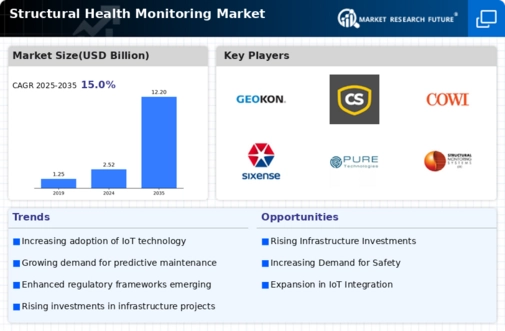
The Global Structural Health Monitoring Market Industry is poised for substantial growth, with projections indicating a market value of 2.52 USD Billion in 2024 and an anticipated increase to 12.2 USD Billion by 2035. This growth trajectory reflects a compound annual growth rate of 15.47% from 2025 to 2035, underscoring the increasing reliance on advanced monitoring technologies. As infrastructure investments rise and safety regulations tighten, the demand for structural health monitoring solutions is expected to escalate, positioning the market for significant expansion in the coming years.

Increasing Infrastructure Investment

The Global Structural Health Monitoring Market Industry is experiencing a surge in demand due to heightened investments in infrastructure development. Governments worldwide are allocating substantial budgets to enhance transportation networks, bridges, and buildings. For instance, the United States has proposed significant funding for infrastructure projects, which is expected to bolster the market. As infrastructure ages, the need for monitoring systems to ensure safety and longevity becomes critical. This trend is projected to contribute to the market's growth, with estimates indicating a market value of 2.52 USD Billion in 2024, potentially escalating to 12.2 USD Billion by 2035.

Rising Awareness of Safety Regulations

The Global Structural Health Monitoring Market Industry is significantly influenced by the increasing awareness of safety regulations and standards. Governments and regulatory bodies are emphasizing the importance of structural integrity to prevent disasters and ensure public safety. This heightened focus leads to the implementation of stringent monitoring protocols across various sectors, including transportation and construction. For instance, the European Union has established guidelines mandating regular inspections and monitoring of critical infrastructure. Such regulatory frameworks are likely to drive demand for structural health monitoring solutions, thereby contributing to the market's expansion.

Growing Urbanization and Population Density

Urbanization and rising population density are pivotal factors propelling the Global Structural Health Monitoring Market Industry. As cities expand and populations grow, the strain on existing infrastructure intensifies, necessitating effective monitoring solutions to ensure structural safety. For example, densely populated urban areas are increasingly adopting monitoring systems to assess the health of bridges and buildings. This trend is expected to escalate the demand for structural health monitoring technologies, as stakeholders seek to mitigate risks associated with aging infrastructure. The market's growth trajectory is likely to reflect these urbanization trends, further emphasizing the need for robust monitoring systems.

Technological Advancements in Monitoring Systems

Technological innovations are driving the Global Structural Health Monitoring Market Industry forward. The integration of advanced sensors, data analytics, and IoT technologies enhances the ability to monitor structural integrity in real-time. For example, the deployment of wireless sensor networks allows for continuous data collection and analysis, leading to timely maintenance decisions. These advancements not only improve safety but also reduce operational costs. As organizations increasingly adopt these technologies, the market is likely to witness a compound annual growth rate of 15.47% from 2025 to 2035, reflecting the growing reliance on sophisticated monitoring solutions.

Environmental Concerns and Sustainability Initiatives

Environmental concerns and sustainability initiatives are shaping the Global Structural Health Monitoring Market Industry. As climate change impacts infrastructure resilience, there is a growing emphasis on sustainable construction practices and materials. Monitoring systems play a crucial role in assessing the performance of eco-friendly structures and ensuring compliance with environmental standards. For instance, green building certifications often require ongoing monitoring to validate sustainability claims. This alignment with environmental goals is likely to drive the adoption of structural health monitoring solutions, fostering market growth as stakeholders prioritize sustainability in their projects.

Market Segment Insights

By Application: Bridges (Largest) vs. Buildings (Fastest-Growing)

<p>In the Structural Health Monitoring market, the application segment showcases a diverse array of key players, with Bridges commanding the largest share due to their critical infrastructure roles. Buildings follow closely, with substantial contributions to market performance and ongoing investments in smart building technologies. Dams, Tunnels, and Airports also play significant roles, but their shares are comparatively smaller, reflecting varying dependency on monitoring solutions across infrastructures. As technology evolves, the demand for advanced monitoring solutions grows. The Buildings segment is emerging rapidly, driven by the integration of IoT and AI, fostering predictive maintenance and safety improvements. Bridges remain vital due to their aging infrastructure requiring constant monitoring, while Airports and Tunnels also witness growing investment as safety and efficiency increasingly take center stage in design and operations.</p>

<p>Bridges (Dominant) vs. Buildings (Emerging)</p>

<p>Bridges stand as the dominant application in the Structural Health Monitoring market due to their essential nature in transport and public safety. As many bridges age, there is a critical need for robust monitoring systems to detect structural anomalies and prevent failures. This segment benefits from established regulatory requirements driving maintenance and monitoring solutions. Conversely, the Buildings segment is emerging, especially in urban centers, where smart technologies are being integrated to enhance energy efficiency and occupant safety. The rise of smart buildings, featuring interconnected sensors and real-time data analytics, positions this segment for rapid growth. Both segments reflect crucial aspects of infrastructure health, with bridges focusing on maintenance and buildings innovating through technology.</p>

By Technology: Fiber Optic Sensors (Largest) vs. Wireless Sensors (Fastest-Growing)

<p>The structural health monitoring market is significantly shaped by various technologies, each contributing uniquely to the overall landscape. Among these, fiber optic sensors hold the largest market share due to their superior accuracy and long-distance monitoring capabilities. Meanwhile, wireless sensors are rapidly gaining traction, driven by their ease of installation and lower maintenance requirements, marking them as a key player in this segment. Growth trends in the structural health monitoring market are primarily influenced by the increasing demand for real-time data collection and analysis. Industry transitions towards smart infrastructure and the growing focus on preventative maintenance have further propelled innovation in technologies like wireless sensors and acoustic emission. The combination of enhanced performance and adaptability ensures that these segments will continue to expand and evolve, catering to a wider range of applications in civil engineering and construction.</p>

<p>Vibration Monitoring (Dominant) vs. Ultrasonic Testing (Emerging)</p>

<p>Vibration monitoring is a dominant technology in the structural health monitoring market, owing to its effectiveness in detecting anomalies in structures before significant failures occur. It provides real-time insights into the state of a structure, allowing for timely interventions. On the other hand, ultrasonic testing is emerging as a valuable technique, particularly for assessing material integrity and detecting flaws not visible to the naked eye. This technology, while still in its growth phase, is being embraced across various sectors for its precision and reliability. The versatility of both technologies ensures they play complementary roles in ensuring the safety and integrity of structural assets, with vibration monitoring currently leading in application and adoption.</p>

By End Use: Civil Engineering (Largest) vs. Transportation (Fastest-Growing)

<p>The Structural Health Monitoring (SHM) market showcases a diverse distribution across various end-use sectors. The Civil Engineering segment stands out as the largest contributor, owing to the increasing focus on infrastructure maintenance and safety. This sector primarily employs SHM technologies to monitor bridges, dams, and buildings, ensuring their longevity and compliance with safety standards. Meanwhile, the Transportation sector is emerging as the fastest-growing area, fueled by advancements in sensor technologies and the rising need for smart transportation systems that can enhance safety and efficiency on roads and railways.</p>

<p>Civil Engineering: Dominant vs. Transportation: Emerging</p>

<p>In the context of the SHM market, Civil Engineering remains the dominant sector, characterized by extensive investments in public infrastructure and an increasing emphasis on structural integrity. Civil engineering applications leverage advanced monitoring tools like strain gauges, accelerometers, and displacement sensors to ensure infrastructure resilience against environmental and human impacts. Conversely, the Transportation sector is on the rise, marked by innovations in vehicle monitoring systems and the integration of SHM into transport networks. This sector seeks to improve safety, reduce maintenance costs, and optimize operational efficiency, making it particularly appealing to stakeholders looking to enhance transport infrastructure sustainability.</p>

By Component: Sensors (Largest) vs. Software (Fastest-Growing)

<p>The Structural Health Monitoring Market is experiencing a diverse distribution of market share across its component segments. Sensors are the largest segment, accounting for a significant portion of the market due to their critical role in monitoring structural integrity. Following this, Software is emerging as a fast-growing segment as organizations increasingly rely on advanced analytics to interpret sensor data for decision-making processes. Data Acquisition Systems, Communication Systems, and Power Supply also contribute to the market but with comparatively lower shares.</p>

<p>Sensors (Dominant) vs. Software (Emerging)</p>

<p>Sensors are the backbone of the Structural Health Monitoring market, offering essential data for assessing the condition of structures. They encompass a wide variety of technologies, including strain gauges and accelerometers, that are crucial for real-time monitoring. In contrast, Software represents an emerging component, facilitating the integration of sensor data into actionable insights through advanced analytics. This segment is gaining traction due to businesses' increasing need for sophisticated tools to process data efficiently and produce reliable predictive maintenance strategies. As more organizations adopt smart technologies, the role of software in enhancing analytical capabilities will significantly expand, leading to sustained growth.</p>

By Monitoring Type: Static Monitoring (Largest) vs. Continuous Monitoring (Fastest-Growing)

<p>The Structural Health Monitoring Market exhibits a diverse segmentation with significant differentiation in market shares between various monitoring types. Static Monitoring has established itself as the largest segment due to its widespread application in assessing the integrity of structures under stationary conditions. Conversely, Continuous Monitoring, which allows for real-time data collection and analysis, is rapidly gaining momentum, becoming the fastest-growing segment as infrastructure and safety requirements evolve.</p>

<p>Static Monitoring (Dominant) vs. Continuous Monitoring (Emerging)</p>

<p>Static Monitoring is characterized by its ability to provide crucial insights into the long-term stability of structures, making it the cornerstone of many traditional assessment methodologies. Often employed in critical infrastructure, it utilizes infrequent measurement techniques to evaluate the behavior of structures over time. In contrast, Continuous Monitoring is revolutionizing the field with its advanced technologies, enabling real-time tracking and dynamic assessments. This segment addresses the growing demand for immediate data response in safety-critical environments, thus positioning itself as an emerging player in the market with immense potential for future growth.</p>

Get more detailed insights about Structural Health Monitoring Market Research Report—Global Forecast till 2035

Regional Insights

North America : Market Leader in Innovation

North America is poised to maintain its leadership in the Structural Health Monitoring (SHM) market, holding a significant share of 1225.0 million in 2024. The region's growth is driven by increasing infrastructure investments, stringent safety regulations, and a rising demand for advanced monitoring technologies. Government initiatives aimed at enhancing public safety and infrastructure resilience further catalyze market expansion. The competitive landscape is robust, with key players such as National Instruments (US), RST Instruments (CA), and GEO-Instruments (US) leading the charge. The presence of innovative companies and a strong focus on R&D contribute to the region's market strength. As infrastructure projects proliferate, the demand for SHM solutions is expected to rise, solidifying North America's position as a market leader.

Europe : Emerging Market with Growth Potential

Europe is witnessing a notable increase in the Structural Health Monitoring market, valued at 675.0 million in 2024. The growth is fueled by stringent EU regulations on infrastructure safety and sustainability, alongside increasing investments in smart city initiatives. The region's commitment to enhancing infrastructure resilience and safety standards is a key driver for SHM adoption. Leading countries such as Germany, the UK, and France are at the forefront of this market, with companies like Keller Group (GB) and COWI (DK) playing pivotal roles. The competitive landscape is characterized by a mix of established firms and innovative startups, fostering a dynamic environment for SHM technologies. As regulatory frameworks evolve, the market is expected to expand significantly, driven by technological advancements and increased awareness of infrastructure health.

Asia-Pacific : Rapidly Growing Market Dynamics

The Asia-Pacific region is emerging as a significant player in the Structural Health Monitoring market, with a valuation of 400.0 million in 2024. The growth is driven by rapid urbanization, increasing infrastructure development, and a heightened focus on safety standards. Governments are investing heavily in infrastructure projects, which is expected to boost the demand for SHM solutions across various sectors. Countries like China, Japan, and India are leading the charge, with a growing number of local and international players entering the market. Companies such as VibroSense (SE) and Senceive (GB) are expanding their presence in the region. The competitive landscape is evolving, with a focus on innovative technologies and solutions tailored to local needs, positioning Asia-Pacific for substantial growth in the SHM sector.

Middle East and Africa : Emerging Market with Untapped Potential

The Middle East and Africa (MEA) region is gradually emerging in the Structural Health Monitoring market, currently valued at 150.0 million in 2024. The growth is primarily driven by increasing investments in infrastructure development and a growing awareness of the importance of safety monitoring. Governments are prioritizing infrastructure projects, which is expected to create demand for SHM solutions in the coming years. Countries like the UAE and South Africa are leading the way, with a focus on modernizing infrastructure and enhancing safety standards. The competitive landscape is still developing, with opportunities for both local and international players to establish a foothold. As the region continues to invest in infrastructure, the SHM market is poised for growth, driven by technological advancements and regulatory support.

Key Players and Competitive Insights

The Structural Health Monitoring Market is currently characterized by a dynamic competitive landscape, driven by the increasing demand for infrastructure safety and longevity. Key players are actively engaging in strategies that emphasize innovation, regional expansion, and partnerships to enhance their market positioning. For instance, Geosense (GB) has focused on integrating advanced sensor technologies into their monitoring solutions, which appears to be a response to the growing need for real-time data analytics in infrastructure management. Similarly, Keller Group (GB) has been pursuing strategic partnerships with technology firms to bolster its service offerings, thereby enhancing its competitive edge in the market.

The market structure is moderately fragmented, with several players vying for market share through localized manufacturing and optimized supply chains. This fragmentation allows for a diverse range of solutions tailored to specific regional needs, which may enhance customer satisfaction and loyalty. The collective influence of these key players is significant, as they not only drive innovation but also set industry standards that others may follow.

In November 2025, VibroSense (SE) announced the launch of a new line of wireless monitoring devices designed for harsh environmental conditions. This strategic move is likely to expand their market reach, particularly in sectors such as mining and construction, where traditional monitoring solutions may fall short. The introduction of these devices could position VibroSense as a leader in specialized monitoring solutions, catering to niche markets that require robust and reliable technology.

In October 2025, RST Instruments (CA) entered into a collaboration with a leading software company to develop an integrated platform for data visualization and analysis. This partnership is expected to enhance RST's product offerings by providing clients with more comprehensive insights into structural health, thereby improving decision-making processes. The integration of software solutions with hardware monitoring systems may represent a significant trend in the market, as companies seek to provide holistic solutions to their customers.

In September 2025, OptaSense (GB) secured a major contract for the deployment of its fiber-optic monitoring technology in a large-scale infrastructure project. This contract not only underscores the growing acceptance of fiber-optic solutions in the market but also highlights OptaSense's strategic focus on large infrastructure projects, which could lead to increased revenue streams. Such contracts may also enhance the company's reputation as a reliable provider of advanced monitoring technologies.

As of December 2025, the competitive trends in the Structural Health Monitoring Market are increasingly defined by digitalization, sustainability, and the integration of AI technologies. Strategic alliances are becoming more prevalent, as companies recognize the need to combine expertise to deliver comprehensive solutions. The shift from price-based competition to a focus on innovation and technology is evident, suggesting that future competitive differentiation will hinge on the ability to provide reliable, cutting-edge solutions that meet the evolving needs of the market.

Key Companies in the Structural Health Monitoring Market market include

Industry Developments

Future Outlook

Structural Health Monitoring Market Future Outlook

<p>The Structural Health Monitoring Market is projected to grow at a 15.05% CAGR from 2024 to 2035, driven by technological advancements, increased infrastructure investments, and heightened safety regulations.</p>

New opportunities lie in:

  • <p>Integration of AI-driven predictive analytics for real-time monitoring solutions.</p>
  • <p>Development of portable monitoring devices for remote infrastructure assessment.</p>
  • <p>Expansion into emerging markets with tailored monitoring solutions for local needs.</p>

<p>By 2035, the market is expected to be robust, driven by innovation and strategic investments.</p>

Market Segmentation

Structural Health Monitoring Market End Use Outlook

  • Civil Engineering
  • Transportation
  • Energy
  • Aerospace
  • Marine

Structural Health Monitoring Market Component Outlook

  • Sensors
  • Data Acquisition Systems
  • Software
  • Communication Systems
  • Power Supply

Structural Health Monitoring Market Technology Outlook

  • Fiber Optic Sensors
  • Wireless Sensors
  • Ultrasonic Testing
  • Vibration Monitoring
  • Acoustic Emission

Structural Health Monitoring Market Application Outlook

  • Bridges
  • Buildings
  • Dams
  • Tunnels
  • Airports

Structural Health Monitoring Market Monitoring Type Outlook

  • Static Monitoring
  • Dynamic Monitoring
  • Continuous Monitoring
  • Periodic Monitoring
  • Remote Monitoring

Report Scope

MARKET SIZE 20242450.0(USD Million)
MARKET SIZE 20252770.0(USD Million)
MARKET SIZE 203511280.0(USD Million)
COMPOUND ANNUAL GROWTH RATE (CAGR)15.05% (2024 - 2035)
REPORT COVERAGERevenue Forecast, Competitive Landscape, Growth Factors, and Trends
BASE YEAR2024
Market Forecast Period2025 - 2035
Historical Data2019 - 2024
Market Forecast UnitsUSD Million
Key Companies ProfiledGeosense (GB), Keller Group (GB), VibroSense (SE), RST Instruments (CA), OptaSense (GB), National Instruments (US), GEO-Instruments (US), Senceive (GB), COWI (DK)
Segments CoveredApplication, Technology, End Use, Component, Monitoring Type
Key Market OpportunitiesIntegration of advanced sensor technologies enhances data accuracy in the Structural Health Monitoring Market.
Key Market DynamicsRising demand for advanced sensors drives innovation and competition in the Structural Health Monitoring Market.
Countries CoveredNorth America, Europe, APAC, South America, MEA

FAQs

What is the study period of this market?

The study period of global Structural Health Monitoring market is 2023 - 2032.

What is the growth rate of global Structural Health Monitoring market?

The global Structural Health Monitoring market is growing at a CAGR of 15% over the next 9 years

Which region has highest growth rate in global Structural Health Monitoring market?

Asia Pacific is expected register the highest CAGR during 2023 - 2032

Which region has largest share in global Structural Health Monitoring market?

North America held the largest share in 2021

Who are the key players in global Structural Health Monitoring market?

Nova Metrix LLC, Geokon, Campbell Scientific, COWI, Geocomp, Acellent Technologies, Sixense, Pure Technologies, Structural Monitoring Systems, SGS, and Digi-Texx are the major companies operating in the global Structural Health Monitoring market.

  1. EXECUTIVE SUMMARY
  2. MARKET INTRODUCTION
    1. Market Definition
    2. Scope of the Study
      1. Research Objectives
      2. Assumptions
    3. & Limitations
    4. Market Structure
  3. MARKET RESEARCH METHODOLOGY
    1. Research Process
    2. Secondary Research
    3. Primary Research
    4. Forecast Model
  4. MARKET LANDSCAPE
    1. Supply Chain Analysis
      1. Raw Technology Suppliers
      2. Manufacturers/Producers
      3. Distributors,
      4. End-users
    2. Retailers, and Wholesalers
    3. Porter’s Five Forces Analysis
      1. Threat of New Entrants
      2. Bargaining Power of Buyers
      3. Bargaining Power of Suppliers
      4. Threat of Substitutes
      5. Internal Rivalry
    4. Impact of COVID-19
    5. on Global Structural Health Monitoring Market
  5. MARKET DYNAMICS OF THE GLOBAL STRUCTURAL HEALTH
  6. MONITORING MARKET
    1. Introduction
    2. Drivers
    3. Restraints
    4. Opportunities
    5. Challenges
  7. GLOBAL STRUCTURAL HEALTH MONITORING MARKET, BY OFFERING
    1. Introduction
    2. Hardware
      1. Market Estimates & Forecast, 2020-2030
      2. Market Estimates
    3. & Forecast, by region, 2020-2030
    4. Software & Services
      1. Market Estimates & Forecast, 2020-2030
      2. Market Estimates
    5. & Forecast, by Region, 2020-2030
  8. GLOBAL STRUCTURAL HEALTH MONITORING MARKET, BY TECHNOLOGY
    1. Introduction
    2. Wired
      1. Market Estimates
      2. Market Estimates & Forecast, by Region, 2020-2030
    3. & Forecast, 2020-2030
    4. Wireless
      1. Market Estimates
      2. Market Estimates & Forecast, by Region, 2020-2030
    5. & Forecast, 2020-2030
  9. GLOBAL STRUCTURAL
  10. HEALTH MONITORING MARKET, BY END-USE
    1. Introduction
    2. Civil Infrastructure
      1. Market Estimates & Forecast, 2020-2030
      2. Market Estimates
    3. & Forecast, by Region, 2020-2030
    4. Aerospace & Defense
      1. Market Estimates & Forecast, 2020-2030
      2. Market Estimates
    5. & Forecast, by Region, 2020-2030
    6. Energy
      1. Market Estimates & Forecast, 2020-2030
      2. Market Estimates
    7. & Forecast, by Region, 2020-2030
    8. Mining
      1. Market Estimates & Forecast, 2020-2030
      2. Market Estimates
    9. & Forecast, by Region, 2020-2030
    10. Others
      1. Market Estimates & Forecast, 2020-2030
      2. Market Estimates
    11. & Forecast, by Region, 2020-2030
  11. GLOBAL STRUCTURAL HEALTH MONITORING MARKET, BY REGION
    1. Introduction
    2. North America
      1. Market Estimates
      2. Market Estimates & Forecast, by Offering, 2020-2030
      3. Market Estimates
      4. Market Estimates & Forecast, by End-use, 2020-2030
      5. Market Estimates
      6. US
      7. Canada
    3. & Forecast, 2020-2030
    4. & Forecast, by Technology, 2020-2030
    5. & Forecast, by Country, 2020-2030
    6. & Forecast, by Technology, 2020-2030
    7. & Forecast, by Offering, 2020-2030
  12. Market Estimates & Forecast, by End-use, 2020-2030
    1. Europe
      1. Market Estimates & Forecast, 2020-2030
      2. Market Estimates
      3. Market Estimates & Forecast, by Technology, 2020-2030
      4. Market Estimates
      5. Market Estimates & Forecast, by Country, 2020-2030
      6. Germany
    2. & Forecast, by Offering, 2020-2030
    3. & Forecast, by End-use, 2020-2030
    4. & Forecast, by Offering, 2020-2030
  13. Market Estimates & Forecast, by End-use, 2020-2030
    1. & Forecast, by Technology, 2020-2030
    2. & Forecast, by Offering, 2020-2030
  14. UK
  15. Market Estimates & Forecast, by Offering, 2020-2030
  16. Market Estimates
  17. Market Estimates & Forecast, by End-use, 2020-2030
  18. France
  19. Market Estimates
  20. Market Estimates & Forecast, by Technology,
  21. Market Estimates & Forecast, by End-use, 2020-2030
  22. Spain
  23. Market Estimates & Forecast, by Offering,
  24. Market Estimates & Forecast, by Technology, 2020-2030
    1. Italy
  25. Market Estimates & Forecast, by End-use,
  26. Market Estimates & Forecast, by Offering, 2020-2030
  27. Market Estimates & Forecast, by Technology,
  28. Market Estimates & Forecast, by End-use, 2020-2030
  29. Rest of Europe
  30. Market Estimates & Forecast, by Offering,
  31. Market Estimates & Forecast, by Technology, 2020-2030
    1. Asia-Pacific
    2. Market Estimates & Forecast, 2020-2030
  32. Market Estimates & Forecast, by End-use,
  33. Market Estimates & Forecast, by Offering,
  34. Market Estimates & Forecast, by Technology, 2020-2030
  35. Market Estimates & Forecast, by End-use,
  36. Market Estimates & Forecast, by Country, 2020-2030
  37. China
  38. Market Estimates & Forecast, by Offering,
  39. Market Estimates & Forecast, by Technology, 2020-2030
    1. Japan
  40. Market Estimates & Forecast, by End-use,
  41. Market Estimates & Forecast, by Offering, 2020-2030
  42. Market Estimates & Forecast, by Technology,
  43. Market Estimates & Forecast, by End-use, 2020-2030
  44. India
  45. Market Estimates & Forecast, by Offering,
  46. Market Estimates & Forecast, by Technology, 2020-2030
    1. Australia & New Zealand
    2. & Forecast, by Technology, 2020-2030
    3. & Forecast, by Offering, 2020-2030
  47. Market Estimates & Forecast, by End-use,
  48. Market Estimates & Forecast, by Offering, 2020-2030
  49. Market Estimates
  50. Market Estimates & Forecast, by End-use, 2020-2030
  51. Rest of Asia-Pacific
  52. Market Estimates
  53. Market Estimates & Forecast, by Technology,
  54. Market Estimates & Forecast, by End-use, 2020-2030
    1. Rest of the World
      1. Market Estimates & Forecast, 2020-2030
      2. Market Estimates
      3. Market Estimates & Forecast, by Technology, 2020-2030
      4. Market Estimates
      5. Market Estimates & Forecast, by Region, 2020-2030
      6. South America
    2. & Forecast, by Offering, 2020-2030
    3. & Forecast, by End-use, 2020-2030
    4. & Forecast, by Offering, 2020-2030
  55. Market Estimates & Forecast, by End-use, 2020-2030
  56. Middle East
  57. Market Estimates & Forecast, by Offering,
  58. Market Estimates & Forecast, by Technology, 2020-2030
    1. Africa
  59. Market Estimates & Forecast, by End-use,
  60. Market Estimates & Forecast, by Offering, 2020-2030
  61. Market Estimates & Forecast, by Technology,
  62. Market Estimates & Forecast, by End-use, 2020-2030
  63. COMPETITIVE LANDSCAPE
    1. Introduction
    2. Market Strategy
    3. Key Development Analysis
    4. (Expansions/Mergers & Acquisitions/Joint
    5. Ventures/New Service Developments/Agreements/Investments)
  64. COMPANY PROFILES
    1. Nova Metrix LLC
      1. Company Overview
      2. Financial Updates
      3. Business Segment Overview
      4. Strategies
      5. Key Developments
      6. SWOT Analysis
    2. Geokon
      1. Company Overview
      2. Financial Updates
      3. Business Segment
      4. Strategies
      5. Key Developments
      6. SWOT Analysis
    3. Overview
    4. Strategies
    5. Key Developments
    6. SWOT Analysis
    7. Campbell Scientific
    8. Company Overview
    9. Financial Updates
    10. Business Segment Overview
    11. COWI
      1. Company Overview
      2. Financial Updates
      3. Business Segment Overview
      4. Strategies
      5. Key Developments
      6. SWOT Analysis
    12. Geocomp
      1. Company Overview
      2. Financial Updates
      3. Business Segment
      4. Strategies
      5. Key Developments
      6. SWOT Analysis
    13. Overview
    14. Strategies
    15. Key Developments
    16. SWOT Analysis
    17. Acellent Technologies
    18. Company Overview
    19. Financial Updates
    20. Business Segment Overview
    21. Sixense
      1. Company Overview
      2. Financial Updates
      3. Business Segment Overview
      4. Strategies
      5. Key Developments
      6. SWOT Analysis
    22. Pure Technologies
      1. Company Overview
      2. Financial Updates
      3. Business Segment
      4. Company Overview
      5. Financial Updates
      6. Business Segment Overview
      7. Strategies
      8. Key Developments
      9. SWOT Analysis
    23. Overview
    24. Strategies
    25. Key Developments
    26. SWOT Analysis
    27. Structural Monitoring Systems
    28. SGS
      1. Company Overview
      2. Financial Updates
      3. Business Segment
      4. Strategies
      5. Key Developments
      6. SWOT Analysis
    29. Overview
    30. Strategies
    31. Key Developments
    32. SWOT Analysis
    33. Digitexx
    34. Company Overview
    35. Financial Updates
    36. Business Segment Overview
  65. CONCLUSION
  66. LIST OF TABLES
  67. Global Structural Health Monitoring Market,
    1. by Region, 2020-2030 (USD Million)
  68. Global Structural Health Monitoring Market, by Offering,
  69. Global Structural Health Monitoring Market, by Technology,
  70. Global Structural Health Monitoring Market, by End-use, 2020-2030
    1. (USD Million)
    2. TABLE
  71. North America: Structural Health Monitoring Market, by Country, 2020-2030 (USD
    1. Million)
    2. TABLE
  72. North America: Structural Health Monitoring Market, by Offering, 2020-2030 (USD
    1. Million)
    2. TABLE
  73. North America: Structural Health Monitoring Market, by Technology, 2020-2030 (USD
    1. Million)
    2. TABLE
  74. North America: Structural Health Monitoring Market, by End-use, 2020-2030 (USD
    1. Million)
    2. TABLE
  75. US: Structural Health Monitoring Market, by Offering, 2020-2030 (USD Million)
  76. US:
  77. Structural Health Monitoring Market, by Technology, 2020-2030 (USD Million)
  78. US: Structural
  79. Health Monitoring Market, by End-use, 2020-2030 (USD Million)
  80. Canada: Structural Health
  81. Monitoring Market, by Offering, 2020-2030 (USD Million)
  82. Canada: Structural Health Monitoring Market,
    1. by Technology, 2020-2030 (USD Million)
  83. Canada: Structural Health Monitoring Market, by
    1. End-use, 2020-2030 (USD Million)
  84. Europe: Structural Health Monitoring Market, by Country, 2020-2030
    1. (USD Million)
    2. TABLE
  85. Europe: Structural Health Monitoring Market, by Offering, 2020-2030 (USD Million)
  86. Europe: Structural
  87. Health Monitoring Market, by Technology, 2020-2030 (USD Million)
  88. Europe: Structural Health
  89. Monitoring Market, by End-use, 2020-2030 (USD Million)
  90. Germany: Structural Health Monitoring Market,
    1. by Offering, 2020-2030 (USD Million)
  91. Germany: Structural Health Monitoring Market, by
    1. Technology, 2020-2030 (USD Million)
  92. Germany: Structural Health Monitoring Market, by
    1. End-use, 2020-2030 (USD Million)
  93. France: Structural Health Monitoring Market, by Offering,
  94. France: Structural Health Monitoring Market, by Technology,
  95. France: Structural Health Monitoring Market, by End-use, 2020-2030
    1. (USD Million)
    2. TABLE
  96. Italy: Structural Health Monitoring Market, by Offering, 2020-2030 (USD Million)
  97. Italy:
  98. Structural Health Monitoring Market, by Technology, 2020-2030 (USD Million)\
  99. Italy: Structural
  100. Health Monitoring Market, by End-use, 2020-2030 (USD Million)
  101. Spain: Structural Health
  102. Monitoring Market, by Offering, 2020-2030 (USD Million)
  103. Spain: Structural Health Monitoring Market,
    1. by Technology, 2020-2030 (USD Million)
  104. Spain: Structural Health Monitoring Market, by
    1. End-use, 2020-2030 (USD Million)
  105. UK: Structural Health Monitoring Market, by Offering, 2020-2030
    1. (USD Million)
    2. TABLE
  106. UK: Structural Health Monitoring Market, by Technology, 2020-2030 (USD Million)
  107. UK: Structural
  108. Health Monitoring Market, by End-use, 2020-2030 (USD Million)
  109. Rest of Europe: Structural
  110. Health Monitoring Market, by Offering, 2020-2030 (USD Million)
  111. Rest of Europe: Structural
  112. Health Monitoring Market, by Technology, 2020-2030 (USD Million)
  113. Rest of Europe: Structural
  114. Health Monitoring Market, by End-use, 2020-2030 (USD Million)
  115. Asia-Pacific: Structural
  116. Health Monitoring Market, by Country, 2020-2030 (USD Million)
  117. Asia-Pacific: Structural
  118. Health Monitoring Market, by Offering, 2020-2030 (USD Million)
  119. Asia-Pacific: Structural
  120. Health Monitoring Market, by Technology, 2020-2030 (USD Million)
  121. Asia-Pacific: Structural
  122. Health Monitoring Market, by End-use, 2020-2030 (USD Million)
  123. China: Structural Health
  124. Monitoring Market, by Offering, 2020-2030 (USD Million)
  125. China: Structural Health Monitoring Market,
    1. by Technology, 2020-2030 (USD Million)
  126. China: Structural Health Monitoring Market, by
    1. End-use, 2020-2030 (USD Million)
  127. India: Structural Health Monitoring Market, by Offering, 2020-2030
    1. (USD Million)
    2. TABLE
  128. India: Structural Health Monitoring Market, by Technology, 2020-2030 (USD Million)
  129. India:
  130. Structural Health Monitoring Market, by End-use, 2020-2030 (USD Million)
  131. Japan: Structural
  132. Health Monitoring Market, by Offering, 2020-2030 (USD Million)
  133. Japan: Structural Health
  134. Monitoring Market, by Technology, 2020-2030 (USD Million)
  135. Japan: Structural Health Monitoring Market,
    1. by End-use, 2020-2030 (USD Million)
  136. Australia & New Zealand: Structural Health
  137. Monitoring Market, by Offering, 2020-2030 (USD Million)
  138. Australia & New Zealand: Structural
  139. Health Monitoring Market, by Technology, 2020-2030 (USD Million)
  140. Australia & New
  141. Zealand: Structural Health Monitoring Market, by End-use, 2020-2030 (USD Million)
  142. Rest
  143. of Asia-Pacific: Structural Health Monitoring Market, by Offering, 2020-2030 (USD
    1. Million)
    2. TABLE
  144. Rest of Asia-Pacific: Structural Health Monitoring Market, by Technology, 2020-2030
    1. (USD Million)
    2. TABLE
  145. Rest of Asia-Pacific: Structural Health Monitoring Market, by End-use, 2020-2030
    1. (USD Million)
    2. TABLE
  146. Rest of the World (RoW): Structural Health Monitoring Market, by Region, 2020-2030
    1. (USD Million)
    2. TABLE
  147. Rest of the World (RoW): Structural Health Monitoring Market, by Offering, 2020-2030
    1. (USD Million)
    2. TABLE
  148. Rest of the World (RoW): Structural Health Monitoring Market, by Technology,
  149. Rest of the World (RoW): Structural Health Monitoring Market,
    1. by End-use, 2020-2030 (USD Million)
  150. South America: Structural Health Monitoring Market,
    1. by Offering, 2020-2030 (USD Million)
  151. South America: Structural Health Monitoring Market,
    1. by Technology, 2020-2030 (USD Million)
  152. South America: Structural Health Monitoring Market,
    1. by End-use, 2020-2030 (USD Million)
  153. Middle East: Structural Health Monitoring Market,
    1. by Offering, 2020-2030 (USD Million)
  154. Middle East: Structural Health Monitoring Market,
    1. by Technology, 2020-2030 (USD Million)
  155. Middle East: Structural Health Monitoring Market,
    1. by End-use, 2020-2030 (USD Million)
  156. Africa: Structural Health Monitoring Market, by
    1. Offering, 2020-2030 (USD Million)
  157. Africa: Structural Health Monitoring Market, by
    1. Technology, 2020-2030 (USD Million)
  158. Africa: Structural Health Monitoring Market, by
    1. End-use, 2020-2030 (USD Million)
  159. LIST OF FIGURES
  160. Global Structural Health
    1. Monitoring Market Segmentation
  161. Research Methodology
  162. Five Forces Analysis of the Global Structural
    1. Health Monitoring Market
  163. Value Chain of the Global Structural Health Monitoring Market
  164. Share of the
  165. Global Structural Health Monitoring Market in 2021, by Country (%)
  166. Global Structural Health
  167. Monitoring Market, by Region, 2020-2030
  168. Global Structural Health Monitoring Market Share,
    1. by Offering, 2021 (%)
    2. FIGURE
  169. Global Structural Health Monitoring Market, by Offering, 2020-2030
  170. Global Structural Health
  171. Monitoring Market Share, by Technology, 2021 (%)
  172. Global Structural Health Monitoring Market,
    1. by Technology, 2020-2030
  173. Global Structural Health Monitoring Market Share, by End-use,
    1. FIGURE
  174. Global Structural Health Monitoring Market, by End-use, 2020-2030

Structural Health Monitoring Market Segmentation

Market Segmentation Overview

  • Detailed segmentation data will be available in the full report
  • Comprehensive analysis by multiple parameters
  • Regional and country-level breakdowns
  • Market size forecasts by segment
Infographic

Free Sample Request

Kindly complete the form below to receive a free sample of this Report

Get Free Sample

Customer Strories

Compare Licence

×
Features License Type
Single User Multiuser License Enterprise User
Price $4,950 $5,950 $7,250
Maximum User Access Limit 1 User Upto 10 Users Unrestricted Access Throughout the Organization
Free Customization
Direct Access to Analyst
Deliverable Format
Platform Access
Discount on Next Purchase 10% 15% 15%
Printable Versions