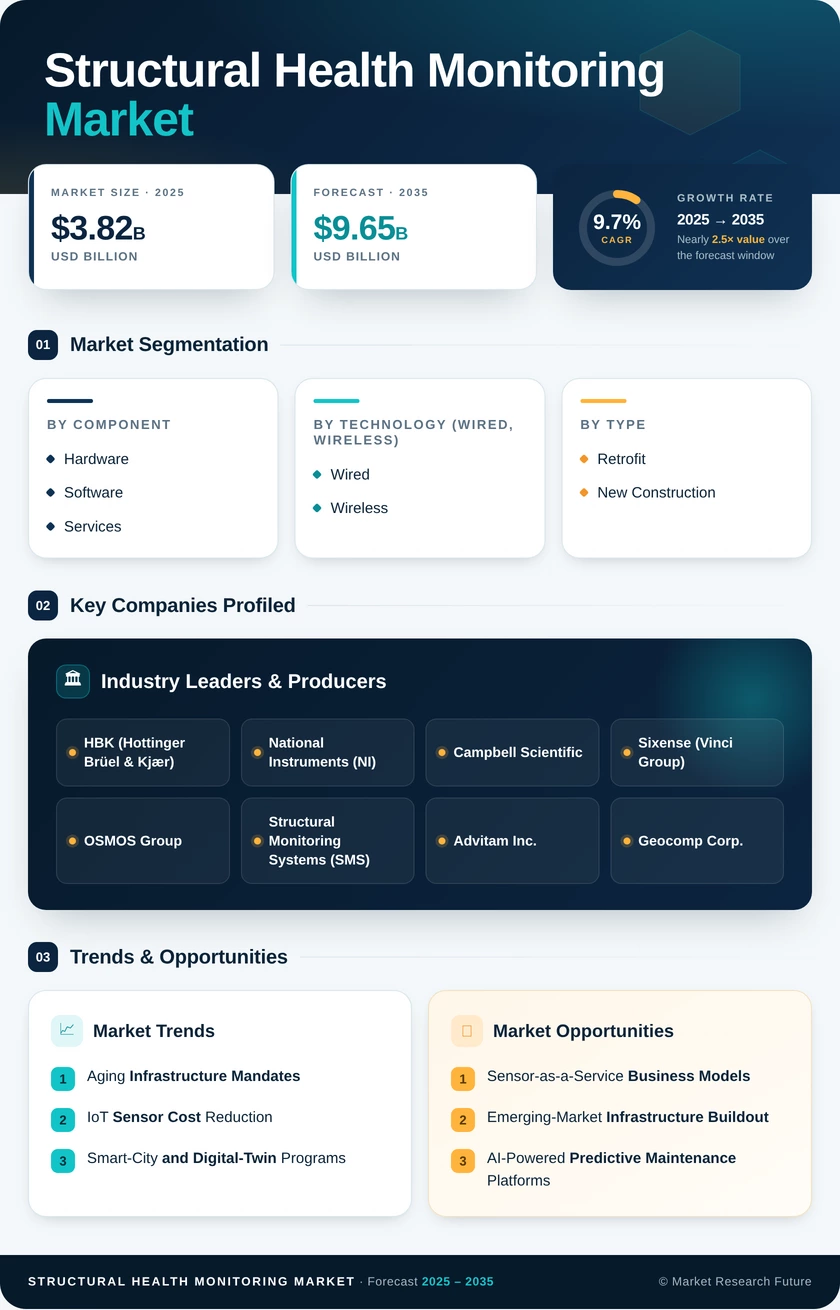
Structural Health Monitoring Market

ID: MRFR/ICT/9371-HCR
100 Pages
Nirmit Biswas
Last Updated: June 22, 2026
Structural Health Monitoring Market Size, Share and Research Report By Component (Hardware, Software, Services), By Technology (Wired, Wireless), By Installation Type (Retrofit, New Construction), By Monitoring Frequency (Continuous Monitoring, Periodic Monitoring), By End-Use Industry (Civil Infrastructure, Energy & Power, Dams & Waterways, Aerospace & Defense, Mining & Industrial, Others) and By Region (North America, Europe, South America, Asia Pacific, Middle East and Africa) - Industry Forecast to 2035.
Download PDF ×

We do not share your information with anyone. However, we may send you emails based on your report interest from time to time. You may contact us at any time to opt-out.

  1. 1 Market Overview |
    1. 1.1 Study Assumptions & Market Definition |
    2. 1.2 Scope of the Study |
    3. 1.3 Research Methodology
  2. 2 Market Summary & Key Takeaways
  3. 3 Market Dynamics |
    1. 3.1 Market Drivers Analysis | |
      1. 3.1.1 Aging Infrastructure Mandates | |
      2. 3.1.2 IoT Sensor Cost Reduction | |
      3. 3.1.3 Smart-City & Digital-Twin Programs | |
      4. 3.1.4 Insurance Premium Incentives | |
      5. 3.1.5 Climate-Resilience Retrofits | |
      6. 3.1.6 AI-Driven Predictive Analytics | |
      7. 3.1.7 Energy-Sector Asset-Life Extension |
    2. 3.2 Market Restraints Analysis | |
      1. 3.2.1 High Upfront Deployment Costs | |
      2. 3.2.2 Data Interoperability Fragmentation | |
      3. 3.2.3 Skilled-Workforce Shortage | |
      4. 3.2.4 Cybersecurity Risks for Sensor Networks | |
      5. 3.2.5 Regulatory Inconsistency Across Jurisdictions |
    3. 3.3 Market Opportunity Analysis | |
      1. 3.3.1 Sensor-as-a-Service Business Models | |
      2. 3.3.2 Emerging-Market Infrastructure Buildout | |
      3. 3.3.3 AI-Powered Predictive Maintenance Platforms | |
      4. 3.3.4 Data Monetization and Insurance Integration | |
      5. 3.3.5 Offshore Energy and Wind-Turbine Monitoring |
    4. 3.4 Industry Value Chain Analysis |
    5. 3.5 Porter's Five Forces Analysis
  4. 4 Global Structural Health Monitoring Market Size & Forecast (2021–2035) |
    1. 4.1 Historical Market Size (2021–2025) |
    2. 4.2 Current & Forecast Market Size (2026–2035) |
    3. 4.3 Market Size by Revenue (USD Billion) |
    4. 4.4 Year-over-Year Growth Analysis
  5. 5 Segmentation Analysis |
    1. 5.1 By Component | |
      1. 5.1.1 Hardware | |
      2. 5.1.2 Software | |
      3. 5.1.3 Services |
    2. 5.2 By Technology | |
      1. 5.2.1 Wired | |
      2. 5.2.2 Wireless |
    3. 5.3 By Installation Type | |
      1. 5.3.1 Retrofit | |
      2. 5.3.2 New Construction |
    4. 5.4 By Monitoring Frequency | |
      1. 5.4.1 Continuous Monitoring | |
      2. 5.4.2 Periodic Monitoring |
    5. 5.5 By End-Use Industry | |
      1. 5.5.1 Civil Infrastructure | |
      2. 5.5.2 Energy & Power | |
      3. 5.5.3 Dams & Waterways | |
      4. 5.5.4 Aerospace & Defense | |
      5. 5.5.5 Mining & Industrial | |
      6. 5.5.6 Others
  6. 6 Regional Analysis |
    1. 6.1 North America | |
      1. 6.1.1 United States | |
      2. 6.1.2 Canada | |
      3. 6.1.3 Mexico |
    2. 6.2 Europe | |
      1. 6.2.1 Germany | |
      2. 6.2.2 United Kingdom | |
      3. 6.2.3 France | |
      4. 6.2.4 Italy | |
      5. 6.2.5 Spain | |
      6. 6.2.6 Nordic Countries | |
      7. 6.2.7 Russia | |
      8. 6.2.8 Rest of Europe |
    3. 6.3 Asia-Pacific | |
      1. 6.3.1 China | |
      2. 6.3.2 India | |
      3. 6.3.3 Japan | |
      4. 6.3.4 South Korea | |
      5. 6.3.5 ASEAN | |
      6. 6.3.6 Rest of Asia-Pacific |
    4. 6.4 South America | |
      1. 6.4.1 Brazil | |
      2. 6.4.2 Argentina | |
      3. 6.4.3 Rest of South America |
    5. 6.5 Middle East & Africa | |
      1. 6.5.1 Saudi Arabia | |
      2. 6.5.2 UAE | |
      3. 6.5.3 South Africa | |
      4. 6.5.4 Egypt | |
      5. 6.5.5 Rest of MEA
  7. 7 Competitive Landscape |
    1. 7.1 Market Share Analysis (2025) |
    2. 7.2 Competitive Benchmarking Matrix |
    3. 7.3 Company Profiles | |
      1. 7.3.1 HBK (Hottinger Brüel & Kjær) | |
      2. 7.3.2 National Instruments (NI) | |
      3. 7.3.3 Campbell Scientific | |
      4. 7.3.4 Sixense (Vinci Group) | |
      5. 7.3.5 OSMOS Group | |
      6. 7.3.6 Structural Monitoring Systems (SMS) | |
      7. 7.3.7 Advitam Inc. | |
      8. 7.3.8 Geocomp Corp. | |
      9. 7.3.9 Acellent Technologies | |
      10. 7.3.10 Digitexx Data Systems
  8. 8 Future Outlook & Strategic Recommendations (2026–2035) |
    1. 8.1 AI-Autonomous Inspection Systems |
    2. 8.2 Platform Economics and Vendor Consolidation |
    3. 8.3 Sustainability and ESG Reporting Requirements |
    4. 8.4 Electrification and Energy-Transition Infrastructure
  9. 9 Recent Developments & News
  10. 10 Frequently Asked Questions (FAQs)
  11. 11 Report Scope & Methodology |
    1. 11.1 Study Period & Base Year |
    2. 11.2 Data Sources & Citations |
    3. 11.3 Abbreviations
  12. 12 LIST OF TABLES |
  13. TABLE 1 Global Structural Health Monitoring Market Size & Forecast, by Revenue (USD Billion), 2021–2035 |
  14. TABLE 2 Global Structural Health Monitoring Market – Year-over-Year Growth Analysis, 2021–2035 |
  15. TABLE 3 Global Structural Health Monitoring Market – Driver Impact Analysis |
  16. TABLE 4 Global Structural Health Monitoring Market – Restraint Impact Analysis |
  17. TABLE 5 Global Structural Health Monitoring Market Size, by Component, 2021–2035 (USD Billion) |
  18. TABLE 6 Global Structural Health Monitoring Market Size, by Technology, 2021–2035 (USD Billion) |
  19. TABLE 7 Global Structural Health Monitoring Market Size, by Installation Type, 2021–2035 (USD Billion) |
  20. TABLE 8 Global Structural Health Monitoring Market Size, by Monitoring Frequency, 2021–2035 (USD Billion) |
  21. TABLE 9 Global Structural Health Monitoring Market Size, by End-Use Industry, 2021–2035 (USD Billion) |
  22. TABLE 10 Global Structural Health Monitoring Market Size, by Region, 2021–2035 (USD Billion) |
  23. TABLE 11 North America Structural Health Monitoring Market Size, by Country, 2021–2035 (USD Billion) |
  24. TABLE 12 Europe Structural Health Monitoring Market Size, by Country, 2021–2035 (USD Billion) |
  25. TABLE 13 Asia-Pacific Structural Health Monitoring Market Size, by Country, 2021–2035 (USD Billion) |
  26. TABLE 14 South America Structural Health Monitoring Market Size, by Country, 2021–2035 (USD Billion) |
  27. TABLE 15 Middle East & Africa Structural Health Monitoring Market Size, by Country, 2021–2035 (USD Billion) |
  28. TABLE 16 Competitive Benchmarking Matrix – Global Structural Health Monitoring Market, 2025 |
  29. TABLE 17 Company Profiles – Key Players, Global Structural Health Monitoring Market |
  30. TABLE 18 Recent Developments & Strategic Announcements, 2023–2025 |
  31. TABLE 19 Report Scope & Methodology Summary |
  32. TABLE 20 Detailed Sources and Citations |
  33. TABLE 21 North America Structural Health Monitoring Market Size, by Component, 2021–2035 (USD Billion) |
  34. TABLE 22 North America Structural Health Monitoring Market Size, by Technology, 2021–2035 (USD Billion) |
  35. TABLE 23 North America Structural Health Monitoring Market Size, by Installation Type, 2021–2035 (USD Billion) |
  36. TABLE 24 North America Structural Health Monitoring Market Size, by End-Use Industry, 2021–2035 (USD Billion) |
  37. TABLE 25 Europe Structural Health Monitoring Market Size, by Component, 2021–2035 (USD Billion) |
  38. TABLE 26 Europe Structural Health Monitoring Market Size, by Technology, 2021–2035 (USD Billion) |
  39. TABLE 27 Europe Structural Health Monitoring Market Size, by Installation Type, 2021–2035 (USD Billion) |
  40. TABLE 28 Europe Structural Health Monitoring Market Size, by End-Use Industry, 2021–2035 (USD Billion) |
  41. TABLE 29 Asia-Pacific Structural Health Monitoring Market Size, by Component, 2021–2035 (USD Billion) |
  42. TABLE 30 Asia-Pacific Structural Health Monitoring Market Size, by Technology, 2021–2035 (USD Billion) |
  43. TABLE 31 Asia-Pacific Structural Health Monitoring Market Size, by Installation Type, 2021–2035 (USD Billion) |
  44. TABLE 32 Asia-Pacific Structural Health Monitoring Market Size, by End-Use Industry, 2021–2035 (USD Billion) |
  45. TABLE 33 South America Structural Health Monitoring Market Size, by Component, 2021–2035 (USD Billion) |
  46. TABLE 34 South America Structural Health Monitoring Market Size, by Technology, 2021–2035 (USD Billion) |
  47. TABLE 35 South America Structural Health Monitoring Market Size, by Installation Type, 2021–2035 (USD Billion) |
  48. TABLE 36 South America Structural Health Monitoring Market Size, by End-Use Industry, 2021–2035 (USD Billion) |
  49. TABLE 37 Middle East & Africa Structural Health Monitoring Market Size, by Component, 2021–2035 (USD Billion) |
  50. TABLE 38 Middle East & Africa Structural Health Monitoring Market Size, by Technology, 2021–2035 (USD Billion) |
  51. TABLE 39 Middle East & Africa Structural Health Monitoring Market Size, by Installation Type, 2021–2035 (USD Billion) |
  52. TABLE 40 Middle East & Africa Structural Health Monitoring Market Size, by End-Use Industry, 2021–2035 (USD Billion) |
  53. TABLE 41 United States Structural Health Monitoring Market Size, by Component, 2021–2035 (USD Billion) |
  54. TABLE 42 United States Structural Health Monitoring Market Size, by Technology, 2021–2035 (USD Billion) |
  55. TABLE 43 United States Structural Health Monitoring Market Size, by End-Use Industry, 2021–2035 (USD Billion) |
  56. TABLE 44 China Structural Health Monitoring Market Size, by Component, 2021–2035 (USD Billion) |
  57. TABLE 45 China Structural Health Monitoring Market Size, by Technology, 2021–2035 (USD Billion) |
  58. TABLE 46 China Structural Health Monitoring Market Size, by End-Use Industry, 2021–2035 (USD Billion) |
  59. TABLE 47 Germany Structural Health Monitoring Market Size, by Component, 2021–2035 (USD Billion) |
  60. TABLE 48 Germany Structural Health Monitoring Market Size, by Technology, 2021–2035 (USD Billion) |
  61. TABLE 49 India Structural Health Monitoring Market Size, by Component, 2021–2035 (USD Billion) |
  62. TABLE 50 India Structural Health Monitoring Market Size, by Technology, 2021–2035 (USD Billion) |
  63. TABLE 51 Japan Structural Health Monitoring Market Size, by Component, 2021–2035 (USD Billion) |
  64. TABLE 52 Japan Structural Health Monitoring Market Size, by Technology, 2021–2035 (USD Billion) |
  65. TABLE 53 UK Structural Health Monitoring Market Size, by Component, 2021–2035 (USD Billion) |
  66. TABLE 54 UK Structural Health Monitoring Market Size, by Technology, 2021–2035 (USD Billion) |
  67. TABLE 55 Brazil Structural Health Monitoring Market Size, by Component, 2021–2035 (USD Billion) |
  68. TABLE 56 Brazil Structural Health Monitoring Market Size, by Technology, 2021–2035 (USD Billion) |
  69. TABLE 57 Saudi Arabia Structural Health Monitoring Market Size, by Component, 2021–2035 (USD Billion) |
  70. TABLE 58 Saudi Arabia Structural Health Monitoring Market Size, by Technology, 2021–2035 (USD Billion)
  71. 13 LIST OF FIGURES |
  72. FIGURE 1 Structural Health Monitoring Market Dynamics (Drivers, Restraints, Opportunities) |
  73. FIGURE 2 Industry Value Chain Analysis — Structural Health Monitoring Market |
  74. FIGURE 3 Porter's Five Forces Analysis — Structural Health Monitoring Market |
  75. FIGURE 4 Global Structural Health Monitoring Market Size Trend & Forecast (USD Billion), 2021–2035 |
  76. FIGURE 5 Global Structural Health Monitoring Market Share, by Component (%), 2025 |
  77. FIGURE 6 Global Structural Health Monitoring Market Share, by Technology (%), 2025 |
  78. FIGURE 7 Global Structural Health Monitoring Market Share, by Installation Type (%), 2025 |
  79. FIGURE 8 Global Structural Health Monitoring Market Share, by Monitoring Frequency (%), 2025 |
  80. FIGURE 9 Global Structural Health Monitoring Market Share, by End-Use Industry (%), 2025 |
  81. FIGURE 10 Global Structural Health Monitoring Market Share, by Region (%), 2025 |
  82. FIGURE 11 North America Structural Health Monitoring Market Size (USD Billion), 2021–2035 |
  83. FIGURE 12 Europe Structural Health Monitoring Market Size (USD Billion), 2021–2035 |
  84. FIGURE 13 Asia-Pacific Structural Health Monitoring Market Size (USD Billion), 2021–2035 |
  85. FIGURE 14 South America Structural Health Monitoring Market Size (USD Billion), 2021–2035 |
  86. FIGURE 15 Middle East & Africa Structural Health Monitoring Market Size (USD Billion), 2021–2035 |
  87. FIGURE 16 Competitive Landscape — Market Share of Top Players (%), 2025 |
  88. FIGURE 17 Competitive Benchmarking Radar Chart — Key Players, 2025

Segmentation Quick Reference

DimensionSub-SegmentsDominant SegmentFastest Growing Segment
ComponentHardware, Software, ServicesHardwareSoftware
TechnologyWired, WirelessWiredWireless
Installation TypeRetrofit, New ConstructionRetrofitNew Construction
Monitoring FrequencyContinuous Monitoring, Periodic MonitoringContinuous MonitoringPeriodic Monitoring
End-Use IndustryCivil Infrastructure, Energy & Power, Dams & Waterways, Aerospace & Defense, Mining & Industrial, OthersCivil InfrastructureEnergy & Power
GeographyNorth America, Europe, Asia-Pacific, South America, Middle East & AfricaNorth AmericaAsia-Pacific


Market Segmentation Overview

By Component

Sub-SegmentKey Trend
HardwareSensor miniaturization and cost reduction driving volume growth across mid-tier assets
SoftwareCloud-native SaaS analytics platforms replacing on-premise data processing
ServicesManaged monitoring contracts gaining share as asset owners outsource operations


Hardware spending leads overall component revenue as sensor deployments scale across bridge, dam, and building portfolios. Software subscriptions are emerging as the fastest-growing revenue stream, with vendors embedding AI-driven anomaly detection and digital-twin integration to increase platform stickiness and recurring revenue.

By Technology

Sub-SegmentKey Trend
WiredRemains standard for critical infrastructure with reliable power and high data-throughput requirements
WirelessLPWAN and 5G protocols reducing installation costs and enabling rapid retrofit deployments


Wired systems continue to dominate large-scale continuous monitoring programs, particularly for highway bridges and nuclear facilities. Wireless technology adoption is accelerating in retrofit scenarios where cable routing is impractical or excessively costly, supported by battery-life improvements and edge-processing capability.

By Installation Type

Sub-SegmentKey Trend
RetrofitAging infrastructure mandates driving sensor installation on existing structures worldwide
New ConstructionEmbedded-from-design specifications becoming standard in smart-city construction codes


Retrofit installations represent the majority of current deployments given the vast inventory of uninstrumented aging structures. New construction is growing faster as building codes in Asia-Pacific and the EU increasingly mandate born-instrumented designs.

By Monitoring Frequency

Sub-SegmentKey Trend
Continuous MonitoringReal-time alerting and digital-twin feeds require 24/7 data acquisition
Periodic MonitoringCost-effective approach for lower-risk assets and regulatory-minimum compliance


Continuous monitoring dominates critical public infrastructure where safety mandates require round-the-clock surveillance. Periodic monitoring serves budget-constrained deployments and secondary assets where risk profiles do not justify continuous data acquisition costs.

By End-Use Industry

Sub-SegmentKey Trend
Civil InfrastructureLargest segment driven by bridge, tunnel, and highway monitoring mandates
Energy & PowerFastest-growing segment led by wind-turbine fatigue monitoring and pipeline integrity
Dams & WaterwaysDam-safety legislation creating regulatory floor for continuous monitoring
Aerospace & DefenseComposite fatigue monitoring and fleet lifecycle management
Mining & IndustrialTailings dam and headgear structural assessment programs
OthersStadiums, historic buildings, and offshore platforms


Civil infrastructure anchors the market with bridge and tunnel monitoring programs funded by federal mandates in the U.S., EU directives, and Asian smart-city initiatives. Energy and power is expanding rapidly as the global energy transition demands fatigue and load monitoring for wind turbines, transmission towers, and aging nuclear containment structures.