Request Free Sample ×

Kindly complete the form below to receive a free sample of this Report

* Please use a valid business email

Leading companies partner with us for data-driven Insights

clients tt-cursor
Hero Background
English
Chinese
French
Japanese
Korean
German
Spanish

Still Wine Market Trends

ID: MRFR/FnB/5144-HCR
128 Pages
Pradeep Nandi
April 2026

Still Wine Market Size, Share, Industry Trend & Analysis Research Report By Product Type (Red Wine, White Wine, Rosé Wine, Sparkling Wine), By Wine Quality (Table Wine, Fine Wine, Super Premium Wine), By Packaging Type (Bottle, Bag-in-Box, Tetra Pak), By Distribution Channel (Supermarkets/Hypermarkets, Specialty Stores, Online Retail), By Consumer Segment (Young Adults, Middle-aged Adults, Seniors) andBy Regional (North America, Europe, South America, Asia Pacific, Middle East and Africa)- Forecast to 2035.

Share:
Download PDF ×

We do not share your information with anyone. However, we may send you emails based on your report interest from time to time. You may contact us at any time to opt-out.

Still Wine Market Infographic
Purchase Options

Market Trends

Key Emerging Trends in the Still Wine Market

In recent years, the still wine market experienced significant changes and movements that reflect both consumer tastes and industry dynamics. One notable development is a growing need for organic and ecological wines. As customers become more concerned about the impact they have on the environment and health, they have begun to look for wines made using natural grapes and sustainable techniques. Wineries that use eco-friendly vineyard oversight and manufacturing procedures are gaining popularity, catering to a demographic of consumers who value both quality and responsibility for the environment.

Additionally, the growth of internet sales and e-commerce sites has had a tremendous impact on the still wine business Consumers are now given access to a diverse range of wines from all over the world, allowing them to experiment and discover novel varietals and styles. This shift in purchasing habit has prompted wineries to build a strong online presence, engage in digital marketing, as well as investigate direct-to-consumer sales platforms. Furthermore, internet channels have fostered the growth of wine memberships and clubs, which provide consumers curated choices and personalized experiences.

There has been a considerable increase in the recognition of less well-known and indigenous grape types. Customers are becoming more attracted to unusual and distinctive tastes, which is fueling demand in wines created with grapes that are not often associated with mainstream manufacturing. This approach has enabled winemakers to experiment with both classic and unusual varietals, resulting in a broad and intriguing environment for still wines.

Terroir, a long-held term in the wine industry, has recently received increased attention and focus in market trends. Consumers are increasingly interested in learning the unique geographic and environmental elements that impact the taste and qualities of wine. Wineries are reacting by emphasizing their vineyards' distinct terroirs, marketing single-vineyard wines, and including particular details regarding the origin and production processes on the labels. This emphasis on geography not only adds credibility to the product, but it also attracts to a rising market of experienced and sophisticated wine consumers.

Consumer tastes in the still wine industry are being shaped by health-conscious choices, as the popularity of low-alcohol along with alcohol-free products rises. As more people embrace conscious drinking behaviors, wineries are creating wines with lower alcohol concentration that retain taste and complexity. This trend is consistent with a larger societal change toward wellness and a responsible manner, encouraging consumers to check out beverages that complement their better lifestyle choices.

Author
Author Profile
Pradeep Nandi
Senior Research Analyst

I have a bachelor's degree in mechanical engineering and an MBA. I have more than two years of expertise in the retail, food, and beverage, chemical, and material industries, and hence have developed a sound cross-domain expertise. A firm believer in lifelong learning and sharing of knowledge. Having a proclivity for hatching ideas and trying to absorb as much information as possible in a short amount of time. Introducing corporates to the data and insight, which enables them to move from probability to possibility, has been my key areas of interest. 

Leave a Comment

FAQs

What is the current valuation of the Still Wine Market as of 2024?

<p>The Still Wine Market was valued at 294.18 USD Billion in 2024.</p>

What is the projected market valuation for the Still Wine Market in 2035?

<p>The projected valuation for the Still Wine Market in 2035 is 402.89 USD Billion.</p>

What is the expected CAGR for the Still Wine Market during the forecast period 2025 - 2035?

<p>The expected CAGR for the Still Wine Market during the forecast period 2025 - 2035 is 2.9%.</p>

Which segment of Still Wine had the highest valuation in 2024?

<p>In 2024, the Red Wine segment had the highest valuation, reaching 120.0 to 170.0 USD Billion.</p>

How does the Fine Wine segment perform compared to Super Premium Wine?

<p>The Fine Wine segment was valued at 100.0 to 140.0 USD Billion, while Super Premium Wine was valued at 44.18 to 52.89 USD Billion in 2024.</p>

What are the leading distribution channels for Still Wine?

<p>Supermarkets/Hypermarkets led the distribution channels with a valuation of 176.0 to 245.0 USD Billion in 2024.</p>

Which consumer segment shows the highest potential for growth in the Still Wine Market?

<p>The Middle-aged Adults segment, valued at 120.0 to 170.0 USD Billion, appears to show the highest potential for growth.</p>

What packaging types are prevalent in the Still Wine Market?

<p>In 2024, Bottle packaging dominated with a valuation of 150.0 to 210.0 USD Billion, followed by Bag-in-Box and Tetra Pak.</p>

Who are the key players in the Still Wine Market?

<p>Key players in the Still Wine Market include E. & J. Gallo Winery, Constellation Brands, and Pernod Ricard, among others.</p>

What is the projected growth trend for the Rosé Wine segment?

<p>The Rosé Wine segment is projected to grow, with a valuation range of 40.0 to 60.0 USD Billion in 2024.</p>

Market Summary

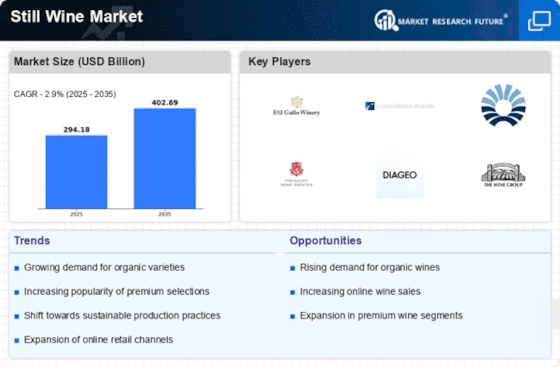
As per Market Research Future analysis, the Still Wine Market was estimated at 294.18 USD Billion in 2024. The Still Wine industry is projected to grow from 302.71 USD Billion in 2025 to 402.89 USD Billion by 2035, exhibiting a compound annual growth rate (CAGR) of 2.9% during the forecast period 2025 - 2035

Key Market Trends & Highlights

The Still Wine Market is experiencing a dynamic shift towards sustainability and e-commerce, driven by evolving consumer preferences.

  • North America remains the largest market for still wine, showcasing a robust demand for diverse varietals. The Asia-Pacific region is emerging as the fastest-growing market, reflecting a rising interest in wine culture and consumption. Red wine continues to dominate the market as the largest segment, while white wine is witnessing rapid growth in popularity. Key market drivers include the increasing focus on sustainability and organic production, alongside the growth of e-commerce platforms.

Market Size & Forecast

2024 Market Size 294.18 (USD Billion)
2035 Market Size 402.89 (USD Billion)
CAGR (2025 - 2035) 2.9%
Largest Regional Market Share in 2024 Europe

Major Players

<a href="https://www.gallo.com/">E. &amp; J. Gallo Winery (US)</a>, Constellation Brands (US), Pernod Ricard (FR), Treasury Wine Estates (AU), Diageo (GB), The Wine Group (US), Accolade Wines (AU), Jackson Family Wines (US), Château Ste. Michelle (US)

Market Trends

The Still Wine Market is currently experiencing a dynamic evolution, characterized by shifting consumer preferences and an increasing inclination towards premium products. As consumers become more discerning, there is a noticeable trend towards organic and sustainably produced wines, reflecting a broader societal movement towards environmental consciousness. This shift is not merely a passing phase; it appears to be a fundamental change in how consumers approach their wine choices, favoring quality over quantity. Additionally, the rise of e-commerce platforms has transformed the purchasing landscape, enabling consumers to access a wider variety of wines from the comfort of their homes. This accessibility may lead to a more informed consumer base, as individuals can explore diverse options and make educated selections based on reviews and ratings. Moreover, The Still Wine Market is witnessing a growing interest in unique varietals and lesser-known regions, suggesting that consumers are eager to expand their palates beyond traditional offerings. This trend may encourage producers to innovate and experiment with new blends, potentially leading to a richer tapestry of flavors and experiences. As the market continues to evolve, it is likely that these trends will shape the future landscape of wine consumption, fostering a culture of exploration and appreciation among wine enthusiasts.

Sustainability and Organic Production

There is a marked shift towards wines that are produced using sustainable practices. Consumers increasingly prefer organic options, reflecting a broader commitment to environmental stewardship. This trend suggests that producers may need to adapt their practices to meet the growing demand for eco-friendly products.

E-commerce Growth

The rise of online shopping platforms has significantly altered how consumers purchase wine. This trend indicates that convenience and accessibility are becoming paramount, allowing consumers to explore a wider range of options and make informed decisions from home.

Exploration of Unique Varietals

An increasing interest in lesser-known grape varieties and regions is evident among consumers. This trend suggests a desire for diversity in wine selections, encouraging producers to innovate and offer unique blends that cater to adventurous palates.

Still Wine Market Market Drivers

E-commerce Growth

The rapid expansion of e-commerce platforms is significantly influencing the Still Wine Market. With the convenience of online shopping, consumers are increasingly turning to digital channels to purchase their favorite wines. Recent statistics reveal that online wine sales have surged, accounting for nearly 15% of total wine sales. This trend is particularly pronounced among younger consumers who prefer the ease of browsing and purchasing wines from the comfort of their homes. As a result, wineries are investing in robust online marketing strategies and enhancing their digital presence to capture this growing segment. The ability to reach a wider audience through e-commerce is likely to drive sales and foster innovation within the Still Wine Market.

Health Consciousness

The rising health consciousness among consumers is significantly impacting the Still Wine Market. As individuals become more aware of their dietary choices, there is a growing demand for lower-alcohol and lower-calorie wine options. This shift is prompting wineries to innovate and create products that align with health trends. Recent surveys indicate that nearly 30% of consumers are actively seeking wines that offer health benefits, such as lower sulfite levels or organic certifications. This trend not only reflects changing consumer preferences but also presents an opportunity for wineries to develop niche products that cater to health-conscious individuals. By addressing these demands, producers can enhance their market position within the Still Wine Market.

Exploration of Unique Varietals

The ongoing exploration of unique varietals is reshaping consumer preferences within the Still Wine Market. As wine enthusiasts seek new and diverse flavors, wineries are increasingly experimenting with lesser-known grape varieties. This trend not only caters to adventurous consumers but also encourages the discovery of new taste profiles. Data suggests that wines made from unique varietals have experienced a growth rate of approximately 10% in recent years. This exploration allows wineries to differentiate themselves in a crowded market, potentially leading to increased sales and brand recognition. By embracing this trend, producers can tap into the evolving tastes of consumers and position themselves favorably within the Still Wine Market.

Cultural and Culinary Pairing Trends

The increasing interest in culinary experiences and cultural pairings is driving growth in the Still Wine Market. Consumers are becoming more adventurous in their dining choices, seeking wines that complement specific cuisines and enhance their overall dining experience. This trend is evident in the rise of wine and food pairing events, which have gained popularity among consumers. Data indicates that nearly 40% of wine consumers are interested in learning about wine pairings, suggesting a strong market for educational initiatives. Wineries that embrace this trend by offering curated wine selections and pairing recommendations are likely to attract a more engaged customer base. This focus on culinary experiences can foster brand loyalty and drive sales within the Still Wine Market.

Sustainability and Organic Production

The increasing consumer preference for sustainable and organic products is reshaping the Still Wine Market. As environmental concerns gain traction, wineries are adopting eco-friendly practices, such as organic farming and sustainable packaging. This shift not only appeals to environmentally conscious consumers but also enhances brand loyalty. According to recent data, organic wine sales have seen a notable rise, with a growth rate of approximately 20% annually. This trend indicates that consumers are willing to pay a premium for wines that align with their values. Consequently, wineries that prioritize sustainability are likely to gain a competitive edge in the Still Wine Market, attracting a broader customer base and fostering long-term growth.

Market Segment Insights

By Type: Red Wine (Largest) vs. White Wine (Fastest-Growing)

<p>The Still Wine Market segments into four key types: Red Wine, <a href="https://www.marketresearchfuture.com/reports/white-wine-market-32304" target="_blank" title="white wine">White Wine</a>, Rosé Wine, and Sparkling Wine. Red Wine maintains the largest market share due to its established consumer preference and cultural significance across various regions. White Wine follows as a significant contender, capturing a notable portion of the market, driven by trends favoring lighter and crisper wines. Rosé Wine, while smaller, has been gaining traction, particularly in summer seasons, whereas Sparkling Wine appeals for celebrations, albeit with a niche market presence.</p>

<p>Red Wine (Dominant) vs. White Wine (Emerging)</p>

<p>Red Wine continues to assert itself as the dominant type in the Still Wine Market, characterized by its rich flavors, complexity, and ability to pair with a variety of foods. Its popularity is particularly strong in regions known for their viticulture, supported by high levels of repeat purchases from consumers. In contrast, White Wine is emerging as a favorite, appealing particularly to younger demographics seeking refreshing alternatives. The growth in this segment is driven by an increasing health-conscious attitude and the rising trend of wine as an everyday beverage, particularly in casual settings. This has positioned White Wine as a versatile option, adapting well to both gourmet dining and relaxed sipping occasions.</p>

By Wine Quality: Table Wine (Largest) vs. Fine Wine (Fastest-Growing)

<p>In the Still Wine Market, the market share is dominated by Table Wine, catering to the mass consumer segment due to its affordable pricing and wide availability. This segment reflects a significant portion of the overall market, driven by the increasing preference for casual dining experiences and social gatherings. Fine Wine, on the other hand, though it holds a smaller market share, is gaining traction as consumer preferences shift towards premium experiences. This is a reflection of the growing interest in wine culture and appreciation.</p>

<p>Table Wine (Dominant) vs. Fine Wine (Emerging)</p>

<p>Table Wine, often seen as the dominant segment in the Still Wine Market, is characterized by its accessibility and affordability, appealing to everyday consumers. This type of wine is widely available in various varieties, making it a staple choice for casual celebrations and meals. In contrast, Fine Wine represents an emerging segment, attracting connoisseurs and those willing to invest in higher quality products. Fine Wines are marked by unique attributes such as region-specific grapes and artisanal production methods, positioning them as desirable choices among premium wine enthusiasts.</p>

By Packaging Type: Bottle (Largest) vs. Bag-in-Box (Fastest-Growing)

<p>In the Still Wine Market, the distribution of packaging types reveals that the traditional Bottle format continues to dominate, accounting for the majority of market share. This classic packaging not only reflects the heritage of wine consumption but also caters to consumers' preference for premium quality and presentation. Meanwhile, Bag-in-Box has emerged as a prominent alternative, attracting a significant share of new consumers seeking convenient and cost-effective options for wine consumption.</p>

<p>Bottle (Dominant) vs. Bag-in-Box (Emerging)</p>

<p>The Bottle packaging has long been the standard in the Still Wine Market, presenting an image of sophistication and quality that appeals to wine enthusiasts. It is predominantly used for premium and vintage wines where the packaging plays a pivotal role in brand identity. In contrast, the emerging Bag-in-Box format provides a practical solution for casual consumers, emphasizing convenience and sustainability. As consumers increasingly favor flexible options for social gatherings and home consumption, Bag-in-Box is rapidly gaining traction, especially among younger demographics who seek affordability without compromising on taste.</p>

By Distribution Channel: Supermarkets/Hypermarkets (Largest) vs. Online Retail (Fastest-Growing)

<p>In the Still Wine Market, Supermarkets and Hypermarkets hold a substantial portion of the distribution channel share, primarily due to their wide accessibility and established customer base. They provide a diverse selection of still wines, appealing to both casual and connoisseur wine drinkers alike. Specialty Stores also feature prominently but cater to a niche market segment that often seeks unique and premium wine offerings. The online retail segment, while initially lagging, has seen a dramatic increase in market participation as consumers increasingly appreciate the convenience of purchasing wines online, particularly after the pandemic. The growth trajectory of the Still Wine Market's distribution channels is majorly influenced by shifting consumer preferences, with online retail emerging strongly due to its convenience and expansive product range. The rise of digital shopping platforms has facilitated a new wave of wine enthusiasts, enabling them to explore international selections from the comfort of their homes. Specialty Stores continue to thrive by enhancing customer experience through personalized services, tastings, and curated selections, which strengthens their market position against the mass-market retailing approach of Supermarkets and Hypermarkets.</p>

<p>Supermarkets/Hypermarkets (Dominant) vs. Specialty Stores (Emerging)</p>

<p>Supermarkets and Hypermarkets maintain a dominant edge in the Still Wine Market by leveraging their extensive product ranges and competitive pricing strategies, catering to a broader consumer demographic. These retail formats offer convenience and accessibility, making it easier for customers to purchase still wine alongside their regular grocery shopping. On the other hand, Specialty Stores present themselves as emerging players, focusing on unique selections and high-quality products that appeal to discerning customers. These stores often foster a strong relationship with local wineries and producers, providing customers with exclusive offerings that cannot be found in larger retail chains. While Supermarkets thrive on volume and variety, Specialty Stores carve out a niche that emphasizes quality and expertise.</p>

By Consumer Segment: Young Adults (Largest) vs. Seniors (Fastest-Growing)

<p>The consumer segment of the Still Wine Market is robustly competitive, with Young Adults holding the largest share. This demographic is increasingly drawn to diverse and innovative wine brands, leveraging social media and influencer marketing to expand their preferences. Conversely, Seniors, while currently a smaller share of the market, are the fastest-growing segment. The appeal of traditional, high-quality wines resonates with this group as they seek nostalgic and refined experiences in their consumption of still wine. In terms of growth trends, Young Adults are increasingly exploring premium and unique varieties, leading to a marked increase in online sales channels and boutique wineries catering specifically to their tastes. Meanwhile, the Senior demographic is witnessing a revival in consumption as they embrace both new offerings and classic labels. Factors driving growth include the increasing focus on health benefits associated with moderate wine consumption and the trend of wine tasting events targeted at older consumers that enhance social engagement and enjoyment.</p>

<p>Young Adults (Dominant) vs. Seniors (Emerging)</p>

<p>Young Adults are recognized as the dominant consumer group within the Still Wine Market, characterized by their adventurous palate and preference for sustainable and organic options. This demographic values brand authenticity and often seeks unique flavors that are contemporary and experiential. They are highly influenced by digital marketing trends and social media, making them discerning consumers who enjoy engaging with brands online. In contrast, Seniors represent an emerging consumer segment, appreciating traditional varieties and quality over quantity. This group's purchasing decisions are more influenced by heritage and experience, leading to increased interest in classic wines and boutique producers. With the rise of health-consciousness, both segments are becoming significant contributors to the evolving still wine landscape, albeit from distinctly different perspectives.</p>

Get more detailed insights about Still Wine Market Research Report — Global Forecast till 2035

Regional Insights

North America : Market Leader in Consumption

North America is the largest market for still wine, accounting for approximately 40% of global consumption. The region's growth is driven by increasing consumer interest in premium wines, health-conscious choices, and a growing number of wineries. Regulatory support, such as favorable taxation policies and trade agreements, further enhances market dynamics. The U.S. leads this market, followed by Canada, which holds around 10% of the market share. The competitive landscape in North America is robust, featuring key players like E. & J. Gallo Winery, Constellation Brands, and The Wine Group. These companies dominate the market with diverse product offerings and strong distribution networks. The presence of numerous local wineries also contributes to a vibrant market, catering to varying consumer preferences and enhancing competition among established brands.

Europe : Cultural Hub of Wine Production

Europe is a significant player in the still wine market, holding approximately 35% of the global share. The region's growth is fueled by a rich cultural heritage, increasing tourism, and a rising trend towards organic and sustainable wines. Countries like France and Italy are the largest markets, with France alone accounting for about 20% of the global market. Regulatory frameworks, such as the EU's Common Agricultural Policy, support local producers and promote quality standards. Leading countries in Europe include France, Italy, and Spain, each with a strong presence of renowned wineries. Key players like Pernod Ricard and Treasury Wine Estates are pivotal in shaping the competitive landscape. The market is characterized by a blend of traditional and modern winemaking techniques, catering to diverse consumer tastes and preferences. The European market remains dynamic, with ongoing innovations in wine production and marketing strategies.

Asia-Pacific : Emerging Market with Potential

The Asia-Pacific region is rapidly emerging in the still wine market, currently holding about 15% of the global share. The growth is driven by increasing disposable incomes, changing consumer preferences towards wine over traditional spirits, and a burgeoning middle class. Countries like China and Australia are leading this trend, with China showing a significant increase in wine consumption, accounting for approximately 8% of the global market. Regulatory changes, including reduced tariffs on wine imports, are also facilitating market growth. Australia stands out as a key player in the region, with major companies like Treasury Wine Estates and Accolade Wines leading the market. The competitive landscape is evolving, with local wineries gaining traction alongside established international brands. The region's wine culture is developing, supported by wine education and tourism, which are further enhancing consumer engagement and market expansion.

Middle East and Africa : Untapped Market Opportunities

The Middle East and Africa region is an emerging market for still wine, currently holding about 10% of the global share. The growth is primarily driven by increasing urbanization, a young population, and a gradual shift in consumer preferences towards wine. Countries like South Africa are leading the market, with a strong wine production tradition, while the UAE is witnessing a rise in wine consumption due to tourism and expatriate communities. Regulatory changes are also playing a role in promoting wine sales in certain areas. South Africa is the dominant player in the region, with a well-established wine industry and key players like Diageo and Accolade Wines making significant contributions. The competitive landscape is characterized by a mix of local and international brands, with increasing investments in marketing and distribution channels. The region presents untapped opportunities for growth, particularly in the premium wine segment, as consumer awareness and interest continue to rise.

Key Players and Competitive Insights

The Still Wine Market is characterized by a dynamic landscape, reflecting the ever-evolving preferences of consumers and the continuous innovation within the industry. Market conditions are shaped by factors such as geographical distribution, consumer trends, and the competitive strategies of major players. Brands are competing not only on product quality and taste but also through marketing initiatives, distribution networks, and sustainability efforts. The segment is notably influenced by varying regional preferences, with distinct wine styles appreciated in different markets. This competitive environment compels companies to enhance their product offerings while maintaining a keen awareness of emerging trends and consumer behaviors.
Diageo has established a robust presence in the Still Wine Market, leveraging its extensive portfolio to cater to diverse consumer tastes and preferences. The company's strengths lie in its strategic marketing capabilities and deep understanding of consumer insights, which allow for targeted campaigns that resonate with wine enthusiasts. Diageo's strong distribution network ensures that its products are readily available in key markets, thereby enhancing brand visibility and accessibility. Their commitment to sustainability and responsible drinking initiatives further bolsters their reputation and aligns with the growing consumer demand for ethical and environmentally friendly products.
This multifaceted approach helps Diageo sustain competitive advantages in a crowded marketplace, allowing it to capitalize on both traditional and innovative wine trends.
Chateau Ste. Michelle is another influential player in the Still Wine Market, recognized for its premium quality offerings and commitment to winemaking excellence. The company boasts a rich heritage and a strong brand identity that appeals to a wide range of consumers. Chateau Ste. Michelle’s strategic focus on producing high-quality wines from renowned vineyards adds to its competitive edge. Their ability to effectively blend tradition with modern techniques ensures that the wines are consistently well-regarded. Additionally, Chateau Ste. Michelle's emphasis on consumer engagement through tastings and events enhances brand loyalty and consumer connection.
Their investment in quality and brand experience contributes to a significant market presence, positioning them as a trusted name in the still wine segment.

Key Companies in the Still Wine Market include

Industry Developments

Recent developments in the Still Wine Market have showcased a dynamic landscape, with companies like Diageo and Pernod Ricard expanding their portfolios through strategic acquisitions. Notable activity includes E and J Gallo Winery's ongoing efforts to enhance their market share by exploring new distribution channels, while Treasury Wine Estates has reported an increase in online sales, tapping into the growing trend of e-commerce. The resurgence of interest in premium wines has driven market growth, influencing companies like Constellation Brands and BrownForman to invest in innovative marketing strategies targeting younger consumers.

Additionally, Molson Coors Beverage Company has been diversifying its offerings, aiming to cater to changing consumer preferences. Growth in valuation across the sector indicates a robust recovery as market players adapt to post-pandemic trends. As companies continue to focus on sustainability, brands like Jackson Family Enterprises and Accolade Wines are highlighting their eco-friendly practices, resonating with environmentally conscious consumers. With the focus on mergers and acquisitions, the market stands to undergo significant transformations as these companies leverage partnerships to enhance their competitive positioning in the ever-evolving landscape of still wine.

Future Outlook

Still Wine Market Future Outlook

The Still Wine Market is projected to grow at a 2.9% CAGR from 2025 to 2035, driven by increasing consumer preferences for <a href="https://www.marketresearchfuture.com/reports/premium-wine-market-35495" target="_blank" title="premium wine">premium wines</a> and sustainable production practices.

New opportunities lie in:

  • Expansion of organic and biodynamic wine offerings
  • Development of e-commerce platforms for direct-to-consumer sales
  • Investment in innovative packaging solutions to enhance shelf appeal

By 2035, the Still Wine Market is expected to solidify its growth trajectory, reflecting evolving consumer demands.

Market Segmentation

Still Wine Market Type Outlook

  • Red Wine
  • White Wine
  • Rosé Wine
  • Sparkling Wine

Still Wine Market Wine Quality Outlook

  • Table Wine
  • Fine Wine
  • Super Premium Wine

Still Wine Market Packaging Type Outlook

  • Bottle
  • Bag-in-Box
  • Tetra Pak

Still Wine Market Consumer Segment Outlook

  • Young Adults
  • Middle-aged Adults
  • Seniors

Still Wine Market Distribution Channel Outlook

  • Supermarkets/Hypermarkets
  • Specialty Stores
  • Online Retail

Report Scope

MARKET SIZE 2024 294.18(USD Billion)
MARKET SIZE 2025 302.71(USD Billion)
MARKET SIZE 2035 402.89(USD Billion)
COMPOUND ANNUAL GROWTH RATE (CAGR) 2.9% (2025 - 2035)
REPORT COVERAGE Revenue Forecast, Competitive Landscape, Growth Factors, and Trends
BASE YEAR 2024
Market Forecast Period 2025 - 2035
Historical Data 2019 - 2024
Market Forecast Units USD Billion
Key Companies Profiled E. & J. Gallo Winery (US), Constellation Brands (US), Pernod Ricard (FR), Treasury Wine Estates (AU), Diageo (GB), The Wine Group (US), Accolade Wines (AU), Jackson Family Wines (US), Château Ste. Michelle (US)
Segments Covered Product Type, Wine Quality, Packaging Type, Distribution Channel, Consumer Segment, Regional
Key Market Opportunities Growing consumer preference for organic and sustainable practices in the Still Wine Market presents significant opportunities.
Key Market Dynamics Shifting consumer preferences towards organic and sustainable practices drive innovation in the still wine market.
Countries Covered North America, Europe, APAC, South America, MEA

FAQs

What is the current valuation of the Still Wine Market as of 2024?

<p>The Still Wine Market was valued at 294.18 USD Billion in 2024.</p>

What is the projected market valuation for the Still Wine Market in 2035?

<p>The projected valuation for the Still Wine Market in 2035 is 402.89 USD Billion.</p>

What is the expected CAGR for the Still Wine Market during the forecast period 2025 - 2035?

<p>The expected CAGR for the Still Wine Market during the forecast period 2025 - 2035 is 2.9%.</p>

Which segment of Still Wine had the highest valuation in 2024?

<p>In 2024, the Red Wine segment had the highest valuation, reaching 120.0 to 170.0 USD Billion.</p>

How does the Fine Wine segment perform compared to Super Premium Wine?

<p>The Fine Wine segment was valued at 100.0 to 140.0 USD Billion, while Super Premium Wine was valued at 44.18 to 52.89 USD Billion in 2024.</p>

What are the leading distribution channels for Still Wine?

<p>Supermarkets/Hypermarkets led the distribution channels with a valuation of 176.0 to 245.0 USD Billion in 2024.</p>

Which consumer segment shows the highest potential for growth in the Still Wine Market?

<p>The Middle-aged Adults segment, valued at 120.0 to 170.0 USD Billion, appears to show the highest potential for growth.</p>

What packaging types are prevalent in the Still Wine Market?

<p>In 2024, Bottle packaging dominated with a valuation of 150.0 to 210.0 USD Billion, followed by Bag-in-Box and Tetra Pak.</p>

Who are the key players in the Still Wine Market?

<p>Key players in the Still Wine Market include E. & J. Gallo Winery, Constellation Brands, and Pernod Ricard, among others.</p>

What is the projected growth trend for the Rosé Wine segment?

<p>The Rosé Wine segment is projected to grow, with a valuation range of 40.0 to 60.0 USD Billion in 2024.</p>

  1. SECTION I: EXECUTIVE SUMMARY AND KEY HIGHLIGHTS
    1. | 1.1 EXECUTIVE SUMMARY
    2. | | 1.1.1 Market Overview
    3. | | 1.1.2 Key Findings
    4. | | 1.1.3 Market Segmentation
    5. | | 1.1.4 Competitive Landscape
    6. | | 1.1.5 Challenges and Opportunities
    7. | | 1.1.6 Future Outlook
  2. SECTION II: SCOPING, METHODOLOGY AND MARKET STRUCTURE
    1. | 2.1 MARKET INTRODUCTION
    2. | | 2.1.1 Definition
    3. | | 2.1.2 Scope of the study
    4. | | | 2.1.2.1 Research Objective
    5. | | | 2.1.2.2 Assumption
    6. | | | 2.1.2.3 Limitations
    7. | 2.2 RESEARCH METHODOLOGY
    8. | | 2.2.1 Overview
    9. | | 2.2.2 Data Mining
    10. | | 2.2.3 Secondary Research
    11. | | 2.2.4 Primary Research
    12. | | | 2.2.4.1 Primary Interviews and Information Gathering Process
    13. | | | 2.2.4.2 Breakdown of Primary Respondents
    14. | | 2.2.5 Forecasting Model
    15. | | 2.2.6 Market Size Estimation
    16. | | | 2.2.6.1 Bottom-Up Approach
    17. | | | 2.2.6.2 Top-Down Approach
    18. | | 2.2.7 Data Triangulation
    19. | | 2.2.8 Validation
  3. SECTION III: QUALITATIVE ANALYSIS
    1. | 3.1 MARKET DYNAMICS
    2. | | 3.1.1 Overview
    3. | | 3.1.2 Drivers
    4. | | 3.1.3 Restraints
    5. | | 3.1.4 Opportunities
    6. | 3.2 MARKET FACTOR ANALYSIS
    7. | | 3.2.1 Value chain Analysis
    8. | | 3.2.2 Porter's Five Forces Analysis
    9. | | | 3.2.2.1 Bargaining Power of Suppliers
    10. | | | 3.2.2.2 Bargaining Power of Buyers
    11. | | | 3.2.2.3 Threat of New Entrants
    12. | | | 3.2.2.4 Threat of Substitutes
    13. | | | 3.2.2.5 Intensity of Rivalry
    14. | | 3.2.3 COVID-19 Impact Analysis
    15. | | | 3.2.3.1 Market Impact Analysis
    16. | | | 3.2.3.2 Regional Impact
    17. | | | 3.2.3.3 Opportunity and Threat Analysis
  4. SECTION IV: QUANTITATIVE ANALYSIS
    1. | 4.1 Food, Beverages & Nutrition, BY Type (USD Billion)
    2. | | 4.1.1 Red Wine
    3. | | 4.1.2 White Wine
    4. | | 4.1.3 Rosé Wine
    5. | | 4.1.4 Sparkling Wine
    6. | 4.2 Food, Beverages & Nutrition, BY Wine Quality (USD Billion)
    7. | | 4.2.1 Table Wine
    8. | | 4.2.2 Fine Wine
    9. | | 4.2.3 Super Premium Wine
    10. | 4.3 Food, Beverages & Nutrition, BY Packaging Type (USD Billion)
    11. | | 4.3.1 Bottle
    12. | | 4.3.2 Bag-in-Box
    13. | | 4.3.3 Tetra Pak
    14. | 4.4 Food, Beverages & Nutrition, BY Distribution Channel (USD Billion)
    15. | | 4.4.1 Supermarkets/Hypermarkets
    16. | | 4.4.2 Specialty Stores
    17. | | 4.4.3 Online Retail
    18. | 4.5 Food, Beverages & Nutrition, BY Consumer Segment (USD Billion)
    19. | | 4.5.1 Young Adults
    20. | | 4.5.2 Middle-aged Adults
    21. | | 4.5.3 Seniors
    22. | 4.6 Food, Beverages & Nutrition, BY Region (USD Billion)
    23. | | 4.6.1 North America
    24. | | | 4.6.1.1 US
    25. | | | 4.6.1.2 Canada
    26. | | 4.6.2 Europe
    27. | | | 4.6.2.1 Germany
    28. | | | 4.6.2.2 UK
    29. | | | 4.6.2.3 France
    30. | | | 4.6.2.4 Russia
    31. | | | 4.6.2.5 Italy
    32. | | | 4.6.2.6 Spain
    33. | | | 4.6.2.7 Rest of Europe
    34. | | 4.6.3 APAC
    35. | | | 4.6.3.1 China
    36. | | | 4.6.3.2 India
    37. | | | 4.6.3.3 Japan
    38. | | | 4.6.3.4 South Korea
    39. | | | 4.6.3.5 Malaysia
    40. | | | 4.6.3.6 Thailand
    41. | | | 4.6.3.7 Indonesia
    42. | | | 4.6.3.8 Rest of APAC
    43. | | 4.6.4 South America
    44. | | | 4.6.4.1 Brazil
    45. | | | 4.6.4.2 Mexico
    46. | | | 4.6.4.3 Argentina
    47. | | | 4.6.4.4 Rest of South America
    48. | | 4.6.5 MEA
    49. | | | 4.6.5.1 GCC Countries
    50. | | | 4.6.5.2 South Africa
    51. | | | 4.6.5.3 Rest of MEA
  5. SECTION V: COMPETITIVE ANALYSIS
    1. | 5.1 Competitive Landscape
    2. | | 5.1.1 Overview
    3. | | 5.1.2 Competitive Analysis
    4. | | 5.1.3 Market share Analysis
    5. | | 5.1.4 Major Growth Strategy in the Food, Beverages & Nutrition
    6. | | 5.1.5 Competitive Benchmarking
    7. | | 5.1.6 Leading Players in Terms of Number of Developments in the Food, Beverages & Nutrition
    8. | | 5.1.7 Key developments and growth strategies
    9. | | | 5.1.7.1 New Product Launch/Service Deployment
    10. | | | 5.1.7.2 Merger & Acquisitions
    11. | | | 5.1.7.3 Joint Ventures
    12. | | 5.1.8 Major Players Financial Matrix
    13. | | | 5.1.8.1 Sales and Operating Income
    14. | | | 5.1.8.2 Major Players R&D Expenditure. 2023
    15. | 5.2 Company Profiles
    16. | | 5.2.1 E. & J. Gallo Winery (US)
    17. | | | 5.2.1.1 Financial Overview
    18. | | | 5.2.1.2 Products Offered
    19. | | | 5.2.1.3 Key Developments
    20. | | | 5.2.1.4 SWOT Analysis
    21. | | | 5.2.1.5 Key Strategies
    22. | | 5.2.2 Constellation Brands (US)
    23. | | | 5.2.2.1 Financial Overview
    24. | | | 5.2.2.2 Products Offered
    25. | | | 5.2.2.3 Key Developments
    26. | | | 5.2.2.4 SWOT Analysis
    27. | | | 5.2.2.5 Key Strategies
    28. | | 5.2.3 Pernod Ricard (FR)
    29. | | | 5.2.3.1 Financial Overview
    30. | | | 5.2.3.2 Products Offered
    31. | | | 5.2.3.3 Key Developments
    32. | | | 5.2.3.4 SWOT Analysis
    33. | | | 5.2.3.5 Key Strategies
    34. | | 5.2.4 Treasury Wine Estates (AU)
    35. | | | 5.2.4.1 Financial Overview
    36. | | | 5.2.4.2 Products Offered
    37. | | | 5.2.4.3 Key Developments
    38. | | | 5.2.4.4 SWOT Analysis
    39. | | | 5.2.4.5 Key Strategies
    40. | | 5.2.5 Diageo (GB)
    41. | | | 5.2.5.1 Financial Overview
    42. | | | 5.2.5.2 Products Offered
    43. | | | 5.2.5.3 Key Developments
    44. | | | 5.2.5.4 SWOT Analysis
    45. | | | 5.2.5.5 Key Strategies
    46. | | 5.2.6 The Wine Group (US)
    47. | | | 5.2.6.1 Financial Overview
    48. | | | 5.2.6.2 Products Offered
    49. | | | 5.2.6.3 Key Developments
    50. | | | 5.2.6.4 SWOT Analysis
    51. | | | 5.2.6.5 Key Strategies
    52. | | 5.2.7 Accolade Wines (AU)
    53. | | | 5.2.7.1 Financial Overview
    54. | | | 5.2.7.2 Products Offered
    55. | | | 5.2.7.3 Key Developments
    56. | | | 5.2.7.4 SWOT Analysis
    57. | | | 5.2.7.5 Key Strategies
    58. | | 5.2.8 Jackson Family Wines (US)
    59. | | | 5.2.8.1 Financial Overview
    60. | | | 5.2.8.2 Products Offered
    61. | | | 5.2.8.3 Key Developments
    62. | | | 5.2.8.4 SWOT Analysis
    63. | | | 5.2.8.5 Key Strategies
    64. | | 5.2.9 Château Ste. Michelle (US)
    65. | | | 5.2.9.1 Financial Overview
    66. | | | 5.2.9.2 Products Offered
    67. | | | 5.2.9.3 Key Developments
    68. | | | 5.2.9.4 SWOT Analysis
    69. | | | 5.2.9.5 Key Strategies
    70. | 5.3 Appendix
    71. | | 5.3.1 References
    72. | | 5.3.2 Related Reports
  6. LIST OF FIGURES
    1. | 6.1 MARKET SYNOPSIS
    2. | 6.2 NORTH AMERICA MARKET ANALYSIS
    3. | 6.3 US MARKET ANALYSIS BY TYPE
    4. | 6.4 US MARKET ANALYSIS BY WINE QUALITY
    5. | 6.5 US MARKET ANALYSIS BY PACKAGING TYPE
    6. | 6.6 US MARKET ANALYSIS BY DISTRIBUTION CHANNEL
    7. | 6.7 US MARKET ANALYSIS BY CONSUMER SEGMENT
    8. | 6.8 CANADA MARKET ANALYSIS BY TYPE
    9. | 6.9 CANADA MARKET ANALYSIS BY WINE QUALITY
    10. | 6.10 CANADA MARKET ANALYSIS BY PACKAGING TYPE
    11. | 6.11 CANADA MARKET ANALYSIS BY DISTRIBUTION CHANNEL
    12. | 6.12 CANADA MARKET ANALYSIS BY CONSUMER SEGMENT
    13. | 6.13 EUROPE MARKET ANALYSIS
    14. | 6.14 GERMANY MARKET ANALYSIS BY TYPE
    15. | 6.15 GERMANY MARKET ANALYSIS BY WINE QUALITY
    16. | 6.16 GERMANY MARKET ANALYSIS BY PACKAGING TYPE
    17. | 6.17 GERMANY MARKET ANALYSIS BY DISTRIBUTION CHANNEL
    18. | 6.18 GERMANY MARKET ANALYSIS BY CONSUMER SEGMENT
    19. | 6.19 UK MARKET ANALYSIS BY TYPE
    20. | 6.20 UK MARKET ANALYSIS BY WINE QUALITY
    21. | 6.21 UK MARKET ANALYSIS BY PACKAGING TYPE
    22. | 6.22 UK MARKET ANALYSIS BY DISTRIBUTION CHANNEL
    23. | 6.23 UK MARKET ANALYSIS BY CONSUMER SEGMENT
    24. | 6.24 FRANCE MARKET ANALYSIS BY TYPE
    25. | 6.25 FRANCE MARKET ANALYSIS BY WINE QUALITY
    26. | 6.26 FRANCE MARKET ANALYSIS BY PACKAGING TYPE
    27. | 6.27 FRANCE MARKET ANALYSIS BY DISTRIBUTION CHANNEL
    28. | 6.28 FRANCE MARKET ANALYSIS BY CONSUMER SEGMENT
    29. | 6.29 RUSSIA MARKET ANALYSIS BY TYPE
    30. | 6.30 RUSSIA MARKET ANALYSIS BY WINE QUALITY
    31. | 6.31 RUSSIA MARKET ANALYSIS BY PACKAGING TYPE
    32. | 6.32 RUSSIA MARKET ANALYSIS BY DISTRIBUTION CHANNEL
    33. | 6.33 RUSSIA MARKET ANALYSIS BY CONSUMER SEGMENT
    34. | 6.34 ITALY MARKET ANALYSIS BY TYPE
    35. | 6.35 ITALY MARKET ANALYSIS BY WINE QUALITY
    36. | 6.36 ITALY MARKET ANALYSIS BY PACKAGING TYPE
    37. | 6.37 ITALY MARKET ANALYSIS BY DISTRIBUTION CHANNEL
    38. | 6.38 ITALY MARKET ANALYSIS BY CONSUMER SEGMENT
    39. | 6.39 SPAIN MARKET ANALYSIS BY TYPE
    40. | 6.40 SPAIN MARKET ANALYSIS BY WINE QUALITY
    41. | 6.41 SPAIN MARKET ANALYSIS BY PACKAGING TYPE
    42. | 6.42 SPAIN MARKET ANALYSIS BY DISTRIBUTION CHANNEL
    43. | 6.43 SPAIN MARKET ANALYSIS BY CONSUMER SEGMENT
    44. | 6.44 REST OF EUROPE MARKET ANALYSIS BY TYPE
    45. | 6.45 REST OF EUROPE MARKET ANALYSIS BY WINE QUALITY
    46. | 6.46 REST OF EUROPE MARKET ANALYSIS BY PACKAGING TYPE
    47. | 6.47 REST OF EUROPE MARKET ANALYSIS BY DISTRIBUTION CHANNEL
    48. | 6.48 REST OF EUROPE MARKET ANALYSIS BY CONSUMER SEGMENT
    49. | 6.49 APAC MARKET ANALYSIS
    50. | 6.50 CHINA MARKET ANALYSIS BY TYPE
    51. | 6.51 CHINA MARKET ANALYSIS BY WINE QUALITY
    52. | 6.52 CHINA MARKET ANALYSIS BY PACKAGING TYPE
    53. | 6.53 CHINA MARKET ANALYSIS BY DISTRIBUTION CHANNEL
    54. | 6.54 CHINA MARKET ANALYSIS BY CONSUMER SEGMENT
    55. | 6.55 INDIA MARKET ANALYSIS BY TYPE
    56. | 6.56 INDIA MARKET ANALYSIS BY WINE QUALITY
    57. | 6.57 INDIA MARKET ANALYSIS BY PACKAGING TYPE
    58. | 6.58 INDIA MARKET ANALYSIS BY DISTRIBUTION CHANNEL
    59. | 6.59 INDIA MARKET ANALYSIS BY CONSUMER SEGMENT
    60. | 6.60 JAPAN MARKET ANALYSIS BY TYPE
    61. | 6.61 JAPAN MARKET ANALYSIS BY WINE QUALITY
    62. | 6.62 JAPAN MARKET ANALYSIS BY PACKAGING TYPE
    63. | 6.63 JAPAN MARKET ANALYSIS BY DISTRIBUTION CHANNEL
    64. | 6.64 JAPAN MARKET ANALYSIS BY CONSUMER SEGMENT
    65. | 6.65 SOUTH KOREA MARKET ANALYSIS BY TYPE
    66. | 6.66 SOUTH KOREA MARKET ANALYSIS BY WINE QUALITY
    67. | 6.67 SOUTH KOREA MARKET ANALYSIS BY PACKAGING TYPE
    68. | 6.68 SOUTH KOREA MARKET ANALYSIS BY DISTRIBUTION CHANNEL
    69. | 6.69 SOUTH KOREA MARKET ANALYSIS BY CONSUMER SEGMENT
    70. | 6.70 MALAYSIA MARKET ANALYSIS BY TYPE
    71. | 6.71 MALAYSIA MARKET ANALYSIS BY WINE QUALITY
    72. | 6.72 MALAYSIA MARKET ANALYSIS BY PACKAGING TYPE
    73. | 6.73 MALAYSIA MARKET ANALYSIS BY DISTRIBUTION CHANNEL
    74. | 6.74 MALAYSIA MARKET ANALYSIS BY CONSUMER SEGMENT
    75. | 6.75 THAILAND MARKET ANALYSIS BY TYPE
    76. | 6.76 THAILAND MARKET ANALYSIS BY WINE QUALITY
    77. | 6.77 THAILAND MARKET ANALYSIS BY PACKAGING TYPE
    78. | 6.78 THAILAND MARKET ANALYSIS BY DISTRIBUTION CHANNEL
    79. | 6.79 THAILAND MARKET ANALYSIS BY CONSUMER SEGMENT
    80. | 6.80 INDONESIA MARKET ANALYSIS BY TYPE
    81. | 6.81 INDONESIA MARKET ANALYSIS BY WINE QUALITY
    82. | 6.82 INDONESIA MARKET ANALYSIS BY PACKAGING TYPE
    83. | 6.83 INDONESIA MARKET ANALYSIS BY DISTRIBUTION CHANNEL
    84. | 6.84 INDONESIA MARKET ANALYSIS BY CONSUMER SEGMENT
    85. | 6.85 REST OF APAC MARKET ANALYSIS BY TYPE
    86. | 6.86 REST OF APAC MARKET ANALYSIS BY WINE QUALITY
    87. | 6.87 REST OF APAC MARKET ANALYSIS BY PACKAGING TYPE
    88. | 6.88 REST OF APAC MARKET ANALYSIS BY DISTRIBUTION CHANNEL
    89. | 6.89 REST OF APAC MARKET ANALYSIS BY CONSUMER SEGMENT
    90. | 6.90 SOUTH AMERICA MARKET ANALYSIS
    91. | 6.91 BRAZIL MARKET ANALYSIS BY TYPE
    92. | 6.92 BRAZIL MARKET ANALYSIS BY WINE QUALITY
    93. | 6.93 BRAZIL MARKET ANALYSIS BY PACKAGING TYPE
    94. | 6.94 BRAZIL MARKET ANALYSIS BY DISTRIBUTION CHANNEL
    95. | 6.95 BRAZIL MARKET ANALYSIS BY CONSUMER SEGMENT
    96. | 6.96 MEXICO MARKET ANALYSIS BY TYPE
    97. | 6.97 MEXICO MARKET ANALYSIS BY WINE QUALITY
    98. | 6.98 MEXICO MARKET ANALYSIS BY PACKAGING TYPE
    99. | 6.99 MEXICO MARKET ANALYSIS BY DISTRIBUTION CHANNEL
    100. | 6.100 MEXICO MARKET ANALYSIS BY CONSUMER SEGMENT
    101. | 6.101 ARGENTINA MARKET ANALYSIS BY TYPE
    102. | 6.102 ARGENTINA MARKET ANALYSIS BY WINE QUALITY
    103. | 6.103 ARGENTINA MARKET ANALYSIS BY PACKAGING TYPE
    104. | 6.104 ARGENTINA MARKET ANALYSIS BY DISTRIBUTION CHANNEL
    105. | 6.105 ARGENTINA MARKET ANALYSIS BY CONSUMER SEGMENT
    106. | 6.106 REST OF SOUTH AMERICA MARKET ANALYSIS BY TYPE
    107. | 6.107 REST OF SOUTH AMERICA MARKET ANALYSIS BY WINE QUALITY
    108. | 6.108 REST OF SOUTH AMERICA MARKET ANALYSIS BY PACKAGING TYPE
    109. | 6.109 REST OF SOUTH AMERICA MARKET ANALYSIS BY DISTRIBUTION CHANNEL
    110. | 6.110 REST OF SOUTH AMERICA MARKET ANALYSIS BY CONSUMER SEGMENT
    111. | 6.111 MEA MARKET ANALYSIS
    112. | 6.112 GCC COUNTRIES MARKET ANALYSIS BY TYPE
    113. | 6.113 GCC COUNTRIES MARKET ANALYSIS BY WINE QUALITY
    114. | 6.114 GCC COUNTRIES MARKET ANALYSIS BY PACKAGING TYPE
    115. | 6.115 GCC COUNTRIES MARKET ANALYSIS BY DISTRIBUTION CHANNEL
    116. | 6.116 GCC COUNTRIES MARKET ANALYSIS BY CONSUMER SEGMENT
    117. | 6.117 SOUTH AFRICA MARKET ANALYSIS BY TYPE
    118. | 6.118 SOUTH AFRICA MARKET ANALYSIS BY WINE QUALITY
    119. | 6.119 SOUTH AFRICA MARKET ANALYSIS BY PACKAGING TYPE
    120. | 6.120 SOUTH AFRICA MARKET ANALYSIS BY DISTRIBUTION CHANNEL
    121. | 6.121 SOUTH AFRICA MARKET ANALYSIS BY CONSUMER SEGMENT
    122. | 6.122 REST OF MEA MARKET ANALYSIS BY TYPE
    123. | 6.123 REST OF MEA MARKET ANALYSIS BY WINE QUALITY
    124. | 6.124 REST OF MEA MARKET ANALYSIS BY PACKAGING TYPE
    125. | 6.125 REST OF MEA MARKET ANALYSIS BY DISTRIBUTION CHANNEL
    126. | 6.126 REST OF MEA MARKET ANALYSIS BY CONSUMER SEGMENT
    127. | 6.127 KEY BUYING CRITERIA OF FOOD, BEVERAGES & NUTRITION
    128. | 6.128 RESEARCH PROCESS OF MRFR
    129. | 6.129 DRO ANALYSIS OF FOOD, BEVERAGES & NUTRITION
    130. | 6.130 DRIVERS IMPACT ANALYSIS: FOOD, BEVERAGES & NUTRITION
    131. | 6.131 RESTRAINTS IMPACT ANALYSIS: FOOD, BEVERAGES & NUTRITION
    132. | 6.132 SUPPLY / VALUE CHAIN: FOOD, BEVERAGES & NUTRITION
    133. | 6.133 FOOD, BEVERAGES & NUTRITION, BY TYPE, 2024 (% SHARE)
    134. | 6.134 FOOD, BEVERAGES & NUTRITION, BY TYPE, 2024 TO 2035 (USD Billion)
    135. | 6.135 FOOD, BEVERAGES & NUTRITION, BY WINE QUALITY, 2024 (% SHARE)
    136. | 6.136 FOOD, BEVERAGES & NUTRITION, BY WINE QUALITY, 2024 TO 2035 (USD Billion)
    137. | 6.137 FOOD, BEVERAGES & NUTRITION, BY PACKAGING TYPE, 2024 (% SHARE)
    138. | 6.138 FOOD, BEVERAGES & NUTRITION, BY PACKAGING TYPE, 2024 TO 2035 (USD Billion)
    139. | 6.139 FOOD, BEVERAGES & NUTRITION, BY DISTRIBUTION CHANNEL, 2024 (% SHARE)
    140. | 6.140 FOOD, BEVERAGES & NUTRITION, BY DISTRIBUTION CHANNEL, 2024 TO 2035 (USD Billion)
    141. | 6.141 FOOD, BEVERAGES & NUTRITION, BY CONSUMER SEGMENT, 2024 (% SHARE)
    142. | 6.142 FOOD, BEVERAGES & NUTRITION, BY CONSUMER SEGMENT, 2024 TO 2035 (USD Billion)
    143. | 6.143 BENCHMARKING OF MAJOR COMPETITORS
  7. LIST OF TABLES
    1. | 7.1 LIST OF ASSUMPTIONS
    2. | | 7.1.1
    3. | 7.2 North America MARKET SIZE ESTIMATES; FORECAST
    4. | | 7.2.1 BY TYPE, 2025-2035 (USD Billion)
    5. | | 7.2.2 BY WINE QUALITY, 2025-2035 (USD Billion)
    6. | | 7.2.3 BY PACKAGING TYPE, 2025-2035 (USD Billion)
    7. | | 7.2.4 BY DISTRIBUTION CHANNEL, 2025-2035 (USD Billion)
    8. | | 7.2.5 BY CONSUMER SEGMENT, 2025-2035 (USD Billion)
    9. | 7.3 US MARKET SIZE ESTIMATES; FORECAST
    10. | | 7.3.1 BY TYPE, 2025-2035 (USD Billion)
    11. | | 7.3.2 BY WINE QUALITY, 2025-2035 (USD Billion)
    12. | | 7.3.3 BY PACKAGING TYPE, 2025-2035 (USD Billion)
    13. | | 7.3.4 BY DISTRIBUTION CHANNEL, 2025-2035 (USD Billion)
    14. | | 7.3.5 BY CONSUMER SEGMENT, 2025-2035 (USD Billion)
    15. | 7.4 Canada MARKET SIZE ESTIMATES; FORECAST
    16. | | 7.4.1 BY TYPE, 2025-2035 (USD Billion)
    17. | | 7.4.2 BY WINE QUALITY, 2025-2035 (USD Billion)
    18. | | 7.4.3 BY PACKAGING TYPE, 2025-2035 (USD Billion)
    19. | | 7.4.4 BY DISTRIBUTION CHANNEL, 2025-2035 (USD Billion)
    20. | | 7.4.5 BY CONSUMER SEGMENT, 2025-2035 (USD Billion)
    21. | 7.5 Europe MARKET SIZE ESTIMATES; FORECAST
    22. | | 7.5.1 BY TYPE, 2025-2035 (USD Billion)
    23. | | 7.5.2 BY WINE QUALITY, 2025-2035 (USD Billion)
    24. | | 7.5.3 BY PACKAGING TYPE, 2025-2035 (USD Billion)
    25. | | 7.5.4 BY DISTRIBUTION CHANNEL, 2025-2035 (USD Billion)
    26. | | 7.5.5 BY CONSUMER SEGMENT, 2025-2035 (USD Billion)
    27. | 7.6 Germany MARKET SIZE ESTIMATES; FORECAST
    28. | | 7.6.1 BY TYPE, 2025-2035 (USD Billion)
    29. | | 7.6.2 BY WINE QUALITY, 2025-2035 (USD Billion)
    30. | | 7.6.3 BY PACKAGING TYPE, 2025-2035 (USD Billion)
    31. | | 7.6.4 BY DISTRIBUTION CHANNEL, 2025-2035 (USD Billion)
    32. | | 7.6.5 BY CONSUMER SEGMENT, 2025-2035 (USD Billion)
    33. | 7.7 UK MARKET SIZE ESTIMATES; FORECAST
    34. | | 7.7.1 BY TYPE, 2025-2035 (USD Billion)
    35. | | 7.7.2 BY WINE QUALITY, 2025-2035 (USD Billion)
    36. | | 7.7.3 BY PACKAGING TYPE, 2025-2035 (USD Billion)
    37. | | 7.7.4 BY DISTRIBUTION CHANNEL, 2025-2035 (USD Billion)
    38. | | 7.7.5 BY CONSUMER SEGMENT, 2025-2035 (USD Billion)
    39. | 7.8 France MARKET SIZE ESTIMATES; FORECAST
    40. | | 7.8.1 BY TYPE, 2025-2035 (USD Billion)
    41. | | 7.8.2 BY WINE QUALITY, 2025-2035 (USD Billion)
    42. | | 7.8.3 BY PACKAGING TYPE, 2025-2035 (USD Billion)
    43. | | 7.8.4 BY DISTRIBUTION CHANNEL, 2025-2035 (USD Billion)
    44. | | 7.8.5 BY CONSUMER SEGMENT, 2025-2035 (USD Billion)
    45. | 7.9 Russia MARKET SIZE ESTIMATES; FORECAST
    46. | | 7.9.1 BY TYPE, 2025-2035 (USD Billion)
    47. | | 7.9.2 BY WINE QUALITY, 2025-2035 (USD Billion)
    48. | | 7.9.3 BY PACKAGING TYPE, 2025-2035 (USD Billion)
    49. | | 7.9.4 BY DISTRIBUTION CHANNEL, 2025-2035 (USD Billion)
    50. | | 7.9.5 BY CONSUMER SEGMENT, 2025-2035 (USD Billion)
    51. | 7.10 Italy MARKET SIZE ESTIMATES; FORECAST
    52. | | 7.10.1 BY TYPE, 2025-2035 (USD Billion)
    53. | | 7.10.2 BY WINE QUALITY, 2025-2035 (USD Billion)
    54. | | 7.10.3 BY PACKAGING TYPE, 2025-2035 (USD Billion)
    55. | | 7.10.4 BY DISTRIBUTION CHANNEL, 2025-2035 (USD Billion)
    56. | | 7.10.5 BY CONSUMER SEGMENT, 2025-2035 (USD Billion)
    57. | 7.11 Spain MARKET SIZE ESTIMATES; FORECAST
    58. | | 7.11.1 BY TYPE, 2025-2035 (USD Billion)
    59. | | 7.11.2 BY WINE QUALITY, 2025-2035 (USD Billion)
    60. | | 7.11.3 BY PACKAGING TYPE, 2025-2035 (USD Billion)
    61. | | 7.11.4 BY DISTRIBUTION CHANNEL, 2025-2035 (USD Billion)
    62. | | 7.11.5 BY CONSUMER SEGMENT, 2025-2035 (USD Billion)
    63. | 7.12 Rest of Europe MARKET SIZE ESTIMATES; FORECAST
    64. | | 7.12.1 BY TYPE, 2025-2035 (USD Billion)
    65. | | 7.12.2 BY WINE QUALITY, 2025-2035 (USD Billion)
    66. | | 7.12.3 BY PACKAGING TYPE, 2025-2035 (USD Billion)
    67. | | 7.12.4 BY DISTRIBUTION CHANNEL, 2025-2035 (USD Billion)
    68. | | 7.12.5 BY CONSUMER SEGMENT, 2025-2035 (USD Billion)
    69. | 7.13 APAC MARKET SIZE ESTIMATES; FORECAST
    70. | | 7.13.1 BY TYPE, 2025-2035 (USD Billion)
    71. | | 7.13.2 BY WINE QUALITY, 2025-2035 (USD Billion)
    72. | | 7.13.3 BY PACKAGING TYPE, 2025-2035 (USD Billion)
    73. | | 7.13.4 BY DISTRIBUTION CHANNEL, 2025-2035 (USD Billion)
    74. | | 7.13.5 BY CONSUMER SEGMENT, 2025-2035 (USD Billion)
    75. | 7.14 China MARKET SIZE ESTIMATES; FORECAST
    76. | | 7.14.1 BY TYPE, 2025-2035 (USD Billion)
    77. | | 7.14.2 BY WINE QUALITY, 2025-2035 (USD Billion)
    78. | | 7.14.3 BY PACKAGING TYPE, 2025-2035 (USD Billion)
    79. | | 7.14.4 BY DISTRIBUTION CHANNEL, 2025-2035 (USD Billion)
    80. | | 7.14.5 BY CONSUMER SEGMENT, 2025-2035 (USD Billion)
    81. | 7.15 India MARKET SIZE ESTIMATES; FORECAST
    82. | | 7.15.1 BY TYPE, 2025-2035 (USD Billion)
    83. | | 7.15.2 BY WINE QUALITY, 2025-2035 (USD Billion)
    84. | | 7.15.3 BY PACKAGING TYPE, 2025-2035 (USD Billion)
    85. | | 7.15.4 BY DISTRIBUTION CHANNEL, 2025-2035 (USD Billion)
    86. | | 7.15.5 BY CONSUMER SEGMENT, 2025-2035 (USD Billion)
    87. | 7.16 Japan MARKET SIZE ESTIMATES; FORECAST
    88. | | 7.16.1 BY TYPE, 2025-2035 (USD Billion)
    89. | | 7.16.2 BY WINE QUALITY, 2025-2035 (USD Billion)
    90. | | 7.16.3 BY PACKAGING TYPE, 2025-2035 (USD Billion)
    91. | | 7.16.4 BY DISTRIBUTION CHANNEL, 2025-2035 (USD Billion)
    92. | | 7.16.5 BY CONSUMER SEGMENT, 2025-2035 (USD Billion)
    93. | 7.17 South Korea MARKET SIZE ESTIMATES; FORECAST
    94. | | 7.17.1 BY TYPE, 2025-2035 (USD Billion)
    95. | | 7.17.2 BY WINE QUALITY, 2025-2035 (USD Billion)
    96. | | 7.17.3 BY PACKAGING TYPE, 2025-2035 (USD Billion)
    97. | | 7.17.4 BY DISTRIBUTION CHANNEL, 2025-2035 (USD Billion)
    98. | | 7.17.5 BY CONSUMER SEGMENT, 2025-2035 (USD Billion)
    99. | 7.18 Malaysia MARKET SIZE ESTIMATES; FORECAST
    100. | | 7.18.1 BY TYPE, 2025-2035 (USD Billion)
    101. | | 7.18.2 BY WINE QUALITY, 2025-2035 (USD Billion)
    102. | | 7.18.3 BY PACKAGING TYPE, 2025-2035 (USD Billion)
    103. | | 7.18.4 BY DISTRIBUTION CHANNEL, 2025-2035 (USD Billion)
    104. | | 7.18.5 BY CONSUMER SEGMENT, 2025-2035 (USD Billion)
    105. | 7.19 Thailand MARKET SIZE ESTIMATES; FORECAST
    106. | | 7.19.1 BY TYPE, 2025-2035 (USD Billion)
    107. | | 7.19.2 BY WINE QUALITY, 2025-2035 (USD Billion)
    108. | | 7.19.3 BY PACKAGING TYPE, 2025-2035 (USD Billion)
    109. | | 7.19.4 BY DISTRIBUTION CHANNEL, 2025-2035 (USD Billion)
    110. | | 7.19.5 BY CONSUMER SEGMENT, 2025-2035 (USD Billion)
    111. | 7.20 Indonesia MARKET SIZE ESTIMATES; FORECAST
    112. | | 7.20.1 BY TYPE, 2025-2035 (USD Billion)
    113. | | 7.20.2 BY WINE QUALITY, 2025-2035 (USD Billion)
    114. | | 7.20.3 BY PACKAGING TYPE, 2025-2035 (USD Billion)
    115. | | 7.20.4 BY DISTRIBUTION CHANNEL, 2025-2035 (USD Billion)
    116. | | 7.20.5 BY CONSUMER SEGMENT, 2025-2035 (USD Billion)
    117. | 7.21 Rest of APAC MARKET SIZE ESTIMATES; FORECAST
    118. | | 7.21.1 BY TYPE, 2025-2035 (USD Billion)
    119. | | 7.21.2 BY WINE QUALITY, 2025-2035 (USD Billion)
    120. | | 7.21.3 BY PACKAGING TYPE, 2025-2035 (USD Billion)
    121. | | 7.21.4 BY DISTRIBUTION CHANNEL, 2025-2035 (USD Billion)
    122. | | 7.21.5 BY CONSUMER SEGMENT, 2025-2035 (USD Billion)
    123. | 7.22 South America MARKET SIZE ESTIMATES; FORECAST
    124. | | 7.22.1 BY TYPE, 2025-2035 (USD Billion)
    125. | | 7.22.2 BY WINE QUALITY, 2025-2035 (USD Billion)
    126. | | 7.22.3 BY PACKAGING TYPE, 2025-2035 (USD Billion)
    127. | | 7.22.4 BY DISTRIBUTION CHANNEL, 2025-2035 (USD Billion)
    128. | | 7.22.5 BY CONSUMER SEGMENT, 2025-2035 (USD Billion)
    129. | 7.23 Brazil MARKET SIZE ESTIMATES; FORECAST
    130. | | 7.23.1 BY TYPE, 2025-2035 (USD Billion)
    131. | | 7.23.2 BY WINE QUALITY, 2025-2035 (USD Billion)
    132. | | 7.23.3 BY PACKAGING TYPE, 2025-2035 (USD Billion)
    133. | | 7.23.4 BY DISTRIBUTION CHANNEL, 2025-2035 (USD Billion)
    134. | | 7.23.5 BY CONSUMER SEGMENT, 2025-2035 (USD Billion)
    135. | 7.24 Mexico MARKET SIZE ESTIMATES; FORECAST
    136. | | 7.24.1 BY TYPE, 2025-2035 (USD Billion)
    137. | | 7.24.2 BY WINE QUALITY, 2025-2035 (USD Billion)
    138. | | 7.24.3 BY PACKAGING TYPE, 2025-2035 (USD Billion)
    139. | | 7.24.4 BY DISTRIBUTION CHANNEL, 2025-2035 (USD Billion)
    140. | | 7.24.5 BY CONSUMER SEGMENT, 2025-2035 (USD Billion)
    141. | 7.25 Argentina MARKET SIZE ESTIMATES; FORECAST
    142. | | 7.25.1 BY TYPE, 2025-2035 (USD Billion)
    143. | | 7.25.2 BY WINE QUALITY, 2025-2035 (USD Billion)
    144. | | 7.25.3 BY PACKAGING TYPE, 2025-2035 (USD Billion)
    145. | | 7.25.4 BY DISTRIBUTION CHANNEL, 2025-2035 (USD Billion)
    146. | | 7.25.5 BY CONSUMER SEGMENT, 2025-2035 (USD Billion)
    147. | 7.26 Rest of South America MARKET SIZE ESTIMATES; FORECAST
    148. | | 7.26.1 BY TYPE, 2025-2035 (USD Billion)
    149. | | 7.26.2 BY WINE QUALITY, 2025-2035 (USD Billion)
    150. | | 7.26.3 BY PACKAGING TYPE, 2025-2035 (USD Billion)
    151. | | 7.26.4 BY DISTRIBUTION CHANNEL, 2025-2035 (USD Billion)
    152. | | 7.26.5 BY CONSUMER SEGMENT, 2025-2035 (USD Billion)
    153. | 7.27 MEA MARKET SIZE ESTIMATES; FORECAST
    154. | | 7.27.1 BY TYPE, 2025-2035 (USD Billion)
    155. | | 7.27.2 BY WINE QUALITY, 2025-2035 (USD Billion)
    156. | | 7.27.3 BY PACKAGING TYPE, 2025-2035 (USD Billion)
    157. | | 7.27.4 BY DISTRIBUTION CHANNEL, 2025-2035 (USD Billion)
    158. | | 7.27.5 BY CONSUMER SEGMENT, 2025-2035 (USD Billion)
    159. | 7.28 GCC Countries MARKET SIZE ESTIMATES; FORECAST
    160. | | 7.28.1 BY TYPE, 2025-2035 (USD Billion)
    161. | | 7.28.2 BY WINE QUALITY, 2025-2035 (USD Billion)
    162. | | 7.28.3 BY PACKAGING TYPE, 2025-2035 (USD Billion)
    163. | | 7.28.4 BY DISTRIBUTION CHANNEL, 2025-2035 (USD Billion)
    164. | | 7.28.5 BY CONSUMER SEGMENT, 2025-2035 (USD Billion)
    165. | 7.29 South Africa MARKET SIZE ESTIMATES; FORECAST
    166. | | 7.29.1 BY TYPE, 2025-2035 (USD Billion)
    167. | | 7.29.2 BY WINE QUALITY, 2025-2035 (USD Billion)
    168. | | 7.29.3 BY PACKAGING TYPE, 2025-2035 (USD Billion)
    169. | | 7.29.4 BY DISTRIBUTION CHANNEL, 2025-2035 (USD Billion)
    170. | | 7.29.5 BY CONSUMER SEGMENT, 2025-2035 (USD Billion)
    171. | 7.30 Rest of MEA MARKET SIZE ESTIMATES; FORECAST
    172. | | 7.30.1 BY TYPE, 2025-2035 (USD Billion)
    173. | | 7.30.2 BY WINE QUALITY, 2025-2035 (USD Billion)
    174. | | 7.30.3 BY PACKAGING TYPE, 2025-2035 (USD Billion)
    175. | | 7.30.4 BY DISTRIBUTION CHANNEL, 2025-2035 (USD Billion)
    176. | | 7.30.5 BY CONSUMER SEGMENT, 2025-2035 (USD Billion)
    177. | 7.31 PRODUCT LAUNCH/PRODUCT DEVELOPMENT/APPROVAL
    178. | | 7.31.1
    179. | 7.32 ACQUISITION/PARTNERSHIP
    180. | | 7.32.1

Food, Beverages & Nutrition Market Segmentation

Food, Beverages & Nutrition By Type (USD Billion, 2025-2035)

  • Red Wine
  • White Wine
  • Rosé Wine
  • Sparkling Wine

Food, Beverages & Nutrition By Wine Quality (USD Billion, 2025-2035)

  • Table Wine
  • Fine Wine
  • Super Premium Wine

Food, Beverages & Nutrition By Packaging Type (USD Billion, 2025-2035)

  • Bottle
  • Bag-in-Box
  • Tetra Pak

Food, Beverages & Nutrition By Distribution Channel (USD Billion, 2025-2035)

  • Supermarkets/Hypermarkets
  • Specialty Stores
  • Online Retail

Food, Beverages & Nutrition By Consumer Segment (USD Billion, 2025-2035)

  • Young Adults
  • Middle-aged Adults
  • Seniors
Infographic

Free Sample Request

Kindly complete the form below to receive a free sample of this Report

Get Free Sample

Customer Strories

Compare Licence

×
Features License Type
Single User Multiuser License Enterprise User
Price $4,950 $5,950 $7,250
Maximum User Access Limit 1 User Upto 10 Users Unrestricted Access Throughout the Organization
Free Customization
Direct Access to Analyst
Deliverable Format
Platform Access
Discount on Next Purchase 10% 15% 15%
Printable Versions
%>