×
Request Free Sample ×

Kindly complete the form below to receive a free sample of this Report

* Please use a valid business email

Leading companies partner with us for data-driven Insights

clients tt-cursor
Hero Background
English
Chinese
French
Japanese
Korean
German
Spanish

Stearic Acid Market Trends

ID: MRFR/CnM/4411-HCR
100 Pages
Anshula Mandaokar
February 2026

Stearic Acid Market By Application (Cosmetics & Personal Care, Detergents & Soaps, Food Products, Pharmaceuticals, Textile Sizing, And Others), End-Use Industry (Personal Care, Food & Beverages, Healthcare, Textile, And Others), By Region: Forecast Till 2035

Share:
Download PDF ×

We do not share your information with anyone. However, we may send you emails based on your report interest from time to time. You may contact us at any time to opt-out.

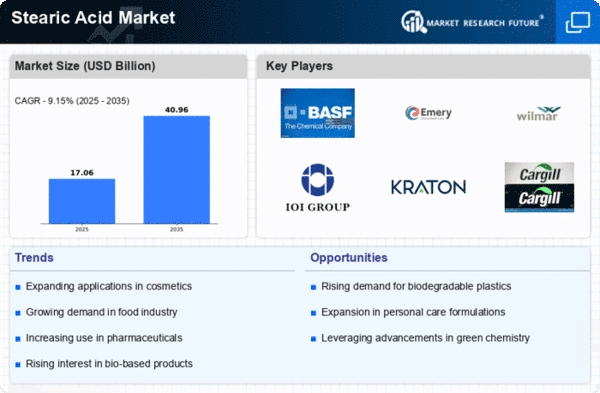
Stearic Acid Market Infographic
Purchase Options

Market Trends

Key Emerging Trends in the Stearic Acid Market

The stearic acid market is experiencing notable trends driven by various factors influencing supply, demand, and consumer preferences. One significant trend is the increasing demand for stearic acid in various industries such as personal care, cosmetics, pharmaceuticals, and plastics. Stearic acid, a saturated fatty acid derived from animal and vegetable fats, is widely used as an emulsifier, surfactant, and thickening agent in these industries. Its versatility and functional properties make it a crucial ingredient in a wide range of products, including lotions, creams, soaps, candles, and PVC stabilizers.

Stearic acid use is rising in the automotive industry owing to its softener and dispersing properties. Burgeoning textile industry due to rising aspiration based purchasing and high per capita disposable income of the consumers is stimulating the product demand globally.

One of the key drivers of market growth is the rising demand for personal care and cosmetics products globally. With the growing awareness of skincare and grooming routines, consumers are increasingly seeking products with natural ingredients like stearic acid. Its ability to stabilize formulations, improve texture, and enhance moisturization makes it a preferred choice for manufacturers of skincare and cosmetic products. Additionally, the trend towards clean beauty and green formulations has led to an increased preference for plant-derived stearic acid over its animal-derived counterpart.

Another significant trend in the stearic acid market is the shift towards sustainable sourcing and production practices. As consumers become more environmentally conscious, there is a growing demand for sustainably sourced ingredients and eco-friendly manufacturing processes. This trend has prompted stearic acid producers to invest in sustainable sourcing methods, such as sourcing from certified sustainable palm oil plantations or utilizing waste fats and oils as feedstock for stearic acid production. Additionally, there is increasing interest in developing alternative sources of stearic acid, such as microbial fermentation, as a more sustainable and ethical alternative to traditional animal and plant-derived sources.

Moreover, the stearic acid market is also influenced by regulatory factors and evolving industry standards. Regulatory changes related to product safety, labeling, and ingredient restrictions can impact the market dynamics and drive innovation in formulation and production processes. For instance, stricter regulations on the use of certain ingredients, such as parabens and sulfates, in personal care products have led manufacturers to reformulate their products using alternative ingredients like stearic acid. Similarly, the implementation of sustainability certifications and standards, such as RSPO (Roundtable on Sustainable Palm Oil) certification, can influence sourcing decisions and supply chain practices within the stearic acid industry.

Furthermore, technological advancements and innovations are shaping the stearic acid market landscape. Manufacturers are continually exploring new technologies and processes to improve the efficiency, cost-effectiveness, and sustainability of stearic acid production. This includes innovations in enzymatic hydrolysis, biocatalysis, and green chemistry techniques to optimize yield, reduce waste, and minimize environmental impact. Additionally, advancements in product formulation and customization, such as the development of high-purity stearic acid grades or specialty derivatives, are enabling manufacturers to cater to diverse customer needs and application requirements.

Author
Anshula Mandaokar
Team Lead - Research

Anshula Mandaokar holds an academic degree in Chemical Engineering and has been contributing to the field for more than 5 years. She has expertise in Market Research and Business Consulting and serves as a Team Lead for a reputed Market Research firm under the Chemicals and Materials domain spectrum. She has worked on multiple projects, generating explicit results in a quick turnaround time. Her understanding of data interpretation justifies her role as a leader.

Leave a Comment

FAQs

What is the projected market valuation of the Stearic Acid Market by 2035?

<p>The projected market valuation of the Stearic Acid Market is expected to reach 40.96 USD Billion by 2035.</p>

What was the market valuation of the Stearic Acid Market in 2024?

<p>The market valuation of the Stearic Acid Market was 15.63 USD Billion in 2024.</p>

What is the expected CAGR for the Stearic Acid Market during the forecast period 2025 - 2035?

<p>The expected CAGR for the Stearic Acid Market during the forecast period 2025 - 2035 is 9.15%.</p>

Which companies are considered key players in the Stearic Acid Market?

<p>Key players in the Stearic Acid Market include BASF SE, Emery Oleochemicals, Wilmar International Limited, and others.</p>

What are the main applications of Stearic Acid and their market valuations?

<p>Main applications include Personal Care (12.17 USD Billion), Food Industry (8.12 USD Billion), and Industrial Lubricants (8.1 USD Billion) by 2035.</p>

How does the market for Stearic Acid in the Food Industry compare to other segments?

The Food Industry segment is projected to reach 8.12 USD Billion by 2035, indicating robust growth compared to other segments.

What are the projected valuations for different sources of Stearic Acid by 2035?

By 2035, the projected valuations for sources include Synthetic (10.5 USD Billion) and Palm Oil (7.5 USD Billion).

What purity levels of Stearic Acid are expected to dominate the market by 2035?

The Technical Grade purity level is anticipated to dominate the market, reaching 13.25 USD Billion by 2035.

What is the significance of the Surfactants segment in the Stearic Acid Market?

The Surfactants segment is projected to grow to 8.12 USD Billion by 2035, highlighting its importance in the market.

How do the valuations of the Personal Care segment compare to other applications?

The Personal Care segment is expected to reach 12.17 USD Billion by 2035, making it one of the leading applications in the market.

Market Summary

As per MRFR analysis, the Stearic Acid Market Size was estimated at 15.63 USD Billion in 2024. The Stearic Acid industry is projected to grow from 17.06 in 2025 to 40.96 by 2035, exhibiting a compound annual growth rate (CAGR) of 9.15% during the forecast period 2025 - 2035.

Key Market Trends & Highlights

The Stearic Acid Market is currently experiencing robust growth driven by diverse applications and sustainability initiatives.

  • North America remains the largest market for stearic acid, primarily due to its extensive use in cosmetics and personal care products. The Asia-Pacific region is recognized as the fastest-growing market, fueled by increasing demand in the food industry and technological advancements. The cosmetics segment dominates the market, while the food industry is emerging as the fastest-growing segment for stearic acid applications. Rising demand for bio-based products and expansion in the pharmaceutical sector are key drivers propelling market growth.

Market Size & Forecast

2024 Market Size 15.63 (USD Billion)
2035 Market Size 40.96 (USD Billion)
CAGR (2025 - 2035) 9.15%
Largest Regional Market Share in 2024 Asia-Pacific

Major Players

BASF SE (DE), Emery Oleochemicals (MY), Wilmar International Limited (SG), IOI Group (MY), Kraton Corporation (US), Cargill, Incorporated (US), SABIC (SA), Mitsubishi Chemical Corporation (JP), Vantage Specialty Chemicals (US)

Market Trends

The Stearic Acid Market is currently experiencing a dynamic phase characterized by evolving consumer preferences and increasing applications across various industries. This fatty acid, derived primarily from vegetable and animal fats, is gaining traction due to its versatility in personal care, cosmetics, and food sectors. The growing demand for natural and organic products appears to be influencing manufacturers to explore sustainable sourcing options, thereby enhancing the market's appeal. Furthermore, the rise in awareness regarding the benefits of stearic acid in formulations is likely to drive innovation and product development, fostering a competitive landscape.

In addition, the stearic acid market is witnessing a shift towards eco-friendly practices, as companies strive to align with global sustainability goals. This trend is reflected in the increasing adoption of biodegradable and renewable materials in production processes. As regulatory frameworks become more stringent, manufacturers may need to adapt their strategies to comply with environmental standards while maintaining competitive stearic acid market price levels. Overall, the market seems poised for growth, supported by expanding industrial demand and the increasing stearic acid market size, driven by a combination of consumer demand for quality, sustainability, and innovation in product offerings.

Sustainability Initiatives

The emphasis on sustainable practices is becoming increasingly prominent within the Stearic Acid Market. Companies are exploring eco-friendly sourcing methods and biodegradable alternatives to meet the rising demand for environmentally responsible products. This trend reflects a broader shift towards sustainability across various sectors, influencing production and consumption patterns.

Technological Advancements

Innovations in production technology are reshaping the landscape of the Stearic Acid Market. Enhanced extraction and refining processes are likely to improve efficiency and reduce environmental impact. These advancements may lead to higher quality products and increased competitiveness among manufacturers.

Diverse Applications

The versatility of stearic acid is evident in its wide range of applications across various sectors, including personal care, food, and pharmaceuticals. This diversity not only enhances the growth potential of the stearic acid market but also influences the overall stearic acid market price as demand rises across multiple industries.

Stearic Acid Market Market Drivers

Growth in Food Industry Applications

The Global Stearic Acid Market Industry benefits from the expanding applications of stearic acid in the food sector. Used as a food additive and emulsifier, stearic acid enhances the texture and stability of various food products. With the global food industry continually evolving, the demand for high-quality ingredients is paramount. Stearic acid's role in improving food quality and shelf life is increasingly recognized, potentially leading to a rise in its consumption. This trend is indicative of the broader market growth, which is anticipated to reach 65.2 USD Billion by 2035, reflecting a robust CAGR of 6.16% from 2025 to 2035.

Rising Demand in Personal Care Products

The Global Stearic Acid Market Industry experiences a notable surge in demand due to the increasing utilization of stearic acid in personal care products. This compound serves as an emulsifier and thickening agent in creams, lotions, and cosmetics. As consumers become more conscious of product ingredients, the preference for natural and biodegradable components is likely to drive the market further. The personal care sector is projected to contribute significantly to the market's growth, with stearic acid's application expanding in formulations. This trend aligns with the overall market valuation, which is expected to reach 33.8 USD Billion in 2024.

Increasing Use in Industrial Applications

The Global Stearic Acid Market Industry is significantly influenced by the rising use of stearic acid in various industrial applications. This compound is utilized in the production of soaps, detergents, and lubricants, where it acts as a surfactant and stabilizer. The industrial sector's demand for high-performance products is likely to propel the market forward. As industries seek to enhance product efficiency and sustainability, stearic acid's role becomes increasingly vital. This trend suggests a steady growth trajectory for the market, aligning with the overall expansion of the industrial sector globally.

Sustainability Trends Driving Market Growth

The Global Stearic Acid Market Industry is experiencing a shift towards sustainability, with a growing emphasis on eco-friendly products. Manufacturers are increasingly sourcing stearic acid from renewable resources, aligning with global sustainability goals. This trend is driven by consumer preferences for environmentally responsible products, prompting companies to innovate in their formulations. The rise of green chemistry and sustainable manufacturing practices is likely to enhance the appeal of stearic acid in various applications. As sustainability becomes a core focus, the market is expected to witness significant growth, reflecting changing consumer attitudes and regulatory pressures.

Technological Advancements in Production Processes

The Global Stearic Acid Market Industry is poised for growth due to ongoing technological advancements in production processes. Innovations in extraction and purification techniques are enhancing the efficiency and yield of stearic acid production. These advancements not only reduce production costs but also improve product quality, making stearic acid more competitive in various applications. As manufacturers adopt cutting-edge technologies, the market is likely to benefit from increased supply and reduced environmental impact. This trend underscores the importance of innovation in driving market dynamics and meeting the evolving demands of consumers and industries.

Market Segment Insights

By Application: Cosmetics (Largest) vs. Personal Care (Fastest-Growing)

<p>The stearic acid market displays a diverse application landscape, with cosmetics holding the largest share due to their essential role in formulations for creams, lotions, and makeup products. Following closely, the personal care segment is growing rapidly as health and beauty trends shift towards more natural and effective ingredients, making stearic acid a favorable choice for manufacturers aiming to enhance product quality. Market growth in these segments is driven by increasing consumer awareness about the benefits of clean beauty products and the rising demand for multifunctional ingredients. The food industry and pharmaceuticals also contribute to the market but at a slower pace. Industrial lubricants remain steady, serving niche applications that are essential but less influenced by the current trends in consumer goods.</p>

<p>Cosmetics (Dominant) vs. Pharmaceuticals (Emerging)</p>

<p>The cosmetics segment remains dominant in the stearic acid market, renowned for its versatility and effectiveness in various formulations, providing emollient and stabilizing properties. This segment is primarily influenced by trends in clean and natural beauty, with brands increasingly seeking to appeal to eco-conscious consumers. In contrast, the pharmaceuticals segment is emerging, driven by the demand for reliable excipients and stabilizers in drug formulations. As pharmaceutical companies focus on developing new delivery systems and formulations that require exceptional ingredient performance, stearic acid is gaining traction. While cosmetics continue to lead, the rising interest in pharmaceutical applications presents a promising avenue for growth and innovation in the stearic acid market.</p>

By End Use: Surfactants (Largest) vs. Emulsifiers (Fastest-Growing)

The Stearic Acid Market has a diverse array of end-use applications, with surfactants occupying the largest share. These compounds are pivotal in various industries like personal care and household products, significantly contributing to the market dynamics. Emulsifiers represent an emerging segment, witnessing rapid growth due to their essential role in food and cosmetic applications, enhancing product stability and texture. As industries evolve and consumer preferences shift towards premium products, the demand for emulsifiers is expected to rise sharply, driving their market presence.

Surfactants (Dominant) vs. Emulsifiers (Emerging)

Surfactants dominate the stearic acid market due to their widespread use in personal care, home care, and industrial applications. Their ability to reduce surface tension makes them invaluable in detergent formulations and other cleaning agents. The stability and effectiveness of surfactants help maintain product quality, thus ensuring consumer satisfaction. In contrast, emulsifiers are recognized for their growing importance, particularly within the food and cosmetic sectors. They enhance product consistency and shelf-life, reflecting their increasing acceptance among manufacturers. With consumers seeking clean-label products, emulsifiers are likely to see expanded applications, appealing to both health-conscious trends and innovative product developments.

By Source: Animal Fat (Largest) vs. Vegetable Oil (Fastest-Growing)

<p>In the Stearic Acid Market, the source segment is predominantly influenced by a mix of Animal Fat, Vegetable Oil, Synthetic sources, Palm Oil, and Tallow. Animal Fat is currently the largest contributor, holding a significant share due to its widespread availability and established extraction processes in the pharmaceutical and cosmetic industries. Following closely is Vegetable Oil, noted for its expanding role in sustainable applications, catering to increasing consumer demand for eco-friendly products. Other sources like Synthetic and Palm Oil are also notable, yet they capture smaller portions of the market.</p>

<p>Animal Fat: Dominant vs. Vegetable Oil: Emerging</p>

<p>Animal Fat has long been established as the dominant source in the Stearic Acid Market, leveraging traditional processing methods and solid demand in various applications such as detergents and cosmetics. Its rich fatty acid profile makes it highly suitable for diverse formulations. Conversely, Vegetable Oil is emerging as a crucial source, driven by a global shift towards renewable resources and sustainable production practices. The increasing regulatory support for bio-based materials further bolsters its market position, attracting investments in capacity expansion and innovative processing techniques. Together, these sources illustrate the dynamic landscape of the Stearic Acid Market.</p>

By Purity Level: High Purity (Largest) vs. Pharmaceutical Grade (Fastest-Growing)

<p>In the Stearic Acid Market, the distribution of market share among the purity levels reveals a clear hierarchy. High Purity Stearic Acid stands out as the largest segment, driven by its extensive applications in personal care and cosmetics sectors. Technical Grade and Food Grade follow, catering to specific industrial and food applications, while Pharmaceutical Grade is rapidly gaining traction, increasingly utilized in pharmaceutical formulations due to rising demands for high-quality ingredients.</p>

<p>High Purity (Dominant) vs. Pharmaceutical Grade (Emerging)</p>

<p>High Purity Stearic Acid is characterized by its stringent specifications and is widely recognized for its effectiveness in various applications ranging from cosmetics to food processing. This segment dominates the market due to its superior quality and performance, appealing to premium brands. On the other hand, Pharmaceutical Grade Stearic Acid is emerging rapidly as the industry recognizes the importance of high-quality excipients in drug manufacturing. This segment is gaining ground because of rising health consciousness and stringent regulatory standards, which are pushing for higher purity levels in pharmaceutical applications, thereby creating new opportunities for growth.</p>

By Purity Level: High Purity Grade (Largest) vs. Food Grade (Fastest-Growing)

In the Stearic Acid Market, the purity level segments are diverse, with each grade catering to specific applications. High Purity Grade stearic acid claims the largest market share, predominantly due to its extensive usage in cosmetic and pharmaceutical applications. Standard Grade and Technical Grade also maintain a considerable presence, serving various industrial applications. Food Grade stearic acid, although smaller in market share, is steadily gaining traction due to increasing consumer demand for food-specific additives.

High Purity Grade (Dominant) vs. Technical Grade (Emerging)

High Purity Grade stearic acid is revered for its exceptional quality and minimal impurities, making it highly sought after in the production of cosmetics and pharmaceuticals. As a dominant segment, it benefits from strong regulatory compliance and consumer preferences for premium products. In contrast, Technical Grade stearic acid serves industries where lower purity levels suffice, such as lubricants and textiles, marking its emergence as a cost-effective option. As industries evolve, the demand for specialized formulations within this segment is expected to grow, driven by advances in processing technologies and increasing end-user sophistication.

Get more detailed insights about Stearic Acid Market Research Report – Forecast to 2035

Regional Insights

North America : Established Market with Growth Potential

The North American stearic acid market is poised for steady growth, driven by increasing demand in personal care and cosmetics industries. With a market size of $3.13 million, the region is witnessing a shift towards sustainable and bio-based products, aligning with regulatory trends favoring eco-friendly solutions. The rise in consumer awareness regarding natural ingredients is further propelling this demand. Leading countries such as the US and Canada are home to key players like Cargill and Kraton Corporation, which are focusing on innovation and product development. The competitive landscape is characterized by a mix of established companies and emerging players, all vying for market share. The presence of stringent regulations regarding product safety and environmental impact is also shaping the market dynamics, encouraging companies to adopt sustainable practices.

Europe : Innovation and Sustainability Focus

Europe's stearic acid market, valued at $4.69 million, is thriving due to a strong emphasis on innovation and sustainability. The region is witnessing a growing demand for stearic acid in various applications, including food, cosmetics, and pharmaceuticals. Regulatory frameworks promoting sustainable practices are acting as catalysts for market growth, encouraging manufacturers to invest in eco-friendly production methods. Germany, France, and the UK are leading countries in this market, hosting major players like BASF and SABIC. The competitive landscape is robust, with companies focusing on R&D to develop high-quality, sustainable products. The European market is characterized by stringent regulations that ensure product safety and environmental compliance, further driving innovation in the sector. "The European market is committed to sustainability, with regulations that support eco-friendly practices in chemical production," European Chemical Agency.

Asia-Pacific : Emerging Powerhouse in Stearic Acid

Asia-Pacific is the largest market for stearic acid, with a market size of $7.88 million, driven by rapid industrialization and increasing consumer demand in personal care and food sectors. The region's growth is supported by favorable government policies and investments in manufacturing capabilities. The rising trend of using natural ingredients in products is also contributing to market expansion, as consumers become more health-conscious. Countries like China, India, and Japan are at the forefront of this growth, with key players such as Wilmar International and Mitsubishi Chemical Corporation leading the charge. The competitive landscape is dynamic, with numerous local and international companies competing for market share. The presence of a well-established supply chain and increasing production capacities are further enhancing the region's position in the global market.

Middle East and Africa : Resource-Rich Frontier for Growth

The Middle East and Africa (MEA) region, with a market size of $0.93 million, is emerging as a resource-rich frontier for the stearic acid market. The growth in this region is primarily driven by increasing industrial activities and a rising demand for personal care products. Government initiatives aimed at boosting local manufacturing and reducing dependency on imports are also contributing to market growth, creating a favorable environment for investment. Countries like South Africa and the UAE are leading the way, with a growing number of local manufacturers entering the market. The competitive landscape is evolving, with both regional and international players seeking to establish a foothold. The presence of abundant natural resources and a young population are key factors that could drive future growth in the MEA stearic acid market.

Key Players and Competitive Insights

The Stearic Acid Market is currently characterized by a competitive landscape that is both dynamic and multifaceted. Key growth drivers include the increasing demand for stearic acid in personal care, cosmetics, and food industries, alongside a growing emphasis on sustainable sourcing and production methods. Major players such as BASF SE (Germany), Cargill, Incorporated (US), and Wilmar International Limited (Singapore) are strategically positioned to leverage these trends. BASF SE (Germany) focuses on innovation and sustainability, investing in bio-based alternatives to traditional stearic acid production, which aligns with the rising consumer preference for eco-friendly products. Meanwhile, Cargill, Incorporated (US) emphasizes supply chain optimization and regional expansion, enhancing its market presence through strategic partnerships and local manufacturing initiatives. Wilmar International Limited (Singapore) is also expanding its footprint by diversifying its product offerings and enhancing its distribution networks, thereby shaping a competitive environment that is increasingly focused on sustainability and innovation.In terms of business tactics, companies are localizing manufacturing to reduce transportation costs and improve supply chain efficiency. The market structure appears moderately fragmented, with several key players exerting influence while also allowing for smaller companies to thrive. This fragmentation fosters competition, driving innovation and efficiency across the sector. The collective influence of these major players is significant, as they set industry standards and trends that smaller companies often follow.
In November BASF SE (Germany) announced the launch of a new line of bio-based stearic acid products aimed at the cosmetics industry. This strategic move is likely to enhance BASF's market share by appealing to environmentally conscious consumers and brands seeking sustainable ingredients. The introduction of these products not only reinforces BASF's commitment to sustainability but also positions the company as a leader in innovation within the stearic acid segment.
In October Cargill, Incorporated (US) expanded its production capacity in Southeast Asia by investing $50 million in a new manufacturing facility. This expansion is expected to significantly increase Cargill's output of stearic acid, allowing the company to meet the growing demand in the region. The strategic importance of this investment lies in its potential to enhance Cargill's competitive edge through improved supply chain reliability and responsiveness to market needs.
In September Wilmar International Limited (Singapore) entered into a strategic partnership with a leading personal care brand to supply sustainably sourced stearic acid. This collaboration is indicative of Wilmar's focus on aligning with consumer trends towards sustainability. By securing such partnerships, Wilmar not only strengthens its market position but also enhances its reputation as a responsible supplier in the stearic acid market.
As of December current competitive trends are increasingly defined by digitalization, sustainability, and the integration of AI technologies. Companies are leveraging these trends to enhance operational efficiencies and product offerings. Strategic alliances are becoming more prevalent, as firms recognize the value of collaboration in navigating the complexities of the market. Looking ahead, competitive differentiation is likely to evolve from traditional price-based competition to a focus on innovation, technological advancements, and supply chain reliability. This shift underscores the importance of adaptability and forward-thinking strategies in maintaining a competitive edge in the stearic acid market.

Key Companies in the Stearic Acid Market include

Industry Developments

In February 2024, the Solvent Extractors’ Association of India (SEA) went to the Government of India to restrict the trade of finished oleochemical products. The SEA stated that the increase in the duty-free imports of stearic acid from Southeast Asian countries would lead to adverse effects on the domestic oleochemical sector.November 2022 - A certified geraniol extra BMBcertTM has a significantly lower third-party-accredited carbon footprint as it offers BASF as the first aroma ingredient supplier. There is a rose scent in many common Home and Personal Care products.

Geraniol Extra BMBcertTM, which substitutes fossil feedstock with Odorless biomass balance, incorporates sustainability benefits to its wide range of application fields and helps reduce CO2 emissions. Also, it is classified as a fast-disappearing and safe biodegradable substance.November 2022 - Now, it is flexible to install-site textile recognition and can be done through trinamiX, the mobile spectroscopy and the subsidiary of BASF SE. Owing to trinamiX’s mobile NIR Spectroscopy Solution even more than 15 different textile types and compositions can be seen and well sorted out.

Even parts made up of material mixes can be easily recognized and are disclosed without material destructive techniques.

Intended Audience

  • Stearic acid manufacturers
  • Traders and distributors of stearic acid
  • Research and development institutes
  • Potential investors
  • Raw material suppliers
  • Nationalized laboratory

Future Outlook

Stearic Acid Market Future Outlook

The Stearic Acid Market is projected to grow at a 9.15% CAGR from 2025 to 2035, driven by rising demand in personal care and industrial applications.

New opportunities lie in:

  • <p>Expansion into bio-based stearic acid production Development of customized formulations for cosmetics Strategic partnerships with packaging companies for sustainable solutions</p>

By 2035, the Stearic Acid Market is expected to achieve robust growth, reflecting evolving consumer preferences and industrial needs.

Market Segmentation

Stearic Acid Market Form Outlook

  • Powder
  • Flakes
  • Liquid
  • Granules
  • Beads

Stearic Acid Market Source Outlook

  • Animal Fat
  • Vegetable Oil
  • Synthetic Production
  • Palm Oil
  • Tallow

Stearic Acid Market End Use Outlook

  • Food Additives
  • Surfactants
  • Emulsifiers
  • Thickeners
  • Stabilizers

Stearic Acid Market Application Outlook

  • Cosmetics
  • Food Industry
  • Pharmaceuticals
  • Industrial Lubricants
  • Personal Care Products

Stearic Acid Market Purity Level Outlook

  • Standard Grade
  • High Purity Grade
  • Technical Grade
  • Food Grade
  • Pharmaceutical Grade

Report Scope

MARKET SIZE 2024 15.63(USD Billion)
MARKET SIZE 2025 17.06(USD Billion)
MARKET SIZE 2035 40.96(USD Billion)
COMPOUND ANNUAL GROWTH RATE (CAGR) 9.15% (2025 - 2035)
REPORT COVERAGE Revenue Forecast, Competitive Landscape, Growth Factors, and Trends
BASE YEAR 2024
Market Forecast Period 2025 - 2035
Historical Data 2019 - 2024
Market Forecast Units USD Billion
Key Companies Profiled BASF SE (DE), Emery Oleochemicals (MY), Wilmar International Limited (SG), IOI Group (MY), Kraton Corporation (US), Cargill, Incorporated (US), SABIC (SA), Mitsubishi Chemical Corporation (JP), Vantage Specialty Chemicals (US)
Segments Covered Application, End Use, Source, Form, Purity Level
Key Market Opportunities Growing demand for sustainable and bio-based products in the Stearic Acid Market presents significant opportunities.
Key Market Dynamics Rising demand for biodegradable products drives innovation and competition in the stearic acid market.
Countries Covered North America, Europe, APAC, South America, MEA

FAQs

What is the projected market valuation of the Stearic Acid Market by 2035?

<p>The projected market valuation of the Stearic Acid Market is expected to reach 40.96 USD Billion by 2035.</p>

What was the market valuation of the Stearic Acid Market in 2024?

<p>The market valuation of the Stearic Acid Market was 15.63 USD Billion in 2024.</p>

What is the expected CAGR for the Stearic Acid Market during the forecast period 2025 - 2035?

<p>The expected CAGR for the Stearic Acid Market during the forecast period 2025 - 2035 is 9.15%.</p>

Which companies are considered key players in the Stearic Acid Market?

<p>Key players in the Stearic Acid Market include BASF SE, Emery Oleochemicals, Wilmar International Limited, and others.</p>

What are the main applications of Stearic Acid and their market valuations?

<p>Main applications include Personal Care (12.17 USD Billion), Food Industry (8.12 USD Billion), and Industrial Lubricants (8.1 USD Billion) by 2035.</p>

How does the market for Stearic Acid in the Food Industry compare to other segments?

The Food Industry segment is projected to reach 8.12 USD Billion by 2035, indicating robust growth compared to other segments.

What are the projected valuations for different sources of Stearic Acid by 2035?

By 2035, the projected valuations for sources include Synthetic (10.5 USD Billion) and Palm Oil (7.5 USD Billion).

What purity levels of Stearic Acid are expected to dominate the market by 2035?

The Technical Grade purity level is anticipated to dominate the market, reaching 13.25 USD Billion by 2035.

What is the significance of the Surfactants segment in the Stearic Acid Market?

The Surfactants segment is projected to grow to 8.12 USD Billion by 2035, highlighting its importance in the market.

How do the valuations of the Personal Care segment compare to other applications?

The Personal Care segment is expected to reach 12.17 USD Billion by 2035, making it one of the leading applications in the market.

  1. SECTION I: EXECUTIVE SUMMARY AND KEY HIGHLIGHTS
    1. EXECUTIVE SUMMARY
      1. Market Overview
      2. Key Findings
      3. Market Segmentation
      4. Competitive Landscape
      5. Challenges and Opportunities
      6. Future Outlook 2
  2. SECTION II: SCOPING, METHODOLOGY AND MARKET STRUCTURE
    1. MARKET INTRODUCTION
      1. Definition
      2. Scope of the study
    2. RESEARCH METHODOLOGY
      1. Overview
      2. Data Mining
      3. Secondary Research
      4. Primary Research
      5. Forecasting Model
      6. Market Size Estimation
      7. Data Triangulation
      8. Validation 3
  3. SECTION III: QUALITATIVE ANALYSIS
    1. MARKET DYNAMICS
      1. Overview
      2. Drivers
      3. Restraints
      4. Opportunities
    2. MARKET FACTOR ANALYSIS
      1. Value chain Analysis
      2. Porter's Five Forces Analysis
      3. COVID-19 Impact Analysis
  4. SECTION IV: QUANTITATIVE ANALYSIS
    1. Stearic Acid Market, BY Application (USD Billion)
      1. Cosmetics
      2. Food Industry
      3. Pharmaceuticals
      4. Industrial Lubricants
      5. Personal Care Products
    2. Stearic Acid Market, BY End Use (USD Billion)
      1. Food Additives
      2. Surfactants
      3. Emulsifiers
      4. Thickeners
      5. Stabilizers
    3. Stearic Acid Market, BY Source (USD Billion)
      1. Animal Fat
      2. Vegetable Oil
      3. Synthetic Production
      4. Palm Oil
      5. Tallow
    4. Stearic Acid Market, BY Form (USD Billion)
      1. Powder
      2. Flakes
      3. Liquid
      4. Granules
      5. Beads
    5. Stearic Acid Market, BY Purity Level (USD Billion)
      1. Standard Grade
      2. High Purity Grade
      3. Technical Grade
      4. Food Grade
      5. Pharmaceutical Grade
    6. Stearic Acid Market, BY Region (USD Billion)
      1. North America
      2. Europe
      3. APAC
      4. South America
      5. MEA
  5. SECTION V: COMPETITIVE ANALYSIS
    1. Competitive Landscape
      1. Overview
      2. Competitive Analysis
      3. Market share Analysis
      4. Major Growth Strategy in the Chemicals and Materials
      5. Competitive Benchmarking
      6. Leading Players in Terms of Number of Developments in the Chemicals and Materials
      7. Key developments and growth strategies
      8. Major Players Financial Matrix
    2. Company Profiles
      1. BASF SE (DE)
      2. Emery Oleochemicals (MY)
      3. Wilmar International Limited (SG)
      4. IOI Group (MY)
      5. Kraton Corporation (US)
      6. Cargill, Incorporated (US)
      7. SABIC (SA)
      8. Mitsubishi Chemical Corporation (JP)
      9. Vantage Specialty Chemicals (US)
    3. Appendix
      1. References
      2. Related Reports

Stearic Acid Market Segmentation

Stearic Acid Market By Application (USD Billion, 2025-2035)

  • Cosmetics
  • Food Industry
  • Pharmaceuticals
  • Industrial Lubricants
  • Personal Care Products

Stearic Acid Market By End Use (USD Billion, 2025-2035)

  • Food Additives
  • Surfactants
  • Emulsifiers
  • Thickeners
  • Stabilizers

Stearic Acid Market By Source (USD Billion, 2025-2035)

  • Animal Fat
  • Vegetable Oil
  • Synthetic Production
  • Palm Oil
  • Tallow

Stearic Acid Market By Form (USD Billion, 2025-2035)

  • Powder
  • Flakes
  • Liquid
  • Granules
  • Beads

Stearic Acid Market By Purity Level (USD Billion, 2025-2035)

  • Standard Grade
  • High Purity Grade
  • Technical Grade
  • Food Grade
  • Pharmaceutical Grade
Infographic

Free Sample Request

Kindly complete the form below to receive a free sample of this Report

Get Free Sample

Customer Strories

Compare Licence

×
Features License Type
Single User Multiuser License Enterprise User
Price $4,950 $5,950 $7,250
Maximum User Access Limit 1 User Upto 10 Users Unrestricted Access Throughout the Organization
Free Customization
Direct Access to Analyst
Deliverable Format
Platform Access
Discount on Next Purchase 10% 15% 15%
Printable Versions