
×
Request Free Sample ×

Kindly complete the form below to receive a free sample of this Report

* Please use a valid business email

Leading companies partner with us for data-driven Insights

clients tt-cursor
Hero Background
English
Chinese
French
Japanese
Korean
German
Spanish

Stealth Warfare Market Analysis

ID: MRFR/AD/4696-HCR
100 Pages
Sejal Akre
February 2026

Stealth Warfare Market Size, Share, Industry Trend & Analysis Research Report By Platform Type (Aircraft, Naval Vessels, Ground Vehicles, Unmanned Aerial Vehicles, Missiles), By Stealth Technology Type (Radar Absorbent Materials, Shape Control Technology, Active Stealth, Low Observable Technology), By Application (Surveillance, Reconnaissance, Combat Operations, Electronic Warfare), By End User (Military, Government Agencies, Private Defense Contractors) andBy Regional (North America, Europe, South America, Asia Pacific, Middle East and Africa)- Forecast to 2035.

Share:
Download PDF ×

We do not share your information with anyone. However, we may send you emails based on your report interest from time to time. You may contact us at any time to opt-out.

Stealth Warfare Market Infographic
Purchase Options

Market Analysis

In-depth Analysis of Stealth Warfare Market Industry Landscape

The market dynamics of stealth warfare are shaped by a confluence of technological advancements, defense strategies, and evolving security threats. The concept of stealth in warfare revolves around minimizing the visibility of military assets to adversaries, and this principle has become a key driver in shaping the defense industry. One of the primary factors influencing the Stealth Warfare Market is the continuous evolution of technology. Advances in radar-absorbing materials, aircraft design, and electronic warfare systems contribute to the development of stealth technologies. Nations invest heavily in research and development to maintain a technological edge, leading to a competitive landscape among defense contractors and aerospace companies.

Geopolitical considerations and security threats also play a pivotal role in shaping the market dynamics of stealth warfare. As nations face diverse and evolving challenges, ranging from regional conflicts to global terrorism, the demand for stealth capabilities rises. Stealth technologies are not limited to aircraft but extend to naval vessels, ground vehicles, and even individual soldiers, providing a comprehensive approach to enhancing military effectiveness. Nations seek to deploy stealth assets to ensure strategic advantages and project power with reduced vulnerability.

The military's focus on modernization and the integration of stealth technologies into various platforms drive the market dynamics. Stealth capabilities are not confined to a specific branch of the military, as air forces, navies, and armies all incorporate stealth features into their assets. The pursuit of versatile and adaptable stealth solutions fuels competition among defense contractors, as they strive to offer comprehensive and integrated stealth solutions across different domains of warfare.

Defense budgets and government spending significantly impact the Stealth Warfare Market. The development and acquisition of stealth technologies require substantial investments, and defense budget allocations directly influence the pace and scale of stealth-related projects. Economic conditions, geopolitical tensions, and perceived security threats influence government priorities, affecting the level of funding allocated to stealth warfare capabilities. Market players must navigate these budgetary considerations and align their offerings with the evolving needs of defense agencies.

Global collaboration and partnerships in the defense industry contribute to the market dynamics of stealth warfare. Many nations engage in joint development programs and international collaborations to share technological expertise, reduce costs, and enhance interoperability. These partnerships influence the distribution of contracts and create a dynamic competitive landscape where companies with global alliances gain strategic advantages in the stealth warfare market.

The emergence of unmanned systems and artificial intelligence further shapes the dynamics of stealth warfare. Unmanned aerial vehicles (UAVs) and autonomous platforms leverage stealth technologies to conduct surveillance, reconnaissance, and strike missions with reduced risk to human operators. As unmanned systems become more prevalent, the market for stealth technologies expands, with a focus on developing cutting-edge solutions that cater to the requirements of autonomous platforms.


Author
Sejal Akre
Senior Research Analyst

She has over 5 years of rich experience, in market research and consulting providing valuable market insights to client. Hands on expertise in management consulting, and extensive knowledge in domain including ICT, Automotive & Transportation and Aerospace & Defense. She is skilled in Go-to market strategy, industry analysis, market sizing, in depth company profiling, competitive intelligence & benchmarking and value chain amongst others.

Leave a Comment

FAQs

What is the projected market valuation of the Stealth Warfare Market by 2035?

<p>The Stealth Warfare Market is projected to reach a valuation of 48.45 USD Billion by 2035.</p>

What was the market valuation of the Stealth Warfare Market in 2024?

<p>In 2024, the Stealth Warfare Market was valued at 29.98 USD Billion.</p>

What is the expected CAGR for the Stealth Warfare Market during the forecast period 2025 - 2035?

<p>The expected CAGR for the Stealth Warfare Market during the forecast period 2025 - 2035 is 4.46%.</p>

Which companies are considered key players in the Stealth Warfare Market?

<p>Key players in the Stealth Warfare Market include Lockheed Martin, Northrop Grumman, Boeing, and Raytheon Technologies.</p>

What are the main segments of the Stealth Warfare Market?

<p>The main segments of the Stealth Warfare Market include Platform Type, Stealth Technology Type, Application, and End User.</p>

How much is the Aircraft segment projected to grow by 2035?

<p>The Aircraft segment is projected to grow from 10.0 USD Billion in 2024 to 15.0 USD Billion by 2035.</p>

What is the projected valuation for the Ground Vehicles segment by 2035?

<p>The Ground Vehicles segment is expected to reach a valuation of 8.0 USD Billion by 2035.</p>

What is the anticipated growth for the Active Stealth technology segment by 2035?

<p>The Active Stealth technology segment is anticipated to grow from 8.0 USD Billion in 2024 to 12.0 USD Billion by 2035.</p>

Which application segment is expected to have the highest valuation by 2035?

<p>The Combat Operations application segment is expected to have the highest valuation, reaching 15.0 USD Billion by 2035.</p>

What is the projected growth for the Military end user segment by 2035?

<p>The Military end user segment is projected to grow from 12.0 USD Billion in 2024 to 19.0 USD Billion by 2035.</p>

Market Summary

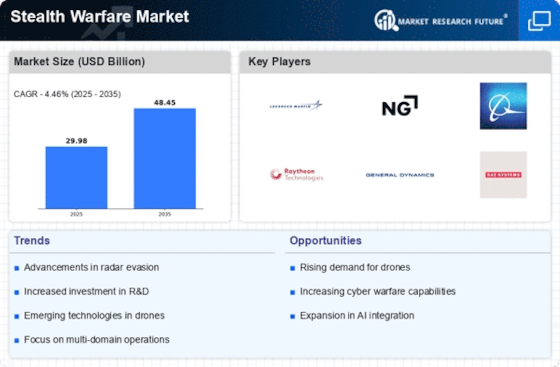
As per Market Research Future analysis, the Stealth Warfare Market Size was estimated at 29.98 USD Billion in 2024. The Stealth Warfare industry is projected to grow from 31.32 USD Billion in 2025 to 48.45 USD Billion by 2035, exhibiting a compound annual growth rate (CAGR) of 4.46% during the forecast period 2025 - 2035

Key Market Trends & Highlights

The Stealth Warfare Market is poised for substantial growth driven by technological advancements and geopolitical dynamics.

  • Technological advancements in stealth systems are reshaping military capabilities across various nations.
  • North America remains the largest market for stealth warfare, while Asia-Pacific is emerging as the fastest-growing region.
  • The aircraft segment dominates the market, whereas unmanned aerial vehicles are witnessing rapid growth.
  • Increased geopolitical tensions and defense modernization programs are key drivers propelling market expansion.

Market Size & Forecast

2024 Market Size 29.98 (USD Billion)
2035 Market Size 48.45 (USD Billion)
CAGR (2025 - 2035) 4.46%
Largest Regional Market Share in 2024 North America

Major Players

Lockheed Martin (US), Northrop Grumman (US), Boeing (US), Raytheon Technologies (US), General Dynamics (US), BAE Systems (GB), Leonardo (IT), Dassault Aviation (FR), Airbus (FR), Saab (SE)

Market Trends

The Stealth Warfare Market is currently experiencing a transformative phase, driven by advancements in technology and evolving military strategies. Nations are increasingly investing in stealth capabilities to enhance their operational effectiveness and maintain a strategic edge over potential adversaries. This market encompasses a wide array of products and services, including stealth aircraft, naval vessels, and ground vehicles, all designed to minimize detection and maximize mission success. As geopolitical tensions rise, the demand for stealth technologies appears to be intensifying, prompting defense contractors to innovate and adapt to the changing landscape. Moreover, the integration of artificial intelligence and advanced materials into stealth systems is likely to redefine operational paradigms. These innovations may not only improve stealth characteristics but also enhance situational awareness and decision-making processes. The Stealth Warfare Market seems poised for growth, as nations prioritize investments in next-generation technologies that promise to revolutionize warfare. The interplay between technological advancements and strategic imperatives suggests a dynamic future for this sector, with potential implications for global security dynamics.

Technological Advancements in Stealth Systems

The ongoing evolution of technology is reshaping the Stealth Warfare Market. Innovations in materials science, such as radar-absorbing materials, are enhancing the effectiveness of stealth platforms. Additionally, advancements in sensor technology and data fusion capabilities are likely to improve situational awareness, enabling more effective stealth operations.

Increased Geopolitical Tensions

Rising geopolitical tensions among nations are driving demand for stealth capabilities. Countries are investing in advanced stealth technologies to deter potential threats and maintain a competitive advantage. This trend indicates a shift in defense priorities, with an emphasis on stealth as a critical component of national security.

Integration of Artificial Intelligence

The incorporation of artificial intelligence into stealth systems is emerging as a pivotal trend. AI can enhance decision-making processes, optimize mission planning, and improve the overall effectiveness of stealth operations. This integration may lead to more autonomous systems, further transforming the landscape of modern warfare.

Stealth Warfare Market Market Drivers

Defense Modernization Programs

The Stealth Warfare Market is benefiting from extensive defense modernization programs being implemented by various nations. Governments are recognizing the necessity of upgrading their military capabilities to address evolving security challenges. These modernization initiatives often prioritize the development and acquisition of stealth technologies, as they are crucial for maintaining strategic advantages. For instance, countries such as India and Japan have announced substantial investments in next-generation stealth aircraft and naval vessels, with budgets exceeding 10 billion dollars over the next decade. This trend indicates a commitment to enhancing national defense through advanced stealth systems. Furthermore, as nations seek to replace aging fleets and improve operational readiness, the demand for innovative stealth solutions is likely to increase, further propelling growth within the Stealth Warfare Market.

Increased Geopolitical Tensions

The Stealth Warfare Market is significantly influenced by rising geopolitical tensions across various regions. Nations are increasingly investing in stealth capabilities to counter perceived threats and enhance their deterrence strategies. For example, the ongoing territorial disputes in the South China Sea and the resurgence of military posturing in Eastern Europe have prompted countries to bolster their defense budgets. Reports indicate that defense spending in these regions has increased by an average of 5% annually, with a substantial portion allocated to stealth technology development. This trend suggests that as tensions escalate, the demand for advanced stealth systems will likely grow, driving innovation and competition within the Stealth Warfare Market. Additionally, the need for covert operations and intelligence gathering further underscores the importance of stealth capabilities in modern warfare.

Emerging Threats and Asymmetric Warfare

The Stealth Warfare Market is increasingly shaped by the emergence of new threats and the evolution of asymmetric warfare. Non-state actors and insurgent groups are employing unconventional tactics that necessitate advanced stealth capabilities for effective countermeasures. As these threats become more sophisticated, traditional military forces are compelled to adapt their strategies, leading to a heightened focus on stealth technologies. Reports suggest that defense budgets are increasingly allocating resources to develop systems capable of countering these asymmetric threats, with an estimated 15% of military spending directed towards stealth capabilities. This shift indicates a recognition of the need for stealth in modern conflict scenarios, thereby driving growth within the Stealth Warfare Market. The ability to conduct operations undetected is becoming paramount, as militaries seek to maintain an edge over adversaries employing unconventional tactics.

Technological Advancements in Stealth Warfare Systems

The Stealth Warfare Market is experiencing a notable surge due to rapid technological advancements in stealth systems. Innovations in radar-absorbing materials and low-observable technologies are enhancing the capabilities of military aircraft and naval vessels. For instance, the development of advanced composite materials has improved the radar cross-section of stealth platforms, making them less detectable. According to recent data, investments in stealth technology are projected to reach approximately 30 billion dollars by 2026, reflecting a growing emphasis on maintaining air superiority. Furthermore, the integration of next-generation sensors and electronic warfare systems is likely to redefine operational strategies, thereby driving demand within the Stealth Warfare Market. As nations prioritize modernization of their defense capabilities, the focus on stealth technology is expected to intensify, leading to increased competition among defense contractors.

Integration of Artificial Intelligence in Stealth Operations

The integration of artificial intelligence (AI) into stealth operations is emerging as a pivotal driver within the Stealth Warfare Market. AI technologies are being utilized to enhance decision-making processes, improve target recognition, and optimize mission planning. For instance, AI algorithms can analyze vast amounts of data from various sensors, enabling stealth platforms to operate more effectively in contested environments. The market for AI in defense is projected to grow at a compound annual growth rate of over 20% through 2027, indicating a robust interest in leveraging AI for stealth applications. This integration not only enhances operational efficiency but also reduces the risk to personnel and assets, thereby making stealth systems more attractive to military planners. As AI continues to evolve, its role in the Stealth Warfare Market is expected to expand, potentially revolutionizing how stealth operations are conducted.

Market Segment Insights

By Platform Type: Aircraft (Largest) vs. Unmanned Aerial Vehicles (Fastest-Growing)

<p>In the Stealth Warfare Market, the platform type segment exhibits a diverse distribution of market shares among various categories. Aircraft holds a significant share, primarily due to its critical role in surveillance and strike operations, making it a backbone of modern warfare. Naval vessels also command a notable presence, as they are essential for power projection at sea. Conversely, unmanned aerial vehicles (UAVs) have emerged as a pivotal player, capitalizing on technological advancements and the increased demand for remote operations. The growth trends within this segment indicate a promising trajectory, particularly for unmanned aerial vehicles, which are seeing rapid adoption driven by advancements in AI and automation technologies. Ground vehicles maintain a steady demand as nations focus on enhancing their land capabilities, while missiles are consistently being upgraded to incorporate stealth features, appealing to the modern defense strategies of many nations. The emphasis on stealth technology is reshaping the operational landscape, leading to innovative solutions and increasing competition among platform types.</p>

<p>Aircraft (Dominant) vs. Unmanned Aerial Vehicles (Emerging)</p>

<p>Aircraft remain the dominant platform type in the Stealth Warfare Market due to their versatility and critical applications in strategic operations. They are equipped with advanced stealth features, enabling them to evade radar and perform high-stakes missions effectively. This persistent dominance is underpinned by nations investing significantly in next-generation aircraft technologies. On the other hand, unmanned aerial vehicles (UAVs) are gaining momentum as an emerging platform category, owing to advancements in drone technologies and their strategic utility in surveillance and combat roles. Their ability to perform missions without risking human life is driving their adoption, making UAVs a key focus for future military innovations. As a result, aircraft and UAVs complement each other, with UAVs set to redefine operational strategies in the Stealth Warfare Market.</p>

By Stealth Technology Type: Radar Absorbent Materials (Largest) vs. Active Stealth (Fastest-Growing)

<p>The Stealth Warfare Market is characterized by a varied distribution of segments, with Radar Absorbent Materials leading the way in market share. This segment has maintained its dominance due to its critical role in enhancing the stealth capabilities of platforms across air, sea, and land domains. Active Stealth technology, while currently smaller in market share, is rapidly gaining traction, driven by advancements in electronic warfare and signal manipulation, showcasing its importance for future stealth systems. In terms of growth trends, Radar Absorbent Materials are not only a staple but also benefit from continuous innovation. Active Stealth is becoming a game-changer, with its potential to adapt in real-time, making it a key focus area for military investments. Both segments are expected to experience growth, albeit at different rates, reflecting evolving operational needs and technological innovations in the stealth warfare sector.</p>

<p>Technology: Radar Absorbent Materials (Dominant) vs. Shape Control Technology (Emerging)</p>

<p>Radar Absorbent Materials have long been a cornerstone of effective stealth technology, designed to minimize radar cross-section and enhance survivability in hostile environments. This dominant segment leverages materials engineering to optimize performance, which is critical in air and naval applications. In contrast, Shape Control Technology represents an emerging frontier; it involves altering the physical structure of stealth platforms to deflect radar waves. While still developing, Shape Control Technology shows immense promise due to its potential to create more versatile and adaptable stealth designs. As military forces seek to enhance their operational capabilities, the integration of these technologies could redefine mission success, appealing to defense contractors and government agencies alike.</p>

By Application: Surveillance (Largest) vs. Electronic Warfare (Fastest-Growing)

<p>In the Stealth Warfare Market, the application segment is divided into various critical areas including Surveillance, Reconnaissance, Combat Operations, and Electronic Warfare. Currently, Surveillance holds the largest market share, owing to its fundamental role in modern warfare strategies, enabling military forces to gather real-time intelligence and monitor enemy activities. Reconnaissance follows closely, as it complements Surveillance, while Combat Operations and Electronic Warfare are also significant players in the domain, albeit with smaller shares.</p>

<p>Surveillance: Dominant vs. Electronic Warfare: Emerging</p>

<p>Surveillance remains the dominant application in the Stealth Warfare Market because of its essential nature in mission planning and execution. This segment utilizes sophisticated technologies such as drones, satellite imagery, and advanced sensors to maintain an edge in intelligence gathering. In contrast, Electronic Warfare is an emerging sector that has witnessed rapid advancements and increased emphasis on cyber capabilities and electronic countermeasures. As military forces worldwide amplify their reliance on technology, Electronic Warfare is becoming integral for securing communications and disrupting enemy operations, thus highlighting its growth potential in the market.</p>

By End User: Military (Largest) vs. Government Agencies (Fastest-Growing)

<p>The Stealth Warfare Market has a diverse end-user segment, with the military commanding the largest share due to the increasing focus on advanced defense technologies. Military organizations globally are investing heavily in stealth capabilities to enhance their operational efficiency and ensure national security. Government agencies are also significant players, but their share is comparatively smaller as they focus on regulatory and strategic initiatives rather than direct warfare applications. This division highlights the primary drivers influencing the market's dynamics.</p>

<p>Military: (Dominant) vs. Government Agencies (Emerging)</p>

<p>The Military sector remains the dominant end-user in the Stealth Warfare Market, characterized by substantial investments in research and development for new stealth technologies. This segment primarily utilizes stealth aircraft, naval vessels, and ground vehicles that employ radar-absorbing materials and advanced design to minimize detection. In contrast, Government Agencies represent an emerging segment, focusing on policy development, funding allocation, and strategic partnerships. This segment's growth can be attributed to increasing security concerns and geopolitical tensions, encouraging government bodies to seek advanced solutions for defense and intelligence operations.</p>

Get more detailed insights about Stealth Warfare Market Research Report – Forecast to 2035

Regional Insights

North America : Defense Innovation Leader

North America is the largest market for stealth warfare, holding approximately 60% of the global share. The region's growth is driven by significant defense budgets, technological advancements, and a focus on modernizing military capabilities. Regulatory support from government initiatives, such as the National Defense Authorization Act, further catalyzes market expansion. The demand for advanced stealth technologies is also fueled by geopolitical tensions and the need for enhanced national security. The United States is the leading country in this sector, with major players like Lockheed Martin, Northrop Grumman, and Boeing dominating the landscape. These companies are at the forefront of developing next-generation stealth aircraft and systems. The competitive environment is characterized by continuous innovation and partnerships with government agencies, ensuring that North America remains a pivotal player in The Stealth Warfare Market.

Europe : Emerging Defense Collaborations

Europe is witnessing a significant rise in the stealth warfare market, accounting for approximately 25% of the global share. The growth is driven by collaborative defense initiatives among EU nations, increased defense spending, and a focus on developing indigenous stealth technologies. Regulatory frameworks, such as the European Defence Fund, are fostering innovation and cooperation in defense projects, enhancing the region's capabilities in stealth warfare. Leading countries in Europe include the United Kingdom, France, and Germany, with key players like BAE Systems, Dassault Aviation, and Airbus actively involved in stealth technology development. The competitive landscape is marked by strategic partnerships and joint ventures aimed at enhancing military capabilities. As European nations prioritize defense modernization, the stealth warfare market is expected to expand significantly in the coming years.

Asia-Pacific : Rapid Military Modernization

Asia-Pacific is emerging as a significant player in the stealth warfare market, holding around 10% of the global share. The region's growth is driven by rapid military modernization, increasing defense budgets, and regional security concerns. Countries like China and India are investing heavily in developing advanced stealth technologies, supported by government initiatives aimed at enhancing national defense capabilities. The demand for stealth systems is further fueled by territorial disputes and the need for advanced military readiness. China is the leading country in this market, with companies like AVIC and Chengdu Aircraft Industry Group leading the charge in stealth aircraft development. India is also making strides with its indigenous programs. The competitive landscape is characterized by a mix of state-owned enterprises and private firms, all vying to enhance their technological capabilities in stealth warfare, making Asia-Pacific a dynamic market to watch.

Middle East and Africa : Strategic Defense Investments

The Middle East and Africa region is gradually developing its stealth warfare capabilities, currently holding about 5% of the global market share. The growth is driven by increasing defense budgets, geopolitical tensions, and a focus on modernizing military forces. Countries in this region are investing in advanced technologies to enhance their defense capabilities, supported by various government initiatives aimed at improving national security and military readiness. Leading countries include the United Arab Emirates and South Africa, with key players like Saab and local defense contractors actively involved in stealth technology development. The competitive landscape is evolving, with nations seeking partnerships with established defense firms to bolster their capabilities. As regional conflicts persist, the demand for stealth warfare solutions is expected to grow, presenting significant opportunities for market expansion.

Key Players and Competitive Insights

The  Stealth Warfare Market encompasses a range of advanced technologies and systems designed to mitigate detection and enhance military capabilities in various operational environments. As nations continue to prioritize stealth and low-observable technologies for their defense strategies, the market is characterized by significant innovation, strategic partnerships, and intensive research and development efforts.
With increasing geopolitical tensions and heightened security challenges, a competitive landscape has emerged where multiple players strive for technological superiority and market penetration. Companies are actively investing in stealth aircraft, unmanned aerial vehicles, electronic warfare systems, and associated services to address both conventional and asymmetric threats effectively.
The competitive dynamics of this market are also influenced by governmental policies, budget allocations for defense, and the emergence of new startups focusing on niche stealth technologies.
General Dynamics has established a significant presence in the  Stealth Warfare Market through its commitment to advanced defense solutions and cutting-edge technology. The company capitalizes on its strong capabilities in developing advanced military systems, including ground vehicles, naval platforms, and information technology solutions that complement stealth operations.
General Dynamics has made substantial investments in research and development to enhance its offerings in stealth technologies, allowing it to maintain a competitive edge in the market. The company's integrated approach, combining advanced engineering with robust project management, enables it to address complex requirements that demand stealth capabilities effectively.
Additionally, General Dynamics' long-standing relationships with government defense agencies and its ability to navigate the intricacies of procurement processes further reinforce its strengths within this specialized sector.
Boeing has emerged as a pivotal player in the  Stealth Warfare Market, leveraging its vast experience in aerospace and defense innovation to deliver state-of-the-art stealth solutions. The company is recognized for its extensive portfolio of military aircraft, including advanced stealth fighters and bombers that are built with cutting-edge materials and design techniques to resist radar detection.
Boeing's focus on integrating next-generation technologies, such as artificial intelligence and advanced avionics, enhances the operational effectiveness of its stealth platforms. With a strong financial position and a continuous commitment to research and development, Boeing is poised to adapt to evolving military needs while fostering strategic partnerships that strengthen its market presence.
The company's  reach and established reputation as a defense contractor further contribute to its influence and competitive standing in the stealth warfare landscape.

Key Companies in the Stealth Warfare Market include

Industry Developments

The  Stealth Warfare Market has recently witnessed significant developments as key players such as Boeing, Lockheed Martin, and Northrop Grumman continue to innovate in stealth technology. The market has been buoyed by increased defense budgets across regions, particularly in the U.S. and NATO countries, driven by evolving geopolitical tensions and a focus on advanced military capabilities.

Companies like BAE Systems and General Dynamics are actively working on next-generation stealth systems, enhancing their combat aircraft and naval platforms. Additionally, mergers and acquisitions in this space are noteworthy; for instance, the consolidation efforts by Raytheon Technologies and L3Harris Technologies indicate a strategic push toward comprehensive defense solutions.

The integration of advanced technologies, including AI and unmanned systems, is also shaping the trajectory of stealth warfare, prompting companies like Thales Group and Elbit Systems to deepen their RD investments.

As these firms enhance their capabilities, the market valuation is forecasted to grow substantially, driven by the demand for sophisticated defense platforms and a robust  military modernization agenda.

Future Outlook

Stealth Warfare Market Future Outlook

The Stealth Warfare Market is projected to grow at a 4.46% CAGR from 2025 to 2035, driven by advancements in technology, increasing defense budgets, and geopolitical tensions.

New opportunities lie in:

  • Development of advanced stealth drones for reconnaissance missions.
  • Integration of AI-driven systems for enhanced stealth capabilities.
  • Expansion of stealth technology in naval warfare applications.

By 2035, the Stealth Warfare Market is expected to be robust, reflecting significant technological advancements and strategic investments.

Market Segmentation

Stealth Warfare Market End User Outlook

  • Military
  • Government Agencies
  • Private Defense Contractors

Stealth Warfare Market Application Outlook

  • Surveillance
  • Reconnaissance
  • Combat Operations
  • Electronic Warfare

Stealth Warfare Market Platform Type Outlook

  • Aircraft
  • Naval Vessels
  • Ground Vehicles
  • Unmanned Aerial Vehicles
  • Missiles

Stealth Warfare Market Stealth Technology Type Outlook

  • Radar Absorbent Materials
  • Shape Control Technology
  • Active Stealth
  • Low Observable Technology

Report Scope

MARKET SIZE 2024 29.98(USD Billion)
MARKET SIZE 2025 31.32(USD Billion)
MARKET SIZE 2035 48.45(USD Billion)
COMPOUND ANNUAL GROWTH RATE (CAGR) 4.46% (2025 - 2035)
REPORT COVERAGE Revenue Forecast, Competitive Landscape, Growth Factors, and Trends
BASE YEAR 2024
Market Forecast Period 2025 - 2035
Historical Data 2019 - 2024
Market Forecast Units USD Billion
Key Companies Profiled Lockheed Martin (US), Northrop Grumman (US), Boeing (US), Raytheon Technologies (US), General Dynamics (US), BAE Systems (GB), Leonardo (IT), Dassault Aviation (FR), Airbus (FR), Saab (SE)
Segments Covered Platform Type, Stealth Technology Type, Application, End User, Regional
Key Market Opportunities Advancements in drone technology enhance capabilities within the Stealth Warfare Market.
Key Market Dynamics Technological advancements in stealth capabilities drive competitive dynamics and influence procurement strategies among defense forces.
Countries Covered North America, Europe, APAC, South America, MEA

FAQs

What is the projected market valuation of the Stealth Warfare Market by 2035?

<p>The Stealth Warfare Market is projected to reach a valuation of 48.45 USD Billion by 2035.</p>

What was the market valuation of the Stealth Warfare Market in 2024?

<p>In 2024, the Stealth Warfare Market was valued at 29.98 USD Billion.</p>

What is the expected CAGR for the Stealth Warfare Market during the forecast period 2025 - 2035?

<p>The expected CAGR for the Stealth Warfare Market during the forecast period 2025 - 2035 is 4.46%.</p>

Which companies are considered key players in the Stealth Warfare Market?

<p>Key players in the Stealth Warfare Market include Lockheed Martin, Northrop Grumman, Boeing, and Raytheon Technologies.</p>

What are the main segments of the Stealth Warfare Market?

<p>The main segments of the Stealth Warfare Market include Platform Type, Stealth Technology Type, Application, and End User.</p>

How much is the Aircraft segment projected to grow by 2035?

<p>The Aircraft segment is projected to grow from 10.0 USD Billion in 2024 to 15.0 USD Billion by 2035.</p>

What is the projected valuation for the Ground Vehicles segment by 2035?

<p>The Ground Vehicles segment is expected to reach a valuation of 8.0 USD Billion by 2035.</p>

What is the anticipated growth for the Active Stealth technology segment by 2035?

<p>The Active Stealth technology segment is anticipated to grow from 8.0 USD Billion in 2024 to 12.0 USD Billion by 2035.</p>

Which application segment is expected to have the highest valuation by 2035?

<p>The Combat Operations application segment is expected to have the highest valuation, reaching 15.0 USD Billion by 2035.</p>

What is the projected growth for the Military end user segment by 2035?

<p>The Military end user segment is projected to grow from 12.0 USD Billion in 2024 to 19.0 USD Billion by 2035.</p>

  1. SECTION I: EXECUTIVE SUMMARY AND KEY HIGHLIGHTS
    1. | 1.1 EXECUTIVE SUMMARY
    2. | | 1.1.1 Market Overview
    3. | | 1.1.2 Key Findings
    4. | | 1.1.3 Market Segmentation
    5. | | 1.1.4 Competitive Landscape
    6. | | 1.1.5 Challenges and Opportunities
    7. | | 1.1.6 Future Outlook
  2. SECTION II: SCOPING, METHODOLOGY AND MARKET STRUCTURE
    1. | 2.1 MARKET INTRODUCTION
    2. | | 2.1.1 Definition
    3. | | 2.1.2 Scope of the study
    4. | | | 2.1.2.1 Research Objective
    5. | | | 2.1.2.2 Assumption
    6. | | | 2.1.2.3 Limitations
    7. | 2.2 RESEARCH METHODOLOGY
    8. | | 2.2.1 Overview
    9. | | 2.2.2 Data Mining
    10. | | 2.2.3 Secondary Research
    11. | | 2.2.4 Primary Research
    12. | | | 2.2.4.1 Primary Interviews and Information Gathering Process
    13. | | | 2.2.4.2 Breakdown of Primary Respondents
    14. | | 2.2.5 Forecasting Model
    15. | | 2.2.6 Market Size Estimation
    16. | | | 2.2.6.1 Bottom-Up Approach
    17. | | | 2.2.6.2 Top-Down Approach
    18. | | 2.2.7 Data Triangulation
    19. | | 2.2.8 Validation
  3. SECTION III: QUALITATIVE ANALYSIS
    1. | 3.1 MARKET DYNAMICS
    2. | | 3.1.1 Overview
    3. | | 3.1.2 Drivers
    4. | | 3.1.3 Restraints
    5. | | 3.1.4 Opportunities
    6. | 3.2 MARKET FACTOR ANALYSIS
    7. | | 3.2.1 Value chain Analysis
    8. | | 3.2.2 Porter's Five Forces Analysis
    9. | | | 3.2.2.1 Bargaining Power of Suppliers
    10. | | | 3.2.2.2 Bargaining Power of Buyers
    11. | | | 3.2.2.3 Threat of New Entrants
    12. | | | 3.2.2.4 Threat of Substitutes
    13. | | | 3.2.2.5 Intensity of Rivalry
    14. | | 3.2.3 COVID-19 Impact Analysis
    15. | | | 3.2.3.1 Market Impact Analysis
    16. | | | 3.2.3.2 Regional Impact
    17. | | | 3.2.3.3 Opportunity and Threat Analysis
  4. SECTION IV: QUANTITATIVE ANALYSIS
    1. | 4.1 Aerospace & Defense, BY Platform Type (USD Billion)
    2. | | 4.1.1 Aircraft
    3. | | 4.1.2 Naval Vessels
    4. | | 4.1.3 Ground Vehicles
    5. | | 4.1.4 Unmanned Aerial Vehicles
    6. | | 4.1.5 Missiles
    7. | 4.2 Aerospace & Defense, BY Stealth Technology Type (USD Billion)
    8. | | 4.2.1 Radar Absorbent Materials
    9. | | 4.2.2 Shape Control Technology
    10. | | 4.2.3 Active Stealth
    11. | | 4.2.4 Low Observable Technology
    12. | 4.3 Aerospace & Defense, BY Application (USD Billion)
    13. | | 4.3.1 Surveillance
    14. | | 4.3.2 Reconnaissance
    15. | | 4.3.3 Combat Operations
    16. | | 4.3.4 Electronic Warfare
    17. | 4.4 Aerospace & Defense, BY End User (USD Billion)
    18. | | 4.4.1 Military
    19. | | 4.4.2 Government Agencies
    20. | | 4.4.3 Private Defense Contractors
    21. | 4.5 Aerospace & Defense, BY Region (USD Billion)
    22. | | 4.5.1 North America
    23. | | | 4.5.1.1 US
    24. | | | 4.5.1.2 Canada
    25. | | 4.5.2 Europe
    26. | | | 4.5.2.1 Germany
    27. | | | 4.5.2.2 UK
    28. | | | 4.5.2.3 France
    29. | | | 4.5.2.4 Russia
    30. | | | 4.5.2.5 Italy
    31. | | | 4.5.2.6 Spain
    32. | | | 4.5.2.7 Rest of Europe
    33. | | 4.5.3 APAC
    34. | | | 4.5.3.1 China
    35. | | | 4.5.3.2 India
    36. | | | 4.5.3.3 Japan
    37. | | | 4.5.3.4 South Korea
    38. | | | 4.5.3.5 Malaysia
    39. | | | 4.5.3.6 Thailand
    40. | | | 4.5.3.7 Indonesia
    41. | | | 4.5.3.8 Rest of APAC
    42. | | 4.5.4 South America
    43. | | | 4.5.4.1 Brazil
    44. | | | 4.5.4.2 Mexico
    45. | | | 4.5.4.3 Argentina
    46. | | | 4.5.4.4 Rest of South America
    47. | | 4.5.5 MEA
    48. | | | 4.5.5.1 GCC Countries
    49. | | | 4.5.5.2 South Africa
    50. | | | 4.5.5.3 Rest of MEA
  5. SECTION V: COMPETITIVE ANALYSIS
    1. | 5.1 Competitive Landscape
    2. | | 5.1.1 Overview
    3. | | 5.1.2 Competitive Analysis
    4. | | 5.1.3 Market share Analysis
    5. | | 5.1.4 Major Growth Strategy in the Aerospace & Defense
    6. | | 5.1.5 Competitive Benchmarking
    7. | | 5.1.6 Leading Players in Terms of Number of Developments in the Aerospace & Defense
    8. | | 5.1.7 Key developments and growth strategies
    9. | | | 5.1.7.1 New Product Launch/Service Deployment
    10. | | | 5.1.7.2 Merger & Acquisitions
    11. | | | 5.1.7.3 Joint Ventures
    12. | | 5.1.8 Major Players Financial Matrix
    13. | | | 5.1.8.1 Sales and Operating Income
    14. | | | 5.1.8.2 Major Players R&D Expenditure. 2023
    15. | 5.2 Company Profiles
    16. | | 5.2.1 Lockheed Martin (US)
    17. | | | 5.2.1.1 Financial Overview
    18. | | | 5.2.1.2 Products Offered
    19. | | | 5.2.1.3 Key Developments
    20. | | | 5.2.1.4 SWOT Analysis
    21. | | | 5.2.1.5 Key Strategies
    22. | | 5.2.2 Northrop Grumman (US)
    23. | | | 5.2.2.1 Financial Overview
    24. | | | 5.2.2.2 Products Offered
    25. | | | 5.2.2.3 Key Developments
    26. | | | 5.2.2.4 SWOT Analysis
    27. | | | 5.2.2.5 Key Strategies
    28. | | 5.2.3 Boeing (US)
    29. | | | 5.2.3.1 Financial Overview
    30. | | | 5.2.3.2 Products Offered
    31. | | | 5.2.3.3 Key Developments
    32. | | | 5.2.3.4 SWOT Analysis
    33. | | | 5.2.3.5 Key Strategies
    34. | | 5.2.4 Raytheon Technologies (US)
    35. | | | 5.2.4.1 Financial Overview
    36. | | | 5.2.4.2 Products Offered
    37. | | | 5.2.4.3 Key Developments
    38. | | | 5.2.4.4 SWOT Analysis
    39. | | | 5.2.4.5 Key Strategies
    40. | | 5.2.5 General Dynamics (US)
    41. | | | 5.2.5.1 Financial Overview
    42. | | | 5.2.5.2 Products Offered
    43. | | | 5.2.5.3 Key Developments
    44. | | | 5.2.5.4 SWOT Analysis
    45. | | | 5.2.5.5 Key Strategies
    46. | | 5.2.6 BAE Systems (GB)
    47. | | | 5.2.6.1 Financial Overview
    48. | | | 5.2.6.2 Products Offered
    49. | | | 5.2.6.3 Key Developments
    50. | | | 5.2.6.4 SWOT Analysis
    51. | | | 5.2.6.5 Key Strategies
    52. | | 5.2.7 Leonardo (IT)
    53. | | | 5.2.7.1 Financial Overview
    54. | | | 5.2.7.2 Products Offered
    55. | | | 5.2.7.3 Key Developments
    56. | | | 5.2.7.4 SWOT Analysis
    57. | | | 5.2.7.5 Key Strategies
    58. | | 5.2.8 Dassault Aviation (FR)
    59. | | | 5.2.8.1 Financial Overview
    60. | | | 5.2.8.2 Products Offered
    61. | | | 5.2.8.3 Key Developments
    62. | | | 5.2.8.4 SWOT Analysis
    63. | | | 5.2.8.5 Key Strategies
    64. | | 5.2.9 Airbus (FR)
    65. | | | 5.2.9.1 Financial Overview
    66. | | | 5.2.9.2 Products Offered
    67. | | | 5.2.9.3 Key Developments
    68. | | | 5.2.9.4 SWOT Analysis
    69. | | | 5.2.9.5 Key Strategies
    70. | | 5.2.10 Saab (SE)
    71. | | | 5.2.10.1 Financial Overview
    72. | | | 5.2.10.2 Products Offered
    73. | | | 5.2.10.3 Key Developments
    74. | | | 5.2.10.4 SWOT Analysis
    75. | | | 5.2.10.5 Key Strategies
    76. | 5.3 Appendix
    77. | | 5.3.1 References
    78. | | 5.3.2 Related Reports
  6. LIST OF FIGURES
    1. | 6.1 MARKET SYNOPSIS
    2. | 6.2 NORTH AMERICA MARKET ANALYSIS
    3. | 6.3 US MARKET ANALYSIS BY PLATFORM TYPE
    4. | 6.4 US MARKET ANALYSIS BY STEALTH TECHNOLOGY TYPE
    5. | 6.5 US MARKET ANALYSIS BY APPLICATION
    6. | 6.6 US MARKET ANALYSIS BY END USER
    7. | 6.7 CANADA MARKET ANALYSIS BY PLATFORM TYPE
    8. | 6.8 CANADA MARKET ANALYSIS BY STEALTH TECHNOLOGY TYPE
    9. | 6.9 CANADA MARKET ANALYSIS BY APPLICATION
    10. | 6.10 CANADA MARKET ANALYSIS BY END USER
    11. | 6.11 EUROPE MARKET ANALYSIS
    12. | 6.12 GERMANY MARKET ANALYSIS BY PLATFORM TYPE
    13. | 6.13 GERMANY MARKET ANALYSIS BY STEALTH TECHNOLOGY TYPE
    14. | 6.14 GERMANY MARKET ANALYSIS BY APPLICATION
    15. | 6.15 GERMANY MARKET ANALYSIS BY END USER
    16. | 6.16 UK MARKET ANALYSIS BY PLATFORM TYPE
    17. | 6.17 UK MARKET ANALYSIS BY STEALTH TECHNOLOGY TYPE
    18. | 6.18 UK MARKET ANALYSIS BY APPLICATION
    19. | 6.19 UK MARKET ANALYSIS BY END USER
    20. | 6.20 FRANCE MARKET ANALYSIS BY PLATFORM TYPE
    21. | 6.21 FRANCE MARKET ANALYSIS BY STEALTH TECHNOLOGY TYPE
    22. | 6.22 FRANCE MARKET ANALYSIS BY APPLICATION
    23. | 6.23 FRANCE MARKET ANALYSIS BY END USER
    24. | 6.24 RUSSIA MARKET ANALYSIS BY PLATFORM TYPE
    25. | 6.25 RUSSIA MARKET ANALYSIS BY STEALTH TECHNOLOGY TYPE
    26. | 6.26 RUSSIA MARKET ANALYSIS BY APPLICATION
    27. | 6.27 RUSSIA MARKET ANALYSIS BY END USER
    28. | 6.28 ITALY MARKET ANALYSIS BY PLATFORM TYPE
    29. | 6.29 ITALY MARKET ANALYSIS BY STEALTH TECHNOLOGY TYPE
    30. | 6.30 ITALY MARKET ANALYSIS BY APPLICATION
    31. | 6.31 ITALY MARKET ANALYSIS BY END USER
    32. | 6.32 SPAIN MARKET ANALYSIS BY PLATFORM TYPE
    33. | 6.33 SPAIN MARKET ANALYSIS BY STEALTH TECHNOLOGY TYPE
    34. | 6.34 SPAIN MARKET ANALYSIS BY APPLICATION
    35. | 6.35 SPAIN MARKET ANALYSIS BY END USER
    36. | 6.36 REST OF EUROPE MARKET ANALYSIS BY PLATFORM TYPE
    37. | 6.37 REST OF EUROPE MARKET ANALYSIS BY STEALTH TECHNOLOGY TYPE
    38. | 6.38 REST OF EUROPE MARKET ANALYSIS BY APPLICATION
    39. | 6.39 REST OF EUROPE MARKET ANALYSIS BY END USER
    40. | 6.40 APAC MARKET ANALYSIS
    41. | 6.41 CHINA MARKET ANALYSIS BY PLATFORM TYPE
    42. | 6.42 CHINA MARKET ANALYSIS BY STEALTH TECHNOLOGY TYPE
    43. | 6.43 CHINA MARKET ANALYSIS BY APPLICATION
    44. | 6.44 CHINA MARKET ANALYSIS BY END USER
    45. | 6.45 INDIA MARKET ANALYSIS BY PLATFORM TYPE
    46. | 6.46 INDIA MARKET ANALYSIS BY STEALTH TECHNOLOGY TYPE
    47. | 6.47 INDIA MARKET ANALYSIS BY APPLICATION
    48. | 6.48 INDIA MARKET ANALYSIS BY END USER
    49. | 6.49 JAPAN MARKET ANALYSIS BY PLATFORM TYPE
    50. | 6.50 JAPAN MARKET ANALYSIS BY STEALTH TECHNOLOGY TYPE
    51. | 6.51 JAPAN MARKET ANALYSIS BY APPLICATION
    52. | 6.52 JAPAN MARKET ANALYSIS BY END USER
    53. | 6.53 SOUTH KOREA MARKET ANALYSIS BY PLATFORM TYPE
    54. | 6.54 SOUTH KOREA MARKET ANALYSIS BY STEALTH TECHNOLOGY TYPE
    55. | 6.55 SOUTH KOREA MARKET ANALYSIS BY APPLICATION
    56. | 6.56 SOUTH KOREA MARKET ANALYSIS BY END USER
    57. | 6.57 MALAYSIA MARKET ANALYSIS BY PLATFORM TYPE
    58. | 6.58 MALAYSIA MARKET ANALYSIS BY STEALTH TECHNOLOGY TYPE
    59. | 6.59 MALAYSIA MARKET ANALYSIS BY APPLICATION
    60. | 6.60 MALAYSIA MARKET ANALYSIS BY END USER
    61. | 6.61 THAILAND MARKET ANALYSIS BY PLATFORM TYPE
    62. | 6.62 THAILAND MARKET ANALYSIS BY STEALTH TECHNOLOGY TYPE
    63. | 6.63 THAILAND MARKET ANALYSIS BY APPLICATION
    64. | 6.64 THAILAND MARKET ANALYSIS BY END USER
    65. | 6.65 INDONESIA MARKET ANALYSIS BY PLATFORM TYPE
    66. | 6.66 INDONESIA MARKET ANALYSIS BY STEALTH TECHNOLOGY TYPE
    67. | 6.67 INDONESIA MARKET ANALYSIS BY APPLICATION
    68. | 6.68 INDONESIA MARKET ANALYSIS BY END USER
    69. | 6.69 REST OF APAC MARKET ANALYSIS BY PLATFORM TYPE
    70. | 6.70 REST OF APAC MARKET ANALYSIS BY STEALTH TECHNOLOGY TYPE
    71. | 6.71 REST OF APAC MARKET ANALYSIS BY APPLICATION
    72. | 6.72 REST OF APAC MARKET ANALYSIS BY END USER
    73. | 6.73 SOUTH AMERICA MARKET ANALYSIS
    74. | 6.74 BRAZIL MARKET ANALYSIS BY PLATFORM TYPE
    75. | 6.75 BRAZIL MARKET ANALYSIS BY STEALTH TECHNOLOGY TYPE
    76. | 6.76 BRAZIL MARKET ANALYSIS BY APPLICATION
    77. | 6.77 BRAZIL MARKET ANALYSIS BY END USER
    78. | 6.78 MEXICO MARKET ANALYSIS BY PLATFORM TYPE
    79. | 6.79 MEXICO MARKET ANALYSIS BY STEALTH TECHNOLOGY TYPE
    80. | 6.80 MEXICO MARKET ANALYSIS BY APPLICATION
    81. | 6.81 MEXICO MARKET ANALYSIS BY END USER
    82. | 6.82 ARGENTINA MARKET ANALYSIS BY PLATFORM TYPE
    83. | 6.83 ARGENTINA MARKET ANALYSIS BY STEALTH TECHNOLOGY TYPE
    84. | 6.84 ARGENTINA MARKET ANALYSIS BY APPLICATION
    85. | 6.85 ARGENTINA MARKET ANALYSIS BY END USER
    86. | 6.86 REST OF SOUTH AMERICA MARKET ANALYSIS BY PLATFORM TYPE
    87. | 6.87 REST OF SOUTH AMERICA MARKET ANALYSIS BY STEALTH TECHNOLOGY TYPE
    88. | 6.88 REST OF SOUTH AMERICA MARKET ANALYSIS BY APPLICATION
    89. | 6.89 REST OF SOUTH AMERICA MARKET ANALYSIS BY END USER
    90. | 6.90 MEA MARKET ANALYSIS
    91. | 6.91 GCC COUNTRIES MARKET ANALYSIS BY PLATFORM TYPE
    92. | 6.92 GCC COUNTRIES MARKET ANALYSIS BY STEALTH TECHNOLOGY TYPE
    93. | 6.93 GCC COUNTRIES MARKET ANALYSIS BY APPLICATION
    94. | 6.94 GCC COUNTRIES MARKET ANALYSIS BY END USER
    95. | 6.95 SOUTH AFRICA MARKET ANALYSIS BY PLATFORM TYPE
    96. | 6.96 SOUTH AFRICA MARKET ANALYSIS BY STEALTH TECHNOLOGY TYPE
    97. | 6.97 SOUTH AFRICA MARKET ANALYSIS BY APPLICATION
    98. | 6.98 SOUTH AFRICA MARKET ANALYSIS BY END USER
    99. | 6.99 REST OF MEA MARKET ANALYSIS BY PLATFORM TYPE
    100. | 6.100 REST OF MEA MARKET ANALYSIS BY STEALTH TECHNOLOGY TYPE
    101. | 6.101 REST OF MEA MARKET ANALYSIS BY APPLICATION
    102. | 6.102 REST OF MEA MARKET ANALYSIS BY END USER
    103. | 6.103 KEY BUYING CRITERIA OF AEROSPACE & DEFENSE
    104. | 6.104 RESEARCH PROCESS OF MRFR
    105. | 6.105 DRO ANALYSIS OF AEROSPACE & DEFENSE
    106. | 6.106 DRIVERS IMPACT ANALYSIS: AEROSPACE & DEFENSE
    107. | 6.107 RESTRAINTS IMPACT ANALYSIS: AEROSPACE & DEFENSE
    108. | 6.108 SUPPLY / VALUE CHAIN: AEROSPACE & DEFENSE
    109. | 6.109 AEROSPACE & DEFENSE, BY PLATFORM TYPE, 2024 (% SHARE)
    110. | 6.110 AEROSPACE & DEFENSE, BY PLATFORM TYPE, 2024 TO 2035 (USD Billion)
    111. | 6.111 AEROSPACE & DEFENSE, BY STEALTH TECHNOLOGY TYPE, 2024 (% SHARE)
    112. | 6.112 AEROSPACE & DEFENSE, BY STEALTH TECHNOLOGY TYPE, 2024 TO 2035 (USD Billion)
    113. | 6.113 AEROSPACE & DEFENSE, BY APPLICATION, 2024 (% SHARE)
    114. | 6.114 AEROSPACE & DEFENSE, BY APPLICATION, 2024 TO 2035 (USD Billion)
    115. | 6.115 AEROSPACE & DEFENSE, BY END USER, 2024 (% SHARE)
    116. | 6.116 AEROSPACE & DEFENSE, BY END USER, 2024 TO 2035 (USD Billion)
    117. | 6.117 BENCHMARKING OF MAJOR COMPETITORS
  7. LIST OF TABLES
    1. | 7.1 LIST OF ASSUMPTIONS
    2. | | 7.1.1
    3. | 7.2 North America MARKET SIZE ESTIMATES; FORECAST
    4. | | 7.2.1 BY PLATFORM TYPE, 2025-2035 (USD Billion)
    5. | | 7.2.2 BY STEALTH TECHNOLOGY TYPE, 2025-2035 (USD Billion)
    6. | | 7.2.3 BY APPLICATION, 2025-2035 (USD Billion)
    7. | | 7.2.4 BY END USER, 2025-2035 (USD Billion)
    8. | 7.3 US MARKET SIZE ESTIMATES; FORECAST
    9. | | 7.3.1 BY PLATFORM TYPE, 2025-2035 (USD Billion)
    10. | | 7.3.2 BY STEALTH TECHNOLOGY TYPE, 2025-2035 (USD Billion)
    11. | | 7.3.3 BY APPLICATION, 2025-2035 (USD Billion)
    12. | | 7.3.4 BY END USER, 2025-2035 (USD Billion)
    13. | 7.4 Canada MARKET SIZE ESTIMATES; FORECAST
    14. | | 7.4.1 BY PLATFORM TYPE, 2025-2035 (USD Billion)
    15. | | 7.4.2 BY STEALTH TECHNOLOGY TYPE, 2025-2035 (USD Billion)
    16. | | 7.4.3 BY APPLICATION, 2025-2035 (USD Billion)
    17. | | 7.4.4 BY END USER, 2025-2035 (USD Billion)
    18. | 7.5 Europe MARKET SIZE ESTIMATES; FORECAST
    19. | | 7.5.1 BY PLATFORM TYPE, 2025-2035 (USD Billion)
    20. | | 7.5.2 BY STEALTH TECHNOLOGY TYPE, 2025-2035 (USD Billion)
    21. | | 7.5.3 BY APPLICATION, 2025-2035 (USD Billion)
    22. | | 7.5.4 BY END USER, 2025-2035 (USD Billion)
    23. | 7.6 Germany MARKET SIZE ESTIMATES; FORECAST
    24. | | 7.6.1 BY PLATFORM TYPE, 2025-2035 (USD Billion)
    25. | | 7.6.2 BY STEALTH TECHNOLOGY TYPE, 2025-2035 (USD Billion)
    26. | | 7.6.3 BY APPLICATION, 2025-2035 (USD Billion)
    27. | | 7.6.4 BY END USER, 2025-2035 (USD Billion)
    28. | 7.7 UK MARKET SIZE ESTIMATES; FORECAST
    29. | | 7.7.1 BY PLATFORM TYPE, 2025-2035 (USD Billion)
    30. | | 7.7.2 BY STEALTH TECHNOLOGY TYPE, 2025-2035 (USD Billion)
    31. | | 7.7.3 BY APPLICATION, 2025-2035 (USD Billion)
    32. | | 7.7.4 BY END USER, 2025-2035 (USD Billion)
    33. | 7.8 France MARKET SIZE ESTIMATES; FORECAST
    34. | | 7.8.1 BY PLATFORM TYPE, 2025-2035 (USD Billion)
    35. | | 7.8.2 BY STEALTH TECHNOLOGY TYPE, 2025-2035 (USD Billion)
    36. | | 7.8.3 BY APPLICATION, 2025-2035 (USD Billion)
    37. | | 7.8.4 BY END USER, 2025-2035 (USD Billion)
    38. | 7.9 Russia MARKET SIZE ESTIMATES; FORECAST
    39. | | 7.9.1 BY PLATFORM TYPE, 2025-2035 (USD Billion)
    40. | | 7.9.2 BY STEALTH TECHNOLOGY TYPE, 2025-2035 (USD Billion)
    41. | | 7.9.3 BY APPLICATION, 2025-2035 (USD Billion)
    42. | | 7.9.4 BY END USER, 2025-2035 (USD Billion)
    43. | 7.10 Italy MARKET SIZE ESTIMATES; FORECAST
    44. | | 7.10.1 BY PLATFORM TYPE, 2025-2035 (USD Billion)
    45. | | 7.10.2 BY STEALTH TECHNOLOGY TYPE, 2025-2035 (USD Billion)
    46. | | 7.10.3 BY APPLICATION, 2025-2035 (USD Billion)
    47. | | 7.10.4 BY END USER, 2025-2035 (USD Billion)
    48. | 7.11 Spain MARKET SIZE ESTIMATES; FORECAST
    49. | | 7.11.1 BY PLATFORM TYPE, 2025-2035 (USD Billion)
    50. | | 7.11.2 BY STEALTH TECHNOLOGY TYPE, 2025-2035 (USD Billion)
    51. | | 7.11.3 BY APPLICATION, 2025-2035 (USD Billion)
    52. | | 7.11.4 BY END USER, 2025-2035 (USD Billion)
    53. | 7.12 Rest of Europe MARKET SIZE ESTIMATES; FORECAST
    54. | | 7.12.1 BY PLATFORM TYPE, 2025-2035 (USD Billion)
    55. | | 7.12.2 BY STEALTH TECHNOLOGY TYPE, 2025-2035 (USD Billion)
    56. | | 7.12.3 BY APPLICATION, 2025-2035 (USD Billion)
    57. | | 7.12.4 BY END USER, 2025-2035 (USD Billion)
    58. | 7.13 APAC MARKET SIZE ESTIMATES; FORECAST
    59. | | 7.13.1 BY PLATFORM TYPE, 2025-2035 (USD Billion)
    60. | | 7.13.2 BY STEALTH TECHNOLOGY TYPE, 2025-2035 (USD Billion)
    61. | | 7.13.3 BY APPLICATION, 2025-2035 (USD Billion)
    62. | | 7.13.4 BY END USER, 2025-2035 (USD Billion)
    63. | 7.14 China MARKET SIZE ESTIMATES; FORECAST
    64. | | 7.14.1 BY PLATFORM TYPE, 2025-2035 (USD Billion)
    65. | | 7.14.2 BY STEALTH TECHNOLOGY TYPE, 2025-2035 (USD Billion)
    66. | | 7.14.3 BY APPLICATION, 2025-2035 (USD Billion)
    67. | | 7.14.4 BY END USER, 2025-2035 (USD Billion)
    68. | 7.15 India MARKET SIZE ESTIMATES; FORECAST
    69. | | 7.15.1 BY PLATFORM TYPE, 2025-2035 (USD Billion)
    70. | | 7.15.2 BY STEALTH TECHNOLOGY TYPE, 2025-2035 (USD Billion)
    71. | | 7.15.3 BY APPLICATION, 2025-2035 (USD Billion)
    72. | | 7.15.4 BY END USER, 2025-2035 (USD Billion)
    73. | 7.16 Japan MARKET SIZE ESTIMATES; FORECAST
    74. | | 7.16.1 BY PLATFORM TYPE, 2025-2035 (USD Billion)
    75. | | 7.16.2 BY STEALTH TECHNOLOGY TYPE, 2025-2035 (USD Billion)
    76. | | 7.16.3 BY APPLICATION, 2025-2035 (USD Billion)
    77. | | 7.16.4 BY END USER, 2025-2035 (USD Billion)
    78. | 7.17 South Korea MARKET SIZE ESTIMATES; FORECAST
    79. | | 7.17.1 BY PLATFORM TYPE, 2025-2035 (USD Billion)
    80. | | 7.17.2 BY STEALTH TECHNOLOGY TYPE, 2025-2035 (USD Billion)
    81. | | 7.17.3 BY APPLICATION, 2025-2035 (USD Billion)
    82. | | 7.17.4 BY END USER, 2025-2035 (USD Billion)
    83. | 7.18 Malaysia MARKET SIZE ESTIMATES; FORECAST
    84. | | 7.18.1 BY PLATFORM TYPE, 2025-2035 (USD Billion)
    85. | | 7.18.2 BY STEALTH TECHNOLOGY TYPE, 2025-2035 (USD Billion)
    86. | | 7.18.3 BY APPLICATION, 2025-2035 (USD Billion)
    87. | | 7.18.4 BY END USER, 2025-2035 (USD Billion)
    88. | 7.19 Thailand MARKET SIZE ESTIMATES; FORECAST
    89. | | 7.19.1 BY PLATFORM TYPE, 2025-2035 (USD Billion)
    90. | | 7.19.2 BY STEALTH TECHNOLOGY TYPE, 2025-2035 (USD Billion)
    91. | | 7.19.3 BY APPLICATION, 2025-2035 (USD Billion)
    92. | | 7.19.4 BY END USER, 2025-2035 (USD Billion)
    93. | 7.20 Indonesia MARKET SIZE ESTIMATES; FORECAST
    94. | | 7.20.1 BY PLATFORM TYPE, 2025-2035 (USD Billion)
    95. | | 7.20.2 BY STEALTH TECHNOLOGY TYPE, 2025-2035 (USD Billion)
    96. | | 7.20.3 BY APPLICATION, 2025-2035 (USD Billion)
    97. | | 7.20.4 BY END USER, 2025-2035 (USD Billion)
    98. | 7.21 Rest of APAC MARKET SIZE ESTIMATES; FORECAST
    99. | | 7.21.1 BY PLATFORM TYPE, 2025-2035 (USD Billion)
    100. | | 7.21.2 BY STEALTH TECHNOLOGY TYPE, 2025-2035 (USD Billion)
    101. | | 7.21.3 BY APPLICATION, 2025-2035 (USD Billion)
    102. | | 7.21.4 BY END USER, 2025-2035 (USD Billion)
    103. | 7.22 South America MARKET SIZE ESTIMATES; FORECAST
    104. | | 7.22.1 BY PLATFORM TYPE, 2025-2035 (USD Billion)
    105. | | 7.22.2 BY STEALTH TECHNOLOGY TYPE, 2025-2035 (USD Billion)
    106. | | 7.22.3 BY APPLICATION, 2025-2035 (USD Billion)
    107. | | 7.22.4 BY END USER, 2025-2035 (USD Billion)
    108. | 7.23 Brazil MARKET SIZE ESTIMATES; FORECAST
    109. | | 7.23.1 BY PLATFORM TYPE, 2025-2035 (USD Billion)
    110. | | 7.23.2 BY STEALTH TECHNOLOGY TYPE, 2025-2035 (USD Billion)
    111. | | 7.23.3 BY APPLICATION, 2025-2035 (USD Billion)
    112. | | 7.23.4 BY END USER, 2025-2035 (USD Billion)
    113. | 7.24 Mexico MARKET SIZE ESTIMATES; FORECAST
    114. | | 7.24.1 BY PLATFORM TYPE, 2025-2035 (USD Billion)
    115. | | 7.24.2 BY STEALTH TECHNOLOGY TYPE, 2025-2035 (USD Billion)
    116. | | 7.24.3 BY APPLICATION, 2025-2035 (USD Billion)
    117. | | 7.24.4 BY END USER, 2025-2035 (USD Billion)
    118. | 7.25 Argentina MARKET SIZE ESTIMATES; FORECAST
    119. | | 7.25.1 BY PLATFORM TYPE, 2025-2035 (USD Billion)
    120. | | 7.25.2 BY STEALTH TECHNOLOGY TYPE, 2025-2035 (USD Billion)
    121. | | 7.25.3 BY APPLICATION, 2025-2035 (USD Billion)
    122. | | 7.25.4 BY END USER, 2025-2035 (USD Billion)
    123. | 7.26 Rest of South America MARKET SIZE ESTIMATES; FORECAST
    124. | | 7.26.1 BY PLATFORM TYPE, 2025-2035 (USD Billion)
    125. | | 7.26.2 BY STEALTH TECHNOLOGY TYPE, 2025-2035 (USD Billion)
    126. | | 7.26.3 BY APPLICATION, 2025-2035 (USD Billion)
    127. | | 7.26.4 BY END USER, 2025-2035 (USD Billion)
    128. | 7.27 MEA MARKET SIZE ESTIMATES; FORECAST
    129. | | 7.27.1 BY PLATFORM TYPE, 2025-2035 (USD Billion)
    130. | | 7.27.2 BY STEALTH TECHNOLOGY TYPE, 2025-2035 (USD Billion)
    131. | | 7.27.3 BY APPLICATION, 2025-2035 (USD Billion)
    132. | | 7.27.4 BY END USER, 2025-2035 (USD Billion)
    133. | 7.28 GCC Countries MARKET SIZE ESTIMATES; FORECAST
    134. | | 7.28.1 BY PLATFORM TYPE, 2025-2035 (USD Billion)
    135. | | 7.28.2 BY STEALTH TECHNOLOGY TYPE, 2025-2035 (USD Billion)
    136. | | 7.28.3 BY APPLICATION, 2025-2035 (USD Billion)
    137. | | 7.28.4 BY END USER, 2025-2035 (USD Billion)
    138. | 7.29 South Africa MARKET SIZE ESTIMATES; FORECAST
    139. | | 7.29.1 BY PLATFORM TYPE, 2025-2035 (USD Billion)
    140. | | 7.29.2 BY STEALTH TECHNOLOGY TYPE, 2025-2035 (USD Billion)
    141. | | 7.29.3 BY APPLICATION, 2025-2035 (USD Billion)
    142. | | 7.29.4 BY END USER, 2025-2035 (USD Billion)
    143. | 7.30 Rest of MEA MARKET SIZE ESTIMATES; FORECAST
    144. | | 7.30.1 BY PLATFORM TYPE, 2025-2035 (USD Billion)
    145. | | 7.30.2 BY STEALTH TECHNOLOGY TYPE, 2025-2035 (USD Billion)
    146. | | 7.30.3 BY APPLICATION, 2025-2035 (USD Billion)
    147. | | 7.30.4 BY END USER, 2025-2035 (USD Billion)
    148. | 7.31 PRODUCT LAUNCH/PRODUCT DEVELOPMENT/APPROVAL
    149. | | 7.31.1
    150. | 7.32 ACQUISITION/PARTNERSHIP
    151. | | 7.32.1

Aerospace & Defense Market Segmentation

Aerospace & Defense By Platform Type (USD Billion, 2025-2035)

  • Aircraft
  • Naval Vessels
  • Ground Vehicles
  • Unmanned Aerial Vehicles
  • Missiles

Aerospace & Defense By Stealth Technology Type (USD Billion, 2025-2035)

  • Radar Absorbent Materials
  • Shape Control Technology
  • Active Stealth
  • Low Observable Technology

Aerospace & Defense By Application (USD Billion, 2025-2035)

  • Surveillance
  • Reconnaissance
  • Combat Operations
  • Electronic Warfare

Aerospace & Defense By End User (USD Billion, 2025-2035)

  • Military
  • Government Agencies
  • Private Defense Contractors
Infographic

Free Sample Request

Kindly complete the form below to receive a free sample of this Report

Get Free Sample

Customer Strories

Compare Licence

×
Features License Type
Single User Multiuser License Enterprise User
Price $4,950 $5,950 $7,250
Maximum User Access Limit 1 User Upto 10 Users Unrestricted Access Throughout the Organization
Free Customization
Direct Access to Analyst
Deliverable Format
Platform Access
Discount on Next Purchase 10% 15% 15%
Printable Versions