Request Free Sample ×

Kindly complete the form below to receive a free sample of this Report

* Please use a valid business email

Leading companies partner with us for data-driven Insights

clients tt-cursor
Hero Background
English
Chinese
French
Japanese
Korean
German
Spanish

Starch based Packaging Market Share

ID: MRFR/PCM/10348-HCR
128 Pages
Pradeep Nandi
Last Updated: April 06, 2026

Starch-based Packaging Market Research Report Information By Type (Starch Blended with PLA, Starch Blended with PHA, and Others), By Technology (Injection Molding, Blow Molding, Extrusion, and Others), By Application (Rigid Packaging, Flexible Packaging, Textile, Consumer Goods, Agriculture, Automotive, Building & Construction, Electronics, and Others), and By Region (North America, Europe, Asia-Pacific, and Rest Of The World) – Market Forecast Till 2035

Share:
Download PDF ×

We do not share your information with anyone. However, we may send you emails based on your report interest from time to time. You may contact us at any time to opt-out.

Starch based Packaging Market Infographic
Purchase Options

Market Share

Starch based Packaging Market Share Analysis

In the face of a dynamic Starch-based Packaging Market, companies rely on different strategies to build individuality and stay ahead of the curve by winning the competition. A core mechanism of market share positioning is realized in the creation of new starch-based packaging materials, formulations, and applications. Starch based packaging, produced from renewable sources, is now another ecofriendly alternative in packaging industry, and therefore, it is essential to pay attention to features like biodegradability, functionality, and versatility a package should have. Companies dedicate huge resources to research and development in improving the properties such as the barrier, shelf life, and sustainability of their starch-based packaging, which helps in meeting the current requirements of the clients and industries.

The pricing strategies particularly define the share in markets for Starch-based Packaging Market. For instance, some firms might utilize a cost-leadership strategy, selling their starch-based packaging to green consumers and businesses at reasonable prices. Contrariwise, premium pricing strategies are the focus of companies that stand out due to their improved formulations, better barrier properties , or customized applications for specific uses. This approach is premium which targets customers who give higher priority to the packaging solutions of starch grade than that of other categories, thereby increasing the revenue as well as the perception of additional value.

The core for the market share positioning is building a proficient and the wide-reaching distribution network. Companies work together with food and beverage manufacturers, retailers, as well as brand partners who are think about nature to get starch-based packages distributed all across the market. An efficient distribution system however can maximize market penetration enabling consumers to be able to attain these sustainability materials easily while carrying out productions and packaging. Accessibility also becomes a relevant element of the purchasing decisions, and in this connection, companies put efforts to satisfy the customers' demand adequately.

Among the tools that strategic partnerships and collaborations with the leaders in the food and beverage, retail, and sustainable packaging industries are of paramount importance in the Starch-based Packaging Market. Such alliances can be formed with the food producers, retailers, or brands that are committed to sustainability, and by it the starch-based packaging manufacturers can use the shared values, entrance to new markets, and combined addressing issues related to specifications, regulations, and established industry standards Working together, end-to-end and strategic buying are a very important input to increase a company’s share and position in the Starch-based Packaging Market.

Effective advertising and branding are the most important factors contributing to the market share growth. To do this, firms will invest in building a solid brand image with the help of multiple advertising methods such as digital marketing, participation in traceable events, and interaction with people and businesses that are committed to sustainability.

Author
Author Profile
Pradeep Nandi
Senior Research Analyst

I have a bachelor's degree in mechanical engineering and an MBA. I have more than two years of expertise in the retail, food, and beverage, chemical, and material industries, and hence have developed a sound cross-domain expertise. A firm believer in lifelong learning and sharing of knowledge. Having a proclivity for hatching ideas and trying to absorb as much information as possible in a short amount of time. Introducing corporates to the data and insight, which enables them to move from probability to possibility, has been my key areas of interest. 

Leave a Comment

FAQs

What is the projected market valuation of the Starch-based Packaging Market by 2035?

<p>The Starch-based Packaging Market is projected to reach a valuation of 16.12 USD Billion by 2035.</p>

What was the market valuation of the Starch-based Packaging Market in 2024?

<p>In 2024, the Starch-based Packaging Market was valued at 7.896 USD Billion.</p>

What is the expected CAGR for the Starch-based Packaging Market during the forecast period 2025 - 2035?

<p>The expected CAGR for the Starch-based Packaging Market during the forecast period 2025 - 2035 is 6.7%.</p>

Which companies are considered key players in the Starch-based Packaging Market?

<p>Key players in the Starch-based Packaging Market include Novamont, BASF, Cargill, NatureWorks, Mitsubishi Chemical, Cardia Bioplastics, Biome Bioplastics, Green Dot Bioplastics, and Stora Enso.</p>

What are the main types of starch-based packaging products and their market values?

<p>The main types include Starch Blended with PLA valued at 3.5 to 7.0 USD Billion, Starch Blended with PHA valued at 2.5 to 5.0 USD Billion, and Others valued at 1.896 to 4.12 USD Billion.</p>

What technologies are utilized in the Starch-based Packaging Market and their respective valuations?

<p>Technologies include Injection Molding valued at 1.5 to 3.2 USD Billion, Blow Molding valued at 1.2 to 2.5 USD Billion, and Extrusion valued at 2.5 to 5.5 USD Billion.</p>

What applications are driving the growth of the Starch-based Packaging Market?

Applications driving growth include Rigid Packaging valued at 1.5 to 3.2 USD Billion, Flexible Packaging valued at 2.0 to 4.5 USD Billion, and Consumer Goods valued at 1.2 to 2.5 USD Billion.

How does the market for flexible packaging compare to rigid packaging in terms of valuation?

Flexible Packaging is projected to be valued between 2.0 to 4.5 USD Billion, whereas Rigid Packaging is expected to be valued between 1.5 to 3.2 USD Billion.

What is the potential market size for the textile application in starch-based packaging?

The textile application in starch-based packaging is projected to reach a market size of 0.5 to 1.0 USD Billion.

What are the growth prospects for the agriculture application in the Starch-based Packaging Market?

The agriculture application is expected to grow, with a projected market size of 0.8 to 1.8 USD Billion.

Market Summary

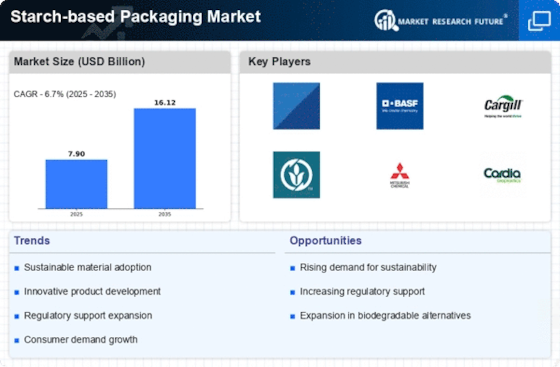
As per Market Research Future analysis, the Starch-based Packaging Market Size was estimated at 7.896 USD Billion in 2024. The Starch-based Packaging industry is projected to grow from 8.425 USD Billion in 2025 to 16.12 USD Billion by 2035, exhibiting a compound annual growth rate (CAGR) of 6.7% during the forecast period 2025 - 2035

Key Market Trends & Highlights

The Starch-based Packaging Market is experiencing a robust shift towards sustainable solutions driven by technological advancements and regulatory support.

  • The market is witnessing a rising demand for sustainable packaging solutions, particularly in North America, which remains the largest market. Technological advancements in material development are enhancing the properties of starch-based packaging, making it more competitive. Increased regulatory support for eco-friendly packaging is fostering growth in the Asia-Pacific region, the fastest-growing market. Key drivers include rising consumer awareness of environmental issues and government initiatives promoting biodegradable materials.

Market Size & Forecast

2024 Market Size 7.896 (USD Billion)
2035 Market Size 16.12 (USD Billion)
CAGR (2025 - 2035) 6.7%
Largest Regional Market Share in 2024 Asia Pacific

Major Players

Novamont (IT), BASF (DE), Cargill (US), NatureWorks (US), Mitsubishi Chemical (JP), Cardia Bioplastics (AU), Biome Bioplastics (GB), Green Dot Bioplastics (US), Stora Enso (FI)

Market Trends

The Starch-based Packaging Market is currently experiencing a notable transformation driven by increasing environmental awareness and the demand for sustainable alternatives to traditional plastic packaging. As consumers become more conscious of their ecological footprint, manufacturers are responding by innovating and expanding their product lines to include biodegradable and compostable materials derived from starch. This shift not only aligns with global sustainability goals but also addresses regulatory pressures aimed at reducing plastic waste. The market appears to be on a trajectory of growth, as businesses seek to enhance their brand image by adopting eco-friendly practices and materials. Moreover, advancements in technology are facilitating the development of starch-based packaging solutions that meet diverse consumer needs. Innovations in processing techniques and material formulations are enhancing the performance characteristics of these products, making them more competitive with conventional packaging options. The Starch-based Packaging Market is likely to witness increased collaboration among stakeholders, including raw material suppliers, manufacturers, and retailers, to create a cohesive ecosystem that supports sustainable practices. As the market evolves, it may also see a rise in consumer education initiatives aimed at promoting the benefits of starch-based packaging, further driving its adoption across various sectors.

Rising Demand for Sustainable Solutions

There is a growing consumer preference for environmentally friendly packaging options, which is propelling the Starch-based Packaging Market forward. This trend reflects a broader societal shift towards sustainability, as individuals and organizations seek to minimize their impact on the planet.

Technological Advancements in Material Development

Innovations in processing technologies are enhancing the properties of starch-based materials, making them more viable alternatives to traditional packaging. These advancements are likely to improve the durability and functionality of starch-based products, broadening their application scope.

Increased Regulatory Support for Eco-friendly Packaging

Governments worldwide are implementing stricter regulations on plastic usage, which is encouraging businesses to explore starch-based alternatives. This regulatory landscape is expected to foster growth in the Starch-based Packaging Market as companies adapt to comply with new environmental standards.

Starch based Packaging Market Market Drivers

Shift Towards Circular Economy Practices

The Starch-based Packaging Market is witnessing a shift towards circular economy practices, which emphasize sustainability and resource efficiency. This paradigm shift encourages the use of renewable materials, such as starch, to create packaging solutions that can be reused, recycled, or composted. As businesses and consumers alike become more committed to reducing waste, the demand for starch-based packaging is likely to increase. Reports indicate that the circular economy could generate USD 4.5 trillion in economic benefits by 2030, highlighting the potential for growth within the Starch-based Packaging Market. This transition not only supports environmental sustainability but also fosters innovation as companies explore new ways to integrate starch-based materials into their packaging strategies.

Growing E-commerce Sector Driving Packaging Needs

The rapid expansion of the e-commerce sector significantly influences the Starch-based Packaging Market. As online shopping continues to grow, the demand for effective and sustainable packaging solutions rises correspondingly. E-commerce companies are increasingly seeking packaging that not only protects products during transit but also aligns with sustainability goals. Starch-based packaging offers a viable solution, as it is both protective and biodegradable. Market analysis indicates that the e-commerce packaging market is expected to reach USD 300 billion by 2025, creating substantial opportunities for the Starch-based Packaging Market. This trend suggests that as e-commerce flourishes, so too will the demand for innovative starch-based packaging solutions.

Rising Consumer Awareness of Environmental Issues

The Starch-based Packaging Market is experiencing a notable shift as consumers become increasingly aware of environmental issues. This heightened awareness drives demand for sustainable packaging solutions, prompting manufacturers to adopt starch-based materials. Research indicates that approximately 70% of consumers prefer products with eco-friendly packaging, which significantly influences purchasing decisions. As a result, companies are compelled to innovate and incorporate starch-based options into their product lines. This trend not only aligns with consumer preferences but also enhances brand loyalty, as environmentally conscious consumers are more likely to support brands that prioritize sustainability. Consequently, the Starch-based Packaging Market is poised for growth as businesses respond to this consumer demand, potentially leading to a more sustainable future in packaging.

Technological Innovations Enhancing Material Properties

Technological advancements play a crucial role in the evolution of the Starch-based Packaging Market. Innovations in material science have led to the development of starch-based packaging that exhibits improved barrier properties, durability, and shelf life. These enhancements make starch-based materials more competitive with traditional plastics, appealing to a broader range of industries. For example, recent studies suggest that starch-based films can achieve moisture barrier properties comparable to conventional plastic films, which could revolutionize food packaging. As technology continues to advance, the Starch-based Packaging Market is likely to witness increased adoption rates, as manufacturers seek to leverage these innovations to meet consumer demands for sustainable and effective packaging solutions.

Government Initiatives Promoting Biodegradable Materials

The Starch-based Packaging Market benefits from various government initiatives aimed at promoting biodegradable materials. Many governments are implementing policies and regulations that encourage the use of sustainable packaging solutions, including starch-based options. For instance, certain regions have introduced incentives for companies that adopt biodegradable materials, which could lead to a significant increase in market penetration. The global market for biodegradable packaging is projected to reach USD 400 billion by 2025, indicating a robust growth trajectory. These initiatives not only support environmental goals but also stimulate economic growth within the Starch-based Packaging Market, as businesses invest in innovative solutions to comply with new regulations.

Market Segment Insights

By Type: Starch Blended with PLA (Largest) vs. Starch Blended with PHA (Fastest-Growing)

In the Starch-based Packaging Market, the segment is predominantly led by Starch Blended with PLA, which commands the largest share. This segment benefits from its widespread acceptance due to its biodegradability and superior barrier properties. Starch Blended with PHA, while currently smaller in market share, is rapidly gaining traction due to its innovative production processes and increasing application across various end-use industries.

Starch Blended with PLA (Dominant) vs. Starch Blended with PHA (Emerging)

The Starch Blended with PLA segment stands out as the dominant player in the starch-based packaging sector, primarily due to its enhanced flexibility, transparency, and ease of processing, making it suitable for a variety of packaging applications. On the other hand, Starch Blended with PHA is viewed as an emerging force in the market, gaining recognition for its unique properties like higher water resistance and better thermal stability. This combination of attributes positions it as a promising alternative for eco-conscious manufacturers looking to innovate and reduce their environmental footprint.

By Technology: Injection Molding (Largest) vs. Blow Molding (Fastest-Growing)

In the Starch-based Packaging Market, Injection Molding emerges as the largest technology segment, primarily due to its versatility in manufacturing complex shapes and designs. This method captures a significant market share, appealing to various industries that require custom packaging solutions. Conversely, Blow Molding shows substantial promise as the fastest-growing segment, driven by the rising demand for lightweight and durable packaging options that cater to consumer preferences.

Technology: Injection Molding (Dominant) vs. Blow Molding (Emerging)

Injection Molding is characterized by its capability to produce high-precision packaging solutions at a relatively low cost, making it a dominant force in the Starch-based Packaging Market. It is favored for creating intricate designs and offers solutions for a variety of products ranging from food containers to consumer goods packaging. On the other hand, Blow Molding is emerging rapidly, fueled by innovations in bioplastics and consumer demand for sustainable packaging. This technology excels in producing light-weight and yet robust packaging products, making it increasingly popular among manufacturers focused on enhancing eco-friendly practices.

By Application: Rigid Packaging (Largest) vs. Flexible Packaging (Fastest-Growing)

The Starch-based Packaging Market exhibits a diverse application segment, with Rigid Packaging holding the largest share due to its widespread use in food packaging and consumer goods. This segment benefits from the increasing demand for sustainable packaging solutions that meet regulatory standards and consumer preferences. In contrast, <a href="https://www.marketresearchfuture.com/reports/flexible-packaging-market-1151">Flexible Packaging</a> is the fastest-growing segment, driven by its versatility and ability to enhance product shelf life while reducing packaging waste. The growth in the Flexible Packaging segment can be attributed to rising consumer demand for convenience and eco-friendly packaging options. Industries like food and beverage, personal care, and healthcare are increasingly adopting starch-based flexible solutions, recognizing their potential to reduce environmental impact. Furthermore, innovations in design and manufacturing processes are enabling brands to leverage these materials, thereby solidifying their place in the packaging landscape.

Rigid Packaging (Dominant) vs. Flexible Packaging (Emerging)

Rigid Packaging remains the dominant force in the Starch-based Packaging Market, largely due to its robustness and reliability in protecting products. This segment is characterized by containers, boxes, and trays that are essential for several applications, particularly in the food sector where they ensure product safety and freshness. In contrast, Flexible Packaging represents the emerging trend within the industry, favored for its lightweight nature and customizability, allowing for greater design flexibility. These innovative solutions cater to a variety of needs in sectors such as consumer goods and healthcare, where minimized waste and improved sustainability are critical. As both segments evolve, the competition and collaboration between rigid and flexible solutions continue to shape the market landscape.

Get more detailed insights about Starch-based Packaging Market Research Report—Global Forecast till 2035

Regional Insights

By region, the study provides the market insights into North America, Europe, Asia-Pacific and Rest of the World. The Asia Pacific Starch-based Packaging market dominated this market in 2022 (45.80%). Southeast Asia's biodegradable market has significant potential due to the region's dense population. The Asia-Pacific market for starch-based bioplastics is expanding due to government initiatives that boost the use of biobased products. The expansion of the regional market can also be ascribed to the rising urbanisation and industrialization in the Asia-Pacific region's emerging economies, especially in India and other South East Asian nations.

Asia-Pacific's top manufacturer of plastics made from starch is China. Moreover, China’s Starch-based Packaging market held the largest market share, and the Indian Starch-based Packaging market was the fastest growing market in the Asia-Pacific region.

Further, the major countries studied in the market report are The US, Canada, German, France, the UK, Italy, Spain, China, Japan, India, Australia, South Korea, and Brazil.

Figure 2: STARCH-BASED PACKAGING MARKET SHARE BY REGION 2022 (USD Billion)

The North America Starch-based Packaging Market is expected to register significant growth from 2023 to 2032. The established presence of significant end use industries and the availability of cutting-edge technologies are primarily responsible for the region's growth. The American government has made steps to promote the use of packaging materials that are compostable and biodegradable. When the Break Free from Plastic Pollution Act is put into effect in 2021, producers will be required to take ownership of their plastic waste and reduce the amount of single-use plastics produced in the nation.

This might increase demand for packaging made of alternatives, such starch.

Several significant players in the starch-based packaging industry are situated in the United States, including Plantic Technologies, Inc., Eco-Products, and NatureWorks LLC. These businesses are actively engaged in the design and production of starch-based packaging solutions, which aid in the expansion of the regional market. Further, the U.S. Starch-based Packaging market held the largest market share, and the Canada Starch-based Packaging market was the fastest growing market in the North America region.

Europe Starch-based Packaging market accounted for the healthy market share in 2022. This is because there are excellent research and development facilities and strict government regulations on minimising carbon footprint. The demand for packaging made of starch has increased as a result of the objectives many European nations have set for themselves to reduce plastic waste and encourage the use of biodegradable materials. The food and beverage sector is a significant end-user of starch-based packaging in Europe. The main sources of starch-based packaging solutions are cafeterias and highly dispersed take-out joints.

Further, the German Starch-based Packaging market held the largest market share, and the U.K Starch-based Packaging market was the fastest growing market in the European region

Key Players and Competitive Insights

Leading market players are investing heavily in research and development in order to expand their product lines, which will help the Starch-based Packaging market, grow even more. Market participants are also undertaking a variety of strategic activities to expand their global footprint, with important market developments including new product launches, contractual agreements, mergers and acquisitions, higher investments, and collaboration with other organizations. To expand and survive in a more competitive and rising market climate, Starch-based Packaging Industry must offer cost-effective items.
Manufacturing locally to minimize operational costs is one of the key business tactics used by manufacturers in the global Starch-based Packaging Industry to benefit clients and increase the market sector. In recent years, the Starch-based Packaging Industry has offered some of the most significant advantages to medicine. Major players in the Starch-based Packaging market, including Seamore, Evoware, Bloom, Cuan Tec, Starch-based Energy Based, AlgaePac, Algopack, Sea6 Energy, Oceanium, and Cascadia Starch-based, are attempting to increase market demand by investing in research and development operations.
The public limited business NOVAMONT S.P.A. is based in Italy at VIA GIACOMO FAUSER, 8. With 305 employees, the business started doing business on November 4th, 1996. The status of NOVAMONT S.P.A. is Active. Their core line of work is the production of fundamental chemicals, nitrogen compounds, polymers, and synthetic rubber in its basic forms. They are registered under the company number NO171484. The partnership between Novamont S.p.A. and the British business Biopac to create and market a new line of compostable packaging materials manufactured from renewable resources was announced in 2020.
A provider of paper and packaging solutions is Mondi Plc (Mondi). It produces and distributes packaging made of pulp, paper, and flexible plastic. Uncoated fine paper, speciality products, and packaging paper are all included in its offering. Additionally, the business maintains trees, turns packaging paper into industrial bags, and produces specialist extrusion-coated products. Products from Mondi are used in a variety of sectors, including the automotive, medical, and pharmaceutical, retail, pet care, building and construction, chemicals and dangerous goods, e-commerce, beverages, home and personal care, farming and agriculture, office and printing paper, photographic and graphic, transportation, and food industries.
Asia, Africa, the Americas, and Europe are all where the company conducts business. In order to create a sustainable packaging solution for 500g packets of tomatoes on the vine to be sold to PENNY stores, which are owned by the top German retailer REWE Group, Mondi collaborated with BIOhof Kirchweidach, an organic farm in Bavaria.

Key Companies in the Starch based Packaging Market include

Industry Developments

January 2021: The first recyclable flexible retort pouch was unveiled by Amcor, a leader in global packaging. This is recognised as a big technical accomplishment that the corporation invested years of steadfast study to achieve.August 2023: Cardia Bioplastics, a US-based company that develops and produces starch-based packaging materials, announced a partnership with PepsiCo, one of the world's leading food and beverage companies. The partnership will focus on developing new starch-based packaging solutions for PepsiCo's products.

Future Outlook

Starch based Packaging Market Future Outlook

The Starch-based Packaging Market is projected to grow at a 6.7% CAGR from 2025 to 2035, driven by sustainability trends, regulatory support, and consumer demand for eco-friendly solutions.

New opportunities lie in:

  • Development of biodegradable food containers for the fast-food industry.
  • Expansion into emerging markets with tailored packaging solutions.
  • Partnerships with e-commerce platforms for sustainable shipping materials.

By 2035, the market is expected to solidify its position as a leader in sustainable packaging solutions.

Market Segmentation

Starch based Packaging Market Type Outlook

  • Starch Blended with PLA
  • Starch Blended with PHA
  • Others

Starch based Packaging Market Technology Outlook

  • Injection Molding
  • Blow Molding
  • Extrusion
  • Others

Starch based Packaging Market Application Outlook

  • Rigid Packaging
  • Flexible Packaging
  • Textile
  • Consumer Goods
  • Agriculture
  • Automotive
  • Building & Construction
  • Electronics
  • Others

Report Scope

MARKET SIZE 2024 7.896(USD Billion)
MARKET SIZE 2025 8.425(USD Billion)
MARKET SIZE 2035 16.12(USD Billion)
COMPOUND ANNUAL GROWTH RATE (CAGR) 6.7% (2025 - 2035)
REPORT COVERAGE Revenue Forecast, Competitive Landscape, Growth Factors, and Trends
BASE YEAR 2024
Market Forecast Period 2025 - 2035
Historical Data 2019 - 2024
Market Forecast Units USD Billion
Key Companies Profiled Novamont (IT), BASF (DE), Cargill (US), NatureWorks (US), Mitsubishi Chemical (JP), Cardia Bioplastics (AU), Biome Bioplastics (GB), Green Dot Bioplastics (US), Stora Enso (FI)
Segments Covered Type, Technology, Application, Region
Key Market Opportunities Growing consumer demand for sustainable alternatives drives innovation in the Starch-based Packaging Market.
Key Market Dynamics Rising consumer demand for sustainable solutions drives innovation and competition in the starch-based packaging sector.
Countries Covered North America, Europe, APAC, South America, MEA

FAQs

What is the projected market valuation of the Starch-based Packaging Market by 2035?

<p>The Starch-based Packaging Market is projected to reach a valuation of 16.12 USD Billion by 2035.</p>

What was the market valuation of the Starch-based Packaging Market in 2024?

<p>In 2024, the Starch-based Packaging Market was valued at 7.896 USD Billion.</p>

What is the expected CAGR for the Starch-based Packaging Market during the forecast period 2025 - 2035?

<p>The expected CAGR for the Starch-based Packaging Market during the forecast period 2025 - 2035 is 6.7%.</p>

Which companies are considered key players in the Starch-based Packaging Market?

<p>Key players in the Starch-based Packaging Market include Novamont, BASF, Cargill, NatureWorks, Mitsubishi Chemical, Cardia Bioplastics, Biome Bioplastics, Green Dot Bioplastics, and Stora Enso.</p>

What are the main types of starch-based packaging products and their market values?

<p>The main types include Starch Blended with PLA valued at 3.5 to 7.0 USD Billion, Starch Blended with PHA valued at 2.5 to 5.0 USD Billion, and Others valued at 1.896 to 4.12 USD Billion.</p>

What technologies are utilized in the Starch-based Packaging Market and their respective valuations?

<p>Technologies include Injection Molding valued at 1.5 to 3.2 USD Billion, Blow Molding valued at 1.2 to 2.5 USD Billion, and Extrusion valued at 2.5 to 5.5 USD Billion.</p>

What applications are driving the growth of the Starch-based Packaging Market?

Applications driving growth include Rigid Packaging valued at 1.5 to 3.2 USD Billion, Flexible Packaging valued at 2.0 to 4.5 USD Billion, and Consumer Goods valued at 1.2 to 2.5 USD Billion.

How does the market for flexible packaging compare to rigid packaging in terms of valuation?

Flexible Packaging is projected to be valued between 2.0 to 4.5 USD Billion, whereas Rigid Packaging is expected to be valued between 1.5 to 3.2 USD Billion.

What is the potential market size for the textile application in starch-based packaging?

The textile application in starch-based packaging is projected to reach a market size of 0.5 to 1.0 USD Billion.

What are the growth prospects for the agriculture application in the Starch-based Packaging Market?

The agriculture application is expected to grow, with a projected market size of 0.8 to 1.8 USD Billion.

  1. SECTION I: EXECUTIVE SUMMARY AND KEY HIGHLIGHTS
    1. | 1.1 EXECUTIVE SUMMARY
    2. | | 1.1.1 Market Overview
    3. | | 1.1.2 Key Findings
    4. | | 1.1.3 Market Segmentation
    5. | | 1.1.4 Competitive Landscape
    6. | | 1.1.5 Challenges and Opportunities
    7. | | 1.1.6 Future Outlook
  2. SECTION II: SCOPING, METHODOLOGY AND MARKET STRUCTURE
    1. | 2.1 MARKET INTRODUCTION
    2. | | 2.1.1 Definition
    3. | | 2.1.2 Scope of the study
    4. | | | 2.1.2.1 Research Objective
    5. | | | 2.1.2.2 Assumption
    6. | | | 2.1.2.3 Limitations
    7. | 2.2 RESEARCH METHODOLOGY
    8. | | 2.2.1 Overview
    9. | | 2.2.2 Data Mining
    10. | | 2.2.3 Secondary Research
    11. | | 2.2.4 Primary Research
    12. | | | 2.2.4.1 Primary Interviews and Information Gathering Process
    13. | | | 2.2.4.2 Breakdown of Primary Respondents
    14. | | 2.2.5 Forecasting Model
    15. | | 2.2.6 Market Size Estimation
    16. | | | 2.2.6.1 Bottom-Up Approach
    17. | | | 2.2.6.2 Top-Down Approach
    18. | | 2.2.7 Data Triangulation
    19. | | 2.2.8 Validation
  3. SECTION III: QUALITATIVE ANALYSIS
    1. | 3.1 MARKET DYNAMICS
    2. | | 3.1.1 Overview
    3. | | 3.1.2 Drivers
    4. | | 3.1.3 Restraints
    5. | | 3.1.4 Opportunities
    6. | 3.2 MARKET FACTOR ANALYSIS
    7. | | 3.2.1 Value chain Analysis
    8. | | 3.2.2 Porter's Five Forces Analysis
    9. | | | 3.2.2.1 Bargaining Power of Suppliers
    10. | | | 3.2.2.2 Bargaining Power of Buyers
    11. | | | 3.2.2.3 Threat of New Entrants
    12. | | | 3.2.2.4 Threat of Substitutes
    13. | | | 3.2.2.5 Intensity of Rivalry
    14. | | 3.2.3 COVID-19 Impact Analysis
    15. | | | 3.2.3.1 Market Impact Analysis
    16. | | | 3.2.3.2 Regional Impact
    17. | | | 3.2.3.3 Opportunity and Threat Analysis
  4. SECTION IV: QUANTITATIVE ANALYSIS
    1. | 4.1 Packaging & Transport, BY Type (USD Billion)
    2. | | 4.1.1 Starch Blended with PLA
    3. | | 4.1.2 Starch Blended with PHA
    4. | | 4.1.3 Others
    5. | 4.2 Packaging & Transport, BY Technology (USD Billion)
    6. | | 4.2.1 Injection Molding
    7. | | 4.2.2 Blow Molding
    8. | | 4.2.3 Extrusion
    9. | | 4.2.4 Others
    10. | 4.3 Packaging & Transport, BY Application (USD Billion)
    11. | | 4.3.1 Rigid Packaging
    12. | | 4.3.2 Flexible Packaging
    13. | | 4.3.3 Textile
    14. | | 4.3.4 Consumer Goods
    15. | | 4.3.5 Agriculture
    16. | | 4.3.6 Automotive
    17. | | 4.3.7 Building & Construction
    18. | | 4.3.8 Electronics
    19. | | 4.3.9 Others
    20. | 4.4 Packaging & Transport, BY Region (USD Billion)
    21. | | 4.4.1 North America
    22. | | | 4.4.1.1 US
    23. | | | 4.4.1.2 Canada
    24. | | 4.4.2 Europe
    25. | | | 4.4.2.1 Germany
    26. | | | 4.4.2.2 UK
    27. | | | 4.4.2.3 France
    28. | | | 4.4.2.4 Russia
    29. | | | 4.4.2.5 Italy
    30. | | | 4.4.2.6 Spain
    31. | | | 4.4.2.7 Rest of Europe
    32. | | 4.4.3 APAC
    33. | | | 4.4.3.1 China
    34. | | | 4.4.3.2 India
    35. | | | 4.4.3.3 Japan
    36. | | | 4.4.3.4 South Korea
    37. | | | 4.4.3.5 Malaysia
    38. | | | 4.4.3.6 Thailand
    39. | | | 4.4.3.7 Indonesia
    40. | | | 4.4.3.8 Rest of APAC
    41. | | 4.4.4 South America
    42. | | | 4.4.4.1 Brazil
    43. | | | 4.4.4.2 Mexico
    44. | | | 4.4.4.3 Argentina
    45. | | | 4.4.4.4 Rest of South America
    46. | | 4.4.5 MEA
    47. | | | 4.4.5.1 GCC Countries
    48. | | | 4.4.5.2 South Africa
    49. | | | 4.4.5.3 Rest of MEA
  5. SECTION V: COMPETITIVE ANALYSIS
    1. | 5.1 Competitive Landscape
    2. | | 5.1.1 Overview
    3. | | 5.1.2 Competitive Analysis
    4. | | 5.1.3 Market share Analysis
    5. | | 5.1.4 Major Growth Strategy in the Packaging & Transport
    6. | | 5.1.5 Competitive Benchmarking
    7. | | 5.1.6 Leading Players in Terms of Number of Developments in the Packaging & Transport
    8. | | 5.1.7 Key developments and growth strategies
    9. | | | 5.1.7.1 New Product Launch/Service Deployment
    10. | | | 5.1.7.2 Merger & Acquisitions
    11. | | | 5.1.7.3 Joint Ventures
    12. | | 5.1.8 Major Players Financial Matrix
    13. | | | 5.1.8.1 Sales and Operating Income
    14. | | | 5.1.8.2 Major Players R&D Expenditure. 2023
    15. | 5.2 Company Profiles
    16. | | 5.2.1 Novamont (IT)
    17. | | | 5.2.1.1 Financial Overview
    18. | | | 5.2.1.2 Products Offered
    19. | | | 5.2.1.3 Key Developments
    20. | | | 5.2.1.4 SWOT Analysis
    21. | | | 5.2.1.5 Key Strategies
    22. | | 5.2.2 BASF (DE)
    23. | | | 5.2.2.1 Financial Overview
    24. | | | 5.2.2.2 Products Offered
    25. | | | 5.2.2.3 Key Developments
    26. | | | 5.2.2.4 SWOT Analysis
    27. | | | 5.2.2.5 Key Strategies
    28. | | 5.2.3 Cargill (US)
    29. | | | 5.2.3.1 Financial Overview
    30. | | | 5.2.3.2 Products Offered
    31. | | | 5.2.3.3 Key Developments
    32. | | | 5.2.3.4 SWOT Analysis
    33. | | | 5.2.3.5 Key Strategies
    34. | | 5.2.4 NatureWorks (US)
    35. | | | 5.2.4.1 Financial Overview
    36. | | | 5.2.4.2 Products Offered
    37. | | | 5.2.4.3 Key Developments
    38. | | | 5.2.4.4 SWOT Analysis
    39. | | | 5.2.4.5 Key Strategies
    40. | | 5.2.5 Mitsubishi Chemical (JP)
    41. | | | 5.2.5.1 Financial Overview
    42. | | | 5.2.5.2 Products Offered
    43. | | | 5.2.5.3 Key Developments
    44. | | | 5.2.5.4 SWOT Analysis
    45. | | | 5.2.5.5 Key Strategies
    46. | | 5.2.6 Cardia Bioplastics (AU)
    47. | | | 5.2.6.1 Financial Overview
    48. | | | 5.2.6.2 Products Offered
    49. | | | 5.2.6.3 Key Developments
    50. | | | 5.2.6.4 SWOT Analysis
    51. | | | 5.2.6.5 Key Strategies
    52. | | 5.2.7 Biome Bioplastics (GB)
    53. | | | 5.2.7.1 Financial Overview
    54. | | | 5.2.7.2 Products Offered
    55. | | | 5.2.7.3 Key Developments
    56. | | | 5.2.7.4 SWOT Analysis
    57. | | | 5.2.7.5 Key Strategies
    58. | | 5.2.8 Green Dot Bioplastics (US)
    59. | | | 5.2.8.1 Financial Overview
    60. | | | 5.2.8.2 Products Offered
    61. | | | 5.2.8.3 Key Developments
    62. | | | 5.2.8.4 SWOT Analysis
    63. | | | 5.2.8.5 Key Strategies
    64. | | 5.2.9 Stora Enso (FI)
    65. | | | 5.2.9.1 Financial Overview
    66. | | | 5.2.9.2 Products Offered
    67. | | | 5.2.9.3 Key Developments
    68. | | | 5.2.9.4 SWOT Analysis
    69. | | | 5.2.9.5 Key Strategies
    70. | 5.3 Appendix
    71. | | 5.3.1 References
    72. | | 5.3.2 Related Reports
  6. LIST OF FIGURES
    1. | 6.1 MARKET SYNOPSIS
    2. | 6.2 NORTH AMERICA MARKET ANALYSIS
    3. | 6.3 US MARKET ANALYSIS BY TYPE
    4. | 6.4 US MARKET ANALYSIS BY TECHNOLOGY
    5. | 6.5 US MARKET ANALYSIS BY APPLICATION
    6. | 6.6 CANADA MARKET ANALYSIS BY TYPE
    7. | 6.7 CANADA MARKET ANALYSIS BY TECHNOLOGY
    8. | 6.8 CANADA MARKET ANALYSIS BY APPLICATION
    9. | 6.9 EUROPE MARKET ANALYSIS
    10. | 6.10 GERMANY MARKET ANALYSIS BY TYPE
    11. | 6.11 GERMANY MARKET ANALYSIS BY TECHNOLOGY
    12. | 6.12 GERMANY MARKET ANALYSIS BY APPLICATION
    13. | 6.13 UK MARKET ANALYSIS BY TYPE
    14. | 6.14 UK MARKET ANALYSIS BY TECHNOLOGY
    15. | 6.15 UK MARKET ANALYSIS BY APPLICATION
    16. | 6.16 FRANCE MARKET ANALYSIS BY TYPE
    17. | 6.17 FRANCE MARKET ANALYSIS BY TECHNOLOGY
    18. | 6.18 FRANCE MARKET ANALYSIS BY APPLICATION
    19. | 6.19 RUSSIA MARKET ANALYSIS BY TYPE
    20. | 6.20 RUSSIA MARKET ANALYSIS BY TECHNOLOGY
    21. | 6.21 RUSSIA MARKET ANALYSIS BY APPLICATION
    22. | 6.22 ITALY MARKET ANALYSIS BY TYPE
    23. | 6.23 ITALY MARKET ANALYSIS BY TECHNOLOGY
    24. | 6.24 ITALY MARKET ANALYSIS BY APPLICATION
    25. | 6.25 SPAIN MARKET ANALYSIS BY TYPE
    26. | 6.26 SPAIN MARKET ANALYSIS BY TECHNOLOGY
    27. | 6.27 SPAIN MARKET ANALYSIS BY APPLICATION
    28. | 6.28 REST OF EUROPE MARKET ANALYSIS BY TYPE
    29. | 6.29 REST OF EUROPE MARKET ANALYSIS BY TECHNOLOGY
    30. | 6.30 REST OF EUROPE MARKET ANALYSIS BY APPLICATION
    31. | 6.31 APAC MARKET ANALYSIS
    32. | 6.32 CHINA MARKET ANALYSIS BY TYPE
    33. | 6.33 CHINA MARKET ANALYSIS BY TECHNOLOGY
    34. | 6.34 CHINA MARKET ANALYSIS BY APPLICATION
    35. | 6.35 INDIA MARKET ANALYSIS BY TYPE
    36. | 6.36 INDIA MARKET ANALYSIS BY TECHNOLOGY
    37. | 6.37 INDIA MARKET ANALYSIS BY APPLICATION
    38. | 6.38 JAPAN MARKET ANALYSIS BY TYPE
    39. | 6.39 JAPAN MARKET ANALYSIS BY TECHNOLOGY
    40. | 6.40 JAPAN MARKET ANALYSIS BY APPLICATION
    41. | 6.41 SOUTH KOREA MARKET ANALYSIS BY TYPE
    42. | 6.42 SOUTH KOREA MARKET ANALYSIS BY TECHNOLOGY
    43. | 6.43 SOUTH KOREA MARKET ANALYSIS BY APPLICATION
    44. | 6.44 MALAYSIA MARKET ANALYSIS BY TYPE
    45. | 6.45 MALAYSIA MARKET ANALYSIS BY TECHNOLOGY
    46. | 6.46 MALAYSIA MARKET ANALYSIS BY APPLICATION
    47. | 6.47 THAILAND MARKET ANALYSIS BY TYPE
    48. | 6.48 THAILAND MARKET ANALYSIS BY TECHNOLOGY
    49. | 6.49 THAILAND MARKET ANALYSIS BY APPLICATION
    50. | 6.50 INDONESIA MARKET ANALYSIS BY TYPE
    51. | 6.51 INDONESIA MARKET ANALYSIS BY TECHNOLOGY
    52. | 6.52 INDONESIA MARKET ANALYSIS BY APPLICATION
    53. | 6.53 REST OF APAC MARKET ANALYSIS BY TYPE
    54. | 6.54 REST OF APAC MARKET ANALYSIS BY TECHNOLOGY
    55. | 6.55 REST OF APAC MARKET ANALYSIS BY APPLICATION
    56. | 6.56 SOUTH AMERICA MARKET ANALYSIS
    57. | 6.57 BRAZIL MARKET ANALYSIS BY TYPE
    58. | 6.58 BRAZIL MARKET ANALYSIS BY TECHNOLOGY
    59. | 6.59 BRAZIL MARKET ANALYSIS BY APPLICATION
    60. | 6.60 MEXICO MARKET ANALYSIS BY TYPE
    61. | 6.61 MEXICO MARKET ANALYSIS BY TECHNOLOGY
    62. | 6.62 MEXICO MARKET ANALYSIS BY APPLICATION
    63. | 6.63 ARGENTINA MARKET ANALYSIS BY TYPE
    64. | 6.64 ARGENTINA MARKET ANALYSIS BY TECHNOLOGY
    65. | 6.65 ARGENTINA MARKET ANALYSIS BY APPLICATION
    66. | 6.66 REST OF SOUTH AMERICA MARKET ANALYSIS BY TYPE
    67. | 6.67 REST OF SOUTH AMERICA MARKET ANALYSIS BY TECHNOLOGY
    68. | 6.68 REST OF SOUTH AMERICA MARKET ANALYSIS BY APPLICATION
    69. | 6.69 MEA MARKET ANALYSIS
    70. | 6.70 GCC COUNTRIES MARKET ANALYSIS BY TYPE
    71. | 6.71 GCC COUNTRIES MARKET ANALYSIS BY TECHNOLOGY
    72. | 6.72 GCC COUNTRIES MARKET ANALYSIS BY APPLICATION
    73. | 6.73 SOUTH AFRICA MARKET ANALYSIS BY TYPE
    74. | 6.74 SOUTH AFRICA MARKET ANALYSIS BY TECHNOLOGY
    75. | 6.75 SOUTH AFRICA MARKET ANALYSIS BY APPLICATION
    76. | 6.76 REST OF MEA MARKET ANALYSIS BY TYPE
    77. | 6.77 REST OF MEA MARKET ANALYSIS BY TECHNOLOGY
    78. | 6.78 REST OF MEA MARKET ANALYSIS BY APPLICATION
    79. | 6.79 KEY BUYING CRITERIA OF PACKAGING & TRANSPORT
    80. | 6.80 RESEARCH PROCESS OF MRFR
    81. | 6.81 DRO ANALYSIS OF PACKAGING & TRANSPORT
    82. | 6.82 DRIVERS IMPACT ANALYSIS: PACKAGING & TRANSPORT
    83. | 6.83 RESTRAINTS IMPACT ANALYSIS: PACKAGING & TRANSPORT
    84. | 6.84 SUPPLY / VALUE CHAIN: PACKAGING & TRANSPORT
    85. | 6.85 PACKAGING & TRANSPORT, BY TYPE, 2024 (% SHARE)
    86. | 6.86 PACKAGING & TRANSPORT, BY TYPE, 2024 TO 2035 (USD Billion)
    87. | 6.87 PACKAGING & TRANSPORT, BY TECHNOLOGY, 2024 (% SHARE)
    88. | 6.88 PACKAGING & TRANSPORT, BY TECHNOLOGY, 2024 TO 2035 (USD Billion)
    89. | 6.89 PACKAGING & TRANSPORT, BY APPLICATION, 2024 (% SHARE)
    90. | 6.90 PACKAGING & TRANSPORT, BY APPLICATION, 2024 TO 2035 (USD Billion)
    91. | 6.91 BENCHMARKING OF MAJOR COMPETITORS
  7. LIST OF TABLES
    1. | 7.1 LIST OF ASSUMPTIONS
    2. | | 7.1.1
    3. | 7.2 North America MARKET SIZE ESTIMATES; FORECAST
    4. | | 7.2.1 BY TYPE, 2025-2035 (USD Billion)
    5. | | 7.2.2 BY TECHNOLOGY, 2025-2035 (USD Billion)
    6. | | 7.2.3 BY APPLICATION, 2025-2035 (USD Billion)
    7. | 7.3 US MARKET SIZE ESTIMATES; FORECAST
    8. | | 7.3.1 BY TYPE, 2025-2035 (USD Billion)
    9. | | 7.3.2 BY TECHNOLOGY, 2025-2035 (USD Billion)
    10. | | 7.3.3 BY APPLICATION, 2025-2035 (USD Billion)
    11. | 7.4 Canada MARKET SIZE ESTIMATES; FORECAST
    12. | | 7.4.1 BY TYPE, 2025-2035 (USD Billion)
    13. | | 7.4.2 BY TECHNOLOGY, 2025-2035 (USD Billion)
    14. | | 7.4.3 BY APPLICATION, 2025-2035 (USD Billion)
    15. | 7.5 Europe MARKET SIZE ESTIMATES; FORECAST
    16. | | 7.5.1 BY TYPE, 2025-2035 (USD Billion)
    17. | | 7.5.2 BY TECHNOLOGY, 2025-2035 (USD Billion)
    18. | | 7.5.3 BY APPLICATION, 2025-2035 (USD Billion)
    19. | 7.6 Germany MARKET SIZE ESTIMATES; FORECAST
    20. | | 7.6.1 BY TYPE, 2025-2035 (USD Billion)
    21. | | 7.6.2 BY TECHNOLOGY, 2025-2035 (USD Billion)
    22. | | 7.6.3 BY APPLICATION, 2025-2035 (USD Billion)
    23. | 7.7 UK MARKET SIZE ESTIMATES; FORECAST
    24. | | 7.7.1 BY TYPE, 2025-2035 (USD Billion)
    25. | | 7.7.2 BY TECHNOLOGY, 2025-2035 (USD Billion)
    26. | | 7.7.3 BY APPLICATION, 2025-2035 (USD Billion)
    27. | 7.8 France MARKET SIZE ESTIMATES; FORECAST
    28. | | 7.8.1 BY TYPE, 2025-2035 (USD Billion)
    29. | | 7.8.2 BY TECHNOLOGY, 2025-2035 (USD Billion)
    30. | | 7.8.3 BY APPLICATION, 2025-2035 (USD Billion)
    31. | 7.9 Russia MARKET SIZE ESTIMATES; FORECAST
    32. | | 7.9.1 BY TYPE, 2025-2035 (USD Billion)
    33. | | 7.9.2 BY TECHNOLOGY, 2025-2035 (USD Billion)
    34. | | 7.9.3 BY APPLICATION, 2025-2035 (USD Billion)
    35. | 7.10 Italy MARKET SIZE ESTIMATES; FORECAST
    36. | | 7.10.1 BY TYPE, 2025-2035 (USD Billion)
    37. | | 7.10.2 BY TECHNOLOGY, 2025-2035 (USD Billion)
    38. | | 7.10.3 BY APPLICATION, 2025-2035 (USD Billion)
    39. | 7.11 Spain MARKET SIZE ESTIMATES; FORECAST
    40. | | 7.11.1 BY TYPE, 2025-2035 (USD Billion)
    41. | | 7.11.2 BY TECHNOLOGY, 2025-2035 (USD Billion)
    42. | | 7.11.3 BY APPLICATION, 2025-2035 (USD Billion)
    43. | 7.12 Rest of Europe MARKET SIZE ESTIMATES; FORECAST
    44. | | 7.12.1 BY TYPE, 2025-2035 (USD Billion)
    45. | | 7.12.2 BY TECHNOLOGY, 2025-2035 (USD Billion)
    46. | | 7.12.3 BY APPLICATION, 2025-2035 (USD Billion)
    47. | 7.13 APAC MARKET SIZE ESTIMATES; FORECAST
    48. | | 7.13.1 BY TYPE, 2025-2035 (USD Billion)
    49. | | 7.13.2 BY TECHNOLOGY, 2025-2035 (USD Billion)
    50. | | 7.13.3 BY APPLICATION, 2025-2035 (USD Billion)
    51. | 7.14 China MARKET SIZE ESTIMATES; FORECAST
    52. | | 7.14.1 BY TYPE, 2025-2035 (USD Billion)
    53. | | 7.14.2 BY TECHNOLOGY, 2025-2035 (USD Billion)
    54. | | 7.14.3 BY APPLICATION, 2025-2035 (USD Billion)
    55. | 7.15 India MARKET SIZE ESTIMATES; FORECAST
    56. | | 7.15.1 BY TYPE, 2025-2035 (USD Billion)
    57. | | 7.15.2 BY TECHNOLOGY, 2025-2035 (USD Billion)
    58. | | 7.15.3 BY APPLICATION, 2025-2035 (USD Billion)
    59. | 7.16 Japan MARKET SIZE ESTIMATES; FORECAST
    60. | | 7.16.1 BY TYPE, 2025-2035 (USD Billion)
    61. | | 7.16.2 BY TECHNOLOGY, 2025-2035 (USD Billion)
    62. | | 7.16.3 BY APPLICATION, 2025-2035 (USD Billion)
    63. | 7.17 South Korea MARKET SIZE ESTIMATES; FORECAST
    64. | | 7.17.1 BY TYPE, 2025-2035 (USD Billion)
    65. | | 7.17.2 BY TECHNOLOGY, 2025-2035 (USD Billion)
    66. | | 7.17.3 BY APPLICATION, 2025-2035 (USD Billion)
    67. | 7.18 Malaysia MARKET SIZE ESTIMATES; FORECAST
    68. | | 7.18.1 BY TYPE, 2025-2035 (USD Billion)
    69. | | 7.18.2 BY TECHNOLOGY, 2025-2035 (USD Billion)
    70. | | 7.18.3 BY APPLICATION, 2025-2035 (USD Billion)
    71. | 7.19 Thailand MARKET SIZE ESTIMATES; FORECAST
    72. | | 7.19.1 BY TYPE, 2025-2035 (USD Billion)
    73. | | 7.19.2 BY TECHNOLOGY, 2025-2035 (USD Billion)
    74. | | 7.19.3 BY APPLICATION, 2025-2035 (USD Billion)
    75. | 7.20 Indonesia MARKET SIZE ESTIMATES; FORECAST
    76. | | 7.20.1 BY TYPE, 2025-2035 (USD Billion)
    77. | | 7.20.2 BY TECHNOLOGY, 2025-2035 (USD Billion)
    78. | | 7.20.3 BY APPLICATION, 2025-2035 (USD Billion)
    79. | 7.21 Rest of APAC MARKET SIZE ESTIMATES; FORECAST
    80. | | 7.21.1 BY TYPE, 2025-2035 (USD Billion)
    81. | | 7.21.2 BY TECHNOLOGY, 2025-2035 (USD Billion)
    82. | | 7.21.3 BY APPLICATION, 2025-2035 (USD Billion)
    83. | 7.22 South America MARKET SIZE ESTIMATES; FORECAST
    84. | | 7.22.1 BY TYPE, 2025-2035 (USD Billion)
    85. | | 7.22.2 BY TECHNOLOGY, 2025-2035 (USD Billion)
    86. | | 7.22.3 BY APPLICATION, 2025-2035 (USD Billion)
    87. | 7.23 Brazil MARKET SIZE ESTIMATES; FORECAST
    88. | | 7.23.1 BY TYPE, 2025-2035 (USD Billion)
    89. | | 7.23.2 BY TECHNOLOGY, 2025-2035 (USD Billion)
    90. | | 7.23.3 BY APPLICATION, 2025-2035 (USD Billion)
    91. | 7.24 Mexico MARKET SIZE ESTIMATES; FORECAST
    92. | | 7.24.1 BY TYPE, 2025-2035 (USD Billion)
    93. | | 7.24.2 BY TECHNOLOGY, 2025-2035 (USD Billion)
    94. | | 7.24.3 BY APPLICATION, 2025-2035 (USD Billion)
    95. | 7.25 Argentina MARKET SIZE ESTIMATES; FORECAST
    96. | | 7.25.1 BY TYPE, 2025-2035 (USD Billion)
    97. | | 7.25.2 BY TECHNOLOGY, 2025-2035 (USD Billion)
    98. | | 7.25.3 BY APPLICATION, 2025-2035 (USD Billion)
    99. | 7.26 Rest of South America MARKET SIZE ESTIMATES; FORECAST
    100. | | 7.26.1 BY TYPE, 2025-2035 (USD Billion)
    101. | | 7.26.2 BY TECHNOLOGY, 2025-2035 (USD Billion)
    102. | | 7.26.3 BY APPLICATION, 2025-2035 (USD Billion)
    103. | 7.27 MEA MARKET SIZE ESTIMATES; FORECAST
    104. | | 7.27.1 BY TYPE, 2025-2035 (USD Billion)
    105. | | 7.27.2 BY TECHNOLOGY, 2025-2035 (USD Billion)
    106. | | 7.27.3 BY APPLICATION, 2025-2035 (USD Billion)
    107. | 7.28 GCC Countries MARKET SIZE ESTIMATES; FORECAST
    108. | | 7.28.1 BY TYPE, 2025-2035 (USD Billion)
    109. | | 7.28.2 BY TECHNOLOGY, 2025-2035 (USD Billion)
    110. | | 7.28.3 BY APPLICATION, 2025-2035 (USD Billion)
    111. | 7.29 South Africa MARKET SIZE ESTIMATES; FORECAST
    112. | | 7.29.1 BY TYPE, 2025-2035 (USD Billion)
    113. | | 7.29.2 BY TECHNOLOGY, 2025-2035 (USD Billion)
    114. | | 7.29.3 BY APPLICATION, 2025-2035 (USD Billion)
    115. | 7.30 Rest of MEA MARKET SIZE ESTIMATES; FORECAST
    116. | | 7.30.1 BY TYPE, 2025-2035 (USD Billion)
    117. | | 7.30.2 BY TECHNOLOGY, 2025-2035 (USD Billion)
    118. | | 7.30.3 BY APPLICATION, 2025-2035 (USD Billion)
    119. | 7.31 PRODUCT LAUNCH/PRODUCT DEVELOPMENT/APPROVAL
    120. | | 7.31.1
    121. | 7.32 ACQUISITION/PARTNERSHIP
    122. | | 7.32.1

Packaging & Transport Market Segmentation

Packaging & Transport By Type (USD Billion, 2025-2035)

  • Starch Blended with PLA
  • Starch Blended with PHA
  • Others

Packaging & Transport By Technology (USD Billion, 2025-2035)

  • Injection Molding
  • Blow Molding
  • Extrusion
  • Others

Packaging & Transport By Application (USD Billion, 2025-2035)

  • Rigid Packaging
  • Flexible Packaging
  • Textile
  • Consumer Goods
  • Agriculture
  • Automotive
  • Building & Construction
  • Electronics
  • Others
Infographic

Free Sample Request

Kindly complete the form below to receive a free sample of this Report

Get Free Sample

Customer Strories

Compare Licence

×
Features License Type
Single User Multiuser License Enterprise User
Price $4,950 $5,950 $7,250
Maximum User Access Limit 1 User Upto 10 Users Unrestricted Access Throughout the Organization
Free Customization
Direct Access to Analyst
Deliverable Format
Platform Access
Discount on Next Purchase 10% 15% 15%
Printable Versions