Request Free Sample ×

Kindly complete the form below to receive a free sample of this Report

* Please use a valid business email

Leading companies partner with us for data-driven Insights

clients tt-cursor
Hero Background
English
Chinese
French
Japanese
Korean
German
Spanish

Staple Market Analysis

ID: MRFR/CnM/11106-HCR
111 Pages
Chitranshi Jaiswal
December 2024

Staple Market Research Report Information By Type (Mini Size, Extra Length, and Regular Sized), By Application (Office/Household, Printing Store, and Others), And By Region (North America, Europe, Asia-Pacific, And Rest Of The World) –Market Forecast Till 2035

Share:
Download PDF ×

We do not share your information with anyone. However, we may send you emails based on your report interest from time to time. You may contact us at any time to opt-out.

Staple Market Infographic
Purchase Options

Market Analysis

In-depth Analysis of Staple Market Industry Landscape

The Staple Market also benefits from cost leadership, as companies strive to be the cheapest producers. Streamlining operations, optimizing supply chains, and negotiating supplier deals are needed. Products should be cheaper than competitors while yet being good. Cheap-conscious shoppers who don't compromise on quality would like this method.

Supply-side staple markets are closely linked to agriculture and industries. Crop yields, weather, and farming technology affect raw material production. Food processing and packaging improvements also affect staple commodities supply. The complicated supply chain from farm to shelf includes growers, distributors, and retailers, each contributing to market dynamics.

The staple market is also affected by inflation, unemployment, and income distribution. Consumers seek cheaper alternatives during economic downturns, changing market purchasing patterns. Conversely, economic prosperity may raise disposable income, allowing for more spending on premium or specialist staples. Businesses in this industry must understand the economy to respond to changing consumer behavior.

Consumer health and sustainability concerns are driving staple market transformation. The wellness movement has made organic and locally sourced items popular. Businesses are rethinking their production, sourcing, and packaging to be environmentally conscious due to customer attitude. Sustainability is becoming a prerequisite for basic market success and a marketing strategy.

Government rules and policies dramatically affect staples markets. From food safety standards to trade agreements, regulations affect staple commodities production, distribution, and consumption. Sustainability has led to environmental restrictions that affect the entire supply chain. Audience. For health-conscious consumers, a corporation may offer organic, gluten-free staples, while offering standard staples for cost and convenience. E-commerce and digital presence are increasingly important in market share positioning. Companies invest in online platforms to give customers a smooth experience. This involves improving websites for easy navigation, introducing secure payment alternatives, and using digital marketing to reach more people. A robust internet presence allows direct consumer contact and data collecting and analysis, helping companies understand and adapt to market trends.

Sustainability is a major influence in staple market share positioning. Companies may attract a rising section of sustainable buyers by portraying themselves as socially and environmentally responsible.


Author
Author Profile
Chitranshi Jaiswal
Team Lead - Research

Chitranshi is a Team Leader in the Chemicals & Materials (CnM) and Energy & Power (EnP) domains, with 6+ years of experience in market research. She leads and mentors teams to deliver cross-domain projects that equip clients with actionable insights and growth strategies. She is skilled in market estimation, forecasting, competitive benchmarking, and both primary & secondary research, enabling her to turn complex data into decision-ready insights. An engineer and MBA professional, she combines technical expertise with strategic acumen to solve dynamic market challenges. Chitranshi has successfully managed projects that support market entry, investment planning, and competitive positioning, while building strong client relationships. Certified in Advanced Excel & Power BI she leverages data-driven approaches to ensure accuracy, clarity, and impactful outcomes.

Leave a Comment

FAQs

What is the current valuation of the Staple Market as of 2024?

<p>The Staple Market was valued at 219.71 USD Billion in 2024.</p>

What is the projected market valuation for the Staple Market in 2035?

<p>The Staple Market is projected to reach a valuation of 349.94 USD Billion by 2035.</p>

What is the expected CAGR for the Staple Market during the forecast period 2025 - 2035?

<p>The expected CAGR for the Staple Market during the forecast period 2025 - 2035 is 4.32%.</p>

Which companies are considered key players in the Staple Market?

<p>Key players in the Staple Market include Cargill, Archer Daniels Midland, Bunge, Olam Group, Louis Dreyfus Company, Wilmar International, General Mills, Kraft Heinz, and Nestle.</p>

What are the main segments of the Staple Market by type?

<p>The main segments by type include Mini Size (30.0 - 50.0 USD Billion), Extra Length (50.0 - 80.0 USD Billion), and Regular Size (139.71 - 219.94 USD Billion).</p>

How does the Staple Market perform in terms of application segments?

<p>In terms of application, the Staple Market includes Office/Household (80.0 - 130.0 USD Billion), Printing Stores (50.0 - 80.0 USD Billion), and Others (89.71 - 139.94 USD Billion).</p>

What factors contribute to the growth of the Staple Market?

Factors contributing to the growth of the Staple Market may include increasing demand for staple products and the expansion of key players like Cargill and Nestle.

How does the Staple Market's growth compare to other food sectors?

The Staple Market's growth, with a projected CAGR of 4.32%, suggests a steady expansion compared to other food sectors that may experience more volatile growth rates.

What role do major companies play in shaping the Staple Market?

Major companies such as Bunge and Olam Group likely influence market trends through innovation and strategic partnerships.

What are the implications of the projected market growth for stakeholders?

The projected growth of the Staple Market may present opportunities for stakeholders to invest in emerging segments and enhance product offerings.

Market Summary

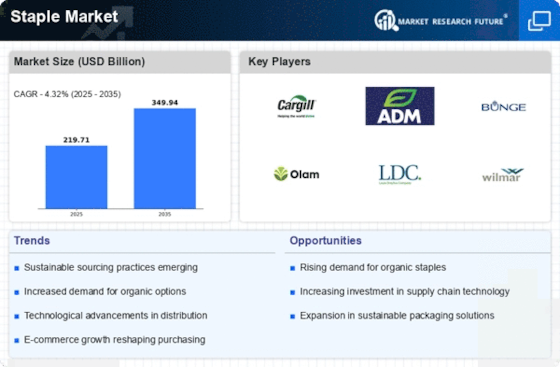
As per Market Research Future analysis, the Staple Market Size was estimated at 219.71 USD Billion in 2024. The Staple industry is projected to grow from 229.21 USD Billion in 2025 to 349.94 USD Billion by 2035, exhibiting a compound annual growth rate (CAGR) of 4.32% during the forecast period 2025 - 2035

Key Market Trends & Highlights

The Staple Market is currently experiencing a dynamic shift towards sustainability and technological integration.

  • The focus on sustainability is reshaping product offerings across the Staple Market, particularly in North America.
  • E-commerce expansion is facilitating greater accessibility and convenience for consumers in both the Regular Size and Mini Size segments.
  • Technological innovations are driving efficiency and productivity, especially in the Office/Household segment, which remains the largest.
  • Rising population and urbanization in Asia-Pacific are significant market drivers, influencing demand patterns and consumer preferences.

Market Size & Forecast

2024 Market Size 219.71 (USD Billion)
2035 Market Size 349.94 (USD Billion)
CAGR (2025 - 2035) 4.32%
Largest Regional Market Share in 2024 North America

Major Players

Cargill (US), Archer Daniels Midland (US), Bunge (US), Olam Group (SG), Louis Dreyfus Company (NL), Wilmar International (SG), General Mills (US), Kraft Heinz (US), Nestle (CH)

Market Trends

The Staple Market is currently experiencing a dynamic evolution, influenced by various factors such as consumer preferences, technological advancements, and global supply chain shifts. As individuals increasingly prioritize sustainability, there is a noticeable shift towards organic and locally sourced staples. This trend appears to be driven by a growing awareness of health and environmental issues, prompting consumers to seek products that align with their values. Additionally, the rise of e-commerce platforms has transformed the way staples are purchased, allowing for greater accessibility and convenience. This shift in purchasing behavior suggests that traditional retail models may need to adapt to remain competitive in this changing landscape. Moreover, innovations in food processing and preservation techniques are likely to enhance the quality and shelf life of staple products. This could lead to a broader acceptance of diverse staple foods, as consumers become more adventurous in their culinary choices. The Staple Market seems poised for further growth, with potential opportunities arising from the integration of technology in production and distribution processes. As the market continues to evolve, stakeholders must remain vigilant to emerging trends and consumer demands to effectively navigate this complex environment.

Sustainability Focus

There is a growing emphasis on sustainable practices within the Staple Market. Consumers are increasingly favoring products that are organic, ethically sourced, and environmentally friendly. This trend indicates a shift in purchasing behavior, as individuals seek to align their consumption with their values.

E-commerce Expansion

The rise of online shopping platforms is reshaping the Staple Market. Consumers now have greater access to a variety of staple products, which enhances convenience and choice. This trend suggests that traditional retail channels may need to adapt to the changing landscape of consumer preferences.

Technological Innovations

Advancements in food processing and preservation technologies are likely to impact the Staple Market positively. These innovations may improve product quality and extend shelf life, potentially leading to increased consumer acceptance of diverse staple foods.

Staple Market Market Drivers

Changing Consumer Preferences

Consumer preferences are evolving, influencing the Staple Market in various ways. There is a noticeable shift towards healthier and more sustainable food options, prompting consumers to seek out organic and whole grain staples. This trend is reflected in market data, which indicates a growing demand for products that are perceived as healthier alternatives. Additionally, the rise of plant-based diets has led to increased interest in staples such as quinoa and legumes. As consumers become more health-conscious, the Staple Market must adapt to these changing preferences by offering a diverse range of products that cater to various dietary needs. This shift not only impacts product offerings but also necessitates changes in marketing strategies to effectively reach and engage health-oriented consumers.

Economic Stability and Growth

Economic conditions play a pivotal role in shaping the Staple Market. In regions where economic stability is evident, consumer purchasing power tends to increase, leading to higher demand for staple foods. For instance, countries experiencing GDP growth often witness a shift in dietary patterns, with consumers opting for higher-quality staples. The International Monetary Fund indicates that many economies are on a recovery path, which could enhance food security and increase investments in agricultural infrastructure. This economic growth may lead to a more robust Staple Market, as producers and retailers respond to the evolving preferences of consumers who are willing to spend more on staple products. Thus, the interplay between economic performance and staple food consumption is likely to influence market dynamics significantly.

Government Policies and Support

Government policies play a crucial role in shaping the Staple Market by influencing agricultural practices, trade regulations, and food security initiatives. Many governments are implementing policies aimed at supporting local farmers and ensuring a stable supply of staple foods. For instance, subsidies for staple crop production can enhance farmers' profitability and encourage increased output. Additionally, trade agreements can facilitate the import and export of staple foods, impacting market dynamics. The Food and Agriculture Organization emphasizes the importance of policy frameworks in achieving food security and sustainable agricultural practices. As governments continue to prioritize food security, the Staple Market is likely to benefit from supportive policies that promote growth and stability in staple food production and distribution.

Rising Population and Urbanization

The increasing global population, projected to reach approximately 9.7 billion by 2050, drives demand in the Staple Market. Urbanization trends indicate that more individuals are moving to cities, where access to staple foods becomes crucial. This demographic shift necessitates a reliable supply chain for staples such as rice, wheat, and maize. As urban areas expand, the Staple Market must adapt to meet the growing needs of urban consumers, who often prefer convenience and accessibility. The demand for staples is expected to rise, with estimates suggesting a 70% increase in food production by 2050 to meet this population growth. Consequently, the Staple Market is likely to experience significant growth opportunities as it seeks to fulfill the dietary needs of an expanding urban populace.

Technological Advancements in Agriculture

Technological innovations are transforming the Staple Market by enhancing agricultural productivity and efficiency. Precision farming, biotechnology, and data analytics are increasingly being adopted to optimize crop yields and reduce waste. For example, the use of genetically modified organisms (GMOs) has been shown to improve resistance to pests and diseases, thereby increasing the availability of staple crops. Additionally, advancements in irrigation and soil management techniques contribute to more sustainable farming practices. As these technologies become more widespread, the Staple Market is expected to benefit from increased production capabilities, which may help stabilize prices and ensure food security. The integration of technology into agriculture not only supports farmers but also aligns with the growing consumer demand for sustainably produced staple foods.

Market Segment Insights

By Type: Regular Size (Largest) vs. Mini Size (Fastest-Growing)

<p>In the Staple Market, the type segment showcases a clear distribution of market share among Mini Size, Extra Length, and Regular Size products. Regular Size dominates this segment, appealing to the conventional preferences of consumers for everyday use. Following this, Mini Size products are gaining traction, particularly among younger demographics and urban dwellers who favor convenience. Extra Length products occupy a niche but stable position, catering to specific needs that require additional length for various applications.</p>

<p>Staple Size: Regular Size (Dominant) vs. Mini Size (Emerging)</p>

<p>In the Staple Market, Regular Size products remain the dominant choice due to their versatility and wide-ranging applicability in day-to-day tasks. They fulfill a broad range of consumer needs and are favored in both retail and commercial settings. Conversely, Mini Size products are rapidly emerging, driven by consumer trends that prioritize portability and convenience. Their compact nature appeals to on-the-go lifestyles, with packaging designed for efficiency without compromising product integrity. As urbanization continues to rise, Mini Size products are likely to carve out an increasingly significant share of the market, offering brands an opportunity to innovate and engage younger consumers.</p>

By Application: Office/Household (Largest) vs. Printing Stores (Fastest-Growing)

<p>In the Staple Market, the application segment exhibits a diverse range of functionalities. The distribution of market share reveals that the Office/Household segment dominates significantly, attributed to a consistent demand for everyday supplies in both corporate and personal settings. The convenience of accessibility and the broad range of products available in this segment further reinforce its largest share in the market. On the other hand, the Printing Stores segment is emerging as a formidable player, reflecting a robust growth trend due to the rising demand for personalized and commercial printing services.</p>

<p>Office/Household (Dominant) vs. Printing Stores (Emerging)</p>

<p>The Office/Household segment is characterized by its comprehensive array of staple products that cater to both large organizations and individual consumers. This segment includes common items such as paper, pens, and other office supplies, which are essential for daily operations. In contrast, the Printing Stores segment stands out as an emerging force within the market, driven by innovation and the increasing demand for customized printed materials. This segment benefits from advancements in printing technology and the trend toward personalized products, allowing it to capitalize on niche markets, thus experiencing rapid growth.</p>

Get more detailed insights about Staple Market Research Report—Global Forecast till 2035

Regional Insights

North America : Market Leader in Staples

North America is the largest market for staples, accounting for approximately 35% of the global share. Key growth drivers include a robust agricultural sector, technological advancements in farming, and increasing consumer demand for organic and healthy food options. Regulatory support, such as subsidies for sustainable farming practices, further catalyzes market growth. The U.S. and Canada are the primary contributors, with the U.S. alone holding around 30% of the market share. The competitive landscape in North America is characterized by major players like Cargill, Archer Daniels Midland, and Bunge, which dominate the market. These companies leverage advanced supply chain management and innovative product offerings to maintain their leadership. The presence of these key players ensures a steady supply of staples, meeting both domestic and international demand. The market is also witnessing a trend towards consolidation, enhancing operational efficiencies among leading firms.

Europe : Sustainable Growth Focus

Europe is the second-largest market for staples, holding approximately 30% of the global market share. The region's growth is driven by increasing consumer awareness regarding food quality and sustainability, alongside stringent regulations promoting organic farming. Countries like Germany and France lead the market, with Germany accounting for about 15% of the total share. The European Union's Common Agricultural Policy plays a crucial role in shaping market dynamics, encouraging sustainable practices and innovation. Leading countries in Europe include Germany, France, and the Netherlands, with a competitive landscape featuring key players such as Louis Dreyfus Company and Olam Group. The market is characterized by a strong emphasis on quality and sustainability, with companies investing in eco-friendly practices and technologies. This focus not only meets consumer demand but also aligns with regulatory requirements, fostering a resilient and innovative staple market in the region.

Asia-Pacific : Emerging Market Potential

Asia-Pacific is an emerging powerhouse in the staple market, accounting for approximately 25% of the global share. The region's growth is fueled by a rising population, urbanization, and increasing disposable incomes, leading to higher demand for staple foods. Countries like China and India are the largest markets, with China holding around 15% of the total market share. Government initiatives aimed at enhancing agricultural productivity and food security are significant growth catalysts in this region. The competitive landscape in Asia-Pacific features key players such as Wilmar International and Olam Group, which are expanding their operations to meet the growing demand. The presence of diverse agricultural practices and a focus on innovation in food processing are shaping the market dynamics. Additionally, the region is witnessing an influx of foreign investments aimed at enhancing supply chain efficiencies and product offerings, further driving market growth.

Middle East and Africa : Resource-Rich Opportunities

The Middle East and Africa represent a resource-rich frontier in the staple market, holding approximately 10% of the global share. The region's growth is driven by increasing food security concerns, population growth, and urbanization. Countries like South Africa and Egypt are leading the market, with South Africa accounting for about 5% of the total share. Government policies aimed at improving agricultural practices and food distribution networks are crucial for market expansion. The competitive landscape is characterized by a mix of local and international players, including General Mills and Nestle, which are investing in the region to tap into its potential. The market is also witnessing a trend towards local sourcing and production, which enhances food security and supports local economies. As the region continues to develop, the staple market is expected to grow significantly, driven by both demand and investment in agricultural infrastructure.

Key Players and Competitive Insights

Leading market players are investing heavily in research and development in order to expand their product lines, which will help the Staple Market grow even more. Market participants are also undertaking a variety of strategic activities to expand their global footprint, with important market developments including new product launches, contractual agreements, mergers and acquisitions, higher investments, and collaboration with other organizations. To expand and survive in a more competitive and rising market climate, the Staple industry must offer cost-effective items.
Manufacturing locally to minimize operational costs is one of the key business tactics used by manufacturers in the global Staple industry to benefit clients and increase the market sector. In recent years, the Staple industry has offered some of the most significant advantages to several industries. Major players in the Staple Market, including Stanley Black & Decker, ACCO Brands Corporation, Novus Dahle GmbH, MAX CO., LTD., Rapesco Office Products PLC, Kangaro Industries Limited, El Casco, Arrow Fastener Company, LLC, Rapid, Leitz, and others, are attempting to increase market demand by investing in research and development operations.
Acco Brands Corporation is a global manufacturer and supplier of office products, school supplies, and organizational solutions. They offer a wide range of products, including binders, notebooks, filing and storage products, workspace tools, and various office and school-related items, catering to both consumer and business markets. The company is known for its brands, such as Swingline, Mead, Five Star, and At-A-Glance, and it focuses on providing innovative and sustainable solutions to enhance productivity and organization in the workplace and educational environments.
In September 2023, Acco Brands, a leading provider of office supplies, and Staples, a leading office supply retailer, announced a partnership to develop and market new staple solutions. The partnership will combine Acco Brands' expertise in staple manufacturing with Staples' expertise in office supply retailing to create solutions that are more efficient, innovative, and sustainable.
Bostitch is a well-known brand and subsidiary of Stanley Black & Decker, specializing in manufacturing and supplying a wide range of fastening tools and products. Bostitch products include staplers, nailers, fasteners, and other tools designed for various applications, including construction, woodworking, and office use. The company is recognized for its high-quality and durable fastening solutions, serving both professional and consumer markets. Bostitch tools are commonly used in industries where fastening and joining materials are essential, making them a reputable name in the fastening industry.
In July 2023, Bostitch, a leading provider of staplers, and Home Depot, the world's largest home improvement retailer, announced a partnership to make Bostitch staplers available to Home Depot customers worldwide. The partnership will enable Bostitch to reach a wider audience and offer its staplers to customers in more countries.

Key Companies in the Staple Market include

Industry Developments

August 2023: Swingline, a leading provider of staplers, and Amazon, the world's largest online retailer, announced a partnership to make Swingline staplers available to Amazon customers worldwide. The partnership will enable Swingline to reach a wider audience and offer its staplers to customers in more countries.

May 2023: Acco Brands, a leading provider of office supplies, acquired Tork, a leading provider of professional hygiene solutions. The acquisition will expand Acco Brands' product portfolio in the professional hygiene solutions market and enable it to offer more comprehensive solutions to its customers.

August 2023: Staples and FedEx announced a partnership to offer same-day and next-day delivery services for Staples' products. The partnership will make it easier and more convenient for Staples' customers to get the products they need when they need them.

Future Outlook

Staple Market Future Outlook

The Staple Market is projected to grow at a 4.32% CAGR from 2025 to 2035, driven by increasing consumer demand, technological advancements, and sustainable practices.

New opportunities lie in:

  • Expansion of e-commerce platforms for staple goods
  • Development of smart inventory management systems
  • Investment in sustainable packaging solutions for staples

By 2035, the Staple Market is expected to achieve robust growth, reflecting evolving consumer preferences and innovative strategies.

Market Segmentation

Staple Market Type Outlook

  • Mini Size
  • Extra Length
  • Regular Size

Staple Market Application Outlook

  • Office/Household
  • Printing Stores
  • Others

Report Scope

MARKET SIZE 2024 219.71(USD Billion)
MARKET SIZE 2025 229.21(USD Billion)
MARKET SIZE 2035 349.94(USD Billion)
COMPOUND ANNUAL GROWTH RATE (CAGR) 4.32% (2025 - 2035)
REPORT COVERAGE Revenue Forecast, Competitive Landscape, Growth Factors, and Trends
BASE YEAR 2024
Market Forecast Period 2025 - 2035
Historical Data 2019 - 2024
Market Forecast Units USD Billion
Key Companies Profiled Cargill (US), Archer Daniels Midland (US), Bunge (US), Olam Group (SG), Louis Dreyfus Company (NL), Wilmar International (SG), General Mills (US), Kraft Heinz (US), Nestle (CH)
Segments Covered Type, Application, Region
Key Market Opportunities Integration of sustainable practices in production and distribution within the Staple Market.
Key Market Dynamics Rising consumer demand for sustainable products drives innovation and competition in the Staple Market.
Countries Covered North America, Europe, APAC, South America, MEA

FAQs

What is the current valuation of the Staple Market as of 2024?

<p>The Staple Market was valued at 219.71 USD Billion in 2024.</p>

What is the projected market valuation for the Staple Market in 2035?

<p>The Staple Market is projected to reach a valuation of 349.94 USD Billion by 2035.</p>

What is the expected CAGR for the Staple Market during the forecast period 2025 - 2035?

<p>The expected CAGR for the Staple Market during the forecast period 2025 - 2035 is 4.32%.</p>

Which companies are considered key players in the Staple Market?

<p>Key players in the Staple Market include Cargill, Archer Daniels Midland, Bunge, Olam Group, Louis Dreyfus Company, Wilmar International, General Mills, Kraft Heinz, and Nestle.</p>

What are the main segments of the Staple Market by type?

<p>The main segments by type include Mini Size (30.0 - 50.0 USD Billion), Extra Length (50.0 - 80.0 USD Billion), and Regular Size (139.71 - 219.94 USD Billion).</p>

How does the Staple Market perform in terms of application segments?

<p>In terms of application, the Staple Market includes Office/Household (80.0 - 130.0 USD Billion), Printing Stores (50.0 - 80.0 USD Billion), and Others (89.71 - 139.94 USD Billion).</p>

What factors contribute to the growth of the Staple Market?

Factors contributing to the growth of the Staple Market may include increasing demand for staple products and the expansion of key players like Cargill and Nestle.

How does the Staple Market's growth compare to other food sectors?

The Staple Market's growth, with a projected CAGR of 4.32%, suggests a steady expansion compared to other food sectors that may experience more volatile growth rates.

What role do major companies play in shaping the Staple Market?

Major companies such as Bunge and Olam Group likely influence market trends through innovation and strategic partnerships.

What are the implications of the projected market growth for stakeholders?

The projected growth of the Staple Market may present opportunities for stakeholders to invest in emerging segments and enhance product offerings.

  1. SECTION I: EXECUTIVE SUMMARY AND KEY HIGHLIGHTS
    1. | 1.1 EXECUTIVE SUMMARY
    2. | | 1.1.1 Market Overview
    3. | | 1.1.2 Key Findings
    4. | | 1.1.3 Market Segmentation
    5. | | 1.1.4 Competitive Landscape
    6. | | 1.1.5 Challenges and Opportunities
    7. | | 1.1.6 Future Outlook
  2. SECTION II: SCOPING, METHODOLOGY AND MARKET STRUCTURE
    1. | 2.1 MARKET INTRODUCTION
    2. | | 2.1.1 Definition
    3. | | 2.1.2 Scope of the study
    4. | | | 2.1.2.1 Research Objective
    5. | | | 2.1.2.2 Assumption
    6. | | | 2.1.2.3 Limitations
    7. | 2.2 RESEARCH METHODOLOGY
    8. | | 2.2.1 Overview
    9. | | 2.2.2 Data Mining
    10. | | 2.2.3 Secondary Research
    11. | | 2.2.4 Primary Research
    12. | | | 2.2.4.1 Primary Interviews and Information Gathering Process
    13. | | | 2.2.4.2 Breakdown of Primary Respondents
    14. | | 2.2.5 Forecasting Model
    15. | | 2.2.6 Market Size Estimation
    16. | | | 2.2.6.1 Bottom-Up Approach
    17. | | | 2.2.6.2 Top-Down Approach
    18. | | 2.2.7 Data Triangulation
    19. | | 2.2.8 Validation
  3. SECTION III: QUALITATIVE ANALYSIS
    1. | 3.1 MARKET DYNAMICS
    2. | | 3.1.1 Overview
    3. | | 3.1.2 Drivers
    4. | | 3.1.3 Restraints
    5. | | 3.1.4 Opportunities
    6. | 3.2 MARKET FACTOR ANALYSIS
    7. | | 3.2.1 Value chain Analysis
    8. | | 3.2.2 Porter's Five Forces Analysis
    9. | | | 3.2.2.1 Bargaining Power of Suppliers
    10. | | | 3.2.2.2 Bargaining Power of Buyers
    11. | | | 3.2.2.3 Threat of New Entrants
    12. | | | 3.2.2.4 Threat of Substitutes
    13. | | | 3.2.2.5 Intensity of Rivalry
    14. | | 3.2.3 COVID-19 Impact Analysis
    15. | | | 3.2.3.1 Market Impact Analysis
    16. | | | 3.2.3.2 Regional Impact
    17. | | | 3.2.3.3 Opportunity and Threat Analysis
  4. SECTION IV: QUANTITATIVE ANALYSIS
    1. | 4.1 Chemicals and Materials, BY Type (USD Billion)
    2. | | 4.1.1 Mini Size
    3. | | 4.1.2 Extra Length
    4. | | 4.1.3 Regular Size
    5. | 4.2 Chemicals and Materials, BY Application (USD Billion)
    6. | | 4.2.1 Office/Household
    7. | | 4.2.2 Printing Stores
    8. | | 4.2.3 Others
    9. | 4.3 Chemicals and Materials, BY Region (USD Billion)
    10. | | 4.3.1 North America
    11. | | | 4.3.1.1 US
    12. | | | 4.3.1.2 Canada
    13. | | 4.3.2 Europe
    14. | | | 4.3.2.1 Germany
    15. | | | 4.3.2.2 UK
    16. | | | 4.3.2.3 France
    17. | | | 4.3.2.4 Russia
    18. | | | 4.3.2.5 Italy
    19. | | | 4.3.2.6 Spain
    20. | | | 4.3.2.7 Rest of Europe
    21. | | 4.3.3 APAC
    22. | | | 4.3.3.1 China
    23. | | | 4.3.3.2 India
    24. | | | 4.3.3.3 Japan
    25. | | | 4.3.3.4 South Korea
    26. | | | 4.3.3.5 Malaysia
    27. | | | 4.3.3.6 Thailand
    28. | | | 4.3.3.7 Indonesia
    29. | | | 4.3.3.8 Rest of APAC
    30. | | 4.3.4 South America
    31. | | | 4.3.4.1 Brazil
    32. | | | 4.3.4.2 Mexico
    33. | | | 4.3.4.3 Argentina
    34. | | | 4.3.4.4 Rest of South America
    35. | | 4.3.5 MEA
    36. | | | 4.3.5.1 GCC Countries
    37. | | | 4.3.5.2 South Africa
    38. | | | 4.3.5.3 Rest of MEA
  5. SECTION V: COMPETITIVE ANALYSIS
    1. | 5.1 Competitive Landscape
    2. | | 5.1.1 Overview
    3. | | 5.1.2 Competitive Analysis
    4. | | 5.1.3 Market share Analysis
    5. | | 5.1.4 Major Growth Strategy in the Chemicals and Materials
    6. | | 5.1.5 Competitive Benchmarking
    7. | | 5.1.6 Leading Players in Terms of Number of Developments in the Chemicals and Materials
    8. | | 5.1.7 Key developments and growth strategies
    9. | | | 5.1.7.1 New Product Launch/Service Deployment
    10. | | | 5.1.7.2 Merger & Acquisitions
    11. | | | 5.1.7.3 Joint Ventures
    12. | | 5.1.8 Major Players Financial Matrix
    13. | | | 5.1.8.1 Sales and Operating Income
    14. | | | 5.1.8.2 Major Players R&D Expenditure. 2023
    15. | 5.2 Company Profiles
    16. | | 5.2.1 Cargill (US)
    17. | | | 5.2.1.1 Financial Overview
    18. | | | 5.2.1.2 Products Offered
    19. | | | 5.2.1.3 Key Developments
    20. | | | 5.2.1.4 SWOT Analysis
    21. | | | 5.2.1.5 Key Strategies
    22. | | 5.2.2 Archer Daniels Midland (US)
    23. | | | 5.2.2.1 Financial Overview
    24. | | | 5.2.2.2 Products Offered
    25. | | | 5.2.2.3 Key Developments
    26. | | | 5.2.2.4 SWOT Analysis
    27. | | | 5.2.2.5 Key Strategies
    28. | | 5.2.3 Bunge (US)
    29. | | | 5.2.3.1 Financial Overview
    30. | | | 5.2.3.2 Products Offered
    31. | | | 5.2.3.3 Key Developments
    32. | | | 5.2.3.4 SWOT Analysis
    33. | | | 5.2.3.5 Key Strategies
    34. | | 5.2.4 Olam Group (SG)
    35. | | | 5.2.4.1 Financial Overview
    36. | | | 5.2.4.2 Products Offered
    37. | | | 5.2.4.3 Key Developments
    38. | | | 5.2.4.4 SWOT Analysis
    39. | | | 5.2.4.5 Key Strategies
    40. | | 5.2.5 Louis Dreyfus Company (NL)
    41. | | | 5.2.5.1 Financial Overview
    42. | | | 5.2.5.2 Products Offered
    43. | | | 5.2.5.3 Key Developments
    44. | | | 5.2.5.4 SWOT Analysis
    45. | | | 5.2.5.5 Key Strategies
    46. | | 5.2.6 Wilmar International (SG)
    47. | | | 5.2.6.1 Financial Overview
    48. | | | 5.2.6.2 Products Offered
    49. | | | 5.2.6.3 Key Developments
    50. | | | 5.2.6.4 SWOT Analysis
    51. | | | 5.2.6.5 Key Strategies
    52. | | 5.2.7 General Mills (US)
    53. | | | 5.2.7.1 Financial Overview
    54. | | | 5.2.7.2 Products Offered
    55. | | | 5.2.7.3 Key Developments
    56. | | | 5.2.7.4 SWOT Analysis
    57. | | | 5.2.7.5 Key Strategies
    58. | | 5.2.8 Kraft Heinz (US)
    59. | | | 5.2.8.1 Financial Overview
    60. | | | 5.2.8.2 Products Offered
    61. | | | 5.2.8.3 Key Developments
    62. | | | 5.2.8.4 SWOT Analysis
    63. | | | 5.2.8.5 Key Strategies
    64. | | 5.2.9 Nestle (CH)
    65. | | | 5.2.9.1 Financial Overview
    66. | | | 5.2.9.2 Products Offered
    67. | | | 5.2.9.3 Key Developments
    68. | | | 5.2.9.4 SWOT Analysis
    69. | | | 5.2.9.5 Key Strategies
    70. | 5.3 Appendix
    71. | | 5.3.1 References
    72. | | 5.3.2 Related Reports
  6. LIST OF FIGURES
    1. | 6.1 MARKET SYNOPSIS
    2. | 6.2 NORTH AMERICA MARKET ANALYSIS
    3. | 6.3 US MARKET ANALYSIS BY TYPE
    4. | 6.4 US MARKET ANALYSIS BY APPLICATION
    5. | 6.5 CANADA MARKET ANALYSIS BY TYPE
    6. | 6.6 CANADA MARKET ANALYSIS BY APPLICATION
    7. | 6.7 EUROPE MARKET ANALYSIS
    8. | 6.8 GERMANY MARKET ANALYSIS BY TYPE
    9. | 6.9 GERMANY MARKET ANALYSIS BY APPLICATION
    10. | 6.10 UK MARKET ANALYSIS BY TYPE
    11. | 6.11 UK MARKET ANALYSIS BY APPLICATION
    12. | 6.12 FRANCE MARKET ANALYSIS BY TYPE
    13. | 6.13 FRANCE MARKET ANALYSIS BY APPLICATION
    14. | 6.14 RUSSIA MARKET ANALYSIS BY TYPE
    15. | 6.15 RUSSIA MARKET ANALYSIS BY APPLICATION
    16. | 6.16 ITALY MARKET ANALYSIS BY TYPE
    17. | 6.17 ITALY MARKET ANALYSIS BY APPLICATION
    18. | 6.18 SPAIN MARKET ANALYSIS BY TYPE
    19. | 6.19 SPAIN MARKET ANALYSIS BY APPLICATION
    20. | 6.20 REST OF EUROPE MARKET ANALYSIS BY TYPE
    21. | 6.21 REST OF EUROPE MARKET ANALYSIS BY APPLICATION
    22. | 6.22 APAC MARKET ANALYSIS
    23. | 6.23 CHINA MARKET ANALYSIS BY TYPE
    24. | 6.24 CHINA MARKET ANALYSIS BY APPLICATION
    25. | 6.25 INDIA MARKET ANALYSIS BY TYPE
    26. | 6.26 INDIA MARKET ANALYSIS BY APPLICATION
    27. | 6.27 JAPAN MARKET ANALYSIS BY TYPE
    28. | 6.28 JAPAN MARKET ANALYSIS BY APPLICATION
    29. | 6.29 SOUTH KOREA MARKET ANALYSIS BY TYPE
    30. | 6.30 SOUTH KOREA MARKET ANALYSIS BY APPLICATION
    31. | 6.31 MALAYSIA MARKET ANALYSIS BY TYPE
    32. | 6.32 MALAYSIA MARKET ANALYSIS BY APPLICATION
    33. | 6.33 THAILAND MARKET ANALYSIS BY TYPE
    34. | 6.34 THAILAND MARKET ANALYSIS BY APPLICATION
    35. | 6.35 INDONESIA MARKET ANALYSIS BY TYPE
    36. | 6.36 INDONESIA MARKET ANALYSIS BY APPLICATION
    37. | 6.37 REST OF APAC MARKET ANALYSIS BY TYPE
    38. | 6.38 REST OF APAC MARKET ANALYSIS BY APPLICATION
    39. | 6.39 SOUTH AMERICA MARKET ANALYSIS
    40. | 6.40 BRAZIL MARKET ANALYSIS BY TYPE
    41. | 6.41 BRAZIL MARKET ANALYSIS BY APPLICATION
    42. | 6.42 MEXICO MARKET ANALYSIS BY TYPE
    43. | 6.43 MEXICO MARKET ANALYSIS BY APPLICATION
    44. | 6.44 ARGENTINA MARKET ANALYSIS BY TYPE
    45. | 6.45 ARGENTINA MARKET ANALYSIS BY APPLICATION
    46. | 6.46 REST OF SOUTH AMERICA MARKET ANALYSIS BY TYPE
    47. | 6.47 REST OF SOUTH AMERICA MARKET ANALYSIS BY APPLICATION
    48. | 6.48 MEA MARKET ANALYSIS
    49. | 6.49 GCC COUNTRIES MARKET ANALYSIS BY TYPE
    50. | 6.50 GCC COUNTRIES MARKET ANALYSIS BY APPLICATION
    51. | 6.51 SOUTH AFRICA MARKET ANALYSIS BY TYPE
    52. | 6.52 SOUTH AFRICA MARKET ANALYSIS BY APPLICATION
    53. | 6.53 REST OF MEA MARKET ANALYSIS BY TYPE
    54. | 6.54 REST OF MEA MARKET ANALYSIS BY APPLICATION
    55. | 6.55 KEY BUYING CRITERIA OF CHEMICALS AND MATERIALS
    56. | 6.56 RESEARCH PROCESS OF MRFR
    57. | 6.57 DRO ANALYSIS OF CHEMICALS AND MATERIALS
    58. | 6.58 DRIVERS IMPACT ANALYSIS: CHEMICALS AND MATERIALS
    59. | 6.59 RESTRAINTS IMPACT ANALYSIS: CHEMICALS AND MATERIALS
    60. | 6.60 SUPPLY / VALUE CHAIN: CHEMICALS AND MATERIALS
    61. | 6.61 CHEMICALS AND MATERIALS, BY TYPE, 2024 (% SHARE)
    62. | 6.62 CHEMICALS AND MATERIALS, BY TYPE, 2024 TO 2035 (USD Billion)
    63. | 6.63 CHEMICALS AND MATERIALS, BY APPLICATION, 2024 (% SHARE)
    64. | 6.64 CHEMICALS AND MATERIALS, BY APPLICATION, 2024 TO 2035 (USD Billion)
    65. | 6.65 BENCHMARKING OF MAJOR COMPETITORS
  7. LIST OF TABLES
    1. | 7.1 LIST OF ASSUMPTIONS
    2. | | 7.1.1
    3. | 7.2 North America MARKET SIZE ESTIMATES; FORECAST
    4. | | 7.2.1 BY TYPE, 2025-2035 (USD Billion)
    5. | | 7.2.2 BY APPLICATION, 2025-2035 (USD Billion)
    6. | 7.3 US MARKET SIZE ESTIMATES; FORECAST
    7. | | 7.3.1 BY TYPE, 2025-2035 (USD Billion)
    8. | | 7.3.2 BY APPLICATION, 2025-2035 (USD Billion)
    9. | 7.4 Canada MARKET SIZE ESTIMATES; FORECAST
    10. | | 7.4.1 BY TYPE, 2025-2035 (USD Billion)
    11. | | 7.4.2 BY APPLICATION, 2025-2035 (USD Billion)
    12. | 7.5 Europe MARKET SIZE ESTIMATES; FORECAST
    13. | | 7.5.1 BY TYPE, 2025-2035 (USD Billion)
    14. | | 7.5.2 BY APPLICATION, 2025-2035 (USD Billion)
    15. | 7.6 Germany MARKET SIZE ESTIMATES; FORECAST
    16. | | 7.6.1 BY TYPE, 2025-2035 (USD Billion)
    17. | | 7.6.2 BY APPLICATION, 2025-2035 (USD Billion)
    18. | 7.7 UK MARKET SIZE ESTIMATES; FORECAST
    19. | | 7.7.1 BY TYPE, 2025-2035 (USD Billion)
    20. | | 7.7.2 BY APPLICATION, 2025-2035 (USD Billion)
    21. | 7.8 France MARKET SIZE ESTIMATES; FORECAST
    22. | | 7.8.1 BY TYPE, 2025-2035 (USD Billion)
    23. | | 7.8.2 BY APPLICATION, 2025-2035 (USD Billion)
    24. | 7.9 Russia MARKET SIZE ESTIMATES; FORECAST
    25. | | 7.9.1 BY TYPE, 2025-2035 (USD Billion)
    26. | | 7.9.2 BY APPLICATION, 2025-2035 (USD Billion)
    27. | 7.10 Italy MARKET SIZE ESTIMATES; FORECAST
    28. | | 7.10.1 BY TYPE, 2025-2035 (USD Billion)
    29. | | 7.10.2 BY APPLICATION, 2025-2035 (USD Billion)
    30. | 7.11 Spain MARKET SIZE ESTIMATES; FORECAST
    31. | | 7.11.1 BY TYPE, 2025-2035 (USD Billion)
    32. | | 7.11.2 BY APPLICATION, 2025-2035 (USD Billion)
    33. | 7.12 Rest of Europe MARKET SIZE ESTIMATES; FORECAST
    34. | | 7.12.1 BY TYPE, 2025-2035 (USD Billion)
    35. | | 7.12.2 BY APPLICATION, 2025-2035 (USD Billion)
    36. | 7.13 APAC MARKET SIZE ESTIMATES; FORECAST
    37. | | 7.13.1 BY TYPE, 2025-2035 (USD Billion)
    38. | | 7.13.2 BY APPLICATION, 2025-2035 (USD Billion)
    39. | 7.14 China MARKET SIZE ESTIMATES; FORECAST
    40. | | 7.14.1 BY TYPE, 2025-2035 (USD Billion)
    41. | | 7.14.2 BY APPLICATION, 2025-2035 (USD Billion)
    42. | 7.15 India MARKET SIZE ESTIMATES; FORECAST
    43. | | 7.15.1 BY TYPE, 2025-2035 (USD Billion)
    44. | | 7.15.2 BY APPLICATION, 2025-2035 (USD Billion)
    45. | 7.16 Japan MARKET SIZE ESTIMATES; FORECAST
    46. | | 7.16.1 BY TYPE, 2025-2035 (USD Billion)
    47. | | 7.16.2 BY APPLICATION, 2025-2035 (USD Billion)
    48. | 7.17 South Korea MARKET SIZE ESTIMATES; FORECAST
    49. | | 7.17.1 BY TYPE, 2025-2035 (USD Billion)
    50. | | 7.17.2 BY APPLICATION, 2025-2035 (USD Billion)
    51. | 7.18 Malaysia MARKET SIZE ESTIMATES; FORECAST
    52. | | 7.18.1 BY TYPE, 2025-2035 (USD Billion)
    53. | | 7.18.2 BY APPLICATION, 2025-2035 (USD Billion)
    54. | 7.19 Thailand MARKET SIZE ESTIMATES; FORECAST
    55. | | 7.19.1 BY TYPE, 2025-2035 (USD Billion)
    56. | | 7.19.2 BY APPLICATION, 2025-2035 (USD Billion)
    57. | 7.20 Indonesia MARKET SIZE ESTIMATES; FORECAST
    58. | | 7.20.1 BY TYPE, 2025-2035 (USD Billion)
    59. | | 7.20.2 BY APPLICATION, 2025-2035 (USD Billion)
    60. | 7.21 Rest of APAC MARKET SIZE ESTIMATES; FORECAST
    61. | | 7.21.1 BY TYPE, 2025-2035 (USD Billion)
    62. | | 7.21.2 BY APPLICATION, 2025-2035 (USD Billion)
    63. | 7.22 South America MARKET SIZE ESTIMATES; FORECAST
    64. | | 7.22.1 BY TYPE, 2025-2035 (USD Billion)
    65. | | 7.22.2 BY APPLICATION, 2025-2035 (USD Billion)
    66. | 7.23 Brazil MARKET SIZE ESTIMATES; FORECAST
    67. | | 7.23.1 BY TYPE, 2025-2035 (USD Billion)
    68. | | 7.23.2 BY APPLICATION, 2025-2035 (USD Billion)
    69. | 7.24 Mexico MARKET SIZE ESTIMATES; FORECAST
    70. | | 7.24.1 BY TYPE, 2025-2035 (USD Billion)
    71. | | 7.24.2 BY APPLICATION, 2025-2035 (USD Billion)
    72. | 7.25 Argentina MARKET SIZE ESTIMATES; FORECAST
    73. | | 7.25.1 BY TYPE, 2025-2035 (USD Billion)
    74. | | 7.25.2 BY APPLICATION, 2025-2035 (USD Billion)
    75. | 7.26 Rest of South America MARKET SIZE ESTIMATES; FORECAST
    76. | | 7.26.1 BY TYPE, 2025-2035 (USD Billion)
    77. | | 7.26.2 BY APPLICATION, 2025-2035 (USD Billion)
    78. | 7.27 MEA MARKET SIZE ESTIMATES; FORECAST
    79. | | 7.27.1 BY TYPE, 2025-2035 (USD Billion)
    80. | | 7.27.2 BY APPLICATION, 2025-2035 (USD Billion)
    81. | 7.28 GCC Countries MARKET SIZE ESTIMATES; FORECAST
    82. | | 7.28.1 BY TYPE, 2025-2035 (USD Billion)
    83. | | 7.28.2 BY APPLICATION, 2025-2035 (USD Billion)
    84. | 7.29 South Africa MARKET SIZE ESTIMATES; FORECAST
    85. | | 7.29.1 BY TYPE, 2025-2035 (USD Billion)
    86. | | 7.29.2 BY APPLICATION, 2025-2035 (USD Billion)
    87. | 7.30 Rest of MEA MARKET SIZE ESTIMATES; FORECAST
    88. | | 7.30.1 BY TYPE, 2025-2035 (USD Billion)
    89. | | 7.30.2 BY APPLICATION, 2025-2035 (USD Billion)
    90. | 7.31 PRODUCT LAUNCH/PRODUCT DEVELOPMENT/APPROVAL
    91. | | 7.31.1
    92. | 7.32 ACQUISITION/PARTNERSHIP
    93. | | 7.32.1

Chemicals and Materials Market Segmentation

Chemicals and Materials By Type (USD Billion, 2025-2035)

  • Mini Size
  • Extra Length
  • Regular Size

Chemicals and Materials By Application (USD Billion, 2025-2035)

  • Office/Household
  • Printing Stores
  • Others
Infographic

Free Sample Request

Kindly complete the form below to receive a free sample of this Report

Get Free Sample

Customer Strories

Compare Licence

×
Features License Type
Single User Multiuser License Enterprise User
Price $4,950 $5,950 $7,250
Maximum User Access Limit 1 User Upto 10 Users Unrestricted Access Throughout the Organization
Free Customization
Direct Access to Analyst
Deliverable Format
Platform Access
Discount on Next Purchase 10% 15% 15%
Printable Versions