×
Request Free Sample ×

Kindly complete the form below to receive a free sample of this Report

* Please use a valid business email

Leading companies partner with us for data-driven Insights

clients tt-cursor
Hero Background
English
Chinese
French
Japanese
Korean
German
Spanish

Stainless Steel Cable Ties Market Size

ID: MRFR/CnM/5543-CR
154 Pages
Anshula Mandaokar
December 2018

Stainless-Steel Cable Ties Market by Type (uncoated stainless-steel cable ties and coated stainless-steel cable ties), By Application (transportation, oil & gas exploration, marine, chemicals, mining, construction, electronics, others) and Region (North America, Europe, Asia Pacific, The Middle East & Africa (MEA), Latin America) - Forecast till 2035

Share:
Download PDF ×

We do not share your information with anyone. However, we may send you emails based on your report interest from time to time. You may contact us at any time to opt-out.

Stainless Steel Cable Ties Market Infographic
×
Stainless Steel Cable Ties Market Infographic Full View
Purchase Options

Stainless Steel Cable Ties Size

Stainless Steel Cable Ties Market Growth Projections and Opportunities

The worldwide market for stainless-steel cable ties reached a value of USD 184,736.6 thousand in 2017 and is anticipated to achieve USD 220,990.5 thousand by 2023, growing at a rate of 3.12%. In volume terms, the global market was 124,157 thousand tons in 2017 and is predicted to experience a Compound Annual Growth Rate (CAGR) of 2.18% throughout the forecast period. The expansion of the global stainless-steel cable ties market is driven by various factors, including the increased utilization of these ties in transportation for securing exhaust heat wrap in motorcycles, trucks, automobiles, and railways. Additionally, their application has surged in the oil & gas sector, where they are used to tie electrical or communication cabling to cable trays in demanding environments at oil rigs and refineries. Furthermore, the recovery of the global economy and the swift industrialization in the Asia-Pacific region are anticipated to contribute to the growth of the global stainless-steel cable ties market.

The global stainless-steel cable ties market is categorized based on type, application, and region. Regarding type, the market is segmented into uncoated stainless-steel cable ties and coated stainless-steel cable ties. In 2017, uncoated stainless-steel cable ties held the larger market share by value at 54.9%, amounting to USD 101,503.0 thousand. This segment is anticipated to continue dominating with a value share of 54.6% by 2023, primarily due to its cost-effectiveness compared to coated stainless-steel cable ties. In terms of volume, uncoated stainless-steel cable ties reached 83,115 thousand units in 2017 and are projected to reach 93,461 thousand units by 2023. The market for coated stainless-steel cable ties was valued at USD 83,233.7 thousand in 2017 and is estimated to register a higher CAGR of 3.26% during the forecast period, reaching USD 100,340.6 thousand by 2023. The superior protection against corrosion and environmental conditions attributed to coatings is expected to drive increased demand.

Application-wise, the global stainless-steel cable ties market is segmented into transportation, marine, oil & gas exploration, chemicals, construction, mining, electronics, and others. The transportation segment held the largest market share by value at 35.1% in 2017, reaching USD 64,847.8 thousand. It is projected to exhibit the highest CAGR of 3.42%, reaching USD 78,939.7 thousand by 2023. In terms of volume, the market was sized at 43,588 thousand units in 2017 and is expected to reach 50,250 thousand units by 2023. Stainless-steel cable ties play a crucial role in fastening and securing the insulation board of automobile exhaust pipes, driveshaft dust covers, brake buses, airbags, water inlet/outlet pipes, and air pipes in vehicles. This application ensures effective sealing, safety, and reliability of pipelines, driving increased demand in the transportation sector.

Regionally, the global stainless-steel cable ties market is segmented into North America, Europe, Asia-Pacific, Latin America, and the Middle East & Africa. In 2017, Asia-Pacific held the largest market share at 40.2%, amounting to USD 74,185.1 thousand. The regional market is anticipated to maintain dominance, accounting for 41.1% by the end of 2023, with an estimated market value of USD 90,825.5 thousand. The rapid industrialization in the Asia-Pacific region is expected to be a key factor fueling the demand for stainless-steel cable ties during the forecast period.
Stainless Steel Cable Ties Market Size Graph
Author
Anshula Mandaokar
Team Lead - Research

Anshula Mandaokar holds an academic degree in Chemical Engineering and has been contributing to the field for more than 5 years. She has expertise in Market Research and Business Consulting and serves as a Team Lead for a reputed Market Research firm under the Chemicals and Materials domain spectrum. She has worked on multiple projects, generating explicit results in a quick turnaround time. Her understanding of data interpretation justifies her role as a leader.

Leave a Comment

FAQs

At what CAGR is the Stainless-Steel Cable Ties Market predicted to grow during the forecast period?

Stainless-Steel Cable Ties Market is predicted to grow at 3.12% through forecast period of 2025-2035.

What is the forecast period of Stainless-Steel Cable Ties Market research report?

The forecast period for Stainless-Steel Cable Ties Market research report is 2025-2035.

Which region will lead the global Stainless-Steel Cable Ties Market?

Global Stainless-Steel Cable Ties Market is dominated by APAC region.

Market Summary

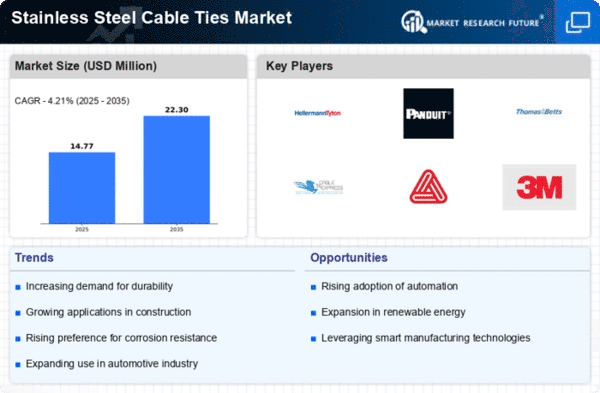
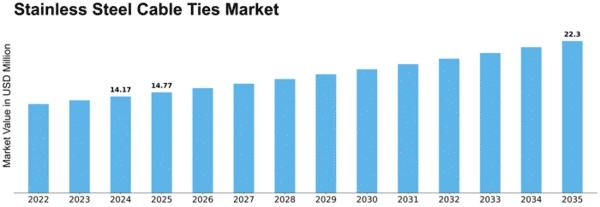
As per MRFR analysis, the Stainless Steel Cable Ties Market Size was estimated at 14.17 USD Million in 2024. The Stainless Steel Cable Ties industry is projected to grow from 14.77 USD Million in 2025 to 22.3 USD Million by 2035, exhibiting a compound annual growth rate (CAGR) of 4.21 during the forecast period 2025 - 2035.

Key Market Trends & Highlights

The Stainless Steel Cable Ties Market is experiencing robust growth driven by industrial applications and technological advancements.

  • The market is witnessing a growing demand in industrial applications, particularly in North America, which remains the largest market.
  • Technological advancements in manufacturing processes are enhancing the efficiency and durability of stainless steel cable ties.
  • Sustainability and eco-friendliness are becoming increasingly important, influencing product development across various sectors.
  • The rising demand in the construction sector and increased adoption in the automotive industry are key drivers propelling market growth.

Market Size & Forecast

2024 Market Size 14.17 (USD Million)
2035 Market Size 22.3 (USD Million)
CAGR (2025 - 2035) 4.21%
Largest Regional Market Share in 2024 North America

Major Players

HellermannTyton (DE), Panduit (US), Thomas & Betts (US), Cable Tie Express (GB), Avery Dennison (US), 3M (US), TE Connectivity (CH), Molex (US), KSS (KR)

Market Trends

The Stainless Steel Cable Ties Market is currently experiencing a notable evolution, driven by various factors that influence demand and supply dynamics. The increasing emphasis on durability and reliability in fastening solutions has led to a growing preference for stainless steel cable ties across multiple industries. These products are recognized for their resistance to corrosion, high tensile strength, and ability to withstand extreme temperatures, making them suitable for applications in sectors such as construction, automotive, and telecommunications. As industries continue to prioritize safety and efficiency, the adoption of stainless steel cable ties is likely to expand, reflecting a shift towards more robust fastening solutions. Moreover, the market appears to be influenced by advancements in manufacturing technologies, which enhance the production processes of stainless steel cable ties. Innovations in design and functionality may lead to the introduction of specialized products tailored to meet specific industry requirements. Additionally, the rising awareness regarding environmental sustainability could drive the demand for recyclable and eco-friendly fastening solutions. As a result, the Stainless Steel Cable Ties Market is poised for growth, with potential opportunities emerging from both technological advancements and changing consumer preferences.

Growing Demand in Industrial Applications

The Stainless Steel Cable Ties Market is witnessing an increase in demand from various industrial sectors. Industries such as construction and automotive are increasingly utilizing these ties due to their strength and durability. This trend suggests a shift towards more reliable fastening solutions that can withstand harsh conditions.

Technological Advancements in Manufacturing

Recent innovations in manufacturing processes are enhancing the production of stainless steel cable ties. These advancements may lead to improved product quality and efficiency, allowing manufacturers to meet the evolving needs of consumers. This trend indicates a potential for increased competition in the market.

Focus on Sustainability and Eco-friendliness

There is a growing emphasis on sustainability within the Stainless Steel Cable Ties Market. As consumers become more environmentally conscious, the demand for recyclable and eco-friendly fastening solutions is likely to rise. This trend reflects a broader movement towards responsible manufacturing practices.

Stainless Steel Cable Ties Market Market Drivers

Market Growth Projections

The Global Stainless Steel Cable Ties Market Industry is projected to experience robust growth over the next decade. With an anticipated market value of 1250 USD Million in 2024, the industry is set to expand significantly, reaching approximately 2750 USD Million by 2035. This growth trajectory suggests a compound annual growth rate of 7.43% from 2025 to 2035, indicating a strong demand for stainless steel cable ties across various sectors. Factors such as increased industrialization, technological advancements, and a focus on sustainability are likely to drive this growth, positioning the market for continued success.

Increased Focus on Sustainability

The Global Stainless Steel Cable Ties Market Industry is witnessing a shift towards sustainable practices, prompting manufacturers to adopt eco-friendly materials. Stainless steel, known for its recyclability and longevity, aligns with the growing emphasis on reducing environmental impact. Companies are increasingly prioritizing sustainable sourcing and production methods, which could attract environmentally conscious consumers. This trend may contribute to the market's expansion, as the demand for sustainable products continues to rise. The industry's commitment to sustainability is likely to enhance its reputation and foster long-term growth.

Expansion of Renewable Energy Sector

The Global Stainless Steel Cable Ties Market Industry is benefiting from the expansion of the renewable energy sector. As the world shifts towards sustainable energy sources, the need for reliable fastening solutions in solar and wind energy installations increases. Stainless steel cable ties are essential for securing cables and components in these systems, ensuring durability and safety. The growth of renewable energy projects globally is likely to drive demand for stainless steel cable ties, contributing to the market's projected value of 2750 USD Million by 2035. This trend underscores the ties' versatility and importance in modern energy solutions.

Rising Demand in Construction Sector

The Global Stainless Steel Cable Ties Market Industry experiences a notable surge in demand driven by the construction sector. As urbanization accelerates, the need for durable and corrosion-resistant materials becomes paramount. Stainless steel cable ties are increasingly utilized in various applications, including securing electrical wiring and plumbing systems. This trend is reflected in the projected market value, which is expected to reach 1250 USD Million in 2024. The construction industry's growth, particularly in emerging economies, is likely to bolster the demand for stainless steel cable ties, thereby enhancing their market presence.

Growing Demand in Automotive Applications

The Global Stainless Steel Cable Ties Market Industry is experiencing increased demand from the automotive sector, where these ties are utilized for securing components and wiring. The automotive industry's shift towards lightweight materials and enhanced safety features drives the need for reliable fastening solutions. Stainless steel cable ties offer superior strength and resistance to environmental factors, making them ideal for automotive applications. As the automotive market continues to expand, the demand for stainless steel cable ties is expected to rise, further solidifying their role in this critical industry.

Technological Advancements in Manufacturing

Technological innovations in manufacturing processes are significantly impacting the Global Stainless Steel Cable Ties Market Industry. Advanced production techniques, such as automated machinery and precision engineering, enhance the quality and efficiency of stainless steel cable ties. These advancements allow for the creation of ties with improved tensile strength and durability, catering to diverse applications across various sectors. As manufacturers invest in technology, the market is poised for growth, with projections indicating a compound annual growth rate of 7.43% from 2025 to 2035. This technological evolution is likely to redefine industry standards.

Market Segment Insights

By Application: Electrical (Largest) vs. Automotive (Fastest-Growing)

The Stainless Steel Cable Ties Market showcases a diverse application spectrum, with electrical applications leading in market share. This segment capitalizes on the increasing demand for reliable and durable cabling solutions across various industries, attributable to expanding electrical infrastructure projects. Following closely are the automotive and construction sectors, each showcasing robust contributions to overall market performance owing to their unique requirements for high-strength tying solutions. In recent years, the automotive application segment has emerged as the fastest-growing, driven by advancements in manufacturing processes and heightened standards for vehicle safety and performance. Coupled with increasing vehicle production and requirements for efficient cable management systems, this segment is set for significant growth. The construction segment also holds potential as project scales expand, emphasizing lasting and effective solutions for cable management in infrastructural projects.

Electrical: Dominant vs. Automotive: Emerging

In the Stainless Steel Cable Ties Market, the electrical application segment is considered the dominant player, primarily due to its fundamental role in ensuring safety and efficiency in electrical installations. These ties are paramount in creating organized and secure connections for wiring, making them essential for compliance with safety standards and regulations. On the other hand, the automotive segment emerges as an emerging force, characterized by innovation in design and manufacturing methodologies. As automakers prioritize lightweight materials that offer both strength and flexibility, stainless steel cable ties are increasingly being recognized for their ability to meet these demands. These segments illustrate the contrast between established reliability and the dynamic growth fueled by technological advancements in the automotive industry.

By End Use: Industrial (Largest) vs. Telecommunications (Fastest-Growing)

The Stainless Steel Cable Ties Market displays a diverse distribution across various end-use segments. The industrial sector holds the largest share, mainly driven by extensive usage in manufacturing and heavy-duty applications. Following closely are the telecommunications and utility sectors, which also contribute significantly to the market. Commercial and residential segments are comparatively smaller, focusing primarily on aesthetic solutions and light-duty applications. As industries increasingly adopt stainless steel cable ties for their durability and resistance to environmental factors, the demand continues to grow in these sectors. As the market evolves, growth trends reveal key drivers for expansion in the telecommunications and utility segments. The rise of smart technologies and improved infrastructure has led to increased demand for reliable data transmission and energy distribution systems. The commercial sector is also adapting to these trends by incorporating stainless steel cable ties for better aesthetic solutions and durability. With the emergence of innovative solutions and advancements in materials, the market for stainless steel cable ties in these sectors is expected to flourish over the upcoming years.

Industrial (Dominant) vs. Telecommunications (Emerging)

The industrial segment of the Stainless Steel Cable Ties Market is characterized by its robust application across various manufacturing processes and infrastructure projects, where tensile strength and reliability are paramount. These ties are preferred for their resistance to corrosion and extreme temperatures, making them ideal for harsh environments. On the other hand, the telecommunications sector is emerging rapidly, driven by the growing demand for high-speed data transmission and network reliability. Stainless steel cable ties play a crucial role in ensuring organized and secure cabling in complex systems. As both segments evolve, the industrial sector remains dominant due to its extensive applications, while the telecommunications segment is gaining traction as businesses upgrade their networks.

By Material Type: 304 Stainless Steel (Largest) vs. 316 Stainless Steel (Fastest-Growing)

In the Stainless Steel Cable Ties Market, 304 Stainless Steel currently holds the largest market share due to its excellent corrosion resistance and versatility in various applications, particularly in industries like automotive and construction. Following closely is 316 Stainless Steel, recognized for its superior resistance to saltwater and harsh environments, making it increasingly popular in marine and outdoor applications as businesses seek durable solutions that withstand challenging conditions. As demand grows for high-quality, reliable fastening solutions, the Stainless Steel Cable Ties Market is witnessing notable growth trends. Factors such as the surge in infrastructure development, rigorous safety regulations, and a shift towards sustainable materials are driving the adoption of premium segments like 316 Stainless Steel. With increasing awareness of durability and corrosion resistance, manufacturers that focus on these high-grade materials are expected to gain significant market traction in the coming years.

304 Stainless Steel: Dominant vs. 316 Stainless Steel: Emerging

304 Stainless Steel is known for its exceptional forming and welding properties, making it the dominant choice for various applications in the Stainless Steel Cable Ties Market. Its popularity stems from its balance between cost and performance, catering to a wide range of sectors, including electronics and industrial use. On the other hand, 316 Stainless Steel, while typically more expensive, is rapidly emerging due to its superior resistance to corrosion and pitting, especially in marine and chemical environments. As industries prioritize longevity and reliability, the demand for 316 Stainless Steel cable ties is accelerating, marking an important shift towards high-performance materials as businesses seek to enhance their operational efficiency and product sustainability.

By Size: Large (Largest) vs. Small (Fastest-Growing)

In the Stainless Steel Cable Ties Market, the size segment showcases a diverse distribution with large cable ties occupying the most significant market share. Large cable ties are favored in industrial applications due to their strength and durability, making them the preferred choice for securing heavy loads. On the other hand, small cable ties are emerging as a key player, capturing the attention of consumers for smaller, lightweight applications. This growth is leading to a notable shift in demand dynamics within the segment. The growth trends in the size segment are driven by increased usage across various end-use industries including construction, automotive, and electronics. Factors contributing to the rise of small cable ties include the expansion of the DIY market and a growing preference for lightweight and versatile solutions in day-to-day applications. Moreover, as sustainability becomes more central in manufacturing processes, companies are opting for stainless steel options known for their longevity and recyclability, further bolstering demand for smaller sizes in environmentally-conscious consumer segments.

Large (Dominant) vs. Small (Emerging)

In the Stainless Steel Cable Ties Market, large cable ties are recognized as the dominant force due to their superior strength and reliability, making them essential in industrial sectors like construction and manufacturing, where heavy-duty performance is a requirement. Their ability to withstand extreme conditions while securing extensive applications positions them favorably against competitors. Conversely, small cable ties are rapidly emerging as a trending choice among consumers looking for convenient and lightweight fastening solutions, especially in DIY projects and small-scale operations. This segment's growth is underscored by the increasing demand for products that offer both efficiency and eco-friendliness, aligning with contemporary consumer preferences for sustainable packaging and materials.

By Packaging Type: Bulk Packaging (Largest) vs. Custom Packaging (Fastest-Growing)

In the Stainless Steel Cable Ties Market, the distribution of market share among different packaging types reveals that bulk packaging holds the largest share, catering predominantly to industries with high volume requirements. Meanwhile, retail packaging taps into the consumer market, providing convenience and accessibility. Custom packaging, while smaller in current market share, is gaining traction as businesses seek tailored solutions to meet specific operational needs.

Bulk Packaging (Dominant) vs. Custom Packaging (Emerging)

Bulk packaging of stainless steel cable ties is characterized by its focus on cost-effectiveness and efficiency, making it the dominant choice for large-scale operations and industrial manufacturers. This segment ensures consistent supply at reduced per-unit costs, catering primarily to businesses in the construction and manufacturing sectors. In contrast, custom packaging is emerging, driven by the demand for personalized branding and specific application needs. Companies are increasingly recognizing the advantages of custom packaging, which allows them to differentiate their products and cater to niche market requirements, thus positioning themselves advantageously in a competitive landscape.

Get more detailed insights about Stainless-Steel Cable Ties Market Research Report - Global Forecast to 2035

Regional Insights

North America : Market Leader in Cable Ties

North America is poised to maintain its leadership in the stainless steel cable ties market, holding a significant market share of 6.5 in 2024. The region's growth is driven by increasing demand from various sectors, including construction, automotive, and electronics. Regulatory support for safety and quality standards further propels market expansion, ensuring that products meet stringent requirements. The rising trend of automation and smart manufacturing also contributes to the demand for durable fastening solutions. The competitive landscape in North America is robust, featuring key players such as Panduit, 3M, and TE Connectivity. These companies leverage advanced technologies and innovative solutions to cater to diverse customer needs. The presence of established distribution networks and strong brand loyalty enhances market penetration. As industries increasingly prioritize sustainability, manufacturers are also focusing on eco-friendly materials, further shaping the market dynamics.

Europe : Emerging Market with Growth Potential

Europe's stainless steel cable ties market is projected to grow significantly, with a market size of 4.0 by 2025. The region benefits from stringent regulations promoting safety and quality, which drive demand across various industries, including telecommunications and energy. The increasing focus on renewable energy projects and infrastructure development is expected to further boost market growth. Additionally, the trend towards automation in manufacturing processes is creating a higher demand for reliable fastening solutions. Leading countries in this region include Germany, France, and the UK, where major players like HellermannTyton and Avery Dennison are actively expanding their market presence. The competitive landscape is characterized by innovation and strategic partnerships, enabling companies to enhance their product offerings. As the market evolves, the emphasis on sustainability and eco-friendly practices is becoming increasingly important, influencing product development and consumer preferences.

Asia-Pacific : Rapidly Growing Market Segment

The Asia-Pacific region is emerging as a significant player in the stainless steel cable ties market, with a market size of 2.5 by 2025. The growth is fueled by rapid industrialization, urbanization, and increasing investments in infrastructure projects. Countries like China and India are leading this growth, driven by their expanding manufacturing sectors and rising demand for durable fastening solutions. Regulatory initiatives aimed at improving safety standards are also contributing to market expansion. In this competitive landscape, key players such as KSS and Molex are establishing a strong foothold, focusing on innovation and product diversification. The presence of a large consumer base and growing awareness of the benefits of stainless steel cable ties are further driving demand. As the region continues to develop, the emphasis on quality and reliability in fastening solutions will shape market dynamics and competitive strategies.

Middle East and Africa : Emerging Market with Challenges

The Middle East and Africa region is gradually developing its stainless steel cable ties market, with a market size of 1.17 by 2025. The growth is primarily driven by increasing construction activities and infrastructure development across various countries. However, challenges such as economic fluctuations and regulatory hurdles may impact market growth. The demand for durable and reliable fastening solutions is rising, particularly in sectors like oil and gas, telecommunications, and construction. Leading countries in this region include South Africa and the UAE, where companies are focusing on enhancing their product offerings to meet local demands. The competitive landscape is characterized by a mix of local and international players, striving to capture market share. As the region continues to evolve, the emphasis on quality and compliance with international standards will be crucial for success in the stainless steel cable ties market.

Key Players and Competitive Insights

The Stainless Steel Cable Ties Market is characterized by a competitive landscape that is increasingly shaped by innovation, sustainability, and strategic partnerships. Key players such as HellermannTyton (DE), Panduit (US), and 3M (US) are actively pursuing strategies that emphasize product differentiation and technological advancement. For instance, HellermannTyton (DE) has focused on enhancing its product portfolio through the introduction of eco-friendly cable ties, which aligns with the growing demand for sustainable solutions. Meanwhile, Panduit (US) has been investing in digital transformation initiatives to streamline operations and improve customer engagement, thereby reinforcing its market position. Collectively, these strategies contribute to a dynamic competitive environment where companies are not only vying for market share but also striving to meet evolving customer expectations.In terms of business tactics, companies are increasingly localizing manufacturing to reduce lead times and optimize supply chains. This approach appears to be particularly effective in a moderately fragmented market, where the presence of numerous players allows for varied competitive strategies. The collective influence of key players, including Thomas & Betts (US) and TE Connectivity (CH), further underscores the importance of operational efficiency and responsiveness to market demands.

In November 3M (US) announced a strategic partnership with a leading renewable energy firm to develop stainless steel cable ties specifically designed for solar panel installations. This collaboration not only enhances 3M's product offerings but also positions the company as a key player in the renewable energy sector, which is experiencing rapid growth. The strategic importance of this move lies in its potential to tap into a burgeoning market while reinforcing 3M's commitment to sustainability.

In October Panduit (US) launched a new line of stainless steel cable ties that incorporate advanced corrosion-resistant technology. This innovation is particularly relevant for industries such as telecommunications and automotive, where durability is paramount. By addressing specific industry needs, Panduit strengthens its competitive edge and demonstrates its focus on customer-centric product development.

In September TE Connectivity (CH) expanded its manufacturing capabilities in Asia, aiming to enhance its supply chain efficiency and meet the increasing demand for stainless steel cable ties in the region. This strategic move not only reflects TE Connectivity's commitment to growth but also highlights the importance of regional expansion in a globalized market.

As of December the competitive trends in the Stainless Steel Cable Ties Market are increasingly defined by digitalization, sustainability, and the integration of advanced technologies such as AI. Strategic alliances are playing a crucial role in shaping the current landscape, enabling companies to leverage complementary strengths and enhance their market offerings. Looking ahead, it is likely that competitive differentiation will evolve from traditional price-based competition to a focus on innovation, technology, and supply chain reliability, as companies seek to navigate the complexities of a rapidly changing market.

Key Companies in the Stainless Steel Cable Ties Market include

Industry Developments

Bharti Airtel has joined the SEA-ME-WE-6 undersea cable consortium in an effort to expand its high-speed global network capacity in order to service India's rapidly rising digital economy. Airtel has announced that it will be a "significant investor" in the SEA-ME-WE-6 cable system, anchoring 20% of the total investment in the line, which will go live in 2025. The SEA-ME-WE-6 consortium's other 12 members will connect Singapore and France, making it one of the world's largest undersea cable systems.

The BestNet Cable Cubby from Eurotech Technologies combines AV control, communication, and AC power. The table-top flush mount Cable Cubby enclosures provide continuous network, phone, VGA, microphone, HDMI output, USB, and 3.5 audio access. Where many, distributed table-top cable connections are required, the BestNet Cable Cubby enclosures are suitable for boardrooms, educational institutions, the hospitality industry, and big training facilities.

Intended Audience:

    • Manufactures
    • Aftermarket suppliers
    • Potential Investors
    • Regional Manufacturers’ Associations
    • Plastics Scraps Suppliers
    • Traders, Distributors, and Suppliers of Stainless-Steel Cable Ties
    • Government & Regional Agencies and Research Organizations

Future Outlook

Stainless Steel Cable Ties Market Future Outlook

The Stainless Steel Cable Ties Market is projected to grow at a 4.21% CAGR from 2025 to 2035, driven by increasing demand in construction, automotive, and electronics sectors.

New opportunities lie in:

  • Expansion into renewable energy sector applications
  • Development of custom stainless steel tie solutions for niche markets
  • Integration of smart technology in cable tie products

By 2035, the market is expected to achieve robust growth, solidifying its position in various industries.

Market Segmentation

Stainless Steel Cable Ties Market Size Outlook

  • Small
  • Medium
  • Large
  • Extra Large

Stainless Steel Cable Ties Market End Use Outlook

  • Industrial
  • Commercial
  • Residential
  • Telecommunications
  • Utilities

Stainless Steel Cable Ties Market Application Outlook

  • Electrical
  • Automotive
  • Construction
  • Aerospace
  • Marine

Stainless Steel Cable Ties Market Material Type Outlook

  • 304 Stainless Steel
  • 316 Stainless Steel
  • 410 Stainless Steel
  • Other Alloys

Stainless Steel Cable Ties Market Packaging Type Outlook

  • Bulk Packaging
  • Retail Packaging
  • Custom Packaging

Report Scope

MARKET SIZE 202414.17(USD Million)
MARKET SIZE 202514.77(USD Million)
MARKET SIZE 203522.3(USD Million)
COMPOUND ANNUAL GROWTH RATE (CAGR)4.21% (2025 - 2035)
REPORT COVERAGERevenue Forecast, Competitive Landscape, Growth Factors, and Trends
BASE YEAR2024
Market Forecast Period2025 - 2035
Historical Data2019 - 2024
Market Forecast UnitsUSD Million
Key Companies ProfiledHellermannTyton (DE), Panduit (US), Thomas & Betts (US), Cable Tie Express (GB), Avery Dennison (US), 3M (US), TE Connectivity (CH), Molex (US), KSS (KR)
Segments CoveredApplication, End Use, Material Type, Size, Packaging Type
Key Market OpportunitiesGrowing demand for durable fastening solutions in industrial applications drives Stainless Steel Cable Ties Market expansion.
Key Market DynamicsRising demand for durable fastening solutions drives innovation and competition in the stainless steel cable ties market.
Countries CoveredNorth America, Europe, APAC, South America, MEA

FAQs

At what CAGR is the Stainless-Steel Cable Ties Market predicted to grow during the forecast period?

Stainless-Steel Cable Ties Market is predicted to grow at 3.12% through forecast period of 2025-2035.

What is the forecast period of Stainless-Steel Cable Ties Market research report?

The forecast period for Stainless-Steel Cable Ties Market research report is 2025-2035.

Which region will lead the global Stainless-Steel Cable Ties Market?

Global Stainless-Steel Cable Ties Market is dominated by APAC region.

  1. SECTION I: EXECUTIVE SUMMARY AND KEY HIGHLIGHTS
    1. | 1.1 EXECUTIVE SUMMARY
    2. | 1.1.1 Market Overview
    3. | 1.1.2 Key Findings
    4. | 1.1.3 Market Segmentation
    5. | 1.1.4 Competitive Landscape
    6. | 1.1.5 Challenges and Opportunities
    7. | 1.1.6 Future Outlook
  2. SECTION II: SCOPING, METHODOLOGY AND MARKET STRUCTURE
    1. | 2.1 MARKET INTRODUCTION
    2. | 2.1.1 Definition
    3. | 2.1.2 Scope of the study
    4. |-- 2.1.2.1 Research Objective
    5. |-- 2.1.2.2 Assumption
    6. |-- 2.1.2.3 Limitations
    7. | 2.2 RESEARCH METHODOLOGY
    8. | 2.2.1 Overview
    9. | 2.2.2 Data Mining
    10. | 2.2.3 Secondary Research
    11. | 2.2.4 Primary Research
    12. |-- 2.2.4.1 Primary Interviews and Information Gathering Process
    13. |-- 2.2.4.2 Breakdown of Primary Respondents
    14. | 2.2.5 Forecasting Model
    15. | 2.2.6 Market Size Estimation
    16. |-- 2.2.6.1 Bottom-Up Approach
    17. |-- 2.2.6.2 Top-Down Approach
    18. | 2.2.7 Data Triangulation
    19. | 2.2.8 Validation
  3. SECTION III: QUALITATIVE ANALYSIS
    1. | 3.1 MARKET DYNAMICS
    2. | 3.1.1 Overview
    3. | 3.1.2 Drivers
    4. | 3.1.3 Restraints
    5. | 3.1.4 Opportunities
    6. | 3.2 MARKET FACTOR ANALYSIS
    7. | 3.2.1 Value chain Analysis
    8. | 3.2.2 Porter's Five Forces Analysis
    9. |-- 3.2.2.1 Bargaining Power of Suppliers
    10. |-- 3.2.2.2 Bargaining Power of Buyers
    11. |-- 3.2.2.3 Threat of New Entrants
    12. |-- 3.2.2.4 Threat of Substitutes
    13. |-- 3.2.2.5 Intensity of Rivalry
    14. | 3.2.3 COVID-19 Impact Analysis
    15. |-- 3.2.3.1 Market Impact Analysis
    16. |-- 3.2.3.2 Regional Impact
    17. |-- 3.2.3.3 Opportunity and Threat Analysis
  4. SECTION IV: QUANTITATIVE ANALYSIS
    1. | 4.1 Chemicals and Materials, BY Application (USD Million)
    2. | 4.1.1 Electrical
    3. | 4.1.2 Automotive
    4. | 4.1.3 Construction
    5. | 4.1.4 Aerospace
    6. | 4.1.5 Marine
    7. | 4.2 Chemicals and Materials, BY End Use (USD Million)
    8. | 4.2.1 Industrial
    9. | 4.2.2 Commercial
    10. | 4.2.3 Residential
    11. | 4.2.4 Telecommunications
    12. | 4.2.5 Utilities
    13. | 4.3 Chemicals and Materials, BY Material Type (USD Million)
    14. | 4.3.1 304 Stainless Steel
    15. | 4.3.2 316 Stainless Steel
    16. | 4.3.3 410 Stainless Steel
    17. | 4.3.4 Other Alloys
    18. | 4.4 Chemicals and Materials, BY Size (USD Million)
    19. | 4.4.1 Small
    20. | 4.4.2 Medium
    21. | 4.4.3 Large
    22. | 4.4.4 Extra Large
    23. | 4.5 Chemicals and Materials, BY Packaging Type (USD Million)
    24. | 4.5.1 Bulk Packaging
    25. | 4.5.2 Retail Packaging
    26. | 4.5.3 Custom Packaging
    27. | 4.6 Chemicals and Materials, BY Region (USD Million)
    28. | 4.6.1 North America
    29. |-- 4.6.1.1 US
    30. |-- 4.6.1.2 Canada
    31. | 4.6.2 Europe
    32. |-- 4.6.2.1 Germany
    33. |-- 4.6.2.2 UK
    34. |-- 4.6.2.3 France
    35. |-- 4.6.2.4 Russia
    36. |-- 4.6.2.5 Italy
    37. |-- 4.6.2.6 Spain
    38. |-- 4.6.2.7 Rest of Europe
    39. | 4.6.3 APAC
    40. |-- 4.6.3.1 China
    41. |-- 4.6.3.2 India
    42. |-- 4.6.3.3 Japan
    43. |-- 4.6.3.4 South Korea
    44. |-- 4.6.3.5 Malaysia
    45. |-- 4.6.3.6 Thailand
    46. |-- 4.6.3.7 Indonesia
    47. |-- 4.6.3.8 Rest of APAC
    48. | 4.6.4 South America
    49. |-- 4.6.4.1 Brazil
    50. |-- 4.6.4.2 Mexico
    51. |-- 4.6.4.3 Argentina
    52. |-- 4.6.4.4 Rest of South America
    53. | 4.6.5 MEA
    54. |-- 4.6.5.1 GCC Countries
    55. |-- 4.6.5.2 South Africa
    56. |-- 4.6.5.3 Rest of MEA
  5. SECTION V: COMPETITIVE ANALYSIS
    1. | 5.1 Competitive Landscape
    2. | 5.1.1 Overview
    3. | 5.1.2 Competitive Analysis
    4. | 5.1.3 Market share Analysis
    5. | 5.1.4 Major Growth Strategy in the Chemicals and Materials
    6. | 5.1.5 Competitive Benchmarking
    7. | 5.1.6 Leading Players in Terms of Number of Developments in the Chemicals and Materials
    8. | 5.1.7 Key developments and growth strategies
    9. |-- 5.1.7.1 New Product Launch/Service Deployment
    10. |-- 5.1.7.2 Merger & Acquisitions
    11. |-- 5.1.7.3 Joint Ventures
    12. | 5.1.8 Major Players Financial Matrix
    13. |-- 5.1.8.1 Sales and Operating Income
    14. |-- 5.1.8.2 Major Players R&D Expenditure. 2023
    15. | 5.2 Company Profiles
    16. | 5.2.1 HellermannTyton (DE)
    17. |-- 5.2.1.1 Financial Overview
    18. |-- 5.2.1.2 Products Offered
    19. |-- 5.2.1.3 Key Developments
    20. |-- 5.2.1.4 SWOT Analysis
    21. |-- 5.2.1.5 Key Strategies
    22. | 5.2.2 Panduit (US)
    23. |-- 5.2.2.1 Financial Overview
    24. |-- 5.2.2.2 Products Offered
    25. |-- 5.2.2.3 Key Developments
    26. |-- 5.2.2.4 SWOT Analysis
    27. |-- 5.2.2.5 Key Strategies
    28. | 5.2.3 Thomas & Betts (US)
    29. |-- 5.2.3.1 Financial Overview
    30. |-- 5.2.3.2 Products Offered
    31. |-- 5.2.3.3 Key Developments
    32. |-- 5.2.3.4 SWOT Analysis
    33. |-- 5.2.3.5 Key Strategies
    34. | 5.2.4 Cable Tie Express (GB)
    35. |-- 5.2.4.1 Financial Overview
    36. |-- 5.2.4.2 Products Offered
    37. |-- 5.2.4.3 Key Developments
    38. |-- 5.2.4.4 SWOT Analysis
    39. |-- 5.2.4.5 Key Strategies
    40. | 5.2.5 Avery Dennison (US)
    41. |-- 5.2.5.1 Financial Overview
    42. |-- 5.2.5.2 Products Offered
    43. |-- 5.2.5.3 Key Developments
    44. |-- 5.2.5.4 SWOT Analysis
    45. |-- 5.2.5.5 Key Strategies
    46. | 5.2.6 3M (US)
    47. |-- 5.2.6.1 Financial Overview
    48. |-- 5.2.6.2 Products Offered
    49. |-- 5.2.6.3 Key Developments
    50. |-- 5.2.6.4 SWOT Analysis
    51. |-- 5.2.6.5 Key Strategies
    52. | 5.2.7 TE Connectivity (CH)
    53. |-- 5.2.7.1 Financial Overview
    54. |-- 5.2.7.2 Products Offered
    55. |-- 5.2.7.3 Key Developments
    56. |-- 5.2.7.4 SWOT Analysis
    57. |-- 5.2.7.5 Key Strategies
    58. | 5.2.8 Molex (US)
    59. |-- 5.2.8.1 Financial Overview
    60. |-- 5.2.8.2 Products Offered
    61. |-- 5.2.8.3 Key Developments
    62. |-- 5.2.8.4 SWOT Analysis
    63. |-- 5.2.8.5 Key Strategies
    64. | 5.2.9 KSS (KR)
    65. |-- 5.2.9.1 Financial Overview
    66. |-- 5.2.9.2 Products Offered
    67. |-- 5.2.9.3 Key Developments
    68. |-- 5.2.9.4 SWOT Analysis
    69. |-- 5.2.9.5 Key Strategies
    70. | 5.3 Appendix
    71. | 5.3.1 References
    72. | 5.3.2 Related Reports

Chemicals and Materials Market Segmentation

Chemicals and Materials By Application (USD Million, 2025-2035)

  • Electrical
  • Automotive
  • Construction
  • Aerospace
  • Marine

Chemicals and Materials By End Use (USD Million, 2025-2035)

  • Industrial
  • Commercial
  • Residential
  • Telecommunications
  • Utilities

Chemicals and Materials By Material Type (USD Million, 2025-2035)

  • 304 Stainless Steel
  • 316 Stainless Steel
  • 410 Stainless Steel
  • Other Alloys

Chemicals and Materials By Size (USD Million, 2025-2035)

  • Small
  • Medium
  • Large
  • Extra Large

Chemicals and Materials By Packaging Type (USD Million, 2025-2035)

  • Bulk Packaging
  • Retail Packaging
  • Custom Packaging
Infographic

Free Sample Request

Kindly complete the form below to receive a free sample of this Report

Get Free Sample

Customer Strories

Compare Licence

×
Features License Type
Single User Multiuser License Enterprise User
Price $4,950 $5,950 $7,250
Maximum User Access Limit 1 User Upto 10 Users Unrestricted Access Throughout the Organization
Free Customization
Direct Access to Analyst
Deliverable Format
Platform Access
Discount on Next Purchase 10% 15% 15%
Printable Versions