Request Free Sample ×

Kindly complete the form below to receive a free sample of this Report

* Please use a valid business email

Leading companies partner with us for data-driven Insights

clients tt-cursor
Hero Background
English
Chinese
French
Japanese
Korean
German
Spanish

Sputter Coatings Market Size

ID: MRFR/CnM/4200-HCR
137 Pages
Anshula Mandaokar
Last Updated: April 06, 2026

Global Sputter Coatings Market Research Report Information by Target Material (Pure Material, Alloys, Compounds, and Others), Substrate (Ceramic, Metals & Dielectric, Glass, Plastic, Semiconductors, and Others) Application (Automotive & Transportation, Architecture, Electrical & Electronics, Energy, and Others), and Region (Asia-Pacific, Latin America, North America, Europe, and Middle East & Africa)—Forecast till 2035

Share:
Download PDF ×

We do not share your information with anyone. However, we may send you emails based on your report interest from time to time. You may contact us at any time to opt-out.

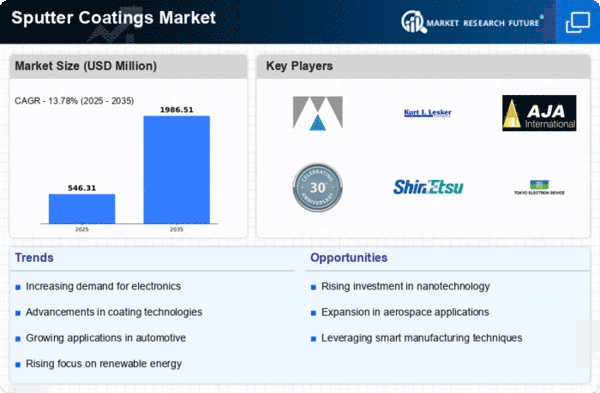
Sputter Coatings Market Infographic
Purchase Options

Sputter Coatings Size

Sputter Coatings Market Growth Projections and Opportunities

The Sputter Coatings market is driven by various factors that determine how it behaves. One of them is the increasing demand for thin film deposition in different industries. In fact, sputter coatings are being applied in electronics and other industries like automotive and aerospace because they are best for depositing thin films on different types of substrates. This has pushed the industry into making more advanced materials with improved properties including durability and conductivity among others. The global sputter coatings market was estimated at USD 4.9 billion in 2018, growing at a CAGR of 5.1% during the forecast period, 2019–2025.

In addition to this, market growth can be attributed to advancements that have been made in technology used for Sputtering coating. As manufacturers try to develop better products through continuous research aimed at improving the precision and efficiency of sputtering processes, the sector has become innovative. This has resulted in an increase in the number of companies providing coatings that perform better than their predecessors do enabling end users to easily adapt to changeable needs. Thus, while stimulating market growth, this promotes competition.

Economic factors such as investment in research and development, overall industrial growth and consumer spending influence where the market will go next. With favorable economic conditions comes increased investment in technology and innovation within the sputter coatings industry. On the contrary, economic downturns or uncertainties may lead to fluctuations as organizations may cut down on capital expenditures.

Additionally, another crucial determinant is stiff competition amongst major players within this space which shapes its behavior over time. Companies continuously seek ways to make their products stand out from those offered by competitors so as not only to stay ahead but also beat them sometimes through product innovations strategic collaborations mergers and acquisitions where necessary . Competition over cost leadership quality/ecological excellence or technological advancement creates a dynamic environment that provides end users with numerous alternatives thereby enhancing performance.

To sum up, the growth and development of Sputter Coatings market are affected by multiple parameters. The demand for thin film deposition, technological developments, environmental considerations, regional industrial activities, economic aspects and competitive forces all form part of the larger canvas for this industry. As companies look to achieve more sustainable solutions through advanced materials development, the Sputter Coatings market is poised for long-term growth and innovation.
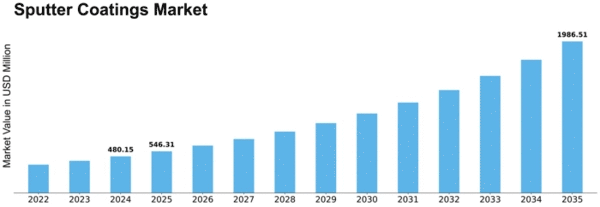
Sputter Coatings Market Size Graph
Author
Author Profile
Anshula Mandaokar
Team Lead - Research

Anshula Mandaokar holds an academic degree in Chemical Engineering and has been contributing to the field for more than 5 years. She has expertise in Market Research and Business Consulting and serves as a Team Lead for a reputed Market Research firm under the Chemicals and Materials domain spectrum. She has worked on multiple projects, generating explicit results in a quick turnaround time. Her understanding of data interpretation justifies her role as a leader.

Leave a Comment

FAQs

What is the current valuation of the Sputter Coatings Market as of 2024?

<p>The Sputter Coatings Market was valued at 480.15 USD Million in 2024.</p>

What is the projected market valuation for the Sputter Coatings Market in 2035?

<p>The market is projected to reach 1986.51 USD Million by 2035.</p>

What is the expected CAGR for the Sputter Coatings Market during the forecast period 2025 - 2035?

<p>The expected CAGR for the Sputter Coatings Market during 2025 - 2035 is 13.78%.</p>

Which application segment had the highest valuation in 2024?

<p>In 2024, the Semiconductors application segment had the highest valuation at 500.0 USD Million.</p>

What are the key players in the Sputter Coatings Market?

<p>Key players include Materion, Kurt J. Lesker Company, AJA International, and Shin-Etsu Chemical.</p>

How does the valuation of the Solar Cells segment compare to others in 2024?

The Solar Cells segment was valued at 400.0 USD Million in 2024, indicating strong market interest.

What is the valuation range for Metallic Coatings in the Sputter Coatings Market?

The valuation range for Metallic Coatings spans from 192.06 to 792.0 USD Million.

Which end-use industry is projected to have the highest growth in the Sputter Coatings Market?

The Energy end-use industry is projected to grow significantly, with a valuation of 586.51 USD Million.

What is the valuation of the Healthcare end-use industry in 2024?

The Healthcare end-use industry was valued at 250.0 USD Million in 2024.

How do the valuations of Dielectric and Composite Coatings compare in 2024?

Both Dielectric and Composite Coatings had identical valuations of 396.0 USD Million in 2024.

Market Summary

As per MRFR analysis, the Sputter Coatings Market Size was estimated at 480.15 USD Million in 2024. The Sputter Coatings industry is projected to grow from 546.31 USD Million in 2025 to 1986.51 USD Million by 2035, exhibiting a compound annual growth rate (CAGR) of 13.78% during the forecast period 2025 - 2035.

Key Market Trends & Highlights

The Sputter Coatings Market is poised for robust growth driven by technological advancements and increasing applications across various sectors.

  • Technological advancements in sputter coating processes are enhancing efficiency and performance across multiple applications.
  • The North American region remains the largest market, while the Asia-Pacific region is experiencing the fastest growth in sputter coatings.
  • In the semiconductor segment, sputter coatings are crucial for device fabrication, whereas the optics segment is witnessing rapid expansion.
  • Rising demand in electronics and growth in renewable energy applications are key drivers propelling the market forward.

Market Size & Forecast

2024 Market Size 480.15 (USD Million)
2035 Market Size 1986.51 (USD Million)
CAGR (2025 - 2035) 13.78%
Largest Regional Market Share in 2024 North America

Major Players

Materion (US), Kurt J. Lesker Company (US), AJA International (US), Angstrom Engineering (CA), Shin-Etsu Chemical (JP), Tokyo Electron Limited (JP), ULVAC, Inc. (JP), VON ARDENNE GmbH (DE), Sputtering Components, Inc. (US)

Market Trends

The Sputter Coatings Market is currently experiencing a notable evolution, driven by advancements in technology and increasing demand across various sectors. Industries such as electronics, optics, and automotive are increasingly adopting sputter coatings for their superior properties, including enhanced durability and improved performance. This trend appears to be fueled by the growing need for high-quality surface finishes and protective layers, which are essential in modern manufacturing processes. Furthermore, the shift towards sustainable practices is prompting manufacturers to explore eco-friendly materials and processes, potentially reshaping the market landscape in the coming years. In addition, the Sputter Coatings Market seems to be influenced by the rising trend of miniaturization in electronic devices. As components become smaller and more complex, the demand for precise and efficient coating techniques is likely to increase. This could lead to innovations in sputtering technology, enhancing the capabilities of coatings to meet the evolving requirements of various applications. Overall, the market appears poised for growth, with opportunities emerging from technological advancements and changing consumer preferences.

Technological Advancements

Recent innovations in sputtering technology are enhancing the efficiency and effectiveness of coating processes. These advancements may lead to improved adhesion, uniformity, and thickness control, which are crucial for high-performance applications.

Sustainability Initiatives

The push for environmentally friendly practices is influencing the Sputter Coatings Market. Manufacturers are increasingly focusing on developing sustainable materials and processes, which could reshape product offerings and attract eco-conscious consumers.

Miniaturization Trends

The ongoing trend towards smaller electronic devices is driving demand for precise sputter coatings. As components shrink, the need for advanced coating techniques that ensure reliability and performance is likely to grow.

Sputter Coatings Market Market Drivers

Growing Demand in Electronics

The Global Sputter Coatings Market Industry experiences a robust demand surge driven by the electronics sector. As electronic devices become increasingly sophisticated, the need for high-performance coatings that enhance durability and functionality is paramount. In 2024, the market is projected to reach 6.12 USD Billion, reflecting the industry's response to the growing complexity of electronic components. Sputter coatings are essential for applications such as semiconductors and displays, where precision and quality are critical. This trend is expected to continue, with the market likely expanding as the electronics industry evolves, indicating a sustained growth trajectory.

Rising Focus on Thin Film Technologies

The Global Sputter Coatings Market Industry is significantly impacted by the rising focus on thin film technologies across various sectors. Thin films are essential in applications ranging from optics to electronics, where they provide unique properties such as enhanced conductivity and reduced weight. The increasing adoption of thin film technologies in industries such as aerospace and telecommunications is likely to drive demand for sputter coatings. As companies seek to innovate and improve product performance, the sputter coatings market is expected to grow at a CAGR of 5.1% from 2025 to 2035, reflecting the ongoing technological advancements and their implications for the industry.

Advancements in Solar Energy Technologies

The Global Sputter Coatings Market Industry is significantly influenced by advancements in solar energy technologies. Sputter coatings are crucial in the production of photovoltaic cells, enhancing their efficiency and longevity. As global efforts to transition to renewable energy sources intensify, the demand for high-quality sputter coatings is likely to rise. The market's growth is further supported by government initiatives promoting solar energy adoption. This sector's expansion is anticipated to contribute to the overall market growth, with projections suggesting a market size of 10.6 USD Billion by 2035, highlighting the potential of sputter coatings in sustainable energy solutions.

Increased Applications in Automotive Industry

The Global Sputter Coatings Market Industry is witnessing increased applications within the automotive sector. As vehicles become more technologically advanced, the need for sputter coatings that enhance performance and aesthetics is growing. These coatings are utilized in various automotive components, including sensors and displays, which require high durability and resistance to environmental factors. The automotive industry's shift towards electric vehicles further propels this demand, as these vehicles often incorporate advanced materials that benefit from sputter coatings. This trend suggests a promising outlook for the market, as automotive manufacturers increasingly recognize the value of these coatings.

Environmental Regulations and Sustainability Initiatives

The Global Sputter Coatings Market Industry is also shaped by stringent environmental regulations and sustainability initiatives. Governments worldwide are implementing policies that encourage the use of eco-friendly materials and processes, prompting industries to adopt sputter coatings that align with these regulations. This shift towards sustainability is not only beneficial for the environment but also enhances the market's appeal to consumers who prioritize green technologies. As industries adapt to these changes, the demand for sputter coatings that meet environmental standards is likely to increase, further driving market growth in the coming years.

Market Segment Insights

By Application: Semiconductors (Largest) vs. Solar Cells (Fastest-Growing)

<p>The Sputter Coatings Market is significantly influenced by its application segments, with semiconductors holding the largest market share. This sector's dominance can be attributed to the explosive growth of electronic devices and the rising demand for advanced semiconductor technologies. Furthermore, optics and data storage also contribute meaningfully to the market, driven by developments in precision optics and the increasing need for efficient data storage solutions. Each application plays a crucial role in defining the market landscape and meeting industry demands.</p>

<p>Semiconductors (Dominant) vs. Solar Cells (Emerging)</p>

<p>The semiconductor segment has established itself as the dominant force in the sputter coatings market, leveraging its critical role in electronics manufacturing. Its established supply chains and technical advancements ensure continued leadership. On the other hand, solar cells represent an emerging segment, growing rapidly due to increased investments in renewable energy technologies. The increased focus on sustainability and energy efficiency drives companies to explore advanced coating technologies in solar panel production. Both segments showcase distinct characteristics, with semiconductors benefiting from stable demand and traditional manufacturing processes, while solar cells are propelled by innovation and environmental concerns.</p>

By Material Type: Metallic Coatings (Largest) vs. Dielectric Coatings (Fastest-Growing)

<p>In the Sputter Coatings Market, metallic coatings dominate due to their extensive applications across various industries, particularly in electronics and optics. They account for a significant share of the market, driven by their excellent electrical conductivity and durability. Dielectric coatings, while smaller in market share, are experiencing rapid growth, fueled by advancements in microelectronics and the increasing demand for thin-film technology.</p>

<p>Metallic Coatings (Dominant) vs. Dielectric Coatings (Emerging)</p>

<p>Metallic coatings, characterized by their high conductivity and reflective properties, are widely used in sectors such as semiconductor manufacturing, optical devices, and automotive applications. Their longstanding presence in the market positions them as the dominant force, as they provide reliable performance and enhance product longevity. Conversely, dielectric coatings are emerging as a significant player, primarily owing to their insulating properties and applications in advanced electronics. As the demand for faster and more efficient electronic devices rises, dielectric coatings are becoming indispensable, positioning them for substantial growth in the coming years.</p>

By End Use Industry: Electronics (Largest) vs. Automotive (Fastest-Growing)

<p>In the Sputter Coatings Market, the Electronics industry commands the largest share, primarily driven by the increasing demand for advanced electronic components and devices. Sputter coatings are essential in the production of semiconductors, display technologies, and various electronic applications, making this sector a dominant force in the market. In contrast, while Automotive holds a smaller share currently, it is the fastest-growing segment due to the surge in electric vehicles (EVs) and innovative automotive technologies, which necessitate high-performance coatings. The growth in the Electronics sector is bolstered by continual technological advancements and the miniaturization of components, leading to a higher adoption of sputter coatings. On the other hand, the Automotive segment is experiencing rapid expansion due to the rising emphasis on lightweight materials and enhanced aesthetics in vehicles. As both industries evolve, the demand for sputter coatings will likely increase significantly, creating opportunities for manufacturers in the market.</p>

<p>Electronics: Dominant vs. Automotive: Emerging</p>

<p>Electronics remain the predominant end use industry for sputter coatings, given their critical role in producing high-performance electronic devices and components. This segment includes applications in semiconductors, displays, and other electronic devices, where sputter coatings provide essential properties, including conductivity and durability. On the other hand, the Automotive sector is emerging as a crucial player, driven by the rapid advancements in electric vehicles and the demand for innovative coatings that enhance sustainability. Automotive applications are increasingly focusing on reducing vehicle weight and improving exterior aesthetics, highlighting the shift towards high-tech and environmentally-friendly materials. As these segments progress, the interplay between their developments will shape the future of sputter coatings in the market.</p>

By Technology: Magnetron Sputtering (Largest) vs. RF Sputtering (Fastest-Growing)

The technology segment of the Sputter Coatings Market displays a dynamic landscape where Magnetron Sputtering leads with the largest market share. This technique has gained widespread adoption due to its efficiency and ability to produce high-quality coatings. RF Sputtering, although smaller in share, is rapidly gaining traction owing to its unique advantages in semiconductor and solar cell applications, positioning it as an emerging favorite among manufacturers. The distribution of market share across these technologies signifies the diversity and evolution within the sputtering process, reflecting varying industry needs and technological advancements. Growth trends indicate a robust expansion for the Sputter Coatings Market, driven by increasing demand across electronics, automotive, and renewable energy sectors. Magnetron Sputtering holds its ground due to its versatility and effectiveness, but RF Sputtering is poised to experience accelerated growth as industries seek innovative coating solutions. Factors like technological improvements, the push for sustainable solutions, and the rising demand for advanced materials are propelling the market forward, highlighting how these technologies will adapt to changing industrial landscapes.

Technology: Magnetron Sputtering (Dominant) vs. RF Sputtering (Emerging)

Magnetron Sputtering is characterized by its high deposition rates and uniform coating capabilities, making it the dominant technology in the Sputter Coatings Market. Its ability to generate dense films with excellent adhesion makes it ideal for applications in optics and electronics. Conversely, RF Sputtering is emerging as a significant player, particularly in the fabrication of thin films for electronic components like semiconductors. Its capability to achieve high-quality coatings on low-conductivity substrates expands its application range. The demand for both technologies is driven by innovation in material sciences and an increasing focus on improving product efficiency and performance, making them critical in the evolving landscape of sputter coatings.

By Substrate Type: Glass (Largest) vs. Silicon (Fastest-Growing)

In the Sputter Coatings Market, the substrate type distribution exhibits a clear differentiation, with glass commanding the largest share due to its extensive application across various industries including electronics and optics. This dominant position stems from its favorable properties such as high transparency and thermal stability, which make it ideal for a range of sputter coating processes. Silicon follows as a rapidly growing substrate, reflecting the escalation of semiconductor manufacturing and solar energy applications that leverage silicon’s capabilities.

Silicon (Dominant) vs. Metal (Emerging)

Silicon stands out as a dominant substrate type in the sputter coatings market primarily due to its versatile use in electronics and semiconductors. Its intrinsic properties, such as excellent electrical conductivity and compatibility with various sputtering techniques, bolster its application in high-performance devices. Meanwhile, metal substrates are emerging as significant players, especially in the manufacturing of reflective and functional coatings. Their strength, durability, and ability to support intricate coatings make them appealing for automotive and aerospace sectors. This dual focus on silicon and metal substrates highlights the industry's shift towards more technologically advanced solutions.

Get more detailed insights about Sputter coatings Market Research Report - Global Forecast till 2035

Regional Insights

North America : Market Leader in Sputter Coatings

North America is poised to maintain its leadership in the sputter coatings market, holding a significant market share of $240.08M in 2024. The region's growth is driven by increasing demand in sectors such as electronics, automotive, and renewable energy. Regulatory support for advanced manufacturing technologies further catalyzes market expansion, ensuring compliance with environmental standards and promoting innovation. The competitive landscape in North America is robust, featuring key players like Materion, Kurt J. Lesker Company, and AJA International. These companies are investing in R&D to enhance product offerings and meet the evolving needs of industries. The presence of established manufacturers and a strong supply chain network contribute to the region's dominance, making it a hub for sputter coating technologies.

Europe : Emerging Market with Growth Potential

Europe is witnessing a notable increase in the sputter coatings market, with a market size of $120.04M. The growth is fueled by rising investments in renewable energy and electronics, alongside stringent regulations promoting sustainable practices. The European Union's commitment to reducing carbon emissions is driving demand for advanced materials, including sputter coatings, which are essential for energy-efficient technologies. Leading countries such as Germany, France, and the UK are at the forefront of this market, supported by key players like VON ARDENNE GmbH and Shin-Etsu Chemical. The competitive landscape is characterized by innovation and collaboration among manufacturers, ensuring a steady supply of high-quality sputter coatings. As the market evolves, Europe is set to become a significant player in the global sputter coatings arena.

Asia-Pacific : Rapid Growth in Emerging Economies

The Asia-Pacific region is experiencing rapid growth in the sputter coatings market, with a market size of $96.06M. This growth is driven by the booming electronics sector, particularly in countries like China, Japan, and South Korea. The increasing adoption of advanced manufacturing technologies and supportive government policies are further propelling market expansion, making it a key area for investment in sputter coatings. China stands out as a leading country in this market, with significant contributions from local manufacturers and international players like Tokyo Electron Limited and ULVAC, Inc. The competitive landscape is dynamic, with companies focusing on innovation and strategic partnerships to enhance their market presence. As demand continues to rise, Asia-Pacific is set to play a crucial role in The Sputter Coatings.

Middle East and Africa : Emerging Market with Untapped Potential

The Middle East and Africa region is gradually emerging in the sputter coatings market, with a market size of $24.97M. The growth is primarily driven by increasing investments in the electronics and renewable energy sectors. Governments in the region are implementing policies to promote technological advancements, which is expected to boost demand for sputter coatings in various applications. Countries like South Africa and the UAE are leading the way in adopting advanced manufacturing technologies. The competitive landscape is still developing, with opportunities for both local and international players to establish a foothold. As the market matures, the Middle East and Africa are likely to become significant contributors to the global sputter coatings industry.

Key Players and Competitive Insights

The Sputter Coatings Market is characterized by a dynamic competitive landscape, driven by technological advancements and increasing demand across various sectors, including electronics, optics, and renewable energy. Key players such as Materion (US), Kurt J. Lesker Company (US), and Shin-Etsu Chemical (JP) are strategically positioned to leverage innovation and operational efficiency. Materion (US) has focused on enhancing its product portfolio through R&D investments, while Kurt J. Lesker Company (US) emphasizes customer-centric solutions and expanding its global footprint. Shin-Etsu Chemical (JP) appears to be concentrating on sustainable practices, which may resonate well with environmentally conscious consumers. Collectively, these strategies contribute to a competitive environment that is increasingly defined by technological prowess and sustainability initiatives.In terms of business tactics, companies are localizing manufacturing to reduce lead times and optimize supply chains, which is particularly crucial in a market that is moderately fragmented. The competitive structure is influenced by the collective actions of these key players, who are not only vying for market share but also striving to enhance operational efficiencies. This localized approach may provide a competitive edge, allowing companies to respond swiftly to market demands and fluctuations.

In November Materion (US) announced the launch of a new line of advanced sputter targets designed for high-performance applications in the semiconductor industry. This strategic move is significant as it positions Materion to capitalize on the growing demand for advanced materials in semiconductor manufacturing, potentially increasing its market share and reinforcing its reputation as a leader in innovation.

In October Kurt J. Lesker Company (US) expanded its manufacturing capabilities by opening a new facility in Europe, aimed at enhancing its service delivery to European clients. This expansion is likely to improve operational efficiency and reduce shipping times, thereby strengthening customer relationships and increasing competitiveness in the region.

In September Shin-Etsu Chemical (JP) entered into a partnership with a leading renewable energy firm to develop sputter coatings specifically for solar panel applications. This collaboration not only underscores Shin-Etsu's commitment to sustainability but also positions the company to tap into the rapidly growing renewable energy sector, which is expected to see substantial growth in the coming years.

As of December the Sputter Coatings Market is witnessing trends such as digitalization, sustainability, and AI integration, which are reshaping competitive dynamics. Strategic alliances are becoming increasingly prevalent, allowing companies to pool resources and expertise to drive innovation. The competitive differentiation is likely to evolve from traditional price-based competition to a focus on technological advancements, supply chain reliability, and sustainable practices, indicating a shift towards a more sophisticated and innovation-driven market landscape.

Key Companies in the Sputter Coatings Market include

Industry Developments

Future Outlook

Sputter Coatings Market Future Outlook

The Sputter Coatings Market is projected to grow at a 13.78% CAGR from 2025 to 2035, driven by advancements in technology and increasing demand across various industries.

New opportunities lie in:

  • Expansion into emerging markets with tailored sputter coating solutions.
  • Development of eco-friendly sputter coating materials to meet regulatory demands.
  • Investment in R&D for innovative applications in electronics and renewable energy sectors.

By 2035, the Sputter Coatings Market is expected to achieve substantial growth and diversification.

Market Segmentation

Sputter Coatings Market End Use Outlook

  • Electronics
  • Automotive
  • Aerospace
  • Medical Devices
  • Energy

Sputter Coatings Market Technology Outlook

  • Magnetron Sputtering
  • RF Sputtering
  • DC Sputtering
  • Pulsed Sputtering

Sputter Coatings Market Application Outlook

  • Semiconductors
  • Optics
  • Solar Cells
  • Data Storage
  • Thin Film Transistors

Sputter Coatings Market Material Type Outlook

  • Metallic Coatings
  • Dielectric Coatings
  • Composite Coatings
  • Ceramic Coatings

Sputter Coatings Market Substrate Type Outlook

  • Glass
  • Silicon
  • Metal
  • Plastic

Report Scope

MARKET SIZE 2024 480.15(USD Million)
MARKET SIZE 2025 546.31(USD Million)
MARKET SIZE 2035 1986.51(USD Million)
COMPOUND ANNUAL GROWTH RATE (CAGR) 13.78% (2025 - 2035)
REPORT COVERAGE Revenue Forecast, Competitive Landscape, Growth Factors, and Trends
BASE YEAR 2024
Market Forecast Period 2025 - 2035
Historical Data 2019 - 2024
Market Forecast Units USD Million
Key Companies Profiled Materion (US), Kurt J. Lesker Company (US), AJA International (US), Angstrom Engineering (CA), Shin-Etsu Chemical (JP), Tokyo Electron Limited (JP), ULVAC, Inc. (JP), VON ARDENNE GmbH (DE), Sputtering Components, Inc. (US)
Segments Covered Application, End Use, Material Type, Technology, Substrate Type
Key Market Opportunities Advancements in nanotechnology enhance performance and expand applications in the Sputter Coatings Market.
Key Market Dynamics Technological advancements and regulatory changes drive innovation and competition in the sputter coatings market.
Countries Covered North America, Europe, APAC, South America, MEA

FAQs

What is the current valuation of the Sputter Coatings Market as of 2024?

<p>The Sputter Coatings Market was valued at 480.15 USD Million in 2024.</p>

What is the projected market valuation for the Sputter Coatings Market in 2035?

<p>The market is projected to reach 1986.51 USD Million by 2035.</p>

What is the expected CAGR for the Sputter Coatings Market during the forecast period 2025 - 2035?

<p>The expected CAGR for the Sputter Coatings Market during 2025 - 2035 is 13.78%.</p>

Which application segment had the highest valuation in 2024?

<p>In 2024, the Semiconductors application segment had the highest valuation at 500.0 USD Million.</p>

What are the key players in the Sputter Coatings Market?

<p>Key players include Materion, Kurt J. Lesker Company, AJA International, and Shin-Etsu Chemical.</p>

How does the valuation of the Solar Cells segment compare to others in 2024?

The Solar Cells segment was valued at 400.0 USD Million in 2024, indicating strong market interest.

What is the valuation range for Metallic Coatings in the Sputter Coatings Market?

The valuation range for Metallic Coatings spans from 192.06 to 792.0 USD Million.

Which end-use industry is projected to have the highest growth in the Sputter Coatings Market?

The Energy end-use industry is projected to grow significantly, with a valuation of 586.51 USD Million.

What is the valuation of the Healthcare end-use industry in 2024?

The Healthcare end-use industry was valued at 250.0 USD Million in 2024.

How do the valuations of Dielectric and Composite Coatings compare in 2024?

Both Dielectric and Composite Coatings had identical valuations of 396.0 USD Million in 2024.

  1. SECTION I: EXECUTIVE SUMMARY AND KEY HIGHLIGHTS
    1. | 1.1 EXECUTIVE SUMMARY
    2. | | 1.1.1 Market Overview
    3. | | 1.1.2 Key Findings
    4. | | 1.1.3 Market Segmentation
    5. | | 1.1.4 Competitive Landscape
    6. | | 1.1.5 Challenges and Opportunities
    7. | | 1.1.6 Future Outlook
  2. SECTION II: SCOPING, METHODOLOGY AND MARKET STRUCTURE
    1. | 2.1 MARKET INTRODUCTION
    2. | | 2.1.1 Definition
    3. | | 2.1.2 Scope of the study
    4. | | | 2.1.2.1 Research Objective
    5. | | | 2.1.2.2 Assumption
    6. | | | 2.1.2.3 Limitations
    7. | 2.2 RESEARCH METHODOLOGY
    8. | | 2.2.1 Overview
    9. | | 2.2.2 Data Mining
    10. | | 2.2.3 Secondary Research
    11. | | 2.2.4 Primary Research
    12. | | | 2.2.4.1 Primary Interviews and Information Gathering Process
    13. | | | 2.2.4.2 Breakdown of Primary Respondents
    14. | | 2.2.5 Forecasting Model
    15. | | 2.2.6 Market Size Estimation
    16. | | | 2.2.6.1 Bottom-Up Approach
    17. | | | 2.2.6.2 Top-Down Approach
    18. | | 2.2.7 Data Triangulation
    19. | | 2.2.8 Validation
  3. SECTION III: QUALITATIVE ANALYSIS
    1. | 3.1 MARKET DYNAMICS
    2. | | 3.1.1 Overview
    3. | | 3.1.2 Drivers
    4. | | 3.1.3 Restraints
    5. | | 3.1.4 Opportunities
    6. | 3.2 MARKET FACTOR ANALYSIS
    7. | | 3.2.1 Value chain Analysis
    8. | | 3.2.2 Porter's Five Forces Analysis
    9. | | | 3.2.2.1 Bargaining Power of Suppliers
    10. | | | 3.2.2.2 Bargaining Power of Buyers
    11. | | | 3.2.2.3 Threat of New Entrants
    12. | | | 3.2.2.4 Threat of Substitutes
    13. | | | 3.2.2.5 Intensity of Rivalry
    14. | | 3.2.3 COVID-19 Impact Analysis
    15. | | | 3.2.3.1 Market Impact Analysis
    16. | | | 3.2.3.2 Regional Impact
    17. | | | 3.2.3.3 Opportunity and Threat Analysis
  4. SECTION IV: QUANTITATIVE ANALYSIS
    1. | 4.1 Chemicals and Materials, BY Application (USD Million)
    2. | | 4.1.1 Semiconductors
    3. | | 4.1.2 Optics
    4. | | 4.1.3 Solar Cells
    5. | | 4.1.4 Data Storage
    6. | | 4.1.5 Medical Devices
    7. | 4.2 Chemicals and Materials, BY Material Type (USD Million)
    8. | | 4.2.1 Metallic Coatings
    9. | | 4.2.2 Dielectric Coatings
    10. | | 4.2.3 Composite Coatings
    11. | | 4.2.4 Ceramic Coatings
    12. | 4.3 Chemicals and Materials, BY End Use Industry (USD Million)
    13. | | 4.3.1 Electronics
    14. | | 4.3.2 Automotive
    15. | | 4.3.3 Aerospace
    16. | | 4.3.4 Healthcare
    17. | | 4.3.5 Energy
    18. | 4.4 Chemicals and Materials, BY Region (USD Million)
    19. | | 4.4.1 North America
    20. | | | 4.4.1.1 US
    21. | | | 4.4.1.2 Canada
    22. | | 4.4.2 Europe
    23. | | | 4.4.2.1 Germany
    24. | | | 4.4.2.2 UK
    25. | | | 4.4.2.3 France
    26. | | | 4.4.2.4 Russia
    27. | | | 4.4.2.5 Italy
    28. | | | 4.4.2.6 Spain
    29. | | | 4.4.2.7 Rest of Europe
    30. | | 4.4.3 APAC
    31. | | | 4.4.3.1 China
    32. | | | 4.4.3.2 India
    33. | | | 4.4.3.3 Japan
    34. | | | 4.4.3.4 South Korea
    35. | | | 4.4.3.5 Malaysia
    36. | | | 4.4.3.6 Thailand
    37. | | | 4.4.3.7 Indonesia
    38. | | | 4.4.3.8 Rest of APAC
    39. | | 4.4.4 South America
    40. | | | 4.4.4.1 Brazil
    41. | | | 4.4.4.2 Mexico
    42. | | | 4.4.4.3 Argentina
    43. | | | 4.4.4.4 Rest of South America
    44. | | 4.4.5 MEA
    45. | | | 4.4.5.1 GCC Countries
    46. | | | 4.4.5.2 South Africa
    47. | | | 4.4.5.3 Rest of MEA
  5. SECTION V: COMPETITIVE ANALYSIS
    1. | 5.1 Competitive Landscape
    2. | | 5.1.1 Overview
    3. | | 5.1.2 Competitive Analysis
    4. | | 5.1.3 Market share Analysis
    5. | | 5.1.4 Major Growth Strategy in the Chemicals and Materials
    6. | | 5.1.5 Competitive Benchmarking
    7. | | 5.1.6 Leading Players in Terms of Number of Developments in the Chemicals and Materials
    8. | | 5.1.7 Key developments and growth strategies
    9. | | | 5.1.7.1 New Product Launch/Service Deployment
    10. | | | 5.1.7.2 Merger & Acquisitions
    11. | | | 5.1.7.3 Joint Ventures
    12. | | 5.1.8 Major Players Financial Matrix
    13. | | | 5.1.8.1 Sales and Operating Income
    14. | | | 5.1.8.2 Major Players R&D Expenditure. 2023
    15. | 5.2 Company Profiles
    16. | | 5.2.1 Materion (US)
    17. | | | 5.2.1.1 Financial Overview
    18. | | | 5.2.1.2 Products Offered
    19. | | | 5.2.1.3 Key Developments
    20. | | | 5.2.1.4 SWOT Analysis
    21. | | | 5.2.1.5 Key Strategies
    22. | | 5.2.2 Kurt J. Lesker Company (US)
    23. | | | 5.2.2.1 Financial Overview
    24. | | | 5.2.2.2 Products Offered
    25. | | | 5.2.2.3 Key Developments
    26. | | | 5.2.2.4 SWOT Analysis
    27. | | | 5.2.2.5 Key Strategies
    28. | | 5.2.3 AJA International (US)
    29. | | | 5.2.3.1 Financial Overview
    30. | | | 5.2.3.2 Products Offered
    31. | | | 5.2.3.3 Key Developments
    32. | | | 5.2.3.4 SWOT Analysis
    33. | | | 5.2.3.5 Key Strategies
    34. | | 5.2.4 Angstrom Engineering (CA)
    35. | | | 5.2.4.1 Financial Overview
    36. | | | 5.2.4.2 Products Offered
    37. | | | 5.2.4.3 Key Developments
    38. | | | 5.2.4.4 SWOT Analysis
    39. | | | 5.2.4.5 Key Strategies
    40. | | 5.2.5 Shin-Etsu Chemical (JP)
    41. | | | 5.2.5.1 Financial Overview
    42. | | | 5.2.5.2 Products Offered
    43. | | | 5.2.5.3 Key Developments
    44. | | | 5.2.5.4 SWOT Analysis
    45. | | | 5.2.5.5 Key Strategies
    46. | | 5.2.6 Tokyo Electron Limited (JP)
    47. | | | 5.2.6.1 Financial Overview
    48. | | | 5.2.6.2 Products Offered
    49. | | | 5.2.6.3 Key Developments
    50. | | | 5.2.6.4 SWOT Analysis
    51. | | | 5.2.6.5 Key Strategies
    52. | | 5.2.7 ULVAC, Inc. (JP)
    53. | | | 5.2.7.1 Financial Overview
    54. | | | 5.2.7.2 Products Offered
    55. | | | 5.2.7.3 Key Developments
    56. | | | 5.2.7.4 SWOT Analysis
    57. | | | 5.2.7.5 Key Strategies
    58. | | 5.2.8 Sputtering Components, Inc. (US)
    59. | | | 5.2.8.1 Financial Overview
    60. | | | 5.2.8.2 Products Offered
    61. | | | 5.2.8.3 Key Developments
    62. | | | 5.2.8.4 SWOT Analysis
    63. | | | 5.2.8.5 Key Strategies
    64. | | 5.2.9 VON ARDENNE GmbH (DE)
    65. | | | 5.2.9.1 Financial Overview
    66. | | | 5.2.9.2 Products Offered
    67. | | | 5.2.9.3 Key Developments
    68. | | | 5.2.9.4 SWOT Analysis
    69. | | | 5.2.9.5 Key Strategies
    70. | 5.3 Appendix
    71. | | 5.3.1 References
    72. | | 5.3.2 Related Reports
  6. LIST OF FIGURES
    1. | 6.1 MARKET SYNOPSIS
    2. | 6.2 NORTH AMERICA MARKET ANALYSIS
    3. | 6.3 US MARKET ANALYSIS BY APPLICATION
    4. | 6.4 US MARKET ANALYSIS BY MATERIAL TYPE
    5. | 6.5 US MARKET ANALYSIS BY END USE INDUSTRY
    6. | 6.6 CANADA MARKET ANALYSIS BY APPLICATION
    7. | 6.7 CANADA MARKET ANALYSIS BY MATERIAL TYPE
    8. | 6.8 CANADA MARKET ANALYSIS BY END USE INDUSTRY
    9. | 6.9 EUROPE MARKET ANALYSIS
    10. | 6.10 GERMANY MARKET ANALYSIS BY APPLICATION
    11. | 6.11 GERMANY MARKET ANALYSIS BY MATERIAL TYPE
    12. | 6.12 GERMANY MARKET ANALYSIS BY END USE INDUSTRY
    13. | 6.13 UK MARKET ANALYSIS BY APPLICATION
    14. | 6.14 UK MARKET ANALYSIS BY MATERIAL TYPE
    15. | 6.15 UK MARKET ANALYSIS BY END USE INDUSTRY
    16. | 6.16 FRANCE MARKET ANALYSIS BY APPLICATION
    17. | 6.17 FRANCE MARKET ANALYSIS BY MATERIAL TYPE
    18. | 6.18 FRANCE MARKET ANALYSIS BY END USE INDUSTRY
    19. | 6.19 RUSSIA MARKET ANALYSIS BY APPLICATION
    20. | 6.20 RUSSIA MARKET ANALYSIS BY MATERIAL TYPE
    21. | 6.21 RUSSIA MARKET ANALYSIS BY END USE INDUSTRY
    22. | 6.22 ITALY MARKET ANALYSIS BY APPLICATION
    23. | 6.23 ITALY MARKET ANALYSIS BY MATERIAL TYPE
    24. | 6.24 ITALY MARKET ANALYSIS BY END USE INDUSTRY
    25. | 6.25 SPAIN MARKET ANALYSIS BY APPLICATION
    26. | 6.26 SPAIN MARKET ANALYSIS BY MATERIAL TYPE
    27. | 6.27 SPAIN MARKET ANALYSIS BY END USE INDUSTRY
    28. | 6.28 REST OF EUROPE MARKET ANALYSIS BY APPLICATION
    29. | 6.29 REST OF EUROPE MARKET ANALYSIS BY MATERIAL TYPE
    30. | 6.30 REST OF EUROPE MARKET ANALYSIS BY END USE INDUSTRY
    31. | 6.31 APAC MARKET ANALYSIS
    32. | 6.32 CHINA MARKET ANALYSIS BY APPLICATION
    33. | 6.33 CHINA MARKET ANALYSIS BY MATERIAL TYPE
    34. | 6.34 CHINA MARKET ANALYSIS BY END USE INDUSTRY
    35. | 6.35 INDIA MARKET ANALYSIS BY APPLICATION
    36. | 6.36 INDIA MARKET ANALYSIS BY MATERIAL TYPE
    37. | 6.37 INDIA MARKET ANALYSIS BY END USE INDUSTRY
    38. | 6.38 JAPAN MARKET ANALYSIS BY APPLICATION
    39. | 6.39 JAPAN MARKET ANALYSIS BY MATERIAL TYPE
    40. | 6.40 JAPAN MARKET ANALYSIS BY END USE INDUSTRY
    41. | 6.41 SOUTH KOREA MARKET ANALYSIS BY APPLICATION
    42. | 6.42 SOUTH KOREA MARKET ANALYSIS BY MATERIAL TYPE
    43. | 6.43 SOUTH KOREA MARKET ANALYSIS BY END USE INDUSTRY
    44. | 6.44 MALAYSIA MARKET ANALYSIS BY APPLICATION
    45. | 6.45 MALAYSIA MARKET ANALYSIS BY MATERIAL TYPE
    46. | 6.46 MALAYSIA MARKET ANALYSIS BY END USE INDUSTRY
    47. | 6.47 THAILAND MARKET ANALYSIS BY APPLICATION
    48. | 6.48 THAILAND MARKET ANALYSIS BY MATERIAL TYPE
    49. | 6.49 THAILAND MARKET ANALYSIS BY END USE INDUSTRY
    50. | 6.50 INDONESIA MARKET ANALYSIS BY APPLICATION
    51. | 6.51 INDONESIA MARKET ANALYSIS BY MATERIAL TYPE
    52. | 6.52 INDONESIA MARKET ANALYSIS BY END USE INDUSTRY
    53. | 6.53 REST OF APAC MARKET ANALYSIS BY APPLICATION
    54. | 6.54 REST OF APAC MARKET ANALYSIS BY MATERIAL TYPE
    55. | 6.55 REST OF APAC MARKET ANALYSIS BY END USE INDUSTRY
    56. | 6.56 SOUTH AMERICA MARKET ANALYSIS
    57. | 6.57 BRAZIL MARKET ANALYSIS BY APPLICATION
    58. | 6.58 BRAZIL MARKET ANALYSIS BY MATERIAL TYPE
    59. | 6.59 BRAZIL MARKET ANALYSIS BY END USE INDUSTRY
    60. | 6.60 MEXICO MARKET ANALYSIS BY APPLICATION
    61. | 6.61 MEXICO MARKET ANALYSIS BY MATERIAL TYPE
    62. | 6.62 MEXICO MARKET ANALYSIS BY END USE INDUSTRY
    63. | 6.63 ARGENTINA MARKET ANALYSIS BY APPLICATION
    64. | 6.64 ARGENTINA MARKET ANALYSIS BY MATERIAL TYPE
    65. | 6.65 ARGENTINA MARKET ANALYSIS BY END USE INDUSTRY
    66. | 6.66 REST OF SOUTH AMERICA MARKET ANALYSIS BY APPLICATION
    67. | 6.67 REST OF SOUTH AMERICA MARKET ANALYSIS BY MATERIAL TYPE
    68. | 6.68 REST OF SOUTH AMERICA MARKET ANALYSIS BY END USE INDUSTRY
    69. | 6.69 MEA MARKET ANALYSIS
    70. | 6.70 GCC COUNTRIES MARKET ANALYSIS BY APPLICATION
    71. | 6.71 GCC COUNTRIES MARKET ANALYSIS BY MATERIAL TYPE
    72. | 6.72 GCC COUNTRIES MARKET ANALYSIS BY END USE INDUSTRY
    73. | 6.73 SOUTH AFRICA MARKET ANALYSIS BY APPLICATION
    74. | 6.74 SOUTH AFRICA MARKET ANALYSIS BY MATERIAL TYPE
    75. | 6.75 SOUTH AFRICA MARKET ANALYSIS BY END USE INDUSTRY
    76. | 6.76 REST OF MEA MARKET ANALYSIS BY APPLICATION
    77. | 6.77 REST OF MEA MARKET ANALYSIS BY MATERIAL TYPE
    78. | 6.78 REST OF MEA MARKET ANALYSIS BY END USE INDUSTRY
    79. | 6.79 KEY BUYING CRITERIA OF CHEMICALS AND MATERIALS
    80. | 6.80 RESEARCH PROCESS OF MRFR
    81. | 6.81 DRO ANALYSIS OF CHEMICALS AND MATERIALS
    82. | 6.82 DRIVERS IMPACT ANALYSIS: CHEMICALS AND MATERIALS
    83. | 6.83 RESTRAINTS IMPACT ANALYSIS: CHEMICALS AND MATERIALS
    84. | 6.84 SUPPLY / VALUE CHAIN: CHEMICALS AND MATERIALS
    85. | 6.85 CHEMICALS AND MATERIALS, BY APPLICATION, 2024 (% SHARE)
    86. | 6.86 CHEMICALS AND MATERIALS, BY APPLICATION, 2024 TO 2035 (USD Million)
    87. | 6.87 CHEMICALS AND MATERIALS, BY MATERIAL TYPE, 2024 (% SHARE)
    88. | 6.88 CHEMICALS AND MATERIALS, BY MATERIAL TYPE, 2024 TO 2035 (USD Million)
    89. | 6.89 CHEMICALS AND MATERIALS, BY END USE INDUSTRY, 2024 (% SHARE)
    90. | 6.90 CHEMICALS AND MATERIALS, BY END USE INDUSTRY, 2024 TO 2035 (USD Million)
    91. | 6.91 BENCHMARKING OF MAJOR COMPETITORS
  7. LIST OF TABLES
    1. | 7.1 LIST OF ASSUMPTIONS
    2. | | 7.1.1
    3. | 7.2 North America MARKET SIZE ESTIMATES; FORECAST
    4. | | 7.2.1 BY APPLICATION, 2025-2035 (USD Million)
    5. | | 7.2.2 BY MATERIAL TYPE, 2025-2035 (USD Million)
    6. | | 7.2.3 BY END USE INDUSTRY, 2025-2035 (USD Million)
    7. | 7.3 US MARKET SIZE ESTIMATES; FORECAST
    8. | | 7.3.1 BY APPLICATION, 2025-2035 (USD Million)
    9. | | 7.3.2 BY MATERIAL TYPE, 2025-2035 (USD Million)
    10. | | 7.3.3 BY END USE INDUSTRY, 2025-2035 (USD Million)
    11. | 7.4 Canada MARKET SIZE ESTIMATES; FORECAST
    12. | | 7.4.1 BY APPLICATION, 2025-2035 (USD Million)
    13. | | 7.4.2 BY MATERIAL TYPE, 2025-2035 (USD Million)
    14. | | 7.4.3 BY END USE INDUSTRY, 2025-2035 (USD Million)
    15. | 7.5 Europe MARKET SIZE ESTIMATES; FORECAST
    16. | | 7.5.1 BY APPLICATION, 2025-2035 (USD Million)
    17. | | 7.5.2 BY MATERIAL TYPE, 2025-2035 (USD Million)
    18. | | 7.5.3 BY END USE INDUSTRY, 2025-2035 (USD Million)
    19. | 7.6 Germany MARKET SIZE ESTIMATES; FORECAST
    20. | | 7.6.1 BY APPLICATION, 2025-2035 (USD Million)
    21. | | 7.6.2 BY MATERIAL TYPE, 2025-2035 (USD Million)
    22. | | 7.6.3 BY END USE INDUSTRY, 2025-2035 (USD Million)
    23. | 7.7 UK MARKET SIZE ESTIMATES; FORECAST
    24. | | 7.7.1 BY APPLICATION, 2025-2035 (USD Million)
    25. | | 7.7.2 BY MATERIAL TYPE, 2025-2035 (USD Million)
    26. | | 7.7.3 BY END USE INDUSTRY, 2025-2035 (USD Million)
    27. | 7.8 France MARKET SIZE ESTIMATES; FORECAST
    28. | | 7.8.1 BY APPLICATION, 2025-2035 (USD Million)
    29. | | 7.8.2 BY MATERIAL TYPE, 2025-2035 (USD Million)
    30. | | 7.8.3 BY END USE INDUSTRY, 2025-2035 (USD Million)
    31. | 7.9 Russia MARKET SIZE ESTIMATES; FORECAST
    32. | | 7.9.1 BY APPLICATION, 2025-2035 (USD Million)
    33. | | 7.9.2 BY MATERIAL TYPE, 2025-2035 (USD Million)
    34. | | 7.9.3 BY END USE INDUSTRY, 2025-2035 (USD Million)
    35. | 7.10 Italy MARKET SIZE ESTIMATES; FORECAST
    36. | | 7.10.1 BY APPLICATION, 2025-2035 (USD Million)
    37. | | 7.10.2 BY MATERIAL TYPE, 2025-2035 (USD Million)
    38. | | 7.10.3 BY END USE INDUSTRY, 2025-2035 (USD Million)
    39. | 7.11 Spain MARKET SIZE ESTIMATES; FORECAST
    40. | | 7.11.1 BY APPLICATION, 2025-2035 (USD Million)
    41. | | 7.11.2 BY MATERIAL TYPE, 2025-2035 (USD Million)
    42. | | 7.11.3 BY END USE INDUSTRY, 2025-2035 (USD Million)
    43. | 7.12 Rest of Europe MARKET SIZE ESTIMATES; FORECAST
    44. | | 7.12.1 BY APPLICATION, 2025-2035 (USD Million)
    45. | | 7.12.2 BY MATERIAL TYPE, 2025-2035 (USD Million)
    46. | | 7.12.3 BY END USE INDUSTRY, 2025-2035 (USD Million)
    47. | 7.13 APAC MARKET SIZE ESTIMATES; FORECAST
    48. | | 7.13.1 BY APPLICATION, 2025-2035 (USD Million)
    49. | | 7.13.2 BY MATERIAL TYPE, 2025-2035 (USD Million)
    50. | | 7.13.3 BY END USE INDUSTRY, 2025-2035 (USD Million)
    51. | 7.14 China MARKET SIZE ESTIMATES; FORECAST
    52. | | 7.14.1 BY APPLICATION, 2025-2035 (USD Million)
    53. | | 7.14.2 BY MATERIAL TYPE, 2025-2035 (USD Million)
    54. | | 7.14.3 BY END USE INDUSTRY, 2025-2035 (USD Million)
    55. | 7.15 India MARKET SIZE ESTIMATES; FORECAST
    56. | | 7.15.1 BY APPLICATION, 2025-2035 (USD Million)
    57. | | 7.15.2 BY MATERIAL TYPE, 2025-2035 (USD Million)
    58. | | 7.15.3 BY END USE INDUSTRY, 2025-2035 (USD Million)
    59. | 7.16 Japan MARKET SIZE ESTIMATES; FORECAST
    60. | | 7.16.1 BY APPLICATION, 2025-2035 (USD Million)
    61. | | 7.16.2 BY MATERIAL TYPE, 2025-2035 (USD Million)
    62. | | 7.16.3 BY END USE INDUSTRY, 2025-2035 (USD Million)
    63. | 7.17 South Korea MARKET SIZE ESTIMATES; FORECAST
    64. | | 7.17.1 BY APPLICATION, 2025-2035 (USD Million)
    65. | | 7.17.2 BY MATERIAL TYPE, 2025-2035 (USD Million)
    66. | | 7.17.3 BY END USE INDUSTRY, 2025-2035 (USD Million)
    67. | 7.18 Malaysia MARKET SIZE ESTIMATES; FORECAST
    68. | | 7.18.1 BY APPLICATION, 2025-2035 (USD Million)
    69. | | 7.18.2 BY MATERIAL TYPE, 2025-2035 (USD Million)
    70. | | 7.18.3 BY END USE INDUSTRY, 2025-2035 (USD Million)
    71. | 7.19 Thailand MARKET SIZE ESTIMATES; FORECAST
    72. | | 7.19.1 BY APPLICATION, 2025-2035 (USD Million)
    73. | | 7.19.2 BY MATERIAL TYPE, 2025-2035 (USD Million)
    74. | | 7.19.3 BY END USE INDUSTRY, 2025-2035 (USD Million)
    75. | 7.20 Indonesia MARKET SIZE ESTIMATES; FORECAST
    76. | | 7.20.1 BY APPLICATION, 2025-2035 (USD Million)
    77. | | 7.20.2 BY MATERIAL TYPE, 2025-2035 (USD Million)
    78. | | 7.20.3 BY END USE INDUSTRY, 2025-2035 (USD Million)
    79. | 7.21 Rest of APAC MARKET SIZE ESTIMATES; FORECAST
    80. | | 7.21.1 BY APPLICATION, 2025-2035 (USD Million)
    81. | | 7.21.2 BY MATERIAL TYPE, 2025-2035 (USD Million)
    82. | | 7.21.3 BY END USE INDUSTRY, 2025-2035 (USD Million)
    83. | 7.22 South America MARKET SIZE ESTIMATES; FORECAST
    84. | | 7.22.1 BY APPLICATION, 2025-2035 (USD Million)
    85. | | 7.22.2 BY MATERIAL TYPE, 2025-2035 (USD Million)
    86. | | 7.22.3 BY END USE INDUSTRY, 2025-2035 (USD Million)
    87. | 7.23 Brazil MARKET SIZE ESTIMATES; FORECAST
    88. | | 7.23.1 BY APPLICATION, 2025-2035 (USD Million)
    89. | | 7.23.2 BY MATERIAL TYPE, 2025-2035 (USD Million)
    90. | | 7.23.3 BY END USE INDUSTRY, 2025-2035 (USD Million)
    91. | 7.24 Mexico MARKET SIZE ESTIMATES; FORECAST
    92. | | 7.24.1 BY APPLICATION, 2025-2035 (USD Million)
    93. | | 7.24.2 BY MATERIAL TYPE, 2025-2035 (USD Million)
    94. | | 7.24.3 BY END USE INDUSTRY, 2025-2035 (USD Million)
    95. | 7.25 Argentina MARKET SIZE ESTIMATES; FORECAST
    96. | | 7.25.1 BY APPLICATION, 2025-2035 (USD Million)
    97. | | 7.25.2 BY MATERIAL TYPE, 2025-2035 (USD Million)
    98. | | 7.25.3 BY END USE INDUSTRY, 2025-2035 (USD Million)
    99. | 7.26 Rest of South America MARKET SIZE ESTIMATES; FORECAST
    100. | | 7.26.1 BY APPLICATION, 2025-2035 (USD Million)
    101. | | 7.26.2 BY MATERIAL TYPE, 2025-2035 (USD Million)
    102. | | 7.26.3 BY END USE INDUSTRY, 2025-2035 (USD Million)
    103. | 7.27 MEA MARKET SIZE ESTIMATES; FORECAST
    104. | | 7.27.1 BY APPLICATION, 2025-2035 (USD Million)
    105. | | 7.27.2 BY MATERIAL TYPE, 2025-2035 (USD Million)
    106. | | 7.27.3 BY END USE INDUSTRY, 2025-2035 (USD Million)
    107. | 7.28 GCC Countries MARKET SIZE ESTIMATES; FORECAST
    108. | | 7.28.1 BY APPLICATION, 2025-2035 (USD Million)
    109. | | 7.28.2 BY MATERIAL TYPE, 2025-2035 (USD Million)
    110. | | 7.28.3 BY END USE INDUSTRY, 2025-2035 (USD Million)
    111. | 7.29 South Africa MARKET SIZE ESTIMATES; FORECAST
    112. | | 7.29.1 BY APPLICATION, 2025-2035 (USD Million)
    113. | | 7.29.2 BY MATERIAL TYPE, 2025-2035 (USD Million)
    114. | | 7.29.3 BY END USE INDUSTRY, 2025-2035 (USD Million)
    115. | 7.30 Rest of MEA MARKET SIZE ESTIMATES; FORECAST
    116. | | 7.30.1 BY APPLICATION, 2025-2035 (USD Million)
    117. | | 7.30.2 BY MATERIAL TYPE, 2025-2035 (USD Million)
    118. | | 7.30.3 BY END USE INDUSTRY, 2025-2035 (USD Million)
    119. | 7.31 PRODUCT LAUNCH/PRODUCT DEVELOPMENT/APPROVAL
    120. | | 7.31.1
    121. | 7.32 ACQUISITION/PARTNERSHIP
    122. | | 7.32.1

Chemicals and Materials Market Segmentation

Chemicals and Materials By Application (USD Million, 2025-2035)

  • Semiconductors
  • Optics
  • Solar Cells
  • Data Storage
  • Medical Devices

Chemicals and Materials By Material Type (USD Million, 2025-2035)

  • Metallic Coatings
  • Dielectric Coatings
  • Composite Coatings
  • Ceramic Coatings

Chemicals and Materials By End Use Industry (USD Million, 2025-2035)

  • Electronics
  • Automotive
  • Aerospace
  • Healthcare
  • Energy
Infographic

Free Sample Request

Kindly complete the form below to receive a free sample of this Report

Get Free Sample

Customer Strories

Compare Licence

×
Features License Type
Single User Multiuser License Enterprise User
Price $4,950 $5,950 $7,250
Maximum User Access Limit 1 User Upto 10 Users Unrestricted Access Throughout the Organization
Free Customization
Direct Access to Analyst
Deliverable Format
Platform Access
Discount on Next Purchase 10% 15% 15%
Printable Versions