×
Request Free Sample ×

Kindly complete the form below to receive a free sample of this Report

* Please use a valid business email

Leading companies partner with us for data-driven Insights

clients tt-cursor
Hero Background
English
Chinese
French
Japanese
Korean
German
Spanish

Sputter Coatings Market Share

ID: MRFR/CnM/4200-HCR
137 Pages
Anshula Mandaokar
October 2025

Global Sputter Coatings Market Research Report Information by Target Material (Pure Material, Alloys, Compounds, and Others), Substrate (Ceramic, Metals & Dielectric, Glass, Plastic, Semiconductors, and Others) Application (Automotive & Transportation, Architecture, Electrical & Electronics, Energy, and Others), and Region (Asia-Pacific, Latin America, North America, Europe, and Middle East & Africa)—Forecast till 2035

Share:
Download PDF ×

We do not share your information with anyone. However, we may send you emails based on your report interest from time to time. You may contact us at any time to opt-out.

Sputter Coatings Market Infographic
×
Sputter Coatings Market Infographic Full View
Purchase Options

Market Share

Sputter Coatings Market Share Analysis

The Sputter Coatings market employs different strategies in order to grow their market share; therefore, they opt to compete their rivals in the industry. For instance, one approach can be differentiation where firms concentrate on providing distinct sputter coating solutions that are innovative as well as uncommon. By making investments in research and development (R&D), companies can develop coatings with higher performance standards than those currently available hence attracting a niche segment of customers. This allows them to command high prices in the market and occupy a special status.

Another strategy is cost leadership where businesses focus on being low price providers in this field of business. In addition to optimizing production processes so that they become efficient over time, companies should review their raw material sourcing procedures so that they procure less expensive inputs. By doing this alone will enable these organizations reach out many people who may want low cost but quality products which are not the case when it comes to most cost sensitive markets like sputter coatings as a result firms attain bigger sales volumes leading them to own substantial portions of such industries

Also, market segmentation is a main strategy in the field of Sputter Coatings. Companies identify unique client needs, tastes and preferences and segment their products and marketing accordingly. The approach allows businesses to address the distinct requirements of various segments thereby generating a more customized and appealing value proposition. An awareness of the varied customer demands within the market ensures that business entities get deeply rooted in some specific niches thus building loyalty among consumers as well as repeat sales.

Another important aspect of market share strategies is brand positioning. This helps companies differentiate themselves from competitors and build confidence with customers through a strong positive image investment in marketing, advertising and public relations activities that shape a favourable perception about the brand which influences purchase decisions and builds brand loyalty.

In order to maintain its market position in the dynamic Sputter Coatings industry, continuous innovation should be practiced without relenting by any company. Customer attention can be caught by companies that are ahead on technological advancements, sustainability initiatives and product improvements for those who seek revolutionary products. Leading innovation enables enterprises to establish standards within an industry hence attracting early adopters while also gaining competitive advantage over rivals.

The Sputter Coatings industry has several dynamic market share positioning strategies including differentiation, cost leadership, targeting, collaboration, geographical expansion, brand positioning and continuous innovation. Successful implementation of these strategies enables firms to successfully navigate through competitive environment by capturing bigger shares of the markets in order to sustain long term growth within this changing sector.


Author
Anshula Mandaokar
Team Lead - Research

Anshula Mandaokar holds an academic degree in Chemical Engineering and has been contributing to the field for more than 5 years. She has expertise in Market Research and Business Consulting and serves as a Team Lead for a reputed Market Research firm under the Chemicals and Materials domain spectrum. She has worked on multiple projects, generating explicit results in a quick turnaround time. Her understanding of data interpretation justifies her role as a leader.

Leave a Comment

FAQs

At what CAGR is the sputter coatings market expected to grow over the forecast period?

The sputter coatings market is predicted to grow at a 5.1% CAGR between 2019-2025.

Which region is expected to dominate the sputter coatings market?

Asia Pacific is expected to dominate the sputter coatings market.

Who are the key competitors in the sputter coatings market?

Key competitors in the sputter coatings market include GRIKIN Advanced Materials Co. Ltd (China), Honeywell International Inc (US), IANGYIN ENTRET COATING TECHNOLOGY CO. LTD (China), Materion Corporation (US), Hereaus Deutschland Gmbh & Co. Kg. (Germany), Umicore (Belgium), Mitsui Mining & Smelting Co., Ltd (Japan), Hitachi Metals, Ltd. (Japan), Tosoh SMD, Inc. (US), and JX Nippon Mining & Metals Corporation (Japan).

What are the key factors driving the growth of the splutter coatings market?

Booming electricals and electronics industry, low cost of electronics devices, and technological advancements in the healthcare sector are adding to the market growth.

Which factors may act as deterrents in the splutter coatings market growth?

Technological barriers and high cost may deter market growth.

Market Summary

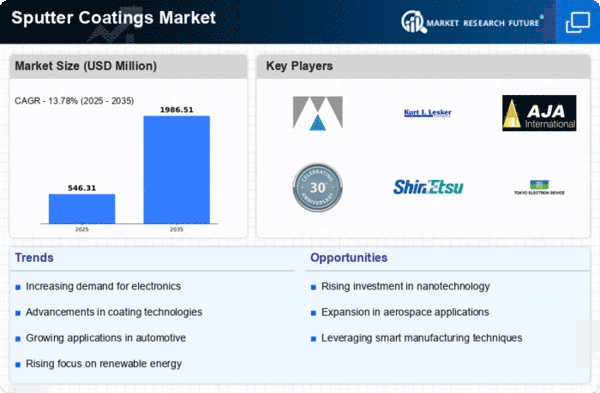
As per MRFR analysis, the Sputter Coatings Market Size was estimated at 480.15 USD Million in 2024. The Sputter Coatings industry is projected to grow from 546.31 USD Million in 2025 to 1986.51 USD Million by 2035, exhibiting a compound annual growth rate (CAGR) of 13.78 during the forecast period 2025 - 2035.

Key Market Trends & Highlights

The Sputter Coatings Market is poised for robust growth driven by technological advancements and increasing applications across various sectors.

  • Technological advancements in sputter coating processes are enhancing efficiency and performance across multiple applications.
  • The North American region remains the largest market, while the Asia-Pacific region is experiencing the fastest growth in sputter coatings.
  • In the semiconductor segment, sputter coatings are crucial for device fabrication, whereas the optics segment is witnessing rapid expansion.
  • Rising demand in electronics and growth in renewable energy applications are key drivers propelling the market forward.

Market Size & Forecast

2024 Market Size 480.15 (USD Million)
2035 Market Size 1986.51 (USD Million)
CAGR (2025 - 2035) 13.78%
Largest Regional Market Share in 2024 North America

Major Players

Materion (US), Kurt J. Lesker Company (US), AJA International (US), Angstrom Engineering (CA), Shin-Etsu Chemical (JP), Tokyo Electron Limited (JP), ULVAC, Inc. (JP), VON ARDENNE GmbH (DE), Sputtering Components, Inc. (US)

Market Trends

The Sputter Coatings Market is currently experiencing a notable evolution, driven by advancements in technology and increasing demand across various sectors. Industries such as electronics, optics, and automotive are increasingly adopting sputter coatings for their superior properties, including enhanced durability and improved performance. This trend appears to be fueled by the growing need for high-quality surface finishes and protective layers, which are essential in modern manufacturing processes. Furthermore, the shift towards sustainable practices is prompting manufacturers to explore eco-friendly materials and processes, potentially reshaping the market landscape in the coming years. In addition, the Sputter Coatings Market seems to be influenced by the rising trend of miniaturization in electronic devices. As components become smaller and more complex, the demand for precise and efficient coating techniques is likely to increase. This could lead to innovations in sputtering technology, enhancing the capabilities of coatings to meet the evolving requirements of various applications. Overall, the market appears poised for growth, with opportunities emerging from technological advancements and changing consumer preferences.

Technological Advancements

Recent innovations in sputtering technology are enhancing the efficiency and effectiveness of coating processes. These advancements may lead to improved adhesion, uniformity, and thickness control, which are crucial for high-performance applications.

Sustainability Initiatives

The push for environmentally friendly practices is influencing the Sputter Coatings Market. Manufacturers are increasingly focusing on developing sustainable materials and processes, which could reshape product offerings and attract eco-conscious consumers.

Miniaturization Trends

The ongoing trend towards smaller electronic devices is driving demand for precise sputter coatings. As components shrink, the need for advanced coating techniques that ensure reliability and performance is likely to grow.

Sputter Coatings Market Market Drivers

Growing Demand in Electronics

The Global Sputter Coatings Market Industry experiences a robust demand surge driven by the electronics sector. As electronic devices become increasingly sophisticated, the need for high-performance coatings that enhance durability and functionality is paramount. In 2024, the market is projected to reach 6.12 USD Billion, reflecting the industry's response to the growing complexity of electronic components. Sputter coatings are essential for applications such as semiconductors and displays, where precision and quality are critical. This trend is expected to continue, with the market likely expanding as the electronics industry evolves, indicating a sustained growth trajectory.

Rising Focus on Thin Film Technologies

The Global Sputter Coatings Market Industry is significantly impacted by the rising focus on thin film technologies across various sectors. Thin films are essential in applications ranging from optics to electronics, where they provide unique properties such as enhanced conductivity and reduced weight. The increasing adoption of thin film technologies in industries such as aerospace and telecommunications is likely to drive demand for sputter coatings. As companies seek to innovate and improve product performance, the sputter coatings market is expected to grow at a CAGR of 5.1% from 2025 to 2035, reflecting the ongoing technological advancements and their implications for the industry.

Advancements in Solar Energy Technologies

The Global Sputter Coatings Market Industry is significantly influenced by advancements in solar energy technologies. Sputter coatings are crucial in the production of photovoltaic cells, enhancing their efficiency and longevity. As global efforts to transition to renewable energy sources intensify, the demand for high-quality sputter coatings is likely to rise. The market's growth is further supported by government initiatives promoting solar energy adoption. This sector's expansion is anticipated to contribute to the overall market growth, with projections suggesting a market size of 10.6 USD Billion by 2035, highlighting the potential of sputter coatings in sustainable energy solutions.

Increased Applications in Automotive Industry

The Global Sputter Coatings Market Industry is witnessing increased applications within the automotive sector. As vehicles become more technologically advanced, the need for sputter coatings that enhance performance and aesthetics is growing. These coatings are utilized in various automotive components, including sensors and displays, which require high durability and resistance to environmental factors. The automotive industry's shift towards electric vehicles further propels this demand, as these vehicles often incorporate advanced materials that benefit from sputter coatings. This trend suggests a promising outlook for the market, as automotive manufacturers increasingly recognize the value of these coatings.

Environmental Regulations and Sustainability Initiatives

The Global Sputter Coatings Market Industry is also shaped by stringent environmental regulations and sustainability initiatives. Governments worldwide are implementing policies that encourage the use of eco-friendly materials and processes, prompting industries to adopt sputter coatings that align with these regulations. This shift towards sustainability is not only beneficial for the environment but also enhances the market's appeal to consumers who prioritize green technologies. As industries adapt to these changes, the demand for sputter coatings that meet environmental standards is likely to increase, further driving market growth in the coming years.

Market Segment Insights

By Application: Semiconductors (Largest) vs. Optics (Fastest-Growing)

The application segment in the sputter coatings market showcases a diverse range of uses including semiconductors, optics, solar cells, data storage, and thin film transistors. Among these, semiconductors dominate the market due to their extensive applications in electronic devices and integrated circuits. Following closely, optics are experiencing rapid development driven by the increasing demand for enhanced optical components in various industries.

Semiconductors (Dominant) vs. Optics (Emerging)

Semiconductors represent the dominant force in the sputter coatings market, driven by their critical role in modern electronics and technology. The demand for advanced sputtered coatings in semiconductor fabrication processes is propelled by the continuous evolution of electronic devices, including smartphones and computers. On the other hand, optics is an emerging segment, marked by significant growth opportunities as demand for optical coatings rises in sectors such as telecommunications and consumer electronics. The optical coatings provide essential functionalities, such as anti-reflective and reflective properties, making them increasingly vital in high-performance optical applications.

By End Use: Electronics (Largest) vs. Automotive (Fastest-Growing)

In the Sputter Coatings Market, the end use segment is notably dominated by the electronics sector, which significantly drives demand due to its critical applications in semiconductors and printed circuit boards. This segment is characterized by a large volume of sputter coating materials, enabling precise and efficient manufacturing processes. Other important sectors include automotive, aerospace, medical devices, and energy, each contributing a distinctive share to the overall market composition.

Electronics (Dominant) vs. Automotive (Emerging)

The electronics segment stands as the dominant force within the sputter coatings market, driven by the ongoing advancements in technology and an ever-increasing requirement for high-performance components. This segment encompasses applications such as flat panel displays and photovoltaic cells, which are vital in the electronics industry. Conversely, the automotive sector is emerging rapidly due to the growing demand for environmentally friendly coatings and energy-efficient components. Automotive applications, notably in electric vehicles and advanced driver assistance systems, are propelling the need for innovative sputter coating solutions, positioning this segment for substantial growth in the coming years.

By Material Type: Metallic Coatings (Largest) vs. Dielectric Coatings (Fastest-Growing)

In the Sputter Coatings Market, the material type segment showcases a diverse distribution of coatings, with metallic coatings leading as the largest segment. They are prominently used in various applications due to their excellent conductivity and durability. Dielectric coatings are rapidly gaining traction, characterized by their insulative properties which make them indispensable in electronic applications. Together, these two segments comprise a significant portion of the market share, reflecting the varied preferences of end-users. The growth trends in the material type segment indicate that while metallic coatings remain the predominant choice, dielectric coatings are emerging as the fastest-growing segment driven by innovation in electronics and renewable energy sectors. The increasing demand for advanced materials that enhance device performance and energy efficiency is propelling the expansion of dielectric coatings, showcasing the evolving landscape of the sputter coatings market.

Metallic Coatings (Dominant) vs. Composite Coatings (Emerging)

Metallic coatings are recognized for their robust performance, making them the dominant force in the sputter coatings market. These coatings provide exceptional wear resistance and conductivity, making them ideal for industries such as automotive, aerospace, and electronics. They are well-established, benefiting from a broad range of applications and technological advancements. On the other hand, composite coatings are an emerging segment characterized by their unique ability to combine different materials to enhance performance characteristics. These coatings often display improved hardness, corrosion resistance, and thermal stability, making them an attractive option for niche applications. While still gaining market share, the innovative potential of composite coatings positions them favorably for future growth, appealing to sectors seeking tailored solutions.

By Technology: Magnetron Sputtering (Largest) vs. RF Sputtering (Fastest-Growing)

The technology segment of the Sputter Coatings Market displays a dynamic landscape where Magnetron Sputtering leads with the largest market share. This technique has gained widespread adoption due to its efficiency and ability to produce high-quality coatings. RF Sputtering, although smaller in share, is rapidly gaining traction owing to its unique advantages in semiconductor and solar cell applications, positioning it as an emerging favorite among manufacturers. The distribution of market share across these technologies signifies the diversity and evolution within the sputtering process, reflecting varying industry needs and technological advancements. Growth trends indicate a robust expansion for the Sputter Coatings Market, driven by increasing demand across electronics, automotive, and renewable energy sectors. Magnetron Sputtering holds its ground due to its versatility and effectiveness, but RF Sputtering is poised to experience accelerated growth as industries seek innovative coating solutions. Factors like technological improvements, the push for sustainable solutions, and the rising demand for advanced materials are propelling the market forward, highlighting how these technologies will adapt to changing industrial landscapes.

Technology: Magnetron Sputtering (Dominant) vs. RF Sputtering (Emerging)

Magnetron Sputtering is characterized by its high deposition rates and uniform coating capabilities, making it the dominant technology in the Sputter Coatings Market. Its ability to generate dense films with excellent adhesion makes it ideal for applications in optics and electronics. Conversely, RF Sputtering is emerging as a significant player, particularly in the fabrication of thin films for electronic components like semiconductors. Its capability to achieve high-quality coatings on low-conductivity substrates expands its application range. The demand for both technologies is driven by innovation in material sciences and an increasing focus on improving product efficiency and performance, making them critical in the evolving landscape of sputter coatings.

By Substrate Type: Glass (Largest) vs. Silicon (Fastest-Growing)

In the Sputter Coatings Market, the substrate type distribution exhibits a clear differentiation, with glass commanding the largest share due to its extensive application across various industries including electronics and optics. This dominant position stems from its favorable properties such as high transparency and thermal stability, which make it ideal for a range of sputter coating processes. Silicon follows as a rapidly growing substrate, reflecting the escalation of semiconductor manufacturing and solar energy applications that leverage silicon’s capabilities.

Silicon (Dominant) vs. Metal (Emerging)

Silicon stands out as a dominant substrate type in the sputter coatings market primarily due to its versatile use in electronics and semiconductors. Its intrinsic properties, such as excellent electrical conductivity and compatibility with various sputtering techniques, bolster its application in high-performance devices. Meanwhile, metal substrates are emerging as significant players, especially in the manufacturing of reflective and functional coatings. Their strength, durability, and ability to support intricate coatings make them appealing for automotive and aerospace sectors. This dual focus on silicon and metal substrates highlights the industry's shift towards more technologically advanced solutions.

Get more detailed insights about Sputter coatings Market Research Report - Global Forecast till 2035

Regional Insights

North America : Market Leader in Sputter Coatings

North America is poised to maintain its leadership in the sputter coatings market, holding a significant market share of $240.08M in 2024. The region's growth is driven by increasing demand in sectors such as electronics, automotive, and renewable energy. Regulatory support for advanced manufacturing technologies further catalyzes market expansion, ensuring compliance with environmental standards and promoting innovation. The competitive landscape in North America is robust, featuring key players like Materion, Kurt J. Lesker Company, and AJA International. These companies are investing in R&D to enhance product offerings and meet the evolving needs of industries. The presence of established manufacturers and a strong supply chain network contribute to the region's dominance, making it a hub for sputter coating technologies.

Europe : Emerging Market with Growth Potential

Europe is witnessing a notable increase in the sputter coatings market, with a market size of $120.04M. The growth is fueled by rising investments in renewable energy and electronics, alongside stringent regulations promoting sustainable practices. The European Union's commitment to reducing carbon emissions is driving demand for advanced materials, including sputter coatings, which are essential for energy-efficient technologies. Leading countries such as Germany, France, and the UK are at the forefront of this market, supported by key players like VON ARDENNE GmbH and Shin-Etsu Chemical. The competitive landscape is characterized by innovation and collaboration among manufacturers, ensuring a steady supply of high-quality sputter coatings. As the market evolves, Europe is set to become a significant player in the global sputter coatings arena.

Asia-Pacific : Rapid Growth in Emerging Economies

The Asia-Pacific region is experiencing rapid growth in the sputter coatings market, with a market size of $96.06M. This growth is driven by the booming electronics sector, particularly in countries like China, Japan, and South Korea. The increasing adoption of advanced manufacturing technologies and supportive government policies are further propelling market expansion, making it a key area for investment in sputter coatings. China stands out as a leading country in this market, with significant contributions from local manufacturers and international players like Tokyo Electron Limited and ULVAC, Inc. The competitive landscape is dynamic, with companies focusing on innovation and strategic partnerships to enhance their market presence. As demand continues to rise, Asia-Pacific is set to play a crucial role in The Sputter Coatings.

Middle East and Africa : Emerging Market with Untapped Potential

The Middle East and Africa region is gradually emerging in the sputter coatings market, with a market size of $24.97M. The growth is primarily driven by increasing investments in the electronics and renewable energy sectors. Governments in the region are implementing policies to promote technological advancements, which is expected to boost demand for sputter coatings in various applications. Countries like South Africa and the UAE are leading the way in adopting advanced manufacturing technologies. The competitive landscape is still developing, with opportunities for both local and international players to establish a foothold. As the market matures, the Middle East and Africa are likely to become significant contributors to the global sputter coatings industry.

Key Players and Competitive Insights

The Sputter Coatings Market is characterized by a dynamic competitive landscape, driven by technological advancements and increasing demand across various sectors, including electronics, optics, and renewable energy. Key players such as Materion (US), Kurt J. Lesker Company (US), and Shin-Etsu Chemical (JP) are strategically positioned to leverage innovation and operational efficiency. Materion (US) has focused on enhancing its product portfolio through R&D investments, while Kurt J. Lesker Company (US) emphasizes customer-centric solutions and expanding its global footprint. Shin-Etsu Chemical (JP) appears to be concentrating on sustainable practices, which may resonate well with environmentally conscious consumers. Collectively, these strategies contribute to a competitive environment that is increasingly defined by technological prowess and sustainability initiatives.In terms of business tactics, companies are localizing manufacturing to reduce lead times and optimize supply chains, which is particularly crucial in a market that is moderately fragmented. The competitive structure is influenced by the collective actions of these key players, who are not only vying for market share but also striving to enhance operational efficiencies. This localized approach may provide a competitive edge, allowing companies to respond swiftly to market demands and fluctuations.

In November Materion (US) announced the launch of a new line of advanced sputter targets designed for high-performance applications in the semiconductor industry. This strategic move is significant as it positions Materion to capitalize on the growing demand for advanced materials in semiconductor manufacturing, potentially increasing its market share and reinforcing its reputation as a leader in innovation.

In October Kurt J. Lesker Company (US) expanded its manufacturing capabilities by opening a new facility in Europe, aimed at enhancing its service delivery to European clients. This expansion is likely to improve operational efficiency and reduce shipping times, thereby strengthening customer relationships and increasing competitiveness in the region.

In September Shin-Etsu Chemical (JP) entered into a partnership with a leading renewable energy firm to develop sputter coatings specifically for solar panel applications. This collaboration not only underscores Shin-Etsu's commitment to sustainability but also positions the company to tap into the rapidly growing renewable energy sector, which is expected to see substantial growth in the coming years.

As of December the Sputter Coatings Market is witnessing trends such as digitalization, sustainability, and AI integration, which are reshaping competitive dynamics. Strategic alliances are becoming increasingly prevalent, allowing companies to pool resources and expertise to drive innovation. The competitive differentiation is likely to evolve from traditional price-based competition to a focus on technological advancements, supply chain reliability, and sustainable practices, indicating a shift towards a more sophisticated and innovation-driven market landscape.

Key Companies in the Sputter Coatings Market include

Industry Developments

Future Outlook

Sputter Coatings Market Future Outlook

The Sputter Coatings Market is projected to grow at a 13.78% CAGR from 2025 to 2035, driven by advancements in technology and increasing demand across various industries.

New opportunities lie in:

  • Expansion into emerging markets with tailored sputter coating solutions.
  • Development of eco-friendly sputter coating materials to meet regulatory demands.
  • Investment in R&D for innovative applications in electronics and renewable energy sectors.

By 2035, the Sputter Coatings Market is expected to achieve substantial growth and diversification.

Market Segmentation

Sputter Coatings Market End Use Outlook

  • Electronics
  • Automotive
  • Aerospace
  • Medical Devices
  • Energy

Sputter Coatings Market Technology Outlook

  • Magnetron Sputtering
  • RF Sputtering
  • DC Sputtering
  • Pulsed Sputtering

Sputter Coatings Market Application Outlook

  • Semiconductors
  • Optics
  • Solar Cells
  • Data Storage
  • Thin Film Transistors

Sputter Coatings Market Material Type Outlook

  • Metallic Coatings
  • Dielectric Coatings
  • Composite Coatings
  • Ceramic Coatings

Sputter Coatings Market Substrate Type Outlook

  • Glass
  • Silicon
  • Metal
  • Plastic

Report Scope

MARKET SIZE 2024480.15(USD Million)
MARKET SIZE 2025546.31(USD Million)
MARKET SIZE 20351986.51(USD Million)
COMPOUND ANNUAL GROWTH RATE (CAGR)13.78% (2025 - 2035)
REPORT COVERAGERevenue Forecast, Competitive Landscape, Growth Factors, and Trends
BASE YEAR2024
Market Forecast Period2025 - 2035
Historical Data2019 - 2024
Market Forecast UnitsUSD Million
Key Companies ProfiledMaterion (US), Kurt J. Lesker Company (US), AJA International (US), Angstrom Engineering (CA), Shin-Etsu Chemical (JP), Tokyo Electron Limited (JP), ULVAC, Inc. (JP), VON ARDENNE GmbH (DE), Sputtering Components, Inc. (US)
Segments CoveredApplication, End Use, Material Type, Technology, Substrate Type
Key Market OpportunitiesAdvancements in nanotechnology enhance performance and expand applications in the Sputter Coatings Market.
Key Market DynamicsTechnological advancements and regulatory changes drive innovation and competition in the sputter coatings market.
Countries CoveredNorth America, Europe, APAC, South America, MEA

FAQs

At what CAGR is the sputter coatings market expected to grow over the forecast period?

The sputter coatings market is predicted to grow at a 5.1% CAGR between 2019-2025.

Which region is expected to dominate the sputter coatings market?

Asia Pacific is expected to dominate the sputter coatings market.

Who are the key competitors in the sputter coatings market?

Key competitors in the sputter coatings market include GRIKIN Advanced Materials Co. Ltd (China), Honeywell International Inc (US), IANGYIN ENTRET COATING TECHNOLOGY CO. LTD (China), Materion Corporation (US), Hereaus Deutschland Gmbh & Co. Kg. (Germany), Umicore (Belgium), Mitsui Mining & Smelting Co., Ltd (Japan), Hitachi Metals, Ltd. (Japan), Tosoh SMD, Inc. (US), and JX Nippon Mining & Metals Corporation (Japan).

What are the key factors driving the growth of the splutter coatings market?

Booming electricals and electronics industry, low cost of electronics devices, and technological advancements in the healthcare sector are adding to the market growth.

Which factors may act as deterrents in the splutter coatings market growth?

Technological barriers and high cost may deter market growth.

  1. SECTION I: EXECUTIVE SUMMARY AND KEY HIGHLIGHTS
    1. | 1.1 EXECUTIVE SUMMARY
    2. | 1.1.1 Market Overview
    3. | 1.1.2 Key Findings
    4. | 1.1.3 Market Segmentation
    5. | 1.1.4 Competitive Landscape
    6. | 1.1.5 Challenges and Opportunities
    7. | 1.1.6 Future Outlook
  2. SECTION II: SCOPING, METHODOLOGY AND MARKET STRUCTURE
    1. | 2.1 MARKET INTRODUCTION
    2. | 2.1.1 Definition
    3. | 2.1.2 Scope of the study
    4. |-- 2.1.2.1 Research Objective
    5. |-- 2.1.2.2 Assumption
    6. |-- 2.1.2.3 Limitations
    7. | 2.2 RESEARCH METHODOLOGY
    8. | 2.2.1 Overview
    9. | 2.2.2 Data Mining
    10. | 2.2.3 Secondary Research
    11. | 2.2.4 Primary Research
    12. |-- 2.2.4.1 Primary Interviews and Information Gathering Process
    13. |-- 2.2.4.2 Breakdown of Primary Respondents
    14. | 2.2.5 Forecasting Model
    15. | 2.2.6 Market Size Estimation
    16. |-- 2.2.6.1 Bottom-Up Approach
    17. |-- 2.2.6.2 Top-Down Approach
    18. | 2.2.7 Data Triangulation
    19. | 2.2.8 Validation
  3. SECTION III: QUALITATIVE ANALYSIS
    1. | 3.1 MARKET DYNAMICS
    2. | 3.1.1 Overview
    3. | 3.1.2 Drivers
    4. | 3.1.3 Restraints
    5. | 3.1.4 Opportunities
    6. | 3.2 MARKET FACTOR ANALYSIS
    7. | 3.2.1 Value chain Analysis
    8. | 3.2.2 Porter's Five Forces Analysis
    9. |-- 3.2.2.1 Bargaining Power of Suppliers
    10. |-- 3.2.2.2 Bargaining Power of Buyers
    11. |-- 3.2.2.3 Threat of New Entrants
    12. |-- 3.2.2.4 Threat of Substitutes
    13. |-- 3.2.2.5 Intensity of Rivalry
    14. | 3.2.3 COVID-19 Impact Analysis
    15. |-- 3.2.3.1 Market Impact Analysis
    16. |-- 3.2.3.2 Regional Impact
    17. |-- 3.2.3.3 Opportunity and Threat Analysis
  4. SECTION IV: QUANTITATIVE ANALYSIS
    1. | 4.1 Chemicals and Materials, BY Application (USD Million)
    2. | 4.1.1 Semiconductors
    3. | 4.1.2 Optics
    4. | 4.1.3 Solar Cells
    5. | 4.1.4 Data Storage
    6. | 4.1.5 Thin Film Transistors
    7. | 4.2 Chemicals and Materials, BY End Use (USD Million)
    8. | 4.2.1 Electronics
    9. | 4.2.2 Automotive
    10. | 4.2.3 Aerospace
    11. | 4.2.4 Medical Devices
    12. | 4.2.5 Energy
    13. | 4.3 Chemicals and Materials, BY Material Type (USD Million)
    14. | 4.3.1 Metallic Coatings
    15. | 4.3.2 Dielectric Coatings
    16. | 4.3.3 Composite Coatings
    17. | 4.3.4 Ceramic Coatings
    18. | 4.4 Chemicals and Materials, BY Technology (USD Million)
    19. | 4.4.1 Magnetron Sputtering
    20. | 4.4.2 RF Sputtering
    21. | 4.4.3 DC Sputtering
    22. | 4.4.4 Pulsed Sputtering
    23. | 4.5 Chemicals and Materials, BY Substrate Type (USD Million)
    24. | 4.5.1 Glass
    25. | 4.5.2 Silicon
    26. | 4.5.3 Metal
    27. | 4.5.4 Plastic
    28. | 4.6 Chemicals and Materials, BY Region (USD Million)
    29. | 4.6.1 North America
    30. |-- 4.6.1.1 US
    31. |-- 4.6.1.2 Canada
    32. | 4.6.2 Europe
    33. |-- 4.6.2.1 Germany
    34. |-- 4.6.2.2 UK
    35. |-- 4.6.2.3 France
    36. |-- 4.6.2.4 Russia
    37. |-- 4.6.2.5 Italy
    38. |-- 4.6.2.6 Spain
    39. |-- 4.6.2.7 Rest of Europe
    40. | 4.6.3 APAC
    41. |-- 4.6.3.1 China
    42. |-- 4.6.3.2 India
    43. |-- 4.6.3.3 Japan
    44. |-- 4.6.3.4 South Korea
    45. |-- 4.6.3.5 Malaysia
    46. |-- 4.6.3.6 Thailand
    47. |-- 4.6.3.7 Indonesia
    48. |-- 4.6.3.8 Rest of APAC
    49. | 4.6.4 South America
    50. |-- 4.6.4.1 Brazil
    51. |-- 4.6.4.2 Mexico
    52. |-- 4.6.4.3 Argentina
    53. |-- 4.6.4.4 Rest of South America
    54. | 4.6.5 MEA
    55. |-- 4.6.5.1 GCC Countries
    56. |-- 4.6.5.2 South Africa
    57. |-- 4.6.5.3 Rest of MEA
  5. SECTION V: COMPETITIVE ANALYSIS
    1. | 5.1 Competitive Landscape
    2. | 5.1.1 Overview
    3. | 5.1.2 Competitive Analysis
    4. | 5.1.3 Market share Analysis
    5. | 5.1.4 Major Growth Strategy in the Chemicals and Materials
    6. | 5.1.5 Competitive Benchmarking
    7. | 5.1.6 Leading Players in Terms of Number of Developments in the Chemicals and Materials
    8. | 5.1.7 Key developments and growth strategies
    9. |-- 5.1.7.1 New Product Launch/Service Deployment
    10. |-- 5.1.7.2 Merger & Acquisitions
    11. |-- 5.1.7.3 Joint Ventures
    12. | 5.1.8 Major Players Financial Matrix
    13. |-- 5.1.8.1 Sales and Operating Income
    14. |-- 5.1.8.2 Major Players R&D Expenditure. 2023
    15. | 5.2 Company Profiles
    16. | 5.2.1 Materion (US)
    17. |-- 5.2.1.1 Financial Overview
    18. |-- 5.2.1.2 Products Offered
    19. |-- 5.2.1.3 Key Developments
    20. |-- 5.2.1.4 SWOT Analysis
    21. |-- 5.2.1.5 Key Strategies
    22. | 5.2.2 Kurt J. Lesker Company (US)
    23. |-- 5.2.2.1 Financial Overview
    24. |-- 5.2.2.2 Products Offered
    25. |-- 5.2.2.3 Key Developments
    26. |-- 5.2.2.4 SWOT Analysis
    27. |-- 5.2.2.5 Key Strategies
    28. | 5.2.3 AJA International (US)
    29. |-- 5.2.3.1 Financial Overview
    30. |-- 5.2.3.2 Products Offered
    31. |-- 5.2.3.3 Key Developments
    32. |-- 5.2.3.4 SWOT Analysis
    33. |-- 5.2.3.5 Key Strategies
    34. | 5.2.4 Angstrom Engineering (CA)
    35. |-- 5.2.4.1 Financial Overview
    36. |-- 5.2.4.2 Products Offered
    37. |-- 5.2.4.3 Key Developments
    38. |-- 5.2.4.4 SWOT Analysis
    39. |-- 5.2.4.5 Key Strategies
    40. | 5.2.5 Shin-Etsu Chemical (JP)
    41. |-- 5.2.5.1 Financial Overview
    42. |-- 5.2.5.2 Products Offered
    43. |-- 5.2.5.3 Key Developments
    44. |-- 5.2.5.4 SWOT Analysis
    45. |-- 5.2.5.5 Key Strategies
    46. | 5.2.6 Tokyo Electron Limited (JP)
    47. |-- 5.2.6.1 Financial Overview
    48. |-- 5.2.6.2 Products Offered
    49. |-- 5.2.6.3 Key Developments
    50. |-- 5.2.6.4 SWOT Analysis
    51. |-- 5.2.6.5 Key Strategies
    52. | 5.2.7 ULVAC, Inc. (JP)
    53. |-- 5.2.7.1 Financial Overview
    54. |-- 5.2.7.2 Products Offered
    55. |-- 5.2.7.3 Key Developments
    56. |-- 5.2.7.4 SWOT Analysis
    57. |-- 5.2.7.5 Key Strategies
    58. | 5.2.8 VON ARDENNE GmbH (DE)
    59. |-- 5.2.8.1 Financial Overview
    60. |-- 5.2.8.2 Products Offered
    61. |-- 5.2.8.3 Key Developments
    62. |-- 5.2.8.4 SWOT Analysis
    63. |-- 5.2.8.5 Key Strategies
    64. | 5.2.9 Sputtering Components, Inc. (US)
    65. |-- 5.2.9.1 Financial Overview
    66. |-- 5.2.9.2 Products Offered
    67. |-- 5.2.9.3 Key Developments
    68. |-- 5.2.9.4 SWOT Analysis
    69. |-- 5.2.9.5 Key Strategies
    70. | 5.3 Appendix
    71. | 5.3.1 References
    72. | 5.3.2 Related Reports

Chemicals and Materials Market Segmentation

Chemicals and Materials By Application (USD Million, 2025-2035)

  • Semiconductors
  • Optics
  • Solar Cells
  • Data Storage
  • Thin Film Transistors

Chemicals and Materials By End Use (USD Million, 2025-2035)

  • Electronics
  • Automotive
  • Aerospace
  • Medical Devices
  • Energy

Chemicals and Materials By Material Type (USD Million, 2025-2035)

  • Metallic Coatings
  • Dielectric Coatings
  • Composite Coatings
  • Ceramic Coatings

Chemicals and Materials By Technology (USD Million, 2025-2035)

  • Magnetron Sputtering
  • RF Sputtering
  • DC Sputtering
  • Pulsed Sputtering

Chemicals and Materials By Substrate Type (USD Million, 2025-2035)

  • Glass
  • Silicon
  • Metal
  • Plastic
Infographic

Free Sample Request

Kindly complete the form below to receive a free sample of this Report

Get Free Sample

Customer Strories

Compare Licence

×
Features License Type
Single User Multiuser License Enterprise User
Price $4,950 $5,950 $7,250
Maximum User Access Limit 1 User Upto 10 Users Unrestricted Access Throughout the Organization
Free Customization
Direct Access to Analyst
Deliverable Format
Platform Access
Discount on Next Purchase 10% 15% 15%
Printable Versions