Request Free Sample ×

Kindly complete the form below to receive a free sample of this Report

* Please use a valid business email

Leading companies partner with us for data-driven Insights

clients tt-cursor
Hero Background
English
Chinese
French
Japanese
Korean
German
Spanish

Spring Water Market Size

ID: MRFR/FnB/10291-HCR
128 Pages
Sakshi Gupta
Last Updated: April 06, 2026

Spring Water Market Size, Share, Industry Trend & Analysis Research Report Information By Distribution Channel (Specialty Stores, Online Retail, and Hypermarkets/Supermarkets), By Packaging Type (Bottled and Canned), and By Region (North America, Europe, Asia-Pacific, and Rest Of The World) – Forecast Till 2035

Share:
Download PDF ×

We do not share your information with anyone. However, we may send you emails based on your report interest from time to time. You may contact us at any time to opt-out.

Spring Water Market Infographic
Purchase Options

Spring Water Size

Spring Water Market Growth Projections and Opportunities

The Spring Water Market is influenced by a variety of market factors that collectively shape its dynamics, growth, and trends. One significant factor contributing to the market's success is the increasing consumer awareness and preference for healthier beverage choices. As more individuals prioritize their well-being, spring water, known for its natural purity and mineral content, has gained popularity as a healthier alternative to sugary and artificially flavored drinks.

Environmental considerations have also played a crucial role in shaping the Spring Water Market. With a growing emphasis on sustainability and eco-friendly practices, consumers are seeking water sources that align with their environmental values. Spring water, often perceived as a more sustainable option compared to some bottled waters, is sourced naturally from underground springs, reducing the environmental impact associated with extraction and packaging.

The importance of convenience in modern lifestyles is another market factor driving the demand for spring water. Packaged in various formats such as bottles and cans, spring water provides a portable and accessible hydration solution for consumers on the go. The convenience factor is particularly appealing to individuals with active lifestyles, contributing to the market's growth as a practical and easily accessible beverage option.

Government regulations and standards also play a critical role in shaping the Spring Water Market. Stringent quality and safety regulations ensure that spring water products meet specific standards for purity and are safe for consumption. These regulations not only safeguard consumer health but also contribute to building trust in the market. Companies operating in the spring water sector must adhere to these regulations, ensuring that their products meet the required quality and safety benchmarks.

Technological advancements in packaging and distribution have had a notable impact on the market dynamics of spring water. Innovations in packaging materials, such as lightweight and eco-friendly materials, contribute to reducing the environmental footprint of bottled water. Additionally, advancements in distribution logistics have improved the efficiency of getting spring water products to consumers, contributing to the market's accessibility and widespread availability.

The competitive landscape is a crucial market factor that influences the Spring Water Market. With numerous brands vying for consumer attention, companies engage in marketing strategies to differentiate their products. Branding, advertising, and promotional activities play a significant role in shaping consumer perceptions and influencing purchasing decisions. Companies often leverage their water source's unique characteristics, such as the specific mineral composition of the spring, to create a distinctive brand image.

Economic factors also contribute to the market dynamics of spring water. The purchasing power of consumers, economic stability, and disposable income levels impact the demand for premium bottled water products, including spring water. Economic fluctuations can influence consumer spending habits, affecting the market's growth trajectory.

Cultural and lifestyle trends further contribute to the Spring Water Market's evolution. The association of spring water with a healthier lifestyle has made it a choice for those seeking wellness and fitness. Additionally, cultural shifts towards sustainability and ethical consumption influence consumer choices, with more individuals opting for products and brands that align with their values.
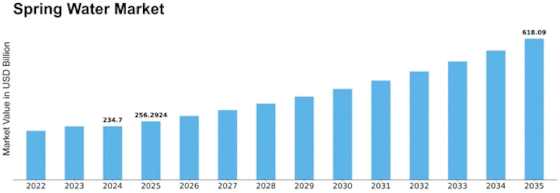

Spring Water Market Size Graph
Author
Author Profile
Sakshi Gupta
Team Lead - Research

Currently a Team Lead in consumer goods, FMCG, and F&B, she translates rigorous research into decisive strategy. She develops GTM roadmaps, pricing architectures, and competitive benchmarks for companies across Europe, the US, and APAC. She synthesize insights, align cross-functional teams, and drive execution from brief to measurable outcomes. She leads end-to-end engagements with crisp analysis, compelling storytelling, and a strong command of Power BI, Tableau, SQL, and advanced research platforms.

Leave a Comment

FAQs

What is the current valuation of the Spring Water Market?

<p>The Spring Water Market was valued at 234.7 USD Billion in 2024.</p>

What is the projected market valuation for the Spring Water Market in 2035?

<p>The market is projected to reach 618.09 USD Billion by 2035.</p>

What is the expected CAGR for the Spring Water Market from 2025 to 2035?

<p>The expected CAGR for the Spring Water Market during the forecast period 2025 - 2035 is 9.2%.</p>

Which distribution channel generated the highest revenue in the Spring Water Market?

<p>Hypermarkets/Supermarkets generated the highest revenue, with a valuation range of 184.7 to 488.09 USD Billion.</p>

How does online retail perform in the Spring Water Market?

<p>Online retail is projected to generate between 20.0 and 50.0 USD Billion in the Spring Water Market.</p>

What are the key packaging types in the Spring Water Market?

<p>The primary packaging types are bottled, valued between 180.0 and 480.0 USD Billion, and canned, valued between 54.7 and 138.09 USD Billion.</p>

Who are the leading companies in the Spring Water Market?

Key players include Nestle Waters, Coca-Cola, PepsiCo, Danone, Fiji Water, Voss Water, San Pellegrino, Evian, and Aquafina.

What is the market trend for specialty stores in the Spring Water Market?

Specialty stores are expected to generate revenue between 30.0 and 80.0 USD Billion.

How does the Spring Water Market's growth compare to other beverage markets?

The Spring Water Market's growth appears robust, with a projected CAGR of 9.2% from 2025 to 2035.

What factors are driving the growth of the Spring Water Market?

Factors such as increasing health consciousness and demand for premium bottled water are likely driving the market's growth.

Market Summary

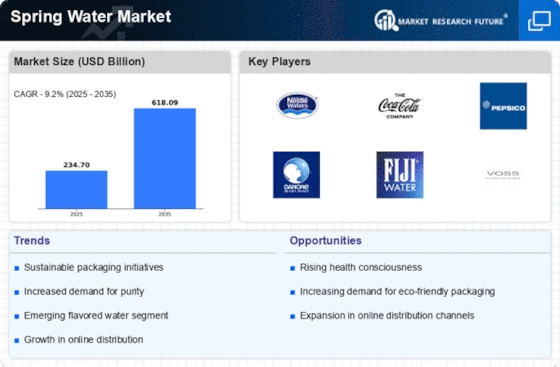
As per Market Research Future analysis, the Spring Water Market Size was estimated at 234.7 USD Billion in 2024. The Spring Water industry is projected to grow from 256.3 USD Billion in 2025 to 618.09 USD Billion by 2035, exhibiting a compound annual growth rate (CAGR) of 9.2% during the forecast period 2025 - 2035

Key Market Trends & Highlights

The Spring Water Market is experiencing a robust growth trajectory driven by health consciousness and sustainability initiatives.

  • North America remains the largest market for spring water, driven by a strong health and wellness focus.
  • Asia-Pacific is emerging as the fastest-growing region, reflecting a rising demand for bottled and canned spring water.
  • Hypermarkets and supermarkets dominate the retail landscape, while online retail is rapidly gaining traction among consumers.
  • Rising health consciousness and environmental sustainability are key drivers propelling the market forward.

Market Size & Forecast

2024 Market Size 234.7 (USD Billion)
2035 Market Size 618.09 (USD Billion)
CAGR (2025 - 2035) 9.2%
Largest Regional Market Share in 2024 North America

Major Players

Nestle Waters (CH), Coca-Cola (US), PepsiCo (US), Danone (FR), Fiji Water (US), Voss Water (NO), San Pellegrino (IT), Evian (FR), Aquafina (US)

Market Trends

The Spring Water Market is currently experiencing a dynamic evolution, driven by a confluence of consumer preferences and environmental considerations. As individuals increasingly prioritize health and wellness, the demand for natural and mineral-rich beverages has surged. This trend is further amplified by a growing awareness of the benefits associated with hydration, leading to a shift away from sugary drinks towards more wholesome alternatives. Additionally, the emphasis on sustainability is reshaping production practices, with brands striving to minimize their ecological footprint. Companies are exploring innovative packaging solutions and sourcing methods that align with environmentally friendly principles. Moreover, the Spring Water Market is witnessing a diversification of product offerings. Brands are introducing flavored and functional waters, catering to a broader audience seeking unique taste experiences and added health benefits. This diversification not only enhances consumer choice but also fosters brand loyalty as companies strive to differentiate themselves in a competitive landscape. The interplay between health consciousness and environmental responsibility appears to be a defining characteristic of the market, suggesting that future growth may hinge on the ability of brands to adapt to these evolving consumer expectations. As the market continues to mature, it is likely that new entrants will emerge, further intensifying competition and innovation within the sector.

Health and Wellness Focus

The Spring Water Market is increasingly influenced by a heightened focus on health and wellness. Consumers are gravitating towards natural beverages that promote hydration and overall well-being, steering clear of sugary alternatives. This trend indicates a shift in lifestyle choices, where individuals prioritize products that align with their health goals.

Sustainability Initiatives

Sustainability has become a pivotal concern within the Spring Water Market. Brands are actively pursuing eco-friendly practices, from sourcing to packaging. This commitment to environmental stewardship resonates with consumers, who are more inclined to support companies that demonstrate a genuine dedication to reducing their ecological impact.

Product Diversification

The Spring Water Market is characterized by an increasing diversification of product offerings. Companies are introducing flavored and functional waters to cater to evolving consumer preferences. This trend not only enhances market appeal but also encourages brand loyalty as consumers seek unique and beneficial hydration options.

Spring Water Market Market Drivers

Rising Health Consciousness

The increasing awareness of health and wellness among consumers appears to be a primary driver for the Spring Water Market. As individuals become more health-conscious, they tend to seek alternatives to sugary beverages, leading to a surge in demand for natural and mineral-rich spring water. According to recent data, the consumption of bottled water, particularly spring water, has seen a notable increase, with a projected growth rate of approximately 6% annually. This trend suggests that consumers are prioritizing hydration and natural sources of minerals, which spring water provides. The Spring Water Market is thus positioned to benefit from this shift in consumer preferences, as more people opt for healthier beverage choices that align with their lifestyle goals.

Environmental Sustainability

Sustainability initiatives are increasingly influencing consumer choices, thereby impacting the Spring Water Market. As environmental concerns grow, consumers are more inclined to support brands that demonstrate eco-friendly practices. This includes the use of recyclable packaging and sustainable sourcing of water. Recent statistics indicate that brands adopting sustainable practices have experienced a rise in market share, as consumers are willing to pay a premium for products that align with their values. The Spring Water Market is likely to see continued growth as companies innovate in their sustainability efforts, potentially leading to a more environmentally responsible market landscape. This shift not only caters to consumer demand but also addresses broader environmental challenges.

Innovative Packaging Solutions

The introduction of innovative packaging solutions is emerging as a significant driver within the Spring Water Market. Companies are increasingly focusing on creating packaging that is not only functional but also appealing to consumers. For instance, the use of lightweight materials and designs that enhance portability can attract a broader audience. Recent market analysis suggests that brands utilizing unique packaging strategies have gained a competitive edge, with some reporting a 15% increase in sales. This trend indicates that packaging plays a crucial role in consumer decision-making, and the Spring Water Market must adapt to these evolving preferences to maintain relevance and drive growth.

Increased Distribution Channels

The expansion of distribution channels is a critical factor influencing the Spring Water Market. With the rise of e-commerce and online grocery shopping, consumers now have greater access to a variety of spring water brands. This shift in purchasing behavior has prompted companies to enhance their distribution strategies, ensuring that their products are readily available to consumers. Recent data shows that online sales of bottled water have surged, indicating a shift in consumer purchasing habits. As the Spring Water Market continues to adapt to these changes, the potential for increased sales and market penetration appears promising, particularly as more consumers seek convenience in their shopping experiences.

Growing Demand for Functional Beverages

The trend towards functional beverages is significantly impacting the Spring Water Market. Consumers are increasingly seeking products that offer additional health benefits, such as enhanced hydration and added minerals. This demand for functional beverages has led to the introduction of spring water infused with vitamins and electrolytes, catering to health-conscious individuals. Market Research Future indicates that the functional beverage segment is expected to grow at a rate of 8% annually, suggesting a robust opportunity for the Spring Water Market to innovate and diversify its product offerings. By aligning with this trend, companies can attract a wider consumer base and enhance their market presence.

Market Segment Insights

By Distribution Channel: Hypermarkets/Supermarkets (Largest) vs. Online Retail (Fastest-Growing)

<p>In the Spring Water Market, the distribution of sales across various channels reveals hypermarkets and supermarkets as the largest segment, dominating market access due to their extensive reach and consumer loyalty. Specialty stores also play a significant role, offering curated selections that attract niche consumers, but they do not match the sheer volume of transactions seen in larger retail formats. Online retail is rapidly gaining traction, driven by changing consumer shopping habits that now favor e-commerce for convenience and door-to-door delivery options. The growth trends for the Spring Water Market distribution channels indicate a shift towards online platforms, marking them as the fastest-growing segment. This trend is supported by advancements in digital marketing and e-commerce logistics, which make it easier for consumers to purchase products directly from manufacturers or retailers online. Meanwhile, hypermarkets and supermarkets continue to hold strong due to their established market presence and value-driven offerings that appeal to a broad audience. Overall, specialty stores maintain a steady presence but face increasing competition from both hypermarkets and the burgeoning online retail segment.</p>

<p>Hypermarkets/Supermarkets (Dominant) vs. Online Retail (Emerging)</p>

<p>Hypermarkets and supermarkets remain the dominant distribution channel in the Spring Water Market, leveraging their large physical spaces to stock an extensive range of brands and flavors. These retail giants benefit from high foot traffic and effective promotional strategies that encourage bulk purchases, making them a favored choice for consumers seeking convenience and variety. Conversely, online retail is an emerging channel that has experienced exponential growth, particularly in the wake of increased digital engagement post-pandemic. Consumers are drawn to the ease of comparing prices, convenience of delivery, and the ability to explore different brands without geographical constraints. This shift signals a transformative period where online platforms may increasingly shape consumer preferences and purchasing habits.</p>

By Packaging Type: Bottled (Largest) vs. Canned (Fastest-Growing)

<p>In the Spring Water Market, the packaging type segment reveals a clear distribution in consumer preferences, with bottled water dominating the market. Bottled spring water has established itself as the preferred choice for consumers due to its convenience, branding, and perceived quality. Canned spring water, while currently a smaller segment, is gaining traction among health-conscious individuals seeking eco-friendly packaging alternatives. The trend towards sustainability is slowly reshaping the dynamics of the market, positioning canned water as a more viable option.</p>

<p>Packaging Type: Bottled (Dominant) vs. Canned (Emerging)</p>

<p>Bottled spring water is characterized by its wide availability, diverse branding, and strong consumer loyalty. This segment benefits from established distribution networks and marketing strategies that reinforce its dominance in the market. On the other hand, canned spring water represents an emerging product that appeals to a niche market focused on sustainability and reducing plastic waste. As awareness regarding environmental issues increases, canned water is likely to see enhancements in production and marketing, drawing in a new customer base. Its compact design makes it a convenient option for on-the-go hydration, further catalyzing its growth in the spring water segment.</p>

Get more detailed insights about Spring Water Market Research Report—Global Forecast till 2035

Regional Insights

North America : Market Leader in Consumption

North America is the largest market for spring water, accounting for approximately 45% of global consumption. The region's growth is driven by increasing health consciousness, a shift towards bottled water over sugary drinks, and stringent regulations ensuring water quality. The U.S. is the primary contributor, followed by Canada, which is experiencing a surge in demand for premium bottled water products. The competitive landscape is characterized by major players like Nestle Waters, Coca-Cola, and PepsiCo, who dominate the market with extensive distribution networks. The presence of various local brands also enhances competition, catering to diverse consumer preferences. The trend towards eco-friendly packaging and sustainable sourcing is gaining traction, further shaping the market dynamics.

Europe : Sustainable Practices in Focus

Europe is the second-largest market for spring water, holding around 30% of the global share. The region's growth is propelled by increasing consumer awareness regarding health and wellness, alongside a strong preference for natural and organic products. Regulatory frameworks, such as the EU Water Framework Directive, promote sustainable water management practices, enhancing market growth and consumer trust. Leading countries include Germany, France, and Italy, with brands like Evian and San Pellegrino leading the charge. The competitive landscape is marked by a mix of multinational corporations and local brands, focusing on sustainability and quality. The trend towards premiumization is evident, with consumers willing to pay more for high-quality, sustainably sourced spring water products.

Asia-Pacific : Emerging Market Potential

Asia-Pacific is an emerging powerhouse in the spring water market, currently holding about 20% of the global share. The region's growth is driven by urbanization, rising disposable incomes, and increasing health awareness among consumers. Countries like China and India are witnessing a significant shift towards bottled water consumption, supported by government initiatives promoting clean drinking water access. China is the largest market in the region, followed by India, where local and international brands are competing fiercely. Key players like Fiji Water and Voss Water are expanding their presence, catering to the growing demand for premium bottled water. The competitive landscape is evolving, with a focus on innovative packaging and marketing strategies to attract health-conscious consumers.

Middle East and Africa : Resource-Rich Yet Challenging

The Middle East and Africa region holds about 5% of The Spring Water Market share, facing unique challenges such as water scarcity and regulatory hurdles. However, the demand for bottled water is on the rise due to increasing urbanization and a growing middle class. Countries like South Africa and the UAE are leading the market, driven by a shift towards healthier beverage options and improved distribution channels. The competitive landscape features both local and international brands, with companies focusing on sustainable sourcing and innovative marketing strategies. The presence of key players like Coca-Cola and PepsiCo enhances competition, while local brands are gaining traction by emphasizing regional flavors and health benefits. The market is poised for growth as consumer preferences continue to evolve.

Key Players and Competitive Insights

Leading market players are investing heavily in research and development in order to expand their product lines, which will help the Spring Water Market, grow even more. Market participants are also undertaking a variety of strategic activities to expand their global footprint, with important market developments including new product launches, contractual agreements, mergers and acquisitions, higher investments, and collaboration with other organizations. To expand and survive in a more competitive and rising market climate, Spring Water industry must offer cost-effective items.

Manufacturing locally to minimize operational costs is one of the key business tactics used by manufacturers in the global Spring Water industry to benefit clients and increase the market sector. In recent years, the Spring Water industry has offered some of the most significant advantages to medicine. Major players in the Spring Water Market, including Orient Beverages Pvt. Ltd., Nestle S.A., Pepsico, Inc., Ten Spring Water Market, Danone, 3 Spring Water Market, Mountain Valley Spring Water Market, Tata Consumer Products Limited, CG Roxane, LLC, and Coca-Cola, are attempting to increase market demand by investing in research and development operations.

Manufacturer and marketer of foodstuffs and beverages is Nestle SA (Nestle). Baby foods, bottled water, cereals, chocolates and confectionary, coffee, culinary products, plant-based meals, chilled and frozen foods, dairy products, nutritional products, ice cream, and pet care items are all included in the company's product line-up. Aero, Purina Alpo, Milkybar, Cerelac, Nescafe, Nespresso, Nido, Perrier, S.Pellegrino, Acqua Panna, Nestea, Milo, Maggi, Buitoni, Cailler, Movenpick, Purina, Boost, Gerber, and Kit Kat are some of the brand names under which Nestle sells its goods. Asia, Oceania, the Americas, Europe, the Middle East, and Africa are all commercial hubs for the company.

In Vevey, Waadt, Switzerland, Nestle has its headquarters.

In April Nestle SA made the decision to sell its North American bottled water business, now known as BlueTriton Brands, to private equity firm One Rock Capital Partners for USD 4.3 billion.

Water purification products are produced, processed, and distributed by Primo Water Corp (Primo). Water dispensers, bottled water, filtration tools, premium spring, sparkling and flavoured water, filtration tools and coffee are all part of its product line. The company sells its goods under a variety of brands, including Aquaterra, Alhambra, Eden, Crystal Springs, PureFLO Deep Rock, Sierra Springs, and Crystal Rock. The company's water exchange, water direct, and water replenishment businesses are among its razorblade offerings. Additionally, Primo offers coffee services, brewers and filtration equipment, as well as bottled water delivery services.

The corporation has operations in both North America and Europe through subsidiaries. Tampa, Florida, in the United States, is where Primo is based. After acquiring Mountain Valley Water Company of Los Angeles in October 2020, Primo Water Corporation will have more than 8,000 customers overall.

Key Companies in the Spring Water Market include

Industry Developments

February 2020: The first plant-based water bottle in the area, the Al Ain Plant Bottle, has been introduced, according to Agthia Group PJSC. A Memorandum of Understanding (MoU) for the start of a PET water bottle collecting programme in the United Arab Emirates was also signed by Agthia and Veolia, a world leader in optimised resource management.

May 2020: A 5% ABV bottled water with vegan and gluten-free claims was introduced by Kopparberg brewery in the United Kingdom. In European Morrisons and Tesco supermarkets, it is offered in flavours such mixed berries, black cherries, and passion fruit.

May 2020: A 12-ounce aluminium can of high-pH premium alkaline water was recently added to the growing product lineup of TEN Alkaline Spring. It offers a new, cheaper price point for the option that is wrapped in aluminium and is being sold for about 50% less money per ounce.

Future Outlook

Spring Water Market Future Outlook

The Spring Water Market is projected to grow at a 9.2% CAGR from 2025 to 2035, driven by increasing health awareness, premiumization, and sustainable packaging innovations.

New opportunities lie in:

  • Expansion into emerging markets with tailored product offerings.
  • Development of eco-friendly packaging solutions to attract environmentally conscious consumers.
  • Implementation of subscription-based delivery services for consistent revenue streams.

By 2035, the Spring Water Market is expected to achieve substantial growth, solidifying its position as a key player in the beverage industry.

Market Segmentation

Spring Water Market Packaging Type Outlook

  • Bottled
  • Canned

Spring Water Market Distribution Channel Outlook

  • Specialty Stores
  • Online Retail
  • Hypermarkets/Supermarkets

Report Scope

MARKET SIZE 2024 234.7(USD Billion)
MARKET SIZE 2025 256.3(USD Billion)
MARKET SIZE 2035 618.09(USD Billion)
COMPOUND ANNUAL GROWTH RATE (CAGR) 9.2% (2025 - 2035)
REPORT COVERAGE Revenue Forecast, Competitive Landscape, Growth Factors, and Trends
BASE YEAR 2024
Market Forecast Period 2025 - 2035
Historical Data 2019 - 2024
Market Forecast Units USD Billion
Key Companies Profiled Nestle Waters (CH), Coca-Cola (US), PepsiCo (US), Danone (FR), Fiji Water (US), Voss Water (NO), San Pellegrino (IT), Evian (FR), Aquafina (US)
Segments Covered Distribution Channel, Packaging Type, Region
Key Market Opportunities Growing consumer preference for sustainable packaging presents opportunities in the Spring Water Market.
Key Market Dynamics Rising consumer preference for natural beverages drives competition and innovation in the spring water market.
Countries Covered North America, Europe, APAC, South America, MEA

FAQs

What is the current valuation of the Spring Water Market?

<p>The Spring Water Market was valued at 234.7 USD Billion in 2024.</p>

What is the projected market valuation for the Spring Water Market in 2035?

<p>The market is projected to reach 618.09 USD Billion by 2035.</p>

What is the expected CAGR for the Spring Water Market from 2025 to 2035?

<p>The expected CAGR for the Spring Water Market during the forecast period 2025 - 2035 is 9.2%.</p>

Which distribution channel generated the highest revenue in the Spring Water Market?

<p>Hypermarkets/Supermarkets generated the highest revenue, with a valuation range of 184.7 to 488.09 USD Billion.</p>

How does online retail perform in the Spring Water Market?

<p>Online retail is projected to generate between 20.0 and 50.0 USD Billion in the Spring Water Market.</p>

What are the key packaging types in the Spring Water Market?

<p>The primary packaging types are bottled, valued between 180.0 and 480.0 USD Billion, and canned, valued between 54.7 and 138.09 USD Billion.</p>

Who are the leading companies in the Spring Water Market?

Key players include Nestle Waters, Coca-Cola, PepsiCo, Danone, Fiji Water, Voss Water, San Pellegrino, Evian, and Aquafina.

What is the market trend for specialty stores in the Spring Water Market?

Specialty stores are expected to generate revenue between 30.0 and 80.0 USD Billion.

How does the Spring Water Market's growth compare to other beverage markets?

The Spring Water Market's growth appears robust, with a projected CAGR of 9.2% from 2025 to 2035.

What factors are driving the growth of the Spring Water Market?

Factors such as increasing health consciousness and demand for premium bottled water are likely driving the market's growth.

  1. SECTION I: EXECUTIVE SUMMARY AND KEY HIGHLIGHTS
    1. | 1.1 EXECUTIVE SUMMARY
    2. | | 1.1.1 Market Overview
    3. | | 1.1.2 Key Findings
    4. | | 1.1.3 Market Segmentation
    5. | | 1.1.4 Competitive Landscape
    6. | | 1.1.5 Challenges and Opportunities
    7. | | 1.1.6 Future Outlook
  2. SECTION II: SCOPING, METHODOLOGY AND MARKET STRUCTURE
    1. | 2.1 MARKET INTRODUCTION
    2. | | 2.1.1 Definition
    3. | | 2.1.2 Scope of the study
    4. | | | 2.1.2.1 Research Objective
    5. | | | 2.1.2.2 Assumption
    6. | | | 2.1.2.3 Limitations
    7. | 2.2 RESEARCH METHODOLOGY
    8. | | 2.2.1 Overview
    9. | | 2.2.2 Data Mining
    10. | | 2.2.3 Secondary Research
    11. | | 2.2.4 Primary Research
    12. | | | 2.2.4.1 Primary Interviews and Information Gathering Process
    13. | | | 2.2.4.2 Breakdown of Primary Respondents
    14. | | 2.2.5 Forecasting Model
    15. | | 2.2.6 Market Size Estimation
    16. | | | 2.2.6.1 Bottom-Up Approach
    17. | | | 2.2.6.2 Top-Down Approach
    18. | | 2.2.7 Data Triangulation
    19. | | 2.2.8 Validation
  3. SECTION III: QUALITATIVE ANALYSIS
    1. | 3.1 MARKET DYNAMICS
    2. | | 3.1.1 Overview
    3. | | 3.1.2 Drivers
    4. | | 3.1.3 Restraints
    5. | | 3.1.4 Opportunities
    6. | 3.2 MARKET FACTOR ANALYSIS
    7. | | 3.2.1 Value chain Analysis
    8. | | 3.2.2 Porter's Five Forces Analysis
    9. | | | 3.2.2.1 Bargaining Power of Suppliers
    10. | | | 3.2.2.2 Bargaining Power of Buyers
    11. | | | 3.2.2.3 Threat of New Entrants
    12. | | | 3.2.2.4 Threat of Substitutes
    13. | | | 3.2.2.5 Intensity of Rivalry
    14. | | 3.2.3 COVID-19 Impact Analysis
    15. | | | 3.2.3.1 Market Impact Analysis
    16. | | | 3.2.3.2 Regional Impact
    17. | | | 3.2.3.3 Opportunity and Threat Analysis
  4. SECTION IV: QUANTITATIVE ANALYSIS
    1. | 4.1 Food, Beverages & Nutrition, BY Distribution Channel (USD Billion)
    2. | | 4.1.1 Specialty Stores
    3. | | 4.1.2 Online Retail
    4. | | 4.1.3 Hypermarkets/Supermarkets
    5. | 4.2 Food, Beverages & Nutrition, BY Packaging Type (USD Billion)
    6. | | 4.2.1 Bottled
    7. | | 4.2.2 Canned
    8. | 4.3 Food, Beverages & Nutrition, BY Region (USD Billion)
    9. | | 4.3.1 North America
    10. | | | 4.3.1.1 US
    11. | | | 4.3.1.2 Canada
    12. | | 4.3.2 Europe
    13. | | | 4.3.2.1 Germany
    14. | | | 4.3.2.2 UK
    15. | | | 4.3.2.3 France
    16. | | | 4.3.2.4 Russia
    17. | | | 4.3.2.5 Italy
    18. | | | 4.3.2.6 Spain
    19. | | | 4.3.2.7 Rest of Europe
    20. | | 4.3.3 APAC
    21. | | | 4.3.3.1 China
    22. | | | 4.3.3.2 India
    23. | | | 4.3.3.3 Japan
    24. | | | 4.3.3.4 South Korea
    25. | | | 4.3.3.5 Malaysia
    26. | | | 4.3.3.6 Thailand
    27. | | | 4.3.3.7 Indonesia
    28. | | | 4.3.3.8 Rest of APAC
    29. | | 4.3.4 South America
    30. | | | 4.3.4.1 Brazil
    31. | | | 4.3.4.2 Mexico
    32. | | | 4.3.4.3 Argentina
    33. | | | 4.3.4.4 Rest of South America
    34. | | 4.3.5 MEA
    35. | | | 4.3.5.1 GCC Countries
    36. | | | 4.3.5.2 South Africa
    37. | | | 4.3.5.3 Rest of MEA
  5. SECTION V: COMPETITIVE ANALYSIS
    1. | 5.1 Competitive Landscape
    2. | | 5.1.1 Overview
    3. | | 5.1.2 Competitive Analysis
    4. | | 5.1.3 Market share Analysis
    5. | | 5.1.4 Major Growth Strategy in the Food, Beverages & Nutrition
    6. | | 5.1.5 Competitive Benchmarking
    7. | | 5.1.6 Leading Players in Terms of Number of Developments in the Food, Beverages & Nutrition
    8. | | 5.1.7 Key developments and growth strategies
    9. | | | 5.1.7.1 New Product Launch/Service Deployment
    10. | | | 5.1.7.2 Merger & Acquisitions
    11. | | | 5.1.7.3 Joint Ventures
    12. | | 5.1.8 Major Players Financial Matrix
    13. | | | 5.1.8.1 Sales and Operating Income
    14. | | | 5.1.8.2 Major Players R&D Expenditure. 2023
    15. | 5.2 Company Profiles
    16. | | 5.2.1 Nestle Waters (CH)
    17. | | | 5.2.1.1 Financial Overview
    18. | | | 5.2.1.2 Products Offered
    19. | | | 5.2.1.3 Key Developments
    20. | | | 5.2.1.4 SWOT Analysis
    21. | | | 5.2.1.5 Key Strategies
    22. | | 5.2.2 Coca-Cola (US)
    23. | | | 5.2.2.1 Financial Overview
    24. | | | 5.2.2.2 Products Offered
    25. | | | 5.2.2.3 Key Developments
    26. | | | 5.2.2.4 SWOT Analysis
    27. | | | 5.2.2.5 Key Strategies
    28. | | 5.2.3 PepsiCo (US)
    29. | | | 5.2.3.1 Financial Overview
    30. | | | 5.2.3.2 Products Offered
    31. | | | 5.2.3.3 Key Developments
    32. | | | 5.2.3.4 SWOT Analysis
    33. | | | 5.2.3.5 Key Strategies
    34. | | 5.2.4 Danone (FR)
    35. | | | 5.2.4.1 Financial Overview
    36. | | | 5.2.4.2 Products Offered
    37. | | | 5.2.4.3 Key Developments
    38. | | | 5.2.4.4 SWOT Analysis
    39. | | | 5.2.4.5 Key Strategies
    40. | | 5.2.5 Fiji Water (US)
    41. | | | 5.2.5.1 Financial Overview
    42. | | | 5.2.5.2 Products Offered
    43. | | | 5.2.5.3 Key Developments
    44. | | | 5.2.5.4 SWOT Analysis
    45. | | | 5.2.5.5 Key Strategies
    46. | | 5.2.6 Voss Water (NO)
    47. | | | 5.2.6.1 Financial Overview
    48. | | | 5.2.6.2 Products Offered
    49. | | | 5.2.6.3 Key Developments
    50. | | | 5.2.6.4 SWOT Analysis
    51. | | | 5.2.6.5 Key Strategies
    52. | | 5.2.7 San Pellegrino (IT)
    53. | | | 5.2.7.1 Financial Overview
    54. | | | 5.2.7.2 Products Offered
    55. | | | 5.2.7.3 Key Developments
    56. | | | 5.2.7.4 SWOT Analysis
    57. | | | 5.2.7.5 Key Strategies
    58. | | 5.2.8 Evian (FR)
    59. | | | 5.2.8.1 Financial Overview
    60. | | | 5.2.8.2 Products Offered
    61. | | | 5.2.8.3 Key Developments
    62. | | | 5.2.8.4 SWOT Analysis
    63. | | | 5.2.8.5 Key Strategies
    64. | | 5.2.9 Aquafina (US)
    65. | | | 5.2.9.1 Financial Overview
    66. | | | 5.2.9.2 Products Offered
    67. | | | 5.2.9.3 Key Developments
    68. | | | 5.2.9.4 SWOT Analysis
    69. | | | 5.2.9.5 Key Strategies
    70. | 5.3 Appendix
    71. | | 5.3.1 References
    72. | | 5.3.2 Related Reports
  6. LIST OF FIGURES
    1. | 6.1 MARKET SYNOPSIS
    2. | 6.2 NORTH AMERICA MARKET ANALYSIS
    3. | 6.3 US MARKET ANALYSIS BY DISTRIBUTION CHANNEL
    4. | 6.4 US MARKET ANALYSIS BY PACKAGING TYPE
    5. | 6.5 CANADA MARKET ANALYSIS BY DISTRIBUTION CHANNEL
    6. | 6.6 CANADA MARKET ANALYSIS BY PACKAGING TYPE
    7. | 6.7 EUROPE MARKET ANALYSIS
    8. | 6.8 GERMANY MARKET ANALYSIS BY DISTRIBUTION CHANNEL
    9. | 6.9 GERMANY MARKET ANALYSIS BY PACKAGING TYPE
    10. | 6.10 UK MARKET ANALYSIS BY DISTRIBUTION CHANNEL
    11. | 6.11 UK MARKET ANALYSIS BY PACKAGING TYPE
    12. | 6.12 FRANCE MARKET ANALYSIS BY DISTRIBUTION CHANNEL
    13. | 6.13 FRANCE MARKET ANALYSIS BY PACKAGING TYPE
    14. | 6.14 RUSSIA MARKET ANALYSIS BY DISTRIBUTION CHANNEL
    15. | 6.15 RUSSIA MARKET ANALYSIS BY PACKAGING TYPE
    16. | 6.16 ITALY MARKET ANALYSIS BY DISTRIBUTION CHANNEL
    17. | 6.17 ITALY MARKET ANALYSIS BY PACKAGING TYPE
    18. | 6.18 SPAIN MARKET ANALYSIS BY DISTRIBUTION CHANNEL
    19. | 6.19 SPAIN MARKET ANALYSIS BY PACKAGING TYPE
    20. | 6.20 REST OF EUROPE MARKET ANALYSIS BY DISTRIBUTION CHANNEL
    21. | 6.21 REST OF EUROPE MARKET ANALYSIS BY PACKAGING TYPE
    22. | 6.22 APAC MARKET ANALYSIS
    23. | 6.23 CHINA MARKET ANALYSIS BY DISTRIBUTION CHANNEL
    24. | 6.24 CHINA MARKET ANALYSIS BY PACKAGING TYPE
    25. | 6.25 INDIA MARKET ANALYSIS BY DISTRIBUTION CHANNEL
    26. | 6.26 INDIA MARKET ANALYSIS BY PACKAGING TYPE
    27. | 6.27 JAPAN MARKET ANALYSIS BY DISTRIBUTION CHANNEL
    28. | 6.28 JAPAN MARKET ANALYSIS BY PACKAGING TYPE
    29. | 6.29 SOUTH KOREA MARKET ANALYSIS BY DISTRIBUTION CHANNEL
    30. | 6.30 SOUTH KOREA MARKET ANALYSIS BY PACKAGING TYPE
    31. | 6.31 MALAYSIA MARKET ANALYSIS BY DISTRIBUTION CHANNEL
    32. | 6.32 MALAYSIA MARKET ANALYSIS BY PACKAGING TYPE
    33. | 6.33 THAILAND MARKET ANALYSIS BY DISTRIBUTION CHANNEL
    34. | 6.34 THAILAND MARKET ANALYSIS BY PACKAGING TYPE
    35. | 6.35 INDONESIA MARKET ANALYSIS BY DISTRIBUTION CHANNEL
    36. | 6.36 INDONESIA MARKET ANALYSIS BY PACKAGING TYPE
    37. | 6.37 REST OF APAC MARKET ANALYSIS BY DISTRIBUTION CHANNEL
    38. | 6.38 REST OF APAC MARKET ANALYSIS BY PACKAGING TYPE
    39. | 6.39 SOUTH AMERICA MARKET ANALYSIS
    40. | 6.40 BRAZIL MARKET ANALYSIS BY DISTRIBUTION CHANNEL
    41. | 6.41 BRAZIL MARKET ANALYSIS BY PACKAGING TYPE
    42. | 6.42 MEXICO MARKET ANALYSIS BY DISTRIBUTION CHANNEL
    43. | 6.43 MEXICO MARKET ANALYSIS BY PACKAGING TYPE
    44. | 6.44 ARGENTINA MARKET ANALYSIS BY DISTRIBUTION CHANNEL
    45. | 6.45 ARGENTINA MARKET ANALYSIS BY PACKAGING TYPE
    46. | 6.46 REST OF SOUTH AMERICA MARKET ANALYSIS BY DISTRIBUTION CHANNEL
    47. | 6.47 REST OF SOUTH AMERICA MARKET ANALYSIS BY PACKAGING TYPE
    48. | 6.48 MEA MARKET ANALYSIS
    49. | 6.49 GCC COUNTRIES MARKET ANALYSIS BY DISTRIBUTION CHANNEL
    50. | 6.50 GCC COUNTRIES MARKET ANALYSIS BY PACKAGING TYPE
    51. | 6.51 SOUTH AFRICA MARKET ANALYSIS BY DISTRIBUTION CHANNEL
    52. | 6.52 SOUTH AFRICA MARKET ANALYSIS BY PACKAGING TYPE
    53. | 6.53 REST OF MEA MARKET ANALYSIS BY DISTRIBUTION CHANNEL
    54. | 6.54 REST OF MEA MARKET ANALYSIS BY PACKAGING TYPE
    55. | 6.55 KEY BUYING CRITERIA OF FOOD, BEVERAGES & NUTRITION
    56. | 6.56 RESEARCH PROCESS OF MRFR
    57. | 6.57 DRO ANALYSIS OF FOOD, BEVERAGES & NUTRITION
    58. | 6.58 DRIVERS IMPACT ANALYSIS: FOOD, BEVERAGES & NUTRITION
    59. | 6.59 RESTRAINTS IMPACT ANALYSIS: FOOD, BEVERAGES & NUTRITION
    60. | 6.60 SUPPLY / VALUE CHAIN: FOOD, BEVERAGES & NUTRITION
    61. | 6.61 FOOD, BEVERAGES & NUTRITION, BY DISTRIBUTION CHANNEL, 2024 (% SHARE)
    62. | 6.62 FOOD, BEVERAGES & NUTRITION, BY DISTRIBUTION CHANNEL, 2024 TO 2035 (USD Billion)
    63. | 6.63 FOOD, BEVERAGES & NUTRITION, BY PACKAGING TYPE, 2024 (% SHARE)
    64. | 6.64 FOOD, BEVERAGES & NUTRITION, BY PACKAGING TYPE, 2024 TO 2035 (USD Billion)
    65. | 6.65 BENCHMARKING OF MAJOR COMPETITORS
  7. LIST OF TABLES
    1. | 7.1 LIST OF ASSUMPTIONS
    2. | | 7.1.1
    3. | 7.2 North America MARKET SIZE ESTIMATES; FORECAST
    4. | | 7.2.1 BY DISTRIBUTION CHANNEL, 2025-2035 (USD Billion)
    5. | | 7.2.2 BY PACKAGING TYPE, 2025-2035 (USD Billion)
    6. | 7.3 US MARKET SIZE ESTIMATES; FORECAST
    7. | | 7.3.1 BY DISTRIBUTION CHANNEL, 2025-2035 (USD Billion)
    8. | | 7.3.2 BY PACKAGING TYPE, 2025-2035 (USD Billion)
    9. | 7.4 Canada MARKET SIZE ESTIMATES; FORECAST
    10. | | 7.4.1 BY DISTRIBUTION CHANNEL, 2025-2035 (USD Billion)
    11. | | 7.4.2 BY PACKAGING TYPE, 2025-2035 (USD Billion)
    12. | 7.5 Europe MARKET SIZE ESTIMATES; FORECAST
    13. | | 7.5.1 BY DISTRIBUTION CHANNEL, 2025-2035 (USD Billion)
    14. | | 7.5.2 BY PACKAGING TYPE, 2025-2035 (USD Billion)
    15. | 7.6 Germany MARKET SIZE ESTIMATES; FORECAST
    16. | | 7.6.1 BY DISTRIBUTION CHANNEL, 2025-2035 (USD Billion)
    17. | | 7.6.2 BY PACKAGING TYPE, 2025-2035 (USD Billion)
    18. | 7.7 UK MARKET SIZE ESTIMATES; FORECAST
    19. | | 7.7.1 BY DISTRIBUTION CHANNEL, 2025-2035 (USD Billion)
    20. | | 7.7.2 BY PACKAGING TYPE, 2025-2035 (USD Billion)
    21. | 7.8 France MARKET SIZE ESTIMATES; FORECAST
    22. | | 7.8.1 BY DISTRIBUTION CHANNEL, 2025-2035 (USD Billion)
    23. | | 7.8.2 BY PACKAGING TYPE, 2025-2035 (USD Billion)
    24. | 7.9 Russia MARKET SIZE ESTIMATES; FORECAST
    25. | | 7.9.1 BY DISTRIBUTION CHANNEL, 2025-2035 (USD Billion)
    26. | | 7.9.2 BY PACKAGING TYPE, 2025-2035 (USD Billion)
    27. | 7.10 Italy MARKET SIZE ESTIMATES; FORECAST
    28. | | 7.10.1 BY DISTRIBUTION CHANNEL, 2025-2035 (USD Billion)
    29. | | 7.10.2 BY PACKAGING TYPE, 2025-2035 (USD Billion)
    30. | 7.11 Spain MARKET SIZE ESTIMATES; FORECAST
    31. | | 7.11.1 BY DISTRIBUTION CHANNEL, 2025-2035 (USD Billion)
    32. | | 7.11.2 BY PACKAGING TYPE, 2025-2035 (USD Billion)
    33. | 7.12 Rest of Europe MARKET SIZE ESTIMATES; FORECAST
    34. | | 7.12.1 BY DISTRIBUTION CHANNEL, 2025-2035 (USD Billion)
    35. | | 7.12.2 BY PACKAGING TYPE, 2025-2035 (USD Billion)
    36. | 7.13 APAC MARKET SIZE ESTIMATES; FORECAST
    37. | | 7.13.1 BY DISTRIBUTION CHANNEL, 2025-2035 (USD Billion)
    38. | | 7.13.2 BY PACKAGING TYPE, 2025-2035 (USD Billion)
    39. | 7.14 China MARKET SIZE ESTIMATES; FORECAST
    40. | | 7.14.1 BY DISTRIBUTION CHANNEL, 2025-2035 (USD Billion)
    41. | | 7.14.2 BY PACKAGING TYPE, 2025-2035 (USD Billion)
    42. | 7.15 India MARKET SIZE ESTIMATES; FORECAST
    43. | | 7.15.1 BY DISTRIBUTION CHANNEL, 2025-2035 (USD Billion)
    44. | | 7.15.2 BY PACKAGING TYPE, 2025-2035 (USD Billion)
    45. | 7.16 Japan MARKET SIZE ESTIMATES; FORECAST
    46. | | 7.16.1 BY DISTRIBUTION CHANNEL, 2025-2035 (USD Billion)
    47. | | 7.16.2 BY PACKAGING TYPE, 2025-2035 (USD Billion)
    48. | 7.17 South Korea MARKET SIZE ESTIMATES; FORECAST
    49. | | 7.17.1 BY DISTRIBUTION CHANNEL, 2025-2035 (USD Billion)
    50. | | 7.17.2 BY PACKAGING TYPE, 2025-2035 (USD Billion)
    51. | 7.18 Malaysia MARKET SIZE ESTIMATES; FORECAST
    52. | | 7.18.1 BY DISTRIBUTION CHANNEL, 2025-2035 (USD Billion)
    53. | | 7.18.2 BY PACKAGING TYPE, 2025-2035 (USD Billion)
    54. | 7.19 Thailand MARKET SIZE ESTIMATES; FORECAST
    55. | | 7.19.1 BY DISTRIBUTION CHANNEL, 2025-2035 (USD Billion)
    56. | | 7.19.2 BY PACKAGING TYPE, 2025-2035 (USD Billion)
    57. | 7.20 Indonesia MARKET SIZE ESTIMATES; FORECAST
    58. | | 7.20.1 BY DISTRIBUTION CHANNEL, 2025-2035 (USD Billion)
    59. | | 7.20.2 BY PACKAGING TYPE, 2025-2035 (USD Billion)
    60. | 7.21 Rest of APAC MARKET SIZE ESTIMATES; FORECAST
    61. | | 7.21.1 BY DISTRIBUTION CHANNEL, 2025-2035 (USD Billion)
    62. | | 7.21.2 BY PACKAGING TYPE, 2025-2035 (USD Billion)
    63. | 7.22 South America MARKET SIZE ESTIMATES; FORECAST
    64. | | 7.22.1 BY DISTRIBUTION CHANNEL, 2025-2035 (USD Billion)
    65. | | 7.22.2 BY PACKAGING TYPE, 2025-2035 (USD Billion)
    66. | 7.23 Brazil MARKET SIZE ESTIMATES; FORECAST
    67. | | 7.23.1 BY DISTRIBUTION CHANNEL, 2025-2035 (USD Billion)
    68. | | 7.23.2 BY PACKAGING TYPE, 2025-2035 (USD Billion)
    69. | 7.24 Mexico MARKET SIZE ESTIMATES; FORECAST
    70. | | 7.24.1 BY DISTRIBUTION CHANNEL, 2025-2035 (USD Billion)
    71. | | 7.24.2 BY PACKAGING TYPE, 2025-2035 (USD Billion)
    72. | 7.25 Argentina MARKET SIZE ESTIMATES; FORECAST
    73. | | 7.25.1 BY DISTRIBUTION CHANNEL, 2025-2035 (USD Billion)
    74. | | 7.25.2 BY PACKAGING TYPE, 2025-2035 (USD Billion)
    75. | 7.26 Rest of South America MARKET SIZE ESTIMATES; FORECAST
    76. | | 7.26.1 BY DISTRIBUTION CHANNEL, 2025-2035 (USD Billion)
    77. | | 7.26.2 BY PACKAGING TYPE, 2025-2035 (USD Billion)
    78. | 7.27 MEA MARKET SIZE ESTIMATES; FORECAST
    79. | | 7.27.1 BY DISTRIBUTION CHANNEL, 2025-2035 (USD Billion)
    80. | | 7.27.2 BY PACKAGING TYPE, 2025-2035 (USD Billion)
    81. | 7.28 GCC Countries MARKET SIZE ESTIMATES; FORECAST
    82. | | 7.28.1 BY DISTRIBUTION CHANNEL, 2025-2035 (USD Billion)
    83. | | 7.28.2 BY PACKAGING TYPE, 2025-2035 (USD Billion)
    84. | 7.29 South Africa MARKET SIZE ESTIMATES; FORECAST
    85. | | 7.29.1 BY DISTRIBUTION CHANNEL, 2025-2035 (USD Billion)
    86. | | 7.29.2 BY PACKAGING TYPE, 2025-2035 (USD Billion)
    87. | 7.30 Rest of MEA MARKET SIZE ESTIMATES; FORECAST
    88. | | 7.30.1 BY DISTRIBUTION CHANNEL, 2025-2035 (USD Billion)
    89. | | 7.30.2 BY PACKAGING TYPE, 2025-2035 (USD Billion)
    90. | 7.31 PRODUCT LAUNCH/PRODUCT DEVELOPMENT/APPROVAL
    91. | | 7.31.1
    92. | 7.32 ACQUISITION/PARTNERSHIP
    93. | | 7.32.1

Food, Beverages & Nutrition Market Segmentation

Food, Beverages & Nutrition By Distribution Channel (USD Billion, 2025-2035)

  • Specialty Stores
  • Online Retail
  • Hypermarkets/Supermarkets

Food, Beverages & Nutrition By Packaging Type (USD Billion, 2025-2035)

  • Bottled
  • Canned
Infographic

Free Sample Request

Kindly complete the form below to receive a free sample of this Report

Get Free Sample

Customer Strories

Compare Licence

×
Features License Type
Single User Multiuser License Enterprise User
Price $4,950 $5,950 $7,250
Maximum User Access Limit 1 User Upto 10 Users Unrestricted Access Throughout the Organization
Free Customization
Direct Access to Analyst
Deliverable Format
Platform Access
Discount on Next Purchase 10% 15% 15%
Printable Versions