
Request Free Sample ×

Kindly complete the form below to receive a free sample of this Report

* Please use a valid business email

Leading companies partner with us for data-driven Insights

clients tt-cursor
Hero Background
English
Chinese
French
Japanese
Korean
German
Spanish

Spices Seasonings Market Analysis

ID: MRFR/FnB/5143-HCR
200 Pages
Snehal Singh
March 2026

Spices and Seasonings Market Size, Share, Industry Trend & Analysis Research Report: By Type (Whole Spices, Ground Spices, Seasoning Blends, Herbs, Salt), By Application (Food Industry, Food Service, Household, Bakery, Culinary Applications), By Distribution Channel (Supermarkets/Hypermarkets, Online Retail, Convenience Stores, Specialty Stores, Direct Sales), By Form (Dried, Fresh, Liquid, Paste) andBy Regional (North America, Europe, South America, Asia Pacific, Middle East, and Africa)- Forecast to 2035

Share:
Download PDF ×

We do not share your information with anyone. However, we may send you emails based on your report interest from time to time. You may contact us at any time to opt-out.

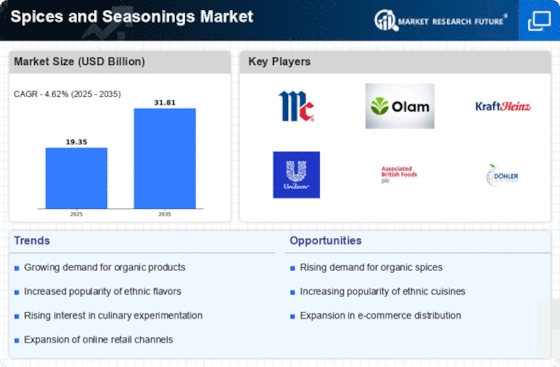
Spices Seasonings Market Infographic
Purchase Options

Market Analysis

In-depth Analysis of Spices Seasonings Market Industry Landscape

The spices and seasonings market is going through powerful changes, driven by a blend of social movements, culinary examination, and a rising spotlight on healthy and delightful eating. One of the critical drivers of this market is the developing attention to worldwide cooking styles and the longing for different and legitimate flavors. As customers become bolder in their culinary pursuits, the demand for many spices and seasonings has flooded. This pattern is not just clear in-home kitchens yet in addition in the foodservice industry, where cooks and restaurateurs are consolidating fascinating and conventional zest mixes to make extraordinary and vital eating encounters. Health awareness is another main consideration affecting the market elements of spices and seasonings. Customers are looking for striking and energizing flavors as well as searching for natural and health-promoting ingredients. This has prompted a rise in the demand for spices known for their restorative properties, like turmeric, ginger, and cinnamon. Manufacturers are answering by promoting the health advantages of their items, lining up with the more extensive pattern of health centered shopper decisions. The comfort factor assumes a critical part in molding the market elements. With engaged ways of life, buyers are looking for simple to-utilize and instant spice mixes and seasonings that upgrade the flavor of their dinners without requiring comprehensive arrangement. This has prompted the development of pre-mixed spice blends, rubs, and mixes, taking care of the necessities of time-lashed people who need to appreciate delightful and extensively prepared dishes. Also, the worldwide idea of the spices and seasonings market is reflected in the variety of contributions. As global travel and multifaceted trade increment, shoppers are presented to a more extensive scope of flavors, spices, and seasonings. This has spurred an interest for credible ethnic and local flavor mixes, with customers anxious to repeat the inclinations of their number one worldwide food at home. Makers are developing this pattern by presenting items that catch the substance of specific culinary traditions.


Author
Author Profile
Snehal Singh
Manager - Research

High acumen in analyzing complex macro & micro markets with more than 6 years of work experience in the field of market research. By implementing her analytical skills in forecasting and estimation into market research reports, she has expertise in Packaging, Construction, and Equipment domains. She handles a team size of 20-25 resources and ensures smooth running of the projects, associated marketing activities, and client servicing.

Leave a Comment

FAQs

What is the current valuation of the Spices and Seasonings Market?

<p>The Spices and Seasonings Market was valued at 19.35 USD Billion in 2024.</p>

What is the projected market size for the Spices and Seasonings Market by 2035?

<p>The market is projected to reach 31.81 USD Billion by 2035.</p>

What is the expected CAGR for the Spices and Seasonings Market during the forecast period 2025 - 2035?

<p>The expected CAGR for the market during 2025 - 2035 is 4.62%.</p>

Which segment of the Spices and Seasonings Market had the highest valuation in 2024?

<p>In 2024, the Seasoning Blends segment had the highest valuation at 5.1 USD Billion.</p>

How much is the Whole Spices segment projected to grow by 2035?

<p>The Whole Spices segment is projected to grow from 3.87 USD Billion in 2024 to 5.95 USD Billion by 2035.</p>

What are the key distribution channels for the Spices and Seasonings Market?

<p>Key distribution channels include Supermarkets/Hypermarkets, Online Retail, and Specialty Stores.</p>

Which company is a leading player in the Spices and Seasonings Market?

<p>McCormick & Company is recognized as a leading player in the Spices and Seasonings Market.</p>

What is the projected valuation for the Food Industry application segment by 2035?

<p>The Food Industry application segment is projected to reach 12.0 USD Billion by 2035.</p>

How does the valuation of the Ground Spices segment change from 2024 to 2035?

<p>The Ground Spices segment is expected to increase from 4.25 USD Billion in 2024 to 6.5 USD Billion by 2035.</p>

What is the expected growth for the Liquid form of spices by 2035?

<p>The Liquid form of spices is projected to grow from 5.0 USD Billion in 2024 to 8.0 USD Billion by 2035.</p>

What trends are shaping the future of the Spices and Seasonings Market?

Key trends include rising demand for organic spices, clean-label seasonings, premium blends, and increased online and specialty retail distribution.

Market Summary

As per Market Research Future analysis, the Spices and Seasonings Market was estimated at 19.35 USD Billion in 2024. The spices and seasonings industry is projected to grow from 20.4 USD Billion in 2025 to 34.2  USD Billion by 2035, exhibiting a compound annual growth rate (CAGR) of 5.3% during the forecast period 2025 - 2035

Key Market Trends & Highlights

The Spices and Seasonings Market is experiencing a dynamic shift towards health-conscious and innovative culinary practices.

  • The North American market remains the largest, driven by a growing demand for health and wellness-focused products. In Asia-Pacific, the spices and seasonings market is the fastest-growing, fueled by increasing culinary exploration and diverse flavor profiles. Whole spices continue to dominate the market, while ground spices are emerging as the fastest-growing segment due to convenience and versatility. Health consciousness and culinary innovation are key drivers propelling market growth across both the food industry and food service segments.

Market Size & Forecast

2024 Market Size 19.35 (USD Billion)
2035 Market Size 34.2 (USD Billion)
CAGR (2025 - 2035) 5.3%
Largest Regional Market Share in 2024 Asia Pacific

Major Players

McCormick &amp; Company (US), <a href="https://www.olamgroup.com/">Olam International (SG)</a>, Kraft Heinz Company (US), Unilever (GB), Associated British Foods (GB), Döhler Group (DE), Spice World (US), Badia Spices (US), Frontier Co-op (US)

Market Trends

The Spices and Seasonings Market is currently experiencing a dynamic evolution, driven by shifting consumer preferences and an increasing inclination towards culinary exploration. As individuals become more adventurous in their cooking endeavors, there is a noticeable rise in the demand for diverse flavors and unique spice blends. This trend is further fueled by the growing popularity of international cuisines, which encourages consumers to experiment with various spices and seasonings that were previously less familiar. Additionally, the health-conscious movement has led to a heightened interest in natural and organic options, prompting manufacturers to innovate and offer products that align with these values. Moreover, the Spices and Seasonings Market is witnessing a significant transformation in distribution channels. The proliferation of e-commerce platforms has made it easier for consumers to access a wide array of products from the comfort of their homes. This shift not only enhances convenience but also allows for greater exposure to niche brands and artisanal offerings. As a result, traditional retail outlets are adapting to this change by enhancing their online presence and diversifying their product ranges. Overall, the Spices and Seasonings Market appears poised for continued growth, driven by evolving consumer behaviors and the ongoing quest for culinary diversity.

Health and Wellness Focus

There is a growing emphasis on health and wellness among consumers, leading to increased demand for spices and seasonings that offer health benefits. Products that are organic, natural, and free from artificial additives are becoming more popular, as individuals seek to enhance their diets with nutritious options.

Culinary Exploration

Consumers are increasingly interested in exploring global cuisines, which is driving the demand for a wider variety of spices and seasonings. This trend reflects a desire for unique flavors and cooking experiences, encouraging individuals to experiment with new ingredients in their culinary practices.

E-commerce Growth

The rise of e-commerce is transforming the way consumers purchase spices and seasonings. Online platforms provide greater access to diverse products, allowing consumers to discover niche brands and specialty items that may not be available in traditional retail settings.

The best spices for cooking play a vital role in enhancing flavor, aroma, and visual appeal across a wide range of cuisines. Commonly used spices are valued not only for their taste but also for their ability to elevate everyday dishes into memorable meals. As home cooking and culinary exploration continue to rise, consumers are increasingly seeking high-quality spices that deliver consistency, freshness, and versatility in the kitchen.

Spices Seasonings Market Market Drivers

Flavor Trends

Flavor trends are significantly influencing the Spices and Seasonings Market, as consumers seek bold and unique taste experiences. The popularity of flavors such as umami and spicy profiles is driving demand for specific spices that enhance culinary creations. Recent market data shows that spices like chili and smoked paprika have seen a surge in popularity, reflecting a broader trend towards intense flavors. This inclination towards flavor experimentation is likely to shape product development, as manufacturers respond to consumer preferences for innovative and diverse seasoning options. As the quest for new taste experiences continues, the demand for unique spices is expected to rise.

Culinary Innovation

Culinary exploration and innovation are driving the Spices and Seasonings Market as consumers seek diverse flavors and unique culinary experiences. The rise of international cuisines and fusion dishes has led to an increased demand for exotic spices and seasonings. For instance, spices like sumac and za'atar have gained popularity in various regions, reflecting a broader trend towards adventurous cooking. Market data suggests that the demand for specialty spices has surged, with a notable increase in sales of ethnic and gourmet seasonings. This trend indicates that consumers are not only looking for traditional flavors but are also eager to experiment with new and exciting taste profiles.

E-commerce Expansion

The rapid expansion of e-commerce platforms is reshaping the Spices and Seasonings Market, providing consumers with unprecedented access to a wide variety of spices and seasonings. Online shopping has become increasingly popular, allowing consumers to explore and purchase products from around the world without geographical limitations. Recent statistics indicate that online sales of spices have grown by over 15% in the past year, driven by the convenience and variety offered by e-commerce platforms. This shift towards online purchasing is likely to continue, as consumers appreciate the ability to compare products, read reviews, and discover new spices from the comfort of their homes.

Health Consciousness

The increasing awareness of health and wellness among consumers appears to be a pivotal driver in the Spices and Seasonings Market. As individuals become more health-conscious, they are actively seeking natural and organic spices that offer health benefits. This trend is reflected in the rising demand for spices known for their antioxidant properties, such as turmeric and ginger. According to recent data, the organic spice segment has witnessed a growth rate of approximately 10% annually, indicating a shift towards healthier culinary choices. This heightened focus on health is likely to continue influencing purchasing decisions, as consumers increasingly prioritize products that contribute to their overall well-being.

Sustainability Trends

Sustainability is emerging as a crucial driver in the Spices and Seasonings Market, as consumers become more environmentally conscious. There is a growing demand for sustainably sourced spices, with consumers increasingly favoring brands that prioritize ethical sourcing and environmentally friendly practices. This trend is reflected in the rise of certifications such as Fair Trade and Rainforest Alliance, which appeal to eco-conscious consumers. Market analysis indicates that products with sustainability certifications are experiencing higher sales growth compared to conventional options. As awareness of environmental issues continues to rise, the demand for sustainable spices is expected to grow, influencing purchasing behaviors in the industry.

Market Segment Insights

By Type: Whole Spices (Largest) vs. Ground Spices (Fastest-Growing)

<p>In the Spices and Seasonings Market, the segment distribution reveals that Whole Spices dominate with a substantial share, appealing to consumers seeking natural and unprocessed options. Ground Spices, while currently smaller in market share, are rapidly gaining popularity as convenience and ready-to-use products become increasingly important for modern cooking. The increasing awareness of the benefits of spices has also supported the growth of Ground Spices, making it an essential segment to watch.</p>

<p>Spices: Whole Spices (Dominant) vs. Ground Spices (Emerging)</p>

<p>Whole Spices hold a strong position in the market due to their longer shelf life, flavor retention, and appeal among culinary enthusiasts. They are often preferred for traditional cooking methods. Conversely, Ground Spices are emerging as a convenient choice for consumers leading busy lives, offering quick flavor solutions. The shift towards convenience, alongside innovative packaging and varied flavor offerings, is driving the growth of Ground Spices, making them an essential part of contemporary kitchens.</p>

By Application: Food Industry (Largest) vs. Food Service (Fastest-Growing)

<p>The Spices and Seasonings Market is significantly influenced by various application segments. The Food Industry is the largest segment, capturing a substantial share of market demand due to its integral role in food processing and manufacturing. Meanwhile, the Food Service segment is emerging rapidly, supported by the growing number of restaurants and catering services seeking to enhance flavor profiles and culinary experiences. This shift highlights the evolving preferences of consumers towards diverse tastes and gourmet experiences, further enriching the market landscape.</p>

<p>Food Industry: Spices (Dominant) vs. Culinary Applications (Emerging)</p>

<p>In the Spices and Seasonings Market, the Food Industry remains the dominant player, leveraging large-scale production and distribution networks to meet the demand for flavoring agents in processed foods. This sector is characterized by the use of spices in mass-produced items such as sauces, snacks, and ready-to-eat meals. Conversely, Culinary Applications are emerging as a pivotal segment, driven by consumers' growing inclination towards home cooking and innovative culinary trends. As chefs and home cooks alike experiment with global flavors, the demand for diverse seasoning options is surging, fostering creativity and variability in dishes.</p>

By Distribution Channel: Supermarkets/Hypermarkets (Largest) vs. Online Retail (Fastest-Growing)

<p>In the Spices and Seasonings Market, Supermarkets and Hypermarkets are currently the largest distribution channel, capturing a significant portion of market share. This channel benefits from wide product ranges, convenience, and the ability to reach a large number of consumers effectively. Online Retail, although smaller in market share compared to traditional supermarkets, has emerged as a rapidly growing segment, especially with increasing digital adoption and consumer preferences for online shopping. The shift towards e-commerce has led to a change in shopping habits, making Online Retail an increasingly important avenue for spices and seasonings distribution. The consumer demand for convenience, personalized shopping experiences, and home delivery options have driven the growth of Online Retail. Additionally, the pandemic accelerated this shift as many consumers turned to online platforms for their grocery needs, further solidifying this segment's position as the fastest-growing channel in the market.</p>

<p>Supermarkets/Hypermarkets (Dominant) vs. Specialty Stores (Emerging)</p>

<p>Supermarkets and Hypermarkets dominate the Spices and Seasonings Market, providing comprehensive selections that cater to diverse consumer preferences. These channels offer a one-stop shopping experience, allowing customers to find various spices and seasonings alongside their regular grocery purchases. However, Specialty Stores are emerging as an important niche segment, appealing to consumers seeking high-quality, unique, and gourmet spice options. These stores often focus on niche markets and provide expert knowledge, which enhances the shopping experience. The growing trend towards culinary exploration and gourmet cooking, along with increased awareness of organic and natural products, fuels demand for specialty spices. Both segments play crucial roles in shaping consumer choices and preferences, reinforcing the idea that while supermarkets remain dominant, specialty stores are carving out a valuable space in the market.</p>

By Form: Dried (Largest) vs. Fresh (Fastest-Growing)

<p>In the Spices and Seasonings Market, the 'By Form' segment showcases a diverse range of offerings, with dried spices holding the largest market share. Dried spices have long been favored for their extended shelf life and concentrated flavors, making them a staple in households and foodservice. In contrast, fresh spices are rapidly gaining traction, appealing to health-conscious consumers and gourmet chefs who prioritize flavor and the nutritional benefits of fresh ingredients.</p>

<p>Dried (Dominant) vs. Fresh (Emerging)</p>

<p>Dried spices dominate the market due to their convenience, versatility, and long shelf life. These spices are often preferred in commercial food preparation, as they offer consistent flavor profiles and ease of storage. On the other hand, fresh spices represent an emerging trend, driven by a growing consumer preference for fresh, organic, and locally sourced ingredients. This shift is influenced by an increasing awareness of health benefits linked to fresh spices, coupled with culinary trends that prioritize vibrant flavors and gourmet cooking experiences. As a result, fresh spices are expected to experience significant growth.</p>

Get more detailed insights about Spices and Seasonings Market Research Report - Forecast till 2035

Regional Insights

North America : Market Leader in Spices

North America is the largest market for spices and seasonings, holding approximately 35% of the global market share. The region's growth is driven by increasing consumer interest in culinary diversity, health-conscious eating, and the rise of gourmet cooking. Regulatory support for food safety and quality standards further catalyzes market expansion, ensuring that products meet high safety and quality benchmarks. The United States is the leading country in this region, with major players like McCormick & Company and Kraft Heinz Company dominating the landscape. The competitive environment is characterized by innovation in product offerings, including organic and specialty spices. Canada also plays a significant role, contributing to the market with a growing demand for ethnic flavors and health-oriented products.

Europe : Culinary Innovation Hub

Europe is a significant player in the spices and seasonings market, accounting for approximately 30% of the global share. The region's growth is fueled by a rising trend in home cooking, increased demand for organic products, and a focus on sustainability. Regulatory frameworks, such as the EU's food safety regulations, ensure high standards for spice quality and safety, further driving consumer confidence and market growth. Leading countries include Germany, France, and the UK, where companies like Unilever and Associated British Foods are key players. The competitive landscape is marked by a blend of traditional and innovative products, catering to diverse culinary preferences. The presence of local and international brands fosters a dynamic market environment, enhancing consumer choice and driving sales.

Asia-Pacific : Emerging Market Potential

Asia-Pacific is an emerging powerhouse in the spices and seasonings market, holding around 25% of the global market share. The region's growth is driven by increasing urbanization, rising disposable incomes, and a growing interest in diverse cuisines. Regulatory initiatives aimed at improving food safety standards are also contributing to market expansion, ensuring that products meet consumer expectations for quality and safety. Countries like India and China are at the forefront, with India being a major producer and exporter of spices. The competitive landscape features both local and international players, including Olam International and Döhler Group. The region's rich culinary heritage and demand for authentic flavors create a vibrant market, attracting investments and fostering innovation in product development.

Middle East and Africa : Diverse Culinary Landscape

The Middle East and Africa region is witnessing a growing interest in spices and seasonings, accounting for approximately 10% of the global market share. The growth is driven by increasing consumer awareness of health benefits associated with spices, along with a rise in culinary tourism. Regulatory frameworks are evolving to enhance food safety and quality, which is crucial for market development in this diverse region. Leading countries include South Africa and the UAE, where the market is characterized by a mix of traditional and modern culinary practices. Key players like Spice World and Badia Spices are making significant inroads, catering to both local tastes and international demands. The competitive landscape is dynamic, with a focus on innovation and product diversification to meet the needs of a diverse consumer base.

Key Players and Competitive Insights

The  Spices and Seasonings Market is characterized by a dynamic landscape filled with a variety of key players competing across different regions and categories. As ization continues to enhance flavor diversity in cuisines, the market has witnessed robust growth, with consumers increasingly seeking products that provide enhanced flavor profiles and health benefits. Various factors, such as changing consumer preferences towards organic and natural products, the rise of culinary trends, and the expansion of the food service industry, contribute to heightened competition. The ever-evolving nature of this market necessitates that companies continuously innovate while effectively managing supply chains to ensure quality. Additionally, the competition extends to branding and marketing strategies wherein companies vie to establish a strong presence both online and offline to capture a wider consumer base, thus impacting market dynamics significantly. Kraft Heinz has established a notable presence within the  Spices and Seasonings Market, leveraging its extensive portfolio of well-known brands that cater to diverse consumer tastes. The company's strengths lie in its capability to combine traditional flavors with modern culinary trends, appealing to a broad demographic. Kraft Heinz emphasizes product quality and innovation, often launching new products that align with the increasing consumer demand for authentic flavors and health-focused alternatives. The company's significant distribution network ensures the wide availability of its spices and seasonings, allowing it to maintain a competitive edge in various regions. Furthermore, Kraft Heinz's dedication to sustainability practices aligns well with the growing trend of environmentally conscious consumerism, enhancing its brand reputation and customer loyalty. Dittrich Spices serves a specialized role in the  Spices and Seasonings Market, recognized for its high-quality offerings that emphasize authenticity and craftsmanship. The company's portfolio includes a range of natural spices and exclusive blends, catering primarily to both the retail and food service sectors. Dittrich Spices has cultivated a strong market presence through strategic partnerships and collaborations, enhancing its distribution channels ly. The company focuses on customer satisfaction by maintaining rigorous quality controls and sourcing premium ingredients. Furthermore, Dittrich Spices is adept at responding to evolving market trends and consumer preferences, which allows it to introduce innovative products effectively. Recent mergers and acquisitions within the industry have additionally positioned Dittrich Spices to expand its market reach and further strengthen its operational capabilities, making it a formidable participant in the  arena. Spice blends recipes are gaining popularity as they simplify cooking while delivering balanced and complex flavors. These blends combine multiple spices in precise proportions to create signature tastes suited for regional and global cuisines. From everyday seasoning mixes to specialty blends, spice blends recipes allow both home cooks and professional chefs to save time, experiment with flavors, and achieve reliable results.

Key Companies in the Spices Seasonings Market include

Industry Developments

Recent developments in the  Spices and Seasonings Market indicate a robust growth trajectory driven by rising consumer interest in diverse culinary experiences. Notable companies such as Kraft Heinz, Unilever, and McCormick have witnessed significant valuation increases, reflecting heightened demand for flavorful and convenient cooking solutions. In September 2023, McCormick announced an expansion of its product lines to cater to emerging health trends, focusing on organic and natural ingredients. Meanwhile, in August 2023, Olam Group revealed its acquisition of a regional spice supplier, thereby strengthening its market presence and distribution network in key regions.

The last couple of years have also seen major trends, such as the surge in plant-based seasonings and the increasing popularity of international cuisines, further propelling growth. Associated British Foods and Ajinomoto have been actively involved in strategic partnerships to enhance innovation and broaden their product offerings. The market continues to evolve, driven by consumer preferences for sustainability and flavor authenticity, paving the way for further investments and advancements in the spices and seasonings segment.

Future Outlook

Spices Seasonings Market Future Outlook

The Spices and Seasonings Market is projected to grow at 5.3% CAGR from 2025 to 2035, driven by increasing consumer demand for diverse flavors and health-conscious products.

New opportunities lie in:

  • <p>Expansion of e-commerce platforms for spice distribution. Development of organic and health-focused spice blends. Investment in sustainable sourcing and packaging solutions.</p>

By 2035, the market is expected to achieve robust growth, reflecting evolving consumer preferences and innovative product offerings.

Market Segmentation

Spices Seasonings Market Form Outlook

  • Dried
  • Fresh
  • Liquid
  • Paste

Spices Seasonings Market Type Outlook

  • Whole Spices
  • Ground Spices
  • Seasoning Blends
  • Herbs
  • Salt

Spices Seasonings Market Application Outlook

  • Food Industry
  • Food Service
  • Household
  • Bakery
  • Culinary Applications

Spices Seasonings Market Distribution Channel Outlook

  • Supermarkets/Hypermarkets
  • Online Retail
  • Convenience Stores
  • Specialty Stores
  • Direct Sales

Report Scope

MARKET SIZE 2024 19.35(USD Billion)
MARKET SIZE 2025 20.4(USD Billion)
MARKET SIZE 2035 34.2(USD Billion)
COMPOUND ANNUAL GROWTH RATE (CAGR) 5.3% (2025 - 2035)
REPORT COVERAGE Revenue Forecast, Competitive Landscape, Growth Factors, and Trends
BASE YEAR 2024
Market Forecast Period 2025 - 2035
Historical Data 2019 - 2024
Market Forecast Units USD Billion
Key Companies Profiled McCormick & Company (US), Olam International (SG), Kraft Heinz Company (US), Unilever (GB), Associated British Foods (GB), Döhler Group (DE), Spice World (US), Badia Spices (US), Frontier Co-op (US)
Segments Covered Type, Application, Distribution Channel, Form, Regional
Key Market Opportunities Growing consumer preference for organic and natural ingredients in the Spices and Seasonings Market.
Key Market Dynamics Rising consumer demand for natural and organic spices drives innovation and competition in the Spices and Seasonings Market.
Countries Covered North America, Europe, APAC, South America, MEA

FAQs

What is the current valuation of the Spices and Seasonings Market?

<p>The Spices and Seasonings Market was valued at 19.35 USD Billion in 2024.</p>

What is the projected market size for the Spices and Seasonings Market by 2035?

<p>The market is projected to reach 31.81 USD Billion by 2035.</p>

What is the expected CAGR for the Spices and Seasonings Market during the forecast period 2025 - 2035?

<p>The expected CAGR for the market during 2025 - 2035 is 4.62%.</p>

Which segment of the Spices and Seasonings Market had the highest valuation in 2024?

<p>In 2024, the Seasoning Blends segment had the highest valuation at 5.1 USD Billion.</p>

How much is the Whole Spices segment projected to grow by 2035?

<p>The Whole Spices segment is projected to grow from 3.87 USD Billion in 2024 to 5.95 USD Billion by 2035.</p>

What are the key distribution channels for the Spices and Seasonings Market?

<p>Key distribution channels include Supermarkets/Hypermarkets, Online Retail, and Specialty Stores.</p>

Which company is a leading player in the Spices and Seasonings Market?

<p>McCormick & Company is recognized as a leading player in the Spices and Seasonings Market.</p>

What is the projected valuation for the Food Industry application segment by 2035?

<p>The Food Industry application segment is projected to reach 12.0 USD Billion by 2035.</p>

How does the valuation of the Ground Spices segment change from 2024 to 2035?

<p>The Ground Spices segment is expected to increase from 4.25 USD Billion in 2024 to 6.5 USD Billion by 2035.</p>

What is the expected growth for the Liquid form of spices by 2035?

<p>The Liquid form of spices is projected to grow from 5.0 USD Billion in 2024 to 8.0 USD Billion by 2035.</p>

What trends are shaping the future of the Spices and Seasonings Market?

Key trends include rising demand for organic spices, clean-label seasonings, premium blends, and increased online and specialty retail distribution.

  1. SECTION I: EXECUTIVE SUMMARY AND KEY HIGHLIGHTS
    1. | 1.1 EXECUTIVE SUMMARY
    2. | | 1.1.1 Market Overview
    3. | | 1.1.2 Key Findings
    4. | | 1.1.3 Market Segmentation
    5. | | 1.1.4 Competitive Landscape
    6. | | 1.1.5 Challenges and Opportunities
    7. | | 1.1.6 Future Outlook
  2. SECTION II: SCOPING, METHODOLOGY AND MARKET STRUCTURE
    1. | 2.1 MARKET INTRODUCTION
    2. | | 2.1.1 Definition
    3. | | 2.1.2 Scope of the study
    4. | | | 2.1.2.1 Research Objective
    5. | | | 2.1.2.2 Assumption
    6. | | | 2.1.2.3 Limitations
    7. | 2.2 RESEARCH METHODOLOGY
    8. | | 2.2.1 Overview
    9. | | 2.2.2 Data Mining
    10. | | 2.2.3 Secondary Research
    11. | | 2.2.4 Primary Research
    12. | | | 2.2.4.1 Primary Interviews and Information Gathering Process
    13. | | | 2.2.4.2 Breakdown of Primary Respondents
    14. | | 2.2.5 Forecasting Model
    15. | | 2.2.6 Market Size Estimation
    16. | | | 2.2.6.1 Bottom-Up Approach
    17. | | | 2.2.6.2 Top-Down Approach
    18. | | 2.2.7 Data Triangulation
    19. | | 2.2.8 Validation
  3. SECTION III: QUALITATIVE ANALYSIS
    1. | 3.1 MARKET DYNAMICS
    2. | | 3.1.1 Overview
    3. | | 3.1.2 Drivers
    4. | | 3.1.3 Restraints
    5. | | 3.1.4 Opportunities
    6. | 3.2 MARKET FACTOR ANALYSIS
    7. | | 3.2.1 Value chain Analysis
    8. | | 3.2.2 Porter's Five Forces Analysis
    9. | | | 3.2.2.1 Bargaining Power of Suppliers
    10. | | | 3.2.2.2 Bargaining Power of Buyers
    11. | | | 3.2.2.3 Threat of New Entrants
    12. | | | 3.2.2.4 Threat of Substitutes
    13. | | | 3.2.2.5 Intensity of Rivalry
    14. | | 3.2.3 COVID-19 Impact Analysis
    15. | | | 3.2.3.1 Market Impact Analysis
    16. | | | 3.2.3.2 Regional Impact
    17. | | | 3.2.3.3 Opportunity and Threat Analysis
  4. SECTION IV: QUANTITATIVE ANALYSIS
    1. | 4.1 Food, Beverages & Nutrition, BY Type (USD Billion)
    2. | | 4.1.1 Whole Spices
    3. | | 4.1.2 Ground Spices
    4. | | 4.1.3 Seasoning Blends
    5. | | 4.1.4 Herbs
    6. | | 4.1.5 Salt
    7. | 4.2 Food, Beverages & Nutrition, BY Application (USD Billion)
    8. | | 4.2.1 Food Industry
    9. | | 4.2.2 Food Service
    10. | | 4.2.3 Household
    11. | | 4.2.4 Bakery
    12. | | 4.2.5 Culinary Applications
    13. | 4.3 Food, Beverages & Nutrition, BY Distribution Channel (USD Billion)
    14. | | 4.3.1 Supermarkets/Hypermarkets
    15. | | 4.3.2 Online Retail
    16. | | 4.3.3 Convenience Stores
    17. | | 4.3.4 Specialty Stores
    18. | | 4.3.5 Direct Sales
    19. | 4.4 Food, Beverages & Nutrition, BY Form (USD Billion)
    20. | | 4.4.1 Dried
    21. | | 4.4.2 Fresh
    22. | | 4.4.3 Liquid
    23. | | 4.4.4 Paste
    24. | 4.5 Food, Beverages & Nutrition, BY Region (USD Billion)
    25. | | 4.5.1 North America
    26. | | | 4.5.1.1 US
    27. | | | 4.5.1.2 Canada
    28. | | 4.5.2 Europe
    29. | | | 4.5.2.1 Germany
    30. | | | 4.5.2.2 UK
    31. | | | 4.5.2.3 France
    32. | | | 4.5.2.4 Russia
    33. | | | 4.5.2.5 Italy
    34. | | | 4.5.2.6 Spain
    35. | | | 4.5.2.7 Rest of Europe
    36. | | 4.5.3 APAC
    37. | | | 4.5.3.1 China
    38. | | | 4.5.3.2 India
    39. | | | 4.5.3.3 Japan
    40. | | | 4.5.3.4 South Korea
    41. | | | 4.5.3.5 Malaysia
    42. | | | 4.5.3.6 Thailand
    43. | | | 4.5.3.7 Indonesia
    44. | | | 4.5.3.8 Rest of APAC
    45. | | 4.5.4 South America
    46. | | | 4.5.4.1 Brazil
    47. | | | 4.5.4.2 Mexico
    48. | | | 4.5.4.3 Argentina
    49. | | | 4.5.4.4 Rest of South America
    50. | | 4.5.5 MEA
    51. | | | 4.5.5.1 GCC Countries
    52. | | | 4.5.5.2 South Africa
    53. | | | 4.5.5.3 Rest of MEA
  5. SECTION V: COMPETITIVE ANALYSIS
    1. | 5.1 Competitive Landscape
    2. | | 5.1.1 Overview
    3. | | 5.1.2 Competitive Analysis
    4. | | 5.1.3 Market share Analysis
    5. | | 5.1.4 Major Growth Strategy in the Food, Beverages & Nutrition
    6. | | 5.1.5 Competitive Benchmarking
    7. | | 5.1.6 Leading Players in Terms of Number of Developments in the Food, Beverages & Nutrition
    8. | | 5.1.7 Key developments and growth strategies
    9. | | | 5.1.7.1 New Product Launch/Service Deployment
    10. | | | 5.1.7.2 Merger & Acquisitions
    11. | | | 5.1.7.3 Joint Ventures
    12. | | 5.1.8 Major Players Financial Matrix
    13. | | | 5.1.8.1 Sales and Operating Income
    14. | | | 5.1.8.2 Major Players R&D Expenditure. 2023
    15. | 5.2 Company Profiles
    16. | | 5.2.1 McCormick & Company (US)
    17. | | | 5.2.1.1 Financial Overview
    18. | | | 5.2.1.2 Products Offered
    19. | | | 5.2.1.3 Key Developments
    20. | | | 5.2.1.4 SWOT Analysis
    21. | | | 5.2.1.5 Key Strategies
    22. | | 5.2.2 Olam International (SG)
    23. | | | 5.2.2.1 Financial Overview
    24. | | | 5.2.2.2 Products Offered
    25. | | | 5.2.2.3 Key Developments
    26. | | | 5.2.2.4 SWOT Analysis
    27. | | | 5.2.2.5 Key Strategies
    28. | | 5.2.3 Kraft Heinz Company (US)
    29. | | | 5.2.3.1 Financial Overview
    30. | | | 5.2.3.2 Products Offered
    31. | | | 5.2.3.3 Key Developments
    32. | | | 5.2.3.4 SWOT Analysis
    33. | | | 5.2.3.5 Key Strategies
    34. | | 5.2.4 Unilever (GB)
    35. | | | 5.2.4.1 Financial Overview
    36. | | | 5.2.4.2 Products Offered
    37. | | | 5.2.4.3 Key Developments
    38. | | | 5.2.4.4 SWOT Analysis
    39. | | | 5.2.4.5 Key Strategies
    40. | | 5.2.5 Associated British Foods (GB)
    41. | | | 5.2.5.1 Financial Overview
    42. | | | 5.2.5.2 Products Offered
    43. | | | 5.2.5.3 Key Developments
    44. | | | 5.2.5.4 SWOT Analysis
    45. | | | 5.2.5.5 Key Strategies
    46. | | 5.2.6 Döhler Group (DE)
    47. | | | 5.2.6.1 Financial Overview
    48. | | | 5.2.6.2 Products Offered
    49. | | | 5.2.6.3 Key Developments
    50. | | | 5.2.6.4 SWOT Analysis
    51. | | | 5.2.6.5 Key Strategies
    52. | | 5.2.7 Spice World (US)
    53. | | | 5.2.7.1 Financial Overview
    54. | | | 5.2.7.2 Products Offered
    55. | | | 5.2.7.3 Key Developments
    56. | | | 5.2.7.4 SWOT Analysis
    57. | | | 5.2.7.5 Key Strategies
    58. | | 5.2.8 Badia Spices (US)
    59. | | | 5.2.8.1 Financial Overview
    60. | | | 5.2.8.2 Products Offered
    61. | | | 5.2.8.3 Key Developments
    62. | | | 5.2.8.4 SWOT Analysis
    63. | | | 5.2.8.5 Key Strategies
    64. | | 5.2.9 Frontier Co-op (US)
    65. | | | 5.2.9.1 Financial Overview
    66. | | | 5.2.9.2 Products Offered
    67. | | | 5.2.9.3 Key Developments
    68. | | | 5.2.9.4 SWOT Analysis
    69. | | | 5.2.9.5 Key Strategies
    70. | 5.3 Appendix
    71. | | 5.3.1 References
    72. | | 5.3.2 Related Reports
  6. LIST OF FIGURES
    1. | 6.1 MARKET SYNOPSIS
    2. | 6.2 NORTH AMERICA MARKET ANALYSIS
    3. | 6.3 US MARKET ANALYSIS BY TYPE
    4. | 6.4 US MARKET ANALYSIS BY APPLICATION
    5. | 6.5 US MARKET ANALYSIS BY DISTRIBUTION CHANNEL
    6. | 6.6 US MARKET ANALYSIS BY FORM
    7. | 6.7 CANADA MARKET ANALYSIS BY TYPE
    8. | 6.8 CANADA MARKET ANALYSIS BY APPLICATION
    9. | 6.9 CANADA MARKET ANALYSIS BY DISTRIBUTION CHANNEL
    10. | 6.10 CANADA MARKET ANALYSIS BY FORM
    11. | 6.11 EUROPE MARKET ANALYSIS
    12. | 6.12 GERMANY MARKET ANALYSIS BY TYPE
    13. | 6.13 GERMANY MARKET ANALYSIS BY APPLICATION
    14. | 6.14 GERMANY MARKET ANALYSIS BY DISTRIBUTION CHANNEL
    15. | 6.15 GERMANY MARKET ANALYSIS BY FORM
    16. | 6.16 UK MARKET ANALYSIS BY TYPE
    17. | 6.17 UK MARKET ANALYSIS BY APPLICATION
    18. | 6.18 UK MARKET ANALYSIS BY DISTRIBUTION CHANNEL
    19. | 6.19 UK MARKET ANALYSIS BY FORM
    20. | 6.20 FRANCE MARKET ANALYSIS BY TYPE
    21. | 6.21 FRANCE MARKET ANALYSIS BY APPLICATION
    22. | 6.22 FRANCE MARKET ANALYSIS BY DISTRIBUTION CHANNEL
    23. | 6.23 FRANCE MARKET ANALYSIS BY FORM
    24. | 6.24 RUSSIA MARKET ANALYSIS BY TYPE
    25. | 6.25 RUSSIA MARKET ANALYSIS BY APPLICATION
    26. | 6.26 RUSSIA MARKET ANALYSIS BY DISTRIBUTION CHANNEL
    27. | 6.27 RUSSIA MARKET ANALYSIS BY FORM
    28. | 6.28 ITALY MARKET ANALYSIS BY TYPE
    29. | 6.29 ITALY MARKET ANALYSIS BY APPLICATION
    30. | 6.30 ITALY MARKET ANALYSIS BY DISTRIBUTION CHANNEL
    31. | 6.31 ITALY MARKET ANALYSIS BY FORM
    32. | 6.32 SPAIN MARKET ANALYSIS BY TYPE
    33. | 6.33 SPAIN MARKET ANALYSIS BY APPLICATION
    34. | 6.34 SPAIN MARKET ANALYSIS BY DISTRIBUTION CHANNEL
    35. | 6.35 SPAIN MARKET ANALYSIS BY FORM
    36. | 6.36 REST OF EUROPE MARKET ANALYSIS BY TYPE
    37. | 6.37 REST OF EUROPE MARKET ANALYSIS BY APPLICATION
    38. | 6.38 REST OF EUROPE MARKET ANALYSIS BY DISTRIBUTION CHANNEL
    39. | 6.39 REST OF EUROPE MARKET ANALYSIS BY FORM
    40. | 6.40 APAC MARKET ANALYSIS
    41. | 6.41 CHINA MARKET ANALYSIS BY TYPE
    42. | 6.42 CHINA MARKET ANALYSIS BY APPLICATION
    43. | 6.43 CHINA MARKET ANALYSIS BY DISTRIBUTION CHANNEL
    44. | 6.44 CHINA MARKET ANALYSIS BY FORM
    45. | 6.45 INDIA MARKET ANALYSIS BY TYPE
    46. | 6.46 INDIA MARKET ANALYSIS BY APPLICATION
    47. | 6.47 INDIA MARKET ANALYSIS BY DISTRIBUTION CHANNEL
    48. | 6.48 INDIA MARKET ANALYSIS BY FORM
    49. | 6.49 JAPAN MARKET ANALYSIS BY TYPE
    50. | 6.50 JAPAN MARKET ANALYSIS BY APPLICATION
    51. | 6.51 JAPAN MARKET ANALYSIS BY DISTRIBUTION CHANNEL
    52. | 6.52 JAPAN MARKET ANALYSIS BY FORM
    53. | 6.53 SOUTH KOREA MARKET ANALYSIS BY TYPE
    54. | 6.54 SOUTH KOREA MARKET ANALYSIS BY APPLICATION
    55. | 6.55 SOUTH KOREA MARKET ANALYSIS BY DISTRIBUTION CHANNEL
    56. | 6.56 SOUTH KOREA MARKET ANALYSIS BY FORM
    57. | 6.57 MALAYSIA MARKET ANALYSIS BY TYPE
    58. | 6.58 MALAYSIA MARKET ANALYSIS BY APPLICATION
    59. | 6.59 MALAYSIA MARKET ANALYSIS BY DISTRIBUTION CHANNEL
    60. | 6.60 MALAYSIA MARKET ANALYSIS BY FORM
    61. | 6.61 THAILAND MARKET ANALYSIS BY TYPE
    62. | 6.62 THAILAND MARKET ANALYSIS BY APPLICATION
    63. | 6.63 THAILAND MARKET ANALYSIS BY DISTRIBUTION CHANNEL
    64. | 6.64 THAILAND MARKET ANALYSIS BY FORM
    65. | 6.65 INDONESIA MARKET ANALYSIS BY TYPE
    66. | 6.66 INDONESIA MARKET ANALYSIS BY APPLICATION
    67. | 6.67 INDONESIA MARKET ANALYSIS BY DISTRIBUTION CHANNEL
    68. | 6.68 INDONESIA MARKET ANALYSIS BY FORM
    69. | 6.69 REST OF APAC MARKET ANALYSIS BY TYPE
    70. | 6.70 REST OF APAC MARKET ANALYSIS BY APPLICATION
    71. | 6.71 REST OF APAC MARKET ANALYSIS BY DISTRIBUTION CHANNEL
    72. | 6.72 REST OF APAC MARKET ANALYSIS BY FORM
    73. | 6.73 SOUTH AMERICA MARKET ANALYSIS
    74. | 6.74 BRAZIL MARKET ANALYSIS BY TYPE
    75. | 6.75 BRAZIL MARKET ANALYSIS BY APPLICATION
    76. | 6.76 BRAZIL MARKET ANALYSIS BY DISTRIBUTION CHANNEL
    77. | 6.77 BRAZIL MARKET ANALYSIS BY FORM
    78. | 6.78 MEXICO MARKET ANALYSIS BY TYPE
    79. | 6.79 MEXICO MARKET ANALYSIS BY APPLICATION
    80. | 6.80 MEXICO MARKET ANALYSIS BY DISTRIBUTION CHANNEL
    81. | 6.81 MEXICO MARKET ANALYSIS BY FORM
    82. | 6.82 ARGENTINA MARKET ANALYSIS BY TYPE
    83. | 6.83 ARGENTINA MARKET ANALYSIS BY APPLICATION
    84. | 6.84 ARGENTINA MARKET ANALYSIS BY DISTRIBUTION CHANNEL
    85. | 6.85 ARGENTINA MARKET ANALYSIS BY FORM
    86. | 6.86 REST OF SOUTH AMERICA MARKET ANALYSIS BY TYPE
    87. | 6.87 REST OF SOUTH AMERICA MARKET ANALYSIS BY APPLICATION
    88. | 6.88 REST OF SOUTH AMERICA MARKET ANALYSIS BY DISTRIBUTION CHANNEL
    89. | 6.89 REST OF SOUTH AMERICA MARKET ANALYSIS BY FORM
    90. | 6.90 MEA MARKET ANALYSIS
    91. | 6.91 GCC COUNTRIES MARKET ANALYSIS BY TYPE
    92. | 6.92 GCC COUNTRIES MARKET ANALYSIS BY APPLICATION
    93. | 6.93 GCC COUNTRIES MARKET ANALYSIS BY DISTRIBUTION CHANNEL
    94. | 6.94 GCC COUNTRIES MARKET ANALYSIS BY FORM
    95. | 6.95 SOUTH AFRICA MARKET ANALYSIS BY TYPE
    96. | 6.96 SOUTH AFRICA MARKET ANALYSIS BY APPLICATION
    97. | 6.97 SOUTH AFRICA MARKET ANALYSIS BY DISTRIBUTION CHANNEL
    98. | 6.98 SOUTH AFRICA MARKET ANALYSIS BY FORM
    99. | 6.99 REST OF MEA MARKET ANALYSIS BY TYPE
    100. | 6.100 REST OF MEA MARKET ANALYSIS BY APPLICATION
    101. | 6.101 REST OF MEA MARKET ANALYSIS BY DISTRIBUTION CHANNEL
    102. | 6.102 REST OF MEA MARKET ANALYSIS BY FORM
    103. | 6.103 KEY BUYING CRITERIA OF FOOD, BEVERAGES & NUTRITION
    104. | 6.104 RESEARCH PROCESS OF MRFR
    105. | 6.105 DRO ANALYSIS OF FOOD, BEVERAGES & NUTRITION
    106. | 6.106 DRIVERS IMPACT ANALYSIS: FOOD, BEVERAGES & NUTRITION
    107. | 6.107 RESTRAINTS IMPACT ANALYSIS: FOOD, BEVERAGES & NUTRITION
    108. | 6.108 SUPPLY / VALUE CHAIN: FOOD, BEVERAGES & NUTRITION
    109. | 6.109 FOOD, BEVERAGES & NUTRITION, BY TYPE, 2024 (% SHARE)
    110. | 6.110 FOOD, BEVERAGES & NUTRITION, BY TYPE, 2024 TO 2035 (USD Billion)
    111. | 6.111 FOOD, BEVERAGES & NUTRITION, BY APPLICATION, 2024 (% SHARE)
    112. | 6.112 FOOD, BEVERAGES & NUTRITION, BY APPLICATION, 2024 TO 2035 (USD Billion)
    113. | 6.113 FOOD, BEVERAGES & NUTRITION, BY DISTRIBUTION CHANNEL, 2024 (% SHARE)
    114. | 6.114 FOOD, BEVERAGES & NUTRITION, BY DISTRIBUTION CHANNEL, 2024 TO 2035 (USD Billion)
    115. | 6.115 FOOD, BEVERAGES & NUTRITION, BY FORM, 2024 (% SHARE)
    116. | 6.116 FOOD, BEVERAGES & NUTRITION, BY FORM, 2024 TO 2035 (USD Billion)
    117. | 6.117 BENCHMARKING OF MAJOR COMPETITORS
  7. LIST OF TABLES
    1. | 7.1 LIST OF ASSUMPTIONS
    2. | | 7.1.1
    3. | 7.2 North America MARKET SIZE ESTIMATES; FORECAST
    4. | | 7.2.1 BY TYPE, 2025-2035 (USD Billion)
    5. | | 7.2.2 BY APPLICATION, 2025-2035 (USD Billion)
    6. | | 7.2.3 BY DISTRIBUTION CHANNEL, 2025-2035 (USD Billion)
    7. | | 7.2.4 BY FORM, 2025-2035 (USD Billion)
    8. | 7.3 US MARKET SIZE ESTIMATES; FORECAST
    9. | | 7.3.1 BY TYPE, 2025-2035 (USD Billion)
    10. | | 7.3.2 BY APPLICATION, 2025-2035 (USD Billion)
    11. | | 7.3.3 BY DISTRIBUTION CHANNEL, 2025-2035 (USD Billion)
    12. | | 7.3.4 BY FORM, 2025-2035 (USD Billion)
    13. | 7.4 Canada MARKET SIZE ESTIMATES; FORECAST
    14. | | 7.4.1 BY TYPE, 2025-2035 (USD Billion)
    15. | | 7.4.2 BY APPLICATION, 2025-2035 (USD Billion)
    16. | | 7.4.3 BY DISTRIBUTION CHANNEL, 2025-2035 (USD Billion)
    17. | | 7.4.4 BY FORM, 2025-2035 (USD Billion)
    18. | 7.5 Europe MARKET SIZE ESTIMATES; FORECAST
    19. | | 7.5.1 BY TYPE, 2025-2035 (USD Billion)
    20. | | 7.5.2 BY APPLICATION, 2025-2035 (USD Billion)
    21. | | 7.5.3 BY DISTRIBUTION CHANNEL, 2025-2035 (USD Billion)
    22. | | 7.5.4 BY FORM, 2025-2035 (USD Billion)
    23. | 7.6 Germany MARKET SIZE ESTIMATES; FORECAST
    24. | | 7.6.1 BY TYPE, 2025-2035 (USD Billion)
    25. | | 7.6.2 BY APPLICATION, 2025-2035 (USD Billion)
    26. | | 7.6.3 BY DISTRIBUTION CHANNEL, 2025-2035 (USD Billion)
    27. | | 7.6.4 BY FORM, 2025-2035 (USD Billion)
    28. | 7.7 UK MARKET SIZE ESTIMATES; FORECAST
    29. | | 7.7.1 BY TYPE, 2025-2035 (USD Billion)
    30. | | 7.7.2 BY APPLICATION, 2025-2035 (USD Billion)
    31. | | 7.7.3 BY DISTRIBUTION CHANNEL, 2025-2035 (USD Billion)
    32. | | 7.7.4 BY FORM, 2025-2035 (USD Billion)
    33. | 7.8 France MARKET SIZE ESTIMATES; FORECAST
    34. | | 7.8.1 BY TYPE, 2025-2035 (USD Billion)
    35. | | 7.8.2 BY APPLICATION, 2025-2035 (USD Billion)
    36. | | 7.8.3 BY DISTRIBUTION CHANNEL, 2025-2035 (USD Billion)
    37. | | 7.8.4 BY FORM, 2025-2035 (USD Billion)
    38. | 7.9 Russia MARKET SIZE ESTIMATES; FORECAST
    39. | | 7.9.1 BY TYPE, 2025-2035 (USD Billion)
    40. | | 7.9.2 BY APPLICATION, 2025-2035 (USD Billion)
    41. | | 7.9.3 BY DISTRIBUTION CHANNEL, 2025-2035 (USD Billion)
    42. | | 7.9.4 BY FORM, 2025-2035 (USD Billion)
    43. | 7.10 Italy MARKET SIZE ESTIMATES; FORECAST
    44. | | 7.10.1 BY TYPE, 2025-2035 (USD Billion)
    45. | | 7.10.2 BY APPLICATION, 2025-2035 (USD Billion)
    46. | | 7.10.3 BY DISTRIBUTION CHANNEL, 2025-2035 (USD Billion)
    47. | | 7.10.4 BY FORM, 2025-2035 (USD Billion)
    48. | 7.11 Spain MARKET SIZE ESTIMATES; FORECAST
    49. | | 7.11.1 BY TYPE, 2025-2035 (USD Billion)
    50. | | 7.11.2 BY APPLICATION, 2025-2035 (USD Billion)
    51. | | 7.11.3 BY DISTRIBUTION CHANNEL, 2025-2035 (USD Billion)
    52. | | 7.11.4 BY FORM, 2025-2035 (USD Billion)
    53. | 7.12 Rest of Europe MARKET SIZE ESTIMATES; FORECAST
    54. | | 7.12.1 BY TYPE, 2025-2035 (USD Billion)
    55. | | 7.12.2 BY APPLICATION, 2025-2035 (USD Billion)
    56. | | 7.12.3 BY DISTRIBUTION CHANNEL, 2025-2035 (USD Billion)
    57. | | 7.12.4 BY FORM, 2025-2035 (USD Billion)
    58. | 7.13 APAC MARKET SIZE ESTIMATES; FORECAST
    59. | | 7.13.1 BY TYPE, 2025-2035 (USD Billion)
    60. | | 7.13.2 BY APPLICATION, 2025-2035 (USD Billion)
    61. | | 7.13.3 BY DISTRIBUTION CHANNEL, 2025-2035 (USD Billion)
    62. | | 7.13.4 BY FORM, 2025-2035 (USD Billion)
    63. | 7.14 China MARKET SIZE ESTIMATES; FORECAST
    64. | | 7.14.1 BY TYPE, 2025-2035 (USD Billion)
    65. | | 7.14.2 BY APPLICATION, 2025-2035 (USD Billion)
    66. | | 7.14.3 BY DISTRIBUTION CHANNEL, 2025-2035 (USD Billion)
    67. | | 7.14.4 BY FORM, 2025-2035 (USD Billion)
    68. | 7.15 India MARKET SIZE ESTIMATES; FORECAST
    69. | | 7.15.1 BY TYPE, 2025-2035 (USD Billion)
    70. | | 7.15.2 BY APPLICATION, 2025-2035 (USD Billion)
    71. | | 7.15.3 BY DISTRIBUTION CHANNEL, 2025-2035 (USD Billion)
    72. | | 7.15.4 BY FORM, 2025-2035 (USD Billion)
    73. | 7.16 Japan MARKET SIZE ESTIMATES; FORECAST
    74. | | 7.16.1 BY TYPE, 2025-2035 (USD Billion)
    75. | | 7.16.2 BY APPLICATION, 2025-2035 (USD Billion)
    76. | | 7.16.3 BY DISTRIBUTION CHANNEL, 2025-2035 (USD Billion)
    77. | | 7.16.4 BY FORM, 2025-2035 (USD Billion)
    78. | 7.17 South Korea MARKET SIZE ESTIMATES; FORECAST
    79. | | 7.17.1 BY TYPE, 2025-2035 (USD Billion)
    80. | | 7.17.2 BY APPLICATION, 2025-2035 (USD Billion)
    81. | | 7.17.3 BY DISTRIBUTION CHANNEL, 2025-2035 (USD Billion)
    82. | | 7.17.4 BY FORM, 2025-2035 (USD Billion)
    83. | 7.18 Malaysia MARKET SIZE ESTIMATES; FORECAST
    84. | | 7.18.1 BY TYPE, 2025-2035 (USD Billion)
    85. | | 7.18.2 BY APPLICATION, 2025-2035 (USD Billion)
    86. | | 7.18.3 BY DISTRIBUTION CHANNEL, 2025-2035 (USD Billion)
    87. | | 7.18.4 BY FORM, 2025-2035 (USD Billion)
    88. | 7.19 Thailand MARKET SIZE ESTIMATES; FORECAST
    89. | | 7.19.1 BY TYPE, 2025-2035 (USD Billion)
    90. | | 7.19.2 BY APPLICATION, 2025-2035 (USD Billion)
    91. | | 7.19.3 BY DISTRIBUTION CHANNEL, 2025-2035 (USD Billion)
    92. | | 7.19.4 BY FORM, 2025-2035 (USD Billion)
    93. | 7.20 Indonesia MARKET SIZE ESTIMATES; FORECAST
    94. | | 7.20.1 BY TYPE, 2025-2035 (USD Billion)
    95. | | 7.20.2 BY APPLICATION, 2025-2035 (USD Billion)
    96. | | 7.20.3 BY DISTRIBUTION CHANNEL, 2025-2035 (USD Billion)
    97. | | 7.20.4 BY FORM, 2025-2035 (USD Billion)
    98. | 7.21 Rest of APAC MARKET SIZE ESTIMATES; FORECAST
    99. | | 7.21.1 BY TYPE, 2025-2035 (USD Billion)
    100. | | 7.21.2 BY APPLICATION, 2025-2035 (USD Billion)
    101. | | 7.21.3 BY DISTRIBUTION CHANNEL, 2025-2035 (USD Billion)
    102. | | 7.21.4 BY FORM, 2025-2035 (USD Billion)
    103. | 7.22 South America MARKET SIZE ESTIMATES; FORECAST
    104. | | 7.22.1 BY TYPE, 2025-2035 (USD Billion)
    105. | | 7.22.2 BY APPLICATION, 2025-2035 (USD Billion)
    106. | | 7.22.3 BY DISTRIBUTION CHANNEL, 2025-2035 (USD Billion)
    107. | | 7.22.4 BY FORM, 2025-2035 (USD Billion)
    108. | 7.23 Brazil MARKET SIZE ESTIMATES; FORECAST
    109. | | 7.23.1 BY TYPE, 2025-2035 (USD Billion)
    110. | | 7.23.2 BY APPLICATION, 2025-2035 (USD Billion)
    111. | | 7.23.3 BY DISTRIBUTION CHANNEL, 2025-2035 (USD Billion)
    112. | | 7.23.4 BY FORM, 2025-2035 (USD Billion)
    113. | 7.24 Mexico MARKET SIZE ESTIMATES; FORECAST
    114. | | 7.24.1 BY TYPE, 2025-2035 (USD Billion)
    115. | | 7.24.2 BY APPLICATION, 2025-2035 (USD Billion)
    116. | | 7.24.3 BY DISTRIBUTION CHANNEL, 2025-2035 (USD Billion)
    117. | | 7.24.4 BY FORM, 2025-2035 (USD Billion)
    118. | 7.25 Argentina MARKET SIZE ESTIMATES; FORECAST
    119. | | 7.25.1 BY TYPE, 2025-2035 (USD Billion)
    120. | | 7.25.2 BY APPLICATION, 2025-2035 (USD Billion)
    121. | | 7.25.3 BY DISTRIBUTION CHANNEL, 2025-2035 (USD Billion)
    122. | | 7.25.4 BY FORM, 2025-2035 (USD Billion)
    123. | 7.26 Rest of South America MARKET SIZE ESTIMATES; FORECAST
    124. | | 7.26.1 BY TYPE, 2025-2035 (USD Billion)
    125. | | 7.26.2 BY APPLICATION, 2025-2035 (USD Billion)
    126. | | 7.26.3 BY DISTRIBUTION CHANNEL, 2025-2035 (USD Billion)
    127. | | 7.26.4 BY FORM, 2025-2035 (USD Billion)
    128. | 7.27 MEA MARKET SIZE ESTIMATES; FORECAST
    129. | | 7.27.1 BY TYPE, 2025-2035 (USD Billion)
    130. | | 7.27.2 BY APPLICATION, 2025-2035 (USD Billion)
    131. | | 7.27.3 BY DISTRIBUTION CHANNEL, 2025-2035 (USD Billion)
    132. | | 7.27.4 BY FORM, 2025-2035 (USD Billion)
    133. | 7.28 GCC Countries MARKET SIZE ESTIMATES; FORECAST
    134. | | 7.28.1 BY TYPE, 2025-2035 (USD Billion)
    135. | | 7.28.2 BY APPLICATION, 2025-2035 (USD Billion)
    136. | | 7.28.3 BY DISTRIBUTION CHANNEL, 2025-2035 (USD Billion)
    137. | | 7.28.4 BY FORM, 2025-2035 (USD Billion)
    138. | 7.29 South Africa MARKET SIZE ESTIMATES; FORECAST
    139. | | 7.29.1 BY TYPE, 2025-2035 (USD Billion)
    140. | | 7.29.2 BY APPLICATION, 2025-2035 (USD Billion)
    141. | | 7.29.3 BY DISTRIBUTION CHANNEL, 2025-2035 (USD Billion)
    142. | | 7.29.4 BY FORM, 2025-2035 (USD Billion)
    143. | 7.30 Rest of MEA MARKET SIZE ESTIMATES; FORECAST
    144. | | 7.30.1 BY TYPE, 2025-2035 (USD Billion)
    145. | | 7.30.2 BY APPLICATION, 2025-2035 (USD Billion)
    146. | | 7.30.3 BY DISTRIBUTION CHANNEL, 2025-2035 (USD Billion)
    147. | | 7.30.4 BY FORM, 2025-2035 (USD Billion)
    148. | 7.31 PRODUCT LAUNCH/PRODUCT DEVELOPMENT/APPROVAL
    149. | | 7.31.1
    150. | 7.32 ACQUISITION/PARTNERSHIP
    151. | | 7.32.1

Food, Beverages & Nutrition Market Segmentation

Food, Beverages & Nutrition By Type (USD Billion, 2025-2035)

  • Whole Spices
  • Ground Spices
  • Seasoning Blends
  • Herbs
  • Salt

Food, Beverages & Nutrition By Application (USD Billion, 2025-2035)

  • Food Industry
  • Food Service
  • Household
  • Bakery
  • Culinary Applications

Food, Beverages & Nutrition By Distribution Channel (USD Billion, 2025-2035)

  • Supermarkets/Hypermarkets
  • Online Retail
  • Convenience Stores
  • Specialty Stores
  • Direct Sales

Food, Beverages & Nutrition By Form (USD Billion, 2025-2035)

  • Dried
  • Fresh
  • Liquid
  • Paste
Infographic

Free Sample Request

Kindly complete the form below to receive a free sample of this Report

Get Free Sample

Customer Strories

Compare Licence

×
Features License Type
Single User Multiuser License Enterprise User
Price $4,950 $5,950 $7,250
Maximum User Access Limit 1 User Upto 10 Users Unrestricted Access Throughout the Organization
Free Customization
Direct Access to Analyst
Deliverable Format
Platform Access
Discount on Next Purchase 10% 15% 15%
Printable Versions
%>