Request Free Sample ×

Kindly complete the form below to receive a free sample of this Report

* Please use a valid business email

Leading companies partner with us for data-driven Insights

clients tt-cursor
Hero Background
English
Chinese
French
Japanese
Korean
German
Spanish

Spectral Computed Tomography Market Size

ID: MRFR/MED/0520-CR
78 Pages
Rahul Gotadki
September 2019

Spectral Computed Tomography Market Research Report Information by Application (Oncology, Cardiology, Musculoskeletal Disorders and Gastrointestinal Diseases), End User (Diagnostic Centers and Hospitals & Clinics) and Region (Americas, Europe, Asia-Pacific and the Middle East & Africa) - Forecast till 2035

Share:
Download PDF ×

We do not share your information with anyone. However, we may send you emails based on your report interest from time to time. You may contact us at any time to opt-out.

Spectral Computed Tomography Market Infographic
Purchase Options

Spectral Computed Tomography Size

Spectral Computed Tomography Market Growth Projections and Opportunities

Dual-energy computed tomography (DECT), commonly referred to as spectral computed tomography (CT), represents a cutting-edge evolution in the realm of medical imaging. Leveraging advanced x-ray scanning techniques, this technology serves as an invaluable tool for obtaining detailed insights into anatomical structures. Spectral computed tomography stands out as a sophisticated medical imaging device, facilitating the discernment and characterization of tissues with unparalleled precision through the acquisition of high-quality X-ray images.

At its core, spectral computed tomography incorporates two distinct energy spectra, laying the foundation for the generation of meticulous images based on material density. This dual-energy approach offers a pivotal advantage over traditional single-energy CT scans, as it enables the application of sophisticated computer algorithms to yield results that transcend the limitations of their single-energy counterparts.

The primary strength of dual-energy CT lies in its capacity to provide a nuanced understanding of tissue characteristics, surpassing the capabilities of conventional CT imaging. By harnessing two energy spectra, the technology enhances the differentiation of various tissues, contributing to a more comprehensive and accurate diagnosis. This heightened level of precision stems from the unique ability to analyze how different materials interact with varying X-ray energies.

Moreover, the utilization of computer algorithms in dual-energy CT plays a crucial role in refining and interpreting imaging data. Unlike single energy CT scans, which may yield less specific results, dual-energy CT algorithms can tease out subtle distinctions in tissue composition, offering a level of detail that significantly aids medical professionals in diagnosis and treatment planning.

Spectral computed tomography emerges as a pivotal advancement in the field of medical imaging, empowering healthcare practitioners with a potent diagnostic tool. By virtue of its dual-energy approach and the computational prowess of advanced algorithms, this technology not only elevates the quality of X-ray images but also enhances the overall accuracy and specificity of diagnostic information, ultimately contributing to more informed medical decisions and improved patient outcomes.
Spectral Computed Tomography Market Size Graph
Author
Author Profile
Rahul Gotadki
Research Manager

He holds an experience of about 9+ years in Market Research and Business Consulting, working under the spectrum of Life Sciences and Healthcare domains. Rahul conceptualizes and implements a scalable business strategy and provides strategic leadership to the clients. His expertise lies in market estimation, competitive intelligence, pipeline analysis, customer assessment, etc.

Leave a Comment

FAQs

What is the projected market valuation of the Spectral Computed Tomography Market by 2035?

<p>The market is projected to reach a valuation of 22.16 USD Billion by 2035.</p>

What was the market valuation of the Spectral Computed Tomography Market in 2024?

<p>The overall market valuation was 9.5 USD Billion in 2024.</p>

What is the expected CAGR for the Spectral Computed Tomography Market during the forecast period 2025 - 2035?

<p>The expected CAGR for the market during the forecast period is 8.0%.</p>

Which application segment is projected to have the highest valuation by 2035?

<p>The Oncology application segment is projected to reach 6.5 USD Billion by 2035.</p>

What is the anticipated market size for hospitals in the Spectral Computed Tomography Market by 2035?

<p>The market size for hospitals is anticipated to reach 8.5 USD Billion by 2035.</p>

Which technology segment is expected to grow significantly by 2035?

<p>The Dual Energy Computed Tomography segment is expected to grow to 7.0 USD Billion by 2035.</p>

What is the projected market size for adult patients in the Spectral Computed Tomography Market by 2035?

<p>The market size for adult patients is projected to reach 10.0 USD Billion by 2035.</p>

Which key player is recognized for its leadership in the Spectral Computed Tomography Market?

<p>Siemens Healthineers is recognized as a key player in the Spectral Computed Tomography Market.</p>

What is the expected valuation for diagnostic imaging centers by 2035?

<p>The expected valuation for diagnostic imaging centers is 5.5 USD Billion by 2035.</p>

What is the projected market size for computed tomography angiography by 2035?

<p>The projected market size for computed tomography angiography is 6.5 USD Billion by 2035.</p>

Market Summary

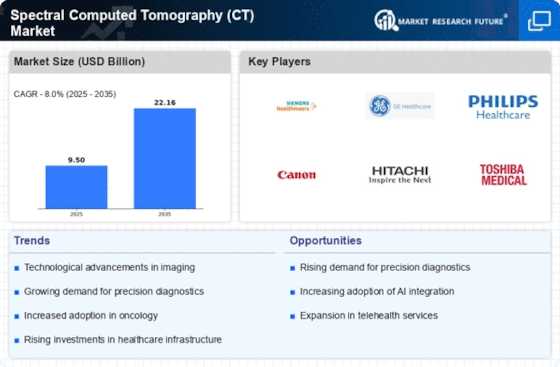
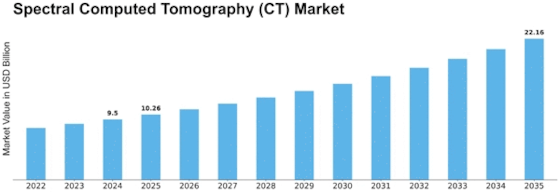
As per MRFR analysis, the Spectral Computed Tomography Market Size was estimated at 9.5 USD Billion in 2024. The Spectral Computed Tomography industry is projected to grow from 10.26 USD Billion in 2025 to 22.16 USD Billion by 2035, exhibiting a compound annual growth rate (CAGR) of 8.0% during the forecast period 2025 - 2035.

Key Market Trends & Highlights

The Spectral Computed Tomography Market is poised for substantial growth driven by technological advancements and increasing demand for personalized healthcare solutions.

  • Technological advancements are enhancing imaging capabilities, leading to improved diagnostic accuracy.
  • The demand for personalized medicine is driving innovations in spectral computed tomography applications.
  • North America remains the largest market, while Asia-Pacific is emerging as the fastest-growing region in this sector.
  • Key market drivers include the rising incidence of chronic diseases and the expansion of healthcare infrastructure.

Market Size & Forecast

2024 Market Size 9.5 (USD Billion)
2035 Market Size 22.16 (USD Billion)
CAGR (2025 - 2035) 8.0%
Largest Regional Market Share in 2024 North America

Major Players

<p>Siemens Healthineers (DE), GE Healthcare (US), Philips Healthcare (NL), Canon Medical Systems (JP), Hitachi Medical Corporation (JP), Carestream Health (US), Agfa-Gevaert Group (BE), Toshiba Medical Systems (JP), Fujifilm Holdings Corporation (JP)</p>

Market Trends

The Spectral Computed Tomography Market is currently experiencing a transformative phase, driven by advancements in imaging technology and increasing demand for precise diagnostic tools. This market appears to be expanding as healthcare providers seek to enhance patient outcomes through improved imaging capabilities. The integration of spectral imaging techniques into existing CT systems is likely to provide clinicians with enhanced diagnostic information, potentially leading to better treatment decisions. Furthermore, the growing prevalence of chronic diseases necessitates more sophisticated imaging solutions, which may further propel market growth. In addition, the rising awareness of the benefits associated with spectral imaging, such as reduced radiation exposure and enhanced tissue characterization, seems to be influencing purchasing decisions among healthcare facilities. As hospitals and diagnostic centers invest in state-of-the-art equipment, the Spectral Computed Tomography Market is poised for continued evolution. The ongoing research and development efforts in this field suggest a promising future, with innovations that could redefine imaging standards and improve overall healthcare delivery.

Technological Advancements

The Spectral Computed Tomography Market is witnessing rapid technological advancements that enhance imaging capabilities. Innovations in detector technology and data processing algorithms are likely to improve image quality and reduce scan times. These developments may lead to increased adoption of spectral CT systems in clinical settings.

Growing Demand for Personalized Medicine

There appears to be a rising demand for personalized medicine, which is influencing the Spectral Computed Tomography Market. As healthcare shifts towards tailored treatment approaches, the need for precise imaging modalities that can provide detailed information about individual patient conditions is becoming more pronounced.

Increased Focus on Patient Safety

The emphasis on patient safety is shaping the Spectral Computed Tomography Market. With growing concerns regarding radiation exposure, healthcare providers are likely to prioritize technologies that minimize risks while maintaining diagnostic accuracy. This trend may drive the adoption of spectral imaging techniques that offer lower radiation doses.

Spectral Computed Tomography Market Market Drivers

Increased Focus on Patient Safety

Patient safety remains a critical concern within the healthcare sector, and the Spectral Computed Tomography Market is responding accordingly. The implementation of spectral CT technology reduces radiation exposure while maintaining high image quality, addressing the growing apprehension regarding radiation risks. Regulatory bodies are increasingly advocating for safer imaging practices, which is likely to propel the adoption of spectral CT systems. As hospitals and imaging centers prioritize patient safety, the market is anticipated to expand, with a projected increase in installations of advanced CT systems that comply with safety standards.

Rising Incidence of Chronic Diseases

The prevalence of chronic diseases such as cancer and cardiovascular disorders is on the rise, which is driving the demand for advanced diagnostic tools in the Spectral Computed Tomography Market. Spectral CT provides enhanced imaging capabilities that are essential for early detection and accurate monitoring of these conditions. As healthcare providers seek to improve patient outcomes through better diagnostic methods, the market is expected to witness substantial growth. The increasing burden of chronic diseases is likely to result in a higher volume of imaging procedures, further fueling the demand for spectral CT technologies.

Expansion of Healthcare Infrastructure

The expansion of healthcare infrastructure, particularly in emerging economies, is contributing to the growth of the Spectral Computed Tomography Market. As countries invest in modernizing their healthcare facilities, there is a corresponding increase in the adoption of advanced imaging technologies. This trend is evident in the establishment of new hospitals and diagnostic centers equipped with state-of-the-art spectral CT systems. The market is projected to benefit from these developments, as improved access to advanced imaging services is likely to enhance diagnostic capabilities and patient care in underserved regions.

Growing Demand for Personalized Medicine

The shift towards personalized medicine is significantly influencing the Spectral Computed Tomography Market. As healthcare moves away from a one-size-fits-all approach, the need for advanced imaging techniques that can provide tailored diagnostic information becomes paramount. Spectral CT offers the ability to assess individual patient needs more effectively, allowing for customized treatment plans. This trend is reflected in the increasing investments in research and development, with the market expected to reach a valuation of USD 2 billion by 2028. The ability to provide specific insights into patient conditions is likely to drive further adoption of spectral imaging technologies.

Technological Advancements in Imaging Techniques

The Spectral Computed Tomography Market is experiencing a surge in technological advancements that enhance imaging capabilities. Innovations such as dual-energy CT and photon-counting detectors are revolutionizing the way medical imaging is conducted. These technologies allow for improved tissue characterization and better differentiation between materials, which is crucial for accurate diagnoses. The integration of artificial intelligence in image processing further streamlines workflows and enhances diagnostic accuracy. As a result, the market is projected to grow at a compound annual growth rate of approximately 8.5% over the next five years, driven by the demand for more precise imaging solutions.

Market Segment Insights

By Application: Oncology (Largest) vs. Cardiology (Fastest-Growing)

<p>In the Spectral Computed Tomography Market, the application segments reveal that oncology holds the largest market share, significantly dominating the landscape due to the rising prevalence of cancer and the need for advanced diagnostic methods. On the other hand, cardiology is experiencing rapid growth, driven by increasing cardiovascular diseases and a growing demand for precise imaging solutions. These two fields distinctly illustrate the diverse applications of spectral CT technology.</p>

<p>Oncology: Dominant vs. Cardiology: Emerging</p>

<p>Oncology remains the dominant application in the Spectral Computed Tomography Market, as its advanced imaging capabilities are crucial for accurate tumor detection and characterization. The increasing emphasis on early diagnosis and personalized treatment strategies contributes to its strong market position. Meanwhile, cardiology is emerging as a fast-growing segment, fueled by the rising incidence of heart diseases and innovations in non-invasive imaging. The capabilities of spectral CT allow for enhanced visualization of coronary arteries and myocardial tissues, propelling its adoption in cardiology practices. This duality in market presence underscores the versatility of spectral CT in addressing critical healthcare needs.</p>

By End Use: Hospitals (Largest) vs. Diagnostic Imaging Centers (Fastest-Growing)

<p>In the Spectral Computed Tomography Market, hospitals account for the largest share, driven by their extensive patient base and demand for advanced diagnostic imaging capabilities. Diagnostic imaging centers follow closely, capturing a significant portion of the market as they offer specialized imaging services that cater to various diagnostic needs. Research institutions and ambulatory surgical centers, while important, hold a smaller share of the market due to their specialized focus and patient throughput limitations.</p>

<p>Hospitals (Dominant) vs. Diagnostic Imaging Centers (Emerging)</p>

<p>Hospitals are the dominant players in the spectral computed tomography market, leveraging their capacity to invest in advanced imaging technologies and facilitate a higher patient volume. They not only provide immediate diagnostic solutions but also integrate these systems within broader healthcare services. On the other hand, diagnostic imaging centers are emerging significantly, as they adapt to growing demands for specialized imaging services. These centers often invest in the latest technologies, expanding their capabilities for low-dose imaging and tailored procedures, thereby appealing to both healthcare providers and patients seeking advanced diagnostic options.</p>

By Technology: Photon Counting (Largest) vs. Spectral Imaging (Fastest-Growing)

<p>In the Spectral Computed Tomography Market, Photon Counting technology holds the largest market share due to its precision in imaging and ability to differentiate materials based on their energy levels. This technology leverages advanced photon detection techniques, thereby enhancing the clarity and accuracy of scans, which has led to its widespread adoption in medical diagnostics and security applications. Conversely, Spectral Imaging, while currently smaller in market share, is rapidly gaining traction due to its innovative approach to capturing multiple energy levels simultaneously, providing detailed insights into material composition.</p>

<p>Technology: Photon Counting (Dominant) vs. Spectral Imaging (Emerging)</p>

<p>Photon Counting technology is recognized as the dominant force in the Spectral Computed Tomography Market. It operates by detecting individual photons, significantly improving image resolution and allowing for enhanced differentiation of tissues, essential in medical imaging. This technology is particularly favored in oncology and cardiology due to its ability to provide clearer diagnostic images. In contrast, Spectral Imaging, although emerging, is showing great potential with its capability to analyze samples based on multiple energy levels, offering unparalleled insights into the composition and characteristics of materials. The trend towards non-invasive diagnostic techniques further fuels the interest in Spectral Imaging, positioning it well for rapid growth in the coming years.</p>

By Patient Demographics: Adult (Largest) vs. Pediatric (Fastest-Growing)

<p>In the Spectral Computed Tomography Market, the distribution of patient demographics reflects a significant tendency towards adult patients, who make up the largest share. This segment captures the majority of scanning demands due to a higher prevalence of diseases requiring detailed imaging. Pediatric patients, though smaller in overall numbers, show a remarkable increase in demand as healthcare systems improve and focus on early diagnosis and treatment for conditions in children. The market is influenced by various growth trends, particularly the technological advancements in spectral CT that cater specifically to pediatric and geriatric populations. The increase in awareness regarding health issues among adults also contributes to their segment dominance. Alongside, the pediatric segment is witnessing rapid advancements, spurred by innovations in lower radiation doses and better imaging techniques. This combination of factors indicates a thriving market landscape for these demographics in spectral CT.</p>

<p>Patient Care: Adult (Dominant) vs. Pediatric (Emerging)</p>

<p>Adult patients represent the dominant segment in the Spectral Computed Tomography Market, largely due to their higher incidence rates of chronic diseases and a comprehensive need for accurate imaging. Adults typically require advanced diagnostic capabilities, which spectral CT offers through enhanced image quality and the ability to detect subtle changes in tissue. On the other hand, the pediatric segment is emerging rapidly, propelled by a growing emphasis on child-specific healthcare and advancements in imaging technologies that minimize radiation exposure. Pediatric patients benefit from tailored protocols that allow for accurate imaging while ensuring safety. This dynamic creates a unique juxtaposition where adult care remains the primary focus, yet the burgeoning pediatric segment is garnering attention as healthcare practices evolve.</p>

By Type of Imaging: Computed Tomography Angiography (Largest) vs. Computed Tomography Colonography (Fastest-Growing)

<p>The market for the type of imaging segment in the spectral computed tomography is predominantly led by Computed Tomography Angiography (CTA), which is favored for its capability in vascular imaging. Computed Tomography Colonography (CTC), while trailing in market share, exhibits an increasing acceptance owing to its non-invasive nature and growing preference for colorectal cancer screening. The market distribution appears to favor CTA with its established usage, yet emerging techniques like CTC show significant potential for future growth. Growth trends within the spectral computed tomography market reveal increasing investments in research and development, particularly in Computed Tomography Perfusion (CTP) and Computed Tomography Myelography (CTM). Innovations aimed at enhancing image resolution and diagnostic accuracy are driving this segment's expansion. Furthermore, the rising prevalence of chronic diseases necessitating advanced imaging techniques will likely propel the demand for these modalities, particularly in emerging markets, thereby influencing future growth trajectories across the segment types.</p>

<p>Computed Tomography Angiography (Dominant) vs. Computed Tomography Colonography (Emerging)</p>

<p>Computed Tomography Angiography (CTA) holds a dominant position in the spectral computed tomography market due to its essential role in evaluating vascular conditions, offering high-resolution images that facilitate accurate diagnostics. Its extensive usage in clinical practice makes it a cornerstone in imaging protocols. Conversely, Computed Tomography Colonography (CTC) represents an emerging segment that is gaining traction among healthcare professionals, particularly for colorectal cancer screening. CTC’s non-invasive approach and patient-friendly procedures are contributing factors to its increasing adoption. As healthcare continues to prioritize early diagnosis and patient comfort, CTC is poised to carve out a significant place in the imaging landscape, challenging the traditional dominance of CTA.</p>

Get more detailed insights about Spectral Computed Tomography (CT) Market Research Report - Global Forecast till 2035

Regional Insights

North America : Market Leader in Innovation

North America is poised to maintain its leadership in the Spectral Computed Tomography market, holding a significant market share of 4.75 in 2024. The region's growth is driven by advanced healthcare infrastructure, increasing demand for diagnostic imaging, and supportive regulatory frameworks. The integration of AI and machine learning in imaging technologies further propels market expansion, enhancing diagnostic accuracy and patient outcomes. The United States stands as the primary contributor, with major players like GE Healthcare and Siemens Healthineers leading the competitive landscape. The presence of cutting-edge research institutions and a robust healthcare system fosters innovation. Additionally, collaborations between technology firms and healthcare providers are expected to enhance product offerings, ensuring that North America remains at the forefront of the Spectral CT market.

Europe : Emerging Market with Growth Potential

Europe, with a market size of 2.5, is witnessing a surge in the adoption of Spectral Computed Tomography technologies. The growth is fueled by increasing investments in healthcare infrastructure, rising awareness of advanced imaging techniques, and regulatory support for innovative medical devices. Countries like Germany and France are leading the charge, focusing on enhancing diagnostic capabilities and improving patient care. The competitive landscape in Europe is characterized by the presence of key players such as Philips Healthcare and Siemens Healthineers. The region is also seeing a rise in partnerships and collaborations aimed at developing next-generation imaging solutions. According to the European Commission, "The EU aims to enhance healthcare delivery through innovative technologies, ensuring patient access to advanced diagnostic tools."

Asia-Pacific : Rapid Growth and Adoption

The Asia-Pacific region, with a market size of 1.75, is rapidly emerging as a significant player in the Spectral Computed Tomography market. Factors such as increasing healthcare expenditure, a growing aging population, and rising incidences of chronic diseases are driving demand for advanced imaging technologies. Countries like Japan and China are at the forefront, investing heavily in healthcare infrastructure and technology adoption. The competitive landscape is evolving, with both local and international players vying for market share. Companies like Canon Medical Systems and Fujifilm Holdings are expanding their presence, focusing on innovative solutions tailored to regional needs. The increasing collaboration between healthcare providers and technology firms is expected to further accelerate market growth, positioning Asia-Pacific as a key player in The Spectral Computed Tomography.

Middle East and Africa : Emerging Market with Challenges

The Middle East and Africa region, with a market size of 0.5, is gradually developing its Spectral Computed Tomography market. The growth is driven by increasing investments in healthcare infrastructure, rising awareness of advanced diagnostic technologies, and government initiatives aimed at improving healthcare access. However, challenges such as limited resources and varying regulatory environments may hinder rapid growth. Countries like South Africa and the UAE are leading the way in adopting advanced imaging technologies. The competitive landscape is characterized by a mix of local and international players, with companies like Agfa-Gevaert Group making strides in the market. As healthcare systems evolve, the region is expected to see increased collaboration between stakeholders to enhance the availability of Spectral CT technologies.

Key Players and Competitive Insights

The Spectral Computed Tomography Market is currently characterized by a dynamic competitive landscape, driven by technological advancements and increasing demand for precise diagnostic imaging. Key players such as Siemens Healthineers (DE), GE Healthcare (US), and Philips Healthcare (NL) are at the forefront, each adopting distinct strategies to enhance their market presence. Siemens Healthineers (DE) emphasizes innovation through the development of advanced imaging technologies, while GE Healthcare (US) focuses on strategic partnerships to expand its product offerings. Philips Healthcare (NL) is leveraging digital transformation to improve patient outcomes and operational efficiency, collectively shaping a competitive environment that prioritizes technological superiority and customer-centric solutions.

In terms of business tactics, companies are increasingly localizing manufacturing and optimizing supply chains to enhance responsiveness to market demands. The competitive structure of the market appears moderately fragmented, with several key players exerting influence over various segments. This fragmentation allows for a diverse range of offerings, yet the collective strength of these major companies drives innovation and sets high standards for quality and performance.

In January 2026, Siemens Healthineers (DE) announced the launch of its latest spectral CT scanner, which integrates artificial intelligence to enhance image quality and reduce radiation exposure. This strategic move not only reinforces Siemens' commitment to innovation but also positions the company as a leader in the push for safer imaging technologies. The integration of AI is likely to attract healthcare providers seeking to improve diagnostic accuracy while minimizing patient risk.

In December 2025, GE Healthcare (US) entered a strategic partnership with a leading telehealth provider to enhance remote diagnostic capabilities. This collaboration aims to integrate spectral CT imaging with telehealth platforms, thereby expanding access to advanced imaging services in underserved regions. Such a move indicates GE's focus on addressing healthcare disparities and enhancing service delivery through technology, which could significantly impact patient care.

In November 2025, Philips Healthcare (NL) unveiled a new initiative aimed at sustainability in imaging technologies, committing to reduce its carbon footprint by 30% by 2030. This initiative not only aligns with global sustainability trends but also positions Philips as a responsible leader in the healthcare sector. The emphasis on eco-friendly practices may resonate well with environmentally conscious healthcare providers and patients alike, potentially influencing purchasing decisions.

As of February 2026, current competitive trends in the Spectral Computed Tomography Market are increasingly defined by digitalization, sustainability, and the integration of AI technologies. Strategic alliances are becoming pivotal in shaping the landscape, as companies seek to combine strengths and resources to innovate more effectively. Looking ahead, competitive differentiation is likely to evolve from traditional price-based competition to a focus on innovation, technological advancements, and supply chain reliability, suggesting a transformative shift in how companies position themselves in the market.

Key Companies in the Spectral Computed Tomography Market include

Industry Developments

  • In March 2018:Philips entered into a 15-year strategic partnership with ZorgSaam Hospital based in the Netherlands. As per the agreement, Philips will provide ZorgSaam with a wide range of diagnostic imaging and image-guided therapy solutions, among others.
  • In March 2019:Koninklijke Philips N.V. announced the expansion of its radiology solutions portfolio with teleradiology services. Teleradiology includes the interpretation of patients’ images from medical imaging exams, such as X-ray exams, MR, and CT. This complements the company’s organic innovation initiatives to expand its radiology solutions portfolio.


Future Outlook

Spectral Computed Tomography Market Future Outlook

The Spectral Computed Tomography Market is projected to grow at an 8.0% CAGR from 2024 to 2035, driven by technological advancements, increasing demand for diagnostic imaging, and enhanced healthcare infrastructure.

New opportunities lie in:

  • Development of AI-driven image analysis software for enhanced diagnostic accuracy.
  • Expansion of portable spectral CT systems for remote healthcare applications.
  • Partnerships with healthcare providers for integrated imaging solutions and services.

By 2035, the market is expected to achieve substantial growth, solidifying its position as a leader in diagnostic imaging.

Market Segmentation

Spectral Computed Tomography Market End Use Outlook

  • Hospitals
  • Diagnostic Imaging Centers
  • Research Institutions
  • Ambulatory Surgical Centers

Spectral Computed Tomography Market Technology Outlook

  • Photon Counting
  • Energy Dispersive Spectroscopy
  • Dual Energy Computed Tomography
  • Spectral Imaging

Spectral Computed Tomography Market Application Outlook

  • Oncology
  • Cardiology
  • Neurology
  • Orthopedics
  • Pulmonology

Spectral Computed Tomography Market Type of Imaging Outlook

  • Computed Tomography Angiography
  • Computed Tomography Colonography
  • Computed Tomography Perfusion
  • Computed Tomography Myelography

Spectral Computed Tomography Market Patient Demographics Outlook

  • Pediatric
  • Adult
  • Geriatric
  • Pregnant Women

Report Scope

MARKET SIZE 2024 9.5(USD Billion)
MARKET SIZE 2025 10.26(USD Billion)
MARKET SIZE 2035 22.16(USD Billion)
COMPOUND ANNUAL GROWTH RATE (CAGR) 8.0% (2024 - 2035)
REPORT COVERAGE Revenue Forecast, Competitive Landscape, Growth Factors, and Trends
BASE YEAR 2024
Market Forecast Period 2025 - 2035
Historical Data 2019 - 2024
Market Forecast Units USD Billion
Key Companies Profiled Siemens Healthineers (DE), GE Healthcare (US), Philips Healthcare (NL), Canon Medical Systems (JP), Hitachi Medical Corporation (JP), Carestream Health (US), Agfa-Gevaert Group (BE), Toshiba Medical Systems (JP), Fujifilm Holdings Corporation (JP)
Segments Covered Application, End Use, Technology, Patient Demographics, Type of Imaging
Key Market Opportunities Advancements in artificial intelligence enhance diagnostic accuracy in the Spectral Computed Tomography Market.
Key Market Dynamics Technological advancements in spectral imaging enhance diagnostic accuracy, driving demand for spectral computed tomography systems.
Countries Covered North America, Europe, APAC, South America, MEA

FAQs

What is the projected market valuation of the Spectral Computed Tomography Market by 2035?

<p>The market is projected to reach a valuation of 22.16 USD Billion by 2035.</p>

What was the market valuation of the Spectral Computed Tomography Market in 2024?

<p>The overall market valuation was 9.5 USD Billion in 2024.</p>

What is the expected CAGR for the Spectral Computed Tomography Market during the forecast period 2025 - 2035?

<p>The expected CAGR for the market during the forecast period is 8.0%.</p>

Which application segment is projected to have the highest valuation by 2035?

<p>The Oncology application segment is projected to reach 6.5 USD Billion by 2035.</p>

What is the anticipated market size for hospitals in the Spectral Computed Tomography Market by 2035?

<p>The market size for hospitals is anticipated to reach 8.5 USD Billion by 2035.</p>

Which technology segment is expected to grow significantly by 2035?

<p>The Dual Energy Computed Tomography segment is expected to grow to 7.0 USD Billion by 2035.</p>

What is the projected market size for adult patients in the Spectral Computed Tomography Market by 2035?

<p>The market size for adult patients is projected to reach 10.0 USD Billion by 2035.</p>

Which key player is recognized for its leadership in the Spectral Computed Tomography Market?

<p>Siemens Healthineers is recognized as a key player in the Spectral Computed Tomography Market.</p>

What is the expected valuation for diagnostic imaging centers by 2035?

<p>The expected valuation for diagnostic imaging centers is 5.5 USD Billion by 2035.</p>

What is the projected market size for computed tomography angiography by 2035?

<p>The projected market size for computed tomography angiography is 6.5 USD Billion by 2035.</p>

  1. SECTION I: EXECUTIVE SUMMARY AND KEY HIGHLIGHTS
    1. | 1.1 EXECUTIVE SUMMARY
    2. | | 1.1.1 Market Overview
    3. | | 1.1.2 Key Findings
    4. | | 1.1.3 Market Segmentation
    5. | | 1.1.4 Competitive Landscape
    6. | | 1.1.5 Challenges and Opportunities
    7. | | 1.1.6 Future Outlook
  2. SECTION II: SCOPING, METHODOLOGY AND MARKET STRUCTURE
    1. | 2.1 MARKET INTRODUCTION
    2. | | 2.1.1 Definition
    3. | | 2.1.2 Scope of the study
    4. | | | 2.1.2.1 Research Objective
    5. | | | 2.1.2.2 Assumption
    6. | | | 2.1.2.3 Limitations
    7. | 2.2 RESEARCH METHODOLOGY
    8. | | 2.2.1 Overview
    9. | | 2.2.2 Data Mining
    10. | | 2.2.3 Secondary Research
    11. | | 2.2.4 Primary Research
    12. | | | 2.2.4.1 Primary Interviews and Information Gathering Process
    13. | | | 2.2.4.2 Breakdown of Primary Respondents
    14. | | 2.2.5 Forecasting Model
    15. | | 2.2.6 Market Size Estimation
    16. | | | 2.2.6.1 Bottom-Up Approach
    17. | | | 2.2.6.2 Top-Down Approach
    18. | | 2.2.7 Data Triangulation
    19. | | 2.2.8 Validation
  3. SECTION III: QUALITATIVE ANALYSIS
    1. | 3.1 MARKET DYNAMICS
    2. | | 3.1.1 Overview
    3. | | 3.1.2 Drivers
    4. | | 3.1.3 Restraints
    5. | | 3.1.4 Opportunities
    6. | 3.2 MARKET FACTOR ANALYSIS
    7. | | 3.2.1 Value chain Analysis
    8. | | 3.2.2 Porter's Five Forces Analysis
    9. | | | 3.2.2.1 Bargaining Power of Suppliers
    10. | | | 3.2.2.2 Bargaining Power of Buyers
    11. | | | 3.2.2.3 Threat of New Entrants
    12. | | | 3.2.2.4 Threat of Substitutes
    13. | | | 3.2.2.5 Intensity of Rivalry
    14. | | 3.2.3 COVID-19 Impact Analysis
    15. | | | 3.2.3.1 Market Impact Analysis
    16. | | | 3.2.3.2 Regional Impact
    17. | | | 3.2.3.3 Opportunity and Threat Analysis
  4. SECTION IV: QUANTITATIVE ANALYSIS
    1. | 4.1 Healthcare, BY Application (USD Billion)
    2. | | 4.1.1 Oncology
    3. | | 4.1.2 Cardiology
    4. | | 4.1.3 Neurology
    5. | | 4.1.4 Orthopedics
    6. | | 4.1.5 Pulmonology
    7. | 4.2 Healthcare, BY End Use (USD Billion)
    8. | | 4.2.1 Hospitals
    9. | | 4.2.2 Diagnostic Imaging Centers
    10. | | 4.2.3 Research Institutions
    11. | | 4.2.4 Ambulatory Surgical Centers
    12. | 4.3 Healthcare, BY Technology (USD Billion)
    13. | | 4.3.1 Photon Counting
    14. | | 4.3.2 Energy Dispersive Spectroscopy
    15. | | 4.3.3 Dual Energy Computed Tomography
    16. | | 4.3.4 Spectral Imaging
    17. | 4.4 Healthcare, BY Patient Demographics (USD Billion)
    18. | | 4.4.1 Pediatric
    19. | | 4.4.2 Adult
    20. | | 4.4.3 Geriatric
    21. | | 4.4.4 Pregnant Women
    22. | 4.5 Healthcare, BY Type of Imaging (USD Billion)
    23. | | 4.5.1 Computed Tomography Angiography
    24. | | 4.5.2 Computed Tomography Colonography
    25. | | 4.5.3 Computed Tomography Perfusion
    26. | | 4.5.4 Computed Tomography Myelography
    27. | 4.6 Healthcare, BY Region (USD Billion)
    28. | | 4.6.1 North America
    29. | | | 4.6.1.1 US
    30. | | | 4.6.1.2 Canada
    31. | | 4.6.2 Europe
    32. | | | 4.6.2.1 Germany
    33. | | | 4.6.2.2 UK
    34. | | | 4.6.2.3 France
    35. | | | 4.6.2.4 Russia
    36. | | | 4.6.2.5 Italy
    37. | | | 4.6.2.6 Spain
    38. | | | 4.6.2.7 Rest of Europe
    39. | | 4.6.3 APAC
    40. | | | 4.6.3.1 China
    41. | | | 4.6.3.2 India
    42. | | | 4.6.3.3 Japan
    43. | | | 4.6.3.4 South Korea
    44. | | | 4.6.3.5 Malaysia
    45. | | | 4.6.3.6 Thailand
    46. | | | 4.6.3.7 Indonesia
    47. | | | 4.6.3.8 Rest of APAC
    48. | | 4.6.4 South America
    49. | | | 4.6.4.1 Brazil
    50. | | | 4.6.4.2 Mexico
    51. | | | 4.6.4.3 Argentina
    52. | | | 4.6.4.4 Rest of South America
    53. | | 4.6.5 MEA
    54. | | | 4.6.5.1 GCC Countries
    55. | | | 4.6.5.2 South Africa
    56. | | | 4.6.5.3 Rest of MEA
  5. SECTION V: COMPETITIVE ANALYSIS
    1. | 5.1 Competitive Landscape
    2. | | 5.1.1 Overview
    3. | | 5.1.2 Competitive Analysis
    4. | | 5.1.3 Market share Analysis
    5. | | 5.1.4 Major Growth Strategy in the Healthcare
    6. | | 5.1.5 Competitive Benchmarking
    7. | | 5.1.6 Leading Players in Terms of Number of Developments in the Healthcare
    8. | | 5.1.7 Key developments and growth strategies
    9. | | | 5.1.7.1 New Product Launch/Service Deployment
    10. | | | 5.1.7.2 Merger & Acquisitions
    11. | | | 5.1.7.3 Joint Ventures
    12. | | 5.1.8 Major Players Financial Matrix
    13. | | | 5.1.8.1 Sales and Operating Income
    14. | | | 5.1.8.2 Major Players R&D Expenditure. 2023
    15. | 5.2 Company Profiles
    16. | | 5.2.1 Siemens Healthineers (DE)
    17. | | | 5.2.1.1 Financial Overview
    18. | | | 5.2.1.2 Products Offered
    19. | | | 5.2.1.3 Key Developments
    20. | | | 5.2.1.4 SWOT Analysis
    21. | | | 5.2.1.5 Key Strategies
    22. | | 5.2.2 GE Healthcare (US)
    23. | | | 5.2.2.1 Financial Overview
    24. | | | 5.2.2.2 Products Offered
    25. | | | 5.2.2.3 Key Developments
    26. | | | 5.2.2.4 SWOT Analysis
    27. | | | 5.2.2.5 Key Strategies
    28. | | 5.2.3 Philips Healthcare (NL)
    29. | | | 5.2.3.1 Financial Overview
    30. | | | 5.2.3.2 Products Offered
    31. | | | 5.2.3.3 Key Developments
    32. | | | 5.2.3.4 SWOT Analysis
    33. | | | 5.2.3.5 Key Strategies
    34. | | 5.2.4 Canon Medical Systems (JP)
    35. | | | 5.2.4.1 Financial Overview
    36. | | | 5.2.4.2 Products Offered
    37. | | | 5.2.4.3 Key Developments
    38. | | | 5.2.4.4 SWOT Analysis
    39. | | | 5.2.4.5 Key Strategies
    40. | | 5.2.5 Hitachi Medical Corporation (JP)
    41. | | | 5.2.5.1 Financial Overview
    42. | | | 5.2.5.2 Products Offered
    43. | | | 5.2.5.3 Key Developments
    44. | | | 5.2.5.4 SWOT Analysis
    45. | | | 5.2.5.5 Key Strategies
    46. | | 5.2.6 Carestream Health (US)
    47. | | | 5.2.6.1 Financial Overview
    48. | | | 5.2.6.2 Products Offered
    49. | | | 5.2.6.3 Key Developments
    50. | | | 5.2.6.4 SWOT Analysis
    51. | | | 5.2.6.5 Key Strategies
    52. | | 5.2.7 Agfa-Gevaert Group (BE)
    53. | | | 5.2.7.1 Financial Overview
    54. | | | 5.2.7.2 Products Offered
    55. | | | 5.2.7.3 Key Developments
    56. | | | 5.2.7.4 SWOT Analysis
    57. | | | 5.2.7.5 Key Strategies
    58. | | 5.2.8 Toshiba Medical Systems (JP)
    59. | | | 5.2.8.1 Financial Overview
    60. | | | 5.2.8.2 Products Offered
    61. | | | 5.2.8.3 Key Developments
    62. | | | 5.2.8.4 SWOT Analysis
    63. | | | 5.2.8.5 Key Strategies
    64. | | 5.2.9 Fujifilm Holdings Corporation (JP)
    65. | | | 5.2.9.1 Financial Overview
    66. | | | 5.2.9.2 Products Offered
    67. | | | 5.2.9.3 Key Developments
    68. | | | 5.2.9.4 SWOT Analysis
    69. | | | 5.2.9.5 Key Strategies
    70. | 5.3 Appendix
    71. | | 5.3.1 References
    72. | | 5.3.2 Related Reports
  6. LIST OF FIGURES
    1. | 6.1 MARKET SYNOPSIS
    2. | 6.2 NORTH AMERICA MARKET ANALYSIS
    3. | 6.3 US MARKET ANALYSIS BY APPLICATION
    4. | 6.4 US MARKET ANALYSIS BY END USE
    5. | 6.5 US MARKET ANALYSIS BY TECHNOLOGY
    6. | 6.6 US MARKET ANALYSIS BY PATIENT DEMOGRAPHICS
    7. | 6.7 US MARKET ANALYSIS BY TYPE OF IMAGING
    8. | 6.8 CANADA MARKET ANALYSIS BY APPLICATION
    9. | 6.9 CANADA MARKET ANALYSIS BY END USE
    10. | 6.10 CANADA MARKET ANALYSIS BY TECHNOLOGY
    11. | 6.11 CANADA MARKET ANALYSIS BY PATIENT DEMOGRAPHICS
    12. | 6.12 CANADA MARKET ANALYSIS BY TYPE OF IMAGING
    13. | 6.13 EUROPE MARKET ANALYSIS
    14. | 6.14 GERMANY MARKET ANALYSIS BY APPLICATION
    15. | 6.15 GERMANY MARKET ANALYSIS BY END USE
    16. | 6.16 GERMANY MARKET ANALYSIS BY TECHNOLOGY
    17. | 6.17 GERMANY MARKET ANALYSIS BY PATIENT DEMOGRAPHICS
    18. | 6.18 GERMANY MARKET ANALYSIS BY TYPE OF IMAGING
    19. | 6.19 UK MARKET ANALYSIS BY APPLICATION
    20. | 6.20 UK MARKET ANALYSIS BY END USE
    21. | 6.21 UK MARKET ANALYSIS BY TECHNOLOGY
    22. | 6.22 UK MARKET ANALYSIS BY PATIENT DEMOGRAPHICS
    23. | 6.23 UK MARKET ANALYSIS BY TYPE OF IMAGING
    24. | 6.24 FRANCE MARKET ANALYSIS BY APPLICATION
    25. | 6.25 FRANCE MARKET ANALYSIS BY END USE
    26. | 6.26 FRANCE MARKET ANALYSIS BY TECHNOLOGY
    27. | 6.27 FRANCE MARKET ANALYSIS BY PATIENT DEMOGRAPHICS
    28. | 6.28 FRANCE MARKET ANALYSIS BY TYPE OF IMAGING
    29. | 6.29 RUSSIA MARKET ANALYSIS BY APPLICATION
    30. | 6.30 RUSSIA MARKET ANALYSIS BY END USE
    31. | 6.31 RUSSIA MARKET ANALYSIS BY TECHNOLOGY
    32. | 6.32 RUSSIA MARKET ANALYSIS BY PATIENT DEMOGRAPHICS
    33. | 6.33 RUSSIA MARKET ANALYSIS BY TYPE OF IMAGING
    34. | 6.34 ITALY MARKET ANALYSIS BY APPLICATION
    35. | 6.35 ITALY MARKET ANALYSIS BY END USE
    36. | 6.36 ITALY MARKET ANALYSIS BY TECHNOLOGY
    37. | 6.37 ITALY MARKET ANALYSIS BY PATIENT DEMOGRAPHICS
    38. | 6.38 ITALY MARKET ANALYSIS BY TYPE OF IMAGING
    39. | 6.39 SPAIN MARKET ANALYSIS BY APPLICATION
    40. | 6.40 SPAIN MARKET ANALYSIS BY END USE
    41. | 6.41 SPAIN MARKET ANALYSIS BY TECHNOLOGY
    42. | 6.42 SPAIN MARKET ANALYSIS BY PATIENT DEMOGRAPHICS
    43. | 6.43 SPAIN MARKET ANALYSIS BY TYPE OF IMAGING
    44. | 6.44 REST OF EUROPE MARKET ANALYSIS BY APPLICATION
    45. | 6.45 REST OF EUROPE MARKET ANALYSIS BY END USE
    46. | 6.46 REST OF EUROPE MARKET ANALYSIS BY TECHNOLOGY
    47. | 6.47 REST OF EUROPE MARKET ANALYSIS BY PATIENT DEMOGRAPHICS
    48. | 6.48 REST OF EUROPE MARKET ANALYSIS BY TYPE OF IMAGING
    49. | 6.49 APAC MARKET ANALYSIS
    50. | 6.50 CHINA MARKET ANALYSIS BY APPLICATION
    51. | 6.51 CHINA MARKET ANALYSIS BY END USE
    52. | 6.52 CHINA MARKET ANALYSIS BY TECHNOLOGY
    53. | 6.53 CHINA MARKET ANALYSIS BY PATIENT DEMOGRAPHICS
    54. | 6.54 CHINA MARKET ANALYSIS BY TYPE OF IMAGING
    55. | 6.55 INDIA MARKET ANALYSIS BY APPLICATION
    56. | 6.56 INDIA MARKET ANALYSIS BY END USE
    57. | 6.57 INDIA MARKET ANALYSIS BY TECHNOLOGY
    58. | 6.58 INDIA MARKET ANALYSIS BY PATIENT DEMOGRAPHICS
    59. | 6.59 INDIA MARKET ANALYSIS BY TYPE OF IMAGING
    60. | 6.60 JAPAN MARKET ANALYSIS BY APPLICATION
    61. | 6.61 JAPAN MARKET ANALYSIS BY END USE
    62. | 6.62 JAPAN MARKET ANALYSIS BY TECHNOLOGY
    63. | 6.63 JAPAN MARKET ANALYSIS BY PATIENT DEMOGRAPHICS
    64. | 6.64 JAPAN MARKET ANALYSIS BY TYPE OF IMAGING
    65. | 6.65 SOUTH KOREA MARKET ANALYSIS BY APPLICATION
    66. | 6.66 SOUTH KOREA MARKET ANALYSIS BY END USE
    67. | 6.67 SOUTH KOREA MARKET ANALYSIS BY TECHNOLOGY
    68. | 6.68 SOUTH KOREA MARKET ANALYSIS BY PATIENT DEMOGRAPHICS
    69. | 6.69 SOUTH KOREA MARKET ANALYSIS BY TYPE OF IMAGING
    70. | 6.70 MALAYSIA MARKET ANALYSIS BY APPLICATION
    71. | 6.71 MALAYSIA MARKET ANALYSIS BY END USE
    72. | 6.72 MALAYSIA MARKET ANALYSIS BY TECHNOLOGY
    73. | 6.73 MALAYSIA MARKET ANALYSIS BY PATIENT DEMOGRAPHICS
    74. | 6.74 MALAYSIA MARKET ANALYSIS BY TYPE OF IMAGING
    75. | 6.75 THAILAND MARKET ANALYSIS BY APPLICATION
    76. | 6.76 THAILAND MARKET ANALYSIS BY END USE
    77. | 6.77 THAILAND MARKET ANALYSIS BY TECHNOLOGY
    78. | 6.78 THAILAND MARKET ANALYSIS BY PATIENT DEMOGRAPHICS
    79. | 6.79 THAILAND MARKET ANALYSIS BY TYPE OF IMAGING
    80. | 6.80 INDONESIA MARKET ANALYSIS BY APPLICATION
    81. | 6.81 INDONESIA MARKET ANALYSIS BY END USE
    82. | 6.82 INDONESIA MARKET ANALYSIS BY TECHNOLOGY
    83. | 6.83 INDONESIA MARKET ANALYSIS BY PATIENT DEMOGRAPHICS
    84. | 6.84 INDONESIA MARKET ANALYSIS BY TYPE OF IMAGING
    85. | 6.85 REST OF APAC MARKET ANALYSIS BY APPLICATION
    86. | 6.86 REST OF APAC MARKET ANALYSIS BY END USE
    87. | 6.87 REST OF APAC MARKET ANALYSIS BY TECHNOLOGY
    88. | 6.88 REST OF APAC MARKET ANALYSIS BY PATIENT DEMOGRAPHICS
    89. | 6.89 REST OF APAC MARKET ANALYSIS BY TYPE OF IMAGING
    90. | 6.90 SOUTH AMERICA MARKET ANALYSIS
    91. | 6.91 BRAZIL MARKET ANALYSIS BY APPLICATION
    92. | 6.92 BRAZIL MARKET ANALYSIS BY END USE
    93. | 6.93 BRAZIL MARKET ANALYSIS BY TECHNOLOGY
    94. | 6.94 BRAZIL MARKET ANALYSIS BY PATIENT DEMOGRAPHICS
    95. | 6.95 BRAZIL MARKET ANALYSIS BY TYPE OF IMAGING
    96. | 6.96 MEXICO MARKET ANALYSIS BY APPLICATION
    97. | 6.97 MEXICO MARKET ANALYSIS BY END USE
    98. | 6.98 MEXICO MARKET ANALYSIS BY TECHNOLOGY
    99. | 6.99 MEXICO MARKET ANALYSIS BY PATIENT DEMOGRAPHICS
    100. | 6.100 MEXICO MARKET ANALYSIS BY TYPE OF IMAGING
    101. | 6.101 ARGENTINA MARKET ANALYSIS BY APPLICATION
    102. | 6.102 ARGENTINA MARKET ANALYSIS BY END USE
    103. | 6.103 ARGENTINA MARKET ANALYSIS BY TECHNOLOGY
    104. | 6.104 ARGENTINA MARKET ANALYSIS BY PATIENT DEMOGRAPHICS
    105. | 6.105 ARGENTINA MARKET ANALYSIS BY TYPE OF IMAGING
    106. | 6.106 REST OF SOUTH AMERICA MARKET ANALYSIS BY APPLICATION
    107. | 6.107 REST OF SOUTH AMERICA MARKET ANALYSIS BY END USE
    108. | 6.108 REST OF SOUTH AMERICA MARKET ANALYSIS BY TECHNOLOGY
    109. | 6.109 REST OF SOUTH AMERICA MARKET ANALYSIS BY PATIENT DEMOGRAPHICS
    110. | 6.110 REST OF SOUTH AMERICA MARKET ANALYSIS BY TYPE OF IMAGING
    111. | 6.111 MEA MARKET ANALYSIS
    112. | 6.112 GCC COUNTRIES MARKET ANALYSIS BY APPLICATION
    113. | 6.113 GCC COUNTRIES MARKET ANALYSIS BY END USE
    114. | 6.114 GCC COUNTRIES MARKET ANALYSIS BY TECHNOLOGY
    115. | 6.115 GCC COUNTRIES MARKET ANALYSIS BY PATIENT DEMOGRAPHICS
    116. | 6.116 GCC COUNTRIES MARKET ANALYSIS BY TYPE OF IMAGING
    117. | 6.117 SOUTH AFRICA MARKET ANALYSIS BY APPLICATION
    118. | 6.118 SOUTH AFRICA MARKET ANALYSIS BY END USE
    119. | 6.119 SOUTH AFRICA MARKET ANALYSIS BY TECHNOLOGY
    120. | 6.120 SOUTH AFRICA MARKET ANALYSIS BY PATIENT DEMOGRAPHICS
    121. | 6.121 SOUTH AFRICA MARKET ANALYSIS BY TYPE OF IMAGING
    122. | 6.122 REST OF MEA MARKET ANALYSIS BY APPLICATION
    123. | 6.123 REST OF MEA MARKET ANALYSIS BY END USE
    124. | 6.124 REST OF MEA MARKET ANALYSIS BY TECHNOLOGY
    125. | 6.125 REST OF MEA MARKET ANALYSIS BY PATIENT DEMOGRAPHICS
    126. | 6.126 REST OF MEA MARKET ANALYSIS BY TYPE OF IMAGING
    127. | 6.127 KEY BUYING CRITERIA OF HEALTHCARE
    128. | 6.128 RESEARCH PROCESS OF MRFR
    129. | 6.129 DRO ANALYSIS OF HEALTHCARE
    130. | 6.130 DRIVERS IMPACT ANALYSIS: HEALTHCARE
    131. | 6.131 RESTRAINTS IMPACT ANALYSIS: HEALTHCARE
    132. | 6.132 SUPPLY / VALUE CHAIN: HEALTHCARE
    133. | 6.133 HEALTHCARE, BY APPLICATION, 2024 (% SHARE)
    134. | 6.134 HEALTHCARE, BY APPLICATION, 2024 TO 2035 (USD Billion)
    135. | 6.135 HEALTHCARE, BY END USE, 2024 (% SHARE)
    136. | 6.136 HEALTHCARE, BY END USE, 2024 TO 2035 (USD Billion)
    137. | 6.137 HEALTHCARE, BY TECHNOLOGY, 2024 (% SHARE)
    138. | 6.138 HEALTHCARE, BY TECHNOLOGY, 2024 TO 2035 (USD Billion)
    139. | 6.139 HEALTHCARE, BY PATIENT DEMOGRAPHICS, 2024 (% SHARE)
    140. | 6.140 HEALTHCARE, BY PATIENT DEMOGRAPHICS, 2024 TO 2035 (USD Billion)
    141. | 6.141 HEALTHCARE, BY TYPE OF IMAGING, 2024 (% SHARE)
    142. | 6.142 HEALTHCARE, BY TYPE OF IMAGING, 2024 TO 2035 (USD Billion)
    143. | 6.143 BENCHMARKING OF MAJOR COMPETITORS
  7. LIST OF TABLES
    1. | 7.1 LIST OF ASSUMPTIONS
    2. | | 7.1.1
    3. | 7.2 North America MARKET SIZE ESTIMATES; FORECAST
    4. | | 7.2.1 BY APPLICATION, 2026-2035 (USD Billion)
    5. | | 7.2.2 BY END USE, 2026-2035 (USD Billion)
    6. | | 7.2.3 BY TECHNOLOGY, 2026-2035 (USD Billion)
    7. | | 7.2.4 BY PATIENT DEMOGRAPHICS, 2026-2035 (USD Billion)
    8. | | 7.2.5 BY TYPE OF IMAGING, 2026-2035 (USD Billion)
    9. | 7.3 US MARKET SIZE ESTIMATES; FORECAST
    10. | | 7.3.1 BY APPLICATION, 2026-2035 (USD Billion)
    11. | | 7.3.2 BY END USE, 2026-2035 (USD Billion)
    12. | | 7.3.3 BY TECHNOLOGY, 2026-2035 (USD Billion)
    13. | | 7.3.4 BY PATIENT DEMOGRAPHICS, 2026-2035 (USD Billion)
    14. | | 7.3.5 BY TYPE OF IMAGING, 2026-2035 (USD Billion)
    15. | 7.4 Canada MARKET SIZE ESTIMATES; FORECAST
    16. | | 7.4.1 BY APPLICATION, 2026-2035 (USD Billion)
    17. | | 7.4.2 BY END USE, 2026-2035 (USD Billion)
    18. | | 7.4.3 BY TECHNOLOGY, 2026-2035 (USD Billion)
    19. | | 7.4.4 BY PATIENT DEMOGRAPHICS, 2026-2035 (USD Billion)
    20. | | 7.4.5 BY TYPE OF IMAGING, 2026-2035 (USD Billion)
    21. | 7.5 Europe MARKET SIZE ESTIMATES; FORECAST
    22. | | 7.5.1 BY APPLICATION, 2026-2035 (USD Billion)
    23. | | 7.5.2 BY END USE, 2026-2035 (USD Billion)
    24. | | 7.5.3 BY TECHNOLOGY, 2026-2035 (USD Billion)
    25. | | 7.5.4 BY PATIENT DEMOGRAPHICS, 2026-2035 (USD Billion)
    26. | | 7.5.5 BY TYPE OF IMAGING, 2026-2035 (USD Billion)
    27. | 7.6 Germany MARKET SIZE ESTIMATES; FORECAST
    28. | | 7.6.1 BY APPLICATION, 2026-2035 (USD Billion)
    29. | | 7.6.2 BY END USE, 2026-2035 (USD Billion)
    30. | | 7.6.3 BY TECHNOLOGY, 2026-2035 (USD Billion)
    31. | | 7.6.4 BY PATIENT DEMOGRAPHICS, 2026-2035 (USD Billion)
    32. | | 7.6.5 BY TYPE OF IMAGING, 2026-2035 (USD Billion)
    33. | 7.7 UK MARKET SIZE ESTIMATES; FORECAST
    34. | | 7.7.1 BY APPLICATION, 2026-2035 (USD Billion)
    35. | | 7.7.2 BY END USE, 2026-2035 (USD Billion)
    36. | | 7.7.3 BY TECHNOLOGY, 2026-2035 (USD Billion)
    37. | | 7.7.4 BY PATIENT DEMOGRAPHICS, 2026-2035 (USD Billion)
    38. | | 7.7.5 BY TYPE OF IMAGING, 2026-2035 (USD Billion)
    39. | 7.8 France MARKET SIZE ESTIMATES; FORECAST
    40. | | 7.8.1 BY APPLICATION, 2026-2035 (USD Billion)
    41. | | 7.8.2 BY END USE, 2026-2035 (USD Billion)
    42. | | 7.8.3 BY TECHNOLOGY, 2026-2035 (USD Billion)
    43. | | 7.8.4 BY PATIENT DEMOGRAPHICS, 2026-2035 (USD Billion)
    44. | | 7.8.5 BY TYPE OF IMAGING, 2026-2035 (USD Billion)
    45. | 7.9 Russia MARKET SIZE ESTIMATES; FORECAST
    46. | | 7.9.1 BY APPLICATION, 2026-2035 (USD Billion)
    47. | | 7.9.2 BY END USE, 2026-2035 (USD Billion)
    48. | | 7.9.3 BY TECHNOLOGY, 2026-2035 (USD Billion)
    49. | | 7.9.4 BY PATIENT DEMOGRAPHICS, 2026-2035 (USD Billion)
    50. | | 7.9.5 BY TYPE OF IMAGING, 2026-2035 (USD Billion)
    51. | 7.10 Italy MARKET SIZE ESTIMATES; FORECAST
    52. | | 7.10.1 BY APPLICATION, 2026-2035 (USD Billion)
    53. | | 7.10.2 BY END USE, 2026-2035 (USD Billion)
    54. | | 7.10.3 BY TECHNOLOGY, 2026-2035 (USD Billion)
    55. | | 7.10.4 BY PATIENT DEMOGRAPHICS, 2026-2035 (USD Billion)
    56. | | 7.10.5 BY TYPE OF IMAGING, 2026-2035 (USD Billion)
    57. | 7.11 Spain MARKET SIZE ESTIMATES; FORECAST
    58. | | 7.11.1 BY APPLICATION, 2026-2035 (USD Billion)
    59. | | 7.11.2 BY END USE, 2026-2035 (USD Billion)
    60. | | 7.11.3 BY TECHNOLOGY, 2026-2035 (USD Billion)
    61. | | 7.11.4 BY PATIENT DEMOGRAPHICS, 2026-2035 (USD Billion)
    62. | | 7.11.5 BY TYPE OF IMAGING, 2026-2035 (USD Billion)
    63. | 7.12 Rest of Europe MARKET SIZE ESTIMATES; FORECAST
    64. | | 7.12.1 BY APPLICATION, 2026-2035 (USD Billion)
    65. | | 7.12.2 BY END USE, 2026-2035 (USD Billion)
    66. | | 7.12.3 BY TECHNOLOGY, 2026-2035 (USD Billion)
    67. | | 7.12.4 BY PATIENT DEMOGRAPHICS, 2026-2035 (USD Billion)
    68. | | 7.12.5 BY TYPE OF IMAGING, 2026-2035 (USD Billion)
    69. | 7.13 APAC MARKET SIZE ESTIMATES; FORECAST
    70. | | 7.13.1 BY APPLICATION, 2026-2035 (USD Billion)
    71. | | 7.13.2 BY END USE, 2026-2035 (USD Billion)
    72. | | 7.13.3 BY TECHNOLOGY, 2026-2035 (USD Billion)
    73. | | 7.13.4 BY PATIENT DEMOGRAPHICS, 2026-2035 (USD Billion)
    74. | | 7.13.5 BY TYPE OF IMAGING, 2026-2035 (USD Billion)
    75. | 7.14 China MARKET SIZE ESTIMATES; FORECAST
    76. | | 7.14.1 BY APPLICATION, 2026-2035 (USD Billion)
    77. | | 7.14.2 BY END USE, 2026-2035 (USD Billion)
    78. | | 7.14.3 BY TECHNOLOGY, 2026-2035 (USD Billion)
    79. | | 7.14.4 BY PATIENT DEMOGRAPHICS, 2026-2035 (USD Billion)
    80. | | 7.14.5 BY TYPE OF IMAGING, 2026-2035 (USD Billion)
    81. | 7.15 India MARKET SIZE ESTIMATES; FORECAST
    82. | | 7.15.1 BY APPLICATION, 2026-2035 (USD Billion)
    83. | | 7.15.2 BY END USE, 2026-2035 (USD Billion)
    84. | | 7.15.3 BY TECHNOLOGY, 2026-2035 (USD Billion)
    85. | | 7.15.4 BY PATIENT DEMOGRAPHICS, 2026-2035 (USD Billion)
    86. | | 7.15.5 BY TYPE OF IMAGING, 2026-2035 (USD Billion)
    87. | 7.16 Japan MARKET SIZE ESTIMATES; FORECAST
    88. | | 7.16.1 BY APPLICATION, 2026-2035 (USD Billion)
    89. | | 7.16.2 BY END USE, 2026-2035 (USD Billion)
    90. | | 7.16.3 BY TECHNOLOGY, 2026-2035 (USD Billion)
    91. | | 7.16.4 BY PATIENT DEMOGRAPHICS, 2026-2035 (USD Billion)
    92. | | 7.16.5 BY TYPE OF IMAGING, 2026-2035 (USD Billion)
    93. | 7.17 South Korea MARKET SIZE ESTIMATES; FORECAST
    94. | | 7.17.1 BY APPLICATION, 2026-2035 (USD Billion)
    95. | | 7.17.2 BY END USE, 2026-2035 (USD Billion)
    96. | | 7.17.3 BY TECHNOLOGY, 2026-2035 (USD Billion)
    97. | | 7.17.4 BY PATIENT DEMOGRAPHICS, 2026-2035 (USD Billion)
    98. | | 7.17.5 BY TYPE OF IMAGING, 2026-2035 (USD Billion)
    99. | 7.18 Malaysia MARKET SIZE ESTIMATES; FORECAST
    100. | | 7.18.1 BY APPLICATION, 2026-2035 (USD Billion)
    101. | | 7.18.2 BY END USE, 2026-2035 (USD Billion)
    102. | | 7.18.3 BY TECHNOLOGY, 2026-2035 (USD Billion)
    103. | | 7.18.4 BY PATIENT DEMOGRAPHICS, 2026-2035 (USD Billion)
    104. | | 7.18.5 BY TYPE OF IMAGING, 2026-2035 (USD Billion)
    105. | 7.19 Thailand MARKET SIZE ESTIMATES; FORECAST
    106. | | 7.19.1 BY APPLICATION, 2026-2035 (USD Billion)
    107. | | 7.19.2 BY END USE, 2026-2035 (USD Billion)
    108. | | 7.19.3 BY TECHNOLOGY, 2026-2035 (USD Billion)
    109. | | 7.19.4 BY PATIENT DEMOGRAPHICS, 2026-2035 (USD Billion)
    110. | | 7.19.5 BY TYPE OF IMAGING, 2026-2035 (USD Billion)
    111. | 7.20 Indonesia MARKET SIZE ESTIMATES; FORECAST
    112. | | 7.20.1 BY APPLICATION, 2026-2035 (USD Billion)
    113. | | 7.20.2 BY END USE, 2026-2035 (USD Billion)
    114. | | 7.20.3 BY TECHNOLOGY, 2026-2035 (USD Billion)
    115. | | 7.20.4 BY PATIENT DEMOGRAPHICS, 2026-2035 (USD Billion)
    116. | | 7.20.5 BY TYPE OF IMAGING, 2026-2035 (USD Billion)
    117. | 7.21 Rest of APAC MARKET SIZE ESTIMATES; FORECAST
    118. | | 7.21.1 BY APPLICATION, 2026-2035 (USD Billion)
    119. | | 7.21.2 BY END USE, 2026-2035 (USD Billion)
    120. | | 7.21.3 BY TECHNOLOGY, 2026-2035 (USD Billion)
    121. | | 7.21.4 BY PATIENT DEMOGRAPHICS, 2026-2035 (USD Billion)
    122. | | 7.21.5 BY TYPE OF IMAGING, 2026-2035 (USD Billion)
    123. | 7.22 South America MARKET SIZE ESTIMATES; FORECAST
    124. | | 7.22.1 BY APPLICATION, 2026-2035 (USD Billion)
    125. | | 7.22.2 BY END USE, 2026-2035 (USD Billion)
    126. | | 7.22.3 BY TECHNOLOGY, 2026-2035 (USD Billion)
    127. | | 7.22.4 BY PATIENT DEMOGRAPHICS, 2026-2035 (USD Billion)
    128. | | 7.22.5 BY TYPE OF IMAGING, 2026-2035 (USD Billion)
    129. | 7.23 Brazil MARKET SIZE ESTIMATES; FORECAST
    130. | | 7.23.1 BY APPLICATION, 2026-2035 (USD Billion)
    131. | | 7.23.2 BY END USE, 2026-2035 (USD Billion)
    132. | | 7.23.3 BY TECHNOLOGY, 2026-2035 (USD Billion)
    133. | | 7.23.4 BY PATIENT DEMOGRAPHICS, 2026-2035 (USD Billion)
    134. | | 7.23.5 BY TYPE OF IMAGING, 2026-2035 (USD Billion)
    135. | 7.24 Mexico MARKET SIZE ESTIMATES; FORECAST
    136. | | 7.24.1 BY APPLICATION, 2026-2035 (USD Billion)
    137. | | 7.24.2 BY END USE, 2026-2035 (USD Billion)
    138. | | 7.24.3 BY TECHNOLOGY, 2026-2035 (USD Billion)
    139. | | 7.24.4 BY PATIENT DEMOGRAPHICS, 2026-2035 (USD Billion)
    140. | | 7.24.5 BY TYPE OF IMAGING, 2026-2035 (USD Billion)
    141. | 7.25 Argentina MARKET SIZE ESTIMATES; FORECAST
    142. | | 7.25.1 BY APPLICATION, 2026-2035 (USD Billion)
    143. | | 7.25.2 BY END USE, 2026-2035 (USD Billion)
    144. | | 7.25.3 BY TECHNOLOGY, 2026-2035 (USD Billion)
    145. | | 7.25.4 BY PATIENT DEMOGRAPHICS, 2026-2035 (USD Billion)
    146. | | 7.25.5 BY TYPE OF IMAGING, 2026-2035 (USD Billion)
    147. | 7.26 Rest of South America MARKET SIZE ESTIMATES; FORECAST
    148. | | 7.26.1 BY APPLICATION, 2026-2035 (USD Billion)
    149. | | 7.26.2 BY END USE, 2026-2035 (USD Billion)
    150. | | 7.26.3 BY TECHNOLOGY, 2026-2035 (USD Billion)
    151. | | 7.26.4 BY PATIENT DEMOGRAPHICS, 2026-2035 (USD Billion)
    152. | | 7.26.5 BY TYPE OF IMAGING, 2026-2035 (USD Billion)
    153. | 7.27 MEA MARKET SIZE ESTIMATES; FORECAST
    154. | | 7.27.1 BY APPLICATION, 2026-2035 (USD Billion)
    155. | | 7.27.2 BY END USE, 2026-2035 (USD Billion)
    156. | | 7.27.3 BY TECHNOLOGY, 2026-2035 (USD Billion)
    157. | | 7.27.4 BY PATIENT DEMOGRAPHICS, 2026-2035 (USD Billion)
    158. | | 7.27.5 BY TYPE OF IMAGING, 2026-2035 (USD Billion)
    159. | 7.28 GCC Countries MARKET SIZE ESTIMATES; FORECAST
    160. | | 7.28.1 BY APPLICATION, 2026-2035 (USD Billion)
    161. | | 7.28.2 BY END USE, 2026-2035 (USD Billion)
    162. | | 7.28.3 BY TECHNOLOGY, 2026-2035 (USD Billion)
    163. | | 7.28.4 BY PATIENT DEMOGRAPHICS, 2026-2035 (USD Billion)
    164. | | 7.28.5 BY TYPE OF IMAGING, 2026-2035 (USD Billion)
    165. | 7.29 South Africa MARKET SIZE ESTIMATES; FORECAST
    166. | | 7.29.1 BY APPLICATION, 2026-2035 (USD Billion)
    167. | | 7.29.2 BY END USE, 2026-2035 (USD Billion)
    168. | | 7.29.3 BY TECHNOLOGY, 2026-2035 (USD Billion)
    169. | | 7.29.4 BY PATIENT DEMOGRAPHICS, 2026-2035 (USD Billion)
    170. | | 7.29.5 BY TYPE OF IMAGING, 2026-2035 (USD Billion)
    171. | 7.30 Rest of MEA MARKET SIZE ESTIMATES; FORECAST
    172. | | 7.30.1 BY APPLICATION, 2026-2035 (USD Billion)
    173. | | 7.30.2 BY END USE, 2026-2035 (USD Billion)
    174. | | 7.30.3 BY TECHNOLOGY, 2026-2035 (USD Billion)
    175. | | 7.30.4 BY PATIENT DEMOGRAPHICS, 2026-2035 (USD Billion)
    176. | | 7.30.5 BY TYPE OF IMAGING, 2026-2035 (USD Billion)
    177. | 7.31 PRODUCT LAUNCH/PRODUCT DEVELOPMENT/APPROVAL
    178. | | 7.31.1
    179. | 7.32 ACQUISITION/PARTNERSHIP
    180. | | 7.32.1

Healthcare Market Segmentation

Healthcare By Application (USD Billion, 2022-2035)

  • Oncology
  • Cardiology
  • Neurology
  • Orthopedics
  • Pulmonology

Healthcare By End Use (USD Billion, 2022-2035)

  • Hospitals
  • Diagnostic Imaging Centers
  • Research Institutions
  • Ambulatory Surgical Centers

Healthcare By Technology (USD Billion, 2022-2035)

  • Photon Counting
  • Energy Dispersive Spectroscopy
  • Dual Energy Computed Tomography
  • Spectral Imaging

Healthcare By Patient Demographics (USD Billion, 2022-2035)

  • Pediatric
  • Adult
  • Geriatric
  • Pregnant Women

Healthcare By Type of Imaging (USD Billion, 2022-2035)

  • Computed Tomography Angiography
  • Computed Tomography Colonography
  • Computed Tomography Perfusion
  • Computed Tomography Myelography
Infographic

Free Sample Request

Kindly complete the form below to receive a free sample of this Report

Get Free Sample

Customer Strories

Compare Licence

×
Features License Type
Single User Multiuser License Enterprise User
Price $4,950 $5,950 $7,250
Maximum User Access Limit 1 User Upto 10 Users Unrestricted Access Throughout the Organization
Free Customization
Direct Access to Analyst
Deliverable Format
Platform Access
Discount on Next Purchase 10% 15% 15%
Printable Versions