×
Request Free Sample ×

Kindly complete the form below to receive a free sample of this Report

* Please use a valid business email

Leading companies partner with us for data-driven Insights

clients tt-cursor
Hero Background
English
Chinese
French
Japanese
Korean
German
Spanish

Specialty Plasticizer Market Trends

ID: MRFR/CnM/2064-HCR
140 Pages
Priya Nagrale
October 2025

Specialty Plasticizer Market Research Report Information-by Types (Phthalates, Trimellitates, Aliphatic dibasic esters, Polymeric, Phosphates Epoxides, and Others), by Applications (Coated Fabric, Wire & Cable, Flooring & Wall Coverings, Film & Sheet, Medical Devices, Consumer Goods, and Others) and by Region - Forecast to 2035

Share:
Download PDF ×

We do not share your information with anyone. However, we may send you emails based on your report interest from time to time. You may contact us at any time to opt-out.

Specialty Plasticizer Market Infographic
×
Specialty Plasticizer Market Infographic Full View
Purchase Options

Market Trends

Key Emerging Trends in the Specialty Plasticizer Market

The specialty plasticizer market has witnessed noteworthy trends, reflecting the evolving landscape of the plastics and polymer industry. Specialty plasticizers, essential additives in polymer formulations, enhance flexibility, durability, and processability of plastic materials. Several key factors are shaping the market trends in the specialty plasticizer sector.

One prominent trend in the specialty plasticizer market is the increasing demand for bio-based and sustainable alternatives. With a growing emphasis on environmental sustainability and regulatory scrutiny on traditional plasticizers, there is a shift towards specialty plasticizers derived from renewable sources. Manufacturers are investing in the development of bio-based plasticizers, such as those derived from plant-based feedstocks, to meet the industry's sustainability goals. This trend aligns with the broader movement towards greener and eco-friendly solutions in the polymer industry.

The evolution of regulatory landscape and consumer preferences is influencing market dynamics in the specialty plasticizer sector. Regulatory measures restricting the use of certain phthalate-based plasticizers due to health and environmental concerns have prompted manufacturers to explore and adopt alternative formulations. Consumers, too, are becoming more conscious of the materials used in everyday products, driving the demand for phthalate-free and non-toxic specialty plasticizers. As a result, the market is witnessing a shift towards more sustainable and health-conscious plasticizer solutions.

Technological advancements play a pivotal role in shaping the specialty plasticizer market. Continuous research and development efforts are leading to the introduction of high-performance plasticizers with enhanced properties. Specialty plasticizers with improved thermal stability, low volatility, and compatibility with various polymer matrices are gaining prominence. These advancements contribute to the development of specialty plasticizers that meet the evolving needs of industries such as automotive, construction, and packaging.

The automotive industry is a significant driver of market trends in the specialty plasticizer sector. With the automotive sector increasingly focusing on lightweight materials to improve fuel efficiency and reduce emissions, specialty plasticizers play a crucial role in formulating flexible and lightweight plastics for interior and exterior components. The trend towards electric vehicles and advancements in automotive design further amplify the demand for specialty plasticizers that offer specific performance characteristics, including flame retardancy and resistance to high temperatures.

Global economic factors and regional dynamics also impact market trends in the specialty plasticizer industry. Economic growth, industrialization, and urbanization contribute to the demand for specialty plasticizers in construction, automotive, and consumer goods sectors. The Asia-Pacific region, in particular, has witnessed substantial growth in these industries, driving the demand for specialty plasticizers. Moreover, regional regulations, trade policies, and market preferences influence the adoption of specialty plasticizers in different parts of the world.
Author
Priya Nagrale
Senior Research Analyst

With an experience of over five years in market research industry (Chemicals & Materials domain), I gather and analyze market data from diverse sources to produce results, which are then presented back to a client. Also, provide recommendations based on the findings. As a Senior Research Analyst, I perform quality checks (QC) for market estimations, QC for reports, and handle queries and work extensively on client customizations. Also, handle the responsibilities of client proposals, report planning, report finalization, and execution

Leave a Comment

FAQs

Who are the major regions in the Specialty plasticizer market?

The major regions in the Specialty plasticizer are North America, Europe, and the Asia Pacific.

What are the segments of the Specialty plasticizer market?

The Specialty plasticizer market segments are type, application, and region

Which region holds the highest share in the Specialty plasticizer market?

The Asia Pacific holds the highest share in the market.

Market Summary

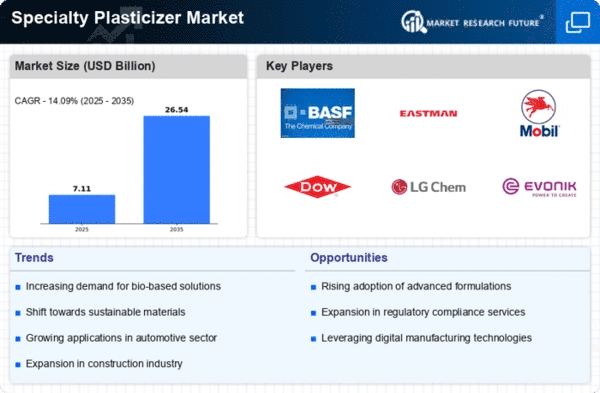
As per MRFR analysis, the Specialty Plasticizer Market was estimated at 6.23 USD Billion in 2024. The Specialty Plasticizer industry is projected to grow from 7.11 USD Billion in 2025 to 26.54 USD Billion by 2035, exhibiting a compound annual growth rate (CAGR) of 14.09 during the forecast period 2025 - 2035.

Key Market Trends & Highlights

The Specialty Plasticizer Market is poised for growth driven by sustainability and technological advancements.

  • The market is increasingly influenced by a strong focus on sustainability initiatives, particularly in North America.
  • Technological advancements are reshaping product offerings, especially in the coatings segment, which is experiencing rapid growth.
  • Regulatory changes are prompting manufacturers to innovate, with the healthcare segment showing significant potential.
  • Rising demand from end-user industries, particularly automotive and healthcare, is driven by sustainability and regulatory compliance.

Market Size & Forecast

2024 Market Size 6.23 (USD Billion)
2035 Market Size 26.54 (USD Billion)
CAGR (2025 - 2035) 14.09%
Largest Regional Market Share in 2024 Asia-Pacific

Major Players

BASF SE (DE), Eastman Chemical Company (US), ExxonMobil Chemical (US), DOW Inc. (US), LG Chem Ltd. (KR), Evonik Industries AG (DE), Mitsubishi Chemical Corporation (JP), SABIC (SA), INEOS Group Limited (GB)

Market Trends

The Specialty Plasticizer Market is currently experiencing a dynamic evolution, driven by a confluence of factors that shape its trajectory. The increasing demand for flexible and durable materials across various industries, including automotive, construction, and consumer goods, appears to be a primary catalyst for growth. Furthermore, the rising awareness regarding environmental sustainability is prompting manufacturers to explore bio-based and non-toxic alternatives, which could potentially reshape product offerings. As regulatory frameworks tighten, the market is likely to witness a shift towards safer and more sustainable plasticizers, aligning with global trends in eco-friendliness and health consciousness. In addition to sustainability, technological advancements in production processes are enhancing the efficiency and performance of specialty plasticizers. Innovations in formulation and application techniques may lead to improved product characteristics, such as enhanced thermal stability and compatibility with various polymers. This evolution suggests that the Specialty Plasticizer Market is not only adapting to current demands but is also poised for future growth as it embraces new technologies and sustainable practices. Overall, the market landscape appears to be shifting towards a more responsible and innovative approach, reflecting broader societal trends and consumer preferences.

Sustainability Focus

The Specialty Plasticizer Market is increasingly influenced by a growing emphasis on sustainability. Manufacturers are exploring bio-based alternatives and non-toxic formulations to meet consumer demand for environmentally friendly products. This trend indicates a potential shift in production practices, aligning with global sustainability goals.

Technological Advancements

Innovations in production techniques are transforming the Specialty Plasticizer Market. Enhanced formulation methods are leading to improved product performance, such as better thermal stability and compatibility with various materials. This trend suggests that technology will play a crucial role in shaping future market dynamics.

Regulatory Changes

The Specialty Plasticizer Market is likely to be impacted by evolving regulatory frameworks aimed at ensuring product safety and environmental protection. Stricter regulations may drive manufacturers to adapt their offerings, focusing on safer and more sustainable plasticizers to comply with new standards.

Specialty Plasticizer Market Market Drivers

Expansion of the Construction Sector

The expansion of the construction sector globally serves as a significant driver for the Global Specialty Plasticizer Market Industry. As urbanization accelerates and infrastructure projects proliferate, the demand for high-performance materials, including specialty plasticizers, rises. These plasticizers enhance the properties of construction materials, improving flexibility and durability in applications such as flooring and roofing. The ongoing growth in construction activities is expected to sustain the market's upward trajectory, with projections indicating a market value of 16.5 USD Billion in 2024 and continued growth towards 23.3 USD Billion by 2035.

Growing Demand from End-User Industries

The Global Specialty Plasticizer Market Industry experiences a notable surge in demand driven by various end-user sectors, including automotive, construction, and consumer goods. As industries increasingly prioritize flexibility and durability in materials, specialty plasticizers become essential for enhancing the performance of polymers. For instance, the automotive sector utilizes these plasticizers to improve the flexibility of interior components. This trend is projected to contribute to the market's growth, with the industry expected to reach 16.5 USD Billion in 2024 and 23.3 USD Billion by 2035, indicating a robust trajectory.

Regulatory Support for Eco-Friendly Solutions

Regulatory frameworks across the globe increasingly favor the adoption of eco-friendly plasticizers, propelling the Global Specialty Plasticizer Market Industry forward. Governments are implementing stringent regulations to limit the use of phthalates and other harmful substances, thereby encouraging manufacturers to innovate and develop safer alternatives. This shift not only aligns with environmental sustainability goals but also opens new avenues for market growth. The anticipated CAGR of 3.22% from 2025 to 2035 reflects the industry's potential to adapt to these regulatory changes while meeting consumer demand for safer products.

Rising Awareness of Health and Safety Concerns

The Global Specialty Plasticizer Market Industry is increasingly influenced by rising awareness regarding health and safety concerns associated with traditional plasticizers. Consumers and manufacturers alike are becoming more conscious of the potential health risks posed by certain chemical additives. This awareness drives the demand for safer alternatives, such as non-phthalate plasticizers, which are perceived as less harmful. As a result, manufacturers are compelled to reformulate their products to meet these evolving consumer preferences. This shift is likely to contribute to the market's growth, as the industry adapts to changing perceptions around health and safety.

Technological Advancements in Production Processes

Technological advancements play a pivotal role in enhancing the efficiency and quality of specialty plasticizer production within the Global Specialty Plasticizer Market Industry. Innovations in manufacturing processes, such as the development of bio-based plasticizers, are gaining traction. These advancements not only improve product performance but also reduce environmental impact. As manufacturers invest in research and development, the market is likely to witness an influx of innovative products that cater to diverse applications. This trend is expected to bolster market growth, aligning with the projected increase in market value over the coming years.

Market Segment Insights

By Application: Plastics (Largest) vs. Coatings (Fastest-Growing)

In the Specialty Plasticizer Market, the application segment is primarily dominated by plastics, which hold the largest market share. This dominance is attributed to the extensive use of specialty plasticizers in various plastic formulations, enhancing flexibility and performance. On the other hand, coatings are emerging as a rapidly growing segment, driven by the increasing demand for innovative coatings in industrial and consumer sectors. This trend reflects a shift towards higher performance and environmentally friendly solutions.

Plastics (Dominant) vs. Coatings (Emerging)

The plastics segment is characterized by its widespread adoption in various industries, particularly in packaging, automotive, and construction. Specialty plasticizers enhance the functionality of plastics by improving their flexibility, durability, and processing characteristics. This segment remains dominant due to its established applications and the continuous innovation in plastic formulation. Conversely, the coatings segment is considered emerging, benefiting from new trends in surface protection and aesthetics. The demand for sustainable and high-performance coatings is propelling growth, supported by advancements in technology and a rising focus on coating longevity and environmental impact.

By End Use Industry: Automotive (Largest) vs. Healthcare (Fastest-Growing)

The Specialty Plasticizer Market shows a diverse distribution among various end-use industries, with the automotive sector holding the largest share. Automotive applications dominate due to the extensive use of plasticizers in manufacturing flexible components like dashboards and upholstery. Following closely are construction and consumer goods, which also contribute significantly, although their shares are lesser compared to automotive. Electronics and healthcare, while smaller in comparison, still play a vital role in the overall market dynamics. Growth trends within this segment reveal that while the automotive industry remains the strongest, healthcare is emerging as the fastest-growing sector. This growth is fueled by the increasing demand for innovative medical devices and packaging solutions that require flexible and durable materials. As regulations evolve, the necessity for compliant materials further enhances the potential for growth in healthcare applications, promising sustained interest in specialty plasticizers.

Automotive: Dominant vs. Healthcare: Emerging

The automotive industry stands as the dominant force in the Specialty Plasticizer Market, driven by an insatiable demand for durable and flexible materials that ensure vehicle safety and aesthetic appeal. Heavy investments in automotive innovations, including electric vehicles and advanced safety features, compound the need for high-performance plasticizers. In contrast, the healthcare industry is emerging robustly, primarily due to the rising production of medical devices that utilize specialty plasticizers for flexibility, safety, and regulatory compliance. With an increasing focus on biocompatible materials, the healthcare segment is expected to gain substantial traction, leveraging technology advancements to meet regulatory standards and consumer needs, thus positioning itself as a pivotal player in the specialty plasticizer landscape.

By Type: Phthalate Plasticizers (Largest) vs. Non-Phthalate Plasticizers (Fastest-Growing)

In the Specialty Plasticizer Market, Phthalate Plasticizers dominate the market with the largest share, driven by their widespread use in various applications such as coatings, plastics, and adhesives. They are favored for their efficiency in enhancing the flexibility and durability of products, thus resulting in higher demand amidst industrial applications. Non-Phthalate Plasticizers, however, are emerging rapidly, gaining traction due to increased regulatory scrutiny regarding phthalates. This segment is increasingly becoming a preferred choice across various industries, providing safer alternatives for consumers and leading to steady market growth.

Phthalate Plasticizers (Dominant) vs. Non-Phthalate Plasticizers (Emerging)

Phthalate Plasticizers are well-established in the market, noted for their effectiveness in plastic applications, particularly in PVC products. Their ability to improve product performance makes them critical in manufacturing processes, leading to a loyal customer base. However, they face rising competition from Non-Phthalate Plasticizers, which are crafted to meet health safety standards and environmental regulations. This segment appeals to manufacturers looking to market eco-friendly products, providing flexibility in applications without compromising safety. The shift towards sustainable practices drives innovations in Non-Phthalate Plasticizers, positioning them as a significant emerging player in the Specialty Plasticizer Market.

Get more detailed insights about Specialty Plasticizer Market Research Report - Forecast to 2035

Regional Insights

North America : Established Market with Growth Potential

The North American specialty plasticizer market is poised for steady growth, driven by increasing demand in construction, automotive, and consumer goods sectors. With a market size of $1.5 billion, the region is witnessing a shift towards eco-friendly plasticizers, spurred by regulatory initiatives aimed at reducing harmful chemicals. The focus on sustainability is expected to further enhance market dynamics, as manufacturers adapt to changing consumer preferences and environmental regulations. Leading countries in this region include the US and Canada, where major players like DOW Inc. and Eastman Chemical Company dominate the landscape. The competitive environment is characterized by innovation and strategic partnerships, as companies invest in R&D to develop advanced plasticizer solutions. The presence of established firms ensures a robust supply chain, catering to diverse industrial applications, thereby solidifying North America's position in the global market.

Europe : Innovation and Sustainability Focus

Europe's specialty plasticizer market, valued at €1.8 billion, is experiencing a transformative phase driven by stringent environmental regulations and a strong push for sustainable materials. The region's commitment to reducing carbon footprints and enhancing product safety is fostering innovation in bio-based plasticizers. This regulatory landscape is a key growth driver, as manufacturers align their offerings with EU directives aimed at promoting eco-friendly alternatives. Germany, France, and the UK are leading countries in this market, with key players like BASF SE and Evonik Industries AG spearheading advancements. The competitive landscape is marked by a focus on R&D and collaboration with regulatory bodies to ensure compliance and innovation. As the demand for sustainable solutions rises, Europe is set to maintain its leadership in the specialty plasticizer sector, catering to diverse industries from automotive to construction.

Asia-Pacific : Emerging Market with High Demand

The Asia-Pacific region, with a market size of $2.8 billion, is the largest player in the specialty plasticizer market, driven by rapid industrialization and urbanization. The demand for plasticizers is surging in sectors such as construction, automotive, and electronics, fueled by increasing consumer spending and infrastructure development. Regulatory support for the adoption of advanced materials is also a significant catalyst for growth, as countries aim to enhance product safety and environmental standards. China, Japan, and India are the leading countries in this market, with major companies like LG Chem Ltd. and Mitsubishi Chemical Corporation playing pivotal roles. The competitive landscape is characterized by a mix of local and international players, fostering innovation and price competitiveness. As the region continues to expand its manufacturing capabilities, the specialty plasticizer market is expected to thrive, catering to diverse industrial needs.

Middle East and Africa : Emerging Market with Growth Potential

The Middle East and Africa specialty plasticizer market, valued at $0.13 billion, is in its nascent stages but shows significant growth potential. The region's expanding construction and automotive sectors are driving demand for plasticizers, as manufacturers seek to enhance product performance and durability. Regulatory frameworks are gradually evolving, encouraging the adoption of safer and more efficient plasticizer solutions, which is expected to stimulate market growth in the coming years. Countries like South Africa and the UAE are emerging as key players in this market, with local and international companies exploring opportunities to establish a foothold. The competitive landscape is still developing, with a focus on building supply chains and enhancing product offerings. As investments in infrastructure and industrialization increase, the specialty plasticizer market in the Middle East and Africa is set to gain momentum, attracting global players looking to capitalize on emerging opportunities.

Key Players and Competitive Insights

The Specialty Plasticizer Market is characterized by a dynamic competitive landscape, driven by increasing demand for high-performance materials across various industries, including automotive, construction, and consumer goods. Key players such as BASF SE (DE), Eastman Chemical Company (US), and DOW Inc. (US) are strategically positioned to leverage innovation and sustainability in their operations. BASF SE (DE) focuses on developing bio-based plasticizers, which aligns with the growing trend towards environmentally friendly products. Meanwhile, Eastman Chemical Company (US) emphasizes digital transformation and supply chain optimization to enhance operational efficiency and customer engagement. DOW Inc. (US) is actively pursuing mergers and acquisitions to expand its product portfolio and market reach, thereby intensifying competition within the sector.

The market structure appears moderately fragmented, with several players vying for market share. Key tactics employed by these companies include localizing manufacturing to reduce costs and enhance responsiveness to regional demands. Supply chain optimization remains a critical focus, as companies seek to mitigate risks and improve delivery times. The collective influence of these major players shapes the competitive environment, fostering innovation and driving advancements in specialty plasticizer formulations.

In November 2025, BASF SE (DE) announced the launch of a new line of bio-based plasticizers aimed at reducing carbon emissions in production processes. This strategic move not only enhances BASF's sustainability credentials but also positions the company to meet the increasing regulatory pressures for greener products. The introduction of these bio-based alternatives is likely to attract environmentally conscious consumers and businesses, thereby expanding BASF's market share.

In October 2025, Eastman Chemical Company (US) unveiled a digital platform designed to streamline customer interactions and improve product traceability. This initiative reflects Eastman's commitment to digitalization, which is becoming increasingly vital in enhancing customer experience and operational transparency. By leveraging technology, Eastman aims to differentiate itself in a competitive market, potentially leading to increased customer loyalty and retention.

In September 2025, DOW Inc. (US) completed the acquisition of a specialty plasticizer manufacturer, significantly bolstering its product offerings and market presence. This acquisition is strategically important as it allows DOW to integrate new technologies and expand its customer base, thereby enhancing its competitive edge. The consolidation of resources and expertise is expected to yield synergies that will further strengthen DOW's position in the market.

As of December 2025, current trends in the Specialty Plasticizer Market indicate a pronounced shift towards digitalization, sustainability, and the integration of AI technologies. Strategic alliances among key players are increasingly shaping the competitive landscape, fostering innovation and collaborative development. The focus appears to be shifting from price-based competition to differentiation through technology, innovation, and supply chain reliability. This evolution suggests that companies that prioritize sustainable practices and technological advancements are likely to thrive in the future market.

Key Companies in the Specialty Plasticizer Market include

Industry Developments

January 2022:

OpenGate Capital, a prominent global private equity firm, announced the acquisition of Chemsolv Inc., a major regional distributor of commodity and speciality chemicals and supplier of value-added services. The business was acquired from the Austin family, who retain an ownership share and an active participation in the organisation. The purchase price was not disclosed. Chemsolv distributes over 1,000 chemical products to a diverse spectrum of clients and end markets, including solvents, speciality plasticizers, coolants, lubricants, surfactants, diesel exhaust fluid, and additives. The business leverages integrated technology and systems to manage complex, high-volume activities successfully.

In 2017, BASF

started the production of DOTP, and it was under the name of Palatinol. This will allow the company to meet the growing demand for plasticizers.

In 2016

, Eastman launched a new plasticizer.

Future Outlook

Specialty Plasticizer Market Future Outlook

<p>The Specialty Plasticizer Market is projected to grow at a 14.09% CAGR from 2024 to 2035, driven by increasing demand in automotive, construction, and consumer goods sectors.</p>

New opportunities lie in:

  • <p>Development of bio-based plasticizers to meet sustainability demands.</p>
  • <p>Expansion into emerging markets with tailored product offerings.</p>
  • <p>Investment in advanced manufacturing technologies for cost efficiency.</p>

<p>By 2035, the Specialty Plasticizer Market is expected to achieve robust growth, solidifying its position as a key industry segment.</p>

Market Segmentation

Specialty Plasticizer Market Type Outlook

  • Phthalate Plasticizers
  • Non-Phthalate Plasticizers
  • Bio-Based Plasticizers
  • Aromatic Plasticizers
  • Aliphatic Plasticizers

Specialty Plasticizer Market Application Outlook

  • Plastics
  • Coatings
  • Adhesives
  • Textiles
  • Rubber

Specialty Plasticizer Market End Use Industry Outlook

  • Automotive
  • Construction
  • Consumer Goods
  • Electronics
  • Healthcare

Report Scope

MARKET SIZE 20246.23(USD Billion)
MARKET SIZE 20257.11(USD Billion)
MARKET SIZE 203526.54(USD Billion)
COMPOUND ANNUAL GROWTH RATE (CAGR)14.09% (2025 - 2035)
REPORT COVERAGERevenue Forecast, Competitive Landscape, Growth Factors, and Trends
BASE YEAR2024
Market Forecast Period2025 - 2035
Historical Data2019 - 2024
Market Forecast UnitsUSD Billion
Key Companies ProfiledBASF SE (DE), Eastman Chemical Company (US), ExxonMobil Chemical (US), DOW Inc. (US), LG Chem Ltd. (KR), Evonik Industries AG (DE), Mitsubishi Chemical Corporation (JP), SABIC (SA), INEOS Group Limited (GB)
Segments CoveredApplication, End Use Industry, Type
Key Market OpportunitiesGrowing demand for bio-based specialty plasticizers driven by sustainability and regulatory changes.
Key Market DynamicsRising demand for eco-friendly materials drives innovation and competition in the specialty plasticizer market.
Countries CoveredNorth America, Europe, APAC, South America, MEA

FAQs

Who are the major regions in the Specialty plasticizer market?

The major regions in the Specialty plasticizer are North America, Europe, and the Asia Pacific.

What are the segments of the Specialty plasticizer market?

The Specialty plasticizer market segments are type, application, and region

Which region holds the highest share in the Specialty plasticizer market?

The Asia Pacific holds the highest share in the market.

  1. SECTION I: EXECUTIVE SUMMARY AND KEY HIGHLIGHTS
    1. | 1.1 EXECUTIVE SUMMARY
  2. SECTION II: SCOPING, METHODOLOGY AND MARKET STRUCTURE
    1. | 2.1 MARKET INTRODUCTION
    2. | 2.2 RESEARCH METHODOLOGY
  3. SECTION III: QUALITATIVE ANALYSIS
    1. | 3.1 MARKET DYNAMICS
    2. | 3.2 MARKET FACTOR ANALYSIS
  4. SECTION IV: QUANTITATIVE ANALYSIS
    1. | 4.1 Chemicals and Materials, BY Application (USD Billion)
    2. | 4.2 Chemicals and Materials, BY End Use Industry (USD Billion)
    3. | 4.3 Chemicals and Materials, BY Type (USD Billion)
    4. | 4.4 Chemicals and Materials, BY Region (USD Billion)
  5. SECTION V: COMPETITIVE ANALYSIS
    1. | 5.1 Competitive Landscape
    2. | 5.2 Company Profiles
    3. | 5.3 Appendix

Specialty Plasticizer Market Segmentation

Market Segmentation Overview

  • Detailed segmentation data will be available in the full report
  • Comprehensive analysis by multiple parameters
  • Regional and country-level breakdowns
  • Market size forecasts by segment
Infographic

Free Sample Request

Kindly complete the form below to receive a free sample of this Report

Get Free Sample

Customer Strories

Compare Licence

×
Features License Type
Single User Multiuser License Enterprise User
Price $4,950 $5,950 $7,250
Maximum User Access Limit 1 User Upto 10 Users Unrestricted Access Throughout the Organization
Free Customization
Direct Access to Analyst
Deliverable Format
Platform Access
Discount on Next Purchase 10% 15% 15%
Printable Versions