Request Free Sample ×

Kindly complete the form below to receive a free sample of this Report

* Please use a valid business email

Leading companies partner with us for data-driven Insights

clients tt-cursor
Hero Background
English
Chinese
French
Japanese
Korean
German
Spanish

Specialty Chemicals Market Size

ID: MRFR/CnM/1494-CR
232 Pages
Priya Nagrale
February 2021

Specialty Chemicals Market Size, Share & Industry Analysis Research Report Information By Source (Crude Oil, Naphtha, Ethane, Propane, Butane, Wood, Others) and By Type (Agrochemicals, Flavors Ingredients, Fragrances Ingredients, Dyes & Pigments, Personal Care Active Ingredients, Water Treatment Chemicals, Construction Chemicals, Surfactants, Textile Chemicals, Polymer Additives, Bio-Based Chemicals, Others), And By Region (North America, Europe, Asia-Pacific, And Rest Of The World) – Market Forecast Till 2035.

Share:
Download PDF ×

We do not share your information with anyone. However, we may send you emails based on your report interest from time to time. You may contact us at any time to opt-out.

Specialty Chemicals Market Infographic
Purchase Options

Specialty Chemicals Size

Specialty Chemicals Market Growth Projections and Opportunities

Automotive industry accounted for substantial part of the global GDP and is also offering a promising future to specialty chemicals. The industry is in a growing phase of its life cycle and is witnessing a high consumption trend for specialty material, especially, in Asia Pacific. The emergence of electronic vehicle and trend for a lightweight vehicle have changed the growth dynamics in this industry. The penetration of specialty chemicals in lightweight vehicle applications as plastic energy absorbers, fenders, front-end modules, instrument panels, steering wheels, headlamp assemblies, throttle bodies has grown gradually and is anticipated to gather pace over the next decade. Average plastic weight in a vehicle has increased by 25% in 2016 as compared to 2010, as a result of numerous incentives and programmes initiated by government and environment concerning agencies across the globe.

On the other hand, plastic is being a game changer in weight reduction process of a lightweight vehicle and is evolved in an application such as glazing, and tailgates, as well as exterior components such as roof racks, wipers, door handles, and rearview mirror assemblies. The trend is expected to continue over the next decade and is likely to gather rapid pace in terms of plastic consumption, which, in turn, is supporting consumption of specialty chemicals

Specialty Chemicals Market Size Graph
Author
Author Profile
Priya Nagrale
Senior Research Analyst

With an experience of over five years in market research industry (Chemicals & Materials domain), I gather and analyze market data from diverse sources to produce results, which are then presented back to a client. Also, provide recommendations based on the findings. As a Senior Research Analyst, I perform quality checks (QC) for market estimations, QC for reports, and handle queries and work extensively on client customizations. Also, handle the responsibilities of client proposals, report planning, report finalization, and execution

Leave a Comment

FAQs

What is the projected market valuation of the Specialty Chemicals Market by 2035?

<p>The Specialty Chemicals Market is projected to reach a valuation of 1167.31 USD Billion by 2035.</p>

What was the market valuation of the Specialty Chemicals Market in 2024?

<p>In 2024, the Specialty Chemicals Market was valued at 682.5 USD Billion.</p>

What is the expected CAGR for the Specialty Chemicals Market from 2025 to 2035?

<p>The expected CAGR for the Specialty Chemicals Market during the forecast period 2025 - 2035 is 5.0%.</p>

Which companies are considered key players in the Specialty Chemicals Market?

<p>Key players in the Specialty Chemicals Market include BASF, Dow, SABIC, Evonik Industries, Huntsman Corporation, Lanxess, Solvay, Mitsubishi Chemical, and Eastman Chemical Company.</p>

What are the projected values for Agrochemicals in the Specialty Chemicals Market by 2035?

<p>Agrochemicals are projected to reach a value of 170.0 USD Billion by 2035.</p>

How much is the market for Personal Care Active Ingredients expected to grow by 2035?

<p>The market for Personal Care Active Ingredients is expected to grow to 120.0 USD Billion by 2035.</p>

What is the projected value of Dyes & Pigments in the Specialty Chemicals Market by 2035?

<p>Dyes & Pigments are projected to reach a value of 100.0 USD Billion by 2035.</p>

What is the expected market size for Water Treatment Chemicals by 2035?

<p>The market size for Water Treatment Chemicals is expected to reach 90.0 USD Billion by 2035.</p>

What are the projected values for crude oil as a source in the Specialty Chemicals Market by 2035?

<p>Crude oil is projected to reach a value of 232.5 USD Billion by 2035.</p>

What is the expected market value for Surfactants in the Specialty Chemicals Market by 2035?

<p>Surfactants are expected to reach a market value of 90.0 USD Billion by 2035.</p>

Market Summary

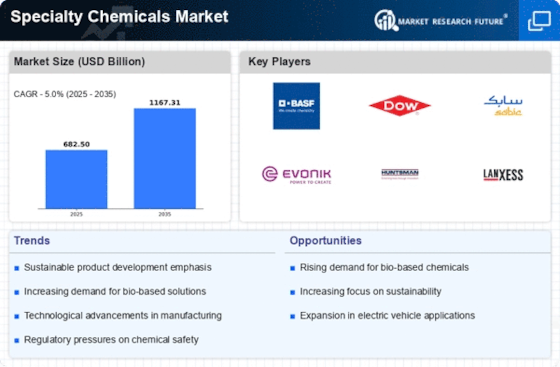
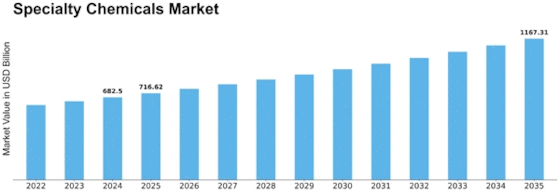
As per Market Research Future analysis, the Specialty Chemicals Market was estimated at 682.5 USD Billion in 2024. The Specialty Chemicals industry is projected to grow from 716.62 USD Billion in 2025 to 1167.31 USD Billion by 2035, exhibiting a compound annual growth rate (CAGR) of 5% during the forecast period 2025 - 2035

Key Market Trends & Highlights

The Specialty Chemicals Market is poised for robust growth driven by sustainability and technological advancements.

  • North America remains the largest market for specialty chemicals, reflecting a strong demand across various industries. Asia-Pacific is emerging as the fastest-growing region, propelled by rapid industrialization and urbanization. The crude oil segment continues to dominate the market, while the naphtha segment is witnessing the fastest growth due to its versatility. Rising demand in end-user industries and innovations in green chemistry are key drivers shaping the market landscape.

Market Size & Forecast

2024 Market Size 682.5 (USD Billion)
2035 Market Size 1167.31 (USD Billion)
CAGR (2025 - 2035) 5.0%
Largest Regional Market Share in 2024 Asia Pacific

Major Players

BASF (DE), Dow (US), SABIC (SA), Evonik Industries (DE), Huntsman Corporation (US), Lanxess (DE), Solvay (BE), Mitsubishi Chemical (JP), Eastman Chemical Company (US)

Market Trends

The Specialty Chemicals Market is currently experiencing a dynamic evolution, driven by various factors that influence demand and supply. The increasing focus on sustainability and environmental regulations appears to be reshaping production processes and product offerings. Companies are likely investing in innovative solutions that minimize environmental impact while meeting consumer needs. Additionally, the rise of advanced materials and technologies is fostering new applications across diverse industries, including automotive, electronics, and healthcare. This trend suggests a shift towards more specialized products that cater to specific requirements, enhancing performance and efficiency. Moreover, the Specialty Chemicals Market seems to be benefiting from the growing emphasis on customization and tailored solutions. As industries seek to differentiate themselves, the demand for specialty chemicals that can provide unique properties and functionalities is likely to increase. This trend indicates a potential for collaboration between chemical manufacturers and end-users, fostering innovation and driving market growth. Overall, the Specialty Chemicals Market is poised for continued expansion, with a focus on sustainability, innovation, and customization shaping its future landscape.

Sustainability Initiatives

The Specialty Chemicals Market is witnessing a notable shift towards sustainability initiatives. Companies are increasingly adopting eco-friendly practices and developing products that align with environmental regulations. This trend reflects a broader commitment to reducing carbon footprints and promoting sustainable development.

Technological Advancements

Technological advancements are playing a crucial role in the evolution of the Specialty Chemicals Market. Innovations in production processes and materials are enabling the development of high-performance chemicals that meet the demands of various industries. This trend suggests a continuous push for efficiency and effectiveness in chemical applications.

Customization and Tailored Solutions

Customization and tailored solutions are becoming increasingly important in the Specialty Chemicals Market. As industries seek specific functionalities, the demand for specialty chemicals that can be adapted to unique requirements is likely to grow. This trend indicates a shift towards more personalized products that enhance performance.

Specialty Chemicals Market Market Drivers

Growing Focus on Customization

The Specialty Chemicals Market is increasingly characterized by a growing focus on customization and tailored solutions to meet specific customer needs. As industries become more specialized, the demand for bespoke chemical formulations that cater to unique applications is on the rise. This trend is particularly evident in sectors such as pharmaceuticals and personal care, where customized specialty chemicals are essential for product differentiation. The market for customized specialty chemicals is projected to expand at a compound annual growth rate of 6% over the next five years. This shift towards personalization not only enhances customer satisfaction but also drives innovation within the industry, as manufacturers strive to develop unique solutions that address specific challenges.

Innovations in Green Chemistry

The Specialty Chemicals Market is witnessing a paradigm shift towards green chemistry, which emphasizes the development of sustainable and eco-friendly chemical processes. Innovations in this area are driven by the increasing awareness of environmental issues and the need for sustainable practices. For example, the market for bio-based specialty chemicals is anticipated to grow at a rate of 7% annually, reflecting a shift towards renewable resources. This transition not only reduces the carbon footprint but also aligns with consumer preferences for sustainable products. Companies that invest in green chemistry are likely to gain a competitive edge, as they cater to the growing demand for environmentally responsible solutions.

Rising Demand in End-User Industries

The Specialty Chemicals Market is experiencing a notable surge in demand from various end-user sectors, including automotive, construction, and electronics. As industries evolve, the need for advanced materials and chemicals that enhance performance and sustainability becomes paramount. For instance, the automotive sector is increasingly adopting specialty chemicals for lightweight materials and improved fuel efficiency. In 2025, the specialty chemicals segment in the automotive industry is projected to reach a valuation of approximately USD 30 billion, reflecting a compound annual growth rate of around 5%. This trend indicates a robust growth trajectory, driven by the necessity for innovation and efficiency across multiple sectors.

Technological Advancements in Production

The Specialty Chemicals Market is benefiting from rapid technological advancements that enhance production efficiency and product quality. Innovations such as automation, artificial intelligence, and advanced analytics are transforming manufacturing processes, leading to reduced costs and improved output. For instance, the adoption of Industry 4.0 technologies is enabling real-time monitoring and optimization of chemical production, which can lead to a 20% increase in efficiency. These advancements not only streamline operations but also facilitate the development of high-performance specialty chemicals that meet evolving market demands. As technology continues to evolve, it is likely to play a crucial role in shaping the future landscape of the specialty chemicals market.

Regulatory Compliance and Safety Standards

The Specialty Chemicals Market is significantly influenced by stringent regulatory frameworks and safety standards imposed by various governments. These regulations aim to ensure environmental protection and public health, compelling manufacturers to innovate and adapt their processes. Compliance with regulations such as REACH in Europe and TSCA in the United States necessitates the development of safer and more sustainable chemical products. As a result, companies are investing heavily in research and development to meet these standards, which is expected to drive market growth. The emphasis on compliance not only enhances product safety but also fosters consumer trust, thereby potentially increasing market share for compliant manufacturers.

Market Segment Insights

By Source: Crude Oil (Largest) vs. Naphtha (Fastest-Growing)

<p>In the Specialty Chemicals Market, the source segment is predominantly influenced by Crude Oil, which holds the largest share among the various feedstocks, including Naphtha, Ethane, Propane, Butane, Wood, and Others. Crude Oil’s established infrastructure and well-developed supply chains contribute significantly to its leading position. In contrast, Naphtha has emerged as the fastest-growing source, driven by its versatility and increasing demand for high-value chemical products, particularly in the production of petrochemicals.</p>

<p>Crude Oil (Dominant) vs. Naphtha (Emerging)</p>

<p>Crude Oil serves as a dominant source in the Specialty Chemicals Market due to its wide-ranging applications and established market presence. Its derivatives are extensively used across various industries, driving demand for chemical products. Conversely, Naphtha is gaining traction as an emerging feedstock, characterized by its ability to yield higher-value chemicals and fuels. The growing emphasis on cleaner and more efficient manufacturing processes enhances its attractiveness. As regulatory frameworks evolve, Naphtha is poised to play a critical role in the shift towards greener alternatives in chemical production.</p>

By Type: Agrochemicals (Largest) vs. Flavors Ingredients (Fastest-Growing)

<p>In the Specialty Chemicals Market, Agrochemicals dominate the landscape, accounting for a significant portion of market share due to the increasing global agricultural demands. Other key players include Flavors Ingredients, Fragrances Ingredients, and Surfactants, which also hold substantial shares. The market distribution shows a balanced competition among various segments, yet Agrochemicals remain the frontrunner thanks to their vital role in enhancing agricultural productivity and crop protection. Flavors Ingredients contribute to the food and beverage industry, showcasing their importance in product innovation and consumer preference adaptation.</p>

<p>Agrochemicals (Dominant) vs. Flavors Ingredients (Emerging)</p>

<p>Agrochemicals stand as a dominant force in the Specialty Chemicals Market. They include fertilizers, pesticides, and herbicides that are essential for modern agriculture. Their market position is bolstered by the rising global population and the concomitant need for increased food production. In contrast, Flavors Ingredients represent an emerging segment, fueled by rising consumer demand for novel experiences in food and beverage products. This segment thrives on innovation, catering to the growing trend of natural and organic ingredients while adapting to changing consumer preferences for health-conscious formulations.</p>

Get more detailed insights about Specialty Chemicals Market Research Report- Forecast to 2035

Regional Insights

North America : Innovation and Demand Surge

North America is the largest market for specialty chemicals, holding approximately 40% of the global share. The region's growth is driven by robust demand from end-user industries such as automotive, construction, and electronics. Regulatory support for sustainable practices and innovation in chemical formulations further catalyzes market expansion. The U.S. and Canada are the primary contributors, with significant investments in R&D and production facilities. The competitive landscape in North America is characterized by the presence of major players like Dow, BASF, and Huntsman Corporation. These companies are focusing on innovation and sustainability to meet the evolving needs of consumers. The U.S. remains a hub for specialty chemicals, with a strong emphasis on advanced manufacturing and technology integration. This competitive environment fosters collaboration and growth, positioning North America as a leader in the specialty chemicals market.

Europe : Sustainability and Innovation Focus

Europe is the second-largest market for specialty chemicals, accounting for around 30% of the global market share. The region's growth is significantly influenced by stringent environmental regulations and a strong push towards sustainable practices. The European Union's Green Deal and REACH regulations are pivotal in shaping market dynamics, encouraging innovation in eco-friendly chemical solutions. Countries like Germany and France are at the forefront of this transition, driving demand for specialty chemicals. Leading countries in Europe include Germany, France, and the UK, with a competitive landscape featuring key players such as BASF and Evonik Industries. These companies are investing heavily in sustainable technologies and product development to comply with regulatory standards. The focus on circular economy principles and reducing carbon footprints is reshaping the market, making Europe a critical player in the global specialty chemicals sector.

Asia-Pacific : Rapid Growth and Expansion

Asia-Pacific is witnessing rapid growth in the specialty chemicals market, holding approximately 25% of the global share. The region's expansion is driven by increasing industrialization, urbanization, and rising consumer demand in countries like China and India. Government initiatives aimed at boosting manufacturing and exports, along with favorable investment policies, are further propelling market growth. The demand for specialty chemicals in sectors such as automotive, electronics, and agriculture is on the rise, contributing to the region's dynamic market landscape. China is the largest market in Asia-Pacific, followed by India and Japan, with a competitive environment featuring companies like Mitsubishi Chemical and SABIC. The presence of numerous local and international players fosters innovation and competition, leading to advancements in product offerings. As the region continues to develop, the specialty chemicals market is expected to expand significantly, driven by technological advancements and increasing investments in R&D.

Middle East and Africa : Resource-Rich and Growing Demand

The Middle East and Africa region is gradually emerging in the specialty chemicals market, holding about 5% of the global share. The growth is primarily driven by the region's rich natural resources and increasing demand for specialty chemicals in various industries, including oil and gas, construction, and agriculture. Government initiatives aimed at diversifying economies and promoting industrialization are also contributing to market expansion. Countries like Saudi Arabia and South Africa are leading the way in this growth trajectory. Saudi Arabia is a key player in the region, with significant investments in petrochemicals and specialty chemicals. The competitive landscape includes both local and international companies, fostering a dynamic market environment. As the region continues to develop its industrial base, the specialty chemicals market is expected to grow, driven by increasing demand and investment in infrastructure and technology.

Key Players and Competitive Insights

The Specialty Chemicals Market is characterized by a dynamic competitive landscape, driven by innovation, sustainability, and strategic partnerships. Major players such as BASF (Germany), Dow (US), and Evonik Industries (Germany) are at the forefront, each adopting distinct strategies to enhance their market positioning. BASF (Germany) emphasizes innovation through its commitment to sustainable solutions, while Dow (US) focuses on digital transformation to optimize its operations. Evonik Industries (Germany) is leveraging its expertise in specialty chemicals to expand its product portfolio, particularly in high-growth sectors such as healthcare and electronics. Collectively, these strategies not only enhance their competitive edge but also contribute to a more sustainable and technologically advanced market environment.

In terms of business tactics, companies are increasingly localizing manufacturing and optimizing supply chains to respond to regional demands effectively. The Specialty Chemicals Market appears moderately fragmented, with key players exerting considerable influence over pricing and innovation. This competitive structure allows for a diverse range of products and services, catering to various industries, including automotive, construction, and consumer goods. The collective actions of these major players shape market dynamics, fostering an environment where agility and responsiveness are paramount.

In August 2025, BASF (Germany) announced a strategic partnership with a leading technology firm to develop advanced materials for electric vehicle batteries. This collaboration is poised to enhance BASF's position in the rapidly growing electric vehicle market, aligning with global trends towards sustainability and energy efficiency. The strategic importance of this move lies in its potential to not only expand BASF's product offerings but also to solidify its commitment to sustainable practices in the specialty chemicals sector.

In September 2025, Dow (US) unveiled a new digital platform aimed at streamlining its supply chain operations. This initiative is expected to enhance operational efficiency and reduce lead times, thereby improving customer satisfaction. The significance of this digital transformation cannot be overstated, as it positions Dow to respond more effectively to market fluctuations and customer needs, ultimately driving competitive advantage in a fast-evolving market landscape.

In July 2025, Evonik Industries (Germany) launched a new line of bio-based specialty chemicals, targeting the growing demand for sustainable products. This strategic move not only diversifies Evonik's portfolio but also aligns with the increasing consumer preference for environmentally friendly solutions. The introduction of these bio-based products is likely to enhance Evonik's market share and reinforce its reputation as a leader in sustainability within the specialty chemicals sector.

As of October 2025, current competitive trends in the Specialty Chemicals Market are heavily influenced by digitalization, sustainability, and the integration of artificial intelligence. Strategic alliances are becoming increasingly vital, enabling companies to pool resources and expertise to innovate more effectively. Looking ahead, competitive differentiation is expected to evolve, shifting from traditional price-based competition to a focus on innovation, technological advancements, and supply chain reliability. This transition underscores the importance of agility and responsiveness in meeting the demands of a rapidly changing market.


Key Companies in the Specialty Chemicals Market include

Industry Developments

In April 2022, Evonik has increased production capacity of isobutene derivatives in Marl location by 50%.5 Isobutene is a part of the C4 production network and manufactures the petrochemical specialties such as Tert Butanol (TBA), Di-isobutene (DiB), and trimethylhexanal (TMH). Tertiary Butanol is a specialised solvent and tablet coating agent for the pharmaceutical industry.

In April 2021, Evonik Industries AG took over the study of the high-performance polymer VESTAKEEP PEEK for structural prosthesis systems. In the case of prostheses made from this polymer there is an advantage of clinical experience for the latter on performance of implant polymer for medical science. In this respect, the company is making use of medical experts from the famous center for knee and hip replacements in Massachusetts General Hospital (USA). If this innovation has prospective, the joint prosthesis VESTAKEEP-based life delivery could be greatly improved, thus eliminating the need for surgery days of pain therapy.

In January 2021, Huntsman revealed it has finalized the acquisition of Gabriel Performance Products a North American enterprise that specializes in manufacturing specialty additives and epoxy curing agents for the purpose of diversification of its product offerings.

In January 2021, LANXESS advanced its strategies when it signed an agreement with the French biocide company INTACE SAS for the expansion of its market and to strengthen itself as one of the leading manufacturers of antimicrobial biocides and fungicides in the packaging industry.

In May 2020, BASF, at a conference, first introduced the Melyra fungicide to its customers in China. Melyra is a product line based on BASF’s innovative fungicide Revysol. There has never been anything like it before, Making it the first of its kind to be developed. Melyra combines the latest fungicide technology from BASF with the well-known active ingredient F500 from this company. It is an exciting new solution for farmers to help them improve their commercially attractive crop output.

Future Outlook

Specialty Chemicals Market Future Outlook

The Specialty Chemicals Market is projected to grow at a 5.0% CAGR from 2024 to 2035, driven by innovations in sustainable materials, increasing demand in end-use industries, and advancements in chemical formulations.

New opportunities lie in:

  • Development of bio-based specialty chemicals for eco-conscious consumers.
  • Expansion into emerging markets with tailored product offerings.
  • Investment in R&D for high-performance specialty coatings and adhesives.

By 2035, the Specialty Chemicals Market is expected to achieve robust growth, driven by strategic innovations and market expansions.

Market Segmentation

Specialty Chemicals Market Type Outlook

  • Agrochemicals
  • Flavors Ingredients
  • Fragrances Ingredients
  • Dyes & Pigments
  • Personal Care Active Ingredients
  • Water Treatment Chemicals
  • Construction Chemicals
  • Surfactants
  • Textile Chemicals
  • Polymer Additives
  • Bio-Based Chemicals
  • Others

Specialty Chemicals Market Source Outlook

  • Crude Oil
  • Naphtha
  • Ethane
  • Propane
  • Butane
  • Wood
  • Others

Report Scope

MARKET SIZE 2024682.5(USD Billion)
MARKET SIZE 2025716.62(USD Billion)
MARKET SIZE 20351167.31(USD Billion)
COMPOUND ANNUAL GROWTH RATE (CAGR)5.0% (2024 - 2035)
REPORT COVERAGERevenue Forecast, Competitive Landscape, Growth Factors, and Trends
BASE YEAR2024
Market Forecast Period2025 - 2035
Historical Data2019 - 2024
Market Forecast UnitsUSD Billion
Key Companies ProfiledMarket analysis in progress
Segments CoveredMarket segmentation analysis in progress
Key Market OpportunitiesAdvancements in sustainable formulations drive growth in the Specialty Chemicals Market.
Key Market DynamicsRising demand for sustainable solutions drives innovation and competition in the specialty chemicals sector.
Countries CoveredNorth America, Europe, APAC, South America, MEA

FAQs

What is the projected market valuation of the Specialty Chemicals Market by 2035?

<p>The Specialty Chemicals Market is projected to reach a valuation of 1167.31 USD Billion by 2035.</p>

What was the market valuation of the Specialty Chemicals Market in 2024?

<p>In 2024, the Specialty Chemicals Market was valued at 682.5 USD Billion.</p>

What is the expected CAGR for the Specialty Chemicals Market from 2025 to 2035?

<p>The expected CAGR for the Specialty Chemicals Market during the forecast period 2025 - 2035 is 5.0%.</p>

Which companies are considered key players in the Specialty Chemicals Market?

<p>Key players in the Specialty Chemicals Market include BASF, Dow, SABIC, Evonik Industries, Huntsman Corporation, Lanxess, Solvay, Mitsubishi Chemical, and Eastman Chemical Company.</p>

What are the projected values for Agrochemicals in the Specialty Chemicals Market by 2035?

<p>Agrochemicals are projected to reach a value of 170.0 USD Billion by 2035.</p>

How much is the market for Personal Care Active Ingredients expected to grow by 2035?

<p>The market for Personal Care Active Ingredients is expected to grow to 120.0 USD Billion by 2035.</p>

What is the projected value of Dyes & Pigments in the Specialty Chemicals Market by 2035?

<p>Dyes & Pigments are projected to reach a value of 100.0 USD Billion by 2035.</p>

What is the expected market size for Water Treatment Chemicals by 2035?

<p>The market size for Water Treatment Chemicals is expected to reach 90.0 USD Billion by 2035.</p>

What are the projected values for crude oil as a source in the Specialty Chemicals Market by 2035?

<p>Crude oil is projected to reach a value of 232.5 USD Billion by 2035.</p>

What is the expected market value for Surfactants in the Specialty Chemicals Market by 2035?

<p>Surfactants are expected to reach a market value of 90.0 USD Billion by 2035.</p>

  1. SECTION I: EXECUTIVE SUMMARY AND KEY HIGHLIGHTS
    1. | 1.1 EXECUTIVE SUMMARY
    2. | | 1.1.1 Market Overview
    3. | | 1.1.2 Key Findings
    4. | | 1.1.3 Market Segmentation
    5. | | 1.1.4 Competitive Landscape
    6. | | 1.1.5 Challenges and Opportunities
    7. | | 1.1.6 Future Outlook
  2. SECTION II: SCOPING, METHODOLOGY AND MARKET STRUCTURE
    1. | 2.1 MARKET INTRODUCTION
    2. | | 2.1.1 Definition
    3. | | 2.1.2 Scope of the study
    4. | | | 2.1.2.1 Research Objective
    5. | | | 2.1.2.2 Assumption
    6. | | | 2.1.2.3 Limitations
    7. | 2.2 RESEARCH METHODOLOGY
    8. | | 2.2.1 Overview
    9. | | 2.2.2 Data Mining
    10. | | 2.2.3 Secondary Research
    11. | | 2.2.4 Primary Research
    12. | | | 2.2.4.1 Primary Interviews and Information Gathering Process
    13. | | | 2.2.4.2 Breakdown of Primary Respondents
    14. | | 2.2.5 Forecasting Model
    15. | | 2.2.6 Market Size Estimation
    16. | | | 2.2.6.1 Bottom-Up Approach
    17. | | | 2.2.6.2 Top-Down Approach
    18. | | 2.2.7 Data Triangulation
    19. | | 2.2.8 Validation
  3. SECTION III: QUALITATIVE ANALYSIS
    1. | 3.1 MARKET DYNAMICS
    2. | | 3.1.1 Overview
    3. | | 3.1.2 Drivers
    4. | | 3.1.3 Restraints
    5. | | 3.1.4 Opportunities
    6. | 3.2 MARKET FACTOR ANALYSIS
    7. | | 3.2.1 Value chain Analysis
    8. | | 3.2.2 Porter's Five Forces Analysis
    9. | | | 3.2.2.1 Bargaining Power of Suppliers
    10. | | | 3.2.2.2 Bargaining Power of Buyers
    11. | | | 3.2.2.3 Threat of New Entrants
    12. | | | 3.2.2.4 Threat of Substitutes
    13. | | | 3.2.2.5 Intensity of Rivalry
    14. | | 3.2.3 COVID-19 Impact Analysis
    15. | | | 3.2.3.1 Market Impact Analysis
    16. | | | 3.2.3.2 Regional Impact
    17. | | | 3.2.3.3 Opportunity and Threat Analysis
  4. SECTION IV: QUANTITATIVE ANALYSIS
    1. | 4.1 Chemicals and Materials, BY Source (USD Billion)
    2. | | 4.1.1 Crude Oil
    3. | | 4.1.2 Naphtha
    4. | | 4.1.3 Ethane
    5. | | 4.1.4 Propane
    6. | | 4.1.5 Butane
    7. | | 4.1.6 Wood
    8. | | 4.1.7 Others
    9. | 4.2 Chemicals and Materials, BY Type (USD Billion)
    10. | | 4.2.1 Agrochemicals
    11. | | 4.2.2 Flavors Ingredients
    12. | | 4.2.3 Fragrances Ingredients
    13. | | 4.2.4 Dyes & Pigments
    14. | | 4.2.5 Personal Care Active Ingredients
    15. | | 4.2.6 Water Treatment Chemicals
    16. | | 4.2.7 Construction Chemicals
    17. | | 4.2.8 Surfactants
    18. | | 4.2.9 Textile Chemicals
    19. | | 4.2.10 Polymer Additives
    20. | | 4.2.11 Bio-Based Chemicals
    21. | | 4.2.12 Others
    22. | 4.3 Chemicals and Materials, BY Region (USD Billion)
    23. | | 4.3.1 North America
    24. | | | 4.3.1.1 US
    25. | | | 4.3.1.2 Canada
    26. | | 4.3.2 Europe
    27. | | | 4.3.2.1 Germany
    28. | | | 4.3.2.2 UK
    29. | | | 4.3.2.3 France
    30. | | | 4.3.2.4 Russia
    31. | | | 4.3.2.5 Italy
    32. | | | 4.3.2.6 Spain
    33. | | | 4.3.2.7 Rest of Europe
    34. | | 4.3.3 APAC
    35. | | | 4.3.3.1 China
    36. | | | 4.3.3.2 India
    37. | | | 4.3.3.3 Japan
    38. | | | 4.3.3.4 South Korea
    39. | | | 4.3.3.5 Malaysia
    40. | | | 4.3.3.6 Thailand
    41. | | | 4.3.3.7 Indonesia
    42. | | | 4.3.3.8 Rest of APAC
    43. | | 4.3.4 South America
    44. | | | 4.3.4.1 Brazil
    45. | | | 4.3.4.2 Mexico
    46. | | | 4.3.4.3 Argentina
    47. | | | 4.3.4.4 Rest of South America
    48. | | 4.3.5 MEA
    49. | | | 4.3.5.1 GCC Countries
    50. | | | 4.3.5.2 South Africa
    51. | | | 4.3.5.3 Rest of MEA
  5. SECTION V: COMPETITIVE ANALYSIS
    1. | 5.1 Competitive Landscape
    2. | | 5.1.1 Overview
    3. | | 5.1.2 Competitive Analysis
    4. | | 5.1.3 Market share Analysis
    5. | | 5.1.4 Major Growth Strategy in the Chemicals and Materials
    6. | | 5.1.5 Competitive Benchmarking
    7. | | 5.1.6 Leading Players in Terms of Number of Developments in the Chemicals and Materials
    8. | | 5.1.7 Key developments and growth strategies
    9. | | | 5.1.7.1 New Product Launch/Service Deployment
    10. | | | 5.1.7.2 Merger & Acquisitions
    11. | | | 5.1.7.3 Joint Ventures
    12. | | 5.1.8 Major Players Financial Matrix
    13. | | | 5.1.8.1 Sales and Operating Income
    14. | | | 5.1.8.2 Major Players R&D Expenditure. 2023
    15. | 5.2 Company Profiles
    16. | | 5.2.1 BASF (DE)
    17. | | | 5.2.1.1 Financial Overview
    18. | | | 5.2.1.2 Products Offered
    19. | | | 5.2.1.3 Key Developments
    20. | | | 5.2.1.4 SWOT Analysis
    21. | | | 5.2.1.5 Key Strategies
    22. | | 5.2.2 Dow (US)
    23. | | | 5.2.2.1 Financial Overview
    24. | | | 5.2.2.2 Products Offered
    25. | | | 5.2.2.3 Key Developments
    26. | | | 5.2.2.4 SWOT Analysis
    27. | | | 5.2.2.5 Key Strategies
    28. | | 5.2.3 SABIC (SA)
    29. | | | 5.2.3.1 Financial Overview
    30. | | | 5.2.3.2 Products Offered
    31. | | | 5.2.3.3 Key Developments
    32. | | | 5.2.3.4 SWOT Analysis
    33. | | | 5.2.3.5 Key Strategies
    34. | | 5.2.4 Evonik Industries (DE)
    35. | | | 5.2.4.1 Financial Overview
    36. | | | 5.2.4.2 Products Offered
    37. | | | 5.2.4.3 Key Developments
    38. | | | 5.2.4.4 SWOT Analysis
    39. | | | 5.2.4.5 Key Strategies
    40. | | 5.2.5 Huntsman Corporation (US)
    41. | | | 5.2.5.1 Financial Overview
    42. | | | 5.2.5.2 Products Offered
    43. | | | 5.2.5.3 Key Developments
    44. | | | 5.2.5.4 SWOT Analysis
    45. | | | 5.2.5.5 Key Strategies
    46. | | 5.2.6 Lanxess (DE)
    47. | | | 5.2.6.1 Financial Overview
    48. | | | 5.2.6.2 Products Offered
    49. | | | 5.2.6.3 Key Developments
    50. | | | 5.2.6.4 SWOT Analysis
    51. | | | 5.2.6.5 Key Strategies
    52. | | 5.2.7 Solvay (BE)
    53. | | | 5.2.7.1 Financial Overview
    54. | | | 5.2.7.2 Products Offered
    55. | | | 5.2.7.3 Key Developments
    56. | | | 5.2.7.4 SWOT Analysis
    57. | | | 5.2.7.5 Key Strategies
    58. | | 5.2.8 Mitsubishi Chemical (JP)
    59. | | | 5.2.8.1 Financial Overview
    60. | | | 5.2.8.2 Products Offered
    61. | | | 5.2.8.3 Key Developments
    62. | | | 5.2.8.4 SWOT Analysis
    63. | | | 5.2.8.5 Key Strategies
    64. | | 5.2.9 Eastman Chemical Company (US)
    65. | | | 5.2.9.1 Financial Overview
    66. | | | 5.2.9.2 Products Offered
    67. | | | 5.2.9.3 Key Developments
    68. | | | 5.2.9.4 SWOT Analysis
    69. | | | 5.2.9.5 Key Strategies
    70. | 5.3 Appendix
    71. | | 5.3.1 References
    72. | | 5.3.2 Related Reports
  6. LIST OF FIGURES
    1. | 6.1 MARKET SYNOPSIS
    2. | 6.2 NORTH AMERICA MARKET ANALYSIS
    3. | 6.3 US MARKET ANALYSIS BY SOURCE
    4. | 6.4 US MARKET ANALYSIS BY TYPE
    5. | 6.5 CANADA MARKET ANALYSIS BY SOURCE
    6. | 6.6 CANADA MARKET ANALYSIS BY TYPE
    7. | 6.7 EUROPE MARKET ANALYSIS
    8. | 6.8 GERMANY MARKET ANALYSIS BY SOURCE
    9. | 6.9 GERMANY MARKET ANALYSIS BY TYPE
    10. | 6.10 UK MARKET ANALYSIS BY SOURCE
    11. | 6.11 UK MARKET ANALYSIS BY TYPE
    12. | 6.12 FRANCE MARKET ANALYSIS BY SOURCE
    13. | 6.13 FRANCE MARKET ANALYSIS BY TYPE
    14. | 6.14 RUSSIA MARKET ANALYSIS BY SOURCE
    15. | 6.15 RUSSIA MARKET ANALYSIS BY TYPE
    16. | 6.16 ITALY MARKET ANALYSIS BY SOURCE
    17. | 6.17 ITALY MARKET ANALYSIS BY TYPE
    18. | 6.18 SPAIN MARKET ANALYSIS BY SOURCE
    19. | 6.19 SPAIN MARKET ANALYSIS BY TYPE
    20. | 6.20 REST OF EUROPE MARKET ANALYSIS BY SOURCE
    21. | 6.21 REST OF EUROPE MARKET ANALYSIS BY TYPE
    22. | 6.22 APAC MARKET ANALYSIS
    23. | 6.23 CHINA MARKET ANALYSIS BY SOURCE
    24. | 6.24 CHINA MARKET ANALYSIS BY TYPE
    25. | 6.25 INDIA MARKET ANALYSIS BY SOURCE
    26. | 6.26 INDIA MARKET ANALYSIS BY TYPE
    27. | 6.27 JAPAN MARKET ANALYSIS BY SOURCE
    28. | 6.28 JAPAN MARKET ANALYSIS BY TYPE
    29. | 6.29 SOUTH KOREA MARKET ANALYSIS BY SOURCE
    30. | 6.30 SOUTH KOREA MARKET ANALYSIS BY TYPE
    31. | 6.31 MALAYSIA MARKET ANALYSIS BY SOURCE
    32. | 6.32 MALAYSIA MARKET ANALYSIS BY TYPE
    33. | 6.33 THAILAND MARKET ANALYSIS BY SOURCE
    34. | 6.34 THAILAND MARKET ANALYSIS BY TYPE
    35. | 6.35 INDONESIA MARKET ANALYSIS BY SOURCE
    36. | 6.36 INDONESIA MARKET ANALYSIS BY TYPE
    37. | 6.37 REST OF APAC MARKET ANALYSIS BY SOURCE
    38. | 6.38 REST OF APAC MARKET ANALYSIS BY TYPE
    39. | 6.39 SOUTH AMERICA MARKET ANALYSIS
    40. | 6.40 BRAZIL MARKET ANALYSIS BY SOURCE
    41. | 6.41 BRAZIL MARKET ANALYSIS BY TYPE
    42. | 6.42 MEXICO MARKET ANALYSIS BY SOURCE
    43. | 6.43 MEXICO MARKET ANALYSIS BY TYPE
    44. | 6.44 ARGENTINA MARKET ANALYSIS BY SOURCE
    45. | 6.45 ARGENTINA MARKET ANALYSIS BY TYPE
    46. | 6.46 REST OF SOUTH AMERICA MARKET ANALYSIS BY SOURCE
    47. | 6.47 REST OF SOUTH AMERICA MARKET ANALYSIS BY TYPE
    48. | 6.48 MEA MARKET ANALYSIS
    49. | 6.49 GCC COUNTRIES MARKET ANALYSIS BY SOURCE
    50. | 6.50 GCC COUNTRIES MARKET ANALYSIS BY TYPE
    51. | 6.51 SOUTH AFRICA MARKET ANALYSIS BY SOURCE
    52. | 6.52 SOUTH AFRICA MARKET ANALYSIS BY TYPE
    53. | 6.53 REST OF MEA MARKET ANALYSIS BY SOURCE
    54. | 6.54 REST OF MEA MARKET ANALYSIS BY TYPE
    55. | 6.55 KEY BUYING CRITERIA OF CHEMICALS AND MATERIALS
    56. | 6.56 RESEARCH PROCESS OF MRFR
    57. | 6.57 DRO ANALYSIS OF CHEMICALS AND MATERIALS
    58. | 6.58 DRIVERS IMPACT ANALYSIS: CHEMICALS AND MATERIALS
    59. | 6.59 RESTRAINTS IMPACT ANALYSIS: CHEMICALS AND MATERIALS
    60. | 6.60 SUPPLY / VALUE CHAIN: CHEMICALS AND MATERIALS
    61. | 6.61 CHEMICALS AND MATERIALS, BY SOURCE, 2024 (% SHARE)
    62. | 6.62 CHEMICALS AND MATERIALS, BY SOURCE, 2024 TO 2035 (USD Billion)
    63. | 6.63 CHEMICALS AND MATERIALS, BY TYPE, 2024 (% SHARE)
    64. | 6.64 CHEMICALS AND MATERIALS, BY TYPE, 2024 TO 2035 (USD Billion)
    65. | 6.65 BENCHMARKING OF MAJOR COMPETITORS
  7. LIST OF TABLES
    1. | 7.1 LIST OF ASSUMPTIONS
    2. | | 7.1.1
    3. | 7.2 North America MARKET SIZE ESTIMATES; FORECAST
    4. | | 7.2.1 BY SOURCE, 2025-2035 (USD Billion)
    5. | | 7.2.2 BY TYPE, 2025-2035 (USD Billion)
    6. | 7.3 US MARKET SIZE ESTIMATES; FORECAST
    7. | | 7.3.1 BY SOURCE, 2025-2035 (USD Billion)
    8. | | 7.3.2 BY TYPE, 2025-2035 (USD Billion)
    9. | 7.4 Canada MARKET SIZE ESTIMATES; FORECAST
    10. | | 7.4.1 BY SOURCE, 2025-2035 (USD Billion)
    11. | | 7.4.2 BY TYPE, 2025-2035 (USD Billion)
    12. | 7.5 Europe MARKET SIZE ESTIMATES; FORECAST
    13. | | 7.5.1 BY SOURCE, 2025-2035 (USD Billion)
    14. | | 7.5.2 BY TYPE, 2025-2035 (USD Billion)
    15. | 7.6 Germany MARKET SIZE ESTIMATES; FORECAST
    16. | | 7.6.1 BY SOURCE, 2025-2035 (USD Billion)
    17. | | 7.6.2 BY TYPE, 2025-2035 (USD Billion)
    18. | 7.7 UK MARKET SIZE ESTIMATES; FORECAST
    19. | | 7.7.1 BY SOURCE, 2025-2035 (USD Billion)
    20. | | 7.7.2 BY TYPE, 2025-2035 (USD Billion)
    21. | 7.8 France MARKET SIZE ESTIMATES; FORECAST
    22. | | 7.8.1 BY SOURCE, 2025-2035 (USD Billion)
    23. | | 7.8.2 BY TYPE, 2025-2035 (USD Billion)
    24. | 7.9 Russia MARKET SIZE ESTIMATES; FORECAST
    25. | | 7.9.1 BY SOURCE, 2025-2035 (USD Billion)
    26. | | 7.9.2 BY TYPE, 2025-2035 (USD Billion)
    27. | 7.10 Italy MARKET SIZE ESTIMATES; FORECAST
    28. | | 7.10.1 BY SOURCE, 2025-2035 (USD Billion)
    29. | | 7.10.2 BY TYPE, 2025-2035 (USD Billion)
    30. | 7.11 Spain MARKET SIZE ESTIMATES; FORECAST
    31. | | 7.11.1 BY SOURCE, 2025-2035 (USD Billion)
    32. | | 7.11.2 BY TYPE, 2025-2035 (USD Billion)
    33. | 7.12 Rest of Europe MARKET SIZE ESTIMATES; FORECAST
    34. | | 7.12.1 BY SOURCE, 2025-2035 (USD Billion)
    35. | | 7.12.2 BY TYPE, 2025-2035 (USD Billion)
    36. | 7.13 APAC MARKET SIZE ESTIMATES; FORECAST
    37. | | 7.13.1 BY SOURCE, 2025-2035 (USD Billion)
    38. | | 7.13.2 BY TYPE, 2025-2035 (USD Billion)
    39. | 7.14 China MARKET SIZE ESTIMATES; FORECAST
    40. | | 7.14.1 BY SOURCE, 2025-2035 (USD Billion)
    41. | | 7.14.2 BY TYPE, 2025-2035 (USD Billion)
    42. | 7.15 India MARKET SIZE ESTIMATES; FORECAST
    43. | | 7.15.1 BY SOURCE, 2025-2035 (USD Billion)
    44. | | 7.15.2 BY TYPE, 2025-2035 (USD Billion)
    45. | 7.16 Japan MARKET SIZE ESTIMATES; FORECAST
    46. | | 7.16.1 BY SOURCE, 2025-2035 (USD Billion)
    47. | | 7.16.2 BY TYPE, 2025-2035 (USD Billion)
    48. | 7.17 South Korea MARKET SIZE ESTIMATES; FORECAST
    49. | | 7.17.1 BY SOURCE, 2025-2035 (USD Billion)
    50. | | 7.17.2 BY TYPE, 2025-2035 (USD Billion)
    51. | 7.18 Malaysia MARKET SIZE ESTIMATES; FORECAST
    52. | | 7.18.1 BY SOURCE, 2025-2035 (USD Billion)
    53. | | 7.18.2 BY TYPE, 2025-2035 (USD Billion)
    54. | 7.19 Thailand MARKET SIZE ESTIMATES; FORECAST
    55. | | 7.19.1 BY SOURCE, 2025-2035 (USD Billion)
    56. | | 7.19.2 BY TYPE, 2025-2035 (USD Billion)
    57. | 7.20 Indonesia MARKET SIZE ESTIMATES; FORECAST
    58. | | 7.20.1 BY SOURCE, 2025-2035 (USD Billion)
    59. | | 7.20.2 BY TYPE, 2025-2035 (USD Billion)
    60. | 7.21 Rest of APAC MARKET SIZE ESTIMATES; FORECAST
    61. | | 7.21.1 BY SOURCE, 2025-2035 (USD Billion)
    62. | | 7.21.2 BY TYPE, 2025-2035 (USD Billion)
    63. | 7.22 South America MARKET SIZE ESTIMATES; FORECAST
    64. | | 7.22.1 BY SOURCE, 2025-2035 (USD Billion)
    65. | | 7.22.2 BY TYPE, 2025-2035 (USD Billion)
    66. | 7.23 Brazil MARKET SIZE ESTIMATES; FORECAST
    67. | | 7.23.1 BY SOURCE, 2025-2035 (USD Billion)
    68. | | 7.23.2 BY TYPE, 2025-2035 (USD Billion)
    69. | 7.24 Mexico MARKET SIZE ESTIMATES; FORECAST
    70. | | 7.24.1 BY SOURCE, 2025-2035 (USD Billion)
    71. | | 7.24.2 BY TYPE, 2025-2035 (USD Billion)
    72. | 7.25 Argentina MARKET SIZE ESTIMATES; FORECAST
    73. | | 7.25.1 BY SOURCE, 2025-2035 (USD Billion)
    74. | | 7.25.2 BY TYPE, 2025-2035 (USD Billion)
    75. | 7.26 Rest of South America MARKET SIZE ESTIMATES; FORECAST
    76. | | 7.26.1 BY SOURCE, 2025-2035 (USD Billion)
    77. | | 7.26.2 BY TYPE, 2025-2035 (USD Billion)
    78. | 7.27 MEA MARKET SIZE ESTIMATES; FORECAST
    79. | | 7.27.1 BY SOURCE, 2025-2035 (USD Billion)
    80. | | 7.27.2 BY TYPE, 2025-2035 (USD Billion)
    81. | 7.28 GCC Countries MARKET SIZE ESTIMATES; FORECAST
    82. | | 7.28.1 BY SOURCE, 2025-2035 (USD Billion)
    83. | | 7.28.2 BY TYPE, 2025-2035 (USD Billion)
    84. | 7.29 South Africa MARKET SIZE ESTIMATES; FORECAST
    85. | | 7.29.1 BY SOURCE, 2025-2035 (USD Billion)
    86. | | 7.29.2 BY TYPE, 2025-2035 (USD Billion)
    87. | 7.30 Rest of MEA MARKET SIZE ESTIMATES; FORECAST
    88. | | 7.30.1 BY SOURCE, 2025-2035 (USD Billion)
    89. | | 7.30.2 BY TYPE, 2025-2035 (USD Billion)
    90. | 7.31 PRODUCT LAUNCH/PRODUCT DEVELOPMENT/APPROVAL
    91. | | 7.31.1
    92. | 7.32 ACQUISITION/PARTNERSHIP
    93. | | 7.32.1

Chemicals and Materials Market Segmentation

Chemicals and Materials By Source (USD Billion, 2025-2035)

  • Crude Oil
  • Naphtha
  • Ethane
  • Propane
  • Butane
  • Wood
  • Others

Chemicals and Materials By Type (USD Billion, 2025-2035)

  • Agrochemicals
  • Flavors Ingredients
  • Fragrances Ingredients
  • Dyes & Pigments
  • Personal Care Active Ingredients
  • Water Treatment Chemicals
  • Construction Chemicals
  • Surfactants
  • Textile Chemicals
  • Polymer Additives
  • Bio-Based Chemicals
  • Others
Infographic

Free Sample Request

Kindly complete the form below to receive a free sample of this Report

Get Free Sample

Customer Strories

Compare Licence

×
Features License Type
Single User Multiuser License Enterprise User
Price $4,950 $5,950 $7,250
Maximum User Access Limit 1 User Upto 10 Users Unrestricted Access Throughout the Organization
Free Customization
Direct Access to Analyst
Deliverable Format
Platform Access
Discount on Next Purchase 10% 15% 15%
Printable Versions