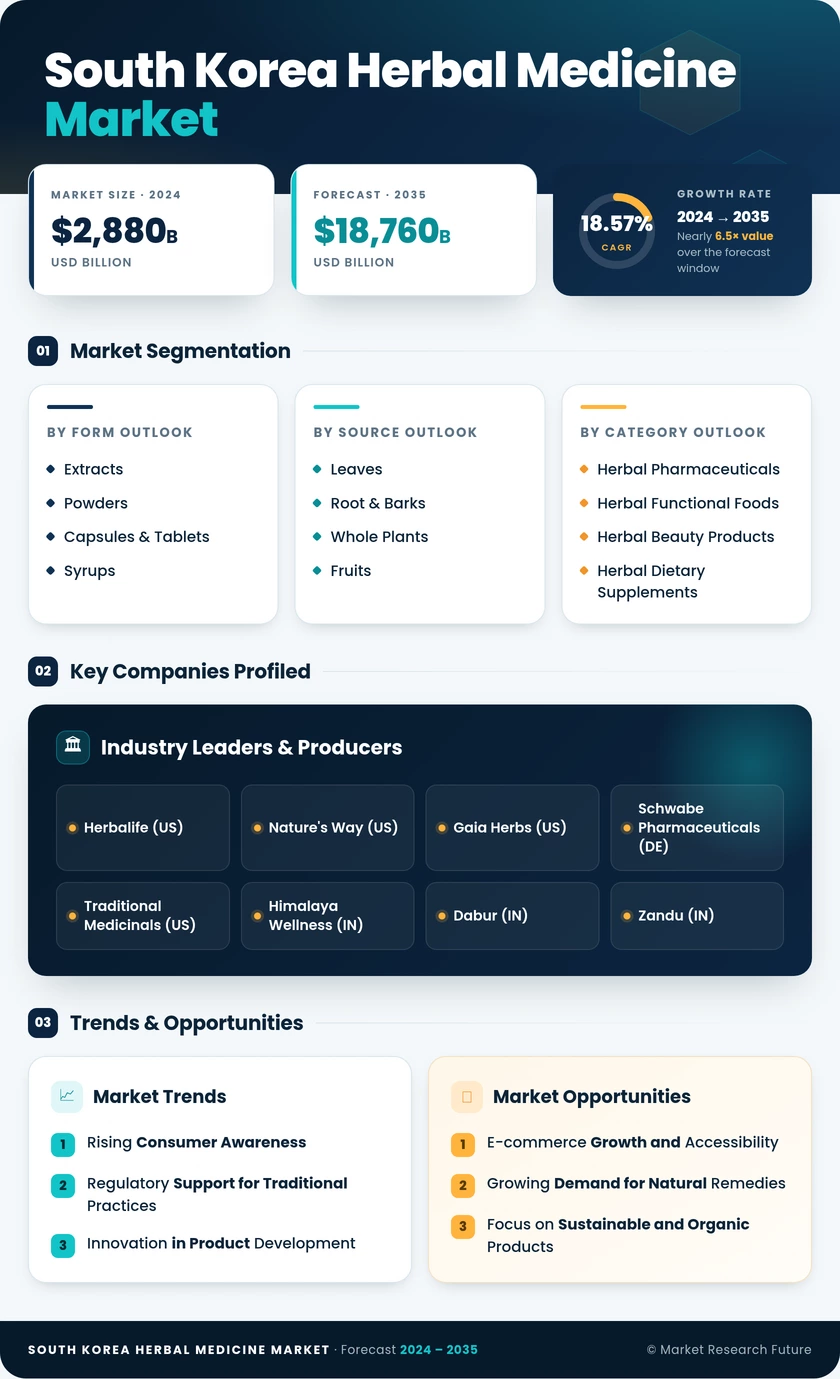
South Korea Herbal Medicine Market

ID: MRFR/HC/50484-HCR 200 Pages Satyendra Maurya Last Updated: September 17, 2026
South Korea Herbal Medicine Market Size, Growth Research Report By Form (Extracts, Powders, Capsules & Tablets, Syrups), By Distribution Channel (Hospital & Retail Pharmacies, E-Commerce), By Category (Herbal Pharmaceuticals, Herbal Functional Foods, Herbal Beauty Products, Herbal Dietary Supplements), By Type of Medicinal Plants (Marrubium Vulgare, Vaccinium Macrocarpon, Echinacea, Curcuma Longa, Camellia Sinensis, Actaea Racemose, Aloe Vera, Zingiber Officinale, Cocos Nucifera, Cinnamomum Spp, Allium Sativum) and By Source (Leaves, Root & Barks, Whole Plants, Fruits) - Competitor Industry Analysis and Trends Forecast Till 2035

South Korea Herbal Medicine Market
Market Size
Forecast Period2025 - 2035
CAGR (2025 - 2035)18.57%
2024 Market Size$ 2,880 Million
2025 Market Size$ 3,414.82 Million
2035 Market Size$ 18,760 Million
Key Players
Herbalife
Nature's Way
Gaia Herbs
Schwabe Pharmaceuticals
Traditional Medicinals
Himalaya Wellness
Opportunities
  • E-commerce Growth and Accessibility
  • Growing Demand for Natural Remedies
  • Focus on Sustainable and Organic Products
  1. 1 SECTION I: EXECUTIVE SUMMARY AND KEY HIGHLIGHTS
    1. 1.1 EXECUTIVE SUMMARY
      1. 1.1.1 Market Overview
      2. 1.1.2 Key Findings
      3. 1.1.3 Market Segmentation
      4. 1.1.4 Competitive Landscape
      5. 1.1.5 Challenges and Opportunities
      6. 1.1.6 Future Outlook
  2. 2 SECTION II: SCOPING, METHODOLOGY AND MARKET STRUCTURE
    1. 2.1 MARKET INTRODUCTION
      1. 2.1.1 Definition
      2. 2.1.2 Scope of the study
        1. 2.1.2.1 Research Objective
        2. 2.1.2.2 Assumption
        3. 2.1.2.3 Limitations
    2. 2.2 RESEARCH METHODOLOGY
      1. 2.2.1 Overview
      2. 2.2.2 Data Mining
      3. 2.2.3 Secondary Research
      4. 2.2.4 Primary Research
        1. 2.2.4.1 Primary Interviews and Information Gathering Process
        2. 2.2.4.2 Breakdown of Primary Respondents
      5. 2.2.5 Forecasting Model
      6. 2.2.6 Market Size Estimation
        1. 2.2.6.1 Bottom-Up Approach
        2. 2.2.6.2 Top-Down Approach
      7. 2.2.7 Data Triangulation
      8. 2.2.8 Validation
  3. 3 SECTION III: QUALITATIVE ANALYSIS
    1. 3.1 MARKET DYNAMICS
      1. 3.1.1 Overview
      2. 3.1.2 Drivers
      3. 3.1.3 Restraints
      4. 3.1.4 Opportunities
    2. 3.2 MARKET FACTOR ANALYSIS
      1. 3.2.1 Value chain Analysis
      2. 3.2.2 Porter's Five Forces Analysis
        1. 3.2.2.1 Bargaining Power of Suppliers
        2. 3.2.2.2 Bargaining Power of Buyers
        3. 3.2.2.3 Threat of New Entrants
        4. 3.2.2.4 Threat of Substitutes
        5. 3.2.2.5 Intensity of Rivalry
      3. 3.2.3 COVID-19 Impact Analysis
        1. 3.2.3.1 Market Impact Analysis
        2. 3.2.3.2 Regional Impact
        3. 3.2.3.3 Opportunity and Threat Analysis
  4. 4 SECTION IV: QUANTITATIVE ANALYSIS
    1. 4.1 Chemicals and Materials, BY Form (USD Million)
      1. 4.1.1 Extracts
      2. 4.1.2 Powders
      3. 4.1.3 Capsules & Tablets
      4. 4.1.4 Syrups
    2. 4.2 Chemicals and Materials, BY Distribution Channel (USD Million)
      1. 4.2.1 Hospital & Retail Pharmacies
      2. 4.2.2 E-Commerce
    3. 4.3 Chemicals and Materials, BY Category (USD Million)
      1. 4.3.1 Herbal Pharmaceuticals
      2. 4.3.2 Herbal Functional Foods
      3. 4.3.3 Herbal Beauty Products
      4. 4.3.4 Herbal Dietary Supplements
    4. 4.4 Chemicals and Materials, BY Type of Medicinal Plants (USD Million)
      1. 4.4.1 Marrubium Vulgare
      2. 4.4.2 Vaccinium Macrocarpon
      3. 4.4.3 Echinacea
      4. 4.4.4 Curcuma Longa
      5. 4.4.5 Camellia Sinensis
      6. 4.4.6 Actaea Racemose
      7. 4.4.7 Aloe Vera
      8. 4.4.8 Zingiber Officinale
      9. 4.4.9 Cocos Nucifera
      10. 4.4.10 Cinnamomum Spp
      11. 4.4.11 Allium Sativum
    5. 4.5 Chemicals and Materials, BY Source (USD Million)
      1. 4.5.1 Leaves
      2. 4.5.2 Root & Barks
      3. 4.5.3 Whole Plants
      4. 4.5.4 Fruits
  5. 5 SECTION V: COMPETITIVE ANALYSIS
    1. 5.1 Competitive Landscape
      1. 5.1.1 Overview
      2. 5.1.2 Competitive Analysis
      3. 5.1.3 Market share Analysis
      4. 5.1.4 Major Growth Strategy in the Chemicals and Materials
      5. 5.1.5 Competitive Benchmarking
      6. 5.1.6 Leading Players in Terms of Number of Developments in the Chemicals and Materials
      7. 5.1.7 Key developments and growth strategies
        1. 5.1.7.1 New Product Launch/Service Deployment
        2. 5.1.7.2 Merger & Acquisitions
        3. 5.1.7.3 Joint Ventures
      8. 5.1.8 Major Players Financial Matrix
        1. 5.1.8.1 Sales and Operating Income
        2. 5.1.8.2 Major Players R&D Expenditure. 2023
    2. 5.2 Company Profiles
      1. 5.2.1 Herbalife (US)
        1. 5.2.1.1 Financial Overview
        2. 5.2.1.2 Products Offered
        3. 5.2.1.3 Key Developments
        4. 5.2.1.4 SWOT Analysis
        5. 5.2.1.5 Key Strategies
      2. 5.2.2 Nature's Way (US)
        1. 5.2.2.1 Financial Overview
        2. 5.2.2.2 Products Offered
        3. 5.2.2.3 Key Developments
        4. 5.2.2.4 SWOT Analysis
        5. 5.2.2.5 Key Strategies
      3. 5.2.3 Gaia Herbs (US)
        1. 5.2.3.1 Financial Overview
        2. 5.2.3.2 Products Offered
        3. 5.2.3.3 Key Developments
        4. 5.2.3.4 SWOT Analysis
        5. 5.2.3.5 Key Strategies
      4. 5.2.4 Schwabe Pharmaceuticals (DE)
        1. 5.2.4.1 Financial Overview
        2. 5.2.4.2 Products Offered
        3. 5.2.4.3 Key Developments
        4. 5.2.4.4 SWOT Analysis
        5. 5.2.4.5 Key Strategies
      5. 5.2.5 Traditional Medicinals (US)
        1. 5.2.5.1 Financial Overview
        2. 5.2.5.2 Products Offered
        3. 5.2.5.3 Key Developments
        4. 5.2.5.4 SWOT Analysis
        5. 5.2.5.5 Key Strategies
      6. 5.2.6 Himalaya Wellness (IN)
        1. 5.2.6.1 Financial Overview
        2. 5.2.6.2 Products Offered
        3. 5.2.6.3 Key Developments
        4. 5.2.6.4 SWOT Analysis
        5. 5.2.6.5 Key Strategies
      7. 5.2.7 Dabur (IN)
        1. 5.2.7.1 Financial Overview
        2. 5.2.7.2 Products Offered
        3. 5.2.7.3 Key Developments
        4. 5.2.7.4 SWOT Analysis
        5. 5.2.7.5 Key Strategies
      8. 5.2.8 Zandu (IN)
        1. 5.2.8.1 Financial Overview
        2. 5.2.8.2 Products Offered
        3. 5.2.8.3 Key Developments
        4. 5.2.8.4 SWOT Analysis
        5. 5.2.8.5 Key Strategies
      9. 5.2.9 Bioforce (CH)
        1. 5.2.9.1 Financial Overview
        2. 5.2.9.2 Products Offered
        3. 5.2.9.3 Key Developments
        4. 5.2.9.4 SWOT Analysis
        5. 5.2.9.5 Key Strategies
    3. 5.3 Appendix
      1. 5.3.1 References
      2. 5.3.2 Related Reports
  6. 6 LIST OF FIGURES
    1. 6.1 MARKET SYNOPSIS
    2. 6.2 SOUTH KOREA MARKET ANALYSIS BY FORM
    3. 6.3 SOUTH KOREA MARKET ANALYSIS BY DISTRIBUTION CHANNEL
    4. 6.4 SOUTH KOREA MARKET ANALYSIS BY CATEGORY
    5. 6.5 SOUTH KOREA MARKET ANALYSIS BY TYPE OF MEDICINAL PLANTS
    6. 6.6 SOUTH KOREA MARKET ANALYSIS BY SOURCE
    7. 6.7 KEY BUYING CRITERIA OF CHEMICALS AND MATERIALS
    8. 6.8 RESEARCH PROCESS OF MRFR
    9. 6.9 DRO ANALYSIS OF CHEMICALS AND MATERIALS
    10. 6.10 DRIVERS IMPACT ANALYSIS: CHEMICALS AND MATERIALS
    11. 6.11 RESTRAINTS IMPACT ANALYSIS: CHEMICALS AND MATERIALS
    12. 6.12 SUPPLY / VALUE CHAIN: CHEMICALS AND MATERIALS
    13. 6.13 CHEMICALS AND MATERIALS, BY FORM, 2024 (% SHARE)
    14. 6.14 CHEMICALS AND MATERIALS, BY FORM, 2024 TO 2035 (USD Million)
    15. 6.15 CHEMICALS AND MATERIALS, BY DISTRIBUTION CHANNEL, 2024 (% SHARE)
    16. 6.16 CHEMICALS AND MATERIALS, BY DISTRIBUTION CHANNEL, 2024 TO 2035 (USD Million)
    17. 6.17 CHEMICALS AND MATERIALS, BY CATEGORY, 2024 (% SHARE)
    18. 6.18 CHEMICALS AND MATERIALS, BY CATEGORY, 2024 TO 2035 (USD Million)
    19. 6.19 CHEMICALS AND MATERIALS, BY TYPE OF MEDICINAL PLANTS, 2024 (% SHARE)
    20. 6.20 CHEMICALS AND MATERIALS, BY TYPE OF MEDICINAL PLANTS, 2024 TO 2035 (USD Million)
    21. 6.21 CHEMICALS AND MATERIALS, BY SOURCE, 2024 (% SHARE)
    22. 6.22 CHEMICALS AND MATERIALS, BY SOURCE, 2024 TO 2035 (USD Million)
    23. 6.23 BENCHMARKING OF MAJOR COMPETITORS
  7. 7 LIST OF TABLES
    1. 7.1 LIST OF ASSUMPTIONS
  8. 7.1.1
    1. 7.2 South Korea MARKET SIZE ESTIMATES; FORECAST
      1. 7.2.1 BY FORM, 2025-2035 (USD Million)
      2. 7.2.2 BY DISTRIBUTION CHANNEL, 2025-2035 (USD Million)
      3. 7.2.3 BY CATEGORY, 2025-2035 (USD Million)
      4. 7.2.4 BY TYPE OF MEDICINAL PLANTS, 2025-2035 (USD Million)
      5. 7.2.5 BY SOURCE, 2025-2035 (USD Million)
    2. 7.3 PRODUCT LAUNCH/PRODUCT DEVELOPMENT/APPROVAL
  9. 7.3.1
    1. 7.4 ACQUISITION/PARTNERSHIP
  10. 7.4.1

South Korea South Korea Herbal Medicine Market Segmentation

South Korea Herbal Medicine Market By Form (USD Million, 2025-2035)

  • Extracts
  • Powders
  • Capsules & Tablets
  • Syrups

South Korea Herbal Medicine Market By Distribution Channel (USD Million, 2025-2035)

  • Hospital & Retail Pharmacies
  • E-Commerce

South Korea Herbal Medicine Market By Category (USD Million, 2025-2035)

  • Herbal Pharmaceuticals
  • Herbal Functional Foods
  • Herbal Beauty Products
  • Herbal Dietary Supplements

South Korea Herbal Medicine Market By Type of Medicinal Plants (USD Million, 2025-2035)

  • Marrubium Vulgare
  • Vaccinium Macrocarpon
  • Echinacea
  • Curcuma Longa
  • Camellia Sinensis
  • Actaea Racemose
  • Aloe Vera
  • Zingiber Officinale
  • Cocos Nucifera
  • Cinnamomum Spp
  • Allium Sativum

South Korea Herbal Medicine Market By Source (USD Million, 2025-2035)

  • Leaves
  • Root & Barks
  • Whole Plants
  • Fruits
Download PDF ×

We do not share your information with anyone. However, we may send you emails based on your report interest from time to time. You may contact us at any time to opt-out.