Request Free Sample ×

Kindly complete the form below to receive a free sample of this Report

* Please use a valid business email

Leading companies partner with us for data-driven Insights

clients tt-cursor
Hero Background
English
Chinese
French
Japanese
Korean
German
Spanish

Solar PV Mounting Systems Market Size

ID: MRFR/EnP/3198-CR
128 Pages
Anshula Mandaokar
May 2023

Solar PV Mounting Systems Market Research Report Information by Product (Rooftop and Ground Mounted), By Technology (Fixed and Tracking), By Component (PV Modules [Panels], Inverters, Racking, Batteries, and Other Components), By End-User (Residential, Commercial, and Industrial), And By Region (North America, Europe, Asia-Pacific, Middle East & Africa and South America) - Growth & Industry Forecast to 2035

Share:
Download PDF ×

We do not share your information with anyone. However, we may send you emails based on your report interest from time to time. You may contact us at any time to opt-out.

Solar PV Mounting Systems Market Infographic
Purchase Options

Solar Pv Mounting Systems Size

Solar PV Mounting Systems Market Growth Projections and Opportunities

The Global Solar PV Mounting Systems Market is expected to register 7.6% CAGR during the forecast period, 2022 to 2030, and is expected to reach USD 24,026.70 million in 2030. Global Solar PV Mounting Systems Market is segmented based on product, technology, component, end-user and region. Based on product, the solar PV mounting system market has been segmented into rooftop and ground-mounted. Based on technology, the solar PV mounting system market has been segmented into fixed and tracking. Based on end user, the solar PV mounting system market has been segmented into residential, commercial, and utility. Based on components, the solar PV mounting system market has been segmented into PV modules (panels), Inverters, Racking, Batteries and Other Components Major regions considered within the market are North America, Europe, Asia Pacific, Middle East & Africa and South America. The key players profiled in the global Solar PV Mounting Systems analysis are Schletter Group, Unirac Inc., SolarWorld AG, K2 Systems GmbH, Land Power Solar Technology Co. Ltd, RBI Solar Inc, Mounting System GmbH and many more.

Solar PV Mounting Systems Market Size Graph
Author
Author Profile
Anshula Mandaokar
Team Lead - Research

Anshula Mandaokar holds an academic degree in Chemical Engineering and has been contributing to the field for more than 5 years. She has expertise in Market Research and Business Consulting and serves as a Team Lead for a reputed Market Research firm under the Chemicals and Materials domain spectrum. She has worked on multiple projects, generating explicit results in a quick turnaround time. Her understanding of data interpretation justifies her role as a leader.

Leave a Comment

FAQs

What is the current valuation of the solar PV mounting system market as of 2025?

<p>The solar PV mounting system market is valued at approximately 5.5 USD Billion in 2024.</p>

What is the projected market size for the solar PV mounting system market by 2035?

<p>The market is expected to reach a valuation of 12.0 USD Billion by 2035.</p>

What is the expected CAGR for the solar PV mounting system market during the forecast period 2025 - 2035?

<p>The expected CAGR for the solar PV mounting system market during 2025 - 2035 is 7.35%.</p>

Which application segment is projected to have the highest growth in the solar PV mounting system market?

<p>The utility scale application segment is projected to grow from 2.0 USD Billion to 5.0 USD Billion by 2035.</p>

What are the key materials used in solar PV mounting systems and their market values?

<p>Aluminum and steel are key materials, with market values projected to reach 3.6 USD Billion and 4.0 USD Billion respectively by 2035.</p>

How does the market for fixed tilt mounting systems compare to single axis tracking systems?

<p>Fixed tilt systems are expected to grow from 1.65 USD Billion to 3.6 USD Billion, while single axis tracking systems are projected to increase from 1.1 USD Billion to 2.5 USD Billion by 2035.</p>

What role do key players like Trina Solar and Canadian Solar play in the market?

<p>Key players such as Trina Solar and Canadian Solar are instrumental in driving innovation and market growth within the solar PV mounting system sector.</p>

What is the expected growth for the agricultural segment in the solar PV mounting system market?

<p>The agricultural segment is anticipated to grow from 0.6 USD Billion to 1.2 USD Billion by 2035.</p>

Which end-user segment is projected to dominate the solar PV mounting system market?

<p>The private sector is projected to dominate, with a market value expected to rise from 2.0 USD Billion to 4.0 USD Billion by 2035.</p>

What are the anticipated trends in installation types for solar PV mounting systems?

<p>On-grid installations are expected to grow from 2.2 USD Billion to 4.8 USD Billion, indicating a strong trend towards grid-connected systems.</p>

Market Summary

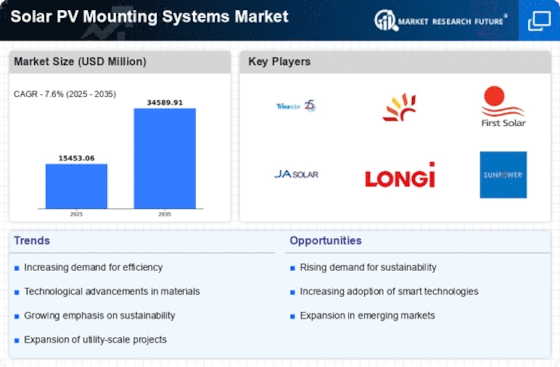
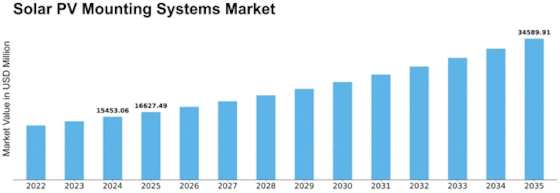
As per Market Research Future analysis, the Solar PV Mounting Systems Market was estimated at 15453.06 USD Million in 2024. The Solar PV Mounting Systems industry is projected to grow from 16627.49 USD Million in 2025 to 34589.91 USD Million by 2035, exhibiting a compound annual growth rate (CAGR) of 7% during the forecast period 2025 - 2035

Key Market Trends & Highlights

The Solar PV Mounting Systems Market is experiencing robust growth driven by technological advancements and increasing sustainability efforts.

  • Technological advancements are enhancing the efficiency and durability of solar PV mounting systems. North America remains the largest market, while Asia-Pacific is emerging as the fastest-growing region for solar PV installations. Rooftop systems dominate the market, yet ground-mounted systems are witnessing the fastest growth due to expanding solar projects. Rising demand for renewable energy and government incentives are key drivers propelling market expansion.

Market Size & Forecast

2024 Market Size 15453.06 (USD Million)
2035 Market Size 34589.91 (USD Million)
CAGR (2025 - 2035) 7.6%
Largest Regional Market Share in 2024 Asia Pacific

Major Players

<a href="https://www.trinasolar.com/fr/resources/newsroom/thu-04212022-0224">Trina Solar</a> (CN), Canadian Solar (CA), First Solar (US), <a href="https://www.jasolar.com/html/en/">JA Solar</a> (CN), LONGi Green Energy (CN), SunPower (US), Risen Energy (CN), Q CELLS (KR), SMA Solar Technology (DE)

Market Trends

The Solar PV Mounting Systems Market is currently experiencing a notable transformation, driven by the increasing demand for renewable energy solutions. This shift is largely influenced by global initiatives aimed at reducing carbon emissions and promoting sustainable energy sources. As governments and organizations prioritize clean energy, the adoption of solar technologies is on the rise. Consequently, the market for mounting systems, which are essential for the installation and efficiency of solar panels, is expanding. Innovations in design and materials are enhancing the performance and durability of these systems, making them more appealing to consumers and businesses alike. Moreover, the Solar PV Mounting Systems Market is witnessing a diversification of applications, ranging from residential to commercial and utility-scale installations. This broadening scope indicates a growing recognition of solar energy's potential across various sectors. Additionally, advancements in technology are leading to the development of more efficient and cost-effective mounting solutions. As the market evolves, stakeholders are likely to focus on integrating smart technologies and sustainable practices into their offerings, further driving growth and adoption in the coming years.

Technological Advancements

The Solar PV Mounting Systems Market is seeing rapid technological advancements that enhance the efficiency and reliability of solar installations. Innovations in materials and design are leading to lighter, more durable mounting solutions that can withstand various environmental conditions. These developments not only improve performance but also reduce installation time and costs, making solar energy more accessible.

Increased Adoption in Emerging Markets

Emerging markets are increasingly adopting solar energy solutions, contributing to the growth of the Solar PV Mounting Systems Market. As these regions seek to address energy shortages and promote sustainable development, the demand for solar installations is rising. This trend is likely to create new opportunities for manufacturers and suppliers of mounting systems.

Focus on Sustainability

There is a growing emphasis on sustainability within the Solar PV Mounting Systems Market. Stakeholders are increasingly prioritizing eco-friendly materials and practices in the production of mounting systems. This focus on sustainability not only aligns with global environmental goals but also appeals to consumers who are becoming more conscious of their ecological footprint.

Solar PV Mounting Systems Market Market Drivers

Expansion of Solar Energy Projects

The expansion of solar energy projects worldwide is a pivotal driver for the Solar PV Mounting Systems Market. As countries strive to meet energy demands and reduce carbon footprints, large-scale solar farms and distributed generation systems are being developed at an unprecedented rate. This expansion necessitates the deployment of robust and efficient mounting systems to ensure the stability and performance of solar installations. According to recent data, the number of solar projects has increased significantly, leading to a corresponding rise in the need for mounting solutions. This trend indicates that the Solar PV Mounting Systems Market will continue to experience growth as more projects come online, further solidifying the role of mounting systems in the solar energy landscape.

Government Incentives and Policies

Government incentives and supportive policies play a crucial role in driving the Solar PV Mounting Systems Market. Various nations have implemented tax credits, rebates, and grants to encourage the adoption of solar energy solutions. These financial incentives lower the initial investment barrier for consumers and businesses, making solar installations more attractive. For example, in several regions, feed-in tariffs guarantee fixed payments for solar energy producers, further stimulating market growth. As a result, the demand for efficient and reliable mounting systems is likely to increase, as they are integral to the successful deployment of solar panels. The ongoing evolution of policy frameworks continues to bolster the Solar PV Mounting Systems Market.

Rising Demand for Renewable Energy

The increasing The Solar PV Mounting Systems Industry. Governments and organizations are actively promoting the transition from fossil fuels to cleaner energy alternatives. This shift is evidenced by the substantial investments in solar energy infrastructure, which have surged in recent years. For instance, the International Energy Agency reported a significant rise in solar capacity installations, indicating a robust demand for solar technologies. Consequently, the mounting systems that support solar panels are experiencing heightened demand, as they are essential for optimizing energy capture and ensuring system longevity. As more countries set ambitious renewable energy targets, the Solar PV Mounting Systems Market is poised for continued growth.

Growing Awareness of Environmental Issues

The rising awareness of environmental issues among consumers and businesses is a significant driver for the Solar PV Mounting Systems Market. As climate change concerns escalate, there is a collective push towards sustainable practices, including the adoption of solar energy. This heightened awareness is reflected in consumer preferences, with many individuals seeking eco-friendly solutions for their energy needs. Businesses are also increasingly recognizing the importance of sustainability in their operations, leading to investments in solar technologies. Consequently, the demand for effective mounting systems that support solar panels is likely to grow, as they are essential for maximizing the benefits of solar energy. The Solar PV Mounting Systems Market is thus positioned to thrive in this environmentally conscious landscape.

Technological Innovations in Mounting Systems

Technological advancements in mounting systems are significantly influencing the Solar PV Mounting Systems Market. Innovations such as lightweight materials, adjustable mounting angles, and integrated tracking systems enhance the efficiency and effectiveness of solar installations. These advancements not only improve energy capture but also reduce installation time and costs. The introduction of smart mounting solutions that can adapt to environmental conditions is also gaining traction. As technology continues to evolve, the market is likely to see an influx of new products that cater to diverse installation needs. This trend suggests that the Solar PV Mounting Systems Market will remain dynamic, with ongoing improvements driving further adoption.


Market Segment Insights

By Application: Residential (Largest) vs. Utility Scale (Fastest-Growing)

<p>The solar PV mounting system market is diversified across several applications, with the residential segment commanding the largest market share. This is attributed to the rising adoption of solar energy solutions among homeowners who are becoming increasingly conscious of energy efficiency and sustainability. Conversely, the utility scale segment is experiencing rapid growth, driven by large-scale solar projects that aim to meet the growing energy demands of cities and industries. As more countries pursue renewable energy targets and regulatory incentives encourage investment in large solar farms, the utility scale application is projected to see substantial growth. Factors like advancements in solar technology, decreases in installation costs, and the need for sustainable energy sources are propelling both segments forward, making the overall application landscape dynamic and competitive.</p>

<p>Residential (Dominant) vs. Agricultural (Emerging)</p>

<p>The residential segment is the most dominant application in the solar PV mounting system market, characterized by widespread installation of solar panels on rooftops and small solar farms. Homeowners are increasingly opting for solar solutions to lower energy bills and enhance their property values. The agricultural sector, on the other hand, has emerged as a growing market, where farmers are harnessing solar energy to power irrigation systems and other farm operations. This trend is bolstered by the dual benefits of reducing electricity costs and promoting sustainability in agriculture. As farms become more integrated with technology, the demand for solar PV systems in agricultural applications is expected to rise, positioning it as a key player in the renewable energy transition.</p>

By Mounting Type: Fixed Tilt (Largest) vs. Single Axis Tracking (Fastest-Growing)

<p>The solar PV mounting system market reflects a diverse set of mounting types, with Fixed Tilt systems leading the market share due to their simplicity and reliability. These systems are preferred for their cost-effectiveness and ease of installation. In contrast, Single Axis Tracking systems, which follow the sun's path to maximize solar exposure, represent the fastest-growing segment, gaining traction among commercial and utility-scale projects for their efficiency improvements.</p>

<p>Mounting Type: Fixed Tilt (Dominant) vs. Single Axis Tracking (Emerging)</p>

<p>Fixed Tilt mounting systems dominate the solar PV landscape due to their straightforward design and relatively low installation costs. They are commonly used in residential and small-scale commercial applications, making them a staple in the market. On the other hand, Single Axis Tracking systems have emerged as a competitive alternative, particularly in larger installations where maximizing energy output is critical. These systems adjust their position throughout the day, providing up to 25% more energy compared to fixed systems. Their growing adoption is driven by decreasing technology costs and increasing efficiency demands, positioning them as a key player in the evolving solar landscape.</p>

By Material Type: Aluminum (Largest) vs. Steel (Fastest-Growing)

<p>The solar PV mounting system market is significantly influenced by the material types employed in manufacturing mounting solutions. Aluminum holds the largest market share due to its favorable properties such as lightweight, corrosion resistance, and ease of installation. Steel, while traditionally used for its strength, is making strides to capture a larger market share with significant technological advancements that enhance its performance and durability. As sustainability becomes increasingly important, these materials are evaluated based on their energy efficiency during production and lifecycle.</p>

<p>Material Type: Aluminum (Dominant) vs. Steel (Emerging)</p>

<p>Aluminum is the dominant player in the solar PV mounting system market, primarily due to its superior strength-to-weight ratio, leading to enhanced structural integrity and lower transportation costs. It is favored for residential and commercial installations when ease of installation is prioritized. In contrast, steel, recognized for its robustness and affordability, is rapidly emerging in the market. Companies are innovating with galvanized and coated steel solutions that extend longevity and reduce maintenance needs, positioning steel as a viable alternative that meets both durability and cost-effectiveness requirements.</p>

By Installation Type: On-Grid (Largest) vs. Off-Grid (Fastest-Growing)

<p>In the solar PV mounting system market, the distribution of installation types highlights the dominance of on-grid systems, accounting for significant market share. This segment benefits from the growing adoption of renewable energy solutions combined with grid connectivity, making it a preferred choice for customers seeking sustainability without sacrificing energy reliability. On-grid systems allow users to sell excess power back to the grid, further incentivizing their installation. Off-grid systems are rapidly gaining traction, driven by factors such as the increasing need for energy independence and the affordability of solar technology. These systems are particularly popular in remote areas where grid access is limited. The emergent trend towards energy storage solutions further elevates their appeal as these installations can harness renewable energy even in isolated settings, promoting decentralized power generation and consumption.</p>

<p>Technology: On-Grid (Dominant) vs. Off-Grid (Emerging)</p>

<p>On-grid solar PV mounting systems remain the most dominant installation type in the market, characterized by their integration with the existing power grid and ability to generate income through net metering. Their significant prevalence is driven by incentives from government policies promoting renewable energy and the economic benefits of lower energy costs. Meanwhile, off-grid systems are emerging as a key player focused on energy self-sufficiency and independence, catering to off-the-grid rural communities and enterprises. These systems often incorporate energy storage solutions, maximizing solar power usage and ensuring energy availability. With advancements in technology and falling prices of solar components, off-grid solutions are expanding, presenting a viable alternative to traditional grid connectivity.</p>

By End User: Government (Largest) vs. Private Sector (Fastest-Growing)

<p>In the solar PV mounting system market, the end user segment shows a diverse distribution across several categories including Government, Private Sector, Non-Profit Organizations, Educational Institutions, and Energy Providers. The Government sector holds the largest share, driven by various incentives and support from national policies aimed at promoting renewable energy. Meanwhile, the Private Sector is rapidly gaining traction, increasingly integrating solar solutions into their business models to reduce energy costs and enhance sustainability efforts. With a growing emphasis on sustainability, the Private Sector emerges as the fastest-growing segment. Companies are investing in solar PV technologies not just for cost savings but to improve their corporate social responsibility. This shift is fueled by technological advancements and more favorable regulatory environments, pushing Energy Providers to innovate while Non-Profit Organizations and Educational Institutions also adapt by adopting solar solutions to showcase their commitment to sustainability and environmental stewardship.</p>

<p>Government (Dominant) vs. Energy Providers (Emerging)</p>

<p>The Government segment stands as a dominant force in the solar PV mounting system market, leveraging favorable policies, grants, and subsidies to support the integration of solar technologies. This segment plays a crucial role in driving national renewable energy agendas, solidifying partnerships with private entities to promote the installation of solar systems. Their ability to influence regulations and funding allocations places them at the forefront of the industry. Conversely, Energy Providers represent an emerging segment, dynamically evolving their services to include solar PV options. As the demand for clean energy solutions surges, these providers are re-evaluating their traditional business models. Emphasizing innovation, they are increasingly collaborating with technology firms to deliver integrated solutions, thus positioning themselves competitively in the market.</p>

Get more detailed insights about Solar PV Mounting Systems Market Research Report—Global Forecast till 2035

Regional Insights

North America : Renewable Energy Leader

North America is witnessing robust growth in the Solar PV Mounting Systems Market, driven by increasing demand for renewable energy and supportive government policies. The United States holds the largest market share at approximately 70%, followed by Canada at around 15%. Regulatory incentives, such as the Investment Tax Credit (ITC), are catalyzing investments in solar infrastructure, further propelling market expansion. The competitive landscape is dominated by key players like First Solar, Canadian Solar, and SunPower, which are leveraging advanced technologies to enhance efficiency and reduce costs. The U.S. market is characterized by a mix of large-scale solar farms and residential installations, while Canada is focusing on utility-scale projects. This dynamic environment fosters innovation and collaboration among industry stakeholders, ensuring sustained growth in the sector.

Europe : Sustainable Energy Transition

Europe is rapidly advancing in the Solar PV Mounting Systems Market, driven by ambitious renewable energy targets and stringent climate policies. Germany and France are the largest markets, collectively holding about 60% of the region's share. The European Green Deal and national initiatives are pivotal in promoting solar energy adoption, aiming for a significant reduction in carbon emissions by 2030. Leading countries like Germany, Spain, and Italy are at the forefront, with a competitive landscape featuring major players such as SMA Solar Technology and Q CELLS. The region is witnessing a surge in innovative mounting solutions that cater to diverse installation environments, from rooftops to large solar farms. This growth is supported by a strong emphasis on sustainability and energy independence, positioning Europe as a leader in The Solar PV Mounting Systems Market.

Asia-Pacific : Emerging Solar Powerhouse

The Asia-Pacific region is emerging as a powerhouse in the Solar PV Mounting Systems Market, driven by rapid industrialization and urbanization. China is the largest market, accounting for approximately 75% of the region's share, followed by Japan at around 10%. Government initiatives, such as feed-in tariffs and subsidies, are fostering a favorable environment for solar energy investments, leading to exponential growth in installations. Key players like Trina Solar, JA Solar, and LONGi Green Energy dominate the competitive landscape, focusing on innovation and cost reduction. Countries like India are also making significant strides, with ambitious solar targets and increasing investments in renewable energy infrastructure. The region's diverse market dynamics and strong government support are crucial for sustaining growth in the solar sector.

Middle East and Africa : Emerging Renewable Frontier

The Middle East and Africa region is witnessing a burgeoning interest in the Solar PV Mounting Systems Market, driven by abundant sunlight and increasing energy demands. Countries like South Africa and the UAE are leading the charge, with South Africa holding about 40% of the market share. Government initiatives aimed at diversifying energy sources and reducing reliance on fossil fuels are key growth drivers in this region. The competitive landscape is evolving, with local and international players entering the market to capitalize on the growing demand for solar solutions. Projects like the Mohammed bin Rashid Al Maktoum Solar Park in the UAE exemplify the region's commitment to renewable energy. As infrastructure develops and financing options improve, the potential for solar energy in the Middle East and Africa is set to expand significantly.

Key Players and Competitive Insights

The Solar PV Mounting Systems Market is currently characterized by a dynamic competitive landscape, driven by increasing demand for renewable energy solutions and technological advancements. Key players such as Trina Solar (CN), Canadian Solar (CA), and First Solar (US) are strategically positioning themselves through innovation and regional expansion. Trina Solar (CN) has focused on enhancing its product offerings with advanced mounting solutions that cater to diverse geographical conditions, while Canadian Solar (CA) has been expanding its footprint in emerging markets, particularly in Southeast Asia, to capitalize on growing solar adoption. First Solar (US) emphasizes sustainability and efficiency in its operations, which aligns with the global shift towards environmentally friendly energy solutions. Collectively, these strategies contribute to a competitive environment that is increasingly focused on technological differentiation and market responsiveness. In terms of business tactics, companies are localizing manufacturing to reduce costs and enhance supply chain efficiency. This approach is particularly evident in the moderately fragmented market structure, where several players vie for market share. The collective influence of key players is significant, as they not only drive innovation but also set industry standards that smaller companies often follow. The competitive dynamics are further shaped by the need for supply chain optimization, which has become critical in ensuring timely delivery and cost-effectiveness in the mounting systems segment. In August 2025, Trina Solar (CN) announced a partnership with a leading construction firm to develop a new line of solar mounting systems specifically designed for urban environments. This strategic move is likely to enhance Trina's market presence in densely populated areas, where traditional mounting solutions may not be feasible. By tailoring products to meet the unique challenges of urban installations, Trina Solar (CN) positions itself as a leader in innovative solutions that address the growing demand for solar energy in cities. In September 2025, Canadian Solar (CA) launched a new series of ground-mounted solar systems that utilize advanced tracking technology. This initiative not only improves energy efficiency but also demonstrates Canadian Solar's commitment to innovation. The introduction of these systems is expected to attract a broader customer base, particularly in regions with high solar potential, thereby reinforcing Canadian Solar's competitive edge in the market. In July 2025, First Solar (US) completed the acquisition of a technology firm specializing in AI-driven solar energy management systems. This acquisition is strategically significant as it allows First Solar (US) to integrate cutting-edge technology into its product offerings, enhancing operational efficiency and customer engagement. The move reflects a broader trend in the industry towards the integration of digital solutions that optimize solar energy production and management. As of October 2025, the competitive trends in the Solar PV Mounting Systems Market are increasingly defined by digitalization, sustainability, and the integration of AI technologies. Strategic alliances are becoming more prevalent, as companies recognize the value of collaboration in driving innovation and expanding market reach. Looking ahead, competitive differentiation is likely to evolve from traditional price-based competition to a focus on technological advancements, innovative solutions, and reliable supply chains. This shift underscores the importance of adaptability and forward-thinking strategies in maintaining a competitive advantage in the rapidly changing energy landscape.

Key Companies in the Solar PV Mounting Systems Market include

Industry Developments

October 2022: Unirac, Inc. (“Unirac” or the “Company”), a leading designer and manufacturer of solar photovoltaic (PV) mounting solutions for the residential and commercial & industrial (C&I) markets, announced today a majority recapitalization investment led by Greenbelt Capital Partners (“Greenbelt”). Investors in the transaction included Greenbelt Capital Partners Unirac L.P. and Trilantic Energy Partners II (North America) L.P. and its parallel fund. The existing sponsor, Tenex Capital Management, along with key members of Unirac’s management team, will continue to own a significant stake in the business.

April 2021: K2 Systems GmbH opened its new location, K2 Systems Pty Limited, in Australia to enhance its global presence.

March 2021: Schletter launches the new "ProLine" pitched roof system, available in Europe. The "ProLine" system is lightweight, more load-bearing, highly durable, and easier to install.

Future Outlook

Solar PV Mounting Systems Market Future Outlook

The Solar PV Mounting Systems Market is projected to grow at a 7.6% CAGR from 2025 to 2035, driven by increasing renewable energy adoption, technological advancements, and supportive government policies.

New opportunities lie in:

  • <p>Expansion into emerging markets with tailored mounting solutions. Development of lightweight, durable materials for enhanced efficiency. Integration of smart technology for real-time performance monitoring.</p>

By 2035, the market is expected to solidify its position as a leader in renewable energy infrastructure.

Market Segmentation

Solar PV Mounting Systems Market Product Outlook

  • Rooftop
  • Ground Mounted

Solar PV Mounting Systems Market End User Outlook

  • Residential
  • Commercial
  • Industrial

Solar PV Mounting Systems Market Component Outlook

  • PV Modules (Panels)
  • Inverters
  • Racking
  • Batteries
  • Other Components

Solar PV Mounting Systems Market Technology Outlook

  • Fixed
  • Tracking

Report Scope

MARKET SIZE 2024 15453.06(USD Million)
MARKET SIZE 2025 16627.49(USD Million)
MARKET SIZE 2035 34589.91(USD Million)
COMPOUND ANNUAL GROWTH RATE (CAGR) 7.6% (2025 - 2035)
REPORT COVERAGE Revenue Forecast, Competitive Landscape, Growth Factors, and Trends
BASE YEAR 2024
Market Forecast Period 2025 - 2035
Historical Data 2019 - 2024
Market Forecast Units USD Million
Key Companies Profiled Trina Solar (CN), Canadian Solar (CA), First Solar (US), JA Solar (CN), LONGi Green Energy (CN), SunPower (US), Risen Energy (CN), Q CELLS (KR), SMA Solar Technology (DE)
Segments Covered Product, Technology, Component, End-User, Region
Key Market Opportunities Integration of advanced materials and smart technologies enhances efficiency in the Solar PV Mounting Systems Market.
Key Market Dynamics Rising demand for efficient solar PV mounting systems driven by technological advancements and regulatory support for renewable energy.
Countries Covered North America, Europe, APAC, South America, MEA

FAQs

What is the current valuation of the solar PV mounting system market as of 2025?

<p>The solar PV mounting system market is valued at approximately 5.5 USD Billion in 2024.</p>

What is the projected market size for the solar PV mounting system market by 2035?

<p>The market is expected to reach a valuation of 12.0 USD Billion by 2035.</p>

What is the expected CAGR for the solar PV mounting system market during the forecast period 2025 - 2035?

<p>The expected CAGR for the solar PV mounting system market during 2025 - 2035 is 7.35%.</p>

Which application segment is projected to have the highest growth in the solar PV mounting system market?

<p>The utility scale application segment is projected to grow from 2.0 USD Billion to 5.0 USD Billion by 2035.</p>

What are the key materials used in solar PV mounting systems and their market values?

<p>Aluminum and steel are key materials, with market values projected to reach 3.6 USD Billion and 4.0 USD Billion respectively by 2035.</p>

How does the market for fixed tilt mounting systems compare to single axis tracking systems?

<p>Fixed tilt systems are expected to grow from 1.65 USD Billion to 3.6 USD Billion, while single axis tracking systems are projected to increase from 1.1 USD Billion to 2.5 USD Billion by 2035.</p>

What role do key players like Trina Solar and Canadian Solar play in the market?

<p>Key players such as Trina Solar and Canadian Solar are instrumental in driving innovation and market growth within the solar PV mounting system sector.</p>

What is the expected growth for the agricultural segment in the solar PV mounting system market?

<p>The agricultural segment is anticipated to grow from 0.6 USD Billion to 1.2 USD Billion by 2035.</p>

Which end-user segment is projected to dominate the solar PV mounting system market?

<p>The private sector is projected to dominate, with a market value expected to rise from 2.0 USD Billion to 4.0 USD Billion by 2035.</p>

What are the anticipated trends in installation types for solar PV mounting systems?

<p>On-grid installations are expected to grow from 2.2 USD Billion to 4.8 USD Billion, indicating a strong trend towards grid-connected systems.</p>

  1. SECTION I: EXECUTIVE SUMMARY AND KEY HIGHLIGHTS
    1. | 1.1 EXECUTIVE SUMMARY
    2. | | 1.1.1 Market Overview
    3. | | 1.1.2 Key Findings
    4. | | 1.1.3 Market Segmentation
    5. | | 1.1.4 Competitive Landscape
    6. | | 1.1.5 Challenges and Opportunities
    7. | | 1.1.6 Future Outlook
  2. SECTION II: SCOPING, METHODOLOGY AND MARKET STRUCTURE
    1. | 2.1 MARKET INTRODUCTION
    2. | | 2.1.1 Definition
    3. | | 2.1.2 Scope of the study
    4. | | | 2.1.2.1 Research Objective
    5. | | | 2.1.2.2 Assumption
    6. | | | 2.1.2.3 Limitations
    7. | 2.2 RESEARCH METHODOLOGY
    8. | | 2.2.1 Overview
    9. | | 2.2.2 Data Mining
    10. | | 2.2.3 Secondary Research
    11. | | 2.2.4 Primary Research
    12. | | | 2.2.4.1 Primary Interviews and Information Gathering Process
    13. | | | 2.2.4.2 Breakdown of Primary Respondents
    14. | | 2.2.5 Forecasting Model
    15. | | 2.2.6 Market Size Estimation
    16. | | | 2.2.6.1 Bottom-Up Approach
    17. | | | 2.2.6.2 Top-Down Approach
    18. | | 2.2.7 Data Triangulation
    19. | | 2.2.8 Validation
  3. SECTION III: QUALITATIVE ANALYSIS
    1. | 3.1 MARKET DYNAMICS
    2. | | 3.1.1 Overview
    3. | | 3.1.2 Drivers
    4. | | 3.1.3 Restraints
    5. | | 3.1.4 Opportunities
    6. | 3.2 MARKET FACTOR ANALYSIS
    7. | | 3.2.1 Value chain Analysis
    8. | | 3.2.2 Porter's Five Forces Analysis
    9. | | | 3.2.2.1 Bargaining Power of Suppliers
    10. | | | 3.2.2.2 Bargaining Power of Buyers
    11. | | | 3.2.2.3 Threat of New Entrants
    12. | | | 3.2.2.4 Threat of Substitutes
    13. | | | 3.2.2.5 Intensity of Rivalry
    14. | | 3.2.3 COVID-19 Impact Analysis
    15. | | | 3.2.3.1 Market Impact Analysis
    16. | | | 3.2.3.2 Regional Impact
    17. | | | 3.2.3.3 Opportunity and Threat Analysis
  4. SECTION IV: QUANTITATIVE ANALYSIS
    1. | 4.1 Energy & Power, BY Application (USD Billion)
    2. | | 4.1.1 Residential
    3. | | 4.1.2 Commercial
    4. | | 4.1.3 Utility Scale
    5. | | 4.1.4 Agricultural
    6. | | 4.1.5 Industrial
    7. | 4.2 Energy & Power, BY Mounting Type (USD Billion)
    8. | | 4.2.1 Fixed Tilt
    9. | | 4.2.2 Single Axis Tracking
    10. | | 4.2.3 Dual Axis Tracking
    11. | | 4.2.4 Ground Mounted
    12. | | 4.2.5 Roof Mounted
    13. | 4.3 Energy & Power, BY Material Type (USD Billion)
    14. | | 4.3.1 Aluminum
    15. | | 4.3.2 Steel
    16. | | 4.3.3 Plastic
    17. | | 4.3.4 Composite
    18. | | 4.3.5 Concrete
    19. | 4.4 Energy & Power, BY Installation Type (USD Billion)
    20. | | 4.4.1 On-Grid
    21. | | 4.4.2 Off-Grid
    22. | | 4.4.3 Hybrid
    23. | | 4.4.4 Integrated
    24. | | 4.4.5 Standalone
    25. | 4.5 Energy & Power, BY End User (USD Billion)
    26. | | 4.5.1 Government
    27. | | 4.5.2 Private Sector
    28. | | 4.5.3 Non-Profit Organizations
    29. | | 4.5.4 Educational Institutions
    30. | | 4.5.5 Energy Providers
    31. | 4.6 Energy & Power, BY Region (USD Billion)
    32. | | 4.6.1 North America
    33. | | | 4.6.1.1 US
    34. | | | 4.6.1.2 Canada
    35. | | 4.6.2 Europe
    36. | | | 4.6.2.1 Germany
    37. | | | 4.6.2.2 UK
    38. | | | 4.6.2.3 France
    39. | | | 4.6.2.4 Russia
    40. | | | 4.6.2.5 Italy
    41. | | | 4.6.2.6 Spain
    42. | | | 4.6.2.7 Rest of Europe
    43. | | 4.6.3 APAC
    44. | | | 4.6.3.1 China
    45. | | | 4.6.3.2 India
    46. | | | 4.6.3.3 Japan
    47. | | | 4.6.3.4 South Korea
    48. | | | 4.6.3.5 Malaysia
    49. | | | 4.6.3.6 Thailand
    50. | | | 4.6.3.7 Indonesia
    51. | | | 4.6.3.8 Rest of APAC
    52. | | 4.6.4 South America
    53. | | | 4.6.4.1 Brazil
    54. | | | 4.6.4.2 Mexico
    55. | | | 4.6.4.3 Argentina
    56. | | | 4.6.4.4 Rest of South America
    57. | | 4.6.5 MEA
    58. | | | 4.6.5.1 GCC Countries
    59. | | | 4.6.5.2 South Africa
    60. | | | 4.6.5.3 Rest of MEA
  5. SECTION V: COMPETITIVE ANALYSIS
    1. | 5.1 Competitive Landscape
    2. | | 5.1.1 Overview
    3. | | 5.1.2 Competitive Analysis
    4. | | 5.1.3 Market share Analysis
    5. | | 5.1.4 Major Growth Strategy in the Energy & Power
    6. | | 5.1.5 Competitive Benchmarking
    7. | | 5.1.6 Leading Players in Terms of Number of Developments in the Energy & Power
    8. | | 5.1.7 Key developments and growth strategies
    9. | | | 5.1.7.1 New Product Launch/Service Deployment
    10. | | | 5.1.7.2 Merger & Acquisitions
    11. | | | 5.1.7.3 Joint Ventures
    12. | | 5.1.8 Major Players Financial Matrix
    13. | | | 5.1.8.1 Sales and Operating Income
    14. | | | 5.1.8.2 Major Players R&D Expenditure. 2023
    15. | 5.2 Company Profiles
    16. | | 5.2.1 Trina Solar (CN)
    17. | | | 5.2.1.1 Financial Overview
    18. | | | 5.2.1.2 Products Offered
    19. | | | 5.2.1.3 Key Developments
    20. | | | 5.2.1.4 SWOT Analysis
    21. | | | 5.2.1.5 Key Strategies
    22. | | 5.2.2 Canadian Solar (CA)
    23. | | | 5.2.2.1 Financial Overview
    24. | | | 5.2.2.2 Products Offered
    25. | | | 5.2.2.3 Key Developments
    26. | | | 5.2.2.4 SWOT Analysis
    27. | | | 5.2.2.5 Key Strategies
    28. | | 5.2.3 First Solar (US)
    29. | | | 5.2.3.1 Financial Overview
    30. | | | 5.2.3.2 Products Offered
    31. | | | 5.2.3.3 Key Developments
    32. | | | 5.2.3.4 SWOT Analysis
    33. | | | 5.2.3.5 Key Strategies
    34. | | 5.2.4 JA Solar (CN)
    35. | | | 5.2.4.1 Financial Overview
    36. | | | 5.2.4.2 Products Offered
    37. | | | 5.2.4.3 Key Developments
    38. | | | 5.2.4.4 SWOT Analysis
    39. | | | 5.2.4.5 Key Strategies
    40. | | 5.2.5 LONGi Green Energy (CN)
    41. | | | 5.2.5.1 Financial Overview
    42. | | | 5.2.5.2 Products Offered
    43. | | | 5.2.5.3 Key Developments
    44. | | | 5.2.5.4 SWOT Analysis
    45. | | | 5.2.5.5 Key Strategies
    46. | | 5.2.6 SunPower (US)
    47. | | | 5.2.6.1 Financial Overview
    48. | | | 5.2.6.2 Products Offered
    49. | | | 5.2.6.3 Key Developments
    50. | | | 5.2.6.4 SWOT Analysis
    51. | | | 5.2.6.5 Key Strategies
    52. | | 5.2.7 Risen Energy (CN)
    53. | | | 5.2.7.1 Financial Overview
    54. | | | 5.2.7.2 Products Offered
    55. | | | 5.2.7.3 Key Developments
    56. | | | 5.2.7.4 SWOT Analysis
    57. | | | 5.2.7.5 Key Strategies
    58. | | 5.2.8 Q CELLS (KR)
    59. | | | 5.2.8.1 Financial Overview
    60. | | | 5.2.8.2 Products Offered
    61. | | | 5.2.8.3 Key Developments
    62. | | | 5.2.8.4 SWOT Analysis
    63. | | | 5.2.8.5 Key Strategies
    64. | | 5.2.9 SMA Solar Technology (DE)
    65. | | | 5.2.9.1 Financial Overview
    66. | | | 5.2.9.2 Products Offered
    67. | | | 5.2.9.3 Key Developments
    68. | | | 5.2.9.4 SWOT Analysis
    69. | | | 5.2.9.5 Key Strategies
    70. | 5.3 Appendix
    71. | | 5.3.1 References
    72. | | 5.3.2 Related Reports
  6. LIST OF FIGURES
    1. | 6.1 MARKET SYNOPSIS
    2. | 6.2 NORTH AMERICA MARKET ANALYSIS
    3. | 6.3 US MARKET ANALYSIS BY APPLICATION
    4. | 6.4 US MARKET ANALYSIS BY MOUNTING TYPE
    5. | 6.5 US MARKET ANALYSIS BY MATERIAL TYPE
    6. | 6.6 US MARKET ANALYSIS BY INSTALLATION TYPE
    7. | 6.7 US MARKET ANALYSIS BY END USER
    8. | 6.8 CANADA MARKET ANALYSIS BY APPLICATION
    9. | 6.9 CANADA MARKET ANALYSIS BY MOUNTING TYPE
    10. | 6.10 CANADA MARKET ANALYSIS BY MATERIAL TYPE
    11. | 6.11 CANADA MARKET ANALYSIS BY INSTALLATION TYPE
    12. | 6.12 CANADA MARKET ANALYSIS BY END USER
    13. | 6.13 EUROPE MARKET ANALYSIS
    14. | 6.14 GERMANY MARKET ANALYSIS BY APPLICATION
    15. | 6.15 GERMANY MARKET ANALYSIS BY MOUNTING TYPE
    16. | 6.16 GERMANY MARKET ANALYSIS BY MATERIAL TYPE
    17. | 6.17 GERMANY MARKET ANALYSIS BY INSTALLATION TYPE
    18. | 6.18 GERMANY MARKET ANALYSIS BY END USER
    19. | 6.19 UK MARKET ANALYSIS BY APPLICATION
    20. | 6.20 UK MARKET ANALYSIS BY MOUNTING TYPE
    21. | 6.21 UK MARKET ANALYSIS BY MATERIAL TYPE
    22. | 6.22 UK MARKET ANALYSIS BY INSTALLATION TYPE
    23. | 6.23 UK MARKET ANALYSIS BY END USER
    24. | 6.24 FRANCE MARKET ANALYSIS BY APPLICATION
    25. | 6.25 FRANCE MARKET ANALYSIS BY MOUNTING TYPE
    26. | 6.26 FRANCE MARKET ANALYSIS BY MATERIAL TYPE
    27. | 6.27 FRANCE MARKET ANALYSIS BY INSTALLATION TYPE
    28. | 6.28 FRANCE MARKET ANALYSIS BY END USER
    29. | 6.29 RUSSIA MARKET ANALYSIS BY APPLICATION
    30. | 6.30 RUSSIA MARKET ANALYSIS BY MOUNTING TYPE
    31. | 6.31 RUSSIA MARKET ANALYSIS BY MATERIAL TYPE
    32. | 6.32 RUSSIA MARKET ANALYSIS BY INSTALLATION TYPE
    33. | 6.33 RUSSIA MARKET ANALYSIS BY END USER
    34. | 6.34 ITALY MARKET ANALYSIS BY APPLICATION
    35. | 6.35 ITALY MARKET ANALYSIS BY MOUNTING TYPE
    36. | 6.36 ITALY MARKET ANALYSIS BY MATERIAL TYPE
    37. | 6.37 ITALY MARKET ANALYSIS BY INSTALLATION TYPE
    38. | 6.38 ITALY MARKET ANALYSIS BY END USER
    39. | 6.39 SPAIN MARKET ANALYSIS BY APPLICATION
    40. | 6.40 SPAIN MARKET ANALYSIS BY MOUNTING TYPE
    41. | 6.41 SPAIN MARKET ANALYSIS BY MATERIAL TYPE
    42. | 6.42 SPAIN MARKET ANALYSIS BY INSTALLATION TYPE
    43. | 6.43 SPAIN MARKET ANALYSIS BY END USER
    44. | 6.44 REST OF EUROPE MARKET ANALYSIS BY APPLICATION
    45. | 6.45 REST OF EUROPE MARKET ANALYSIS BY MOUNTING TYPE
    46. | 6.46 REST OF EUROPE MARKET ANALYSIS BY MATERIAL TYPE
    47. | 6.47 REST OF EUROPE MARKET ANALYSIS BY INSTALLATION TYPE
    48. | 6.48 REST OF EUROPE MARKET ANALYSIS BY END USER
    49. | 6.49 APAC MARKET ANALYSIS
    50. | 6.50 CHINA MARKET ANALYSIS BY APPLICATION
    51. | 6.51 CHINA MARKET ANALYSIS BY MOUNTING TYPE
    52. | 6.52 CHINA MARKET ANALYSIS BY MATERIAL TYPE
    53. | 6.53 CHINA MARKET ANALYSIS BY INSTALLATION TYPE
    54. | 6.54 CHINA MARKET ANALYSIS BY END USER
    55. | 6.55 INDIA MARKET ANALYSIS BY APPLICATION
    56. | 6.56 INDIA MARKET ANALYSIS BY MOUNTING TYPE
    57. | 6.57 INDIA MARKET ANALYSIS BY MATERIAL TYPE
    58. | 6.58 INDIA MARKET ANALYSIS BY INSTALLATION TYPE
    59. | 6.59 INDIA MARKET ANALYSIS BY END USER
    60. | 6.60 JAPAN MARKET ANALYSIS BY APPLICATION
    61. | 6.61 JAPAN MARKET ANALYSIS BY MOUNTING TYPE
    62. | 6.62 JAPAN MARKET ANALYSIS BY MATERIAL TYPE
    63. | 6.63 JAPAN MARKET ANALYSIS BY INSTALLATION TYPE
    64. | 6.64 JAPAN MARKET ANALYSIS BY END USER
    65. | 6.65 SOUTH KOREA MARKET ANALYSIS BY APPLICATION
    66. | 6.66 SOUTH KOREA MARKET ANALYSIS BY MOUNTING TYPE
    67. | 6.67 SOUTH KOREA MARKET ANALYSIS BY MATERIAL TYPE
    68. | 6.68 SOUTH KOREA MARKET ANALYSIS BY INSTALLATION TYPE
    69. | 6.69 SOUTH KOREA MARKET ANALYSIS BY END USER
    70. | 6.70 MALAYSIA MARKET ANALYSIS BY APPLICATION
    71. | 6.71 MALAYSIA MARKET ANALYSIS BY MOUNTING TYPE
    72. | 6.72 MALAYSIA MARKET ANALYSIS BY MATERIAL TYPE
    73. | 6.73 MALAYSIA MARKET ANALYSIS BY INSTALLATION TYPE
    74. | 6.74 MALAYSIA MARKET ANALYSIS BY END USER
    75. | 6.75 THAILAND MARKET ANALYSIS BY APPLICATION
    76. | 6.76 THAILAND MARKET ANALYSIS BY MOUNTING TYPE
    77. | 6.77 THAILAND MARKET ANALYSIS BY MATERIAL TYPE
    78. | 6.78 THAILAND MARKET ANALYSIS BY INSTALLATION TYPE
    79. | 6.79 THAILAND MARKET ANALYSIS BY END USER
    80. | 6.80 INDONESIA MARKET ANALYSIS BY APPLICATION
    81. | 6.81 INDONESIA MARKET ANALYSIS BY MOUNTING TYPE
    82. | 6.82 INDONESIA MARKET ANALYSIS BY MATERIAL TYPE
    83. | 6.83 INDONESIA MARKET ANALYSIS BY INSTALLATION TYPE
    84. | 6.84 INDONESIA MARKET ANALYSIS BY END USER
    85. | 6.85 REST OF APAC MARKET ANALYSIS BY APPLICATION
    86. | 6.86 REST OF APAC MARKET ANALYSIS BY MOUNTING TYPE
    87. | 6.87 REST OF APAC MARKET ANALYSIS BY MATERIAL TYPE
    88. | 6.88 REST OF APAC MARKET ANALYSIS BY INSTALLATION TYPE
    89. | 6.89 REST OF APAC MARKET ANALYSIS BY END USER
    90. | 6.90 SOUTH AMERICA MARKET ANALYSIS
    91. | 6.91 BRAZIL MARKET ANALYSIS BY APPLICATION
    92. | 6.92 BRAZIL MARKET ANALYSIS BY MOUNTING TYPE
    93. | 6.93 BRAZIL MARKET ANALYSIS BY MATERIAL TYPE
    94. | 6.94 BRAZIL MARKET ANALYSIS BY INSTALLATION TYPE
    95. | 6.95 BRAZIL MARKET ANALYSIS BY END USER
    96. | 6.96 MEXICO MARKET ANALYSIS BY APPLICATION
    97. | 6.97 MEXICO MARKET ANALYSIS BY MOUNTING TYPE
    98. | 6.98 MEXICO MARKET ANALYSIS BY MATERIAL TYPE
    99. | 6.99 MEXICO MARKET ANALYSIS BY INSTALLATION TYPE
    100. | 6.100 MEXICO MARKET ANALYSIS BY END USER
    101. | 6.101 ARGENTINA MARKET ANALYSIS BY APPLICATION
    102. | 6.102 ARGENTINA MARKET ANALYSIS BY MOUNTING TYPE
    103. | 6.103 ARGENTINA MARKET ANALYSIS BY MATERIAL TYPE
    104. | 6.104 ARGENTINA MARKET ANALYSIS BY INSTALLATION TYPE
    105. | 6.105 ARGENTINA MARKET ANALYSIS BY END USER
    106. | 6.106 REST OF SOUTH AMERICA MARKET ANALYSIS BY APPLICATION
    107. | 6.107 REST OF SOUTH AMERICA MARKET ANALYSIS BY MOUNTING TYPE
    108. | 6.108 REST OF SOUTH AMERICA MARKET ANALYSIS BY MATERIAL TYPE
    109. | 6.109 REST OF SOUTH AMERICA MARKET ANALYSIS BY INSTALLATION TYPE
    110. | 6.110 REST OF SOUTH AMERICA MARKET ANALYSIS BY END USER
    111. | 6.111 MEA MARKET ANALYSIS
    112. | 6.112 GCC COUNTRIES MARKET ANALYSIS BY APPLICATION
    113. | 6.113 GCC COUNTRIES MARKET ANALYSIS BY MOUNTING TYPE
    114. | 6.114 GCC COUNTRIES MARKET ANALYSIS BY MATERIAL TYPE
    115. | 6.115 GCC COUNTRIES MARKET ANALYSIS BY INSTALLATION TYPE
    116. | 6.116 GCC COUNTRIES MARKET ANALYSIS BY END USER
    117. | 6.117 SOUTH AFRICA MARKET ANALYSIS BY APPLICATION
    118. | 6.118 SOUTH AFRICA MARKET ANALYSIS BY MOUNTING TYPE
    119. | 6.119 SOUTH AFRICA MARKET ANALYSIS BY MATERIAL TYPE
    120. | 6.120 SOUTH AFRICA MARKET ANALYSIS BY INSTALLATION TYPE
    121. | 6.121 SOUTH AFRICA MARKET ANALYSIS BY END USER
    122. | 6.122 REST OF MEA MARKET ANALYSIS BY APPLICATION
    123. | 6.123 REST OF MEA MARKET ANALYSIS BY MOUNTING TYPE
    124. | 6.124 REST OF MEA MARKET ANALYSIS BY MATERIAL TYPE
    125. | 6.125 REST OF MEA MARKET ANALYSIS BY INSTALLATION TYPE
    126. | 6.126 REST OF MEA MARKET ANALYSIS BY END USER
    127. | 6.127 KEY BUYING CRITERIA OF ENERGY & POWER
    128. | 6.128 RESEARCH PROCESS OF MRFR
    129. | 6.129 DRO ANALYSIS OF ENERGY & POWER
    130. | 6.130 DRIVERS IMPACT ANALYSIS: ENERGY & POWER
    131. | 6.131 RESTRAINTS IMPACT ANALYSIS: ENERGY & POWER
    132. | 6.132 SUPPLY / VALUE CHAIN: ENERGY & POWER
    133. | 6.133 ENERGY & POWER, BY APPLICATION, 2024 (% SHARE)
    134. | 6.134 ENERGY & POWER, BY APPLICATION, 2024 TO 2035 (USD Billion)
    135. | 6.135 ENERGY & POWER, BY MOUNTING TYPE, 2024 (% SHARE)
    136. | 6.136 ENERGY & POWER, BY MOUNTING TYPE, 2024 TO 2035 (USD Billion)
    137. | 6.137 ENERGY & POWER, BY MATERIAL TYPE, 2024 (% SHARE)
    138. | 6.138 ENERGY & POWER, BY MATERIAL TYPE, 2024 TO 2035 (USD Billion)
    139. | 6.139 ENERGY & POWER, BY INSTALLATION TYPE, 2024 (% SHARE)
    140. | 6.140 ENERGY & POWER, BY INSTALLATION TYPE, 2024 TO 2035 (USD Billion)
    141. | 6.141 ENERGY & POWER, BY END USER, 2024 (% SHARE)
    142. | 6.142 ENERGY & POWER, BY END USER, 2024 TO 2035 (USD Billion)
    143. | 6.143 BENCHMARKING OF MAJOR COMPETITORS
  7. LIST OF TABLES
    1. | 7.1 LIST OF ASSUMPTIONS
    2. | | 7.1.1
    3. | 7.2 North America MARKET SIZE ESTIMATES; FORECAST
    4. | | 7.2.1 BY APPLICATION, 2025-2035 (USD Billion)
    5. | | 7.2.2 BY MOUNTING TYPE, 2025-2035 (USD Billion)
    6. | | 7.2.3 BY MATERIAL TYPE, 2025-2035 (USD Billion)
    7. | | 7.2.4 BY INSTALLATION TYPE, 2025-2035 (USD Billion)
    8. | | 7.2.5 BY END USER, 2025-2035 (USD Billion)
    9. | 7.3 US MARKET SIZE ESTIMATES; FORECAST
    10. | | 7.3.1 BY APPLICATION, 2025-2035 (USD Billion)
    11. | | 7.3.2 BY MOUNTING TYPE, 2025-2035 (USD Billion)
    12. | | 7.3.3 BY MATERIAL TYPE, 2025-2035 (USD Billion)
    13. | | 7.3.4 BY INSTALLATION TYPE, 2025-2035 (USD Billion)
    14. | | 7.3.5 BY END USER, 2025-2035 (USD Billion)
    15. | 7.4 Canada MARKET SIZE ESTIMATES; FORECAST
    16. | | 7.4.1 BY APPLICATION, 2025-2035 (USD Billion)
    17. | | 7.4.2 BY MOUNTING TYPE, 2025-2035 (USD Billion)
    18. | | 7.4.3 BY MATERIAL TYPE, 2025-2035 (USD Billion)
    19. | | 7.4.4 BY INSTALLATION TYPE, 2025-2035 (USD Billion)
    20. | | 7.4.5 BY END USER, 2025-2035 (USD Billion)
    21. | 7.5 Europe MARKET SIZE ESTIMATES; FORECAST
    22. | | 7.5.1 BY APPLICATION, 2025-2035 (USD Billion)
    23. | | 7.5.2 BY MOUNTING TYPE, 2025-2035 (USD Billion)
    24. | | 7.5.3 BY MATERIAL TYPE, 2025-2035 (USD Billion)
    25. | | 7.5.4 BY INSTALLATION TYPE, 2025-2035 (USD Billion)
    26. | | 7.5.5 BY END USER, 2025-2035 (USD Billion)
    27. | 7.6 Germany MARKET SIZE ESTIMATES; FORECAST
    28. | | 7.6.1 BY APPLICATION, 2025-2035 (USD Billion)
    29. | | 7.6.2 BY MOUNTING TYPE, 2025-2035 (USD Billion)
    30. | | 7.6.3 BY MATERIAL TYPE, 2025-2035 (USD Billion)
    31. | | 7.6.4 BY INSTALLATION TYPE, 2025-2035 (USD Billion)
    32. | | 7.6.5 BY END USER, 2025-2035 (USD Billion)
    33. | 7.7 UK MARKET SIZE ESTIMATES; FORECAST
    34. | | 7.7.1 BY APPLICATION, 2025-2035 (USD Billion)
    35. | | 7.7.2 BY MOUNTING TYPE, 2025-2035 (USD Billion)
    36. | | 7.7.3 BY MATERIAL TYPE, 2025-2035 (USD Billion)
    37. | | 7.7.4 BY INSTALLATION TYPE, 2025-2035 (USD Billion)
    38. | | 7.7.5 BY END USER, 2025-2035 (USD Billion)
    39. | 7.8 France MARKET SIZE ESTIMATES; FORECAST
    40. | | 7.8.1 BY APPLICATION, 2025-2035 (USD Billion)
    41. | | 7.8.2 BY MOUNTING TYPE, 2025-2035 (USD Billion)
    42. | | 7.8.3 BY MATERIAL TYPE, 2025-2035 (USD Billion)
    43. | | 7.8.4 BY INSTALLATION TYPE, 2025-2035 (USD Billion)
    44. | | 7.8.5 BY END USER, 2025-2035 (USD Billion)
    45. | 7.9 Russia MARKET SIZE ESTIMATES; FORECAST
    46. | | 7.9.1 BY APPLICATION, 2025-2035 (USD Billion)
    47. | | 7.9.2 BY MOUNTING TYPE, 2025-2035 (USD Billion)
    48. | | 7.9.3 BY MATERIAL TYPE, 2025-2035 (USD Billion)
    49. | | 7.9.4 BY INSTALLATION TYPE, 2025-2035 (USD Billion)
    50. | | 7.9.5 BY END USER, 2025-2035 (USD Billion)
    51. | 7.10 Italy MARKET SIZE ESTIMATES; FORECAST
    52. | | 7.10.1 BY APPLICATION, 2025-2035 (USD Billion)
    53. | | 7.10.2 BY MOUNTING TYPE, 2025-2035 (USD Billion)
    54. | | 7.10.3 BY MATERIAL TYPE, 2025-2035 (USD Billion)
    55. | | 7.10.4 BY INSTALLATION TYPE, 2025-2035 (USD Billion)
    56. | | 7.10.5 BY END USER, 2025-2035 (USD Billion)
    57. | 7.11 Spain MARKET SIZE ESTIMATES; FORECAST
    58. | | 7.11.1 BY APPLICATION, 2025-2035 (USD Billion)
    59. | | 7.11.2 BY MOUNTING TYPE, 2025-2035 (USD Billion)
    60. | | 7.11.3 BY MATERIAL TYPE, 2025-2035 (USD Billion)
    61. | | 7.11.4 BY INSTALLATION TYPE, 2025-2035 (USD Billion)
    62. | | 7.11.5 BY END USER, 2025-2035 (USD Billion)
    63. | 7.12 Rest of Europe MARKET SIZE ESTIMATES; FORECAST
    64. | | 7.12.1 BY APPLICATION, 2025-2035 (USD Billion)
    65. | | 7.12.2 BY MOUNTING TYPE, 2025-2035 (USD Billion)
    66. | | 7.12.3 BY MATERIAL TYPE, 2025-2035 (USD Billion)
    67. | | 7.12.4 BY INSTALLATION TYPE, 2025-2035 (USD Billion)
    68. | | 7.12.5 BY END USER, 2025-2035 (USD Billion)
    69. | 7.13 APAC MARKET SIZE ESTIMATES; FORECAST
    70. | | 7.13.1 BY APPLICATION, 2025-2035 (USD Billion)
    71. | | 7.13.2 BY MOUNTING TYPE, 2025-2035 (USD Billion)
    72. | | 7.13.3 BY MATERIAL TYPE, 2025-2035 (USD Billion)
    73. | | 7.13.4 BY INSTALLATION TYPE, 2025-2035 (USD Billion)
    74. | | 7.13.5 BY END USER, 2025-2035 (USD Billion)
    75. | 7.14 China MARKET SIZE ESTIMATES; FORECAST
    76. | | 7.14.1 BY APPLICATION, 2025-2035 (USD Billion)
    77. | | 7.14.2 BY MOUNTING TYPE, 2025-2035 (USD Billion)
    78. | | 7.14.3 BY MATERIAL TYPE, 2025-2035 (USD Billion)
    79. | | 7.14.4 BY INSTALLATION TYPE, 2025-2035 (USD Billion)
    80. | | 7.14.5 BY END USER, 2025-2035 (USD Billion)
    81. | 7.15 India MARKET SIZE ESTIMATES; FORECAST
    82. | | 7.15.1 BY APPLICATION, 2025-2035 (USD Billion)
    83. | | 7.15.2 BY MOUNTING TYPE, 2025-2035 (USD Billion)
    84. | | 7.15.3 BY MATERIAL TYPE, 2025-2035 (USD Billion)
    85. | | 7.15.4 BY INSTALLATION TYPE, 2025-2035 (USD Billion)
    86. | | 7.15.5 BY END USER, 2025-2035 (USD Billion)
    87. | 7.16 Japan MARKET SIZE ESTIMATES; FORECAST
    88. | | 7.16.1 BY APPLICATION, 2025-2035 (USD Billion)
    89. | | 7.16.2 BY MOUNTING TYPE, 2025-2035 (USD Billion)
    90. | | 7.16.3 BY MATERIAL TYPE, 2025-2035 (USD Billion)
    91. | | 7.16.4 BY INSTALLATION TYPE, 2025-2035 (USD Billion)
    92. | | 7.16.5 BY END USER, 2025-2035 (USD Billion)
    93. | 7.17 South Korea MARKET SIZE ESTIMATES; FORECAST
    94. | | 7.17.1 BY APPLICATION, 2025-2035 (USD Billion)
    95. | | 7.17.2 BY MOUNTING TYPE, 2025-2035 (USD Billion)
    96. | | 7.17.3 BY MATERIAL TYPE, 2025-2035 (USD Billion)
    97. | | 7.17.4 BY INSTALLATION TYPE, 2025-2035 (USD Billion)
    98. | | 7.17.5 BY END USER, 2025-2035 (USD Billion)
    99. | 7.18 Malaysia MARKET SIZE ESTIMATES; FORECAST
    100. | | 7.18.1 BY APPLICATION, 2025-2035 (USD Billion)
    101. | | 7.18.2 BY MOUNTING TYPE, 2025-2035 (USD Billion)
    102. | | 7.18.3 BY MATERIAL TYPE, 2025-2035 (USD Billion)
    103. | | 7.18.4 BY INSTALLATION TYPE, 2025-2035 (USD Billion)
    104. | | 7.18.5 BY END USER, 2025-2035 (USD Billion)
    105. | 7.19 Thailand MARKET SIZE ESTIMATES; FORECAST
    106. | | 7.19.1 BY APPLICATION, 2025-2035 (USD Billion)
    107. | | 7.19.2 BY MOUNTING TYPE, 2025-2035 (USD Billion)
    108. | | 7.19.3 BY MATERIAL TYPE, 2025-2035 (USD Billion)
    109. | | 7.19.4 BY INSTALLATION TYPE, 2025-2035 (USD Billion)
    110. | | 7.19.5 BY END USER, 2025-2035 (USD Billion)
    111. | 7.20 Indonesia MARKET SIZE ESTIMATES; FORECAST
    112. | | 7.20.1 BY APPLICATION, 2025-2035 (USD Billion)
    113. | | 7.20.2 BY MOUNTING TYPE, 2025-2035 (USD Billion)
    114. | | 7.20.3 BY MATERIAL TYPE, 2025-2035 (USD Billion)
    115. | | 7.20.4 BY INSTALLATION TYPE, 2025-2035 (USD Billion)
    116. | | 7.20.5 BY END USER, 2025-2035 (USD Billion)
    117. | 7.21 Rest of APAC MARKET SIZE ESTIMATES; FORECAST
    118. | | 7.21.1 BY APPLICATION, 2025-2035 (USD Billion)
    119. | | 7.21.2 BY MOUNTING TYPE, 2025-2035 (USD Billion)
    120. | | 7.21.3 BY MATERIAL TYPE, 2025-2035 (USD Billion)
    121. | | 7.21.4 BY INSTALLATION TYPE, 2025-2035 (USD Billion)
    122. | | 7.21.5 BY END USER, 2025-2035 (USD Billion)
    123. | 7.22 South America MARKET SIZE ESTIMATES; FORECAST
    124. | | 7.22.1 BY APPLICATION, 2025-2035 (USD Billion)
    125. | | 7.22.2 BY MOUNTING TYPE, 2025-2035 (USD Billion)
    126. | | 7.22.3 BY MATERIAL TYPE, 2025-2035 (USD Billion)
    127. | | 7.22.4 BY INSTALLATION TYPE, 2025-2035 (USD Billion)
    128. | | 7.22.5 BY END USER, 2025-2035 (USD Billion)
    129. | 7.23 Brazil MARKET SIZE ESTIMATES; FORECAST
    130. | | 7.23.1 BY APPLICATION, 2025-2035 (USD Billion)
    131. | | 7.23.2 BY MOUNTING TYPE, 2025-2035 (USD Billion)
    132. | | 7.23.3 BY MATERIAL TYPE, 2025-2035 (USD Billion)
    133. | | 7.23.4 BY INSTALLATION TYPE, 2025-2035 (USD Billion)
    134. | | 7.23.5 BY END USER, 2025-2035 (USD Billion)
    135. | 7.24 Mexico MARKET SIZE ESTIMATES; FORECAST
    136. | | 7.24.1 BY APPLICATION, 2025-2035 (USD Billion)
    137. | | 7.24.2 BY MOUNTING TYPE, 2025-2035 (USD Billion)
    138. | | 7.24.3 BY MATERIAL TYPE, 2025-2035 (USD Billion)
    139. | | 7.24.4 BY INSTALLATION TYPE, 2025-2035 (USD Billion)
    140. | | 7.24.5 BY END USER, 2025-2035 (USD Billion)
    141. | 7.25 Argentina MARKET SIZE ESTIMATES; FORECAST
    142. | | 7.25.1 BY APPLICATION, 2025-2035 (USD Billion)
    143. | | 7.25.2 BY MOUNTING TYPE, 2025-2035 (USD Billion)
    144. | | 7.25.3 BY MATERIAL TYPE, 2025-2035 (USD Billion)
    145. | | 7.25.4 BY INSTALLATION TYPE, 2025-2035 (USD Billion)
    146. | | 7.25.5 BY END USER, 2025-2035 (USD Billion)
    147. | 7.26 Rest of South America MARKET SIZE ESTIMATES; FORECAST
    148. | | 7.26.1 BY APPLICATION, 2025-2035 (USD Billion)
    149. | | 7.26.2 BY MOUNTING TYPE, 2025-2035 (USD Billion)
    150. | | 7.26.3 BY MATERIAL TYPE, 2025-2035 (USD Billion)
    151. | | 7.26.4 BY INSTALLATION TYPE, 2025-2035 (USD Billion)
    152. | | 7.26.5 BY END USER, 2025-2035 (USD Billion)
    153. | 7.27 MEA MARKET SIZE ESTIMATES; FORECAST
    154. | | 7.27.1 BY APPLICATION, 2025-2035 (USD Billion)
    155. | | 7.27.2 BY MOUNTING TYPE, 2025-2035 (USD Billion)
    156. | | 7.27.3 BY MATERIAL TYPE, 2025-2035 (USD Billion)
    157. | | 7.27.4 BY INSTALLATION TYPE, 2025-2035 (USD Billion)
    158. | | 7.27.5 BY END USER, 2025-2035 (USD Billion)
    159. | 7.28 GCC Countries MARKET SIZE ESTIMATES; FORECAST
    160. | | 7.28.1 BY APPLICATION, 2025-2035 (USD Billion)
    161. | | 7.28.2 BY MOUNTING TYPE, 2025-2035 (USD Billion)
    162. | | 7.28.3 BY MATERIAL TYPE, 2025-2035 (USD Billion)
    163. | | 7.28.4 BY INSTALLATION TYPE, 2025-2035 (USD Billion)
    164. | | 7.28.5 BY END USER, 2025-2035 (USD Billion)
    165. | 7.29 South Africa MARKET SIZE ESTIMATES; FORECAST
    166. | | 7.29.1 BY APPLICATION, 2025-2035 (USD Billion)
    167. | | 7.29.2 BY MOUNTING TYPE, 2025-2035 (USD Billion)
    168. | | 7.29.3 BY MATERIAL TYPE, 2025-2035 (USD Billion)
    169. | | 7.29.4 BY INSTALLATION TYPE, 2025-2035 (USD Billion)
    170. | | 7.29.5 BY END USER, 2025-2035 (USD Billion)
    171. | 7.30 Rest of MEA MARKET SIZE ESTIMATES; FORECAST
    172. | | 7.30.1 BY APPLICATION, 2025-2035 (USD Billion)
    173. | | 7.30.2 BY MOUNTING TYPE, 2025-2035 (USD Billion)
    174. | | 7.30.3 BY MATERIAL TYPE, 2025-2035 (USD Billion)
    175. | | 7.30.4 BY INSTALLATION TYPE, 2025-2035 (USD Billion)
    176. | | 7.30.5 BY END USER, 2025-2035 (USD Billion)
    177. | 7.31 PRODUCT LAUNCH/PRODUCT DEVELOPMENT/APPROVAL
    178. | | 7.31.1
    179. | 7.32 ACQUISITION/PARTNERSHIP
    180. | | 7.32.1

Energy & Power Market Segmentation

Energy & Power By Application (USD Billion, 2025-2035)

  • Residential
  • Commercial
  • Utility Scale
  • Agricultural
  • Industrial

Energy & Power By Mounting Type (USD Billion, 2025-2035)

  • Fixed Tilt
  • Single Axis Tracking
  • Dual Axis Tracking
  • Ground Mounted
  • Roof Mounted

Energy & Power By Material Type (USD Billion, 2025-2035)

  • Aluminum
  • Steel
  • Plastic
  • Composite
  • Concrete

Energy & Power By Installation Type (USD Billion, 2025-2035)

  • On-Grid
  • Off-Grid
  • Hybrid
  • Integrated
  • Standalone

Energy & Power By End User (USD Billion, 2025-2035)

  • Government
  • Private Sector
  • Non-Profit Organizations
  • Educational Institutions
  • Energy Providers
Infographic

Free Sample Request

Kindly complete the form below to receive a free sample of this Report

Get Free Sample

Customer Strories

Compare Licence

×
Features License Type
Single User Multiuser License Enterprise User
Price $4,950 $5,950 $7,250
Maximum User Access Limit 1 User Upto 10 Users Unrestricted Access Throughout the Organization
Free Customization
Direct Access to Analyst
Deliverable Format
Platform Access
Discount on Next Purchase 10% 15% 15%
Printable Versions