Segmentation Quick Reference
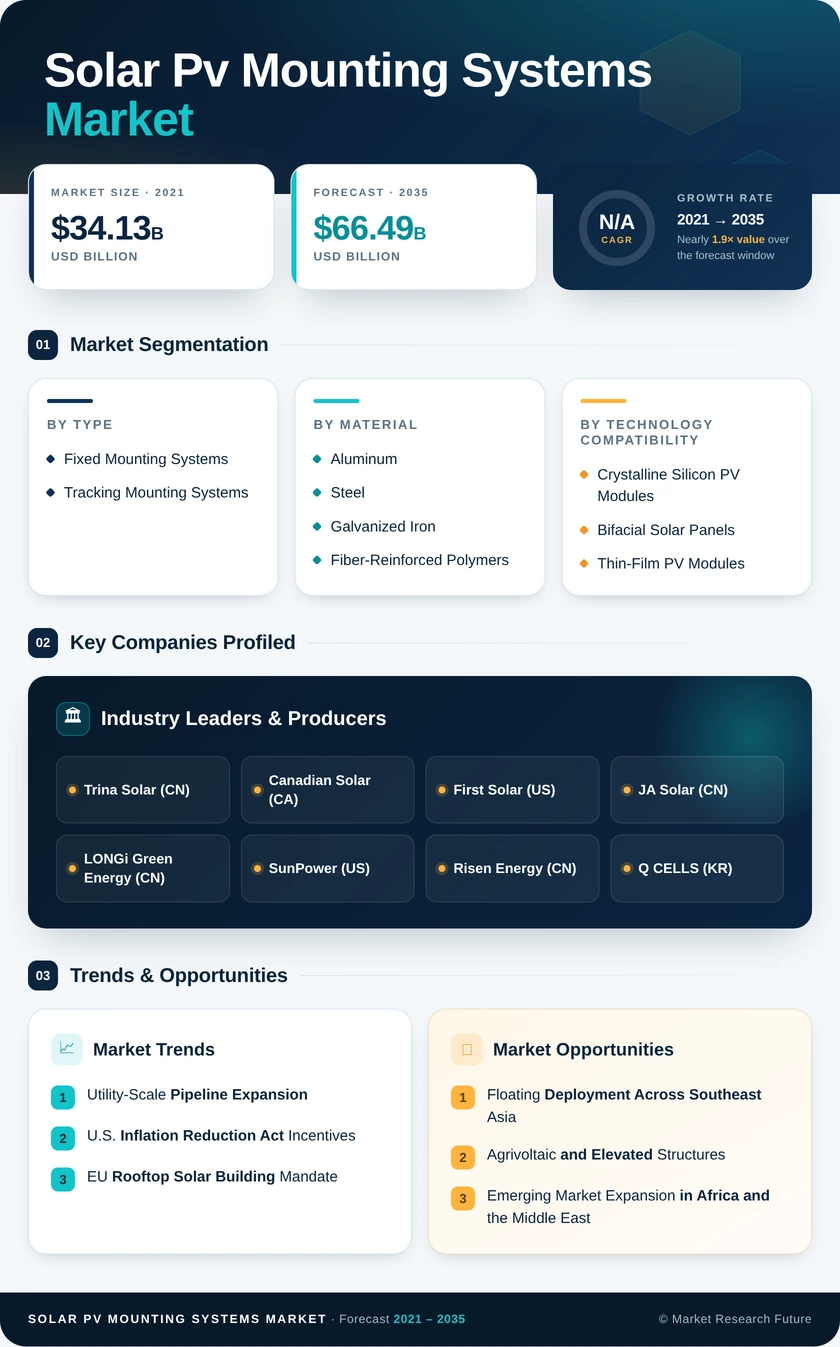
| Dimension | Sub-Segments | Dominant Segment | Fastest Growing Segment |
| By Type | Fixed Mounting Systems, Tracking Mounting Systems | Fixed Mounting Systems | Tracking Mounting Systems |
| By Material | Aluminum, Steel, Galvanized Iron, Fiber-Reinforced Polymers | Aluminum | Steel |
| By Technology Compatibility | Crystalline Silicon PV Modules, Bifacial Solar Panels, Thin-Film PV Modules | Crystalline Silicon PV Modules | Bifacial Solar Panels |
| By Application | Utility-Scale, Commercial, Residential, Floating Solar | Utility-Scale | Commercial |
Market Segmentation Overview
By Type
| Sub-Segment | Key Trend |
| Fixed Mounting Systems | Lowest installed cost on rooftops and small ground arrays |
| Tracking Mounting Systems | 20–25% yield uplift on high-irradiance land |
Fixed mounting systems remain the volume backbone of the Solar PV Mounting Systems Market because rooftop structural limits and small-site economics rarely justify moving parts. Tracking mounting systems are gaining faster, however, as wireless row controls and automatic hail-stow remove the reliability objections that once kept utilities cautious. Terrain-following lateral-adjust variants cut earthworks by close to 20% on sloped parcels, and dual-axis designs persist in a narrow high-irradiance niche where output gains reach 45%.
By Material
| Sub-Segment | Key Trend |
| Aluminum | Weight limits and corrosion resistance on roofs |
| Steel | Tensile strength per dollar on ground-mount |
| Galvanized Iron | Low-cost fabrication in price-sensitive markets |
| Fiber-Reinforced Polymers | Salt-spray immunity in coastal installations |
Aluminium leads the Solar PV Mounting Systems Market on rooftop physics: dead-load allowances leave little margin, and extruded rails install without site welding. Steel grows faster because utility-scale developers buy strength by the tonne, and larger modules raise the wind loads foundations must resist. Hybrid assemblies now pair galvanised steel piles with aluminium purlins, while fibre-reinforced polymers hold a small but defensible position in coastal and floating environments.
By Technology Compatibility
| Sub-Segment | Key Trend |
| Crystalline Silicon PV Modules | Installed base and standardised frame dimensions |
| Bifacial Solar Panels | Rear-side gain requiring clearance redesign |
| Thin-Film PV Modules | Lightweight adhesion on membrane roofs |
Crystalline silicon compatibility defines the default product architecture across the Solar PV Mounting Systems Market, since frame dimensions and clamping zones are standardised. Bifacial solar panels are forcing the fastest redesign cycle: manufacturers are raising clearance, narrowing cross-bracing, and adopting edge-grip clamps that avoid rear-glass micro-cracking. Thin-film modules retain a role on lightweight commercial roofs, where flexible laminates bond directly and eliminate penetrative fixing altogether.
By Application
| Sub-Segment | Key Trend |
| Utility-Scale | Auction pipelines and tracker cost declines |
| Commercial | Rooftop mandates and corporate procurement |
| Residential | Financing costs moderating retrofit demand |
| Floating Solar | Land scarcity and water-cooling yield gains |
Utility-scale deployment supplies half the revenue of the Solar PV Mounting Systems Market and sets the price benchmark that every other application references. Floating solar grows fastest by a wide margin, since reservoir and quarry siting sidesteps land acquisition entirely while water cooling trims module temperature by around 5 °C. Commercial rooftops advance


 Noah Malgeri
Co-Founder

 Peter Groot koerkamp
Account and Business Manager

 Younghwan Choi
Senior Retail Manager

 Mark Irwin
Management Consultant

 Akif Moroglu
Strategy & Business Development Director

 Guilherme Gomes Martins
Product Management Director

 Joseph Aguayo
Sales Operations & Pricing Manager

 La Terria Dodd
Program Support Specialist

 Rob Kooiker
Group Product Manager HVAC & Fire Protection GMA