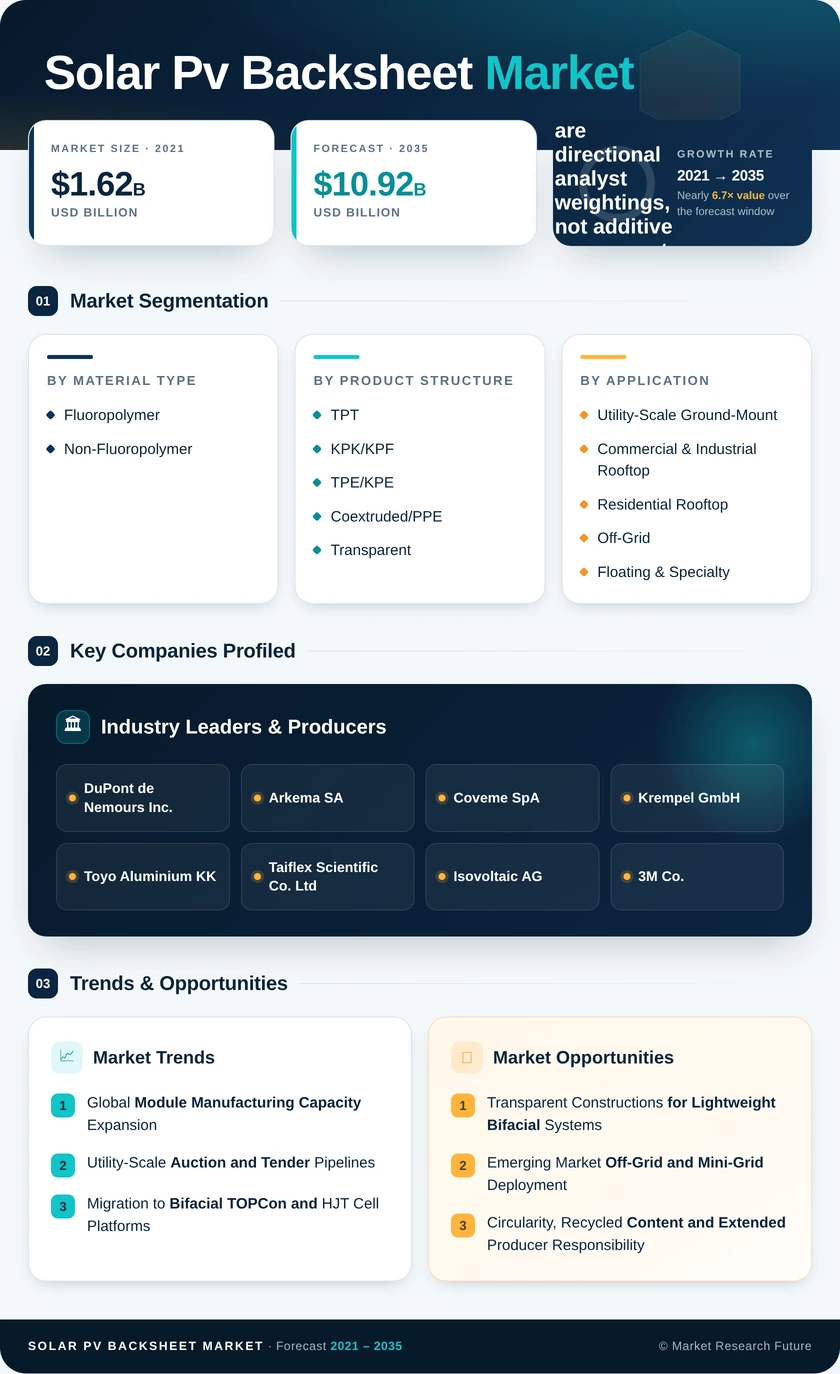
Segmentation Quick Reference
| Dimension | Sub-Segments | Dominant Segment | Fastest Growing Segment |
| By Material Type | Fluoropolymer; Non-Fluoropolymer | Fluoropolymer | Non-Fluoropolymer |
| By Product Structure | TPT; KPK/KPF; TPE/KPE; Coextruded/PPE; Transparent | KPK / KPF | Coextruded / PPE |
| By Application | Utility-Scale Ground-Mount; Commercial & Industrial Rooftop; Residential Rooftop; Off-Grid, Floating & Specialty | Utility-Scale Ground-Mount | Commercial & Industrial Rooftop |
| By End User | Module OEMs (Tier 1); Module OEMs (Tier 2/3); Repowering & Aftermarket | Module OEMs (Tier 1) | Module OEMs (Tier 2/3) |
| By Geography | North America; Europe; Asia-Pacific; South America; Middle East & Africa | Asia-Pacific | Asia-Pacific |
Market Segmentation Overview
By Material Type
| Sub-Segment | Key Trend |
| Fluoropolymer | Single-side constructions displace double-sided laminates as utility buyers optimize cost against actual UV exposure. |
| Non-Fluoropolymer | Polyolefin and fluorine-free polyester grades gain qualification wins as European regulatory risk reprices incumbent chemistries. |
Material choice now functions as a regulatory hedge as much as a performance decision. Fluoropolymer retains the bankability advantage that insurers and independent engineers expect for 30-year warranty tiers. Still, the durability gap has narrowed enough that non-fluoropolymer alternatives win on total installed cost in temperate climates. Suppliers carrying both chemistries hold the strongest position through the forecast window.
By Product Structure
| Sub-Segment | Key Trend |
| TPT (Tedlar-PET-Tedlar) | Legacy premium specification; volume share declining as buyers optimize the rear layer |
| KPK / KPF (PVDF-Faced) | Largest value pool; benefits directly from coextrusion cost reduction |
| TPE / KPE (Single-Side Fluoropolymer) | Balanced cost-durability profile winning incremental utility volume |
| Coextruded / PPE | Fastest structural growth on thin-layer material efficiency |
| Transparent | Premium pricing on bifacial rooftop systems where dual-glass weight is prohibitive |
Structure is where converters actually compete. Coextrusion has cut fluoropolymer consumption per square meter substantially while preserving accelerated weathering performance, which lets suppliers defend margin without abandoning the premium specification tier. Transparent grades remain the highest-value niche per square meter and face the fewest qualified competitors.
By Application
| Sub-Segment | Key Trend |
| Utility-Scale Ground-Mount | Largest volume pool but under sustained pressure from glass-glass substitution |
| Commercial & Industrial Rooftop | Building-level solar mandates in the EU and Japan protect polymer content on weight-constrained roofs. |
| Residential Rooftop | Self-consumption economics sustain steady demand; fragmented buyers support pricing. |
| Off-Grid, Floating & Specialty | Small volume, high margin; qualification credentials transfer into premium utility bids |
Application mix determines margin far more than headline volume. Rooftop segments are structurally defensible because dual-glass modules cannot meet load limits on most existing commercial roofs. Utility projects deliver scale but expose suppliers to the sharpest substitution and price-deflation risk over the next decade.
By End User
| Sub-Segment | Key Trend |
| Module OEMs (Tier 1) | Annual volume contracts with resin-index price adjustment clauses; deliberate multi-sourcing |
| Module OEMs (Tier 2/3) | Fastest growth as assembly capacity expands across India, Turkey, Brazil and Southeast Asia. |
| Repowering & Aftermarket | Emerging replacement stream driven by remediation of legacy polyamide installations |
Buyer concentration shapes commercial terms across the entire supply chain. Tier-one manufacturers negotiate from strength and rarely single-source, which keeps supplier fragmentation intact. Smaller assemblers pay a meaningful premium for equivalent specifications, making emerging-market accounts disproportionately attractive to converters with regional presence.


 Noah Malgeri
Co-Founder

 Peter Groot koerkamp
Account and Business Manager

 Younghwan Choi
Senior Retail Manager

 Mark Irwin
Management Consultant

 Akif Moroglu
Strategy & Business Development Director

 Guilherme Gomes Martins
Product Management Director

 Joseph Aguayo
Sales Operations & Pricing Manager

 La Terria Dodd
Program Support Specialist

 Rob Kooiker
Group Product Manager HVAC & Fire Protection GMA