Request Free Sample ×

Kindly complete the form below to receive a free sample of this Report

* Please use a valid business email

Leading companies partner with us for data-driven Insights

clients tt-cursor
Hero Background
English
Chinese
French
Japanese
Korean
German
Spanish

Solar Energy and Battery Storage Market Share

ID: MRFR/EnP/4410-HCR
125 Pages
Anshula Mandaokar
April 2026

Solar Energy and Battery Storage Market Research Report By Application (Residential, Commercial, Utility), By Battery Type (Lithium-Ion, Lead-Acid, Flow Battery, Nickel-Cadmium), By Technology (Solar Photovoltaic, Concentrated Solar Power, Solar Thermal), By End Use (Grid-tied, Off-grid, Hybrid) and By Regional (North America, Europe, South America, Asia Pacific, Middle East and Africa) - Growth & Industry Forecast to 2035

Share:
Download PDF ×

We do not share your information with anyone. However, we may send you emails based on your report interest from time to time. You may contact us at any time to opt-out.

Solar Energy and Battery Storage Market Infographic
Purchase Options

Market Share

Solar Energy and Battery Storage Market Share Analysis

Various procedures are utilized by organizations in the solar energy and battery storage industry to get an upper hand. Mechanical development, with an accentuation on the formation of refined sunlight-based chargers and energy stockpiling arrangements that outperform those of rivals regarding productivity, toughness, and cost-viability, is a common procedure. This approach requests organizations and earth cognizant buyers who are looking for trustworthy sustainable power options.

In the solar energy and battery storage industry, piece of the pie situating is fundamentally affected by essential unions. Partnerships are often settled by organizations with utility suppliers, state run administrations, and different partners to get to new business sectors, positive administrative conditions, and joint innovative work drives. These unions help organizations in conquering industry snags and lay out them as dependable members.

Cost initiative is a basic key methodology inside the solar energy and battery storage industry as it empowers organizations to give serious estimating and work with passage into new business sectors. This system additionally allows organizations to put resources into Research and development to foster creative assembling processes, which further decreases creation expenses and supports market infiltration and development.

Market division is an essential system utilized by elements working in the solar energy and battery storage industry to oblige different purchaser requests, including geographic area based energy utilization designs and administrative scenes. This system empowers associations to grow their market presence and effectively take special care of the necessities of private, business, and modern customer base.

The piece of the pie in the sustainable power area is significantly affected by brand situating. Associations try to develop a positive standing by putting accentuation on supportability, steadfastness, and client happiness. This technique requests to earth mindful customer base and cultivates trust in the organization.

Embracing client driven approaches, including the arrangement of extraordinary help, custom-made arrangements, and smooth mix of sun based and battery capacity frameworks, is basic for the procurement and upkeep of piece of the pie, as well as the development of brand loyalty.

The market for solar energy and battery storage is portrayed by quick innovative headways and extreme rivalry. Capable associations utilize strategies, for example, advancement, key unions, cost authority, market division, brand situating, and client driven ways to deal with increase their market presence and make commitments to the development of the environmentally friendly power industry.


Author
Author Profile
Anshula Mandaokar
Team Lead - Research

Anshula Mandaokar holds an academic degree in Chemical Engineering and has been contributing to the field for more than 5 years. She has expertise in Market Research and Business Consulting and serves as a Team Lead for a reputed Market Research firm under the Chemicals and Materials domain spectrum. She has worked on multiple projects, generating explicit results in a quick turnaround time. Her understanding of data interpretation justifies her role as a leader.

Leave a Comment

FAQs

What is the projected market valuation for the Solar Energy and Battery Storage Market in 2035?

<p>The projected market valuation for the Solar Energy and Battery Storage Market in 2035 is 0.6016 USD Billion.</p>

What was the market valuation in 2024?

<p>The overall market valuation was 0.14 USD Billion in 2024.</p>

What is the expected CAGR for the Solar Energy and Battery Storage Market from 2025 to 2035?

<p>The expected CAGR for the Solar Energy and Battery Storage Market during the forecast period 2025 - 2035 is 14.17%.</p>

Which companies are considered key players in the Solar Energy and Battery Storage Market?

<p>Key players in the market include First Solar, NextEra Energy, Canadian Solar, SunPower, Enphase Energy, Tesla, SMA Solar Technology, LG Energy Solution, JinkoSolar, and Trina Solar.</p>

What are the main applications of solar energy in the market?

<p>The main applications of solar energy in the market include Residential, Commercial, and Utility segments, with valuations of 0.25, 0.18, and 0.1316 USD Billion respectively.</p>

What types of batteries are utilized in the Solar Energy and Battery Storage Market?

<p>The types of batteries utilized in the market include Lithium-Ion, Lead-Acid, Flow Batteries, and Nickel-Cadmium, with Lithium-Ion leading at 0.3 USD Billion.</p>

What technologies are employed in solar energy production?

<p>Technologies employed in solar energy production include Solar Photovoltaic, Concentrated Solar Power, and Solar Thermal, with Solar Photovoltaic valued at 0.3 USD Billion.</p>

How is the market segmented by end use?

<p>The market is segmented by end use into Grid-tied, Off-grid, and Hybrid systems, with Grid-tied systems valued at 0.3016 USD Billion.</p>

What trends are influencing the growth of the Solar Energy and Battery Storage Market?

<p>Trends influencing growth include increasing demand for renewable energy, technological advancements, and supportive government policies.</p>

How does the market performance in 2025 compare to 2024?

<p>The market performance in 2025 is expected to show substantial growth compared to the 0.14 USD Billion valuation in 2024, reflecting the anticipated upward trajectory.</p>

Market Summary

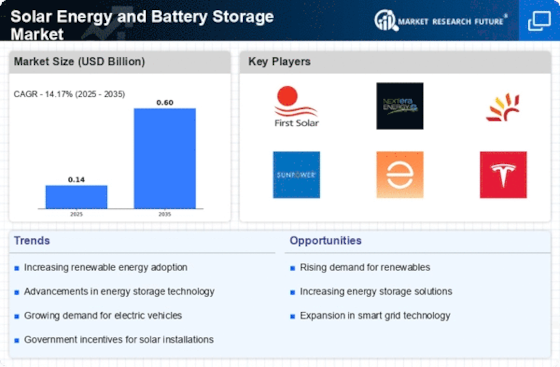
As per Market Research Future analysis, the Solar Energy and Battery Storage Market was estimated at 0.14 USD Billion in 2024. The market is projected to grow from 0.1598 USD Billion in 2025 to 0.6016 USD Billion by 2035, exhibiting a compound annual growth rate (CAGR) of 14.1% during the forecast period 2025 - 2035

Key Market Trends & Highlights

The Solar Energy and Battery Storage Market is poised for substantial growth driven by technological advancements and increasing consumer adoption.

  • Technological advancements in energy storage are enhancing efficiency and performance across the market. In North America, the residential segment remains the largest, while the commercial segment is experiencing rapid growth in Asia-Pacific. Lithium-ion batteries dominate the market, yet flow batteries are emerging as the fastest-growing technology segment. Rising demand for renewable energy and declining costs of solar technologies are key drivers propelling market expansion.

Market Size & Forecast

2024 Market Size 0.14 (USD Billion)
2035 Market Size 0.6016 (USD Billion)
CAGR (2025 - 2035) 14.17%
Largest Regional Market Share in 2024 Asia Pacific

Major Players

First Solar (US), NextEra Energy (US), Canadian Solar (CA), <a href="https://us.sunpower.com/home-solar/solar-battery-storage">SunPower</a> (US), Enphase Energy (US), Tesla (US), SMA Solar Technology (DE), LG Energy Solution (KR), JinkoSolar (CN), Trina Solar (CN)

Market Trends

The Solar Energy and Battery Storage Market is currently experiencing a transformative phase characterized by rapid advancements in technology and increasing consumer awareness regarding sustainable energy solutions. The integration of solar energy systems with battery storage is becoming more prevalent, as it offers a reliable means to harness renewable energy while addressing the intermittency issues associated with solar power generation. This synergy not only enhances energy efficiency but also empowers consumers to take control of their energy consumption, leading to a more decentralized energy landscape. Furthermore, government policies and incentives are playing a crucial role in promoting the adoption of solar energy and battery storage solutions, thereby fostering a favorable environment for market growth. In addition to technological innovations, the Solar Energy and Battery Storage Market is witnessing a shift in consumer preferences towards eco-friendly energy sources. As environmental concerns continue to rise, individuals and businesses alike are increasingly seeking sustainable alternatives to traditional energy sources. This trend is further supported by the declining costs of solar panels and battery systems, making them more accessible to a broader audience. The market appears poised for continued expansion, driven by a combination of technological advancements, supportive policies, and a growing commitment to sustainability. As the landscape evolves, stakeholders must remain vigilant to adapt to emerging trends and consumer demands, ensuring a resilient and sustainable energy future.

Technological Advancements in Energy Storage

Recent innovations in battery technology are enhancing the efficiency and capacity of energy storage systems. These advancements enable longer storage durations and faster charging times, making solar energy more viable for everyday use. As technology progresses, the integration of smart systems is likely to optimize energy management, further driving market growth.

Increased Consumer Adoption

There is a noticeable shift in consumer behavior towards adopting solar energy and battery storage solutions. Individuals and businesses are increasingly motivated by the desire for energy independence and cost savings. This trend suggests a growing awareness of the benefits associated with renewable energy, which may lead to a more widespread acceptance of these technologies.

Supportive Regulatory Frameworks

Government policies and incentives are playing a pivotal role in shaping the Solar Energy and Battery Storage Market. Various initiatives aimed at promoting renewable energy adoption are likely to create a conducive environment for investment and innovation. This regulatory support may enhance market stability and encourage further advancements in solar and storage technologies.

Solar Energy and Battery Storage Market Market Drivers

Growing Environmental Regulations

The Solar Energy and Battery Storage Market is increasingly influenced by stringent environmental regulations aimed at reducing greenhouse gas emissions. Governments worldwide are implementing policies that mandate a transition to cleaner energy sources, thereby creating a favorable environment for solar energy adoption. For example, emissions reduction targets and renewable energy mandates are compelling utilities and businesses to invest in solar energy systems and battery storage solutions. This regulatory push not only fosters market growth but also encourages innovation in solar technologies. As environmental regulations become more rigorous, the demand for solar energy and battery storage is expected to rise, further solidifying their role in the energy landscape.

Rising Demand for Renewable Energy

The Solar Energy and Battery Storage Market is experiencing a notable surge in demand for renewable energy sources. This trend is largely driven by increasing awareness of climate change and the need for sustainable energy solutions. According to recent data, renewable energy accounted for approximately 29% of total electricity generation, with solar energy being a significant contributor. As consumers and businesses alike seek to reduce their carbon footprints, the adoption of solar energy systems and battery storage solutions is likely to accelerate. This shift not only aligns with environmental goals but also offers potential cost savings on energy bills, further incentivizing investment in solar technologies.

Government Incentives and Subsidies

The Solar Energy and Battery Storage Market benefits significantly from various government incentives and subsidies aimed at promoting renewable energy adoption. Many governments have implemented tax credits, rebates, and grants to encourage the installation of solar energy systems and battery storage solutions. For instance, certain regions offer up to 30% tax credits for solar installations, which can substantially lower the upfront costs for consumers. These financial incentives not only stimulate market growth but also enhance the overall attractiveness of solar energy as a viable alternative to traditional energy sources. As these programs evolve, they are likely to further bolster the market.

Declining Costs of Solar Technologies

The Solar Energy and Battery Storage Market is witnessing a dramatic decline in the costs associated with solar technologies. Over the past decade, the price of solar photovoltaic (PV) systems has decreased by nearly 90%, making solar energy more accessible to a broader audience. This reduction in costs is attributed to advancements in manufacturing processes and economies of scale. As prices continue to fall, more consumers and businesses are likely to invest in solar energy systems, thereby driving growth in the market. Additionally, the decreasing costs of battery storage solutions complement this trend, as they enhance the viability of solar energy by providing reliable energy storage options.

Technological Innovations in Energy Storage

The Solar Energy and Battery Storage Market is being propelled by ongoing technological innovations in energy storage solutions. Advances in battery technologies, such as lithium-ion and solid-state batteries, are enhancing the efficiency and capacity of energy storage systems. These innovations allow for better integration of solar energy into the grid, addressing intermittency issues associated with solar power generation. As energy storage becomes more efficient and cost-effective, it is expected to play a crucial role in the widespread adoption of solar energy systems. This synergy between solar energy and advanced storage technologies is likely to redefine energy consumption patterns in the coming years.

Market Segment Insights

By Application: Residential (Largest) vs. Commercial (Fastest-Growing)

The Solar Energy and Battery Storage Market shows remarkable segmentation in its application area, predominantly featuring three key sections: residential, commercial, and utility. Of these, the residential segment currently holds the largest share, driven by a growing consumer preference for sustainable energy solutions and the increasing installation of rooftop solar panels. The commercial sector, while smaller in share compared to residential, is rapidly expanding as businesses recognize the potential savings and sustainability benefits associated with solar energy and battery storage systems.

Application: Residential (Dominant) vs. Commercial (Emerging)

The residential segment is characterized by widespread adoption, primarily due to governmental incentives and the decreasing costs of solar technologies, making it an attractive option for homeowners. This segment leads in the market share, reflecting a shift towards energy independence and eco-conscious living. Conversely, the commercial segment, deemed emerging, is witnessing accelerated growth as firms pursue renewable energy solutions to reduce operational costs and enhance their brand image. The drive for corporate sustainability, combined with advancements in technology and financing options, is propelling commercial installations upward, thereby shaping the overall dynamics of the market.

By Battery Type: Lithium-Ion (Largest) vs. Flow Batteries (Fastest-Growing)

In the Solar Energy and Battery Storage Market, the 'Battery Type' segment exhibits a diverse range of technologies, with Lithium-Ion batteries commanding the largest market share due to their high energy density and efficiency. Lead-Acid batteries follow, offering cost advantages but with lower efficiency and longevity. Flow Batteries, while currently a smaller portion of the market, are gaining traction as they provide scalability and long-duration energy storage solutions, catering to the growing need for renewable energy integration. Nickel-Cadmium, though historically significant, is witnessing decline due to environmental concerns and competition from newer technologies.

Battery Type: Lithium-Ion (Dominant) vs. Lead-Acid (Emerging)

<a href="https://www.marketresearchfuture.com/reports/li-ion-battery-recycling-market-10583">Lithium-Ion batteries</a> are the dominant force within the solar energy storage market, credited for their high performance, longevity, and rapidly declining costs, making them ideal for numerous applications from residential to commercial. Conversely, Lead-Acid batteries, while traditionally utilized due to their lower upfront costs, are becoming increasingly seen as an emerging option optimized for specific applications where weight and space limitations are less critical. Their slower charge/discharge rates and shorter lifespan make them less favorable for large-scale adoption compared to Lithium-Ion; however, they still capture a niche market, particularly in backup power systems. As renewable energy usage accelerates, both types have unique roles and characteristics that will shape their future in the segment.

By Technology: Solar Photovoltaic (Largest) vs. Concentrated Solar Power (Fastest-Growing)

The Solar Energy and Battery Storage Market is largely dominated by Solar Photovoltaic (PV) technology, which consistently holds the largest market share due to its widespread adoption and affordability. <a href="https://www.marketresearchfuture.com/reports/concentrating-solar-power-market-2104">Concentrated Solar Power</a> (CSP), while a smaller segment, is rapidly gaining traction, particularly in regions with high solar insolation, as technological advancements enhance its efficiency and output, making it a compelling alternative to traditional methods. The Solar Thermal segment also holds relevance but lags behind the other two technologies in market share and application diversity.

Technology: Solar Photovoltaic (Dominant) vs. Concentrated Solar Power (Emerging)

Solar Photovoltaic technology is the dominant force in the Solar Energy market, characterized by its versatility and scalability, making it suitable for residential, commercial, and utility-scale applications. Its widespread adoption is supported by decreasing costs and increasing efficiency rates. Conversely, Concentrated Solar Power is emerging as a compelling option, particularly for large-scale solar projects, as it utilizes mirrors or lenses to concentrate sunlight, thereby generating heat to drive turbines. This technology thrives in areas with high direct sunlight and is increasingly recognized for its ability to provide energy even after sunset, supported by thermal storage solutions.

By End Use: Grid-tied (Largest) vs. Off-grid (Fastest-Growing)

In the Solar Energy and Battery Storage Market, the end-use segment is primarily divided into three categories: grid-tied, off-grid, and hybrid systems. Among these, grid-tied applications hold the largest share, benefiting from established infrastructure and the growing integration of solar installations with the electrical grid. Off-grid systems, while currently smaller in market share, are rapidly gaining traction as consumers prioritize energy independence, particularly in remote areas and regions with unreliable grid access.

Grid-tied (Dominant) vs. Off-grid (Emerging)

Grid-tied solar energy systems are recognized as the dominant force within the end-use segment due to their efficiency and ability to leverage existing grid infrastructure. These systems facilitate seamless energy exchange, allowing users to sell excess power back to the grid. In contrast, off-grid systems, characterized by their autonomy, represent an emerging market segment driven by increasing consumer demand for sustainable energy solutions. With technological advancements and decreasing costs, off-grid systems are becoming more accessible, appealing to environmentally conscious consumers seeking energy resilience in remote locales.

Get more detailed insights about Solar Energy and Battery Storage Market Research Report – Forecast to 2035

Regional Insights

North America : Innovation and Investment Hub

North America is a powerhouse in the solar energy and battery storage market, driven by strong government incentives, technological advancements, and increasing consumer demand for renewable energy. The United States holds the largest market share at approximately 70%, followed by Canada at around 10%. Regulatory frameworks, such as the Investment Tax Credit (ITC), have catalyzed growth, making solar energy more accessible and affordable for consumers. The competitive landscape is dominated by key players like First Solar, NextEra Energy, and Tesla, which are leading innovations in solar technology and energy storage solutions. The U.S. market is characterized by a diverse range of projects, from residential installations to large-scale solar farms. Canada is also emerging with significant investments in solar energy, supported by provincial incentives and a commitment to reducing carbon emissions.

Europe : Sustainable Energy Transition Leader

Europe is at the forefront of the solar energy and battery storage market, propelled by ambitious climate goals and robust regulatory frameworks. The European Union aims to achieve a 55% reduction in greenhouse gas emissions by 2030, which has led to a surge in solar installations across member states. Germany and France are the largest markets, holding approximately 30% and 15% market shares, respectively, driven by favorable policies and public support for renewable energy. Leading countries like Germany, Spain, and Italy are home to major players such as SMA Solar Technology and Enphase Energy. The competitive landscape is marked by innovation in solar technology and energy storage solutions, with a focus on sustainability. The European market is characterized by a strong emphasis on energy efficiency and integration of renewable sources into the grid, fostering a collaborative environment for growth.

Asia-Pacific : Emerging Powerhouse in Renewables

Asia-Pacific is rapidly emerging as a significant player in the solar energy and battery storage market, driven by increasing energy demands and government initiatives promoting renewable energy. China is the largest market globally, accounting for over 40% of the total market share, followed by Japan and India, which hold approximately 10% and 8%, respectively. The region benefits from substantial investments in solar infrastructure and favorable policies aimed at reducing carbon emissions. China's dominance is underscored by key players like JinkoSolar and Trina Solar, which are leading in solar panel manufacturing and technology. Japan and India are also witnessing a surge in solar projects, supported by government incentives and public-private partnerships. The competitive landscape is characterized by rapid technological advancements and a growing focus on energy storage solutions to enhance grid stability and efficiency.

Middle East and Africa : Resource-Rich Frontier for Solar

The Middle East and Africa region is poised for significant growth in the solar energy and battery storage market, driven by abundant sunlight and increasing energy demands. Countries like South Africa and the United Arab Emirates are leading the charge, with the UAE holding approximately 15% of the market share, followed by South Africa at around 5%. Government initiatives and investments in renewable energy projects are catalyzing this growth, aiming to diversify energy sources and reduce reliance on fossil fuels. The competitive landscape is evolving, with key players like First Solar and local firms entering the market. The region's potential is vast, with numerous solar projects in the pipeline, supported by international investments and partnerships. As the focus shifts towards sustainable energy solutions, the Middle East and Africa are becoming attractive destinations for solar energy investments, promising a bright future for the industry.

Key Players and Competitive Insights

The Solar Energy and Battery Storage Market is currently characterized by a dynamic competitive landscape, driven by increasing demand for renewable energy solutions and advancements in technology. Key players such as First Solar (US), NextEra Energy (US), and Tesla (US) are strategically positioning themselves through innovation and regional expansion. First Solar (US) focuses on developing advanced thin-film solar technology, while NextEra Energy (US) emphasizes large-scale solar and wind projects, indicating a diversified approach to renewable energy. Tesla (US), on the other hand, integrates solar energy with battery storage solutions, enhancing its competitive edge in the energy ecosystem. Collectively, these strategies contribute to a robust competitive environment, where innovation and sustainability are paramount. In terms of business tactics, companies are increasingly localizing manufacturing and optimizing supply chains to enhance efficiency and reduce costs. The market appears moderately fragmented, with a mix of established players and emerging companies vying for market share. This competitive structure allows for a variety of approaches, as companies leverage their unique strengths to capture consumer interest and adapt to regional demands. In August 2025, First Solar (US) announced a significant expansion of its manufacturing capacity in the United States, aiming to produce more than 10 gigawatts of solar panels annually. This move is strategically important as it not only bolsters domestic production but also aligns with the growing trend of energy independence and local job creation. By increasing its manufacturing footprint, First Solar (US) positions itself to meet the surging demand for solar energy while mitigating supply chain vulnerabilities. In September 2025, NextEra Energy (US) unveiled plans to invest $5 billion in renewable energy projects over the next five years, focusing on solar and battery storage. This investment underscores the company's commitment to sustainability and its proactive approach to scaling operations in response to market demands. By prioritizing large-scale projects, NextEra Energy (US) aims to solidify its leadership position in the renewable energy sector, potentially influencing market dynamics significantly. In October 2025, Tesla (US) launched a new version of its solar roof tiles, which are designed to be more efficient and cost-effective. This innovation reflects Tesla's ongoing commitment to integrating cutting-edge technology into its product offerings. The introduction of enhanced solar roof tiles may not only attract new customers but also reinforce Tesla's reputation as a leader in the solar energy market, further differentiating it from competitors. As of October 2025, current competitive trends in the Solar Energy and Battery Storage Market are increasingly defined by digitalization, sustainability, and the integration of artificial intelligence. Strategic alliances among key players are shaping the landscape, fostering collaboration that enhances technological advancements and market reach. Looking ahead, competitive differentiation is likely to evolve from traditional price-based competition to a focus on innovation, technological prowess, and supply chain reliability, as companies strive to meet the growing expectations of environmentally conscious consumers.

Key Companies in the Solar Energy and Battery Storage Market include

Industry Developments

In recent months, the Solar Energy and Battery Storage Market has witnessed significant developments. In September 2023, First Solar announced plans to expand its manufacturing capacity in the United States, emphasizing its commitment to domestic production of solar panels. This expansion aligns with the increasing domestic energy requirements and government incentives. Simultaneously, in October 2023, Tesla launched upgraded versions of its solar products and energy storage solutions, enhancing efficiency and integrating with the electric vehicle ecosystem, which bolsters its position in the competitive market.

Furthermore, in August 2023, Enphase Energy entered into a partnership with BYD to promote combined solar and energy storage solutions, aiming to increase market penetration in renewable energy sectors.

In terms of mergers and acquisitions, Brookfield Renewable Partners completed the acquisition of a large-scale solar project in California from a well-known solar developer in July 2023, reflecting the ongoing trend of consolidation in the sector. Furthermore, Trina Solar and JinkoSolar continue to report increasing revenues, driven by rising demands for solar installations globally. With these advancements, the market is positioned for notable growth, with ongoing investments shaping the future landscape of renewable energy technologies.

Future Outlook

Solar Energy and Battery Storage Market Future Outlook

The Solar Energy and Battery Storage Market is projected to grow at a 14.17% CAGR from 2025 to 2035, driven by technological advancements, regulatory support, and increasing energy demand.

New opportunities lie in:

  • <p>Development of integrated solar-plus-storage solutions for commercial sectors. Expansion of energy-as-a-service models for residential customers. Investment in advanced battery recycling technologies to enhance sustainability.</p>

By 2035, the market is expected to be robust, driven by innovation and increasing adoption.

Market Segmentation

Solar Energy and Battery Storage Market End Use Outlook

  • Grid-tied
  • Off-grid
  • Hybrid

Solar Energy and Battery Storage Market Technology Outlook

  • Solar Photovoltaic
  • Concentrated Solar Power
  • Solar Thermal

Solar Energy and Battery Storage Market Application Outlook

  • Residential
  • Commercial
  • Utility

Solar Energy and Battery Storage Market Battery Type Outlook

  • Lithium-Ion
  • Lead-Acid
  • Flow Batteries
  • Nickel-Cadmium

Report Scope

MARKET SIZE 2024 0.14(USD Billion)
MARKET SIZE 2025 0.1598(USD Billion)
MARKET SIZE 2035 0.6016(USD Billion)
COMPOUND ANNUAL GROWTH RATE (CAGR) 14.17% (2025 - 2035)
REPORT COVERAGE Revenue Forecast, Competitive Landscape, Growth Factors, and Trends
BASE YEAR 2024
Market Forecast Period 2025 - 2035
Historical Data 2019 - 2024
Market Forecast Units USD Billion
Key Companies Profiled First Solar (US), NextEra Energy (US), Canadian Solar (CA), SunPower (US), Enphase Energy (US), Tesla (US), SMA Solar Technology (DE), LG Energy Solution (KR), JinkoSolar (CN), Trina Solar (CN)
Segments Covered Application, Battery Type, Technology, End Use, Regional
Key Market Opportunities Integration of advanced energy storage solutions enhances solar energy reliability and grid resilience.
Key Market Dynamics Rising demand for renewable energy drives innovation in solar technology and battery storage solutions.
Countries Covered North America, Europe, APAC, South America, MEA

FAQs

What is the projected market valuation for the Solar Energy and Battery Storage Market in 2035?

<p>The projected market valuation for the Solar Energy and Battery Storage Market in 2035 is 0.6016 USD Billion.</p>

What was the market valuation in 2024?

<p>The overall market valuation was 0.14 USD Billion in 2024.</p>

What is the expected CAGR for the Solar Energy and Battery Storage Market from 2025 to 2035?

<p>The expected CAGR for the Solar Energy and Battery Storage Market during the forecast period 2025 - 2035 is 14.17%.</p>

Which companies are considered key players in the Solar Energy and Battery Storage Market?

<p>Key players in the market include First Solar, NextEra Energy, Canadian Solar, SunPower, Enphase Energy, Tesla, SMA Solar Technology, LG Energy Solution, JinkoSolar, and Trina Solar.</p>

What are the main applications of solar energy in the market?

<p>The main applications of solar energy in the market include Residential, Commercial, and Utility segments, with valuations of 0.25, 0.18, and 0.1316 USD Billion respectively.</p>

What types of batteries are utilized in the Solar Energy and Battery Storage Market?

<p>The types of batteries utilized in the market include Lithium-Ion, Lead-Acid, Flow Batteries, and Nickel-Cadmium, with Lithium-Ion leading at 0.3 USD Billion.</p>

What technologies are employed in solar energy production?

<p>Technologies employed in solar energy production include Solar Photovoltaic, Concentrated Solar Power, and Solar Thermal, with Solar Photovoltaic valued at 0.3 USD Billion.</p>

How is the market segmented by end use?

<p>The market is segmented by end use into Grid-tied, Off-grid, and Hybrid systems, with Grid-tied systems valued at 0.3016 USD Billion.</p>

What trends are influencing the growth of the Solar Energy and Battery Storage Market?

<p>Trends influencing growth include increasing demand for renewable energy, technological advancements, and supportive government policies.</p>

How does the market performance in 2025 compare to 2024?

<p>The market performance in 2025 is expected to show substantial growth compared to the 0.14 USD Billion valuation in 2024, reflecting the anticipated upward trajectory.</p>

  1. SECTION I: EXECUTIVE SUMMARY AND KEY HIGHLIGHTS
    1. | 1.1 EXECUTIVE SUMMARY
    2. | | 1.1.1 Market Overview
    3. | | 1.1.2 Key Findings
    4. | | 1.1.3 Market Segmentation
    5. | | 1.1.4 Competitive Landscape
    6. | | 1.1.5 Challenges and Opportunities
    7. | | 1.1.6 Future Outlook
  2. SECTION II: SCOPING, METHODOLOGY AND MARKET STRUCTURE
    1. | 2.1 MARKET INTRODUCTION
    2. | | 2.1.1 Definition
    3. | | 2.1.2 Scope of the study
    4. | | | 2.1.2.1 Research Objective
    5. | | | 2.1.2.2 Assumption
    6. | | | 2.1.2.3 Limitations
    7. | 2.2 RESEARCH METHODOLOGY
    8. | | 2.2.1 Overview
    9. | | 2.2.2 Data Mining
    10. | | 2.2.3 Secondary Research
    11. | | 2.2.4 Primary Research
    12. | | | 2.2.4.1 Primary Interviews and Information Gathering Process
    13. | | | 2.2.4.2 Breakdown of Primary Respondents
    14. | | 2.2.5 Forecasting Model
    15. | | 2.2.6 Market Size Estimation
    16. | | | 2.2.6.1 Bottom-Up Approach
    17. | | | 2.2.6.2 Top-Down Approach
    18. | | 2.2.7 Data Triangulation
    19. | | 2.2.8 Validation
  3. SECTION III: QUALITATIVE ANALYSIS
    1. | 3.1 MARKET DYNAMICS
    2. | | 3.1.1 Overview
    3. | | 3.1.2 Drivers
    4. | | 3.1.3 Restraints
    5. | | 3.1.4 Opportunities
    6. | 3.2 MARKET FACTOR ANALYSIS
    7. | | 3.2.1 Value chain Analysis
    8. | | 3.2.2 Porter's Five Forces Analysis
    9. | | | 3.2.2.1 Bargaining Power of Suppliers
    10. | | | 3.2.2.2 Bargaining Power of Buyers
    11. | | | 3.2.2.3 Threat of New Entrants
    12. | | | 3.2.2.4 Threat of Substitutes
    13. | | | 3.2.2.5 Intensity of Rivalry
    14. | | 3.2.3 COVID-19 Impact Analysis
    15. | | | 3.2.3.1 Market Impact Analysis
    16. | | | 3.2.3.2 Regional Impact
    17. | | | 3.2.3.3 Opportunity and Threat Analysis
  4. SECTION IV: QUANTITATIVE ANALYSIS
    1. | 4.1 Energy & Power, BY Application (USD Billion)
    2. | | 4.1.1 Residential
    3. | | 4.1.2 Commercial
    4. | | 4.1.3 Utility
    5. | 4.2 Energy & Power, BY Battery Type (USD Billion)
    6. | | 4.2.1 Lithium-Ion
    7. | | 4.2.2 Lead-Acid
    8. | | 4.2.3 Flow Batteries
    9. | | 4.2.4 Nickel-Cadmium
    10. | 4.3 Energy & Power, BY Technology (USD Billion)
    11. | | 4.3.1 Solar Photovoltaic
    12. | | 4.3.2 Concentrated Solar Power
    13. | | 4.3.3 Solar Thermal
    14. | 4.4 Energy & Power, BY End Use (USD Billion)
    15. | | 4.4.1 Grid-tied
    16. | | 4.4.2 Off-grid
    17. | | 4.4.3 Hybrid
    18. | 4.5 Energy & Power, BY Region (USD Billion)
    19. | | 4.5.1 North America
    20. | | | 4.5.1.1 US
    21. | | | 4.5.1.2 Canada
    22. | | 4.5.2 Europe
    23. | | | 4.5.2.1 Germany
    24. | | | 4.5.2.2 UK
    25. | | | 4.5.2.3 France
    26. | | | 4.5.2.4 Russia
    27. | | | 4.5.2.5 Italy
    28. | | | 4.5.2.6 Spain
    29. | | | 4.5.2.7 Rest of Europe
    30. | | 4.5.3 APAC
    31. | | | 4.5.3.1 China
    32. | | | 4.5.3.2 India
    33. | | | 4.5.3.3 Japan
    34. | | | 4.5.3.4 South Korea
    35. | | | 4.5.3.5 Malaysia
    36. | | | 4.5.3.6 Thailand
    37. | | | 4.5.3.7 Indonesia
    38. | | | 4.5.3.8 Rest of APAC
    39. | | 4.5.4 South America
    40. | | | 4.5.4.1 Brazil
    41. | | | 4.5.4.2 Mexico
    42. | | | 4.5.4.3 Argentina
    43. | | | 4.5.4.4 Rest of South America
    44. | | 4.5.5 MEA
    45. | | | 4.5.5.1 GCC Countries
    46. | | | 4.5.5.2 South Africa
    47. | | | 4.5.5.3 Rest of MEA
  5. SECTION V: COMPETITIVE ANALYSIS
    1. | 5.1 Competitive Landscape
    2. | | 5.1.1 Overview
    3. | | 5.1.2 Competitive Analysis
    4. | | 5.1.3 Market share Analysis
    5. | | 5.1.4 Major Growth Strategy in the Energy & Power
    6. | | 5.1.5 Competitive Benchmarking
    7. | | 5.1.6 Leading Players in Terms of Number of Developments in the Energy & Power
    8. | | 5.1.7 Key developments and growth strategies
    9. | | | 5.1.7.1 New Product Launch/Service Deployment
    10. | | | 5.1.7.2 Merger & Acquisitions
    11. | | | 5.1.7.3 Joint Ventures
    12. | | 5.1.8 Major Players Financial Matrix
    13. | | | 5.1.8.1 Sales and Operating Income
    14. | | | 5.1.8.2 Major Players R&D Expenditure. 2023
    15. | 5.2 Company Profiles
    16. | | 5.2.1 First Solar (US)
    17. | | | 5.2.1.1 Financial Overview
    18. | | | 5.2.1.2 Products Offered
    19. | | | 5.2.1.3 Key Developments
    20. | | | 5.2.1.4 SWOT Analysis
    21. | | | 5.2.1.5 Key Strategies
    22. | | 5.2.2 NextEra Energy (US)
    23. | | | 5.2.2.1 Financial Overview
    24. | | | 5.2.2.2 Products Offered
    25. | | | 5.2.2.3 Key Developments
    26. | | | 5.2.2.4 SWOT Analysis
    27. | | | 5.2.2.5 Key Strategies
    28. | | 5.2.3 Canadian Solar (CA)
    29. | | | 5.2.3.1 Financial Overview
    30. | | | 5.2.3.2 Products Offered
    31. | | | 5.2.3.3 Key Developments
    32. | | | 5.2.3.4 SWOT Analysis
    33. | | | 5.2.3.5 Key Strategies
    34. | | 5.2.4 SunPower (US)
    35. | | | 5.2.4.1 Financial Overview
    36. | | | 5.2.4.2 Products Offered
    37. | | | 5.2.4.3 Key Developments
    38. | | | 5.2.4.4 SWOT Analysis
    39. | | | 5.2.4.5 Key Strategies
    40. | | 5.2.5 Enphase Energy (US)
    41. | | | 5.2.5.1 Financial Overview
    42. | | | 5.2.5.2 Products Offered
    43. | | | 5.2.5.3 Key Developments
    44. | | | 5.2.5.4 SWOT Analysis
    45. | | | 5.2.5.5 Key Strategies
    46. | | 5.2.6 Tesla (US)
    47. | | | 5.2.6.1 Financial Overview
    48. | | | 5.2.6.2 Products Offered
    49. | | | 5.2.6.3 Key Developments
    50. | | | 5.2.6.4 SWOT Analysis
    51. | | | 5.2.6.5 Key Strategies
    52. | | 5.2.7 SMA Solar Technology (DE)
    53. | | | 5.2.7.1 Financial Overview
    54. | | | 5.2.7.2 Products Offered
    55. | | | 5.2.7.3 Key Developments
    56. | | | 5.2.7.4 SWOT Analysis
    57. | | | 5.2.7.5 Key Strategies
    58. | | 5.2.8 LG Energy Solution (KR)
    59. | | | 5.2.8.1 Financial Overview
    60. | | | 5.2.8.2 Products Offered
    61. | | | 5.2.8.3 Key Developments
    62. | | | 5.2.8.4 SWOT Analysis
    63. | | | 5.2.8.5 Key Strategies
    64. | | 5.2.9 JinkoSolar (CN)
    65. | | | 5.2.9.1 Financial Overview
    66. | | | 5.2.9.2 Products Offered
    67. | | | 5.2.9.3 Key Developments
    68. | | | 5.2.9.4 SWOT Analysis
    69. | | | 5.2.9.5 Key Strategies
    70. | | 5.2.10 Trina Solar (CN)
    71. | | | 5.2.10.1 Financial Overview
    72. | | | 5.2.10.2 Products Offered
    73. | | | 5.2.10.3 Key Developments
    74. | | | 5.2.10.4 SWOT Analysis
    75. | | | 5.2.10.5 Key Strategies
    76. | 5.3 Appendix
    77. | | 5.3.1 References
    78. | | 5.3.2 Related Reports
  6. LIST OF FIGURES
    1. | 6.1 MARKET SYNOPSIS
    2. | 6.2 NORTH AMERICA MARKET ANALYSIS
    3. | 6.3 US MARKET ANALYSIS BY APPLICATION
    4. | 6.4 US MARKET ANALYSIS BY BATTERY TYPE
    5. | 6.5 US MARKET ANALYSIS BY TECHNOLOGY
    6. | 6.6 US MARKET ANALYSIS BY END USE
    7. | 6.7 CANADA MARKET ANALYSIS BY APPLICATION
    8. | 6.8 CANADA MARKET ANALYSIS BY BATTERY TYPE
    9. | 6.9 CANADA MARKET ANALYSIS BY TECHNOLOGY
    10. | 6.10 CANADA MARKET ANALYSIS BY END USE
    11. | 6.11 EUROPE MARKET ANALYSIS
    12. | 6.12 GERMANY MARKET ANALYSIS BY APPLICATION
    13. | 6.13 GERMANY MARKET ANALYSIS BY BATTERY TYPE
    14. | 6.14 GERMANY MARKET ANALYSIS BY TECHNOLOGY
    15. | 6.15 GERMANY MARKET ANALYSIS BY END USE
    16. | 6.16 UK MARKET ANALYSIS BY APPLICATION
    17. | 6.17 UK MARKET ANALYSIS BY BATTERY TYPE
    18. | 6.18 UK MARKET ANALYSIS BY TECHNOLOGY
    19. | 6.19 UK MARKET ANALYSIS BY END USE
    20. | 6.20 FRANCE MARKET ANALYSIS BY APPLICATION
    21. | 6.21 FRANCE MARKET ANALYSIS BY BATTERY TYPE
    22. | 6.22 FRANCE MARKET ANALYSIS BY TECHNOLOGY
    23. | 6.23 FRANCE MARKET ANALYSIS BY END USE
    24. | 6.24 RUSSIA MARKET ANALYSIS BY APPLICATION
    25. | 6.25 RUSSIA MARKET ANALYSIS BY BATTERY TYPE
    26. | 6.26 RUSSIA MARKET ANALYSIS BY TECHNOLOGY
    27. | 6.27 RUSSIA MARKET ANALYSIS BY END USE
    28. | 6.28 ITALY MARKET ANALYSIS BY APPLICATION
    29. | 6.29 ITALY MARKET ANALYSIS BY BATTERY TYPE
    30. | 6.30 ITALY MARKET ANALYSIS BY TECHNOLOGY
    31. | 6.31 ITALY MARKET ANALYSIS BY END USE
    32. | 6.32 SPAIN MARKET ANALYSIS BY APPLICATION
    33. | 6.33 SPAIN MARKET ANALYSIS BY BATTERY TYPE
    34. | 6.34 SPAIN MARKET ANALYSIS BY TECHNOLOGY
    35. | 6.35 SPAIN MARKET ANALYSIS BY END USE
    36. | 6.36 REST OF EUROPE MARKET ANALYSIS BY APPLICATION
    37. | 6.37 REST OF EUROPE MARKET ANALYSIS BY BATTERY TYPE
    38. | 6.38 REST OF EUROPE MARKET ANALYSIS BY TECHNOLOGY
    39. | 6.39 REST OF EUROPE MARKET ANALYSIS BY END USE
    40. | 6.40 APAC MARKET ANALYSIS
    41. | 6.41 CHINA MARKET ANALYSIS BY APPLICATION
    42. | 6.42 CHINA MARKET ANALYSIS BY BATTERY TYPE
    43. | 6.43 CHINA MARKET ANALYSIS BY TECHNOLOGY
    44. | 6.44 CHINA MARKET ANALYSIS BY END USE
    45. | 6.45 INDIA MARKET ANALYSIS BY APPLICATION
    46. | 6.46 INDIA MARKET ANALYSIS BY BATTERY TYPE
    47. | 6.47 INDIA MARKET ANALYSIS BY TECHNOLOGY
    48. | 6.48 INDIA MARKET ANALYSIS BY END USE
    49. | 6.49 JAPAN MARKET ANALYSIS BY APPLICATION
    50. | 6.50 JAPAN MARKET ANALYSIS BY BATTERY TYPE
    51. | 6.51 JAPAN MARKET ANALYSIS BY TECHNOLOGY
    52. | 6.52 JAPAN MARKET ANALYSIS BY END USE
    53. | 6.53 SOUTH KOREA MARKET ANALYSIS BY APPLICATION
    54. | 6.54 SOUTH KOREA MARKET ANALYSIS BY BATTERY TYPE
    55. | 6.55 SOUTH KOREA MARKET ANALYSIS BY TECHNOLOGY
    56. | 6.56 SOUTH KOREA MARKET ANALYSIS BY END USE
    57. | 6.57 MALAYSIA MARKET ANALYSIS BY APPLICATION
    58. | 6.58 MALAYSIA MARKET ANALYSIS BY BATTERY TYPE
    59. | 6.59 MALAYSIA MARKET ANALYSIS BY TECHNOLOGY
    60. | 6.60 MALAYSIA MARKET ANALYSIS BY END USE
    61. | 6.61 THAILAND MARKET ANALYSIS BY APPLICATION
    62. | 6.62 THAILAND MARKET ANALYSIS BY BATTERY TYPE
    63. | 6.63 THAILAND MARKET ANALYSIS BY TECHNOLOGY
    64. | 6.64 THAILAND MARKET ANALYSIS BY END USE
    65. | 6.65 INDONESIA MARKET ANALYSIS BY APPLICATION
    66. | 6.66 INDONESIA MARKET ANALYSIS BY BATTERY TYPE
    67. | 6.67 INDONESIA MARKET ANALYSIS BY TECHNOLOGY
    68. | 6.68 INDONESIA MARKET ANALYSIS BY END USE
    69. | 6.69 REST OF APAC MARKET ANALYSIS BY APPLICATION
    70. | 6.70 REST OF APAC MARKET ANALYSIS BY BATTERY TYPE
    71. | 6.71 REST OF APAC MARKET ANALYSIS BY TECHNOLOGY
    72. | 6.72 REST OF APAC MARKET ANALYSIS BY END USE
    73. | 6.73 SOUTH AMERICA MARKET ANALYSIS
    74. | 6.74 BRAZIL MARKET ANALYSIS BY APPLICATION
    75. | 6.75 BRAZIL MARKET ANALYSIS BY BATTERY TYPE
    76. | 6.76 BRAZIL MARKET ANALYSIS BY TECHNOLOGY
    77. | 6.77 BRAZIL MARKET ANALYSIS BY END USE
    78. | 6.78 MEXICO MARKET ANALYSIS BY APPLICATION
    79. | 6.79 MEXICO MARKET ANALYSIS BY BATTERY TYPE
    80. | 6.80 MEXICO MARKET ANALYSIS BY TECHNOLOGY
    81. | 6.81 MEXICO MARKET ANALYSIS BY END USE
    82. | 6.82 ARGENTINA MARKET ANALYSIS BY APPLICATION
    83. | 6.83 ARGENTINA MARKET ANALYSIS BY BATTERY TYPE
    84. | 6.84 ARGENTINA MARKET ANALYSIS BY TECHNOLOGY
    85. | 6.85 ARGENTINA MARKET ANALYSIS BY END USE
    86. | 6.86 REST OF SOUTH AMERICA MARKET ANALYSIS BY APPLICATION
    87. | 6.87 REST OF SOUTH AMERICA MARKET ANALYSIS BY BATTERY TYPE
    88. | 6.88 REST OF SOUTH AMERICA MARKET ANALYSIS BY TECHNOLOGY
    89. | 6.89 REST OF SOUTH AMERICA MARKET ANALYSIS BY END USE
    90. | 6.90 MEA MARKET ANALYSIS
    91. | 6.91 GCC COUNTRIES MARKET ANALYSIS BY APPLICATION
    92. | 6.92 GCC COUNTRIES MARKET ANALYSIS BY BATTERY TYPE
    93. | 6.93 GCC COUNTRIES MARKET ANALYSIS BY TECHNOLOGY
    94. | 6.94 GCC COUNTRIES MARKET ANALYSIS BY END USE
    95. | 6.95 SOUTH AFRICA MARKET ANALYSIS BY APPLICATION
    96. | 6.96 SOUTH AFRICA MARKET ANALYSIS BY BATTERY TYPE
    97. | 6.97 SOUTH AFRICA MARKET ANALYSIS BY TECHNOLOGY
    98. | 6.98 SOUTH AFRICA MARKET ANALYSIS BY END USE
    99. | 6.99 REST OF MEA MARKET ANALYSIS BY APPLICATION
    100. | 6.100 REST OF MEA MARKET ANALYSIS BY BATTERY TYPE
    101. | 6.101 REST OF MEA MARKET ANALYSIS BY TECHNOLOGY
    102. | 6.102 REST OF MEA MARKET ANALYSIS BY END USE
    103. | 6.103 KEY BUYING CRITERIA OF ENERGY & POWER
    104. | 6.104 RESEARCH PROCESS OF MRFR
    105. | 6.105 DRO ANALYSIS OF ENERGY & POWER
    106. | 6.106 DRIVERS IMPACT ANALYSIS: ENERGY & POWER
    107. | 6.107 RESTRAINTS IMPACT ANALYSIS: ENERGY & POWER
    108. | 6.108 SUPPLY / VALUE CHAIN: ENERGY & POWER
    109. | 6.109 ENERGY & POWER, BY APPLICATION, 2024 (% SHARE)
    110. | 6.110 ENERGY & POWER, BY APPLICATION, 2024 TO 2035 (USD Billion)
    111. | 6.111 ENERGY & POWER, BY BATTERY TYPE, 2024 (% SHARE)
    112. | 6.112 ENERGY & POWER, BY BATTERY TYPE, 2024 TO 2035 (USD Billion)
    113. | 6.113 ENERGY & POWER, BY TECHNOLOGY, 2024 (% SHARE)
    114. | 6.114 ENERGY & POWER, BY TECHNOLOGY, 2024 TO 2035 (USD Billion)
    115. | 6.115 ENERGY & POWER, BY END USE, 2024 (% SHARE)
    116. | 6.116 ENERGY & POWER, BY END USE, 2024 TO 2035 (USD Billion)
    117. | 6.117 BENCHMARKING OF MAJOR COMPETITORS
  7. LIST OF TABLES
    1. | 7.1 LIST OF ASSUMPTIONS
    2. | | 7.1.1
    3. | 7.2 North America MARKET SIZE ESTIMATES; FORECAST
    4. | | 7.2.1 BY APPLICATION, 2025-2035 (USD Billion)
    5. | | 7.2.2 BY BATTERY TYPE, 2025-2035 (USD Billion)
    6. | | 7.2.3 BY TECHNOLOGY, 2025-2035 (USD Billion)
    7. | | 7.2.4 BY END USE, 2025-2035 (USD Billion)
    8. | 7.3 US MARKET SIZE ESTIMATES; FORECAST
    9. | | 7.3.1 BY APPLICATION, 2025-2035 (USD Billion)
    10. | | 7.3.2 BY BATTERY TYPE, 2025-2035 (USD Billion)
    11. | | 7.3.3 BY TECHNOLOGY, 2025-2035 (USD Billion)
    12. | | 7.3.4 BY END USE, 2025-2035 (USD Billion)
    13. | 7.4 Canada MARKET SIZE ESTIMATES; FORECAST
    14. | | 7.4.1 BY APPLICATION, 2025-2035 (USD Billion)
    15. | | 7.4.2 BY BATTERY TYPE, 2025-2035 (USD Billion)
    16. | | 7.4.3 BY TECHNOLOGY, 2025-2035 (USD Billion)
    17. | | 7.4.4 BY END USE, 2025-2035 (USD Billion)
    18. | 7.5 Europe MARKET SIZE ESTIMATES; FORECAST
    19. | | 7.5.1 BY APPLICATION, 2025-2035 (USD Billion)
    20. | | 7.5.2 BY BATTERY TYPE, 2025-2035 (USD Billion)
    21. | | 7.5.3 BY TECHNOLOGY, 2025-2035 (USD Billion)
    22. | | 7.5.4 BY END USE, 2025-2035 (USD Billion)
    23. | 7.6 Germany MARKET SIZE ESTIMATES; FORECAST
    24. | | 7.6.1 BY APPLICATION, 2025-2035 (USD Billion)
    25. | | 7.6.2 BY BATTERY TYPE, 2025-2035 (USD Billion)
    26. | | 7.6.3 BY TECHNOLOGY, 2025-2035 (USD Billion)
    27. | | 7.6.4 BY END USE, 2025-2035 (USD Billion)
    28. | 7.7 UK MARKET SIZE ESTIMATES; FORECAST
    29. | | 7.7.1 BY APPLICATION, 2025-2035 (USD Billion)
    30. | | 7.7.2 BY BATTERY TYPE, 2025-2035 (USD Billion)
    31. | | 7.7.3 BY TECHNOLOGY, 2025-2035 (USD Billion)
    32. | | 7.7.4 BY END USE, 2025-2035 (USD Billion)
    33. | 7.8 France MARKET SIZE ESTIMATES; FORECAST
    34. | | 7.8.1 BY APPLICATION, 2025-2035 (USD Billion)
    35. | | 7.8.2 BY BATTERY TYPE, 2025-2035 (USD Billion)
    36. | | 7.8.3 BY TECHNOLOGY, 2025-2035 (USD Billion)
    37. | | 7.8.4 BY END USE, 2025-2035 (USD Billion)
    38. | 7.9 Russia MARKET SIZE ESTIMATES; FORECAST
    39. | | 7.9.1 BY APPLICATION, 2025-2035 (USD Billion)
    40. | | 7.9.2 BY BATTERY TYPE, 2025-2035 (USD Billion)
    41. | | 7.9.3 BY TECHNOLOGY, 2025-2035 (USD Billion)
    42. | | 7.9.4 BY END USE, 2025-2035 (USD Billion)
    43. | 7.10 Italy MARKET SIZE ESTIMATES; FORECAST
    44. | | 7.10.1 BY APPLICATION, 2025-2035 (USD Billion)
    45. | | 7.10.2 BY BATTERY TYPE, 2025-2035 (USD Billion)
    46. | | 7.10.3 BY TECHNOLOGY, 2025-2035 (USD Billion)
    47. | | 7.10.4 BY END USE, 2025-2035 (USD Billion)
    48. | 7.11 Spain MARKET SIZE ESTIMATES; FORECAST
    49. | | 7.11.1 BY APPLICATION, 2025-2035 (USD Billion)
    50. | | 7.11.2 BY BATTERY TYPE, 2025-2035 (USD Billion)
    51. | | 7.11.3 BY TECHNOLOGY, 2025-2035 (USD Billion)
    52. | | 7.11.4 BY END USE, 2025-2035 (USD Billion)
    53. | 7.12 Rest of Europe MARKET SIZE ESTIMATES; FORECAST
    54. | | 7.12.1 BY APPLICATION, 2025-2035 (USD Billion)
    55. | | 7.12.2 BY BATTERY TYPE, 2025-2035 (USD Billion)
    56. | | 7.12.3 BY TECHNOLOGY, 2025-2035 (USD Billion)
    57. | | 7.12.4 BY END USE, 2025-2035 (USD Billion)
    58. | 7.13 APAC MARKET SIZE ESTIMATES; FORECAST
    59. | | 7.13.1 BY APPLICATION, 2025-2035 (USD Billion)
    60. | | 7.13.2 BY BATTERY TYPE, 2025-2035 (USD Billion)
    61. | | 7.13.3 BY TECHNOLOGY, 2025-2035 (USD Billion)
    62. | | 7.13.4 BY END USE, 2025-2035 (USD Billion)
    63. | 7.14 China MARKET SIZE ESTIMATES; FORECAST
    64. | | 7.14.1 BY APPLICATION, 2025-2035 (USD Billion)
    65. | | 7.14.2 BY BATTERY TYPE, 2025-2035 (USD Billion)
    66. | | 7.14.3 BY TECHNOLOGY, 2025-2035 (USD Billion)
    67. | | 7.14.4 BY END USE, 2025-2035 (USD Billion)
    68. | 7.15 India MARKET SIZE ESTIMATES; FORECAST
    69. | | 7.15.1 BY APPLICATION, 2025-2035 (USD Billion)
    70. | | 7.15.2 BY BATTERY TYPE, 2025-2035 (USD Billion)
    71. | | 7.15.3 BY TECHNOLOGY, 2025-2035 (USD Billion)
    72. | | 7.15.4 BY END USE, 2025-2035 (USD Billion)
    73. | 7.16 Japan MARKET SIZE ESTIMATES; FORECAST
    74. | | 7.16.1 BY APPLICATION, 2025-2035 (USD Billion)
    75. | | 7.16.2 BY BATTERY TYPE, 2025-2035 (USD Billion)
    76. | | 7.16.3 BY TECHNOLOGY, 2025-2035 (USD Billion)
    77. | | 7.16.4 BY END USE, 2025-2035 (USD Billion)
    78. | 7.17 South Korea MARKET SIZE ESTIMATES; FORECAST
    79. | | 7.17.1 BY APPLICATION, 2025-2035 (USD Billion)
    80. | | 7.17.2 BY BATTERY TYPE, 2025-2035 (USD Billion)
    81. | | 7.17.3 BY TECHNOLOGY, 2025-2035 (USD Billion)
    82. | | 7.17.4 BY END USE, 2025-2035 (USD Billion)
    83. | 7.18 Malaysia MARKET SIZE ESTIMATES; FORECAST
    84. | | 7.18.1 BY APPLICATION, 2025-2035 (USD Billion)
    85. | | 7.18.2 BY BATTERY TYPE, 2025-2035 (USD Billion)
    86. | | 7.18.3 BY TECHNOLOGY, 2025-2035 (USD Billion)
    87. | | 7.18.4 BY END USE, 2025-2035 (USD Billion)
    88. | 7.19 Thailand MARKET SIZE ESTIMATES; FORECAST
    89. | | 7.19.1 BY APPLICATION, 2025-2035 (USD Billion)
    90. | | 7.19.2 BY BATTERY TYPE, 2025-2035 (USD Billion)
    91. | | 7.19.3 BY TECHNOLOGY, 2025-2035 (USD Billion)
    92. | | 7.19.4 BY END USE, 2025-2035 (USD Billion)
    93. | 7.20 Indonesia MARKET SIZE ESTIMATES; FORECAST
    94. | | 7.20.1 BY APPLICATION, 2025-2035 (USD Billion)
    95. | | 7.20.2 BY BATTERY TYPE, 2025-2035 (USD Billion)
    96. | | 7.20.3 BY TECHNOLOGY, 2025-2035 (USD Billion)
    97. | | 7.20.4 BY END USE, 2025-2035 (USD Billion)
    98. | 7.21 Rest of APAC MARKET SIZE ESTIMATES; FORECAST
    99. | | 7.21.1 BY APPLICATION, 2025-2035 (USD Billion)
    100. | | 7.21.2 BY BATTERY TYPE, 2025-2035 (USD Billion)
    101. | | 7.21.3 BY TECHNOLOGY, 2025-2035 (USD Billion)
    102. | | 7.21.4 BY END USE, 2025-2035 (USD Billion)
    103. | 7.22 South America MARKET SIZE ESTIMATES; FORECAST
    104. | | 7.22.1 BY APPLICATION, 2025-2035 (USD Billion)
    105. | | 7.22.2 BY BATTERY TYPE, 2025-2035 (USD Billion)
    106. | | 7.22.3 BY TECHNOLOGY, 2025-2035 (USD Billion)
    107. | | 7.22.4 BY END USE, 2025-2035 (USD Billion)
    108. | 7.23 Brazil MARKET SIZE ESTIMATES; FORECAST
    109. | | 7.23.1 BY APPLICATION, 2025-2035 (USD Billion)
    110. | | 7.23.2 BY BATTERY TYPE, 2025-2035 (USD Billion)
    111. | | 7.23.3 BY TECHNOLOGY, 2025-2035 (USD Billion)
    112. | | 7.23.4 BY END USE, 2025-2035 (USD Billion)
    113. | 7.24 Mexico MARKET SIZE ESTIMATES; FORECAST
    114. | | 7.24.1 BY APPLICATION, 2025-2035 (USD Billion)
    115. | | 7.24.2 BY BATTERY TYPE, 2025-2035 (USD Billion)
    116. | | 7.24.3 BY TECHNOLOGY, 2025-2035 (USD Billion)
    117. | | 7.24.4 BY END USE, 2025-2035 (USD Billion)
    118. | 7.25 Argentina MARKET SIZE ESTIMATES; FORECAST
    119. | | 7.25.1 BY APPLICATION, 2025-2035 (USD Billion)
    120. | | 7.25.2 BY BATTERY TYPE, 2025-2035 (USD Billion)
    121. | | 7.25.3 BY TECHNOLOGY, 2025-2035 (USD Billion)
    122. | | 7.25.4 BY END USE, 2025-2035 (USD Billion)
    123. | 7.26 Rest of South America MARKET SIZE ESTIMATES; FORECAST
    124. | | 7.26.1 BY APPLICATION, 2025-2035 (USD Billion)
    125. | | 7.26.2 BY BATTERY TYPE, 2025-2035 (USD Billion)
    126. | | 7.26.3 BY TECHNOLOGY, 2025-2035 (USD Billion)
    127. | | 7.26.4 BY END USE, 2025-2035 (USD Billion)
    128. | 7.27 MEA MARKET SIZE ESTIMATES; FORECAST
    129. | | 7.27.1 BY APPLICATION, 2025-2035 (USD Billion)
    130. | | 7.27.2 BY BATTERY TYPE, 2025-2035 (USD Billion)
    131. | | 7.27.3 BY TECHNOLOGY, 2025-2035 (USD Billion)
    132. | | 7.27.4 BY END USE, 2025-2035 (USD Billion)
    133. | 7.28 GCC Countries MARKET SIZE ESTIMATES; FORECAST
    134. | | 7.28.1 BY APPLICATION, 2025-2035 (USD Billion)
    135. | | 7.28.2 BY BATTERY TYPE, 2025-2035 (USD Billion)
    136. | | 7.28.3 BY TECHNOLOGY, 2025-2035 (USD Billion)
    137. | | 7.28.4 BY END USE, 2025-2035 (USD Billion)
    138. | 7.29 South Africa MARKET SIZE ESTIMATES; FORECAST
    139. | | 7.29.1 BY APPLICATION, 2025-2035 (USD Billion)
    140. | | 7.29.2 BY BATTERY TYPE, 2025-2035 (USD Billion)
    141. | | 7.29.3 BY TECHNOLOGY, 2025-2035 (USD Billion)
    142. | | 7.29.4 BY END USE, 2025-2035 (USD Billion)
    143. | 7.30 Rest of MEA MARKET SIZE ESTIMATES; FORECAST
    144. | | 7.30.1 BY APPLICATION, 2025-2035 (USD Billion)
    145. | | 7.30.2 BY BATTERY TYPE, 2025-2035 (USD Billion)
    146. | | 7.30.3 BY TECHNOLOGY, 2025-2035 (USD Billion)
    147. | | 7.30.4 BY END USE, 2025-2035 (USD Billion)
    148. | 7.31 PRODUCT LAUNCH/PRODUCT DEVELOPMENT/APPROVAL
    149. | | 7.31.1
    150. | 7.32 ACQUISITION/PARTNERSHIP
    151. | | 7.32.1

Energy & Power Market Segmentation

Energy & Power By Application (USD Billion, 2025-2035)

  • Residential
  • Commercial
  • Utility

Energy & Power By Battery Type (USD Billion, 2025-2035)

  • Lithium-Ion
  • Lead-Acid
  • Flow Batteries
  • Nickel-Cadmium

Energy & Power By Technology (USD Billion, 2025-2035)

  • Solar Photovoltaic
  • Concentrated Solar Power
  • Solar Thermal

Energy & Power By End Use (USD Billion, 2025-2035)

  • Grid-tied
  • Off-grid
  • Hybrid
Infographic

Free Sample Request

Kindly complete the form below to receive a free sample of this Report

Get Free Sample

Customer Strories

Compare Licence

×
Features License Type
Single User Multiuser License Enterprise User
Price $4,950 $5,950 $7,250
Maximum User Access Limit 1 User Upto 10 Users Unrestricted Access Throughout the Organization
Free Customization
Direct Access to Analyst
Deliverable Format
Platform Access
Discount on Next Purchase 10% 15% 15%
Printable Versions
%>