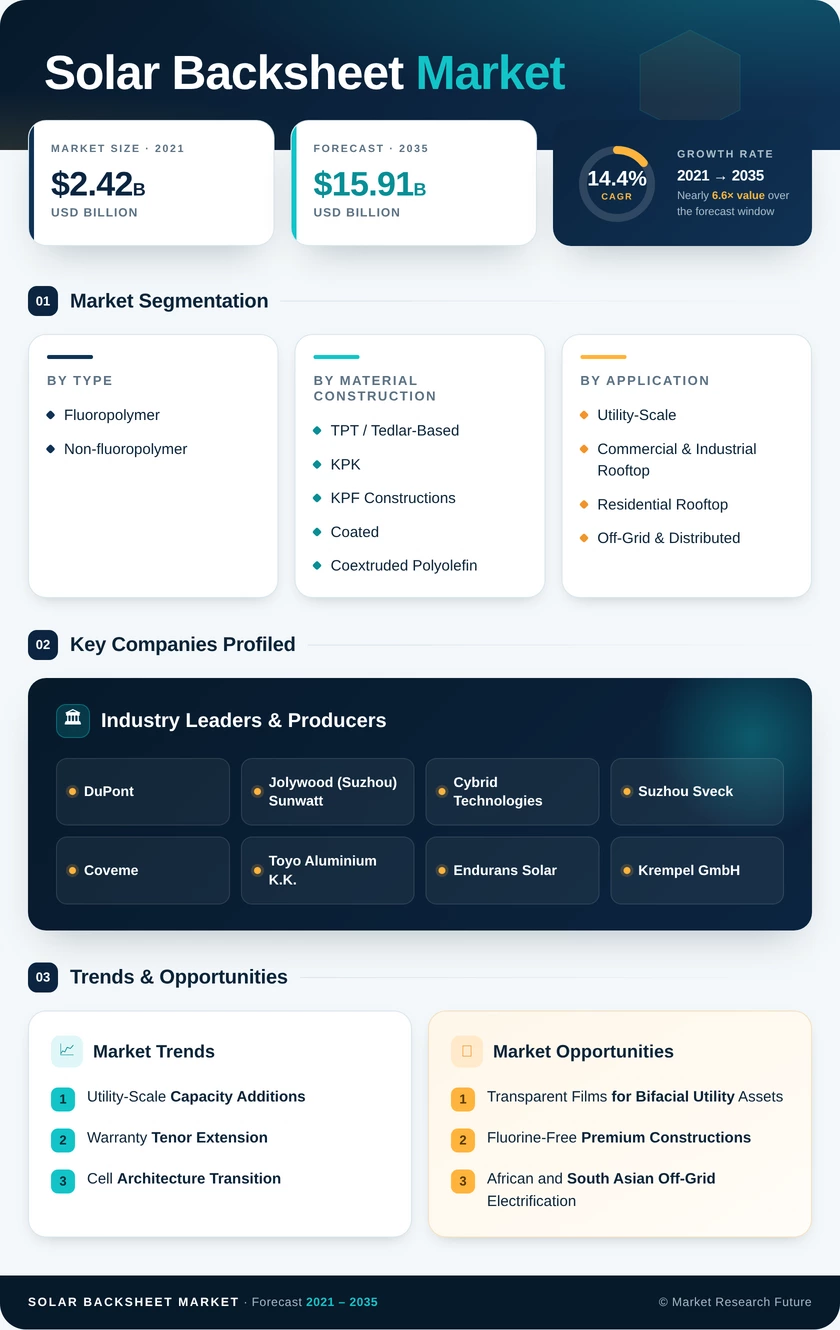
Segmentation Quick Reference
| Dimension | Sub-Segments | Dominant Segment | Fastest Growing Segment |
| By Type | Fluoropolymer; Non-fluoropolymer | Fluoropolymer | Fluoropolymer |
| By Material Construction | TPT / Tedlar-Based; KPK and KPF Constructions; Coated and Coextruded Polyolefin; Transparent; PET-Only Constructions | TPT / Tedlar-Based | Transparent |
| By Application | Utility-Scale; Commercial & Industrial Rooftop; Residential Rooftop; Off-Grid & Distributed | Utility-Scale | Off-Grid & Distributed |
| By Geography | North America; Europe; Asia-Pacific; South America; Middle East & Africa | Asia-Pacific | Asia-Pacific |
Market Segmentation Overview
By Type
| Sub-Segment | Key Trend |
| Fluoropolymer | Share sustained by 30-year warranty requirements and insurer pricing of degradation risk. |
| Non-fluoropolymer | Repositioning toward short-tenor rooftop and distributed assets where capital cost dominates |
Type selection is now driven by asset life expectation rather than by regional preference. Utility buyers underwriting three-decade yield guarantees default to fluorinated constructions, while distributed generation installers optimize for installed cost. Regulatory pressure on fluorinated chemistry is the single variable most likely to disturb this equilibrium before 2030.
By Material Construction
| Sub-Segment | Key Trend |
| TPT / Tedlar-Based | Longest verified field record; premium specification anchor for bankable projects |
| KPK and KPF Constructions | Fastest-growing fluorinated format on thinner protective layers and lower resin content |
| Coated and Coextruded Polyolefin | Positioned as the compliance pathway if fluorine restrictions tighten |
| Transparent | Enabled by bifacial architecture; weight advantage over dual-glass alternatives |
| PET-Only Constructions | Declining share in utility procurement; persisting in cost-led distributed segments |
Construction diversity reflects genuine engineering trade-offs rather than product proliferation. Each format optimizes a different constraint — cost, weight, optical transmission, or regulatory exposure — and no single structure dominates across all four. Suppliers maintaining capability across multiple constructions hedge against both regulatory and architectural shifts.
By Application
| Sub-Segment | Key Trend |
| Utility-Scale | Sets qualification standards that cascade to all other applications |
| Commercial & Industrial Rooftop | Growth tied to corporate renewable procurement commitments |
| Residential Rooftop | Sensitive to retail tariff structures and net metering policy revisions |
| Off-Grid & Distributed | Fastest-growing application, funded largely through development finance channels |
Application mix determines margin structure more than volume. Utility tenders deliver scale at compressed margins with rigorous qualification burdens; distributed segments offer better pricing but fragmented demand and higher commercial overhead. Suppliers increasingly segment their portfolios deliberately rather than serving all applications with a single product family.
By Geography
| Sub-Segment | Key Trend |
| North America | Onshoring driven by production tax credits; traceability documentation now a qualification gate |
| Europe | Repowering demand plus tightening sustainability and chemical compliance criteria |
| Asia-Pacific | Manufacturing gravity centre; Indian localization creating a second regional cluster |
| South America | Import-dependent demand centre with high-UV exposure conditions |
| Middle East & Africa | Extreme-climate specification requirements alongside electrification access programs |
Geographic revenue follows laminator location, not installation location, which is why Asia-Pacific's share exceeds its installed capacity share. Policy is actively redrawing that map. Content requirements in North America, Europe and India are pulling converting capacity toward assembly hubs, and the resulting supply base will be more distributed in 2035 than it is today.


 Noah Malgeri
Co-Founder

 Peter Groot koerkamp
Account and Business Manager

 Younghwan Choi
Senior Retail Manager

 Mark Irwin
Management Consultant

 Akif Moroglu
Strategy & Business Development Director

 Guilherme Gomes Martins
Product Management Director

 Joseph Aguayo
Sales Operations & Pricing Manager

 La Terria Dodd
Program Support Specialist

 Rob Kooiker
Group Product Manager HVAC & Fire Protection GMA