×
Request Free Sample ×

Kindly complete the form below to receive a free sample of this Report

* Please use a valid business email

Leading companies partner with us for data-driven Insights

clients tt-cursor
Hero Background

software-defined-wide-area-network-market

ID: MRFR/ICT/66060-CR
200 Pages
MRFR Team
December 2025

Share:
Download PDF ×

We do not share your information with anyone. However, we may send you emails based on your report interest from time to time. You may contact us at any time to opt-out.

software-defined-wide-area-network-market Infographic
Purchase Options

software-defined-wide-area-network-market Summary

As per MRFR analysis, the software defined wide area network market size was estimated at 12.0 USD Billion in 2024. The software defined wide area network industry is projected to grow from 13.04 USD Billion in 2025 to 30.0 USD Billion by 2035, exhibiting a compound annual growth rate (CAGR) of 8.69 during the forecast period 2025 - 2035.

Key Market Trends & Highlights

The software defined wide area network market is experiencing robust growth driven by technological advancements and evolving user needs.

  • North America remains the largest market for software defined wide area networks, reflecting a strong demand for innovative networking solutions.
  • The Asia-Pacific region is emerging as the fastest-growing market, propelled by rapid digital transformation initiatives.
  • Network security continues to dominate as the largest segment, while traffic management is recognized as the fastest-growing segment within the market.
  • Key drivers such as the growing demand for network agility and cost efficiency are significantly influencing market expansion.

Market Size & Forecast

2024 Market Size 12.0 (USD Billion)
2035 Market Size 30.0 (USD Billion)
CAGR (2025 - 2035) 8.69%

Major Players

Cisco Systems (US), VMware (US), Microsoft (US), Juniper Networks (US), Arista Networks (US), Hewlett Packard Enterprise (US), Nokia (FI), MikroTik (LV), Silver Peak (US)

software-defined-wide-area-network-market Trends

The software defined wide area network market is currently experiencing a transformative phase, characterized by the increasing adoption of cloud-based solutions and the growing demand for enhanced network performance. Organizations are increasingly recognizing the need for agile and flexible networking solutions that can adapt to their evolving requirements. This shift is driven by the desire to optimize operational efficiency and reduce costs, as traditional networking approaches often fall short in meeting the dynamic needs of modern enterprises. As a result, the software defined wide area network market is poised for substantial growth, with businesses seeking to leverage advanced technologies to improve connectivity and streamline their operations. Moreover, the emphasis on security within the software defined wide area network market cannot be overlooked. With the rise of cyber threats, organizations are prioritizing secure networking solutions that can safeguard sensitive data while maintaining high performance. This focus on security is likely to shape the development of new offerings and innovations within the market. Additionally, the integration of artificial intelligence and machine learning into networking solutions is anticipated to enhance automation and improve decision-making processes. Overall, the software defined wide area network market appears to be on a trajectory of significant evolution, driven by technological advancements and changing business needs.

Increased Cloud Adoption

The software defined wide area network market is witnessing a surge in cloud adoption as organizations migrate their operations to cloud environments. This trend reflects a broader shift towards digital transformation, where businesses seek to leverage the scalability and flexibility offered by cloud solutions. As a result, software defined wide area networks are becoming essential for ensuring seamless connectivity and performance across distributed cloud resources.

Focus on Enhanced Security

Security remains a paramount concern within the software defined wide area network market. Organizations are increasingly prioritizing secure networking solutions to protect sensitive information from evolving cyber threats. This heightened focus on security is driving the development of advanced features and protocols that enhance data protection while maintaining optimal network performance.

Integration of AI and Automation

The integration of artificial intelligence and automation technologies is emerging as a key trend in the software defined wide area network market. By incorporating AI-driven analytics and automation tools, organizations can optimize network management, improve performance, and enhance decision-making processes. This trend indicates a move towards more intelligent and responsive networking solutions that can adapt to changing conditions.

Market Segment Insights

By Application: Network Security (Largest) vs. Traffic Management (Fastest-Growing)

The software defined wide area network (SD-WAN) market is witnessing a significant distribution among its application segments. Network Security holds the largest share, as organizations prioritize securing their data and infrastructure against increasing cyber threats. Traffic Management, while having a smaller yet notable share, is rapidly gaining traction as more businesses seek to improve their network performance and efficiency. The demand for reliable connectivity and enhanced security measures is compelling enterprises to adopt these SD-WAN solutions extensively. Growth trends in the SD-WAN market are driven by the increasing need for secure remote access, particularly with the rise of cloud services and remote work environments. Network Security is propelled by stringent regulations and the necessity for compliance, while Traffic Management is responding to the need for efficient bandwidth utilization. This dynamic landscape calls for continuous innovation to meet the evolving requirements of organizations looking to enhance their operational capabilities.

Network Security: Dominant vs. Traffic Management: Emerging

Network Security in the SD-WAN market is characterized by its robust solutions that enable organizations to protect their networks from malicious attacks and unauthorized access. With a primary focus on ensuring data integrity and confidentiality, this application segment has effectively established itself as the dominant force. On the other hand, Traffic Management is emerging as a key player, optimizing the flow of data across networks to prevent congestion and improve application performance. As customers experience increasing demands for streamlined operations, Traffic Management tools are becoming essential. This duality in the application segment reflects a comprehensive approach to NAC (Network Access Control) that encompasses both strong security and efficient data handling, positioning SD-WAN as a versatile offering in the industry.

By End Use: Telecommunications (Largest) vs. Healthcare (Fastest-Growing)

In the software defined wide area network (SD-WAN) market, Telecommunications holds the largest share due to its critical role in providing connectivity solutions that enhance operational efficiency and flexibility. This segment benefits from the ongoing trend of digital transformation, as telecom companies upgrade their infrastructure to meet the growing demand for reliable and scalable network solutions. Conversely, Healthcare is emerging as the fastest-growing segment, driven by the increasing need for secure and efficient data handling in patient care, remote monitoring, and telehealth services that require robust network capabilities.

Telecommunications (Dominant) vs. Healthcare (Emerging)

Telecommunications has established itself as the dominant force in the software defined wide area network market. This sector relies on SD-WAN technology to facilitate seamless communication, manage increased data traffic, and ensure network reliability across extensive geographical areas. On the other hand, the Healthcare segment is rapidly emerging, fueled by regulatory requirements and the digitalization of patient data. Healthcare providers are adopting SD-WAN to improve the speed and security of their network services, enhancing patient outcomes and operational efficiency. Both segments continue to adapt to technological advancements, but their strategies reflect their unique needs and objectives.

By Deployment Model: Cloud-Based (Largest) vs. Hybrid (Fastest-Growing)

In the software defined wide area network (SD-WAN) market, the deployment model segment showcases a dynamic distribution among key alternatives: On-Premises, Cloud-Based, and Hybrid. Currently, Cloud-Based deployment holds the largest share due to its scalability and ease of management, appealing to organizations seeking flexibility without the burden of physical infrastructure. On-Premises solutions, while still relevant, face challenges in market share as enterprises increasingly opt for more agile solutions. Hybrid models are gaining traction as they combine the advantages of both, providing organizations with an adaptable approach to network management. Growth trends in the SD-WAN deployment model segment are driven by the accelerating shift towards digital transformation. With increasing demand for remote connectivity and the necessity for secure, reliable performance, Cloud-Based solutions are expected to maintain their lead. Meanwhile, the Hybrid model is emerging rapidly as businesses look to transition to more comprehensive frameworks incorporating both cloud and on-premises resources, ensuring resilience and enhanced performance as they navigate evolving network needs.

Cloud-Based (Dominant) vs. Hybrid (Emerging)

The Cloud-Based deployment model in the software defined wide area network market stands out as the dominant approach, favored for its unmatched scalability and operational efficiency. Organizations utilizing this model benefit from reduced infrastructure costs and enhanced flexibility, enabling quick adjustments to changing business requirements. Cloud-Based solutions are characterized by their ease of integration and management, appealing to enterprises looking to streamline operations. Conversely, the Hybrid deployment model is emerging as a significant player, enabling organizations to leverage both Cloud and On-Premises resources. This model supports businesses in maintaining control over sensitive data while still reaping the benefits of cloud scalability. The Hybrid model is particularly attractive for enterprises aiming for a balanced approach to their networking needs, ensuring that they can adapt to future technological advancements.

By Network Type: Wide Area Network (Largest) vs. Metropolitan Area Network (Fastest-Growing)

In the software defined wide area network market, Wide Area Networks (WAN) command a significant portion of the market share, particularly due to their extensive geographical reach and ability to facilitate connectivity across multiple sites. Local Area Networks (LAN) also hold a noteworthy position, serving small geographical areas like offices and buildings, while the Metropolitan Area Networks (MAN) are positioned in urban settings, offering intermediate range connectivity. The distribution reveals a clear dominance of WANs, while MANs are emerging as viable alternatives in urban settings.

Wide Area Network: Dominant vs. Metropolitan Area Network: Emerging

Wide Area Networks (WAN) are characterized by their ability to connect diverse geographical locations, making them indispensable for enterprises with multiple offices or operations spread across vast distances. They leverage advanced technologies to ensure reliable and secure communication over vast terrains. Conversely, Metropolitan Area Networks (MAN) are gaining traction as they provide high-speed connections within specific urban areas. They cater to local enterprises seeking reduced latency while enabling data-centric applications. As businesses increasingly prioritize digital transformation, both WANs and MANs are crucial, with WANs being the established standard and MANs emerging to meet specific urban connectivity demands.

By Service Type: Managed Services (Largest) vs. Professional Services (Fastest-Growing)

In the software defined wide area network market, Managed Services hold the largest market share, primarily due to their ability to provide comprehensive, end-to-end solutions that enhance network performance and security. These services are favored for their cost-effectiveness and streamlined operations, appealing to businesses looking to optimize their WAN infrastructure without the need for extensive in-house expertise. On the other hand, Professional Services have been gaining traction, reflecting a growing demand for specialized consulting and deployment support as organizations navigate the complexities of SD-WAN adoption. Growth trends within this segment are heavily influenced by the digital transformation initiatives across various industries. As businesses increasingly shift towards cloud applications and remote work models, the need for tailored solutions in Network Design, Implementation, and Optimization escalates, driving Professional Services' rapid expansion. Additionally, the rise of hybrid networking solutions compounds the demand for Managed Services, while both segments benefit from enhanced focus on network security and performance monitoring to address evolving cyber threats and compliance requirements.

Managed Services: Dominant vs. Support Services: Emerging

Managed Services are characterized by their comprehensive care, allowing organizations to outsource the monitoring and management of their entire WAN infrastructure. This enables companies to focus on their core operations while relying on expert services to ensure network reliability and efficiency. Managed Services ensure proactive management of network performance and security. In contrast, Support Services are emerging with a focus on providing technical assistance and troubleshooting for network issues. While Support Services do not share the dominant position of Managed Services, they are essential for enterprises seeking immediate solutions to operational challenges. The demand for responsive support is heightened as organizations increasingly rely on SD-WAN technologies, making Support Services a necessary complement in the evolving network landscape.

Get more detailed insights about software-defined-wide-area-network-market

Regional Insights

North America : Market Leader in SD-WAN

North America continues to lead the software defined wide area network (SD-WAN) market, holding a significant share of 6.0 in 2025. The region's growth is driven by increasing demand for cloud-based services, enhanced network security, and the need for efficient bandwidth management. Regulatory support for digital transformation initiatives further catalyzes market expansion, making it a hotbed for innovation in networking technologies. The competitive landscape is robust, with key players like Cisco Systems, VMware, and Microsoft dominating the market. The U.S. is the primary contributor, benefiting from a mature IT infrastructure and a high adoption rate of SD-WAN solutions. Companies are increasingly investing in advanced technologies to enhance service delivery and customer experience, solidifying North America's position as a leader in the SD-WAN space.

Europe : Emerging Market with Growth Potential

Europe is witnessing a rapid expansion in the software defined wide area network (SD-WAN) market, with a market size of 3.0 in 2025. The growth is fueled by the increasing need for flexible and scalable network solutions, driven by the rise of remote work and digital transformation initiatives. Regulatory frameworks promoting cybersecurity and data protection are also significant catalysts for market growth, ensuring compliance and fostering trust among users. Leading countries in this region include Germany, the UK, and France, where major players like Nokia and VMware are making substantial investments. The competitive landscape is characterized by a mix of established firms and emerging startups, all vying for market share. The European market is expected to continue its upward trajectory as organizations increasingly adopt SD-WAN solutions to enhance operational efficiency and reduce costs.

Asia-Pacific : Rapid Growth in Connectivity Solutions

The Asia-Pacific region is experiencing a notable surge in the software defined wide area network (SD-WAN) market, with a market size of 2.5 in 2025. This growth is driven by the increasing adoption of cloud services, the rise of IoT, and the demand for improved network performance. Governments in the region are also promoting digital initiatives, which serve as a catalyst for the adoption of advanced networking solutions, including SD-WAN. Countries like China, India, and Australia are leading the charge, with significant investments from key players such as Microsoft and Cisco. The competitive landscape is evolving, with both The software defined wide area network market share. As businesses in the region seek to enhance their digital capabilities, the SD-WAN market is poised for continued growth, driven by innovation and technological advancements.

Middle East and Africa : Emerging Market with Untapped Potential

The Middle East and Africa (MEA) region is gradually emerging in the software defined wide area network (SD-WAN) market, with a market size of 0.5 in 2025. The growth is primarily driven by increasing internet penetration, the rise of mobile connectivity, and the need for efficient network management solutions. Regulatory bodies are beginning to recognize the importance of digital infrastructure, which is expected to further stimulate market growth in the coming years. Countries like South Africa and the UAE are at the forefront of this growth, with local and international players exploring opportunities in the SD-WAN space. The competitive landscape is still developing, with several startups and established firms vying for market presence. As organizations in the MEA region increasingly adopt digital solutions, the SD-WAN market is set to expand, driven by the need for enhanced connectivity and operational efficiency.


Key Players and Competitive Insights

The software defined wide area network market exhibits a dynamic competitive landscape characterized by rapid technological advancements and evolving customer demands. Key players such as Cisco Systems (US), VMware (US), and Microsoft (US) are at the forefront, each adopting distinct strategies to enhance their market positioning. Cisco Systems (US) emphasizes innovation through continuous development of its SD-WAN solutions, focusing on integrating advanced security features and cloud capabilities. VMware (US) leverages its strong virtualization expertise to offer comprehensive SD-WAN solutions that facilitate seamless connectivity and operational efficiency. Meanwhile, Microsoft (US) is strategically expanding its Azure networking services, aiming to integrate SD-WAN capabilities into its cloud offerings, thereby enhancing its competitive edge in the cloud services market.
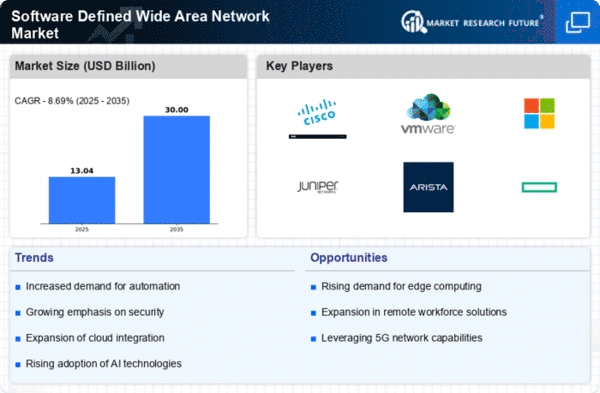
The market structure appears moderately fragmented, with a mix of established players and emerging companies vying for market share. Key business tactics include localizing manufacturing and optimizing supply chains to enhance responsiveness to regional demands. This competitive environment is shaped by the collective influence of major players, who are increasingly focusing on partnerships and collaborations to drive innovation and expand their service offerings.

In November 2025, Juniper Networks (US) announced a strategic partnership with a leading telecommunications provider to enhance its SD-WAN capabilities. This collaboration aims to integrate advanced analytics and AI-driven insights into their offerings, potentially improving network performance and customer experience. Such strategic moves indicate a shift towards more integrated solutions that leverage data analytics for enhanced operational efficiency.

In October 2025, Arista Networks (US) launched a new SD-WAN solution designed to optimize cloud connectivity for enterprises. This product introduction reflects Arista's commitment to addressing the growing demand for reliable and high-performance networking solutions. The strategic importance of this launch lies in its potential to attract enterprise customers seeking to enhance their cloud operations, thereby positioning Arista favorably in a competitive market.

In September 2025, Nokia (FI) expanded its SD-WAN portfolio by acquiring a smaller tech firm specializing in network automation. This acquisition is likely to bolster Nokia's capabilities in delivering automated and intelligent networking solutions, aligning with the broader industry trend towards automation and AI integration. Such strategic actions underscore the importance of innovation and technological advancement in maintaining competitive differentiation.

As of December 2025, current trends in the software defined wide area network market are heavily influenced by digitalization, sustainability, and AI integration. Strategic alliances are increasingly shaping the competitive landscape, enabling companies to pool resources and expertise to deliver more comprehensive solutions. The evolution of competitive differentiation appears to be shifting from price-based competition towards a focus on innovation, technology, and supply chain reliability, suggesting that companies that prioritize these aspects may gain a significant advantage in the future.

Key Companies in the software-defined-wide-area-network-market market include

Future Outlook

software-defined-wide-area-network-market Future Outlook

The software defined wide area network market is projected to grow at an 8.69% CAGR from 2024 to 2035, driven by increasing demand for network agility and cost efficiency.

New opportunities lie in:

  • Development of AI-driven network optimization tools
  • Expansion into emerging markets with tailored solutions
  • Integration of SD-WAN with IoT for enhanced connectivity

By 2035, the market is expected to achieve robust growth, solidifying its position as a critical infrastructure component.

Market Segmentation

software-defined-wide-area-network-market End Use Outlook

  • Telecommunications
  • Healthcare
  • Education
  • Retail

software-defined-wide-area-network-market Application Outlook

  • Network Security
  • Traffic Management
  • Data Backup
  • Cloud Connectivity

software-defined-wide-area-network-market Network Type Outlook

  • Wide Area Network
  • Local Area Network
  • Metropolitan Area Network

software-defined-wide-area-network-market Service Type Outlook

  • Managed Services
  • Professional Services
  • Support Services

software-defined-wide-area-network-market Deployment Model Outlook

  • On-Premises
  • Cloud-Based
  • Hybrid

Report Scope

MARKET SIZE 202412.0(USD Billion)
MARKET SIZE 202513.04(USD Billion)
MARKET SIZE 203530.0(USD Billion)
COMPOUND ANNUAL GROWTH RATE (CAGR)8.69% (2024 - 2035)
REPORT COVERAGERevenue Forecast, Competitive Landscape, Growth Factors, and Trends
BASE YEAR2024
Market Forecast Period2025 - 2035
Historical Data2019 - 2024
Market Forecast UnitsUSD Billion
Key Companies ProfiledCisco Systems (US), VMware (US), Microsoft (US), Juniper Networks (US), Arista Networks (US), Hewlett Packard Enterprise (US), Nokia (FI), MikroTik (LV), Silver Peak (US)
Segments CoveredApplication, End Use, Deployment Model, Network Type, Service Type
Key Market OpportunitiesIntegration of artificial intelligence enhances network management in the software defined wide area network market.
Key Market DynamicsRising demand for agile network solutions drives competitive innovation in the software defined wide area network market.
Countries CoveredNorth America, Europe, APAC, South America, MEA

Leave a Comment

Download Free Sample

Kindly complete the form below to receive a free sample of this Report

Compare Licence

×
Features License Type
Single User Multiuser License Enterprise User
Price $4,950 $5,950 $7,250
Maximum User Access Limit 1 User Upto 10 Users Unrestricted Access Throughout the Organization
Free Customization
Direct Access to Analyst
Deliverable Format
Platform Access
Discount on Next Purchase 10% 15% 15%
Printable Versions