Request Free Sample ×

Kindly complete the form below to receive a free sample of this Report

* Please use a valid business email

Leading companies partner with us for data-driven Insights

clients tt-cursor
Hero Background
English
Chinese
French
Japanese
Korean
German
Spanish

Smart Home Market Trends

ID: MRFR/ICT/0468-CR
200 Pages
Aarti Dhapte
July 2025

Smart Home Market Size, Share and Trends Analysis Report By Product Type (Smart Lighting, Smart Security Systems, Smart Thermostats, Smart Home Appliances, Smart Entertainment Systems), By Technology (Wi-Fi, Zigbee, Bluetooth, Thread, Z-Wave), By Application (Home Automation, Energy Management, Security Surveillance, Health Monitoring, Entertainment Control), By End Use (Residential, Commercial, Industrial) and By Regional (North America, Europe, South America, Asia Pacific, Middle East and Africa) - Forecast to 2035

Share:
Download PDF ×

We do not share your information with anyone. However, we may send you emails based on your report interest from time to time. You may contact us at any time to opt-out.

Smart Home Market Infographic
Purchase Options

Market Trends

Key Emerging Trends in the Smart Home Market

The Smart Home market has witnessed an exquisite boom in recent years, reflecting the growing integration of generations into our day-by-day lives. Market developments suggest a shift towards more sophisticated and interconnected home automation solutions, pushed through improvements in Internet of Things (IoT) technology. One outstanding trend is the growing popularity of voice-activated smart assistants like Amazon Alexa and Google Assistant, which serve as critical hubs for controlling various related gadgets. Energy performance is a key attention within the Smart Home market, with a growing emphasis on green and sustainable answers.

Smart thermostats, lighting fixtures systems, and electricity monitoring devices allow owners to optimize electricity consumption, lessen waste, and lower application costs. The integration of artificial intelligence (AI) algorithms further enhances those devices' capacity to research and adapt to user possibilities, optimizing energy usage based on daily routines and environmental situations. The upward thrust of clever appliances is some other giant market fashion. From refrigerators and washing machines to ovens and espresso makers, manufacturers are incorporating smart functions into conventional family appliances. These clever appliances can be managed remotely through phone apps, presenting customers with greater flexibility and the capability to automate habitual duties.

For instance, customers can preheat their ovens on their own domestically or get hold of alerts while their laundry is performed, streamlining household chores and enhancing universal efficiency. Interoperability and compatibility have turned out to be vital concerns in the Smart Home marketplace. Consumers are increasingly seeking gadgets that can seamlessly speak with each other, promoting cohesive and interconnected domestic surroundings. The enterprise is transferring closer to standardized communication protocols such as Zigbee and Z-Wave, permitting exceptional devices from numerous manufacturers to paint together easily.

The emergence of 5G technology is set to have a profound impact on the Smart Home marketplace. With quicker and extra reliable connectivity, 5G will unlock new possibilities for Smart Home programs, allowing real-time record transfer and improving the performance of related gadgets. This expanded space and bandwidth will, in addition, assist the increase of immersive technologies consisting of augmented reality (AR) and virtual reality (VR) inside Smart Home environments, providing users with greater enjoyment, education, and communication reports.


Author
Author Profile
Aarti Dhapte
AVP - Research

A consulting professional focused on helping businesses navigate complex markets through structured research and strategic insights. I partner with clients to solve high-impact business problems across market entry strategy, competitive intelligence, and opportunity assessment. Over the course of my experience, I have led and contributed to 100+ market research and consulting engagements, delivering insights across multiple industries and geographies, and supporting strategic decisions linked to $500M+ market opportunities. My core expertise lies in building robust market sizing, forecasting, and commercial models (top-down and bottom-up), alongside deep-dive competitive and industry analysis. I have played a key role in shaping go-to-market strategies, investment cases, and growth roadmaps, enabling clients to make confident, data-backed decisions in dynamic markets.

Leave a Comment

FAQs

What is the projected market valuation of the Smart Home Market by 2035?

<p>The Smart Home Market is projected to reach a valuation of 387.22 USD Billion by 2035.</p>

What was the market valuation of the Smart Home Market in 2024?

<p>In 2024, the Smart Home Market was valued at 126.67 USD Billion.</p>

What is the expected CAGR for the Smart Home Market from 2025 to 2035?

<p>The expected CAGR for the Smart Home Market during the forecast period 2025 - 2035 is 10.69%.</p>

Which product segment is expected to show the highest growth in the Smart Home Market?

<p>Smart Security Systems, with a projected growth from 30.0 to 90.0 USD Billion, appears poised for significant growth.</p>

How do residential and commercial segments compare in the Smart Home Market?

<p>The residential segment is expected to grow from 75.0 to 230.0 USD Billion, whereas the commercial segment is projected to increase from 30.0 to 100.0 USD Billion.</p>

What are the leading companies in the Smart Home Market?

<p>Key players in the Smart Home Market include Amazon, Google, Apple, Samsung, and Xiaomi.</p>

What technology segments are driving the Smart Home Market?

<p>Wi-Fi technology is projected to grow from 50.0 to 150.0 USD Billion, indicating its dominance in the Smart Home Market.</p>

What applications are expected to see the most growth in the Smart Home Market?

<p>Entertainment Control is projected to grow from 36.67 to 117.22 USD Billion, suggesting a strong demand in this application area.</p>

How does the Smart Home Market's growth compare across different technologies?

<p>Zigbee and Bluetooth technologies are expected to grow from 30.0 to 90.0 USD Billion and from 20.0 to 60.0 USD Billion, respectively, indicating varied growth rates.</p>

What is the potential impact of smart home appliances on the market?

<p>Smart Home Appliances are projected to grow from 30.0 to 90.0 USD Billion, highlighting their potential impact on overall market growth.</p>

Market Summary

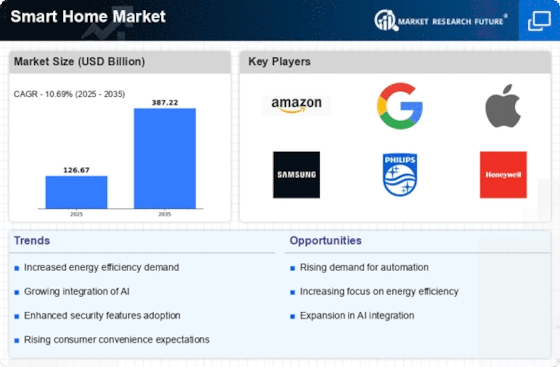
As per Market Research Future analysis, the Smart Home Market Size was estimated at 126.67 USD Billion in 2024. The Smart Home industry is projected to grow from 140.21 USD Billion in 2025 to 387.22 USD Billion by 2035, exhibiting a compound annual growth rate (CAGR) of 10.69% during the forecast period 2025 - 2035

Key Market Trends & Highlights

The Smart Home Market is experiencing robust growth driven by technological advancements and consumer preferences.

  • The integration of Artificial Intelligence is transforming user experiences in smart home devices. Energy efficiency remains a focal point, with consumers increasingly seeking sustainable solutions. Enhanced security solutions are gaining traction, particularly in the Asia-Pacific region, which is the fastest-growing market. Rising consumer demand for automation and advancements in IoT technology are key drivers propelling the growth of smart security systems.

Market Size & Forecast

2024 Market Size 126.67 (USD Billion)
2035 Market Size 387.22 (USD Billion)
CAGR (2025 - 2035) 10.69%
Largest Regional Market Share in 2024 North America

Major Players

<a href="https://aws.amazon.com/blogs/security/amazon-threat-intelligence-identifies-russian-cyber-threat-group-targeting-western-critical-infrastructure/">Amazon</a> (US), Google (US), Apple (US), Samsung (KR), Philips (NL), Honeywell (US), Lutron (US), <a href="https://newsroom.arm.com/blog/xiaomi-xring-o1-silicon">Xiaomi</a> (CN), ADT (US)

Market Trends

The Smart Home Market is currently experiencing a transformative phase characterized by rapid technological advancements and evolving consumer preferences. As households increasingly seek convenience, security, and energy efficiency, the demand for smart devices continues to rise. Innovations in artificial intelligence and the Internet of Things are driving the integration of various home systems, allowing for seamless communication between devices. This interconnectedness not only enhances user experience but also promotes energy conservation and cost savings. Furthermore, the growing awareness of sustainability and environmental impact is influencing purchasing decisions, leading consumers to opt for smart solutions that align with their values. In addition, the Smart Home Market is witnessing a shift towards enhanced security features and remote monitoring capabilities. Homeowners are increasingly prioritizing safety, prompting manufacturers to develop advanced security systems that incorporate smart technology. This trend is likely to continue as consumers become more aware of potential threats and seek solutions that provide peace of mind. Overall, the Smart Home Market appears poised for continued growth, driven by innovation, consumer demand, and a focus on sustainability.

Integration of Artificial Intelligence

The Smart Home Market is seeing a notable trend towards the integration of artificial intelligence in various devices. This advancement allows for personalized user experiences, as systems learn and adapt to individual preferences over time. AI-driven solutions enhance automation, making homes more intuitive and responsive to the needs of occupants.The integration of spatial computing is among the top future trends in smart devices, allowing users to control their environment through gesture-based overlays.

Focus on Energy Efficiency

A growing emphasis on energy efficiency is shaping the Smart Home Market. Consumers are increasingly aware of their environmental footprint and are seeking solutions that reduce energy consumption. Smart devices, such as thermostats and lighting systems, are designed to optimize energy use, contributing to both cost savings and sustainability.Recent innovations in smart technology include the rollout of "Firedancer" level processing at the edge, enabling real-time, on-device AI without cloud dependency. Additionally, Technological advancements in smart devices have introduced "energy-aware" appliances that automatically shift high-drain tasks to periods of peak renewable energy production.

Enhanced Security Solutions

The demand for enhanced security solutions is a prominent trend within the Smart Home Market. Homeowners are prioritizing safety and are investing in smart security systems that offer features like remote monitoring and real-time alerts. This focus on security reflects a broader societal concern for personal safety and property protection.Increased concerns over digital sovereignty have led to a new wave of smart home adoption focused on localized data storage and privacy-first architecture.

Smart Connected Homes

One of the most visible connected home trends is the shift toward invisible hardware, where smart sensors are embedded directly into building materials and furniture. This trend emphasizes "whole-home" wellness, where lighting, air purification, and soundscapes synchronize to support circadian rhythms.

Smart Home Market Market Drivers

Increased Focus on Home Security

The Smart Home Market is experiencing a heightened focus on home security solutions. With rising concerns about safety and crime rates, consumers are increasingly investing in smart security systems, including cameras, alarms, and smart locks. Data suggests that the global market for smart security devices is projected to grow at a compound annual growth rate of over 20% in the coming years. This growth is fueled by advancements in technology, such as facial recognition and remote monitoring capabilities, which enhance the effectiveness of security systems. As a result, the Smart Home Market is likely to expand as consumers prioritize safety in their smart home investments.

Rising Consumer Demand for Automation

The Smart Home Market experiences a notable increase in consumer demand for automation solutions. As households seek convenience and efficiency, the adoption of smart devices such as smart thermostats, lighting systems, and home assistants rises. Recent data indicates that approximately 70% of consumers express interest in automating their homes, reflecting a shift towards a more connected lifestyle. This trend is driven by the desire for enhanced control over home environments, leading to a surge in product offerings from manufacturers. Consequently, the Smart Home Market is likely to witness sustained growth as more consumers prioritize automation in their purchasing decisions.

Growing Awareness of Energy Efficiency

The Smart Home Market benefits from a growing awareness of energy efficiency among consumers. As energy costs rise and environmental concerns become more pressing, homeowners increasingly seek solutions that reduce energy consumption. Smart devices, such as energy-efficient appliances and smart meters, play a crucial role in this transition. Recent statistics reveal that homes equipped with smart technology can reduce energy usage by up to 30%, making them attractive to eco-conscious consumers. This trend not only supports sustainability efforts but also drives the Smart Home Market forward, as manufacturers respond to the demand for energy-efficient solutions.

Integration of Voice-Activated Technology

The Smart Home Market is significantly shaped by the integration of voice-activated technology. As virtual assistants like Amazon Alexa and Google Assistant gain popularity, consumers increasingly prefer hands-free control of their smart devices. This trend is evident in the rising sales of voice-activated speakers, which have become central hubs for smart home management. Current estimates indicate that over 50% of smart home users utilize voice commands to control their devices, highlighting the convenience and accessibility offered by this technology. The continued integration of voice-activated solutions suggests that the Smart Home Market will further evolve, catering to the preferences of tech-savvy consumers.

Advancements in Internet of Things (IoT) Technology

The Smart Home Market is significantly influenced by advancements in Internet of Things (IoT) technology. The proliferation of connected devices enables seamless communication between various home systems, enhancing user experience. As of October 2025, it is estimated that the number of connected devices in households has surpassed 30 billion, indicating a robust ecosystem for smart home solutions. This interconnectedness allows for improved functionality and integration of devices, making smart homes more appealing to consumers. The ongoing development of IoT technology suggests that the Smart Home Market will continue to evolve, offering innovative solutions that cater to diverse consumer needs.

Market Segment Insights

By Product Type: Smart Lighting (Largest) vs. Smart Security Systems (Fastest-Growing)

<p>In the Smart Home Market, Smart Lighting holds the largest market share, driven by increasing consumer adoption of energy-efficient solutions and technological advancements. With a focus on user convenience, Smart Lighting systems are becoming integral to modern homes. Smart Security Systems follow closely, gaining traction due to rising concerns regarding safety and home automation, making significant inroads among consumers looking to enhance their home security features. The growth trends in Smart Home products are predominantly led by Smart Security Systems, which are witnessing the fastest growth. Factors influencing this expansion include enhanced technological interfaces, affordability, and increasing investments in home automation. The appeal of mobile accessibility and real-time monitoring is also propelling the demand for smart security solutions, affirming their status as a critical segment in the market.</p>

<p>Smart Lighting (Dominant) vs. Smart Home Appliances (Emerging)</p>

<p>Smart Lighting stands out as a dominant force within the Smart Home Market, characterized by its widespread adoption and significant user base. The appeal of remotely controllable, energy-efficient lighting solutions resonates well with eco-conscious consumers, positioning Smart Lighting not only as a utility but also as a lifestyle choice. On the other hand, Smart Home Appliances represent an emerging segment, rapidly gaining consumer interest due to technological innovations that bring convenience and efficiency into daily tasks. This segment includes various products, from smart refrigerators to intelligent ovens, designed to enhance user experience and streamline home management. While Smart Lighting leads with its established market presence, Smart Home Appliances are on a trajectory of growth, poised to capture a larger share as technology continues to evolve.</p>

By Technology: Wi-Fi (Largest) vs. Zigbee (Fastest-Growing)

<p>In the Smart Home Market, Wi-Fi technology currently holds the largest market share, enabling seamless connectivity for a wide range of devices, from smart speakers to security systems. Its ubiquity and established presence in consumer households provide robust support for various smart applications, leading to a dominant position amongst other technologies. Zigbee, while lesser-known, is emerging as the fastest-growing technology segment, particularly in applications requiring low power consumption and interoperability across devices. This has positioned Zigbee as a favorable choice for smart home solutions focused on home automation and energy efficiency.</p>

<p>Wi-Fi: Dominant vs. Zigbee: Emerging</p>

<p>Wi-Fi stands out in the Smart Home Market as the dominant technology due to its extensive compatibility with a multitude of devices and established infrastructure. This wireless technology offers high data throughput necessary for applications such as video streaming and gaming. On the other hand, Zigbee is rapidly gaining traction among smart home users, given its low power consumption and ability to support a mesh network, which enhances connectivity between devices. Zigbee's focus on short-range, reliable communication makes it an attractive choice for smart lighting and sensor systems, addressing the growing demand for energy-efficient home automation solutions. As consumers become increasingly interested in smart homes, both technologies are likely to see a surge in adoption.</p>

By Application: Home Automation (Largest) vs. Energy Management (Fastest-Growing)

<p>In the Smart Home Market, the application segment is led by Home Automation, which has established itself as the largest contributor due to increased consumer demand for convenience and seamless integration of smart devices. Following closely is Energy Management, which is rapidly gaining share as concerns for energy efficiency and sustainability spur investment by consumers and businesses alike. Other applications like Security Surveillance and Health Monitoring also contribute to the market, showcasing the diverse needs that smart home technologies address.</p>

<p>Home Automation (Dominant) vs. Energy Management (Emerging)</p>

<p>Home Automation stands as the dominant force in the Smart Home Market, driven by advancements in IoT technology and escalating consumer interest in enhancing comfort and efficiency within their living spaces. This segment incorporates devices that allow for the remote control and automation of home features such as lighting, heating, and appliances. On the other hand, Energy Management is the emerging segment, utilizing smart technology to optimize energy consumption. This sector is primarily driven by the growing awareness of climate issues and the rising costs of energy, presenting significant opportunities for innovation and consumer engagement in the implementation of energy-efficient solutions.</p>

By End Use: Residential (Largest) vs. Commercial (Fastest-Growing)

<p>The Smart Home Market is primarily segmented into residential, commercial, and industrial end uses. The residential segment holds the largest market share, driven by increasing consumer adoption of smart devices for enhanced convenience, security, and energy efficiency. Meanwhile, the commercial segment, while currently smaller, is emerging rapidly as businesses recognize the benefits of automating systems to improve operational efficiency and reduce costs. This shift is largely influenced by the growing trend of smart buildings that utilize advanced technologies to manage resources effectively. As the smart home industry evolves, both segments experience significant growth. The residential market is propelled by technological advancements and a surge in IoT applications, making smart homes more accessible and appealing to consumers. Conversely, the commercial sector is seeing the fastest growth due to the implementation of smart technologies in corporate environments, driven by demand for smarter energy management systems and improved workplace experiences. The intersection of these trends indicates a dynamic future for the smart home market, characterized by increased integration between home and commercial technologies.</p>

<p>Residential (Dominant) vs. Commercial (Emerging)</p>

<p>The residential segment is characterized by the widespread adoption of smart home devices, including smart thermostats, security cameras, and lighting systems. Homeowners are increasingly investing in these technologies to enhance security, comfort, and energy efficiency, thereby establishing a stronghold in the market. The large customer base for residential solutions is bolstered by extensive marketing and consumer education initiatives that highlight the convenience and long-term savings associated with smart home technologies. In contrast, the commercial segment is emerging rapidly as businesses adopt smart systems to streamline operations and enhance the customer experience. With growing awareness of energy conservation and a strong focus on sustainability, commercial enterprises are integrating smart technologies to optimize resource management and operational efficiency, highlighting its potential for significant future growth.</p>

Get more detailed insights about Smart Home Market Research Report - Global Forecast till 2035

Regional Insights

North America : Innovation and Adoption Leader

North America is the largest market for smart home technology, accounting for approximately 40% of the global market share. The region's growth is driven by increasing consumer demand for convenience, energy efficiency, and security. Regulatory support, such as energy efficiency standards and smart grid initiatives, further catalyzes market expansion. The U.S. leads this market, followed closely by Canada, which holds around 10% of the share. The competitive landscape in North America is dominated by major players like Amazon, Google, and Apple, who are continuously innovating to enhance user experience. The presence of established companies fosters a robust ecosystem for smart home devices, including security systems, smart lighting, and home automation solutions. Additionally, partnerships between tech firms and utility companies are emerging to promote smart home adoption, further solidifying the region's leadership in this sector.

Europe : Regulatory Framework and Growth

Europe is witnessing significant growth in the smart home market, holding approximately 30% of the global share. The region's expansion is fueled by stringent energy regulations and a growing emphasis on sustainability. Countries like Germany and the UK are at the forefront, with Germany accounting for about 12% of the market. The European Union's Green Deal and various national initiatives are pivotal in driving consumer adoption and innovation in smart home technologies. Leading countries in Europe include Germany, the UK, and France, with a competitive landscape featuring key players like Philips and Samsung. The market is characterized by a mix of established brands and innovative startups, fostering a dynamic environment for smart home solutions. The presence of regulatory bodies ensures compliance and encourages investment in energy-efficient technologies, further enhancing market growth.

Asia-Pacific : Emerging Market with Potential

Asia-Pacific is rapidly emerging as a significant player in the smart home market, holding around 25% of the global share. The region's growth is driven by rising disposable incomes, urbanization, and increasing awareness of smart technologies. China is the largest market in this region, contributing approximately 15% to the global share, followed by Japan and India, which are also witnessing substantial growth in smart home adoption. The competitive landscape in Asia-Pacific is diverse, with local players like Xiaomi and The Smart Home Market share. The region is characterized by a high demand for affordable smart home solutions, leading to increased competition and innovation. Government initiatives promoting digital transformation and smart city projects are further propelling the growth of smart home technologies in this dynamic market.

Middle East and Africa : Untapped Market Opportunities

The Middle East and Africa region is gradually emerging in the smart home market, currently holding about 5% of the global share. The growth is primarily driven by increasing urbanization, rising disposable incomes, and a growing interest in home automation technologies. Countries like South Africa and the UAE are leading the market, with the UAE showing a strong inclination towards smart city initiatives, which significantly boosts smart home adoption. The competitive landscape is still developing, with a mix of local and international players entering the market. Key players like Honeywell and ADT are establishing a presence, while local startups are innovating to cater to the unique needs of the region. Government support for technology adoption and infrastructure development is crucial for unlocking the full potential of the smart home market in this region.

Key Players and Competitive Insights

The Smart Home Market is currently characterized by a dynamic competitive landscape, driven by rapid technological advancements and evolving consumer preferences. Major players such as Amazon (US), Google (US), and Samsung (KR) are at the forefront, each adopting distinct strategies to enhance their market positioning. Amazon (US) continues to leverage its extensive ecosystem, integrating smart home devices with its voice assistant, Alexa, thereby fostering a seamless user experience. Google (US), on the other hand, emphasizes its AI capabilities, enhancing its Nest product line to offer more personalized and intelligent home automation solutions. Samsung (KR) focuses on interoperability, promoting its SmartThings platform to unify various smart devices, which appears to resonate well with consumers seeking convenience and efficiency. Collectively, these strategies contribute to a competitive environment that is increasingly centered around innovation and user-centric solutions. In terms of business tactics, companies are increasingly localizing manufacturing and optimizing supply chains to enhance responsiveness to market demands. The Smart Home Market is moderately fragmented, with a mix of established players and emerging startups. This fragmentation allows for diverse offerings, yet the collective influence of key players like Amazon (US) and Google (US) tends to dominate market trends and consumer expectations. Their ability to innovate and adapt to changing consumer needs significantly shapes the competitive structure. In August 2025, Amazon (US) announced the launch of a new line of energy-efficient smart home devices, which aligns with the growing consumer demand for sustainability. This strategic move not only enhances Amazon's product portfolio but also positions the company as a leader in eco-friendly technology, potentially attracting environmentally conscious consumers. The emphasis on energy efficiency may also serve to differentiate Amazon in a crowded market, where sustainability is becoming a key purchasing criterion. In September 2025, Google (US) unveiled an upgraded version of its Nest Hub, featuring enhanced AI capabilities that allow for more intuitive home management. This development underscores Google's commitment to integrating advanced technology into everyday life, thereby enhancing user engagement and satisfaction. The strategic importance of this upgrade lies in its potential to solidify Google’s position in the smart home ecosystem, as consumers increasingly seek devices that offer not just functionality but also intelligence and adaptability. In October 2025, Samsung (KR) entered into a strategic partnership with a leading energy management firm to develop smart home solutions that optimize energy consumption. This collaboration is indicative of a broader trend towards integrating smart home technology with energy efficiency initiatives. By aligning with an energy management expert, Samsung (KR) not only enhances its product offerings but also addresses the growing consumer concern regarding energy usage, thereby reinforcing its market position. As of October 2025, the Smart Home Market is witnessing significant trends such as digitalization, sustainability, and the integration of artificial intelligence. Strategic alliances are increasingly shaping the competitive landscape, enabling companies to pool resources and expertise to innovate more effectively. Looking ahead, competitive differentiation is likely to evolve from traditional price-based competition to a focus on innovation, technological advancement, and supply chain reliability. Companies that can successfully navigate these trends will likely emerge as leaders in the Smart Home Market.

Key Companies in the Smart Home Market include

Industry Developments

The Smart Home Market has made a lot of progress in terms of technology and strategy in the last few months. Amazon showed off the Echo Hub and new Alexa AI features in September 2023. These made its smart home control interface better. Philips and Xiaomi have focused on eco-friendly smart appliances, which is in line with current trends toward sustainability. In July 2023, Schneider Electric and SAMRIDHI GROUP signed a memorandum of understanding (MoU) to bring its Wiser Smart Home Market solutions to energy-efficient homes.

At the same time, LG Electronics and Honeywell are making progress on home security and automation systems that use AI. These changes show how the market is always changing, thanks to new smart devices, energy efficiency, and home control systems that work together.

Future Outlook

Smart Home Market Future Outlook

The Smart Home Market is projected to grow at a 10.69% CAGR from 2025 to 2035, driven by technological advancements, increased consumer awareness, and <a title="energy efficiency" href="https://www.marketresearchfuture.com/reports/energy-efficient-material-market-9949" target="_blank" rel="noopener">energy efficiency</a> demands.Industry predictions for smart technology suggest that autonomous household robots will soon move beyond simple floor cleaning to complex multi-tasking and organization. Future applications of smart devices are expanding into the eldercare sector, utilizing fall-detection radar and predictive diagnostics to support aging-in-place. Strategic partnerships between insurance providers and the smart home business are creating new incentives for homeowners who install proactive leak and fire detection systems.

New opportunities lie in:

  • <p>Integration of AI-driven home automation systems Expansion of subscription-based smart home services Development of energy-efficient smart appliances</p>

By 2035, the Smart Home Market is expected to be robust, reflecting substantial growth and innovation.

Market Segmentation

Smart Home Market End Use Outlook

  • Residential
  • Commercial
  • Industrial

Smart Home Market Technology Outlook

  • Wi-Fi
  • Zigbee
  • Bluetooth
  • Thread
  • Z-Wave

Smart Home Market Application Outlook

  • Home Automation
  • Energy Management
  • Security Surveillance
  • Health Monitoring
  • Entertainment Control

Smart Home Market Product Type Outlook

  • Smart Lighting
  • Smart Security Systems
  • Smart Thermostats
  • Smart Home Appliances
  • Smart Entertainment Systems

Report Scope

MARKET SIZE 2024 126.67(USD Billion)
MARKET SIZE 2025 140.21(USD Billion)
MARKET SIZE 2035 387.22(USD Billion)
COMPOUND ANNUAL GROWTH RATE (CAGR) 10.69% (2025 - 2035)
REPORT COVERAGE Revenue Forecast, Competitive Landscape, Growth Factors, and Trends
BASE YEAR 2024
Market Forecast Period 2025 - 2035
Historical Data 2019 - 2024
Market Forecast Units USD Billion
Key Companies Profiled Amazon (US), Google (US), Apple (US), Samsung (KR), Philips (NL), Honeywell (US), Lutron (US), Xiaomi (CN), ADT (US)
Segments Covered Product Type, Technology, Application, End Use, Regional
Key Market Opportunities Integration of artificial intelligence in home automation systems enhances user experience and energy efficiency.
Key Market Dynamics Rising consumer demand for energy-efficient solutions drives innovation and competition in the Smart Home Market.
Countries Covered North America, Europe, APAC, South America, MEA

FAQs

What is the projected market valuation of the Smart Home Market by 2035?

<p>The Smart Home Market is projected to reach a valuation of 387.22 USD Billion by 2035.</p>

What was the market valuation of the Smart Home Market in 2024?

<p>In 2024, the Smart Home Market was valued at 126.67 USD Billion.</p>

What is the expected CAGR for the Smart Home Market from 2025 to 2035?

<p>The expected CAGR for the Smart Home Market during the forecast period 2025 - 2035 is 10.69%.</p>

Which product segment is expected to show the highest growth in the Smart Home Market?

<p>Smart Security Systems, with a projected growth from 30.0 to 90.0 USD Billion, appears poised for significant growth.</p>

How do residential and commercial segments compare in the Smart Home Market?

<p>The residential segment is expected to grow from 75.0 to 230.0 USD Billion, whereas the commercial segment is projected to increase from 30.0 to 100.0 USD Billion.</p>

What are the leading companies in the Smart Home Market?

<p>Key players in the Smart Home Market include Amazon, Google, Apple, Samsung, and Xiaomi.</p>

What technology segments are driving the Smart Home Market?

<p>Wi-Fi technology is projected to grow from 50.0 to 150.0 USD Billion, indicating its dominance in the Smart Home Market.</p>

What applications are expected to see the most growth in the Smart Home Market?

<p>Entertainment Control is projected to grow from 36.67 to 117.22 USD Billion, suggesting a strong demand in this application area.</p>

How does the Smart Home Market's growth compare across different technologies?

<p>Zigbee and Bluetooth technologies are expected to grow from 30.0 to 90.0 USD Billion and from 20.0 to 60.0 USD Billion, respectively, indicating varied growth rates.</p>

What is the potential impact of smart home appliances on the market?

<p>Smart Home Appliances are projected to grow from 30.0 to 90.0 USD Billion, highlighting their potential impact on overall market growth.</p>

  1. SECTION I: EXECUTIVE SUMMARY AND KEY HIGHLIGHTS
    1. | 1.1 EXECUTIVE SUMMARY
    2. | | 1.1.1 Market Overview
    3. | | 1.1.2 Key Findings
    4. | | 1.1.3 Market Segmentation
    5. | | 1.1.4 Competitive Landscape
    6. | | 1.1.5 Challenges and Opportunities
    7. | | 1.1.6 Future Outlook
  2. SECTION II: SCOPING, METHODOLOGY AND MARKET STRUCTURE
    1. | 2.1 MARKET INTRODUCTION
    2. | | 2.1.1 Definition
    3. | | 2.1.2 Scope of the study
    4. | | | 2.1.2.1 Research Objective
    5. | | | 2.1.2.2 Assumption
    6. | | | 2.1.2.3 Limitations
    7. | 2.2 RESEARCH METHODOLOGY
    8. | | 2.2.1 Overview
    9. | | 2.2.2 Data Mining
    10. | | 2.2.3 Secondary Research
    11. | | 2.2.4 Primary Research
    12. | | | 2.2.4.1 Primary Interviews and Information Gathering Process
    13. | | | 2.2.4.2 Breakdown of Primary Respondents
    14. | | 2.2.5 Forecasting Model
    15. | | 2.2.6 Market Size Estimation
    16. | | | 2.2.6.1 Bottom-Up Approach
    17. | | | 2.2.6.2 Top-Down Approach
    18. | | 2.2.7 Data Triangulation
    19. | | 2.2.8 Validation
  3. SECTION III: QUALITATIVE ANALYSIS
    1. | 3.1 MARKET DYNAMICS
    2. | | 3.1.1 Overview
    3. | | 3.1.2 Drivers
    4. | | 3.1.3 Restraints
    5. | | 3.1.4 Opportunities
    6. | 3.2 MARKET FACTOR ANALYSIS
    7. | | 3.2.1 Value chain Analysis
    8. | | 3.2.2 Porter's Five Forces Analysis
    9. | | | 3.2.2.1 Bargaining Power of Suppliers
    10. | | | 3.2.2.2 Bargaining Power of Buyers
    11. | | | 3.2.2.3 Threat of New Entrants
    12. | | | 3.2.2.4 Threat of Substitutes
    13. | | | 3.2.2.5 Intensity of Rivalry
    14. | | 3.2.3 COVID-19 Impact Analysis
    15. | | | 3.2.3.1 Market Impact Analysis
    16. | | | 3.2.3.2 Regional Impact
    17. | | | 3.2.3.3 Opportunity and Threat Analysis
  4. SECTION IV: QUANTITATIVE ANALYSIS
    1. | 4.1 Information and Communications Technology, BY Product Type (USD Billion)
    2. | | 4.1.1 Smart Lighting
    3. | | 4.1.2 Smart Security Systems
    4. | | 4.1.3 Smart Thermostats
    5. | | 4.1.4 Smart Home Appliances
    6. | | 4.1.5 Smart Entertainment Systems
    7. | 4.2 Information and Communications Technology, BY Technology (USD Billion)
    8. | | 4.2.1 Wi-Fi
    9. | | 4.2.2 Zigbee
    10. | | 4.2.3 Bluetooth
    11. | | 4.2.4 Thread
    12. | | 4.2.5 Z-Wave
    13. | 4.3 Information and Communications Technology, BY Application (USD Billion)
    14. | | 4.3.1 Home Automation
    15. | | 4.3.2 Energy Management
    16. | | 4.3.3 Security Surveillance
    17. | | 4.3.4 Health Monitoring
    18. | | 4.3.5 Entertainment Control
    19. | 4.4 Information and Communications Technology, BY End Use (USD Billion)
    20. | | 4.4.1 Residential
    21. | | 4.4.2 Commercial
    22. | | 4.4.3 Industrial
    23. | 4.5 Information and Communications Technology, BY Region (USD Billion)
    24. | | 4.5.1 North America
    25. | | | 4.5.1.1 US
    26. | | | 4.5.1.2 Canada
    27. | | 4.5.2 Europe
    28. | | | 4.5.2.1 Germany
    29. | | | 4.5.2.2 UK
    30. | | | 4.5.2.3 France
    31. | | | 4.5.2.4 Russia
    32. | | | 4.5.2.5 Italy
    33. | | | 4.5.2.6 Spain
    34. | | | 4.5.2.7 Rest of Europe
    35. | | 4.5.3 APAC
    36. | | | 4.5.3.1 China
    37. | | | 4.5.3.2 India
    38. | | | 4.5.3.3 Japan
    39. | | | 4.5.3.4 South Korea
    40. | | | 4.5.3.5 Malaysia
    41. | | | 4.5.3.6 Thailand
    42. | | | 4.5.3.7 Indonesia
    43. | | | 4.5.3.8 Rest of APAC
    44. | | 4.5.4 South America
    45. | | | 4.5.4.1 Brazil
    46. | | | 4.5.4.2 Mexico
    47. | | | 4.5.4.3 Argentina
    48. | | | 4.5.4.4 Rest of South America
    49. | | 4.5.5 MEA
    50. | | | 4.5.5.1 GCC Countries
    51. | | | 4.5.5.2 South Africa
    52. | | | 4.5.5.3 Rest of MEA
  5. SECTION V: COMPETITIVE ANALYSIS
    1. | 5.1 Competitive Landscape
    2. | | 5.1.1 Overview
    3. | | 5.1.2 Competitive Analysis
    4. | | 5.1.3 Market share Analysis
    5. | | 5.1.4 Major Growth Strategy in the Information and Communications Technology
    6. | | 5.1.5 Competitive Benchmarking
    7. | | 5.1.6 Leading Players in Terms of Number of Developments in the Information and Communications Technology
    8. | | 5.1.7 Key developments and growth strategies
    9. | | | 5.1.7.1 New Product Launch/Service Deployment
    10. | | | 5.1.7.2 Merger & Acquisitions
    11. | | | 5.1.7.3 Joint Ventures
    12. | | 5.1.8 Major Players Financial Matrix
    13. | | | 5.1.8.1 Sales and Operating Income
    14. | | | 5.1.8.2 Major Players R&D Expenditure. 2023
    15. | 5.2 Company Profiles
    16. | | 5.2.1 Amazon (US)
    17. | | | 5.2.1.1 Financial Overview
    18. | | | 5.2.1.2 Products Offered
    19. | | | 5.2.1.3 Key Developments
    20. | | | 5.2.1.4 SWOT Analysis
    21. | | | 5.2.1.5 Key Strategies
    22. | | 5.2.2 Google (US)
    23. | | | 5.2.2.1 Financial Overview
    24. | | | 5.2.2.2 Products Offered
    25. | | | 5.2.2.3 Key Developments
    26. | | | 5.2.2.4 SWOT Analysis
    27. | | | 5.2.2.5 Key Strategies
    28. | | 5.2.3 Apple (US)
    29. | | | 5.2.3.1 Financial Overview
    30. | | | 5.2.3.2 Products Offered
    31. | | | 5.2.3.3 Key Developments
    32. | | | 5.2.3.4 SWOT Analysis
    33. | | | 5.2.3.5 Key Strategies
    34. | | 5.2.4 Samsung (KR)
    35. | | | 5.2.4.1 Financial Overview
    36. | | | 5.2.4.2 Products Offered
    37. | | | 5.2.4.3 Key Developments
    38. | | | 5.2.4.4 SWOT Analysis
    39. | | | 5.2.4.5 Key Strategies
    40. | | 5.2.5 Philips (NL)
    41. | | | 5.2.5.1 Financial Overview
    42. | | | 5.2.5.2 Products Offered
    43. | | | 5.2.5.3 Key Developments
    44. | | | 5.2.5.4 SWOT Analysis
    45. | | | 5.2.5.5 Key Strategies
    46. | | 5.2.6 Honeywell (US)
    47. | | | 5.2.6.1 Financial Overview
    48. | | | 5.2.6.2 Products Offered
    49. | | | 5.2.6.3 Key Developments
    50. | | | 5.2.6.4 SWOT Analysis
    51. | | | 5.2.6.5 Key Strategies
    52. | | 5.2.7 Lutron (US)
    53. | | | 5.2.7.1 Financial Overview
    54. | | | 5.2.7.2 Products Offered
    55. | | | 5.2.7.3 Key Developments
    56. | | | 5.2.7.4 SWOT Analysis
    57. | | | 5.2.7.5 Key Strategies
    58. | | 5.2.8 Xiaomi (CN)
    59. | | | 5.2.8.1 Financial Overview
    60. | | | 5.2.8.2 Products Offered
    61. | | | 5.2.8.3 Key Developments
    62. | | | 5.2.8.4 SWOT Analysis
    63. | | | 5.2.8.5 Key Strategies
    64. | | 5.2.9 ADT (US)
    65. | | | 5.2.9.1 Financial Overview
    66. | | | 5.2.9.2 Products Offered
    67. | | | 5.2.9.3 Key Developments
    68. | | | 5.2.9.4 SWOT Analysis
    69. | | | 5.2.9.5 Key Strategies
    70. | 5.3 Appendix
    71. | | 5.3.1 References
    72. | | 5.3.2 Related Reports
  6. LIST OF FIGURES
    1. | 6.1 MARKET SYNOPSIS
    2. | 6.2 NORTH AMERICA MARKET ANALYSIS
    3. | 6.3 US MARKET ANALYSIS BY PRODUCT TYPE
    4. | 6.4 US MARKET ANALYSIS BY TECHNOLOGY
    5. | 6.5 US MARKET ANALYSIS BY APPLICATION
    6. | 6.6 US MARKET ANALYSIS BY END USE
    7. | 6.7 CANADA MARKET ANALYSIS BY PRODUCT TYPE
    8. | 6.8 CANADA MARKET ANALYSIS BY TECHNOLOGY
    9. | 6.9 CANADA MARKET ANALYSIS BY APPLICATION
    10. | 6.10 CANADA MARKET ANALYSIS BY END USE
    11. | 6.11 EUROPE MARKET ANALYSIS
    12. | 6.12 GERMANY MARKET ANALYSIS BY PRODUCT TYPE
    13. | 6.13 GERMANY MARKET ANALYSIS BY TECHNOLOGY
    14. | 6.14 GERMANY MARKET ANALYSIS BY APPLICATION
    15. | 6.15 GERMANY MARKET ANALYSIS BY END USE
    16. | 6.16 UK MARKET ANALYSIS BY PRODUCT TYPE
    17. | 6.17 UK MARKET ANALYSIS BY TECHNOLOGY
    18. | 6.18 UK MARKET ANALYSIS BY APPLICATION
    19. | 6.19 UK MARKET ANALYSIS BY END USE
    20. | 6.20 FRANCE MARKET ANALYSIS BY PRODUCT TYPE
    21. | 6.21 FRANCE MARKET ANALYSIS BY TECHNOLOGY
    22. | 6.22 FRANCE MARKET ANALYSIS BY APPLICATION
    23. | 6.23 FRANCE MARKET ANALYSIS BY END USE
    24. | 6.24 RUSSIA MARKET ANALYSIS BY PRODUCT TYPE
    25. | 6.25 RUSSIA MARKET ANALYSIS BY TECHNOLOGY
    26. | 6.26 RUSSIA MARKET ANALYSIS BY APPLICATION
    27. | 6.27 RUSSIA MARKET ANALYSIS BY END USE
    28. | 6.28 ITALY MARKET ANALYSIS BY PRODUCT TYPE
    29. | 6.29 ITALY MARKET ANALYSIS BY TECHNOLOGY
    30. | 6.30 ITALY MARKET ANALYSIS BY APPLICATION
    31. | 6.31 ITALY MARKET ANALYSIS BY END USE
    32. | 6.32 SPAIN MARKET ANALYSIS BY PRODUCT TYPE
    33. | 6.33 SPAIN MARKET ANALYSIS BY TECHNOLOGY
    34. | 6.34 SPAIN MARKET ANALYSIS BY APPLICATION
    35. | 6.35 SPAIN MARKET ANALYSIS BY END USE
    36. | 6.36 REST OF EUROPE MARKET ANALYSIS BY PRODUCT TYPE
    37. | 6.37 REST OF EUROPE MARKET ANALYSIS BY TECHNOLOGY
    38. | 6.38 REST OF EUROPE MARKET ANALYSIS BY APPLICATION
    39. | 6.39 REST OF EUROPE MARKET ANALYSIS BY END USE
    40. | 6.40 APAC MARKET ANALYSIS
    41. | 6.41 CHINA MARKET ANALYSIS BY PRODUCT TYPE
    42. | 6.42 CHINA MARKET ANALYSIS BY TECHNOLOGY
    43. | 6.43 CHINA MARKET ANALYSIS BY APPLICATION
    44. | 6.44 CHINA MARKET ANALYSIS BY END USE
    45. | 6.45 INDIA MARKET ANALYSIS BY PRODUCT TYPE
    46. | 6.46 INDIA MARKET ANALYSIS BY TECHNOLOGY
    47. | 6.47 INDIA MARKET ANALYSIS BY APPLICATION
    48. | 6.48 INDIA MARKET ANALYSIS BY END USE
    49. | 6.49 JAPAN MARKET ANALYSIS BY PRODUCT TYPE
    50. | 6.50 JAPAN MARKET ANALYSIS BY TECHNOLOGY
    51. | 6.51 JAPAN MARKET ANALYSIS BY APPLICATION
    52. | 6.52 JAPAN MARKET ANALYSIS BY END USE
    53. | 6.53 SOUTH KOREA MARKET ANALYSIS BY PRODUCT TYPE
    54. | 6.54 SOUTH KOREA MARKET ANALYSIS BY TECHNOLOGY
    55. | 6.55 SOUTH KOREA MARKET ANALYSIS BY APPLICATION
    56. | 6.56 SOUTH KOREA MARKET ANALYSIS BY END USE
    57. | 6.57 MALAYSIA MARKET ANALYSIS BY PRODUCT TYPE
    58. | 6.58 MALAYSIA MARKET ANALYSIS BY TECHNOLOGY
    59. | 6.59 MALAYSIA MARKET ANALYSIS BY APPLICATION
    60. | 6.60 MALAYSIA MARKET ANALYSIS BY END USE
    61. | 6.61 THAILAND MARKET ANALYSIS BY PRODUCT TYPE
    62. | 6.62 THAILAND MARKET ANALYSIS BY TECHNOLOGY
    63. | 6.63 THAILAND MARKET ANALYSIS BY APPLICATION
    64. | 6.64 THAILAND MARKET ANALYSIS BY END USE
    65. | 6.65 INDONESIA MARKET ANALYSIS BY PRODUCT TYPE
    66. | 6.66 INDONESIA MARKET ANALYSIS BY TECHNOLOGY
    67. | 6.67 INDONESIA MARKET ANALYSIS BY APPLICATION
    68. | 6.68 INDONESIA MARKET ANALYSIS BY END USE
    69. | 6.69 REST OF APAC MARKET ANALYSIS BY PRODUCT TYPE
    70. | 6.70 REST OF APAC MARKET ANALYSIS BY TECHNOLOGY
    71. | 6.71 REST OF APAC MARKET ANALYSIS BY APPLICATION
    72. | 6.72 REST OF APAC MARKET ANALYSIS BY END USE
    73. | 6.73 SOUTH AMERICA MARKET ANALYSIS
    74. | 6.74 BRAZIL MARKET ANALYSIS BY PRODUCT TYPE
    75. | 6.75 BRAZIL MARKET ANALYSIS BY TECHNOLOGY
    76. | 6.76 BRAZIL MARKET ANALYSIS BY APPLICATION
    77. | 6.77 BRAZIL MARKET ANALYSIS BY END USE
    78. | 6.78 MEXICO MARKET ANALYSIS BY PRODUCT TYPE
    79. | 6.79 MEXICO MARKET ANALYSIS BY TECHNOLOGY
    80. | 6.80 MEXICO MARKET ANALYSIS BY APPLICATION
    81. | 6.81 MEXICO MARKET ANALYSIS BY END USE
    82. | 6.82 ARGENTINA MARKET ANALYSIS BY PRODUCT TYPE
    83. | 6.83 ARGENTINA MARKET ANALYSIS BY TECHNOLOGY
    84. | 6.84 ARGENTINA MARKET ANALYSIS BY APPLICATION
    85. | 6.85 ARGENTINA MARKET ANALYSIS BY END USE
    86. | 6.86 REST OF SOUTH AMERICA MARKET ANALYSIS BY PRODUCT TYPE
    87. | 6.87 REST OF SOUTH AMERICA MARKET ANALYSIS BY TECHNOLOGY
    88. | 6.88 REST OF SOUTH AMERICA MARKET ANALYSIS BY APPLICATION
    89. | 6.89 REST OF SOUTH AMERICA MARKET ANALYSIS BY END USE
    90. | 6.90 MEA MARKET ANALYSIS
    91. | 6.91 GCC COUNTRIES MARKET ANALYSIS BY PRODUCT TYPE
    92. | 6.92 GCC COUNTRIES MARKET ANALYSIS BY TECHNOLOGY
    93. | 6.93 GCC COUNTRIES MARKET ANALYSIS BY APPLICATION
    94. | 6.94 GCC COUNTRIES MARKET ANALYSIS BY END USE
    95. | 6.95 SOUTH AFRICA MARKET ANALYSIS BY PRODUCT TYPE
    96. | 6.96 SOUTH AFRICA MARKET ANALYSIS BY TECHNOLOGY
    97. | 6.97 SOUTH AFRICA MARKET ANALYSIS BY APPLICATION
    98. | 6.98 SOUTH AFRICA MARKET ANALYSIS BY END USE
    99. | 6.99 REST OF MEA MARKET ANALYSIS BY PRODUCT TYPE
    100. | 6.100 REST OF MEA MARKET ANALYSIS BY TECHNOLOGY
    101. | 6.101 REST OF MEA MARKET ANALYSIS BY APPLICATION
    102. | 6.102 REST OF MEA MARKET ANALYSIS BY END USE
    103. | 6.103 KEY BUYING CRITERIA OF INFORMATION AND COMMUNICATIONS TECHNOLOGY
    104. | 6.104 RESEARCH PROCESS OF MRFR
    105. | 6.105 DRO ANALYSIS OF INFORMATION AND COMMUNICATIONS TECHNOLOGY
    106. | 6.106 DRIVERS IMPACT ANALYSIS: INFORMATION AND COMMUNICATIONS TECHNOLOGY
    107. | 6.107 RESTRAINTS IMPACT ANALYSIS: INFORMATION AND COMMUNICATIONS TECHNOLOGY
    108. | 6.108 SUPPLY / VALUE CHAIN: INFORMATION AND COMMUNICATIONS TECHNOLOGY
    109. | 6.109 INFORMATION AND COMMUNICATIONS TECHNOLOGY, BY PRODUCT TYPE, 2024 (% SHARE)
    110. | 6.110 INFORMATION AND COMMUNICATIONS TECHNOLOGY, BY PRODUCT TYPE, 2024 TO 2035 (USD Billion)
    111. | 6.111 INFORMATION AND COMMUNICATIONS TECHNOLOGY, BY TECHNOLOGY, 2024 (% SHARE)
    112. | 6.112 INFORMATION AND COMMUNICATIONS TECHNOLOGY, BY TECHNOLOGY, 2024 TO 2035 (USD Billion)
    113. | 6.113 INFORMATION AND COMMUNICATIONS TECHNOLOGY, BY APPLICATION, 2024 (% SHARE)
    114. | 6.114 INFORMATION AND COMMUNICATIONS TECHNOLOGY, BY APPLICATION, 2024 TO 2035 (USD Billion)
    115. | 6.115 INFORMATION AND COMMUNICATIONS TECHNOLOGY, BY END USE, 2024 (% SHARE)
    116. | 6.116 INFORMATION AND COMMUNICATIONS TECHNOLOGY, BY END USE, 2024 TO 2035 (USD Billion)
    117. | 6.117 BENCHMARKING OF MAJOR COMPETITORS
  7. LIST OF TABLES
    1. | 7.1 LIST OF ASSUMPTIONS
    2. | | 7.1.1
    3. | 7.2 North America MARKET SIZE ESTIMATES; FORECAST
    4. | | 7.2.1 BY PRODUCT TYPE, 2025-2035 (USD Billion)
    5. | | 7.2.2 BY TECHNOLOGY, 2025-2035 (USD Billion)
    6. | | 7.2.3 BY APPLICATION, 2025-2035 (USD Billion)
    7. | | 7.2.4 BY END USE, 2025-2035 (USD Billion)
    8. | 7.3 US MARKET SIZE ESTIMATES; FORECAST
    9. | | 7.3.1 BY PRODUCT TYPE, 2025-2035 (USD Billion)
    10. | | 7.3.2 BY TECHNOLOGY, 2025-2035 (USD Billion)
    11. | | 7.3.3 BY APPLICATION, 2025-2035 (USD Billion)
    12. | | 7.3.4 BY END USE, 2025-2035 (USD Billion)
    13. | 7.4 Canada MARKET SIZE ESTIMATES; FORECAST
    14. | | 7.4.1 BY PRODUCT TYPE, 2025-2035 (USD Billion)
    15. | | 7.4.2 BY TECHNOLOGY, 2025-2035 (USD Billion)
    16. | | 7.4.3 BY APPLICATION, 2025-2035 (USD Billion)
    17. | | 7.4.4 BY END USE, 2025-2035 (USD Billion)
    18. | 7.5 Europe MARKET SIZE ESTIMATES; FORECAST
    19. | | 7.5.1 BY PRODUCT TYPE, 2025-2035 (USD Billion)
    20. | | 7.5.2 BY TECHNOLOGY, 2025-2035 (USD Billion)
    21. | | 7.5.3 BY APPLICATION, 2025-2035 (USD Billion)
    22. | | 7.5.4 BY END USE, 2025-2035 (USD Billion)
    23. | 7.6 Germany MARKET SIZE ESTIMATES; FORECAST
    24. | | 7.6.1 BY PRODUCT TYPE, 2025-2035 (USD Billion)
    25. | | 7.6.2 BY TECHNOLOGY, 2025-2035 (USD Billion)
    26. | | 7.6.3 BY APPLICATION, 2025-2035 (USD Billion)
    27. | | 7.6.4 BY END USE, 2025-2035 (USD Billion)
    28. | 7.7 UK MARKET SIZE ESTIMATES; FORECAST
    29. | | 7.7.1 BY PRODUCT TYPE, 2025-2035 (USD Billion)
    30. | | 7.7.2 BY TECHNOLOGY, 2025-2035 (USD Billion)
    31. | | 7.7.3 BY APPLICATION, 2025-2035 (USD Billion)
    32. | | 7.7.4 BY END USE, 2025-2035 (USD Billion)
    33. | 7.8 France MARKET SIZE ESTIMATES; FORECAST
    34. | | 7.8.1 BY PRODUCT TYPE, 2025-2035 (USD Billion)
    35. | | 7.8.2 BY TECHNOLOGY, 2025-2035 (USD Billion)
    36. | | 7.8.3 BY APPLICATION, 2025-2035 (USD Billion)
    37. | | 7.8.4 BY END USE, 2025-2035 (USD Billion)
    38. | 7.9 Russia MARKET SIZE ESTIMATES; FORECAST
    39. | | 7.9.1 BY PRODUCT TYPE, 2025-2035 (USD Billion)
    40. | | 7.9.2 BY TECHNOLOGY, 2025-2035 (USD Billion)
    41. | | 7.9.3 BY APPLICATION, 2025-2035 (USD Billion)
    42. | | 7.9.4 BY END USE, 2025-2035 (USD Billion)
    43. | 7.10 Italy MARKET SIZE ESTIMATES; FORECAST
    44. | | 7.10.1 BY PRODUCT TYPE, 2025-2035 (USD Billion)
    45. | | 7.10.2 BY TECHNOLOGY, 2025-2035 (USD Billion)
    46. | | 7.10.3 BY APPLICATION, 2025-2035 (USD Billion)
    47. | | 7.10.4 BY END USE, 2025-2035 (USD Billion)
    48. | 7.11 Spain MARKET SIZE ESTIMATES; FORECAST
    49. | | 7.11.1 BY PRODUCT TYPE, 2025-2035 (USD Billion)
    50. | | 7.11.2 BY TECHNOLOGY, 2025-2035 (USD Billion)
    51. | | 7.11.3 BY APPLICATION, 2025-2035 (USD Billion)
    52. | | 7.11.4 BY END USE, 2025-2035 (USD Billion)
    53. | 7.12 Rest of Europe MARKET SIZE ESTIMATES; FORECAST
    54. | | 7.12.1 BY PRODUCT TYPE, 2025-2035 (USD Billion)
    55. | | 7.12.2 BY TECHNOLOGY, 2025-2035 (USD Billion)
    56. | | 7.12.3 BY APPLICATION, 2025-2035 (USD Billion)
    57. | | 7.12.4 BY END USE, 2025-2035 (USD Billion)
    58. | 7.13 APAC MARKET SIZE ESTIMATES; FORECAST
    59. | | 7.13.1 BY PRODUCT TYPE, 2025-2035 (USD Billion)
    60. | | 7.13.2 BY TECHNOLOGY, 2025-2035 (USD Billion)
    61. | | 7.13.3 BY APPLICATION, 2025-2035 (USD Billion)
    62. | | 7.13.4 BY END USE, 2025-2035 (USD Billion)
    63. | 7.14 China MARKET SIZE ESTIMATES; FORECAST
    64. | | 7.14.1 BY PRODUCT TYPE, 2025-2035 (USD Billion)
    65. | | 7.14.2 BY TECHNOLOGY, 2025-2035 (USD Billion)
    66. | | 7.14.3 BY APPLICATION, 2025-2035 (USD Billion)
    67. | | 7.14.4 BY END USE, 2025-2035 (USD Billion)
    68. | 7.15 India MARKET SIZE ESTIMATES; FORECAST
    69. | | 7.15.1 BY PRODUCT TYPE, 2025-2035 (USD Billion)
    70. | | 7.15.2 BY TECHNOLOGY, 2025-2035 (USD Billion)
    71. | | 7.15.3 BY APPLICATION, 2025-2035 (USD Billion)
    72. | | 7.15.4 BY END USE, 2025-2035 (USD Billion)
    73. | 7.16 Japan MARKET SIZE ESTIMATES; FORECAST
    74. | | 7.16.1 BY PRODUCT TYPE, 2025-2035 (USD Billion)
    75. | | 7.16.2 BY TECHNOLOGY, 2025-2035 (USD Billion)
    76. | | 7.16.3 BY APPLICATION, 2025-2035 (USD Billion)
    77. | | 7.16.4 BY END USE, 2025-2035 (USD Billion)
    78. | 7.17 South Korea MARKET SIZE ESTIMATES; FORECAST
    79. | | 7.17.1 BY PRODUCT TYPE, 2025-2035 (USD Billion)
    80. | | 7.17.2 BY TECHNOLOGY, 2025-2035 (USD Billion)
    81. | | 7.17.3 BY APPLICATION, 2025-2035 (USD Billion)
    82. | | 7.17.4 BY END USE, 2025-2035 (USD Billion)
    83. | 7.18 Malaysia MARKET SIZE ESTIMATES; FORECAST
    84. | | 7.18.1 BY PRODUCT TYPE, 2025-2035 (USD Billion)
    85. | | 7.18.2 BY TECHNOLOGY, 2025-2035 (USD Billion)
    86. | | 7.18.3 BY APPLICATION, 2025-2035 (USD Billion)
    87. | | 7.18.4 BY END USE, 2025-2035 (USD Billion)
    88. | 7.19 Thailand MARKET SIZE ESTIMATES; FORECAST
    89. | | 7.19.1 BY PRODUCT TYPE, 2025-2035 (USD Billion)
    90. | | 7.19.2 BY TECHNOLOGY, 2025-2035 (USD Billion)
    91. | | 7.19.3 BY APPLICATION, 2025-2035 (USD Billion)
    92. | | 7.19.4 BY END USE, 2025-2035 (USD Billion)
    93. | 7.20 Indonesia MARKET SIZE ESTIMATES; FORECAST
    94. | | 7.20.1 BY PRODUCT TYPE, 2025-2035 (USD Billion)
    95. | | 7.20.2 BY TECHNOLOGY, 2025-2035 (USD Billion)
    96. | | 7.20.3 BY APPLICATION, 2025-2035 (USD Billion)
    97. | | 7.20.4 BY END USE, 2025-2035 (USD Billion)
    98. | 7.21 Rest of APAC MARKET SIZE ESTIMATES; FORECAST
    99. | | 7.21.1 BY PRODUCT TYPE, 2025-2035 (USD Billion)
    100. | | 7.21.2 BY TECHNOLOGY, 2025-2035 (USD Billion)
    101. | | 7.21.3 BY APPLICATION, 2025-2035 (USD Billion)
    102. | | 7.21.4 BY END USE, 2025-2035 (USD Billion)
    103. | 7.22 South America MARKET SIZE ESTIMATES; FORECAST
    104. | | 7.22.1 BY PRODUCT TYPE, 2025-2035 (USD Billion)
    105. | | 7.22.2 BY TECHNOLOGY, 2025-2035 (USD Billion)
    106. | | 7.22.3 BY APPLICATION, 2025-2035 (USD Billion)
    107. | | 7.22.4 BY END USE, 2025-2035 (USD Billion)
    108. | 7.23 Brazil MARKET SIZE ESTIMATES; FORECAST
    109. | | 7.23.1 BY PRODUCT TYPE, 2025-2035 (USD Billion)
    110. | | 7.23.2 BY TECHNOLOGY, 2025-2035 (USD Billion)
    111. | | 7.23.3 BY APPLICATION, 2025-2035 (USD Billion)
    112. | | 7.23.4 BY END USE, 2025-2035 (USD Billion)
    113. | 7.24 Mexico MARKET SIZE ESTIMATES; FORECAST
    114. | | 7.24.1 BY PRODUCT TYPE, 2025-2035 (USD Billion)
    115. | | 7.24.2 BY TECHNOLOGY, 2025-2035 (USD Billion)
    116. | | 7.24.3 BY APPLICATION, 2025-2035 (USD Billion)
    117. | | 7.24.4 BY END USE, 2025-2035 (USD Billion)
    118. | 7.25 Argentina MARKET SIZE ESTIMATES; FORECAST
    119. | | 7.25.1 BY PRODUCT TYPE, 2025-2035 (USD Billion)
    120. | | 7.25.2 BY TECHNOLOGY, 2025-2035 (USD Billion)
    121. | | 7.25.3 BY APPLICATION, 2025-2035 (USD Billion)
    122. | | 7.25.4 BY END USE, 2025-2035 (USD Billion)
    123. | 7.26 Rest of South America MARKET SIZE ESTIMATES; FORECAST
    124. | | 7.26.1 BY PRODUCT TYPE, 2025-2035 (USD Billion)
    125. | | 7.26.2 BY TECHNOLOGY, 2025-2035 (USD Billion)
    126. | | 7.26.3 BY APPLICATION, 2025-2035 (USD Billion)
    127. | | 7.26.4 BY END USE, 2025-2035 (USD Billion)
    128. | 7.27 MEA MARKET SIZE ESTIMATES; FORECAST
    129. | | 7.27.1 BY PRODUCT TYPE, 2025-2035 (USD Billion)
    130. | | 7.27.2 BY TECHNOLOGY, 2025-2035 (USD Billion)
    131. | | 7.27.3 BY APPLICATION, 2025-2035 (USD Billion)
    132. | | 7.27.4 BY END USE, 2025-2035 (USD Billion)
    133. | 7.28 GCC Countries MARKET SIZE ESTIMATES; FORECAST
    134. | | 7.28.1 BY PRODUCT TYPE, 2025-2035 (USD Billion)
    135. | | 7.28.2 BY TECHNOLOGY, 2025-2035 (USD Billion)
    136. | | 7.28.3 BY APPLICATION, 2025-2035 (USD Billion)
    137. | | 7.28.4 BY END USE, 2025-2035 (USD Billion)
    138. | 7.29 South Africa MARKET SIZE ESTIMATES; FORECAST
    139. | | 7.29.1 BY PRODUCT TYPE, 2025-2035 (USD Billion)
    140. | | 7.29.2 BY TECHNOLOGY, 2025-2035 (USD Billion)
    141. | | 7.29.3 BY APPLICATION, 2025-2035 (USD Billion)
    142. | | 7.29.4 BY END USE, 2025-2035 (USD Billion)
    143. | 7.30 Rest of MEA MARKET SIZE ESTIMATES; FORECAST
    144. | | 7.30.1 BY PRODUCT TYPE, 2025-2035 (USD Billion)
    145. | | 7.30.2 BY TECHNOLOGY, 2025-2035 (USD Billion)
    146. | | 7.30.3 BY APPLICATION, 2025-2035 (USD Billion)
    147. | | 7.30.4 BY END USE, 2025-2035 (USD Billion)
    148. | 7.31 PRODUCT LAUNCH/PRODUCT DEVELOPMENT/APPROVAL
    149. | | 7.31.1
    150. | 7.32 ACQUISITION/PARTNERSHIP
    151. | | 7.32.1

Information and Communications Technology Market Segmentation

Information and Communications Technology By Product Type (USD Billion, 2025-2035)

  • Smart Lighting
  • Smart Security Systems
  • Smart Thermostats
  • Smart Home Appliances
  • Smart Entertainment Systems

Information and Communications Technology By Technology (USD Billion, 2025-2035)

  • Wi-Fi
  • Zigbee
  • Bluetooth
  • Thread
  • Z-Wave

Information and Communications Technology By Application (USD Billion, 2025-2035)

  • Home Automation
  • Energy Management
  • Security Surveillance
  • Health Monitoring
  • Entertainment Control

Information and Communications Technology By End Use (USD Billion, 2025-2035)

  • Residential
  • Commercial
  • Industrial
Infographic

Free Sample Request

Kindly complete the form below to receive a free sample of this Report

Get Free Sample

Customer Strories

Compare Licence

×
Features License Type
Single User Multiuser License Enterprise User
Price $4,950 $5,950 $7,250
Maximum User Access Limit 1 User Upto 10 Users Unrestricted Access Throughout the Organization
Free Customization
Direct Access to Analyst
Deliverable Format
Platform Access
Discount on Next Purchase 10% 15% 15%
Printable Versions