×
Request Free Sample ×

Kindly complete the form below to receive a free sample of this Report

* Please use a valid business email

Leading companies partner with us for data-driven Insights

clients tt-cursor
Hero Background
English
Chinese
French
Japanese
Korean
German
Spanish

Smart Fleet Management Market Size

ID: MRFR/AT/3788-CR
111 Pages
Sejal Akre
June 2023

Smart Fleet Management Market Research Report by Transportation (Automotive, Rolling Stock and Marine), by Component (Hardware, Software and Services), by Application (Tracking, Optimization, ADAS and Diagnostic) by Connectivity (Cloud, Short Range Communication and Long Range Communication) and By Region (North America, Europe, Asia-Pacific, and Rest of the World) – Global Industry Size, Share, Growth, Trends and Forecast To 2035

Share:
Download PDF ×

We do not share your information with anyone. However, we may send you emails based on your report interest from time to time. You may contact us at any time to opt-out.

Smart Fleet Management Market Infographic
Purchase Options

Smart Fleet Management Size

Smart Fleet Management Market Growth Projections and Opportunities

Rolling stock refers to the wheeled vehicles used on railways or by motor carriers. This term includes both vehicles that have engines (like locomotives) and those without (like coaches and wagons). The quality of rolling stock significantly impacts the performance of a rail system, directly affecting the safety and comfort of passengers.

The global rolling stock market is expected to grow at a rate of 5.01% during the period from 2020 to 2026. In 2019, Europe led the market with a share of 35.54%, followed by Asia-Pacific at 29.48%, and North America at 23.21%.

The market is divided into different segments based on product, type, train type, and region. In terms of product, wagons held the largest share in 2019, accounting for 54.53% of the market and valued at USD 33,686.6 million. The wagon segment is projected to grow at a rate of 4.62% during the forecast period. Diesel-powered rolling stock dominated by holding a 56.11% market share in 2019, valued at USD 34,664.0 million, and is expected to grow at a rate of 3.83%. Rail freight was the dominant train type with a 55.56% market share in 2019, valued at USD 34,324.7 million, and is projected to grow at a rate of 4.79%.

Major players in the global rolling stock market include Siemens AG, General Electric, Alstom, Kawasaki Heavy Industries, Ltd, CRRC Corporation Limited (CRRC), Bombardier, and Stadler Rail AG. These companies have strengthened their global presence through product development and research & development. In the future, they are expected to focus on partnerships to meet the growing demand for rolling stock.

In summary, rolling stock plays a crucial role in railway transportation, impacting passenger safety and comfort. The global market is witnessing growth, with Europe leading the way, and key players are gearing up to meet the increasing demand through strategies like product development and partnerships.

Smart Fleet Management Market Size Graph
Author
Sejal Akre
Senior Research Analyst

She has over 5 years of rich experience, in market research and consulting providing valuable market insights to client. Hands on expertise in management consulting, and extensive knowledge in domain including ICT, Automotive & Transportation and Aerospace & Defense. She is skilled in Go-to market strategy, industry analysis, market sizing, in depth company profiling, competitive intelligence & benchmarking and value chain amongst others.

Leave a Comment

FAQs

What is the projected market valuation of the Smart Fleet Management Market by 2035?

<p>The Smart Fleet Management Market is projected to reach a valuation of 905.81 USD Billion by 2035.</p>

What was the market valuation of the Smart Fleet Management Market in 2024?

<p>In 2024, the Smart Fleet Management Market was valued at 314.32 USD Billion.</p>

What is the expected CAGR for the Smart Fleet Management Market during the forecast period 2025 - 2035?

<p>The expected CAGR for the Smart Fleet Management Market during the forecast period 2025 - 2035 is 10.1%.</p>

Which segments are included in the Smart Fleet Management Market?

<p>The Smart Fleet Management Market includes segments such as Transportation, Component, Application, and Connectivity.</p>

What are the projected valuations for the Transportation segment by 2035?

<p>The Transportation segment is projected to grow from 314.32 USD Billion in 2024 to between 314.32 and 905.81 USD Billion by 2035.</p>

Which companies are considered key players in the Smart Fleet Management Market?

<p>Key players in the Smart Fleet Management Market include Teletrac Navman, Geotab, Verizon Connect, and Samsara.</p>

What is the projected growth for the Software component in the Smart Fleet Management Market?

<p>The Software component is expected to grow from 120.0 USD Billion in 2024 to between 120.0 and 350.0 USD Billion by 2035.</p>

How does the market for Tracking applications in Smart Fleet Management appear to be evolving?

<p>The Tracking application segment is projected to grow from 50.0 USD Billion in 2024 to between 50.0 and 150.0 USD Billion by 2035.</p>

What is the expected growth for the Cloud connectivity segment in the Smart Fleet Management Market?

<p>The Cloud connectivity segment is anticipated to grow from 100.0 USD Billion in 2024 to between 100.0 and 300.0 USD Billion by 2035.</p>

What does the future hold for the Optimization application segment in the Smart Fleet Management Market?

<p>The Optimization application segment is projected to grow from 80.0 USD Billion in 2024 to between 80.0 and 250.0 USD Billion by 2035.</p>

Market Summary

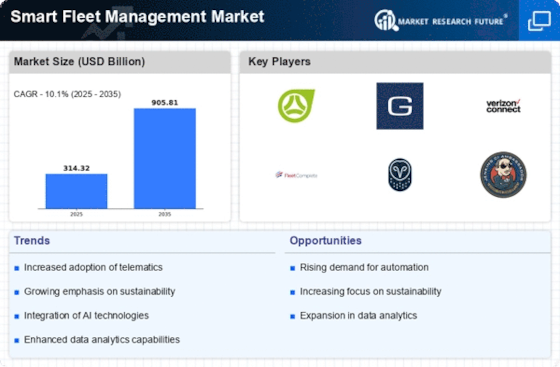
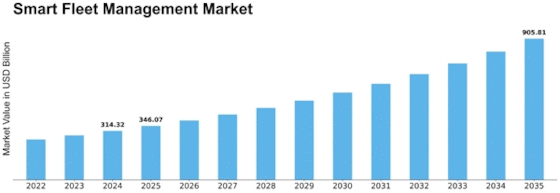
As per Market Research Future analysis, the Smart Fleet Management Market Size was estimated at 314.32 USD Billion in 2024. The Smart Fleet Management industry is projected to grow from 346.07 USD Billion in 2025 to 905.81 USD Billion by 2035, exhibiting a compound annual growth rate (CAGR) of 10.1% during the forecast period 2025 - 2035

Key Market Trends & Highlights

The Smart Fleet Management Market is poised for substantial growth driven by technological advancements and sustainability initiatives.

  • The integration of advanced technologies is transforming fleet operations, enhancing efficiency and safety. North America remains the largest market, while Asia-Pacific is emerging as the fastest-growing region in smart fleet management. The automotive segment leads in market size, whereas the marine segment is witnessing rapid growth due to increasing demand for innovative solutions. Key market drivers include the integration of IoT solutions and a growing emphasis on environmental sustainability.

Market Size & Forecast

2024 Market Size 314.32 (USD Billion)
2035 Market Size 905.81 (USD Billion)
CAGR (2025 - 2035) 10.1%
Largest Regional Market Share in 2024 Asia Pacific

Major Players

Teletrac Navman (US), Geotab (CA), Verizon Connect (US), Fleet Complete (CA), Samsara (US), Omnicomm (RU), Teletrac (US), Zubie (US), Ctrack (ZA)

Market Trends

The Smart Fleet Management Market is currently experiencing a transformative phase, driven by advancements in technology and an increasing emphasis on operational efficiency. Companies are increasingly adopting smart fleet solutions to optimize their logistics and transportation processes. This shift is largely influenced by the need for real-time data analytics, which enables businesses to make informed decisions regarding vehicle maintenance, route optimization, and fuel management. Furthermore, the integration of Internet of Things (IoT) devices is enhancing connectivity among fleet vehicles, allowing for improved tracking and monitoring capabilities. As a result, organizations are likely to witness enhanced productivity and reduced operational costs. contributing to the expanding smart fleet management market size In addition to technological advancements, regulatory frameworks are evolving to support sustainable practices within the Smart Fleet Management Market.

Governments are implementing stricter emissions regulations, prompting companies to invest in greener fleet options. This trend not only aligns with global sustainability goals but also encourages the adoption of electric and hybrid vehicles. Moreover, the growing awareness of environmental impact among consumers is pushing businesses to prioritize eco-friendly solutions. Overall, the Smart Fleet Management Market appears poised for growth, driven by innovation and a commitment to sustainability which continue to shape smart fleet management market trends..

Integration of Advanced Technologies

The Smart Fleet Management Market is witnessing a notable trend towards the integration of advanced technologies such as artificial intelligence and machine learning. These technologies facilitate predictive maintenance, enabling fleets to anticipate issues before they escalate, thereby minimizing downtime and enhancing operational efficiency.

Focus on Sustainability

There is a growing emphasis on sustainability within the Smart Fleet Management Market, as companies increasingly seek to reduce their carbon footprint. This trend is reflected in the rising adoption of electric and hybrid vehicles, as well as the implementation of eco-friendly practices in fleet operations.

Enhanced Data Analytics

The utilization of enhanced data analytics is becoming a cornerstone of the smart fleet management market . Organizations are leveraging big data to gain insights into fleet performance, driver behavior, and fuel consumption, which ultimately aids in making strategic decisions that improve overall efficiency.

Smart Fleet Management Market Market Drivers

Integration of IoT Solutions

The integration of Internet of Things (IoT) solutions is a pivotal driver for the Smart Fleet Management Market. IoT technology enables real-time tracking and monitoring of fleet vehicles, enhancing operational efficiency. By utilizing sensors and connected devices, fleet managers can gather data on vehicle performance, driver behavior, and maintenance needs. This data-driven approach not only reduces operational costs but also improves safety and compliance. According to recent estimates, the adoption of IoT in fleet management could lead to a reduction in fuel consumption by up to 15%. As more companies recognize the benefits of IoT, the demand for smart fleet management solutions is expected to surge, further propelling the market forward.

Rising Demand for Cost Efficiency

The rising demand for cost efficiency is a significant driver in the Smart Fleet Management Market. Companies are increasingly seeking ways to optimize their operations and reduce expenses associated with fleet management. Smart fleet management solutions offer tools for route optimization, fuel management, and predictive maintenance, which can lead to substantial cost savings. Research indicates that organizations implementing these solutions can achieve a reduction in operational costs by approximately 20 to 30%. As businesses strive to enhance their bottom line, the adoption of smart fleet management technologies is expected to accelerate, contributing to the overall growth of the market.

Regulatory Compliance and Safety Standards

Regulatory compliance and safety standards are increasingly influencing the Smart Fleet Management Market. Governments worldwide are implementing stringent regulations aimed at improving road safety and reducing emissions. Fleet operators are required to adhere to these regulations, which often necessitates the adoption of advanced fleet management technologies. For instance, the implementation of electronic logging devices (ELDs) has become mandatory in many regions, ensuring that drivers adhere to hours-of-service regulations. This compliance not only enhances safety but also mitigates the risk of penalties and legal issues for fleet operators. As regulatory frameworks continue to evolve, the demand for smart fleet management solutions that facilitate compliance is likely to grow, driving market expansion.

Advancements in Telecommunication Technologies

Advancements in telecommunication technologies are playing a crucial role in shaping the Smart Fleet Management Market. The proliferation of 4G and 5G networks facilitates seamless communication between vehicles and fleet management systems. This connectivity enables real-time data transmission, allowing fleet managers to make informed decisions quickly. Enhanced telecommunication capabilities also support the integration of advanced technologies such as artificial intelligence and machine learning, which can further optimize fleet operations. As telecommunication infrastructure continues to improve, the potential for smart fleet management solutions to deliver enhanced performance and efficiency is likely to increase, driving market growth.

Growing Emphasis on Environmental Sustainability

The growing emphasis on environmental sustainability is a key driver for the Smart Fleet Management Market. As concerns about climate change and environmental degradation rise, companies are increasingly adopting sustainable practices within their operations. Smart fleet management solutions enable organizations to monitor and reduce their carbon footprint through efficient route planning and vehicle utilization. Additionally, the integration of electric and hybrid vehicles into fleets is becoming more prevalent, further supporting sustainability goals. Market analysis suggests that the shift towards greener fleet management practices could lead to a significant increase in the adoption of smart fleet management technologies, as businesses seek to align with environmental regulations and consumer expectations.


Market Segment Insights

By Transportation: Automotive (Largest) vs. Marine (Fastest-Growing)

<p>In the Smart Fleet Management Market, the Transportation segment is predominantly influenced by the Automotive sector, which holds the largest share of the market. This dominance can be attributed to the increasing integration of advanced technologies in vehicles, providing enhanced safety and operational efficiency. On the other hand, the Marine sector, while smaller, is rapidly gaining traction as digital transformation initiatives are adopted to optimize fleet operations across waterways. The need for efficient management of marine assets is driving the growth of this segment.</p>

<p>Automotive (Dominant) vs. Rolling Stock (Emerging)</p>

<p>The Automotive segment remains the dominant force in the Smart Fleet Management Market due to its extensive deployment of telematics and IoT technologies, which significantly improve vehicle tracking and maintenance scheduling. Conversely, the Rolling Stock segment, which includes trains and rail systems, is emerging as a critical player by leveraging smart technologies to enhance operational efficiency and safety. The adoption of predictive maintenance and real-time monitoring in rolling stock is poised for growth, responding to increased demand for reliability and improved asset utilization. As smart technologies become integral in these sectors, the comparison highlights the Automotive sector's mature status against the rising potential of Rolling Stock.</p>

By Component: Hardware (Largest) vs. Services (Fastest-Growing)

<p>In the Smart Fleet Management Market, the component segment is considerably diverse, comprising hardware, software, and services. Hardware currently holds the largest market share, driven by the substantial investments in advanced vehicle technologies and infrastructure development. It plays a vital role in ensuring efficient fleet operations through GPS-enabled devices and IoT integration. Software also enjoys a significant market presence, providing essential tools for real-time analytics and fleet monitoring, while services, though initially smaller, are rapidly gaining traction as companies seek comprehensive solutions for fleet management.</p>

<p>Software (Dominant) vs. Services (Emerging)</p>

<p>The software segment in smart fleet management is dominant, offering critical functionalities like route optimization, performance analytics, and compliance reporting, which are essential for operational efficiency. On the other hand, the services segment, although emerging, is swiftly transforming the market landscape by providing tailored solutions that encompass training, maintenance, and support. This shift is fueled by the growing recognition of the need for integrated solutions to manage increasingly complex fleets effectively. As businesses prioritize operational excellence, the demand for software tools rises, and services are catching up to meet these evolving needs.</p>

By Application: Tracking (Largest) vs. Optimization (Fastest-Growing)

<p>In the Smart Fleet Management Market, the 'Application' segment is primarily driven by Tracking, which holds the largest share due to its essential role in improving operational efficiency and asset visibility. Alongside Tracking, Optimization is emerging as a significant player with rapid development, facilitating resource management and route planning enhancements. As fleets look to maximize effectiveness, the demand for Tracking systems remains paramount, reflecting a clear preference among businesses. In addition to Tracking's dominance, the growth of Optimization technology is powered by the increasing need for cost-effective solutions amidst rising operational complexities. Fleet managers are increasingly adopting Optimization tools to leverage data analytics, leading to smarter decisions regarding route choices and fuel management. Consequently, while Tracking consolidates its lead, Optimization is gaining traction as fleets transition towards advanced solutions.</p>

<p>Tracking (Dominant) vs. ADAS (Emerging)</p>

<p>The Tracking segment in the Smart Fleet Management Market has solidified its position as the dominant application, primarily providing real-time visibility and control over fleet operations. By allowing fleet managers to monitor vehicle locations and movements, Tracking enhances operational efficiency and reduces costs when implemented effectively. The integration of GPS and telematics technology further strengthens its appeal, ensuring accurate data delivery around the clock. On the other hand, Advanced Driver-Assistance Systems (ADAS) represents an emerging application striving to enhance vehicle safety and driver awareness. Though still in its infancy within this market, ADAS technology holds great potential as it combines various sensors and intelligent systems designed to prevent collisions and ensure compliance with regulations. As safety becomes a priority in fleet management, more operators are likely to invest in such cutting-edge technologies.</p>

By Connectivity: Cloud (Largest) vs. Long Range Communication (Fastest-Growing)

<p>The Smart Fleet Management Market has seen a significant distribution in its connectivity segment, with the Cloud segment leading the way. This segment's dominance is attributed to the increasing demand for real-time data analysis and monitoring capabilities that cloud solutions offer. In contrast, Long Range Communication is emerging quickly, spurred by advancements in connectivity technology that expand operational range and enhance overall fleet management efficiency. While Cloud maintains its substantial share, the rise of Long Range Communication is indicative of a shifting preference towards more robust communication solutions that permit fleets to operate effectively across vast distances. The growth trends highlight a pivotal shift towards integrated connectivity solutions within Smart Fleet Management. Cloud-based systems are evolving to incorporate enhanced features like AI-driven analytics and automatic updates, fueling their sustained market share. Meanwhile, Long Range Communication is progressing rapidly, driven by increasing demand for connectivity in remote areas and the necessity for consistent communication between fleet elements. Factors like the rise of IoT devices and the need for safer, more efficient operations are encouraging fleets to adopt these innovative connectivity solutions, fostering an environment for sustained growth and evolution in smart fleet management practices.</p>

<p>Cloud (Dominant) vs. Short Range Communication (Emerging)</p>

<p>The connectivity landscape of Smart Fleet Management is marked by the dominance of Cloud technology as a preferred solution. It's characterized by its ability to store vast amounts of data while providing real-time analysis and fleet performance monitoring, making it indispensable for modern fleet operators. In contrast, Short Range Communication is identified as an emerging technology within the market. While it offers efficient local communication solutions, its limitation lies in range compared to Cloud options. Nevertheless, Short Range Communication is critical in ensuring instant data transfer and communication among vehicles and infrastructure within a constrained area. Its development is spurred by advancements in communication protocols, allowing for smoother fleet operations, even as it plays a supporting role to dominant Cloud systems.</p>

Get more detailed insights about Smart Fleet Management Market Research Report - Global Forecast To 2035

Regional Insights

North America : Innovation and Technology Leader

North America is the largest market for Smart Fleet Management Market, holding approximately 45% of the global share. The region's growth is driven by technological advancements, increasing demand for operational efficiency, and stringent regulations aimed at reducing emissions. The U.S. and Canada are the primary contributors, with a strong focus on integrating IoT and AI technologies into fleet operations. Regulatory incentives further catalyze market expansion, promoting sustainable practices. The competitive landscape is robust, featuring key players like Teletrac Navman, Geotab, and Verizon Connect. These companies leverage advanced analytics and real-time data to enhance fleet performance. The presence of established firms fosters innovation, while new entrants are also emerging, intensifying competition. The market is characterized by strategic partnerships and collaborations aimed at enhancing service offerings and expanding market reach.

Europe : Regulatory-Driven Market Growth

Europe is the second-largest market for Smart Fleet Management Market, accounting for around 30% of the global share. The region's growth is significantly influenced by stringent environmental regulations and a strong push towards sustainability. Countries like Germany and the UK are leading the charge, implementing policies that encourage the adoption of smart technologies in fleet management. The European Union's Green Deal further supports this transition, aiming for a significant reduction in carbon emissions by 2030. Leading countries in this market include Germany, the UK, and France, where companies are increasingly adopting smart fleet solutions to comply with regulations and enhance operational efficiency. The competitive landscape features prominent players such as Omnicomm and Ctrack, who are innovating to meet the evolving demands of the market. The presence of various startups also adds dynamism, fostering a culture of innovation and collaboration within the sector.

Asia-Pacific : Emerging Market Potential

Asia-Pacific is witnessing rapid growth in the Smart Fleet Management Market, holding approximately 20% of the global share. The region's expansion is driven by increasing urbanization, rising logistics demands, and government initiatives promoting smart transportation solutions. Countries like China and India are at the forefront, implementing policies that encourage the adoption of advanced fleet management technologies to improve efficiency and reduce costs. The competitive landscape is evolving, with both established players and new entrants vying for market share. Key companies such as Samsara and Geotab are expanding their presence in the region, leveraging local partnerships to enhance service delivery. The market is characterized by a growing emphasis on data analytics and real-time tracking, which are becoming essential for fleet operators aiming to optimize their operations and reduce operational costs.

Middle East and Africa : Resource-Rich Market Opportunities

The Middle East and Africa region is gradually emerging in the Smart Fleet Management Market, holding about 5% of the global share. The growth is primarily driven by increasing investments in infrastructure and logistics, alongside a rising focus on operational efficiency. Countries like South Africa and the UAE are leading the way, with government initiatives aimed at modernizing transportation systems and enhancing fleet management practices. The competitive landscape is still developing, with key players like Ctrack making significant inroads. The market is characterized by a mix of local and international companies, all striving to capture the growing demand for smart fleet solutions. As the region continues to invest in technology and infrastructure, the potential for growth in fleet management solutions is substantial, paving the way for innovative practices and enhanced service delivery.

Key Players and Competitive Insights

The Market is a highly competitive industry, with numerous local and global vendors present in the market. Many of these market players possess extensive experience and strong regional presence across North America, Europe, Asia-Pacific, Africa, and Latin America in the Smart Fleet Management Market services. The market consists of various global, regional, and local service providers that are continuously evolving to enhance their market position. The rising demand for advanced fleet management solutions and the need for increased operational efficiency are the key factors aiding market growth. Smart Fleet Management Market service providers compete based on the cost, reliability, and efficiency of their products to remain relevant in the competitive market. Vendors in the Market are focused on improving their products and services and expanding their presence in underdeveloped and developing countries. Some of the major players in the Market include Some of the major players in the market include Continental AG, Samsung Electronics Co Ltd, Robert Bosch GmbH, Siemens, Denso Corporation, Hitachi, Ltd. and Orbcomm, Inc. These companies have a strong presence in the market and offer a wide range of Smart Fleet Management Market services to fleet owners and managers across the world. To benefit customers and expand the market sector, manufacturers in the global Smart Fleet Management industry are adopting various business strategies, such as investing in research and development to expand their product lines and reducing operating costs. The Smart Fleet Management industry has provided significant benefits to various industries, including logistics, transportation, and automotive. In conclusion, the market is expected to witness intense competition in the coming years, with major players investing in research and development to expand their product lines and remain competitive. Companies such as Cisco Systems, Inc., IBM Corporation, and Continental AG are likely to continue expanding their operations through mergers and acquisitions, partnerships, and collaborations to strengthen their position in the market.

Key Companies in the Smart Fleet Management Market include

Industry Developments

February 2024: In corporate fleet management, electric vehicles (EVs) are revolutionizing the mobility experience. Mercedes-Benz and SAP's relationship, in which the two corporations are each other's suppliers and clients, is a prime example. Mercedes-Benz is using SAP solutions to digitize its omnichannel purchasing process, and SAP is the first client in Germany to manage the company's fleet of vehicles using its own technology.

In February 2024, the corporate fleet management industry voices the new game - electric vehicles (EV) in the future of mobility. It is demonstrated, for example, by the relationship of Mercedes-Benz and SAP where both corporations supply and consume goods or services from each other. Mercedes-Benz is adopting SAP solutions to enhance the digitization of its omnichannel purchasing processes; in response, SAP has become the first client within Germany that manage the fleet of a local company by implementing its technology.

In January of the year 2022, a strategic partnership was signed between Continental AG and IVECO with the aim of promoting a tachograph data management solution. CNG International, a German technology company, and IVECO, an Italian commercial vehicle manufacturer, are joining forces in the fight against accidents on European streets.

January 2022 Continental AG partnered with IVECO to promote a tachograph data management solution. The German technology company Continental and the Italian commercial vehicle manufacturer IVECO are teaming up for more safety on Europe's roads.

Future Outlook

Smart Fleet Management Market Future Outlook

The Smart <a href="https://www.marketresearchfuture.com/reports/fleet-management-market-2646" target="_blank" title="fleet management">Fleet Management</a> Market is projected to grow at a 10.1% CAGR from 2025 to 2035, driven by advancements in IoT, AI, and sustainability initiatives.

New opportunities lie in:

  • <p>Integration of AI-driven predictive maintenance solutions Development of advanced <a href="https://www.marketresearchfuture.com/reports/telematics-market-1121" target="_blank" title="telematics">telematics</a> for real-time data analytics Expansion into electric vehicle <a href="https://www.marketresearchfuture.com/reports/fleet-management-services-market-66783">fleet management services</a></p>

By 2035, the market is expected to be robust, driven by innovation and strategic partnerships.

Market Segmentation

Smart Fleet Management Market Component Outlook

  • Hardware
  • Software
  • Services

Smart Fleet Management Market Application Outlook

  • Tracking
  • Optimization
  • ADAS
  • Diagnostic

Smart Fleet Management Market Connectivity Outlook

  • Cloud
  • Short Range Communication
  • Long Range Communication

Smart Fleet Management Market Transportation Outlook

  • Automotive
  • Rolling Stock
  • Marine

Report Scope

MARKET SIZE 2024 314.32(USD Billion)
MARKET SIZE 2025 346.07(USD Billion)
MARKET SIZE 2035 905.81(USD Billion)
COMPOUND ANNUAL GROWTH RATE (CAGR) 10.1% (2025 - 2035)
REPORT COVERAGE Revenue Forecast, Competitive Landscape, Growth Factors, and Trends
BASE YEAR 2024
Market Forecast Period 2025 - 2035
Historical Data 2019 - 2024
Market Forecast Units USD Billion
Key Companies Profiled Teletrac Navman (US), Geotab (CA), Verizon Connect (US), Fleet Complete (CA), Samsara (US), Omnicomm (RU), Teletrac (US), Zubie (US), Ctrack (ZA)
Segments Covered Transportation, Component, Application, Connectivity, Region
Key Market Opportunities Integration of artificial intelligence and machine learning enhances operational efficiency in the Smart Fleet Management Market.
Key Market Dynamics Rising demand for real-time data analytics drives innovation in Smart Fleet Management solutions and enhances operational efficiency.
Countries Covered North America, Europe, APAC, South America, MEA

FAQs

What is the projected market valuation of the Smart Fleet Management Market by 2035?

<p>The Smart Fleet Management Market is projected to reach a valuation of 905.81 USD Billion by 2035.</p>

What was the market valuation of the Smart Fleet Management Market in 2024?

<p>In 2024, the Smart Fleet Management Market was valued at 314.32 USD Billion.</p>

What is the expected CAGR for the Smart Fleet Management Market during the forecast period 2025 - 2035?

<p>The expected CAGR for the Smart Fleet Management Market during the forecast period 2025 - 2035 is 10.1%.</p>

Which segments are included in the Smart Fleet Management Market?

<p>The Smart Fleet Management Market includes segments such as Transportation, Component, Application, and Connectivity.</p>

What are the projected valuations for the Transportation segment by 2035?

<p>The Transportation segment is projected to grow from 314.32 USD Billion in 2024 to between 314.32 and 905.81 USD Billion by 2035.</p>

Which companies are considered key players in the Smart Fleet Management Market?

<p>Key players in the Smart Fleet Management Market include Teletrac Navman, Geotab, Verizon Connect, and Samsara.</p>

What is the projected growth for the Software component in the Smart Fleet Management Market?

<p>The Software component is expected to grow from 120.0 USD Billion in 2024 to between 120.0 and 350.0 USD Billion by 2035.</p>

How does the market for Tracking applications in Smart Fleet Management appear to be evolving?

<p>The Tracking application segment is projected to grow from 50.0 USD Billion in 2024 to between 50.0 and 150.0 USD Billion by 2035.</p>

What is the expected growth for the Cloud connectivity segment in the Smart Fleet Management Market?

<p>The Cloud connectivity segment is anticipated to grow from 100.0 USD Billion in 2024 to between 100.0 and 300.0 USD Billion by 2035.</p>

What does the future hold for the Optimization application segment in the Smart Fleet Management Market?

<p>The Optimization application segment is projected to grow from 80.0 USD Billion in 2024 to between 80.0 and 250.0 USD Billion by 2035.</p>

  1. SECTION I: EXECUTIVE SUMMARY AND KEY HIGHLIGHTS
    1. | 1.1 EXECUTIVE SUMMARY
    2. | | 1.1.1 Market Overview
    3. | | 1.1.2 Key Findings
    4. | | 1.1.3 Market Segmentation
    5. | | 1.1.4 Competitive Landscape
    6. | | 1.1.5 Challenges and Opportunities
    7. | | 1.1.6 Future Outlook
  2. SECTION II: SCOPING, METHODOLOGY AND MARKET STRUCTURE
    1. | 2.1 MARKET INTRODUCTION
    2. | | 2.1.1 Definition
    3. | | 2.1.2 Scope of the study
    4. | | | 2.1.2.1 Research Objective
    5. | | | 2.1.2.2 Assumption
    6. | | | 2.1.2.3 Limitations
    7. | 2.2 RESEARCH METHODOLOGY
    8. | | 2.2.1 Overview
    9. | | 2.2.2 Data Mining
    10. | | 2.2.3 Secondary Research
    11. | | 2.2.4 Primary Research
    12. | | | 2.2.4.1 Primary Interviews and Information Gathering Process
    13. | | | 2.2.4.2 Breakdown of Primary Respondents
    14. | | 2.2.5 Forecasting Model
    15. | | 2.2.6 Market Size Estimation
    16. | | | 2.2.6.1 Bottom-Up Approach
    17. | | | 2.2.6.2 Top-Down Approach
    18. | | 2.2.7 Data Triangulation
    19. | | 2.2.8 Validation
  3. SECTION III: QUALITATIVE ANALYSIS
    1. | 3.1 MARKET DYNAMICS
    2. | | 3.1.1 Overview
    3. | | 3.1.2 Drivers
    4. | | 3.1.3 Restraints
    5. | | 3.1.4 Opportunities
    6. | 3.2 MARKET FACTOR ANALYSIS
    7. | | 3.2.1 Value chain Analysis
    8. | | 3.2.2 Porter's Five Forces Analysis
    9. | | | 3.2.2.1 Bargaining Power of Suppliers
    10. | | | 3.2.2.2 Bargaining Power of Buyers
    11. | | | 3.2.2.3 Threat of New Entrants
    12. | | | 3.2.2.4 Threat of Substitutes
    13. | | | 3.2.2.5 Intensity of Rivalry
    14. | | 3.2.3 COVID-19 Impact Analysis
    15. | | | 3.2.3.1 Market Impact Analysis
    16. | | | 3.2.3.2 Regional Impact
    17. | | | 3.2.3.3 Opportunity and Threat Analysis
  4. SECTION IV: QUANTITATIVE ANALYSIS
    1. | 4.1 Automobile, BY Transportation (USD Billion)
    2. | | 4.1.1 Automotive
    3. | | 4.1.2 Rolling Stock
    4. | | 4.1.3 Marine
    5. | 4.2 Automobile, BY Component (USD Billion)
    6. | | 4.2.1 Hardware
    7. | | 4.2.2 Software
    8. | | 4.2.3 Services
    9. | 4.3 Automobile, BY Application (USD Billion)
    10. | | 4.3.1 Tracking
    11. | | 4.3.2 Optimization
    12. | | 4.3.3 ADAS
    13. | | 4.3.4 Diagnostic
    14. | 4.4 Automobile, BY Connectivity (USD Billion)
    15. | | 4.4.1 Cloud
    16. | | 4.4.2 Short Range Communication
    17. | | 4.4.3 Long Range Communication
    18. | 4.5 Automobile, BY Region (USD Billion)
    19. | | 4.5.1 North America
    20. | | | 4.5.1.1 US
    21. | | | 4.5.1.2 Canada
    22. | | 4.5.2 Europe
    23. | | | 4.5.2.1 Germany
    24. | | | 4.5.2.2 UK
    25. | | | 4.5.2.3 France
    26. | | | 4.5.2.4 Russia
    27. | | | 4.5.2.5 Italy
    28. | | | 4.5.2.6 Spain
    29. | | | 4.5.2.7 Rest of Europe
    30. | | 4.5.3 APAC
    31. | | | 4.5.3.1 China
    32. | | | 4.5.3.2 India
    33. | | | 4.5.3.3 Japan
    34. | | | 4.5.3.4 South Korea
    35. | | | 4.5.3.5 Malaysia
    36. | | | 4.5.3.6 Thailand
    37. | | | 4.5.3.7 Indonesia
    38. | | | 4.5.3.8 Rest of APAC
    39. | | 4.5.4 South America
    40. | | | 4.5.4.1 Brazil
    41. | | | 4.5.4.2 Mexico
    42. | | | 4.5.4.3 Argentina
    43. | | | 4.5.4.4 Rest of South America
    44. | | 4.5.5 MEA
    45. | | | 4.5.5.1 GCC Countries
    46. | | | 4.5.5.2 South Africa
    47. | | | 4.5.5.3 Rest of MEA
  5. SECTION V: COMPETITIVE ANALYSIS
    1. | 5.1 Competitive Landscape
    2. | | 5.1.1 Overview
    3. | | 5.1.2 Competitive Analysis
    4. | | 5.1.3 Market share Analysis
    5. | | 5.1.4 Major Growth Strategy in the Automobile
    6. | | 5.1.5 Competitive Benchmarking
    7. | | 5.1.6 Leading Players in Terms of Number of Developments in the Automobile
    8. | | 5.1.7 Key developments and growth strategies
    9. | | | 5.1.7.1 New Product Launch/Service Deployment
    10. | | | 5.1.7.2 Merger & Acquisitions
    11. | | | 5.1.7.3 Joint Ventures
    12. | | 5.1.8 Major Players Financial Matrix
    13. | | | 5.1.8.1 Sales and Operating Income
    14. | | | 5.1.8.2 Major Players R&D Expenditure. 2023
    15. | 5.2 Company Profiles
    16. | | 5.2.1 Teletrac Navman (US)
    17. | | | 5.2.1.1 Financial Overview
    18. | | | 5.2.1.2 Products Offered
    19. | | | 5.2.1.3 Key Developments
    20. | | | 5.2.1.4 SWOT Analysis
    21. | | | 5.2.1.5 Key Strategies
    22. | | 5.2.2 Geotab (CA)
    23. | | | 5.2.2.1 Financial Overview
    24. | | | 5.2.2.2 Products Offered
    25. | | | 5.2.2.3 Key Developments
    26. | | | 5.2.2.4 SWOT Analysis
    27. | | | 5.2.2.5 Key Strategies
    28. | | 5.2.3 Verizon Connect (US)
    29. | | | 5.2.3.1 Financial Overview
    30. | | | 5.2.3.2 Products Offered
    31. | | | 5.2.3.3 Key Developments
    32. | | | 5.2.3.4 SWOT Analysis
    33. | | | 5.2.3.5 Key Strategies
    34. | | 5.2.4 Fleet Complete (CA)
    35. | | | 5.2.4.1 Financial Overview
    36. | | | 5.2.4.2 Products Offered
    37. | | | 5.2.4.3 Key Developments
    38. | | | 5.2.4.4 SWOT Analysis
    39. | | | 5.2.4.5 Key Strategies
    40. | | 5.2.5 Samsara (US)
    41. | | | 5.2.5.1 Financial Overview
    42. | | | 5.2.5.2 Products Offered
    43. | | | 5.2.5.3 Key Developments
    44. | | | 5.2.5.4 SWOT Analysis
    45. | | | 5.2.5.5 Key Strategies
    46. | | 5.2.6 Omnicomm (RU)
    47. | | | 5.2.6.1 Financial Overview
    48. | | | 5.2.6.2 Products Offered
    49. | | | 5.2.6.3 Key Developments
    50. | | | 5.2.6.4 SWOT Analysis
    51. | | | 5.2.6.5 Key Strategies
    52. | | 5.2.7 Teletrac (US)
    53. | | | 5.2.7.1 Financial Overview
    54. | | | 5.2.7.2 Products Offered
    55. | | | 5.2.7.3 Key Developments
    56. | | | 5.2.7.4 SWOT Analysis
    57. | | | 5.2.7.5 Key Strategies
    58. | | 5.2.8 Zubie (US)
    59. | | | 5.2.8.1 Financial Overview
    60. | | | 5.2.8.2 Products Offered
    61. | | | 5.2.8.3 Key Developments
    62. | | | 5.2.8.4 SWOT Analysis
    63. | | | 5.2.8.5 Key Strategies
    64. | | 5.2.9 Ctrack (ZA)
    65. | | | 5.2.9.1 Financial Overview
    66. | | | 5.2.9.2 Products Offered
    67. | | | 5.2.9.3 Key Developments
    68. | | | 5.2.9.4 SWOT Analysis
    69. | | | 5.2.9.5 Key Strategies
    70. | 5.3 Appendix
    71. | | 5.3.1 References
    72. | | 5.3.2 Related Reports
  6. LIST OF FIGURES
    1. | 6.1 MARKET SYNOPSIS
    2. | 6.2 NORTH AMERICA MARKET ANALYSIS
    3. | 6.3 US MARKET ANALYSIS BY TRANSPORTATION
    4. | 6.4 US MARKET ANALYSIS BY COMPONENT
    5. | 6.5 US MARKET ANALYSIS BY APPLICATION
    6. | 6.6 US MARKET ANALYSIS BY CONNECTIVITY
    7. | 6.7 CANADA MARKET ANALYSIS BY TRANSPORTATION
    8. | 6.8 CANADA MARKET ANALYSIS BY COMPONENT
    9. | 6.9 CANADA MARKET ANALYSIS BY APPLICATION
    10. | 6.10 CANADA MARKET ANALYSIS BY CONNECTIVITY
    11. | 6.11 EUROPE MARKET ANALYSIS
    12. | 6.12 GERMANY MARKET ANALYSIS BY TRANSPORTATION
    13. | 6.13 GERMANY MARKET ANALYSIS BY COMPONENT
    14. | 6.14 GERMANY MARKET ANALYSIS BY APPLICATION
    15. | 6.15 GERMANY MARKET ANALYSIS BY CONNECTIVITY
    16. | 6.16 UK MARKET ANALYSIS BY TRANSPORTATION
    17. | 6.17 UK MARKET ANALYSIS BY COMPONENT
    18. | 6.18 UK MARKET ANALYSIS BY APPLICATION
    19. | 6.19 UK MARKET ANALYSIS BY CONNECTIVITY
    20. | 6.20 FRANCE MARKET ANALYSIS BY TRANSPORTATION
    21. | 6.21 FRANCE MARKET ANALYSIS BY COMPONENT
    22. | 6.22 FRANCE MARKET ANALYSIS BY APPLICATION
    23. | 6.23 FRANCE MARKET ANALYSIS BY CONNECTIVITY
    24. | 6.24 RUSSIA MARKET ANALYSIS BY TRANSPORTATION
    25. | 6.25 RUSSIA MARKET ANALYSIS BY COMPONENT
    26. | 6.26 RUSSIA MARKET ANALYSIS BY APPLICATION
    27. | 6.27 RUSSIA MARKET ANALYSIS BY CONNECTIVITY
    28. | 6.28 ITALY MARKET ANALYSIS BY TRANSPORTATION
    29. | 6.29 ITALY MARKET ANALYSIS BY COMPONENT
    30. | 6.30 ITALY MARKET ANALYSIS BY APPLICATION
    31. | 6.31 ITALY MARKET ANALYSIS BY CONNECTIVITY
    32. | 6.32 SPAIN MARKET ANALYSIS BY TRANSPORTATION
    33. | 6.33 SPAIN MARKET ANALYSIS BY COMPONENT
    34. | 6.34 SPAIN MARKET ANALYSIS BY APPLICATION
    35. | 6.35 SPAIN MARKET ANALYSIS BY CONNECTIVITY
    36. | 6.36 REST OF EUROPE MARKET ANALYSIS BY TRANSPORTATION
    37. | 6.37 REST OF EUROPE MARKET ANALYSIS BY COMPONENT
    38. | 6.38 REST OF EUROPE MARKET ANALYSIS BY APPLICATION
    39. | 6.39 REST OF EUROPE MARKET ANALYSIS BY CONNECTIVITY
    40. | 6.40 APAC MARKET ANALYSIS
    41. | 6.41 CHINA MARKET ANALYSIS BY TRANSPORTATION
    42. | 6.42 CHINA MARKET ANALYSIS BY COMPONENT
    43. | 6.43 CHINA MARKET ANALYSIS BY APPLICATION
    44. | 6.44 CHINA MARKET ANALYSIS BY CONNECTIVITY
    45. | 6.45 INDIA MARKET ANALYSIS BY TRANSPORTATION
    46. | 6.46 INDIA MARKET ANALYSIS BY COMPONENT
    47. | 6.47 INDIA MARKET ANALYSIS BY APPLICATION
    48. | 6.48 INDIA MARKET ANALYSIS BY CONNECTIVITY
    49. | 6.49 JAPAN MARKET ANALYSIS BY TRANSPORTATION
    50. | 6.50 JAPAN MARKET ANALYSIS BY COMPONENT
    51. | 6.51 JAPAN MARKET ANALYSIS BY APPLICATION
    52. | 6.52 JAPAN MARKET ANALYSIS BY CONNECTIVITY
    53. | 6.53 SOUTH KOREA MARKET ANALYSIS BY TRANSPORTATION
    54. | 6.54 SOUTH KOREA MARKET ANALYSIS BY COMPONENT
    55. | 6.55 SOUTH KOREA MARKET ANALYSIS BY APPLICATION
    56. | 6.56 SOUTH KOREA MARKET ANALYSIS BY CONNECTIVITY
    57. | 6.57 MALAYSIA MARKET ANALYSIS BY TRANSPORTATION
    58. | 6.58 MALAYSIA MARKET ANALYSIS BY COMPONENT
    59. | 6.59 MALAYSIA MARKET ANALYSIS BY APPLICATION
    60. | 6.60 MALAYSIA MARKET ANALYSIS BY CONNECTIVITY
    61. | 6.61 THAILAND MARKET ANALYSIS BY TRANSPORTATION
    62. | 6.62 THAILAND MARKET ANALYSIS BY COMPONENT
    63. | 6.63 THAILAND MARKET ANALYSIS BY APPLICATION
    64. | 6.64 THAILAND MARKET ANALYSIS BY CONNECTIVITY
    65. | 6.65 INDONESIA MARKET ANALYSIS BY TRANSPORTATION
    66. | 6.66 INDONESIA MARKET ANALYSIS BY COMPONENT
    67. | 6.67 INDONESIA MARKET ANALYSIS BY APPLICATION
    68. | 6.68 INDONESIA MARKET ANALYSIS BY CONNECTIVITY
    69. | 6.69 REST OF APAC MARKET ANALYSIS BY TRANSPORTATION
    70. | 6.70 REST OF APAC MARKET ANALYSIS BY COMPONENT
    71. | 6.71 REST OF APAC MARKET ANALYSIS BY APPLICATION
    72. | 6.72 REST OF APAC MARKET ANALYSIS BY CONNECTIVITY
    73. | 6.73 SOUTH AMERICA MARKET ANALYSIS
    74. | 6.74 BRAZIL MARKET ANALYSIS BY TRANSPORTATION
    75. | 6.75 BRAZIL MARKET ANALYSIS BY COMPONENT
    76. | 6.76 BRAZIL MARKET ANALYSIS BY APPLICATION
    77. | 6.77 BRAZIL MARKET ANALYSIS BY CONNECTIVITY
    78. | 6.78 MEXICO MARKET ANALYSIS BY TRANSPORTATION
    79. | 6.79 MEXICO MARKET ANALYSIS BY COMPONENT
    80. | 6.80 MEXICO MARKET ANALYSIS BY APPLICATION
    81. | 6.81 MEXICO MARKET ANALYSIS BY CONNECTIVITY
    82. | 6.82 ARGENTINA MARKET ANALYSIS BY TRANSPORTATION
    83. | 6.83 ARGENTINA MARKET ANALYSIS BY COMPONENT
    84. | 6.84 ARGENTINA MARKET ANALYSIS BY APPLICATION
    85. | 6.85 ARGENTINA MARKET ANALYSIS BY CONNECTIVITY
    86. | 6.86 REST OF SOUTH AMERICA MARKET ANALYSIS BY TRANSPORTATION
    87. | 6.87 REST OF SOUTH AMERICA MARKET ANALYSIS BY COMPONENT
    88. | 6.88 REST OF SOUTH AMERICA MARKET ANALYSIS BY APPLICATION
    89. | 6.89 REST OF SOUTH AMERICA MARKET ANALYSIS BY CONNECTIVITY
    90. | 6.90 MEA MARKET ANALYSIS
    91. | 6.91 GCC COUNTRIES MARKET ANALYSIS BY TRANSPORTATION
    92. | 6.92 GCC COUNTRIES MARKET ANALYSIS BY COMPONENT
    93. | 6.93 GCC COUNTRIES MARKET ANALYSIS BY APPLICATION
    94. | 6.94 GCC COUNTRIES MARKET ANALYSIS BY CONNECTIVITY
    95. | 6.95 SOUTH AFRICA MARKET ANALYSIS BY TRANSPORTATION
    96. | 6.96 SOUTH AFRICA MARKET ANALYSIS BY COMPONENT
    97. | 6.97 SOUTH AFRICA MARKET ANALYSIS BY APPLICATION
    98. | 6.98 SOUTH AFRICA MARKET ANALYSIS BY CONNECTIVITY
    99. | 6.99 REST OF MEA MARKET ANALYSIS BY TRANSPORTATION
    100. | 6.100 REST OF MEA MARKET ANALYSIS BY COMPONENT
    101. | 6.101 REST OF MEA MARKET ANALYSIS BY APPLICATION
    102. | 6.102 REST OF MEA MARKET ANALYSIS BY CONNECTIVITY
    103. | 6.103 KEY BUYING CRITERIA OF AUTOMOBILE
    104. | 6.104 RESEARCH PROCESS OF MRFR
    105. | 6.105 DRO ANALYSIS OF AUTOMOBILE
    106. | 6.106 DRIVERS IMPACT ANALYSIS: AUTOMOBILE
    107. | 6.107 RESTRAINTS IMPACT ANALYSIS: AUTOMOBILE
    108. | 6.108 SUPPLY / VALUE CHAIN: AUTOMOBILE
    109. | 6.109 AUTOMOBILE, BY TRANSPORTATION, 2024 (% SHARE)
    110. | 6.110 AUTOMOBILE, BY TRANSPORTATION, 2024 TO 2035 (USD Billion)
    111. | 6.111 AUTOMOBILE, BY COMPONENT, 2024 (% SHARE)
    112. | 6.112 AUTOMOBILE, BY COMPONENT, 2024 TO 2035 (USD Billion)
    113. | 6.113 AUTOMOBILE, BY APPLICATION, 2024 (% SHARE)
    114. | 6.114 AUTOMOBILE, BY APPLICATION, 2024 TO 2035 (USD Billion)
    115. | 6.115 AUTOMOBILE, BY CONNECTIVITY, 2024 (% SHARE)
    116. | 6.116 AUTOMOBILE, BY CONNECTIVITY, 2024 TO 2035 (USD Billion)
    117. | 6.117 BENCHMARKING OF MAJOR COMPETITORS
  7. LIST OF TABLES
    1. | 7.1 LIST OF ASSUMPTIONS
    2. | | 7.1.1
    3. | 7.2 North America MARKET SIZE ESTIMATES; FORECAST
    4. | | 7.2.1 BY TRANSPORTATION, 2025-2035 (USD Billion)
    5. | | 7.2.2 BY COMPONENT, 2025-2035 (USD Billion)
    6. | | 7.2.3 BY APPLICATION, 2025-2035 (USD Billion)
    7. | | 7.2.4 BY CONNECTIVITY, 2025-2035 (USD Billion)
    8. | 7.3 US MARKET SIZE ESTIMATES; FORECAST
    9. | | 7.3.1 BY TRANSPORTATION, 2025-2035 (USD Billion)
    10. | | 7.3.2 BY COMPONENT, 2025-2035 (USD Billion)
    11. | | 7.3.3 BY APPLICATION, 2025-2035 (USD Billion)
    12. | | 7.3.4 BY CONNECTIVITY, 2025-2035 (USD Billion)
    13. | 7.4 Canada MARKET SIZE ESTIMATES; FORECAST
    14. | | 7.4.1 BY TRANSPORTATION, 2025-2035 (USD Billion)
    15. | | 7.4.2 BY COMPONENT, 2025-2035 (USD Billion)
    16. | | 7.4.3 BY APPLICATION, 2025-2035 (USD Billion)
    17. | | 7.4.4 BY CONNECTIVITY, 2025-2035 (USD Billion)
    18. | 7.5 Europe MARKET SIZE ESTIMATES; FORECAST
    19. | | 7.5.1 BY TRANSPORTATION, 2025-2035 (USD Billion)
    20. | | 7.5.2 BY COMPONENT, 2025-2035 (USD Billion)
    21. | | 7.5.3 BY APPLICATION, 2025-2035 (USD Billion)
    22. | | 7.5.4 BY CONNECTIVITY, 2025-2035 (USD Billion)
    23. | 7.6 Germany MARKET SIZE ESTIMATES; FORECAST
    24. | | 7.6.1 BY TRANSPORTATION, 2025-2035 (USD Billion)
    25. | | 7.6.2 BY COMPONENT, 2025-2035 (USD Billion)
    26. | | 7.6.3 BY APPLICATION, 2025-2035 (USD Billion)
    27. | | 7.6.4 BY CONNECTIVITY, 2025-2035 (USD Billion)
    28. | 7.7 UK MARKET SIZE ESTIMATES; FORECAST
    29. | | 7.7.1 BY TRANSPORTATION, 2025-2035 (USD Billion)
    30. | | 7.7.2 BY COMPONENT, 2025-2035 (USD Billion)
    31. | | 7.7.3 BY APPLICATION, 2025-2035 (USD Billion)
    32. | | 7.7.4 BY CONNECTIVITY, 2025-2035 (USD Billion)
    33. | 7.8 France MARKET SIZE ESTIMATES; FORECAST
    34. | | 7.8.1 BY TRANSPORTATION, 2025-2035 (USD Billion)
    35. | | 7.8.2 BY COMPONENT, 2025-2035 (USD Billion)
    36. | | 7.8.3 BY APPLICATION, 2025-2035 (USD Billion)
    37. | | 7.8.4 BY CONNECTIVITY, 2025-2035 (USD Billion)
    38. | 7.9 Russia MARKET SIZE ESTIMATES; FORECAST
    39. | | 7.9.1 BY TRANSPORTATION, 2025-2035 (USD Billion)
    40. | | 7.9.2 BY COMPONENT, 2025-2035 (USD Billion)
    41. | | 7.9.3 BY APPLICATION, 2025-2035 (USD Billion)
    42. | | 7.9.4 BY CONNECTIVITY, 2025-2035 (USD Billion)
    43. | 7.10 Italy MARKET SIZE ESTIMATES; FORECAST
    44. | | 7.10.1 BY TRANSPORTATION, 2025-2035 (USD Billion)
    45. | | 7.10.2 BY COMPONENT, 2025-2035 (USD Billion)
    46. | | 7.10.3 BY APPLICATION, 2025-2035 (USD Billion)
    47. | | 7.10.4 BY CONNECTIVITY, 2025-2035 (USD Billion)
    48. | 7.11 Spain MARKET SIZE ESTIMATES; FORECAST
    49. | | 7.11.1 BY TRANSPORTATION, 2025-2035 (USD Billion)
    50. | | 7.11.2 BY COMPONENT, 2025-2035 (USD Billion)
    51. | | 7.11.3 BY APPLICATION, 2025-2035 (USD Billion)
    52. | | 7.11.4 BY CONNECTIVITY, 2025-2035 (USD Billion)
    53. | 7.12 Rest of Europe MARKET SIZE ESTIMATES; FORECAST
    54. | | 7.12.1 BY TRANSPORTATION, 2025-2035 (USD Billion)
    55. | | 7.12.2 BY COMPONENT, 2025-2035 (USD Billion)
    56. | | 7.12.3 BY APPLICATION, 2025-2035 (USD Billion)
    57. | | 7.12.4 BY CONNECTIVITY, 2025-2035 (USD Billion)
    58. | 7.13 APAC MARKET SIZE ESTIMATES; FORECAST
    59. | | 7.13.1 BY TRANSPORTATION, 2025-2035 (USD Billion)
    60. | | 7.13.2 BY COMPONENT, 2025-2035 (USD Billion)
    61. | | 7.13.3 BY APPLICATION, 2025-2035 (USD Billion)
    62. | | 7.13.4 BY CONNECTIVITY, 2025-2035 (USD Billion)
    63. | 7.14 China MARKET SIZE ESTIMATES; FORECAST
    64. | | 7.14.1 BY TRANSPORTATION, 2025-2035 (USD Billion)
    65. | | 7.14.2 BY COMPONENT, 2025-2035 (USD Billion)
    66. | | 7.14.3 BY APPLICATION, 2025-2035 (USD Billion)
    67. | | 7.14.4 BY CONNECTIVITY, 2025-2035 (USD Billion)
    68. | 7.15 India MARKET SIZE ESTIMATES; FORECAST
    69. | | 7.15.1 BY TRANSPORTATION, 2025-2035 (USD Billion)
    70. | | 7.15.2 BY COMPONENT, 2025-2035 (USD Billion)
    71. | | 7.15.3 BY APPLICATION, 2025-2035 (USD Billion)
    72. | | 7.15.4 BY CONNECTIVITY, 2025-2035 (USD Billion)
    73. | 7.16 Japan MARKET SIZE ESTIMATES; FORECAST
    74. | | 7.16.1 BY TRANSPORTATION, 2025-2035 (USD Billion)
    75. | | 7.16.2 BY COMPONENT, 2025-2035 (USD Billion)
    76. | | 7.16.3 BY APPLICATION, 2025-2035 (USD Billion)
    77. | | 7.16.4 BY CONNECTIVITY, 2025-2035 (USD Billion)
    78. | 7.17 South Korea MARKET SIZE ESTIMATES; FORECAST
    79. | | 7.17.1 BY TRANSPORTATION, 2025-2035 (USD Billion)
    80. | | 7.17.2 BY COMPONENT, 2025-2035 (USD Billion)
    81. | | 7.17.3 BY APPLICATION, 2025-2035 (USD Billion)
    82. | | 7.17.4 BY CONNECTIVITY, 2025-2035 (USD Billion)
    83. | 7.18 Malaysia MARKET SIZE ESTIMATES; FORECAST
    84. | | 7.18.1 BY TRANSPORTATION, 2025-2035 (USD Billion)
    85. | | 7.18.2 BY COMPONENT, 2025-2035 (USD Billion)
    86. | | 7.18.3 BY APPLICATION, 2025-2035 (USD Billion)
    87. | | 7.18.4 BY CONNECTIVITY, 2025-2035 (USD Billion)
    88. | 7.19 Thailand MARKET SIZE ESTIMATES; FORECAST
    89. | | 7.19.1 BY TRANSPORTATION, 2025-2035 (USD Billion)
    90. | | 7.19.2 BY COMPONENT, 2025-2035 (USD Billion)
    91. | | 7.19.3 BY APPLICATION, 2025-2035 (USD Billion)
    92. | | 7.19.4 BY CONNECTIVITY, 2025-2035 (USD Billion)
    93. | 7.20 Indonesia MARKET SIZE ESTIMATES; FORECAST
    94. | | 7.20.1 BY TRANSPORTATION, 2025-2035 (USD Billion)
    95. | | 7.20.2 BY COMPONENT, 2025-2035 (USD Billion)
    96. | | 7.20.3 BY APPLICATION, 2025-2035 (USD Billion)
    97. | | 7.20.4 BY CONNECTIVITY, 2025-2035 (USD Billion)
    98. | 7.21 Rest of APAC MARKET SIZE ESTIMATES; FORECAST
    99. | | 7.21.1 BY TRANSPORTATION, 2025-2035 (USD Billion)
    100. | | 7.21.2 BY COMPONENT, 2025-2035 (USD Billion)
    101. | | 7.21.3 BY APPLICATION, 2025-2035 (USD Billion)
    102. | | 7.21.4 BY CONNECTIVITY, 2025-2035 (USD Billion)
    103. | 7.22 South America MARKET SIZE ESTIMATES; FORECAST
    104. | | 7.22.1 BY TRANSPORTATION, 2025-2035 (USD Billion)
    105. | | 7.22.2 BY COMPONENT, 2025-2035 (USD Billion)
    106. | | 7.22.3 BY APPLICATION, 2025-2035 (USD Billion)
    107. | | 7.22.4 BY CONNECTIVITY, 2025-2035 (USD Billion)
    108. | 7.23 Brazil MARKET SIZE ESTIMATES; FORECAST
    109. | | 7.23.1 BY TRANSPORTATION, 2025-2035 (USD Billion)
    110. | | 7.23.2 BY COMPONENT, 2025-2035 (USD Billion)
    111. | | 7.23.3 BY APPLICATION, 2025-2035 (USD Billion)
    112. | | 7.23.4 BY CONNECTIVITY, 2025-2035 (USD Billion)
    113. | 7.24 Mexico MARKET SIZE ESTIMATES; FORECAST
    114. | | 7.24.1 BY TRANSPORTATION, 2025-2035 (USD Billion)
    115. | | 7.24.2 BY COMPONENT, 2025-2035 (USD Billion)
    116. | | 7.24.3 BY APPLICATION, 2025-2035 (USD Billion)
    117. | | 7.24.4 BY CONNECTIVITY, 2025-2035 (USD Billion)
    118. | 7.25 Argentina MARKET SIZE ESTIMATES; FORECAST
    119. | | 7.25.1 BY TRANSPORTATION, 2025-2035 (USD Billion)
    120. | | 7.25.2 BY COMPONENT, 2025-2035 (USD Billion)
    121. | | 7.25.3 BY APPLICATION, 2025-2035 (USD Billion)
    122. | | 7.25.4 BY CONNECTIVITY, 2025-2035 (USD Billion)
    123. | 7.26 Rest of South America MARKET SIZE ESTIMATES; FORECAST
    124. | | 7.26.1 BY TRANSPORTATION, 2025-2035 (USD Billion)
    125. | | 7.26.2 BY COMPONENT, 2025-2035 (USD Billion)
    126. | | 7.26.3 BY APPLICATION, 2025-2035 (USD Billion)
    127. | | 7.26.4 BY CONNECTIVITY, 2025-2035 (USD Billion)
    128. | 7.27 MEA MARKET SIZE ESTIMATES; FORECAST
    129. | | 7.27.1 BY TRANSPORTATION, 2025-2035 (USD Billion)
    130. | | 7.27.2 BY COMPONENT, 2025-2035 (USD Billion)
    131. | | 7.27.3 BY APPLICATION, 2025-2035 (USD Billion)
    132. | | 7.27.4 BY CONNECTIVITY, 2025-2035 (USD Billion)
    133. | 7.28 GCC Countries MARKET SIZE ESTIMATES; FORECAST
    134. | | 7.28.1 BY TRANSPORTATION, 2025-2035 (USD Billion)
    135. | | 7.28.2 BY COMPONENT, 2025-2035 (USD Billion)
    136. | | 7.28.3 BY APPLICATION, 2025-2035 (USD Billion)
    137. | | 7.28.4 BY CONNECTIVITY, 2025-2035 (USD Billion)
    138. | 7.29 South Africa MARKET SIZE ESTIMATES; FORECAST
    139. | | 7.29.1 BY TRANSPORTATION, 2025-2035 (USD Billion)
    140. | | 7.29.2 BY COMPONENT, 2025-2035 (USD Billion)
    141. | | 7.29.3 BY APPLICATION, 2025-2035 (USD Billion)
    142. | | 7.29.4 BY CONNECTIVITY, 2025-2035 (USD Billion)
    143. | 7.30 Rest of MEA MARKET SIZE ESTIMATES; FORECAST
    144. | | 7.30.1 BY TRANSPORTATION, 2025-2035 (USD Billion)
    145. | | 7.30.2 BY COMPONENT, 2025-2035 (USD Billion)
    146. | | 7.30.3 BY APPLICATION, 2025-2035 (USD Billion)
    147. | | 7.30.4 BY CONNECTIVITY, 2025-2035 (USD Billion)
    148. | 7.31 PRODUCT LAUNCH/PRODUCT DEVELOPMENT/APPROVAL
    149. | | 7.31.1
    150. | 7.32 ACQUISITION/PARTNERSHIP
    151. | | 7.32.1

Automobile Market Segmentation

Automobile By Transportation (USD Billion, 2025-2035)

  • Automotive
  • Rolling Stock
  • Marine

Automobile By Component (USD Billion, 2025-2035)

  • Hardware
  • Software
  • Services

Automobile By Application (USD Billion, 2025-2035)

  • Tracking
  • Optimization
  • ADAS
  • Diagnostic

Automobile By Connectivity (USD Billion, 2025-2035)

  • Cloud
  • Short Range Communication
  • Long Range Communication
Infographic

Free Sample Request

Kindly complete the form below to receive a free sample of this Report

Get Free Sample

Customer Strories

Compare Licence

×
Features License Type
Single User Multiuser License Enterprise User
Price $4,950 $5,950 $7,250
Maximum User Access Limit 1 User Upto 10 Users Unrestricted Access Throughout the Organization
Free Customization
Direct Access to Analyst
Deliverable Format
Platform Access
Discount on Next Purchase 10% 15% 15%
Printable Versions