
×
Request Free Sample ×

Kindly complete the form below to receive a free sample of this Report

* Please use a valid business email

Leading companies partner with us for data-driven Insights

clients tt-cursor
Hero Background
English
Chinese
French
Japanese
Korean
German
Spanish

Smart Elevator Market Trends

ID: MRFR/PCM/4057-CR
111 Pages
Snehal Singh
July 2025

Smart Elevator Market Research Report Information by Component (Control systems (Elevator control systems, Security control systems (Surveillance camera, Intruder camera system, Fire alarm system, Visitor management system), Access control systems (Biometrics access control systems, Card-based access control systems, Touch-screen & keypad based access control systems), Sensors), Maintenance systems, Communication systems), by Service (New Installation, Maintenance, Renovation), by Application (Residential, Commercial, Industrial) and Region (North America, Europe, Asia-Pacific, South America, Middle East & Africa) - Forecast till 2035

Share:
Download PDF ×

We do not share your information with anyone. However, we may send you emails based on your report interest from time to time. You may contact us at any time to opt-out.

Smart Elevator Market Infographic
Purchase Options

Market Trends

Key Emerging Trends in the Smart Elevator Market

The construction and real estate industries' thirst for modern technology has pushed the smart elevator market's rapid rise. Smart elevator market trends favor more efficient and sophisticated vertical transportation systems. Elevators are increasingly using Internet of Things technologies to communicate with building management systems. This link improves operational efficiency by delivering real-time elevator performance, usage, and maintenance data.

Smart elevators with AI are another industry trend. AI-powered elevators optimize performance and reduce wait times by learning and adapting to user preferences and traffic patterns. Elevators employ machine learning algorithms to anticipate efficiency by analyzing sensor and user data. This trend matches modern buildings' focus on user experience and operational efficiency.

Energy efficiency is key to smart elevator market trends. Smart elevators reduce energy use to promote green development. Low-use standby mode, regenerative motors, and energy-efficient lighting save energy. Smart elevators are appealing to developers and building owners seeking green building certifications due to the global movement toward environmental consciousness.

The smart elevator market is also seeing a rise in destination dispatch systems. These algorithms optimize elevator paths depending on user destinations, saving time and enhancing efficiency. This is common in high-rise buildings and business complexes where elevator traffic management is crucial. Destination dispatch systems reduce wait times and boost convenience and personalization.

Biometric authentication and touchless technology are also growing in smart elevators. Biometric authentication systems like fingerprint scanning and facial recognition increase elevator security as security worries develop. Touchless controls like gesture recognition and smartphone-based interfaces provide a clean, contactless user experience, which is important post-pandemic.

Smart elevator use is rising rapidly in urban and emerging economies. Urbanization and smart building construction in developing countries drive the industry. Governments and regulatory organizations are also pushing smart building efforts, boosting smart elevator usage.

Technological advances, sustainability aims, and user experience define smart elevator market trends. As buildings grow smarter and more connected, need for intelligent and efficient vertical transportation systems will rise. Developers, building owners, and elevator manufacturers can benefit on these trends by adopting innovation and smart elevator solutions.


Author
Snehal Singh
Assistant Manager - Research

High acumen in analyzing complex macro & micro markets with more than 6 years of work experience in the field of market research. By implementing her analytical skills in forecasting and estimation into market research reports, she has expertise in Packaging, Construction, and Equipment domains. She handles a team size of 20-25 resources and ensures smooth running of the projects, associated marketing activities, and client servicing.

Leave a Comment

FAQs

What is the projected market valuation of the Smart Elevator Market by 2035?

<p>The Smart Elevator Market is projected to reach a valuation of 40.26 USD Billion by 2035.</p>

What was the market valuation of the Smart Elevator Market in 2024?

<p>In 2024, the Smart Elevator Market was valued at 15.57 USD Billion.</p>

What is the expected CAGR for the Smart Elevator Market during the forecast period 2025 - 2035?

<p>The expected CAGR for the Smart Elevator Market during the forecast period 2025 - 2035 is 9.02%.</p>

Which segments are included in the Smart Elevator Market analysis?

<p>The Smart Elevator Market analysis includes segments such as components, services, and applications.</p>

What are the projected valuations for the component segment of the Smart Elevator Market by 2035?

<p>The component segment is projected to grow from 15.57 USD Billion in 2024 to approximately 40.26 USD Billion by 2035.</p>

Who are the key players in the Smart Elevator Market?

Key players in the Smart Elevator Market include Otis Elevator Company, Schindler Group, Thyssenkrupp AG, and Kone Corporation.

What is the projected growth for the new installation service segment by 2035?

The new installation service segment is expected to grow from 6.23 USD Billion in 2024 to 16.25 USD Billion by 2035.

How does the commercial application segment perform in the Smart Elevator Market?

The commercial application segment is projected to grow from 7.0 USD Billion in 2024 to 18.0 USD Billion by 2035.

What is the expected growth for the maintenance systems component by 2035?

The maintenance systems component is anticipated to grow from 4.0 USD Billion in 2024 to 10.0 USD Billion by 2035.

What trends are influencing the Smart Elevator Market in 2025?

Trends influencing the Smart Elevator Market in 2025 include advancements in technology and increasing demand for energy-efficient solutions.

Market Summary

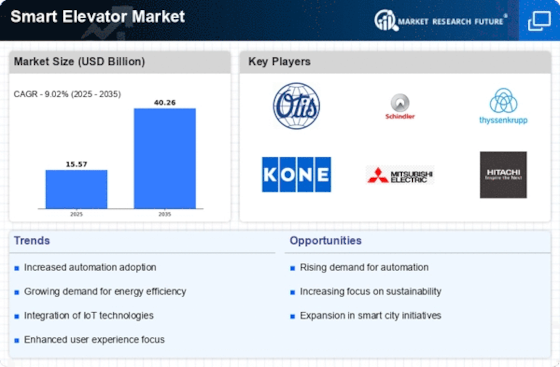
As per Market Research Future analysis, the Smart Elevator Market Size was estimated at 15.57 USD Billion in 2024. The Smart Elevator industry is projected to grow from 16.97 USD Billion in 2025 to 40.26 USD Billion by 2035, exhibiting a compound annual growth rate (CAGR) of 9.02% during the forecast period 2025 - 2035

Key Market Trends & Highlights

The Smart Elevator Market is poised for substantial growth driven by technological advancements and urbanization.

  • The integration of IoT technology is transforming operational efficiency in smart elevators across North America. Energy efficiency remains a focal point, with manufacturers prioritizing sustainable solutions in the Asia-Pacific region. Enhanced safety features are increasingly demanded, particularly in the control systems segment, which is the largest in the market. Rising urbanization and government regulations are key drivers propelling the growth of new installations and maintenance services.

Market Size & Forecast

2024 Market Size 15.57 (USD Billion)
2035 Market Size 40.26 (USD Billion)
CAGR (2025 - 2035) 9.02%
Largest Regional Market Share in 2024 Asia Pacific

Major Players

Otis Elevator Company (US), Schindler Group (CH), Thyssenkrupp AG (DE), Kone Corporation (FI), Mitsubishi Electric Corporation (JP), Hitachi Ltd. (JP), Toshiba Elevator and Building Systems Corporation (JP), Johnson Lifts (IN), Hyundai Elevator Co., Ltd. (KR)

Market Trends

The Smart Elevator Market is currently experiencing a transformative phase, driven by advancements in technology and increasing urbanization. As cities expand and the demand for efficient vertical transportation rises, smart elevators are becoming integral to modern infrastructure. These systems, equipped with advanced features such as IoT connectivity, energy efficiency, and enhanced safety protocols, are appealing to both developers and consumers. The integration of artificial intelligence and machine learning into elevator systems is also noteworthy, as it allows for predictive maintenance and improved user experience. Collectively, these developments are shaping emerging smart elevator market trends and supporting long-term industry expansion. Sustainability considerations are also playing a crucial role in shaping the smart elevator automation system market.   Building owners are increasingly seeking elevators that not only reduce energy consumption but also contribute to green building certifications. This trend aligns with global efforts to minimize carbon footprints and promote environmentally friendly practices. As the market evolves, it appears poised for further growth, with innovations likely to shape the future of vertical transportation in urban environments.

Integration of IoT Technology

The incorporation of Internet of Things (IoT) technology into smart elevators is a prominent trend. This integration allows for real-time monitoring and data collection, enhancing operational efficiency and user experience. By connecting elevators to building management systems, operators can optimize performance and reduce downtime.

Focus on Energy Efficiency

There is a notable shift towards energy-efficient elevator solutions within the Smart Elevator Market. Manufacturers are developing systems that utilize regenerative drives and energy-saving technologies, which not only lower operational costs but also align with sustainability goals.

Enhanced Safety Features

Safety remains a critical concern in the Smart Elevator Market. Recent advancements include the implementation of advanced safety protocols, such as emergency communication systems and real-time monitoring, which aim to improve passenger safety and ensure compliance with regulatory standards.

Smart Elevator Market Market Drivers

Rising Urbanization

The increasing trend of urbanization is a pivotal driver for the Smart Elevator Market. As more individuals migrate to urban areas, the demand for high-rise buildings escalates. This trend necessitates advanced elevator systems that can efficiently transport a larger number of people over multiple floors. According to recent data, urban areas are expected to house approximately 68% of the world's population by 2050. This demographic shift is likely to propel the Smart Elevator Market, as developers seek innovative solutions to enhance vertical transportation in densely populated regions. Furthermore, the integration of smart technologies in elevators can optimize traffic flow, reduce wait times, and improve overall user experience, making them an attractive option for modern urban infrastructure.

Sustainability Initiatives

Sustainability initiatives are becoming increasingly important in the Smart Elevator Market. As environmental concerns gain prominence, building owners are seeking energy-efficient solutions that align with green building standards. Smart elevators, equipped with regenerative drives and energy-saving features, contribute to reduced energy consumption and lower carbon footprints. The market is witnessing a shift towards elevators that not only meet operational needs but also adhere to sustainability goals. According to industry reports, the energy-efficient elevator segment is anticipated to grow significantly, reflecting a broader trend towards eco-friendly construction practices. This focus on sustainability is likely to drive innovation within the Smart Elevator Market, as manufacturers develop solutions that meet both performance and environmental criteria.

Technological Advancements

Technological advancements play a crucial role in shaping the Smart Elevator Market. Innovations such as artificial intelligence, machine learning, and IoT integration are transforming traditional elevator systems into smart solutions. These technologies enable predictive maintenance, real-time monitoring, and enhanced user interfaces, which significantly improve operational efficiency. For instance, the implementation of AI algorithms can analyze usage patterns and optimize elevator dispatching, thereby reducing energy consumption and wait times. The market for smart elevators is projected to grow at a compound annual growth rate of around 10% over the next few years, driven by these technological innovations. As building owners and managers increasingly recognize the benefits of smart elevators, the demand for these advanced systems is expected to rise.

Increased Focus on User Experience

The increased focus on user experience is a significant driver for the Smart Elevator Market. As competition among building developers intensifies, there is a growing emphasis on providing a seamless and enjoyable experience for users. Smart elevators equipped with advanced features such as touchless controls, personalized interfaces, and real-time information displays enhance user satisfaction. Furthermore, the integration of mobile applications allows users to call elevators and access building information conveniently. This focus on user-centric design is likely to influence purchasing decisions, as building owners seek to differentiate their properties in a competitive market. The Smart Elevator Market is expected to benefit from this trend, as innovations aimed at improving user experience continue to emerge.

Government Regulations and Standards

Government regulations and standards are increasingly influencing the Smart Elevator Market. Many regions are implementing stringent building codes and safety regulations that mandate the use of advanced elevator systems. These regulations often focus on enhancing safety features, energy efficiency, and accessibility for individuals with disabilities. Compliance with these standards is essential for construction projects, thereby driving the demand for smart elevators that meet regulatory requirements. As governments continue to prioritize public safety and environmental sustainability, the Smart Elevator Market is likely to experience growth. The need for compliance with evolving regulations may encourage manufacturers to innovate and develop smarter, safer, and more efficient elevator solutions.

Market Segment Insights

By Component: Control Systems (Largest) vs. Communication Systems (Fastest-Growing)

In the Smart Elevator Market, the Component segment is primarily driven by control systems, which account for the largest market share. Control systems facilitate efficient elevator operations, enhancing user experience, safety, and energy efficiency. Maintenance systems follow closely, ensuring reliability and <a href="https://www.marketresearchfuture.com/reports/longevity-market-42067" target="_blank" title="longevity">longevity</a> of elevator systems, while communication systems, though currently smaller in market share, are rapidly gaining traction due to increased demand for smart technologies and connectivity in buildings.

Control Systems (Dominant) vs. Communication Systems (Emerging)

Control systems play a dominant role in the Smart Elevator Market, characterized by advanced algorithms and automated technologies that optimize elevator performance and safety. Key features include predictive maintenance, real-time monitoring, and energy-efficient operations. Communication systems, on the other hand, are emerging rapidly, driven by the rise of IoT and smart building solutions. They facilitate interactions between elevators and users, enhancing operational efficiency and enabling remote management. This segment's growth is propelled by the increasing integration of smart technologies, with manufacturers focusing on innovative solutions to provide seamless elevator experiences.

By Service: New Installation (Largest) vs. Maintenance (Fastest-Growing)

In the Smart Elevator Market, the service segment is comprised of three main categories: New Installation, Maintenance, and Renovation. Among these, New Installation holds the largest market share, driven by urbanization and the demand for modern infrastructure. Maintenance services follow closely, serving as a critical component for operational efficiency and safety compliance in existing elevator systems. Renovation, while important, is currently a smaller part of the overall service segment compared to the other two.

Installation (Dominant) vs. Maintenance (Emerging)

New Installation services in the Smart Elevator Market have become a dominant force due to growing real estate developments, urbanization, and an increasing emphasis on smart building technologies. Meanwhile, Maintenance services represent an emerging category, gaining traction thanks to heightened awareness of safety regulations and a shift towards proactive maintenance strategies. As building owners prioritize the longevity and reliability of their elevator systems, maintenance is evolving into a strategic investment, supported by advanced analytics and IoT technologies. Together, these segments are crucial for ensuring efficient and compliant building operations.

By Application: Residential (Largest) vs. Commercial (Fastest-Growing)

In the Smart Elevator Market, the application segment is primarily divided into Residential, Commercial, and Industrial sectors. Among these, the Residential sector holds the largest share, as the demand for high-rise apartment buildings and luxury housing continues to rise. Following closely, the Commercial sector is experiencing rapid growth fueled by urbanization and the development of smart buildings which require advanced elevation solutions. Meanwhile, the Industrial sector remains smaller but plays a crucial role in specific applications where heavy goods transportation is necessary.

Residential (Dominant) vs. Commercial (Emerging)

The Residential application segment is the dominant player in the Smart Elevator Market, driven by increasing urbanization and the trend towards smarter living spaces. This segment primarily focuses on enhancing comfort and convenience in residential buildings, making elevators a must-have feature for luxury apartments and high-rise dwellings. In comparison, the Commercial segment is emerging rapidly, characterized by the implementation of technologically advanced elevators in office buildings, shopping complexes, and mixed-use developments. The integration of IoT in commercial elevators is leading to greater efficiency and user experience, coupled with an increasing preference for energy-efficient solutions. As both segments continue to evolve, innovation plays a key role in meeting increasing consumer expectations.

Get more detailed insights about Smart Elevator Market Research Report – Forecast Till 2035

Regional Insights

Based on the Region, the global Smart Elevator Market is segmented into North America, Europe, Asia-Pacific, South America and Middle East & Africa. The Asia-Pacific dominated the global market in 2024, while it is projected to be the fastest–growing segment during the forecast period. Major demand factors driving the Asia-Pacific market are the growing demand for energy-efficient and sustainable solutions that triggers the market and increasing urbanization and smart cities promoting smart elevator adoption and impact of aging population and growing accessibility demands. 

This rapid urban expansion is fueling demand for smarter infrastructure, including advanced vertical mobility solutions like smart elevators, to accommodate high-density living and commercial spaces efficiently. Countries such as China, India, and Indonesia among others are witnessing significant high-rise construction projects, increasing the demand for advanced vertical transportation solutions. 

The region's rapid construction boom, particularly in megacities like Shanghai, Mumbai, and Jakarta, is fueling the need for smart elevators that enhance efficiency and safety. Smart city programs including China’s " ew Infrastructure" initiative and India’s "Smart Cities Mission " are further accelerating the adoption of intelligent elevator systems. 

Bridging this gap is essential for maintaining economic momentum and achieving development goals. Increased investments in infrastructure, including high-rise buildings and urban mobility solutions, is expected to drive demand for smart elevators. As cities expand and modernize, the need for energy-efficient, connected elevator systems will rise, making smart elevators integral to the region’s rapid urban development and construction boom.

FIGURE 3: SMART ELEVATOR MARKET VALUE BY REGION 2024 AND 2035 (USD BILLION)

Further, the countries considered in the scope of the Application Tracking System Market are the US, Canada, Mexico, Germany, France, UK, Italy, China, Japan, India, Brazil, Argentina, Saudi Arabia, UAE, South Africa and others.

Key Players and Competitive Insights

Many global, regional, and local vendors characterize the Smart Elevator Market. The market is highly competitive, with all the players competing to gain market share. Intense competition, rapid advances in technology, frequent changes in government policies, and environmental regulations are key factors that confront market growth. The vendors compete based on cost, product quality, reliability, and government regulations. Vendors must provide cost-efficient, high-quality products to survive and succeed in an intensely competitive market. The major competitors in the market are Fujitec Co Ltd, Toshiba Corporation, Honeywell, Mitsubishi Electric Corporation, Hyundai Elevators, Hitachi Ltd, Schindler Group, Otis Worldwide Corporation, KONE Corporation, Robert Bosch Group are among others. The Smart Elevator Market is a consolidated market due to increasing competition, acquisitions, mergers and other strategic market developments and decisions to improve operational effectiveness.

Key Companies in the Smart Elevator Market include

Industry Developments

November 2024: Otis Electric Launched Smart Elevator Market for New Construction and Modernization. With a suite of features that optimize safety, dependability, and passenger experience, the new connected Otis Electric 7000 elevator from Otis Electric Elevator Company (Otis Electric) is ideal for both new construction and modernization projects. It offers a variety of customizable aesthetic packages and a new space-saving design.

December 2024: KONE India, a market leader in elevator and escalator technology, showcased its groundbreaking I MonoSpace SMART, KONE I MiniSpace, and KONE A MonoSpace SMART elevator at the International Sourcing Exposition for Elevators (ISEE 2024) in Mumbai.

April 2023: Mitsubishi Electric Corporation announced today that Motum AB, a Sweden-based wholly owned subsidiary of Mitsubishi Electric, formally agreed on April 27 to wholly acquire Norway-based UNIHEIS AS, which operates an elevator business mainly in Norway as a distributor of Mitsubishi Electric products.

July 2019: The Next-Generation Smart Elevator Market MCA-ES is introduced by Hitachi Elevator. Hitachi Elevator's most recent contribution to the advancement and expansion of the smart buildings industry was demonstrated with the launch of the next-generation smart elevator, the MCA-ES.

Smart Elevator Market Segmentation

Smart Elevator Market by Component Outlook

  • Control systems
    • Elevator control systems
    • Security control systems
      • Surveillance camera
      • Intruder camera system
      • Fire alarm system
      • Visitor management system
    • Access control systems
      • Biometrics access control systems
      • Card-based access control systems
      • Touch-screen & keypad-based access control systems
    • Sensors
  • Maintenance systems
  • Communication systems

Smart Elevator Market by Service Outlook

  • New Installation
  • Maintenance
  • Renovation

Smart Elevator Market by Application Outlook

  • Residential
  • Commercial
  • Industrial

Smart Elevator Market Regional Outlook

  • North America
    • US
    • Canada
    • Mexico
  • Europe
    • Germany
    • France
    • UK
    • Italy
    • Rest of Europe
  • Asia-Pacific
    • China
    • Japan
    • Japan
    • Rest of Asia-Pacific
  • South America
    • Brazil
    • Argentina
    • Rest of South America
  • Middle East & Africa
    • Saudi Arabia
    • UAE
    • South Africa
    • Rest of MEA

Future Outlook

Smart Elevator Market Future Outlook

The Smart Elevator Market is projected to grow at a 9.02% CAGR from 2025 to 2035, driven by urbanization, technological advancements, and sustainability initiatives.

New opportunities lie in:

  • <p>Integration of IoT for predictive maintenance solutions. Development of energy-efficient elevator systems. Expansion into emerging markets with tailored smart solutions.</p>

By 2035, the Smart Elevator Market is expected to be robust, reflecting substantial growth and innovation.

Market Segmentation

Smart Elevator Market Service Outlook

  • New Installation
  • Maintenance
  • Renovation

Smart Elevator Market Component Outlook

  • Control systems
  • Maintenance systems
  • Communication systems

Smart Elevator Market Application Outlook

  • Residential
  • Commercial
  • Industrial

Report Scope

MARKET SIZE 2024 15.57(USD Billion)
MARKET SIZE 2025 16.97(USD Billion)
MARKET SIZE 2035 40.26(USD Billion)
COMPOUND ANNUAL GROWTH RATE (CAGR) 9.02% (2025 - 2035)
REPORT COVERAGE Revenue Forecast, Competitive Landscape, Growth Factors, and Trends
BASE YEAR 2024
Market Forecast Period 2025 - 2035
Historical Data 2019 - 2024
Market Forecast Units USD Billion
Key Companies Profiled Otis Elevator Company (US), Schindler Group (CH), Thyssenkrupp AG (DE), Kone Corporation (FI), Mitsubishi Electric Corporation (JP), Hitachi Ltd. (JP), Toshiba Elevator and Building Systems Corporation (JP), Johnson Lifts (IN), Hyundai Elevator Co., Ltd. (KR)
Segments Covered Component, Service, Application
Key Market Opportunities Integration of Internet of Things technology enhances operational efficiency in the Smart Elevator Market.
Key Market Dynamics Technological advancements and urbanization drive demand for smart elevators, enhancing efficiency and user experience.
Countries Covered North America, Europe, APAC, South America, MEA

FAQs

What is the projected market valuation of the Smart Elevator Market by 2035?

<p>The Smart Elevator Market is projected to reach a valuation of 40.26 USD Billion by 2035.</p>

What was the market valuation of the Smart Elevator Market in 2024?

<p>In 2024, the Smart Elevator Market was valued at 15.57 USD Billion.</p>

What is the expected CAGR for the Smart Elevator Market during the forecast period 2025 - 2035?

<p>The expected CAGR for the Smart Elevator Market during the forecast period 2025 - 2035 is 9.02%.</p>

Which segments are included in the Smart Elevator Market analysis?

<p>The Smart Elevator Market analysis includes segments such as components, services, and applications.</p>

What are the projected valuations for the component segment of the Smart Elevator Market by 2035?

<p>The component segment is projected to grow from 15.57 USD Billion in 2024 to approximately 40.26 USD Billion by 2035.</p>

Who are the key players in the Smart Elevator Market?

Key players in the Smart Elevator Market include Otis Elevator Company, Schindler Group, Thyssenkrupp AG, and Kone Corporation.

What is the projected growth for the new installation service segment by 2035?

The new installation service segment is expected to grow from 6.23 USD Billion in 2024 to 16.25 USD Billion by 2035.

How does the commercial application segment perform in the Smart Elevator Market?

The commercial application segment is projected to grow from 7.0 USD Billion in 2024 to 18.0 USD Billion by 2035.

What is the expected growth for the maintenance systems component by 2035?

The maintenance systems component is anticipated to grow from 4.0 USD Billion in 2024 to 10.0 USD Billion by 2035.

What trends are influencing the Smart Elevator Market in 2025?

Trends influencing the Smart Elevator Market in 2025 include advancements in technology and increasing demand for energy-efficient solutions.

  1. SECTION I: EXECUTIVE SUMMARY AND KEY HIGHLIGHTS
    1. | 1.1 EXECUTIVE SUMMARY
    2. | | 1.1.1 Market Overview
    3. | | 1.1.2 Key Findings
    4. | | 1.1.3 Market Segmentation
    5. | | 1.1.4 Competitive Landscape
    6. | | 1.1.5 Challenges and Opportunities
    7. | | 1.1.6 Future Outlook
  2. SECTION II: SCOPING, METHODOLOGY AND MARKET STRUCTURE
    1. | 2.1 MARKET INTRODUCTION
    2. | | 2.1.1 Definition
    3. | | 2.1.2 Scope of the study
    4. | | | 2.1.2.1 Research Objective
    5. | | | 2.1.2.2 Assumption
    6. | | | 2.1.2.3 Limitations
    7. | 2.2 RESEARCH METHODOLOGY
    8. | | 2.2.1 Overview
    9. | | 2.2.2 Data Mining
    10. | | 2.2.3 Secondary Research
    11. | | 2.2.4 Primary Research
    12. | | | 2.2.4.1 Primary Interviews and Information Gathering Process
    13. | | | 2.2.4.2 Breakdown of Primary Respondents
    14. | | 2.2.5 Forecasting Model
    15. | | 2.2.6 Market Size Estimation
    16. | | | 2.2.6.1 Bottom-Up Approach
    17. | | | 2.2.6.2 Top-Down Approach
    18. | | 2.2.7 Data Triangulation
    19. | | 2.2.8 Validation
  3. SECTION III: QUALITATIVE ANALYSIS
    1. | 3.1 MARKET DYNAMICS
    2. | | 3.1.1 Overview
    3. | | 3.1.2 Drivers
    4. | | 3.1.3 Restraints
    5. | | 3.1.4 Opportunities
    6. | 3.2 MARKET FACTOR ANALYSIS
    7. | | 3.2.1 Value chain Analysis
    8. | | 3.2.2 Porter's Five Forces Analysis
    9. | | | 3.2.2.1 Bargaining Power of Suppliers
    10. | | | 3.2.2.2 Bargaining Power of Buyers
    11. | | | 3.2.2.3 Threat of New Entrants
    12. | | | 3.2.2.4 Threat of Substitutes
    13. | | | 3.2.2.5 Intensity of Rivalry
    14. | | 3.2.3 COVID-19 Impact Analysis
    15. | | | 3.2.3.1 Market Impact Analysis
    16. | | | 3.2.3.2 Regional Impact
    17. | | | 3.2.3.3 Opportunity and Threat Analysis
  4. SECTION IV: QUANTITATIVE ANALYSIS
    1. | 4.1 Packaging & Transport, BY Component (USD Billion)
    2. | | 4.1.1 Control systems
    3. | | 4.1.2 Maintenance systems
    4. | | 4.1.3 Communication systems
    5. | 4.2 Packaging & Transport, BY Service (USD Billion)
    6. | | 4.2.1 New Installation
    7. | | 4.2.2 Maintenance
    8. | | 4.2.3 Renovation
    9. | 4.3 Packaging & Transport, BY Application (USD Billion)
    10. | | 4.3.1 Residential
    11. | | 4.3.2 Commercial
    12. | | 4.3.3 Industrial
    13. | 4.4 Packaging & Transport, BY Region (USD Billion)
    14. | | 4.4.1 North America
    15. | | | 4.4.1.1 US
    16. | | | 4.4.1.2 Canada
    17. | | 4.4.2 Europe
    18. | | | 4.4.2.1 Germany
    19. | | | 4.4.2.2 UK
    20. | | | 4.4.2.3 France
    21. | | | 4.4.2.4 Russia
    22. | | | 4.4.2.5 Italy
    23. | | | 4.4.2.6 Spain
    24. | | | 4.4.2.7 Rest of Europe
    25. | | 4.4.3 APAC
    26. | | | 4.4.3.1 China
    27. | | | 4.4.3.2 India
    28. | | | 4.4.3.3 Japan
    29. | | | 4.4.3.4 South Korea
    30. | | | 4.4.3.5 Malaysia
    31. | | | 4.4.3.6 Thailand
    32. | | | 4.4.3.7 Indonesia
    33. | | | 4.4.3.8 Rest of APAC
    34. | | 4.4.4 South America
    35. | | | 4.4.4.1 Brazil
    36. | | | 4.4.4.2 Mexico
    37. | | | 4.4.4.3 Argentina
    38. | | | 4.4.4.4 Rest of South America
    39. | | 4.4.5 MEA
    40. | | | 4.4.5.1 GCC Countries
    41. | | | 4.4.5.2 South Africa
    42. | | | 4.4.5.3 Rest of MEA
  5. SECTION V: COMPETITIVE ANALYSIS
    1. | 5.1 Competitive Landscape
    2. | | 5.1.1 Overview
    3. | | 5.1.2 Competitive Analysis
    4. | | 5.1.3 Market share Analysis
    5. | | 5.1.4 Major Growth Strategy in the Packaging & Transport
    6. | | 5.1.5 Competitive Benchmarking
    7. | | 5.1.6 Leading Players in Terms of Number of Developments in the Packaging & Transport
    8. | | 5.1.7 Key developments and growth strategies
    9. | | | 5.1.7.1 New Product Launch/Service Deployment
    10. | | | 5.1.7.2 Merger & Acquisitions
    11. | | | 5.1.7.3 Joint Ventures
    12. | | 5.1.8 Major Players Financial Matrix
    13. | | | 5.1.8.1 Sales and Operating Income
    14. | | | 5.1.8.2 Major Players R&D Expenditure. 2023
    15. | 5.2 Company Profiles
    16. | | 5.2.1 Otis Elevator Company (US)
    17. | | | 5.2.1.1 Financial Overview
    18. | | | 5.2.1.2 Products Offered
    19. | | | 5.2.1.3 Key Developments
    20. | | | 5.2.1.4 SWOT Analysis
    21. | | | 5.2.1.5 Key Strategies
    22. | | 5.2.2 Schindler Group (CH)
    23. | | | 5.2.2.1 Financial Overview
    24. | | | 5.2.2.2 Products Offered
    25. | | | 5.2.2.3 Key Developments
    26. | | | 5.2.2.4 SWOT Analysis
    27. | | | 5.2.2.5 Key Strategies
    28. | | 5.2.3 Thyssenkrupp AG (DE)
    29. | | | 5.2.3.1 Financial Overview
    30. | | | 5.2.3.2 Products Offered
    31. | | | 5.2.3.3 Key Developments
    32. | | | 5.2.3.4 SWOT Analysis
    33. | | | 5.2.3.5 Key Strategies
    34. | | 5.2.4 Kone Corporation (FI)
    35. | | | 5.2.4.1 Financial Overview
    36. | | | 5.2.4.2 Products Offered
    37. | | | 5.2.4.3 Key Developments
    38. | | | 5.2.4.4 SWOT Analysis
    39. | | | 5.2.4.5 Key Strategies
    40. | | 5.2.5 Mitsubishi Electric Corporation (JP)
    41. | | | 5.2.5.1 Financial Overview
    42. | | | 5.2.5.2 Products Offered
    43. | | | 5.2.5.3 Key Developments
    44. | | | 5.2.5.4 SWOT Analysis
    45. | | | 5.2.5.5 Key Strategies
    46. | | 5.2.6 Hitachi Ltd. (JP)
    47. | | | 5.2.6.1 Financial Overview
    48. | | | 5.2.6.2 Products Offered
    49. | | | 5.2.6.3 Key Developments
    50. | | | 5.2.6.4 SWOT Analysis
    51. | | | 5.2.6.5 Key Strategies
    52. | | 5.2.7 Toshiba Elevator and Building Systems Corporation (JP)
    53. | | | 5.2.7.1 Financial Overview
    54. | | | 5.2.7.2 Products Offered
    55. | | | 5.2.7.3 Key Developments
    56. | | | 5.2.7.4 SWOT Analysis
    57. | | | 5.2.7.5 Key Strategies
    58. | | 5.2.8 Johnson Lifts (IN)
    59. | | | 5.2.8.1 Financial Overview
    60. | | | 5.2.8.2 Products Offered
    61. | | | 5.2.8.3 Key Developments
    62. | | | 5.2.8.4 SWOT Analysis
    63. | | | 5.2.8.5 Key Strategies
    64. | | 5.2.9 Hyundai Elevator Co., Ltd. (KR)
    65. | | | 5.2.9.1 Financial Overview
    66. | | | 5.2.9.2 Products Offered
    67. | | | 5.2.9.3 Key Developments
    68. | | | 5.2.9.4 SWOT Analysis
    69. | | | 5.2.9.5 Key Strategies
    70. | 5.3 Appendix
    71. | | 5.3.1 References
    72. | | 5.3.2 Related Reports
  6. LIST OF FIGURES
    1. | 6.1 MARKET SYNOPSIS
    2. | 6.2 NORTH AMERICA MARKET ANALYSIS
    3. | 6.3 US MARKET ANALYSIS BY COMPONENT
    4. | 6.4 US MARKET ANALYSIS BY SERVICE
    5. | 6.5 US MARKET ANALYSIS BY APPLICATION
    6. | 6.6 CANADA MARKET ANALYSIS BY COMPONENT
    7. | 6.7 CANADA MARKET ANALYSIS BY SERVICE
    8. | 6.8 CANADA MARKET ANALYSIS BY APPLICATION
    9. | 6.9 EUROPE MARKET ANALYSIS
    10. | 6.10 GERMANY MARKET ANALYSIS BY COMPONENT
    11. | 6.11 GERMANY MARKET ANALYSIS BY SERVICE
    12. | 6.12 GERMANY MARKET ANALYSIS BY APPLICATION
    13. | 6.13 UK MARKET ANALYSIS BY COMPONENT
    14. | 6.14 UK MARKET ANALYSIS BY SERVICE
    15. | 6.15 UK MARKET ANALYSIS BY APPLICATION
    16. | 6.16 FRANCE MARKET ANALYSIS BY COMPONENT
    17. | 6.17 FRANCE MARKET ANALYSIS BY SERVICE
    18. | 6.18 FRANCE MARKET ANALYSIS BY APPLICATION
    19. | 6.19 RUSSIA MARKET ANALYSIS BY COMPONENT
    20. | 6.20 RUSSIA MARKET ANALYSIS BY SERVICE
    21. | 6.21 RUSSIA MARKET ANALYSIS BY APPLICATION
    22. | 6.22 ITALY MARKET ANALYSIS BY COMPONENT
    23. | 6.23 ITALY MARKET ANALYSIS BY SERVICE
    24. | 6.24 ITALY MARKET ANALYSIS BY APPLICATION
    25. | 6.25 SPAIN MARKET ANALYSIS BY COMPONENT
    26. | 6.26 SPAIN MARKET ANALYSIS BY SERVICE
    27. | 6.27 SPAIN MARKET ANALYSIS BY APPLICATION
    28. | 6.28 REST OF EUROPE MARKET ANALYSIS BY COMPONENT
    29. | 6.29 REST OF EUROPE MARKET ANALYSIS BY SERVICE
    30. | 6.30 REST OF EUROPE MARKET ANALYSIS BY APPLICATION
    31. | 6.31 APAC MARKET ANALYSIS
    32. | 6.32 CHINA MARKET ANALYSIS BY COMPONENT
    33. | 6.33 CHINA MARKET ANALYSIS BY SERVICE
    34. | 6.34 CHINA MARKET ANALYSIS BY APPLICATION
    35. | 6.35 INDIA MARKET ANALYSIS BY COMPONENT
    36. | 6.36 INDIA MARKET ANALYSIS BY SERVICE
    37. | 6.37 INDIA MARKET ANALYSIS BY APPLICATION
    38. | 6.38 JAPAN MARKET ANALYSIS BY COMPONENT
    39. | 6.39 JAPAN MARKET ANALYSIS BY SERVICE
    40. | 6.40 JAPAN MARKET ANALYSIS BY APPLICATION
    41. | 6.41 SOUTH KOREA MARKET ANALYSIS BY COMPONENT
    42. | 6.42 SOUTH KOREA MARKET ANALYSIS BY SERVICE
    43. | 6.43 SOUTH KOREA MARKET ANALYSIS BY APPLICATION
    44. | 6.44 MALAYSIA MARKET ANALYSIS BY COMPONENT
    45. | 6.45 MALAYSIA MARKET ANALYSIS BY SERVICE
    46. | 6.46 MALAYSIA MARKET ANALYSIS BY APPLICATION
    47. | 6.47 THAILAND MARKET ANALYSIS BY COMPONENT
    48. | 6.48 THAILAND MARKET ANALYSIS BY SERVICE
    49. | 6.49 THAILAND MARKET ANALYSIS BY APPLICATION
    50. | 6.50 INDONESIA MARKET ANALYSIS BY COMPONENT
    51. | 6.51 INDONESIA MARKET ANALYSIS BY SERVICE
    52. | 6.52 INDONESIA MARKET ANALYSIS BY APPLICATION
    53. | 6.53 REST OF APAC MARKET ANALYSIS BY COMPONENT
    54. | 6.54 REST OF APAC MARKET ANALYSIS BY SERVICE
    55. | 6.55 REST OF APAC MARKET ANALYSIS BY APPLICATION
    56. | 6.56 SOUTH AMERICA MARKET ANALYSIS
    57. | 6.57 BRAZIL MARKET ANALYSIS BY COMPONENT
    58. | 6.58 BRAZIL MARKET ANALYSIS BY SERVICE
    59. | 6.59 BRAZIL MARKET ANALYSIS BY APPLICATION
    60. | 6.60 MEXICO MARKET ANALYSIS BY COMPONENT
    61. | 6.61 MEXICO MARKET ANALYSIS BY SERVICE
    62. | 6.62 MEXICO MARKET ANALYSIS BY APPLICATION
    63. | 6.63 ARGENTINA MARKET ANALYSIS BY COMPONENT
    64. | 6.64 ARGENTINA MARKET ANALYSIS BY SERVICE
    65. | 6.65 ARGENTINA MARKET ANALYSIS BY APPLICATION
    66. | 6.66 REST OF SOUTH AMERICA MARKET ANALYSIS BY COMPONENT
    67. | 6.67 REST OF SOUTH AMERICA MARKET ANALYSIS BY SERVICE
    68. | 6.68 REST OF SOUTH AMERICA MARKET ANALYSIS BY APPLICATION
    69. | 6.69 MEA MARKET ANALYSIS
    70. | 6.70 GCC COUNTRIES MARKET ANALYSIS BY COMPONENT
    71. | 6.71 GCC COUNTRIES MARKET ANALYSIS BY SERVICE
    72. | 6.72 GCC COUNTRIES MARKET ANALYSIS BY APPLICATION
    73. | 6.73 SOUTH AFRICA MARKET ANALYSIS BY COMPONENT
    74. | 6.74 SOUTH AFRICA MARKET ANALYSIS BY SERVICE
    75. | 6.75 SOUTH AFRICA MARKET ANALYSIS BY APPLICATION
    76. | 6.76 REST OF MEA MARKET ANALYSIS BY COMPONENT
    77. | 6.77 REST OF MEA MARKET ANALYSIS BY SERVICE
    78. | 6.78 REST OF MEA MARKET ANALYSIS BY APPLICATION
    79. | 6.79 KEY BUYING CRITERIA OF PACKAGING & TRANSPORT
    80. | 6.80 RESEARCH PROCESS OF MRFR
    81. | 6.81 DRO ANALYSIS OF PACKAGING & TRANSPORT
    82. | 6.82 DRIVERS IMPACT ANALYSIS: PACKAGING & TRANSPORT
    83. | 6.83 RESTRAINTS IMPACT ANALYSIS: PACKAGING & TRANSPORT
    84. | 6.84 SUPPLY / VALUE CHAIN: PACKAGING & TRANSPORT
    85. | 6.85 PACKAGING & TRANSPORT, BY COMPONENT, 2024 (% SHARE)
    86. | 6.86 PACKAGING & TRANSPORT, BY COMPONENT, 2024 TO 2035 (USD Billion)
    87. | 6.87 PACKAGING & TRANSPORT, BY SERVICE, 2024 (% SHARE)
    88. | 6.88 PACKAGING & TRANSPORT, BY SERVICE, 2024 TO 2035 (USD Billion)
    89. | 6.89 PACKAGING & TRANSPORT, BY APPLICATION, 2024 (% SHARE)
    90. | 6.90 PACKAGING & TRANSPORT, BY APPLICATION, 2024 TO 2035 (USD Billion)
    91. | 6.91 BENCHMARKING OF MAJOR COMPETITORS
  7. LIST OF TABLES
    1. | 7.1 LIST OF ASSUMPTIONS
    2. | | 7.1.1
    3. | 7.2 North America MARKET SIZE ESTIMATES; FORECAST
    4. | | 7.2.1 BY COMPONENT, 2025-2035 (USD Billion)
    5. | | 7.2.2 BY SERVICE, 2025-2035 (USD Billion)
    6. | | 7.2.3 BY APPLICATION, 2025-2035 (USD Billion)
    7. | 7.3 US MARKET SIZE ESTIMATES; FORECAST
    8. | | 7.3.1 BY COMPONENT, 2025-2035 (USD Billion)
    9. | | 7.3.2 BY SERVICE, 2025-2035 (USD Billion)
    10. | | 7.3.3 BY APPLICATION, 2025-2035 (USD Billion)
    11. | 7.4 Canada MARKET SIZE ESTIMATES; FORECAST
    12. | | 7.4.1 BY COMPONENT, 2025-2035 (USD Billion)
    13. | | 7.4.2 BY SERVICE, 2025-2035 (USD Billion)
    14. | | 7.4.3 BY APPLICATION, 2025-2035 (USD Billion)
    15. | 7.5 Europe MARKET SIZE ESTIMATES; FORECAST
    16. | | 7.5.1 BY COMPONENT, 2025-2035 (USD Billion)
    17. | | 7.5.2 BY SERVICE, 2025-2035 (USD Billion)
    18. | | 7.5.3 BY APPLICATION, 2025-2035 (USD Billion)
    19. | 7.6 Germany MARKET SIZE ESTIMATES; FORECAST
    20. | | 7.6.1 BY COMPONENT, 2025-2035 (USD Billion)
    21. | | 7.6.2 BY SERVICE, 2025-2035 (USD Billion)
    22. | | 7.6.3 BY APPLICATION, 2025-2035 (USD Billion)
    23. | 7.7 UK MARKET SIZE ESTIMATES; FORECAST
    24. | | 7.7.1 BY COMPONENT, 2025-2035 (USD Billion)
    25. | | 7.7.2 BY SERVICE, 2025-2035 (USD Billion)
    26. | | 7.7.3 BY APPLICATION, 2025-2035 (USD Billion)
    27. | 7.8 France MARKET SIZE ESTIMATES; FORECAST
    28. | | 7.8.1 BY COMPONENT, 2025-2035 (USD Billion)
    29. | | 7.8.2 BY SERVICE, 2025-2035 (USD Billion)
    30. | | 7.8.3 BY APPLICATION, 2025-2035 (USD Billion)
    31. | 7.9 Russia MARKET SIZE ESTIMATES; FORECAST
    32. | | 7.9.1 BY COMPONENT, 2025-2035 (USD Billion)
    33. | | 7.9.2 BY SERVICE, 2025-2035 (USD Billion)
    34. | | 7.9.3 BY APPLICATION, 2025-2035 (USD Billion)
    35. | 7.10 Italy MARKET SIZE ESTIMATES; FORECAST
    36. | | 7.10.1 BY COMPONENT, 2025-2035 (USD Billion)
    37. | | 7.10.2 BY SERVICE, 2025-2035 (USD Billion)
    38. | | 7.10.3 BY APPLICATION, 2025-2035 (USD Billion)
    39. | 7.11 Spain MARKET SIZE ESTIMATES; FORECAST
    40. | | 7.11.1 BY COMPONENT, 2025-2035 (USD Billion)
    41. | | 7.11.2 BY SERVICE, 2025-2035 (USD Billion)
    42. | | 7.11.3 BY APPLICATION, 2025-2035 (USD Billion)
    43. | 7.12 Rest of Europe MARKET SIZE ESTIMATES; FORECAST
    44. | | 7.12.1 BY COMPONENT, 2025-2035 (USD Billion)
    45. | | 7.12.2 BY SERVICE, 2025-2035 (USD Billion)
    46. | | 7.12.3 BY APPLICATION, 2025-2035 (USD Billion)
    47. | 7.13 APAC MARKET SIZE ESTIMATES; FORECAST
    48. | | 7.13.1 BY COMPONENT, 2025-2035 (USD Billion)
    49. | | 7.13.2 BY SERVICE, 2025-2035 (USD Billion)
    50. | | 7.13.3 BY APPLICATION, 2025-2035 (USD Billion)
    51. | 7.14 China MARKET SIZE ESTIMATES; FORECAST
    52. | | 7.14.1 BY COMPONENT, 2025-2035 (USD Billion)
    53. | | 7.14.2 BY SERVICE, 2025-2035 (USD Billion)
    54. | | 7.14.3 BY APPLICATION, 2025-2035 (USD Billion)
    55. | 7.15 India MARKET SIZE ESTIMATES; FORECAST
    56. | | 7.15.1 BY COMPONENT, 2025-2035 (USD Billion)
    57. | | 7.15.2 BY SERVICE, 2025-2035 (USD Billion)
    58. | | 7.15.3 BY APPLICATION, 2025-2035 (USD Billion)
    59. | 7.16 Japan MARKET SIZE ESTIMATES; FORECAST
    60. | | 7.16.1 BY COMPONENT, 2025-2035 (USD Billion)
    61. | | 7.16.2 BY SERVICE, 2025-2035 (USD Billion)
    62. | | 7.16.3 BY APPLICATION, 2025-2035 (USD Billion)
    63. | 7.17 South Korea MARKET SIZE ESTIMATES; FORECAST
    64. | | 7.17.1 BY COMPONENT, 2025-2035 (USD Billion)
    65. | | 7.17.2 BY SERVICE, 2025-2035 (USD Billion)
    66. | | 7.17.3 BY APPLICATION, 2025-2035 (USD Billion)
    67. | 7.18 Malaysia MARKET SIZE ESTIMATES; FORECAST
    68. | | 7.18.1 BY COMPONENT, 2025-2035 (USD Billion)
    69. | | 7.18.2 BY SERVICE, 2025-2035 (USD Billion)
    70. | | 7.18.3 BY APPLICATION, 2025-2035 (USD Billion)
    71. | 7.19 Thailand MARKET SIZE ESTIMATES; FORECAST
    72. | | 7.19.1 BY COMPONENT, 2025-2035 (USD Billion)
    73. | | 7.19.2 BY SERVICE, 2025-2035 (USD Billion)
    74. | | 7.19.3 BY APPLICATION, 2025-2035 (USD Billion)
    75. | 7.20 Indonesia MARKET SIZE ESTIMATES; FORECAST
    76. | | 7.20.1 BY COMPONENT, 2025-2035 (USD Billion)
    77. | | 7.20.2 BY SERVICE, 2025-2035 (USD Billion)
    78. | | 7.20.3 BY APPLICATION, 2025-2035 (USD Billion)
    79. | 7.21 Rest of APAC MARKET SIZE ESTIMATES; FORECAST
    80. | | 7.21.1 BY COMPONENT, 2025-2035 (USD Billion)
    81. | | 7.21.2 BY SERVICE, 2025-2035 (USD Billion)
    82. | | 7.21.3 BY APPLICATION, 2025-2035 (USD Billion)
    83. | 7.22 South America MARKET SIZE ESTIMATES; FORECAST
    84. | | 7.22.1 BY COMPONENT, 2025-2035 (USD Billion)
    85. | | 7.22.2 BY SERVICE, 2025-2035 (USD Billion)
    86. | | 7.22.3 BY APPLICATION, 2025-2035 (USD Billion)
    87. | 7.23 Brazil MARKET SIZE ESTIMATES; FORECAST
    88. | | 7.23.1 BY COMPONENT, 2025-2035 (USD Billion)
    89. | | 7.23.2 BY SERVICE, 2025-2035 (USD Billion)
    90. | | 7.23.3 BY APPLICATION, 2025-2035 (USD Billion)
    91. | 7.24 Mexico MARKET SIZE ESTIMATES; FORECAST
    92. | | 7.24.1 BY COMPONENT, 2025-2035 (USD Billion)
    93. | | 7.24.2 BY SERVICE, 2025-2035 (USD Billion)
    94. | | 7.24.3 BY APPLICATION, 2025-2035 (USD Billion)
    95. | 7.25 Argentina MARKET SIZE ESTIMATES; FORECAST
    96. | | 7.25.1 BY COMPONENT, 2025-2035 (USD Billion)
    97. | | 7.25.2 BY SERVICE, 2025-2035 (USD Billion)
    98. | | 7.25.3 BY APPLICATION, 2025-2035 (USD Billion)
    99. | 7.26 Rest of South America MARKET SIZE ESTIMATES; FORECAST
    100. | | 7.26.1 BY COMPONENT, 2025-2035 (USD Billion)
    101. | | 7.26.2 BY SERVICE, 2025-2035 (USD Billion)
    102. | | 7.26.3 BY APPLICATION, 2025-2035 (USD Billion)
    103. | 7.27 MEA MARKET SIZE ESTIMATES; FORECAST
    104. | | 7.27.1 BY COMPONENT, 2025-2035 (USD Billion)
    105. | | 7.27.2 BY SERVICE, 2025-2035 (USD Billion)
    106. | | 7.27.3 BY APPLICATION, 2025-2035 (USD Billion)
    107. | 7.28 GCC Countries MARKET SIZE ESTIMATES; FORECAST
    108. | | 7.28.1 BY COMPONENT, 2025-2035 (USD Billion)
    109. | | 7.28.2 BY SERVICE, 2025-2035 (USD Billion)
    110. | | 7.28.3 BY APPLICATION, 2025-2035 (USD Billion)
    111. | 7.29 South Africa MARKET SIZE ESTIMATES; FORECAST
    112. | | 7.29.1 BY COMPONENT, 2025-2035 (USD Billion)
    113. | | 7.29.2 BY SERVICE, 2025-2035 (USD Billion)
    114. | | 7.29.3 BY APPLICATION, 2025-2035 (USD Billion)
    115. | 7.30 Rest of MEA MARKET SIZE ESTIMATES; FORECAST
    116. | | 7.30.1 BY COMPONENT, 2025-2035 (USD Billion)
    117. | | 7.30.2 BY SERVICE, 2025-2035 (USD Billion)
    118. | | 7.30.3 BY APPLICATION, 2025-2035 (USD Billion)
    119. | 7.31 PRODUCT LAUNCH/PRODUCT DEVELOPMENT/APPROVAL
    120. | | 7.31.1
    121. | 7.32 ACQUISITION/PARTNERSHIP
    122. | | 7.32.1

Packaging & Transport Market Segmentation

Packaging & Transport By Component (USD Billion, 2025-2035)

  • Control systems
  • Maintenance systems
  • Communication systems

Packaging & Transport By Service (USD Billion, 2025-2035)

  • New Installation
  • Maintenance
  • Renovation

Packaging & Transport By Application (USD Billion, 2025-2035)

  • Residential
  • Commercial
  • Industrial
Infographic

Free Sample Request

Kindly complete the form below to receive a free sample of this Report

Get Free Sample

Customer Strories

Compare Licence

×
Features License Type
Single User Multiuser License Enterprise User
Price $4,950 $5,950 $7,250
Maximum User Access Limit 1 User Upto 10 Users Unrestricted Access Throughout the Organization
Free Customization
Direct Access to Analyst
Deliverable Format
Platform Access
Discount on Next Purchase 10% 15% 15%
Printable Versions