×
Request Free Sample ×

Kindly complete the form below to receive a free sample of this Report

* Please use a valid business email

Leading companies partner with us for data-driven Insights

clients tt-cursor
Hero Background
English
Chinese
French
Japanese
Korean
German
Spanish

Smart Cards Market Share

ID: MRFR/SEM/5037-HCR
100 Pages
Aarti Dhapte
October 2025

Smart Cards Market Size, Share and Research Report By Type (Contact, Contactless, Hybrid, Dual-interface), By Component (Hardware, Smart Cards, Readers, Software, Services) and By Application (Government, Healthcare, BFSI, Retail, Transportation, Education, Entertainment, Enterprises) – Forecast to 2035

Share:
Download PDF ×

We do not share your information with anyone. However, we may send you emails based on your report interest from time to time. You may contact us at any time to opt-out.

Smart Cards Market Infographic
×
Smart Cards Market Infographic Full View
Purchase Options

Market Share

Smart Cards Market Share Analysis

In the competitive landscape of the Smart Cards market, market share positioning strategies play a pivotal role in determining the success of companies in this industry. One prevalent strategy is differentiation, where companies focus on creating unique and innovative features for their smart cards to distinguish themselves from competitors. This could include advanced security features, integration with emerging technologies, or design elements that cater to specific user preferences. By offering something distinct, companies aim to attract a niche market segment and secure a competitive advantage.

Another strategic approach in market share positioning is cost leadership. Some companies prioritize cost efficiency in the production of smart cards, allowing them to offer competitive pricing to customers. This strategy can be particularly effective in price-sensitive markets, where affordability is a significant factor influencing purchasing decisions. By capturing a larger customer base through competitive pricing, companies employing cost leadership strategies can strengthen their market share.

Partnerships and collaborations are also common strategies in the Smart Cards market. Companies often form alliances with other organizations, such as financial institutions, technology providers, or even government bodies. These partnerships can provide access to a broader customer base, distribution channels, or complementary technologies. Collaborative efforts can enhance a company's market share by leveraging the strengths of multiple entities to create comprehensive and mutually beneficial solutions.

Geographical expansion is a crucial market share positioning strategy for companies in the Smart Cards market. As the demand for smart cards continues to grow globally, companies strive to establish a strong presence in different regions. Expanding into new markets allows companies to tap into diverse consumer needs and preferences, adapt their products to local requirements, and gain a foothold in emerging economies with untapped potential.

Innovation and staying ahead in terms of technology is a fundamental strategy for market share positioning in the Smart Cards industry. Companies that invest in research and development to introduce cutting-edge technologies, such as biometric authentication, contactless capabilities, or IoT integration, can attract tech-savvy customers and gain a reputation for being at the forefront of innovation. Being the first to market with a groundbreaking feature can translate into a significant advantage in terms of market share.

Customer-centric strategies also play a crucial role in market share positioning. Companies that prioritize customer experience by offering user-friendly interfaces, efficient customer support, and customization options can build strong brand loyalty. Satisfied customers are more likely to remain loyal and recommend products to others, contributing to increased market share over time.

Acquisitions and mergers are strategic moves employed by some companies to enhance their market share. By acquiring or merging with other firms, companies can consolidate their resources, expand their product portfolios, and eliminate competitors. This strategic approach allows for a more significant market presence and increased bargaining power in negotiations with suppliers and customers.

Regulatory compliance and adherence to industry standards are essential aspects of market share positioning in the Smart Cards market. Companies that stay abreast of and comply with evolving regulations demonstrate reliability and trustworthiness to customers. This commitment to compliance can be a differentiating factor, particularly in industries where data security and privacy are paramount concerns.

Author
Aarti Dhapte
Team Lead - Research

She holds an experience of about 6+ years in Market Research and Business Consulting, working under the spectrum of Information Communication Technology, Telecommunications and Semiconductor domains. Aarti conceptualizes and implements a scalable business strategy and provides strategic leadership to the clients. Her expertise lies in market estimation, competitive intelligence, pipeline analysis, customer assessment, etc.

Leave a Comment

FAQs

How much is the Smart Cards market?

The Smart Cards Market size was valued at USD 11.03 billion in 2024.

What is the growth rate of the Smart Cards market?

The global market is projected to grow at a CAGR of 7.00% during the forecast period, 2025 to 2035.

Which region held the largest market share in the Smart Cards market?

Asia Pacific had the largest share in the Smart Cards Market.

Who are the key players in the Smart Cards market?

The key players in the market are Rambus Inc, CardLogix Corporation, CPI Card Group Inc., Identiv, Inc., VeriFone Systems, Inc., Gemalto N.V., Giesecke & Devrient GmbH, IDEMIA France SAS, Infineon Technologies AG, NXP Semiconductors N.V.

Which type led the Smart Cards market?

The dual interface category dominated the market in 2022.

Which application had the largest market share in the market?

The BFSI had the largest share in the global market for Smart Cards.

Market Summary

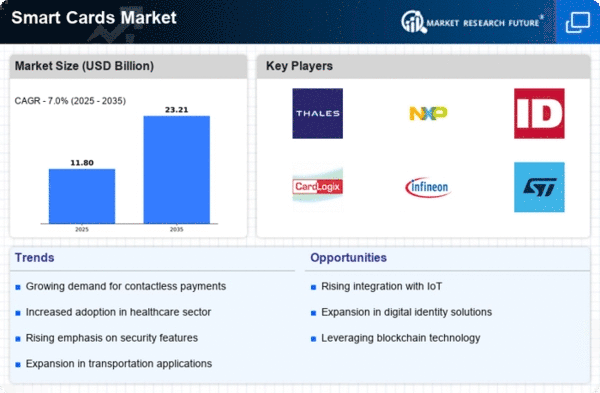
As per MRFR analysis, the Smart Cards Market Size was estimated at 11.03 USD Billion in 2024. The Smart Cards industry is projected to grow from 11.8 USD Billion in 2025 to 23.21 USD Billion by 2035, exhibiting a compound annual growth rate (CAGR) of 7.0 during the forecast period 2025 - 2035.

Key Market Trends & Highlights

The Smart Cards Market is experiencing robust growth driven by technological advancements and increasing demand for secure payment solutions.

  • The demand for contactless payments is rising, particularly in North America, where convenience and speed are prioritized.
  • Enhanced security features are becoming a focal point, especially in the banking segment, to combat fraud and ensure user trust.
  • Healthcare applications are expanding rapidly in the Asia-Pacific region, reflecting a growing trend towards digital health solutions.
  • The market is driven by the growing adoption of digital payment solutions and increased focus on security and fraud prevention.

Market Size & Forecast

2024 Market Size 11.03 (USD Billion)
2035 Market Size 23.21 (USD Billion)
CAGR (2025 - 2035) 7.0%
Largest Regional Market Share in 2024 North America

Major Players

<p>Gemalto (NL), Giesecke+Devrient (DE), NXP Semiconductors (NL), Identiv (US), CardLogix (US), Infineon Technologies (DE), STMicroelectronics (FR), Mitsubishi Electric (JP), HID Global (US)</p>

Market Trends

The Smart Cards Market is currently experiencing a transformative phase, driven by advancements in technology and increasing demand for secure identification solutions. The proliferation of digital transactions and the need for enhanced security measures have led to a surge in the adoption of smart cards across various sectors, including banking, healthcare, and government services. As organizations seek to streamline operations and improve customer experiences, the integration of smart card technology appears to be a strategic priority. Furthermore, the growing emphasis on contactless payment solutions is reshaping consumer behavior, indicating a shift towards more convenient and efficient transaction methods. In addition to the financial sector, the Smart Cards Market is witnessing significant growth in the healthcare industry, where patient identification and data security are paramount. The implementation of smart cards for medical records and insurance verification is becoming increasingly prevalent, suggesting a broader acceptance of this technology. Moreover, the ongoing development of innovative applications, such as mobile wallets and loyalty programs, indicates that the market is poised for further expansion. As the landscape evolves, stakeholders must remain vigilant to emerging trends and adapt their strategies accordingly to capitalize on the opportunities presented by this dynamic market.

Rising Demand for Contactless Payments

The Smart Cards Market is witnessing a notable increase in the demand for contactless payment solutions. This trend is largely driven by consumer preferences for convenience and speed during transactions. As more retailers and service providers adopt contactless technology, the integration of smart cards into payment systems is becoming more prevalent, enhancing the overall user experience.

Enhanced Security Features

Security remains a critical concern across various industries, prompting the Smart Cards Market to evolve with advanced security features. Innovations such as biometric authentication and encryption technologies are being integrated into smart cards, providing users with greater protection against fraud and unauthorized access. This trend reflects a growing awareness of the importance of safeguarding sensitive information.

Expansion in Healthcare Applications

The Smart Cards Market is increasingly finding applications within the healthcare sector. Smart cards are being utilized for patient identification, medical records management, and insurance verification. This expansion indicates a shift towards more efficient healthcare delivery systems, where secure and reliable identification methods are essential for improving patient care and operational efficiency.

Smart Cards Market Market Drivers

Market Growth Projections

The Global Smart Cards Market Industry is poised for substantial growth, with projections indicating a market size of 11.0 USD Billion in 2024 and an anticipated increase to 23.2 USD Billion by 2035. This growth trajectory suggests a compound annual growth rate (CAGR) of 7.0% from 2025 to 2035. The market dynamics are influenced by various factors, including technological advancements, increasing demand for secure transactions, and government initiatives promoting digitalization. These projections highlight the potential for innovation and investment in smart card technology, making it a critical area of focus for stakeholders in the industry.

Enhanced Security Features

The need for enhanced security in financial transactions and personal identification is a significant driver for the Global Smart Cards Market Industry. Smart cards offer advanced encryption and authentication mechanisms, making them a preferred choice for secure transactions. Governments and organizations are increasingly adopting smart cards for identity verification and access control. For instance, many countries are implementing smart ID cards to combat fraud and enhance national security. This focus on security is expected to contribute to the market's growth, as consumers and businesses prioritize safety in their transactions.

Rising Adoption in Emerging Markets

The rising adoption of smart card technology in emerging markets is a crucial driver for the Global Smart Cards Market Industry. Countries in Asia-Pacific, Latin America, and Africa are increasingly recognizing the benefits of smart cards for financial inclusion and secure identification. As mobile penetration increases and digital payment ecosystems develop, the demand for smart cards is expected to surge. This trend is particularly evident in regions where traditional banking infrastructure is limited. The growth in these markets presents significant opportunities for smart card manufacturers and service providers, contributing to the overall expansion of the industry.

Government Initiatives and Regulations

Government initiatives aimed at promoting digitalization and secure transactions are pivotal in driving the Global Smart Cards Market Industry. Various countries are implementing regulations that encourage the adoption of smart card technology in sectors such as healthcare, transportation, and finance. For example, initiatives to replace traditional identification methods with smart cards are gaining momentum globally. These efforts not only enhance security but also improve efficiency in service delivery. As governments continue to invest in smart card infrastructure, the market is anticipated to expand, with projections indicating a growth to 23.2 USD Billion by 2035.

Growing Demand for Contactless Payments

The increasing preference for contactless payment solutions is a primary driver of the Global Smart Cards Market Industry. As consumers seek convenience and speed in transactions, smart cards equipped with Near Field Communication (NFC) technology are gaining traction. In 2024, the market is projected to reach 11.0 USD Billion, reflecting a substantial shift towards digital payment methods. Retailers and financial institutions are investing in smart card technology to enhance customer experience and streamline payment processes. This trend is likely to continue, as the demand for secure and efficient payment solutions grows, further propelling the market forward.

Technological Advancements in Smart Card Solutions

Technological advancements in smart card solutions are significantly influencing the Global Smart Cards Market Industry. Innovations such as biometric authentication, multi-application capabilities, and integration with mobile devices are enhancing the functionality of smart cards. These advancements are appealing to various sectors, including banking, healthcare, and transportation, where secure and versatile solutions are essential. As organizations seek to leverage these technologies, the market is likely to experience robust growth. The anticipated compound annual growth rate (CAGR) of 7.0% from 2025 to 2035 underscores the potential for continued innovation and expansion in this sector.

Market Segment Insights

By Application: Payment Cards (Largest) vs. Identification Cards (Fastest-Growing)

<p>In the Smart Cards Market, the application segment is segmented into various categories, with Payment Cards holding the largest share. This segment caters to a growing demand for secure and convenient payment solutions, closely followed by Identification Cards, which are rapidly gaining traction. Access Control Cards, SIM Cards, and Transport Cards hold smaller but essential shares, marking their importance in the overall market landscape. As consumers and organizations continue to adopt smart technology, the competition among these segments intensifies, influencing their respective shares significantly. The growth trends within the Smart Cards Application segment are driven by technological advancements and increasing security concerns. Payment Cards are benefitting from the rising trend of cashless transactions, while Identification Cards are experiencing growth due to heightened security measures and identity verification processes. The demand for Access Control Cards is also growing, particularly in corporate environments seeking enhanced security solutions. SIM Cards and Transport Cards, though smaller segments, are seeing innovations aimed at improving connectivity and user experiences, ensuring they remain relevant in an evolving market.</p>

<p>Payment Cards (Dominant) vs. Identification Cards (Emerging)</p>

<p>Payment Cards have established themselves as the dominant force within the Smart Cards Market, characterized by their strong integration into consumer payment behaviors and the convenience they offer in transactions. Their widespread use across various platforms, including online and in-store, has solidified their position. In contrast, Identification Cards represent an emerging segment, driven by an increasing emphasis on secure identification and authentication processes across many sectors, including government and corporate environments. These cards are evolving with technologies such as biometric integration and electronic access management, attracting significant investments. As the push for digital security grows, both segments are positioning themselves strategically to adapt to changing consumer expectations and regulatory demands.</p>

By End Use: Banking (Largest) vs. Telecommunications (Fastest-Growing)

<p>The smart cards market exhibits a varied distribution among its end-use segments, with banking emerging as the most significant player. This dominance arises from the widespread adoption of chip-enabled cards for secure financial transactions, fostering trust and convenience for consumers. Telecommunications follow suit as the second-largest segment, driven by the need for secure SIM cards and mobile payments, reflecting an essential part of modern communication. In recent years, telecommunications has not only maintained its status but is experiencing rapid growth, propelled by advancements in mobile technology and digital payment solutions. Government initiatives promoting cashless transactions further boost smart card adoption across sectors, ensuring a competitive market landscape. Moreover, investments in secure healthcare identification systems and transportation ticketing solutions promise substantial opportunities within their respective segments.</p>

<p>Banking: Credit Cards (Dominant) vs. Government: National ID Cards (Emerging)</p>

<p>In the smart cards market, credit cards are regarded as the dominant force within the banking sector, offering consumers enhanced security and convenience through chip technology. These cards streamline transactions, reduce fraud, and provide various rewards, solidifying their role in consumer spending. On the other hand, national ID cards are emerging in the government segment, fueled by initiatives aimed at digitalization and secure identification methods. These smart cards serve multiple purposes such as voter identification and access to governmental services, showcasing their versatility. The integration of biometrics into national ID solutions further enhances security, driving their adoption rates. As both segments evolve, the interplay between established and emerging smart card applications will shape the future landscape of the industry.</p>

By Material Type: Polyvinyl Chloride (Largest) vs. Polycarbonate (Fastest-Growing)

<p>The Smart Cards Market exhibits a varied distribution of market share among different material types. Polyvinyl Chloride (PVC) remains the largest segment as it is widely used due to its durability, cost-effectiveness, and versatility. It is the primary material for manufacturing smart cards, holding a significant portion of the market share. Polycarbonate, with its superior durability and heat resistance, is observing a rapid increase in adoption, making it the fastest-growing segment despite its smaller share. Other materials like PET, ABS, and Paper are also present, catering to niche applications in the market.</p>

<p>Polyvinyl Chloride (Dominant) vs. Polycarbonate (Emerging)</p>

<p>Polyvinyl Chloride (PVC) is the dominant material in the Smart Cards Market, recognized for its robustness and affordability. Its excellent mechanical properties and resistance to environmental factors contribute to its long-standing preference among manufacturers. Polycarbonate, while currently classified as an emerging material, is gaining momentum due to its advanced features like enhanced safety and flexibility that meet the demands of more sophisticated applications. The trend towards higher security and durability in smart card technology drives this growth, positioning polycarbonate as an increasingly viable alternative to traditional materials. Other materials like PET and ABS offer unique advantages, focusing on specific market needs, but they remain on the fringes compared to the main players.</p>

By Technology: Contactless Smart Cards (Largest) vs. Dual Interface Smart Cards (Fastest-Growing)

<p>In the Smart Cards Market, the distribution of market share among the technology segments showcases a clear leader: Contactless Smart Cards. This segment has captured the largest portion of the market due to their convenience and versatility in applications ranging from payments to access control. Following closely, Dual Interface Smart Cards are gaining traction, providing users with the flexibility of contact and contactless technology in one card, appealing especially to sectors where both functionalities are needed. Analyzing growth trends, the overall demand for Smart Cards is on the rise, with factors such as increasing digital payment adoption and heightened security needs driving their popularity. Contactless Smart Cards have benefitted from their ease of use, particularly during the pandemic, while Dual Interface Smart Cards are becoming increasingly relevant as businesses seek to offer enhanced functionality. The innovation and technological advancements in this segment are also paving the way for significant growth opportunities.</p>

<p>Contactless Smart Cards (Dominant) vs. Hybrid Smart Cards (Emerging)</p>

<p>Contactless Smart Cards are characterized by their advanced technology that allows for quick and efficient transactions without the need for physical contact, making them the dominant force in the Smart Cards Market. Their use in payments, identification, and access control has made them integral across various industries, capitalizing on consumer demand for convenience. On the other hand, Hybrid Smart Cards, which combine both contact and contactless capabilities, are emerging as a flexible solution suitable for varied applications. Although they hold a smaller market share currently, their versatility is appealing to organizations seeking tailored solutions, positioning them for potential growth in a landscape that is increasingly favoring multifunctional technologies.</p>

By Form Factor: Standard Size Cards (Largest) vs. Mini Cards (Fastest-Growing)

<p>Within the Smart Cards Market, Standard Size Cards account for the largest share, widely used in various applications such as banking, identification, and access control. These cards are preferred due to their robust functionality and compatibility with existing readers and systems, making them the go-to choice for many industries. Conversely, Mini Cards, while holding a smaller market share, are rapidly gaining popularity, especially in mobile payments and wearable tech. Their compact size enhances their appeal, particularly with consumer preference shifting towards portable devices.</p>

<p>Standard Size Cards (Dominant) vs. Mini Cards (Emerging)</p>

<p>Standard Size Cards continue to dominate the Smart Cards Market due to their versatility and established presence in key sectors. They are designed to meet the needs of a broad range of applications, from secure transactions to identity verification. On the other hand, Mini Cards are emerging as a significant player, driven by the growing demand for compact and convenient payment solutions. Their smaller form factor makes them ideal for integration into wearable technology, representing a trend towards mobility and ease of use in financial transactions.</p>

Get more detailed insights about Smart Cards Market Research Report – Forecast to 2035

Regional Insights

North America : Market Leader in Smart Cards

North America continues to lead the Smart Cards market, holding a significant share of 4.5 in 2024. The region's growth is driven by increasing demand for secure payment solutions, advancements in technology, and supportive regulatory frameworks. The rise in contactless payment systems and digital identity verification is further propelling market expansion. Additionally, government initiatives promoting digital transformation are acting as catalysts for growth. The competitive landscape in North America is robust, with key players such as Gemalto, NXP Semiconductors, and HID The Smart Cards. The U.S. is the primary contributor, driven by high adoption rates in sectors like finance, healthcare, and government services. The presence of innovative companies and a strong focus on R&D are enhancing the region's market position, ensuring it remains at the forefront of Smart Card technology.

Europe : Emerging Market with Growth Potential

Europe's Smart Cards market is poised for growth, with a market size of 3.0 in 2024. The region is witnessing an increase in demand for secure identification and payment solutions, driven by regulatory requirements and consumer preferences for contactless transactions. The European Union's initiatives to enhance digital security and privacy are also contributing to market expansion, making it a key player in the global landscape. Leading countries in Europe include Germany, France, and the UK, where major players like Giesecke+Devrient and Infineon Technologies are actively innovating. The competitive environment is characterized by collaborations and partnerships aimed at enhancing product offerings. The presence of stringent regulations ensures that companies prioritize security and compliance, further solidifying Europe's position in the Smart Cards market.

Asia-Pacific : Rapid Growth in Emerging Economies

The Asia-Pacific region is experiencing a surge in the Smart Cards market, with a size of 3.2 in 2024. This growth is fueled by rising disposable incomes, urbanization, and a growing preference for digital payment solutions. Countries like China and India are leading the charge, supported by government initiatives aimed at promoting cashless economies and enhancing digital infrastructure. The region's regulatory environment is also evolving to support the adoption of smart technologies. China and India are the frontrunners in this market, with significant investments from key players such as NXP Semiconductors and STMicroelectronics. The competitive landscape is marked by rapid technological advancements and a focus on innovation. As the region continues to embrace digital transformation, the demand for smart cards in various sectors, including finance and telecommunications, is expected to rise significantly, positioning Asia-Pacific as a vital market.

Middle East and Africa : Emerging Market with Untapped Potential

The Middle East and Africa (MEA) region is gradually emerging in the Smart Cards market, with a size of 0.33 in 2024. The growth is primarily driven by increasing investments in digital infrastructure and a rising demand for secure payment solutions. Governments in the region are focusing on enhancing digital security and identity management, which is expected to boost the adoption of smart cards across various sectors, including banking and telecommunications. Countries like South Africa and the UAE are leading the way in adopting smart card technologies. The competitive landscape is characterized by a mix of local and international players, with companies like Identiv and CardLogix making significant inroads. As the region continues to develop its digital economy, the Smart Cards market is anticipated to grow, presenting numerous opportunities for stakeholders.

Key Players and Competitive Insights

The Smart Cards Market is currently characterized by a dynamic competitive landscape, driven by technological advancements and increasing demand for secure identification solutions. Key players such as Gemalto (NL), Giesecke+Devrient (DE), and NXP Semiconductors (NL) are at the forefront, each adopting distinct strategies to enhance their market positioning. For instance, Gemalto (NL) has focused on innovation in digital security, particularly in the realm of mobile payments and identity verification, while Giesecke+Devrient (DE) emphasizes partnerships with financial institutions to expand its reach in the banking sector. NXP Semiconductors (NL) is leveraging its expertise in semiconductor technology to develop advanced smart card solutions, thereby shaping a competitive environment that prioritizes technological differentiation and strategic collaborations.

In terms of business tactics, companies are increasingly localizing manufacturing to reduce costs and enhance supply chain efficiency. The Smart Cards Market appears moderately fragmented, with several key players exerting influence over various segments. This fragmentation allows for niche players to thrive, while larger companies consolidate their market share through strategic acquisitions and partnerships, thereby intensifying competition.

In November 2025, Gemalto (NL) announced a strategic partnership with a leading telecommunications provider to enhance mobile payment solutions. This collaboration is expected to integrate advanced security features into mobile wallets, thereby addressing growing consumer concerns regarding transaction safety. Such initiatives not only bolster Gemalto's market presence but also reflect a broader trend towards integrating smart card technology with mobile platforms.

In October 2025, Giesecke+Devrient (DE) launched a new line of biometric smart cards aimed at improving security in identity verification processes. This product line is particularly significant as it aligns with the increasing demand for secure identification methods across various sectors, including government and finance. The introduction of biometric features may position Giesecke+Devrient as a leader in the security segment of the market, potentially reshaping consumer expectations.

In September 2025, NXP Semiconductors (NL) unveiled a new chip designed for contactless smart cards, which promises enhanced performance and security. This innovation is crucial as it addresses the rising demand for contactless payment solutions, particularly in retail environments. By focusing on technological advancements, NXP Semiconductors is likely to strengthen its competitive edge and cater to evolving consumer preferences.

As of December 2025, the Smart Cards Market is witnessing trends such as digitalization, sustainability, and the integration of AI technologies. Strategic alliances are increasingly shaping the competitive landscape, enabling companies to pool resources and expertise. The shift from price-based competition to a focus on innovation and technology is evident, as firms prioritize supply chain reliability and advanced solutions to differentiate themselves in a crowded market. Looking ahead, competitive differentiation will likely hinge on the ability to innovate and adapt to emerging technologies, ensuring that companies remain relevant in an ever-evolving marketplace.

Key Companies in the Smart Cards Market include

Industry Developments

  • Q2 2024: Thales launches new eco-friendly smart card made from recycled ocean plastics Thales announced the launch of a new smart card product line manufactured using recycled ocean plastics, targeting the banking and payment sector's sustainability initiatives.
  • Q2 2024: CPI Card Group Announces Opening of New Secure Card Manufacturing Facility in Tennessee CPI Card Group opened a new secure facility in Tennessee to expand its production capacity for smart payment cards and meet growing demand from U.S. financial institutions.
  • Q3 2024: IDEMIA and Mastercard Partner to Launch Biometric Payment Cards in Europe IDEMIA and Mastercard entered a partnership to roll out biometric-enabled smart payment cards across several European markets, aiming to enhance security and user convenience.
  • Q1 2024: Giesecke+Devrient wins contract to supply smart health cards for German eHealth initiative Giesecke+Devrient secured a government contract to provide smart health cards as part of Germany's national eHealth infrastructure rollout.
  • Q2 2024: HID Global Launches Next-Generation Smart Card for Access Control HID Global introduced a new line of smart cards featuring advanced encryption and multi-application support for enterprise access control systems.
  • Q3 2024: Eastcompeace Technology signs partnership with Indian telecom operator for SIM card supply Eastcompeace Technology entered a multi-year partnership to supply smart SIM cards to a major Indian telecom operator, supporting the country's 5G rollout.
  • Q2 2024: Identiv Announces Acquisition of Smart Card Reader Business from NXP Semiconductors Identiv acquired NXP Semiconductors' smart card reader business to expand its portfolio in secure identification and authentication solutions.
  • Q1 2025: Watchdata Technologies launches contactless transit card for Singapore’s new metro line Watchdata Technologies introduced a new contactless smart card for fare payment on Singapore’s latest metro line, supporting seamless and secure transit access.
  • Q2 2025: Alioth secures Series B funding to expand smart card manufacturing in Eastern Europe Alioth raised Series B funding to increase its smart card production capacity and invest in new manufacturing technologies in Eastern Europe.
  • Q1 2025: CardLogix Corporation appoints new CEO to drive digital ID card strategy CardLogix Corporation named a new CEO, tasking the executive with accelerating the company’s digital ID and smart card solutions strategy.
  • Q2 2025: AT&T Business launches IoT-enabled smart SIM card for enterprise customers AT&T Business unveiled a new IoT-enabled smart SIM card designed to provide enhanced security and connectivity for enterprise IoT deployments.
  • Q3 2024: Giesecke+Devrient opens new R&D center for smart card innovation in Munich Giesecke+Devrient inaugurated a new research and development center in Munich focused on advancing smart card technologies for payment and identity applications.

Future Outlook

Smart Cards Market Future Outlook

<p>The Smart Cards Market is projected to grow at a 7.0% CAGR from 2024 to 2035, driven by advancements in security, contactless technology, and increasing demand for digital transactions.</p>

New opportunities lie in:

  • <p>Integration of smart cards in IoT devices for enhanced security solutions.</p>
  • <p>Development of mobile payment systems utilizing smart card technology.</p>
  • <p>Expansion of loyalty programs leveraging smart card data analytics.</p>

<p>By 2035, the Smart Cards Market is expected to be robust, driven by innovation and increasing adoption across various sectors.</p>

Market Segmentation

Smart Cards Market End Use Outlook

  • Banking
  • Telecommunications
  • Government
  • Transportation
  • Healthcare

Smart Cards Market Technology Outlook

  • Contact Smart Cards
  • Contactless Smart Cards
  • Dual Interface Smart Cards
  • Hybrid Smart Cards

Smart Cards Market Application Outlook

  • Payment Cards
  • Identification Cards
  • Access Control Cards
  • SIM Cards
  • Transport Cards

Smart Cards Market Form Factor Outlook

  • Standard Size Cards
  • Mini Cards
  • Key Fob Cards
  • Wearable Cards

Smart Cards Market Material Type Outlook

  • Polyvinyl Chloride
  • Polycarbonate
  • PET
  • ABS
  • Paper

Report Scope

MARKET SIZE 202411.03(USD Billion)
MARKET SIZE 202511.8(USD Billion)
MARKET SIZE 203523.21(USD Billion)
COMPOUND ANNUAL GROWTH RATE (CAGR)7.0% (2024 - 2035)
REPORT COVERAGERevenue Forecast, Competitive Landscape, Growth Factors, and Trends
BASE YEAR2024
Market Forecast Period2025 - 2035
Historical Data2019 - 2024
Market Forecast UnitsUSD Billion
Key Companies ProfiledGemalto (NL), Giesecke+Devrient (DE), NXP Semiconductors (NL), Identiv (US), CardLogix (US), Infineon Technologies (DE), STMicroelectronics (FR), Mitsubishi Electric (JP), HID Global (US)
Segments CoveredApplication, End Use, Material Type, Technology, Form Factor
Key Market OpportunitiesIntegration of biometric authentication enhances security in the Smart Cards Market.
Key Market DynamicsRising demand for contactless payment solutions drives innovation and competition in the Smart Cards Market.
Countries CoveredNorth America, Europe, APAC, South America, MEA

FAQs

How much is the Smart Cards market?

The Smart Cards Market size was valued at USD 11.03 billion in 2024.

What is the growth rate of the Smart Cards market?

The global market is projected to grow at a CAGR of 7.00% during the forecast period, 2025 to 2035.

Which region held the largest market share in the Smart Cards market?

Asia Pacific had the largest share in the Smart Cards Market.

Who are the key players in the Smart Cards market?

The key players in the market are Rambus Inc, CardLogix Corporation, CPI Card Group Inc., Identiv, Inc., VeriFone Systems, Inc., Gemalto N.V., Giesecke &amp; Devrient GmbH, IDEMIA France SAS, Infineon Technologies AG, NXP Semiconductors N.V.

Which type led the Smart Cards market?

The dual interface category dominated the market in 2022.

Which application had the largest market share in the market?

The BFSI had the largest share in the global market for Smart Cards.

No Data Available

Smart Cards Market Segmentation

Smart Cards Component Outlook (USD Million, 2020-2034)

  • Contact & Contactless
  • Hybrid
  • Dual-interface

Smart Cards Component Outlook (USD Million, 2020-2034)

  • Hardware
  • Smart Cards & Readers
  • Software & Services

Smart Cards Application Outlook (USD Million, 2020-2034)

  • Government & Healthcare
  • BFSI, Retail & Transportation
  • Education & Entertainment
  • Enterprises

Smart Cards Regional Outlook (USD Million, 2020-2034)

  • North America Outlook (USD Million, 2020-2034)
    • North America Smart Cards by Type
      • Contact & Contactless
      • Hybrid
      • Dual-interface
    • North America Smart Cards by Component
      • Hardware
      • Smart Cards & Readers
      • Software & Services
    • North America Smart Cards by Application
      • Government & Healthcare
      • BFSI, Retail & Transportation
      • Education & Entertainment
      • Enterprises
    • US Outlook (USD Million, 2020-2034)
    • US Smart Cards by Type
      • Contact & Contactless
      • Hybrid
      • Dual-interface
    • US Smart Cards by Component
      • Hardware
      • Smart Cards & Readers
      • Software & Services
    • US Smart Cards by Application
      • Government & Healthcare
      • BFSI, Retail & Transportation
      • Education & Entertainment
      • Enterprises
    • CANADA Outlook (USD Million, 2020-2034)
    • CANADA Smart Cards by Type
      • Contact & Contactless
      • Hybrid
      • Dual-interface
    • CANADA Smart Cards by Component
      • Hardware
      • Smart Cards & Readers
      • Software & Services
    • CANADA Smart Cards by Application
      • Government & Healthcare
      • BFSI, Retail & Transportation
      • Education & Entertainment
      • Enterprises
  • Europe Outlook (USD Million, 2020-2034)
    • Europe Smart Cards by Type
      • Contact & Contactless
      • Hybrid
      • Dual-interface
    • Europe Smart Cards by Component
      • Hardware
      • Smart Cards & Readers
      • Software & Services
    • Europe Smart Cards by Application
    • Government & Healthcare
      • BFSI, Retail & Transportation
      • Education & Entertainment
      • Enterprises
    • Germany Outlook (USD Million, 2020-2034)
    • Germany Smart Cards by Type
      • Contact & Contactless
      • Hybrid
      • Dual-interface
    • Germany Smart Cards by Component
      • Hardware
      • Smart Cards & Readers
      • Software & Services
    • Germany Smart Cards by Application
      • Government & Healthcare
      • BFSI, Retail & Transportation
      • Education & Entertainment
      • Enterprises
    • France Outlook (USD Million, 2020-2034)
    • France Smart Cards by Type
      • Contact & Contactless
      • Hybrid
      • Dual-interface
    • France Smart Cards by Component
      • Hardware
      • Smart Cards & Readers
      • Software & Services
    • France Smart Cards by Application
      • Government & Healthcare
      • BFSI, Retail & Transportation
      • Education & Entertainment
      • Enterprises
    • UK Outlook (USD Million, 2020-2034)
    • UK Smart Cards by Type
      • Contact & Contactless
      • Hybrid
      • Dual-interface
    • UK Smart Cards by Component
      • Hardware
      • Smart Cards & Readers
      • Software & Services
    • UK Smart Cards by Application
      • Government & Healthcare
      • BFSI, Retail & Transportation
      • Education & Entertainment
      • Enterprises
    • ITALY Outlook (USD Million, 2020-2034)
    • ITALY Smart Cards by Type
      • Contact & Contactless
      • Hybrid
      • Dual-interface
    • ITALY Smart Cards by Component
      • Hardware
      • Smart Cards & Readers
      • Software & Services
    • ITALY Smart Cards by Application
      • Government & Healthcare
      • BFSI, Retail & Transportation
      • Education & Entertainment
      • Enterprises
    • SPAIN Outlook (USD Million, 2020-2034)
    • Spain Smart Cards by Type
      • Contact & Contactless
      • Hybrid
      • Dual-interface
    • Spain Smart Cards by Component
      • Hardware
      • Smart Cards & Readers
      • Software & Services
    • Spain Smart Cards by Application
      • Government & Healthcare
      • BFSI, Retail & Transportation
      • Education & Entertainment
      • Enterprises
    • Rest Of Europe Outlook (USD Million, 2020-2034)
    • Rest Of Europe Smart Cards by Type
      • Contact & Contactless
      • Hybrid
      • Dual-interface
    • REST OF EUROPE Smart Cards by Component
      • Hardware
      • Smart Cards & Readers
      • Software & Services
    • REST OF EUROPE Smart Cards by Application
      • Government & Healthcare
      • BFSI, Retail & Transportation
      • Education & Entertainment
      • Enterprises
  • Asia-Pacific Outlook (USD Million, 2020-2034)
    • Asia-Pacific Smart Cards by Type
      • Contact & Contactless
      • Hybrid
      • Dual-interface
    • Asia-Pacific Smart Cards by Component
      • Hardware
      • Smart Cards & Readers
      • Software & Services
    • Asia-Pacific Smart Cards by Application
      • Government & Healthcare
      • BFSI, Retail & Transportation
      • Education & Entertainment
      • Enterprises
    • China Outlook (USD Million, 2020-2034)
    • China Smart Cards by Type
      • Contact & Contactless
      • Hybrid
      • Dual-interface
    • China Smart Cards by Component
      • Hardware
      • Smart Cards & Readers
      • Software & Services
    • China Smart Cards by Application
      • Government & Healthcare
      • BFSI, Retail & Transportation
      • Education & Entertainment
      • Enterprises
    • Japan Outlook (USD Million, 2020-2034)
    • Japan Smart Cards by Type
      • Contact & Contactless
      • Hybrid
      • Dual-interface
    • Japan Smart Cards by Component
      • Hardware
      • Smart Cards & Readers
      • Software & Services
    • Japan Smart Cards by Application
      • Government & Healthcare
      • BFSI, Retail & Transportation
      • Education & Entertainment
      • Enterprises
    • India Outlook (USD Million, 2020-2034)
    • India Smart Cards by Type
      • Contact & Contactless
      • Hybrid
      • Dual-interface
    • India Smart Cards by Component
      • Hardware
      • Smart Cards & Readers
      • Software & Services
    • India Smart Cards by Application
      • Government & Healthcare
      • BFSI, Retail & Transportation
      • Education & Entertainment
      • Enterprises
    • Australia Outlook (USD Million, 2020-2034)
    • Australia Smart Cards by Type
      • Contact & Contactless
      • Hybrid
      • Dual-interface
    • Australia Smart Cards by Component
      • Hardware
      • Smart Cards & Readers
      • Software & Services
    • Australia Smart Cards by Application
      • Government & Healthcare
      • BFSI, Retail & Transportation
      • Education & Entertainment
      • Enterprises
    • Rest of Asia-Pacific Outlook (USD Million, 2020-2034)
    • Rest of Asia-Pacific Smart Cards by Type
      • Contact & Contactless
      • Hybrid
      • Dual-interface
    • Rest of Asia-Pacific Smart Cards by Component
      • Hardware
      • Smart Cards & Readers
      • Software & Services
    • Rest of Asia-Pacific Smart Cards by Application
      • Government & Healthcare
      • BFSI, Retail & Transportation
      • Education & Entertainment
      • Enterprises
  • Rest of the World Outlook (USD Million, 2020-2034)
    • Rest of the World Smart Cards by Type
      • Contact & Contactless
      • Hybrid
      • Dual-interface
    • Rest of the World Smart Cards by Component
      • Hardware
      • Smart Cards & Readers
      • Software & Services
    • Rest of the World Smart Cards by Application
      • Government & Healthcare
      • BFSI, Retail & Transportation
      • Education & Entertainment
      • Enterprises
    • Middle East Outlook (USD Million, 2020-2034)
    • Middle East Smart Cards by Type
      • Contact & Contactless
      • Hybrid
      • Dual-interface
    • Middle East Smart Cards by Component
      • Hardware
      • Smart Cards & Readers
      • Software & Services
    • Middle East Smart Cards by Application
      • Government & Healthcare
      • BFSI, Retail & Transportation
      • Education & Entertainment
      • Enterprises
    • Africa Outlook (USD Million, 2020-2034)
    • Africa Smart Cards by Type
      • Contact & Contactless
      • Hybrid
      • Dual-interface
    • Africa Smart Cards by Component
      • Hardware
      • Smart Cards & Readers
      • Software & Services
    • Africa Smart Cards by Application
      • Government & Healthcare
      • BFSI, Retail & Transportation
      • Education & Entertainment
      • Enterprises
    • Latin America Outlook (USD Million, 2020-2034)
    • Latin America Smart Cards by Type
      • Contact & Contactless
      • Hybrid
      • Dual-interface
    • Latin America Smart Cards by Component
      • Hardware
      • Smart Cards & Readers
      • Software & Services
    • Latin America Smart Cards by Application
      • Government & Healthcare
      • BFSI, Retail & Transportation
      • Education & Entertainment
      • Enterprises


Infographic

Free Sample Request

Kindly complete the form below to receive a free sample of this Report

Get Free Sample

Customer Strories

Compare Licence

×
Features License Type
Single User Multiuser License Enterprise User
Price $4,950 $5,950 $7,250
Maximum User Access Limit 1 User Upto 10 Users Unrestricted Access Throughout the Organization
Free Customization
Direct Access to Analyst
Deliverable Format
Platform Access
Discount on Next Purchase 10% 15% 15%
Printable Versions