Request Free Sample ×

Kindly complete the form below to receive a free sample of this Report

* Please use a valid business email

Leading companies partner with us for data-driven Insights

clients tt-cursor
Hero Background
English
Chinese
French
Japanese
Korean
German
Spanish

Smart Bathroom Market Size

ID: MRFR/SEM/3413-CR
135 Pages
Nirmit Biswas
October 2021

Smart Bathroom Market Size, Share and Research Report By Product Type (Hi-Tech Toilets, Soaking Tubs, Digital Faucets, and Others), Connectivity (Bluetooth, Wi-Fi, and 3G), End User (Commercial and Residential) and By Region (North America, Europe, Asia-Pacific, And Rest Of The World) –Industry Forecast Till 2035

Share:
Download PDF ×

We do not share your information with anyone. However, we may send you emails based on your report interest from time to time. You may contact us at any time to opt-out.

Smart Bathroom Market Infographic
Purchase Options

Smart Bathroom Size

Smart Bathroom Market Growth Projections and Opportunities

The global Smart Bathroom market, which refers to the market for advanced bathroom fixtures and technologies, was valued at USD 5.92 billion in 2017. It is projected to reach USD 10.93 billion by 2023, with a Compound Annual Growth Rate (CAGR) of 10.74% during the forecast period. This means that the market is expected to grow steadily over the next few years.

There are several factors driving the growth of the smart bathroom market. One of the major concerns that consumers have is energy conservation and hygiene maintenance. People are becoming more conscious of saving energy and water, and they want bathroom fixtures that can help them achieve these goals. Another factor is the growing population and urbanization. As more people move to cities and live in smaller spaces, there is a greater demand for smart bathroom solutions that make the most efficient use of limited space. Additionally, the increasing aging population is driving the demand for bathroom fixtures that are accessible and easy to use for older individuals.

However, there are also some challenges that are impacting the growth of the smart bathroom market. One of these challenges is the high cost of implementation. Smart bathroom fixtures are often more expensive than traditional fixtures, which can deter some consumers from adopting these technologies. Another challenge is the dominance of traditional bathrooms. Many people are accustomed to using traditional fixtures and may be hesitant to switch to smart bathroom solutions. These factors have hindered the growth of the smart bathroom market on a global scale.

The global smart bathroom market is segmented into different categories based on product type, connectivity, end user, and region. The product types include hi-tech toilets, soaking tubs, digital faucets, and others. Among these product types, hi-tech toilets are leading the market in terms of revenue. This growth is driven by changing consumer behavior, particularly in Europe, where people are increasingly seeking luxurious bathroom experiences.

In conclusion, the global smart bathroom market is witnessing steady growth. Factors such as concerns about energy conservation and hygiene maintenance, population growth and urbanization, and the aging population are driving the demand for smart bathroom solutions. However, challenges such as the high cost of implementation and the prevalence of traditional bathrooms are hindering the market's growth. The market is segmented into different product types, with hi-tech toilets leading in terms of revenue. The growth of the smart bathroom market is also influenced by changing consumer behavior, particularly in Europe, where luxury bathroom experiences are in high demand.
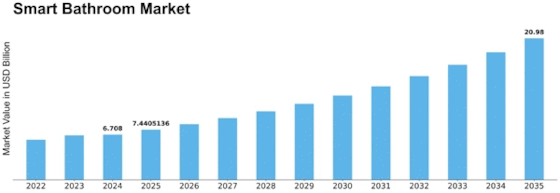

Smart Bathroom Market Size Graph
Author
Author Profile
Nirmit Biswas
Senior Research Analyst

With 5+ years of expertise in Market Intelligence and Strategic Research, Nirmit Biswas specializes in ICT, Semiconductors, and BFSI. Backed by an MBA in Financial Services and a Computer Science foundation, Nirmit blends technical depth with business acumen. He has successfully led 100+ projects for global enterprises and startups, including Amazon, Cisco, L&T and Huawei, delivering market estimations, competitive benchmarking, and GTM strategies. His focus lies in transforming complex data into clear, actionable insights that drive growth, innovation, and investment decisions. Recognized for bridging engineering innovation with executive strategy, Nirmit helps businesses navigate dynamic markets with confidence.

Leave a Comment

FAQs

What is the current valuation of the Smart Bathroom Market as of 2024?

<p>The Smart Bathroom Market was valued at 6.708 USD Billion in 2024.</p>

What is the projected market size for the Smart Bathroom Market by 2035?

<p>The market is projected to reach 20.98 USD Billion by 2035.</p>

What is the expected CAGR for the Smart Bathroom Market during the forecast period 2025 - 2035?

<p>The expected CAGR for the Smart Bathroom Market during 2025 - 2035 is 10.92%.</p>

Which product type segment is anticipated to show the highest growth in the Smart Bathroom Market?

<p>Hi-Tech Toilets are expected to grow from 2.5 USD Billion to 7.5 USD Billion during the forecast period.</p>

How does the market for residential smart bathrooms compare to commercial ones?

<p>The residential segment is projected to grow from 4.032 USD Billion to 12.84 USD Billion, surpassing the commercial segment's growth.</p>

What are the key connectivity technologies driving the Smart Bathroom Market?

<p>Wi-Fi connectivity is projected to expand from 3.5 USD Billion to 10.5 USD Billion, indicating strong growth potential.</p>

Who are the leading companies in the Smart Bathroom Market?

Key players include Kohler, Moen, Toto, and LIXIL Group, among others.

What is the growth potential for digital faucets in the Smart Bathroom Market?

Digital Faucets are expected to grow from 1.2 USD Billion to 3.6 USD Billion, reflecting increasing consumer interest.

What is the expected growth for soaking tubs in the Smart Bathroom Market?

Soaking Tubs are projected to increase from 1.5 USD Billion to 4.5 USD Billion during the forecast period.

How does the Smart Bathroom Market's growth reflect consumer trends?

The growth in the Smart Bathroom Market suggests a rising consumer preference for technology-integrated bathroom solutions.

Market Summary

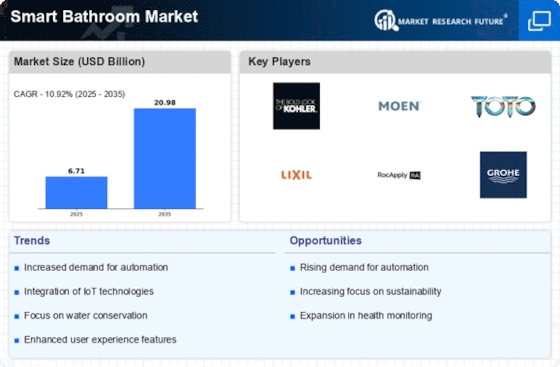
As per Market Research Future analysis, the Smart Bathroom Market Size was estimated at 6.708 USD Billion in 2024. The Smart Bathroom industry is projected to grow from 7.441 USD Billion in 2025 to 20.98 USD Billion by 2035, exhibiting a compound annual growth rate (CAGR) of 10.92% during the forecast period 2025 - 2035

Key Market Trends & Highlights

The Smart Bathroom Market is experiencing robust growth driven by technological advancements and evolving consumer preferences.

  • The integration of IoT technology is transforming traditional bathrooms into smart environments, enhancing user experience. Sustainability remains a focal point, with consumers increasingly seeking water-efficient solutions in their bathroom fixtures. Health and wellness features are gaining traction, as consumers prioritize hygiene and personal health monitoring in their bathroom choices. The rising demand for smart technology and increased focus on hygiene and sanitation are key drivers propelling market expansion, particularly in North America and the Asia-Pacific region.

Market Size & Forecast

2024 Market Size 6.708 (USD Billion)
2035 Market Size 20.98 (USD Billion)
CAGR (2025 - 2035) 10.92%
Largest Regional Market Share in 2024 North America

Major Players

Kohler (US), Moen (US), Toto (JP), LIXIL Group (JP), Roca (ES), GROHE (DE), American Standard (US), Duravit (DE), Hansgrohe (DE), Geberit (CH)

Market Trends

The Smart Bathroom Market is currently experiencing a notable transformation, driven by advancements in technology and a growing emphasis on sustainability. Consumers increasingly seek innovative solutions that enhance comfort, convenience, and efficiency within their personal spaces. This shift is reflected in the rising popularity of smart toilets, automated faucets, and intelligent shower systems, which not only offer enhanced functionality but also contribute to water conservation efforts. As environmental awareness continues to rise, manufacturers are focusing on creating products that align with eco-friendly practices, thereby appealing to a more conscientious consumer base. Moreover, the integration of smart home technology into bathroom settings is becoming more prevalent. Devices that connect to the Internet of Things (IoT) allow users to control various aspects of their bathrooms remotely, providing a seamless experience. This trend indicates a broader movement towards interconnected living spaces, where convenience and personalization are paramount. As the Smart Bathroom Market evolves, it appears poised to attract a diverse range of consumers, from tech enthusiasts to those simply seeking to enhance their daily routines. The future of this market seems promising, with continuous innovation likely to drive further growth and diversification in product offerings.

Integration of IoT Technology

The Smart Bathroom Market is witnessing a surge in the integration of Internet of Things (IoT) technology. This trend allows for enhanced connectivity between devices, enabling users to control various bathroom features remotely. Smart mirrors, automated lighting, and temperature control systems are becoming increasingly common, providing a more personalized and efficient experience.

Focus on Sustainability

Sustainability is emerging as a key driver in the Smart Bathroom Market. Manufacturers are prioritizing eco-friendly materials and water-saving technologies in their products. This focus not only meets consumer demand for greener solutions but also aligns with global efforts to reduce environmental impact.

Health and Wellness Features

The incorporation of health and wellness features into bathroom products is gaining traction. Smart showers and toilets equipped with health monitoring capabilities are appealing to consumers interested in personal well-being. This trend reflects a broader societal shift towards health-conscious living, influencing product development in the Smart Bathroom Market.

Smart Bathroom Market Market Drivers

Integration of Smart Technology

The Smart Bathroom Market is experiencing a notable shift towards the integration of advanced smart technologies. This trend encompasses the incorporation of IoT devices, automated systems, and AI-driven solutions that enhance user experience and convenience. For instance, smart mirrors equipped with touch controls and voice recognition are becoming increasingly popular, allowing users to access information and control other devices seamlessly. The market for smart bathroom products is projected to grow significantly, with estimates suggesting a compound annual growth rate of over 20% in the coming years. This integration not only improves functionality but also aligns with the growing consumer demand for innovative and efficient home solutions.

Rising Demand for Water Efficiency

Water conservation has emerged as a critical concern, driving the Smart Bathroom Market towards the development of water-efficient products. Smart toilets and faucets equipped with sensors and automatic shut-off features are gaining traction as they help reduce water wastage. According to recent data, the adoption of smart water-saving technologies could lead to a reduction in household water usage by up to 30%. This trend is particularly relevant in regions facing water scarcity, where consumers are increasingly seeking solutions that promote sustainability. The emphasis on water efficiency not only addresses environmental concerns but also appeals to cost-conscious consumers looking to lower their utility bills.

Customization and Personalization Trends

The Smart Bathroom Market is increasingly characterized by a trend towards customization and personalization. Consumers are seeking products that cater to their individual preferences and lifestyles, leading to the development of smart showers and lighting systems that can be tailored to specific needs. For example, smart showers that allow users to set their preferred water temperature and flow rate are gaining popularity. This trend is supported by data indicating that personalized home solutions are becoming a priority for consumers, with many willing to invest in technology that enhances their daily routines. The ability to customize bathroom experiences not only adds value but also fosters a deeper connection between consumers and their living spaces.

Increased Focus on Hygiene and Sanitation

The Smart Bathroom Market is witnessing a heightened emphasis on hygiene and sanitation, particularly in the wake of evolving consumer preferences. Smart bathrooms equipped with touchless fixtures, self-cleaning toilets, and advanced air purification systems are becoming essential in modern homes. This shift is driven by a growing awareness of health and wellness, with consumers prioritizing cleanliness in their living spaces. Market analysis indicates that the demand for touchless technology in bathrooms is expected to rise significantly, as it offers a practical solution to maintaining hygiene. This focus on sanitation not only enhances user comfort but also positions smart bathroom products as essential components of contemporary living.

Integration of Health Monitoring Features

The Smart Bathroom Market is evolving to include health monitoring features that cater to the growing interest in personal health and wellness. Smart scales, mirrors, and toilets equipped with health tracking capabilities are becoming increasingly prevalent. These devices can monitor vital signs, track weight, and even analyze body composition, providing users with valuable insights into their health. Market projections suggest that the health monitoring segment within smart bathrooms could see substantial growth, as consumers become more health-conscious and seek ways to integrate wellness into their daily routines. This integration of health features not only enhances the functionality of smart bathrooms but also positions them as essential tools for proactive health management.

Market Segment Insights

By Product Type: Hi-Tech Toilets (Largest) vs. Digital Faucets (Fastest-Growing)

<p>The Smart Bathroom Market is primarily driven by the significant presence of Hi-Tech Toilets, which command the largest market share among product types. These advanced toilets offer features like automatic flushing, heated seats, and integrated bidets, catering to growing consumer demands for convenience and hygiene. Soaking Tubs and Digital Faucets follow with noteworthy shares, as consumers increasingly seek premium bath experiences and the latest in modern plumbing fixtures.</p>

<p>Technology: Hi-Tech Toilets (Dominant) vs. Digital Faucets (Emerging)</p>

<p>Hi-Tech Toilets are positioned as the dominant force in the Smart Bathroom Market, blending luxury with technology to enhance user experience. Their features such as self-cleaning mechanisms, water-saving flush technologies, and health monitoring systems appeal to tech-savvy consumers. In contrast, Digital Faucets are emerging rapidly, capturing the interest of customers with touchless activation and smart water management features. These faucets align with sustainability trends, promoting water conservation while introducing smart capabilities to everyday tasks. As homeowners prioritize efficiency and innovation, both segments are expected to evolve, influencing purchasing decisions.</p>

By Connectivity: Wi-Fi (Largest) vs. Bluetooth (Fastest-Growing)

<p>In the Smart Bathroom Market, the Connectivity segment is primarily dominated by Wi-Fi, which offers extensive range and reliability, making it the preferred choice for integrated smart devices. Bluetooth follows as the second most utilized connectivity option, providing a practical solution for short-range communication between bathroom installations and personal devices. 3G connectivity, while still in the market, holds a smaller share due to the transition towards more advanced technologies like Wi-Fi and Bluetooth. The growth trends in this segment are driven by the increasing demand for interconnected devices within smart bathrooms. Wi-Fi's extensive adoption stems from consumers seeking seamless integration for features like automated faucets and smart mirrors. Conversely, Bluetooth is emerging rapidly, appealing to users for its low power consumption and convenience in connecting devices like smart scales and showerheads. The market is witnessing a shift towards more efficient and scalable connectivity options that cater to evolving consumer needs.</p>

<p>Wi-Fi (Dominant) vs. Bluetooth (Emerging)</p>

<p>Wi-Fi connectivity in the Smart Bathroom Market has established itself as the dominant force, facilitating seamless integration of multiple devices into a centralized network. Its ability to support high data transfer rates and maintain stable connections across a variety of devices makes it ideal for applications such as remote monitoring and control of bathroom fixtures. In contrast, Bluetooth is emerging as a favored choice for close-range applications, providing users with easy access to smart devices with minimal setup. The appeal of Bluetooth lies in its low energy consumption and straightforward pairing process, making it an attractive option for personal devices such as toothbrushes and fitness trackers. As consumer demand for smart technology grows, both Wi-Fi and Bluetooth will continue to shape the future of home connectivity.</p>

By End User: Commercial (Largest) vs. Residential (Fastest-Growing)

<p>In the Smart Bathroom Market, the distribution of market share between the commercial and residential segments reveals significant insights. The commercial segment is currently the largest, driven by the increasing adoption of smart technologies in hotels, offices, and public restrooms. This segment is characterized by a growing need for efficiency and enhanced user experience, appealing to businesses that seek to improve sustainability and cut operational costs. Conversely, the residential segment, although smaller in market share, is experiencing rapid growth fueled by rising consumer interest in home automation and smart appliances.</p>

<p>End User: Commercial (Dominant) vs. Residential (Emerging)</p>

<p>The Commercial segment in the Smart Bathroom Market is recognized as the dominant player, primarily due to the high volume of installations in hotels, malls, and corporate offices. These spaces prioritize user comfort and technologically advanced facilities, leading to increased investment in smart bathrooms. On the other hand, the Residential segment is emerging rapidly, driven by tech-savvy homeowners seeking to enhance convenience and energy efficiency at home. This segment thrives on the integration of smart features such as automated faucets, toilets, and shower systems, which are increasingly becoming preferred choices among consumers. As trends shift towards personalization and advanced technologies, the residential market's growth trajectory is expected to accelerate.</p>

Get more detailed insights about Smart Bathroom Market Research Report—Global Forecast till 2035

Regional Insights

North America : Innovation and Technology Hub

The North American smart bathroom market is driven by increasing consumer demand for innovative and connected home solutions. The region holds the largest market share at approximately 45%, fueled by advancements in IoT technology and a growing focus on sustainability. Regulatory support for energy-efficient products further catalyzes market growth, with initiatives promoting smart home technologies. The United States leads the market, with significant contributions from Canada. Key players like Kohler, Moen, and American Standard dominate the landscape, offering a range of smart products. The competitive environment is characterized by continuous innovation and partnerships aimed at enhancing user experience and integrating smart technologies into everyday bathroom fixtures.

Europe : Sustainability and Design Focus

Europe is witnessing a rapid evolution in the smart bathroom market, driven by a strong emphasis on sustainability and design. The region accounts for approximately 35% of the global market share, with countries like Germany and the UK leading the charge. Regulatory frameworks promoting energy efficiency and smart technology adoption are key growth drivers, alongside increasing consumer awareness of eco-friendly solutions. Germany stands out as a leader in smart bathroom innovations, with major players like GROHE and Duravit at the forefront. The competitive landscape is marked by a blend of traditional manufacturers and tech startups, all vying to capture the growing demand for smart, connected bathroom solutions. The focus on user-centric design and functionality is reshaping the market, making it a dynamic space for innovation.

Asia-Pacific : Emerging Market Potential

The Asia-Pacific region is emerging as a significant player in the smart bathroom market, driven by rapid urbanization and increasing disposable incomes. This region holds approximately 15% of the global market share, with countries like Japan and China leading in adoption. The growing trend of smart homes and government initiatives supporting technological advancements are key factors propelling market growth. Japan is at the forefront, with companies like Toto and LIXIL Group innovating in smart bathroom solutions. The competitive landscape is characterized by a mix of established brands and new entrants, all focusing on integrating advanced technologies into bathroom products. As consumer preferences shift towards convenience and connectivity, the market is poised for substantial growth in the coming years.

Middle East and Africa : Untapped Market Opportunities

The Middle East and Africa region presents untapped opportunities in the smart bathroom market, driven by increasing urbanization and a growing middle class. This region currently holds about 5% of the global market share, with countries like the UAE and South Africa showing promising growth. Government initiatives aimed at enhancing infrastructure and promoting smart technologies are key catalysts for market expansion. The competitive landscape is still developing, with a mix of local and international players entering the market. Companies are focusing on adapting smart bathroom solutions to meet regional needs, emphasizing water conservation and energy efficiency. As awareness of smart technologies increases, the market is expected to grow significantly in the coming years, driven by both consumer demand and regulatory support.

Key Players and Competitive Insights

The Smart Bathroom Market is currently characterized by a dynamic competitive landscape, driven by technological advancements and evolving consumer preferences. Key players such as Kohler (US), Moen (US), and Toto (JP) are at the forefront, each adopting distinct strategies to enhance their market positioning. Kohler (US) emphasizes innovation through the integration of smart technology in its products, aiming to create a seamless user experience. Meanwhile, Moen (US) focuses on sustainability, developing water-efficient fixtures that appeal to environmentally conscious consumers. Toto (JP) leverages its strong brand heritage to introduce high-tech solutions that enhance comfort and hygiene, thereby solidifying its competitive edge. Collectively, these strategies contribute to a market that is increasingly oriented towards smart, sustainable, and user-friendly solutions.In terms of business tactics, companies are localizing manufacturing to reduce costs and improve supply chain efficiency. This approach is particularly evident in the Smart Bathroom Market, which appears moderately fragmented, with several players vying for market share. The collective influence of these key players shapes a competitive structure that encourages innovation and responsiveness to consumer demands, fostering an environment where agility and adaptability are paramount.

In August Kohler (US) announced the launch of its latest smart toilet model, which features advanced AI capabilities for personalized user experiences. This strategic move not only reinforces Kohler's commitment to innovation but also positions the company to capture a growing segment of tech-savvy consumers seeking enhanced bathroom experiences. The integration of AI into everyday products signifies a shift towards more intelligent home solutions, potentially setting a new standard in the industry.

In September Moen (US) unveiled a partnership with a leading smart home technology firm to develop a comprehensive bathroom ecosystem that integrates seamlessly with existing smart home devices. This collaboration is strategically significant as it allows Moen to expand its product offerings while enhancing user convenience through interoperability. Such partnerships are likely to become a cornerstone of competitive strategy in the Smart Bathroom Market, as they enable companies to leverage each other's strengths and broaden their market reach.

In July Toto (JP) launched a new line of eco-friendly bathroom fixtures designed to reduce water consumption without compromising performance. This initiative aligns with the growing consumer demand for sustainable products and reflects Toto's strategic focus on environmental responsibility. By prioritizing sustainability, Toto not only meets regulatory expectations but also appeals to a demographic increasingly concerned with ecological impact, thereby enhancing its market position.

As of October the Smart Bathroom Market is witnessing trends that emphasize digitalization, sustainability, and the integration of artificial intelligence. Strategic alliances are becoming increasingly vital, as companies recognize the need to collaborate to enhance their technological capabilities and market presence. Looking ahead, competitive differentiation is likely to evolve from traditional price-based competition to a focus on innovation, advanced technology, and reliable supply chains. This shift suggests that companies that prioritize these elements will be better positioned to thrive in an increasingly competitive landscape.

Key Companies in the Smart Bathroom Market include

Industry Developments

May 2020: In order to broaden its selection of bathroom tap taps, Masco Corporation, a global leader in the production of home renovation and building products, purchased Israel-based startup SmarTap Ltd. The bathroom goods division of Masco will grow as a result of this product portfolio expansion.

Future Outlook

Smart Bathroom Market Future Outlook

The Smart Bathroom Market is projected to grow at a 10.92% CAGR from 2025 to 2035, driven by technological advancements, increasing consumer demand for convenience, and sustainability trends.

New opportunities lie in:

  • Integration of IoT-enabled water-saving fixtures</p><p>Development of AI-driven personalized bathroom experiences</p><p>Expansion of smart health monitoring systems in bathrooms

By 2035, the Smart Bathroom Market is expected to be a pivotal segment in home automation.

Market Segmentation

Smart Bathroom Market End User Outlook

  • Commercial
  • Residential

Smart Bathroom Market Connectivity Outlook

  • Bluetooth
  • Wi-Fi
  • 3G

Smart Bathroom Market Product Type Outlook

  • Hi-Tech Toilets
  • Soaking Tubs
  • Digital Faucets
  • Others

Report Scope

MARKET SIZE 2024 6.708(USD Billion)
MARKET SIZE 2025 7.441(USD Billion)
MARKET SIZE 2035 20.98(USD Billion)
COMPOUND ANNUAL GROWTH RATE (CAGR) 10.92% (2025 - 2035)
REPORT COVERAGE Revenue Forecast, Competitive Landscape, Growth Factors, and Trends
BASE YEAR 2024
Market Forecast Period 2025 - 2035
Historical Data 2019 - 2024
Market Forecast Units USD Billion
Key Companies Profiled Kohler (US), Moen (US), Toto (JP), LIXIL Group (JP), Roca (ES), GROHE (DE), American Standard (US), Duravit (DE), Hansgrohe (DE), Geberit (CH)
Segments Covered Product Type, Region
Key Market Opportunities Integration of IoT and AI technologies enhances user experience in the Smart Bathroom Market.
Key Market Dynamics Rising consumer demand for energy-efficient solutions drives innovation and competition in the Smart Bathroom Market.
Countries Covered North America, Europe, APAC, South America, MEA

FAQs

What is the current valuation of the Smart Bathroom Market as of 2024?

<p>The Smart Bathroom Market was valued at 6.708 USD Billion in 2024.</p>

What is the projected market size for the Smart Bathroom Market by 2035?

<p>The market is projected to reach 20.98 USD Billion by 2035.</p>

What is the expected CAGR for the Smart Bathroom Market during the forecast period 2025 - 2035?

<p>The expected CAGR for the Smart Bathroom Market during 2025 - 2035 is 10.92%.</p>

Which product type segment is anticipated to show the highest growth in the Smart Bathroom Market?

<p>Hi-Tech Toilets are expected to grow from 2.5 USD Billion to 7.5 USD Billion during the forecast period.</p>

How does the market for residential smart bathrooms compare to commercial ones?

<p>The residential segment is projected to grow from 4.032 USD Billion to 12.84 USD Billion, surpassing the commercial segment's growth.</p>

What are the key connectivity technologies driving the Smart Bathroom Market?

<p>Wi-Fi connectivity is projected to expand from 3.5 USD Billion to 10.5 USD Billion, indicating strong growth potential.</p>

Who are the leading companies in the Smart Bathroom Market?

Key players include Kohler, Moen, Toto, and LIXIL Group, among others.

What is the growth potential for digital faucets in the Smart Bathroom Market?

Digital Faucets are expected to grow from 1.2 USD Billion to 3.6 USD Billion, reflecting increasing consumer interest.

What is the expected growth for soaking tubs in the Smart Bathroom Market?

Soaking Tubs are projected to increase from 1.5 USD Billion to 4.5 USD Billion during the forecast period.

How does the Smart Bathroom Market's growth reflect consumer trends?

The growth in the Smart Bathroom Market suggests a rising consumer preference for technology-integrated bathroom solutions.

  1. SECTION I: EXECUTIVE SUMMARY AND KEY HIGHLIGHTS
    1. | 1.1 EXECUTIVE SUMMARY
    2. | | 1.1.1 Market Overview
    3. | | 1.1.2 Key Findings
    4. | | 1.1.3 Market Segmentation
    5. | | 1.1.4 Competitive Landscape
    6. | | 1.1.5 Challenges and Opportunities
    7. | | 1.1.6 Future Outlook
  2. SECTION II: SCOPING, METHODOLOGY AND MARKET STRUCTURE
    1. | 2.1 MARKET INTRODUCTION
    2. | | 2.1.1 Definition
    3. | | 2.1.2 Scope of the study
    4. | | | 2.1.2.1 Research Objective
    5. | | | 2.1.2.2 Assumption
    6. | | | 2.1.2.3 Limitations
    7. | 2.2 RESEARCH METHODOLOGY
    8. | | 2.2.1 Overview
    9. | | 2.2.2 Data Mining
    10. | | 2.2.3 Secondary Research
    11. | | 2.2.4 Primary Research
    12. | | | 2.2.4.1 Primary Interviews and Information Gathering Process
    13. | | | 2.2.4.2 Breakdown of Primary Respondents
    14. | | 2.2.5 Forecasting Model
    15. | | 2.2.6 Market Size Estimation
    16. | | | 2.2.6.1 Bottom-Up Approach
    17. | | | 2.2.6.2 Top-Down Approach
    18. | | 2.2.7 Data Triangulation
    19. | | 2.2.8 Validation
  3. SECTION III: QUALITATIVE ANALYSIS
    1. | 3.1 MARKET DYNAMICS
    2. | | 3.1.1 Overview
    3. | | 3.1.2 Drivers
    4. | | 3.1.3 Restraints
    5. | | 3.1.4 Opportunities
    6. | 3.2 MARKET FACTOR ANALYSIS
    7. | | 3.2.1 Value chain Analysis
    8. | | 3.2.2 Porter's Five Forces Analysis
    9. | | | 3.2.2.1 Bargaining Power of Suppliers
    10. | | | 3.2.2.2 Bargaining Power of Buyers
    11. | | | 3.2.2.3 Threat of New Entrants
    12. | | | 3.2.2.4 Threat of Substitutes
    13. | | | 3.2.2.5 Intensity of Rivalry
    14. | | 3.2.3 COVID-19 Impact Analysis
    15. | | | 3.2.3.1 Market Impact Analysis
    16. | | | 3.2.3.2 Regional Impact
    17. | | | 3.2.3.3 Opportunity and Threat Analysis
  4. SECTION IV: QUANTITATIVE ANALYSIS
    1. | 4.1 Semiconductor & Electronics, BY Product Type (USD Billion)
    2. | | 4.1.1 Hi-Tech Toilets
    3. | | 4.1.2 Soaking Tubs
    4. | | 4.1.3 Digital Faucets
    5. | | 4.1.4 Others
    6. | 4.2 Semiconductor & Electronics, BY Connectivity (USD Billion)
    7. | | 4.2.1 Bluetooth
    8. | | 4.2.2 Wi-Fi
    9. | | 4.2.3 3G
    10. | 4.3 Semiconductor & Electronics, BY End User (USD Billion)
    11. | | 4.3.1 Commercial
    12. | | 4.3.2 Residential
    13. | 4.4 Semiconductor & Electronics, BY Region (USD Billion)
    14. | | 4.4.1 North America
    15. | | | 4.4.1.1 US
    16. | | | 4.4.1.2 Canada
    17. | | 4.4.2 Europe
    18. | | | 4.4.2.1 Germany
    19. | | | 4.4.2.2 UK
    20. | | | 4.4.2.3 France
    21. | | | 4.4.2.4 Russia
    22. | | | 4.4.2.5 Italy
    23. | | | 4.4.2.6 Spain
    24. | | | 4.4.2.7 Rest of Europe
    25. | | 4.4.3 APAC
    26. | | | 4.4.3.1 China
    27. | | | 4.4.3.2 India
    28. | | | 4.4.3.3 Japan
    29. | | | 4.4.3.4 South Korea
    30. | | | 4.4.3.5 Malaysia
    31. | | | 4.4.3.6 Thailand
    32. | | | 4.4.3.7 Indonesia
    33. | | | 4.4.3.8 Rest of APAC
    34. | | 4.4.4 South America
    35. | | | 4.4.4.1 Brazil
    36. | | | 4.4.4.2 Mexico
    37. | | | 4.4.4.3 Argentina
    38. | | | 4.4.4.4 Rest of South America
    39. | | 4.4.5 MEA
    40. | | | 4.4.5.1 GCC Countries
    41. | | | 4.4.5.2 South Africa
    42. | | | 4.4.5.3 Rest of MEA
  5. SECTION V: COMPETITIVE ANALYSIS
    1. | 5.1 Competitive Landscape
    2. | | 5.1.1 Overview
    3. | | 5.1.2 Competitive Analysis
    4. | | 5.1.3 Market share Analysis
    5. | | 5.1.4 Major Growth Strategy in the Semiconductor & Electronics
    6. | | 5.1.5 Competitive Benchmarking
    7. | | 5.1.6 Leading Players in Terms of Number of Developments in the Semiconductor & Electronics
    8. | | 5.1.7 Key developments and growth strategies
    9. | | | 5.1.7.1 New Product Launch/Service Deployment
    10. | | | 5.1.7.2 Merger & Acquisitions
    11. | | | 5.1.7.3 Joint Ventures
    12. | | 5.1.8 Major Players Financial Matrix
    13. | | | 5.1.8.1 Sales and Operating Income
    14. | | | 5.1.8.2 Major Players R&D Expenditure. 2023
    15. | 5.2 Company Profiles
    16. | | 5.2.1 Kohler (US)
    17. | | | 5.2.1.1 Financial Overview
    18. | | | 5.2.1.2 Products Offered
    19. | | | 5.2.1.3 Key Developments
    20. | | | 5.2.1.4 SWOT Analysis
    21. | | | 5.2.1.5 Key Strategies
    22. | | 5.2.2 Moen (US)
    23. | | | 5.2.2.1 Financial Overview
    24. | | | 5.2.2.2 Products Offered
    25. | | | 5.2.2.3 Key Developments
    26. | | | 5.2.2.4 SWOT Analysis
    27. | | | 5.2.2.5 Key Strategies
    28. | | 5.2.3 Toto (JP)
    29. | | | 5.2.3.1 Financial Overview
    30. | | | 5.2.3.2 Products Offered
    31. | | | 5.2.3.3 Key Developments
    32. | | | 5.2.3.4 SWOT Analysis
    33. | | | 5.2.3.5 Key Strategies
    34. | | 5.2.4 LIXIL Group (JP)
    35. | | | 5.2.4.1 Financial Overview
    36. | | | 5.2.4.2 Products Offered
    37. | | | 5.2.4.3 Key Developments
    38. | | | 5.2.4.4 SWOT Analysis
    39. | | | 5.2.4.5 Key Strategies
    40. | | 5.2.5 Roca (ES)
    41. | | | 5.2.5.1 Financial Overview
    42. | | | 5.2.5.2 Products Offered
    43. | | | 5.2.5.3 Key Developments
    44. | | | 5.2.5.4 SWOT Analysis
    45. | | | 5.2.5.5 Key Strategies
    46. | | 5.2.6 GROHE (DE)
    47. | | | 5.2.6.1 Financial Overview
    48. | | | 5.2.6.2 Products Offered
    49. | | | 5.2.6.3 Key Developments
    50. | | | 5.2.6.4 SWOT Analysis
    51. | | | 5.2.6.5 Key Strategies
    52. | | 5.2.7 American Standard (US)
    53. | | | 5.2.7.1 Financial Overview
    54. | | | 5.2.7.2 Products Offered
    55. | | | 5.2.7.3 Key Developments
    56. | | | 5.2.7.4 SWOT Analysis
    57. | | | 5.2.7.5 Key Strategies
    58. | | 5.2.8 Duravit (DE)
    59. | | | 5.2.8.1 Financial Overview
    60. | | | 5.2.8.2 Products Offered
    61. | | | 5.2.8.3 Key Developments
    62. | | | 5.2.8.4 SWOT Analysis
    63. | | | 5.2.8.5 Key Strategies
    64. | | 5.2.9 Hansgrohe (DE)
    65. | | | 5.2.9.1 Financial Overview
    66. | | | 5.2.9.2 Products Offered
    67. | | | 5.2.9.3 Key Developments
    68. | | | 5.2.9.4 SWOT Analysis
    69. | | | 5.2.9.5 Key Strategies
    70. | | 5.2.10 Geberit (CH)
    71. | | | 5.2.10.1 Financial Overview
    72. | | | 5.2.10.2 Products Offered
    73. | | | 5.2.10.3 Key Developments
    74. | | | 5.2.10.4 SWOT Analysis
    75. | | | 5.2.10.5 Key Strategies
    76. | 5.3 Appendix
    77. | | 5.3.1 References
    78. | | 5.3.2 Related Reports
  6. LIST OF FIGURES
    1. | 6.1 MARKET SYNOPSIS
    2. | 6.2 NORTH AMERICA MARKET ANALYSIS
    3. | 6.3 US MARKET ANALYSIS BY PRODUCT TYPE
    4. | 6.4 US MARKET ANALYSIS BY CONNECTIVITY
    5. | 6.5 US MARKET ANALYSIS BY END USER
    6. | 6.6 CANADA MARKET ANALYSIS BY PRODUCT TYPE
    7. | 6.7 CANADA MARKET ANALYSIS BY CONNECTIVITY
    8. | 6.8 CANADA MARKET ANALYSIS BY END USER
    9. | 6.9 EUROPE MARKET ANALYSIS
    10. | 6.10 GERMANY MARKET ANALYSIS BY PRODUCT TYPE
    11. | 6.11 GERMANY MARKET ANALYSIS BY CONNECTIVITY
    12. | 6.12 GERMANY MARKET ANALYSIS BY END USER
    13. | 6.13 UK MARKET ANALYSIS BY PRODUCT TYPE
    14. | 6.14 UK MARKET ANALYSIS BY CONNECTIVITY
    15. | 6.15 UK MARKET ANALYSIS BY END USER
    16. | 6.16 FRANCE MARKET ANALYSIS BY PRODUCT TYPE
    17. | 6.17 FRANCE MARKET ANALYSIS BY CONNECTIVITY
    18. | 6.18 FRANCE MARKET ANALYSIS BY END USER
    19. | 6.19 RUSSIA MARKET ANALYSIS BY PRODUCT TYPE
    20. | 6.20 RUSSIA MARKET ANALYSIS BY CONNECTIVITY
    21. | 6.21 RUSSIA MARKET ANALYSIS BY END USER
    22. | 6.22 ITALY MARKET ANALYSIS BY PRODUCT TYPE
    23. | 6.23 ITALY MARKET ANALYSIS BY CONNECTIVITY
    24. | 6.24 ITALY MARKET ANALYSIS BY END USER
    25. | 6.25 SPAIN MARKET ANALYSIS BY PRODUCT TYPE
    26. | 6.26 SPAIN MARKET ANALYSIS BY CONNECTIVITY
    27. | 6.27 SPAIN MARKET ANALYSIS BY END USER
    28. | 6.28 REST OF EUROPE MARKET ANALYSIS BY PRODUCT TYPE
    29. | 6.29 REST OF EUROPE MARKET ANALYSIS BY CONNECTIVITY
    30. | 6.30 REST OF EUROPE MARKET ANALYSIS BY END USER
    31. | 6.31 APAC MARKET ANALYSIS
    32. | 6.32 CHINA MARKET ANALYSIS BY PRODUCT TYPE
    33. | 6.33 CHINA MARKET ANALYSIS BY CONNECTIVITY
    34. | 6.34 CHINA MARKET ANALYSIS BY END USER
    35. | 6.35 INDIA MARKET ANALYSIS BY PRODUCT TYPE
    36. | 6.36 INDIA MARKET ANALYSIS BY CONNECTIVITY
    37. | 6.37 INDIA MARKET ANALYSIS BY END USER
    38. | 6.38 JAPAN MARKET ANALYSIS BY PRODUCT TYPE
    39. | 6.39 JAPAN MARKET ANALYSIS BY CONNECTIVITY
    40. | 6.40 JAPAN MARKET ANALYSIS BY END USER
    41. | 6.41 SOUTH KOREA MARKET ANALYSIS BY PRODUCT TYPE
    42. | 6.42 SOUTH KOREA MARKET ANALYSIS BY CONNECTIVITY
    43. | 6.43 SOUTH KOREA MARKET ANALYSIS BY END USER
    44. | 6.44 MALAYSIA MARKET ANALYSIS BY PRODUCT TYPE
    45. | 6.45 MALAYSIA MARKET ANALYSIS BY CONNECTIVITY
    46. | 6.46 MALAYSIA MARKET ANALYSIS BY END USER
    47. | 6.47 THAILAND MARKET ANALYSIS BY PRODUCT TYPE
    48. | 6.48 THAILAND MARKET ANALYSIS BY CONNECTIVITY
    49. | 6.49 THAILAND MARKET ANALYSIS BY END USER
    50. | 6.50 INDONESIA MARKET ANALYSIS BY PRODUCT TYPE
    51. | 6.51 INDONESIA MARKET ANALYSIS BY CONNECTIVITY
    52. | 6.52 INDONESIA MARKET ANALYSIS BY END USER
    53. | 6.53 REST OF APAC MARKET ANALYSIS BY PRODUCT TYPE
    54. | 6.54 REST OF APAC MARKET ANALYSIS BY CONNECTIVITY
    55. | 6.55 REST OF APAC MARKET ANALYSIS BY END USER
    56. | 6.56 SOUTH AMERICA MARKET ANALYSIS
    57. | 6.57 BRAZIL MARKET ANALYSIS BY PRODUCT TYPE
    58. | 6.58 BRAZIL MARKET ANALYSIS BY CONNECTIVITY
    59. | 6.59 BRAZIL MARKET ANALYSIS BY END USER
    60. | 6.60 MEXICO MARKET ANALYSIS BY PRODUCT TYPE
    61. | 6.61 MEXICO MARKET ANALYSIS BY CONNECTIVITY
    62. | 6.62 MEXICO MARKET ANALYSIS BY END USER
    63. | 6.63 ARGENTINA MARKET ANALYSIS BY PRODUCT TYPE
    64. | 6.64 ARGENTINA MARKET ANALYSIS BY CONNECTIVITY
    65. | 6.65 ARGENTINA MARKET ANALYSIS BY END USER
    66. | 6.66 REST OF SOUTH AMERICA MARKET ANALYSIS BY PRODUCT TYPE
    67. | 6.67 REST OF SOUTH AMERICA MARKET ANALYSIS BY CONNECTIVITY
    68. | 6.68 REST OF SOUTH AMERICA MARKET ANALYSIS BY END USER
    69. | 6.69 MEA MARKET ANALYSIS
    70. | 6.70 GCC COUNTRIES MARKET ANALYSIS BY PRODUCT TYPE
    71. | 6.71 GCC COUNTRIES MARKET ANALYSIS BY CONNECTIVITY
    72. | 6.72 GCC COUNTRIES MARKET ANALYSIS BY END USER
    73. | 6.73 SOUTH AFRICA MARKET ANALYSIS BY PRODUCT TYPE
    74. | 6.74 SOUTH AFRICA MARKET ANALYSIS BY CONNECTIVITY
    75. | 6.75 SOUTH AFRICA MARKET ANALYSIS BY END USER
    76. | 6.76 REST OF MEA MARKET ANALYSIS BY PRODUCT TYPE
    77. | 6.77 REST OF MEA MARKET ANALYSIS BY CONNECTIVITY
    78. | 6.78 REST OF MEA MARKET ANALYSIS BY END USER
    79. | 6.79 KEY BUYING CRITERIA OF SEMICONDUCTOR & ELECTRONICS
    80. | 6.80 RESEARCH PROCESS OF MRFR
    81. | 6.81 DRO ANALYSIS OF SEMICONDUCTOR & ELECTRONICS
    82. | 6.82 DRIVERS IMPACT ANALYSIS: SEMICONDUCTOR & ELECTRONICS
    83. | 6.83 RESTRAINTS IMPACT ANALYSIS: SEMICONDUCTOR & ELECTRONICS
    84. | 6.84 SUPPLY / VALUE CHAIN: SEMICONDUCTOR & ELECTRONICS
    85. | 6.85 SEMICONDUCTOR & ELECTRONICS, BY PRODUCT TYPE, 2024 (% SHARE)
    86. | 6.86 SEMICONDUCTOR & ELECTRONICS, BY PRODUCT TYPE, 2024 TO 2035 (USD Billion)
    87. | 6.87 SEMICONDUCTOR & ELECTRONICS, BY CONNECTIVITY, 2024 (% SHARE)
    88. | 6.88 SEMICONDUCTOR & ELECTRONICS, BY CONNECTIVITY, 2024 TO 2035 (USD Billion)
    89. | 6.89 SEMICONDUCTOR & ELECTRONICS, BY END USER, 2024 (% SHARE)
    90. | 6.90 SEMICONDUCTOR & ELECTRONICS, BY END USER, 2024 TO 2035 (USD Billion)
    91. | 6.91 BENCHMARKING OF MAJOR COMPETITORS
  7. LIST OF TABLES
    1. | 7.1 LIST OF ASSUMPTIONS
    2. | | 7.1.1
    3. | 7.2 North America MARKET SIZE ESTIMATES; FORECAST
    4. | | 7.2.1 BY PRODUCT TYPE, 2025-2035 (USD Billion)
    5. | | 7.2.2 BY CONNECTIVITY, 2025-2035 (USD Billion)
    6. | | 7.2.3 BY END USER, 2025-2035 (USD Billion)
    7. | 7.3 US MARKET SIZE ESTIMATES; FORECAST
    8. | | 7.3.1 BY PRODUCT TYPE, 2025-2035 (USD Billion)
    9. | | 7.3.2 BY CONNECTIVITY, 2025-2035 (USD Billion)
    10. | | 7.3.3 BY END USER, 2025-2035 (USD Billion)
    11. | 7.4 Canada MARKET SIZE ESTIMATES; FORECAST
    12. | | 7.4.1 BY PRODUCT TYPE, 2025-2035 (USD Billion)
    13. | | 7.4.2 BY CONNECTIVITY, 2025-2035 (USD Billion)
    14. | | 7.4.3 BY END USER, 2025-2035 (USD Billion)
    15. | 7.5 Europe MARKET SIZE ESTIMATES; FORECAST
    16. | | 7.5.1 BY PRODUCT TYPE, 2025-2035 (USD Billion)
    17. | | 7.5.2 BY CONNECTIVITY, 2025-2035 (USD Billion)
    18. | | 7.5.3 BY END USER, 2025-2035 (USD Billion)
    19. | 7.6 Germany MARKET SIZE ESTIMATES; FORECAST
    20. | | 7.6.1 BY PRODUCT TYPE, 2025-2035 (USD Billion)
    21. | | 7.6.2 BY CONNECTIVITY, 2025-2035 (USD Billion)
    22. | | 7.6.3 BY END USER, 2025-2035 (USD Billion)
    23. | 7.7 UK MARKET SIZE ESTIMATES; FORECAST
    24. | | 7.7.1 BY PRODUCT TYPE, 2025-2035 (USD Billion)
    25. | | 7.7.2 BY CONNECTIVITY, 2025-2035 (USD Billion)
    26. | | 7.7.3 BY END USER, 2025-2035 (USD Billion)
    27. | 7.8 France MARKET SIZE ESTIMATES; FORECAST
    28. | | 7.8.1 BY PRODUCT TYPE, 2025-2035 (USD Billion)
    29. | | 7.8.2 BY CONNECTIVITY, 2025-2035 (USD Billion)
    30. | | 7.8.3 BY END USER, 2025-2035 (USD Billion)
    31. | 7.9 Russia MARKET SIZE ESTIMATES; FORECAST
    32. | | 7.9.1 BY PRODUCT TYPE, 2025-2035 (USD Billion)
    33. | | 7.9.2 BY CONNECTIVITY, 2025-2035 (USD Billion)
    34. | | 7.9.3 BY END USER, 2025-2035 (USD Billion)
    35. | 7.10 Italy MARKET SIZE ESTIMATES; FORECAST
    36. | | 7.10.1 BY PRODUCT TYPE, 2025-2035 (USD Billion)
    37. | | 7.10.2 BY CONNECTIVITY, 2025-2035 (USD Billion)
    38. | | 7.10.3 BY END USER, 2025-2035 (USD Billion)
    39. | 7.11 Spain MARKET SIZE ESTIMATES; FORECAST
    40. | | 7.11.1 BY PRODUCT TYPE, 2025-2035 (USD Billion)
    41. | | 7.11.2 BY CONNECTIVITY, 2025-2035 (USD Billion)
    42. | | 7.11.3 BY END USER, 2025-2035 (USD Billion)
    43. | 7.12 Rest of Europe MARKET SIZE ESTIMATES; FORECAST
    44. | | 7.12.1 BY PRODUCT TYPE, 2025-2035 (USD Billion)
    45. | | 7.12.2 BY CONNECTIVITY, 2025-2035 (USD Billion)
    46. | | 7.12.3 BY END USER, 2025-2035 (USD Billion)
    47. | 7.13 APAC MARKET SIZE ESTIMATES; FORECAST
    48. | | 7.13.1 BY PRODUCT TYPE, 2025-2035 (USD Billion)
    49. | | 7.13.2 BY CONNECTIVITY, 2025-2035 (USD Billion)
    50. | | 7.13.3 BY END USER, 2025-2035 (USD Billion)
    51. | 7.14 China MARKET SIZE ESTIMATES; FORECAST
    52. | | 7.14.1 BY PRODUCT TYPE, 2025-2035 (USD Billion)
    53. | | 7.14.2 BY CONNECTIVITY, 2025-2035 (USD Billion)
    54. | | 7.14.3 BY END USER, 2025-2035 (USD Billion)
    55. | 7.15 India MARKET SIZE ESTIMATES; FORECAST
    56. | | 7.15.1 BY PRODUCT TYPE, 2025-2035 (USD Billion)
    57. | | 7.15.2 BY CONNECTIVITY, 2025-2035 (USD Billion)
    58. | | 7.15.3 BY END USER, 2025-2035 (USD Billion)
    59. | 7.16 Japan MARKET SIZE ESTIMATES; FORECAST
    60. | | 7.16.1 BY PRODUCT TYPE, 2025-2035 (USD Billion)
    61. | | 7.16.2 BY CONNECTIVITY, 2025-2035 (USD Billion)
    62. | | 7.16.3 BY END USER, 2025-2035 (USD Billion)
    63. | 7.17 South Korea MARKET SIZE ESTIMATES; FORECAST
    64. | | 7.17.1 BY PRODUCT TYPE, 2025-2035 (USD Billion)
    65. | | 7.17.2 BY CONNECTIVITY, 2025-2035 (USD Billion)
    66. | | 7.17.3 BY END USER, 2025-2035 (USD Billion)
    67. | 7.18 Malaysia MARKET SIZE ESTIMATES; FORECAST
    68. | | 7.18.1 BY PRODUCT TYPE, 2025-2035 (USD Billion)
    69. | | 7.18.2 BY CONNECTIVITY, 2025-2035 (USD Billion)
    70. | | 7.18.3 BY END USER, 2025-2035 (USD Billion)
    71. | 7.19 Thailand MARKET SIZE ESTIMATES; FORECAST
    72. | | 7.19.1 BY PRODUCT TYPE, 2025-2035 (USD Billion)
    73. | | 7.19.2 BY CONNECTIVITY, 2025-2035 (USD Billion)
    74. | | 7.19.3 BY END USER, 2025-2035 (USD Billion)
    75. | 7.20 Indonesia MARKET SIZE ESTIMATES; FORECAST
    76. | | 7.20.1 BY PRODUCT TYPE, 2025-2035 (USD Billion)
    77. | | 7.20.2 BY CONNECTIVITY, 2025-2035 (USD Billion)
    78. | | 7.20.3 BY END USER, 2025-2035 (USD Billion)
    79. | 7.21 Rest of APAC MARKET SIZE ESTIMATES; FORECAST
    80. | | 7.21.1 BY PRODUCT TYPE, 2025-2035 (USD Billion)
    81. | | 7.21.2 BY CONNECTIVITY, 2025-2035 (USD Billion)
    82. | | 7.21.3 BY END USER, 2025-2035 (USD Billion)
    83. | 7.22 South America MARKET SIZE ESTIMATES; FORECAST
    84. | | 7.22.1 BY PRODUCT TYPE, 2025-2035 (USD Billion)
    85. | | 7.22.2 BY CONNECTIVITY, 2025-2035 (USD Billion)
    86. | | 7.22.3 BY END USER, 2025-2035 (USD Billion)
    87. | 7.23 Brazil MARKET SIZE ESTIMATES; FORECAST
    88. | | 7.23.1 BY PRODUCT TYPE, 2025-2035 (USD Billion)
    89. | | 7.23.2 BY CONNECTIVITY, 2025-2035 (USD Billion)
    90. | | 7.23.3 BY END USER, 2025-2035 (USD Billion)
    91. | 7.24 Mexico MARKET SIZE ESTIMATES; FORECAST
    92. | | 7.24.1 BY PRODUCT TYPE, 2025-2035 (USD Billion)
    93. | | 7.24.2 BY CONNECTIVITY, 2025-2035 (USD Billion)
    94. | | 7.24.3 BY END USER, 2025-2035 (USD Billion)
    95. | 7.25 Argentina MARKET SIZE ESTIMATES; FORECAST
    96. | | 7.25.1 BY PRODUCT TYPE, 2025-2035 (USD Billion)
    97. | | 7.25.2 BY CONNECTIVITY, 2025-2035 (USD Billion)
    98. | | 7.25.3 BY END USER, 2025-2035 (USD Billion)
    99. | 7.26 Rest of South America MARKET SIZE ESTIMATES; FORECAST
    100. | | 7.26.1 BY PRODUCT TYPE, 2025-2035 (USD Billion)
    101. | | 7.26.2 BY CONNECTIVITY, 2025-2035 (USD Billion)
    102. | | 7.26.3 BY END USER, 2025-2035 (USD Billion)
    103. | 7.27 MEA MARKET SIZE ESTIMATES; FORECAST
    104. | | 7.27.1 BY PRODUCT TYPE, 2025-2035 (USD Billion)
    105. | | 7.27.2 BY CONNECTIVITY, 2025-2035 (USD Billion)
    106. | | 7.27.3 BY END USER, 2025-2035 (USD Billion)
    107. | 7.28 GCC Countries MARKET SIZE ESTIMATES; FORECAST
    108. | | 7.28.1 BY PRODUCT TYPE, 2025-2035 (USD Billion)
    109. | | 7.28.2 BY CONNECTIVITY, 2025-2035 (USD Billion)
    110. | | 7.28.3 BY END USER, 2025-2035 (USD Billion)
    111. | 7.29 South Africa MARKET SIZE ESTIMATES; FORECAST
    112. | | 7.29.1 BY PRODUCT TYPE, 2025-2035 (USD Billion)
    113. | | 7.29.2 BY CONNECTIVITY, 2025-2035 (USD Billion)
    114. | | 7.29.3 BY END USER, 2025-2035 (USD Billion)
    115. | 7.30 Rest of MEA MARKET SIZE ESTIMATES; FORECAST
    116. | | 7.30.1 BY PRODUCT TYPE, 2025-2035 (USD Billion)
    117. | | 7.30.2 BY CONNECTIVITY, 2025-2035 (USD Billion)
    118. | | 7.30.3 BY END USER, 2025-2035 (USD Billion)
    119. | 7.31 PRODUCT LAUNCH/PRODUCT DEVELOPMENT/APPROVAL
    120. | | 7.31.1
    121. | 7.32 ACQUISITION/PARTNERSHIP
    122. | | 7.32.1

Semiconductor & Electronics Market Segmentation

Semiconductor & Electronics By Product Type (USD Billion, 2025-2035)

  • Hi-Tech Toilets
  • Soaking Tubs
  • Digital Faucets
  • Others

Semiconductor & Electronics By Connectivity (USD Billion, 2025-2035)

  • Bluetooth
  • Wi-Fi
  • 3G

Semiconductor & Electronics By End User (USD Billion, 2025-2035)

  • Commercial
  • Residential
Infographic

Free Sample Request

Kindly complete the form below to receive a free sample of this Report

Get Free Sample

Customer Strories

Compare Licence

×
Features License Type
Single User Multiuser License Enterprise User
Price $4,950 $5,950 $7,250
Maximum User Access Limit 1 User Upto 10 Users Unrestricted Access Throughout the Organization
Free Customization
Direct Access to Analyst
Deliverable Format
Platform Access
Discount on Next Purchase 10% 15% 15%
Printable Versions