×
Request Free Sample ×

Kindly complete the form below to receive a free sample of this Report

* Please use a valid business email

Leading companies partner with us for data-driven Insights

clients tt-cursor
Hero Background
English
Chinese
French
Japanese
Korean
German
Spanish

Slip Disc Market Size

ID: MRFR/MED/2785-CR
108 Pages
Rahul Gotadki
August 2017

Slip Disc Market information, by types (thoracic herniated discs, lumbar herniated disc, and others), by diagnosis (physical examination, nerve conduction test, and others), by treatment (medications, therapy, and others) - global forecast till 2035

Share:
Download PDF ×

We do not share your information with anyone. However, we may send you emails based on your report interest from time to time. You may contact us at any time to opt-out.

Slip Disc Market Infographic
Purchase Options

Slip Disc Size

Slip Disc Market Growth Projections and Opportunities

A slipped disc, medically known as a herniated disc, is a condition where the soft cushion of tissue between the bones in the spine protrudes out, causing pain when it presses on nerves. The symptoms associated with a slipped disc encompass pain, numbness, and loss of motor control. The direction of herniation—whether central, sideways, or centro-lateral—depends on the disc's location. Factors such as weak muscles and a sedentary lifestyle can contribute to the development of a slipped disc.

The market for slipped disc treatment is experiencing significant growth, driven by an increase in spinal injuries, greater awareness of non-fusion procedures for the spine, and changes in lifestyles. Additionally, the growing elderly population, augmented government support, and a rise in healthcare expenditure contribute to the market's expansion. However, obstacles such as the pain associated with treatment and its cost may impede this growth.

Data from the Agency for Healthcare Research and Quality of the U.S. Department of Health & Human Services reveals that 23% of low back pain affects individuals over 65 years of age. A noteworthy advancement in the field is minimally invasive spine surgery, which reduces hospital stays and postoperative pain due to its less traumatic nature. Over the past few years, several new options for the diagnosis and treatment of slipped discs have emerged. Diagnostic tools include physical examinations, nerve conduction tests, and various imaging tests. Treatment methods encompass medications, therapy, and surgery.

As of 2016, the global slipped disc market was valued at US$ 7,612.8 million, and it is anticipated to reach almost US$ 11,011.3 million by the conclusion of 2023, exhibiting a Compound Annual Growth Rate (CAGR) of 5.4% during 2017 to 2023.

The market is categorized by types, including thoracic herniated discs, lumbar herniated discs, and cervical herniated discs. The lumbar herniated disc segment is poised to dominate the market, capturing a market share of 45.8%. This segment is projected to achieve a value of US$ 5,193.4 million by the close of 2023, growing at a CAGR of 5.9% throughout the forecast period from 2017 to 2023. Moreover, the cervical herniated disc market is anticipated to witness the fastest growth, with an expected CAGR of 5.7% during the same forecast period. Starting at US$ 2,863.7 million in 2016, this market is predicted to reach US$ 4,222.2 million by the end of 2023.

In conclusion, the slipped disc market is undergoing substantial expansion, fueled by various factors, including demographic shifts, technological advancements, and increased awareness. Despite challenges such as treatment costs and pain, the market is projected to maintain a positive growth trajectory in the coming years.
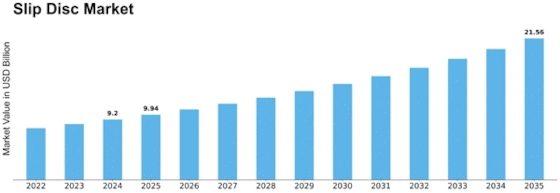

Slip Disc Market Size Graph
Author
Rahul Gotadki
Research Manager

He holds an experience of about 9+ years in Market Research and Business Consulting, working under the spectrum of Life Sciences and Healthcare domains. Rahul conceptualizes and implements a scalable business strategy and provides strategic leadership to the clients. His expertise lies in market estimation, competitive intelligence, pipeline analysis, customer assessment, etc.

Leave a Comment

FAQs

What is the current valuation of the Slip Disc Market as of 2024?

The Slip Disc Market was valued at 9.2 USD Billion in 2024.

What is the projected market size for the Slip Disc Market in 2035?

The market is projected to reach 21.56 USD Billion by 2035.

What is the expected CAGR for the Slip Disc Market during the forecast period 2025 - 2035?

The expected CAGR for the Slip Disc Market during 2025 - 2035 is 8.05%.

Which segments are included in the treatment category of the Slip Disc Market?

The treatment category includes surgeries, therapies, and medications, with respective valuations of 6.25, 7.15, and 8.16 USD Billion projected.

What are the key types of herniated discs in the Slip Disc Market?

The key types include cervical, thoracic, and lumbar herniated discs, with projected valuations of 6.36, 3.24, and 9.96 USD Billion respectively.

Which companies are leading the Slip Disc Market?

Key players in the market include Medtronic, Johnson & Johnson, Stryker, and NuVasive, among others.

What is the projected valuation for imaging tests in the diagnosis segment of the Slip Disc Market?

The projected valuation for imaging tests in the diagnosis segment is 7.0 USD Billion.

How do nerve-related tests contribute to the diagnosis segment of the Slip Disc Market?

Nerve-related tests are projected to contribute 5.5 USD Billion to the diagnosis segment.

What is the projected valuation for physical examinations in the diagnosis segment?

Physical examinations are expected to reach a valuation of 9.06 USD Billion in the diagnosis segment.

How does the growth of the Slip Disc Market compare across different treatment segments?

The growth across treatment segments indicates that medications are projected to have the highest valuation at 8.16 USD Billion.

Market Summary

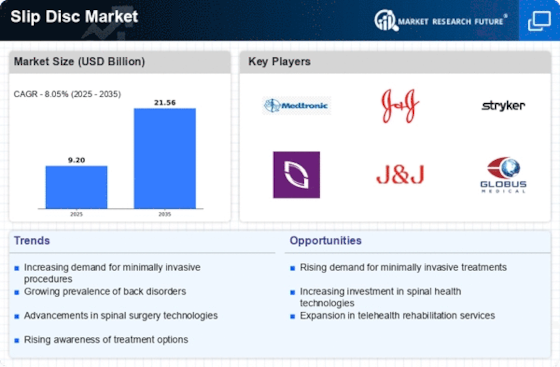
As per Market Research Future analysis, the Slip Disc Market Size was estimated at 9.2 USD Billion in 2024. The Slip Disc industry is projected to grow from 9.941 USD Billion in 2025 to 21.56 USD Billion by 2035, exhibiting a compound annual growth rate (CAGR) of 8.05% during the forecast period 2025 - 2035

Key Market Trends & Highlights

The Slip Disc Market is experiencing notable growth driven by technological advancements and increasing awareness of spinal health.

  • North America remains the largest market for slip disc treatments, reflecting a robust healthcare infrastructure.
  • The Asia-Pacific region is emerging as the fastest-growing market, driven by rising healthcare expenditures and population awareness.
  • Surgical interventions dominate the market, while therapy-based treatments are rapidly gaining traction due to their non-invasive nature.
  • The rising incidence of back disorders and advancements in medical technology are key drivers propelling market growth.

Market Size & Forecast

2024 Market Size 9.2 (USD Billion)
2035 Market Size 21.56 (USD Billion)
CAGR (2025 - 2035) 8.05%
Largest Regional Market Share in 2024 Asia Pacific

Major Players

Medtronic (US), Johnson & Johnson (US), Stryker (US), NuVasive (US), DePuy Synthes (US), Globus Medical (US), B. Braun Melsungen AG (DE), Zimmer Biomet (US), Orthofix Medical Inc. (US)

Market Trends

The Slip Disc Market is currently experiencing a notable evolution, driven by a combination of technological advancements and an increasing awareness of spinal health. As healthcare providers and patients alike become more informed about the implications of spinal disorders, there appears to be a growing demand for innovative treatment options. This shift is likely influenced by the rising prevalence of conditions associated with disc herniation, which may lead to heightened interest in both surgical and non-surgical interventions. Furthermore, the integration of minimally invasive techniques into treatment protocols seems to enhance patient outcomes, thereby fostering a more favorable environment for market growth. In addition to technological progress, the Slip Disc Market is also shaped by demographic factors. An aging population, coupled with lifestyle changes that contribute to musculoskeletal disorders, indicates a potential increase in the number of individuals seeking treatment for slip discs. This demographic shift may prompt healthcare systems to adapt their approaches, focusing on preventive measures and early intervention strategies. As the market continues to evolve, stakeholders must remain vigilant in monitoring these trends to effectively address the needs of patients and healthcare providers alike.

Technological Advancements in Treatment

The Slip Disc Market is witnessing a surge in the adoption of advanced treatment modalities. Innovations such as robotic-assisted surgeries and enhanced imaging techniques are transforming traditional approaches, potentially leading to improved surgical precision and patient recovery times. This trend suggests a shift towards more effective and less invasive options, which may appeal to a broader patient demographic.

Increased Awareness of Spinal Health

There is a growing recognition of the importance of spinal health among both healthcare professionals and the general public. Educational campaigns and resources are likely contributing to this heightened awareness, which may result in more individuals seeking timely interventions for slip disc conditions. This trend indicates a proactive approach to managing spinal disorders.

Demographic Shifts and Lifestyle Changes

The Slip Disc Market is influenced by demographic changes, particularly the aging population and evolving lifestyle habits. As more individuals engage in sedentary activities and experience age-related degeneration, the demand for slip disc treatments may increase. This trend highlights the need for healthcare systems to adapt their strategies to address the unique challenges posed by these demographic factors.

Slip Disc Market Market Drivers

Increased Healthcare Expenditure

The rise in healthcare expenditure across various regions is a notable driver of the Slip Disc Market. As governments and private sectors allocate more resources to healthcare, there is a corresponding increase in funding for spinal health initiatives and treatments. This trend is particularly evident in countries with aging populations, where the demand for effective slip disc treatments is surging. Data indicates that healthcare spending is projected to grow at an annual rate of approximately 7%, which is likely to enhance access to advanced treatment options for patients suffering from slip disc conditions. Furthermore, increased investment in research and development is expected to yield innovative therapies and technologies, thereby expanding the market landscape. As healthcare systems evolve, the focus on improving patient outcomes and reducing the economic burden of spinal disorders will continue to drive growth in the Slip Disc Market.

Advancements in Medical Technology

Technological innovations in medical devices and treatment methodologies are significantly influencing the Slip Disc Market. The introduction of cutting-edge imaging techniques, such as MRI and CT scans, has enhanced diagnostic accuracy, enabling healthcare professionals to identify slip disc conditions more effectively. Furthermore, advancements in surgical techniques, including endoscopic procedures and robotic-assisted surgeries, have improved patient outcomes and reduced recovery times. Data indicates that the market for spinal surgery devices is projected to grow at a compound annual growth rate of over 5% in the coming years. These technological advancements not only facilitate better treatment options but also foster patient confidence in seeking medical intervention for slip disc issues. As the industry continues to evolve, the integration of artificial intelligence and telemedicine may further transform the landscape, making treatments more accessible and efficient for patients worldwide.

Rising Incidence of Back Disorders

The increasing prevalence of back disorders, particularly among the aging population, appears to be a primary driver of the Slip Disc Market. As individuals age, the risk of developing conditions such as herniated discs escalates, leading to a heightened demand for effective treatment options. According to recent data, approximately 80% of adults experience back pain at some point in their lives, which underscores the urgency for innovative solutions in the Slip Disc Market. This trend is further exacerbated by sedentary lifestyles and poor ergonomics, which contribute to spinal issues. Consequently, healthcare providers are focusing on advanced treatment modalities, including minimally invasive surgeries and rehabilitation programs, to address these challenges. The growing awareness of the importance of spinal health is likely to propel the market forward, as patients seek timely interventions to alleviate pain and improve quality of life.

Growing Demand for Non-Invasive Treatments

The increasing preference for non-invasive treatment options is shaping the dynamics of the Slip Disc Market. Patients are increasingly seeking alternatives to traditional surgical interventions, which often involve longer recovery periods and higher risks. Non-invasive therapies, such as physical therapy, chiropractic care, and acupuncture, are gaining traction as effective methods for managing slip disc symptoms. Market data suggests that the non-invasive segment is expected to witness substantial growth, driven by patient demand for safer and less invasive solutions. Additionally, the rise of telehealth services has made it easier for patients to access these treatments from the comfort of their homes. This shift towards non-invasive approaches not only aligns with patient preferences but also reduces the overall healthcare burden, making it a pivotal factor in the ongoing evolution of the Slip Disc Market.

Rising Awareness and Education on Spinal Health

The growing awareness and education surrounding spinal health are crucial factors influencing the Slip Disc Market. Public health campaigns and educational initiatives aimed at promoting spinal health have led to increased recognition of the importance of early diagnosis and treatment of slip disc conditions. As individuals become more informed about the risks associated with poor spinal health, they are more likely to seek medical advice and intervention. This heightened awareness is reflected in the rising number of consultations and treatments for slip disc issues. Additionally, healthcare providers are increasingly emphasizing preventive measures, such as ergonomic assessments and lifestyle modifications, to mitigate the risk of developing spinal disorders. The ongoing efforts to educate the public about spinal health are likely to foster a proactive approach to treatment, thereby driving demand within the Slip Disc Market.

Market Segment Insights

By Treatment: Surgeries (Largest) vs. Therapies (Fastest-Growing)

<p>In the Slip Disc Market, the treatment segment comprises various approaches including surgeries, therapies, and medications. Currently, surgeries account for the largest share, reflecting their critical role in treating severe cases of slip disc where non-invasive methods may not suffice. On the other hand, therapies, including physical and chiropractic treatments, are gaining traction and are the fastest-growing segment as more patients seek alternatives to surgical interventions, driven by enhanced awareness regarding non-invasive options.</p>

<p>Surgeries (Dominant) vs. Therapies (Emerging)</p>

<p>Surgeries remain the dominant treatment option for slip discs due to their effectiveness in alleviating severe pain and neurological deficits. They typically involve procedures such as discectomy and spinal fusion, which are well-established and supported by extensive clinical practices. Conversely, therapies are emerging as a preferred alternative for many patients, focusing on pain management and rehabilitation without the need for invasive procedures. This shift is supported by increasing research validating the efficacy of conservative treatments, leading to a growing acceptance among healthcare professionals and patients alike. As healthcare systems increasingly prioritize patient-centric care, therapies are expected to grow significantly in popularity, complementing surgical options.</p>

By Diagnosis: Imaging Tests (Largest) vs. Nerve-related Tests (Fastest-Growing)

<p>In the Slip Disc Market, the 'Diagnosis' segment displays a varied market share among its key components. Imaging Tests clearly hold the dominant position, being widely utilized for accurate diagnosis. This traditional method encompasses MRIs and CT scans, providing essential visual insights into spinal conditions. On the other hand, Nerve-related Tests, although smaller in share, show rapid adoption due to advancements in technology, enabling more precise assessments of nerve function and damage. Physical examinations are also vital, serving as preliminary assessments, but play a lesser role in the overall share compared to the other two methods.</p>

<p>Diagnostic Techniques: Imaging Tests (Dominant) vs. Nerve-related Tests (Emerging)</p>

<p>Imaging Tests, primarily encompassing MRIs and CT scans, are the cornerstone of diagnosing slip disc issues due to their ability to provide comprehensive visual evidence of spinal irregularities. This dominance stems from the reliability and accuracy of imaging techniques in pinpointing the severity and exact location of disc herniations. In contrast, Nerve-related Tests are gaining traction as emerging tools in this segment. They focus on assessing nerve function and damage, becoming imperative in comprehensive treatment planning. This growth is driven by technological advancements, enabling more detailed observations and efficacy evaluation of therapeutic interventions, which are essential in delivering effective patient care.</p>

By Type: Lumbar Herniated Discs (Largest) vs. Cervical Herniated Discs (Fastest-Growing)

<p>In the Slip Disc Market, Lumbar Herniated Discs represent the largest segment, accounting for a significant share due to their prevalence among patients experiencing lower back pain. This type is commonly associated with lifestyle factors, increasing incidence of obesity, and sedentary living, making it a key focus for healthcare providers. On the other hand, Cervical Herniated Discs are witnessing robust growth, largely driven by a rising awareness of neck-related issues and the impact of prolonged screen time, leading to an increased number of diagnoses and treatments in this area.</p>

<p>Cervical Herniated Discs (Dominant) vs. Thoracic Herniated Discs (Emerging)</p>

<p>The Slip Disc Market reflects a clear distinction between Cervical Herniated Discs, which dominate the segment due to their growing prevalence in today’s work environment, and Thoracic Herniated Discs, which are considered emerging. Cervical Herniated Discs are marked by a high incidence among office workers and individuals engaged in occupations that require extended periods of stationary head positioning. Meanwhile, Thoracic Herniated Discs, although less common, are gaining attention due to increasing sports-related injuries and the aging population. Both segments present unique challenges and opportunities for healthcare innovations and treatment modalities.</p>

Get more detailed insights about Slip Disc Market Research Report- Global Forecast till 2035

Regional Insights

North America : Leading Innovation and Demand

North America is the largest market for slip disc treatments, accounting for approximately 45% of the global market share. The region's growth is driven by advanced healthcare infrastructure, increasing prevalence of spinal disorders, and a rising aging population. Regulatory support from agencies like the FDA facilitates the introduction of innovative treatment options, enhancing patient access and outcomes. The United States is the primary contributor, with key players such as Medtronic, Johnson & Johnson, and Stryker leading the competitive landscape. The presence of established healthcare systems and significant investment in research and development further solidifies North America's position. The market is characterized by continuous innovation and a focus on minimally invasive procedures, catering to the growing demand for effective treatment solutions.

Europe : Emerging Market with Growth Potential

Europe is the second-largest market for slip disc treatments, holding around 30% of the global market share. The region's growth is propelled by increasing awareness of spinal health, advancements in medical technology, and supportive regulatory frameworks. The European Medicines Agency (EMA) plays a crucial role in ensuring the safety and efficacy of new treatments, which boosts market confidence and adoption. Leading countries include Germany, France, and the UK, where healthcare systems are increasingly adopting innovative solutions. Key players like B. Braun Melsungen AG and Zimmer Biomet are expanding their presence through strategic partnerships and product launches. The competitive landscape is marked by a focus on research and development, with an emphasis on improving patient outcomes and reducing recovery times.

Asia-Pacific : Rapidly Growing Healthcare Sector

Asia-Pacific is witnessing rapid growth in the slip disc market, accounting for approximately 20% of the global share. The region's expansion is driven by increasing healthcare expenditure, a growing elderly population, and rising awareness of spinal health. Countries like China and India are investing heavily in healthcare infrastructure, which is expected to further boost market growth in the coming years. China is the largest market in the region, with significant contributions from local and international players. The competitive landscape is evolving, with companies like NuVasive and Orthofix Medical Inc. expanding their operations. The focus on affordable healthcare solutions and the adoption of advanced technologies are key trends shaping the market, making it a focal point for future investments.

Middle East and Africa : Untapped Market with Potential

The Middle East and Africa region represents a smaller segment of the slip disc market, holding about 5% of the global share. However, it is characterized by significant growth potential driven by increasing healthcare investments, rising awareness of spinal disorders, and improving access to medical facilities. Governments are prioritizing healthcare reforms, which are expected to enhance market dynamics in the coming years. Countries like South Africa and the UAE are leading the way in adopting advanced medical technologies. The competitive landscape is gradually evolving, with both local and international players seeking to establish a foothold. Key players are focusing on partnerships and collaborations to expand their reach, making this region an attractive market for future growth opportunities.

Key Players and Competitive Insights

The Slip Disc Market is currently characterized by a dynamic competitive landscape, driven by increasing incidences of spinal disorders and a growing aging population. Key players such as Medtronic (US), Johnson & Johnson (US), and Stryker (US) are at the forefront, each adopting distinct strategies to enhance their market presence. Medtronic (US) focuses on innovation through advanced surgical technologies, while Johnson & Johnson (US) emphasizes a diversified product portfolio that includes minimally invasive solutions. Stryker (US) is actively pursuing mergers and acquisitions to bolster its capabilities in spinal surgery, thereby shaping a competitive environment that is increasingly reliant on technological advancements and strategic partnerships.

In terms of business tactics, companies are localizing manufacturing to reduce costs and optimize supply chains, which appears to be a critical factor in maintaining competitiveness. The Slip Disc Market is moderately fragmented, with several players vying for market share. However, the collective influence of major companies is significant, as they drive innovation and set industry standards, thereby impacting smaller players and new entrants.

In August 2025, Medtronic (US) announced the launch of a new spinal implant designed to enhance recovery times for patients undergoing surgery for herniated discs. This strategic move not only reinforces Medtronic's commitment to innovation but also positions the company to capture a larger share of the market by addressing the growing demand for effective surgical solutions. The introduction of this product is likely to enhance patient outcomes, thereby strengthening Medtronic's reputation in the industry.

In September 2025, Johnson & Johnson (US) expanded its partnership with a leading telehealth provider to integrate digital health solutions into its spinal care offerings. This initiative reflects a broader trend towards digital transformation in healthcare, allowing for improved patient monitoring and engagement. By leveraging telehealth capabilities, Johnson & Johnson aims to enhance the overall patient experience, which could lead to increased loyalty and market share in the Slip Disc segment.

In October 2025, Stryker (US) completed the acquisition of a promising startup specializing in AI-driven surgical planning tools. This acquisition is indicative of Stryker's strategy to integrate cutting-edge technology into its product offerings, potentially revolutionizing surgical procedures for slip disc patients. The incorporation of AI into surgical planning may not only improve surgical precision but also reduce recovery times, thereby enhancing patient satisfaction and outcomes.

As of October 2025, the Slip Disc Market is witnessing trends that emphasize digitalization, sustainability, and the integration of artificial intelligence. Strategic alliances are increasingly shaping the competitive landscape, as companies recognize the value of collaboration in driving innovation. Looking ahead, competitive differentiation is likely to evolve from traditional price-based competition to a focus on technological advancements, innovative solutions, and reliable supply chains. This shift underscores the importance of adaptability and forward-thinking strategies in maintaining a competitive edge in the Slip Disc Market.

Key Companies in the Slip Disc Market include

Industry Developments

    • The European market companies are increasing their expenditure to improvise healthcare facilities by collaborating with the research and development of new productions. Also, there is an emergence of new therapies positively affecting the market growth.
    • Researches are being conducted in collaboration with Cornell University (USA) where new treatment techniques are being developed for herniated disc issues treatment that helps in repairing issues like a flat tyre.
    • Also, the researchers predict that in response to the disc injuries, the default responses should be stopped that will help in better treatment of the slip disc issues. This is being widely adopted by skilled medical professionals.
    • The Bonati Spine Institute that is known as a leader for patented Bonati spine treatment procedures, recently, rolled out a study that surgical interventions are one of the best ways to treat particular back injuries.

Intended Audience

    • Slip disc manufacturers, providers, and suppliers
    • Laboratories conducting medical research
    • Companies conducting research and development procedures
    • Potential investors of the slip disc market
    • Providers of market research and consultation services

Future Outlook

Slip Disc Market Future Outlook

The Slip Disc Market is projected to grow at an 8.05% CAGR from 2025 to 2035, driven by increasing prevalence of spinal disorders, advancements in treatment technologies, and rising healthcare expenditure.

New opportunities lie in:

  • Development of minimally invasive surgical techniques for faster recovery.
  • Expansion of telehealth services for remote patient monitoring and consultations.
  • Investment in AI-driven diagnostic tools to enhance treatment accuracy.

By 2035, the Slip Disc Market is expected to achieve substantial growth, reflecting evolving healthcare dynamics.

Market Segmentation

Slip Disc Market Type Outlook

  • Cervical Herniated Discs
  • Thoracic Herniated Discs
  • Lumbar Herniated Discs

Slip Disc Market Diagnosis Outlook

  • Imaging Tests
  • Nerve-related Tests
  • Physical Examination

Slip Disc Market Treatment Outlook

  • Surgeries
  • Therapies
  • Medications

Report Scope

MARKET SIZE 2024 9.2(USD Billion)
MARKET SIZE 2025 9.941(USD Billion)
MARKET SIZE 2035 21.56(USD Billion)
COMPOUND ANNUAL GROWTH RATE (CAGR) 8.05% (2025 - 2035)
REPORT COVERAGE Revenue Forecast, Competitive Landscape, Growth Factors, and Trends
BASE YEAR 2024
Market Forecast Period 2025 - 2035
Historical Data 2019 - 2024
Market Forecast Units USD Billion
Key Companies Profiled Medtronic (US), Johnson & Johnson (US), Stryker (US), NuVasive (US), DePuy Synthes (US), Globus Medical (US), B. Braun Melsungen AG (DE), Zimmer Biomet (US), Orthofix Medical Inc. (US)
Segments Covered types, diagnosis, treatment
Key Market Opportunities Advancements in minimally invasive surgical techniques enhance treatment options in the Slip Disc Market.
Key Market Dynamics Rising demand for minimally invasive treatments drives innovation and competition in the slip disc market.
Countries Covered North America, Europe, APAC, South America, MEA

FAQs

What is the current valuation of the Slip Disc Market as of 2024?

The Slip Disc Market was valued at 9.2 USD Billion in 2024.

What is the projected market size for the Slip Disc Market in 2035?

The market is projected to reach 21.56 USD Billion by 2035.

What is the expected CAGR for the Slip Disc Market during the forecast period 2025 - 2035?

The expected CAGR for the Slip Disc Market during 2025 - 2035 is 8.05%.

Which segments are included in the treatment category of the Slip Disc Market?

The treatment category includes surgeries, therapies, and medications, with respective valuations of 6.25, 7.15, and 8.16 USD Billion projected.

What are the key types of herniated discs in the Slip Disc Market?

The key types include cervical, thoracic, and lumbar herniated discs, with projected valuations of 6.36, 3.24, and 9.96 USD Billion respectively.

Which companies are leading the Slip Disc Market?

Key players in the market include Medtronic, Johnson &amp; Johnson, Stryker, and NuVasive, among others.

What is the projected valuation for imaging tests in the diagnosis segment of the Slip Disc Market?

The projected valuation for imaging tests in the diagnosis segment is 7.0 USD Billion.

How do nerve-related tests contribute to the diagnosis segment of the Slip Disc Market?

Nerve-related tests are projected to contribute 5.5 USD Billion to the diagnosis segment.

What is the projected valuation for physical examinations in the diagnosis segment?

Physical examinations are expected to reach a valuation of 9.06 USD Billion in the diagnosis segment.

How does the growth of the Slip Disc Market compare across different treatment segments?

The growth across treatment segments indicates that medications are projected to have the highest valuation at 8.16 USD Billion.

  1. SECTION I: EXECUTIVE SUMMARY AND KEY HIGHLIGHTS
    1. | 1.1 EXECUTIVE SUMMARY
    2. | | 1.1.1 Market Overview
    3. | | 1.1.2 Key Findings
    4. | | 1.1.3 Market Segmentation
    5. | | 1.1.4 Competitive Landscape
    6. | | 1.1.5 Challenges and Opportunities
    7. | | 1.1.6 Future Outlook
  2. SECTION II: SCOPING, METHODOLOGY AND MARKET STRUCTURE
    1. | 2.1 MARKET INTRODUCTION
    2. | | 2.1.1 Definition
    3. | | 2.1.2 Scope of the study
    4. | | | 2.1.2.1 Research Objective
    5. | | | 2.1.2.2 Assumption
    6. | | | 2.1.2.3 Limitations
    7. | 2.2 RESEARCH METHODOLOGY
    8. | | 2.2.1 Overview
    9. | | 2.2.2 Data Mining
    10. | | 2.2.3 Secondary Research
    11. | | 2.2.4 Primary Research
    12. | | | 2.2.4.1 Primary Interviews and Information Gathering Process
    13. | | | 2.2.4.2 Breakdown of Primary Respondents
    14. | | 2.2.5 Forecasting Model
    15. | | 2.2.6 Market Size Estimation
    16. | | | 2.2.6.1 Bottom-Up Approach
    17. | | | 2.2.6.2 Top-Down Approach
    18. | | 2.2.7 Data Triangulation
    19. | | 2.2.8 Validation
  3. SECTION III: QUALITATIVE ANALYSIS
    1. | 3.1 MARKET DYNAMICS
    2. | | 3.1.1 Overview
    3. | | 3.1.2 Drivers
    4. | | 3.1.3 Restraints
    5. | | 3.1.4 Opportunities
    6. | 3.2 MARKET FACTOR ANALYSIS
    7. | | 3.2.1 Value chain Analysis
    8. | | 3.2.2 Porter's Five Forces Analysis
    9. | | | 3.2.2.1 Bargaining Power of Suppliers
    10. | | | 3.2.2.2 Bargaining Power of Buyers
    11. | | | 3.2.2.3 Threat of New Entrants
    12. | | | 3.2.2.4 Threat of Substitutes
    13. | | | 3.2.2.5 Intensity of Rivalry
    14. | | 3.2.3 COVID-19 Impact Analysis
    15. | | | 3.2.3.1 Market Impact Analysis
    16. | | | 3.2.3.2 Regional Impact
    17. | | | 3.2.3.3 Opportunity and Threat Analysis
  4. SECTION IV: QUANTITATIVE ANALYSIS
    1. | 4.1 Healthcare, BY Treatment (USD Billion)
    2. | | 4.1.1 Surgeries
    3. | | 4.1.2 Therapies
    4. | | 4.1.3 Medications
    5. | 4.2 Healthcare, BY Diagnosis (USD Billion)
    6. | | 4.2.1 Imaging Tests
    7. | | 4.2.2 Nerve-related Tests
    8. | | 4.2.3 Physical Examination
    9. | 4.3 Healthcare, BY Type (USD Billion)
    10. | | 4.3.1 Cervical Herniated Discs
    11. | | 4.3.2 Thoracic Herniated Discs
    12. | | 4.3.3 Lumbar Herniated Discs
    13. | 4.4 Healthcare, BY Region (USD Billion)
    14. | | 4.4.1 North America
    15. | | | 4.4.1.1 US
    16. | | | 4.4.1.2 Canada
    17. | | 4.4.2 Europe
    18. | | | 4.4.2.1 Germany
    19. | | | 4.4.2.2 UK
    20. | | | 4.4.2.3 France
    21. | | | 4.4.2.4 Russia
    22. | | | 4.4.2.5 Italy
    23. | | | 4.4.2.6 Spain
    24. | | | 4.4.2.7 Rest of Europe
    25. | | 4.4.3 APAC
    26. | | | 4.4.3.1 China
    27. | | | 4.4.3.2 India
    28. | | | 4.4.3.3 Japan
    29. | | | 4.4.3.4 South Korea
    30. | | | 4.4.3.5 Malaysia
    31. | | | 4.4.3.6 Thailand
    32. | | | 4.4.3.7 Indonesia
    33. | | | 4.4.3.8 Rest of APAC
    34. | | 4.4.4 South America
    35. | | | 4.4.4.1 Brazil
    36. | | | 4.4.4.2 Mexico
    37. | | | 4.4.4.3 Argentina
    38. | | | 4.4.4.4 Rest of South America
    39. | | 4.4.5 MEA
    40. | | | 4.4.5.1 GCC Countries
    41. | | | 4.4.5.2 South Africa
    42. | | | 4.4.5.3 Rest of MEA
  5. SECTION V: COMPETITIVE ANALYSIS
    1. | 5.1 Competitive Landscape
    2. | | 5.1.1 Overview
    3. | | 5.1.2 Competitive Analysis
    4. | | 5.1.3 Market share Analysis
    5. | | 5.1.4 Major Growth Strategy in the Healthcare
    6. | | 5.1.5 Competitive Benchmarking
    7. | | 5.1.6 Leading Players in Terms of Number of Developments in the Healthcare
    8. | | 5.1.7 Key developments and growth strategies
    9. | | | 5.1.7.1 New Product Launch/Service Deployment
    10. | | | 5.1.7.2 Merger & Acquisitions
    11. | | | 5.1.7.3 Joint Ventures
    12. | | 5.1.8 Major Players Financial Matrix
    13. | | | 5.1.8.1 Sales and Operating Income
    14. | | | 5.1.8.2 Major Players R&D Expenditure. 2023
    15. | 5.2 Company Profiles
    16. | | 5.2.1 Medtronic (US)
    17. | | | 5.2.1.1 Financial Overview
    18. | | | 5.2.1.2 Products Offered
    19. | | | 5.2.1.3 Key Developments
    20. | | | 5.2.1.4 SWOT Analysis
    21. | | | 5.2.1.5 Key Strategies
    22. | | 5.2.2 Johnson & Johnson (US)
    23. | | | 5.2.2.1 Financial Overview
    24. | | | 5.2.2.2 Products Offered
    25. | | | 5.2.2.3 Key Developments
    26. | | | 5.2.2.4 SWOT Analysis
    27. | | | 5.2.2.5 Key Strategies
    28. | | 5.2.3 Stryker (US)
    29. | | | 5.2.3.1 Financial Overview
    30. | | | 5.2.3.2 Products Offered
    31. | | | 5.2.3.3 Key Developments
    32. | | | 5.2.3.4 SWOT Analysis
    33. | | | 5.2.3.5 Key Strategies
    34. | | 5.2.4 NuVasive (US)
    35. | | | 5.2.4.1 Financial Overview
    36. | | | 5.2.4.2 Products Offered
    37. | | | 5.2.4.3 Key Developments
    38. | | | 5.2.4.4 SWOT Analysis
    39. | | | 5.2.4.5 Key Strategies
    40. | | 5.2.5 DePuy Synthes (US)
    41. | | | 5.2.5.1 Financial Overview
    42. | | | 5.2.5.2 Products Offered
    43. | | | 5.2.5.3 Key Developments
    44. | | | 5.2.5.4 SWOT Analysis
    45. | | | 5.2.5.5 Key Strategies
    46. | | 5.2.6 Globus Medical (US)
    47. | | | 5.2.6.1 Financial Overview
    48. | | | 5.2.6.2 Products Offered
    49. | | | 5.2.6.3 Key Developments
    50. | | | 5.2.6.4 SWOT Analysis
    51. | | | 5.2.6.5 Key Strategies
    52. | | 5.2.7 B. Braun Melsungen AG (DE)
    53. | | | 5.2.7.1 Financial Overview
    54. | | | 5.2.7.2 Products Offered
    55. | | | 5.2.7.3 Key Developments
    56. | | | 5.2.7.4 SWOT Analysis
    57. | | | 5.2.7.5 Key Strategies
    58. | | 5.2.8 Zimmer Biomet (US)
    59. | | | 5.2.8.1 Financial Overview
    60. | | | 5.2.8.2 Products Offered
    61. | | | 5.2.8.3 Key Developments
    62. | | | 5.2.8.4 SWOT Analysis
    63. | | | 5.2.8.5 Key Strategies
    64. | | 5.2.9 Orthofix Medical Inc. (US)
    65. | | | 5.2.9.1 Financial Overview
    66. | | | 5.2.9.2 Products Offered
    67. | | | 5.2.9.3 Key Developments
    68. | | | 5.2.9.4 SWOT Analysis
    69. | | | 5.2.9.5 Key Strategies
    70. | 5.3 Appendix
    71. | | 5.3.1 References
    72. | | 5.3.2 Related Reports
  6. LIST OF FIGURES
    1. | 6.1 MARKET SYNOPSIS
    2. | 6.2 NORTH AMERICA MARKET ANALYSIS
    3. | 6.3 US MARKET ANALYSIS BY TREATMENT
    4. | 6.4 US MARKET ANALYSIS BY DIAGNOSIS
    5. | 6.5 US MARKET ANALYSIS BY TYPE
    6. | 6.6 CANADA MARKET ANALYSIS BY TREATMENT
    7. | 6.7 CANADA MARKET ANALYSIS BY DIAGNOSIS
    8. | 6.8 CANADA MARKET ANALYSIS BY TYPE
    9. | 6.9 EUROPE MARKET ANALYSIS
    10. | 6.10 GERMANY MARKET ANALYSIS BY TREATMENT
    11. | 6.11 GERMANY MARKET ANALYSIS BY DIAGNOSIS
    12. | 6.12 GERMANY MARKET ANALYSIS BY TYPE
    13. | 6.13 UK MARKET ANALYSIS BY TREATMENT
    14. | 6.14 UK MARKET ANALYSIS BY DIAGNOSIS
    15. | 6.15 UK MARKET ANALYSIS BY TYPE
    16. | 6.16 FRANCE MARKET ANALYSIS BY TREATMENT
    17. | 6.17 FRANCE MARKET ANALYSIS BY DIAGNOSIS
    18. | 6.18 FRANCE MARKET ANALYSIS BY TYPE
    19. | 6.19 RUSSIA MARKET ANALYSIS BY TREATMENT
    20. | 6.20 RUSSIA MARKET ANALYSIS BY DIAGNOSIS
    21. | 6.21 RUSSIA MARKET ANALYSIS BY TYPE
    22. | 6.22 ITALY MARKET ANALYSIS BY TREATMENT
    23. | 6.23 ITALY MARKET ANALYSIS BY DIAGNOSIS
    24. | 6.24 ITALY MARKET ANALYSIS BY TYPE
    25. | 6.25 SPAIN MARKET ANALYSIS BY TREATMENT
    26. | 6.26 SPAIN MARKET ANALYSIS BY DIAGNOSIS
    27. | 6.27 SPAIN MARKET ANALYSIS BY TYPE
    28. | 6.28 REST OF EUROPE MARKET ANALYSIS BY TREATMENT
    29. | 6.29 REST OF EUROPE MARKET ANALYSIS BY DIAGNOSIS
    30. | 6.30 REST OF EUROPE MARKET ANALYSIS BY TYPE
    31. | 6.31 APAC MARKET ANALYSIS
    32. | 6.32 CHINA MARKET ANALYSIS BY TREATMENT
    33. | 6.33 CHINA MARKET ANALYSIS BY DIAGNOSIS
    34. | 6.34 CHINA MARKET ANALYSIS BY TYPE
    35. | 6.35 INDIA MARKET ANALYSIS BY TREATMENT
    36. | 6.36 INDIA MARKET ANALYSIS BY DIAGNOSIS
    37. | 6.37 INDIA MARKET ANALYSIS BY TYPE
    38. | 6.38 JAPAN MARKET ANALYSIS BY TREATMENT
    39. | 6.39 JAPAN MARKET ANALYSIS BY DIAGNOSIS
    40. | 6.40 JAPAN MARKET ANALYSIS BY TYPE
    41. | 6.41 SOUTH KOREA MARKET ANALYSIS BY TREATMENT
    42. | 6.42 SOUTH KOREA MARKET ANALYSIS BY DIAGNOSIS
    43. | 6.43 SOUTH KOREA MARKET ANALYSIS BY TYPE
    44. | 6.44 MALAYSIA MARKET ANALYSIS BY TREATMENT
    45. | 6.45 MALAYSIA MARKET ANALYSIS BY DIAGNOSIS
    46. | 6.46 MALAYSIA MARKET ANALYSIS BY TYPE
    47. | 6.47 THAILAND MARKET ANALYSIS BY TREATMENT
    48. | 6.48 THAILAND MARKET ANALYSIS BY DIAGNOSIS
    49. | 6.49 THAILAND MARKET ANALYSIS BY TYPE
    50. | 6.50 INDONESIA MARKET ANALYSIS BY TREATMENT
    51. | 6.51 INDONESIA MARKET ANALYSIS BY DIAGNOSIS
    52. | 6.52 INDONESIA MARKET ANALYSIS BY TYPE
    53. | 6.53 REST OF APAC MARKET ANALYSIS BY TREATMENT
    54. | 6.54 REST OF APAC MARKET ANALYSIS BY DIAGNOSIS
    55. | 6.55 REST OF APAC MARKET ANALYSIS BY TYPE
    56. | 6.56 SOUTH AMERICA MARKET ANALYSIS
    57. | 6.57 BRAZIL MARKET ANALYSIS BY TREATMENT
    58. | 6.58 BRAZIL MARKET ANALYSIS BY DIAGNOSIS
    59. | 6.59 BRAZIL MARKET ANALYSIS BY TYPE
    60. | 6.60 MEXICO MARKET ANALYSIS BY TREATMENT
    61. | 6.61 MEXICO MARKET ANALYSIS BY DIAGNOSIS
    62. | 6.62 MEXICO MARKET ANALYSIS BY TYPE
    63. | 6.63 ARGENTINA MARKET ANALYSIS BY TREATMENT
    64. | 6.64 ARGENTINA MARKET ANALYSIS BY DIAGNOSIS
    65. | 6.65 ARGENTINA MARKET ANALYSIS BY TYPE
    66. | 6.66 REST OF SOUTH AMERICA MARKET ANALYSIS BY TREATMENT
    67. | 6.67 REST OF SOUTH AMERICA MARKET ANALYSIS BY DIAGNOSIS
    68. | 6.68 REST OF SOUTH AMERICA MARKET ANALYSIS BY TYPE
    69. | 6.69 MEA MARKET ANALYSIS
    70. | 6.70 GCC COUNTRIES MARKET ANALYSIS BY TREATMENT
    71. | 6.71 GCC COUNTRIES MARKET ANALYSIS BY DIAGNOSIS
    72. | 6.72 GCC COUNTRIES MARKET ANALYSIS BY TYPE
    73. | 6.73 SOUTH AFRICA MARKET ANALYSIS BY TREATMENT
    74. | 6.74 SOUTH AFRICA MARKET ANALYSIS BY DIAGNOSIS
    75. | 6.75 SOUTH AFRICA MARKET ANALYSIS BY TYPE
    76. | 6.76 REST OF MEA MARKET ANALYSIS BY TREATMENT
    77. | 6.77 REST OF MEA MARKET ANALYSIS BY DIAGNOSIS
    78. | 6.78 REST OF MEA MARKET ANALYSIS BY TYPE
    79. | 6.79 KEY BUYING CRITERIA OF HEALTHCARE
    80. | 6.80 RESEARCH PROCESS OF MRFR
    81. | 6.81 DRO ANALYSIS OF HEALTHCARE
    82. | 6.82 DRIVERS IMPACT ANALYSIS: HEALTHCARE
    83. | 6.83 RESTRAINTS IMPACT ANALYSIS: HEALTHCARE
    84. | 6.84 SUPPLY / VALUE CHAIN: HEALTHCARE
    85. | 6.85 HEALTHCARE, BY TREATMENT, 2024 (% SHARE)
    86. | 6.86 HEALTHCARE, BY TREATMENT, 2024 TO 2035 (USD Billion)
    87. | 6.87 HEALTHCARE, BY DIAGNOSIS, 2024 (% SHARE)
    88. | 6.88 HEALTHCARE, BY DIAGNOSIS, 2024 TO 2035 (USD Billion)
    89. | 6.89 HEALTHCARE, BY TYPE, 2024 (% SHARE)
    90. | 6.90 HEALTHCARE, BY TYPE, 2024 TO 2035 (USD Billion)
    91. | 6.91 BENCHMARKING OF MAJOR COMPETITORS
  7. LIST OF TABLES
    1. | 7.1 LIST OF ASSUMPTIONS
    2. | | 7.1.1
    3. | 7.2 North America MARKET SIZE ESTIMATES; FORECAST
    4. | | 7.2.1 BY TREATMENT, 2025-2035 (USD Billion)
    5. | | 7.2.2 BY DIAGNOSIS, 2025-2035 (USD Billion)
    6. | | 7.2.3 BY TYPE, 2025-2035 (USD Billion)
    7. | 7.3 US MARKET SIZE ESTIMATES; FORECAST
    8. | | 7.3.1 BY TREATMENT, 2025-2035 (USD Billion)
    9. | | 7.3.2 BY DIAGNOSIS, 2025-2035 (USD Billion)
    10. | | 7.3.3 BY TYPE, 2025-2035 (USD Billion)
    11. | 7.4 Canada MARKET SIZE ESTIMATES; FORECAST
    12. | | 7.4.1 BY TREATMENT, 2025-2035 (USD Billion)
    13. | | 7.4.2 BY DIAGNOSIS, 2025-2035 (USD Billion)
    14. | | 7.4.3 BY TYPE, 2025-2035 (USD Billion)
    15. | 7.5 Europe MARKET SIZE ESTIMATES; FORECAST
    16. | | 7.5.1 BY TREATMENT, 2025-2035 (USD Billion)
    17. | | 7.5.2 BY DIAGNOSIS, 2025-2035 (USD Billion)
    18. | | 7.5.3 BY TYPE, 2025-2035 (USD Billion)
    19. | 7.6 Germany MARKET SIZE ESTIMATES; FORECAST
    20. | | 7.6.1 BY TREATMENT, 2025-2035 (USD Billion)
    21. | | 7.6.2 BY DIAGNOSIS, 2025-2035 (USD Billion)
    22. | | 7.6.3 BY TYPE, 2025-2035 (USD Billion)
    23. | 7.7 UK MARKET SIZE ESTIMATES; FORECAST
    24. | | 7.7.1 BY TREATMENT, 2025-2035 (USD Billion)
    25. | | 7.7.2 BY DIAGNOSIS, 2025-2035 (USD Billion)
    26. | | 7.7.3 BY TYPE, 2025-2035 (USD Billion)
    27. | 7.8 France MARKET SIZE ESTIMATES; FORECAST
    28. | | 7.8.1 BY TREATMENT, 2025-2035 (USD Billion)
    29. | | 7.8.2 BY DIAGNOSIS, 2025-2035 (USD Billion)
    30. | | 7.8.3 BY TYPE, 2025-2035 (USD Billion)
    31. | 7.9 Russia MARKET SIZE ESTIMATES; FORECAST
    32. | | 7.9.1 BY TREATMENT, 2025-2035 (USD Billion)
    33. | | 7.9.2 BY DIAGNOSIS, 2025-2035 (USD Billion)
    34. | | 7.9.3 BY TYPE, 2025-2035 (USD Billion)
    35. | 7.10 Italy MARKET SIZE ESTIMATES; FORECAST
    36. | | 7.10.1 BY TREATMENT, 2025-2035 (USD Billion)
    37. | | 7.10.2 BY DIAGNOSIS, 2025-2035 (USD Billion)
    38. | | 7.10.3 BY TYPE, 2025-2035 (USD Billion)
    39. | 7.11 Spain MARKET SIZE ESTIMATES; FORECAST
    40. | | 7.11.1 BY TREATMENT, 2025-2035 (USD Billion)
    41. | | 7.11.2 BY DIAGNOSIS, 2025-2035 (USD Billion)
    42. | | 7.11.3 BY TYPE, 2025-2035 (USD Billion)
    43. | 7.12 Rest of Europe MARKET SIZE ESTIMATES; FORECAST
    44. | | 7.12.1 BY TREATMENT, 2025-2035 (USD Billion)
    45. | | 7.12.2 BY DIAGNOSIS, 2025-2035 (USD Billion)
    46. | | 7.12.3 BY TYPE, 2025-2035 (USD Billion)
    47. | 7.13 APAC MARKET SIZE ESTIMATES; FORECAST
    48. | | 7.13.1 BY TREATMENT, 2025-2035 (USD Billion)
    49. | | 7.13.2 BY DIAGNOSIS, 2025-2035 (USD Billion)
    50. | | 7.13.3 BY TYPE, 2025-2035 (USD Billion)
    51. | 7.14 China MARKET SIZE ESTIMATES; FORECAST
    52. | | 7.14.1 BY TREATMENT, 2025-2035 (USD Billion)
    53. | | 7.14.2 BY DIAGNOSIS, 2025-2035 (USD Billion)
    54. | | 7.14.3 BY TYPE, 2025-2035 (USD Billion)
    55. | 7.15 India MARKET SIZE ESTIMATES; FORECAST
    56. | | 7.15.1 BY TREATMENT, 2025-2035 (USD Billion)
    57. | | 7.15.2 BY DIAGNOSIS, 2025-2035 (USD Billion)
    58. | | 7.15.3 BY TYPE, 2025-2035 (USD Billion)
    59. | 7.16 Japan MARKET SIZE ESTIMATES; FORECAST
    60. | | 7.16.1 BY TREATMENT, 2025-2035 (USD Billion)
    61. | | 7.16.2 BY DIAGNOSIS, 2025-2035 (USD Billion)
    62. | | 7.16.3 BY TYPE, 2025-2035 (USD Billion)
    63. | 7.17 South Korea MARKET SIZE ESTIMATES; FORECAST
    64. | | 7.17.1 BY TREATMENT, 2025-2035 (USD Billion)
    65. | | 7.17.2 BY DIAGNOSIS, 2025-2035 (USD Billion)
    66. | | 7.17.3 BY TYPE, 2025-2035 (USD Billion)
    67. | 7.18 Malaysia MARKET SIZE ESTIMATES; FORECAST
    68. | | 7.18.1 BY TREATMENT, 2025-2035 (USD Billion)
    69. | | 7.18.2 BY DIAGNOSIS, 2025-2035 (USD Billion)
    70. | | 7.18.3 BY TYPE, 2025-2035 (USD Billion)
    71. | 7.19 Thailand MARKET SIZE ESTIMATES; FORECAST
    72. | | 7.19.1 BY TREATMENT, 2025-2035 (USD Billion)
    73. | | 7.19.2 BY DIAGNOSIS, 2025-2035 (USD Billion)
    74. | | 7.19.3 BY TYPE, 2025-2035 (USD Billion)
    75. | 7.20 Indonesia MARKET SIZE ESTIMATES; FORECAST
    76. | | 7.20.1 BY TREATMENT, 2025-2035 (USD Billion)
    77. | | 7.20.2 BY DIAGNOSIS, 2025-2035 (USD Billion)
    78. | | 7.20.3 BY TYPE, 2025-2035 (USD Billion)
    79. | 7.21 Rest of APAC MARKET SIZE ESTIMATES; FORECAST
    80. | | 7.21.1 BY TREATMENT, 2025-2035 (USD Billion)
    81. | | 7.21.2 BY DIAGNOSIS, 2025-2035 (USD Billion)
    82. | | 7.21.3 BY TYPE, 2025-2035 (USD Billion)
    83. | 7.22 South America MARKET SIZE ESTIMATES; FORECAST
    84. | | 7.22.1 BY TREATMENT, 2025-2035 (USD Billion)
    85. | | 7.22.2 BY DIAGNOSIS, 2025-2035 (USD Billion)
    86. | | 7.22.3 BY TYPE, 2025-2035 (USD Billion)
    87. | 7.23 Brazil MARKET SIZE ESTIMATES; FORECAST
    88. | | 7.23.1 BY TREATMENT, 2025-2035 (USD Billion)
    89. | | 7.23.2 BY DIAGNOSIS, 2025-2035 (USD Billion)
    90. | | 7.23.3 BY TYPE, 2025-2035 (USD Billion)
    91. | 7.24 Mexico MARKET SIZE ESTIMATES; FORECAST
    92. | | 7.24.1 BY TREATMENT, 2025-2035 (USD Billion)
    93. | | 7.24.2 BY DIAGNOSIS, 2025-2035 (USD Billion)
    94. | | 7.24.3 BY TYPE, 2025-2035 (USD Billion)
    95. | 7.25 Argentina MARKET SIZE ESTIMATES; FORECAST
    96. | | 7.25.1 BY TREATMENT, 2025-2035 (USD Billion)
    97. | | 7.25.2 BY DIAGNOSIS, 2025-2035 (USD Billion)
    98. | | 7.25.3 BY TYPE, 2025-2035 (USD Billion)
    99. | 7.26 Rest of South America MARKET SIZE ESTIMATES; FORECAST
    100. | | 7.26.1 BY TREATMENT, 2025-2035 (USD Billion)
    101. | | 7.26.2 BY DIAGNOSIS, 2025-2035 (USD Billion)
    102. | | 7.26.3 BY TYPE, 2025-2035 (USD Billion)
    103. | 7.27 MEA MARKET SIZE ESTIMATES; FORECAST
    104. | | 7.27.1 BY TREATMENT, 2025-2035 (USD Billion)
    105. | | 7.27.2 BY DIAGNOSIS, 2025-2035 (USD Billion)
    106. | | 7.27.3 BY TYPE, 2025-2035 (USD Billion)
    107. | 7.28 GCC Countries MARKET SIZE ESTIMATES; FORECAST
    108. | | 7.28.1 BY TREATMENT, 2025-2035 (USD Billion)
    109. | | 7.28.2 BY DIAGNOSIS, 2025-2035 (USD Billion)
    110. | | 7.28.3 BY TYPE, 2025-2035 (USD Billion)
    111. | 7.29 South Africa MARKET SIZE ESTIMATES; FORECAST
    112. | | 7.29.1 BY TREATMENT, 2025-2035 (USD Billion)
    113. | | 7.29.2 BY DIAGNOSIS, 2025-2035 (USD Billion)
    114. | | 7.29.3 BY TYPE, 2025-2035 (USD Billion)
    115. | 7.30 Rest of MEA MARKET SIZE ESTIMATES; FORECAST
    116. | | 7.30.1 BY TREATMENT, 2025-2035 (USD Billion)
    117. | | 7.30.2 BY DIAGNOSIS, 2025-2035 (USD Billion)
    118. | | 7.30.3 BY TYPE, 2025-2035 (USD Billion)
    119. | 7.31 PRODUCT LAUNCH/PRODUCT DEVELOPMENT/APPROVAL
    120. | | 7.31.1
    121. | 7.32 ACQUISITION/PARTNERSHIP
    122. | | 7.32.1

Healthcare Market Segmentation

Healthcare By Treatment (USD Billion, 2025-2035)

  • Surgeries
  • Therapies
  • Medications

Healthcare By Diagnosis (USD Billion, 2025-2035)

  • Imaging Tests
  • Nerve-related Tests
  • Physical Examination

Healthcare By Type (USD Billion, 2025-2035)

  • Cervical Herniated Discs
  • Thoracic Herniated Discs
  • Lumbar Herniated Discs
Infographic

Free Sample Request

Kindly complete the form below to receive a free sample of this Report

Get Free Sample

Customer Strories

Compare Licence

×
Features License Type
Single User Multiuser License Enterprise User
Price $4,950 $5,950 $7,250
Maximum User Access Limit 1 User Upto 10 Users Unrestricted Access Throughout the Organization
Free Customization
Direct Access to Analyst
Deliverable Format
Platform Access
Discount on Next Purchase 10% 15% 15%
Printable Versions