
Request Free Sample ×

Kindly complete the form below to receive a free sample of this Report

* Please use a valid business email

Leading companies partner with us for data-driven Insights

clients tt-cursor
Hero Background
English
Chinese
French
Japanese
Korean
German
Spanish

Slickline Services Market Size

ID: MRFR/EnP/8678-HCR
111 Pages
Chitranshi Jaiswal
April 2026

Slickline Services Market Research Report Information By Slickline Tools (Pulling Tools, Gauge Cutter, Downhole Bailer, Bridge Plug and Others), By Application (Offshore and Onshore) and Region (North America, Europe, Asia-Pacific, the Middle East & Africa and South America) - Forecast till 2035

Share:
Download PDF ×

We do not share your information with anyone. However, we may send you emails based on your report interest from time to time. You may contact us at any time to opt-out.

Slickline Services Market Infographic
Purchase Options

Slickline Services Size

Slickline Services Market Growth Projections and Opportunities

The slickline services engaged in a wider spectrum of the oil and gas industry are highly vital for the well intervention and maintenance operations. Market dynamics in payments sector are constituted of a significant number of factors which basically determine competitiveness of this sector and the services it is providing. By far, the demand for energy worldwide is the principal aspect that fuels exploration and production activities. While the world squeezes itself from oil and gas industries, slickline services are growing proportionately, affirming the demand for them.

Substantial improvement in technology also serves a major contributor in reshaping the market dynamics. Downhole devices and equipment innovations always go hand in hand with the upgrade of exsisting slickline services which enables efficient and reliable solutions to all kinds of oilfield challenges the companies may face. With the growing integration of smart technologies, data analytics and automation, interventions can become more detailed, accurate and cost-sensitive thus ensuring that well production activities are discharged with accuracy, cost-effectiveness and simplicity. This technical evolution is not just about improving operational efficiency but also it reflects the trend of sustainability and ecological responsibility that future of this industry stress a lot on.

Market dynamism also depends on compliances and environmental utilities. As more and more governments around the world coming out with tighter regulations to maintain the utmost safety and environmental protection licences, slickline services companies have to revamp their services and tech so they’re always up to date. Complentation with these regulations not just only guarantees the company its legal standing but also its reputation within the industry which makes people to trust more the clients and stakeholders.

Competition is one of the major forces, influencing the market niche of slick line service providers. The sector by the players who are both the big multinational group of companies and also the little regional service provides. In turn, this creates a heated competition among businesses vying to develop unique technologies, excellent service delivery and innovative processes, which fundamentally brings customer satisfaction and higher competitiveness to the market. Strategic cooperation and consolidation in form of mergers and acquisitions are also among important factors shaping the competitive environment of the market which are used by companies to broaden their service offerings and market presence.

The cyclicality of the oil and gas industry adds another dimension to the interaction of market principles with this industry. Oil price may fluctuate could lead to a limitation in production and exploration that in the end would reducing the demand of slickline services. Low oil prices act as a discouraging factor and enhance the probability of companies investing less in exploration and production, thus low the demand for well intervention and maintenance services provided by the company. On the other hand, during the down turns, business tends to cut costs means that social services might not be part of the priorities.
Slickline Services Market Size Graph
Author
Author Profile
Chitranshi Jaiswal
Team Lead - Research

Chitranshi is a Team Leader in the Chemicals & Materials (CnM) and Energy & Power (EnP) domains, with 6+ years of experience in market research. She leads and mentors teams to deliver cross-domain projects that equip clients with actionable insights and growth strategies. She is skilled in market estimation, forecasting, competitive benchmarking, and both primary & secondary research, enabling her to turn complex data into decision-ready insights. An engineer and MBA professional, she combines technical expertise with strategic acumen to solve dynamic market challenges. Chitranshi has successfully managed projects that support market entry, investment planning, and competitive positioning, while building strong client relationships. Certified in Advanced Excel & Power BI she leverages data-driven approaches to ensure accuracy, clarity, and impactful outcomes.

Leave a Comment

FAQs

What is the projected market valuation of the Slickline Services Market by 2035?

<p>The Slickline Services Market is projected to reach a valuation of 59.84 USD Million by 2035.</p>

What was the market valuation of the Slickline Services Market in 2024?

<p>In 2024, the Slickline Services Market had a valuation of 15.47 USD Million.</p>

What is the expected CAGR for the Slickline Services Market during the forecast period 2025 - 2035?

<p>The expected CAGR for the Slickline Services Market during the forecast period 2025 - 2035 is 13.08%.</p>

Which companies are considered key players in the Slickline Services Market?

<p>Key players in the Slickline Services Market include Schlumberger, Halliburton, Baker Hughes, Weatherford, and National Oilwell Varco.</p>

What are the main applications of Slickline Services?

<p>The main applications of Slickline Services include Well Intervention, Production Optimization, Data Acquisition, and Maintenance Services.</p>

How do Slickline Services compare to other service types in terms of market valuation?

Slickline Services had a valuation of 3.09 USD Million, while Wireline Services and Coiled Tubing Services were valued at 4.64 USD Million and 4.12 USD Million, respectively.

What is the market valuation for Mechanical Slickline technology?

The market valuation for Mechanical Slickline technology is projected to be between 5.0 and 20.0 USD Million.

What is the expected market performance for Offshore Wells in the Slickline Services Market?

The market valuation for Offshore Wells is anticipated to range from 3.0 to 12.0 USD Million.

What segment of the Slickline Services Market is expected to show the highest growth?

The segment of Production Optimization is expected to show notable growth, with a valuation projected to rise from 4.64 USD Million to 17.83 USD Million.

What is the projected valuation for Electronic Slickline technology by 2035?

The projected valuation for Electronic Slickline technology is expected to reach between 6.0 and 25.0 USD Million by 2035.

Market Summary

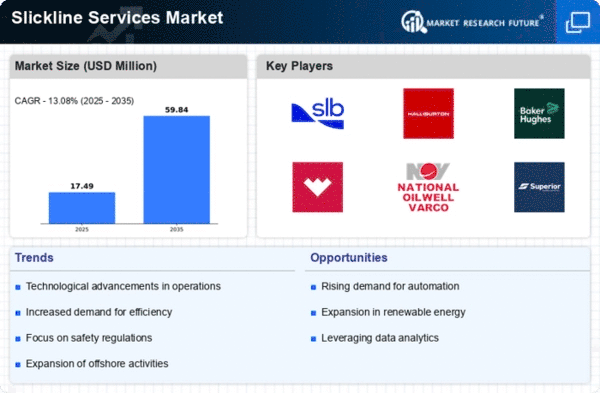
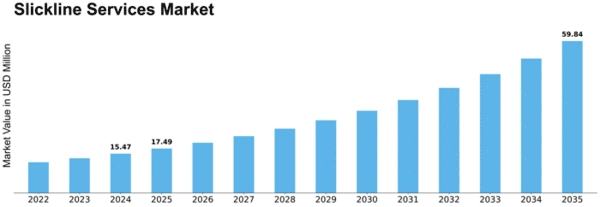
As per MRFR analysis, the Slickline Services Market Size was estimated at 15.47 USD Million in 2024. The Slickline Services industry is projected to grow from 17.5 in 2025 to 59.84 by 2035, exhibiting a compound annual growth rate (CAGR) of 13.08% during the forecast period 2025 - 2035.

Key Market Trends & Highlights

The Slickline Services Market is poised for growth driven by technological advancements and increasing demand for oil and gas.

  • Technological advancements are enhancing the efficiency and safety of slickline operations, particularly in North America. The Asia-Pacific region is emerging as the fastest-growing market, driven by rising exploration activities in unconventional resources. Well intervention remains the largest segment, while production optimization is witnessing rapid growth due to evolving industry needs. Key market drivers include increasing demand for oil and gas and a growing focus on operational efficiency, shaping the future of slickline services.

Market Size & Forecast

2024 Market Size 15.47 (USD Million)
2035 Market Size 59.84 (USD Million)
CAGR (2025 - 2035) 13.08%
Largest Regional Market Share in 2024 North America

Major Players

<a href="https://www.slb.com/products-and-services/innovating-in-oil-and-gas/well-intervention/slickline-well-intervention/slickline-mechanical-intervention">Schlumberger</a> (US), Halliburton (US), Baker Hughes (US), <a href="https://www.weatherford.com/drilling-and-evaluation/wireline-services/cased-hole-wireline/slickline-services/">Weatherford</a> (US), National Oilwell Varco (US), Superior Energy Services (US), C&amp;J Energy Services (US), Aker Solutions (NO), Oil States International (US)

Market Trends

The Slickline Services Market is currently experiencing a dynamic evolution, driven by the increasing demand for efficient well intervention solutions. This sector, which encompasses various services such as the deployment of slickline tools for well maintenance and data acquisition, appears to be gaining traction as operators seek to enhance productivity and reduce operational costs. The integration of advanced technologies, such as real-time data analytics and automation, seems to be reshaping service delivery, allowing for more precise interventions and improved decision-making processes. Furthermore, the growing emphasis on environmental sustainability may influence the adoption of slickline services, as companies strive to minimize their ecological footprint while maximizing resource extraction efficiency. In addition, the Slickline Services Market is likely to witness a shift towards more collaborative approaches among service providers and oil and gas operators. This trend suggests a move away from traditional transactional relationships towards partnerships that foster innovation and shared objectives. As the industry navigates challenges such as fluctuating energy prices and regulatory pressures, the ability to adapt and innovate will be crucial. Overall, the market appears poised for growth, with opportunities emerging from technological advancements and evolving industry dynamics that could redefine the landscape of slickline services in the coming years.

Technological Advancements

The Slickline Services Market is increasingly influenced by technological innovations that enhance operational efficiency. The adoption of advanced tools and real-time monitoring systems allows for more accurate data collection and analysis, leading to improved decision-making in well interventions.

Sustainability Focus

There is a growing emphasis on sustainability within the Slickline Services Market, as companies seek to reduce their environmental impact. This trend may drive the development of eco-friendly slickline solutions that align with global sustainability goals, potentially reshaping service offerings.

Collaborative Partnerships

The market is witnessing a shift towards collaborative partnerships between service providers and operators. This trend indicates a move towards shared objectives and innovation, as companies work together to address challenges and enhance service delivery in the slickline sector.

Slickline Services Market Market Drivers

Technological Advancements

Technological innovations play a crucial role in shaping the Global Slickline Services Market Industry. The introduction of advanced slickline tools and techniques enhances operational efficiency and safety, thereby attracting more investments. For instance, the integration of real-time data analytics and automation in slickline operations allows for better decision-making and reduced downtime. As these technologies evolve, they are expected to drive market expansion significantly. The anticipated growth trajectory indicates that by 2035, the market could reach 1278.6 USD Million, underscoring the importance of technology in meeting the demands of modern oil and gas operations.

Market Charts and Projections

The Global Slickline Services Market Industry is characterized by various charts and projections that illustrate its growth trajectory. The market is anticipated to reach 628.8 USD Million in 2024, with further expansion expected to 1278.6 USD Million by 2035. The projected CAGR of 6.67% from 2025 to 2035 highlights the industry's resilience and adaptability in a changing economic landscape. These visual representations provide insights into market dynamics, investment trends, and the overall health of the slickline services sector, enabling stakeholders to make informed decisions.

Rising Exploration Activities

The Global Slickline Services Market Industry is significantly influenced by the rising exploration activities in both conventional and unconventional oil and gas reserves. As companies seek to tap into new resources, the demand for slickline services, which are vital for well intervention and maintenance, is expected to increase. This trend is particularly evident in regions with untapped potential, where exploration efforts are intensifying. The market's growth is indicative of the industry's response to these exploration demands, suggesting a robust future as companies invest in slickline capabilities to enhance production efficiency and reduce operational costs.

Increasing Demand for Oil and Gas

The Global Slickline Services Market Industry experiences a notable surge in demand driven by the increasing global consumption of oil and gas. As economies expand, the need for efficient extraction methods becomes paramount. Slickline services, which facilitate the maintenance and operation of wells, are essential for optimizing production. In 2024, the market is projected to reach 628.8 USD Million, reflecting the industry's response to this growing demand. The trend suggests that as exploration activities intensify, particularly in emerging markets, the reliance on slickline services will likely escalate, further propelling market growth.

Regulatory Support and Environmental Considerations

The Global Slickline Services Market Industry benefits from supportive regulatory frameworks aimed at promoting sustainable practices in oil and gas extraction. Governments worldwide are increasingly emphasizing environmental protection, leading to the adoption of slickline services that minimize ecological impact. Compliance with stringent regulations not only enhances operational safety but also boosts the market's appeal to environmentally conscious investors. As the industry adapts to these regulations, it is likely to witness a steady growth rate, with a projected CAGR of 6.67% from 2025 to 2035, reflecting the alignment of slickline services with global sustainability goals.

Market Segment Insights

By Application: Well Intervention (Largest) vs. Production Optimization (Fastest-Growing)

In the Slickline Services Market, the distribution of market share among different application segments reveals that Well Intervention holds the largest share, primarily due to its critical role in maintaining and restoring well productivity. This application is traditionally favored due to its extensive usage across various oil and gas fields. On the other hand, Production Optimization is emerging as a significant player, demonstrating rapid growth as companies seek to enhance oil output and efficiency through advanced techniques.

Well Intervention (Dominant) vs. Maintenance Services (Emerging)

The Well Intervention segment is characterized by its vital function in ensuring the longevity and productivity of oil wells, making it a dominant force in the Slickline Services Market. This application encompasses a range of services aimed at performing maintenance operations and problem-solving in oil wells, which is crucial for maximum yield. Conversely, Maintenance Services is an emerging segment that focuses on proactive measures and regular upkeep to prevent well failures. While this segment is growing, it has not yet reached the same level of market dominance as Well Intervention, but its importance is continually increasing as operators recognize the benefits of routine maintenance in extending the lifecycle of assets.

By Service Type: Slickline Services (Largest) vs. Wireline Services (Fastest-Growing)

The service type segment in the Slickline Services Market exhibits a competitive landscape where Slickline Services dominates the market share, owing to its robust application in maintenance and operation tasks within the oil and gas industry. This segment is critical for efficient well intervention, leading to its substantial hold in the market. On the other hand, Wireline Services is rapidly gaining traction, being recognized for its advanced technology and operational flexibility, attracting a growing customer base and gradually increasing its market share. Investigating growth trends reveals a noticeable shift toward automation and digitalization in the Slickline Services Market. Companies are investing in technology-driven solutions to improve operational efficiency, driving the growth of Wireline Services. Environmental considerations and the need for more efficient extraction processes favor innovative slickline technologies as stakeholders prioritize methods that minimize disruption to existing ecosystems and enhance recovery rates.

Slickline Services (Dominant) vs. Coiled Tubing Services (Emerging)

Slickline Services present a dominant position in the market due to their extensive applications in the oil and gas sector, allowing operators to conduct well interventions without the need for substantial rigging. This service is greatly valued for its cost-effectiveness and ability to perform essential tasks such as pressure monitoring and the transportation of tools to the wellhead. In contrast, Coiled Tubing Services represent an emerging opportunity, with their unique capability to perform continuous operations and interventions at greater depths. They are gaining favor for their ability to reduce operational downtime and enhance efficiency, appealing to operators seeking advanced solutions for well management and production optimization.

By End User: Oil and Gas Production (Largest) vs. Well Services (Fastest-Growing)

<p>The Slickline Services Market is segmented into various end users, with Oil and Gas Production holding the largest share. This segment benefits from the ongoing demand for energy and the requirement for efficient extraction services. In contrast, Well Services has emerged as the fastest-growing segment, driven by increasing investments in enhancing well productivity and the need for advanced maintenance solutions.</p>

<p>Oil and Gas Production: Dominant vs. Well Services: Emerging</p>

<p>Oil and Gas Production is the dominant segment in the Slickline Services Market, characterized by its extensive reliance on slickline operations for completing and maintaining wells efficiently. This segment is essential for optimizing extraction processes and ensuring that production rates are maximized. On the other hand, Well Services has gained traction as an emerging segment, focusing on innovative solutions for well interventions and enhancements. The increasing complexity of wells and the integration of new technologies in maintenance processes are fueling its rapid growth, making it a vital area for investment and development in the industry.</p>

By Technology: Mechanical Slickline (Largest) vs. Electronic Slickline (Fastest-Growing)

<p>In the Slickline Services Market, the Mechanical Slickline segment holds the largest market share due to its long-established presence and reliability in various applications. This segment is essential for performing tasks such as well intervention and maintenance without the need for a workover rig. On the other hand, the Electronic Slickline segment, while smaller in comparison, is rapidly gaining traction, driven by the increasing demand for automation and real-time data acquisition in oil and gas industries. The growth trends within these segments indicate a strong inclination towards technological advancements and automation. The Electronic Slickline is becoming the fastest-growing sector as operators seek more efficient solutions. This surge is primarily driven by the need for better data analytics and performance monitoring, enabling operators to improve productivity and operational efficiency in their slickline operations.</p>

<p>Technology: Mechanical Slickline (Dominant) vs. Electronic Slickline (Emerging)</p>

<p>Mechanical Slickline leads the market as the dominant technology, favored for its simplicity, reliability, and cost-effectiveness in completing slickline operations. Its proven track record makes it the go-to choice for many operators. Conversely, the Emerging Electronic Slickline is transforming the landscape with its advanced features such as real-time monitoring and precision operations. This technology enhances well performance and provides valuable data analytics, making it an attractive option for modern oil and gas operations. As the industry shifts towards automation, Electronic Slickline is expected to capture a larger share of the market as operators prioritize innovation and efficiency.</p>

By Well Type: Conventional Wells (Largest) vs. Shale Wells (Fastest-Growing)

<p>The Slickline Services Market is prominently influenced by the well type segment, with Conventional Wells commanding the largest share due to their established infrastructure and lower operational costs. As of recent analyses, they maintain a significant competitive edge, largely attributed to extensive existing reserves and the minimal complexity associated with slickline operations in these wells. Conversely, Shale Wells are emerging rapidly in the market, propelled by technological advancements and increasing demand for hydrocarbon recovery from unconventional sources, thus gaining a notable share of market interest.</p>

<p>Conventional Wells (Dominant) vs. Shale Wells (Emerging)</p>

<p>Conventional Wells represent the backbone of the Slickline Services Market, characterized by their simplicity and efficiency. They have a well-established history, with a proven track record for slickline operations that require less specialized equipment compared to other well types. The inherent stability of these wells translates to predictable operational costs and a lower risk profile. In contrast, Shale Wells are evolving as a vital segment due to the surge in interest in unconventional oil and gas extraction methods. Their growth is fueled by advancements in fracking technology and a shift in investment toward more complex projects, indicating a dynamic and rapidly changing market landscape.</p>

Get more detailed insights about Slickline Services Market Research Report - Global Forecast until 2035

Regional Insights

North America : Market Leader in Slickline Services

North America continues to lead the slickline services market, holding a significant share of 7.74 in 2024. The region's growth is driven by increasing oil and gas exploration activities, technological advancements, and a robust regulatory framework that supports energy production. The demand for slickline services is further fueled by the need for efficient well intervention and maintenance solutions, which are critical for optimizing production rates and reducing operational costs. The United States is the primary contributor to this market, with major players like Schlumberger, Halliburton, and Baker Hughes dominating the landscape. The competitive environment is characterized by continuous innovation and strategic partnerships among key players. The presence of advanced infrastructure and a skilled workforce enhances the region's capability to meet the growing demand for slickline services, ensuring its position as a market leader.

Europe : Emerging Market with Growth Potential

Europe's slickline services market is poised for growth, with a market size of 3.69. The region is witnessing an increase in offshore drilling activities and a shift towards sustainable energy practices, which are driving demand for efficient slickline services. Regulatory support for energy transition and environmental sustainability is also a key factor, encouraging investments in innovative technologies and services that enhance operational efficiency and reduce environmental impact. Leading countries in this region include Norway and the UK, where companies like Aker Solutions and Weatherford are making significant strides. The competitive landscape is evolving, with a focus on collaboration between established firms and new entrants to leverage technological advancements. This dynamic environment is expected to foster growth and innovation in the slickline services market across Europe.

Asia-Pacific : Rapidly Growing Market Segment

The Asia-Pacific region is emerging as a significant player in the slickline services market, with a size of 2.93. The growth is driven by increasing investments in oil and gas exploration, particularly in countries like China and India. The demand for slickline services is also supported by the need for efficient well management and enhanced recovery techniques, which are essential for maximizing production in mature fields. Regulatory frameworks are gradually evolving to support these initiatives, further boosting market potential. Key players in this region include local firms and international companies expanding their footprint. The competitive landscape is characterized by a mix of established players and new entrants, all vying for market share. As the region continues to develop its energy sector, the demand for slickline services is expected to rise, presenting opportunities for growth and innovation.

Middle East and Africa : Resource-Rich Market Opportunities

The Middle East and Africa (MEA) region, with a market size of 1.11, presents unique opportunities in the slickline services market. The region's rich oil and gas reserves drive demand for efficient well intervention services. Increasing exploration activities and the need for enhanced oil recovery techniques are key growth drivers. Regulatory support for energy projects and investments in infrastructure are also contributing to the market's expansion, making it a focal point for slickline service providers. Countries like Saudi Arabia and the UAE are leading the charge, with major players such as National Oilwell Varco and Weatherford establishing a strong presence. The competitive landscape is marked by collaborations and partnerships aimed at leveraging technological advancements. As the region continues to invest in its energy sector, the demand for slickline services is expected to grow, creating a vibrant market environment.

Key Players and Competitive Insights

The Slickline Services Market is characterized by a competitive landscape that is increasingly shaped by technological advancements and strategic collaborations among key players. Major companies such as Schlumberger (US), Halliburton (US), and Baker Hughes (US) are at the forefront, leveraging innovation and digital transformation to enhance operational efficiency. These firms are not only focusing on expanding their service offerings but are also investing in sustainable practices to meet the evolving demands of the energy sector. The collective strategies of these companies indicate a shift towards integrated service solutions, which is likely to redefine competitive dynamics in the market.In terms of business tactics, companies are increasingly localizing manufacturing and optimizing supply chains to enhance responsiveness to market demands. The competitive structure of the Slickline Services Market appears moderately fragmented, with several players vying for market share. However, the influence of major firms remains substantial, as they set benchmarks for service quality and technological innovation, thereby shaping the overall market environment.
In November Schlumberger (US) announced a strategic partnership with a leading technology firm to develop advanced data analytics solutions for slickline operations. This collaboration is expected to enhance real-time decision-making capabilities, thereby improving operational efficiency and reducing downtime. Such initiatives underscore Schlumberger's commitment to integrating cutting-edge technology into its service offerings, positioning it favorably against competitors.Similarly, in October 2025, Halliburton (US) launched a new suite of slickline services that incorporates AI-driven predictive maintenance tools. This innovation aims to minimize equipment failures and optimize performance, reflecting Halliburton's focus on leveraging technology to enhance service reliability. The introduction of these tools is likely to strengthen Halliburton's market position by offering clients more efficient and cost-effective solutions.
In September Baker Hughes (US) expanded its slickline service capabilities through the acquisition of a regional service provider. This strategic move not only broadens Baker Hughes' geographical reach but also enhances its service portfolio, allowing for a more comprehensive approach to client needs. The acquisition is indicative of a trend where larger firms seek to consolidate their market presence through targeted acquisitions, thereby increasing their competitive edge.
As of December the Slickline Services Market is witnessing trends that emphasize digitalization, sustainability, and the integration of AI technologies. Strategic alliances are becoming increasingly pivotal, as companies recognize the value of collaborative innovation in enhancing service delivery. Looking ahead, competitive differentiation is likely to evolve from traditional price-based competition to a focus on technological innovation, supply chain reliability, and sustainable practices, which will be crucial for long-term success in this dynamic market.

Key Companies in the Slickline Services Market include

Industry Developments

In April 2020, Beach Energy had announced a termination notice to Diamond Offshore for its year-long offshore drilling program in the Otway basin in Southern Australia with the semi-submersible Ocean Onyx. This was a result of the logistical difficulties caused by the CoVID-19 pandemic. This has pushed for an increase in the drilling and completion activities globally driving the demand for slickline services. So much so, that the market companies are taking on international projects for their expansion. Like, in 2021, Saipem had been awarded new onshore drilling contracts in the Middle East and South America worth USD 70 million.

Many oil & gas companies, such as Schlumberger Limited (US) and Halliburton (US), are focusing on E&P of oil and gas across the world. For instance, in October 2017, Schlumberger, along with Torxen Energy (Canada), signed an agreement with Cenovus Energy Inc. (Canada) to purchase Palliser Block in Canada for carrying out E&P of oil and gas in Canada. Moreover, in August 2019, Halliburton (US) signed a contract with Woodside (Australia) for drilling and completion services of offshore SNE Field, located in Senegal, Africa, for E&P of oil and gas.

Such developments are expected to increase the demand for slickline services for retrieving and delivering downhole hardware owing to increasing oil and gas production. Furthermore, as per the data of Baker Hughes, a GE Company (US), the worldwide rig count increased from 2029 rig counts in 2017 to 2211 rig counts in 2018, signifying an increase in the use of slickline services.

Such developments have led to an increased demand for slickline services, as these services are being used in the production stage of oil and gas and to further drive the growth of the global slickline services market during the forecast period.

Future Outlook

Slickline Services Market Future Outlook

The Slickline Services Market is projected to grow at a 13.08% CAGR from 2025 to 2035, driven by technological advancements, increasing oil and gas exploration, and demand for efficient well intervention solutions.

New opportunities lie in:

  • <p>Development of automated slickline systems for enhanced operational efficiency. Expansion into emerging markets with untapped oil reserves. Integration of data analytics for predictive maintenance and service optimization.</p>

By 2035, the Slickline Services Market is expected to achieve substantial growth, reflecting evolving industry demands.

Market Segmentation

Slickline Services Market End User Outlook

  • Oil and Gas Exploration
  • Oil and Gas Production
  • Service Companies
  • Independent Operators

Slickline Services Market Application Outlook

  • Well Intervention
  • Production Optimization
  • Data Acquisition
  • Maintenance Services

Slickline Services Market Service Type Outlook

  • Slickline Services
  • Wireline Services
  • Coiled Tubing Services
  • Fishing Services

Report Scope

MARKET SIZE 2024 15.47(USD Million)
MARKET SIZE 2025 17.5(USD Million)
MARKET SIZE 2035 59.84(USD Million)
COMPOUND ANNUAL GROWTH RATE (CAGR) 13.08% (2025 - 2035)
REPORT COVERAGE Revenue Forecast, Competitive Landscape, Growth Factors, and Trends
BASE YEAR 2024
Market Forecast Period 2025 - 2035
Historical Data 2019 - 2024
Market Forecast Units USD Million
Key Companies Profiled Schlumberger (US), Halliburton (US), Baker Hughes (US), Weatherford (US), National Oilwell Varco (US), Superior Energy Services (US), C&J Energy Services (US), Aker Solutions (NO), Oil States International (US)
Segments Covered Application, Service Type, End User
Key Market Opportunities Integration of advanced data analytics and automation in Slickline Services Market operations.
Key Market Dynamics Technological advancements and regulatory changes drive innovation and competition in the Slickline Services Market.
Countries Covered North America, Europe, APAC, South America, MEA

FAQs

What is the projected market valuation of the Slickline Services Market by 2035?

<p>The Slickline Services Market is projected to reach a valuation of 59.84 USD Million by 2035.</p>

What was the market valuation of the Slickline Services Market in 2024?

<p>In 2024, the Slickline Services Market had a valuation of 15.47 USD Million.</p>

What is the expected CAGR for the Slickline Services Market during the forecast period 2025 - 2035?

<p>The expected CAGR for the Slickline Services Market during the forecast period 2025 - 2035 is 13.08%.</p>

Which companies are considered key players in the Slickline Services Market?

<p>Key players in the Slickline Services Market include Schlumberger, Halliburton, Baker Hughes, Weatherford, and National Oilwell Varco.</p>

What are the main applications of Slickline Services?

<p>The main applications of Slickline Services include Well Intervention, Production Optimization, Data Acquisition, and Maintenance Services.</p>

How do Slickline Services compare to other service types in terms of market valuation?

Slickline Services had a valuation of 3.09 USD Million, while Wireline Services and Coiled Tubing Services were valued at 4.64 USD Million and 4.12 USD Million, respectively.

What is the market valuation for Mechanical Slickline technology?

The market valuation for Mechanical Slickline technology is projected to be between 5.0 and 20.0 USD Million.

What is the expected market performance for Offshore Wells in the Slickline Services Market?

The market valuation for Offshore Wells is anticipated to range from 3.0 to 12.0 USD Million.

What segment of the Slickline Services Market is expected to show the highest growth?

The segment of Production Optimization is expected to show notable growth, with a valuation projected to rise from 4.64 USD Million to 17.83 USD Million.

What is the projected valuation for Electronic Slickline technology by 2035?

The projected valuation for Electronic Slickline technology is expected to reach between 6.0 and 25.0 USD Million by 2035.

  1. SECTION I: EXECUTIVE SUMMARY AND KEY HIGHLIGHTS
    1. | 1.1 EXECUTIVE SUMMARY
    2. | | 1.1.1 Market Overview
    3. | | 1.1.2 Key Findings
    4. | | 1.1.3 Market Segmentation
    5. | | 1.1.4 Competitive Landscape
    6. | | 1.1.5 Challenges and Opportunities
    7. | | 1.1.6 Future Outlook
  2. SECTION II: SCOPING, METHODOLOGY AND MARKET STRUCTURE
    1. | 2.1 MARKET INTRODUCTION
    2. | | 2.1.1 Definition
    3. | | 2.1.2 Scope of the study
    4. | | | 2.1.2.1 Research Objective
    5. | | | 2.1.2.2 Assumption
    6. | | | 2.1.2.3 Limitations
    7. | 2.2 RESEARCH METHODOLOGY
    8. | | 2.2.1 Overview
    9. | | 2.2.2 Data Mining
    10. | | 2.2.3 Secondary Research
    11. | | 2.2.4 Primary Research
    12. | | | 2.2.4.1 Primary Interviews and Information Gathering Process
    13. | | | 2.2.4.2 Breakdown of Primary Respondents
    14. | | 2.2.5 Forecasting Model
    15. | | 2.2.6 Market Size Estimation
    16. | | | 2.2.6.1 Bottom-Up Approach
    17. | | | 2.2.6.2 Top-Down Approach
    18. | | 2.2.7 Data Triangulation
    19. | | 2.2.8 Validation
  3. SECTION III: QUALITATIVE ANALYSIS
    1. | 3.1 MARKET DYNAMICS
    2. | | 3.1.1 Overview
    3. | | 3.1.2 Drivers
    4. | | 3.1.3 Restraints
    5. | | 3.1.4 Opportunities
    6. | 3.2 MARKET FACTOR ANALYSIS
    7. | | 3.2.1 Value chain Analysis
    8. | | 3.2.2 Porter's Five Forces Analysis
    9. | | | 3.2.2.1 Bargaining Power of Suppliers
    10. | | | 3.2.2.2 Bargaining Power of Buyers
    11. | | | 3.2.2.3 Threat of New Entrants
    12. | | | 3.2.2.4 Threat of Substitutes
    13. | | | 3.2.2.5 Intensity of Rivalry
    14. | | 3.2.3 COVID-19 Impact Analysis
    15. | | | 3.2.3.1 Market Impact Analysis
    16. | | | 3.2.3.2 Regional Impact
    17. | | | 3.2.3.3 Opportunity and Threat Analysis
  4. SECTION IV: QUANTITATIVE ANALYSIS
    1. | 4.1 Energy & Power, BY Application (USD Million)
    2. | | 4.1.1 Well Intervention
    3. | | 4.1.2 Production Optimization
    4. | | 4.1.3 Data Acquisition
    5. | | 4.1.4 Maintenance Services
    6. | 4.2 Energy & Power, BY Service Type (USD Million)
    7. | | 4.2.1 Slickline Services
    8. | | 4.2.2 Wireline Services
    9. | | 4.2.3 Coiled Tubing Services
    10. | | 4.2.4 Fishing Services
    11. | 4.3 Energy & Power, BY End User (USD Million)
    12. | | 4.3.1 Oil and Gas Exploration
    13. | | 4.3.2 Oil and Gas Production
    14. | | 4.3.3 Well Services
    15. | | 4.3.4 Offshore Operations
    16. | 4.4 Energy & Power, BY Technology (USD Million)
    17. | | 4.4.1 Mechanical Slickline
    18. | | 4.4.2 Electronic Slickline
    19. | | 4.4.3 Hybrid Slickline
    20. | 4.5 Energy & Power, BY Well Type (USD Million)
    21. | | 4.5.1 Onshore Wells
    22. | | 4.5.2 Offshore Wells
    23. | | 4.5.3 Shale Wells
    24. | | 4.5.4 Conventional Wells
    25. | 4.6 Energy & Power, BY Region (USD Million)
    26. | | 4.6.1 North America
    27. | | | 4.6.1.1 US
    28. | | | 4.6.1.2 Canada
    29. | | 4.6.2 Europe
    30. | | | 4.6.2.1 Germany
    31. | | | 4.6.2.2 UK
    32. | | | 4.6.2.3 France
    33. | | | 4.6.2.4 Russia
    34. | | | 4.6.2.5 Italy
    35. | | | 4.6.2.6 Spain
    36. | | | 4.6.2.7 Rest of Europe
    37. | | 4.6.3 APAC
    38. | | | 4.6.3.1 China
    39. | | | 4.6.3.2 India
    40. | | | 4.6.3.3 Japan
    41. | | | 4.6.3.4 South Korea
    42. | | | 4.6.3.5 Malaysia
    43. | | | 4.6.3.6 Thailand
    44. | | | 4.6.3.7 Indonesia
    45. | | | 4.6.3.8 Rest of APAC
    46. | | 4.6.4 South America
    47. | | | 4.6.4.1 Brazil
    48. | | | 4.6.4.2 Mexico
    49. | | | 4.6.4.3 Argentina
    50. | | | 4.6.4.4 Rest of South America
    51. | | 4.6.5 MEA
    52. | | | 4.6.5.1 GCC Countries
    53. | | | 4.6.5.2 South Africa
    54. | | | 4.6.5.3 Rest of MEA
  5. SECTION V: COMPETITIVE ANALYSIS
    1. | 5.1 Competitive Landscape
    2. | | 5.1.1 Overview
    3. | | 5.1.2 Competitive Analysis
    4. | | 5.1.3 Market share Analysis
    5. | | 5.1.4 Major Growth Strategy in the Energy & Power
    6. | | 5.1.5 Competitive Benchmarking
    7. | | 5.1.6 Leading Players in Terms of Number of Developments in the Energy & Power
    8. | | 5.1.7 Key developments and growth strategies
    9. | | | 5.1.7.1 New Product Launch/Service Deployment
    10. | | | 5.1.7.2 Merger & Acquisitions
    11. | | | 5.1.7.3 Joint Ventures
    12. | | 5.1.8 Major Players Financial Matrix
    13. | | | 5.1.8.1 Sales and Operating Income
    14. | | | 5.1.8.2 Major Players R&D Expenditure. 2023
    15. | 5.2 Company Profiles
    16. | | 5.2.1 Schlumberger (US)
    17. | | | 5.2.1.1 Financial Overview
    18. | | | 5.2.1.2 Products Offered
    19. | | | 5.2.1.3 Key Developments
    20. | | | 5.2.1.4 SWOT Analysis
    21. | | | 5.2.1.5 Key Strategies
    22. | | 5.2.2 Halliburton (US)
    23. | | | 5.2.2.1 Financial Overview
    24. | | | 5.2.2.2 Products Offered
    25. | | | 5.2.2.3 Key Developments
    26. | | | 5.2.2.4 SWOT Analysis
    27. | | | 5.2.2.5 Key Strategies
    28. | | 5.2.3 Baker Hughes (US)
    29. | | | 5.2.3.1 Financial Overview
    30. | | | 5.2.3.2 Products Offered
    31. | | | 5.2.3.3 Key Developments
    32. | | | 5.2.3.4 SWOT Analysis
    33. | | | 5.2.3.5 Key Strategies
    34. | | 5.2.4 Weatherford (US)
    35. | | | 5.2.4.1 Financial Overview
    36. | | | 5.2.4.2 Products Offered
    37. | | | 5.2.4.3 Key Developments
    38. | | | 5.2.4.4 SWOT Analysis
    39. | | | 5.2.4.5 Key Strategies
    40. | | 5.2.5 National Oilwell Varco (US)
    41. | | | 5.2.5.1 Financial Overview
    42. | | | 5.2.5.2 Products Offered
    43. | | | 5.2.5.3 Key Developments
    44. | | | 5.2.5.4 SWOT Analysis
    45. | | | 5.2.5.5 Key Strategies
    46. | | 5.2.6 Superior Energy Services (US)
    47. | | | 5.2.6.1 Financial Overview
    48. | | | 5.2.6.2 Products Offered
    49. | | | 5.2.6.3 Key Developments
    50. | | | 5.2.6.4 SWOT Analysis
    51. | | | 5.2.6.5 Key Strategies
    52. | | 5.2.7 C&J Energy Services (US)
    53. | | | 5.2.7.1 Financial Overview
    54. | | | 5.2.7.2 Products Offered
    55. | | | 5.2.7.3 Key Developments
    56. | | | 5.2.7.4 SWOT Analysis
    57. | | | 5.2.7.5 Key Strategies
    58. | | 5.2.8 Tetra Technologies (US)
    59. | | | 5.2.8.1 Financial Overview
    60. | | | 5.2.8.2 Products Offered
    61. | | | 5.2.8.3 Key Developments
    62. | | | 5.2.8.4 SWOT Analysis
    63. | | | 5.2.8.5 Key Strategies
    64. | 5.3 Appendix
    65. | | 5.3.1 References
    66. | | 5.3.2 Related Reports
  6. LIST OF FIGURES
    1. | 6.1 MARKET SYNOPSIS
    2. | 6.2 NORTH AMERICA MARKET ANALYSIS
    3. | 6.3 US MARKET ANALYSIS BY APPLICATION
    4. | 6.4 US MARKET ANALYSIS BY SERVICE TYPE
    5. | 6.5 US MARKET ANALYSIS BY END USER
    6. | 6.6 US MARKET ANALYSIS BY TECHNOLOGY
    7. | 6.7 US MARKET ANALYSIS BY WELL TYPE
    8. | 6.8 CANADA MARKET ANALYSIS BY APPLICATION
    9. | 6.9 CANADA MARKET ANALYSIS BY SERVICE TYPE
    10. | 6.10 CANADA MARKET ANALYSIS BY END USER
    11. | 6.11 CANADA MARKET ANALYSIS BY TECHNOLOGY
    12. | 6.12 CANADA MARKET ANALYSIS BY WELL TYPE
    13. | 6.13 EUROPE MARKET ANALYSIS
    14. | 6.14 GERMANY MARKET ANALYSIS BY APPLICATION
    15. | 6.15 GERMANY MARKET ANALYSIS BY SERVICE TYPE
    16. | 6.16 GERMANY MARKET ANALYSIS BY END USER
    17. | 6.17 GERMANY MARKET ANALYSIS BY TECHNOLOGY
    18. | 6.18 GERMANY MARKET ANALYSIS BY WELL TYPE
    19. | 6.19 UK MARKET ANALYSIS BY APPLICATION
    20. | 6.20 UK MARKET ANALYSIS BY SERVICE TYPE
    21. | 6.21 UK MARKET ANALYSIS BY END USER
    22. | 6.22 UK MARKET ANALYSIS BY TECHNOLOGY
    23. | 6.23 UK MARKET ANALYSIS BY WELL TYPE
    24. | 6.24 FRANCE MARKET ANALYSIS BY APPLICATION
    25. | 6.25 FRANCE MARKET ANALYSIS BY SERVICE TYPE
    26. | 6.26 FRANCE MARKET ANALYSIS BY END USER
    27. | 6.27 FRANCE MARKET ANALYSIS BY TECHNOLOGY
    28. | 6.28 FRANCE MARKET ANALYSIS BY WELL TYPE
    29. | 6.29 RUSSIA MARKET ANALYSIS BY APPLICATION
    30. | 6.30 RUSSIA MARKET ANALYSIS BY SERVICE TYPE
    31. | 6.31 RUSSIA MARKET ANALYSIS BY END USER
    32. | 6.32 RUSSIA MARKET ANALYSIS BY TECHNOLOGY
    33. | 6.33 RUSSIA MARKET ANALYSIS BY WELL TYPE
    34. | 6.34 ITALY MARKET ANALYSIS BY APPLICATION
    35. | 6.35 ITALY MARKET ANALYSIS BY SERVICE TYPE
    36. | 6.36 ITALY MARKET ANALYSIS BY END USER
    37. | 6.37 ITALY MARKET ANALYSIS BY TECHNOLOGY
    38. | 6.38 ITALY MARKET ANALYSIS BY WELL TYPE
    39. | 6.39 SPAIN MARKET ANALYSIS BY APPLICATION
    40. | 6.40 SPAIN MARKET ANALYSIS BY SERVICE TYPE
    41. | 6.41 SPAIN MARKET ANALYSIS BY END USER
    42. | 6.42 SPAIN MARKET ANALYSIS BY TECHNOLOGY
    43. | 6.43 SPAIN MARKET ANALYSIS BY WELL TYPE
    44. | 6.44 REST OF EUROPE MARKET ANALYSIS BY APPLICATION
    45. | 6.45 REST OF EUROPE MARKET ANALYSIS BY SERVICE TYPE
    46. | 6.46 REST OF EUROPE MARKET ANALYSIS BY END USER
    47. | 6.47 REST OF EUROPE MARKET ANALYSIS BY TECHNOLOGY
    48. | 6.48 REST OF EUROPE MARKET ANALYSIS BY WELL TYPE
    49. | 6.49 APAC MARKET ANALYSIS
    50. | 6.50 CHINA MARKET ANALYSIS BY APPLICATION
    51. | 6.51 CHINA MARKET ANALYSIS BY SERVICE TYPE
    52. | 6.52 CHINA MARKET ANALYSIS BY END USER
    53. | 6.53 CHINA MARKET ANALYSIS BY TECHNOLOGY
    54. | 6.54 CHINA MARKET ANALYSIS BY WELL TYPE
    55. | 6.55 INDIA MARKET ANALYSIS BY APPLICATION
    56. | 6.56 INDIA MARKET ANALYSIS BY SERVICE TYPE
    57. | 6.57 INDIA MARKET ANALYSIS BY END USER
    58. | 6.58 INDIA MARKET ANALYSIS BY TECHNOLOGY
    59. | 6.59 INDIA MARKET ANALYSIS BY WELL TYPE
    60. | 6.60 JAPAN MARKET ANALYSIS BY APPLICATION
    61. | 6.61 JAPAN MARKET ANALYSIS BY SERVICE TYPE
    62. | 6.62 JAPAN MARKET ANALYSIS BY END USER
    63. | 6.63 JAPAN MARKET ANALYSIS BY TECHNOLOGY
    64. | 6.64 JAPAN MARKET ANALYSIS BY WELL TYPE
    65. | 6.65 SOUTH KOREA MARKET ANALYSIS BY APPLICATION
    66. | 6.66 SOUTH KOREA MARKET ANALYSIS BY SERVICE TYPE
    67. | 6.67 SOUTH KOREA MARKET ANALYSIS BY END USER
    68. | 6.68 SOUTH KOREA MARKET ANALYSIS BY TECHNOLOGY
    69. | 6.69 SOUTH KOREA MARKET ANALYSIS BY WELL TYPE
    70. | 6.70 MALAYSIA MARKET ANALYSIS BY APPLICATION
    71. | 6.71 MALAYSIA MARKET ANALYSIS BY SERVICE TYPE
    72. | 6.72 MALAYSIA MARKET ANALYSIS BY END USER
    73. | 6.73 MALAYSIA MARKET ANALYSIS BY TECHNOLOGY
    74. | 6.74 MALAYSIA MARKET ANALYSIS BY WELL TYPE
    75. | 6.75 THAILAND MARKET ANALYSIS BY APPLICATION
    76. | 6.76 THAILAND MARKET ANALYSIS BY SERVICE TYPE
    77. | 6.77 THAILAND MARKET ANALYSIS BY END USER
    78. | 6.78 THAILAND MARKET ANALYSIS BY TECHNOLOGY
    79. | 6.79 THAILAND MARKET ANALYSIS BY WELL TYPE
    80. | 6.80 INDONESIA MARKET ANALYSIS BY APPLICATION
    81. | 6.81 INDONESIA MARKET ANALYSIS BY SERVICE TYPE
    82. | 6.82 INDONESIA MARKET ANALYSIS BY END USER
    83. | 6.83 INDONESIA MARKET ANALYSIS BY TECHNOLOGY
    84. | 6.84 INDONESIA MARKET ANALYSIS BY WELL TYPE
    85. | 6.85 REST OF APAC MARKET ANALYSIS BY APPLICATION
    86. | 6.86 REST OF APAC MARKET ANALYSIS BY SERVICE TYPE
    87. | 6.87 REST OF APAC MARKET ANALYSIS BY END USER
    88. | 6.88 REST OF APAC MARKET ANALYSIS BY TECHNOLOGY
    89. | 6.89 REST OF APAC MARKET ANALYSIS BY WELL TYPE
    90. | 6.90 SOUTH AMERICA MARKET ANALYSIS
    91. | 6.91 BRAZIL MARKET ANALYSIS BY APPLICATION
    92. | 6.92 BRAZIL MARKET ANALYSIS BY SERVICE TYPE
    93. | 6.93 BRAZIL MARKET ANALYSIS BY END USER
    94. | 6.94 BRAZIL MARKET ANALYSIS BY TECHNOLOGY
    95. | 6.95 BRAZIL MARKET ANALYSIS BY WELL TYPE
    96. | 6.96 MEXICO MARKET ANALYSIS BY APPLICATION
    97. | 6.97 MEXICO MARKET ANALYSIS BY SERVICE TYPE
    98. | 6.98 MEXICO MARKET ANALYSIS BY END USER
    99. | 6.99 MEXICO MARKET ANALYSIS BY TECHNOLOGY
    100. | 6.100 MEXICO MARKET ANALYSIS BY WELL TYPE
    101. | 6.101 ARGENTINA MARKET ANALYSIS BY APPLICATION
    102. | 6.102 ARGENTINA MARKET ANALYSIS BY SERVICE TYPE
    103. | 6.103 ARGENTINA MARKET ANALYSIS BY END USER
    104. | 6.104 ARGENTINA MARKET ANALYSIS BY TECHNOLOGY
    105. | 6.105 ARGENTINA MARKET ANALYSIS BY WELL TYPE
    106. | 6.106 REST OF SOUTH AMERICA MARKET ANALYSIS BY APPLICATION
    107. | 6.107 REST OF SOUTH AMERICA MARKET ANALYSIS BY SERVICE TYPE
    108. | 6.108 REST OF SOUTH AMERICA MARKET ANALYSIS BY END USER
    109. | 6.109 REST OF SOUTH AMERICA MARKET ANALYSIS BY TECHNOLOGY
    110. | 6.110 REST OF SOUTH AMERICA MARKET ANALYSIS BY WELL TYPE
    111. | 6.111 MEA MARKET ANALYSIS
    112. | 6.112 GCC COUNTRIES MARKET ANALYSIS BY APPLICATION
    113. | 6.113 GCC COUNTRIES MARKET ANALYSIS BY SERVICE TYPE
    114. | 6.114 GCC COUNTRIES MARKET ANALYSIS BY END USER
    115. | 6.115 GCC COUNTRIES MARKET ANALYSIS BY TECHNOLOGY
    116. | 6.116 GCC COUNTRIES MARKET ANALYSIS BY WELL TYPE
    117. | 6.117 SOUTH AFRICA MARKET ANALYSIS BY APPLICATION
    118. | 6.118 SOUTH AFRICA MARKET ANALYSIS BY SERVICE TYPE
    119. | 6.119 SOUTH AFRICA MARKET ANALYSIS BY END USER
    120. | 6.120 SOUTH AFRICA MARKET ANALYSIS BY TECHNOLOGY
    121. | 6.121 SOUTH AFRICA MARKET ANALYSIS BY WELL TYPE
    122. | 6.122 REST OF MEA MARKET ANALYSIS BY APPLICATION
    123. | 6.123 REST OF MEA MARKET ANALYSIS BY SERVICE TYPE
    124. | 6.124 REST OF MEA MARKET ANALYSIS BY END USER
    125. | 6.125 REST OF MEA MARKET ANALYSIS BY TECHNOLOGY
    126. | 6.126 REST OF MEA MARKET ANALYSIS BY WELL TYPE
    127. | 6.127 KEY BUYING CRITERIA OF ENERGY & POWER
    128. | 6.128 RESEARCH PROCESS OF MRFR
    129. | 6.129 DRO ANALYSIS OF ENERGY & POWER
    130. | 6.130 DRIVERS IMPACT ANALYSIS: ENERGY & POWER
    131. | 6.131 RESTRAINTS IMPACT ANALYSIS: ENERGY & POWER
    132. | 6.132 SUPPLY / VALUE CHAIN: ENERGY & POWER
    133. | 6.133 ENERGY & POWER, BY APPLICATION, 2024 (% SHARE)
    134. | 6.134 ENERGY & POWER, BY APPLICATION, 2024 TO 2035 (USD Million)
    135. | 6.135 ENERGY & POWER, BY SERVICE TYPE, 2024 (% SHARE)
    136. | 6.136 ENERGY & POWER, BY SERVICE TYPE, 2024 TO 2035 (USD Million)
    137. | 6.137 ENERGY & POWER, BY END USER, 2024 (% SHARE)
    138. | 6.138 ENERGY & POWER, BY END USER, 2024 TO 2035 (USD Million)
    139. | 6.139 ENERGY & POWER, BY TECHNOLOGY, 2024 (% SHARE)
    140. | 6.140 ENERGY & POWER, BY TECHNOLOGY, 2024 TO 2035 (USD Million)
    141. | 6.141 ENERGY & POWER, BY WELL TYPE, 2024 (% SHARE)
    142. | 6.142 ENERGY & POWER, BY WELL TYPE, 2024 TO 2035 (USD Million)
    143. | 6.143 BENCHMARKING OF MAJOR COMPETITORS
  7. LIST OF TABLES
    1. | 7.1 LIST OF ASSUMPTIONS
    2. | | 7.1.1
    3. | 7.2 North America MARKET SIZE ESTIMATES; FORECAST
    4. | | 7.2.1 BY APPLICATION, 2025-2035 (USD Million)
    5. | | 7.2.2 BY SERVICE TYPE, 2025-2035 (USD Million)
    6. | | 7.2.3 BY END USER, 2025-2035 (USD Million)
    7. | | 7.2.4 BY TECHNOLOGY, 2025-2035 (USD Million)
    8. | | 7.2.5 BY WELL TYPE, 2025-2035 (USD Million)
    9. | 7.3 US MARKET SIZE ESTIMATES; FORECAST
    10. | | 7.3.1 BY APPLICATION, 2025-2035 (USD Million)
    11. | | 7.3.2 BY SERVICE TYPE, 2025-2035 (USD Million)
    12. | | 7.3.3 BY END USER, 2025-2035 (USD Million)
    13. | | 7.3.4 BY TECHNOLOGY, 2025-2035 (USD Million)
    14. | | 7.3.5 BY WELL TYPE, 2025-2035 (USD Million)
    15. | 7.4 Canada MARKET SIZE ESTIMATES; FORECAST
    16. | | 7.4.1 BY APPLICATION, 2025-2035 (USD Million)
    17. | | 7.4.2 BY SERVICE TYPE, 2025-2035 (USD Million)
    18. | | 7.4.3 BY END USER, 2025-2035 (USD Million)
    19. | | 7.4.4 BY TECHNOLOGY, 2025-2035 (USD Million)
    20. | | 7.4.5 BY WELL TYPE, 2025-2035 (USD Million)
    21. | 7.5 Europe MARKET SIZE ESTIMATES; FORECAST
    22. | | 7.5.1 BY APPLICATION, 2025-2035 (USD Million)
    23. | | 7.5.2 BY SERVICE TYPE, 2025-2035 (USD Million)
    24. | | 7.5.3 BY END USER, 2025-2035 (USD Million)
    25. | | 7.5.4 BY TECHNOLOGY, 2025-2035 (USD Million)
    26. | | 7.5.5 BY WELL TYPE, 2025-2035 (USD Million)
    27. | 7.6 Germany MARKET SIZE ESTIMATES; FORECAST
    28. | | 7.6.1 BY APPLICATION, 2025-2035 (USD Million)
    29. | | 7.6.2 BY SERVICE TYPE, 2025-2035 (USD Million)
    30. | | 7.6.3 BY END USER, 2025-2035 (USD Million)
    31. | | 7.6.4 BY TECHNOLOGY, 2025-2035 (USD Million)
    32. | | 7.6.5 BY WELL TYPE, 2025-2035 (USD Million)
    33. | 7.7 UK MARKET SIZE ESTIMATES; FORECAST
    34. | | 7.7.1 BY APPLICATION, 2025-2035 (USD Million)
    35. | | 7.7.2 BY SERVICE TYPE, 2025-2035 (USD Million)
    36. | | 7.7.3 BY END USER, 2025-2035 (USD Million)
    37. | | 7.7.4 BY TECHNOLOGY, 2025-2035 (USD Million)
    38. | | 7.7.5 BY WELL TYPE, 2025-2035 (USD Million)
    39. | 7.8 France MARKET SIZE ESTIMATES; FORECAST
    40. | | 7.8.1 BY APPLICATION, 2025-2035 (USD Million)
    41. | | 7.8.2 BY SERVICE TYPE, 2025-2035 (USD Million)
    42. | | 7.8.3 BY END USER, 2025-2035 (USD Million)
    43. | | 7.8.4 BY TECHNOLOGY, 2025-2035 (USD Million)
    44. | | 7.8.5 BY WELL TYPE, 2025-2035 (USD Million)
    45. | 7.9 Russia MARKET SIZE ESTIMATES; FORECAST
    46. | | 7.9.1 BY APPLICATION, 2025-2035 (USD Million)
    47. | | 7.9.2 BY SERVICE TYPE, 2025-2035 (USD Million)
    48. | | 7.9.3 BY END USER, 2025-2035 (USD Million)
    49. | | 7.9.4 BY TECHNOLOGY, 2025-2035 (USD Million)
    50. | | 7.9.5 BY WELL TYPE, 2025-2035 (USD Million)
    51. | 7.10 Italy MARKET SIZE ESTIMATES; FORECAST
    52. | | 7.10.1 BY APPLICATION, 2025-2035 (USD Million)
    53. | | 7.10.2 BY SERVICE TYPE, 2025-2035 (USD Million)
    54. | | 7.10.3 BY END USER, 2025-2035 (USD Million)
    55. | | 7.10.4 BY TECHNOLOGY, 2025-2035 (USD Million)
    56. | | 7.10.5 BY WELL TYPE, 2025-2035 (USD Million)
    57. | 7.11 Spain MARKET SIZE ESTIMATES; FORECAST
    58. | | 7.11.1 BY APPLICATION, 2025-2035 (USD Million)
    59. | | 7.11.2 BY SERVICE TYPE, 2025-2035 (USD Million)
    60. | | 7.11.3 BY END USER, 2025-2035 (USD Million)
    61. | | 7.11.4 BY TECHNOLOGY, 2025-2035 (USD Million)
    62. | | 7.11.5 BY WELL TYPE, 2025-2035 (USD Million)
    63. | 7.12 Rest of Europe MARKET SIZE ESTIMATES; FORECAST
    64. | | 7.12.1 BY APPLICATION, 2025-2035 (USD Million)
    65. | | 7.12.2 BY SERVICE TYPE, 2025-2035 (USD Million)
    66. | | 7.12.3 BY END USER, 2025-2035 (USD Million)
    67. | | 7.12.4 BY TECHNOLOGY, 2025-2035 (USD Million)
    68. | | 7.12.5 BY WELL TYPE, 2025-2035 (USD Million)
    69. | 7.13 APAC MARKET SIZE ESTIMATES; FORECAST
    70. | | 7.13.1 BY APPLICATION, 2025-2035 (USD Million)
    71. | | 7.13.2 BY SERVICE TYPE, 2025-2035 (USD Million)
    72. | | 7.13.3 BY END USER, 2025-2035 (USD Million)
    73. | | 7.13.4 BY TECHNOLOGY, 2025-2035 (USD Million)
    74. | | 7.13.5 BY WELL TYPE, 2025-2035 (USD Million)
    75. | 7.14 China MARKET SIZE ESTIMATES; FORECAST
    76. | | 7.14.1 BY APPLICATION, 2025-2035 (USD Million)
    77. | | 7.14.2 BY SERVICE TYPE, 2025-2035 (USD Million)
    78. | | 7.14.3 BY END USER, 2025-2035 (USD Million)
    79. | | 7.14.4 BY TECHNOLOGY, 2025-2035 (USD Million)
    80. | | 7.14.5 BY WELL TYPE, 2025-2035 (USD Million)
    81. | 7.15 India MARKET SIZE ESTIMATES; FORECAST
    82. | | 7.15.1 BY APPLICATION, 2025-2035 (USD Million)
    83. | | 7.15.2 BY SERVICE TYPE, 2025-2035 (USD Million)
    84. | | 7.15.3 BY END USER, 2025-2035 (USD Million)
    85. | | 7.15.4 BY TECHNOLOGY, 2025-2035 (USD Million)
    86. | | 7.15.5 BY WELL TYPE, 2025-2035 (USD Million)
    87. | 7.16 Japan MARKET SIZE ESTIMATES; FORECAST
    88. | | 7.16.1 BY APPLICATION, 2025-2035 (USD Million)
    89. | | 7.16.2 BY SERVICE TYPE, 2025-2035 (USD Million)
    90. | | 7.16.3 BY END USER, 2025-2035 (USD Million)
    91. | | 7.16.4 BY TECHNOLOGY, 2025-2035 (USD Million)
    92. | | 7.16.5 BY WELL TYPE, 2025-2035 (USD Million)
    93. | 7.17 South Korea MARKET SIZE ESTIMATES; FORECAST
    94. | | 7.17.1 BY APPLICATION, 2025-2035 (USD Million)
    95. | | 7.17.2 BY SERVICE TYPE, 2025-2035 (USD Million)
    96. | | 7.17.3 BY END USER, 2025-2035 (USD Million)
    97. | | 7.17.4 BY TECHNOLOGY, 2025-2035 (USD Million)
    98. | | 7.17.5 BY WELL TYPE, 2025-2035 (USD Million)
    99. | 7.18 Malaysia MARKET SIZE ESTIMATES; FORECAST
    100. | | 7.18.1 BY APPLICATION, 2025-2035 (USD Million)
    101. | | 7.18.2 BY SERVICE TYPE, 2025-2035 (USD Million)
    102. | | 7.18.3 BY END USER, 2025-2035 (USD Million)
    103. | | 7.18.4 BY TECHNOLOGY, 2025-2035 (USD Million)
    104. | | 7.18.5 BY WELL TYPE, 2025-2035 (USD Million)
    105. | 7.19 Thailand MARKET SIZE ESTIMATES; FORECAST
    106. | | 7.19.1 BY APPLICATION, 2025-2035 (USD Million)
    107. | | 7.19.2 BY SERVICE TYPE, 2025-2035 (USD Million)
    108. | | 7.19.3 BY END USER, 2025-2035 (USD Million)
    109. | | 7.19.4 BY TECHNOLOGY, 2025-2035 (USD Million)
    110. | | 7.19.5 BY WELL TYPE, 2025-2035 (USD Million)
    111. | 7.20 Indonesia MARKET SIZE ESTIMATES; FORECAST
    112. | | 7.20.1 BY APPLICATION, 2025-2035 (USD Million)
    113. | | 7.20.2 BY SERVICE TYPE, 2025-2035 (USD Million)
    114. | | 7.20.3 BY END USER, 2025-2035 (USD Million)
    115. | | 7.20.4 BY TECHNOLOGY, 2025-2035 (USD Million)
    116. | | 7.20.5 BY WELL TYPE, 2025-2035 (USD Million)
    117. | 7.21 Rest of APAC MARKET SIZE ESTIMATES; FORECAST
    118. | | 7.21.1 BY APPLICATION, 2025-2035 (USD Million)
    119. | | 7.21.2 BY SERVICE TYPE, 2025-2035 (USD Million)
    120. | | 7.21.3 BY END USER, 2025-2035 (USD Million)
    121. | | 7.21.4 BY TECHNOLOGY, 2025-2035 (USD Million)
    122. | | 7.21.5 BY WELL TYPE, 2025-2035 (USD Million)
    123. | 7.22 South America MARKET SIZE ESTIMATES; FORECAST
    124. | | 7.22.1 BY APPLICATION, 2025-2035 (USD Million)
    125. | | 7.22.2 BY SERVICE TYPE, 2025-2035 (USD Million)
    126. | | 7.22.3 BY END USER, 2025-2035 (USD Million)
    127. | | 7.22.4 BY TECHNOLOGY, 2025-2035 (USD Million)
    128. | | 7.22.5 BY WELL TYPE, 2025-2035 (USD Million)
    129. | 7.23 Brazil MARKET SIZE ESTIMATES; FORECAST
    130. | | 7.23.1 BY APPLICATION, 2025-2035 (USD Million)
    131. | | 7.23.2 BY SERVICE TYPE, 2025-2035 (USD Million)
    132. | | 7.23.3 BY END USER, 2025-2035 (USD Million)
    133. | | 7.23.4 BY TECHNOLOGY, 2025-2035 (USD Million)
    134. | | 7.23.5 BY WELL TYPE, 2025-2035 (USD Million)
    135. | 7.24 Mexico MARKET SIZE ESTIMATES; FORECAST
    136. | | 7.24.1 BY APPLICATION, 2025-2035 (USD Million)
    137. | | 7.24.2 BY SERVICE TYPE, 2025-2035 (USD Million)
    138. | | 7.24.3 BY END USER, 2025-2035 (USD Million)
    139. | | 7.24.4 BY TECHNOLOGY, 2025-2035 (USD Million)
    140. | | 7.24.5 BY WELL TYPE, 2025-2035 (USD Million)
    141. | 7.25 Argentina MARKET SIZE ESTIMATES; FORECAST
    142. | | 7.25.1 BY APPLICATION, 2025-2035 (USD Million)
    143. | | 7.25.2 BY SERVICE TYPE, 2025-2035 (USD Million)
    144. | | 7.25.3 BY END USER, 2025-2035 (USD Million)
    145. | | 7.25.4 BY TECHNOLOGY, 2025-2035 (USD Million)
    146. | | 7.25.5 BY WELL TYPE, 2025-2035 (USD Million)
    147. | 7.26 Rest of South America MARKET SIZE ESTIMATES; FORECAST
    148. | | 7.26.1 BY APPLICATION, 2025-2035 (USD Million)
    149. | | 7.26.2 BY SERVICE TYPE, 2025-2035 (USD Million)
    150. | | 7.26.3 BY END USER, 2025-2035 (USD Million)
    151. | | 7.26.4 BY TECHNOLOGY, 2025-2035 (USD Million)
    152. | | 7.26.5 BY WELL TYPE, 2025-2035 (USD Million)
    153. | 7.27 MEA MARKET SIZE ESTIMATES; FORECAST
    154. | | 7.27.1 BY APPLICATION, 2025-2035 (USD Million)
    155. | | 7.27.2 BY SERVICE TYPE, 2025-2035 (USD Million)
    156. | | 7.27.3 BY END USER, 2025-2035 (USD Million)
    157. | | 7.27.4 BY TECHNOLOGY, 2025-2035 (USD Million)
    158. | | 7.27.5 BY WELL TYPE, 2025-2035 (USD Million)
    159. | 7.28 GCC Countries MARKET SIZE ESTIMATES; FORECAST
    160. | | 7.28.1 BY APPLICATION, 2025-2035 (USD Million)
    161. | | 7.28.2 BY SERVICE TYPE, 2025-2035 (USD Million)
    162. | | 7.28.3 BY END USER, 2025-2035 (USD Million)
    163. | | 7.28.4 BY TECHNOLOGY, 2025-2035 (USD Million)
    164. | | 7.28.5 BY WELL TYPE, 2025-2035 (USD Million)
    165. | 7.29 South Africa MARKET SIZE ESTIMATES; FORECAST
    166. | | 7.29.1 BY APPLICATION, 2025-2035 (USD Million)
    167. | | 7.29.2 BY SERVICE TYPE, 2025-2035 (USD Million)
    168. | | 7.29.3 BY END USER, 2025-2035 (USD Million)
    169. | | 7.29.4 BY TECHNOLOGY, 2025-2035 (USD Million)
    170. | | 7.29.5 BY WELL TYPE, 2025-2035 (USD Million)
    171. | 7.30 Rest of MEA MARKET SIZE ESTIMATES; FORECAST
    172. | | 7.30.1 BY APPLICATION, 2025-2035 (USD Million)
    173. | | 7.30.2 BY SERVICE TYPE, 2025-2035 (USD Million)
    174. | | 7.30.3 BY END USER, 2025-2035 (USD Million)
    175. | | 7.30.4 BY TECHNOLOGY, 2025-2035 (USD Million)
    176. | | 7.30.5 BY WELL TYPE, 2025-2035 (USD Million)
    177. | 7.31 PRODUCT LAUNCH/PRODUCT DEVELOPMENT/APPROVAL
    178. | | 7.31.1
    179. | 7.32 ACQUISITION/PARTNERSHIP
    180. | | 7.32.1

Energy & Power Market Segmentation

Energy & Power By Application (USD Million, 2025-2035)

  • Well Intervention
  • Production Optimization
  • Data Acquisition
  • Maintenance Services

Energy & Power By Service Type (USD Million, 2025-2035)

  • Slickline Services
  • Wireline Services
  • Coiled Tubing Services
  • Fishing Services

Energy & Power By End User (USD Million, 2025-2035)

  • Oil and Gas Exploration
  • Oil and Gas Production
  • Well Services
  • Offshore Operations

Energy & Power By Technology (USD Million, 2025-2035)

  • Mechanical Slickline
  • Electronic Slickline
  • Hybrid Slickline

Energy & Power By Well Type (USD Million, 2025-2035)

  • Onshore Wells
  • Offshore Wells
  • Shale Wells
  • Conventional Wells
Infographic

Free Sample Request

Kindly complete the form below to receive a free sample of this Report

Get Free Sample

Customer Strories

Compare Licence

×
Features License Type
Single User Multiuser License Enterprise User
Price $4,950 $5,950 $7,250
Maximum User Access Limit 1 User Upto 10 Users Unrestricted Access Throughout the Organization
Free Customization
Direct Access to Analyst
Deliverable Format
Platform Access
Discount on Next Purchase 10% 15% 15%
Printable Versions
%>