×
Hero Background
English
Chinese
French
Japanese
Korean
German
Spanish

Sleep Aids Market Size

ID: MRFR/HC/10218-HCR
128 Pages
Kinjoll Dey
October 2025

Sleep Aids Market Size, Growth Research Report By Product (Mattresses & Pillows, Medications, Sleep Apnea Devices, and Others), By Sleep-Disorder (Insomnia, Sleep Apnea, Restless Legs Syndrome, Narcolepsy, Sleep Walking, and Other Sleep Disorders), and By Region (North America, Europe, Asia-Pacific, and Rest Of The World) – Competitor Industry Analysis and Trends Forecast Till2034

Share:
Download PDF ×

We do not share your information with anyone. However, we may send you emails based on your report interest from time to time. You may contact us at any time to opt-out.

Sleep Aids Market Infographic
Purchase Options

Sleep Aids Size

Sleep Aids Market Growth Projections and Opportunities

The sleep aids market is anticipated to reach USD 112.6 billion by 2032 at 7.2% CAGR. Several variables define the Sleep Aids industry. The rising frequency of sleep problems and awareness of the value of adequate sleep for health and well-being are major causes. Modern lives, stress, and environmental factors disrupt sleep, increasing need for effective sleep aids. Due to the dangers and negative effects of sleep drugs, strict regulations and approval processes assure their safety, effectiveness, and proper usage. Pharmaceutical businesses must follow regulatory requirements to convince healthcare experts and customers that new sleep aids are safe and reliable.

Economic factors influence the Sleep Aids market. Sleep aid usage varies by demography due to the economic cost of untreated sleep problems, including healthcare expenditures, lower productivity, and mental and physical health effects. Economic factors, healthcare expenditure habits, and insurance coverage affect market growth and whether people can buy sleep aids.

Sleep Aids market influence comes from consumer knowledge and education. Education regarding sleep hygiene, the risks of untreated sleep problems, and treatment alternatives raises awareness and demand for sleep aids. Pharmaceutical businesses and healthcare professionals promote sleep-related awareness initiatives to educate the public.

Technology in sleep monitoring and therapy affects the Sleep Aids business. Wearable gadgets, sleep monitoring applications, and home-based sleep testing aid sleep problem diagnosis. Advanced non-pharmacological therapies including cognitive-behavioral therapy for insomnia (CBT-I) and sleep hygiene programs provide alternatives to medicine. These technology advances improve sleep management and provide people more alternatives to suit their requirements.

Changing mental health awareness and the link between mental health and sleep impact the Sleep Aids industry. Research on sleep and mental health expands the market and explores novel therapies that treat both."
Sleep Aids Market Size Graph
Author
Kinjoll Dey
Research Analyst Level I

He is an extremely curious individual currently working in Healthcare and Medical Devices Domain. Kinjoll is comfortably versed in data centric research backed by healthcare educational background. He leverages extensive data mining and analytics tools such as Primary and Secondary Research, Statistical Analysis, Machine Learning, Data Modelling. His key role also involves Technical Sales Support, Client Interaction and Project management within the Healthcare team. Lastly, he showcases extensive affinity towards learning new skills and remain fascinated in implementing them.

Leave a Comment

FAQs

What is the current valuation of the Sleep Aids Market as of 2024?

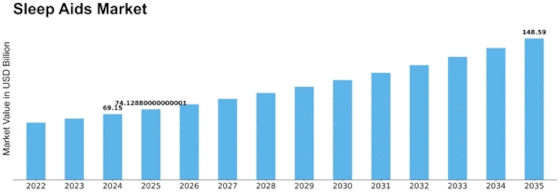
The Sleep Aids Market was valued at 69.15 USD Billion in 2024.

What is the projected market valuation for the Sleep Aids Market in 2035?

The market is projected to reach 148.59 USD Billion by 2035.

What is the expected CAGR for the Sleep Aids Market during the forecast period 2025 - 2035?

The expected CAGR for the Sleep Aids Market during 2025 - 2035 is 7.2%.

Which product segment holds the highest valuation in the Sleep Aids Market?

Medications hold the highest valuation, with a range from 25.0 to 50.0 USD Billion.

How does the valuation of Sleep Apnea Devices compare to other segments?

Sleep Apnea Devices are valued between 15.0 and 30.0 USD Billion, indicating a substantial market presence.

What are the key players in the Sleep Aids Market?

Key players include Pfizer, Johnson & Johnson, Sanofi, and GlaxoSmithKline, among others.

Market Summary

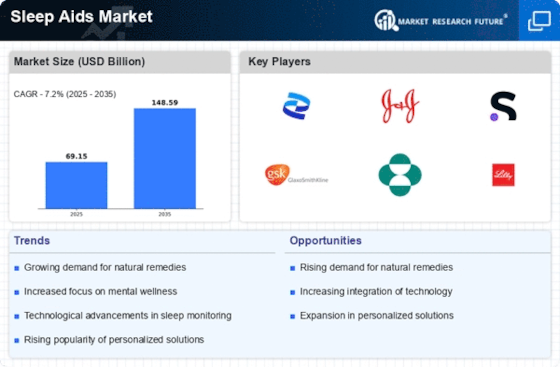
As per MRFR analysis, the Sleep Aids Market Size was estimated at 69.15 USD Billion in 2024. The Sleep Aids industry is projected to grow from 74.13 USD Billion in 2025 to 148.59 USD Billion by 2035, exhibiting a compound annual growth rate (CAGR) of 7.2 during the forecast period 2025 - 2035.

Key Market Trends & Highlights

The Sleep Aids Market is experiencing a transformative shift towards natural solutions and technological integration.

  • The market is witnessing a notable rise in the demand for natural sleep aids, reflecting a broader consumer preference for organic products. North America remains the largest market for sleep aids, while the Asia-Pacific region is emerging as the fastest-growing market. The mattresses and pillows segment continues to dominate the market, whereas sleep apnea devices are rapidly gaining traction. Key drivers of this market include the increasing prevalence of sleep disorders and a growing awareness of sleep hygiene.

Market Size & Forecast

2024 Market Size 69.15 (USD Billion)
2035 Market Size 148.59 (USD Billion)
CAGR (2025 - 2035) 7.2%
Largest Regional Market Share in 2024 North America

Major Players

<p><a href="https://healthanswers.pfizer.com/sleep/remedies/otc-sleep-aids">Pfizer </a>(US), Johnson &amp; Johnson (US), Sanofi (FR), GlaxoSmithKline (GB), <a href="https://www.merck.com/product/usa/pi_circulars/b/belsomra/belsomra_pi.pdf">Merck &amp; Co</a>. (US), Eli Lilly and Company (US), AstraZeneca (GB), Novartis (CH), Sleep Number Corporation (US)</p>

Market Trends

The Sleep Aids Market is currently experiencing a notable transformation, driven by a growing awareness of sleep health and the increasing prevalence of sleep disorders. Consumers are becoming more informed about the importance of quality sleep, leading to a surge in demand for various sleep aid products. This market encompasses a wide range of offerings, including over-the-counter medications, herbal supplements, and innovative technological solutions such as sleep tracking devices and smart mattresses. As individuals seek effective ways to enhance their sleep quality, the market is likely to expand further, reflecting changing consumer preferences and lifestyle choices. Moreover, the Sleep Aids Market is witnessing a shift towards natural and organic products, as many consumers express a preference for solutions that are perceived as safer and more holistic. This trend aligns with a broader movement towards wellness and self-care, where individuals prioritize their health and well-being. Additionally, advancements in technology are facilitating the development of personalized sleep solutions, which may cater to individual needs and preferences. As the market evolves, it appears poised for continued growth, driven by innovation and a deeper understanding of sleep's critical role in overall health and productivity.

Rise of Natural Sleep Aids Market

There is a growing inclination among consumers towards natural sleep aids, such as herbal supplements and essential oils. This trend reflects a broader shift in consumer preferences, as individuals seek alternatives to pharmaceutical options that may have undesirable side effects.

Integration of Technology in Sleep Solutions

The incorporation of technology into sleep aids is becoming increasingly prevalent. Devices such as sleep trackers and smart mattresses are gaining traction, offering users insights into their sleep patterns and helping them optimize their sleep environment.

Focus on Mental Health and Sleep Connection

An increasing awareness of the relationship between mental health and sleep is influencing the Sleep Aids Market. As more individuals recognize the impact of stress and anxiety on sleep quality, there is a rising demand for products that address both sleep issues and mental well-being.

Sleep Aids Market Market Drivers

Aging Population and Sleep Needs

The demographic shift towards an aging population is significantly influencing the Sleep Aids Market. Older adults often face unique sleep challenges, including changes in sleep architecture and increased prevalence of chronic health conditions that disrupt sleep. As the global population aged 65 and above continues to expand, the demand for sleep aids tailored to this demographic is expected to rise. Reports indicate that individuals in this age group are more likely to seek medical advice for sleep issues, thereby driving the market for both prescription and non-prescription sleep aids. This trend suggests that the Sleep Aids Market must adapt to meet the specific needs of older consumers, potentially leading to innovations in product formulations and marketing strategies.

Growing Awareness of Sleep Hygiene

There is a notable increase in public awareness regarding the importance of sleep hygiene, which is positively impacting the Sleep Aids Market. Educational campaigns and health initiatives are emphasizing the role of good sleep practices in overall well-being. As consumers become more informed about the detrimental effects of poor sleep, they are more inclined to invest in sleep aids that promote better sleep hygiene. This shift is reflected in the rising sales of products such as sleep masks, white noise machines, and herbal teas designed to enhance sleep quality. The Sleep Aids Market is likely to benefit from this trend, as consumers actively seek out solutions that align with their newfound understanding of sleep health.

Increasing Prevalence of Sleep Disorders

The rising incidence of sleep disorders, such as insomnia and sleep apnea, is a primary driver of the Sleep Aids Market. According to recent estimates, nearly 30% of adults experience some form of sleep disturbance, which has led to a growing demand for effective sleep solutions. This trend is further exacerbated by lifestyle factors, including increased stress levels and sedentary habits. As awareness of sleep health continues to grow, consumers are actively seeking remedies that can enhance their sleep quality. Consequently, the Sleep Aids Market is witnessing a surge in product offerings, ranging from over-the-counter medications to herbal supplements, catering to diverse consumer needs. This increasing prevalence of sleep disorders is likely to sustain market growth in the foreseeable future.

Rising Demand for Natural and Organic Products

The increasing consumer preference for natural and organic products is a significant driver of the Sleep Aids Market. As individuals become more health-conscious, there is a growing inclination towards sleep aids that are perceived as safe and free from synthetic ingredients. This trend is evident in the rising popularity of herbal supplements, essential oils, and other natural remedies that promote relaxation and sleep. Market data suggests that sales of natural sleep aids have seen a substantial increase, reflecting a shift in consumer behavior. The Sleep Aids Market must continue to adapt to this demand for natural solutions, potentially leading to the development of innovative products that align with consumer values.

Technological Advancements in Sleep Monitoring

Technological innovations in sleep monitoring devices are reshaping the Sleep Aids Market. Wearable technology, such as smartwatches and fitness trackers, now includes features that monitor sleep patterns and provide insights into sleep quality. This data-driven approach empowers consumers to make informed decisions about their sleep habits and the products they choose to use. As these technologies become more sophisticated, they are likely to drive demand for complementary sleep aids that enhance the overall sleep experience. The integration of technology into sleep solutions not only appeals to tech-savvy consumers but also fosters a more personalized approach to sleep health, potentially expanding the market further.

Market Segment Insights

By Product: Mattresses & Pillows (Largest) vs. Sleep Apnea Devices (Fastest-Growing)

<p>In the Sleep Aids Market, there is a clear distribution of market share among the various product segments. Mattresses and pillows represent the largest portion of the market due to their fundamental role in promoting sleep quality. This segment has established itself as essential for sleep hygiene, comprising a significant share as consumers increasingly prioritize comfort and ergonomics in their choices. Conversely, sleep apnea devices are gaining ground rapidly, driven by rising awareness of sleep disorders and their health implications, making them the fastest-growing segment in the market.</p>

<p>Mattresses &amp; Pillows (Dominant) vs. Sleep Apnea Devices (Emerging)</p>

<p>Mattresses and pillows have long been regarded as the dominant segment in the Sleep Aids Market, as they address the foundational need for comfort in sleep. Consumers are increasingly choosing advanced materials and designs, such as memory foam and latex, which offer enhanced support and pressure relief. On the other hand, sleep apnea devices are an emerging segment, propelled by a growing demographic of individuals diagnosed with sleep apnea and a heightened focus on overall health. These devices, which include <a href="https://www.marketresearchfuture.com/reports/continuous-positive-airway-pressure-devices-market-939">CPAP machines</a> and oral appliances, are seeing innovation in terms of comfort and usability, catering to a broader audience and encouraging their adoption.</p>

By Sleep Disorder: Insomnia (Largest) vs. Sleep Apnea (Fastest-Growing)

<p>In the Sleep Aids Market, insomnia accounts for the largest share, driven by its prevalence in today&rsquo;s fast-paced lifestyle. It is estimated that a significant portion of the adult population experiences insomnia, leading to an increasing demand for therapies and sleep aids. On the other hand, sleep apnea is emerging as the fastest-growing segment due to rising awareness about the disorder and the health risks associated with untreated conditions. The increased diagnosis rates greatly contribute to the expansion of treatment options in this segment.</p>

<p>Insomnia (Dominant) vs. Sleep Apnea (Emerging)</p>

<p>Insomnia remains the dominant player in the Sleep Aids Market, characterized by its diverse treatment landscape that includes medications, behavioral therapies, and lifestyle modifications. This segment caters to individuals facing difficulties in falling or staying asleep, making it crucial for providers to offer comprehensive solutions. Conversely, sleep apnea is categorized as an emerging segment, fueled by advances in diagnostic tools and treatment innovations such as CPAP devices. Increasing awareness regarding the disorder's impact on overall health, paired with a growing aging population, positions sleep apnea as a critical focus area for market expansion.</p>

Get more detailed insights about Sleep Aids Market Research Report—Global Forecast till 2035

Regional Insights

North America : Market Leader in Sleep Aids Market

North America is the largest market for sleep aids, accounting for approximately 40% of the global market share. The region's growth is driven by increasing awareness of sleep disorders, rising healthcare expenditures, and a growing aging population. Regulatory support for innovative sleep solutions and the rise of telehealth services are also significant catalysts for market expansion. The United States leads the North American market, with key players like Pfizer, Johnson & Johnson, and Merck & Co. dominating the landscape. The competitive environment is characterized by a mix of pharmaceutical companies and emerging startups focusing on natural and over-the-counter sleep aids. The presence of established brands and ongoing research into sleep disorders further solidifies North America's position in the global market.

Europe : Emerging Market for Sleep Solutions

Europe is witnessing a growing demand for sleep aids, holding approximately 30% of the global market share. Factors such as increasing stress levels, lifestyle changes, and a heightened focus on mental health are driving this growth. Regulatory frameworks in countries like Germany and France are becoming more supportive of innovative sleep solutions, enhancing market accessibility. Leading countries in Europe include Germany, France, and the UK, where major players like Sanofi and GlaxoSmithKline are actively involved. The competitive landscape is evolving, with a mix of traditional pharmaceutical companies and new entrants focusing on holistic and natural sleep aids. The region's emphasis on research and development is expected to further boost market growth.

Asia-Pacific : Rapidly Growing Sleep Market

Asia-Pacific is rapidly emerging as a significant player in the sleep aids market, accounting for about 20% of the global share. The region's growth is fueled by increasing urbanization, rising disposable incomes, and a growing awareness of sleep health. Countries like China and India are witnessing a surge in demand for both prescription and over-the-counter sleep aids, supported by favorable regulatory environments. China and Japan are leading the market in this region, with key players like Eli Lilly and AstraZeneca making substantial investments. The competitive landscape is characterized by a mix of established pharmaceutical companies and local startups focusing on innovative sleep solutions. The increasing prevalence of sleep disorders is prompting more research and development in this sector, further driving market growth.

Middle East and Africa : Untapped Potential in Sleep Aids Market

The Middle East and Africa represent an untapped market for sleep aids, holding approximately 10% of the global market share. The region's growth is driven by increasing awareness of sleep disorders, rising healthcare investments, and a growing middle class. Regulatory bodies are beginning to recognize the importance of sleep health, which is expected to catalyze market development. Leading countries in this region include South Africa and the UAE, where the presence of key players is gradually increasing. The competitive landscape is still developing, with opportunities for both international and local companies to introduce innovative sleep solutions. The region's unique cultural factors and lifestyle changes are also influencing the demand for sleep aids, creating a dynamic market environment.

Key Players and Competitive Insights

The Sleep Aids Market is currently characterized by a dynamic competitive landscape, driven by increasing consumer awareness regarding sleep health and the rising prevalence of sleep disorders. Major players such as Pfizer (US), Johnson & Johnson (US), and Sanofi (FR) are strategically positioned to leverage their extensive research and development capabilities to innovate and expand their product offerings. Pfizer (US) has focused on enhancing its portfolio through strategic partnerships, while Johnson & Johnson (US) emphasizes digital health solutions to engage consumers more effectively. Sanofi (FR) appears to be concentrating on regional expansion, particularly in emerging markets, which could potentially reshape the competitive environment by increasing accessibility to sleep aids.

In terms of business tactics, companies are increasingly localizing manufacturing to reduce costs and optimize supply chains. The Sleep Aids Market is moderately fragmented, with a mix of established pharmaceutical giants and emerging players. This fragmentation allows for diverse product offerings, yet the collective influence of key players like Merck & Co. (US) and GlaxoSmithKline (GB) remains significant, as they continue to dominate market share through innovative product development and strategic marketing initiatives.

In August 2025, Merck & Co. (US) announced the launch of a new sleep aid product that incorporates a novel formulation aimed at reducing side effects commonly associated with traditional sleep medications. This strategic move not only enhances Merck's product portfolio but also positions the company as a leader in addressing consumer concerns about safety and efficacy in sleep aids. The introduction of this product could potentially capture a larger market share by appealing to health-conscious consumers.

In September 2025, GlaxoSmithKline (GB) revealed a partnership with a technology firm to develop a digital platform that integrates sleep tracking with personalized sleep aid recommendations. This initiative reflects a growing trend towards digital health solutions, suggesting that GlaxoSmithKline is keen on leveraging technology to enhance consumer engagement and improve treatment outcomes. Such a strategy may not only differentiate GlaxoSmithKline in a crowded market but also align with the increasing consumer demand for personalized healthcare solutions.

In October 2025, Johnson & Johnson (US) launched a comprehensive marketing campaign aimed at promoting its sleep aid products through various digital channels. This campaign underscores the company's commitment to digital transformation and consumer education, which could enhance brand loyalty and drive sales. By focusing on digital outreach, Johnson & Johnson is likely to strengthen its market position amidst evolving consumer preferences.

As of October 2025, the Sleep Aids Market is witnessing trends such as digitalization, sustainability, and the integration of artificial intelligence in product development. Strategic alliances are increasingly shaping the competitive landscape, enabling companies to pool resources and expertise. Looking ahead, competitive differentiation is expected to evolve from traditional price-based competition towards innovation, technology integration, and supply chain reliability, as companies strive to meet the growing demand for effective and safe sleep solutions.

Key Companies in the Sleep Aids Market market include

Industry Developments

  • Q2 2024: Idorsia launches QUVIVIQ® (daridorexant) in the United Kingdom for the treatment of adult patients with insomnia Idorsia announced the commercial launch of QUVIVIQ® (daridorexant), a dual orexin receptor antagonist, in the UK for adults suffering from insomnia, following regulatory approval.
  • Q2 2024: Hims & Hers Launches Sleep Gummy to Expand Wellness Portfolio Hims & Hers Health, Inc. announced the launch of a new sleep gummy supplement, expanding its consumer wellness product line to address sleep health.
  • Q2 2024: Vanda Pharmaceuticals Announces FDA Approval of HETLIOZ® (tasimelteon) for the Treatment of Insomnia Vanda Pharmaceuticals received FDA approval for HETLIOZ® (tasimelteon) as a treatment for insomnia, expanding its indications beyond non-24-hour sleep-wake disorder.
  • Q3 2024: Philips Launches Next Generation SmartSleep Deep Sleep Headband 2.0 Philips introduced the SmartSleep Deep Sleep Headband 2.0, a wearable device designed to improve deep sleep quality through real-time audio tones.
  • Q3 2024: ResMed acquires Somnoware to expand sleep management platform ResMed completed the acquisition of Somnoware, a cloud-based sleep and respiratory care management platform, to enhance its digital health offerings in sleep care.
  • Q3 2024: Sleep Number Announces Opening of New Sleep Innovation and Research Center Sleep Number opened a new Sleep Innovation and Research Center focused on developing advanced sleep technologies and conducting clinical research.
  • Q4 2024: Ebb Therapeutics Receives FDA Clearance for Next-Generation Sleep Device Ebb Therapeutics received FDA clearance for its next-generation wearable device designed to reduce sleeplessness by cooling the forehead.
  • Q4 2024: Sleep tech startup Eight Sleep raises $60 million in Series C funding Eight Sleep, a company specializing in smart mattresses and sleep optimization technology, raised $60 million in Series C funding to accelerate product development and global expansion.
  • Q1 2025: ZzzQuil Launches New Melatonin-Infused Sleep Aid Gummies ZzzQuil, a leading OTC sleep aid brand, launched a new line of melatonin-infused gummies aimed at consumers seeking non-prescription sleep solutions.
  • Q1 2025: CVS Health Introduces Private Label Sleep Aid Products CVS Health announced the launch of a new line of private label sleep aid products, including supplements and over-the-counter medications, to expand its health and wellness offerings.
  • Q2 2025: Jazz Pharmaceuticals appoints new Chief Commercial Officer to lead sleep medicine portfolio Jazz Pharmaceuticals appointed a new Chief Commercial Officer to oversee the company’s sleep medicine business, including its portfolio of narcolepsy and insomnia treatments.
  • Q2 2025: Oura partners with Headspace to integrate sleep and mindfulness features Oura, maker of the Oura Ring sleep tracker, announced a partnership with Headspace to integrate guided mindfulness and sleep content into its wearable platform.
  • Global demand is rising as awareness of sleep disorders grows and wearable sleep-tracking adoption feeds consumer interest in solutions beyond prescription drugs. Analysts report the market expanding rapidly from the mid-2020s with double-digit segments in OTC supplements, digital sleep tools, and device-enabled therapeutics gaining share. Watch: smart wearable sleep features and regulatory scrutiny of dosing/claims for new OTC products.

Future Outlook

Sleep Aids Market Future Outlook

<p>The Sleep Aids Market is projected to grow at a 7.2% CAGR from 2024 to 2035, driven by increasing sleep disorders, technological advancements, and rising consumer awareness.</p>

New opportunities lie in:

  • <p>Development of personalized sleep aid solutions using AI technology.</p>
  • <p>Expansion of subscription-based delivery services for sleep products.</p>
  • <p>Partnerships with healthcare providers for integrated sleep health programs.</p>

<p>By 2035, the Sleep Aids Market is expected to be robust, reflecting substantial growth and innovation.</p>

Market Segmentation

Sleep Aids Market Product Outlook

  • Mattresses & Pillows
  • Medications
  • Sleep Apnea Devices
  • Others

Sleep Aids Market Sleep Disorder Outlook

  • Insomnia
  • Sleep Apnea
  • Restless Legs Syndrome
  • Narcolepsy
  • Sleep Walking
  • Other Sleep Disorders

Report Scope

MARKET SIZE 2024 69.15(USD Billion)
MARKET SIZE 2025 74.13(USD Billion)
MARKET SIZE 2035 148.59(USD Billion)
COMPOUND ANNUAL GROWTH RATE (CAGR) 7.2% (2024 - 2035)
REPORT COVERAGE Revenue Forecast, Competitive Landscape, Growth Factors, and Trends
BASE YEAR 2024
Market Forecast Period 2025 - 2035
Historical Data 2019 - 2024
Market Forecast Units USD Billion
Key Companies Profiled Market analysis in progress
Segments Covered Market segmentation analysis in progress
Key Market Opportunities Integration of digital therapeutics and personalized solutions in the Sleep Aids Market.
Key Market Dynamics Rising consumer awareness of sleep health drives demand for innovative sleep aid solutions and personalized therapies.
Countries Covered North America, Europe, APAC, South America, MEA

FAQs

What is the current valuation of the Sleep Aids Market as of 2024?

The Sleep Aids Market was valued at 69.15 USD Billion in 2024.

What is the projected market valuation for the Sleep Aids Market in 2035?

The market is projected to reach 148.59 USD Billion by 2035.

What is the expected CAGR for the Sleep Aids Market during the forecast period 2025 - 2035?

The expected CAGR for the Sleep Aids Market during 2025 - 2035 is 7.2%.

Which product segment holds the highest valuation in the Sleep Aids Market?

Medications hold the highest valuation, with a range from 25.0 to 50.0 USD Billion.

How does the valuation of Sleep Apnea Devices compare to other segments?

Sleep Apnea Devices are valued between 15.0 and 30.0 USD Billion, indicating a substantial market presence.

What are the key players in the Sleep Aids Market?

Key players include Pfizer, Johnson &amp; Johnson, Sanofi, and GlaxoSmithKline, among others.

  1. SECTION I: EXECUTIVE SUMMARY AND KEY HIGHLIGHTS
    1. EXECUTIVE SUMMARY
      1. Market Overview
      2. Key Findings
      3. Market Segmentation
      4. Competitive Landscape
      5. Challenges and Opportunities
      6. Future Outlook 2
  2. SECTION II: SCOPING, METHODOLOGY AND MARKET STRUCTURE
    1. MARKET INTRODUCTION
      1. Definition
      2. Scope of the study
    2. RESEARCH METHODOLOGY
      1. Overview
      2. Data Mining
      3. Secondary Research
      4. Primary Research
      5. Forecasting Model
      6. Market Size Estimation
      7. Data Triangulation
      8. Validation 3
  3. SECTION III: QUALITATIVE ANALYSIS
    1. MARKET DYNAMICS
      1. Overview
      2. Drivers
      3. Restraints
      4. Opportunities
    2. MARKET FACTOR ANALYSIS
      1. Value chain Analysis
      2. Porter's Five Forces Analysis
      3. COVID-19 Impact Analysis
  4. SECTION IV: QUANTITATIVE ANALYSIS
    1. Healthcare, BY Product (USD Billion)
      1. Mattresses & Pillows
      2. Medications
      3. Sleep Apnea Devices
      4. Others
    2. Healthcare, BY Sleep Disorder (USD Billion)
      1. Insomnia
      2. Sleep Apnea
      3. Restless Legs Syndrome
      4. Narcolepsy
      5. Sleep Walking
      6. Other Sleep Disorders
    3. Healthcare, BY Region (USD Billion)
      1. North America
      2. Europe
      3. APAC
      4. South America
      5. MEA
  5. SECTION V: COMPETITIVE ANALYSIS
    1. Competitive Landscape
      1. Overview
      2. Competitive Analysis
      3. Market share Analysis
      4. Major Growth Strategy in the Healthcare
      5. Competitive Benchmarking
      6. Leading Players in Terms of Number of Developments in the Healthcare
      7. Key developments and growth strategies
      8. Major Players Financial Matrix
    2. Company Profiles
      1. Pfizer (US)
      2. Johnson & Johnson (US)
      3. Sanofi (FR)
      4. GlaxoSmithKline (GB)
      5. Merck & Co. (US)
      6. Eli Lilly and Company (US)
      7. AstraZeneca (GB)
      8. Novartis (CH)
      9. Sleep Number Corporation (US)
    3. Appendix
      1. References
      2. Related Reports 6 LIST OF FIGURES
    4. MARKET SYNOPSIS
    5. NORTH AMERICA MARKET ANALYSIS
    6. US MARKET ANALYSIS BY PRODUCT
    7. US MARKET ANALYSIS BY SLEEP DISORDER
    8. CANADA MARKET ANALYSIS BY PRODUCT
    9. CANADA MARKET ANALYSIS BY SLEEP DISORDER
    10. EUROPE MARKET ANALYSIS
    11. GERMANY MARKET ANALYSIS BY PRODUCT
    12. GERMANY MARKET ANALYSIS BY SLEEP DISORDER
    13. UK MARKET ANALYSIS BY PRODUCT
    14. UK MARKET ANALYSIS BY SLEEP DISORDER
    15. FRANCE MARKET ANALYSIS BY PRODUCT
    16. FRANCE MARKET ANALYSIS BY SLEEP DISORDER
    17. RUSSIA MARKET ANALYSIS BY PRODUCT
    18. RUSSIA MARKET ANALYSIS BY SLEEP DISORDER
    19. ITALY MARKET ANALYSIS BY PRODUCT
    20. ITALY MARKET ANALYSIS BY SLEEP DISORDER
    21. SPAIN MARKET ANALYSIS BY PRODUCT
    22. SPAIN MARKET ANALYSIS BY SLEEP DISORDER
    23. REST OF EUROPE MARKET ANALYSIS BY PRODUCT
    24. REST OF EUROPE MARKET ANALYSIS BY SLEEP DISORDER
    25. APAC MARKET ANALYSIS
    26. CHINA MARKET ANALYSIS BY PRODUCT
    27. CHINA MARKET ANALYSIS BY SLEEP DISORDER
    28. INDIA MARKET ANALYSIS BY PRODUCT
    29. INDIA MARKET ANALYSIS BY SLEEP DISORDER
    30. JAPAN MARKET ANALYSIS BY PRODUCT
    31. JAPAN MARKET ANALYSIS BY SLEEP DISORDER
    32. SOUTH KOREA MARKET ANALYSIS BY PRODUCT
    33. SOUTH KOREA MARKET ANALYSIS BY SLEEP DISORDER
    34. MALAYSIA MARKET ANALYSIS BY PRODUCT
    35. MALAYSIA MARKET ANALYSIS BY SLEEP DISORDER
    36. THAILAND MARKET ANALYSIS BY PRODUCT
    37. THAILAND MARKET ANALYSIS BY SLEEP DISORDER
    38. INDONESIA MARKET ANALYSIS BY PRODUCT
    39. INDONESIA MARKET ANALYSIS BY SLEEP DISORDER
    40. REST OF APAC MARKET ANALYSIS BY PRODUCT
    41. REST OF APAC MARKET ANALYSIS BY SLEEP DISORDER
    42. SOUTH AMERICA MARKET ANALYSIS
    43. BRAZIL MARKET ANALYSIS BY PRODUCT
    44. BRAZIL MARKET ANALYSIS BY SLEEP DISORDER
    45. MEXICO MARKET ANALYSIS BY PRODUCT
    46. MEXICO MARKET ANALYSIS BY SLEEP DISORDER
    47. ARGENTINA MARKET ANALYSIS BY PRODUCT
    48. ARGENTINA MARKET ANALYSIS BY SLEEP DISORDER
    49. REST OF SOUTH AMERICA MARKET ANALYSIS BY PRODUCT
    50. REST OF SOUTH AMERICA MARKET ANALYSIS BY SLEEP DISORDER
    51. MEA MARKET ANALYSIS
    52. GCC COUNTRIES MARKET ANALYSIS BY PRODUCT
    53. GCC COUNTRIES MARKET ANALYSIS BY SLEEP DISORDER
    54. SOUTH AFRICA MARKET ANALYSIS BY PRODUCT
    55. SOUTH AFRICA MARKET ANALYSIS BY SLEEP DISORDER
    56. REST OF MEA MARKET ANALYSIS BY PRODUCT
    57. REST OF MEA MARKET ANALYSIS BY SLEEP DISORDER
    58. KEY BUYING CRITERIA OF HEALTHCARE
    59. RESEARCH PROCESS OF MRFR
    60. DRO ANALYSIS OF HEALTHCARE
    61. DRIVERS IMPACT ANALYSIS: HEALTHCARE
    62. RESTRAINTS IMPACT ANALYSIS: HEALTHCARE
    63. SUPPLY / VALUE CHAIN: HEALTHCARE
    64. HEALTHCARE, BY PRODUCT, 2024 (% SHARE)
    65. HEALTHCARE, BY PRODUCT, 2024 TO 2035 (USD Billion)
    66. HEALTHCARE, BY SLEEP DISORDER, 2024 (% SHARE)
    67. HEALTHCARE, BY SLEEP DISORDER, 2024 TO 2035 (USD Billion)
    68. BENCHMARKING OF MAJOR COMPETITORS 7 LIST OF TABLES
    69. LIST OF ASSUMPTIONS
    70. North America MARKET SIZE ESTIMATES; FORECAST
      1. BY PRODUCT, 2025-2035 (USD Billion)
      2. BY SLEEP DISORDER, 2025-2035 (USD Billion)
    71. US MARKET SIZE ESTIMATES; FORECAST
      1. BY PRODUCT, 2025-2035 (USD Billion)
      2. BY SLEEP DISORDER, 2025-2035 (USD Billion)
    72. Canada MARKET SIZE ESTIMATES; FORECAST
      1. BY PRODUCT, 2025-2035 (USD Billion)
      2. BY SLEEP DISORDER, 2025-2035 (USD Billion)
    73. Europe MARKET SIZE ESTIMATES; FORECAST
      1. BY PRODUCT, 2025-2035 (USD Billion)
      2. BY SLEEP DISORDER, 2025-2035 (USD Billion)
    74. Germany MARKET SIZE ESTIMATES; FORECAST
      1. BY PRODUCT, 2025-2035 (USD Billion)
      2. BY SLEEP DISORDER, 2025-2035 (USD Billion)
    75. UK MARKET SIZE ESTIMATES; FORECAST
      1. BY PRODUCT, 2025-2035 (USD Billion)
      2. BY SLEEP DISORDER, 2025-2035 (USD Billion)
    76. France MARKET SIZE ESTIMATES; FORECAST
      1. BY PRODUCT, 2025-2035 (USD Billion)
      2. BY SLEEP DISORDER, 2025-2035 (USD Billion)
    77. Russia MARKET SIZE ESTIMATES; FORECAST
      1. BY PRODUCT, 2025-2035 (USD Billion)
      2. BY SLEEP DISORDER, 2025-2035 (USD Billion)
    78. Italy MARKET SIZE ESTIMATES; FORECAST
      1. BY PRODUCT, 2025-2035 (USD Billion)
      2. BY SLEEP DISORDER, 2025-2035 (USD Billion)
    79. Spain MARKET SIZE ESTIMATES; FORECAST
      1. BY PRODUCT, 2025-2035 (USD Billion)
      2. BY SLEEP DISORDER, 2025-2035 (USD Billion)
    80. Rest of Europe MARKET SIZE ESTIMATES; FORECAST
      1. BY PRODUCT, 2025-2035 (USD Billion)
      2. BY SLEEP DISORDER, 2025-2035 (USD Billion)
    81. APAC MARKET SIZE ESTIMATES; FORECAST
      1. BY PRODUCT, 2025-2035 (USD Billion)
      2. BY SLEEP DISORDER, 2025-2035 (USD Billion)
    82. China MARKET SIZE ESTIMATES; FORECAST
      1. BY PRODUCT, 2025-2035 (USD Billion)
      2. BY SLEEP DISORDER, 2025-2035 (USD Billion)
    83. India MARKET SIZE ESTIMATES; FORECAST
      1. BY PRODUCT, 2025-2035 (USD Billion)
      2. BY SLEEP DISORDER, 2025-2035 (USD Billion)
    84. Japan MARKET SIZE ESTIMATES; FORECAST
      1. BY PRODUCT, 2025-2035 (USD Billion)
      2. BY SLEEP DISORDER, 2025-2035 (USD Billion)
    85. South Korea MARKET SIZE ESTIMATES; FORECAST
      1. BY PRODUCT, 2025-2035 (USD Billion)
      2. BY SLEEP DISORDER, 2025-2035 (USD Billion)
    86. Malaysia MARKET SIZE ESTIMATES; FORECAST
      1. BY PRODUCT, 2025-2035 (USD Billion)
      2. BY SLEEP DISORDER, 2025-2035 (USD Billion)
    87. Thailand MARKET SIZE ESTIMATES; FORECAST
      1. BY PRODUCT, 2025-2035 (USD Billion)
      2. BY SLEEP DISORDER, 2025-2035 (USD Billion)
    88. Indonesia MARKET SIZE ESTIMATES; FORECAST
      1. BY PRODUCT, 2025-2035 (USD Billion)
      2. BY SLEEP DISORDER, 2025-2035 (USD Billion)
    89. Rest of APAC MARKET SIZE ESTIMATES; FORECAST
      1. BY PRODUCT, 2025-2035 (USD Billion)
      2. BY SLEEP DISORDER, 2025-2035 (USD Billion)
    90. South America MARKET SIZE ESTIMATES; FORECAST
      1. BY PRODUCT, 2025-2035 (USD Billion)
      2. BY SLEEP DISORDER, 2025-2035 (USD Billion)
    91. Brazil MARKET SIZE ESTIMATES; FORECAST
      1. BY PRODUCT, 2025-2035 (USD Billion)
      2. BY SLEEP DISORDER, 2025-2035 (USD Billion)
    92. Mexico MARKET SIZE ESTIMATES; FORECAST
      1. BY PRODUCT, 2025-2035 (USD Billion)
      2. BY SLEEP DISORDER, 2025-2035 (USD Billion)
    93. Argentina MARKET SIZE ESTIMATES; FORECAST
      1. BY PRODUCT, 2025-2035 (USD Billion)
      2. BY SLEEP DISORDER, 2025-2035 (USD Billion)
    94. Rest of South America MARKET SIZE ESTIMATES; FORECAST
      1. BY PRODUCT, 2025-2035 (USD Billion)
      2. BY SLEEP DISORDER, 2025-2035 (USD Billion)
    95. MEA MARKET SIZE ESTIMATES; FORECAST
      1. BY PRODUCT, 2025-2035 (USD Billion)
      2. BY SLEEP DISORDER, 2025-2035 (USD Billion)
    96. GCC Countries MARKET SIZE ESTIMATES; FORECAST
      1. BY PRODUCT, 2025-2035 (USD Billion)
      2. BY SLEEP DISORDER, 2025-2035 (USD Billion)
    97. South Africa MARKET SIZE ESTIMATES; FORECAST
      1. BY PRODUCT, 2025-2035 (USD Billion)
      2. BY SLEEP DISORDER, 2025-2035 (USD Billion)
    98. Rest of MEA MARKET SIZE ESTIMATES; FORECAST
      1. BY PRODUCT, 2025-2035 (USD Billion)
      2. BY SLEEP DISORDER, 2025-2035 (USD Billion)
    99. PRODUCT LAUNCH/PRODUCT DEVELOPMENT/APPROVAL
    100. ACQUISITION/PARTNERSHIP

Sleep Aids Market Segmentation

Sleep Aids Product Outlook (USD Billion, 2018-2032)

Mattresses & Pillows

Medications

Sleep Apnea Devices

Others

Sleep Aids Sleep-Disorder Outlook (USD Billion, 2018-2032)

Insomnia

Sleep Apnea

Restless Legs Syndrome

Narcolepsy

Sleep Walking

Other Sleep Disorders

Sleep Aids Regional Outlook (USD Billion, 2018-2032)

North America Outlook (USD Billion, 2018-2032)

Sleep Aids by Product

Mattresses & Pillows

Medications

Sleep Apnea Devices

Others

Sleep Aids by Sleep-Disorder

Insomnia

Sleep Apnea

Restless Legs Syndrome

Narcolepsy

Sleep Walking

Other Sleep Disorders

US Outlook (USD Billion, 2018-2032)

Sleep Aids by Product

Mattresses & Pillows

Medications

Sleep Apnea Devices

Others

Sleep Aids by Sleep-Disorder

Insomnia

Sleep Apnea

Restless Legs Syndrome

Narcolepsy

Sleep Walking

Other Sleep Disorders

Canada Outlook (USD Billion, 2018-2032)

Sleep Aids by Product

Mattresses & Pillows

Medications

Sleep Apnea Devices

Others

Sleep Aids by Sleep-Disorder

Insomnia

Sleep Apnea

Restless Legs Syndrome

Narcolepsy

Sleep Walking

Other Sleep Disorders

Europe Outlook (USD Billion, 2018-2032)

Sleep Aids by Product

Mattresses & Pillows

Medications

Sleep Apnea Devices

Others

Sleep Aids by Sleep-Disorder

Insomnia

Sleep Apnea

Restless Legs Syndrome

Narcolepsy

Sleep Walking

Other Sleep Disorders

Germany Outlook (USD Billion, 2018-2032)

Sleep Aids by Product

Mattresses & Pillows

Medications

Sleep Apnea Devices

Others

Sleep Aids by Sleep-Disorder

Insomnia

Sleep Apnea

Restless Legs Syndrome

Narcolepsy

Sleep Walking

Other Sleep Disorders

France Outlook (USD Billion, 2018-2032)

Sleep Aids by Product

Mattresses & Pillows

Medications

Sleep Apnea Devices

Others

Sleep Aids by Sleep-Disorder

Insomnia

Sleep Apnea

Restless Legs Syndrome

Narcolepsy

Sleep Walking

Other Sleep Disorders

UK Outlook (USD Billion, 2018-2032)

Sleep Aids by Product

Mattresses & Pillows

Medications

Sleep Apnea Devices

Others

Sleep Aids by Sleep-Disorder

Insomnia

Sleep Apnea

Restless Legs Syndrome

Narcolepsy

Sleep Walking

Other Sleep Disorders

Italy Outlook (USD Billion, 2018-2032)

Sleep Aids by Product

Mattresses & Pillows

Medications

Sleep Apnea Devices

Others

Sleep Aids by Sleep-Disorder

Insomnia

Sleep Apnea

Restless Legs Syndrome

Narcolepsy

Sleep Walking

Other Sleep Disorders

Spain Outlook (USD Billion, 2018-2032)

Sleep Aids by Product

Mattresses & Pillows

Medications

Sleep Apnea Devices

Others

Sleep Aids by Sleep-Disorder

Insomnia

Sleep Apnea

Restless Legs Syndrome

Narcolepsy

Sleep Walking

Other Sleep Disorders

Rest Of Europe Outlook (USD Billion, 2018-2032)

Sleep Aids by Product

Mattresses & Pillows

Medications

Sleep Apnea Devices

Others

Sleep Aids by Sleep-Disorder

Insomnia

Sleep Apnea

Restless Legs Syndrome

Narcolepsy

Sleep Walking

Other Sleep Disorders

Asia-Pacific Outlook (USD Billion, 2018-2032)

Sleep Aids by Product

Mattresses & Pillows

Medications

Sleep Apnea Devices

Others

Sleep Aids by Sleep-Disorder

Insomnia

Sleep Apnea

Restless Legs Syndrome

Narcolepsy

Sleep Walking

Other Sleep Disorders

China Outlook (USD Billion, 2018-2032)

Sleep Aids by Product

Mattresses & Pillows

Medications

Sleep Apnea Devices

Others

Sleep Aids by Sleep-Disorder

Insomnia

Sleep Apnea

Restless Legs Syndrome

Narcolepsy

Sleep Walking

Other Sleep Disorders

Japan Outlook (USD Billion, 2018-2032)

Sleep Aids by Product

Mattresses & Pillows

Medications

Sleep Apnea Devices

Others

Sleep Aids by Sleep-Disorder

Insomnia

Sleep Apnea

Restless Legs Syndrome

Narcolepsy

Sleep Walking

Other Sleep Disorders

India Outlook (USD Billion, 2018-2032)

Sleep Aids by Product

Mattresses & Pillows

Medications

Sleep Apnea Devices

Others

Sleep Aids by Sleep-Disorder

Insomnia

Sleep Apnea

Restless Legs Syndrome

Narcolepsy

Sleep Walking

Other Sleep Disorders

Australia Outlook (USD Billion, 2018-2032)

Sleep Aids by Product

Mattresses & Pillows

Medications

Sleep Apnea Devices

Others

Sleep Aids by Sleep-Disorder

Insomnia

Sleep Apnea

Restless Legs Syndrome

Narcolepsy

Sleep Walking

Other Sleep Disorders

Rest of Asia-Pacific Outlook (USD Billion, 2018-2032)

Sleep Aids by Product

Mattresses & Pillows

Medications

Sleep Apnea Devices

Others

Sleep Aids by Sleep-Disorder

Insomnia

Sleep Apnea

Restless Legs Syndrome

Narcolepsy

Sleep Walking

Other Sleep Disorders

Rest of the World Outlook (USD Billion, 2018-2032)

Sleep Aids by Product

Mattresses & Pillows

Medications

Sleep Apnea Devices

Others

Sleep Aids by Sleep-Disorder

Insomnia

Sleep Apnea

Restless Legs Syndrome

Narcolepsy

Sleep Walking

Other Sleep Disorders

Middle East Outlook (USD Billion, 2018-2032)

Sleep Aids by Product

Mattresses & Pillows

Medications

Sleep Apnea Devices

Others

Sleep Aids by Sleep-Disorder

Insomnia

Sleep Apnea

Restless Legs Syndrome

Narcolepsy

Sleep Walking

Other Sleep Disorders

Africa Outlook (USD Billion, 2018-2032)

Sleep Aids by Product

Mattresses & Pillows

Medications

Sleep Apnea Devices

Others

Sleep Aids by Sleep-Disorder

Insomnia

Sleep Apnea

Restless Legs Syndrome

Narcolepsy

Sleep Walking

Other Sleep Disorders

Latin America Outlook (USD Billion, 2018-2032)

Sleep Aids by Product

Mattresses & Pillows

Medications

Sleep Apnea Devices

Others

Sleep Aids by Sleep-Disorder

Insomnia

Sleep Apnea

Restless Legs Syndrome

Narcolepsy

Sleep Walking

Other Sleep Disorders

Infographic

Free Sample Request

Kindly complete the form below to receive a free sample of this Report

Get Free Sample

Customer Strories

Compare Licence

×
Features License Type
Single User Multiuser License Enterprise User
Price $4,950 $5,950 $7,250
Maximum User Access Limit 1 User Upto 10 Users Unrestricted Access Throughout the Organization
Free Customization
Direct Access to Analyst
Deliverable Format
Platform Access
Discount on Next Purchase 10% 15% 15%
Printable Versions