Sleep Aids Market (2026 - 2035)

ID: MRFR/HC/10218-HCR
128 Pages
Vikita Thakur
Last Updated: July 02, 2026
Sleep Aids Market Research Report: Size, Share, Trend Analysis By Product (Mattresses & Pillows, Medications, Sleep Apnea Devices, and Others), By Sleep-Disorder (Insomnia, Sleep Apnea, Restless Legs Syndrome, Narcolepsy, Sleep Walking, and Other Sleep Disorders), and By Region (North America, Europe, Asia-Pacific, and Rest Of The World) – Competitor Industry Analysis and Trends Forecast Till 2035
Sleep Aids Market
Market Size
Forecast Period2026-2035
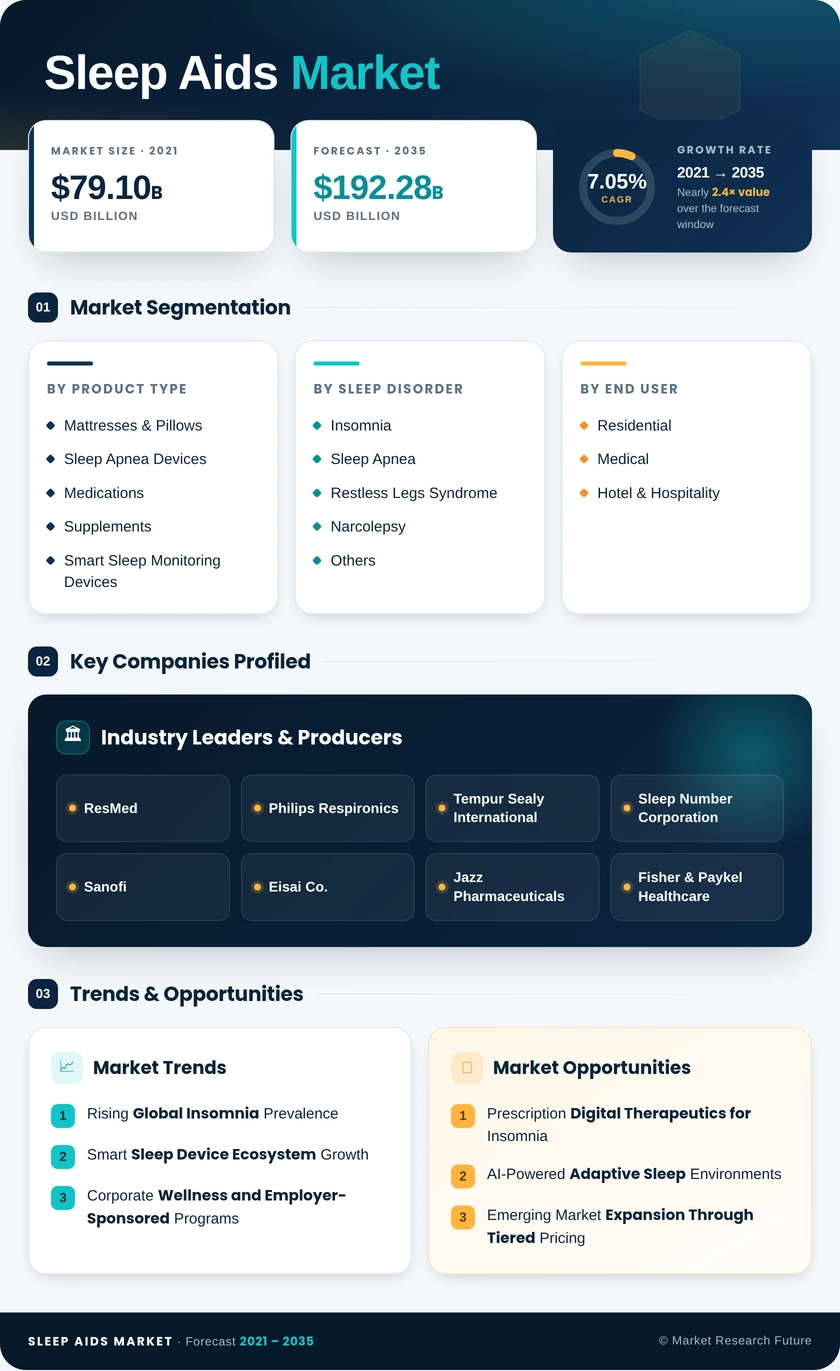
CAGR (2026-2035)7.05%
2025 Market SizeUSD 97.30 Billion
2035 Market SizeUSD 192.28 Billion
Key Players
ResMed
Philips Respironics
Tempur Sealy International
Sleep Number Corporation
Sanofi
Eisai Co.
Opportunities
  • Prescription Digital Therapeutics for Insomnia
  • AI-Powered Adaptive Sleep Environments
  • Emerging Market Expansion Through Tiered Pricing
  1. 1 Market Overview |
    1. 1.1 Study Assumptions & Market Definition |
    2. 1.2 Scope of the Study |
    3. 1.3 Research Methodology
  2. 2 Market Summary & Key Takeaways
  3. 3 Market Dynamics |
    1. 3.1 Market Drivers Analysis | |
      1. 3.1.1 Rising Global Insomnia Prevalence | |
      2. 3.1.2 Smart Sleep Device Ecosystem Growth | |
      3. 3.1.3 Corporate Wellness and Employer-Sponsored Programs | |
      4. 3.1.4 Insurance Reimbursement Expansion for PAP Therapy | |
      5. 3.1.5 Aging Population Demographics | |
      6. 3.1.6 Prescription Digital Therapeutics Approvals | |
      7. 3.1.7 E-Commerce and DTC Distribution Scaling |
    2. 3.2 Market Restraints Analysis | |
      1. 3.2.1 Safety Concerns Over Prescription Hypnotics | |
      2. 3.2.2 Counterfeit Supplements on E-Commerce Platforms | |
      3. 3.2.3 Price Sensitivity in Emerging Economies | |
      4. 3.2.4 Regulatory Fragmentation Across Markets | |
      5. 3.2.5 Data Privacy Concerns with Connected Devices |
    3. 3.3 Market Opportunity Analysis | |
      1. 3.3.1 Prescription Digital Therapeutics for Insomnia | |
      2. 3.3.2 AI-Powered Adaptive Sleep Environments | |
      3. 3.3.3 Emerging Market Expansion Through Tiered Pricing | |
      4. 3.3.4 Sleep-as-a-Service in Hospitality and Corporate Sectors | |
      5. 3.3.5 Data Monetization and Preventive Health Integration |
    4. 3.4 Industry Value Chain Analysis |
    5. 3.5 Porter's Five Forces Analysis
  4. 4 Global Sleep Aids Market Size & Forecast (2021–2035) |
    1. 4.1 Historical Market Size (2021–2025) |
    2. 4.2 Current & Forecast Market Size (2026–2035) |
    3. 4.3 Market Size by Revenue (USD Billion) |
    4. 4.4 Year-over-Year Growth Analysis
  5. 5 Segmentation Analysis |
    1. 5.1 By Product Type | |
      1. 5.1.1 Mattresses & Pillows | |
      2. 5.1.2 Sleep Apnea Devices | |
      3. 5.1.3 Medications | |
      4. 5.1.4 Supplements | |
      5. 5.1.5 Smart Sleep Monitoring Devices | |
      6. 5.1.6 Other Devices & Accessories |
    2. 5.2 By Sleep Disorder | |
      1. 5.2.1 Insomnia | |
      2. 5.2.2 Sleep Apnea | |
      3. 5.2.3 Restless Legs Syndrome | |
      4. 5.2.4 Narcolepsy | |
      5. 5.2.5 Others |
    3. 5.3 By End User | |
      1. 5.3.1 Residential | |
      2. 5.3.2 Medical | |
      3. 5.3.3 Hotel & Hospitality
  6. 6 Regional Analysis |
    1. 6.1 North America | |
      1. 6.1.1 United States | |
      2. 6.1.2 Canada | |
      3. 6.1.3 Mexico |
    2. 6.2 Europe | |
      1. 6.2.1 Germany | |
      2. 6.2.2 United Kingdom | |
      3. 6.2.3 France | |
      4. 6.2.4 Italy | |
      5. 6.2.5 Spain | |
      6. 6.2.6 Nordic Countries | |
      7. 6.2.7 Russia | |
      8. 6.2.8 Rest of Europe |
    3. 6.3 Asia-Pacific | |
      1. 6.3.1 China | |
      2. 6.3.2 India | |
      3. 6.3.3 Japan | |
      4. 6.3.4 South Korea | |
      5. 6.3.5 ASEAN | |
      6. 6.3.6 Rest of Asia-Pacific |
    4. 6.4 South America | |
      1. 6.4.1 Brazil | |
      2. 6.4.2 Argentina | |
      3. 6.4.3 Rest of South America |
    5. 6.5 Middle East & Africa | |
      1. 6.5.1 Saudi Arabia | |
      2. 6.5.2 UAE | |
      3. 6.5.3 South Africa | |
      4. 6.5.4 Egypt | |
      5. 6.5.5 Rest of MEA
  7. 7 Competitive Landscape |
    1. 7.1 Market Share Analysis (2025) |
    2. 7.2 Competitive Benchmarking Matrix |
    3. 7.3 Company Profiles | |
      1. 7.3.1 ResMed | |
      2. 7.3.2 Philips Respironics | |
      3. 7.3.3 Tempur Sealy International | |
      4. 7.3.4 Sleep Number Corporation | |
      5. 7.3.5 Sanofi | |
      6. 7.3.6 Eisai Co. | |
      7. 7.3.7 Jazz Pharmaceuticals | |
      8. 7.3.8 Fisher & Paykel Healthcare | |
      9. 7.3.9 Casper Sleep | |
      10. 7.3.10 Idorsia Pharmaceuticals
  8. 8 Future Outlook & Strategic Recommendations (2026–2035) |
    1. 8.1 AI-Driven Personalization and Predictive Sleep Medicine |
    2. 8.2 Platform Economics and Ecosystem Consolidation |
    3. 8.3 Sustainability and Circular Economy Pressures |
    4. 8.4 Telehealth Integration and Remote Sleep Diagnostics
  9. 9 Recent Developments & News
  10. 10 Frequently Asked Questions (FAQs)
  11. 11 Report Scope & Methodology |
    1. 11.1 Study Period & Base Year |
    2. 11.2 Data Sources & Citations |
    3. 11.3 Abbreviations
  12. 12 LIST OF TABLES |
  13. TABLE 1 Global Sleep Aids Market Size & Forecast, by Revenue (USD Billion), 2021–2035 |
  14. TABLE 2 Global Sleep Aids Market — Year-over-Year Growth Analysis, 2021–2035 |
  15. TABLE 3 Global Sleep Aids Market — Driver Impact Analysis |
  16. TABLE 4 Global Sleep Aids Market — Restraint Impact Analysis |
  17. TABLE 5 Global Sleep Aids Market Size, by Product Type, 2021–2035 (USD Billion) |
  18. TABLE 6 Global Sleep Aids Market Size, by Sleep Disorder, 2021–2035 (USD Billion) |
  19. TABLE 7 Global Sleep Aids Market Size, by End User, 2021–2035 (USD Billion) |
  20. TABLE 8 Global Sleep Aids Market Size, by Region, 2021–2035 (USD Billion) |
  21. TABLE 9 North America Sleep Aids Market Size, by Country, 2021–2035 (USD Billion) |
  22. TABLE 10 Europe Sleep Aids Market Size, by Country, 2021–2035 (USD Billion) |
  23. TABLE 11 Asia-Pacific Sleep Aids Market Size, by Country, 2021–2035 (USD Billion) |
  24. TABLE 12 South America Sleep Aids Market Size, by Country, 2021–2035 (USD Billion) |
  25. TABLE 13 Middle East & Africa Sleep Aids Market Size, by Country, 2021–2035 (USD Billion) |
  26. TABLE 14 Competitive Benchmarking Matrix — Global Sleep Aids Market, 2025 |
  27. TABLE 15 Company Profiles — Key Players, Global Sleep Aids Market |
  28. TABLE 16 Recent Developments & Strategic Announcements, 2023–2024 |
  29. TABLE 17 Report Scope & Methodology Summary |
  30. TABLE 18 Detailed Sources and Citations
  31. 13 LIST OF FIGURES |
  32. FIGURE 1 Global Sleep Aids Market Dynamics — Drivers, Restraints, and Opportunities |
  33. FIGURE 2 Industry Value Chain Analysis — Sleep Aids Market |
  34. FIGURE 3 Porter's Five Forces Analysis — Sleep Aids Market |
  35. FIGURE 4 Global Sleep Aids Market Size Trend (USD Billion), 2021–2035 |
  36. FIGURE 5 Global Sleep Aids Market Share, by Product Type (%), 2025 |
  37. FIGURE 6 Global Sleep Aids Market Share, by Sleep Disorder (%), 2025 |
  38. FIGURE 7 Global Sleep Aids Market Share, by End User (%), 2025 |
  39. FIGURE 8 Global Sleep Aids Market Share, by Region (%), 2025 |
  40. FIGURE 9 North America Sleep Aids Market Share, by Country (%), 2025 |
  41. FIGURE 10 Europe Sleep Aids Market Share, by Country (%), 2025 |
  42. FIGURE 11 Asia-Pacific Sleep Aids Market Share, by Country (%), 2025 |
  43. FIGURE 12 South America Sleep Aids Market Share, by Country (%), 2025 |
  44. FIGURE 13 Middle East & Africa Sleep Aids Market Share, by Country (%), 2025 |
  45. FIGURE 14 Competitive Landscape — Market Share Distribution, 2025 |
  46. FIGURE 15 Competitive Positioning Matrix — Key Players, Sleep Aids Market

Segmentation Quick Reference

DimensionSub-SegmentsDominant SegmentFastest Growing Segment
Product TypeMattresses & Pillows, Sleep Apnea Devices, Medications, Supplements, Smart Sleep Monitoring Devices, Other Devices & AccessoriesMattresses & PillowsSmart Sleep Monitoring Devices
Sleep DisorderInsomnia, Sleep Apnea, Restless Legs Syndrome, Narcolepsy, OthersInsomniaSleep Apnea
End UserResidential, Medical, Hotel & HospitalityResidentialHotel & Hospitality
GeographyNorth America, Europe, Asia-Pacific, South America, Middle East & AfricaNorth AmericaAsia-Pacific


Market Segmentation Overview

By Product Type

Sub-SegmentKey Trend
Mattresses & PillowsDTC brands driving premiumization with smart foam and cooling technologies
Sleep Apnea DevicesMiniaturized auto-titrating PAP devices expanding home-use adoption
MedicationsDORA-class drugs replacing legacy benzodiazepine receptor agonists
SupplementsClean-label and plant-based formulations are gaining consumer trust.
Smart Sleep Monitoring DevicesRing and under-mattress sensors are achieving clinical-grade accuracy.
Other Devices & AccessoriesWeighted blankets and white noise machines are sustaining steady demand.


The product type dimension captures the full spectrum of solutions consumers and clinicians deploy against sleep disorders, from passive comfort products to prescription-grade devices and pharmaceuticals. Sleep Aids Market-enabled segments are growing fastest as data-driven personalization reshapes purchasing behavior.

By Sleep Disorder

Sub-SegmentKey Trend
InsomniaDigital CBT-I platforms are expanding treatment access beyond clinical settings.
Sleep ApneaHome sleep testing kits are reducing diagnostic friction and cost.
Restless Legs SyndromeDopaminergic therapy refinement improves tolerability profiles.
NarcolepsyOrphan drug designations incentivizing pipeline investment
OthersCircadian rhythm disorder awareness is growing among shift workers


Sleep disorder segmentation reflects the clinical landscape driving product demand. Insomnia's broad prevalence sustains the largest addressable patient population, while sleep apnea's high-value device requirements produce the fastest revenue growth trajectory.

By End User

Sub-SegmentKey Trend
ResidentialE-commerce and subscription models expanding consumer access
MedicalValue-based procurement shifting hospital purchasing criteria
Hotel & HospitalityPremium sleep experience programs becoming brand differentiators


End-user segmentation distinguishes between consumer-driven purchases, institutional medical procurement, and emerging commercial hospitality applications. The residential segment dominates by volume, while hospitality applications represent the highest-growth channel as sleep quality becomes a competitive advantage in premium lodging.


 

Download PDF ×

We do not share your information with anyone. However, we may send you emails based on your report interest from time to time. You may contact us at any time to opt-out.