
Request Free Sample ×

Kindly complete the form below to receive a free sample of this Report

* Please use a valid business email

Leading companies partner with us for data-driven Insights

clients tt-cursor
Hero Background
English
Chinese
French
Japanese
Korean
German
Spanish

Simulators Market Trends

ID: MRFR/AD/8222-HCR
168 Pages
Abbas Raut
Last Updated: April 29, 2026

Simulators Market Size, Share, Industry Trend & Analysis Research Report: Information By Application (Commercial Training, Military Training), By Solution (Products, Services), By Platform (Airborne, Land, Maritime), By (Full Flight Simulators, Flight Training Devices, Other), By Technique (Live, Virtual & Constructive Simulation, Synthetic Environment Simulation, Gaming Simulation), And By Region (North America, Europe, Asia-Pacific, And Rest Of The World) – Forecast Till 2035

Share:
Download PDF ×

We do not share your information with anyone. However, we may send you emails based on your report interest from time to time. You may contact us at any time to opt-out.

Simulators Market Infographic
Purchase Options

Market Trends

Key Emerging Trends in the Simulators Market

Several notable developments in the Simulators Market illustrate the changing landscape of simulation technology across sectors. VR and AR integration in simulators is a major development. Demand for more immersive and realistic training experiences has propelled VR and AR technology adoption, improving simulation quality. In aviation, healthcare, and military, realistic surroundings and situations make training more effective and entertaining.

Cloud-based simulation solutions are another Simulators Market trend. Cloud computing allows users to remotely access and run simulators over the internet. This tendency supports the move toward virtual and remote training, which offers flexibility, scalability, and cost-effectiveness for simulation training programs. Cloud-based simulators meet the growing need for on-demand training materials, creating a more decentralized and adaptable training environment.

Simulations are being used in collaborative training settings to improve collaboration and communication across sectors. Healthcare personnel practice interdisciplinary situations in virtual environments, demonstrating the tendency toward collaborative simulation. Collaborative simulations help military and emergency response teams handle difficult scenarios. This trend reflects a greater awareness of cooperation and communication abilities in real-world situations, pushing the creation of collaborative training simulations.

Advanced driver assistance system (ADAS) and autonomous vehicle simulator demand is rising. Simulators are essential for testing ADAS and autonomous technologies in different driving situations as the automobile industry advances their development and testing. Automotive manufacturers and technology developers are investing in simulation systems to enhance and validate autonomous vehicle technologies by replicating different road conditions, traffic situations, and edge cases.

The Simulators Market is trending toward adaptive learning and tailored training. Simulation systems increasingly use adaptive learning algorithms to customize training situations depending on performance and learning preferences. This trend enables for more personalised and efficient training programmes that meet learners' different skill levels and learning styles. Adaptive learning trends in aviation, healthcare, and manufacturing customize simulations to user demands and competence levels to improve training.

The market for intelligent simulators is being influenced by AI and ML. AI and ML provide dynamic and responsive components to simulations, making them more realistic. AI-enabled simulators may adjust settings to user inputs, making training more realistic. In aviation, intelligent simulators may replicate uncertain weather or air traffic events to challenge pilots and improve decision-making.

Environmental sustainability is impacting the Simulators Market, especially in aviation. As aviation attempts to lower its carbon impact, eco-friendly simulator technologies are being developed. This trend in simulator manufacturing uses sustainable materials, energy-efficient components, and eco-friendly procedures. Environmental sustainability is part of industry initiatives to green aviation training and simulation.

Simulation and data analytics are converging in the simulators market to improve performance assessment and training. Simulation systems utilize data analytics to monitor and evaluate user performance, revealing skill growth, improvement areas, and training results. This trend lets companies evaluate simulation training programs, adjust curricula based on performance data, and improve training overall.

The Simulators Market is trending toward more immersive and collaborative training, cloud-based solutions, AI and ML integration, adaptive learning approaches, sustainability in simulator development, and simulation-data analytics convergence. As businesses emphasize realistic and effective training techniques, the Simulators Market adapts its technology to satisfy the diversified and dynamic demands of contemporary aviation, healthcare, automotive, and military training and simulation applications.


Author
Author Profile
Abbas Raut
Research Analyst

Abbas Raut is a Senior Research Analyst with 5+ years of experience delivering data-driven insights and strategic recommendations across the Automotive and Aerospace & Defense sectors. He specializes in emerging technologies, industry value chains, and global market dynamics shaping the future of mobility and defense. In automotive, Abbas has led studies on EVs, charging stations, BMS, superchargers, and more, guiding stakeholders through electrification and regulatory shifts. In Aerospace & Defense, he has analyzed markets for military electronics, drones, radars, and electronic warfare solutions, supporting procurement and investment strategies. With expertise in market sizing, forecasting, benchmarking, and technology adoption, Abbas is known for transforming complex datasets into actionable insights that drive strategy, innovation, and growth.

Leave a Comment

FAQs

What is the projected market valuation of the Simulators Market by 2035?

<p>The Simulators Market is projected to reach a valuation of 36.04 USD Billion by 2035.</p>

What was the overall market valuation of the Simulators Market in 2024?

<p>The overall market valuation of the Simulators Market was 23.61 USD Billion in 2024.</p>

What is the expected CAGR for the Simulators Market during the forecast period 2025 - 2035?

<p>The expected CAGR for the Simulators Market during the forecast period 2025 - 2035 is 3.92%.</p>

Which companies are considered key players in the Simulators Market?

<p>Key players in the Simulators Market include Lockheed Martin, Northrop Grumman, Thales Group, CAE Inc., Boeing, Raytheon Technologies, L3Harris Technologies, General Dynamics, and FlightSafety International.</p>

How did the Commercial Training segment perform in 2024?

<p>In 2024, the Commercial Training segment was valued at 9.43 USD Billion and is projected to grow to 14.67 USD Billion by 2035.</p>

What is the projected growth for the Military Training segment from 2024 to 2035?

<p>The Military Training segment was valued at 14.18 USD Billion in 2024 and is expected to reach 21.37 USD Billion by 2035.</p>

What are the projected valuations for Products and Services in the Simulators Market?

In 2024, Products were valued at 15.0 USD Billion and are projected to grow to 23.0 USD Billion, while Services were valued at 8.61 USD Billion and are expected to reach 13.04 USD Billion by 2035.

What is the expected growth in the Airborne, Land, and Maritime segments by 2035?

The Airborne segment is projected to grow from 8.0 USD Billion in 2024 to 12.0 USD Billion, the Land segment from 9.0 USD Billion to 14.0 USD Billion, and the Maritime segment from 6.61 USD Billion to 10.04 USD Billion by 2035.

What are the projected valuations for different types of simulators by 2035?

By 2035, Full Flight Simulators are expected to reach 14.5 USD Billion, Flight Training Devices 12.5 USD Billion, and Other types 9.04 USD Billion.

How do the various simulation techniques compare in terms of projected growth?

By 2035, Live simulation is expected to grow to 7.5 USD Billion, Virtual &amp; Constructive Simulation to 12.0 USD Billion, Synthetic Environment Simulation to 9.0 USD Billion, and Gaming Simulation to 7.54 USD Billion.

Market Summary

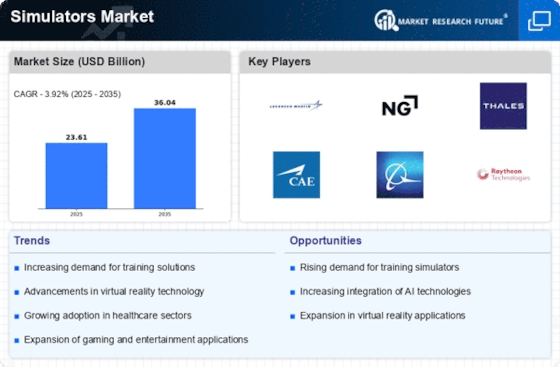
As per Market Research Future analysis, the Simulators Market was estimated at 23.61 USD Billion in 2024. The Simulators industry is projected to grow from 24.54 USD Billion in 2025 to 36.04 USD Billion by 2035, exhibiting a compound annual growth rate (CAGR) of 3.92% during the forecast period 2025 - 2035. North America holds the largest share of the global Simulators Market at approximately 38% (valued at ~USD 9.3 Billion in 2025), driven by the integration of virtual reality technologies transforming user experiences, strong military training procurement budgets, and high demand from the commercial aviation and defense sectors for advanced simulation systems. The United States is the leading country within North America, capturing approximately 32% of the global Simulators Market share (~USD 7.9 Billion in 2025), supported by large-scale military training simulator contracts from the U.S. Army, Air Force, and Navy, FAA-mandated flight simulator training requirements for commercial pilots, and a robust innovation ecosystem developing next-generation VR-based simulation platforms. Military Training dominates the Simulators Market as the largest end-use segment, accounting for approximately 35% of the global market share (~USD 8.6 Billion in 2025), driven by increasing defense budgets globally, the critical need for realistic and cost-effective training environments for combat, flight, and naval operations, and the adoption of AI-enhanced simulation technologies for mission rehearsal.

Key Market Trends & Highlights

The Simulators Market is experiencing robust growth driven by technological advancements and increasing demand across various sectors.

  • The integration of Virtual Reality is transforming user experiences in the Simulators Market, particularly in North America. Data-driven insights are becoming essential for enhancing training effectiveness, especially in the Commercial Training segment. Customization and personalization are increasingly prioritized to meet diverse user needs, with a notable focus in the Military Training segment. Advancements in technology and rising demand for training solutions are key drivers propelling growth in both the Products and Services segments.

Market Size & Forecast

2024 Market Size 23.61 (USD Billion)
2035 Market Size 36.04 (USD Billion)
CAGR (2025 - 2035) 3.92%
Largest Regional Market Share in 2024 North America

Major Players

Lockheed Martin (US), Northrop Grumman (US), <a href="https://en.wikipedia.org/wiki/Simulation">Thales Group (</a>FR), CAE Inc. (CA), Boeing (US), Raytheon Technologies (US), L3Harris Technologies (US), General Dynamics (US), FlightSafety International (US)

Market Trends

The Simulators Market is currently experiencing a dynamic evolution, driven by advancements in technology and increasing demand across various sectors. Industries such as aviation, healthcare, and military are integrating sophisticated simulation tools to enhance training and operational efficiency. This trend reflects a broader shift towards immersive learning experiences, where users can engage in realistic scenarios without the associated risks of real-world applications. Furthermore, the rise of virtual and augmented reality technologies is reshaping the landscape, offering unprecedented levels of interactivity and engagement. As organizations seek to improve performance and reduce costs, the adoption of simulation solutions is likely to accelerate, fostering innovation and competitiveness. In addition to technological advancements, the Simulators Market is influenced by a growing emphasis on data analytics and artificial intelligence. These elements are being incorporated into simulation systems to provide deeper insights and predictive capabilities. As a result, users can make informed decisions based on simulated outcomes, enhancing strategic planning and operational effectiveness. The convergence of these trends suggests a robust future for the Simulators Market, characterized by continuous improvement and adaptation to meet the evolving needs of diverse industries. Stakeholders are encouraged to remain vigilant and responsive to these changes, as they may present both challenges and opportunities in the coming years.

Integration of Virtual Reality

The incorporation of virtual reality technologies into the Simulators Market is transforming training methodologies. This trend allows users to immerse themselves in lifelike environments, enhancing learning retention and engagement. As organizations recognize the benefits of VR, the demand for such solutions is likely to grow.

Focus on Data-Driven Insights

There is an increasing emphasis on integrating data analytics within simulation systems. This trend enables users to derive actionable insights from simulated scenarios, facilitating better decision-making processes. As organizations seek to optimize performance, this focus on data-driven approaches is expected to expand.

Customization and Personalization

The demand for tailored simulation experiences is on the rise. Organizations are seeking solutions that can be customized to meet specific training needs and objectives. This trend indicates a shift towards more personalized learning experiences, which may enhance user satisfaction and effectiveness.

Simulators Market Market Drivers

Advancements in Technology

The Simulators Market is experiencing a surge due to rapid advancements in technology. Innovations in artificial intelligence, machine learning, and graphics rendering are enhancing the realism and interactivity of simulators. For instance, the integration of high-definition graphics and real-time data processing allows for more immersive experiences. This technological evolution is not only attracting new users but also expanding the applications of simulators across various sectors, including aviation, healthcare, and military training. As a result, the market is projected to grow at a compound annual growth rate of approximately 15% over the next five years, indicating a robust demand for sophisticated simulation solutions.

Rising Adoption in Entertainment

The Simulators Market is significantly influenced by the rising adoption of simulators in the entertainment sector. With the proliferation of gaming and virtual reality experiences, consumers are increasingly seeking immersive entertainment options. This trend is evident in the popularity of racing and flight simulation games, which have gained substantial traction among gamers. Furthermore, theme parks and entertainment venues are incorporating advanced simulators to enhance visitor experiences, creating a new revenue stream. The entertainment segment is projected to account for a considerable share of the market, potentially exceeding 30% by 2025, reflecting the growing consumer appetite for engaging and interactive experiences.

Focus on Safety and Risk Management

The Simulators Market is also driven by a heightened focus on safety and risk management across various industries. Organizations are increasingly utilizing simulators to conduct risk assessments and safety training, particularly in high-stakes environments such as oil and gas, construction, and aviation. By simulating hazardous scenarios, companies can prepare their workforce to respond effectively to emergencies, thereby reducing the likelihood of accidents. This proactive approach to safety is likely to propel the demand for simulation technologies, as businesses seek to comply with regulatory standards and enhance operational safety. The market for safety-related simulators is expected to grow substantially, reflecting the critical importance of risk management.

Emerging Markets and Economic Growth

The Simulators Market is poised for growth due to emerging markets and overall economic development. As economies in regions such as Asia and Latin America continue to expand, there is a growing investment in training and simulation technologies. These regions are increasingly adopting simulators for various applications, including education, military training, and industrial operations. The rising middle class and increased spending power are contributing to the demand for advanced training solutions. Consequently, the market is likely to see a significant influx of investments, with projections indicating a potential doubling of market size in these emerging economies over the next decade.

Increased Demand for Training Solutions

The Simulators Market is witnessing increased demand for effective training solutions across multiple sectors. Organizations are recognizing the value of simulation-based training as it offers a safe and controlled environment for skill development. For example, in the aviation sector, flight simulators are essential for pilot training, allowing for the practice of emergency procedures without real-world risks. The healthcare industry is also leveraging simulators for medical training, where practitioners can hone their skills on virtual patients. This growing emphasis on experiential learning is expected to drive the market, with estimates suggesting a market size reaching several billion dollars by 2026.

Market Segment Insights

By Application: Commercial Training (Largest) vs. Military Training (Fastest-Growing)

In the Simulators Market, the application segment is primarily divided between Commercial Training and Military Training. Commercial Training holds the largest share, driven by the increasing need for realistic training environments in sectors such as aviation, medicine, and sports. This segment capitalizes on the demand for highly effective training solutions that enhance skills and reduce risks, thus ensuring a robust market presence. On the other hand, Military Training, while historically smaller, is swiftly gaining traction as defense budgets expand and the need for advanced warfare simulations escalates, reflecting a significant shift toward immersive training methodologies.

Commercial Training (Dominant) vs. Military Training (Emerging)

Commercial Training remains the dominant force in the Simulators Market, characterized by its broad application across various industries, including aviation, healthcare, and professional sports. This segment benefits from technological advancements that enable highly interactive and engaging training experiences. Conversely, Military Training is emerging rapidly, fueled by innovations in virtual and augmented reality, which offer more realistic scenarios for soldier preparation. This segment is gaining importance as military organizations recognize the advantages of simulation in preparing personnel for complex operational environments. As both segments evolve, the demand for advanced simulation technologies continues to propel growth in the overall market.

By Solution: Products (Largest) vs. Services (Fastest-Growing)

In the Simulators Market, the distribution of market share between Products and Services reveals a strong preference for Products, which hold the largest share. The Products segment encompasses physical simulators and software solutions, which are widely adopted across various sectors such as healthcare, military, and education. In contrast, the Services segment, which includes training, support, and maintenance services, complements the product offerings but currently occupies a smaller portion of the total market share. However, significant growth is projected for the Services segment, driven by increasing demand for training solutions and ongoing support in increasingly complex simulator environments. As industries continue to adopt advanced simulation technologies, the need for expert services to integrate and maintain these systems is becoming crucial, positioning Services as the fastest-growing aspect of the Simulators Market.

Products: Hardware (Dominant) vs. Services: Training (Emerging)

Products in the Simulators Market, particularly hardware solutions, have established themselves as the dominant segment due to their vital role in delivering realistic training experiences. These products are crucial for sectors like aviation, healthcare, and defense, where accuracy and reliability are paramount. They offer robust features, such as high-fidelity graphics and real-time feedback, enhancing user training capabilities. On the other hand, Services, particularly training, are emerging rapidly as businesses recognize the necessity of skilled personnel capable of using these simulators effectively. Training services not only provide initial onboarding but also continual updates and support, reflecting the dynamic requirements of modern simulation technologies. This dual focus within the segment highlights the complementary relationship between Products and Services in driving market growth.

By Platform: Airborne (Largest) vs. Land (Fastest-Growing)

In the Simulators Market, the Platform segment reveals a dynamic distribution of market share among its key categories: Airborne, Land, and Maritime. Airborne simulators command the largest share due to their widespread application in training military and commercial pilots. Land simulators follow closely, catering to ground forces and vehicle operators, while Maritime simulators, though currently smaller, are vital for naval training and operations, showcasing a niche yet critical market presence. The competition drives innovation and development across these platforms, each vying to enhance user experience and training efficacy. Analyzing growth trends, the Land platform emerges as the fastest-growing segment, fueled by increasing defense budgets and the rising demand for advanced training solutions. The advent of new technologies, such as virtual and augmented reality, has bolstered the appeal of land-based simulators, while Airborne platforms benefit from constant upgrades to meet changing aviation standards. Maritime simulators are also witnessing growth, attributed to advancements in naval training requirements, highlighting the need for realistic and immersive training environments across all platforms.

Airborne (Dominant) vs. Maritime (Emerging)

The Airborne segment of the Simulators Market is dominant due to its established presence and demand from both military and commercial sectors. Airborne simulators are pivotal for pilot training and often feature sophisticated technologies to simulate real-world flying conditions, ensuring trainees are adequately prepared for actual flight scenarios. In contrast, the Maritime segment is emerging, driven by technological advancements and increasing recognition of the importance of naval training. Maritime simulators provide realistic scenarios for ship operations and naval combat tactics, appealing to both military and commercial maritime sectors. As the need for enhanced training methodologies grows, the Maritime segment is progressively enhancing its market share, showcasing potential for substantial growth in the coming years.

By Type: Full Flight Simulators (Largest) vs. Flight Training Devices (Fastest-Growing)

In the Simulators Market, Full Flight Simulators (FFS) represent the largest segment, commanding a significant portion of the market share due to their comprehensive capabilities for pilot training. These simulators offer a realistic flying experience, making them indispensable for commercial airlines and pilot training academies. Flight Training Devices (FTD), while not as dominant, are quickly gaining traction for their cost-effectiveness and adaptability, contributing to their rapid growth in the market.

Flight Training Devices (Dominant) vs. Other Simulators (Emerging)

Flight Training Devices are becoming increasingly dominant in the simulators market, known for their versatility and reduced operational costs compared to Full Flight Simulators. They are widely used for specific training scenarios without the extensive infrastructure required for FFS. On the other hand, Other simulators, including desktop and fixed-base trainers, represent an emerging segment, appealing to niche markets and specialized training needs. These offerings provide innovative training solutions that complement traditional methods, bolstering the overall market by catering to diverse training requirements.

By Technique: Live (Largest) vs. Virtual & Constructive Simulation (Fastest-Growing)

In the Simulators Market, the distribution among the segments reveals that Live simulation commands the largest share, favored for its real-time engagement and effectiveness. Virtual &amp; Constructive Simulation, while currently in a smaller share, is quickly gaining traction thanks to technological advancements and an increasing shift toward immersive experiences in training and education environments.

Live Simulation (Dominant) vs. Virtual &amp; Constructive Simulation (Emerging)

Live simulation is characterized by its real-world application and direct interaction, making it a preferred choice for fields requiring immediate feedback such as military training, medical simulations, and operational drills. Its dominance is attributed to the immersive experience it provides, which closely mimics real-life scenarios. On the other hand, Virtual &amp; Constructive Simulation is emerging rapidly, leveraging innovative technologies such as virtual reality and augmented reality to create environments that are equally engaging but often more scalable. This segment appeals to diverse industries seeking cost-effective training solutions and flexible operational testing, positioning itself as a strong competitor in the market.

Get more detailed insights about Simulators Market Research Report - Forecast till 2035

Regional Insights

North America : Global Leader in Simulation

North America remains the largest market for simulators, accounting for approximately 45% of the global share. The region's growth is driven by increasing defense budgets, technological advancements, and a strong focus on training and education. Regulatory support from government agencies, such as the Federal Aviation Administration (FAA), further catalyzes market expansion. The demand for high-fidelity simulation systems in military and commercial sectors is on the rise, enhancing operational readiness and safety. The United States is the primary contributor to this market, with key players like Lockheed Martin, Northrop Grumman, and Boeing leading the charge. Canada also plays a significant role, particularly in the civil aviation sector. The competitive landscape is characterized by continuous innovation and partnerships among major firms, ensuring that North America remains at the forefront of simulator technology development.

Europe : Emerging Hub for Innovation

Europe is witnessing significant growth in the simulators market, holding approximately 30% of the global share. The region benefits from a robust aerospace and defense sector, with increasing investments in simulation technologies for training and operational efficiency. Regulatory frameworks, such as the European Union Aviation Safety Agency (EASA) guidelines, are pivotal in shaping market dynamics and ensuring compliance with safety standards. The demand for advanced simulators in both military and civilian applications is driving this growth. Leading countries in this region include the United Kingdom, France, and Germany, where companies like Thales Group and CAE Inc. are prominent. The competitive landscape is marked by collaborations between government and industry to enhance simulation capabilities. The presence of various defense contractors and technology firms fosters innovation, making Europe a key player in The Simulators Market.

Asia-Pacific : Rapidly Growing Market Potential

Asia-Pacific is emerging as a significant player in the simulators market, accounting for approximately 20% of the global share. The region's growth is fueled by increasing investments in defense and aviation sectors, coupled with a rising demand for advanced training solutions. Countries like India and China are ramping up their military capabilities, leading to a surge in simulator adoption. Regulatory initiatives aimed at improving training standards are also contributing to market expansion. Key players in this region include L3Harris Technologies and General Dynamics, which are focusing on developing tailored solutions for local markets. The competitive landscape is evolving, with both domestic and international firms vying for market share. As the region continues to invest in modernization and technological advancements, the demand for high-quality simulators is expected to rise significantly, positioning Asia-Pacific as a future leader in this sector.

Middle East and Africa : Emerging Market with Potential

The Middle East and Africa region is gradually establishing itself in the simulators market, holding about 5% of the global share. The growth is primarily driven by increasing defense expenditures and a focus on enhancing training capabilities across military and civil sectors. Countries like the United Arab Emirates and South Africa are investing in advanced simulation technologies to improve operational readiness and safety. Regulatory support from local governments is also fostering market growth. The competitive landscape is characterized by a mix of local and international players, with companies like FlightSafety International making strides in the region. The presence of key players is expected to grow as demand for simulators increases, particularly in defense and aviation training. As the region continues to develop its infrastructure and capabilities, opportunities for growth in the simulators market are becoming more pronounced.

Key Players and Competitive Insights

Leading market players are investing heavily in research and development in order to expand their product lines, which will help the simulators market, grow even more. Market participants are also undertaking a variety of strategic activities to expand their footprint, with important market developments including new product launches, contractual agreements, mergers and acquisitions, higher investments, and collaboration with other organizations. To expand and survive in a more competitive and rising market climate, simulators industry must offer cost-effective items.
Manufacturing locally to minimize operational costs is one of the key business tactics used by manufacturers in the simulators industry to benefit clients and increase the market sector. In recent years, the simulators industry has offered some of the most significant advantages to market. Major players in the weight loss products market attempting to increase market demand by investing in research and development operations include CAE Inc. (US), L3Harris Technologies Inc. (US), Thales Group (France), Saab AB (Sweden), Indra (Spain), Flight Safety International (US), Boeing (US), Raytheon Technologies Corporation (US), Airbus S.A.S. (Netherlands), and Tru Simulation + Training Inc. (US).
L3Harris Technologies Inc. offers goods and services in the cyber, space, air, and maritime sectors. The business provides integrated mission, aviation, space, and airborne systems and communication systems. Additionally, it offers mission-critical infrastructure communications and networking solutions as well as services for both commercial and military pilot training.
In January a new A320ceo full flight simulator will be provided by L3Harris to Pakistan International Airlines (PIA) for the airline's training facility in Karachi, per the latter company's contract inked with PIA.
It will be the first RealitySevenE simulator delivered in the MEASA region when the company delivers an Airbus A320ceo FFS to the PIA training facility in Karachi.
Airbus SE's areas of expertise are Aeronautics, defense, and space-related services. The company produces commercial aircraft, passenger aircraft, helicopters, business jets, unmanned aerial systems, and cargo aircraft. Additionally, Airbus provides special mission aircraft, medium and light military transport aircraft, as well as civil and parabolic helicopters. The business also offers space services, designing, producing, and launching satellites and orbital equipment. Additionally, it provides training, flying operations, upgrades, and maintenance services.
In May 2022, the Royal Air Force will receive a second full-flight simulator for the Airbus A400M military transport aircraft thanks to a multimillion-pound contract that Airbus Defense and Space gave Thales. Reducing the number of hours spent on actual aircraft flight training is made possible by the A400M simulator's realistic training capabilities.

Key Companies in the Simulators Market include

Industry Developments

February 2022: Kongsberg Digital (KDI) has received a significant tender. It will provide South Metropolitan TAFE (Technical and Further Education) institute in Fremantle, Western Australia, with a wide range of marine simulator systems.

March 2022: Bohemia Interactive Simulations was fully acquired by BAE Systems for USD 200 million, according to an announcement. The business specializes in creating realistic training simulations for the armed forces. Bohemia Interactive Simulations collaborates with 300 integrators that support 60 different militaries all around the world.

Future Outlook

Simulators Market Future Outlook

The Simulators Market is projected to grow at a 3.92% CAGR from 2025 to 2035, driven by technological advancements, increased training needs, and demand for immersive experiences.

New opportunities lie in:

  • <p>Development of virtual reality training modules for healthcare professionals. Expansion of simulation-based learning platforms in educational institutions. Integration of AI-driven analytics for performance assessment in training simulators.</p>

By 2035, the Simulators Market is expected to be robust, reflecting sustained growth and innovation.

Market Segmentation

Simulators Market Type Outlook

  • Full Flight Simulators
  • Flight Training Devices
  • Other

Simulators Market Platform Outlook

  • Airborne
  • Land
  • Maritime

Simulators Market Solution Outlook

  • Products
  • Services

Simulators Market Technique Outlook

  • Live
  • Virtual & Constructive Simulation
  • Synthetic Environment Simulation
  • Gaming Simulation

Simulators Market Application Outlook

  • Commercial Training
  • Military Training

Report Scope

MARKET SIZE 2024 23.61 (USD Billion)
MARKET SIZE 2025 24.54 (USD Billion)
MARKET SIZE 2035 36.04 (USD Billion)
COMPOUND ANNUAL GROWTH RATE (CAGR) 3.92% (2025 - 2035)
REPORT COVERAGE Revenue Forecast, Competitive Landscape, Growth Factors, and Trends
BASE YEAR 2024
Market Forecast Period 2025 - 2035
Historical Data 2019 - 2024
Market Forecast Units USD Billion
Key Companies Profiled Lockheed Martin (US), Northrop Grumman (US), Thales Group (FR), CAE Inc. (CA), Boeing (US), Raytheon Technologies (US), L3Harris Technologies (US), General Dynamics (US), FlightSafety International (US)
Segments Covered Application, Solution, Platform, Technique, Region
Key Market Opportunities Integration of artificial intelligence enhances training efficiency in the Simulators Market.
Key Market Dynamics Technological advancements drive innovation in the Simulators Market, enhancing user experience and expanding application areas.
Countries Covered North America, Europe, APAC, South America, MEA

FAQs

What is the projected market valuation of the Simulators Market by 2035?

<p>The Simulators Market is projected to reach a valuation of 36.04 USD Billion by 2035.</p>

What was the overall market valuation of the Simulators Market in 2024?

<p>The overall market valuation of the Simulators Market was 23.61 USD Billion in 2024.</p>

What is the expected CAGR for the Simulators Market during the forecast period 2025 - 2035?

<p>The expected CAGR for the Simulators Market during the forecast period 2025 - 2035 is 3.92%.</p>

Which companies are considered key players in the Simulators Market?

<p>Key players in the Simulators Market include Lockheed Martin, Northrop Grumman, Thales Group, CAE Inc., Boeing, Raytheon Technologies, L3Harris Technologies, General Dynamics, and FlightSafety International.</p>

How did the Commercial Training segment perform in 2024?

<p>In 2024, the Commercial Training segment was valued at 9.43 USD Billion and is projected to grow to 14.67 USD Billion by 2035.</p>

What is the projected growth for the Military Training segment from 2024 to 2035?

<p>The Military Training segment was valued at 14.18 USD Billion in 2024 and is expected to reach 21.37 USD Billion by 2035.</p>

What are the projected valuations for Products and Services in the Simulators Market?

In 2024, Products were valued at 15.0 USD Billion and are projected to grow to 23.0 USD Billion, while Services were valued at 8.61 USD Billion and are expected to reach 13.04 USD Billion by 2035.

What is the expected growth in the Airborne, Land, and Maritime segments by 2035?

The Airborne segment is projected to grow from 8.0 USD Billion in 2024 to 12.0 USD Billion, the Land segment from 9.0 USD Billion to 14.0 USD Billion, and the Maritime segment from 6.61 USD Billion to 10.04 USD Billion by 2035.

What are the projected valuations for different types of simulators by 2035?

By 2035, Full Flight Simulators are expected to reach 14.5 USD Billion, Flight Training Devices 12.5 USD Billion, and Other types 9.04 USD Billion.

How do the various simulation techniques compare in terms of projected growth?

By 2035, Live simulation is expected to grow to 7.5 USD Billion, Virtual &amp; Constructive Simulation to 12.0 USD Billion, Synthetic Environment Simulation to 9.0 USD Billion, and Gaming Simulation to 7.54 USD Billion.

  1. SECTION I: EXECUTIVE SUMMARY AND KEY HIGHLIGHTS |
    1. EXECUTIVE SUMMARY | |
      1. Market Overview | |
      2. Key Findings | |
      3. Market Segmentation | |
      4. Competitive Landscape | |
      5. Challenges and Opportunities | |
      6. Future Outlook 2
  2. SECTION II: SCOPING, METHODOLOGY AND MARKET STRUCTURE |
    1. MARKET INTRODUCTION | |
      1. Definition | |
      2. Scope of the study | | |
    2. RESEARCH METHODOLOGY | |
      1. Overview | |
      2. Data Mining | |
      3. Secondary Research | |
      4. Primary Research | | |
      5. Forecasting Model | |
      6. Market Size Estimation | | |
      7. Data Triangulation | |
      8. Validation 3
  3. SECTION III: QUALITATIVE ANALYSIS |
    1. MARKET DYNAMICS | |
      1. Overview | |
      2. Drivers | |
      3. Restraints | |
      4. Opportunities |
    2. MARKET FACTOR ANALYSIS | |
      1. Value chain Analysis | |
      2. Porter's Five Forces Analysis | | |
      3. COVID-19 Impact Analysis | | |
  4. SECTION IV: QUANTITATIVE ANALYSIS |
    1. Aerospace & Defense, BY Application (USD Billion) | |
      1. Commercial Training | |
      2. Military Training |
    2. Aerospace & Defense, BY Solution (USD Billion) | |
      1. Products | |
      2. Services |
    3. Aerospace & Defense, BY Platform (USD Billion) | |
      1. Airborne | |
      2. Land | |
      3. Maritime |
    4. Aerospace & Defense, BY Type (USD Billion) | |
      1. Full Flight Simulators | |
      2. Flight Training Devices | |
      3. Other |
    5. Aerospace & Defense, BY Technique (USD Billion) | |
      1. Live | |
      2. Virtual & Constructive Simulation | |
      3. Synthetic Environment Simulation | |
      4. Gaming Simulation |
    6. Aerospace & Defense, BY Region (USD Billion) | |
      1. North America | | |
      2. Europe | | |
      3. APAC | | |
      4. South America | | |
      5. MEA | | |
  5. SECTION V: COMPETITIVE ANALYSIS |
    1. Competitive Landscape | |
      1. Overview | |
      2. Competitive Analysis | |
      3. Market share Analysis | |
      4. Major Growth Strategy in the Aerospace & Defense | |
      5. Competitive Benchmarking | |
      6. Leading Players in Terms of Number of Developments in the Aerospace & Defense | |
      7. Key developments and growth strategies | | |
      8. Major Players Financial Matrix | | |
    2. Company Profiles | |
      1. Lockheed Martin (US) | | |
      2. Northrop Grumman (US) | | |
      3. Thales Group (FR) | | |
      4. CAE Inc. (CA) | | |
      5. Boeing (US) | | |
      6. Raytheon Technologies (US) | | |
      7. L3Harris Technologies (US) | | |
      8. General Dynamics (US) | | |
      9. FlightSafety International (US) | | |
    3. Appendix | |
      1. References | |
      2. Related Reports 6 LIST OF FIGURES |
    4. MARKET SYNOPSIS |
    5. NORTH AMERICA MARKET ANALYSIS |
    6. US MARKET ANALYSIS BY APPLICATION |
    7. US MARKET ANALYSIS BY SOLUTION |
    8. US MARKET ANALYSIS BY PLATFORM |
    9. US MARKET ANALYSIS BY TYPE |
    10. US MARKET ANALYSIS BY TECHNIQUE |
    11. CANADA MARKET ANALYSIS BY APPLICATION |
    12. CANADA MARKET ANALYSIS BY SOLUTION |
    13. CANADA MARKET ANALYSIS BY PLATFORM |
    14. CANADA MARKET ANALYSIS BY TYPE |
    15. CANADA MARKET ANALYSIS BY TECHNIQUE |
    16. EUROPE MARKET ANALYSIS |
    17. GERMANY MARKET ANALYSIS BY APPLICATION |
    18. GERMANY MARKET ANALYSIS BY SOLUTION |
    19. GERMANY MARKET ANALYSIS BY PLATFORM |
    20. GERMANY MARKET ANALYSIS BY TYPE |
    21. GERMANY MARKET ANALYSIS BY TECHNIQUE |
    22. UK MARKET ANALYSIS BY APPLICATION |
    23. UK MARKET ANALYSIS BY SOLUTION |
    24. UK MARKET ANALYSIS BY PLATFORM |
    25. UK MARKET ANALYSIS BY TYPE |
    26. UK MARKET ANALYSIS BY TECHNIQUE |
    27. FRANCE MARKET ANALYSIS BY APPLICATION |
    28. FRANCE MARKET ANALYSIS BY SOLUTION |
    29. FRANCE MARKET ANALYSIS BY PLATFORM |
    30. FRANCE MARKET ANALYSIS BY TYPE |
    31. FRANCE MARKET ANALYSIS BY TECHNIQUE |
    32. RUSSIA MARKET ANALYSIS BY APPLICATION |
    33. RUSSIA MARKET ANALYSIS BY SOLUTION |
    34. RUSSIA MARKET ANALYSIS BY PLATFORM |
    35. RUSSIA MARKET ANALYSIS BY TYPE |
    36. RUSSIA MARKET ANALYSIS BY TECHNIQUE |
    37. ITALY MARKET ANALYSIS BY APPLICATION |
    38. ITALY MARKET ANALYSIS BY SOLUTION |
    39. ITALY MARKET ANALYSIS BY PLATFORM |
    40. ITALY MARKET ANALYSIS BY TYPE |
    41. ITALY MARKET ANALYSIS BY TECHNIQUE |
    42. SPAIN MARKET ANALYSIS BY APPLICATION |
    43. SPAIN MARKET ANALYSIS BY SOLUTION |
    44. SPAIN MARKET ANALYSIS BY PLATFORM |
    45. SPAIN MARKET ANALYSIS BY TYPE |
    46. SPAIN MARKET ANALYSIS BY TECHNIQUE |
    47. REST OF EUROPE MARKET ANALYSIS BY APPLICATION |
    48. REST OF EUROPE MARKET ANALYSIS BY SOLUTION |
    49. REST OF EUROPE MARKET ANALYSIS BY PLATFORM |
    50. REST OF EUROPE MARKET ANALYSIS BY TYPE |
    51. REST OF EUROPE MARKET ANALYSIS BY TECHNIQUE |
    52. APAC MARKET ANALYSIS |
    53. CHINA MARKET ANALYSIS BY APPLICATION |
    54. CHINA MARKET ANALYSIS BY SOLUTION |
    55. CHINA MARKET ANALYSIS BY PLATFORM |
    56. CHINA MARKET ANALYSIS BY TYPE |
    57. CHINA MARKET ANALYSIS BY TECHNIQUE |
    58. INDIA MARKET ANALYSIS BY APPLICATION |
    59. INDIA MARKET ANALYSIS BY SOLUTION |
    60. INDIA MARKET ANALYSIS BY PLATFORM |
    61. INDIA MARKET ANALYSIS BY TYPE |
    62. INDIA MARKET ANALYSIS BY TECHNIQUE |
    63. JAPAN MARKET ANALYSIS BY APPLICATION |
    64. JAPAN MARKET ANALYSIS BY SOLUTION |
    65. JAPAN MARKET ANALYSIS BY PLATFORM |
    66. JAPAN MARKET ANALYSIS BY TYPE |
    67. JAPAN MARKET ANALYSIS BY TECHNIQUE |
    68. SOUTH KOREA MARKET ANALYSIS BY APPLICATION |
    69. SOUTH KOREA MARKET ANALYSIS BY SOLUTION |
    70. SOUTH KOREA MARKET ANALYSIS BY PLATFORM |
    71. SOUTH KOREA MARKET ANALYSIS BY TYPE |
    72. SOUTH KOREA MARKET ANALYSIS BY TECHNIQUE |
    73. MALAYSIA MARKET ANALYSIS BY APPLICATION |
    74. MALAYSIA MARKET ANALYSIS BY SOLUTION |
    75. MALAYSIA MARKET ANALYSIS BY PLATFORM |
    76. MALAYSIA MARKET ANALYSIS BY TYPE |
    77. MALAYSIA MARKET ANALYSIS BY TECHNIQUE |
    78. THAILAND MARKET ANALYSIS BY APPLICATION |
    79. THAILAND MARKET ANALYSIS BY SOLUTION |
    80. THAILAND MARKET ANALYSIS BY PLATFORM |
    81. THAILAND MARKET ANALYSIS BY TYPE |
    82. THAILAND MARKET ANALYSIS BY TECHNIQUE |
    83. INDONESIA MARKET ANALYSIS BY APPLICATION |
    84. INDONESIA MARKET ANALYSIS BY SOLUTION |
    85. INDONESIA MARKET ANALYSIS BY PLATFORM |
    86. INDONESIA MARKET ANALYSIS BY TYPE |
    87. INDONESIA MARKET ANALYSIS BY TECHNIQUE |
    88. REST OF APAC MARKET ANALYSIS BY APPLICATION |
    89. REST OF APAC MARKET ANALYSIS BY SOLUTION |
    90. REST OF APAC MARKET ANALYSIS BY PLATFORM |
    91. REST OF APAC MARKET ANALYSIS BY TYPE |
    92. REST OF APAC MARKET ANALYSIS BY TECHNIQUE |
    93. SOUTH AMERICA MARKET ANALYSIS |
    94. BRAZIL MARKET ANALYSIS BY APPLICATION |
    95. BRAZIL MARKET ANALYSIS BY SOLUTION |
    96. BRAZIL MARKET ANALYSIS BY PLATFORM |
    97. BRAZIL MARKET ANALYSIS BY TYPE |
    98. BRAZIL MARKET ANALYSIS BY TECHNIQUE |
    99. MEXICO MARKET ANALYSIS BY APPLICATION |
    100. MEXICO MARKET ANALYSIS BY SOLUTION |
    101. MEXICO MARKET ANALYSIS BY PLATFORM |
    102. MEXICO MARKET ANALYSIS BY TYPE |
    103. MEXICO MARKET ANALYSIS BY TECHNIQUE |
    104. ARGENTINA MARKET ANALYSIS BY APPLICATION |
    105. ARGENTINA MARKET ANALYSIS BY SOLUTION |
    106. ARGENTINA MARKET ANALYSIS BY PLATFORM |
    107. ARGENTINA MARKET ANALYSIS BY TYPE |
    108. ARGENTINA MARKET ANALYSIS BY TECHNIQUE |
    109. REST OF SOUTH AMERICA MARKET ANALYSIS BY APPLICATION |
    110. REST OF SOUTH AMERICA MARKET ANALYSIS BY SOLUTION |
    111. REST OF SOUTH AMERICA MARKET ANALYSIS BY PLATFORM |
    112. REST OF SOUTH AMERICA MARKET ANALYSIS BY TYPE |
    113. REST OF SOUTH AMERICA MARKET ANALYSIS BY TECHNIQUE |
    114. MEA MARKET ANALYSIS |
    115. GCC COUNTRIES MARKET ANALYSIS BY APPLICATION |
    116. GCC COUNTRIES MARKET ANALYSIS BY SOLUTION |
    117. GCC COUNTRIES MARKET ANALYSIS BY PLATFORM |
    118. GCC COUNTRIES MARKET ANALYSIS BY TYPE |
    119. GCC COUNTRIES MARKET ANALYSIS BY TECHNIQUE |
    120. SOUTH AFRICA MARKET ANALYSIS BY APPLICATION |
    121. SOUTH AFRICA MARKET ANALYSIS BY SOLUTION |
    122. SOUTH AFRICA MARKET ANALYSIS BY PLATFORM |
    123. SOUTH AFRICA MARKET ANALYSIS BY TYPE |
    124. SOUTH AFRICA MARKET ANALYSIS BY TECHNIQUE |
    125. REST OF MEA MARKET ANALYSIS BY APPLICATION |
    126. REST OF MEA MARKET ANALYSIS BY SOLUTION |
    127. REST OF MEA MARKET ANALYSIS BY PLATFORM |
    128. REST OF MEA MARKET ANALYSIS BY TYPE |
    129. REST OF MEA MARKET ANALYSIS BY TECHNIQUE |
    130. KEY BUYING CRITERIA OF AEROSPACE & DEFENSE |
    131. RESEARCH PROCESS OF MRFR |
    132. DRO ANALYSIS OF AEROSPACE & DEFENSE |
    133. DRIVERS IMPACT ANALYSIS: AEROSPACE & DEFENSE |
    134. RESTRAINTS IMPACT ANALYSIS: AEROSPACE & DEFENSE |
    135. SUPPLY / VALUE CHAIN: AEROSPACE & DEFENSE |
    136. AEROSPACE & DEFENSE, BY APPLICATION, 2024 (% SHARE) |
    137. AEROSPACE & DEFENSE, BY APPLICATION, 2024 TO 2035 (USD Billion) |
    138. AEROSPACE & DEFENSE, BY SOLUTION, 2024 (% SHARE) |
    139. AEROSPACE & DEFENSE, BY SOLUTION, 2024 TO 2035 (USD Billion) |
    140. AEROSPACE & DEFENSE, BY PLATFORM, 2024 (% SHARE) |
    141. AEROSPACE & DEFENSE, BY PLATFORM, 2024 TO 2035 (USD Billion) |
    142. AEROSPACE & DEFENSE, BY TYPE, 2024 (% SHARE) |
    143. AEROSPACE & DEFENSE, BY TYPE, 2024 TO 2035 (USD Billion) |
    144. AEROSPACE & DEFENSE, BY TECHNIQUE, 2024 (% SHARE) |
    145. AEROSPACE & DEFENSE, BY TECHNIQUE, 2024 TO 2035 (USD Billion) |
    146. BENCHMARKING OF MAJOR COMPETITORS 7 LIST OF TABLES |
    147. LIST OF ASSUMPTIONS | |
      1. |
    148. North America MARKET SIZE ESTIMATES; FORECAST | |
      1. BY APPLICATION, 2025-2035 (USD Billion) | |
      2. BY SOLUTION, 2025-2035 (USD Billion) | |
      3. BY PLATFORM, 2025-2035 (USD Billion) | |
      4. BY TYPE, 2025-2035 (USD Billion) | |
      5. BY TECHNIQUE, 2025-2035 (USD Billion) |
    149. US MARKET SIZE ESTIMATES; FORECAST | |
      1. BY APPLICATION, 2025-2035 (USD Billion) | |
      2. BY SOLUTION, 2025-2035 (USD Billion) | |
      3. BY PLATFORM, 2025-2035 (USD Billion) | |
      4. BY TYPE, 2025-2035 (USD Billion) | |
      5. BY TECHNIQUE, 2025-2035 (USD Billion) |
    150. Canada MARKET SIZE ESTIMATES; FORECAST | |
      1. BY APPLICATION, 2025-2035 (USD Billion) | |
      2. BY SOLUTION, 2025-2035 (USD Billion) | |
      3. BY PLATFORM, 2025-2035 (USD Billion) | |
      4. BY TYPE, 2025-2035 (USD Billion) | |
      5. BY TECHNIQUE, 2025-2035 (USD Billion) |
    151. Europe MARKET SIZE ESTIMATES; FORECAST | |
      1. BY APPLICATION, 2025-2035 (USD Billion) | |
      2. BY SOLUTION, 2025-2035 (USD Billion) | |
      3. BY PLATFORM, 2025-2035 (USD Billion) | |
      4. BY TYPE, 2025-2035 (USD Billion) | |
      5. BY TECHNIQUE, 2025-2035 (USD Billion) |
    152. Germany MARKET SIZE ESTIMATES; FORECAST | |
      1. BY APPLICATION, 2025-2035 (USD Billion) | |
      2. BY SOLUTION, 2025-2035 (USD Billion) | |
      3. BY PLATFORM, 2025-2035 (USD Billion) | |
      4. BY TYPE, 2025-2035 (USD Billion) | |
      5. BY TECHNIQUE, 2025-2035 (USD Billion) |
    153. UK MARKET SIZE ESTIMATES; FORECAST | |
      1. BY APPLICATION, 2025-2035 (USD Billion) | |
      2. BY SOLUTION, 2025-2035 (USD Billion) | |
      3. BY PLATFORM, 2025-2035 (USD Billion) | |
      4. BY TYPE, 2025-2035 (USD Billion) | |
      5. BY TECHNIQUE, 2025-2035 (USD Billion) |
    154. France MARKET SIZE ESTIMATES; FORECAST | |
      1. BY APPLICATION, 2025-2035 (USD Billion) | |
      2. BY SOLUTION, 2025-2035 (USD Billion) | |
      3. BY PLATFORM, 2025-2035 (USD Billion) | |
      4. BY TYPE, 2025-2035 (USD Billion) | |
      5. BY TECHNIQUE, 2025-2035 (USD Billion) |
    155. Russia MARKET SIZE ESTIMATES; FORECAST | |
      1. BY APPLICATION, 2025-2035 (USD Billion) | |
      2. BY SOLUTION, 2025-2035 (USD Billion) | |
      3. BY PLATFORM, 2025-2035 (USD Billion) | |
      4. BY TYPE, 2025-2035 (USD Billion) | |
      5. BY TECHNIQUE, 2025-2035 (USD Billion) |
    156. Italy MARKET SIZE ESTIMATES; FORECAST | |
      1. BY APPLICATION, 2025-2035 (USD Billion) | |
      2. BY SOLUTION, 2025-2035 (USD Billion) | |
      3. BY PLATFORM, 2025-2035 (USD Billion) | |
      4. BY TYPE, 2025-2035 (USD Billion) | |
      5. BY TECHNIQUE, 2025-2035 (USD Billion) |
    157. Spain MARKET SIZE ESTIMATES; FORECAST | |
      1. BY APPLICATION, 2025-2035 (USD Billion) | |
      2. BY SOLUTION, 2025-2035 (USD Billion) | |
      3. BY PLATFORM, 2025-2035 (USD Billion) | |
      4. BY TYPE, 2025-2035 (USD Billion) | |
      5. BY TECHNIQUE, 2025-2035 (USD Billion) |
    158. Rest of Europe MARKET SIZE ESTIMATES; FORECAST | |
      1. BY APPLICATION, 2025-2035 (USD Billion) | |
      2. BY SOLUTION, 2025-2035 (USD Billion) | |
      3. BY PLATFORM, 2025-2035 (USD Billion) | |
      4. BY TYPE, 2025-2035 (USD Billion) | |
      5. BY TECHNIQUE, 2025-2035 (USD Billion) |
    159. APAC MARKET SIZE ESTIMATES; FORECAST | |
      1. BY APPLICATION, 2025-2035 (USD Billion) | |
      2. BY SOLUTION, 2025-2035 (USD Billion) | |
      3. BY PLATFORM, 2025-2035 (USD Billion) | |
      4. BY TYPE, 2025-2035 (USD Billion) | |
      5. BY TECHNIQUE, 2025-2035 (USD Billion) |
    160. China MARKET SIZE ESTIMATES; FORECAST | |
      1. BY APPLICATION, 2025-2035 (USD Billion) | |
      2. BY SOLUTION, 2025-2035 (USD Billion) | |
      3. BY PLATFORM, 2025-2035 (USD Billion) | |
      4. BY TYPE, 2025-2035 (USD Billion) | |
      5. BY TECHNIQUE, 2025-2035 (USD Billion) |
    161. India MARKET SIZE ESTIMATES; FORECAST | |
      1. BY APPLICATION, 2025-2035 (USD Billion) | |
      2. BY SOLUTION, 2025-2035 (USD Billion) | |
      3. BY PLATFORM, 2025-2035 (USD Billion) | |
      4. BY TYPE, 2025-2035 (USD Billion) | |
      5. BY TECHNIQUE, 2025-2035 (USD Billion) |
    162. Japan MARKET SIZE ESTIMATES; FORECAST | |
      1. BY APPLICATION, 2025-2035 (USD Billion) | |
      2. BY SOLUTION, 2025-2035 (USD Billion) | |
      3. BY PLATFORM, 2025-2035 (USD Billion) | |
      4. BY TYPE, 2025-2035 (USD Billion) | |
      5. BY TECHNIQUE, 2025-2035 (USD Billion) |
    163. South Korea MARKET SIZE ESTIMATES; FORECAST | |
      1. BY APPLICATION, 2025-2035 (USD Billion) | |
      2. BY SOLUTION, 2025-2035 (USD Billion) | |
      3. BY PLATFORM, 2025-2035 (USD Billion) | |
      4. BY TYPE, 2025-2035 (USD Billion) | |
      5. BY TECHNIQUE, 2025-2035 (USD Billion) |
    164. Malaysia MARKET SIZE ESTIMATES; FORECAST | |
      1. BY APPLICATION, 2025-2035 (USD Billion) | |
      2. BY SOLUTION, 2025-2035 (USD Billion) | |
      3. BY PLATFORM, 2025-2035 (USD Billion) | |
      4. BY TYPE, 2025-2035 (USD Billion) | |
      5. BY TECHNIQUE, 2025-2035 (USD Billion) |
    165. Thailand MARKET SIZE ESTIMATES; FORECAST | |
      1. BY APPLICATION, 2025-2035 (USD Billion) | |
      2. BY SOLUTION, 2025-2035 (USD Billion) | |
      3. BY PLATFORM, 2025-2035 (USD Billion) | |
      4. BY TYPE, 2025-2035 (USD Billion) | |
      5. BY TECHNIQUE, 2025-2035 (USD Billion) |
    166. Indonesia MARKET SIZE ESTIMATES; FORECAST | |
      1. BY APPLICATION, 2025-2035 (USD Billion) | |
      2. BY SOLUTION, 2025-2035 (USD Billion) | |
      3. BY PLATFORM, 2025-2035 (USD Billion) | |
      4. BY TYPE, 2025-2035 (USD Billion) | |
      5. BY TECHNIQUE, 2025-2035 (USD Billion) |
    167. Rest of APAC MARKET SIZE ESTIMATES; FORECAST | |
      1. BY APPLICATION, 2025-2035 (USD Billion) | |
      2. BY SOLUTION, 2025-2035 (USD Billion) | |
      3. BY PLATFORM, 2025-2035 (USD Billion) | |
      4. BY TYPE, 2025-2035 (USD Billion) | |
      5. BY TECHNIQUE, 2025-2035 (USD Billion) |
    168. South America MARKET SIZE ESTIMATES; FORECAST | |
      1. BY APPLICATION, 2025-2035 (USD Billion) | |
      2. BY SOLUTION, 2025-2035 (USD Billion) | |
      3. BY PLATFORM, 2025-2035 (USD Billion) | |
      4. BY TYPE, 2025-2035 (USD Billion) | |
      5. BY TECHNIQUE, 2025-2035 (USD Billion) |
    169. Brazil MARKET SIZE ESTIMATES; FORECAST | |
      1. BY APPLICATION, 2025-2035 (USD Billion) | |
      2. BY SOLUTION, 2025-2035 (USD Billion) | |
      3. BY PLATFORM, 2025-2035 (USD Billion) | |
      4. BY TYPE, 2025-2035 (USD Billion) | |
      5. BY TECHNIQUE, 2025-2035 (USD Billion) |
    170. Mexico MARKET SIZE ESTIMATES; FORECAST | |
      1. BY APPLICATION, 2025-2035 (USD Billion) | |
      2. BY SOLUTION, 2025-2035 (USD Billion) | |
      3. BY PLATFORM, 2025-2035 (USD Billion) | |
      4. BY TYPE, 2025-2035 (USD Billion) | |
      5. BY TECHNIQUE, 2025-2035 (USD Billion) |
    171. Argentina MARKET SIZE ESTIMATES; FORECAST | |
      1. BY APPLICATION, 2025-2035 (USD Billion) | |
      2. BY SOLUTION, 2025-2035 (USD Billion) | |
      3. BY PLATFORM, 2025-2035 (USD Billion) | |
      4. BY TYPE, 2025-2035 (USD Billion) | |
      5. BY TECHNIQUE, 2025-2035 (USD Billion) |
    172. Rest of South America MARKET SIZE ESTIMATES; FORECAST | |
      1. BY APPLICATION, 2025-2035 (USD Billion) | |
      2. BY SOLUTION, 2025-2035 (USD Billion) | |
      3. BY PLATFORM, 2025-2035 (USD Billion) | |
      4. BY TYPE, 2025-2035 (USD Billion) | |
      5. BY TECHNIQUE, 2025-2035 (USD Billion) |
    173. MEA MARKET SIZE ESTIMATES; FORECAST | |
      1. BY APPLICATION, 2025-2035 (USD Billion) | |
      2. BY SOLUTION, 2025-2035 (USD Billion) | |
      3. BY PLATFORM, 2025-2035 (USD Billion) | |
      4. BY TYPE, 2025-2035 (USD Billion) | |
      5. BY TECHNIQUE, 2025-2035 (USD Billion) |
    174. GCC Countries MARKET SIZE ESTIMATES; FORECAST | |
      1. BY APPLICATION, 2025-2035 (USD Billion) | |
      2. BY SOLUTION, 2025-2035 (USD Billion) | |
      3. BY PLATFORM, 2025-2035 (USD Billion) | |
      4. BY TYPE, 2025-2035 (USD Billion) | |
      5. BY TECHNIQUE, 2025-2035 (USD Billion) |
    175. South Africa MARKET SIZE ESTIMATES; FORECAST | |
      1. BY APPLICATION, 2025-2035 (USD Billion) | |
      2. BY SOLUTION, 2025-2035 (USD Billion) | |
      3. BY PLATFORM, 2025-2035 (USD Billion) | |
      4. BY TYPE, 2025-2035 (USD Billion) | |
      5. BY TECHNIQUE, 2025-2035 (USD Billion) |
    176. Rest of MEA MARKET SIZE ESTIMATES; FORECAST | |
      1. BY APPLICATION, 2025-2035 (USD Billion) | |
      2. BY SOLUTION, 2025-2035 (USD Billion) | |
      3. BY PLATFORM, 2025-2035 (USD Billion) | |
      4. BY TYPE, 2025-2035 (USD Billion) | |
      5. BY TECHNIQUE, 2025-2035 (USD Billion) |
    177. PRODUCT LAUNCH/PRODUCT DEVELOPMENT/APPROVAL | |
      1. |
    178. ACQUISITION/PARTNERSHIP | |

Aerospace & Defense Market Segmentation

Aerospace & Defense By Application (USD Billion, 2025-2035)

  • Commercial Training
  • Military Training

Aerospace & Defense By Solution (USD Billion, 2025-2035)

  • Products
  • Services

Aerospace & Defense By Platform (USD Billion, 2025-2035)

  • Airborne
  • Land
  • Maritime

Aerospace & Defense By Type (USD Billion, 2025-2035)

  • Full Flight Simulators
  • Flight Training Devices
  • Other

Aerospace & Defense By Technique (USD Billion, 2025-2035)

  • Live
  • Virtual & Constructive Simulation
  • Synthetic Environment Simulation
  • Gaming Simulation
Infographic

Free Sample Request

Kindly complete the form below to receive a free sample of this Report

Get Free Sample

Customer Strories

Compare Licence

×
Features License Type
Single User Multiuser License Enterprise User
Price $4,950 $5,950 $7,250
Maximum User Access Limit 1 User Upto 10 Users Unrestricted Access Throughout the Organization
Free Customization
Direct Access to Analyst
Deliverable Format
Platform Access
Discount on Next Purchase 10% 15% 15%
Printable Versions