×
  • Cat-intel
  • MedIntelliX
  • Resources
  • About Us
  • Hero Background
    English
    Chinese
    French
    Japanese
    Korean
    German
    Spanish

    Silicone Elastomers Market Share

    ID: MRFR/CnM/1229-HCR
    111 Pages
    Chitranshi Jaiswal
    October 2025

    Silicone Elastomers Market Research Report Information by Type (High Temperature Vulcanized [HTV], Liquid Silicone Rubber [LSR], Room Temperature Vulcanized [RTV]), Application (Automotive, Electrical & Electronics, Healthcare, and Others) and Region Forecast till 2035

    Share:
    Download PDF ×

    We do not share your information with anyone. However, we may send you emails based on your report interest from time to time. You may contact us at any time to opt-out.

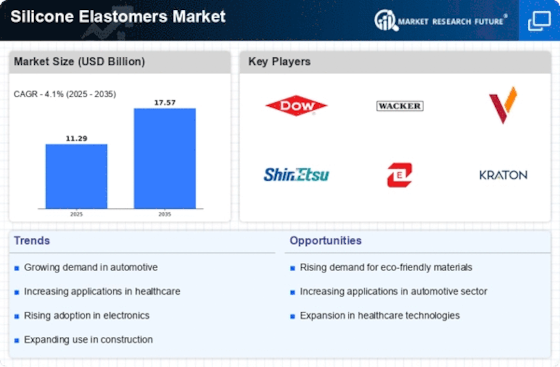
    Silicone Elastomers Market Infographic
    Purchase Options

    Market Share

    Introduction: Navigating the Competitive Landscape of Silicone Elastomers

    The competitive situation in the silicon rubber market is being reshaped by the rapid development of new technology, by the changing regulatory environment, and by the growing demand for sustainability and performance from consumers. Among the main market players are car manufacturers, chemical companies and new players that use the latest technological developments such as artificial intelligence, automation and IoT to optimize their product offerings and operations. The established companies are investing in green and sustainable solutions to meet the increasingly stringent regulations, while the new entrants are focusing on niche applications and individualization. Strategic trends are increasingly focusing on the localization of production and the optimization of supply chains in the regional markets, especially in Asia-Pacific and North America. The dynamic market situation requires a clear understanding of the technology-driven differentiating factors that will shape market share and competitive advantage in the coming years.

    Competitive Positioning

    Full-Suite Integrators

    These vendors offer comprehensive solutions across the silicone elastomers spectrum, integrating various technologies and services.

    Vendor Competitive Edge Solution Focus Regional Focus
    Momentive Innovative product development Silicone elastomers and specialty chemicals Global
    Wacker Chemie AG Strong R&D capabilities Silicone products and solutions Europe, Asia, Americas
    DowDuPont Diverse product portfolio Silicone elastomers and materials science Global
    Shin-Etsu Chemical Co. Ltd. Leading market position Silicone materials and compounds Asia, Americas, Europe

    Specialized Technology Vendors

    These vendors focus on niche applications and advanced technologies within the silicone elastomers market.

    Vendor Competitive Edge Solution Focus Regional Focus
    KCC CORPORATION Expertise in specialty silicones Silicone elastomers for various industries Asia, Americas
    China National Bluestar (Group) Co. Ltd. Strong manufacturing capabilities Silicone elastomers and related products Asia, Europe
    Reiss Manufacturing Inc. Custom solutions provider Silicone elastomers for medical applications North America
    MESGO S.p.A. Tailored elastomer solutions Silicone elastomers for industrial use Europe, Americas

    Infrastructure & Equipment Providers

    These vendors supply essential equipment and infrastructure for the production and processing of silicone elastomers.

    Vendor Competitive Edge Solution Focus Regional Focus
    ALLERGAN Focus on healthcare applications Silicone elastomers for medical devices Global
    Bentec Medical Specialization in medical technology Silicone elastomers for healthcare Global
    Rogers Corporation High-performance materials expertise Silicone elastomers for electronics and automotive Global

    Emerging Players & Regional Champions

    • Silicone Solutions Inc., which specializes in high-performance silicone elastomers for the automotive and aeronautical industries, has recently secured a contract with a major automobile manufacturer to supply custom-made parts made of silicone rubber, and has thereby displaced an established supplier by offering a faster lead time and new formulations.
    • Elastomer Innovations, Germany: The company, which has specialised in bio-based silicone elastomers, has recently developed a range of products for the medical sector, offering sustainable alternatives to products from the established suppliers.
    • Asiasilicone (China): This company provides cost-effective silicone elastomer for the field of consumer electronics, and has recently signed a contract with a large-scale mobile phone manufacturer to produce silicon parts, and has the advantage of low cost and fast development.
    • Silicone Dynamics (India): Provides special silicone elastomers for the construction industry, recently completed a large project for a major road-building project, and complements the leading suppliers by focusing on niche applications and local market needs.

    Regional Trends: In 2024, there is a noticeable trend towards the sustainable use of elastomers in the form of a rising number of biodegradable materials, especially in Europe and North America. In Asia-Pacific, the market for the growing number of consumer electronics is driven by cost-effective solutions and new manufacturing methods. The localization of production in response to local demand increases competition among the established companies.

    Collaborations & M&A Movements

    • Wacker Chemie AG and Momentive Performance Materials Inc. entered into a joint venture to develop advanced silicone elastomers for the automotive sector, aiming to enhance their competitive positioning in the growing electric vehicle market.
    • Dow Inc. acquired a minority stake in a startup specializing in bio-based silicone elastomers, intending to diversify its product offerings and meet increasing sustainability demands from consumers and regulators.
    • Elkem ASA and Shin-Etsu Chemical Co. formed a strategic partnership to co-develop high-performance silicone elastomers for the healthcare industry, enhancing their market share in a sector that is increasingly focused on biocompatibility and safety.

    Competitive Summary Table

    Capability Leading Players Remarks
    Biometric Self-Boarding Momentive Performance Materials, Wacker Chemie AG The company has now incorporated biometric technology into its silicone elastomers to enable enhanced security applications. Wacker Chemie AG has developed elastomers that can be used in biometric sensors, thus demonstrating its commitment to the improvement of the user experience.
    AI-Powered Ops Mgmt Dow Silicones, Shin-Etsu Chemical Dow Silicones utilizes AI to optimize production processes of silicone elastomers, improving efficiency and reducing waste. Shin-Etsu has implemented AI-driven analytics for better supply chain management, enhancing operational capabilities.
    Border Control Elkem ASA, Kraton Corporation Elkem ASA has developed a silicon rubber which is used in the most advanced control technology, ensuring both reliability and endurance. The Kraton Corporation focuses on sustainable materials for control applications that meet the demands of the authorities.
    Sustainability Momentive Performance Materials, Wacker Chemie AG Momentive is leading in sustainable silicone elastomers with bio-based options, while Wacker Chemie AG emphasizes eco-friendly production processes, both demonstrating a strong commitment to sustainability in their product lines.
    Passenger Experience Dow Silicones, Kraton Corporation Dow Silicones enhances passenger experience through the development of soft-touch silicone elastomers for automotive interiors. Kraton Corporation focuses on high-performance elastomers that improve comfort and safety in passenger applications.

    Conclusion: Navigating the Silicone Elastomers Landscape

    The market for elastomers is very much a disputed one, and characterized by a great deal of fragmentation. The market is thus contested by a large number of companies, both old and new, and has to be taken into account in evaluating the overall performance of the industry. There is a tendency for a growth in Asia-Pacific and North America, and the suppliers of elastomers are adjusting their strategies accordingly. The established companies are relying on their established supply chains and their well-known brands, while the new companies are relying on innovation and sustainable development to carve out their own niches. The companies that will be able to compete in the future will be those with a good position in artificial intelligence, automation and flexibility. These are the areas in which the suppliers will have to concentrate in order to be able to take advantage of the opportunities that will arise.

    Author
    Chitranshi Jaiswal
    Research Analyst Level I

    In her 3 years of experience in the market research field, she has handled critical cross-domain projects. She has an in-depth knowledge of market estimation & analysis, problem-solving, primary as well as secondary research, and team management.She holds an engineering degree and is an MBA professional from a well-known university, capable of evaluating the market and competitive conditions. An exceptional strategist with excellent communication skills and a passion for delivering cutting-edge & practical insights for the market. Proficient in multi-tasking, and can successfully deal with competing demands, while maintaining complete confidentiality. Generated business through active client and project development, networking, and high-quality responses. Her knowledge and skills have helped in making solid business decisions, securing funding from investors, and avoiding business failures.

    Leave a Comment

    FAQs

    What is the projected market valuation of the Silicone Elastomers Market by 2035?

    The Silicone Elastomers Market is projected to reach a valuation of 17.57 USD Billion by 2035.

    What was the market valuation of Silicone Elastomers in 2024?

    In 2024, the overall market valuation of Silicone Elastomers was 11.29 USD Billion.

    What is the expected CAGR for the Silicone Elastomers Market during the forecast period 2025 - 2035?

    The expected CAGR for the Silicone Elastomers Market during the forecast period 2025 - 2035 is 4.1%.

    Which segment of Silicone Elastomers had the highest valuation in 2024?

    In 2024, the Liquid Silicone Rubber (LSR) segment had the highest valuation at 5.0 USD Billion.

    What are the projected valuations for the High-Temperature Vulcanized (HTV) segment by 2035?

    The High-Temperature Vulcanized (HTV) segment is projected to reach a valuation of 4.5 USD Billion by 2035.

    Which application segment is expected to grow the most by 2035?

    The Electrical & Electronics application segment is expected to grow the most, reaching 6.91 USD Billion by 2035.

    Market Summary

    As per MRFR analysis, the Silicone Elastomers Market Size was estimated at 11.29 USD Billion in 2024. The Silicone Elastomers industry is projected to grow from 11.75 USD Billion in 2025 to 17.57 USD Billion by 2035, exhibiting a compound annual growth rate (CAGR) of 4.1 during the forecast period 2025 - 2035.

    Key Market Trends & Highlights

    The Silicone Elastomers Market is poised for robust growth driven by sustainability and technological advancements.

    • North America remains the largest market for silicone elastomers, reflecting a strong demand across various industries. The Asia-Pacific region is emerging as the fastest-growing market, fueled by rapid industrialization and innovation. Liquid Silicone Rubber continues to dominate the market, while High-Temperature Vulcanized silicone is witnessing the fastest growth. Key market drivers include rising demand in the automotive sector and an increasing focus on sustainability initiatives.

    Market Size & Forecast

    2024 Market Size 11.29 (USD Billion)
    2035 Market Size 17.57 (USD Billion)
    CAGR (2025 - 2035) 4.1%
    Largest Regional Market Share in 2024 Asia Pacific

    Major Players

    <p><a href="https://www.dow.com/en-us/pdp.dowsil-9546-silicone-elastomer-blend.04019510z.html?productCatalogFlag=1#overview">Dow</a> (US), Wacker Chemie (DE), <a href="https://www.momentive.com/en-us/product-categories/formulated-products/thermal-management/rtv31-rtv60andrtv88siliconeelastomers">Momentive</a> (US), Shin-Etsu Chemical (JP), Elkem (NO), Kraton (US), Hexpol (SE), KCC Corporation (KR), Trelleborg (SE)</p>

    Market Trends

    The Silicone Elastomers Market is currently experiencing a dynamic evolution, driven by a multitude of factors that influence its growth trajectory. The increasing demand for versatile materials across various industries, including automotive, healthcare, and electronics, appears to be a primary catalyst. These elastomers are recognized for their exceptional properties, such as thermal stability, chemical resistance, and flexibility, making them suitable for a wide range of applications. Furthermore, the ongoing advancements in manufacturing technologies and the development of innovative formulations are likely to enhance the performance characteristics of silicone elastomers, thereby expanding their utility in specialized applications. In addition to the industrial demand, environmental considerations are becoming increasingly relevant. The push for sustainable materials is prompting manufacturers to explore bio-based silicone elastomers, which may offer a more eco-friendly alternative to traditional options. This shift not only aligns with global sustainability goals but also caters to the growing consumer preference for environmentally responsible products. As the Silicone Elastomers Market continues to evolve, it is poised to adapt to these changing dynamics, potentially leading to new opportunities and challenges in the coming years.

    Sustainability Initiatives

    The trend towards sustainability is gaining momentum within the Silicone Elastomers Market. Manufacturers are increasingly focusing on developing eco-friendly alternatives, such as bio-based silicone elastomers, to meet the rising demand for sustainable materials. This shift not only addresses environmental concerns but also aligns with consumer preferences for greener products.

    Technological Advancements

    Ongoing technological innovations are reshaping the Silicone Elastomers Market. Enhanced manufacturing processes and the introduction of advanced formulations are likely to improve the performance and versatility of silicone elastomers. These advancements may lead to broader applications across various sectors, including automotive and healthcare.

    Growing Application Scope

    The application scope of silicone elastomers is expanding significantly. Industries such as electronics, automotive, and healthcare are increasingly utilizing these materials due to their unique properties. This trend suggests a potential for growth as new applications are explored, further driving demand in the Silicone Elastomers Market.

    Silicone Elastomers Market Market Drivers

    Increasing Focus on Sustainability

    The silicone elastomers market is witnessing a shift towards sustainability, as manufacturers and consumers alike prioritize eco-friendly materials. The growing awareness of environmental issues is prompting companies to seek alternatives that minimize ecological impact. Silicone elastomers, known for their longevity and recyclability, are becoming a preferred choice in various applications, from construction to consumer products. The market is expected to grow as more industries adopt sustainable practices, with silicone elastomers offering a viable solution that meets both performance and environmental standards. Additionally, regulatory pressures are encouraging manufacturers to innovate and develop greener products, further propelling the silicone elastomers market. This trend suggests a promising future for silicone elastomers, as sustainability becomes a central theme in product development and consumer preferences.

    Rising Demand in Automotive Sector

    The automotive sector is experiencing a notable increase in the adoption of silicone elastomers, driven by their superior performance characteristics. These materials are utilized in various applications, including seals, gaskets, and insulation components, which are essential for enhancing vehicle durability and efficiency. The silicone elastomers market is projected to witness a compound annual growth rate of approximately 5% over the next few years, as manufacturers seek lightweight and high-performance materials to meet stringent regulatory standards. Furthermore, the shift towards electric vehicles is likely to further bolster demand, as silicone elastomers offer excellent thermal stability and resistance to environmental factors, making them ideal for battery and electronic components. This trend indicates a robust growth trajectory for the silicone elastomers market, as automotive manufacturers increasingly prioritize innovative materials to improve vehicle performance.

    Expansion in Healthcare Applications

    The healthcare sector is increasingly recognizing the advantages of silicone elastomers, which are being integrated into medical devices, prosthetics, and drug delivery systems. The silicone elastomers market is benefiting from the growing need for biocompatible materials that can withstand sterilization processes while maintaining their integrity. With The Silicone Elastomers projected to reach over 500 billion USD by 2027, the demand for silicone elastomers is expected to rise correspondingly. These materials are favored for their flexibility, durability, and resistance to chemicals, making them suitable for a wide range of applications, from surgical instruments to wearable health monitors. As healthcare technology continues to advance, the silicone elastomers market is likely to see sustained growth, driven by innovations in medical applications and an increasing focus on patient safety and comfort.

    Technological Innovations in Manufacturing

    Technological advancements in the manufacturing processes of silicone elastomers are significantly influencing the market landscape. Innovations such as 3D printing and advanced molding techniques are enabling manufacturers to produce complex geometries and customized solutions that cater to specific industry needs. The silicone elastomers market is poised for growth as these technologies enhance production efficiency and reduce waste, aligning with sustainability goals. Moreover, the introduction of new formulations and hybrid materials is expanding the application range of silicone elastomers, making them more appealing to various sectors, including electronics and consumer goods. As manufacturers continue to invest in research and development, the silicone elastomers market is likely to experience a surge in product offerings, further driving market expansion.

    Diverse Application Range Across Industries

    The versatility of silicone elastomers is a key driver of their market growth, as they find applications across a multitude of industries, including electronics, construction, and consumer goods. The silicone elastomers market is characterized by its ability to adapt to various requirements, such as temperature resistance, electrical insulation, and chemical stability. This adaptability is particularly beneficial in the electronics sector, where silicone elastomers are used in potting compounds and encapsulants to protect sensitive components. The construction industry also increasingly utilizes silicone elastomers for sealants and adhesives, enhancing building durability and energy efficiency. As industries continue to explore innovative applications for silicone elastomers, the market is likely to expand, driven by the demand for high-performance materials that meet diverse functional requirements.

    Market Segment Insights

    By Type: Liquid Silicone Rubber (Largest) vs. High-Temperature Vulcanized (Fastest-Growing)

    <p>In the Silicone Elastomers Market, Liquid Silicone Rubber (LSR) holds the largest market share due to its versatility and excellent performance characteristics. This segment is widely used in various applications, including automotive, healthcare, and consumer goods, making it a preferred choice among manufacturers. Conversely, High-Temperature Vulcanized (HTV) <a href="https://www.marketresearchfuture.com/reports/silicone-market-7449">silicone</a> elastomers, while smaller in market share, are seeing rapid growth. This growth is driven by increasing demand in high-performance applications such as aerospace and industrial uses. The growth trends in the Silicone Elastomers Market are largely influenced by advancements in technology and a growing preference for sustainable and high-performance materials. The demand for LSR is propelled by its superior properties, including resistance to extreme temperatures and chemicals, making it essential in industries requiring durable and flexible materials. HTV's emerging growth can be attributed to the rising need for high-quality materials that can withstand severe conditions, indicating a shift towards more specialized applications in the market.</p>

    <p>Liquid Silicone Rubber (Dominant) vs. Room Temperature Vulcanized (Emerging)</p>

    <p>Liquid Silicone Rubber (LSR) is characterized by its exceptional flow properties and is extensively utilized in high-volume manufacturing processes due to its efficiency and versatility. Its dominance in the market stems from its application in diverse sectors like automotive, medical devices, and consumer products, where consistency and reliability are paramount. Meanwhile, Room Temperature Vulcanized (RTV) silicone exhibits unique advantages, such as ease of use and versatility in application, making it a popular choice among DIY enthusiasts and in industrial applications. However, RTV is currently positioned as an emerging segment, experiencing growth due to increasing awareness of its benefits and applications in various industries, especially for sealing and bonding purposes. The ongoing innovation in formulation and processing techniques is expected to further bolster RTV’s market position.</p>

    By Application: Automotive (Largest) vs. Healthcare (Fastest-Growing)

    <p>In the Silicone Elastomers Market, the application segment is primarily dominated by the automotive industry. This segment accounts for a significant portion of the market, driven by the rising demand for lightweight and fuel-efficient vehicles that utilize silicone elastomers for various components such as seals, gaskets, and insulation. Following the automotive sector, healthcare is gaining traction, reflecting the increasing adoption of silicone elastomers in medical devices, prosthetics, and other healthcare applications.</p>

    <p>Automotive: Dominant vs. Healthcare: Emerging</p>

    <p>The automotive application of silicone elastomers is well-established, characterized by its extensive use in components that require flexibility, durability, and resistance to extreme temperatures. As advancements in electric vehicles and smart automotive technologies continue to evolve, the demand for these materials is expected to remain strong. On the other hand, the healthcare application is emerging rapidly, spurred by innovations in medical technologies and rising healthcare standards. Silicone elastomers are increasingly used in products such as tubing, implants, and flexible membranes due to their biocompatibility and mechanical properties, positioning them as a critical asset in the medical field.</p>

    Get more detailed insights about Silicone Elastomers Market Research Report -Forecast to 2035

    Regional Insights

    North America : Innovation and Demand Surge

    North America is the largest market for silicone elastomers, holding approximately 40% of the global share. The region's growth is driven by increasing demand in automotive, healthcare, and electronics sectors, alongside stringent regulations promoting the use of high-performance materials. The presence of major manufacturers and a robust supply chain further catalyze market expansion. The United States leads the market, followed by Canada, with significant contributions from key players like Dow and Momentive. The competitive landscape is characterized by innovation and strategic partnerships, as companies invest in R&D to enhance product offerings. The region's focus on sustainability and eco-friendly materials is also shaping market dynamics.

    Europe : Regulatory Framework and Innovation

    Europe is the second-largest market for silicone elastomers, accounting for around 30% of the global market share. The region's growth is fueled by stringent regulations aimed at improving product safety and environmental sustainability. The European Union's REACH regulations encourage the adoption of high-quality silicone materials across various industries, including automotive and construction. Germany and France are the leading countries in this market, with a strong presence of key players like Wacker Chemie and Elkem. The competitive landscape is marked by innovation, with companies focusing on developing advanced silicone solutions. Collaborations between manufacturers and research institutions are common, driving technological advancements and expanding application areas.

    Asia-Pacific : Emerging Markets and Growth Potential

    Asia-Pacific is witnessing rapid growth in the silicone elastomers market, holding approximately 25% of the global share. The region's expansion is driven by increasing industrialization, urbanization, and rising demand from the automotive and electronics sectors. Countries like China and India are key contributors, supported by favorable government policies promoting manufacturing and innovation. China is the largest market in the region, with significant investments in silicone production and R&D. The competitive landscape features major players like Shin-Etsu Chemical and KCC Corporation, who are focusing on expanding their product portfolios. The region's growing emphasis on sustainability and eco-friendly materials is also influencing market trends, leading to increased adoption of silicone elastomers.

    Middle East and Africa : Resource-Rich and Growing Demand

    The Middle East and Africa region is emerging as a significant market for silicone elastomers, holding about 5% of the global share. The growth is driven by increasing demand in construction, automotive, and healthcare sectors, alongside the region's rich natural resources. Government initiatives aimed at diversifying economies and promoting industrial growth are further catalyzing market expansion. Countries like South Africa and the UAE are leading the market, with a growing presence of key players such as Trelleborg and Hexpol. The competitive landscape is evolving, with local manufacturers increasingly investing in technology and innovation to meet rising demand. The region's focus on sustainable practices is also shaping the future of the silicone elastomers market.

    Key Players and Competitive Insights

    The Silicone Elastomers Market is currently characterized by a dynamic competitive landscape, driven by innovation, sustainability, and strategic partnerships. Key players such as Dow (US), Wacker Chemie (DE), and Momentive (US) are actively shaping the market through their distinct operational focuses. Dow (US) emphasizes innovation in product development, particularly in high-performance elastomers that cater to the automotive and healthcare sectors. Wacker Chemie (DE) is strategically positioned with a strong emphasis on sustainability, focusing on eco-friendly production processes and materials. Momentive (US) appears to be leveraging its expertise in silicone technology to expand its product offerings, particularly in the electronics and consumer goods sectors. Collectively, these strategies contribute to a competitive environment that is increasingly focused on technological advancement and sustainability.

    In terms of business tactics, companies are localizing manufacturing and optimizing supply chains to enhance efficiency and responsiveness to market demands. The market structure is moderately fragmented, with several key players exerting considerable influence. This fragmentation allows for niche players to thrive, while larger corporations leverage their scale to drive innovation and capture market share. The collective influence of these key players fosters a competitive atmosphere where agility and adaptability are paramount.

    In August 2025, Dow (US) announced a significant investment in a new manufacturing facility in Texas, aimed at increasing production capacity for its silicone elastomers. This strategic move is likely to enhance Dow's ability to meet the growing demand in the automotive and healthcare sectors, reinforcing its market leadership. The investment underscores Dow's commitment to innovation and responsiveness to customer needs, positioning the company favorably in a competitive landscape.

    In September 2025, Wacker Chemie (DE) launched a new line of bio-based silicone elastomers, which are designed to meet the increasing demand for sustainable materials. This initiative not only aligns with global sustainability trends but also enhances Wacker's product portfolio, allowing it to cater to environmentally conscious consumers. The introduction of bio-based products may provide Wacker with a competitive edge, particularly in markets where sustainability is a key purchasing criterion.

    In October 2025, Momentive (US) entered into a strategic partnership with a leading electronics manufacturer to develop advanced silicone materials for next-generation electronic devices. This collaboration is expected to leverage Momentive's silicone technology to create innovative solutions that enhance device performance and durability. Such partnerships indicate a trend towards collaborative innovation, which is becoming increasingly vital in the fast-evolving electronics sector.

    As of October 2025, the competitive trends in the Silicone Elastomers Market are heavily influenced by digitalization, sustainability, and the integration of advanced technologies such as AI. Strategic alliances are playing a crucial role in shaping the current landscape, enabling companies to pool resources and expertise for enhanced innovation. Looking ahead, it appears that competitive differentiation will increasingly pivot from price-based competition to a focus on innovation, technological advancement, and supply chain reliability, as companies strive to meet the evolving demands of consumers and industries alike.

    Key Companies in the Silicone Elastomers Market market include

    Industry Developments

    • Q2 2024: Wacker Chemie AG Opens New Silicone Elastomer Production Facility in China Wacker Chemie AG announced the opening of a new silicone elastomer manufacturing plant in Zhangjiagang, China, to expand its capacity and meet growing demand in the Asia-Pacific region.
    • Q2 2024: Dow Launches Next-Generation Liquid Silicone Rubber for Medical Devices Dow introduced a new line of high-purity liquid silicone rubber (LSR) specifically designed for use in medical device manufacturing, targeting improved biocompatibility and processability.
    • Q3 2024: Momentive Expands Silicone Elastomer Production in Waterford, New York Momentive Performance Materials completed an expansion of its Waterford, NY facility, increasing its silicone elastomer production capacity to support North American automotive and healthcare markets.
    • Q3 2024: Shin-Etsu Chemical Announces New Silicone Elastomer Grades for Electric Vehicles Shin-Etsu Chemical launched a new series of silicone elastomers engineered for high-voltage insulation and thermal management in electric vehicle applications.
    • Q4 2024: Wacker Chemie AG and Elkem ASA Sign Strategic Partnership for Sustainable Silicone Elastomer Production Wacker Chemie AG and Elkem ASA entered a strategic partnership to jointly develop and commercialize sustainable silicone elastomer solutions, focusing on reducing carbon footprint in production.
    • Q1 2025: Dow Announces $150 Million Investment in U.S. Silicone Elastomer Plant Expansion Dow revealed plans to invest $150 million to expand its silicone elastomer manufacturing facility in Midland, Michigan, aiming to boost output for automotive and electronics sectors.
    • Q1 2025: Elkem ASA Acquires Minority Stake in Indian Silicone Elastomer Startup Elkem ASA acquired a 20% stake in an Indian startup specializing in advanced silicone elastomer formulations for the medical and consumer goods markets.
    • Q2 2025: Wacker Chemie AG Appoints New Head of Silicone Elastomers Division Wacker Chemie AG announced the appointment of Dr. Anna Müller as the new head of its Silicone Elastomers Division, effective June 2025.
    • Q2 2025: Momentive Wins Major Contract to Supply Silicone Elastomers for European EV Battery Manufacturer Momentive secured a multi-year contract to supply specialized silicone elastomers to a leading European electric vehicle battery manufacturer, supporting thermal management and safety.
    • Q2 2025: Shin-Etsu Chemical Receives Regulatory Approval for New Medical-Grade Silicone Elastomer Shin-Etsu Chemical obtained regulatory approval in the EU for its latest medical-grade silicone elastomer, enabling its use in implantable medical devices.

    Future Outlook

    Silicone Elastomers Market Future Outlook

    <p>The Silicone Elastomers Market is projected to grow at a 4.1% CAGR from 2024 to 2035, driven by increasing demand in automotive, healthcare, and electronics sectors.</p>

    New opportunities lie in:

    • <p>Development of bio-based silicone elastomers for sustainable applications.</p><p>Expansion into emerging markets with tailored product offerings.</p><p>Investment in advanced manufacturing technologies to enhance production efficiency.</p>

    <p>By 2035, the market is expected to achieve robust growth, solidifying its position as a key material in various industries.</p>

    Market Segmentation

    Silicone Elastomers Market Type Outlook

    • High-Temperature Vulcanized [HTV]
    • Liquid Silicone Rubber [LSR]
    • Room Temperature Vulcanized [RTV]

    Silicone Elastomers Market Application Outlook

    • Automotive
    • Electrical & Electronics
    • Healthcare

    Report Scope

    MARKET SIZE 202411.29(USD Billion)
    MARKET SIZE 202511.75(USD Billion)
    MARKET SIZE 203517.57(USD Billion)
    COMPOUND ANNUAL GROWTH RATE (CAGR)4.1% (2024 - 2035)
    REPORT COVERAGERevenue Forecast, Competitive Landscape, Growth Factors, and Trends
    BASE YEAR2024
    Market Forecast Period2025 - 2035
    Historical Data2019 - 2024
    Market Forecast UnitsUSD Billion
    Key Companies ProfiledMarket analysis in progress
    Segments CoveredMarket segmentation analysis in progress
    Key Market OpportunitiesGrowing demand for eco-friendly materials drives innovation in the Silicone Elastomers Market.
    Key Market DynamicsRising demand for high-performance materials drives innovation and competition in the Silicone Elastomers Market.
    Countries CoveredNorth America, Europe, APAC, South America, MEA

    FAQs

    What is the projected market valuation of the Silicone Elastomers Market by 2035?

    The Silicone Elastomers Market is projected to reach a valuation of 17.57 USD Billion by 2035.

    What was the market valuation of Silicone Elastomers in 2024?

    In 2024, the overall market valuation of Silicone Elastomers was 11.29 USD Billion.

    What is the expected CAGR for the Silicone Elastomers Market during the forecast period 2025 - 2035?

    The expected CAGR for the Silicone Elastomers Market during the forecast period 2025 - 2035 is 4.1%.

    Which segment of Silicone Elastomers had the highest valuation in 2024?

    In 2024, the Liquid Silicone Rubber (LSR) segment had the highest valuation at 5.0 USD Billion.

    What are the projected valuations for the High-Temperature Vulcanized (HTV) segment by 2035?

    The High-Temperature Vulcanized (HTV) segment is projected to reach a valuation of 4.5 USD Billion by 2035.

    Which application segment is expected to grow the most by 2035?

    The Electrical & Electronics application segment is expected to grow the most, reaching 6.91 USD Billion by 2035.

    1. SECTION I: EXECUTIVE SUMMARY AND KEY HIGHLIGHTS |
      1. EXECUTIVE SUMMARY | |
        1. Market Overview | |
        2. Key Findings | |
        3. Market Segmentation | |
        4. Competitive Landscape | |
        5. Challenges and Opportunities | |
        6. Future Outlook 2 SECTION II: SCOPING, METHODOLOGY AND MARKET STRUCTURE |
      2. MARKET INTRODUCTION | |
        1. Definition | |
        2. Scope of the study | | |
      3. RESEARCH METHODOLOGY | |
        1. Overview | |
        2. Data Mining | |
        3. Secondary Research | |
        4. Primary Research | | |
        5. Forecasting Model | |
        6. Market Size Estimation | | |
        7. Data Triangulation | |
        8. Validation 3 SECTION III: QUALITATIVE ANALYSIS |
      4. MARKET DYNAMICS | |
        1. Overview | |
        2. Drivers | |
        3. Restraints | |
        4. Opportunities |
      5. MARKET FACTOR ANALYSIS | |
        1. Value chain Analysis | |
        2. Porter's Five Forces Analysis | | |
        3. COVID-19 Impact Analysis | | |
      6. Chemicals and Materials, BY Type (USD Billion) | |
        1. High-Temperature Vulcanized [HTV] | |
        2. Liquid Silicone Rubber [LSR] | |
        3. Room Temperature Vulcanized [RTV] |
      7. Chemicals and Materials, BY Application (USD Billion) | |
        1. Automotive | |
        2. Electrical & Electronics | |
        3. Healthcare |
      8. Chemicals and Materials, BY Region (USD Billion) | |
        1. North America | | |
        2. Europe | | |
        3. APAC | | |
        4. South America | | |
        5. MEA | | |
      9. Competitive Landscape | |
        1. Overview | |
        2. Competitive Analysis | |
        3. Market share Analysis | |
        4. Major Growth Strategy in the Chemicals and Materials | |
        5. Competitive Benchmarking | |
        6. Leading Players in Terms of Number of Developments in the Chemicals and Materials | |
        7. Key developments and growth strategies | | |
        8. Major Players Financial Matrix | | |
      10. Company Profiles | |
        1. Dow (US) | | |
        2. Wacker Chemie (DE) | | |
        3. Momentive (US) | | |
        4. Shin-Etsu Chemical (JP) | | |
        5. Elkem (NO) | | |
        6. Kraton (US) | | |
        7. Hexpol (SE) | | |
        8. KCC Corporation (KR) | | |
        9. Trelleborg (SE) | | |
        10. Related Reports 6 LIST OF FIGURES |
      11. 5.3
      12. Appendix | |
      13. 5.3.1
      14. References | |
      15. MARKET SYNOPSIS |
      16. NORTH AMERICA MARKET ANALYSIS |
      17. US MARKET ANALYSIS BY TYPE |
      18. US MARKET ANALYSIS BY APPLICATION |
      19. CANADA MARKET ANALYSIS BY TYPE |
      20. CANADA MARKET ANALYSIS BY APPLICATION |
      21. EUROPE MARKET ANALYSIS |
      22. GERMANY MARKET ANALYSIS BY TYPE |
      23. GERMANY MARKET ANALYSIS BY APPLICATION |
      24. UK MARKET ANALYSIS BY TYPE |
      25. UK MARKET ANALYSIS BY APPLICATION |
      26. FRANCE MARKET ANALYSIS BY TYPE |
      27. FRANCE MARKET ANALYSIS BY APPLICATION |
      28. RUSSIA MARKET ANALYSIS BY TYPE |
      29. RUSSIA MARKET ANALYSIS BY APPLICATION |
      30. ITALY MARKET ANALYSIS BY TYPE |
      31. ITALY MARKET ANALYSIS BY APPLICATION |
      32. SPAIN MARKET ANALYSIS BY TYPE |
      33. SPAIN MARKET ANALYSIS BY APPLICATION |
      34. REST OF EUROPE MARKET ANALYSIS BY TYPE |
      35. REST OF EUROPE MARKET ANALYSIS BY APPLICATION |
      36. APAC MARKET ANALYSIS |
      37. CHINA MARKET ANALYSIS BY TYPE |
      38. CHINA MARKET ANALYSIS BY APPLICATION |
      39. INDIA MARKET ANALYSIS BY TYPE |
      40. INDIA MARKET ANALYSIS BY APPLICATION |
      41. JAPAN MARKET ANALYSIS BY TYPE |
      42. JAPAN MARKET ANALYSIS BY APPLICATION |
      43. SOUTH KOREA MARKET ANALYSIS BY TYPE |
      44. SOUTH KOREA MARKET ANALYSIS BY APPLICATION |
      45. MALAYSIA MARKET ANALYSIS BY TYPE |
      46. MALAYSIA MARKET ANALYSIS BY APPLICATION |
      47. THAILAND MARKET ANALYSIS BY TYPE |
      48. THAILAND MARKET ANALYSIS BY APPLICATION |
      49. INDONESIA MARKET ANALYSIS BY TYPE |
      50. INDONESIA MARKET ANALYSIS BY APPLICATION |
      51. REST OF APAC MARKET ANALYSIS BY TYPE |
      52. REST OF APAC MARKET ANALYSIS BY APPLICATION |
      53. SOUTH AMERICA MARKET ANALYSIS |
      54. BRAZIL MARKET ANALYSIS BY TYPE |
      55. BRAZIL MARKET ANALYSIS BY APPLICATION |
      56. MEXICO MARKET ANALYSIS BY TYPE |
      57. MEXICO MARKET ANALYSIS BY APPLICATION |
      58. ARGENTINA MARKET ANALYSIS BY TYPE |
      59. ARGENTINA MARKET ANALYSIS BY APPLICATION |
      60. REST OF SOUTH AMERICA MARKET ANALYSIS BY TYPE |
      61. REST OF SOUTH AMERICA MARKET ANALYSIS BY APPLICATION |
      62. MEA MARKET ANALYSIS |
      63. GCC COUNTRIES MARKET ANALYSIS BY TYPE |
      64. GCC COUNTRIES MARKET ANALYSIS BY APPLICATION |
      65. SOUTH AFRICA MARKET ANALYSIS BY TYPE |
      66. SOUTH AFRICA MARKET ANALYSIS BY APPLICATION |
      67. REST OF MEA MARKET ANALYSIS BY TYPE |
      68. REST OF MEA MARKET ANALYSIS BY APPLICATION |
      69. KEY BUYING CRITERIA OF CHEMICALS AND MATERIALS |
      70. RESEARCH PROCESS OF MRFR |
      71. DRO ANALYSIS OF CHEMICALS AND MATERIALS |
      72. DRIVERS IMPACT ANALYSIS: CHEMICALS AND MATERIALS |
      73. RESTRAINTS IMPACT ANALYSIS: CHEMICALS AND MATERIALS |
      74. SUPPLY / VALUE CHAIN: CHEMICALS AND MATERIALS |
      75. CHEMICALS AND MATERIALS, BY TYPE, 2024 (% SHARE) |
      76. CHEMICALS AND MATERIALS, BY TYPE, 2024 TO 2035 (USD Billion) |
      77. CHEMICALS AND MATERIALS, BY APPLICATION, 2024 (% SHARE) |
      78. CHEMICALS AND MATERIALS, BY APPLICATION, 2024 TO 2035 (USD Billion) |
      79. BENCHMARKING OF MAJOR COMPETITORS 7 LIST OF TABLES |
      80. LIST OF ASSUMPTIONS | |
        1. |
      81. North America MARKET SIZE ESTIMATES; FORECAST | |
        1. BY TYPE, 2025-2035 (USD Billion) | |
        2. BY APPLICATION, 2025-2035 (USD Billion) |
      82. US MARKET SIZE ESTIMATES; FORECAST | |
        1. BY TYPE, 2025-2035 (USD Billion) | |
        2. BY APPLICATION, 2025-2035 (USD Billion) |
      83. Canada MARKET SIZE ESTIMATES; FORECAST | |
        1. BY TYPE, 2025-2035 (USD Billion) | |
        2. BY APPLICATION, 2025-2035 (USD Billion) |
      84. Europe MARKET SIZE ESTIMATES; FORECAST | |
        1. BY TYPE, 2025-2035 (USD Billion) | |
        2. BY APPLICATION, 2025-2035 (USD Billion) |
      85. Germany MARKET SIZE ESTIMATES; FORECAST | |
        1. BY TYPE, 2025-2035 (USD Billion) | |
        2. BY APPLICATION, 2025-2035 (USD Billion) |
      86. UK MARKET SIZE ESTIMATES; FORECAST | |
        1. BY TYPE, 2025-2035 (USD Billion) | |
        2. BY APPLICATION, 2025-2035 (USD Billion) |
      87. France MARKET SIZE ESTIMATES; FORECAST | |
        1. BY TYPE, 2025-2035 (USD Billion) | |
        2. BY APPLICATION, 2025-2035 (USD Billion) |
      88. Russia MARKET SIZE ESTIMATES; FORECAST | |
        1. BY TYPE, 2025-2035 (USD Billion) | |
        2. BY APPLICATION, 2025-2035 (USD Billion) |
      89. Italy MARKET SIZE ESTIMATES; FORECAST | |
        1. BY TYPE, 2025-2035 (USD Billion) | |
        2. BY APPLICATION, 2025-2035 (USD Billion) |
      90. Spain MARKET SIZE ESTIMATES; FORECAST | |
        1. BY TYPE, 2025-2035 (USD Billion) | |
        2. BY APPLICATION, 2025-2035 (USD Billion) |
      91. Rest of Europe MARKET SIZE ESTIMATES; FORECAST | |
        1. BY TYPE, 2025-2035 (USD Billion) | |
        2. BY APPLICATION, 2025-2035 (USD Billion) |
      92. APAC MARKET SIZE ESTIMATES; FORECAST | |
        1. BY TYPE, 2025-2035 (USD Billion) | |
        2. BY APPLICATION, 2025-2035 (USD Billion) |
      93. China MARKET SIZE ESTIMATES; FORECAST | |
        1. BY TYPE, 2025-2035 (USD Billion) | |
        2. BY APPLICATION, 2025-2035 (USD Billion) |
      94. India MARKET SIZE ESTIMATES; FORECAST | |
        1. BY TYPE, 2025-2035 (USD Billion) | |
        2. BY APPLICATION, 2025-2035 (USD Billion) |
      95. Japan MARKET SIZE ESTIMATES; FORECAST | |
        1. BY TYPE, 2025-2035 (USD Billion) | |
        2. BY APPLICATION, 2025-2035 (USD Billion) |
      96. South Korea MARKET SIZE ESTIMATES; FORECAST | |
        1. BY TYPE, 2025-2035 (USD Billion) | |
        2. BY APPLICATION, 2025-2035 (USD Billion) |
      97. Malaysia MARKET SIZE ESTIMATES; FORECAST | |
        1. BY TYPE, 2025-2035 (USD Billion) | |
        2. BY APPLICATION, 2025-2035 (USD Billion) |
      98. Thailand MARKET SIZE ESTIMATES; FORECAST | |
        1. BY TYPE, 2025-2035 (USD Billion) | |
        2. BY APPLICATION, 2025-2035 (USD Billion) |
      99. Indonesia MARKET SIZE ESTIMATES; FORECAST | |
        1. BY TYPE, 2025-2035 (USD Billion) | |
        2. BY APPLICATION, 2025-2035 (USD Billion) |
      100. Rest of APAC MARKET SIZE ESTIMATES; FORECAST | |
        1. BY TYPE, 2025-2035 (USD Billion) | |
        2. BY APPLICATION, 2025-2035 (USD Billion) |
      101. South America MARKET SIZE ESTIMATES; FORECAST | |
        1. BY TYPE, 2025-2035 (USD Billion) | |
        2. BY APPLICATION, 2025-2035 (USD Billion) |
      102. Brazil MARKET SIZE ESTIMATES; FORECAST | |
        1. BY TYPE, 2025-2035 (USD Billion) | |
        2. BY APPLICATION, 2025-2035 (USD Billion) |
      103. Mexico MARKET SIZE ESTIMATES; FORECAST | |
        1. BY TYPE, 2025-2035 (USD Billion) | |
        2. BY APPLICATION, 2025-2035 (USD Billion) |
      104. Argentina MARKET SIZE ESTIMATES; FORECAST | |
        1. BY TYPE, 2025-2035 (USD Billion) | |
        2. BY APPLICATION, 2025-2035 (USD Billion) |
      105. Rest of South America MARKET SIZE ESTIMATES; FORECAST | |
        1. BY TYPE, 2025-2035 (USD Billion) | |
        2. BY APPLICATION, 2025-2035 (USD Billion) |
      106. MEA MARKET SIZE ESTIMATES; FORECAST | |
        1. BY TYPE, 2025-2035 (USD Billion) | |
        2. BY APPLICATION, 2025-2035 (USD Billion) |
      107. GCC Countries MARKET SIZE ESTIMATES; FORECAST | |
        1. BY TYPE, 2025-2035 (USD Billion) | |
        2. BY APPLICATION, 2025-2035 (USD Billion) |
      108. South Africa MARKET SIZE ESTIMATES; FORECAST | |
        1. BY TYPE, 2025-2035 (USD Billion) | |
        2. BY APPLICATION, 2025-2035 (USD Billion) |
      109. Rest of MEA MARKET SIZE ESTIMATES; FORECAST | |
        1. BY TYPE, 2025-2035 (USD Billion) | |
        2. BY APPLICATION, 2025-2035 (USD Billion) |
      110. PRODUCT LAUNCH/PRODUCT DEVELOPMENT/APPROVAL | |
        1. |
      111. ACQUISITION/PARTNERSHIP | |
      112. 7.32.1

    Silicone Elastomers Type Outlook (USD Billion, 2019-2032)

    High Temperature Vulcanized [HTV]

    Liquid Silicone Rubber [LSR]

    Room Temperature Vulcanized [RTV]

    Silicone Elastomers Application Outlook (USD Billion, 2019-2032)

    Automotive

    Electrical & Electronics

    Healthcare

    Silicone Elastomers Regional Outlook (USD Billion, 2019-2032)

    North America Outlook (USD Billion, 2019-2032)

    North America Silicone Elastomers by Type

    High Temperature Vulcanized [HTV]

    Liquid Silicone Rubber [LSR]

    Room Temperature Vulcanized [RTV]

    North America Silicone Elastomers by Application

    Automotive

    Electrical & Electronics

    Healthcare

    US Outlook (USD Billion, 2019-2032)

    US Silicone Elastomers by Type

    High Temperature Vulcanized [HTV]

    Liquid Silicone Rubber [LSR]

    Room Temperature Vulcanized [RTV]

    US Silicone Elastomers by Application

    Automotive

    Electrical & Electronics

    Healthcare

    CANADA Outlook (USD Billion, 2019-2032)

    CANADA Silicone Elastomers by Type

    High Temperature Vulcanized [HTV]

    Liquid Silicone Rubber [LSR]

    Room Temperature Vulcanized [RTV]

    Canada Silicone Elastomers by Application

    Automotive

    Electrical & Electronics

    Healthcare

    Europe Outlook (USD Billion, 2019-2032)

    Europe Silicone Elastomers by Type

    High Temperature Vulcanized [HTV]

    Liquid Silicone Rubber [LSR]

    Room Temperature Vulcanized [RTV]

    Europe Silicone Elastomers by Application

    Automotive

    Electrical & Electronics

    Healthcare

    Germany Outlook (USD Billion, 2019-2032)

    Germany Silicone Elastomers by Type

    High Temperature Vulcanized [HTV]

    Liquid Silicone Rubber [LSR]

    Room Temperature Vulcanized [RTV]

    Germany Silicone Elastomers by Application

    Automotive

    Electrical & Electronics

    Healthcare

    France Outlook (USD Billion, 2019-2032)

    France Silicone Elastomers by Type

    High Temperature Vulcanized [HTV]

    Liquid Silicone Rubber [LSR]

    Room Temperature Vulcanized [RTV]

    France Silicone Elastomers by Application

    Automotive

    Electrical & Electronics

    Healthcare

    UK Outlook (USD Billion, 2019-2032)

    UK Silicone Elastomers by Type

    High Temperature Vulcanized [HTV]

    Liquid Silicone Rubber [LSR]

    Room Temperature Vulcanized [RTV]

    UK Silicone Elastomers by Application

    Automotive

    Electrical & Electronics

    Healthcare

    Italy Outlook (USD Billion, 2019-2032)

    Italy Silicone Elastomers by Type

    High Temperature Vulcanized [HTV]

    Liquid Silicone Rubber [LSR]

    Room Temperature Vulcanized [RTV]

    Italy Silicone Elastomers by Application

    Automotive

    Electrical & Electronics

    Healthcare

    Spain Outlook (USD Billion, 2019-2032)

    Spain Silicone Elastomers by Type

    High Temperature Vulcanized [HTV]

    Liquid Silicone Rubber [LSR]

    Room Temperature Vulcanized [RTV]

    Spain Silicone Elastomers by Application

    Automotive

    Electrical & Electronics

    Healthcare

    Rest Of Europe Outlook (USD Billion, 2019-2032)

    Rest Of Europe Silicone Elastomers by Type

    High Temperature Vulcanized [HTV]

    Liquid Silicone Rubber [LSR]

    Room Temperature Vulcanized [RTV]

    Rest of Europe Silicone Elastomers by Application

    Automotive

    Electrical & Electronics

    Healthcare

    Asia-Pacific Outlook (USD Billion, 2019-2032)

    Asia-Pacific Silicone Elastomers by Type

    High Temperature Vulcanized [HTV]

    Liquid Silicone Rubber [LSR]

    Room Temperature Vulcanized [RTV]

    Asia-Pacific Silicone Elastomers by Application

    Automotive

    Electrical & Electronics

    Healthcare

    China Outlook (USD Billion, 2019-2032)

    China Silicone Elastomers by Type

    High Temperature Vulcanized [HTV]

    Liquid Silicone Rubber [LSR]

    Room Temperature Vulcanized [RTV]

    China Silicone Elastomers by Application

    Automotive

    Electrical & Electronics

    Healthcare

    Japan Outlook (USD Billion, 2019-2032)

    Japan Silicone Elastomers by Type

    High Temperature Vulcanized [HTV]

    Liquid Silicone Rubber [LSR]

    Room Temperature Vulcanized [RTV]

    Japan Silicone Elastomers by Application

    Automotive

    Electrical & Electronics

    Healthcare

    India Outlook (USD Billion, 2019-2032)

    India Silicone Elastomers by Type

    High Temperature Vulcanized [HTV]

    Liquid Silicone Rubber [LSR]

    Room Temperature Vulcanized [RTV]

    India Silicone Elastomers by Application

    Automotive

    Electrical & Electronics

    Healthcare

    Australia Outlook (USD Billion, 2019-2032)

    Australia Silicone Elastomers by Type

    High Temperature Vulcanized [HTV]

    Liquid Silicone Rubber [LSR]

    Room Temperature Vulcanized [RTV]

    Australia Silicone Elastomers by Application

    Automotive

    Electrical & Electronics

    Healthcare

    Rest of Asia-Pacific Outlook (USD Billion, 2019-2032)

    Rest of Asia-Pacific Silicone Elastomers by Type

    High Temperature Vulcanized [HTV]

    Liquid Silicone Rubber [LSR]

    Room Temperature Vulcanized [RTV]

    Rest of Asia-Pacific Silicone Elastomers by Application

    Automotive

    Electrical & Electronics

    Healthcare

    Rest of the World Outlook (USD Billion, 2019-2032)

    Rest of the World Silicone Elastomers by Type

    High Temperature Vulcanized [HTV]

    Liquid Silicone Rubber [LSR]

    Room Temperature Vulcanized [RTV]

    Rest of the World Silicone Elastomers by Application

    Automotive

    Electrical & Electronics

    Healthcare

    Middle East Outlook (USD Billion, 2019-2032)

    Middle East Silicone Elastomers by Type

    High Temperature Vulcanized [HTV]

    Liquid Silicone Rubber [LSR]

    Room Temperature Vulcanized [RTV]

    Middle East Silicone Elastomers by Application

    Automotive

    Electrical & Electronics

    Healthcare

    Africa Outlook (USD Billion, 2019-2032)

    Africa Silicone Elastomers by Type

    High Temperature Vulcanized [HTV]

    Liquid Silicone Rubber [LSR]

    Room Temperature Vulcanized [RTV]

    Africa Silicone Elastomers by Application

    Automotive

    Electrical & Electronics

    Healthcare

    Latin America Outlook (USD Billion, 2019-2032)

    Latin America Silicone Elastomers by Type

    High Temperature Vulcanized [HTV]

    Liquid Silicone Rubber [LSR]

    Room Temperature Vulcanized [RTV]

    Latin America Silicone Elastomers by Application

    Automotive

    Electrical & Electronics

    Healthcare


    Infographic

    Free Sample Request

    Kindly complete the form below to receive a free sample of this Report

    Get Free Sample

    Customer Strories

    “I am very pleased with how market segments have been defined in a relevant way for my purposes (such as "Portable Freezers & refrigerators" and "last-mile"). In general the report is well structured. Thanks very much for your efforts.”

    Victoria Milne

    Founder
    Case Study
    Chemicals and Materials

    Compare Licence

    ×
    Features License Type
    Single User Multiuser License Enterprise User
    Price $4,950 $5,950 $7,250
    Maximum User Access Limit 1 User Upto 10 Users Unrestricted Access Throughout the Organization
    Free Customization
    Direct Access to Analyst
    Deliverable Format
    Platform Access
    Discount on Next Purchase 10% 15% 15%
    Printable Versions