×
Hero Background
English
Chinese
French
Japanese
Korean
German
Spanish

Silicone Derivative Market Analysis

ID: MRFR/CnM/2751-HCR
140 Pages
Priya Nagrale
October 2025

Silicone Derivative Market by Type (Silicon Dioxide (Silica), Silicon Carbide, Silicate, Silicon Nitride, and Others), by End Use Industries (Building & Construction, Automobile, Electronics, Energy, Chemicals, Personal Care, and Others), by Region till 2030

Share:
Download PDF ×

We do not share your information with anyone. However, we may send you emails based on your report interest from time to time. You may contact us at any time to opt-out.

Silicone Derivative Market Infographic
Purchase Options

Market Analysis

In-depth Analysis of Silicone Derivative Market Industry Landscape

The chemical & materials industry has a key section known as Market Dynamics of Silicone Derivatives. It addresses various factors affecting their manufacturing, demand levels, and overall changes witnessed in this sphere over time. Heat resistance, water repellency, and silicone derivatives obtained after applying diverse chemical operations on silicon polymers have distinct properties, making them applicable across automotive, construction electronics, and personal care industries, among others. Supply chain activities throughout the world result in supply chain dynamics affecting each stage, thus influencing prices of raw materials used during the manufacture of certain products like silicone rubber elastomers, leading to fluctuations experienced from month to month. Factors such as environmental concerns have risen due to their increased effects on the dynamics of the Silicone Derivative market. The demand for derivatives with low environmental impact has increased due to the growing emphasis on sustainability and green practices. Market competition in the Silicone Derivative sector is fierce as these materials are versatile. In order to differentiate themselves, manufacturers must focus on product quality, cost-effectiveness, and innovation. Differentiation strategies such as developing specialized silicone derivative formulations for specific applications or offering enhanced performance characteristics have a crucial role to play in gaining market share. Continuous research and development efforts are essential for companies to stay ahead of the competition and meet the evolving needs of their customers. Geopolitical and trade policies influence silicone derivatives. The global supply chain of silicone derivatives can be affected by tariffs, import/export regulations, and geopolitical tensions in different regions. Similarly, the regulatory and standards environment is an important factor affecting the silicone derivative market. Compliance with quality guidelines, environmental requirements, and safety rules is a must to gain acceptance in the clients' market. On top of that, consumer preferences and market trends impact the dynamics of the Silicone Derivative market, where huge changes could be seen based on factors such as demand for green materials because they are multipurpose.

Author
Priya Nagrale
Senior Research Analyst

With an experience of over five years in market research industry (Chemicals & Materials domain), I gather and analyze market data from diverse sources to produce results, which are then presented back to a client. Also, provide recommendations based on the findings. As a Senior Research Analyst, I perform quality checks (QC) for market estimations, QC for reports, and handle queries and work extensively on client customizations. Also, handle the responsibilities of client proposals, report planning, report finalization, and execution

Leave a Comment

FAQs

At what CAGR is the Silicone Derivative Market predicted to grow during the forecast period?

Silicone Derivative Market is predicted to grow at Substantial CAGR 6.20%through forecast period of 2025-2035

What is the forecast period of Silicone Derivative Market research report?

The forecast period for Silicone Derivative Market research report is 2025-2035.

Which region will lead the global Silicone Derivative Market?

Silicone Derivative Market is dominated by APAC region.

What are the key factors driving the Silicone Derivative Market ?

There is growing demand for Silicone Derivative from ever increasing construction activities

Who are the key players in the Silicone Derivative Market ?

Dow Corning Corporation (U.S.), Shin-Etsu Chemical Co., Ltd. (China), Wacker Chemie AG (Germany), Triveni chemicals (India), Zhenzhou Yellow River Emery Co., Ltd (China), Saint-Gobain Silicon Carbide (France), Xuancheng Crystal Clear New Materials Co., Ltd (China), aromachimie Company Ltd. (U.K.), Multimin-Egypt for Mining S.A.E (Egypt), Hisilco (China).

Market Summary

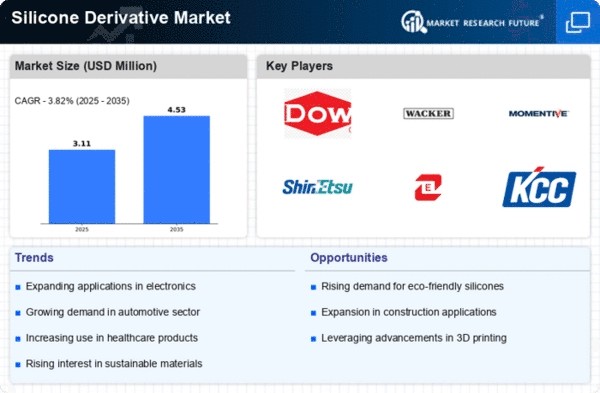
As per MRFR analysis, the Silicone Derivative Market Size was estimated at 3.0 USD Million in 2024. The Silicone Derivative industry is projected to grow from 3.11 in 2025 to 4.53 by 2035, exhibiting a compound annual growth rate (CAGR) of 3.82 during the forecast period 2025 - 2035.

Key Market Trends & Highlights

The Silicone Derivative Market is poised for robust growth driven by sustainability and technological advancements.

  • North America remains the largest market for silicone derivatives, driven by diverse industrial applications.
  • Asia-Pacific is the fastest-growing region, reflecting increasing demand across various sectors.
  • Adhesives represent the largest segment, while sealants are experiencing rapid growth due to expanding applications.
  • Key market drivers include rising demand in the automotive sector and a growing focus on sustainability and eco-friendly products.

Market Size & Forecast

2024 Market Size 3.0 (USD Million)
2035 Market Size 4.53 (USD Million)
CAGR (2025 - 2035) 3.82%
Largest Regional Market Share in 2024 North America

Major Players

<p>Dow Chemical (US), Wacker Chemie (DE), Momentive Performance Materials (US), Shin-Etsu Chemical (JP), Elkem (NO), KCC Corporation (KR), Hubei Xingfa Chemicals Group (CN), Silicone Solutions (US), China National Bluestar (Group) Co., Ltd. (CN)</p>

Market Trends

The Silicone Derivative Market is currently experiencing a dynamic evolution, driven by a confluence of technological advancements and increasing demand across various sectors. Industries such as automotive, electronics, and healthcare are increasingly integrating silicone derivatives into their products due to their unique properties, including thermal stability, chemical resistance, and flexibility. This growing adoption suggests a robust trajectory for the market, as manufacturers seek materials that enhance performance and sustainability. Furthermore, the ongoing innovation in silicone formulations appears to cater to specific applications, thereby expanding the market's reach and potential. In addition to technological progress, environmental considerations are shaping the Silicone Derivative Market. There is a noticeable shift towards eco-friendly alternatives, as consumers and regulatory bodies alike advocate for sustainable practices. This trend indicates that companies are likely to invest in research and development to create greener silicone derivatives, which could lead to a more sustainable future for the industry. As the market continues to evolve, it seems poised for growth, driven by both innovation and a commitment to environmental responsibility.

Sustainability Initiatives

The Silicone Derivative Market is witnessing a growing emphasis on sustainability, as manufacturers strive to develop eco-friendly products. This trend reflects a broader societal shift towards environmental consciousness, prompting companies to explore biodegradable and recyclable silicone options. Such initiatives not only cater to consumer preferences but also align with regulatory pressures aimed at reducing environmental impact.

Technological Advancements

Innovations in silicone chemistry are significantly influencing the Silicone Derivative Market. Enhanced formulations and processing techniques are enabling the production of high-performance silicone derivatives that meet the evolving needs of various industries. This trend suggests that ongoing research and development efforts will continue to drive market growth and diversification.

Expanding Applications

The versatility of silicone derivatives is leading to their increased use in diverse applications, ranging from personal care products to construction materials. This trend indicates a broadening scope for the Silicone Derivative Market, as industries recognize the benefits of incorporating silicone derivatives into their offerings, thereby enhancing product performance and consumer satisfaction.

Silicone Derivative Market Market Drivers

Rising Demand in Automotive Sector

The Global Silicone Derivative Market Industry experiences a notable surge in demand from the automotive sector, driven by the increasing adoption of silicone-based materials in vehicle manufacturing. These materials are utilized for their durability, heat resistance, and lightweight properties, which contribute to enhanced fuel efficiency and safety. As electric vehicles gain traction, the need for advanced silicone derivatives is expected to grow. In 2024, the market is projected to reach approximately 235.94 USD Billion, reflecting the automotive industry's shift towards sustainable and efficient materials. This trend indicates a robust growth trajectory for silicone derivatives in automotive applications.

Increasing Focus on Sustainable Materials

The Global Silicone Derivative Market Industry is witnessing a shift towards sustainable materials, driven by growing environmental awareness and regulatory pressures. Manufacturers are increasingly seeking silicone derivatives that offer eco-friendly properties, such as low VOC emissions and recyclability. This trend is particularly evident in industries like cosmetics and personal care, where consumers demand safer and more sustainable products. As companies adapt to these changing preferences, the market for silicone derivatives is expected to expand, potentially leading to innovative formulations and applications that align with sustainability goals, thereby enhancing the industry's overall growth.

Expansion in Electronics and Electrical Applications

The Global Silicone Derivative Market Industry is significantly influenced by the expansion of electronics and electrical applications. Silicone derivatives are increasingly employed in the production of insulating materials, adhesives, and sealants, which are essential for the performance and longevity of electronic devices. The proliferation of consumer electronics, coupled with advancements in technology, drives the demand for high-performance silicone materials. As the market evolves, it is anticipated that by 2035, the industry could reach a valuation of 541.32 USD Billion, highlighting the critical role of silicone derivatives in supporting the electronics sector's growth.

Growth in Construction and Infrastructure Development

The Global Silicone Derivative Market Industry benefits from the ongoing growth in construction and infrastructure development worldwide. Silicone derivatives are utilized in sealants, coatings, and adhesives, which are vital for ensuring structural integrity and durability in buildings and infrastructure projects. As urbanization accelerates and governments invest in infrastructure, the demand for high-performance silicone materials is likely to increase. This trend suggests a sustained growth rate, with a projected CAGR of 7.84% from 2025 to 2035, indicating that silicone derivatives will play a crucial role in meeting the needs of the construction sector.

Technological Advancements in Manufacturing Processes

The Global Silicone Derivative Market Industry is significantly impacted by technological advancements in manufacturing processes. Innovations in production techniques enhance the efficiency and quality of silicone derivatives, enabling manufacturers to meet the evolving demands of various industries. For instance, advancements in polymerization and curing processes lead to the development of high-performance silicone materials with superior properties. As these technologies continue to evolve, they are likely to drive market growth, allowing for the introduction of new products that cater to diverse applications across sectors such as automotive, electronics, and construction.

Market Segment Insights

By Application: Adhesives (Largest) vs. Sealants (Fastest-Growing)

<p>In the Silicone Derivative Market, the application segmentation reveals that adhesives hold the largest market share due to their widespread usage across multiple industries, notably construction and automotive. Coatings and elastomers follow but are less dominant. Sealants, while currently smaller in share, show impressive growth potential, indicating a shifting preference towards silicone-based solutions for their superior performance characteristics. The growth trends in this segment are driven by increased demand for high-performance adhesives and sealants in construction and automotive sectors, as well as rising consumer awareness regarding durable and environmentally friendly materials. Innovations in elastomers and surfactants also contribute to market evolution, as manufacturers seek versatile solutions to meet diverse application needs across various industries.</p>

<p>Adhesives: Dominant vs. Sealants: Emerging</p>

<p>Adhesives are the dominant force in the Silicone Derivative Market, known for their excellent bonding capabilities and versatility. They are essential in manufacturing, packaging, and construction, where reliable adhesion is critical. The demand for high-performance adhesives is bolstered by increasingly complex engineering challenges and consumer preference for durable solutions. Sealants, on the other hand, represent an emerging segment, rapidly gaining traction due to their effectiveness in preventing water, air, and moisture intrusion in construction applications. Their growth is fueled by stringent regulations encouraging energy-efficient building designs, as well as innovation in formulations that enhance performance. This dual dynamic enhances the market landscape, as stakeholders balance the strengths of established adhesives with the evolving needs driving sealant adoption.</p>

By End Use Industry: Automotive (Largest) vs. Electronics (Fastest-Growing)

<p>In the Silicone Derivative Market, the automotive sector has established itself as the dominant end-use industry, accounting for a significant portion of market share. In contrast, the electronics sector is gaining traction rapidly, driven by the increasing demand for advanced materials in electronic applications. Meanwhile, construction, healthcare, and personal care industries also contribute to market dynamics, albeit with lesser shares than automotive and electronics.</p>

<p>Automotive: Dominant vs. Electronics: Emerging</p>

<p>The automotive industry remains at the forefront of silicone derivative consumption, primarily due to the high demand for innovative materials that enhance performance and sustainability in vehicles. Silicone derivatives are utilized in various applications such as sealants, adhesives, and coatings, offering superior heat resistance and durability. On the other hand, the electronics industry is emerging as a vital component in this market, fueled by the proliferation of smart devices and the need for advanced insulation and encapsulation materials. This segment's growth is attributed to rapid technological advancements and an increasing focus on miniaturization and energy efficiency.</p>

By Product Type: Silicone Rubber (Largest) vs. Silicone Oils (Fastest-Growing)

<p>The Silicone Derivative Market is prominently characterized by its diverse product types, with Silicone Rubber leading in market share due to its extensive applications in various industries. Silicone Oils and Silicone Gels follow, catering to specific market niches with unique properties. Each segment showcases varying levels of demand driven by industrial applications and consumer trends, allowing for strategic focus on the more lucrative segments such as Silicone Rubber.</p>

<p>Silicone Rubber (Dominant) vs. Silicone Oils (Emerging)</p>

<p>Silicone Rubber stands as the dominant product type in the Silicone Derivative Market, mainly due to its exceptional performance attributes such as flexibility, durability, and heat resistance. It finds extensive applications in automotive, electronics, and construction sectors. On the other hand, Silicone Oils, which are emerging in popularity, possess unique lubricating properties and are gaining momentum in the cosmetics and personal care industries. Their growing use in formulations highlights a shift towards innovative solutions, showcasing the versatility and adaptability of silicone derivatives and creating a promising market outlook for these segments.</p>

By Formulation Type: One Component (Largest) vs. Two Component (Fastest-Growing)

<p>In the Silicone Derivative Market, the Formulation Type segment is characterized by a diverse range of product offerings. Among these, One Component formulations hold the largest market share, driven by their ease of use and compatibility across various applications. On the other hand, Two Component formulations are gaining traction as they provide enhanced performance features, positioning them as the fastest-growing segment within this category. This dynamic reflects the growing demand for more sophisticated product options in various industrial applications.</p>

<p>One Component (Dominant) vs. Two Component (Emerging)</p>

<p>One Component silicone derivatives are celebrated for their convenience and versatility, facilitating a seamless application process across multiple sectors such as construction, automotive, and electronics. Their ability to cure upon exposure to moisture significantly enhances their appeal, making them the dominant choice in many applications. Conversely, Two Component silicone derivatives, while requiring mixing at the point of use, present enhanced elasticity and strength, appealing to industries demanding performance-driven solutions. As industries evolve, the two-component systems showcase their capability to meet stringent performance standards, marking them as an emerging segment with significant potential for future growth.</p>

By Distribution Channel: Distributors (Largest) vs. Online Sales (Fastest-Growing)

<p>In the Silicone Derivative Market, distribution channels exhibit a varied landscape. Distributors hold the largest share, acting as a crucial link between manufacturers and end-users, thereby ensuring widespread availability. Following closely are direct sales, which benefit from direct manufacturer-to-consumer interactions, and retail, which contributes significantly to consumer accessibility. Online sales are emerging as a rapid channel, reflecting shifting consumer behaviors towards digital purchasing, further diversifying the market landscape.</p>

<p>Direct Sales (Dominant) vs. Retail (Emerging)</p>

<p>Direct sales are characterized by a strong one-on-one connection with customers, allowing manufacturers to establish brand loyalty and cater to specific consumer needs. This channel is dominant due to its effectiveness in niche markets and high-value segments where personalized service is paramount. In contrast, retail is an emerging channel that thrives on visibility and consumer footfall, providing a physical presence for products. As the market evolves, retailers are increasingly leveraging e-commerce platforms to enhance their offerings, blending the traditional storefront experience with the convenience of online shopping, thus gaining traction amongst consumers.</p>

Get more detailed insights about Silicone Derivative Market Research Report- Forecast to 2035

Regional Insights

North America : Market Leader in Silicone Derivatives

North America is poised to maintain its leadership in the Silicone Derivative Market, holding a market size of $1.2 billion in 2025. Key growth drivers include the increasing demand for silicone products in automotive, construction, and healthcare sectors. Regulatory support for sustainable materials and innovations in manufacturing processes further catalyze market expansion. The region's robust infrastructure and technological advancements also contribute to its market dominance. The competitive landscape in North America is characterized by major players such as Dow Chemical and Momentive Performance Materials, which are investing heavily in R&D to enhance product offerings. The U.S. leads the market, followed by Canada and Mexico, with a focus on eco-friendly silicone solutions. The presence of established companies and a growing number of startups fosters innovation, ensuring that North America remains at the forefront of the silicone derivatives industry.

Europe : Innovation and Sustainability Focus

Europe's Silicone Derivative Market is projected to reach $0.9 billion by 2025, driven by increasing demand for sustainable and eco-friendly products. Regulatory frameworks such as REACH and the European Green Deal are pushing manufacturers to innovate and adopt greener practices. The region's commitment to reducing carbon footprints and enhancing product safety is a significant catalyst for market growth, aligning with consumer preferences for environmentally responsible products. Germany, France, and the UK are leading the market, with companies like Wacker Chemie and Elkem spearheading advancements in silicone technology. The competitive landscape is marked by a strong emphasis on R&D, with firms investing in new applications for silicone derivatives across various industries. The presence of stringent regulations ensures that only high-quality, safe products are available, further enhancing market credibility.

Asia-Pacific : Emerging Market with High Potential

The Asia-Pacific region is witnessing rapid growth in the Silicone Derivative Market, projected to reach $0.7 billion by 2025. Key drivers include the booming automotive and electronics industries, alongside increasing urbanization and infrastructure development. Countries like China and India are experiencing significant demand for silicone products, driven by their expanding manufacturing sectors and rising consumer markets. Regulatory support for industrial growth further enhances market prospects in this region. China is the dominant player in the market, with companies like Hubei Xingfa Chemicals Group and China National Bluestar leading the charge. The competitive landscape is evolving, with both local and international players vying for market share. The region's focus on innovation and cost-effective production methods positions it as a critical hub for silicone derivatives, catering to both domestic and global markets.

Middle East and Africa : Emerging Market Opportunities

The Middle East and Africa (MEA) region is gradually emerging in the Silicone Derivative Market, with a market size of $0.2 billion projected for 2025. The growth is driven by increasing industrialization and infrastructure projects, particularly in the Gulf Cooperation Council (GCC) countries. The demand for silicone products in construction, automotive, and consumer goods is on the rise, supported by government initiatives to diversify economies and enhance manufacturing capabilities. Countries like the UAE and South Africa are leading the market, with a growing number of local manufacturers entering the silicone derivatives space. The competitive landscape is characterized by a mix of established players and new entrants, focusing on innovation and quality. As the region continues to develop, the silicone market is expected to expand, driven by both local demand and export opportunities.

Key Players and Competitive Insights

The Silicone Derivative Market is characterized by a dynamic competitive landscape, driven by innovation, sustainability, and strategic partnerships. Key players such as Dow Chemical (US), Wacker Chemie (DE), and Momentive Performance Materials (US) are actively shaping the market through their distinct operational focuses. Dow Chemical (US) emphasizes innovation in product development, particularly in eco-friendly silicone solutions, which aligns with the growing demand for sustainable materials. Wacker Chemie (DE) has adopted a strategy of regional expansion, enhancing its manufacturing capabilities in Asia to cater to the increasing demand in that region. Momentive Performance Materials (US) focuses on digital transformation, leveraging advanced technologies to optimize production processes and improve customer engagement. Collectively, these strategies contribute to a competitive environment that prioritizes technological advancement and sustainability.

The business tactics employed by these companies include localizing manufacturing and optimizing supply chains to enhance efficiency and responsiveness to market demands. The market structure appears moderately fragmented, with several key players exerting significant influence. This fragmentation allows for a diverse range of products and innovations, fostering competition that drives continuous improvement and adaptation among the players.

In November 2025, Dow Chemical (US) announced a partnership with a leading renewable energy firm to develop bio-based silicone products. This strategic move is likely to enhance Dow's portfolio of sustainable offerings, positioning the company favorably in a market increasingly focused on environmental responsibility. The collaboration may also facilitate access to new technologies and resources, further strengthening Dow's competitive edge.

In October 2025, Wacker Chemie (DE) launched a new line of silicone sealants specifically designed for the automotive industry. This product introduction is significant as it addresses the growing demand for high-performance materials in electric vehicles, indicating Wacker's commitment to innovation and responsiveness to industry trends. By targeting this niche market, Wacker may enhance its market share and establish itself as a leader in automotive silicone applications.

In September 2025, Momentive Performance Materials (US) unveiled a digital platform aimed at streamlining customer interactions and enhancing service delivery. This initiative reflects a broader trend towards digitalization within the industry, suggesting that Momentive is keen on leveraging technology to improve customer experience and operational efficiency. Such advancements may provide Momentive with a competitive advantage in an increasingly digital marketplace.

As of December 2025, current competitive trends in the Silicone Derivative Market include a pronounced focus on digitalization, sustainability, and the integration of AI technologies. Strategic alliances are becoming increasingly pivotal, enabling companies to pool resources and expertise to drive innovation. The competitive differentiation is likely to evolve from traditional price-based competition towards a landscape where innovation, technological advancement, and supply chain reliability take precedence. This shift indicates a transformative phase in the market, where companies that prioritize these elements may emerge as leaders.

Key Companies in the Silicone Derivative Market market include

Industry Developments

Future Outlook

Silicone Derivative Market Future Outlook

<p>The Silicone Derivative Market is projected to grow at 3.82% CAGR from 2024 to 2035, driven by increasing demand in automotive, construction, and healthcare sectors.</p>

New opportunities lie in:

  • <p>Development of bio-based silicone derivatives for sustainable applications.</p>
  • <p>Expansion into emerging markets with tailored product offerings.</p>
  • <p>Investment in R&D for innovative silicone applications in electronics.</p>

<p>By 2035, the market is expected to solidify its position as a key player in diverse industries.</p>

Market Segmentation

Silicone Derivative Market Application Outlook

  • Adhesives
  • Coatings
  • Sealants
  • Elastomers
  • Surfactants

Silicone Derivative Market Product Type Outlook

  • Silicone Oils
  • Silicone Resins
  • Silicone Gels
  • Silicone Rubber
  • Silicone Emulsions

Silicone Derivative Market End Use Industry Outlook

  • Automotive
  • Construction
  • Electronics
  • Healthcare
  • Personal Care

Silicone Derivative Market Formulation Type Outlook

  • One Component
  • Two Component
  • Multi Component
  • Pre-Cured
  • Liquid

Silicone Derivative Market Distribution Channel Outlook

  • Direct Sales
  • Distributors
  • Online Sales
  • Retail
  • Wholesale

Report Scope

MARKET SIZE 20243.0(USD Million)
MARKET SIZE 20253.11(USD Million)
MARKET SIZE 20354.53(USD Million)
COMPOUND ANNUAL GROWTH RATE (CAGR)3.82% (2024 - 2035)
REPORT COVERAGERevenue Forecast, Competitive Landscape, Growth Factors, and Trends
BASE YEAR2024
Market Forecast Period2025 - 2035
Historical Data2019 - 2024
Market Forecast UnitsUSD Million
Key Companies ProfiledDow Chemical (US), Wacker Chemie (DE), Momentive Performance Materials (US), Shin-Etsu Chemical (JP), Elkem (NO), KCC Corporation (KR), Hubei Xingfa Chemicals Group (CN), Silicone Solutions (US), China National Bluestar (Group) Co., Ltd. (CN)
Segments CoveredApplication, End Use Industry, Product Type, Formulation Type, Distribution Channel
Key Market OpportunitiesGrowing demand for eco-friendly silicone derivatives in automotive and construction sectors presents significant market opportunities.
Key Market DynamicsRising demand for eco-friendly silicone derivatives drives innovation and competition among manufacturers in diverse industries.
Countries CoveredNorth America, Europe, APAC, South America, MEA

FAQs

At what CAGR is the Silicone Derivative Market predicted to grow during the forecast period?

Silicone Derivative Market is predicted to grow at Substantial CAGR 6.20%through forecast period of 2025-2035

What is the forecast period of Silicone Derivative Market research report?

The forecast period for Silicone Derivative Market research report is 2025-2035.

Which region will lead the global Silicone Derivative Market?

Silicone Derivative Market is dominated by APAC region.

What are the key factors driving the Silicone Derivative Market ?

There is growing demand for Silicone Derivative from ever increasing construction activities

Who are the key players in the Silicone Derivative Market ?

Dow Corning Corporation (U.S.), Shin-Etsu Chemical Co., Ltd. (China), Wacker Chemie AG (Germany), Triveni chemicals (India), Zhenzhou Yellow River Emery Co., Ltd (China), Saint-Gobain Silicon Carbide (France), Xuancheng Crystal Clear New Materials Co., Ltd (China), aromachimie Company Ltd. (U.K.), Multimin-Egypt for Mining S.A.E (Egypt), Hisilco (China).

  1. Executive Summary
  2. Scope of the Report
    1. Market Definition
    2. Scope of the
      1. Research Objectives
      2. Assumptions & Limitations
    3. Study
    4. Markets Structure
    5. Market Research Methodology
    6. Research
    7. Process
    8. Secondary Research
    9. Primary Research
    10. Forecast Model
  3. Market Landscape
    1. Five Forces Analysis
      1. Bargaining
      2. Threat of substitutes
      3. Segment rivalry
    2. Threat of New Entrants
    3. power of buyers
    4. Value Chain/Supply Chain of Global Silicone Derivative Market
  4. Industry Overview of Global Silicone Derivative
    1. Market
    2. Introduction
    3. Growth Drivers
    4. Impact analysis
    5. Market Challenges
    6. Impact analysis
  5. Market Trends
    1. Introduction
    2. Growth Trends
    3. Impact analysis
  6. Global Silicone Derivative Market by Region
  7. Global Silicone Derivative Market by type (silicon
    1. dioxide (silica), silicon carbide, silicate, silicon nitride, and others)
    2. Global Silicone Derivative Market by end use industry (building
    3. & construction industry, automobile,
    4. electronics, energy, chemical, personal care, and others)
    5. Company Landscape
  8. Company Profiles
    1. Dow Corning Corporation
      1. Product/Business Segment Overview
      2. Financial Updates
      3. Key Developments
    2. Company Overview
    3. Shin-Etsu Chemical Co., Ltd.
      1. Company
      2. Product/Business Segment Overview
      3. Key Developments
      4. Company Overview
      5. Financial
      6. Key Developments
    4. Overview
    5. Financial Updates
    6. Wacker Chemie AG
    7. Product/Business Segment Overview
    8. Updates
    9. Triveni
      1. Company Overview
      2. Financial
      3. Key Developments
    10. chemicals
    11. Product/Business Segment Overview
    12. Updates
    13. Zhenzhou
      1. Company Overview
      2. Financial
      3. Key Developments
    14. Yellow River Emery Co., Ltd.
    15. Product/Business Segment Overview
    16. Updates
    17. Saint-Gobain
      1. Company Overview
      2. Financial
      3. Key Developments
    18. Silicon Carbide
    19. Product/Business Segment Overview
    20. Updates
    21. Xuancheng
      1. Company
      2. Product/Business Segment Overview
      3. Key Developments
      4. Company Overview
      5. Financial Updates
    22. Crystal Clear New Materials Co., Ltd.
    23. Overview
    24. Financial Updates
    25. Aromachimie Company Ltd.
    26. Product/Business Segment Overview
    27. Key Developments
    28. Multimin-Egypt for Mining S.A.E
      1. Company Overview
      2. Product/Business Segment Overview
      3. Financial Updates
      4. Key Developments
      5. Company Overview
      6. Product/Business Segment Overview
      7. Financial Updates
      8. Key Developments
    29. Hisilco
  9. Conclusion
    1. LIST OF TABLES:
  10. World Population
    1. by Major Regions (2020-2027)
  11. Global Silicone
    1. Derivative Market: By Region, 2020-2027
  12. North
    1. America Silicone Derivative Market: By Country, 2020-2027
    2. Table 4
    3. Europe Silicone Derivative Market: By Country, 2020-2027
    4. Table
  13. Asia-Pacific Silicone Derivative Market: By Country, 2020-2027
  14. Middle East & Africa Silicone Derivative
    1. Market: By Country, 2020-2027
  15. Latin America
    1. Silicone Derivative Market: By Country, 2020-2027
    2. Table 8
    3. Global Silicone Derivative by End use industry Market: By Regions, 2020-2027
  16. North America Silicone Derivative by End use
    1. industry Market: By Country, 2020-2027
  17. Europe Silicone
    1. Derivative by End use industry Market: By Country, 2020-2027
    2. Table
  18. Asia-Pacific Silicone Derivative by End use industry Market: By Country, 2020-2027
  19. Middle East & Africa Silicone Derivative by End use industry
    1. Market: By Country, 2020-2027
  20. Latin America Silicone
    1. Derivative by End use industry Market: By Country, 2020-2027
    2. Table
  21. North America Silicone Derivative for Type Market: By Country, 2020-2027
  22. Europe Silicone Derivative for Type Market: By Country,
  23. Asia-Pacific Silicone Derivative for Type Market:
    1. By Country, 2020-2027
  24. Middle East & Africa Silicone Derivative
    1. for Type Market: By Country, 2020-2027
  25. Latin America Silicone
    1. Derivative for Type Market: By Country, 2020-2027
  26. Global End
    1. use industry Market: By Region, 2020-2027
  27. Global Type
    1. Market: By Region, 2020-2027
  28. North America Silicone Derivative
  29. Market, By Country
  30. North America Silicone Derivative
  31. Market, By End use industry
  32. North America Silicone Derivative
  33. Market, By Type
  34. Europe : Silicone Derivative Market, By Country
  35. Europe : Silicone Derivative Market, By End use industry
  36. Europe : Silicone Derivative Market, By Type
  37. Asia-Pacific:
  38. Silicone Derivative Market, By Country
  39. Asia-Pacific: Silicone
  40. Derivative Market, By End use industry
  41. Asia-Pacific:
  42. Silicone Derivative Market, By Type
  43. Middle East & Africa:
  44. Silicone Derivative Market, By Country
  45. Middle East & Africa
  46. Silicone Derivative Market, By End use industry
  47. Middle
  48. East & Africa: Silicone Derivative Market, By Type
  49. Latin
  50. America: Silicone Derivative Market, By Country
  51. Latin America
  52. Silicone Derivative Market, By End use industry
  53. Latin
  54. America: Silicone Derivative Market, By Type
    1. LIST OF FIGURES:
  55. Global Silicone Derivative Market
    1. segmentation
  56. Forecast Methodology
  57. Five Forces
    1. Analysis of Global Silicone Derivative Market
  58. Value Chain of
    1. Global Silicone Derivative Market
  59. Share of Global Silicone Derivative
  60. Market in 2020, by country (in %)
  61. Global Silicone Derivative
    1. Market, 2020-2027, (USD billion)
  62. Sub-segments of end user
  63. Global Silicone Derivative Market size by Type, 2020
    1. FIGURE
  64. Share of Global Silicone Derivative Market by Type, 2020-2027
  65. Global Silicone Derivative Market size by End
    1. use industry, 2020
  66. Share of Global Silicone Derivative Market by
    1. End use industry, 2020-2027

Silicone Derivative Market Segmentation

Market Segmentation Overview

  • Detailed segmentation data will be available in the full report
  • Comprehensive analysis by multiple parameters
  • Regional and country-level breakdowns
  • Market size forecasts by segment
Infographic

Free Sample Request

Kindly complete the form below to receive a free sample of this Report

Get Free Sample

Customer Strories

Compare Licence

×
Features License Type
Single User Multiuser License Enterprise User
Price $4,950 $5,950 $7,250
Maximum User Access Limit 1 User Upto 10 Users Unrestricted Access Throughout the Organization
Free Customization
Direct Access to Analyst
Deliverable Format
Platform Access
Discount on Next Purchase 10% 15% 15%
Printable Versions