Request Free Sample ×

Kindly complete the form below to receive a free sample of this Report

* Please use a valid business email

Leading companies partner with us for data-driven Insights

clients tt-cursor
Hero Background
English
Chinese
French
Japanese
Korean
German
Spanish

Semiconductor Materials Market Trends

ID: MRFR/CnM/7133-HCR
185 Pages
Anshula Mandaokar
March 2026

Semiconductor Materials Market Research Report Information By Product (Fab Materials, Packaging Materials), By Application (Computers, Communications), And By Region (North America, Europe, Asia-Pacific, And Rest Of The World) – Market Forecast Till 2035

Share:
Download PDF ×

We do not share your information with anyone. However, we may send you emails based on your report interest from time to time. You may contact us at any time to opt-out.

Semiconductor Materials Market Infographic
Purchase Options

Market Trends

Key Emerging Trends in the Semiconductor Materials Market

The Global market for Semiconductor Materials is undertaking dynamic shifts propelled by shifting consumer preferences, the global demand for electronic devices, and technological developments. A sizable trend in the Global market for Semiconductor Materials is the persistent momentum for shrinking. Expanded packaging technologies, such as wafer-level packaging and 3D packaging, are gaining recognition to fulfill the demand for more efficient, smaller electronic gadgets.

The explosion of IoT gadgets is molding the Global market for Semiconductor Materials. As the number of connected gadgets continues to grow, there is a soaring demand for materials that facilitate the production of communication devices, sensors, and IoT components.

The province is undergoing a move towards wide bandgap semiconductors, such as silicon carbide (SiC) and gallium nitride (GaN). The Global market for Semiconductor Materials is concentrating on building durable and varied supply chains. The field is reassessing its dependency on specific regions to deal with challenges in the logistics of raw materials and augmenting general supply chain flexibility.

The expanding demand for expanded memory solutions, including DRAM and NAND flash, is a sizable trend. Semiconductor materials strengthening the fabrication of high-performance, high-density memory sections are undergoing heightened demand.

The chase of quantum computing technologies is swaying the Global market for Semiconductor Materials. Items that qualify the expansion of qubits and encourage quantum computing research are becoming zones of interest for semiconductor manufacturers.

As semiconductor fabrication processes advance, there is a repeated constraint for materials that accelerate finer planning and pledge, pushing innovation in photolithography. Compound semiconductors involving materials like indium phosphide (InP) and gallium arsenide (GaAs) are gaining fame. These materials propound distinctive properties that are beneficial for given applications, supporting their rising use in semiconductor manufacturing.

Collaboration and research initiatives on a global scale are shaping the Global market for Semiconductor Materials. The escalating demand for specialty chemicals and gases in semiconductor manufacturing developments is expanding. These materials act as an important part of procedures such as etching and chemical vapor deposition (CVD), backing the production of advanced semiconductor devices.

Author
Author Profile
Anshula Mandaokar
Team Lead - Research

Anshula Mandaokar holds an academic degree in Chemical Engineering and has been contributing to the field for more than 5 years. She has expertise in Market Research and Business Consulting and serves as a Team Lead for a reputed Market Research firm under the Chemicals and Materials domain spectrum. She has worked on multiple projects, generating explicit results in a quick turnaround time. Her understanding of data interpretation justifies her role as a leader.

Leave a Comment

FAQs

What is the projected market valuation of the Semiconductor Materials Market by 2035?

<p>The Semiconductor Materials Market is projected to reach a valuation of 105.23 USD Billion by 2035.</p>

What was the market valuation of the Semiconductor Materials Market in 2024?

<p>In 2024, the Semiconductor Materials Market was valued at 65.17 USD Billion.</p>

What is the expected CAGR for the Semiconductor Materials Market during the forecast period 2025 - 2035?

<p>The expected CAGR for the Semiconductor Materials Market during the forecast period 2025 - 2035 is 4.45%.</p>

Which companies are considered key players in the Semiconductor Materials Market?

<p>Key players in the Semiconductor Materials Market include Applied Materials, Lam Research, Tokyo Electron, ASML, KLA Corporation, Merck Group, BASF, Sumco Corporation, and Shin-Etsu Chemical.</p>

What are the main product segments in the Semiconductor Materials Market?

<p>The main product segments in the Semiconductor Materials Market are Fab Materials, valued at 48.0 USD Billion, and Packaging Materials, valued at 57.23 USD Billion.</p>

How do the application segments of the Semiconductor Materials Market break down?

<p>The application segments include Computers at 24.0 USD Billion, Communications at 30.0 USD Billion, Consumer Goods at 15.0 USD Billion, Defense & Aerospace at 12.0 USD Billion, and Others at 24.23 USD Billion.</p>

What growth trends are observed in the Semiconductor Materials Market from 2024 to 2035?

The Semiconductor Materials Market is expected to experience growth, increasing from 65.17 USD Billion in 2024 to 105.23 USD Billion by 2035.

Which product segment is expected to grow the most in the Semiconductor Materials Market?

The Packaging Materials segment, valued at 57.23 USD Billion, appears to be a strong contender for growth in the Semiconductor Materials Market.

What factors might influence the growth of the Semiconductor Materials Market?

Factors influencing growth may include advancements in technology, increased demand for electronics, and innovations from key players like ASML and KLA Corporation.

How does the Semiconductor Materials Market compare to other technology sectors?

While the Semiconductor Materials Market is projected to grow steadily, its performance may be influenced by trends in related technology sectors, particularly in communications and consumer goods.

Market Summary

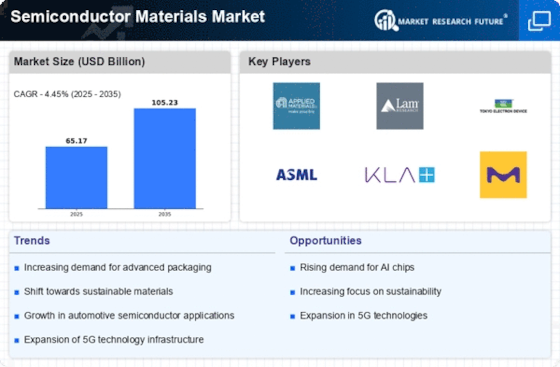
As per Market Research Future analysis, the Semiconductor Materials Market Size was estimated at 65.17 USD Billion in 2024. The semiconductor materials industry is projected to grow from 68.07 USD Billion in 2025 to 105.23 USD Billion by 2035, exhibiting a compound annual growth rate (CAGR) of 4.45% during the forecast period 2025 - 2035

Key Market Trends & Highlights

The Semiconductor Materials Market is poised for robust growth driven by technological advancements and sustainability initiatives.

  • North America remains the largest market for semiconductor materials, reflecting its strong consumer electronics sector. Asia-Pacific is the fastest-growing region, propelled by increasing investments in telecommunications infrastructure. Fab materials dominate the market, while packaging materials are emerging as the fastest-growing segment due to miniaturization trends. Rising demand for consumer electronics and growth in automotive electronics are key drivers influencing market expansion.

Market Size & Forecast

2024 Market Size 65.17 (USD Billion)
2035 Market Size 105.23 (USD Billion)
CAGR (2025 - 2035) 4.45%
Largest Regional Market Share in 2024 North America

Major Players

Applied Materials (US), Lam Research (US), Tokyo Electron (JP), ASML (NL), KLA Corporation (US), Merck Group (DE), BASF (DE), Sumco Corporation (JP), Shin-Etsu Chemical (JP)

Market Trends

The Semiconductor Materials Market is currently experiencing a dynamic evolution, driven by the increasing demand for advanced electronic devices and the ongoing miniaturization of technology. This market encompasses a wide range of materials, including silicon, gallium arsenide, and various compounds essential for the production of semiconductors, forming the backbone of the broader compound semiconductor materials market. . As industries such as automotive, telecommunications, and consumer electronics continue to expand, the need for high-performance materials becomes more pronounced. Furthermore, the rise of emerging technologies, such as artificial intelligence and the Internet of Things, is likely to further propel the market forward, as these innovations require sophisticated semiconductor solutions. In addition to technological advancements, sustainability concerns are influencing the Semiconductor Materials Market.

Manufacturers are increasingly focusing on eco-friendly materials and processes to reduce environmental impact. This shift towards sustainable practices may lead to the development of new materials that not only meet performance standards but also align with global environmental goals. As the market adapts to these changes, it appears poised for growth, with opportunities for innovation and collaboration across various sectors. The interplay between technological progress and sustainability will likely shape the future landscape of the Semiconductor Materials Market.

Sustainability Initiatives

The Semiconductor Materials Market is witnessing a growing emphasis on sustainability, as companies strive to minimize their environmental footprint. This trend involves the adoption of eco-friendly materials and processes, which may lead to the development of innovative solutions that align with global sustainability goals.

Technological Advancements

Rapid advancements in technology are significantly impacting the Semiconductor Materials Market. The increasing demand for high-performance semiconductors in applications such as artificial intelligence and the Internet of Things is driving the need for advanced materials that can support these innovations.

Miniaturization of Devices

The ongoing trend of miniaturization in electronic devices is influencing the Semiconductor Materials Market. As manufacturers seek to create smaller, more efficient components, the demand for specialized materials that can meet these requirements is likely to rise, fostering further innovation in the sector.

Semiconductor Materials Market Market Drivers

Growth in Automotive Electronics

The Semiconductor Materials Market is significantly influenced by the automotive sector, which is increasingly integrating advanced electronics into vehicles. The shift towards electric vehicles (EVs) and autonomous driving technologies is driving the demand for specialized semiconductor materials. In 2025, the automotive segment is expected to represent around 25% of the semiconductor materials market. This growth is attributed to the need for high-performance materials that can withstand the rigorous conditions of automotive applications. Furthermore, the transition to EVs necessitates the use of advanced semiconductor materials for battery management systems and power electronics, thereby creating new opportunities for manufacturers in the semiconductor materials space.

Rising Demand for Consumer Electronics

The Semiconductor Materials Market is experiencing a surge in demand driven by the increasing consumption of consumer electronics. As more households adopt smart devices, the need for advanced semiconductor materials becomes paramount. In 2025, the consumer electronics sector is projected to account for approximately 30% of the total semiconductor materials demand. This trend is likely to continue as innovations in smartphones, tablets, and wearables necessitate more sophisticated materials to enhance performance and energy efficiency. The proliferation of Internet of Things (IoT) devices further amplifies this demand, as these devices require reliable and efficient semiconductor components. Consequently, manufacturers are compelled to invest in high-quality semiconductor materials to meet the evolving needs of consumers.

Sustainability and Environmental Regulations

The Semiconductor Materials Market is increasingly influenced by sustainability initiatives and environmental regulations. As governments and organizations prioritize eco-friendly practices, semiconductor manufacturers are compelled to adopt sustainable materials and processes. In 2025, it is expected that a significant portion of the semiconductor materials market will be driven by the demand for environmentally friendly alternatives. This shift is likely to result in the development of new materials that minimize environmental impact while maintaining performance standards. Additionally, compliance with stringent regulations will push manufacturers to innovate and invest in sustainable practices, thereby shaping the future landscape of the semiconductor materials market.

Expansion of Telecommunications Infrastructure

The Semiconductor Materials Market is poised for growth due to the expansion of telecommunications infrastructure, particularly with the rollout of 5G technology. As telecommunications companies invest heavily in upgrading their networks, the demand for semiconductor materials is expected to rise. In 2025, the telecommunications sector is projected to contribute approximately 20% to the overall semiconductor materials market. The implementation of 5G networks requires advanced semiconductor components that can support higher frequencies and data rates. This necessitates the use of specialized materials that enhance signal integrity and reduce power consumption. As a result, semiconductor manufacturers are likely to focus on developing innovative materials tailored for the telecommunications industry.

Increased Investment in Research and Development

The Semiconductor Materials Market is benefiting from heightened investment in research and development (R&D) activities. Companies are increasingly allocating resources to innovate and develop new materials that can meet the demands of emerging technologies. In 2025, R&D spending in the semiconductor sector is anticipated to reach unprecedented levels, reflecting a commitment to advancing material science. This investment is crucial for developing next-generation semiconductor materials that can support applications in artificial intelligence, machine learning, and quantum computing. As the industry evolves, the focus on R&D will likely lead to breakthroughs that enhance the performance and efficiency of semiconductor materials, thereby driving market growth.

Market Segment Insights

By Product: Fab Materials (Largest) vs. Packaging Materials (Fastest-Growing)

<p>In the Semiconductor Materials Market, the distribution of market share among key product segments reveals a clear hierarchy. Fab Materials hold the largest share, playing a crucial role in the manufacturing processes of semiconductors. These materials are essential for fabricating integrated circuits and other semiconductor components, sustaining their dominant position. On the other hand, Packaging Materials, while smaller in share, are rapidly gaining traction due to the increasing focus on advanced packaging solutions that enhance performance and efficiency in electronic devices.</p>

<p>Materials: Fab (Dominant) vs. Packaging (Emerging)</p>

<p>Fab Materials are at the forefront of the Semiconductor Materials Market, comprising essential components used during the fabrication of semiconductor devices. They include various chemicals and substrates vital for producing chips, which are indispensable in modern electronics. These materials are characterized by their stability and precision, ensuring high yields and quality. Conversely, Packaging Materials represent an emerging but significant sector within the market, as they adapt to the growing demands for compact, efficient, and high-performance semiconductor solutions. Innovations in this segment are driven by technological advances in packaging design that enhance device functionality, portability, and thermal management.</p>

By Application: Computers (Largest) vs. Communications (Fastest-Growing)

<p>In the Semiconductor Materials Market, the application segment showcases a diverse distribution of market share across various values. Computers hold the largest share, driven by the demand for high-performance semiconductors to support computing operations. Following closely is the communications sector, which has been steadily increasing its share due to the growing reliance on advanced connectivity technologies. Other applications like consumer goods and defense contribute to a significant but smaller share, highlighting the necessity of semiconductor materials in these industries as well.</p>

<p>Computers: Dominant vs. Communications: Emerging</p>

<p>The Computers application segment stands as the dominant force in the Semiconductor Materials Market, largely due to the incessant need for improved processing capabilities in personal and enterprise-level computing devices. This segment utilizes a variety of semiconductor materials that enhance performance and energy efficiency, leading to rapid technological advancements. On the other hand, the Communications sector is rapidly emerging, fueled by innovations in 5G technology and the increasing demand for faster data transfer and connectivity solutions. As businesses and consumers continue to prioritize seamless communication, this segment is witnessing a surge in investment and research, positioning it as a key player in the future of the semiconductor landscape.</p>

Get more detailed insights about Semiconductor Materials Market Research Report - Forecast till 2035

Regional Insights

North America : Innovation and Leadership Hub

North America remains the largest market for semiconductor materials, holding approximately 40% of the global share. The region's growth is driven by robust demand from the automotive and consumer electronics sectors, alongside significant investments in R&D. Regulatory support for technology innovation and sustainability initiatives further catalyze market expansion. The U.S. government’s focus on semiconductor supply chain resilience is a key driver for future growth. The competitive landscape is characterized by major players such as Applied Materials, Lam Research, and KLA Corporation, which are at the forefront of technological advancements. The presence of these companies fosters a vibrant ecosystem for innovation. Additionally, the U.S. and Canada are leading in semiconductor manufacturing capabilities, ensuring a steady supply of high-quality materials to meet increasing global demand.

Europe : Emerging Semiconductor Powerhouse

Europe is witnessing a significant transformation in its semiconductor materials market, projected to hold around 25% of the global share by 2025. The region's growth is fueled by increasing investments in semiconductor manufacturing and a strong push towards digitalization and green technologies. Regulatory frameworks, such as the European Chips Act, aim to enhance local production capabilities and reduce dependency on external suppliers, further driving market demand. Leading countries in this region include Germany, France, and the Netherlands, with Germany being the largest market. The UK semiconductor materials market is also gaining attention due to strategic investments in research and advanced chip design. Key players like ASML and Merck Group are pivotal in advancing semiconductor technologies. The competitive landscape is evolving, with a focus on collaboration between industry and academia to foster innovation and maintain Europe's competitive edge in the global semiconductor supply chain.

Asia-Pacific : Manufacturing and Innovation Hub

Asia-Pacific is the second-largest market for semiconductor materials, accounting for approximately 30% of the global share. The region's growth is primarily driven by the booming electronics industry, particularly in countries like China, Japan, and South Korea. Government initiatives to promote semiconductor manufacturing and innovation, along with increasing demand for consumer electronics, are key factors propelling market expansion. The region is also witnessing a shift towards advanced materials to enhance semiconductor performance. China is the largest market in Asia-Pacific, followed by Japan and South Korea. Major players such as Tokyo Electron and Shin-Etsu Chemical are instrumental in driving technological advancements. The competitive landscape is marked by rapid innovation and collaboration among companies to meet the growing demand for high-performance semiconductor materials, ensuring the region's pivotal role in the global market.

Middle East and Africa : Emerging Market Potential

The Middle East and Africa region is gradually emerging in the semiconductor materials market, currently holding about 5% of the global share. The growth is driven by increasing investments in technology infrastructure and a rising demand for electronics. Governments in the region are focusing on diversifying their economies and enhancing local manufacturing capabilities, which is expected to boost the semiconductor sector significantly in the coming years. Countries like South Africa and the UAE are leading the charge in developing their semiconductor industries. The competitive landscape is still developing, with opportunities for both local and international players to establish a foothold. As the region invests in technology and innovation, the presence of key players is expected to grow, fostering a more robust semiconductor ecosystem.

Key Players and Competitive Insights

Major market players are spending a lot of money on R&D to increase their product lines, which will help the Semiconductor Materials Market grow even more. Market participants are also taking a range of strategic initiatives to grow their worldwide footprint, with key market developments such as new product launches, contractual agreements, mergers and acquisitions, increased investments, and collaboration with other organizations. Competitors in the Semiconductor Materials industry must offer cost-effective items to expand and survive in an increasingly competitive and rising market environment. The major market players are investing a lot of money in R&D to expand their product lines, which will spur further market growth for Semiconductor Materials Market. With significant market development like new product releases, contractual agreements, mergers and acquisitions, increased investments, and collaboration with other organizations, market participants are also undertaking various strategic activities to expand their global presence. To grow and thrive in a market climate that is becoming more competitive and growing, competitors in the Semiconductor Materials industry must offer affordable products. Manufacturing locally to cut operating costs is one of the main business tactics manufacturers use in the global Semiconductor Materials industry to benefit customers and expand the market sector. The Semiconductor Materials Market has recently given medicine some of the most important advantages. Major Semiconductor Materials Market players, including BASF SE, Cabot Microelectronics, DowDuPont, Hemlock Semiconductor, and others, are attempting to increase market demand by funding R&D initiatives. ASF is a company that provides petrochemicals, intermediates, performance materials, monomers, dispersions and pigments, performance chemicals, catalysts, coatings, and care chemicals. It conducts its operations through six business segments: Chemicals, Materials, Industrial Solutions, Surface Technologies, Nutrition and Care, and Agricultural Solutions. Also, DowDuPont is a chemical holding company that specializes in agriculture, materials science, and specialty products. Its solutions include seed-applied technologies, crop protection, performance materials and coatings, industrial intermediates, specialty plastics, imaging, biotechnology, nutrition ingredients, construction materials, sustainable solutions, advanced polymers, etc.

Key Companies in the Semiconductor Materials Market include

Industry Developments

  • Q2 2024: Japan's Showa Denko to acquire semiconductor materials unit from Hitachi Chemical Showa Denko announced the acquisition of Hitachi Chemical's semiconductor materials business, aiming to expand its portfolio in advanced materials for chip manufacturing.
  • Q2 2024: Entegris opens new semiconductor materials plant in Taiwan Entegris inaugurated a new manufacturing facility in Hsinchu, Taiwan, to boost production of specialty chemicals and filtration products for the semiconductor industry.
  • Q3 2024: Merck KGaA announces $300 million investment in US semiconductor materials site Merck KGaA revealed plans to invest $300 million in expanding its semiconductor materials production site in Arizona, targeting increased supply for North American chipmakers.
  • Q3 2024: DuPont launches new advanced photoresist for EUV lithography DuPont introduced a next-generation photoresist material designed for extreme ultraviolet (EUV) lithography, supporting the production of cutting-edge semiconductor devices.

  • Q4 2024: JSR Corporation and Samsung Electronics sign strategic partnership for advanced materials JSR Corporation entered a strategic partnership with Samsung Electronics to co-develop advanced semiconductor materials for next-generation memory and logic chips.
  • Q4 2024: Cabot Microelectronics wins major CMP slurry supply contract with TSMC Cabot Microelectronics secured a multi-year contract to supply chemical mechanical planarization (CMP) slurries to TSMC's advanced fabrication facilities.
  • Q1 2025: SK Materials completes acquisition of US-based Versum Materials SK Materials finalized its acquisition of Versum Materials, strengthening its global position in specialty gases and chemicals for semiconductor manufacturing.
  • Q1 2025: ASM International opens new R&D center for atomic layer deposition materials ASM International launched a new research and development center in the Netherlands focused on atomic layer deposition (ALD) materials for advanced semiconductor nodes.
  • Q2 2025: BASF and Intel sign long-term supply agreement for high-purity chemicals BASF entered a long-term agreement to supply high-purity chemicals to Intel's new semiconductor fabs in Ohio, supporting advanced chip manufacturing processes.
  • Q2 2025: Sumitomo Chemical launches new line of advanced packaging materials Sumitomo Chemical unveiled a new product line of advanced packaging materials designed to enable higher performance and miniaturization in semiconductor devices.

  • Q3 2025: Applied Materials announces $500 million expansion of semiconductor materials facility in Texas Applied Materials announced a $500 million investment to expand its semiconductor materials manufacturing facility in Texas, aiming to meet growing demand from US chipmakers.
  • Q3 2025: Avantor secures funding for new semiconductor materials plant in South Korea Avantor received government approval and funding to build a new plant in South Korea dedicated to producing ultra-high purity materials for semiconductor fabrication.

Future Outlook

Semiconductor Materials Market Future Outlook

The Semiconductor Materials Market is projected to grow at a 4.45% CAGR from 2025 to 2035, driven by advancements in technology, increasing demand for electronics, and the rise of electric vehicles.

New opportunities lie in:

  • <p>Development of advanced semiconductor materials for 5G applications. Investment in sustainable sourcing of raw materials to enhance supply chain resilience. Expansion into emerging markets with tailored semiconductor solutions.</p>

By 2035, the Semiconductor Materials Market is expected to achieve robust growth, reflecting evolving technological demands.

Market Segmentation

Semiconductor Materials Market Product Outlook

  • Fab Materials
  • Packaging Materials

Semiconductor Materials Market Application Outlook

  • Computers
  • Communications
  • Consumer Goods
  • Defense & Aerospace
  • Others

Report Scope

MARKET SIZE 2024 65.17(USD Billion)
MARKET SIZE 2025 68.07(USD Billion)
MARKET SIZE 2035 105.23(USD Billion)
COMPOUND ANNUAL GROWTH RATE (CAGR) 4.45% (2025 - 2035)
REPORT COVERAGE Revenue Forecast, Competitive Landscape, Growth Factors, and Trends
BASE YEAR 2024
Market Forecast Period 2025 - 2035
Historical Data 2019 - 2024
Market Forecast Units USD Billion
Key Companies Profiled Applied Materials (US), Lam Research (US), Tokyo Electron (JP), ASML (NL), KLA Corporation (US), Merck Group (DE), BASF (DE), Sumco Corporation (JP), Shin-Etsu Chemical (JP)
Segments Covered Product, Application, Region
Key Market Opportunities Advancements in electric vehicle technology drive demand for innovative semiconductor materials.
Key Market Dynamics Technological advancements drive demand for innovative semiconductor materials, influencing competitive dynamics and supply chain strategies.
Countries Covered North America, Europe, APAC, South America, MEA

FAQs

What is the projected market valuation of the Semiconductor Materials Market by 2035?

<p>The Semiconductor Materials Market is projected to reach a valuation of 105.23 USD Billion by 2035.</p>

What was the market valuation of the Semiconductor Materials Market in 2024?

<p>In 2024, the Semiconductor Materials Market was valued at 65.17 USD Billion.</p>

What is the expected CAGR for the Semiconductor Materials Market during the forecast period 2025 - 2035?

<p>The expected CAGR for the Semiconductor Materials Market during the forecast period 2025 - 2035 is 4.45%.</p>

Which companies are considered key players in the Semiconductor Materials Market?

<p>Key players in the Semiconductor Materials Market include Applied Materials, Lam Research, Tokyo Electron, ASML, KLA Corporation, Merck Group, BASF, Sumco Corporation, and Shin-Etsu Chemical.</p>

What are the main product segments in the Semiconductor Materials Market?

<p>The main product segments in the Semiconductor Materials Market are Fab Materials, valued at 48.0 USD Billion, and Packaging Materials, valued at 57.23 USD Billion.</p>

How do the application segments of the Semiconductor Materials Market break down?

<p>The application segments include Computers at 24.0 USD Billion, Communications at 30.0 USD Billion, Consumer Goods at 15.0 USD Billion, Defense & Aerospace at 12.0 USD Billion, and Others at 24.23 USD Billion.</p>

What growth trends are observed in the Semiconductor Materials Market from 2024 to 2035?

The Semiconductor Materials Market is expected to experience growth, increasing from 65.17 USD Billion in 2024 to 105.23 USD Billion by 2035.

Which product segment is expected to grow the most in the Semiconductor Materials Market?

The Packaging Materials segment, valued at 57.23 USD Billion, appears to be a strong contender for growth in the Semiconductor Materials Market.

What factors might influence the growth of the Semiconductor Materials Market?

Factors influencing growth may include advancements in technology, increased demand for electronics, and innovations from key players like ASML and KLA Corporation.

How does the Semiconductor Materials Market compare to other technology sectors?

While the Semiconductor Materials Market is projected to grow steadily, its performance may be influenced by trends in related technology sectors, particularly in communications and consumer goods.

  1. SECTION I: EXECUTIVE SUMMARY AND KEY HIGHLIGHTS
    1. | 1.1 EXECUTIVE SUMMARY
    2. | | 1.1.1 Market Overview
    3. | | 1.1.2 Key Findings
    4. | | 1.1.3 Market Segmentation
    5. | | 1.1.4 Competitive Landscape
    6. | | 1.1.5 Challenges and Opportunities
    7. | | 1.1.6 Future Outlook
  2. SECTION II: SCOPING, METHODOLOGY AND MARKET STRUCTURE
    1. | 2.1 MARKET INTRODUCTION
    2. | | 2.1.1 Definition
    3. | | 2.1.2 Scope of the study
    4. | | | 2.1.2.1 Research Objective
    5. | | | 2.1.2.2 Assumption
    6. | | | 2.1.2.3 Limitations
    7. | 2.2 RESEARCH METHODOLOGY
    8. | | 2.2.1 Overview
    9. | | 2.2.2 Data Mining
    10. | | 2.2.3 Secondary Research
    11. | | 2.2.4 Primary Research
    12. | | | 2.2.4.1 Primary Interviews and Information Gathering Process
    13. | | | 2.2.4.2 Breakdown of Primary Respondents
    14. | | 2.2.5 Forecasting Model
    15. | | 2.2.6 Market Size Estimation
    16. | | | 2.2.6.1 Bottom-Up Approach
    17. | | | 2.2.6.2 Top-Down Approach
    18. | | 2.2.7 Data Triangulation
    19. | | 2.2.8 Validation
  3. SECTION III: QUALITATIVE ANALYSIS
    1. | 3.1 MARKET DYNAMICS
    2. | | 3.1.1 Overview
    3. | | 3.1.2 Drivers
    4. | | 3.1.3 Restraints
    5. | | 3.1.4 Opportunities
    6. | 3.2 MARKET FACTOR ANALYSIS
    7. | | 3.2.1 Value chain Analysis
    8. | | 3.2.2 Porter's Five Forces Analysis
    9. | | | 3.2.2.1 Bargaining Power of Suppliers
    10. | | | 3.2.2.2 Bargaining Power of Buyers
    11. | | | 3.2.2.3 Threat of New Entrants
    12. | | | 3.2.2.4 Threat of Substitutes
    13. | | | 3.2.2.5 Intensity of Rivalry
    14. | | 3.2.3 COVID-19 Impact Analysis
    15. | | | 3.2.3.1 Market Impact Analysis
    16. | | | 3.2.3.2 Regional Impact
    17. | | | 3.2.3.3 Opportunity and Threat Analysis
  4. SECTION IV: QUANTITATIVE ANALYSIS
    1. | 4.1 Chemicals and Materials, BY Product (USD Billion)
    2. | | 4.1.1 Fab Materials
    3. | | 4.1.2 Packaging Materials
    4. | 4.2 Chemicals and Materials, BY Application (USD Billion)
    5. | | 4.2.1 Computers
    6. | | 4.2.2 Communications
    7. | | 4.2.3 Consumer Goods
    8. | | 4.2.4 Defense & Aerospace
    9. | | 4.2.5 Others
    10. | 4.3 Chemicals and Materials, BY Region (USD Billion)
    11. | | 4.3.1 North America
    12. | | | 4.3.1.1 US
    13. | | | 4.3.1.2 Canada
    14. | | 4.3.2 Europe
    15. | | | 4.3.2.1 Germany
    16. | | | 4.3.2.2 UK
    17. | | | 4.3.2.3 France
    18. | | | 4.3.2.4 Russia
    19. | | | 4.3.2.5 Italy
    20. | | | 4.3.2.6 Spain
    21. | | | 4.3.2.7 Rest of Europe
    22. | | 4.3.3 APAC
    23. | | | 4.3.3.1 China
    24. | | | 4.3.3.2 India
    25. | | | 4.3.3.3 Japan
    26. | | | 4.3.3.4 South Korea
    27. | | | 4.3.3.5 Malaysia
    28. | | | 4.3.3.6 Thailand
    29. | | | 4.3.3.7 Indonesia
    30. | | | 4.3.3.8 Rest of APAC
    31. | | 4.3.4 South America
    32. | | | 4.3.4.1 Brazil
    33. | | | 4.3.4.2 Mexico
    34. | | | 4.3.4.3 Argentina
    35. | | | 4.3.4.4 Rest of South America
    36. | | 4.3.5 MEA
    37. | | | 4.3.5.1 GCC Countries
    38. | | | 4.3.5.2 South Africa
    39. | | | 4.3.5.3 Rest of MEA
  5. SECTION V: COMPETITIVE ANALYSIS
    1. | 5.1 Competitive Landscape
    2. | | 5.1.1 Overview
    3. | | 5.1.2 Competitive Analysis
    4. | | 5.1.3 Market share Analysis
    5. | | 5.1.4 Major Growth Strategy in the Chemicals and Materials
    6. | | 5.1.5 Competitive Benchmarking
    7. | | 5.1.6 Leading Players in Terms of Number of Developments in the Chemicals and Materials
    8. | | 5.1.7 Key developments and growth strategies
    9. | | | 5.1.7.1 New Product Launch/Service Deployment
    10. | | | 5.1.7.2 Merger & Acquisitions
    11. | | | 5.1.7.3 Joint Ventures
    12. | | 5.1.8 Major Players Financial Matrix
    13. | | | 5.1.8.1 Sales and Operating Income
    14. | | | 5.1.8.2 Major Players R&D Expenditure. 2023
    15. | 5.2 Company Profiles
    16. | | 5.2.1 Applied Materials (US)
    17. | | | 5.2.1.1 Financial Overview
    18. | | | 5.2.1.2 Products Offered
    19. | | | 5.2.1.3 Key Developments
    20. | | | 5.2.1.4 SWOT Analysis
    21. | | | 5.2.1.5 Key Strategies
    22. | | 5.2.2 Lam Research (US)
    23. | | | 5.2.2.1 Financial Overview
    24. | | | 5.2.2.2 Products Offered
    25. | | | 5.2.2.3 Key Developments
    26. | | | 5.2.2.4 SWOT Analysis
    27. | | | 5.2.2.5 Key Strategies
    28. | | 5.2.3 Tokyo Electron (JP)
    29. | | | 5.2.3.1 Financial Overview
    30. | | | 5.2.3.2 Products Offered
    31. | | | 5.2.3.3 Key Developments
    32. | | | 5.2.3.4 SWOT Analysis
    33. | | | 5.2.3.5 Key Strategies
    34. | | 5.2.4 ASML (NL)
    35. | | | 5.2.4.1 Financial Overview
    36. | | | 5.2.4.2 Products Offered
    37. | | | 5.2.4.3 Key Developments
    38. | | | 5.2.4.4 SWOT Analysis
    39. | | | 5.2.4.5 Key Strategies
    40. | | 5.2.5 KLA Corporation (US)
    41. | | | 5.2.5.1 Financial Overview
    42. | | | 5.2.5.2 Products Offered
    43. | | | 5.2.5.3 Key Developments
    44. | | | 5.2.5.4 SWOT Analysis
    45. | | | 5.2.5.5 Key Strategies
    46. | | 5.2.6 Merck Group (DE)
    47. | | | 5.2.6.1 Financial Overview
    48. | | | 5.2.6.2 Products Offered
    49. | | | 5.2.6.3 Key Developments
    50. | | | 5.2.6.4 SWOT Analysis
    51. | | | 5.2.6.5 Key Strategies
    52. | | 5.2.7 BASF (DE)
    53. | | | 5.2.7.1 Financial Overview
    54. | | | 5.2.7.2 Products Offered
    55. | | | 5.2.7.3 Key Developments
    56. | | | 5.2.7.4 SWOT Analysis
    57. | | | 5.2.7.5 Key Strategies
    58. | | 5.2.8 Sumco Corporation (JP)
    59. | | | 5.2.8.1 Financial Overview
    60. | | | 5.2.8.2 Products Offered
    61. | | | 5.2.8.3 Key Developments
    62. | | | 5.2.8.4 SWOT Analysis
    63. | | | 5.2.8.5 Key Strategies
    64. | | 5.2.9 Shin-Etsu Chemical (JP)
    65. | | | 5.2.9.1 Financial Overview
    66. | | | 5.2.9.2 Products Offered
    67. | | | 5.2.9.3 Key Developments
    68. | | | 5.2.9.4 SWOT Analysis
    69. | | | 5.2.9.5 Key Strategies
    70. | 5.3 Appendix
    71. | | 5.3.1 References
    72. | | 5.3.2 Related Reports
  6. LIST OF FIGURES
    1. | 6.1 MARKET SYNOPSIS
    2. | 6.2 NORTH AMERICA MARKET ANALYSIS
    3. | 6.3 US MARKET ANALYSIS BY PRODUCT
    4. | 6.4 US MARKET ANALYSIS BY APPLICATION
    5. | 6.5 CANADA MARKET ANALYSIS BY PRODUCT
    6. | 6.6 CANADA MARKET ANALYSIS BY APPLICATION
    7. | 6.7 EUROPE MARKET ANALYSIS
    8. | 6.8 GERMANY MARKET ANALYSIS BY PRODUCT
    9. | 6.9 GERMANY MARKET ANALYSIS BY APPLICATION
    10. | 6.10 UK MARKET ANALYSIS BY PRODUCT
    11. | 6.11 UK MARKET ANALYSIS BY APPLICATION
    12. | 6.12 FRANCE MARKET ANALYSIS BY PRODUCT
    13. | 6.13 FRANCE MARKET ANALYSIS BY APPLICATION
    14. | 6.14 RUSSIA MARKET ANALYSIS BY PRODUCT
    15. | 6.15 RUSSIA MARKET ANALYSIS BY APPLICATION
    16. | 6.16 ITALY MARKET ANALYSIS BY PRODUCT
    17. | 6.17 ITALY MARKET ANALYSIS BY APPLICATION
    18. | 6.18 SPAIN MARKET ANALYSIS BY PRODUCT
    19. | 6.19 SPAIN MARKET ANALYSIS BY APPLICATION
    20. | 6.20 REST OF EUROPE MARKET ANALYSIS BY PRODUCT
    21. | 6.21 REST OF EUROPE MARKET ANALYSIS BY APPLICATION
    22. | 6.22 APAC MARKET ANALYSIS
    23. | 6.23 CHINA MARKET ANALYSIS BY PRODUCT
    24. | 6.24 CHINA MARKET ANALYSIS BY APPLICATION
    25. | 6.25 INDIA MARKET ANALYSIS BY PRODUCT
    26. | 6.26 INDIA MARKET ANALYSIS BY APPLICATION
    27. | 6.27 JAPAN MARKET ANALYSIS BY PRODUCT
    28. | 6.28 JAPAN MARKET ANALYSIS BY APPLICATION
    29. | 6.29 SOUTH KOREA MARKET ANALYSIS BY PRODUCT
    30. | 6.30 SOUTH KOREA MARKET ANALYSIS BY APPLICATION
    31. | 6.31 MALAYSIA MARKET ANALYSIS BY PRODUCT
    32. | 6.32 MALAYSIA MARKET ANALYSIS BY APPLICATION
    33. | 6.33 THAILAND MARKET ANALYSIS BY PRODUCT
    34. | 6.34 THAILAND MARKET ANALYSIS BY APPLICATION
    35. | 6.35 INDONESIA MARKET ANALYSIS BY PRODUCT
    36. | 6.36 INDONESIA MARKET ANALYSIS BY APPLICATION
    37. | 6.37 REST OF APAC MARKET ANALYSIS BY PRODUCT
    38. | 6.38 REST OF APAC MARKET ANALYSIS BY APPLICATION
    39. | 6.39 SOUTH AMERICA MARKET ANALYSIS
    40. | 6.40 BRAZIL MARKET ANALYSIS BY PRODUCT
    41. | 6.41 BRAZIL MARKET ANALYSIS BY APPLICATION
    42. | 6.42 MEXICO MARKET ANALYSIS BY PRODUCT
    43. | 6.43 MEXICO MARKET ANALYSIS BY APPLICATION
    44. | 6.44 ARGENTINA MARKET ANALYSIS BY PRODUCT
    45. | 6.45 ARGENTINA MARKET ANALYSIS BY APPLICATION
    46. | 6.46 REST OF SOUTH AMERICA MARKET ANALYSIS BY PRODUCT
    47. | 6.47 REST OF SOUTH AMERICA MARKET ANALYSIS BY APPLICATION
    48. | 6.48 MEA MARKET ANALYSIS
    49. | 6.49 GCC COUNTRIES MARKET ANALYSIS BY PRODUCT
    50. | 6.50 GCC COUNTRIES MARKET ANALYSIS BY APPLICATION
    51. | 6.51 SOUTH AFRICA MARKET ANALYSIS BY PRODUCT
    52. | 6.52 SOUTH AFRICA MARKET ANALYSIS BY APPLICATION
    53. | 6.53 REST OF MEA MARKET ANALYSIS BY PRODUCT
    54. | 6.54 REST OF MEA MARKET ANALYSIS BY APPLICATION
    55. | 6.55 KEY BUYING CRITERIA OF CHEMICALS AND MATERIALS
    56. | 6.56 RESEARCH PROCESS OF MRFR
    57. | 6.57 DRO ANALYSIS OF CHEMICALS AND MATERIALS
    58. | 6.58 DRIVERS IMPACT ANALYSIS: CHEMICALS AND MATERIALS
    59. | 6.59 RESTRAINTS IMPACT ANALYSIS: CHEMICALS AND MATERIALS
    60. | 6.60 SUPPLY / VALUE CHAIN: CHEMICALS AND MATERIALS
    61. | 6.61 CHEMICALS AND MATERIALS, BY PRODUCT, 2024 (% SHARE)
    62. | 6.62 CHEMICALS AND MATERIALS, BY PRODUCT, 2024 TO 2035 (USD Billion)
    63. | 6.63 CHEMICALS AND MATERIALS, BY APPLICATION, 2024 (% SHARE)
    64. | 6.64 CHEMICALS AND MATERIALS, BY APPLICATION, 2024 TO 2035 (USD Billion)
    65. | 6.65 BENCHMARKING OF MAJOR COMPETITORS
  7. LIST OF TABLES
    1. | 7.1 LIST OF ASSUMPTIONS
    2. | | 7.1.1
    3. | 7.2 North America MARKET SIZE ESTIMATES; FORECAST
    4. | | 7.2.1 BY PRODUCT, 2025-2035 (USD Billion)
    5. | | 7.2.2 BY APPLICATION, 2025-2035 (USD Billion)
    6. | 7.3 US MARKET SIZE ESTIMATES; FORECAST
    7. | | 7.3.1 BY PRODUCT, 2025-2035 (USD Billion)
    8. | | 7.3.2 BY APPLICATION, 2025-2035 (USD Billion)
    9. | 7.4 Canada MARKET SIZE ESTIMATES; FORECAST
    10. | | 7.4.1 BY PRODUCT, 2025-2035 (USD Billion)
    11. | | 7.4.2 BY APPLICATION, 2025-2035 (USD Billion)
    12. | 7.5 Europe MARKET SIZE ESTIMATES; FORECAST
    13. | | 7.5.1 BY PRODUCT, 2025-2035 (USD Billion)
    14. | | 7.5.2 BY APPLICATION, 2025-2035 (USD Billion)
    15. | 7.6 Germany MARKET SIZE ESTIMATES; FORECAST
    16. | | 7.6.1 BY PRODUCT, 2025-2035 (USD Billion)
    17. | | 7.6.2 BY APPLICATION, 2025-2035 (USD Billion)
    18. | 7.7 UK MARKET SIZE ESTIMATES; FORECAST
    19. | | 7.7.1 BY PRODUCT, 2025-2035 (USD Billion)
    20. | | 7.7.2 BY APPLICATION, 2025-2035 (USD Billion)
    21. | 7.8 France MARKET SIZE ESTIMATES; FORECAST
    22. | | 7.8.1 BY PRODUCT, 2025-2035 (USD Billion)
    23. | | 7.8.2 BY APPLICATION, 2025-2035 (USD Billion)
    24. | 7.9 Russia MARKET SIZE ESTIMATES; FORECAST
    25. | | 7.9.1 BY PRODUCT, 2025-2035 (USD Billion)
    26. | | 7.9.2 BY APPLICATION, 2025-2035 (USD Billion)
    27. | 7.10 Italy MARKET SIZE ESTIMATES; FORECAST
    28. | | 7.10.1 BY PRODUCT, 2025-2035 (USD Billion)
    29. | | 7.10.2 BY APPLICATION, 2025-2035 (USD Billion)
    30. | 7.11 Spain MARKET SIZE ESTIMATES; FORECAST
    31. | | 7.11.1 BY PRODUCT, 2025-2035 (USD Billion)
    32. | | 7.11.2 BY APPLICATION, 2025-2035 (USD Billion)
    33. | 7.12 Rest of Europe MARKET SIZE ESTIMATES; FORECAST
    34. | | 7.12.1 BY PRODUCT, 2025-2035 (USD Billion)
    35. | | 7.12.2 BY APPLICATION, 2025-2035 (USD Billion)
    36. | 7.13 APAC MARKET SIZE ESTIMATES; FORECAST
    37. | | 7.13.1 BY PRODUCT, 2025-2035 (USD Billion)
    38. | | 7.13.2 BY APPLICATION, 2025-2035 (USD Billion)
    39. | 7.14 China MARKET SIZE ESTIMATES; FORECAST
    40. | | 7.14.1 BY PRODUCT, 2025-2035 (USD Billion)
    41. | | 7.14.2 BY APPLICATION, 2025-2035 (USD Billion)
    42. | 7.15 India MARKET SIZE ESTIMATES; FORECAST
    43. | | 7.15.1 BY PRODUCT, 2025-2035 (USD Billion)
    44. | | 7.15.2 BY APPLICATION, 2025-2035 (USD Billion)
    45. | 7.16 Japan MARKET SIZE ESTIMATES; FORECAST
    46. | | 7.16.1 BY PRODUCT, 2025-2035 (USD Billion)
    47. | | 7.16.2 BY APPLICATION, 2025-2035 (USD Billion)
    48. | 7.17 South Korea MARKET SIZE ESTIMATES; FORECAST
    49. | | 7.17.1 BY PRODUCT, 2025-2035 (USD Billion)
    50. | | 7.17.2 BY APPLICATION, 2025-2035 (USD Billion)
    51. | 7.18 Malaysia MARKET SIZE ESTIMATES; FORECAST
    52. | | 7.18.1 BY PRODUCT, 2025-2035 (USD Billion)
    53. | | 7.18.2 BY APPLICATION, 2025-2035 (USD Billion)
    54. | 7.19 Thailand MARKET SIZE ESTIMATES; FORECAST
    55. | | 7.19.1 BY PRODUCT, 2025-2035 (USD Billion)
    56. | | 7.19.2 BY APPLICATION, 2025-2035 (USD Billion)
    57. | 7.20 Indonesia MARKET SIZE ESTIMATES; FORECAST
    58. | | 7.20.1 BY PRODUCT, 2025-2035 (USD Billion)
    59. | | 7.20.2 BY APPLICATION, 2025-2035 (USD Billion)
    60. | 7.21 Rest of APAC MARKET SIZE ESTIMATES; FORECAST
    61. | | 7.21.1 BY PRODUCT, 2025-2035 (USD Billion)
    62. | | 7.21.2 BY APPLICATION, 2025-2035 (USD Billion)
    63. | 7.22 South America MARKET SIZE ESTIMATES; FORECAST
    64. | | 7.22.1 BY PRODUCT, 2025-2035 (USD Billion)
    65. | | 7.22.2 BY APPLICATION, 2025-2035 (USD Billion)
    66. | 7.23 Brazil MARKET SIZE ESTIMATES; FORECAST
    67. | | 7.23.1 BY PRODUCT, 2025-2035 (USD Billion)
    68. | | 7.23.2 BY APPLICATION, 2025-2035 (USD Billion)
    69. | 7.24 Mexico MARKET SIZE ESTIMATES; FORECAST
    70. | | 7.24.1 BY PRODUCT, 2025-2035 (USD Billion)
    71. | | 7.24.2 BY APPLICATION, 2025-2035 (USD Billion)
    72. | 7.25 Argentina MARKET SIZE ESTIMATES; FORECAST
    73. | | 7.25.1 BY PRODUCT, 2025-2035 (USD Billion)
    74. | | 7.25.2 BY APPLICATION, 2025-2035 (USD Billion)
    75. | 7.26 Rest of South America MARKET SIZE ESTIMATES; FORECAST
    76. | | 7.26.1 BY PRODUCT, 2025-2035 (USD Billion)
    77. | | 7.26.2 BY APPLICATION, 2025-2035 (USD Billion)
    78. | 7.27 MEA MARKET SIZE ESTIMATES; FORECAST
    79. | | 7.27.1 BY PRODUCT, 2025-2035 (USD Billion)
    80. | | 7.27.2 BY APPLICATION, 2025-2035 (USD Billion)
    81. | 7.28 GCC Countries MARKET SIZE ESTIMATES; FORECAST
    82. | | 7.28.1 BY PRODUCT, 2025-2035 (USD Billion)
    83. | | 7.28.2 BY APPLICATION, 2025-2035 (USD Billion)
    84. | 7.29 South Africa MARKET SIZE ESTIMATES; FORECAST
    85. | | 7.29.1 BY PRODUCT, 2025-2035 (USD Billion)
    86. | | 7.29.2 BY APPLICATION, 2025-2035 (USD Billion)
    87. | 7.30 Rest of MEA MARKET SIZE ESTIMATES; FORECAST
    88. | | 7.30.1 BY PRODUCT, 2025-2035 (USD Billion)
    89. | | 7.30.2 BY APPLICATION, 2025-2035 (USD Billion)
    90. | 7.31 PRODUCT LAUNCH/PRODUCT DEVELOPMENT/APPROVAL
    91. | | 7.31.1
    92. | 7.32 ACQUISITION/PARTNERSHIP
    93. | | 7.32.1

Chemicals and Materials Market Segmentation

Chemicals and Materials By Product (USD Billion, 2025-2035)

  • Fab Materials
  • Packaging Materials

Chemicals and Materials By Application (USD Billion, 2025-2035)

  • Computers
  • Communications
  • Consumer Goods
  • Defense & Aerospace
  • Others
Infographic

Free Sample Request

Kindly complete the form below to receive a free sample of this Report

Get Free Sample

Customer Strories

Compare Licence

×
Features License Type
Single User Multiuser License Enterprise User
Price $4,950 $5,950 $7,250
Maximum User Access Limit 1 User Upto 10 Users Unrestricted Access Throughout the Organization
Free Customization
Direct Access to Analyst
Deliverable Format
Platform Access
Discount on Next Purchase 10% 15% 15%
Printable Versions