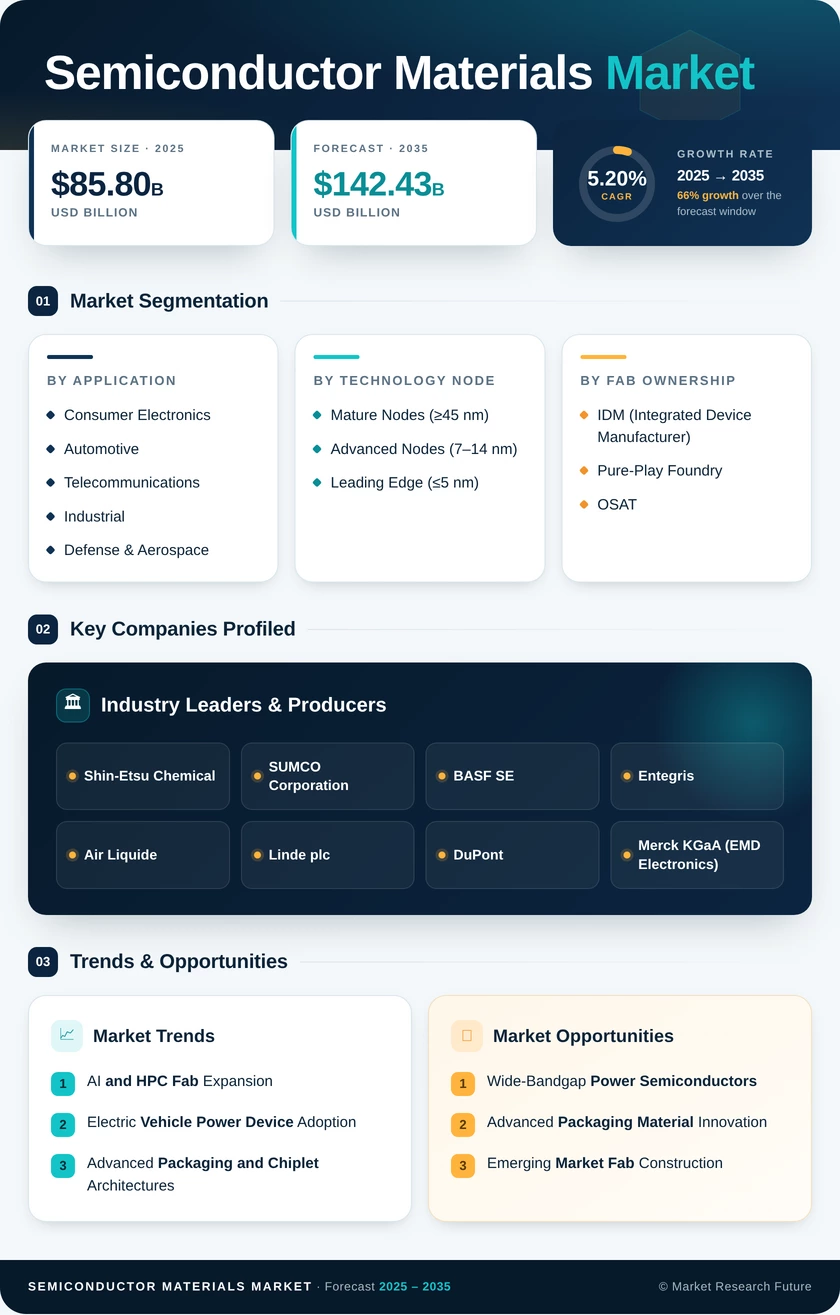
Segmentation Quick Reference
| Dimension | Sub-Segments | Dominant Segment | Fastest Growing Segment |
| By Application | Fabrication Materials, Packaging Materials | Fabrication Materials (~58% share) | Packaging Materials (10.0% CAGR) |
| By End-User Industry | Consumer Electronics, Automotive, Telecommunications, Industrial, Defense & Aerospace | Consumer Electronics (~35% share) | Automotive (9.50% CAGR) |
| By Semiconductor Materials Market Node | Mature Nodes (≥45 nm), Advanced Nodes (7–14 nm), Leading Edge (≤5 nm) | Mature Nodes (~46% share) | Leading Edge ≤5 nm (15.70% CAGR) |
| By Fab Ownership | IDM, Pure-Play Foundry, OSAT | IDM (~44% share) | Pure-Play Foundry (7.80% CAGR) |
Market Segmentation Overview
By Application
| Sub-Segment | Key Trend |
| Fabrication Materials | Steady volume growth driven by wafer-start expansion; higher chemical intensity at advanced nodes |
| Packaging Materials | Rapid acceleration from chiplet-based 2.5D/3D integration and hybrid bonding adoption |
Fabrication materials encompass photoresists, CMP slurries, wet chemicals, process gases, and silicon wafers consumed during front-end wafer processing. Packaging materials cover die-attach adhesives, encapsulants, bonding wires, solder materials, and substrates used in back-end assembly and advanced packaging.
By End-User Industry
| Sub-Segment | Key Trend |
| Consumer Electronics | High-volume node migration is driving photoresist and CMP slurry consumption. |
| Automotive | SiC and GaN substrate adoption for EV power trains and ADAS platforms |
| Telecommunications | 5G/6G rollout expanding demand for RF-grade compound semiconductors |
| Industrial | Factory automation and power-management ICs are sustaining mature-node material volumes. |
| Defense & Aerospace | Radiation-hardened and high-reliability chip requirements are pulling specialty materials. |
Consumer electronics and automotive collectively account for over half of global semiconductor material consumption. However, their material profiles diverge sharply — consumer chips favor advanced-node photoresists while automotive demands wide-bandgap substrates and high-temperature packaging compounds.
By Semiconductor Materials Market Node
| Sub-Segment | Key Trend |
| Mature Nodes (≥45 nm) | Sustained demand from automotive, IoT, and industrial applications |
| Advanced Nodes (7–14 nm) | Mid-range AI inference and mobile application processors |
| Leading Edge (≤5 nm) | EUV-intensive processes requiring next-generation photoresists and etch gases |
The cost-per-wafer gap between mature and leading-edge nodes continues to widen, with sub-5 nm wafers costing 3–4× more in material inputs alone, creating a bifurcated demand landscape within the semiconductor materials supply chain.
By Fab Ownership
| Sub-Segment | Key Trend |
| IDM (Integrated Device Manufacturer) | In-house procurement with long-term supply agreements |
| Pure-Play Foundry | Fastest material consumption growth, led by TSMC and Samsung Foundry expansion |
| OSAT | Back-end packaging material demand is rising with chiplet and fan-out adoption. |
Pure-play foundries are the primary growth engine for material demand, as their capital-intensive expansion programs translate directly into higher volumes of specialty chemicals, gases, and substrates consumed per wafer start.


 Noah Malgeri
Co-Founder
Noah Malgeri
Co-Founder

 Peter Groot koerkamp
Account and Business Manager
Peter Groot koerkamp
Account and Business Manager

 Younghwan Choi
Senior Retail Manager
Younghwan Choi
Senior Retail Manager

 Mark Irwin
Management Consultant
Mark Irwin
Management Consultant

 Akif Moroglu
Strategy & Business Development Director
Akif Moroglu
Strategy & Business Development Director

 Guilherme Gomes Martins
Product Management Director
Guilherme Gomes Martins
Product Management Director

 Joseph Aguayo
Sales Operations & Pricing Manager
Joseph Aguayo
Sales Operations & Pricing Manager

 La Terria Dodd
Program Support Specialist
La Terria Dodd
Program Support Specialist

 Rob Kooiker
Group Product Manager HVAC & Fire Protection GMA
Rob Kooiker
Group Product Manager HVAC & Fire Protection GMA