Request Free Sample ×

Kindly complete the form below to receive a free sample of this Report

* Please use a valid business email

Leading companies partner with us for data-driven Insights

clients tt-cursor
Hero Background
English
Chinese
French
Japanese
Korean
German
Spanish

Self Supervised Learning Market Share

ID: MRFR/ICT/10396-HCR
128 Pages
Ankit Gupta
March 2026

Self-supervised Learning Market Size, Share and Trends Analysis Report By Technology (Natural Language Processing (NLP), Computer Vision, and Speech Processing), By End Use (Healthcare, BFSI, Automotive & Transportation, Software Development (IT), Advertising & Media, and Others), and By Region (North America, Europe, Asia-Pacific, and Rest Of The World) – Market Forecast Till 2035

Share:
Download PDF ×

We do not share your information with anyone. However, we may send you emails based on your report interest from time to time. You may contact us at any time to opt-out.

Self Supervised Learning Market Infographic
Purchase Options

Market Share

Self Supervised Learning Market Share Analysis

The Self-supervised Learning market is a rapidly growing sector within the field of artificial intelligence and machine learning. As companies and research institutions continue to invest in the development of self-supervised learning algorithms, the competition to capture a significant market share has intensified. In this dynamic landscape, various positioning strategies are being employed to gain a competitive edge and establish a strong foothold in the market.

A popular practice in positioning is differentiation based on the idea of algorithmic innovation. There is a rapid evolution of self-supervised learning algorithms which are aimed at improving the performance strategies of these systems and companies wish to achieve customer’s recognition through superior and unique products. This strategy is all about investing heavily in research and development for the production of unrivaled algorithms that may outdo the available models. As innovators in the field of algorithms, these firms aim to win customers who want to improve their reliability and increase their trajectory of technological evolution.

Another important strategy that targets firms according to specific industry-driven applications. Realizing that every industry has unique demands, companies are reconfiguring their self-supervised learning solutions to specifically resolve challenges within industries like healthcare, finance technology, autonomous vehicle operations, and natural language. Companies can segment and reposition their offerings for the various industries, based on what is needed to serve them specifically. In return; automatically this will help these companies establish a niche in a specific industry as they become experts.

In addition, the partnerships and collaborations are a key determinant of the position in market share relating to self-supervised landscaping. The firms are entering into strategic alliances with academia, research organization , and the familiar industry players by pooling together their expertise as well s resources. Strategic partnerships’ offer companies a stronger market presence, enables in obtaining an insider knowledge, guarantees as well boost credibility for the organization through the broader cross-selling capabilities. Alliances additionally permit organizations to share assets for extensive scale ventures and quicker creation and appropriation of SLA arrangements.

Apart from these approaches, pricing and availability can play a huge role in regards to market share positioning. Some companies go for cost leadership approach to capture large market share by pricing their products nominally thereby attracting the price conscious customers. Some put an accent on simple user interfaces to demonstrate readiness for a wide spectrum of customers, desire to be enhanced and equipped easily. Companies must link their price break and offered accessibility to the needs provided by related institutions such as business or research agencies that seek self-supervised learning solutions so they can become a household name among sought persons. Moreover, branding and thought leadership are integral to market share positioning in the self-supervised learning market. Establishing a strong brand identity and thought leadership position requires companies to actively engage in knowledge sharing, thought-provoking content creation, and participation in industry events and conferences. By positioning themselves as authoritative voices in self-supervised learning, companies can build trust, credibility, and visibility within the market, ultimately influencing customer perception and market share.


Author
Author Profile
Ankit Gupta
Team Lead - Research

Ankit Gupta is a seasoned market intelligence and strategic research professional with over six plus years of experience in the ICT and Semiconductor industries. With academic roots in Telecom, Marketing, and Electronics, he blends technical insight with business strategy. Ankit has led 200+ projects, including work for Fortune 500 clients like Microsoft and Rio Tinto, covering market sizing, tech forecasting, and go-to-market strategies. Known for bridging engineering and enterprise decision-making, his insights support growth, innovation, and investment planning across diverse technology markets.

Leave a Comment

FAQs

What is the projected market valuation of the Self-supervised Learning Market by 2035?

<p>The Self-supervised Learning Market is projected to reach a valuation of 349.03 USD Billion by 2035.</p>

What was the market valuation of the Self-supervised Learning Market in 2024?

<p>In 2024, the Self-supervised Learning Market was valued at 14.18 USD Billion.</p>

What is the expected CAGR for the Self-supervised Learning Market from 2025 to 2035?

<p>The expected CAGR for the Self-supervised Learning Market during the forecast period 2025 - 2035 is 33.8%.</p>

Which technology segments are driving the Self-supervised Learning Market?

<p>Key technology segments include Natural Language Processing (NLP) valued at 4.25 USD Billion, Computer Vision at 5.0 USD Billion, and Speech Processing at 4.93 USD Billion.</p>

What are the primary end-use sectors for Self-supervised Learning applications?

<p>The primary end-use sectors include BFSI valued at 3.56 USD Billion, Healthcare at 2.83 USD Billion, and Software Development (IT) at 3.0 USD Billion.</p>

Who are the leading companies in the Self-supervised Learning Market?

<p>Leading companies in the Self-supervised Learning Market include Google, Facebook, Microsoft, NVIDIA, Amazon, IBM, Alibaba, Baidu, and Salesforce.</p>

How does the Computer Vision segment perform in the Self-supervised Learning Market?

The Computer Vision segment performs robustly, with a valuation of 5.0 USD Billion.

What is the valuation of the Speech Processing segment in the Self-supervised Learning Market?

The Speech Processing segment is valued at 4.93 USD Billion.

Which end-use sector has the lowest valuation in the Self-supervised Learning Market?

The Automotive &amp; Transportation sector has the lowest valuation at 1.42 USD Billion.

What is the projected growth trend for the Self-supervised Learning Market?

The Self-supervised Learning Market is expected to experience substantial growth, reaching 349.03 USD Billion by 2035.

Market Summary

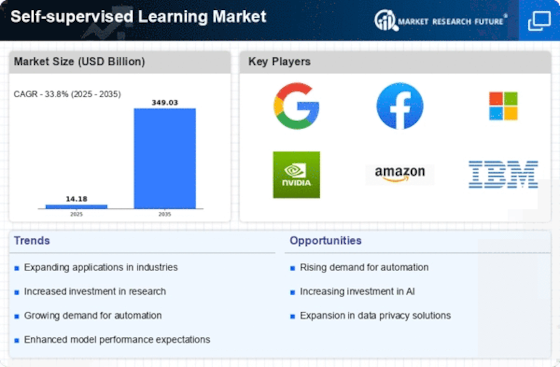
As per Market Research Future analysis, the Self-supervised Learning Market Size was estimated at 14.18 USD Billion in 2024. The Self-supervised Learning industry is projected to grow from 18.98 USD Billion in 2025 to 349.03 USD Billion by 2035, exhibiting a compound annual growth rate (CAGR) of 33.8% during the forecast period 2025 - 2035

Key Market Trends & Highlights

The self-supervised learning market is experiencing robust growth driven by technological advancements and increasing enterprise adoption.

  • The self-supervised learning market is witnessing rising adoption in enterprises, particularly in North America, which remains the largest market. Advancements in algorithm development are propelling the growth of self-supervised learning, especially in the Natural Language Processing segment. Collaboration between academia and industry is fostering innovation, with Asia-Pacific emerging as the fastest-growing region. Increased demand for automation and the growing volume of unlabelled data are key drivers fueling market expansion, particularly in the Healthcare and BFSI segments.

Market Size & Forecast

2024 Market Size 14.18 (USD Billion)
2035 Market Size 349.03 (USD Billion)
CAGR (2025 - 2035) 33.8%
Largest Regional Market Share in 2024 North America

Major Players

Google (US), Facebook (US), Microsoft (US), NVIDIA (US), Amazon (US), IBM (US), Alibaba (CN), Baidu (CN), Salesforce (US)

Market Trends

The Self-supervised Learning Market is currently experiencing a notable evolution, driven by advancements in artificial intelligence and machine learning technologies. This market segment appears to be gaining traction as organizations increasingly recognize the potential of self-supervised learning techniques to enhance data utilization without the need for extensive labeled datasets. The growing demand for automation and efficiency in data processing suggests that self-supervised learning could play a pivotal role in various applications, including natural language processing, computer vision, and robotics. As businesses strive to leverage vast amounts of unstructured data, the adoption of self-supervised learning methodologies is likely to expand, fostering innovation and competitive advantage. Moreover, the Self-supervised Learning Market seems poised for further growth as research institutions and technology companies invest in developing more sophisticated algorithms. These advancements may lead to improved model performance and broader applicability across different sectors. The increasing collaboration between academia and industry indicates a shared interest in exploring the capabilities of self-supervised learning, which could result in novel applications and solutions. As the landscape evolves, stakeholders must remain vigilant to emerging trends and technologies that could shape the future of this dynamic market.

Rising Adoption in Enterprises

Organizations are increasingly integrating self-supervised learning techniques into their operations to enhance data analysis and decision-making processes. This trend reflects a broader shift towards automation and efficiency, as businesses seek to optimize their data utilization.

Advancements in Algorithm Development

Continuous research and development efforts are leading to the creation of more sophisticated self-supervised learning algorithms. These innovations are likely to improve model accuracy and expand the range of applications across various industries.

Collaboration Between Academia and Industry

There is a growing partnership between academic institutions and technology companies focused on self-supervised learning. This collaboration aims to explore new methodologies and applications, potentially driving further advancements in the market.

Self Supervised Learning Market Market Drivers

Increased Demand for Automation

The Self-supervised Learning Market is experiencing a notable surge in demand for automation across various sectors. Organizations are increasingly seeking to enhance operational efficiency and reduce human intervention in data processing. This trend is particularly evident in industries such as finance, healthcare, and manufacturing, where the need for rapid data analysis and decision-making is paramount. According to recent estimates, the automation market is projected to reach USD 200 billion by 2026, indicating a strong correlation with the growth of self-supervised learning technologies. As businesses strive to leverage vast amounts of unlabelled data, self-supervised learning emerges as a pivotal solution, enabling systems to learn from data without extensive human oversight. This shift towards automation not only streamlines processes but also fosters innovation, positioning self-supervised learning as a critical component in the evolving landscape of artificial intelligence.

Growing Volume of Unlabelled Data

The Self-supervised Learning Market is significantly influenced by the exponential growth of unlabelled data generated across various platforms. With the proliferation of digital content, organizations are inundated with vast amounts of data that remain unlabelled, making traditional supervised learning approaches less feasible. It is estimated that over 80% of data generated today is unlabelled, presenting a unique opportunity for self-supervised learning methodologies. These techniques allow models to learn from this unlabelled data, extracting valuable insights without the need for extensive manual annotation. As businesses recognize the potential of harnessing unlabelled data, the demand for self-supervised learning solutions is expected to rise. This trend not only enhances the efficiency of data utilization but also drives innovation in machine learning applications, positioning self-supervised learning as a cornerstone in the future of artificial intelligence.

Advancements in Computational Power

The Self-supervised Learning Market is benefiting from significant advancements in computational power, which are enabling more complex and efficient learning algorithms. The rise of powerful GPUs and cloud computing resources has made it feasible to train large-scale models on extensive datasets. This technological evolution is crucial for self-supervised learning, as it often requires substantial computational resources to process and analyze vast amounts of unlabelled data. Recent reports indicate that The Self-supervised Learning is expected to reach USD 832 billion by 2025, further facilitating the deployment of self-supervised learning models. As organizations invest in advanced computational infrastructure, the capabilities of self-supervised learning are likely to expand, allowing for more sophisticated applications across various industries, including natural language processing and computer vision.

Increased Focus on Data Privacy and Security

The Self-supervised Learning Market is increasingly shaped by the growing emphasis on data privacy and security. As organizations collect and process vast amounts of data, concerns regarding data breaches and compliance with regulations such as GDPR and CCPA have intensified. Self-supervised learning offers a potential solution by enabling models to learn from data without exposing sensitive information. This approach not only mitigates privacy risks but also aligns with regulatory requirements, making it an attractive option for businesses. The market for data privacy solutions is projected to grow significantly, with estimates suggesting a value of USD 150 billion by 2028. As organizations prioritize data protection, the adoption of self-supervised learning techniques is likely to increase, positioning them as a vital component in the development of secure AI applications.

Rising Investment in Artificial Intelligence

The Self-supervised Learning Market is witnessing a surge in investment in artificial intelligence technologies, which is driving the demand for innovative learning methodologies. As businesses recognize the transformative potential of AI, funding for AI startups and research initiatives has escalated. In 2025, global investment in AI is projected to exceed USD 100 billion, reflecting a robust interest in developing advanced machine learning techniques, including self-supervised learning. This influx of capital is likely to accelerate research and development efforts, fostering the creation of novel algorithms and applications. As organizations seek to leverage AI for competitive advantage, self-supervised learning is positioned to play a crucial role in enhancing the capabilities of AI systems, thereby contributing to the overall growth of the market.

Market Segment Insights

By Technology: Natural Language Processing (NLP) (Largest) vs. Computer Vision (Fastest-Growing)

In the Self-supervised Learning Market, Natural Language Processing (NLP) holds the largest share, capitalizing on the growing demand for advanced language models and applications across various sectors. This dominance is largely driven by the increasing need for automated translation, sentiment analysis, and enhanced content creation. On the other hand, Computer Vision is emerging rapidly, bolstered by advancements in image recognition, facial recognition, and automated visual analysis, capturing significant attention from industries such as healthcare and automotive for its rapid deployment capabilities. The shift toward self-supervised learning is fueling growth across these technologies. NLP continues to evolve with breakthroughs in transformer models, while Computer Vision is experiencing unprecedented growth due to the integration of AI in surveillance, augmented reality, and robotics. The accessibility of vast amounts of unlabeled data is further driving the adoption of self-supervised methods, enabling organizations to harness the potential of these technologies more effectively and efficiently.

Technology: NLP (Dominant) vs. Computer Vision (Emerging)

Natural Language Processing (NLP) is established as the dominant technology in the self-supervised learning landscape, effectively transforming the way businesses interact with language-based tasks. With its strong foundation in deep learning and the ability to process and analyze complex language patterns, NLP applications are extensive, from chatbots to virtual assistants. Conversely, Computer Vision is an emerging segment, experiencing a rapid surge in interest and application in various fields such as healthcare diagnostics, autonomous driving, and retail analytics. Its capability to interpret and understand visual information is revolutionizing industries, supported by advancements in deep learning architectures and powerful image datasets. As both segments evolve, their interplay will shape the future of artificial intelligence.

By End Use: Healthcare (Largest) vs. BFSI (Fastest-Growing)

In the Self-supervised Learning Market, healthcare emerges as the leading segment, significantly dominating market share due to its increasing application in medical imaging, diagnostics, and patient data analysis. This sector has fully embraced self-supervised learning techniques to enhance the precision and efficiency of medical processes. BFSI, on the other hand, is rapidly gaining traction as a growing segment, fueled by a higher demand for personalized financial services and fraud detection systems that utilize advanced machine learning algorithms.

Healthcare: Diagnosis (Dominant) vs. BFSI: Fraud Detection (Emerging)

In the healthcare sector, self-supervised learning plays a crucial role in advancing diagnostic capabilities by intelligently processing vast amounts of patient data and medical imagery. This technology allows for the extraction of actionable insights without the need for extensive labeled data. Conversely, the BFSI sector is leveraging self-supervised learning primarily for fraud detection systems. By implementing these advanced algorithms, financial institutions can identify suspicious patterns and anomalies, enabling them to bolster security measures and deliver tailored services to customers, thus making BFSI an emerging powerhouse in this market.

Get more detailed insights about Self-supervised Learning Market Research Report—Global Forecast till 2035

Regional Insights

North America : Innovation and Leadership Hub

North America is the largest market for self-supervised learning, holding approximately 45% of the global share. The region's growth is driven by significant investments in AI research, a robust technology infrastructure, and a strong presence of leading tech companies. Regulatory support for AI innovation further catalyzes market expansion, with initiatives aimed at fostering ethical AI development and deployment. The United States is the primary contributor, with major players like Google, Facebook, and Microsoft leading the charge. The competitive landscape is characterized by rapid advancements in technology and a focus on developing scalable self-supervised learning models. This region's emphasis on research and development positions it as a global leader in AI technologies, ensuring continued growth and innovation.

Europe : Emerging AI Powerhouse

Europe is witnessing a surge in the self-supervised learning market, accounting for approximately 30% of the global share. The region's growth is propelled by increasing demand for AI solutions across various sectors, coupled with stringent regulations that promote ethical AI practices. The European Union's initiatives to enhance digital transformation and AI adoption are significant catalysts for market expansion, fostering a conducive environment for innovation. Leading countries such as Germany, France, and the UK are at the forefront of this growth, with numerous startups and established firms investing in self-supervised learning technologies. The competitive landscape is vibrant, with a mix of local and international players striving to capture market share. The presence of key organizations and research institutions further strengthens Europe's position in the global AI arena.

Asia-Pacific : Rapidly Growing Market

Asia-Pacific is rapidly emerging as a significant player in the self-supervised learning market, holding around 20% of the global share. The region's growth is driven by increasing investments in AI technologies, a burgeoning startup ecosystem, and a rising demand for automation across industries. Countries like China and India are leading this growth, supported by government initiatives aimed at enhancing digital capabilities and fostering innovation in AI. China, in particular, is home to major tech giants like Alibaba and Baidu, which are heavily investing in self-supervised learning research. The competitive landscape is marked by a mix of established companies and innovative startups, all vying for a share of the expanding market. The region's focus on technological advancement and collaboration between academia and industry is expected to further accelerate growth in the coming years.

Middle East and Africa : Emerging Frontier for AI

The Middle East and Africa are gradually emerging as a frontier for self-supervised learning, capturing about 5% of the global market share. The growth in this region is primarily driven by increasing investments in technology and a growing recognition of the importance of AI in various sectors. Governments are actively promoting digital transformation initiatives, which are crucial for fostering an environment conducive to AI development. Countries like South Africa and the UAE are leading the charge, with various initiatives aimed at enhancing AI capabilities. The competitive landscape is still developing, with a mix of local startups and international players entering the market. The presence of key players and a focus on building AI infrastructure are expected to drive further growth in the region, making it an attractive market for investment.

Key Players and Competitive Insights

The Self-supervised Learning Market is currently characterized by a dynamic competitive landscape, driven by rapid advancements in artificial intelligence and machine learning technologies. Major players such as Google (US), Microsoft (US), and NVIDIA (US) are at the forefront, leveraging their extensive research capabilities and technological prowess to innovate and expand their market presence. Google (US) focuses on enhancing its AI capabilities through self-supervised learning techniques, which are integral to its product offerings, including Google Cloud and various consumer applications. Meanwhile, Microsoft (US) emphasizes strategic partnerships and acquisitions to bolster its AI portfolio, particularly in cloud services, thereby enhancing its competitive positioning in the market. NVIDIA (US), known for its powerful GPUs, is increasingly integrating self-supervised learning into its hardware solutions, catering to the growing demand for efficient AI processing.The business tactics employed by these companies reflect a concerted effort to optimize operations and enhance market reach. The Self-supervised Learning Market appears moderately fragmented, with a mix of established tech giants and emerging startups. Key players are increasingly localizing their operations and optimizing supply chains to respond to regional demands and technological advancements. This collective influence of major companies shapes a competitive environment where innovation and strategic collaborations are paramount.
In August Google (US) announced a significant partnership with a leading academic institution to develop advanced self-supervised learning algorithms aimed at improving natural language processing capabilities. This collaboration is expected to enhance Google's AI-driven services, reinforcing its leadership in the market. The strategic importance of this partnership lies in its potential to accelerate research and development, thereby solidifying Google's competitive edge in AI applications.
In September Microsoft (US) unveiled a new suite of AI tools that incorporate self-supervised learning techniques, designed specifically for enterprise customers. This launch is indicative of Microsoft's commitment to integrating cutting-edge AI technologies into its cloud offerings, which could significantly enhance user experience and operational efficiency. The introduction of these tools not only strengthens Microsoft's market position but also reflects a broader trend towards the democratization of AI technologies for businesses.
In July NVIDIA (US) expanded its AI research division, focusing on self-supervised learning applications in autonomous systems. This strategic move is likely to position NVIDIA as a leader in the burgeoning field of AI-driven automation, particularly in sectors such as transportation and logistics. By investing in self-supervised learning, NVIDIA aims to enhance the capabilities of its hardware solutions, thereby catering to the increasing demand for intelligent systems.
As of October the competitive trends in the Self-supervised Learning Market are increasingly defined by digitalization, sustainability, and the integration of AI across various sectors. Strategic alliances are becoming more prevalent, as companies recognize the value of collaboration in driving innovation. Looking ahead, it is anticipated that competitive differentiation will evolve, shifting from traditional price-based competition to a focus on technological innovation, reliability in supply chains, and the ability to deliver cutting-edge solutions that meet the evolving needs of consumers and businesses alike.

Key Companies in the Self Supervised Learning Market include

Industry Developments

  • Q2 2025: US Tariff Impact on the Market In April 2025, new U.S. tariffs on technology imports and AI-enabling components, including those used in self-learning and self-supervised AI, were implemented, raising production and deployment costs for AI developers and enterprises. These tariffs are expected to disrupt global supply chains and impact pricing strategies for startups and SMEs, particularly in the self-supervised learning sector.

Future Outlook

Self Supervised Learning Market Future Outlook

The Self-supervised Learning Market is projected to grow at a 33.8% CAGR from 2025 to 2035, driven by advancements in AI technologies, increasing data availability, and demand for automation.

New opportunities lie in:

  • <p>Development of industry-specific self-supervised learning models for healthcare applications. Integration of self-supervised learning in autonomous vehicle systems for enhanced decision-making. Creation of cloud-based platforms offering self-supervised learning tools for businesses.</p>

By 2035, the Self-supervised Learning Market is expected to be a pivotal component of AI-driven industries.

Market Segmentation

Self Supervised Learning Market End Use Outlook

  • Healthcare
  • BFSI
  • Automotive & Transportation
  • Software Development (IT)
  • Advertising & Media
  • Others

Self Supervised Learning Market Technology Outlook

  • Natural Language Processing (NLP)
  • Computer Vision
  • Speech Processing

Report Scope

MARKET SIZE 2024 14.18(USD Billion)
MARKET SIZE 2025 18.98(USD Billion)
MARKET SIZE 2035 349.03(USD Billion)
COMPOUND ANNUAL GROWTH RATE (CAGR) 33.8% (2025 - 2035)
REPORT COVERAGE Revenue Forecast, Competitive Landscape, Growth Factors, and Trends
BASE YEAR 2024
Market Forecast Period 2025 - 2035
Historical Data 2019 - 2024
Market Forecast Units USD Billion
Key Companies Profiled Google (US), Facebook (US), Microsoft (US), NVIDIA (US), Amazon (US), IBM (US), Alibaba (CN), Baidu (CN), Salesforce (US)
Segments Covered Technology, End Use, Region
Key Market Opportunities Integration of Self-supervised Learning in diverse industries enhances automation and data-driven decision-making.
Key Market Dynamics Rising demand for automated data processing drives innovation and competition in the self-supervised learning market.
Countries Covered North America, Europe, APAC, South America, MEA

FAQs

What is the projected market valuation of the Self-supervised Learning Market by 2035?

<p>The Self-supervised Learning Market is projected to reach a valuation of 349.03 USD Billion by 2035.</p>

What was the market valuation of the Self-supervised Learning Market in 2024?

<p>In 2024, the Self-supervised Learning Market was valued at 14.18 USD Billion.</p>

What is the expected CAGR for the Self-supervised Learning Market from 2025 to 2035?

<p>The expected CAGR for the Self-supervised Learning Market during the forecast period 2025 - 2035 is 33.8%.</p>

Which technology segments are driving the Self-supervised Learning Market?

<p>Key technology segments include Natural Language Processing (NLP) valued at 4.25 USD Billion, Computer Vision at 5.0 USD Billion, and Speech Processing at 4.93 USD Billion.</p>

What are the primary end-use sectors for Self-supervised Learning applications?

<p>The primary end-use sectors include BFSI valued at 3.56 USD Billion, Healthcare at 2.83 USD Billion, and Software Development (IT) at 3.0 USD Billion.</p>

Who are the leading companies in the Self-supervised Learning Market?

<p>Leading companies in the Self-supervised Learning Market include Google, Facebook, Microsoft, NVIDIA, Amazon, IBM, Alibaba, Baidu, and Salesforce.</p>

How does the Computer Vision segment perform in the Self-supervised Learning Market?

The Computer Vision segment performs robustly, with a valuation of 5.0 USD Billion.

What is the valuation of the Speech Processing segment in the Self-supervised Learning Market?

The Speech Processing segment is valued at 4.93 USD Billion.

Which end-use sector has the lowest valuation in the Self-supervised Learning Market?

The Automotive &amp; Transportation sector has the lowest valuation at 1.42 USD Billion.

What is the projected growth trend for the Self-supervised Learning Market?

The Self-supervised Learning Market is expected to experience substantial growth, reaching 349.03 USD Billion by 2035.

  1. SECTION I: EXECUTIVE SUMMARY AND KEY HIGHLIGHTS
    1. | 1.1 EXECUTIVE SUMMARY
    2. | | 1.1.1 Market Overview
    3. | | 1.1.2 Key Findings
    4. | | 1.1.3 Market Segmentation
    5. | | 1.1.4 Competitive Landscape
    6. | | 1.1.5 Challenges and Opportunities
    7. | | 1.1.6 Future Outlook
  2. SECTION II: SCOPING, METHODOLOGY AND MARKET STRUCTURE
    1. | 2.1 MARKET INTRODUCTION
    2. | | 2.1.1 Definition
    3. | | 2.1.2 Scope of the study
    4. | | | 2.1.2.1 Research Objective
    5. | | | 2.1.2.2 Assumption
    6. | | | 2.1.2.3 Limitations
    7. | 2.2 RESEARCH METHODOLOGY
    8. | | 2.2.1 Overview
    9. | | 2.2.2 Data Mining
    10. | | 2.2.3 Secondary Research
    11. | | 2.2.4 Primary Research
    12. | | | 2.2.4.1 Primary Interviews and Information Gathering Process
    13. | | | 2.2.4.2 Breakdown of Primary Respondents
    14. | | 2.2.5 Forecasting Model
    15. | | 2.2.6 Market Size Estimation
    16. | | | 2.2.6.1 Bottom-Up Approach
    17. | | | 2.2.6.2 Top-Down Approach
    18. | | 2.2.7 Data Triangulation
    19. | | 2.2.8 Validation
  3. SECTION III: QUALITATIVE ANALYSIS
    1. | 3.1 MARKET DYNAMICS
    2. | | 3.1.1 Overview
    3. | | 3.1.2 Drivers
    4. | | 3.1.3 Restraints
    5. | | 3.1.4 Opportunities
    6. | 3.2 MARKET FACTOR ANALYSIS
    7. | | 3.2.1 Value chain Analysis
    8. | | 3.2.2 Porter's Five Forces Analysis
    9. | | | 3.2.2.1 Bargaining Power of Suppliers
    10. | | | 3.2.2.2 Bargaining Power of Buyers
    11. | | | 3.2.2.3 Threat of New Entrants
    12. | | | 3.2.2.4 Threat of Substitutes
    13. | | | 3.2.2.5 Intensity of Rivalry
    14. | | 3.2.3 COVID-19 Impact Analysis
    15. | | | 3.2.3.1 Market Impact Analysis
    16. | | | 3.2.3.2 Regional Impact
    17. | | | 3.2.3.3 Opportunity and Threat Analysis
  4. SECTION IV: QUANTITATIVE ANALYSIS
    1. | 4.1 Information and Communications Technology, BY Technology (USD Billion)
    2. | | 4.1.1 Natural Language Processing (NLP)
    3. | | 4.1.2 Computer Vision
    4. | | 4.1.3 Speech Processing
    5. | 4.2 Information and Communications Technology, BY End Use (USD Billion)
    6. | | 4.2.1 Healthcare
    7. | | 4.2.2 BFSI
    8. | | 4.2.3 Automotive & Transportation
    9. | | 4.2.4 Software Development (IT)
    10. | | 4.2.5 Advertising & Media
    11. | | 4.2.6 Others
    12. | 4.3 Information and Communications Technology, BY Region (USD Billion)
    13. | | 4.3.1 North America
    14. | | | 4.3.1.1 US
    15. | | | 4.3.1.2 Canada
    16. | | 4.3.2 Europe
    17. | | | 4.3.2.1 Germany
    18. | | | 4.3.2.2 UK
    19. | | | 4.3.2.3 France
    20. | | | 4.3.2.4 Russia
    21. | | | 4.3.2.5 Italy
    22. | | | 4.3.2.6 Spain
    23. | | | 4.3.2.7 Rest of Europe
    24. | | 4.3.3 APAC
    25. | | | 4.3.3.1 China
    26. | | | 4.3.3.2 India
    27. | | | 4.3.3.3 Japan
    28. | | | 4.3.3.4 South Korea
    29. | | | 4.3.3.5 Malaysia
    30. | | | 4.3.3.6 Thailand
    31. | | | 4.3.3.7 Indonesia
    32. | | | 4.3.3.8 Rest of APAC
    33. | | 4.3.4 South America
    34. | | | 4.3.4.1 Brazil
    35. | | | 4.3.4.2 Mexico
    36. | | | 4.3.4.3 Argentina
    37. | | | 4.3.4.4 Rest of South America
    38. | | 4.3.5 MEA
    39. | | | 4.3.5.1 GCC Countries
    40. | | | 4.3.5.2 South Africa
    41. | | | 4.3.5.3 Rest of MEA
  5. SECTION V: COMPETITIVE ANALYSIS
    1. | 5.1 Competitive Landscape
    2. | | 5.1.1 Overview
    3. | | 5.1.2 Competitive Analysis
    4. | | 5.1.3 Market share Analysis
    5. | | 5.1.4 Major Growth Strategy in the Information and Communications Technology
    6. | | 5.1.5 Competitive Benchmarking
    7. | | 5.1.6 Leading Players in Terms of Number of Developments in the Information and Communications Technology
    8. | | 5.1.7 Key developments and growth strategies
    9. | | | 5.1.7.1 New Product Launch/Service Deployment
    10. | | | 5.1.7.2 Merger & Acquisitions
    11. | | | 5.1.7.3 Joint Ventures
    12. | | 5.1.8 Major Players Financial Matrix
    13. | | | 5.1.8.1 Sales and Operating Income
    14. | | | 5.1.8.2 Major Players R&D Expenditure. 2023
    15. | 5.2 Company Profiles
    16. | | 5.2.1 Google (US)
    17. | | | 5.2.1.1 Financial Overview
    18. | | | 5.2.1.2 Products Offered
    19. | | | 5.2.1.3 Key Developments
    20. | | | 5.2.1.4 SWOT Analysis
    21. | | | 5.2.1.5 Key Strategies
    22. | | 5.2.2 Facebook (US)
    23. | | | 5.2.2.1 Financial Overview
    24. | | | 5.2.2.2 Products Offered
    25. | | | 5.2.2.3 Key Developments
    26. | | | 5.2.2.4 SWOT Analysis
    27. | | | 5.2.2.5 Key Strategies
    28. | | 5.2.3 Microsoft (US)
    29. | | | 5.2.3.1 Financial Overview
    30. | | | 5.2.3.2 Products Offered
    31. | | | 5.2.3.3 Key Developments
    32. | | | 5.2.3.4 SWOT Analysis
    33. | | | 5.2.3.5 Key Strategies
    34. | | 5.2.4 NVIDIA (US)
    35. | | | 5.2.4.1 Financial Overview
    36. | | | 5.2.4.2 Products Offered
    37. | | | 5.2.4.3 Key Developments
    38. | | | 5.2.4.4 SWOT Analysis
    39. | | | 5.2.4.5 Key Strategies
    40. | | 5.2.5 Amazon (US)
    41. | | | 5.2.5.1 Financial Overview
    42. | | | 5.2.5.2 Products Offered
    43. | | | 5.2.5.3 Key Developments
    44. | | | 5.2.5.4 SWOT Analysis
    45. | | | 5.2.5.5 Key Strategies
    46. | | 5.2.6 IBM (US)
    47. | | | 5.2.6.1 Financial Overview
    48. | | | 5.2.6.2 Products Offered
    49. | | | 5.2.6.3 Key Developments
    50. | | | 5.2.6.4 SWOT Analysis
    51. | | | 5.2.6.5 Key Strategies
    52. | | 5.2.7 Alibaba (CN)
    53. | | | 5.2.7.1 Financial Overview
    54. | | | 5.2.7.2 Products Offered
    55. | | | 5.2.7.3 Key Developments
    56. | | | 5.2.7.4 SWOT Analysis
    57. | | | 5.2.7.5 Key Strategies
    58. | | 5.2.8 Baidu (CN)
    59. | | | 5.2.8.1 Financial Overview
    60. | | | 5.2.8.2 Products Offered
    61. | | | 5.2.8.3 Key Developments
    62. | | | 5.2.8.4 SWOT Analysis
    63. | | | 5.2.8.5 Key Strategies
    64. | | 5.2.9 Salesforce (US)
    65. | | | 5.2.9.1 Financial Overview
    66. | | | 5.2.9.2 Products Offered
    67. | | | 5.2.9.3 Key Developments
    68. | | | 5.2.9.4 SWOT Analysis
    69. | | | 5.2.9.5 Key Strategies
    70. | 5.3 Appendix
    71. | | 5.3.1 References
    72. | | 5.3.2 Related Reports
  6. LIST OF FIGURES
    1. | 6.1 MARKET SYNOPSIS
    2. | 6.2 NORTH AMERICA MARKET ANALYSIS
    3. | 6.3 US MARKET ANALYSIS BY TECHNOLOGY
    4. | 6.4 US MARKET ANALYSIS BY END USE
    5. | 6.5 CANADA MARKET ANALYSIS BY TECHNOLOGY
    6. | 6.6 CANADA MARKET ANALYSIS BY END USE
    7. | 6.7 EUROPE MARKET ANALYSIS
    8. | 6.8 GERMANY MARKET ANALYSIS BY TECHNOLOGY
    9. | 6.9 GERMANY MARKET ANALYSIS BY END USE
    10. | 6.10 UK MARKET ANALYSIS BY TECHNOLOGY
    11. | 6.11 UK MARKET ANALYSIS BY END USE
    12. | 6.12 FRANCE MARKET ANALYSIS BY TECHNOLOGY
    13. | 6.13 FRANCE MARKET ANALYSIS BY END USE
    14. | 6.14 RUSSIA MARKET ANALYSIS BY TECHNOLOGY
    15. | 6.15 RUSSIA MARKET ANALYSIS BY END USE
    16. | 6.16 ITALY MARKET ANALYSIS BY TECHNOLOGY
    17. | 6.17 ITALY MARKET ANALYSIS BY END USE
    18. | 6.18 SPAIN MARKET ANALYSIS BY TECHNOLOGY
    19. | 6.19 SPAIN MARKET ANALYSIS BY END USE
    20. | 6.20 REST OF EUROPE MARKET ANALYSIS BY TECHNOLOGY
    21. | 6.21 REST OF EUROPE MARKET ANALYSIS BY END USE
    22. | 6.22 APAC MARKET ANALYSIS
    23. | 6.23 CHINA MARKET ANALYSIS BY TECHNOLOGY
    24. | 6.24 CHINA MARKET ANALYSIS BY END USE
    25. | 6.25 INDIA MARKET ANALYSIS BY TECHNOLOGY
    26. | 6.26 INDIA MARKET ANALYSIS BY END USE
    27. | 6.27 JAPAN MARKET ANALYSIS BY TECHNOLOGY
    28. | 6.28 JAPAN MARKET ANALYSIS BY END USE
    29. | 6.29 SOUTH KOREA MARKET ANALYSIS BY TECHNOLOGY
    30. | 6.30 SOUTH KOREA MARKET ANALYSIS BY END USE
    31. | 6.31 MALAYSIA MARKET ANALYSIS BY TECHNOLOGY
    32. | 6.32 MALAYSIA MARKET ANALYSIS BY END USE
    33. | 6.33 THAILAND MARKET ANALYSIS BY TECHNOLOGY
    34. | 6.34 THAILAND MARKET ANALYSIS BY END USE
    35. | 6.35 INDONESIA MARKET ANALYSIS BY TECHNOLOGY
    36. | 6.36 INDONESIA MARKET ANALYSIS BY END USE
    37. | 6.37 REST OF APAC MARKET ANALYSIS BY TECHNOLOGY
    38. | 6.38 REST OF APAC MARKET ANALYSIS BY END USE
    39. | 6.39 SOUTH AMERICA MARKET ANALYSIS
    40. | 6.40 BRAZIL MARKET ANALYSIS BY TECHNOLOGY
    41. | 6.41 BRAZIL MARKET ANALYSIS BY END USE
    42. | 6.42 MEXICO MARKET ANALYSIS BY TECHNOLOGY
    43. | 6.43 MEXICO MARKET ANALYSIS BY END USE
    44. | 6.44 ARGENTINA MARKET ANALYSIS BY TECHNOLOGY
    45. | 6.45 ARGENTINA MARKET ANALYSIS BY END USE
    46. | 6.46 REST OF SOUTH AMERICA MARKET ANALYSIS BY TECHNOLOGY
    47. | 6.47 REST OF SOUTH AMERICA MARKET ANALYSIS BY END USE
    48. | 6.48 MEA MARKET ANALYSIS
    49. | 6.49 GCC COUNTRIES MARKET ANALYSIS BY TECHNOLOGY
    50. | 6.50 GCC COUNTRIES MARKET ANALYSIS BY END USE
    51. | 6.51 SOUTH AFRICA MARKET ANALYSIS BY TECHNOLOGY
    52. | 6.52 SOUTH AFRICA MARKET ANALYSIS BY END USE
    53. | 6.53 REST OF MEA MARKET ANALYSIS BY TECHNOLOGY
    54. | 6.54 REST OF MEA MARKET ANALYSIS BY END USE
    55. | 6.55 KEY BUYING CRITERIA OF INFORMATION AND COMMUNICATIONS TECHNOLOGY
    56. | 6.56 RESEARCH PROCESS OF MRFR
    57. | 6.57 DRO ANALYSIS OF INFORMATION AND COMMUNICATIONS TECHNOLOGY
    58. | 6.58 DRIVERS IMPACT ANALYSIS: INFORMATION AND COMMUNICATIONS TECHNOLOGY
    59. | 6.59 RESTRAINTS IMPACT ANALYSIS: INFORMATION AND COMMUNICATIONS TECHNOLOGY
    60. | 6.60 SUPPLY / VALUE CHAIN: INFORMATION AND COMMUNICATIONS TECHNOLOGY
    61. | 6.61 INFORMATION AND COMMUNICATIONS TECHNOLOGY, BY TECHNOLOGY, 2024 (% SHARE)
    62. | 6.62 INFORMATION AND COMMUNICATIONS TECHNOLOGY, BY TECHNOLOGY, 2024 TO 2035 (USD Billion)
    63. | 6.63 INFORMATION AND COMMUNICATIONS TECHNOLOGY, BY END USE, 2024 (% SHARE)
    64. | 6.64 INFORMATION AND COMMUNICATIONS TECHNOLOGY, BY END USE, 2024 TO 2035 (USD Billion)
    65. | 6.65 BENCHMARKING OF MAJOR COMPETITORS
  7. LIST OF TABLES
    1. | 7.1 LIST OF ASSUMPTIONS
    2. | | 7.1.1
    3. | 7.2 North America MARKET SIZE ESTIMATES; FORECAST
    4. | | 7.2.1 BY TECHNOLOGY, 2025-2035 (USD Billion)
    5. | | 7.2.2 BY END USE, 2025-2035 (USD Billion)
    6. | 7.3 US MARKET SIZE ESTIMATES; FORECAST
    7. | | 7.3.1 BY TECHNOLOGY, 2025-2035 (USD Billion)
    8. | | 7.3.2 BY END USE, 2025-2035 (USD Billion)
    9. | 7.4 Canada MARKET SIZE ESTIMATES; FORECAST
    10. | | 7.4.1 BY TECHNOLOGY, 2025-2035 (USD Billion)
    11. | | 7.4.2 BY END USE, 2025-2035 (USD Billion)
    12. | 7.5 Europe MARKET SIZE ESTIMATES; FORECAST
    13. | | 7.5.1 BY TECHNOLOGY, 2025-2035 (USD Billion)
    14. | | 7.5.2 BY END USE, 2025-2035 (USD Billion)
    15. | 7.6 Germany MARKET SIZE ESTIMATES; FORECAST
    16. | | 7.6.1 BY TECHNOLOGY, 2025-2035 (USD Billion)
    17. | | 7.6.2 BY END USE, 2025-2035 (USD Billion)
    18. | 7.7 UK MARKET SIZE ESTIMATES; FORECAST
    19. | | 7.7.1 BY TECHNOLOGY, 2025-2035 (USD Billion)
    20. | | 7.7.2 BY END USE, 2025-2035 (USD Billion)
    21. | 7.8 France MARKET SIZE ESTIMATES; FORECAST
    22. | | 7.8.1 BY TECHNOLOGY, 2025-2035 (USD Billion)
    23. | | 7.8.2 BY END USE, 2025-2035 (USD Billion)
    24. | 7.9 Russia MARKET SIZE ESTIMATES; FORECAST
    25. | | 7.9.1 BY TECHNOLOGY, 2025-2035 (USD Billion)
    26. | | 7.9.2 BY END USE, 2025-2035 (USD Billion)
    27. | 7.10 Italy MARKET SIZE ESTIMATES; FORECAST
    28. | | 7.10.1 BY TECHNOLOGY, 2025-2035 (USD Billion)
    29. | | 7.10.2 BY END USE, 2025-2035 (USD Billion)
    30. | 7.11 Spain MARKET SIZE ESTIMATES; FORECAST
    31. | | 7.11.1 BY TECHNOLOGY, 2025-2035 (USD Billion)
    32. | | 7.11.2 BY END USE, 2025-2035 (USD Billion)
    33. | 7.12 Rest of Europe MARKET SIZE ESTIMATES; FORECAST
    34. | | 7.12.1 BY TECHNOLOGY, 2025-2035 (USD Billion)
    35. | | 7.12.2 BY END USE, 2025-2035 (USD Billion)
    36. | 7.13 APAC MARKET SIZE ESTIMATES; FORECAST
    37. | | 7.13.1 BY TECHNOLOGY, 2025-2035 (USD Billion)
    38. | | 7.13.2 BY END USE, 2025-2035 (USD Billion)
    39. | 7.14 China MARKET SIZE ESTIMATES; FORECAST
    40. | | 7.14.1 BY TECHNOLOGY, 2025-2035 (USD Billion)
    41. | | 7.14.2 BY END USE, 2025-2035 (USD Billion)
    42. | 7.15 India MARKET SIZE ESTIMATES; FORECAST
    43. | | 7.15.1 BY TECHNOLOGY, 2025-2035 (USD Billion)
    44. | | 7.15.2 BY END USE, 2025-2035 (USD Billion)
    45. | 7.16 Japan MARKET SIZE ESTIMATES; FORECAST
    46. | | 7.16.1 BY TECHNOLOGY, 2025-2035 (USD Billion)
    47. | | 7.16.2 BY END USE, 2025-2035 (USD Billion)
    48. | 7.17 South Korea MARKET SIZE ESTIMATES; FORECAST
    49. | | 7.17.1 BY TECHNOLOGY, 2025-2035 (USD Billion)
    50. | | 7.17.2 BY END USE, 2025-2035 (USD Billion)
    51. | 7.18 Malaysia MARKET SIZE ESTIMATES; FORECAST
    52. | | 7.18.1 BY TECHNOLOGY, 2025-2035 (USD Billion)
    53. | | 7.18.2 BY END USE, 2025-2035 (USD Billion)
    54. | 7.19 Thailand MARKET SIZE ESTIMATES; FORECAST
    55. | | 7.19.1 BY TECHNOLOGY, 2025-2035 (USD Billion)
    56. | | 7.19.2 BY END USE, 2025-2035 (USD Billion)
    57. | 7.20 Indonesia MARKET SIZE ESTIMATES; FORECAST
    58. | | 7.20.1 BY TECHNOLOGY, 2025-2035 (USD Billion)
    59. | | 7.20.2 BY END USE, 2025-2035 (USD Billion)
    60. | 7.21 Rest of APAC MARKET SIZE ESTIMATES; FORECAST
    61. | | 7.21.1 BY TECHNOLOGY, 2025-2035 (USD Billion)
    62. | | 7.21.2 BY END USE, 2025-2035 (USD Billion)
    63. | 7.22 South America MARKET SIZE ESTIMATES; FORECAST
    64. | | 7.22.1 BY TECHNOLOGY, 2025-2035 (USD Billion)
    65. | | 7.22.2 BY END USE, 2025-2035 (USD Billion)
    66. | 7.23 Brazil MARKET SIZE ESTIMATES; FORECAST
    67. | | 7.23.1 BY TECHNOLOGY, 2025-2035 (USD Billion)
    68. | | 7.23.2 BY END USE, 2025-2035 (USD Billion)
    69. | 7.24 Mexico MARKET SIZE ESTIMATES; FORECAST
    70. | | 7.24.1 BY TECHNOLOGY, 2025-2035 (USD Billion)
    71. | | 7.24.2 BY END USE, 2025-2035 (USD Billion)
    72. | 7.25 Argentina MARKET SIZE ESTIMATES; FORECAST
    73. | | 7.25.1 BY TECHNOLOGY, 2025-2035 (USD Billion)
    74. | | 7.25.2 BY END USE, 2025-2035 (USD Billion)
    75. | 7.26 Rest of South America MARKET SIZE ESTIMATES; FORECAST
    76. | | 7.26.1 BY TECHNOLOGY, 2025-2035 (USD Billion)
    77. | | 7.26.2 BY END USE, 2025-2035 (USD Billion)
    78. | 7.27 MEA MARKET SIZE ESTIMATES; FORECAST
    79. | | 7.27.1 BY TECHNOLOGY, 2025-2035 (USD Billion)
    80. | | 7.27.2 BY END USE, 2025-2035 (USD Billion)
    81. | 7.28 GCC Countries MARKET SIZE ESTIMATES; FORECAST
    82. | | 7.28.1 BY TECHNOLOGY, 2025-2035 (USD Billion)
    83. | | 7.28.2 BY END USE, 2025-2035 (USD Billion)
    84. | 7.29 South Africa MARKET SIZE ESTIMATES; FORECAST
    85. | | 7.29.1 BY TECHNOLOGY, 2025-2035 (USD Billion)
    86. | | 7.29.2 BY END USE, 2025-2035 (USD Billion)
    87. | 7.30 Rest of MEA MARKET SIZE ESTIMATES; FORECAST
    88. | | 7.30.1 BY TECHNOLOGY, 2025-2035 (USD Billion)
    89. | | 7.30.2 BY END USE, 2025-2035 (USD Billion)
    90. | 7.31 PRODUCT LAUNCH/PRODUCT DEVELOPMENT/APPROVAL
    91. | | 7.31.1
    92. | 7.32 ACQUISITION/PARTNERSHIP
    93. | | 7.32.1

Information and Communications Technology Market Segmentation

Information and Communications Technology By Technology (USD Billion, 2025-2035)

  • Natural Language Processing (NLP)
  • Computer Vision
  • Speech Processing

Information and Communications Technology By End Use (USD Billion, 2025-2035)

  • Healthcare
  • BFSI
  • Automotive & Transportation
  • Software Development (IT)
  • Advertising & Media
  • Others
Infographic

Free Sample Request

Kindly complete the form below to receive a free sample of this Report

Get Free Sample

Customer Strories

Compare Licence

×
Features License Type
Single User Multiuser License Enterprise User
Price $4,950 $5,950 $7,250
Maximum User Access Limit 1 User Upto 10 Users Unrestricted Access Throughout the Organization
Free Customization
Direct Access to Analyst
Deliverable Format
Platform Access
Discount on Next Purchase 10% 15% 15%
Printable Versions