
Request Free Sample ×

Kindly complete the form below to receive a free sample of this Report

* Please use a valid business email

Leading companies partner with us for data-driven Insights

clients tt-cursor
Hero Background
English
Chinese
French
Japanese
Korean
German
Spanish

Security as a Service Market Trends

ID: MRFR/ICT/5246-HCR
100 Pages
Ankit Gupta
March 2026

Security as a Service Market Size, Share and Research Report: By Component (Solution and Service), By Application Area (Network Security, Email-security, Database Cloud Security, Web Security, and Others), By Organization Size (SMEs and Large Enterprises), By Vertical (BFSI, Oil & Gas, IT & Telecom, Retail, Government, and Defence) And By Region (North America, Europe, Asia-Pacific, And Rest Of The World) –Market Forecast Till 2035.

Share:
Download PDF ×

We do not share your information with anyone. However, we may send you emails based on your report interest from time to time. You may contact us at any time to opt-out.

Security as a Service Market Infographic
Purchase Options

Market Trends

Key Emerging Trends in the Security as a Service Market

The market trends for Security as a Service (SECaaS) show that in order to handle the changing threat landscape and the challenges of cybersecurity management, there is an increasing need for cloud-based security solutions, managed security services, and subscription-based security products. The growing use of cloud-based security solutions, such as network security, endpoint protection, identity and access management, and threat intelligence, across numerous industries is one important development in the SECaaS industry. Businesses are using SECaaS technology to take advantage of cloud-based security's affordability, scalability, and flexibility in order to protect sensitive data and digital assets from various threats. The demand for reliable, quickly deployable security solutions that can adjust to changing security threats and dynamic corporate contexts is what's driving this trend. Furthermore, companies that employ outside vendors to monitor, detect, and handle security-related issues are witnessing a sharp increase in demand for managed security services within the SECaaS market. Businesses aim to enhance their internal security capabilities by utilizing SECaaS models to obtain professional security monitoring, threat analysis, and incident response services. This development demonstrates how the industry is starting to recognize the value of the knowledge and assets provided by managed security service providers, who help companies improve their security posture and fortify their defenses against cyberattacks without needing to make sizable investments in internal security staff or infrastructure. Furthermore, there is a noticeable trend toward the incorporation of machine learning (ML) and artificial intelligence (AI) technology into SECaaS products in order to facilitate automated response, behavioral analytics, and improved threat identification. Organizations are turning to SECaaS solutions that use AI and ML to detect abnormalities, identify patterns, and proactively protect against emerging threats as the volume and sophistication of cyberattacks continue to rise. The market's emphasis on employing intelligent automation and predictive analytics to stay ahead of cybercriminals and lessen the impact of security incidents is reflected in this trend.


Author
Author Profile
Ankit Gupta
Team Lead - Research

Ankit Gupta is a seasoned market intelligence and strategic research professional with over six plus years of experience in the ICT and Semiconductor industries. With academic roots in Telecom, Marketing, and Electronics, he blends technical insight with business strategy. Ankit has led 200+ projects, including work for Fortune 500 clients like Microsoft and Rio Tinto, covering market sizing, tech forecasting, and go-to-market strategies. Known for bridging engineering and enterprise decision-making, his insights support growth, innovation, and investment planning across diverse technology markets.

Leave a Comment

FAQs

What is the current valuation of the Security as a Service Market in 2024?

<p>The Security as a Service Market was valued at 15.14 USD Billion in 2024.</p>

What is the projected market size for the Security as a Service Market by 2035?

<p>The market is projected to reach 70.59 USD Billion by 2035.</p>

What is the expected CAGR for the Security as a Service Market during the forecast period 2025 - 2035?

<p>The expected CAGR for the market during 2025 - 2035 is 15.02%.</p>

Which organization size segments are driving growth in the Security as a Service Market?

<p>Large Enterprises are projected to grow from 11.36 USD Billion in 2024 to 53.59 USD Billion by 2035, indicating substantial growth.</p>

What are the key application areas within the Security as a Service Market?

<p>Key application areas include Network Security, Email Security, and Database Cloud Security, with valuations ranging from 2.5 to 25.0 USD Billion.</p>

Who are the leading players in the Security as a Service Market?

<p>Key players include Microsoft, Amazon, IBM, Cisco, and Palo Alto Networks, among others.</p>

How does the Security as a Service Market perform across different verticals?

The BFSI sector shows a growth from 3.5 USD Billion in 2024 to 16.5 USD Billion by 2035, highlighting its importance.

What is the projected growth for SMEs in the Security as a Service Market?

SMEs are expected to grow from 3.78 USD Billion in 2024 to 17.0 USD Billion by 2035.

What is the significance of the projected growth in the Security as a Service Market?

The projected growth indicates a robust demand for security solutions, reflecting increasing cybersecurity concerns.

How do the services and solutions segments compare in the Security as a Service Market?

Solutions are projected to grow from 9.05 USD Billion in 2024 to 42.29 USD Billion by 2035, while services grow from 6.09 to 28.3 USD Billion.

Market Summary

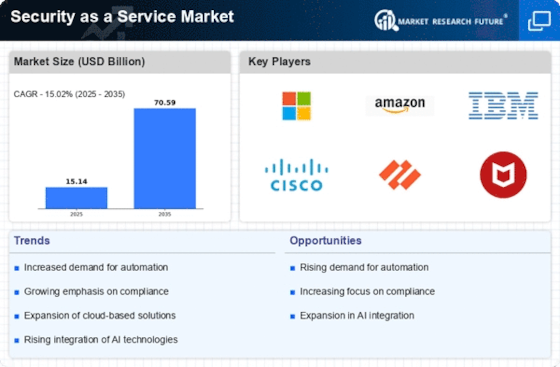
As per Market Research Future analysis, the Security as a Service Market Size was estimated at 15.14 USD Billion in 2024. The Security as a Service industry is projected to grow from 17.41 USD Billion in 2025 to 70.59 USD Billion by 2035, exhibiting a compound annual growth rate (CAGR) of 15.02% during the forecast period 2025 - 2035

Key Market Trends & Highlights

The Security as a Service Market is experiencing robust growth driven by technological advancements and increasing security concerns.

  • The market witnesses increased adoption of cloud security solutions, particularly in North America, which remains the largest market. There is a heightened focus on compliance and regulatory requirements, especially in the Asia-Pacific region, which is the fastest-growing market. Integration of advanced technologies, such as artificial intelligence and machine learning, is becoming prevalent across various service offerings. Rising cybersecurity threats and the cost-effectiveness of security solutions are key drivers propelling market expansion.

Market Size & Forecast

2024 Market Size 15.14 (USD Billion)
2035 Market Size 70.59 (USD Billion)
CAGR (2025 - 2035) 15.02%
Largest Regional Market Share in 2024 North America

Major Players

Microsoft (US), Amazon (US), IBM (US), Cisco (US), Palo Alto Networks (US), McAfee (US), Fortinet (US), Check Point Software (IL), Trend Micro (JP)

Market Trends

The Security as a Service Market is currently experiencing a notable transformation, driven by the increasing demand for flexible and scalable security solutions. Organizations are increasingly recognizing the necessity of protecting their digital assets against evolving threats. This shift is largely influenced by the growing complexity of cyber threats and the need for businesses to maintain compliance with various regulations. As a result, many enterprises are opting for cloud-based security services that offer enhanced protection without the burden of managing on-premises infrastructure. This trend suggests a significant movement towards outsourcing security functions to specialized providers, which may lead to improved efficiency and focus on core business activities.

Moreover, the rise of remote work and digital transformation initiatives has further accelerated the adoption of Security as a Service Market solutions. Companies are seeking to ensure that their remote workforce is adequately protected, which has led to an increased reliance on managed security services. This evolving landscape indicates that the Security as a Service Market is poised for continued growth, as organizations prioritize cybersecurity in their strategic planning. The emphasis on proactive threat detection and response capabilities is likely to shape the future of security services, making them more integral to business operations than ever before. The rising adoption of information security as a service is enabling enterprises to outsource data protection, threat intelligence, and risk management functions to specialized cloud security providers. Small and medium-sized enterprises are increasingly investing in IT security as a service to reduce infrastructure costs while ensuring enterprise-grade protection against cyber threats.

Increased Adoption of Cloud Security Solutions

Organizations are increasingly turning to cloud-based security services to enhance their cybersecurity posture. This trend reflects a shift towards more flexible and scalable security measures that can adapt to changing business needs.

Focus on Compliance and Regulatory Requirements

As businesses navigate a complex regulatory environment, there is a growing emphasis on compliance-driven security solutions. This focus ensures that organizations meet legal obligations while safeguarding sensitive data.

Integration of Advanced Technologies

The Security as a Service Market is witnessing the integration of advanced technologies such as artificial intelligence and machine learning. These innovations enhance threat detection and response capabilities, providing organizations with more robust security measures.

Security as a Service Market Market Drivers

Rising Cybersecurity Threats

The increasing frequency and sophistication of cyber threats is a primary driver for the Security as a Service Market. Organizations are facing a myriad of challenges, including ransomware attacks, data breaches, and phishing schemes. According to recent data, cybercrime is projected to cost businesses over 10 trillion dollars annually by 2025. This alarming trend compels companies to seek robust security solutions, leading to a surge in demand for Security as a Service Market offerings. As businesses recognize the necessity of protecting sensitive information, the market is likely to expand, with more organizations opting for outsourced security services to mitigate risks and enhance their cybersecurity posture.

Regulatory Compliance Pressures

The evolving landscape of regulatory compliance is a crucial driver for the Security as a Service Market. Organizations are increasingly required to adhere to stringent regulations regarding data protection and privacy, such as GDPR and HIPAA. Non-compliance can result in severe penalties and reputational damage. As a result, many businesses are turning to Security as a Service Market providers to ensure they meet these regulatory requirements effectively. The market is likely to see continued growth as companies seek solutions that not only protect their data but also help them navigate the complex web of compliance obligations, thereby reducing legal risks.

Shift Towards Remote Work Environments

The transition to remote work has fundamentally altered the security landscape, driving demand for the Security as a Service Market. As employees access corporate networks from various locations, the risk of security breaches increases. Organizations are compelled to implement comprehensive security measures that can protect remote access points. Security as a Service Market solutions offer scalable and flexible options that cater to the needs of a distributed workforce. This shift is expected to propel the market forward, as businesses prioritize securing their remote operations and ensuring that employees can work safely from anywhere.

Cost-Effectiveness of Security Solutions

The financial advantages associated with Security as a Service Market are becoming increasingly apparent. Organizations are often burdened by the high costs of maintaining in-house security infrastructure, which includes hardware, software, and personnel expenses. By adopting Security as a Service Market, companies can significantly reduce these costs, as they only pay for the services they utilize. This model allows for better budget management and resource allocation. Furthermore, the market is expected to grow as businesses recognize that outsourcing security can lead to improved efficiency and access to advanced technologies without the hefty price tag of traditional security measures.

Integration of Artificial Intelligence and Machine Learning

The incorporation of artificial intelligence and machine learning technologies into the Security as a Service Market is transforming how security threats are detected and mitigated. These advanced technologies enable real-time threat analysis and automated responses, significantly enhancing the effectiveness of security measures. As organizations seek to leverage these innovations, the demand for Security as a Service Market solutions that integrate AI and machine learning is likely to rise. This trend not only improves the overall security posture of businesses but also streamlines operations, making it a compelling driver for market growth.

Market Segment Insights

By Component: Solutions (Largest) vs. Services (Fastest-Growing)

<p>In the Security as a Service Market, Solutions hold the largest share, driven by their comprehensive features and integration capabilities. These solutions are crucial for businesses looking to safeguard their IT infrastructure against evolving security threats. On the other hand, Services are rapidly gaining traction, particularly as organizations increasingly outsource their security needs to specialized providers, leading to a more significant focus on flexible, tailored security strategies.</p>

<p>Solutions (Dominant) vs. Services (Emerging)</p>

<p>Solutions in the Security as a Service Market are characterized by their ability to provide comprehensive security frameworks that address a wide range of threats. These solutions often incorporate advanced technologies such as AI and machine learning, enabling proactive threat detection and response. Conversely, Services represent the emerging portion of this market landscape, focusing on delivering specialized consulting, managed services, and continuous monitoring. Their agility and adaptability cater to diverse client requirements, making them an attractive option for organizations looking to enhance their security posture without significant upfront investments.</p>

By Application Area: Network Security (Largest) vs. Email Security (Fastest-Growing)

<p>The Security as a Service market is characterized by varied application areas, with network security leading the segment due to its primary role in safeguarding IT infrastructure. Email security follows closely as enterprises increasingly protect against phishing and other email-borne threats, making it a significant contributor. Database cloud security and web security also play essential roles, but their market shares are smaller compared to network and email security. Other niche applications address specific security needs across industries, contributing to an emerging market share. In recent years, growth trends indicate a heightened focus on network security as cyber threats become more sophisticated. Email security is experiencing the fastest growth as businesses recognize the need to combat evolving spam and phishing tactics. Factors such as increased cloud adoption, regulatory requirements, and a growing number of connected devices are driving investments in these security solutions. Companies are rapidly adopting Security as a Service models for their flexibility and scalability, further fueling demand across all application areas.</p>

<p>Network Security (Dominant) vs. Email Security (Emerging)</p>

<p>Network security has established itself as the dominant application area within the Security as a Service market, providing foundational protection against a multitude of threats. It encompasses a wide range of solutions, including firewall management, intrusion detection, and secure access protocols that mitigate risks associated with network vulnerabilities. Conversely, email security has emerged as a vital component for organizations responding to the surge in email-related attacks. As cybercriminals exploit weak points in email infrastructures, email security solutions have gained prominence, offering advanced threat protection, spam filtering, and data loss prevention features. Both segments reflect the critical need for robust security measures, but their focus and strategies differ, with network security prioritizing comprehensive IT protection and email security adapting to address emerging threats.</p>

By Organization Size: SMEs (Largest) vs. Large Enterprise (Fastest-Growing)

<p>In the Security as a Service Market, the distribution of market share between SMEs and Large Enterprises reveals a clear leadership from SMEs, which hold a significant portion of the market. This dominance can be attributed to the increasing reliance of smaller businesses on affordable and effective security solutions, driving their investment in SaaS offerings tailored to their specific needs. Meanwhile, Large Enterprises, with their greater resources and complex security requirements, are gradually catching up, accounting for a substantial yet smaller piece of the total market share.</p>

<p>SMEs (Dominant) vs. Large Enterprise (Emerging)</p>

<p>Small and Medium Enterprises (SMEs) are currently considered the dominant players in the Security as a Service Market, largely due to their proactive approach towards adopting technology that ensures business continuity and data protection. These organizations typically seek cost-effective and scalable security solutions that align with their operational needs. Conversely, Large Enterprises represent an emerging force in the market, driven by their need for comprehensive security frameworks to fend off sophisticated cyber threats. They often have the capacity for higher investment in advanced security features, fueling rapid growth in this segment as they adapt to evolving security challenges.</p>

By Vertical: BFSI (Largest) vs. Healthcare (Fastest-Growing)

<p>The Security as a Service market exhibits varied shares across multiple verticals, with Banking, Financial Services, and Insurance (BFSI) leading the way in dominance. It is propelled by the sensitive nature of customer financial data and regulatory demands, driving the need for robust security solutions. In contrast, sectors like Healthcare are rapidly adopting these services to protect sensitive patient information and comply with increasing regulatory pressures, indicating a significant shift in market dynamics as these industries face unique security challenges.</p>

<p>BFSI: Financial Institutions (Dominant) vs. Healthcare (Emerging)</p>

<p>In the BFSI segment, financial institutions are the dominant players, characterized by their stringent security requirements due to sensitive data handling and the potential for cyber threats that can cause severe financial and reputational damage. Banks and financial organizations invest heavily in continuous monitoring and multi-layered security protocols to protect against fraud. On the other hand, the Healthcare sector has emerged as a rapidly growing segment, driven by the escalating need to secure electronic health records and patient data. The increasing frequency of cyberattacks targeting healthcare institutions is compelling stakeholders to prioritize advanced security solutions that ensure compliance with regulations and safeguard patient information.</p>

Get more detailed insights about Security as a Service Market Research Report – Forecast till 2035

Regional Insights

North America : Leading Innovation and Adoption

North America is the largest market for Security as a Service Market, holding approximately 45% of the global market share. The region's growth is driven by increasing cyber threats, regulatory compliance requirements, and the rapid adoption of cloud technologies. Companies are investing heavily in advanced security solutions to protect sensitive data and maintain customer trust. The U.S. and Canada are the primary contributors to this growth, with a strong focus on innovation and technology advancement. The competitive landscape in North America is robust, featuring key players such as Microsoft, Amazon, and IBM. These companies are continuously enhancing their offerings to meet the evolving security needs of businesses. The presence of established tech giants fosters a dynamic environment for startups and smaller firms, promoting innovation. As organizations increasingly shift to cloud-based services, the demand for Security as a Service Market is expected to rise significantly, further solidifying North America's leading position in the market.

Europe : Regulatory Framework and Growth

Europe is the second-largest market for Security as a Service Market, accounting for approximately 30% of the global market share. The region's growth is propelled by stringent data protection regulations, such as the GDPR, which mandate robust security measures for organizations. Additionally, the increasing frequency of cyberattacks has heightened awareness and demand for comprehensive security solutions. Countries like Germany and the UK are at the forefront of this growth, emphasizing the need for advanced security measures. The competitive landscape in Europe is characterized by a mix of established players and emerging startups. Key companies such as Cisco and Check Point Software are actively expanding their services to cater to the diverse needs of businesses. The presence of a strong regulatory framework encourages organizations to invest in Security as a Service Market, ensuring compliance while enhancing their security posture. This trend is expected to continue as businesses prioritize cybersecurity in their operational strategies.

Asia-Pacific : Emerging Market Potential

Asia-Pacific is witnessing rapid growth in the Security as a Service Market, holding approximately 20% of the global market share. The region's expansion is driven by increasing digital transformation initiatives, rising cyber threats, and a growing awareness of cybersecurity among businesses. Countries like China and India are leading this growth, with significant investments in technology and infrastructure to enhance security measures. The demand for scalable and cost-effective security solutions is also on the rise as organizations transition to cloud-based services. The competitive landscape in Asia-Pacific is evolving, with both The Security as a Service Market share. Companies like Trend Micro and Fortinet are prominent in the region, offering tailored solutions to meet the unique needs of businesses. The increasing collaboration between governments and private sectors to address cybersecurity challenges is further fueling market growth. As the region continues to embrace digitalization, the demand for Security as a Service Market is expected to surge, presenting significant opportunities for providers.

Middle East and Africa : Growing Awareness and Investment

The Middle East and Africa region is gradually emerging in the Security as a Service Market, holding approximately 5% of the global market share. The growth is driven by increasing awareness of cybersecurity threats and the need for compliance with international standards. Countries like the UAE and South Africa are leading the charge, investing in advanced security solutions to protect critical infrastructure and sensitive data. The region's focus on digital transformation is also contributing to the demand for Security as a Service Market solutions. The competitive landscape in the Middle East and Africa is characterized by a mix of local and international players. Companies are increasingly partnering with global security firms to enhance their offerings and address the unique challenges faced by businesses in the region. As governments prioritize cybersecurity initiatives, the market is expected to grow, providing opportunities for both established and emerging players to expand their presence in this evolving landscape.

Key Players and Competitive Insights

Leading market players are investing heavily in research and development to expand their product lines, which will help the security as a service market grow even more. There are some strategies for action that market participants are implementing to increase their presence around the world's footprint, with important market developments including new product launches, contractual agreements and acquisitions, higher investments, and collaboration with other organizations. To expand and survive in a more competitive and rising market climate, the security as a service industry must offer cost-effective items.Manufacturing locally to minimize operational costs is one of the key business tactics manufacturer use in the security as a service industry to benefit clients and increase the market sector. In recent years, the security as a service industry has offered some of the most significant technological advancements.Major players in the security as a service market, including Trend Micro (Japan), Zscaler (US), McAfee (US), IBM (US), Microsoft (US), Clearswift (UK), Alert Logic (US), Forcepoint (US), Sophos (UK), Barracuda Networks (US), Cygilant (US), Cisco (US), Fortinet (US), Panda Security (Spain), Radware (China), Mindsight (US), and others are attempting to grow market demand by investing in research and development operations.Trend Micro, a world leader in cybersecurity, aids market expansion. Trend Micro's cybersecurity platform protects hundreds of thousands of organizations and millions of people across clouds, networks, devices, and endpoints. It uses decades of security expertise, study on threats, and constant innovation.
In March Trend Micro, Inc. announced a world tour to more than 120 cities. It is part of the company's ongoing effort to help companies deal with rising cyber risks.Trend Micro's Risk to Resilience World Tour aims to help companies learn how to take control of their risk and succeed in cyber resiliency by using a single cybersecurity platform.Cisco is the undisputed leader in IT that safely links everything together to make anything doable. By assisting clients in reimagining apps, enabling hybrid work, securing the enterprise, transforming the infrastructure, and attaining sustainability goals, we hope to fuel a future accessible to all. In the United States or other countries, Cisco or its affiliates own the trademark rights to, use, and display the Cisco name and logo. Since our inception in 1984, we have focused on helping businesses with their toughest problems.
In June Cisco released a new Full-Stack Observability Platform, a vendor-neutral solution that takes advantage of the company's entire product line. To reduce corporate risk and improve customer satisfaction, it provides contextual, linked, and predictive insights.

Key Companies in the Security as a Service Market include

Industry Developments

In November 2023, Skyhawk Security, which established cloud threat detection and response, announced a paradigm shift in cloud security with Continuous Proactive Protection. The new product performs constant analysis of customers' cloud infrastructure, proactively simulates attacks against it, and uses the findings to generate verified detections, validated automated responses, and remediation recommendations to ensure that the cloud has the most current Security in place.

In January 2023, OTAVA, a global leader in customizable and compliant multi-cloud solutions, launched compliance-based Security as a Service Market (SECaaS) for organizations that need external resources or added expertise to maintain a comprehensive cybersecurity practice. OTAVA has developed security-as-a-service (SECaaS) solutions that cut through the noise of automatic alerts and protect against all attack vectors.

November 2022 saw HCLTech, a top global technology company, launch a number of cyber-security offerings on Amazon Web Services (AWS). This supports and extends HCLTech’s Cloud Security-as-a-Service (CSaaS) portfolios for their businesses on AWS.

December 2022 - Allot Ltd., which provides innovative network intelligence as well as security-as-a-service (SECaaS) solutions for communication service providers (CSPs) and enterprises, has announced that Far Eastone Telecommunications (FET), Taiwan is rolling out mobile content control services with cybersecurity threat protection based on Allot NetworkSecure. Allot is working with CommVerge for solution integration and ongoing local support.

May 2022 - Intel unveiled its security-as-a-service (SeCaaS) product line, which primarily enables remote attestation of trustworthiness for an asset across edge, on-premise, or cloud environments. Project Amber represents Intel’s continuing commitment to strengthening its confidential computing initiatives.

In September 2023, Symantec, a division of Broadcom Inc. (NASDAQ: AVGO) and Google Cloud, announced a strategic alliance that will see gen AI integrated into the Symantec Security platform, enabling phasing it in and out to clients who would gain immense technological edge in recognizing, comprehending as well as containing sophisticated cyber threats.

Future Outlook

Security as a Service Market Future Outlook

The Security as a Service Market is projected to grow at a 15.02% CAGR from 2025 to 2035, driven by increasing cyber threats, regulatory compliance, and demand for scalable solutions.

New opportunities lie in:

  • <p>Integration of AI-driven threat detection systems Expansion into emerging markets with tailored solutions Development of subscription-based compliance management tools</p>

By 2035, the market is expected to be robust, reflecting substantial growth and innovation.

Market Segmentation

Security as a Service Market Vertical Outlook

  • BFSI
  • Oil & gas
  • IT & Telecom
  • Healthcare
  • Retail
  • Government
  • Defence

Security as a Service Market Component Outlook

  • Solutions
  • Services

Security as a Service Market Application Area Outlook

  • Network security
  • Email security
  • Database cloud security
  • Web security
  • Others

Security as a Service Market Organization Size Outlook

  • SMEs
  • Large Enterprise

Report Scope

MARKET SIZE 2024 15.14(USD Billion)
MARKET SIZE 2025 17.41(USD Billion)
MARKET SIZE 2035 70.59(USD Billion)
COMPOUND ANNUAL GROWTH RATE (CAGR) 15.02% (2025 - 2035)
REPORT COVERAGE Revenue Forecast, Competitive Landscape, Growth Factors, and Trends
BASE YEAR 2024
Market Forecast Period 2025 - 2035
Historical Data 2019 - 2024
Market Forecast Units USD Billion
Key Companies Profiled Microsoft (US), Amazon (US), IBM (US), Cisco (US), Palo Alto Networks (US), McAfee (US), Fortinet (US), Check Point Software (IL), Trend Micro (JP)
Segments Covered Component, Application Area, Organization Size, Vertical, Region
Key Market Opportunities Integration of artificial intelligence enhances threat detection in the Security as a Service Market.
Key Market Dynamics Rising demand for cloud-based security solutions drives competitive dynamics and technological advancements in the Security as a Service Market.
Countries Covered North America, Europe, APAC, South America, MEA

FAQs

What is the current valuation of the Security as a Service Market in 2024?

<p>The Security as a Service Market was valued at 15.14 USD Billion in 2024.</p>

What is the projected market size for the Security as a Service Market by 2035?

<p>The market is projected to reach 70.59 USD Billion by 2035.</p>

What is the expected CAGR for the Security as a Service Market during the forecast period 2025 - 2035?

<p>The expected CAGR for the market during 2025 - 2035 is 15.02%.</p>

Which organization size segments are driving growth in the Security as a Service Market?

<p>Large Enterprises are projected to grow from 11.36 USD Billion in 2024 to 53.59 USD Billion by 2035, indicating substantial growth.</p>

What are the key application areas within the Security as a Service Market?

<p>Key application areas include Network Security, Email Security, and Database Cloud Security, with valuations ranging from 2.5 to 25.0 USD Billion.</p>

Who are the leading players in the Security as a Service Market?

<p>Key players include Microsoft, Amazon, IBM, Cisco, and Palo Alto Networks, among others.</p>

How does the Security as a Service Market perform across different verticals?

The BFSI sector shows a growth from 3.5 USD Billion in 2024 to 16.5 USD Billion by 2035, highlighting its importance.

What is the projected growth for SMEs in the Security as a Service Market?

SMEs are expected to grow from 3.78 USD Billion in 2024 to 17.0 USD Billion by 2035.

What is the significance of the projected growth in the Security as a Service Market?

The projected growth indicates a robust demand for security solutions, reflecting increasing cybersecurity concerns.

How do the services and solutions segments compare in the Security as a Service Market?

Solutions are projected to grow from 9.05 USD Billion in 2024 to 42.29 USD Billion by 2035, while services grow from 6.09 to 28.3 USD Billion.

  1. SECTION I: EXECUTIVE SUMMARY AND KEY HIGHLIGHTS
    1. | 1.1 EXECUTIVE SUMMARY
    2. | | 1.1.1 Market Overview
    3. | | 1.1.2 Key Findings
    4. | | 1.1.3 Market Segmentation
    5. | | 1.1.4 Competitive Landscape
    6. | | 1.1.5 Challenges and Opportunities
    7. | | 1.1.6 Future Outlook
  2. SECTION II: SCOPING, METHODOLOGY AND MARKET STRUCTURE
    1. | 2.1 MARKET INTRODUCTION
    2. | | 2.1.1 Definition
    3. | | 2.1.2 Scope of the study
    4. | | | 2.1.2.1 Research Objective
    5. | | | 2.1.2.2 Assumption
    6. | | | 2.1.2.3 Limitations
    7. | 2.2 RESEARCH METHODOLOGY
    8. | | 2.2.1 Overview
    9. | | 2.2.2 Data Mining
    10. | | 2.2.3 Secondary Research
    11. | | 2.2.4 Primary Research
    12. | | | 2.2.4.1 Primary Interviews and Information Gathering Process
    13. | | | 2.2.4.2 Breakdown of Primary Respondents
    14. | | 2.2.5 Forecasting Model
    15. | | 2.2.6 Market Size Estimation
    16. | | | 2.2.6.1 Bottom-Up Approach
    17. | | | 2.2.6.2 Top-Down Approach
    18. | | 2.2.7 Data Triangulation
    19. | | 2.2.8 Validation
  3. SECTION III: QUALITATIVE ANALYSIS
    1. | 3.1 MARKET DYNAMICS
    2. | | 3.1.1 Overview
    3. | | 3.1.2 Drivers
    4. | | 3.1.3 Restraints
    5. | | 3.1.4 Opportunities
    6. | 3.2 MARKET FACTOR ANALYSIS
    7. | | 3.2.1 Value chain Analysis
    8. | | 3.2.2 Porter's Five Forces Analysis
    9. | | | 3.2.2.1 Bargaining Power of Suppliers
    10. | | | 3.2.2.2 Bargaining Power of Buyers
    11. | | | 3.2.2.3 Threat of New Entrants
    12. | | | 3.2.2.4 Threat of Substitutes
    13. | | | 3.2.2.5 Intensity of Rivalry
    14. | | 3.2.3 COVID-19 Impact Analysis
    15. | | | 3.2.3.1 Market Impact Analysis
    16. | | | 3.2.3.2 Regional Impact
    17. | | | 3.2.3.3 Opportunity and Threat Analysis
  4. SECTION IV: QUANTITATIVE ANALYSIS
    1. | 4.1 Information and Communications Technology, BY Component (USD Billion)
    2. | | 4.1.1 Solutions
    3. | | 4.1.2 Services
    4. | 4.2 Information and Communications Technology, BY Application Area (USD Billion)
    5. | | 4.2.1 Network security
    6. | | 4.2.2 Email security
    7. | | 4.2.3 Database cloud security
    8. | | 4.2.4 Web security
    9. | | 4.2.5 Others
    10. | 4.3 Information and Communications Technology, BY Organization Size (USD Billion)
    11. | | 4.3.1 SMEs
    12. | | 4.3.2 Large Enterprise
    13. | 4.4 Information and Communications Technology, BY Vertical (USD Billion)
    14. | | 4.4.1 BFSI
    15. | | 4.4.2 Oil & gas
    16. | | 4.4.3 IT & Telecom
    17. | | 4.4.4 Healthcare
    18. | | 4.4.5 Retail
    19. | | 4.4.6 Government
    20. | | 4.4.7 Defence
    21. | 4.5 Information and Communications Technology, BY Region (USD Billion)
    22. | | 4.5.1 North America
    23. | | | 4.5.1.1 US
    24. | | | 4.5.1.2 Canada
    25. | | 4.5.2 Europe
    26. | | | 4.5.2.1 Germany
    27. | | | 4.5.2.2 UK
    28. | | | 4.5.2.3 France
    29. | | | 4.5.2.4 Russia
    30. | | | 4.5.2.5 Italy
    31. | | | 4.5.2.6 Spain
    32. | | | 4.5.2.7 Rest of Europe
    33. | | 4.5.3 APAC
    34. | | | 4.5.3.1 China
    35. | | | 4.5.3.2 India
    36. | | | 4.5.3.3 Japan
    37. | | | 4.5.3.4 South Korea
    38. | | | 4.5.3.5 Malaysia
    39. | | | 4.5.3.6 Thailand
    40. | | | 4.5.3.7 Indonesia
    41. | | | 4.5.3.8 Rest of APAC
    42. | | 4.5.4 South America
    43. | | | 4.5.4.1 Brazil
    44. | | | 4.5.4.2 Mexico
    45. | | | 4.5.4.3 Argentina
    46. | | | 4.5.4.4 Rest of South America
    47. | | 4.5.5 MEA
    48. | | | 4.5.5.1 GCC Countries
    49. | | | 4.5.5.2 South Africa
    50. | | | 4.5.5.3 Rest of MEA
  5. SECTION V: COMPETITIVE ANALYSIS
    1. | 5.1 Competitive Landscape
    2. | | 5.1.1 Overview
    3. | | 5.1.2 Competitive Analysis
    4. | | 5.1.3 Market share Analysis
    5. | | 5.1.4 Major Growth Strategy in the Information and Communications Technology
    6. | | 5.1.5 Competitive Benchmarking
    7. | | 5.1.6 Leading Players in Terms of Number of Developments in the Information and Communications Technology
    8. | | 5.1.7 Key developments and growth strategies
    9. | | | 5.1.7.1 New Product Launch/Service Deployment
    10. | | | 5.1.7.2 Merger & Acquisitions
    11. | | | 5.1.7.3 Joint Ventures
    12. | | 5.1.8 Major Players Financial Matrix
    13. | | | 5.1.8.1 Sales and Operating Income
    14. | | | 5.1.8.2 Major Players R&D Expenditure. 2023
    15. | 5.2 Company Profiles
    16. | | 5.2.1 Microsoft (US)
    17. | | | 5.2.1.1 Financial Overview
    18. | | | 5.2.1.2 Products Offered
    19. | | | 5.2.1.3 Key Developments
    20. | | | 5.2.1.4 SWOT Analysis
    21. | | | 5.2.1.5 Key Strategies
    22. | | 5.2.2 Amazon (US)
    23. | | | 5.2.2.1 Financial Overview
    24. | | | 5.2.2.2 Products Offered
    25. | | | 5.2.2.3 Key Developments
    26. | | | 5.2.2.4 SWOT Analysis
    27. | | | 5.2.2.5 Key Strategies
    28. | | 5.2.3 IBM (US)
    29. | | | 5.2.3.1 Financial Overview
    30. | | | 5.2.3.2 Products Offered
    31. | | | 5.2.3.3 Key Developments
    32. | | | 5.2.3.4 SWOT Analysis
    33. | | | 5.2.3.5 Key Strategies
    34. | | 5.2.4 Cisco (US)
    35. | | | 5.2.4.1 Financial Overview
    36. | | | 5.2.4.2 Products Offered
    37. | | | 5.2.4.3 Key Developments
    38. | | | 5.2.4.4 SWOT Analysis
    39. | | | 5.2.4.5 Key Strategies
    40. | | 5.2.5 Palo Alto Networks (US)
    41. | | | 5.2.5.1 Financial Overview
    42. | | | 5.2.5.2 Products Offered
    43. | | | 5.2.5.3 Key Developments
    44. | | | 5.2.5.4 SWOT Analysis
    45. | | | 5.2.5.5 Key Strategies
    46. | | 5.2.6 McAfee (US)
    47. | | | 5.2.6.1 Financial Overview
    48. | | | 5.2.6.2 Products Offered
    49. | | | 5.2.6.3 Key Developments
    50. | | | 5.2.6.4 SWOT Analysis
    51. | | | 5.2.6.5 Key Strategies
    52. | | 5.2.7 Fortinet (US)
    53. | | | 5.2.7.1 Financial Overview
    54. | | | 5.2.7.2 Products Offered
    55. | | | 5.2.7.3 Key Developments
    56. | | | 5.2.7.4 SWOT Analysis
    57. | | | 5.2.7.5 Key Strategies
    58. | | 5.2.8 Check Point Software (IL)
    59. | | | 5.2.8.1 Financial Overview
    60. | | | 5.2.8.2 Products Offered
    61. | | | 5.2.8.3 Key Developments
    62. | | | 5.2.8.4 SWOT Analysis
    63. | | | 5.2.8.5 Key Strategies
    64. | | 5.2.9 Trend Micro (JP)
    65. | | | 5.2.9.1 Financial Overview
    66. | | | 5.2.9.2 Products Offered
    67. | | | 5.2.9.3 Key Developments
    68. | | | 5.2.9.4 SWOT Analysis
    69. | | | 5.2.9.5 Key Strategies
    70. | 5.3 Appendix
    71. | | 5.3.1 References
    72. | | 5.3.2 Related Reports
  6. LIST OF FIGURES
    1. | 6.1 MARKET SYNOPSIS
    2. | 6.2 NORTH AMERICA MARKET ANALYSIS
    3. | 6.3 US MARKET ANALYSIS BY COMPONENT
    4. | 6.4 US MARKET ANALYSIS BY APPLICATION AREA
    5. | 6.5 US MARKET ANALYSIS BY ORGANIZATION SIZE
    6. | 6.6 US MARKET ANALYSIS BY VERTICAL
    7. | 6.7 CANADA MARKET ANALYSIS BY COMPONENT
    8. | 6.8 CANADA MARKET ANALYSIS BY APPLICATION AREA
    9. | 6.9 CANADA MARKET ANALYSIS BY ORGANIZATION SIZE
    10. | 6.10 CANADA MARKET ANALYSIS BY VERTICAL
    11. | 6.11 EUROPE MARKET ANALYSIS
    12. | 6.12 GERMANY MARKET ANALYSIS BY COMPONENT
    13. | 6.13 GERMANY MARKET ANALYSIS BY APPLICATION AREA
    14. | 6.14 GERMANY MARKET ANALYSIS BY ORGANIZATION SIZE
    15. | 6.15 GERMANY MARKET ANALYSIS BY VERTICAL
    16. | 6.16 UK MARKET ANALYSIS BY COMPONENT
    17. | 6.17 UK MARKET ANALYSIS BY APPLICATION AREA
    18. | 6.18 UK MARKET ANALYSIS BY ORGANIZATION SIZE
    19. | 6.19 UK MARKET ANALYSIS BY VERTICAL
    20. | 6.20 FRANCE MARKET ANALYSIS BY COMPONENT
    21. | 6.21 FRANCE MARKET ANALYSIS BY APPLICATION AREA
    22. | 6.22 FRANCE MARKET ANALYSIS BY ORGANIZATION SIZE
    23. | 6.23 FRANCE MARKET ANALYSIS BY VERTICAL
    24. | 6.24 RUSSIA MARKET ANALYSIS BY COMPONENT
    25. | 6.25 RUSSIA MARKET ANALYSIS BY APPLICATION AREA
    26. | 6.26 RUSSIA MARKET ANALYSIS BY ORGANIZATION SIZE
    27. | 6.27 RUSSIA MARKET ANALYSIS BY VERTICAL
    28. | 6.28 ITALY MARKET ANALYSIS BY COMPONENT
    29. | 6.29 ITALY MARKET ANALYSIS BY APPLICATION AREA
    30. | 6.30 ITALY MARKET ANALYSIS BY ORGANIZATION SIZE
    31. | 6.31 ITALY MARKET ANALYSIS BY VERTICAL
    32. | 6.32 SPAIN MARKET ANALYSIS BY COMPONENT
    33. | 6.33 SPAIN MARKET ANALYSIS BY APPLICATION AREA
    34. | 6.34 SPAIN MARKET ANALYSIS BY ORGANIZATION SIZE
    35. | 6.35 SPAIN MARKET ANALYSIS BY VERTICAL
    36. | 6.36 REST OF EUROPE MARKET ANALYSIS BY COMPONENT
    37. | 6.37 REST OF EUROPE MARKET ANALYSIS BY APPLICATION AREA
    38. | 6.38 REST OF EUROPE MARKET ANALYSIS BY ORGANIZATION SIZE
    39. | 6.39 REST OF EUROPE MARKET ANALYSIS BY VERTICAL
    40. | 6.40 APAC MARKET ANALYSIS
    41. | 6.41 CHINA MARKET ANALYSIS BY COMPONENT
    42. | 6.42 CHINA MARKET ANALYSIS BY APPLICATION AREA
    43. | 6.43 CHINA MARKET ANALYSIS BY ORGANIZATION SIZE
    44. | 6.44 CHINA MARKET ANALYSIS BY VERTICAL
    45. | 6.45 INDIA MARKET ANALYSIS BY COMPONENT
    46. | 6.46 INDIA MARKET ANALYSIS BY APPLICATION AREA
    47. | 6.47 INDIA MARKET ANALYSIS BY ORGANIZATION SIZE
    48. | 6.48 INDIA MARKET ANALYSIS BY VERTICAL
    49. | 6.49 JAPAN MARKET ANALYSIS BY COMPONENT
    50. | 6.50 JAPAN MARKET ANALYSIS BY APPLICATION AREA
    51. | 6.51 JAPAN MARKET ANALYSIS BY ORGANIZATION SIZE
    52. | 6.52 JAPAN MARKET ANALYSIS BY VERTICAL
    53. | 6.53 SOUTH KOREA MARKET ANALYSIS BY COMPONENT
    54. | 6.54 SOUTH KOREA MARKET ANALYSIS BY APPLICATION AREA
    55. | 6.55 SOUTH KOREA MARKET ANALYSIS BY ORGANIZATION SIZE
    56. | 6.56 SOUTH KOREA MARKET ANALYSIS BY VERTICAL
    57. | 6.57 MALAYSIA MARKET ANALYSIS BY COMPONENT
    58. | 6.58 MALAYSIA MARKET ANALYSIS BY APPLICATION AREA
    59. | 6.59 MALAYSIA MARKET ANALYSIS BY ORGANIZATION SIZE
    60. | 6.60 MALAYSIA MARKET ANALYSIS BY VERTICAL
    61. | 6.61 THAILAND MARKET ANALYSIS BY COMPONENT
    62. | 6.62 THAILAND MARKET ANALYSIS BY APPLICATION AREA
    63. | 6.63 THAILAND MARKET ANALYSIS BY ORGANIZATION SIZE
    64. | 6.64 THAILAND MARKET ANALYSIS BY VERTICAL
    65. | 6.65 INDONESIA MARKET ANALYSIS BY COMPONENT
    66. | 6.66 INDONESIA MARKET ANALYSIS BY APPLICATION AREA
    67. | 6.67 INDONESIA MARKET ANALYSIS BY ORGANIZATION SIZE
    68. | 6.68 INDONESIA MARKET ANALYSIS BY VERTICAL
    69. | 6.69 REST OF APAC MARKET ANALYSIS BY COMPONENT
    70. | 6.70 REST OF APAC MARKET ANALYSIS BY APPLICATION AREA
    71. | 6.71 REST OF APAC MARKET ANALYSIS BY ORGANIZATION SIZE
    72. | 6.72 REST OF APAC MARKET ANALYSIS BY VERTICAL
    73. | 6.73 SOUTH AMERICA MARKET ANALYSIS
    74. | 6.74 BRAZIL MARKET ANALYSIS BY COMPONENT
    75. | 6.75 BRAZIL MARKET ANALYSIS BY APPLICATION AREA
    76. | 6.76 BRAZIL MARKET ANALYSIS BY ORGANIZATION SIZE
    77. | 6.77 BRAZIL MARKET ANALYSIS BY VERTICAL
    78. | 6.78 MEXICO MARKET ANALYSIS BY COMPONENT
    79. | 6.79 MEXICO MARKET ANALYSIS BY APPLICATION AREA
    80. | 6.80 MEXICO MARKET ANALYSIS BY ORGANIZATION SIZE
    81. | 6.81 MEXICO MARKET ANALYSIS BY VERTICAL
    82. | 6.82 ARGENTINA MARKET ANALYSIS BY COMPONENT
    83. | 6.83 ARGENTINA MARKET ANALYSIS BY APPLICATION AREA
    84. | 6.84 ARGENTINA MARKET ANALYSIS BY ORGANIZATION SIZE
    85. | 6.85 ARGENTINA MARKET ANALYSIS BY VERTICAL
    86. | 6.86 REST OF SOUTH AMERICA MARKET ANALYSIS BY COMPONENT
    87. | 6.87 REST OF SOUTH AMERICA MARKET ANALYSIS BY APPLICATION AREA
    88. | 6.88 REST OF SOUTH AMERICA MARKET ANALYSIS BY ORGANIZATION SIZE
    89. | 6.89 REST OF SOUTH AMERICA MARKET ANALYSIS BY VERTICAL
    90. | 6.90 MEA MARKET ANALYSIS
    91. | 6.91 GCC COUNTRIES MARKET ANALYSIS BY COMPONENT
    92. | 6.92 GCC COUNTRIES MARKET ANALYSIS BY APPLICATION AREA
    93. | 6.93 GCC COUNTRIES MARKET ANALYSIS BY ORGANIZATION SIZE
    94. | 6.94 GCC COUNTRIES MARKET ANALYSIS BY VERTICAL
    95. | 6.95 SOUTH AFRICA MARKET ANALYSIS BY COMPONENT
    96. | 6.96 SOUTH AFRICA MARKET ANALYSIS BY APPLICATION AREA
    97. | 6.97 SOUTH AFRICA MARKET ANALYSIS BY ORGANIZATION SIZE
    98. | 6.98 SOUTH AFRICA MARKET ANALYSIS BY VERTICAL
    99. | 6.99 REST OF MEA MARKET ANALYSIS BY COMPONENT
    100. | 6.100 REST OF MEA MARKET ANALYSIS BY APPLICATION AREA
    101. | 6.101 REST OF MEA MARKET ANALYSIS BY ORGANIZATION SIZE
    102. | 6.102 REST OF MEA MARKET ANALYSIS BY VERTICAL
    103. | 6.103 KEY BUYING CRITERIA OF INFORMATION AND COMMUNICATIONS TECHNOLOGY
    104. | 6.104 RESEARCH PROCESS OF MRFR
    105. | 6.105 DRO ANALYSIS OF INFORMATION AND COMMUNICATIONS TECHNOLOGY
    106. | 6.106 DRIVERS IMPACT ANALYSIS: INFORMATION AND COMMUNICATIONS TECHNOLOGY
    107. | 6.107 RESTRAINTS IMPACT ANALYSIS: INFORMATION AND COMMUNICATIONS TECHNOLOGY
    108. | 6.108 SUPPLY / VALUE CHAIN: INFORMATION AND COMMUNICATIONS TECHNOLOGY
    109. | 6.109 INFORMATION AND COMMUNICATIONS TECHNOLOGY, BY COMPONENT, 2024 (% SHARE)
    110. | 6.110 INFORMATION AND COMMUNICATIONS TECHNOLOGY, BY COMPONENT, 2024 TO 2035 (USD Billion)
    111. | 6.111 INFORMATION AND COMMUNICATIONS TECHNOLOGY, BY APPLICATION AREA, 2024 (% SHARE)
    112. | 6.112 INFORMATION AND COMMUNICATIONS TECHNOLOGY, BY APPLICATION AREA, 2024 TO 2035 (USD Billion)
    113. | 6.113 INFORMATION AND COMMUNICATIONS TECHNOLOGY, BY ORGANIZATION SIZE, 2024 (% SHARE)
    114. | 6.114 INFORMATION AND COMMUNICATIONS TECHNOLOGY, BY ORGANIZATION SIZE, 2024 TO 2035 (USD Billion)
    115. | 6.115 INFORMATION AND COMMUNICATIONS TECHNOLOGY, BY VERTICAL, 2024 (% SHARE)
    116. | 6.116 INFORMATION AND COMMUNICATIONS TECHNOLOGY, BY VERTICAL, 2024 TO 2035 (USD Billion)
    117. | 6.117 BENCHMARKING OF MAJOR COMPETITORS
  7. LIST OF TABLES
    1. | 7.1 LIST OF ASSUMPTIONS
    2. | | 7.1.1
    3. | 7.2 North America MARKET SIZE ESTIMATES; FORECAST
    4. | | 7.2.1 BY COMPONENT, 2025-2035 (USD Billion)
    5. | | 7.2.2 BY APPLICATION AREA, 2025-2035 (USD Billion)
    6. | | 7.2.3 BY ORGANIZATION SIZE, 2025-2035 (USD Billion)
    7. | | 7.2.4 BY VERTICAL, 2025-2035 (USD Billion)
    8. | 7.3 US MARKET SIZE ESTIMATES; FORECAST
    9. | | 7.3.1 BY COMPONENT, 2025-2035 (USD Billion)
    10. | | 7.3.2 BY APPLICATION AREA, 2025-2035 (USD Billion)
    11. | | 7.3.3 BY ORGANIZATION SIZE, 2025-2035 (USD Billion)
    12. | | 7.3.4 BY VERTICAL, 2025-2035 (USD Billion)
    13. | 7.4 Canada MARKET SIZE ESTIMATES; FORECAST
    14. | | 7.4.1 BY COMPONENT, 2025-2035 (USD Billion)
    15. | | 7.4.2 BY APPLICATION AREA, 2025-2035 (USD Billion)
    16. | | 7.4.3 BY ORGANIZATION SIZE, 2025-2035 (USD Billion)
    17. | | 7.4.4 BY VERTICAL, 2025-2035 (USD Billion)
    18. | 7.5 Europe MARKET SIZE ESTIMATES; FORECAST
    19. | | 7.5.1 BY COMPONENT, 2025-2035 (USD Billion)
    20. | | 7.5.2 BY APPLICATION AREA, 2025-2035 (USD Billion)
    21. | | 7.5.3 BY ORGANIZATION SIZE, 2025-2035 (USD Billion)
    22. | | 7.5.4 BY VERTICAL, 2025-2035 (USD Billion)
    23. | 7.6 Germany MARKET SIZE ESTIMATES; FORECAST
    24. | | 7.6.1 BY COMPONENT, 2025-2035 (USD Billion)
    25. | | 7.6.2 BY APPLICATION AREA, 2025-2035 (USD Billion)
    26. | | 7.6.3 BY ORGANIZATION SIZE, 2025-2035 (USD Billion)
    27. | | 7.6.4 BY VERTICAL, 2025-2035 (USD Billion)
    28. | 7.7 UK MARKET SIZE ESTIMATES; FORECAST
    29. | | 7.7.1 BY COMPONENT, 2025-2035 (USD Billion)
    30. | | 7.7.2 BY APPLICATION AREA, 2025-2035 (USD Billion)
    31. | | 7.7.3 BY ORGANIZATION SIZE, 2025-2035 (USD Billion)
    32. | | 7.7.4 BY VERTICAL, 2025-2035 (USD Billion)
    33. | 7.8 France MARKET SIZE ESTIMATES; FORECAST
    34. | | 7.8.1 BY COMPONENT, 2025-2035 (USD Billion)
    35. | | 7.8.2 BY APPLICATION AREA, 2025-2035 (USD Billion)
    36. | | 7.8.3 BY ORGANIZATION SIZE, 2025-2035 (USD Billion)
    37. | | 7.8.4 BY VERTICAL, 2025-2035 (USD Billion)
    38. | 7.9 Russia MARKET SIZE ESTIMATES; FORECAST
    39. | | 7.9.1 BY COMPONENT, 2025-2035 (USD Billion)
    40. | | 7.9.2 BY APPLICATION AREA, 2025-2035 (USD Billion)
    41. | | 7.9.3 BY ORGANIZATION SIZE, 2025-2035 (USD Billion)
    42. | | 7.9.4 BY VERTICAL, 2025-2035 (USD Billion)
    43. | 7.10 Italy MARKET SIZE ESTIMATES; FORECAST
    44. | | 7.10.1 BY COMPONENT, 2025-2035 (USD Billion)
    45. | | 7.10.2 BY APPLICATION AREA, 2025-2035 (USD Billion)
    46. | | 7.10.3 BY ORGANIZATION SIZE, 2025-2035 (USD Billion)
    47. | | 7.10.4 BY VERTICAL, 2025-2035 (USD Billion)
    48. | 7.11 Spain MARKET SIZE ESTIMATES; FORECAST
    49. | | 7.11.1 BY COMPONENT, 2025-2035 (USD Billion)
    50. | | 7.11.2 BY APPLICATION AREA, 2025-2035 (USD Billion)
    51. | | 7.11.3 BY ORGANIZATION SIZE, 2025-2035 (USD Billion)
    52. | | 7.11.4 BY VERTICAL, 2025-2035 (USD Billion)
    53. | 7.12 Rest of Europe MARKET SIZE ESTIMATES; FORECAST
    54. | | 7.12.1 BY COMPONENT, 2025-2035 (USD Billion)
    55. | | 7.12.2 BY APPLICATION AREA, 2025-2035 (USD Billion)
    56. | | 7.12.3 BY ORGANIZATION SIZE, 2025-2035 (USD Billion)
    57. | | 7.12.4 BY VERTICAL, 2025-2035 (USD Billion)
    58. | 7.13 APAC MARKET SIZE ESTIMATES; FORECAST
    59. | | 7.13.1 BY COMPONENT, 2025-2035 (USD Billion)
    60. | | 7.13.2 BY APPLICATION AREA, 2025-2035 (USD Billion)
    61. | | 7.13.3 BY ORGANIZATION SIZE, 2025-2035 (USD Billion)
    62. | | 7.13.4 BY VERTICAL, 2025-2035 (USD Billion)
    63. | 7.14 China MARKET SIZE ESTIMATES; FORECAST
    64. | | 7.14.1 BY COMPONENT, 2025-2035 (USD Billion)
    65. | | 7.14.2 BY APPLICATION AREA, 2025-2035 (USD Billion)
    66. | | 7.14.3 BY ORGANIZATION SIZE, 2025-2035 (USD Billion)
    67. | | 7.14.4 BY VERTICAL, 2025-2035 (USD Billion)
    68. | 7.15 India MARKET SIZE ESTIMATES; FORECAST
    69. | | 7.15.1 BY COMPONENT, 2025-2035 (USD Billion)
    70. | | 7.15.2 BY APPLICATION AREA, 2025-2035 (USD Billion)
    71. | | 7.15.3 BY ORGANIZATION SIZE, 2025-2035 (USD Billion)
    72. | | 7.15.4 BY VERTICAL, 2025-2035 (USD Billion)
    73. | 7.16 Japan MARKET SIZE ESTIMATES; FORECAST
    74. | | 7.16.1 BY COMPONENT, 2025-2035 (USD Billion)
    75. | | 7.16.2 BY APPLICATION AREA, 2025-2035 (USD Billion)
    76. | | 7.16.3 BY ORGANIZATION SIZE, 2025-2035 (USD Billion)
    77. | | 7.16.4 BY VERTICAL, 2025-2035 (USD Billion)
    78. | 7.17 South Korea MARKET SIZE ESTIMATES; FORECAST
    79. | | 7.17.1 BY COMPONENT, 2025-2035 (USD Billion)
    80. | | 7.17.2 BY APPLICATION AREA, 2025-2035 (USD Billion)
    81. | | 7.17.3 BY ORGANIZATION SIZE, 2025-2035 (USD Billion)
    82. | | 7.17.4 BY VERTICAL, 2025-2035 (USD Billion)
    83. | 7.18 Malaysia MARKET SIZE ESTIMATES; FORECAST
    84. | | 7.18.1 BY COMPONENT, 2025-2035 (USD Billion)
    85. | | 7.18.2 BY APPLICATION AREA, 2025-2035 (USD Billion)
    86. | | 7.18.3 BY ORGANIZATION SIZE, 2025-2035 (USD Billion)
    87. | | 7.18.4 BY VERTICAL, 2025-2035 (USD Billion)
    88. | 7.19 Thailand MARKET SIZE ESTIMATES; FORECAST
    89. | | 7.19.1 BY COMPONENT, 2025-2035 (USD Billion)
    90. | | 7.19.2 BY APPLICATION AREA, 2025-2035 (USD Billion)
    91. | | 7.19.3 BY ORGANIZATION SIZE, 2025-2035 (USD Billion)
    92. | | 7.19.4 BY VERTICAL, 2025-2035 (USD Billion)
    93. | 7.20 Indonesia MARKET SIZE ESTIMATES; FORECAST
    94. | | 7.20.1 BY COMPONENT, 2025-2035 (USD Billion)
    95. | | 7.20.2 BY APPLICATION AREA, 2025-2035 (USD Billion)
    96. | | 7.20.3 BY ORGANIZATION SIZE, 2025-2035 (USD Billion)
    97. | | 7.20.4 BY VERTICAL, 2025-2035 (USD Billion)
    98. | 7.21 Rest of APAC MARKET SIZE ESTIMATES; FORECAST
    99. | | 7.21.1 BY COMPONENT, 2025-2035 (USD Billion)
    100. | | 7.21.2 BY APPLICATION AREA, 2025-2035 (USD Billion)
    101. | | 7.21.3 BY ORGANIZATION SIZE, 2025-2035 (USD Billion)
    102. | | 7.21.4 BY VERTICAL, 2025-2035 (USD Billion)
    103. | 7.22 South America MARKET SIZE ESTIMATES; FORECAST
    104. | | 7.22.1 BY COMPONENT, 2025-2035 (USD Billion)
    105. | | 7.22.2 BY APPLICATION AREA, 2025-2035 (USD Billion)
    106. | | 7.22.3 BY ORGANIZATION SIZE, 2025-2035 (USD Billion)
    107. | | 7.22.4 BY VERTICAL, 2025-2035 (USD Billion)
    108. | 7.23 Brazil MARKET SIZE ESTIMATES; FORECAST
    109. | | 7.23.1 BY COMPONENT, 2025-2035 (USD Billion)
    110. | | 7.23.2 BY APPLICATION AREA, 2025-2035 (USD Billion)
    111. | | 7.23.3 BY ORGANIZATION SIZE, 2025-2035 (USD Billion)
    112. | | 7.23.4 BY VERTICAL, 2025-2035 (USD Billion)
    113. | 7.24 Mexico MARKET SIZE ESTIMATES; FORECAST
    114. | | 7.24.1 BY COMPONENT, 2025-2035 (USD Billion)
    115. | | 7.24.2 BY APPLICATION AREA, 2025-2035 (USD Billion)
    116. | | 7.24.3 BY ORGANIZATION SIZE, 2025-2035 (USD Billion)
    117. | | 7.24.4 BY VERTICAL, 2025-2035 (USD Billion)
    118. | 7.25 Argentina MARKET SIZE ESTIMATES; FORECAST
    119. | | 7.25.1 BY COMPONENT, 2025-2035 (USD Billion)
    120. | | 7.25.2 BY APPLICATION AREA, 2025-2035 (USD Billion)
    121. | | 7.25.3 BY ORGANIZATION SIZE, 2025-2035 (USD Billion)
    122. | | 7.25.4 BY VERTICAL, 2025-2035 (USD Billion)
    123. | 7.26 Rest of South America MARKET SIZE ESTIMATES; FORECAST
    124. | | 7.26.1 BY COMPONENT, 2025-2035 (USD Billion)
    125. | | 7.26.2 BY APPLICATION AREA, 2025-2035 (USD Billion)
    126. | | 7.26.3 BY ORGANIZATION SIZE, 2025-2035 (USD Billion)
    127. | | 7.26.4 BY VERTICAL, 2025-2035 (USD Billion)
    128. | 7.27 MEA MARKET SIZE ESTIMATES; FORECAST
    129. | | 7.27.1 BY COMPONENT, 2025-2035 (USD Billion)
    130. | | 7.27.2 BY APPLICATION AREA, 2025-2035 (USD Billion)
    131. | | 7.27.3 BY ORGANIZATION SIZE, 2025-2035 (USD Billion)
    132. | | 7.27.4 BY VERTICAL, 2025-2035 (USD Billion)
    133. | 7.28 GCC Countries MARKET SIZE ESTIMATES; FORECAST
    134. | | 7.28.1 BY COMPONENT, 2025-2035 (USD Billion)
    135. | | 7.28.2 BY APPLICATION AREA, 2025-2035 (USD Billion)
    136. | | 7.28.3 BY ORGANIZATION SIZE, 2025-2035 (USD Billion)
    137. | | 7.28.4 BY VERTICAL, 2025-2035 (USD Billion)
    138. | 7.29 South Africa MARKET SIZE ESTIMATES; FORECAST
    139. | | 7.29.1 BY COMPONENT, 2025-2035 (USD Billion)
    140. | | 7.29.2 BY APPLICATION AREA, 2025-2035 (USD Billion)
    141. | | 7.29.3 BY ORGANIZATION SIZE, 2025-2035 (USD Billion)
    142. | | 7.29.4 BY VERTICAL, 2025-2035 (USD Billion)
    143. | 7.30 Rest of MEA MARKET SIZE ESTIMATES; FORECAST
    144. | | 7.30.1 BY COMPONENT, 2025-2035 (USD Billion)
    145. | | 7.30.2 BY APPLICATION AREA, 2025-2035 (USD Billion)
    146. | | 7.30.3 BY ORGANIZATION SIZE, 2025-2035 (USD Billion)
    147. | | 7.30.4 BY VERTICAL, 2025-2035 (USD Billion)
    148. | 7.31 PRODUCT LAUNCH/PRODUCT DEVELOPMENT/APPROVAL
    149. | | 7.31.1
    150. | 7.32 ACQUISITION/PARTNERSHIP
    151. | | 7.32.1

Information and Communications Technology Market Segmentation

Information and Communications Technology By Component (USD Billion, 2025-2035)

  • Solutions
  • Services

Information and Communications Technology By Application Area (USD Billion, 2025-2035)

  • Network security
  • Email security
  • Database cloud security
  • Web security
  • Others

Information and Communications Technology By Organization Size (USD Billion, 2025-2035)

  • SMEs
  • Large Enterprise

Information and Communications Technology By Vertical (USD Billion, 2025-2035)

  • BFSI
  • Oil & gas
  • IT & Telecom
  • Healthcare
  • Retail
  • Government
  • Defence
Infographic

Free Sample Request

Kindly complete the form below to receive a free sample of this Report

Get Free Sample

Customer Strories

Compare Licence

×
Features License Type
Single User Multiuser License Enterprise User
Price $4,950 $5,950 $7,250
Maximum User Access Limit 1 User Upto 10 Users Unrestricted Access Throughout the Organization
Free Customization
Direct Access to Analyst
Deliverable Format
Platform Access
Discount on Next Purchase 10% 15% 15%
Printable Versions